
Unit 1&2 WARM UP Questions....... What is meant
LD
Published · 18 slides · 0 views

1 / 1

Description
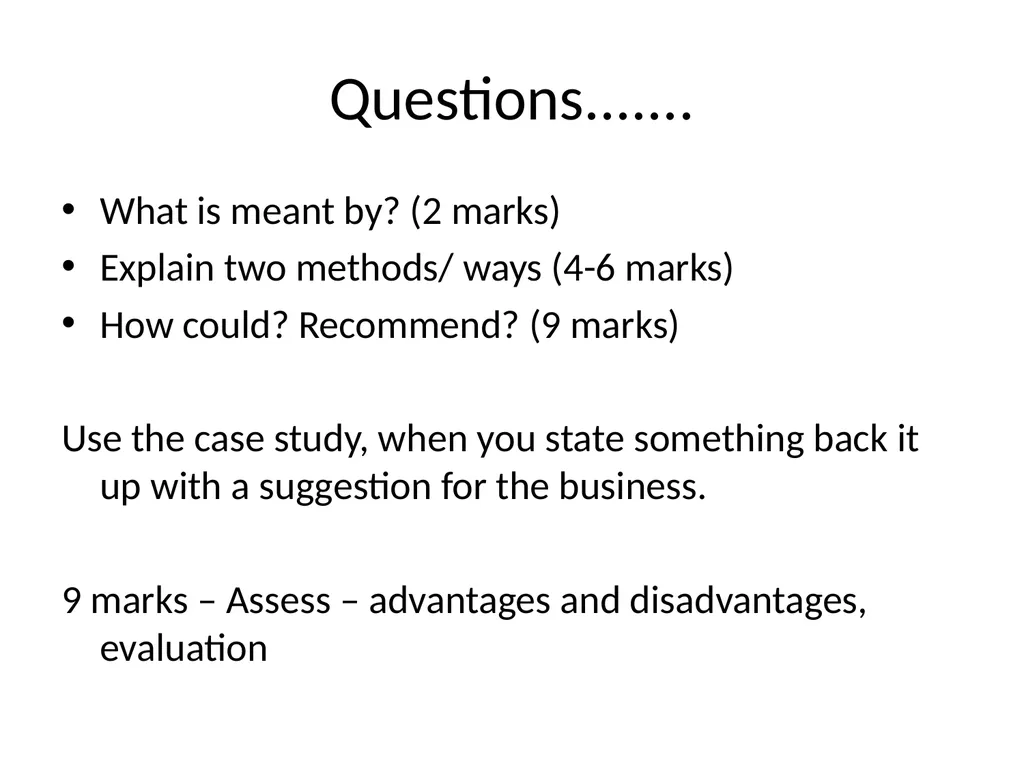
Unit 12 WARM UP Questions....... What is meant by? (2 marks) Explain two methods ways (4-6 marks) How could? Recommend? (9 marks) Use the case study, when you state something back it up with a suggestion for the business. 9 marks Assess
Related Topics
Share
Embed code
Download this presentation From Below
"Unit 1&2 WARM UP Questions....... What is meant" is the property of its rightful owner. Permission is granted to download and print the materials on this website for personal, non-commercial use only, and to display it on your personal computer provided you do not modify the materials and that you retain all copyright notices contained in the materials. By downloading content from our website, you accept the terms of this agreement.
Presentation Transcript
01
Unit 1&2
WARM UP<br>
02
Questions....... What is meant by? (2 marks)
Explain two methods/ ways (4-6 marks)
How could? Recommend? (9 marks)
Use the case study, when you state something back it up with a suggestion for the business.
9 marks – Assess – advantages and disadvantages, evaluation<br>
Explain two methods/ ways (4-6 marks)
How could? Recommend? (9 marks)
Use the case study, when you state something back it up with a suggestion for the business.
9 marks – Assess – advantages and disadvantages, evaluation<br>
03
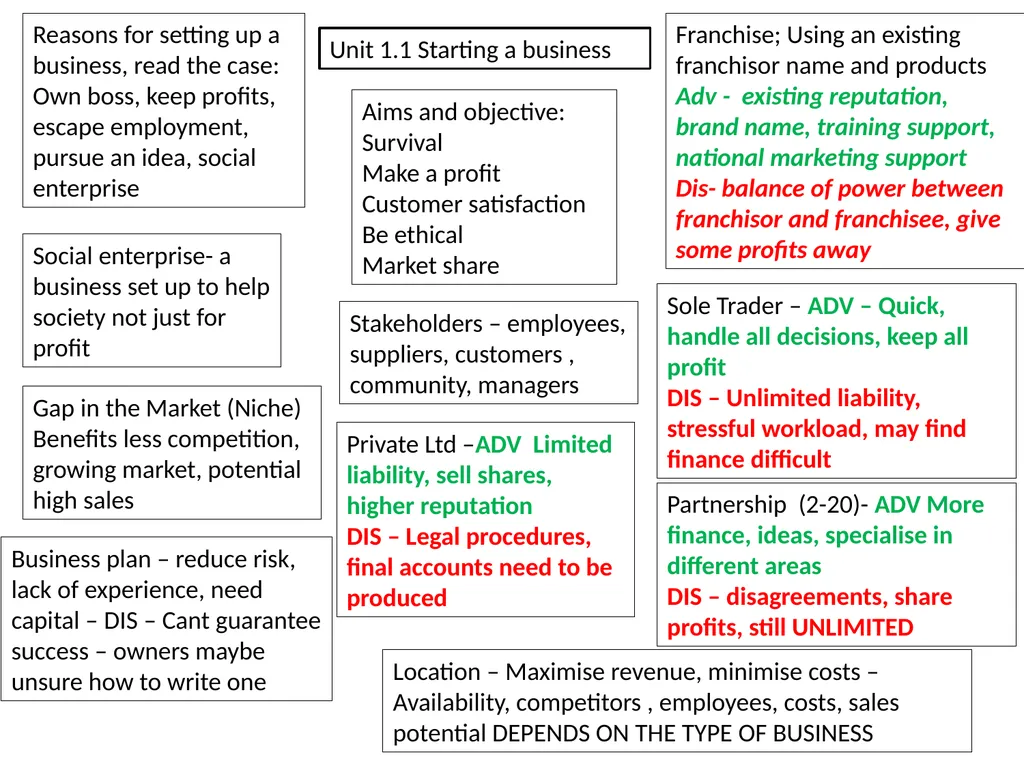
Unit 1.1 Starting a business Reasons for setting up a business, read the case:
Own boss, keep profits, escape employment, pursue an idea, social enterprise Social enterprise- a business set up to help society not just for profit Gap in the Market (Niche)
Benefits less competition, growing market, potential high sales Franchise; Using an existing franchisor name and products
Adv - existing reputation, brand name, training support, national marketing support
Dis- balance of power between franchisor and franchisee, give some profits away Aims and objective:
Survival
Make a profit
Customer satisfaction
Be ethical
Market share Stakeholders – employees, suppliers, customers , community, managers Business plan – reduce risk, lack of experience, need capital – DIS – Cant guarantee success – owners maybe unsure how to write one Sole Trader – ADV – Quick, handle all decisions, keep all profit
DIS – Unlimited liability, stressful workload, may find finance difficult Partnership (2-20)- ADV More finance, ideas, specialise in different areas
DIS – disagreements, share profits, still UNLIMITED Private Ltd –ADV Limited liability, sell shares, higher reputation
DIS – Legal procedures, final accounts need to be produced Location – Maximise revenue, minimise costs –
Availability, competitors , employees, costs, sales potential DEPENDS ON THE TYPE OF BUSINESS<br>
Own boss, keep profits, escape employment, pursue an idea, social enterprise Social enterprise- a business set up to help society not just for profit Gap in the Market (Niche)
Benefits less competition, growing market, potential high sales Franchise; Using an existing franchisor name and products
Adv - existing reputation, brand name, training support, national marketing support
Dis- balance of power between franchisor and franchisee, give some profits away Aims and objective:
Survival
Make a profit
Customer satisfaction
Be ethical
Market share Stakeholders – employees, suppliers, customers , community, managers Business plan – reduce risk, lack of experience, need capital – DIS – Cant guarantee success – owners maybe unsure how to write one Sole Trader – ADV – Quick, handle all decisions, keep all profit
DIS – Unlimited liability, stressful workload, may find finance difficult Partnership (2-20)- ADV More finance, ideas, specialise in different areas
DIS – disagreements, share profits, still UNLIMITED Private Ltd –ADV Limited liability, sell shares, higher reputation
DIS – Legal procedures, final accounts need to be produced Location – Maximise revenue, minimise costs –
Availability, competitors , employees, costs, sales potential DEPENDS ON THE TYPE OF BUSINESS<br>
04
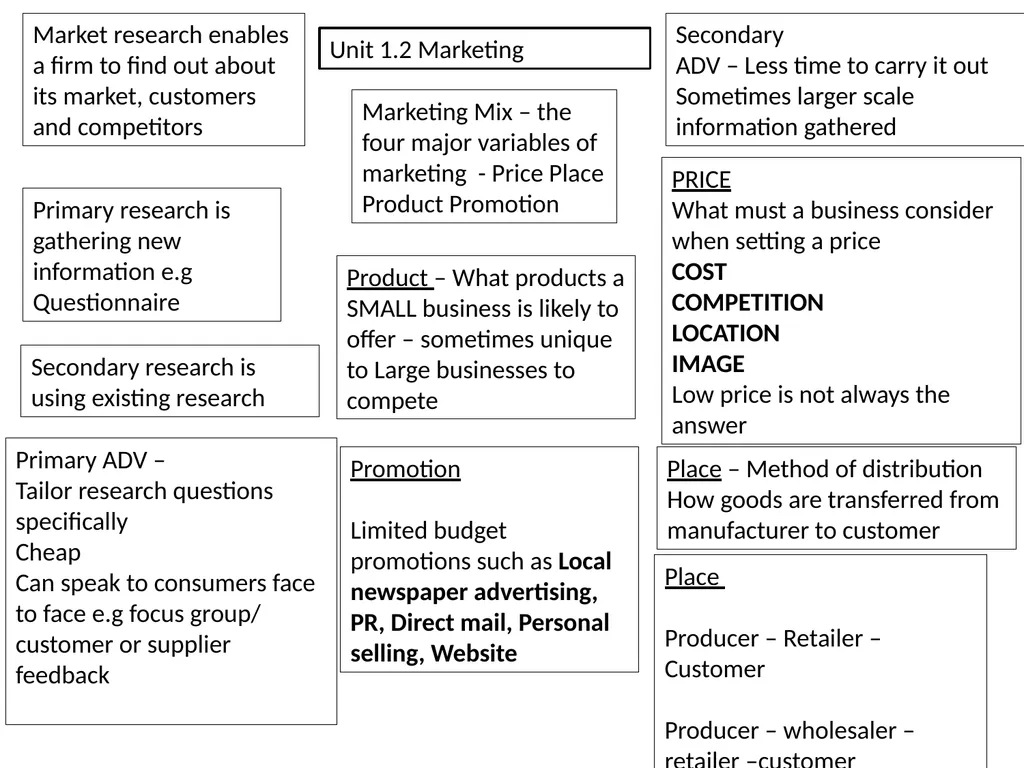
Unit 1.2 Marketing Market research enables a firm to find out about its market, customers and competitors Primary research is gathering new information e.g Questionnaire Secondary research is using existing research Secondary
ADV – Less time to carry it out
Sometimes larger scale information gathered Marketing Mix – the four major variables of marketing - Price Place Product Promotion Product – What products a SMALL business is likely to offer – sometimes unique to Large businesses to compete Primary ADV –
Tailor research questions specifically
Cheap
Can speak to consumers face to face e.g focus group/ customer or supplier feedback PRICE
What must a business consider when setting a price
COST
COMPETITION
LOCATION
IMAGE
Low price is not always the answer Place – Method of distribution
How goods are transferred from manufacturer to customer Promotion
Limited budget promotions such as Local newspaper advertising, PR, Direct mail, Personal selling, Website Place
Producer – Retailer – Customer
Producer – wholesaler – retailer –customer<br>
ADV – Less time to carry it out
Sometimes larger scale information gathered Marketing Mix – the four major variables of marketing - Price Place Product Promotion Product – What products a SMALL business is likely to offer – sometimes unique to Large businesses to compete Primary ADV –
Tailor research questions specifically
Cheap
Can speak to consumers face to face e.g focus group/ customer or supplier feedback PRICE
What must a business consider when setting a price
COST
COMPETITION
LOCATION
IMAGE
Low price is not always the answer Place – Method of distribution
How goods are transferred from manufacturer to customer Promotion
Limited budget promotions such as Local newspaper advertising, PR, Direct mail, Personal selling, Website Place
Producer – Retailer – Customer
Producer – wholesaler – retailer –customer<br>
05
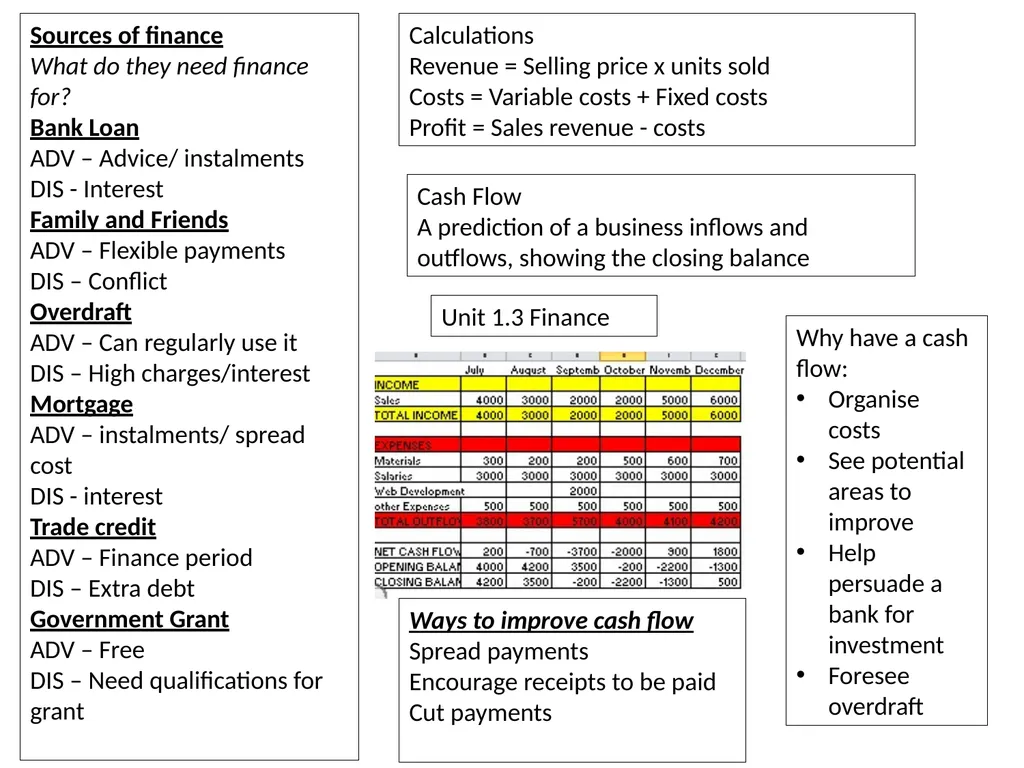
Unit 1.3 Finance Sources of finance
What do they need finance for?
Bank Loan
ADV – Advice/ instalments
DIS - Interest
Family and Friends
ADV – Flexible payments
DIS – Conflict
Overdraft
ADV – Can regularly use it
DIS – High charges/interest
Mortgage
ADV – instalments/ spread cost
DIS - interest
Trade credit
ADV – Finance period
DIS – Extra debt
Government Grant
ADV – Free
DIS – Need qualifications for grant Calculations
Revenue = Selling price x units sold
Costs = Variable costs + Fixed costs
Profit = Sales revenue - costs Cash Flow
A prediction of a business inflows and outflows, showing the closing balance Why have a cash flow:
Organise costs
See potential areas to improve
Help persuade a bank for investment
Foresee overdraft Ways to improve cash flow
Spread payments
Encourage receipts to be paid
Cut payments<br>
What do they need finance for?
Bank Loan
ADV – Advice/ instalments
DIS - Interest
Family and Friends
ADV – Flexible payments
DIS – Conflict
Overdraft
ADV – Can regularly use it
DIS – High charges/interest
Mortgage
ADV – instalments/ spread cost
DIS - interest
Trade credit
ADV – Finance period
DIS – Extra debt
Government Grant
ADV – Free
DIS – Need qualifications for grant Calculations
Revenue = Selling price x units sold
Costs = Variable costs + Fixed costs
Profit = Sales revenue - costs Cash Flow
A prediction of a business inflows and outflows, showing the closing balance Why have a cash flow:
Organise costs
See potential areas to improve
Help persuade a bank for investment
Foresee overdraft Ways to improve cash flow
Spread payments
Encourage receipts to be paid
Cut payments<br>
06
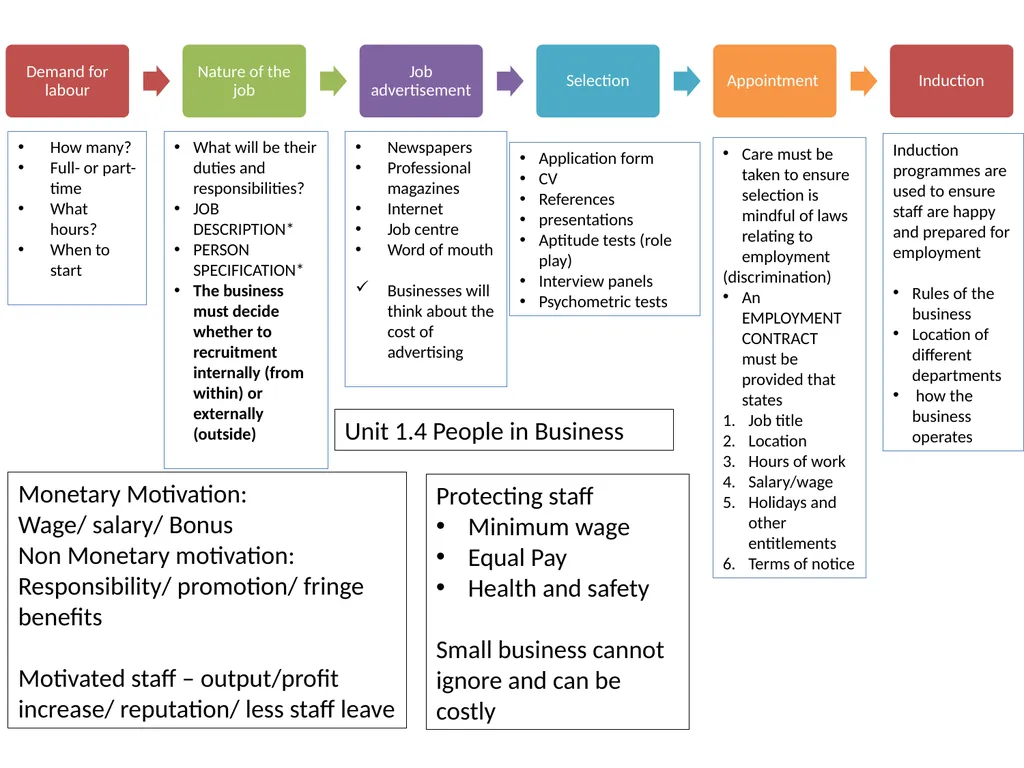
How many?
Full- or part-time
What hours?
When to start What will be their duties and responsibilities?
JOB DESCRIPTION*
PERSON SPECIFICATION*
The business must decide whether to recruitment internally (from within) or externally (outside) Newspapers
Professional magazines
Internet
Job centre
Word of mouth
Businesses will think about the cost of advertising Application form
CV
References
presentations
Aptitude tests (role play)
Interview panels
Psychometric tests Care must be taken to ensure selection is mindful of laws relating to employment
(discrimination)
An EMPLOYMENT CONTRACT must be provided that states
Job title
Location
Hours of work
Salary/wage
Holidays and other entitlements
Terms of notice Induction programmes are used to ensure staff are happy and prepared for employment
Rules of the business
Location of different departments
how the business operates Unit 1.4 People in Business Monetary Motivation:
Wage/ salary/ Bonus
Non Monetary motivation:
Responsibility/ promotion/ fringe benefits
Motivated staff – output/profit increase/ reputation/ less staff leave Protecting staff
Minimum wage
Equal Pay
Health and safety
Small business cannot ignore and can be costly<br>
Full- or part-time
What hours?
When to start What will be their duties and responsibilities?
JOB DESCRIPTION*
PERSON SPECIFICATION*
The business must decide whether to recruitment internally (from within) or externally (outside) Newspapers
Professional magazines
Internet
Job centre
Word of mouth
Businesses will think about the cost of advertising Application form
CV
References
presentations
Aptitude tests (role play)
Interview panels
Psychometric tests Care must be taken to ensure selection is mindful of laws relating to employment
(discrimination)
An EMPLOYMENT CONTRACT must be provided that states
Job title
Location
Hours of work
Salary/wage
Holidays and other entitlements
Terms of notice Induction programmes are used to ensure staff are happy and prepared for employment
Rules of the business
Location of different departments
how the business operates Unit 1.4 People in Business Monetary Motivation:
Wage/ salary/ Bonus
Non Monetary motivation:
Responsibility/ promotion/ fringe benefits
Motivated staff – output/profit increase/ reputation/ less staff leave Protecting staff
Minimum wage
Equal Pay
Health and safety
Small business cannot ignore and can be costly<br>
07
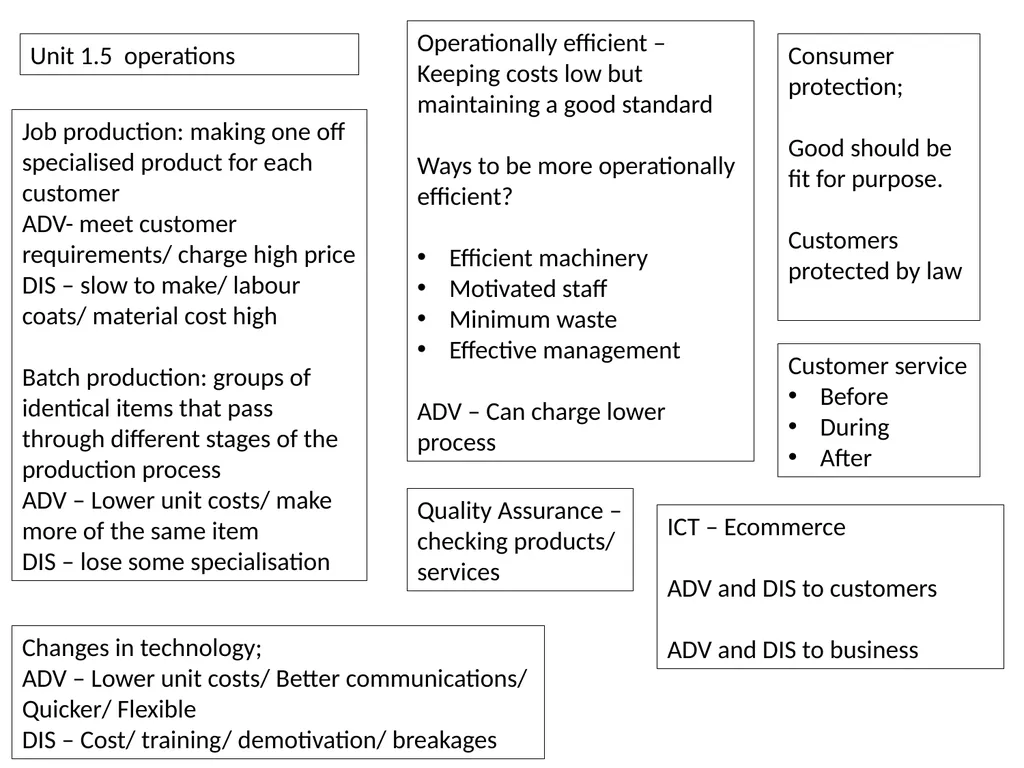
Unit 1.5 operations Job production: making one off specialised product for each customer
ADV- meet customer requirements/ charge high price
DIS – slow to make/ labour coats/ material cost high
Batch production: groups of identical items that pass through different stages of the production process
ADV – Lower unit costs/ make more of the same item
DIS – lose some specialisation Operationally efficient –
Keeping costs low but maintaining a good standard
Ways to be more operationally efficient?
Efficient machinery
Motivated staff
Minimum waste
Effective management
ADV – Can charge lower process Changes in technology;
ADV – Lower unit costs/ Better communications/ Quicker/ Flexible
DIS – Cost/ training/ demotivation/ breakages Quality Assurance – checking products/ services Customer service
Before
During
After Consumer protection;
Good should be fit for purpose.
Customers protected by law ICT – Ecommerce
ADV and DIS to customers
ADV and DIS to business<br>
ADV- meet customer requirements/ charge high price
DIS – slow to make/ labour coats/ material cost high
Batch production: groups of identical items that pass through different stages of the production process
ADV – Lower unit costs/ make more of the same item
DIS – lose some specialisation Operationally efficient –
Keeping costs low but maintaining a good standard
Ways to be more operationally efficient?
Efficient machinery
Motivated staff
Minimum waste
Effective management
ADV – Can charge lower process Changes in technology;
ADV – Lower unit costs/ Better communications/ Quicker/ Flexible
DIS – Cost/ training/ demotivation/ breakages Quality Assurance – checking products/ services Customer service
Before
During
After Consumer protection;
Good should be fit for purpose.
Customers protected by law ICT – Ecommerce
ADV and DIS to customers
ADV and DIS to business<br>
08
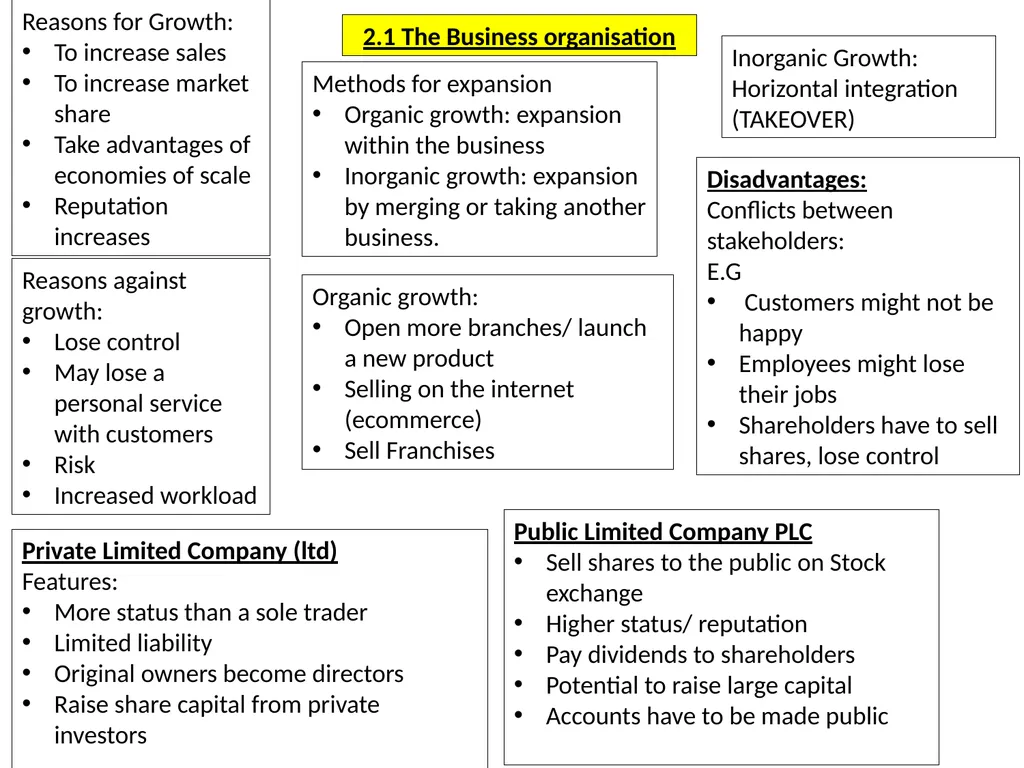
2.1 The Business organisation Reasons for Growth:
To increase sales
To increase market share
Take advantages of economies of scale
Reputation increases Reasons against growth:
Lose control
May lose a personal service with customers
Risk
Increased workload Methods for expansion
Organic growth: expansion within the business
Inorganic growth: expansion by merging or taking another business. Organic growth:
Open more branches/ launch a new product
Selling on the internet (ecommerce)
Sell Franchises Inorganic Growth:
Horizontal integration (TAKEOVER) Disadvantages:
Conflicts between stakeholders:
E.G
Customers might not be happy
Employees might lose their jobs
Shareholders have to sell shares, lose control Private Limited Company (ltd)
Features:
More status than a sole trader
Limited liability
Original owners become directors
Raise share capital from private investors Public Limited Company PLC
Sell shares to the public on Stock exchange
Higher status/ reputation
Pay dividends to shareholders
Potential to raise large capital
Accounts have to be made public<br>
To increase sales
To increase market share
Take advantages of economies of scale
Reputation increases Reasons against growth:
Lose control
May lose a personal service with customers
Risk
Increased workload Methods for expansion
Organic growth: expansion within the business
Inorganic growth: expansion by merging or taking another business. Organic growth:
Open more branches/ launch a new product
Selling on the internet (ecommerce)
Sell Franchises Inorganic Growth:
Horizontal integration (TAKEOVER) Disadvantages:
Conflicts between stakeholders:
E.G
Customers might not be happy
Employees might lose their jobs
Shareholders have to sell shares, lose control Private Limited Company (ltd)
Features:
More status than a sole trader
Limited liability
Original owners become directors
Raise share capital from private investors Public Limited Company PLC
Sell shares to the public on Stock exchange
Higher status/ reputation
Pay dividends to shareholders
Potential to raise large capital
Accounts have to be made public<br>
09
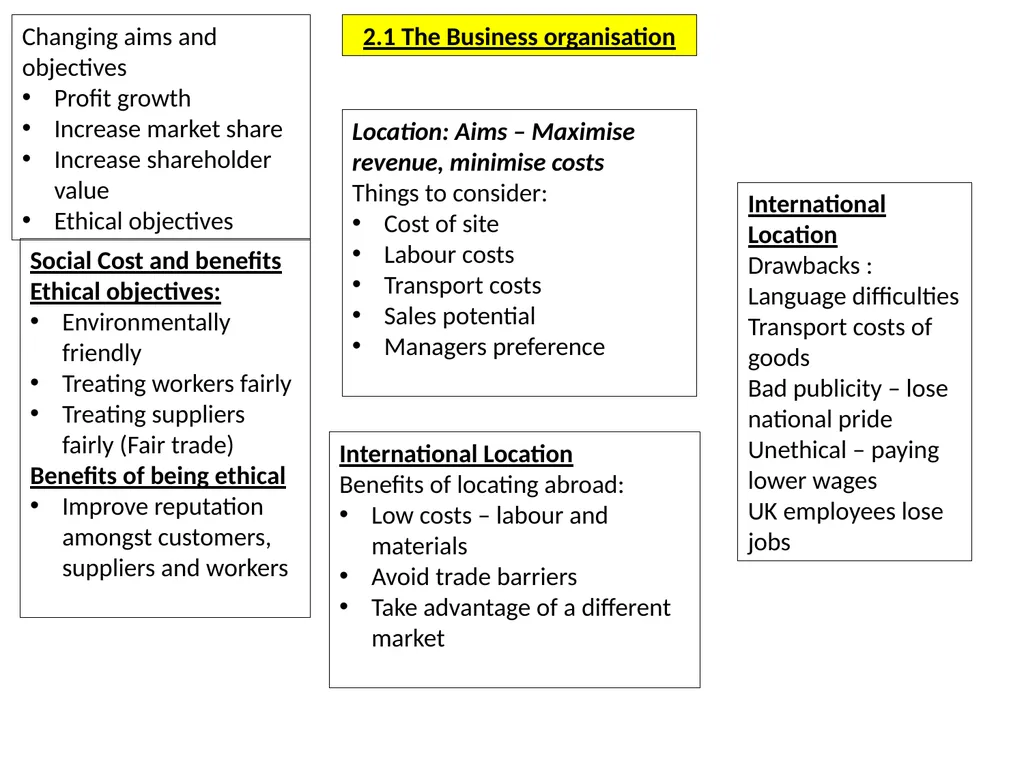
2.1 The Business organisation Changing aims and objectives
Profit growth
Increase market share
Increase shareholder value
Ethical objectives Social Cost and benefits
Ethical objectives:
Environmentally friendly
Treating workers fairly
Treating suppliers fairly (Fair trade)
Benefits of being ethical
Improve reputation amongst customers, suppliers and workers Location: Aims – Maximise revenue, minimise costs
Things to consider:
Cost of site
Labour costs
Transport costs
Sales potential
Managers preference International Location
Benefits of locating abroad:
Low costs – labour and materials
Avoid trade barriers
Take advantage of a different market International Location
Drawbacks :
Language difficulties
Transport costs of goods
Bad publicity – lose national pride
Unethical – paying lower wages
UK employees lose jobs<br>
Profit growth
Increase market share
Increase shareholder value
Ethical objectives Social Cost and benefits
Ethical objectives:
Environmentally friendly
Treating workers fairly
Treating suppliers fairly (Fair trade)
Benefits of being ethical
Improve reputation amongst customers, suppliers and workers Location: Aims – Maximise revenue, minimise costs
Things to consider:
Cost of site
Labour costs
Transport costs
Sales potential
Managers preference International Location
Benefits of locating abroad:
Low costs – labour and materials
Avoid trade barriers
Take advantage of a different market International Location
Drawbacks :
Language difficulties
Transport costs of goods
Bad publicity – lose national pride
Unethical – paying lower wages
UK employees lose jobs<br>
10
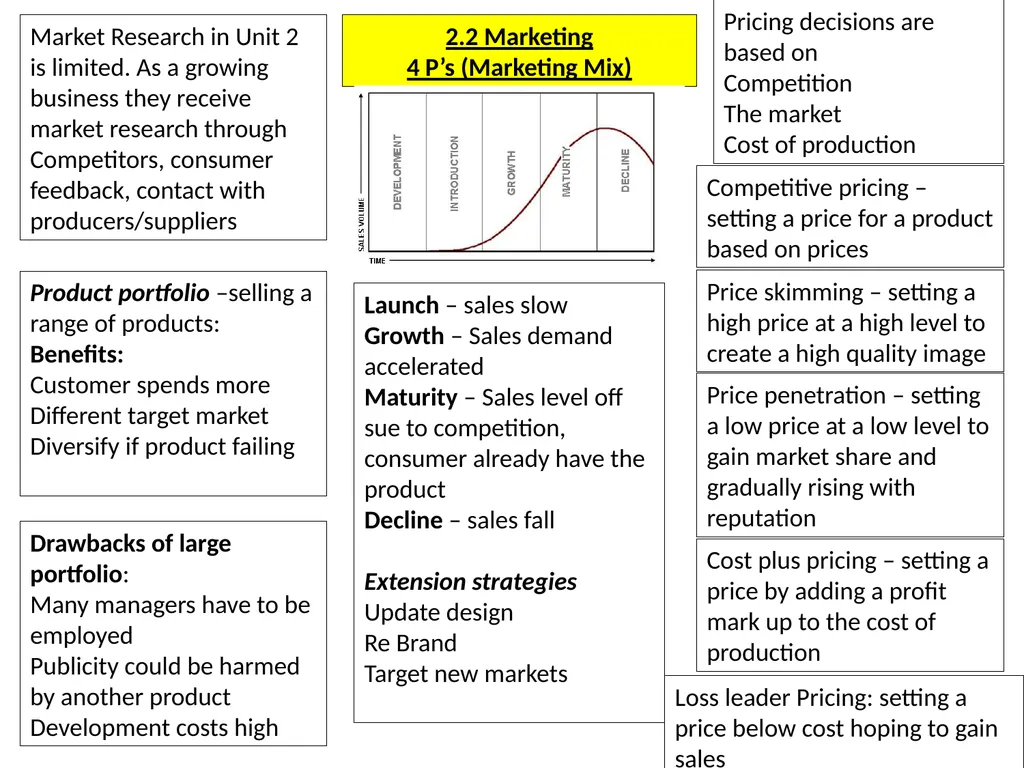
2.2 Marketing
4 P’s (Marketing Mix) Market Research in Unit 2 is limited. As a growing business they receive market research through Competitors, consumer feedback, contact with producers/suppliers Product portfolio –selling a range of products:
Benefits:
Customer spends more
Different target market
Diversify if product failing Drawbacks of large portfolio:
Many managers have to be employed
Publicity could be harmed by another product
Development costs high Launch – sales slow
Growth – Sales demand accelerated
Maturity – Sales level off sue to competition, consumer already have the product
Decline – sales fall
Extension strategies
Update design
Re Brand
Target new markets Pricing decisions are based on
Competition
The market
Cost of production Competitive pricing – setting a price for a product based on prices Price skimming – setting a high price at a high level to create a high quality image Price penetration – setting a low price at a low level to gain market share and gradually rising with reputation Cost plus pricing – setting a price by adding a profit mark up to the cost of production Loss leader Pricing: setting a price below cost hoping to gain sales<br>
4 P’s (Marketing Mix) Market Research in Unit 2 is limited. As a growing business they receive market research through Competitors, consumer feedback, contact with producers/suppliers Product portfolio –selling a range of products:
Benefits:
Customer spends more
Different target market
Diversify if product failing Drawbacks of large portfolio:
Many managers have to be employed
Publicity could be harmed by another product
Development costs high Launch – sales slow
Growth – Sales demand accelerated
Maturity – Sales level off sue to competition, consumer already have the product
Decline – sales fall
Extension strategies
Update design
Re Brand
Target new markets Pricing decisions are based on
Competition
The market
Cost of production Competitive pricing – setting a price for a product based on prices Price skimming – setting a high price at a high level to create a high quality image Price penetration – setting a low price at a low level to gain market share and gradually rising with reputation Cost plus pricing – setting a price by adding a profit mark up to the cost of production Loss leader Pricing: setting a price below cost hoping to gain sales<br>
11
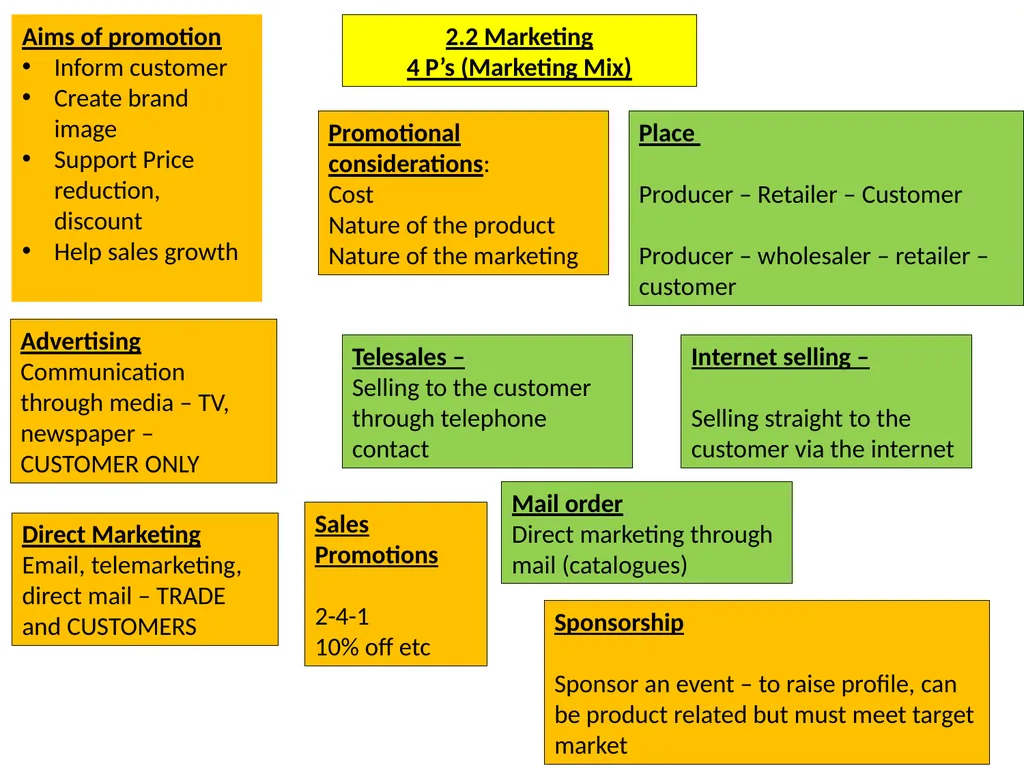
2.2 Marketing
4 P’s (Marketing Mix) Aims of promotion
Inform customer
Create brand image
Support Price reduction, discount
Help sales growth Advertising
Communication through media – TV, newspaper – CUSTOMER ONLY Direct Marketing
Email, telemarketing, direct mail – TRADE and CUSTOMERS Promotional considerations:
Cost
Nature of the product
Nature of the marketing Place
Producer – Retailer – Customer
Producer – wholesaler – retailer –customer Telesales –
Selling to the customer through telephone contact Internet selling –
Selling straight to the customer via the internet Mail order
Direct marketing through mail (catalogues) Sales Promotions
2-4-1
10% off etc Sponsorship
Sponsor an event – to raise profile, can be product related but must meet target market<br>
4 P’s (Marketing Mix) Aims of promotion
Inform customer
Create brand image
Support Price reduction, discount
Help sales growth Advertising
Communication through media – TV, newspaper – CUSTOMER ONLY Direct Marketing
Email, telemarketing, direct mail – TRADE and CUSTOMERS Promotional considerations:
Cost
Nature of the product
Nature of the marketing Place
Producer – Retailer – Customer
Producer – wholesaler – retailer –customer Telesales –
Selling to the customer through telephone contact Internet selling –
Selling straight to the customer via the internet Mail order
Direct marketing through mail (catalogues) Sales Promotions
2-4-1
10% off etc Sponsorship
Sponsor an event – to raise profile, can be product related but must meet target market<br>
12
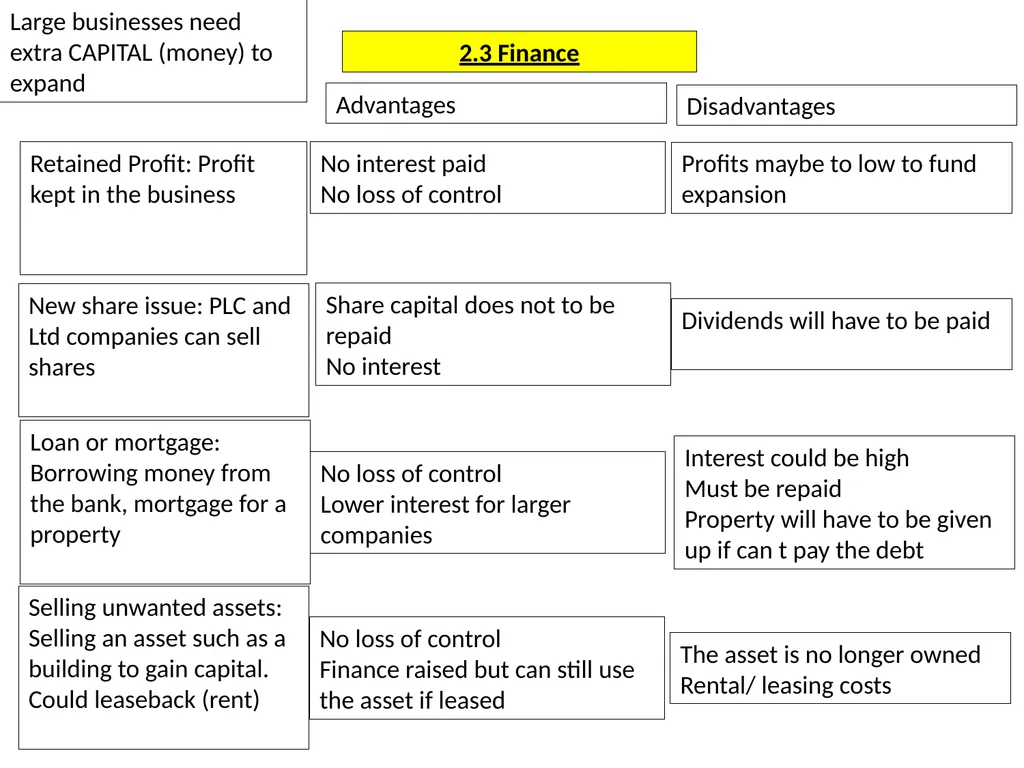
Large businesses need extra CAPITAL (money) to expand Retained Profit: Profit kept in the business New share issue: PLC and Ltd companies can sell shares Loan or mortgage:
Borrowing money from the bank, mortgage for a property Selling unwanted assets:
Selling an asset such as a building to gain capital. Could leaseback (rent) 2.3 Finance No interest paid
No loss of control Share capital does not to be repaid
No interest No loss of control
Lower interest for larger companies No loss of control
Finance raised but can still use the asset if leased Profits maybe to low to fund expansion Dividends will have to be paid Interest could be high
Must be repaid
Property will have to be given up if can t pay the debt The asset is no longer owned
Rental/ leasing costs Advantages Disadvantages<br>
Borrowing money from the bank, mortgage for a property Selling unwanted assets:
Selling an asset such as a building to gain capital. Could leaseback (rent) 2.3 Finance No interest paid
No loss of control Share capital does not to be repaid
No interest No loss of control
Lower interest for larger companies No loss of control
Finance raised but can still use the asset if leased Profits maybe to low to fund expansion Dividends will have to be paid Interest could be high
Must be repaid
Property will have to be given up if can t pay the debt The asset is no longer owned
Rental/ leasing costs Advantages Disadvantages<br>
13
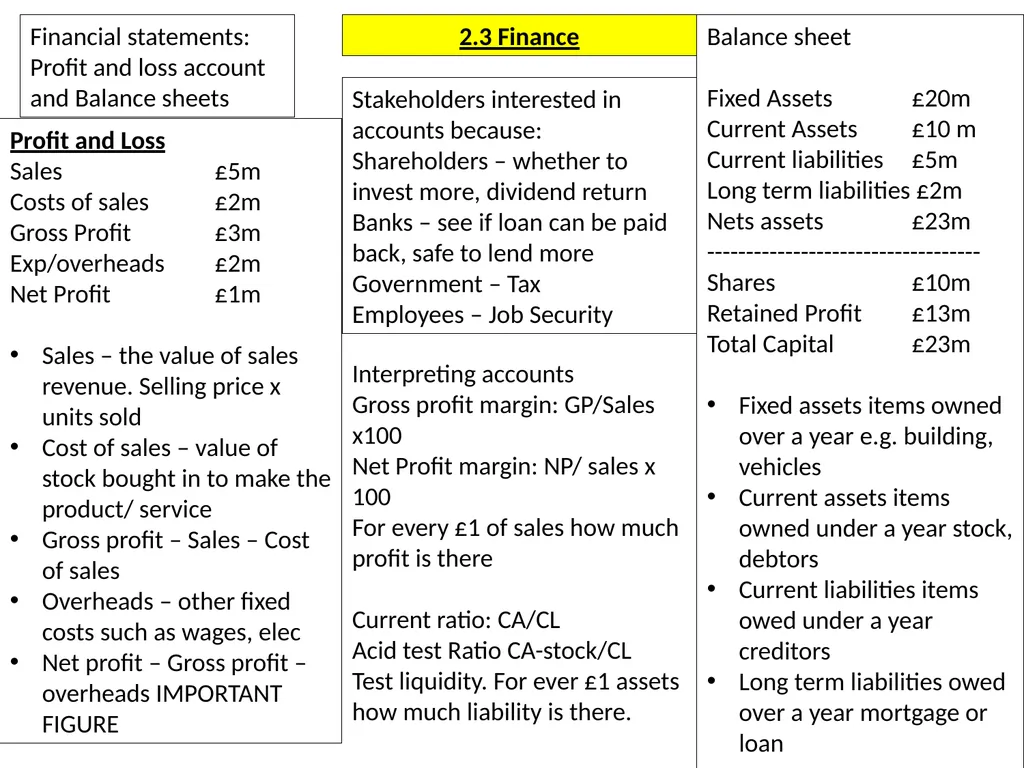
2.3 Finance Financial statements:
Profit and loss account and Balance sheets Stakeholders interested in accounts because:
Shareholders – whether to invest more, dividend return
Banks – see if loan can be paid back, safe to lend more
Government – Tax
Employees – Job Security Profit and Loss
Sales £5m
Costs of sales £2m
Gross Profit £3m
Exp/overheads £2m
Net Profit £1m
Sales – the value of sales revenue. Selling price x units sold
Cost of sales – value of stock bought in to make the product/ service
Gross profit – Sales – Cost of sales
Overheads – other fixed costs such as wages, elec
Net profit – Gross profit – overheads IMPORTANT FIGURE Balance sheet
Fixed Assets £20m
Current Assets £10 m
Current liabilities £5m
Long term liabilities £2m
Nets assets £23m
-----------------------------------
Shares £10m
Retained Profit £13m
Total Capital £23m
Fixed assets items owned over a year e.g. building, vehicles
Current assets items owned under a year stock, debtors
Current liabilities items owed under a year creditors
Long term liabilities owed over a year mortgage or loan Interpreting accounts
Gross profit margin: GP/Sales x100
Net Profit margin: NP/ sales x 100
For every £1 of sales how much profit is there
Current ratio: CA/CL
Acid test Ratio CA-stock/CL
Test liquidity. For ever £1 assets how much liability is there.<br>
Profit and loss account and Balance sheets Stakeholders interested in accounts because:
Shareholders – whether to invest more, dividend return
Banks – see if loan can be paid back, safe to lend more
Government – Tax
Employees – Job Security Profit and Loss
Sales £5m
Costs of sales £2m
Gross Profit £3m
Exp/overheads £2m
Net Profit £1m
Sales – the value of sales revenue. Selling price x units sold
Cost of sales – value of stock bought in to make the product/ service
Gross profit – Sales – Cost of sales
Overheads – other fixed costs such as wages, elec
Net profit – Gross profit – overheads IMPORTANT FIGURE Balance sheet
Fixed Assets £20m
Current Assets £10 m
Current liabilities £5m
Long term liabilities £2m
Nets assets £23m
-----------------------------------
Shares £10m
Retained Profit £13m
Total Capital £23m
Fixed assets items owned over a year e.g. building, vehicles
Current assets items owned under a year stock, debtors
Current liabilities items owed under a year creditors
Long term liabilities owed over a year mortgage or loan Interpreting accounts
Gross profit margin: GP/Sales x100
Net Profit margin: NP/ sales x 100
For every £1 of sales how much profit is there
Current ratio: CA/CL
Acid test Ratio CA-stock/CL
Test liquidity. For ever £1 assets how much liability is there.<br>
14
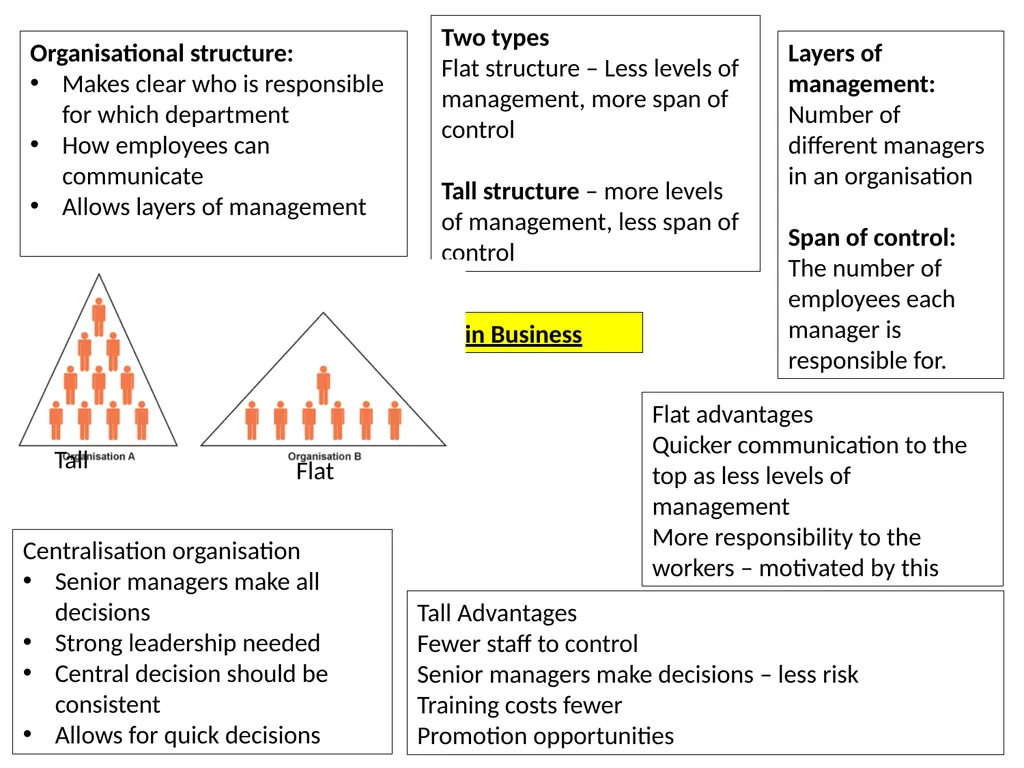
2.4 People in Business Organisational structure:
Makes clear who is responsible for which department
How employees can communicate
Allows layers of management Two types
Flat structure – Less levels of management, more span of control
Tall structure – more levels of management, less span of control Layers of management:
Number of different managers in an organisation
Span of control:
The number of employees each manager is responsible for. Flat advantages
Quicker communication to the top as less levels of management
More responsibility to the workers – motivated by this Tall Advantages
Fewer staff to control
Senior managers make decisions – less risk
Training costs fewer
Promotion opportunities Tall Flat Centralisation organisation
Senior managers make all decisions
Strong leadership needed
Central decision should be consistent
Allows for quick decisions<br>
Makes clear who is responsible for which department
How employees can communicate
Allows layers of management Two types
Flat structure – Less levels of management, more span of control
Tall structure – more levels of management, less span of control Layers of management:
Number of different managers in an organisation
Span of control:
The number of employees each manager is responsible for. Flat advantages
Quicker communication to the top as less levels of management
More responsibility to the workers – motivated by this Tall Advantages
Fewer staff to control
Senior managers make decisions – less risk
Training costs fewer
Promotion opportunities Tall Flat Centralisation organisation
Senior managers make all decisions
Strong leadership needed
Central decision should be consistent
Allows for quick decisions<br>
15
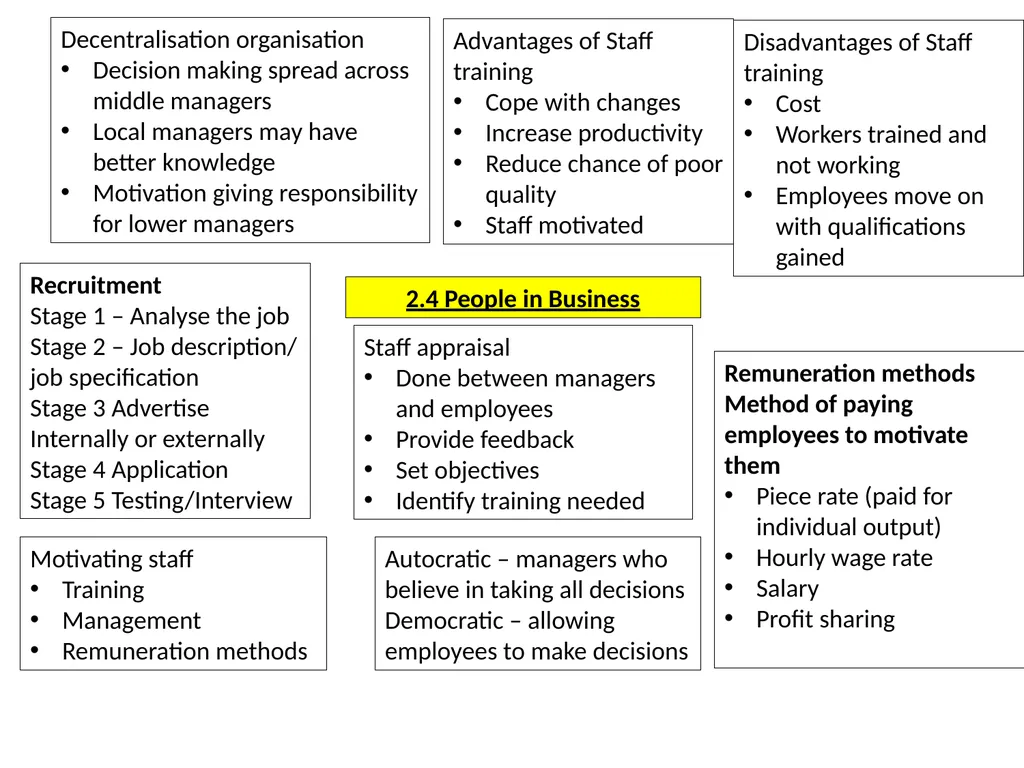
2.4 People in Business Decentralisation organisation
Decision making spread across middle managers
Local managers may have better knowledge
Motivation giving responsibility for lower managers Recruitment
Stage 1 – Analyse the job
Stage 2 – Job description/ job specification
Stage 3 Advertise Internally or externally
Stage 4 Application
Stage 5 Testing/Interview Advantages of Staff training
Cope with changes
Increase productivity
Reduce chance of poor quality
Staff motivated Disadvantages of Staff training
Cost
Workers trained and not working
Employees move on with qualifications gained Staff appraisal
Done between managers and employees
Provide feedback
Set objectives
Identify training needed Motivating staff
Training
Management
Remuneration methods Autocratic – managers who believe in taking all decisions
Democratic – allowing employees to make decisions Remuneration methods
Method of paying employees to motivate them
Piece rate (paid for individual output)
Hourly wage rate
Salary
Profit sharing<br>
Decision making spread across middle managers
Local managers may have better knowledge
Motivation giving responsibility for lower managers Recruitment
Stage 1 – Analyse the job
Stage 2 – Job description/ job specification
Stage 3 Advertise Internally or externally
Stage 4 Application
Stage 5 Testing/Interview Advantages of Staff training
Cope with changes
Increase productivity
Reduce chance of poor quality
Staff motivated Disadvantages of Staff training
Cost
Workers trained and not working
Employees move on with qualifications gained Staff appraisal
Done between managers and employees
Provide feedback
Set objectives
Identify training needed Motivating staff
Training
Management
Remuneration methods Autocratic – managers who believe in taking all decisions
Democratic – allowing employees to make decisions Remuneration methods
Method of paying employees to motivate them
Piece rate (paid for individual output)
Hourly wage rate
Salary
Profit sharing<br>
16
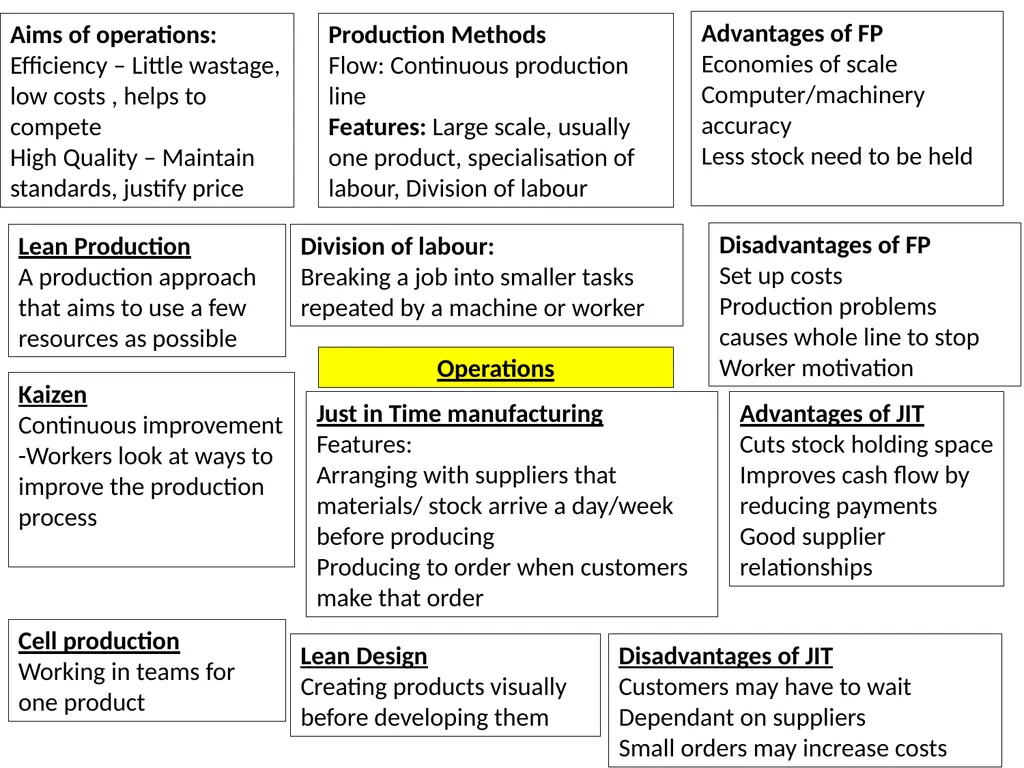
Operations Aims of operations:
Efficiency – Little wastage, low costs , helps to compete
High Quality – Maintain standards, justify price Production Methods
Flow: Continuous production line
Features: Large scale, usually one product, specialisation of labour, Division of labour Division of labour:
Breaking a job into smaller tasks repeated by a machine or worker Advantages of FP
Economies of scale
Computer/machinery accuracy
Less stock need to be held Disadvantages of FP
Set up costs
Production problems causes whole line to stop
Worker motivation Lean Production
A production approach that aims to use a few resources as possible Kaizen
Continuous improvement
-Workers look at ways to improve the production process Just in Time manufacturing
Features:
Arranging with suppliers that materials/ stock arrive a day/week before producing
Producing to order when customers make that order Advantages of JIT
Cuts stock holding space
Improves cash flow by reducing payments
Good supplier relationships Disadvantages of JIT
Customers may have to wait
Dependant on suppliers
Small orders may increase costs Lean Design
Creating products visually before developing them Cell production
Working in teams for one product<br>
Efficiency – Little wastage, low costs , helps to compete
High Quality – Maintain standards, justify price Production Methods
Flow: Continuous production line
Features: Large scale, usually one product, specialisation of labour, Division of labour Division of labour:
Breaking a job into smaller tasks repeated by a machine or worker Advantages of FP
Economies of scale
Computer/machinery accuracy
Less stock need to be held Disadvantages of FP
Set up costs
Production problems causes whole line to stop
Worker motivation Lean Production
A production approach that aims to use a few resources as possible Kaizen
Continuous improvement
-Workers look at ways to improve the production process Just in Time manufacturing
Features:
Arranging with suppliers that materials/ stock arrive a day/week before producing
Producing to order when customers make that order Advantages of JIT
Cuts stock holding space
Improves cash flow by reducing payments
Good supplier relationships Disadvantages of JIT
Customers may have to wait
Dependant on suppliers
Small orders may increase costs Lean Design
Creating products visually before developing them Cell production
Working in teams for one product<br>
17
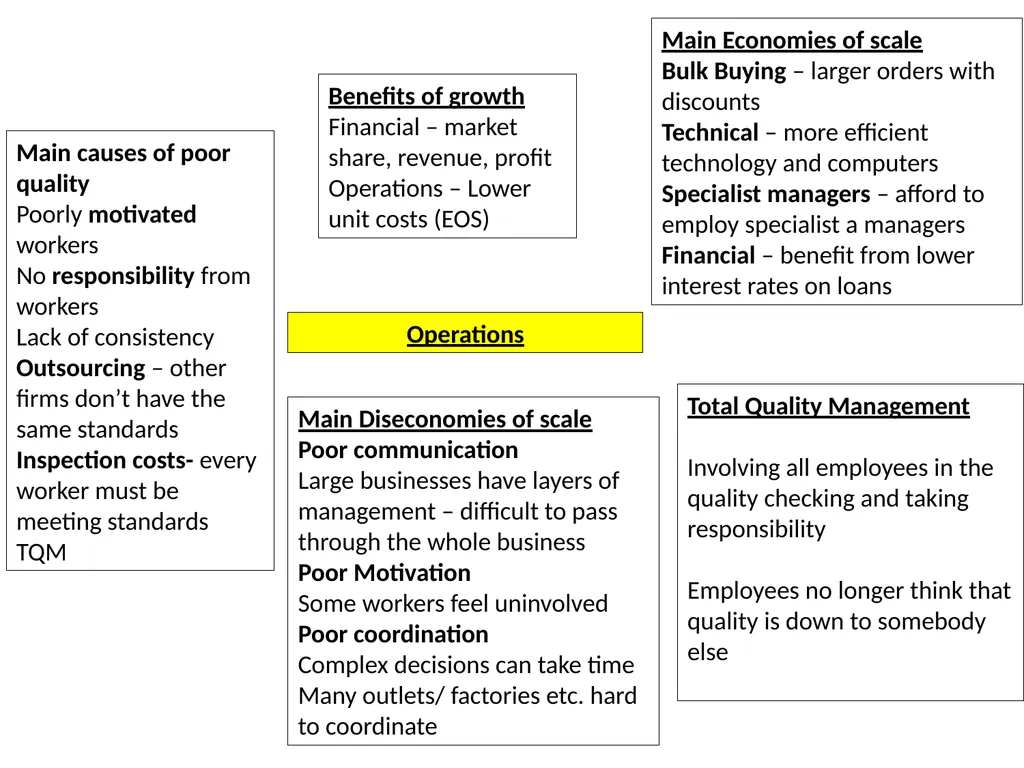
Operations Benefits of growth
Financial – market share, revenue, profit
Operations – Lower unit costs (EOS) Main Economies of scale
Bulk Buying – larger orders with discounts
Technical – more efficient technology and computers
Specialist managers – afford to employ specialist a managers
Financial – benefit from lower interest rates on loans Main Diseconomies of scale
Poor communication
Large businesses have layers of management – difficult to pass through the whole business
Poor Motivation
Some workers feel uninvolved
Poor coordination
Complex decisions can take time
Many outlets/ factories etc. hard to coordinate Main causes of poor quality
Poorly motivated workers
No responsibility from workers
Lack of consistency
Outsourcing – other firms don’t have the same standards
Inspection costs- every worker must be meeting standards TQM Total Quality Management
Involving all employees in the quality checking and taking responsibility
Employees no longer think that quality is down to somebody else<br>
Financial – market share, revenue, profit
Operations – Lower unit costs (EOS) Main Economies of scale
Bulk Buying – larger orders with discounts
Technical – more efficient technology and computers
Specialist managers – afford to employ specialist a managers
Financial – benefit from lower interest rates on loans Main Diseconomies of scale
Poor communication
Large businesses have layers of management – difficult to pass through the whole business
Poor Motivation
Some workers feel uninvolved
Poor coordination
Complex decisions can take time
Many outlets/ factories etc. hard to coordinate Main causes of poor quality
Poorly motivated workers
No responsibility from workers
Lack of consistency
Outsourcing – other firms don’t have the same standards
Inspection costs- every worker must be meeting standards TQM Total Quality Management
Involving all employees in the quality checking and taking responsibility
Employees no longer think that quality is down to somebody else<br>