
Unit 1-Product Session 3 –Managing Product Life
CM
Published · 21 slides · 0 views
1 / 1
Description
Unit 1-Product Session 3 Managing Product Life Cycle 2. Growth Stage: Sucessful product launched Repeated purchase Unit 1-Product Session 3 Managing Product Life Cycle It is characterized by Reduced costs because of economies of scale.
Related Topics
Share
Embed code
Download this presentation From Below
"Unit 1-Product Session 3 –Managing Product Life" is the property of its rightful owner. Permission is granted to download and print the materials on this website for personal, non-commercial use only, and to display it on your personal computer provided you do not modify the materials and that you retain all copyright notices contained in the materials. By downloading content from our website, you accept the terms of this agreement.
Presentation Transcript
01
Unit 1-Product
Session 3 –Managing Product Life Cycle 2. Growth Stage:
Sucessful product launched
Repeated purchase<br>
Sucessful product launched
Repeated purchase<br>
02
Unit 1-Product
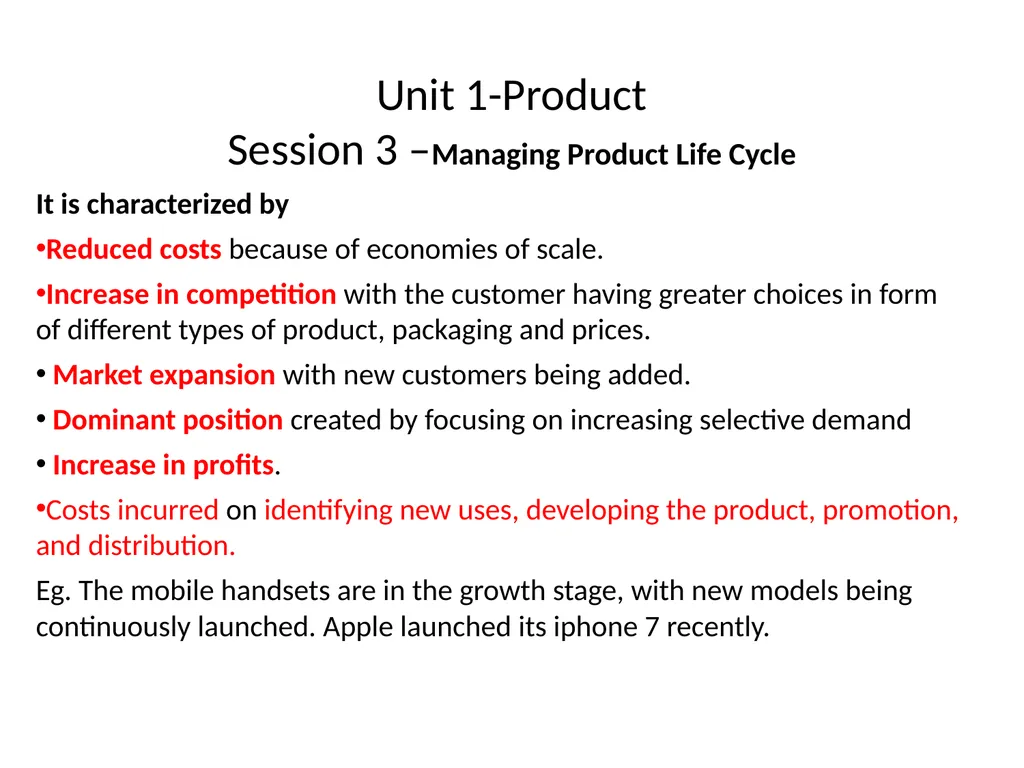
Session 3 –Managing Product Life Cycle It is characterized by
Reduced costs because of economies of scale.
Increase in competition with the customer having greater choices in form of different types of product, packaging and prices.
Market expansion with new customers being added.
Dominant position created by focusing on increasing selective demand
Increase in profits.
Costs incurred on identifying new uses, developing the product, promotion, and distribution.
Eg. The mobile handsets are in the growth stage, with new models being continuously launched. Apple launched its iphone 7 recently.<br>
Reduced costs because of economies of scale.
Increase in competition with the customer having greater choices in form of different types of product, packaging and prices.
Market expansion with new customers being added.
Dominant position created by focusing on increasing selective demand
Increase in profits.
Costs incurred on identifying new uses, developing the product, promotion, and distribution.
Eg. The mobile handsets are in the growth stage, with new models being continuously launched. Apple launched its iphone 7 recently.<br>
03
Unit 1-Product
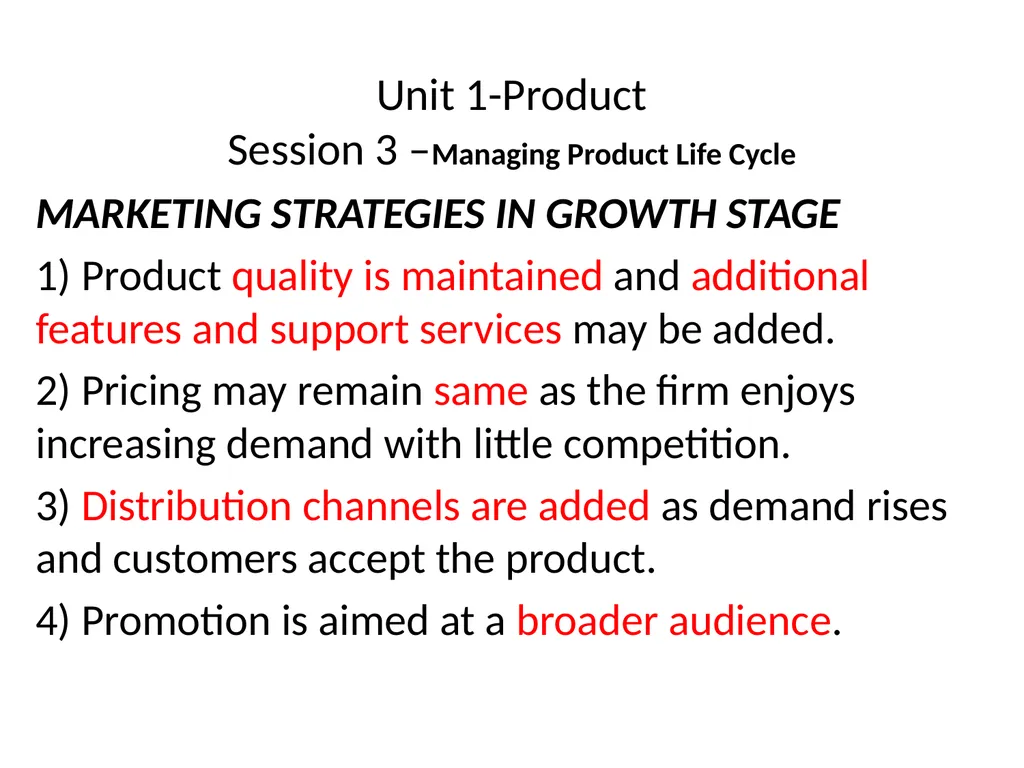
Session 3 –Managing Product Life Cycle MARKETING STRATEGIES IN GROWTH STAGE
1) Product quality is maintained and additional features and support services may be added.
2) Pricing may remain same as the firm enjoys increasing demand with little competition.
3) Distribution channels are added as demand rises and customers accept the product.
4) Promotion is aimed at a broader audience.<br>
1) Product quality is maintained and additional features and support services may be added.
2) Pricing may remain same as the firm enjoys increasing demand with little competition.
3) Distribution channels are added as demand rises and customers accept the product.
4) Promotion is aimed at a broader audience.<br>
04
Unit 1-Product
Session 3 –Managing Product Life Cycle 3. Maturity Stage:
Withstand the heat of competition(including middlemen)
Role of Product manager(niche market, service increase, image marketing, new value market)<br>
Withstand the heat of competition(including middlemen)
Role of Product manager(niche market, service increase, image marketing, new value market)<br>
05
Unit 1-Product
Session 3 –Managing Product Life Cycle It is characterized by
Costs would be decreased as a result of increase in production volumes
The Sales volumes peak and market saturation is visible.
Competitors entering the market increase
There is drop in prices due to entry of competing products
Advertising spend incurred on brand differentiation
Product feature diversification is emphasized to maintain or enhance market share.
The industrial profits decrease during this period.<br>
Costs would be decreased as a result of increase in production volumes
The Sales volumes peak and market saturation is visible.
Competitors entering the market increase
There is drop in prices due to entry of competing products
Advertising spend incurred on brand differentiation
Product feature diversification is emphasized to maintain or enhance market share.
The industrial profits decrease during this period.<br>
06
Unit 1-Product
Session 3 –Managing Product Life Cycle MARKETING STRATEGIES IN MATURITY STAGE
1. Product managers have to play a vital role for carving a niche within a specific market segment through enhanced service, image marketing and by creating new value image
and strengthening through repositioning.
2. They should also consider modifying the market, product and marketing mix to fight competition and take it closer to the customer so as to register adequate profits to remain
in the business<br>
1. Product managers have to play a vital role for carving a niche within a specific market segment through enhanced service, image marketing and by creating new value image
and strengthening through repositioning.
2. They should also consider modifying the market, product and marketing mix to fight competition and take it closer to the customer so as to register adequate profits to remain
in the business<br>
07
Unit 1-Product
Session 3 –Managing Product Life Cycle 4. Decline Stage:
Customers preferences changed
Sales and profits decline
Reposition the product<br>
Customers preferences changed
Sales and profits decline
Reposition the product<br>
08
Unit 1-Product
Session 3 –Managing Product Life Cycle MARKETING STRATEGIES IN DECLINE STAGE
1. The product can be maintained by either by adding new features or finding new uses.
2. The costs can be reduced and it can be offered to loyal segment.
3. The product can be discontinued or sold to another firm that is willing to continue the
product.<br>
1. The product can be maintained by either by adding new features or finding new uses.
2. The costs can be reduced and it can be offered to loyal segment.
3. The product can be discontinued or sold to another firm that is willing to continue the
product.<br>
09
Unit 1-Product
Session 3 –Managing Product Life Cycle Question: The PLC depicts a product’s sales history through various stages. Accordingly,
adjustments and modifications need to be made because of changes in the environment, composition of the market. Justify the statements with the help of a suitable example.<br>
adjustments and modifications need to be made because of changes in the environment, composition of the market. Justify the statements with the help of a suitable example.<br>
10
Unit 1-Product
Session 3 –Managing Product Life Cycle<br>
11
Unit 1-Product
Session 3 –Managing Product Life Cycle<br>
12
Unit 1-Product
Session 4 –Packaging and Labelling Q. Packaging is considered as the 5th P of Marketing Mix. What are its implications on the
PLC? Discuss.
Ans. Packaging refers to the process of developing and designing the container for a product. It enables differentiation and identification of a product from other products and it acts as a promotional tool. The use of colors, pictures, symbols in packaging helps in attracting the customers. For e.g shampoo is always in an airtight bottle or container so that it is easy to handle.
Implications: 1) It conveys descriptive and persuasive information. 2) It gives assistance related to the home storage of products. 3) It describes the features of the product. 4) Unique and innovative packaging gives benefit to both consumers and producers. 5) It shows the company logo which defines the company.<br>
PLC? Discuss.
Ans. Packaging refers to the process of developing and designing the container for a product. It enables differentiation and identification of a product from other products and it acts as a promotional tool. The use of colors, pictures, symbols in packaging helps in attracting the customers. For e.g shampoo is always in an airtight bottle or container so that it is easy to handle.
Implications: 1) It conveys descriptive and persuasive information. 2) It gives assistance related to the home storage of products. 3) It describes the features of the product. 4) Unique and innovative packaging gives benefit to both consumers and producers. 5) It shows the company logo which defines the company.<br>
13
Unit 1-Product
Session 4 –Packaging and Labelling Q. Discuss the importance of packaging as a tool for product differentiation and market cultivation.
Ans. 1. Importance of packaging as a tool for product differentiation:
Packaging can differentiate one brand of product from another brand. Because the product packaging can contain company names, logos and the color scheme of the company, it helps consumers to identify the product as it sits among the competition’s products on store shelves. For example, as a shopper walks through the coffee aisle of the local grocery store, the bright orange, pink and white packaging of the Dunkin’ Donuts coffee brand may be easily recognizable for the consumer to grab on his way by the coffee shelf. The shopper may identify with the company brand, which propels them to buy the product. If the product packaging changes, it may alter the brand perception of the company, which doesn’t mean that the consumer would not still purchase the product, but it may delay the purchase until the person is able to identify the product according to its new packaging.<br>
Ans. 1. Importance of packaging as a tool for product differentiation:
Packaging can differentiate one brand of product from another brand. Because the product packaging can contain company names, logos and the color scheme of the company, it helps consumers to identify the product as it sits among the competition’s products on store shelves. For example, as a shopper walks through the coffee aisle of the local grocery store, the bright orange, pink and white packaging of the Dunkin’ Donuts coffee brand may be easily recognizable for the consumer to grab on his way by the coffee shelf. The shopper may identify with the company brand, which propels them to buy the product. If the product packaging changes, it may alter the brand perception of the company, which doesn’t mean that the consumer would not still purchase the product, but it may delay the purchase until the person is able to identify the product according to its new packaging.<br>
14
Unit 1-Product
Session 4 –Packaging and Labelling Ans. 1. Importance of packaging as a tool for market cultivation:
Good packaging can sell the product more easily and quickly as it works as a promotional tool. As a promotional tool, it does self-advertising , displaying, publishing and acts as an advertising medium. It is the package, size, design, color combinations and graphics that decide its ability to attract the valuable attention of customers or the prospects. Packaging plays an important role in the creation of demand by attracting the consumers. The customers become known with the product through advertising. It helps to increase the demand of the customers.<br>
Good packaging can sell the product more easily and quickly as it works as a promotional tool. As a promotional tool, it does self-advertising , displaying, publishing and acts as an advertising medium. It is the package, size, design, color combinations and graphics that decide its ability to attract the valuable attention of customers or the prospects. Packaging plays an important role in the creation of demand by attracting the consumers. The customers become known with the product through advertising. It helps to increase the demand of the customers.<br>
15
Unit 1-Product
Session 4 –Packaging and Labelling Q.6. “Packaging has been criticized as being expensive, giving no additional value and often deceptive.” How would you justify marketers use of packaging?
Ans. This statement can be justified in the following functions of packaging:
Protection: The reason for packaging the products is to protect the goods for the below reasons”
Control pilferage during transit or storage
Prevent the absorption of moisture
Avoid breakage/damage due to rough mechanical or manual handling during
transit.
Protect liquid from evaporation.<br>
Ans. This statement can be justified in the following functions of packaging:
Protection: The reason for packaging the products is to protect the goods for the below reasons”
Control pilferage during transit or storage
Prevent the absorption of moisture
Avoid breakage/damage due to rough mechanical or manual handling during
transit.
Protect liquid from evaporation.<br>
16
Unit 1-Product
Session 4 –Packaging and Labelling 2. Appeal: The emergences of self service outlets have forced manufacturers to have attractive packaging. The following characteristics have been identified to help a package perform the self selling tasks:
It helps in attracting attention of the customer
It helps to enhance the product image
It helps in the product looking and hygienic<br>
It helps in attracting attention of the customer
It helps to enhance the product image
It helps in the product looking and hygienic<br>
17
Unit 1-Product
Session 4 –Packaging and Labelling 3. Performance: Packaging should perform the task for which it is designed. For eg. Bottled water is now available in 500ml, 1 litre and also 20 litres. Accordingly the packaging also differs based on
4.Convenience: It provides convenience to distribution channel members, such as wholesalers, retailers and consumers in keeping stock, display, save shelf-space, handling and disposing off.<br>
4.Convenience: It provides convenience to distribution channel members, such as wholesalers, retailers and consumers in keeping stock, display, save shelf-space, handling and disposing off.<br>
18
Unit 1-Product
Session 4 –Packaging and Labelling 3. Performance: Packaging should perform the task for which it is designed. For eg. Bottled water is now available in 500ml, 1 litre and also 20 litres. Accordingly the packaging also differs based on
4.Convenience: It provides convenience to distribution channel members, such as wholesalers, retailers and consumers in keeping stock, display, save shelf-space, handling and disposing off.<br>
4.Convenience: It provides convenience to distribution channel members, such as wholesalers, retailers and consumers in keeping stock, display, save shelf-space, handling and disposing off.<br>
19
Unit 1-Product
Session 4 –Packaging and Labelling Q.7. What is packaging concept? Explain various packaging decisions in brief.
Ans. Packaging can be defined as an art, science and technology of preparing goods for transport and sale. The useful packaging decisions include:
1. Packaging Decision: The company design a package for various items. For example, all Hand wash come in bottles, but different brands of hand wash differ in their packaging.
The high costs of packaging lead to bringing out refill packs too.<br>
Ans. Packaging can be defined as an art, science and technology of preparing goods for transport and sale. The useful packaging decisions include:
1. Packaging Decision: The company design a package for various items. For example, all Hand wash come in bottles, but different brands of hand wash differ in their packaging.
The high costs of packaging lead to bringing out refill packs too.<br>
20
Unit 1-Product
Session 4 –Packaging and Labelling 2. Attractive Colour: The use of right colours in packaging also assists marketers, reap huge advantage. Packaging colour should be attractive so that it may aid in promoting sales.
3.Packaging the product line: The company has to decide whether to manufacture identical
packages for all products or the use of packages with some common feature.<br>
3.Packaging the product line: The company has to decide whether to manufacture identical
packages for all products or the use of packages with some common feature.<br>
21
Unit 1-Product
Session 4 –Packaging and Labelling Q.8. What are the functions of packaging? Explain various packaging strategies.
Ans. 1. Functions of packaging-please see textbook functions. Write the points.
2. Strategies: These are same as types of packaging. Write the four types of packages from textbook.<br>
Ans. 1. Functions of packaging-please see textbook functions. Write the points.
2. Strategies: These are same as types of packaging. Write the four types of packages from textbook.<br>