Unit 10 Personality Module 58 Social-Cognitive
Description: Unit 10 Personality Module 58 Social-Cognitive Theories Learning Targets 58-1 Describe how social-cognitive theorists view personality development and how they explore behavior. 58-2 Discuss the criticisms social-cognitive theorists have
Related Topics
Download Presentation
"Unit 10 Personality Module 58 Social-Cognitive" is the property of its rightful owner. Permission is granted to download and print the materials on this website for personal, non-commercial use only, and to display it on your personal computer provided you do not modify the materials and that you retain all copyright notices contained in the materials. By downloading content from our website, you accept the terms of this agreement.
Presentation Transcript
slide1. Unit 10Personality<br>
slide2. Module 58 Social-Cognitive Theories Learning Targets 58-1 Describe how social-cognitive theorists view personality development and how they explore behavior. 58-2 Discuss the criticisms social-cognitive theorists have faced.<br>
slide3. Applying the theories. Can you think of a recent situation in which your personality led you to react differently than did some classmates who experienced the same event? Talk about it with your class.<br>
slide4. What is the social-cognitive perspective? views behavior as influenced by the interaction between people’s traits (including their thinking)
and their social context Much as nature and nurture always work together, so do individuals and their situations.<br>
slide5. What is the behavioral approach? focuses on the effects of learning on our
personality development We are conditioned to repeat certain behaviors, and we learn by observing and imitating others.
For example, a child with a very controlling parent may learn to follow orders rather than think independently, and may exhibit a more timid personality.<br>
slide6. How do the two approaches relate? Social-cognitive theorists do consider the behavioral perspective, believing that we learn many of our behaviors either through conditioning or by observing and imitating others.
They also emphasize the importance of mental processes: What we think about a situation affects our resulting behavior.
Instead of focusing solely on how our environment controls us, as behaviorists do, social-cognitive
theorists focus on how we and our environment interact.<br>
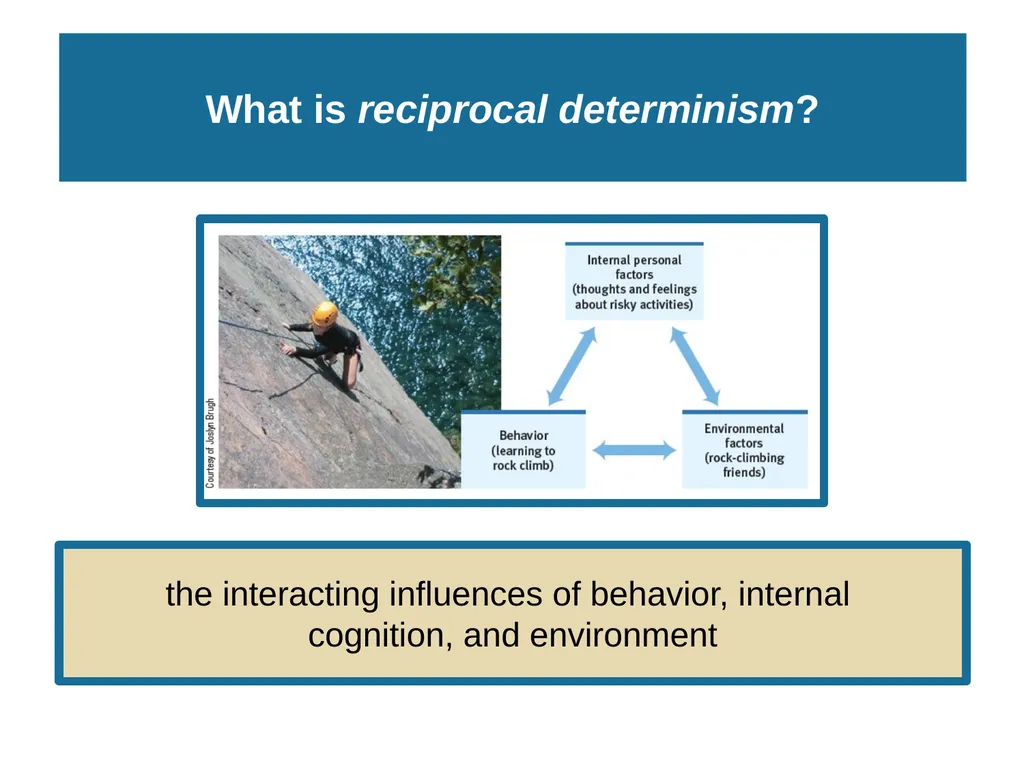
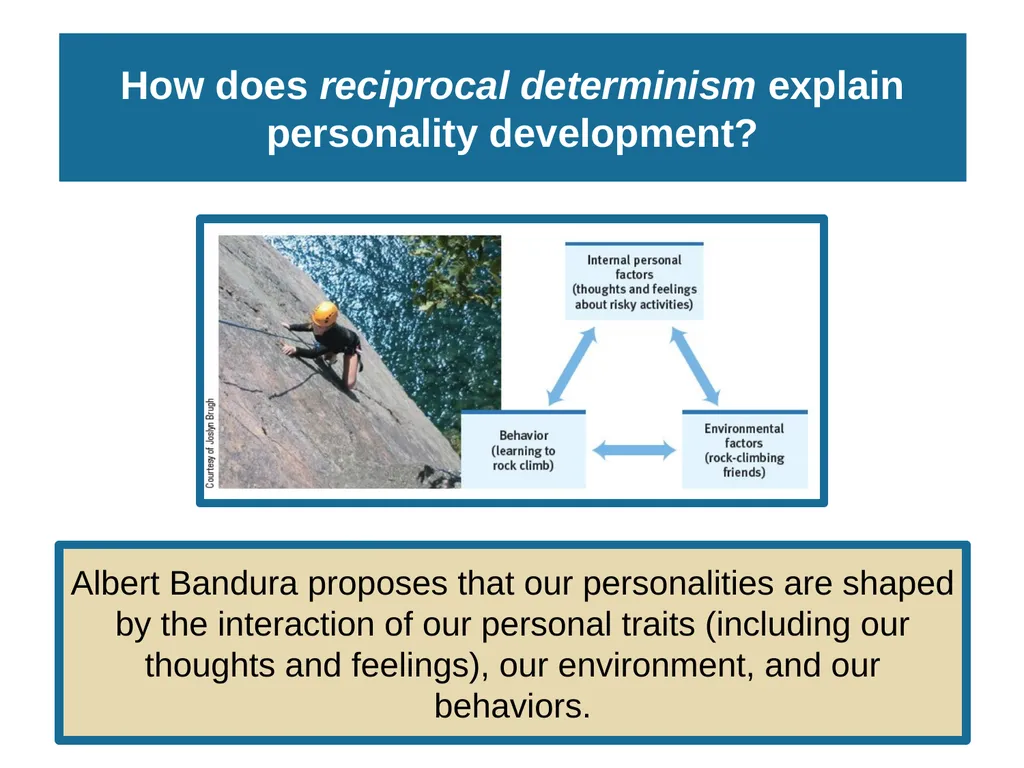
slide7. What is reciprocal determinism? the interacting influences of behavior, internal
cognition, and environment<br>
slide8. How does reciprocal determinism explain personality development? Albert Bandura proposes that our personalities are shaped by the interaction of our personal traits (including our thoughts and feelings), our environment, and our behaviors.<br>
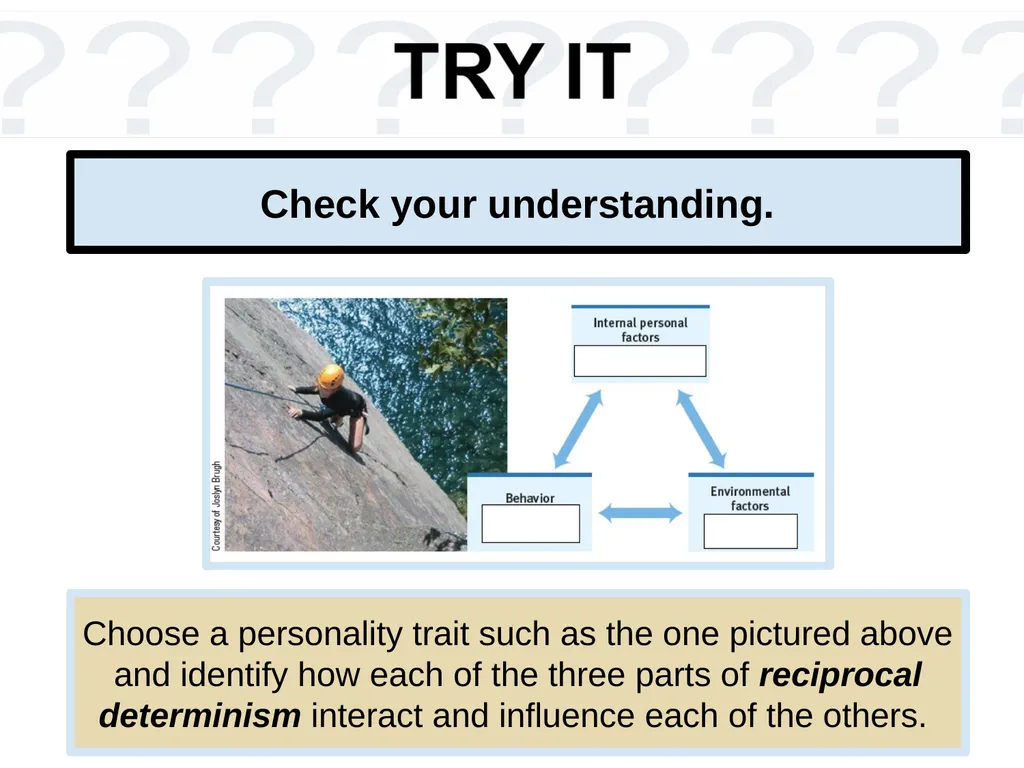
slide9. Check your understanding. Choose a personality trait such as the one pictured above and identify how each of the three parts of reciprocal determinism interact and influence each of the others.<br>
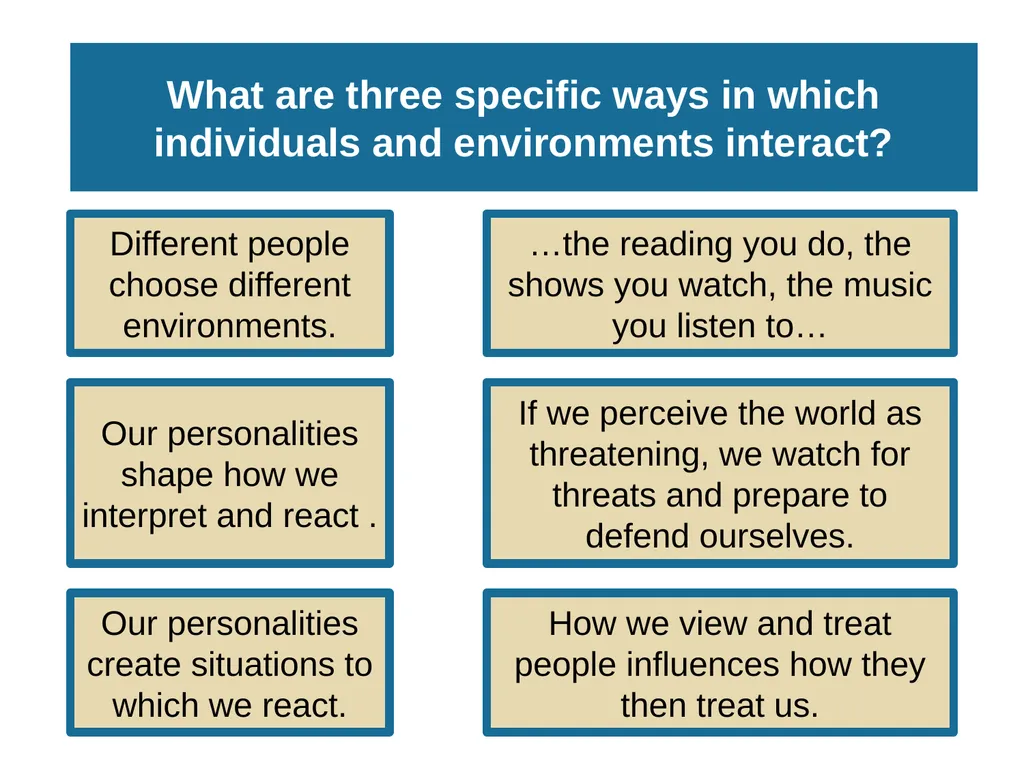
slide10. What are three specific ways in which individuals and environments interact? Different people choose different environments. …the reading you do, the shows you watch, the music you listen to… Our personalities shape how we interpret and react . If we perceive the world as threatening, we watch for threats and prepare to defend ourselves. Our personalities create situations to which we react. How we view and treat
people influences how they then treat us.<br>
slide11. biopsychosocial approach As with other psychological phenomena, personality is
fruitfully studied at multiple levels.<br>
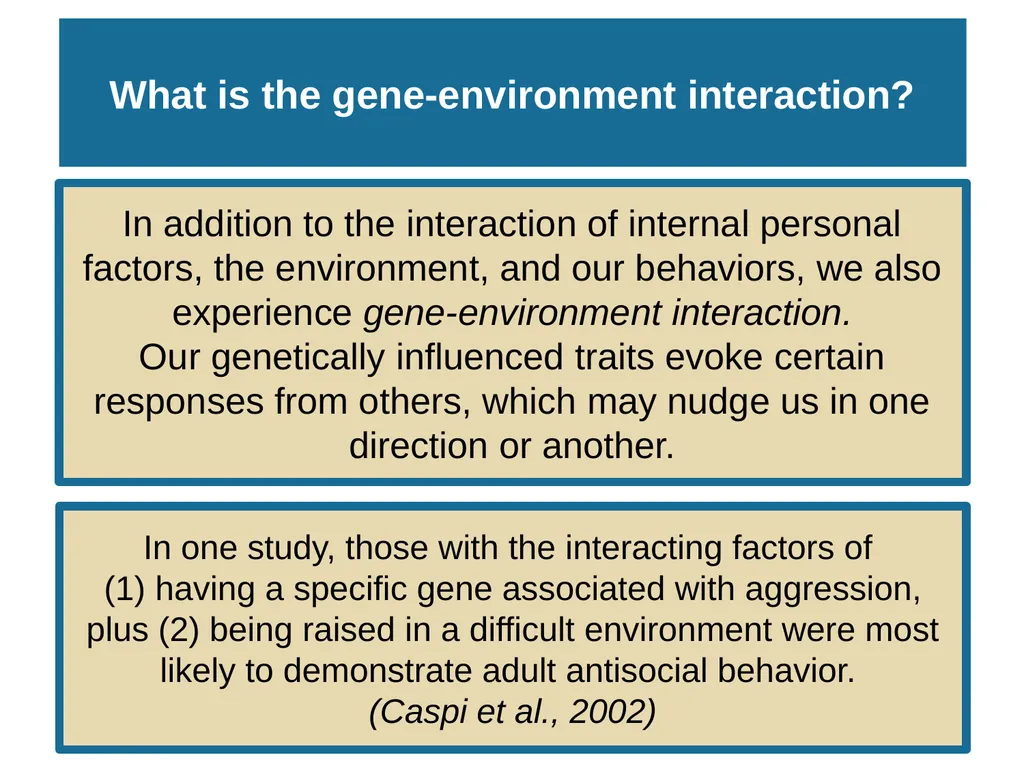
slide12. What is the gene-environment interaction? In addition to the interaction of internal personal factors, the environment, and our behaviors, we also experience gene-environment interaction.
Our genetically influenced traits evoke certain responses from others, which may nudge us in one direction or another. In one study, those with the interacting factors of
(1) having a specific gene associated with aggression, plus (2) being raised in a difficult environment were most
likely to demonstrate adult antisocial behavior.
(Caspi et al., 2002)<br>
slide13. What are the influences on personality? In such ways, we are both the products and the architects of our environments: Behavior emerges from the interplay of external and internal influences. Boiling water turns an egg hard and a potato soft. A threatening environment turns one person into a hero, another into a scoundrel.<br>
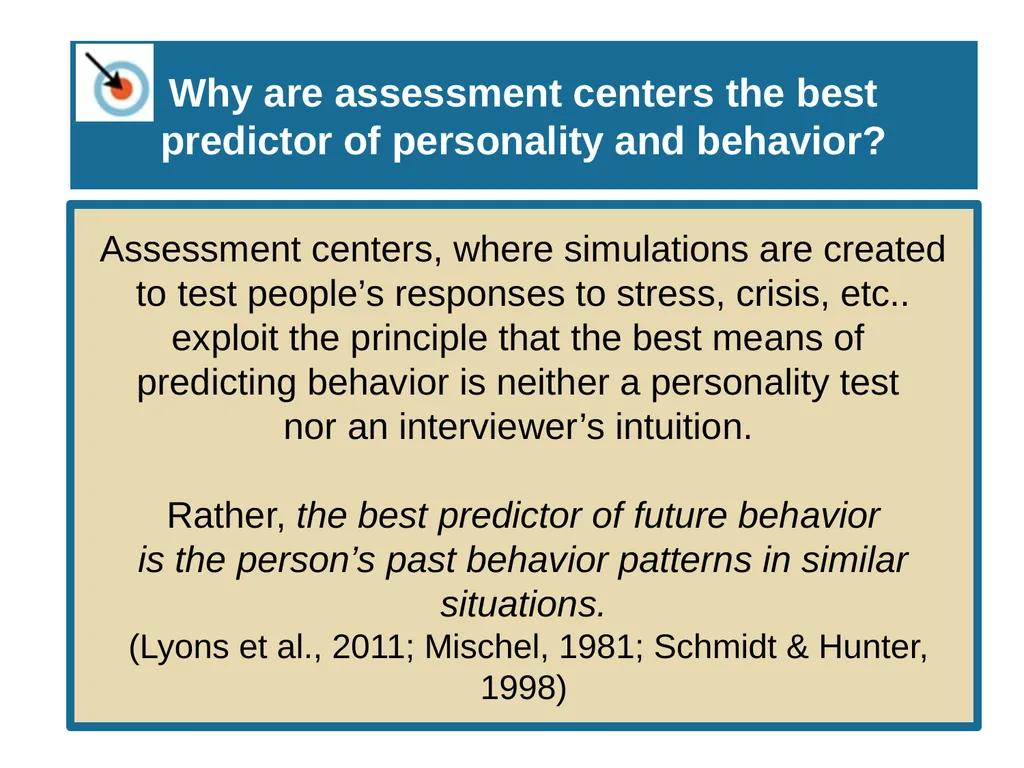
slide14. Why are assessment centers the best predictor of personality and behavior? Assessment centers, where simulations are created to test people’s responses to stress, crisis, etc.. exploit the principle that the best means of
predicting behavior is neither a personality test
nor an interviewer’s intuition.
Rather, the best predictor of future behavior
is the person’s past behavior patterns in similar situations.
(Lyons et al., 2011; Mischel, 1981; Schmidt & Hunter, 1998)<br>
slide15. What criticisms have social-cognitive theorists faced? Critics charge that social-cognitive theories focus so much on the situation that they fail to appreciate the person’s inner traits.
Where is the person in this view of personality, ask
the dissenters, and where are human emotions?
Social-cognitive theorists have also been faulted for underemphasizing the importance of unconscious motives, emotions, and biologically influenced traits.<br>

slide16. What Would You Answer? Heidi is an exceptionally avid reader of books.
Explain how Heidi’s desire to read is supported by
the following elements of reciprocal determinism:
Internal factors
Environmental factors
Behavioral factors<br>
slide17. Learning Target 58-1 Review Describe how social-cognitive
theorists view personality development
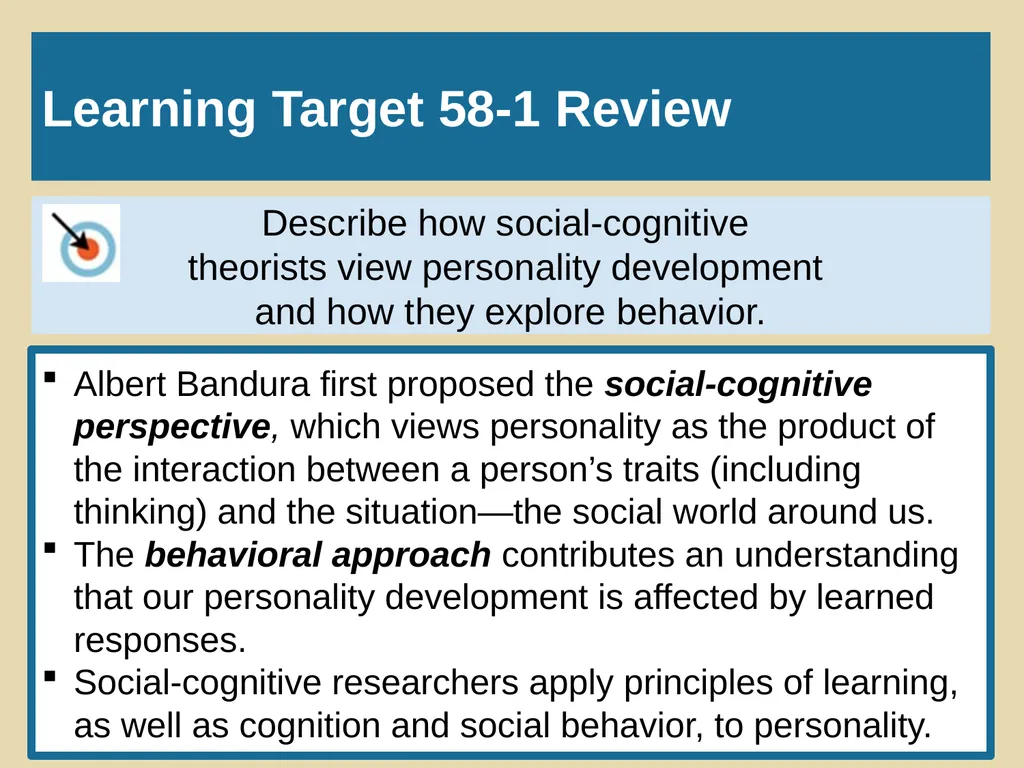
and how they explore behavior. Albert Bandura first proposed the social-cognitive perspective, which views personality as the product of the interaction between a person’s traits (including thinking) and the situation—the social world around us.
The behavioral approach contributes an understanding that our personality development is affected by learned responses.
Social-cognitive researchers apply principles of learning, as well as cognition and social behavior, to personality.<br>
slide18. Learning Target 58-1 Review cont. Describe how social-cognitive
theorists view personality development
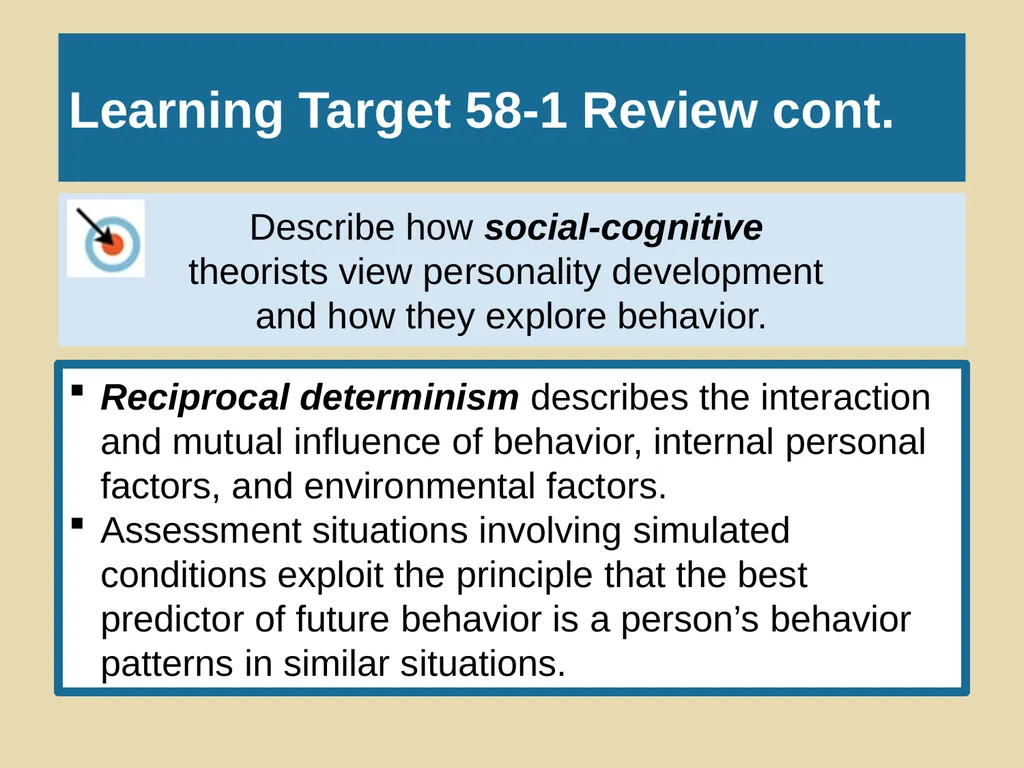
and how they explore behavior. Reciprocal determinism describes the interaction and mutual influence of behavior, internal personal factors, and environmental factors.
Assessment situations involving simulated conditions exploit the principle that the best predictor of future behavior is a person’s behavior patterns in similar situations.<br>
slide19. Learning Target 58-2 Review Discuss the criticisms
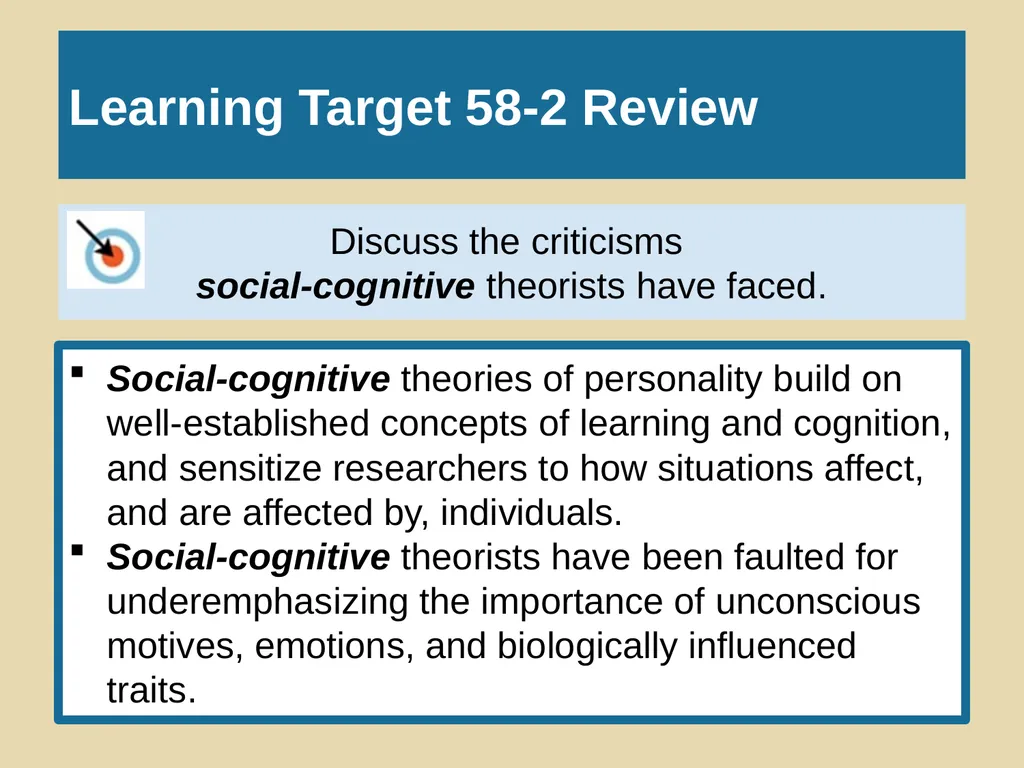
social-cognitive theorists have faced. Social-cognitive theories of personality build on well-established concepts of learning and cognition, and sensitize researchers to how situations affect, and are affected by, individuals.
Social-cognitive theorists have been faulted for underemphasizing the importance of unconscious motives, emotions, and biologically influenced traits.<br>

slide2. Module 58 Social-Cognitive Theories Learning Targets 58-1 Describe how social-cognitive theorists view personality development and how they explore behavior. 58-2 Discuss the criticisms social-cognitive theorists have faced.<br>
slide3. Applying the theories. Can you think of a recent situation in which your personality led you to react differently than did some classmates who experienced the same event? Talk about it with your class.<br>
slide4. What is the social-cognitive perspective? views behavior as influenced by the interaction between people’s traits (including their thinking)
and their social context Much as nature and nurture always work together, so do individuals and their situations.<br>
slide5. What is the behavioral approach? focuses on the effects of learning on our
personality development We are conditioned to repeat certain behaviors, and we learn by observing and imitating others.
For example, a child with a very controlling parent may learn to follow orders rather than think independently, and may exhibit a more timid personality.<br>
slide6. How do the two approaches relate? Social-cognitive theorists do consider the behavioral perspective, believing that we learn many of our behaviors either through conditioning or by observing and imitating others.
They also emphasize the importance of mental processes: What we think about a situation affects our resulting behavior.
Instead of focusing solely on how our environment controls us, as behaviorists do, social-cognitive
theorists focus on how we and our environment interact.<br>
slide7. What is reciprocal determinism? the interacting influences of behavior, internal
cognition, and environment<br>
slide8. How does reciprocal determinism explain personality development? Albert Bandura proposes that our personalities are shaped by the interaction of our personal traits (including our thoughts and feelings), our environment, and our behaviors.<br>
slide9. Check your understanding. Choose a personality trait such as the one pictured above and identify how each of the three parts of reciprocal determinism interact and influence each of the others.<br>
slide10. What are three specific ways in which individuals and environments interact? Different people choose different environments. …the reading you do, the shows you watch, the music you listen to… Our personalities shape how we interpret and react . If we perceive the world as threatening, we watch for threats and prepare to defend ourselves. Our personalities create situations to which we react. How we view and treat
people influences how they then treat us.<br>
slide11. biopsychosocial approach As with other psychological phenomena, personality is
fruitfully studied at multiple levels.<br>
slide12. What is the gene-environment interaction? In addition to the interaction of internal personal factors, the environment, and our behaviors, we also experience gene-environment interaction.
Our genetically influenced traits evoke certain responses from others, which may nudge us in one direction or another. In one study, those with the interacting factors of
(1) having a specific gene associated with aggression, plus (2) being raised in a difficult environment were most
likely to demonstrate adult antisocial behavior.
(Caspi et al., 2002)<br>
slide13. What are the influences on personality? In such ways, we are both the products and the architects of our environments: Behavior emerges from the interplay of external and internal influences. Boiling water turns an egg hard and a potato soft. A threatening environment turns one person into a hero, another into a scoundrel.<br>
slide14. Why are assessment centers the best predictor of personality and behavior? Assessment centers, where simulations are created to test people’s responses to stress, crisis, etc.. exploit the principle that the best means of
predicting behavior is neither a personality test
nor an interviewer’s intuition.
Rather, the best predictor of future behavior
is the person’s past behavior patterns in similar situations.
(Lyons et al., 2011; Mischel, 1981; Schmidt & Hunter, 1998)<br>
slide15. What criticisms have social-cognitive theorists faced? Critics charge that social-cognitive theories focus so much on the situation that they fail to appreciate the person’s inner traits.
Where is the person in this view of personality, ask
the dissenters, and where are human emotions?
Social-cognitive theorists have also been faulted for underemphasizing the importance of unconscious motives, emotions, and biologically influenced traits.<br>

slide16. What Would You Answer? Heidi is an exceptionally avid reader of books.
Explain how Heidi’s desire to read is supported by
the following elements of reciprocal determinism:
Internal factors
Environmental factors
Behavioral factors<br>
slide17. Learning Target 58-1 Review Describe how social-cognitive
theorists view personality development
and how they explore behavior. Albert Bandura first proposed the social-cognitive perspective, which views personality as the product of the interaction between a person’s traits (including thinking) and the situation—the social world around us.
The behavioral approach contributes an understanding that our personality development is affected by learned responses.
Social-cognitive researchers apply principles of learning, as well as cognition and social behavior, to personality.<br>
slide18. Learning Target 58-1 Review cont. Describe how social-cognitive
theorists view personality development
and how they explore behavior. Reciprocal determinism describes the interaction and mutual influence of behavior, internal personal factors, and environmental factors.
Assessment situations involving simulated conditions exploit the principle that the best predictor of future behavior is a person’s behavior patterns in similar situations.<br>
slide19. Learning Target 58-2 Review Discuss the criticisms
social-cognitive theorists have faced. Social-cognitive theories of personality build on well-established concepts of learning and cognition, and sensitize researchers to how situations affect, and are affected by, individuals.
Social-cognitive theorists have been faulted for underemphasizing the importance of unconscious motives, emotions, and biologically influenced traits.<br>