
Unit 11 Testing and Individual Differences Module
CB
Published · 35 slides · 0 views
1 / 1

Description
Unit 11 Testing and Individual Differences Module 60 Introduction to Intelligence Learning Targets 60-1 Discuss how psychologists define intelligence, and present the arguments for g. 60-2 Compare Howard Gardners and Robert Sternbergs
Related Topics
Share
Embed code
Download this presentation From Below
"Unit 11 Testing and Individual Differences Module" is the property of its rightful owner. Permission is granted to download and print the materials on this website for personal, non-commercial use only, and to display it on your personal computer provided you do not modify the materials and that you retain all copyright notices contained in the materials. By downloading content from our website, you accept the terms of this agreement.
Presentation Transcript
01
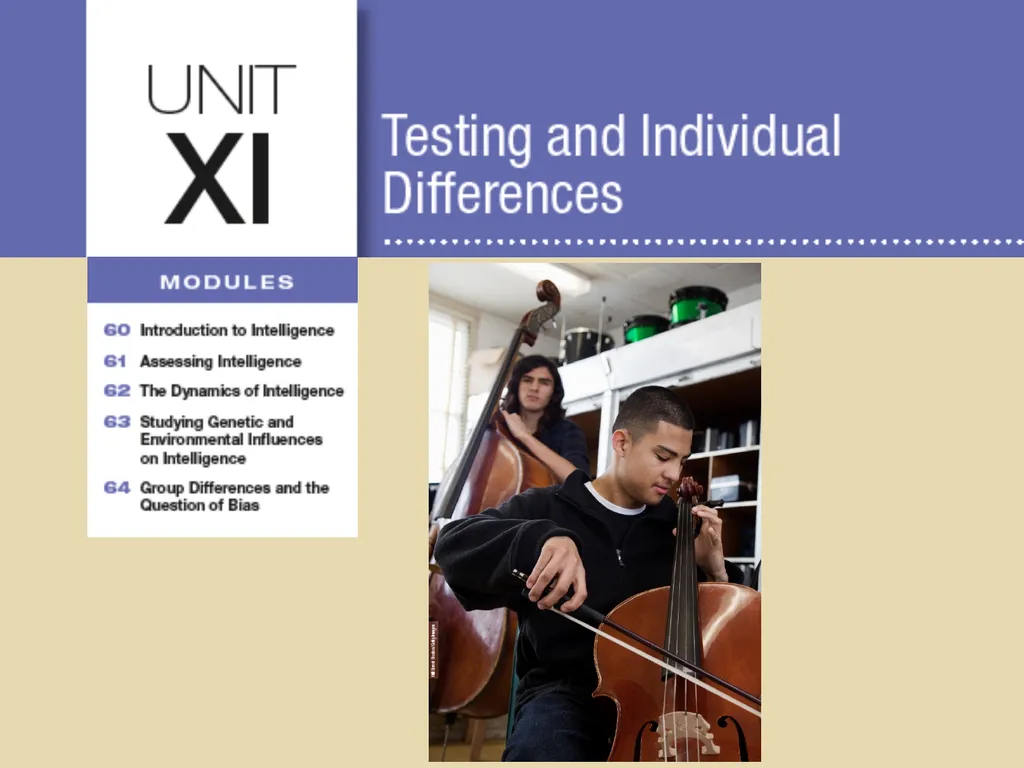
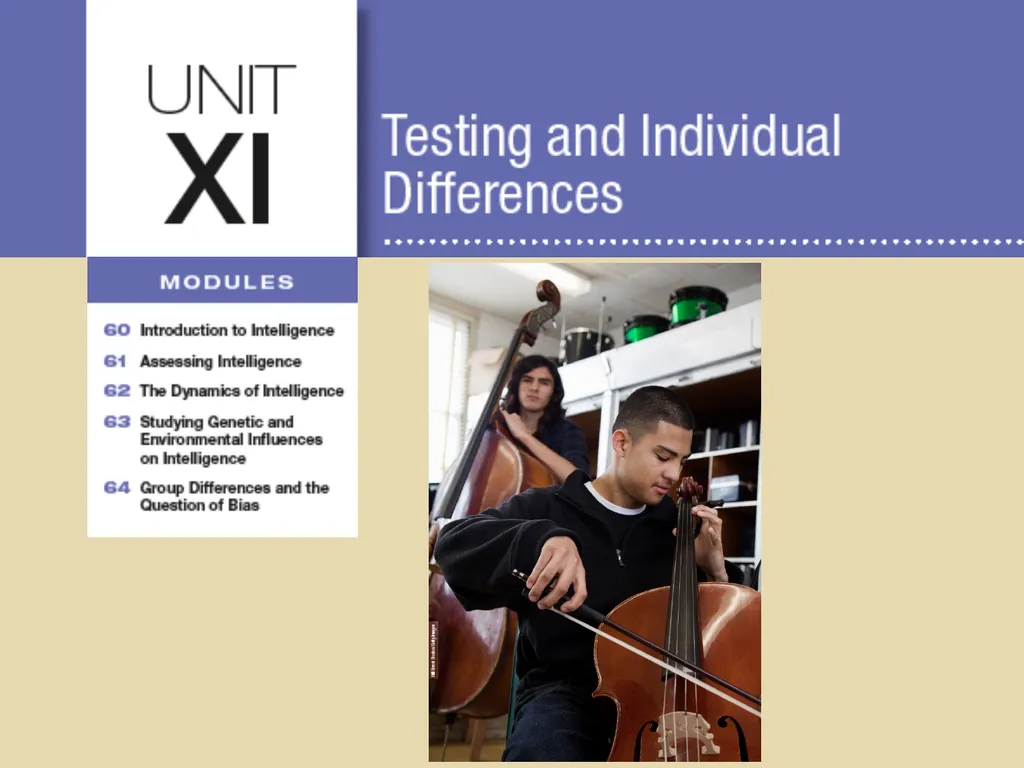
Unit 11
Testing and Individual Differences<br>
02
Module 60 Introduction to Intelligence Learning Targets 60-1 Discuss how psychologists define intelligence, and present the arguments for g. 60-2 Compare Howard Gardner’s and Robert Sternberg’s theories of multiple intelligences, and discuss the criticisms they have faced. 60-3 Describe the four components of emotional intelligence.<br>
03
What does it mean to be intelligent? In many studies, intelligence has been defined as whatever intelligence tests measure, which has tended to be school smarts.
But intelligence is not a quality like
height or weight, which have the same meaning to
everyone worldwide. People assign this term to the
qualities that enable success in their own time and culture
(Sternberg & Kaufman, 1998).<br>
But intelligence is not a quality like
height or weight, which have the same meaning to
everyone worldwide. People assign this term to the
qualities that enable success in their own time and culture
(Sternberg & Kaufman, 1998).<br>
04
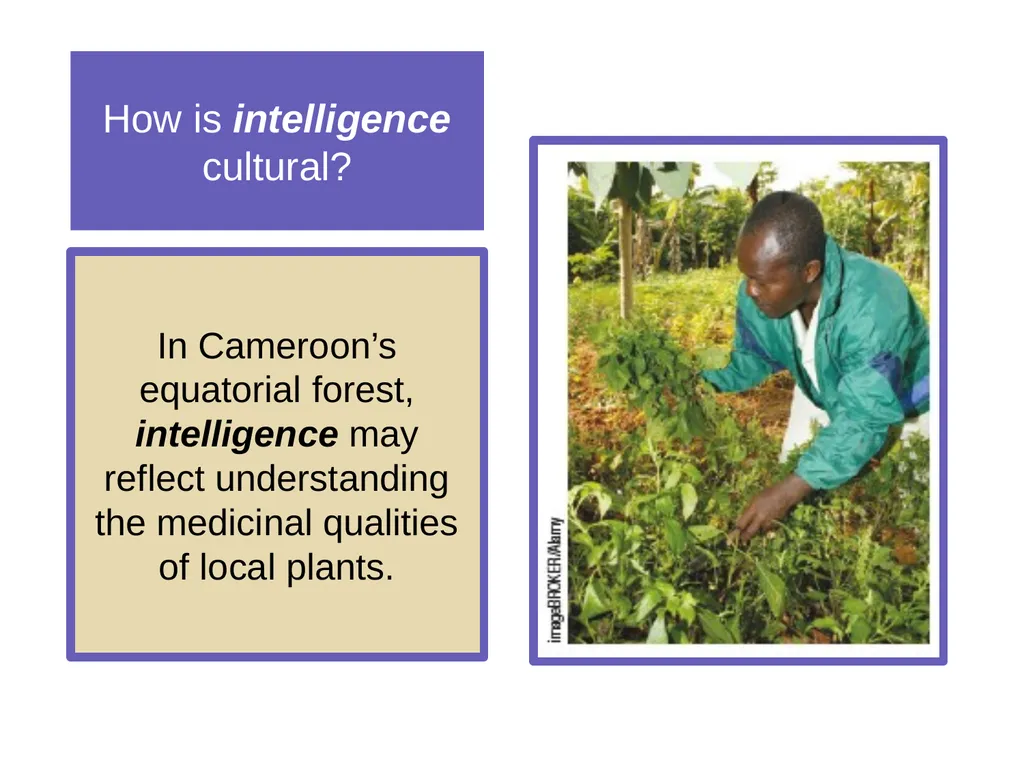
How is intelligence cultural? In Cameroon’s equatorial forest, intelligence may reflect understanding the medicinal qualities of local plants.<br>
05
So, how is intelligence defined? the ability to learn from experience, solve problems,
and use knowledge to adapt to new situations Some people have talents in science, others excel in the humanities, and still others are gifted in athletics, art, music, or dance.
A talented artist may be stumped by the simplest math problem, or a brilliant math student may struggle
when discussing literature.
Are all these people intelligent?<br>
and use knowledge to adapt to new situations Some people have talents in science, others excel in the humanities, and still others are gifted in athletics, art, music, or dance.
A talented artist may be stumped by the simplest math problem, or a brilliant math student may struggle
when discussing literature.
Are all these people intelligent?<br>
06
What is general intelligence (g)? According to Charles Spearman and others,
general intelligence, or “g”, underlies all mental abilities and is therefore measured by every task on an intelligence test. General intelligence is at the heart of all our intelligent behavior, from navigating the sea to excelling in school. Spearman believed people often have special, outstanding abilities, or “s” as well.
He noted that those who score high in one area, such as verbal intelligence, typically score higher than average in other areas, such as spatial or reasoning ability.<br>
general intelligence, or “g”, underlies all mental abilities and is therefore measured by every task on an intelligence test. General intelligence is at the heart of all our intelligent behavior, from navigating the sea to excelling in school. Spearman believed people often have special, outstanding abilities, or “s” as well.
He noted that those who score high in one area, such as verbal intelligence, typically score higher than average in other areas, such as spatial or reasoning ability.<br>
07
What is factor analysis? a statistical procedure that identifies clusters
of related items (called factors) on a test;
used to identify different dimensions of performance that underlie a person’s total score Charles Spearman utilized factor analysis in creating his theory of “g” and “s”.<br>
of related items (called factors) on a test;
used to identify different dimensions of performance that underlie a person’s total score Charles Spearman utilized factor analysis in creating his theory of “g” and “s”.<br>
08
How did the work of L.L. Thurstone contradict and support Spearman’s findings? L. L. Thurstone, one of Spearman’s early opponents
gave 56 different tests to people and mathematically identified seven clusters of primary mental abilities (word fluency, verbal comprehension, spatial ability, perceptual speed, numerical ability, inductive reasoning, and memory). This idea of a general mental capacity, “g”, expressed by a single intelligence score was controversial in Spearman’s day, and so it remains.<br>
gave 56 different tests to people and mathematically identified seven clusters of primary mental abilities (word fluency, verbal comprehension, spatial ability, perceptual speed, numerical ability, inductive reasoning, and memory). This idea of a general mental capacity, “g”, expressed by a single intelligence score was controversial in Spearman’s day, and so it remains.<br>
09
What is an argument in support of the existence of “g”? Thurstone did not rank people on a single scale of general aptitude.
But when other investigators studied these profiles, they detected a persistent tendency:
those who excelled in one of the seven clusters generally scored well on the others. So, the investigators concluded, there was still some evidence of a “g” factor.<br>
But when other investigators studied these profiles, they detected a persistent tendency:
those who excelled in one of the seven clusters generally scored well on the others. So, the investigators concluded, there was still some evidence of a “g” factor.<br>
10
What is Howard Gardner’s theory of
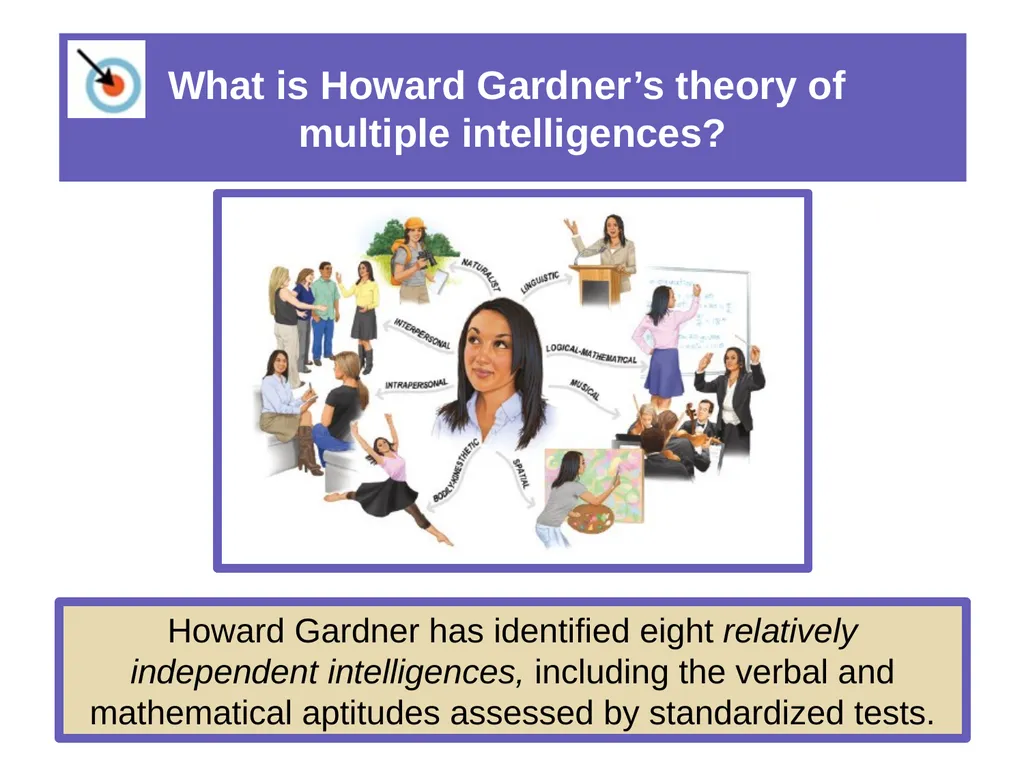
multiple intelligences? Howard Gardner has identified eight relatively independent intelligences, including the verbal and mathematical aptitudes assessed by standardized tests.<br>
11
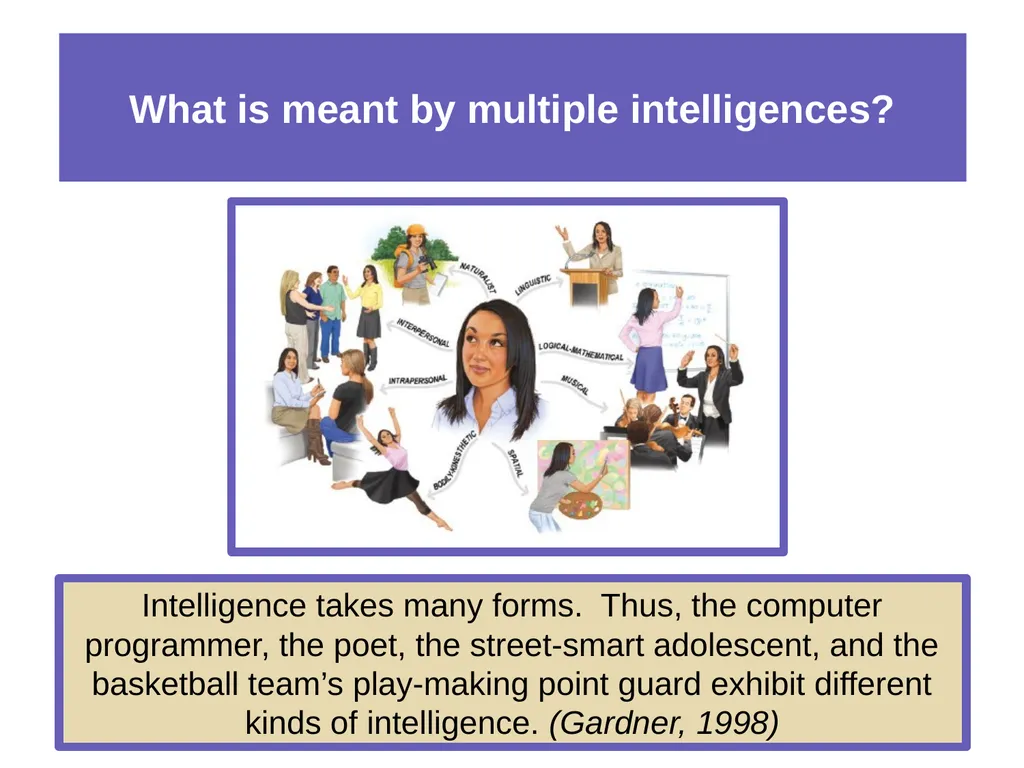
What is meant by multiple intelligences? Intelligence takes many forms. Thus, the computer programmer, the poet, the street-smart adolescent, and the basketball team’s play-making point guard exhibit different kinds of intelligence. (Gardner, 1998)<br>
12
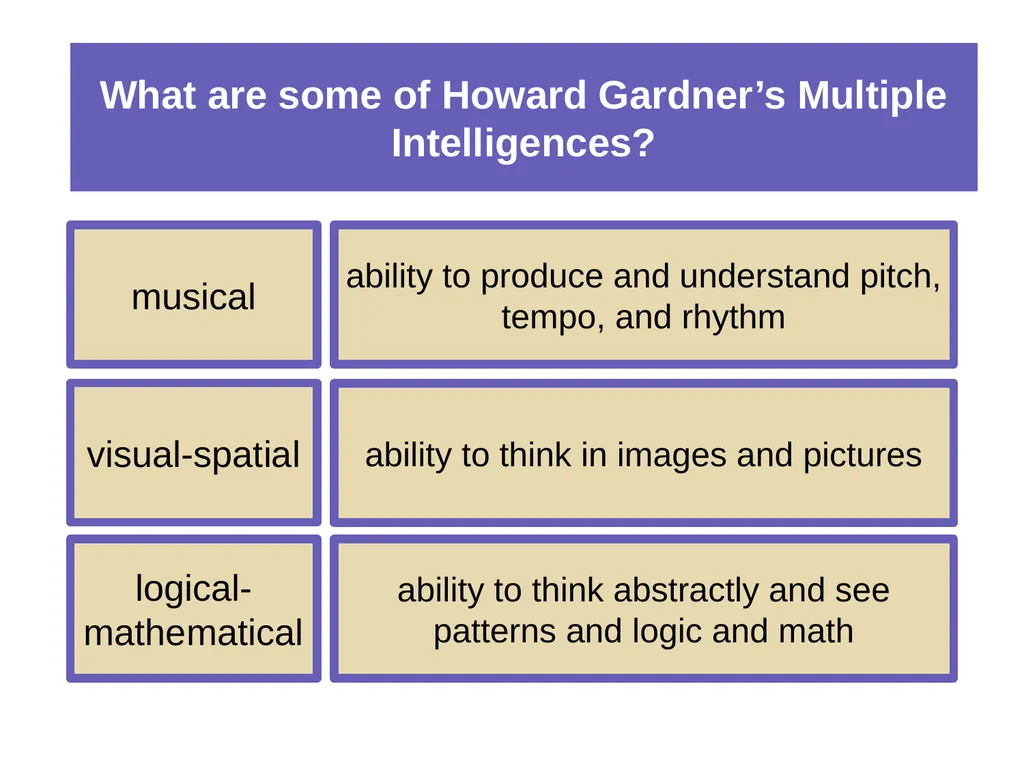
What are some of Howard Gardner’s Multiple Intelligences? musical ability to produce and understand pitch, tempo, and rhythm visual-spatial ability to think in images and pictures logical-mathematical ability to think abstractly and see patterns and logic and math<br>
13
What are some additional
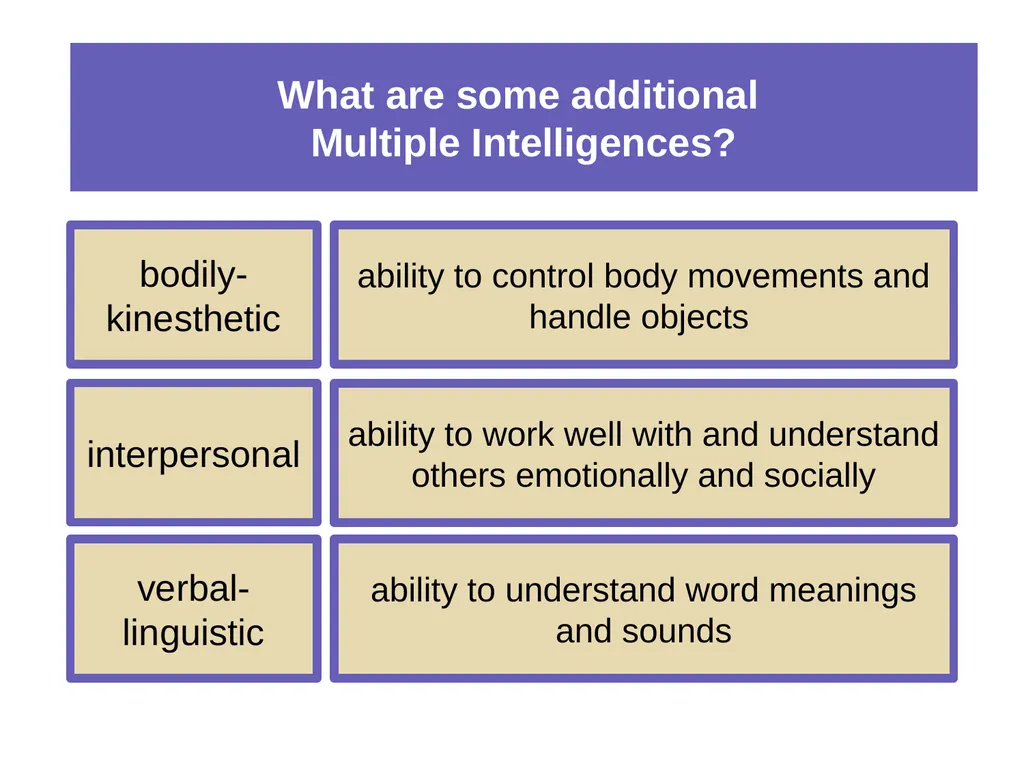
Multiple Intelligences? bodily-kinesthetic ability to control body movements and handle objects interpersonal ability to work well with and understand others emotionally and socially verbal-linguistic ability to understand word meanings and sounds<br>
14
How would you teach first grade students the alphabet if you knew they had strong…. musical intelligence visual–spatial intelligence interpersonal intelligence bodily-kinesthetic intelligence logical-mathematical intelligence<br>
15
What is savant syndrome? a condition in which a person otherwise limited in mental ability has an exceptional specific skill, such as in computation or drawing People with savant syndrome, have an island of brilliance but often score low on intelligence tests and may have limited or no language ability.
(Treffert, 2010)
Some can compute complicated calculations almost instantly, or identify the day of the week of any given historical date, or render incredible works of art or music.
(Miller, 1999)<br>
(Treffert, 2010)
Some can compute complicated calculations almost instantly, or identify the day of the week of any given historical date, or render incredible works of art or music.
(Miller, 1999)<br>
16
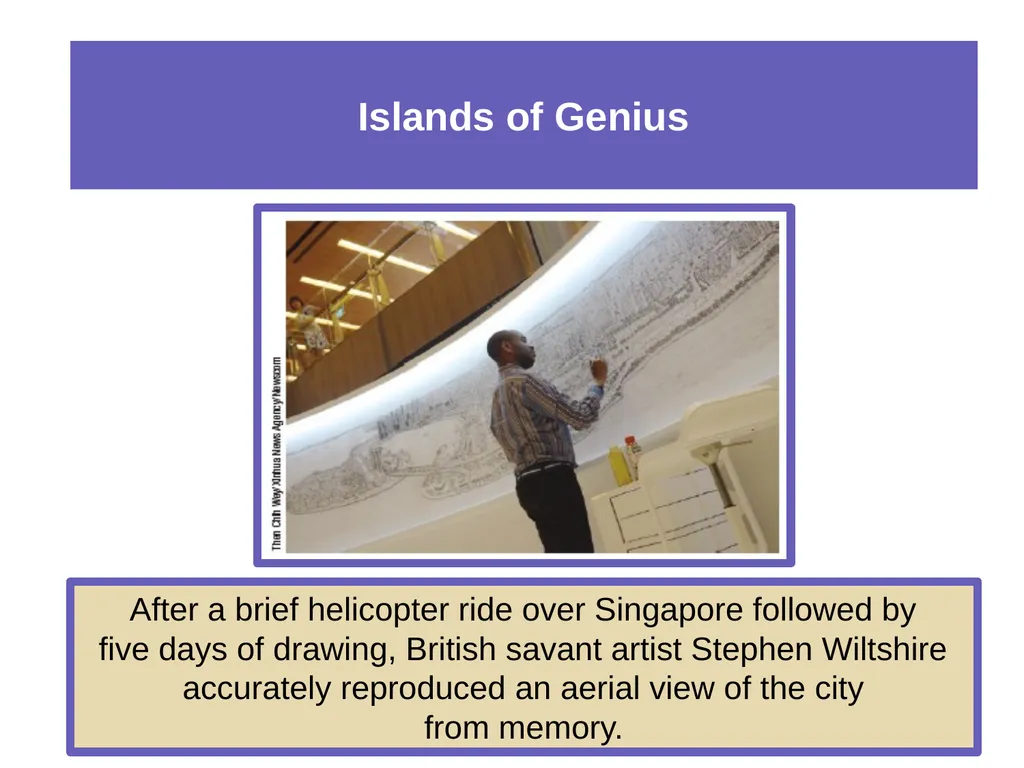
Islands of Genius After a brief helicopter ride over Singapore followed by
five days of drawing, British savant artist Stephen Wiltshire accurately reproduced an aerial view of the city
from memory.<br>
five days of drawing, British savant artist Stephen Wiltshire accurately reproduced an aerial view of the city
from memory.<br>
17
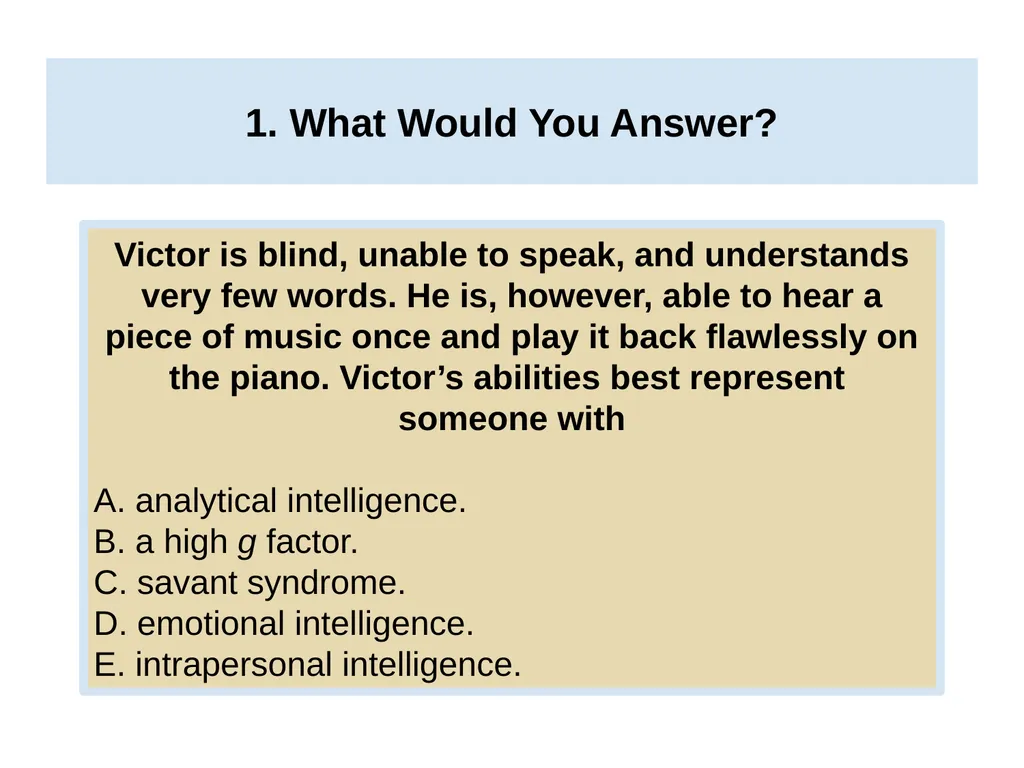
1. What Would You Answer? Victor is blind, unable to speak, and understands very few words. He is, however, able to hear a piece of music once and play it back flawlessly on the piano. Victor’s abilities best represent
someone with
A. analytical intelligence.
B. a high g factor.
C. savant syndrome.
D. emotional intelligence.
E. intrapersonal intelligence.<br>
someone with
A. analytical intelligence.
B. a high g factor.
C. savant syndrome.
D. emotional intelligence.
E. intrapersonal intelligence.<br>
18
How does Robert Sternberg agree
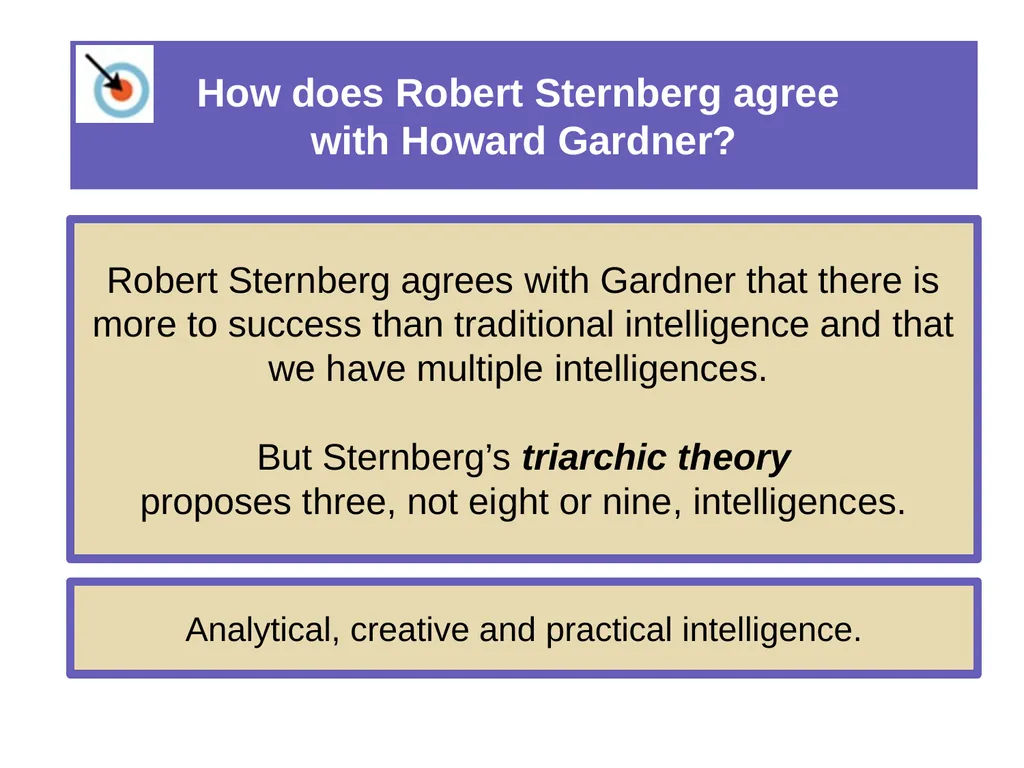
with Howard Gardner? Robert Sternberg agrees with Gardner that there is more to success than traditional intelligence and that we have multiple intelligences.
But Sternberg’s triarchic theory
proposes three, not eight or nine, intelligences. Analytical, creative and practical intelligence.<br>
But Sternberg’s triarchic theory
proposes three, not eight or nine, intelligences. Analytical, creative and practical intelligence.<br>
19
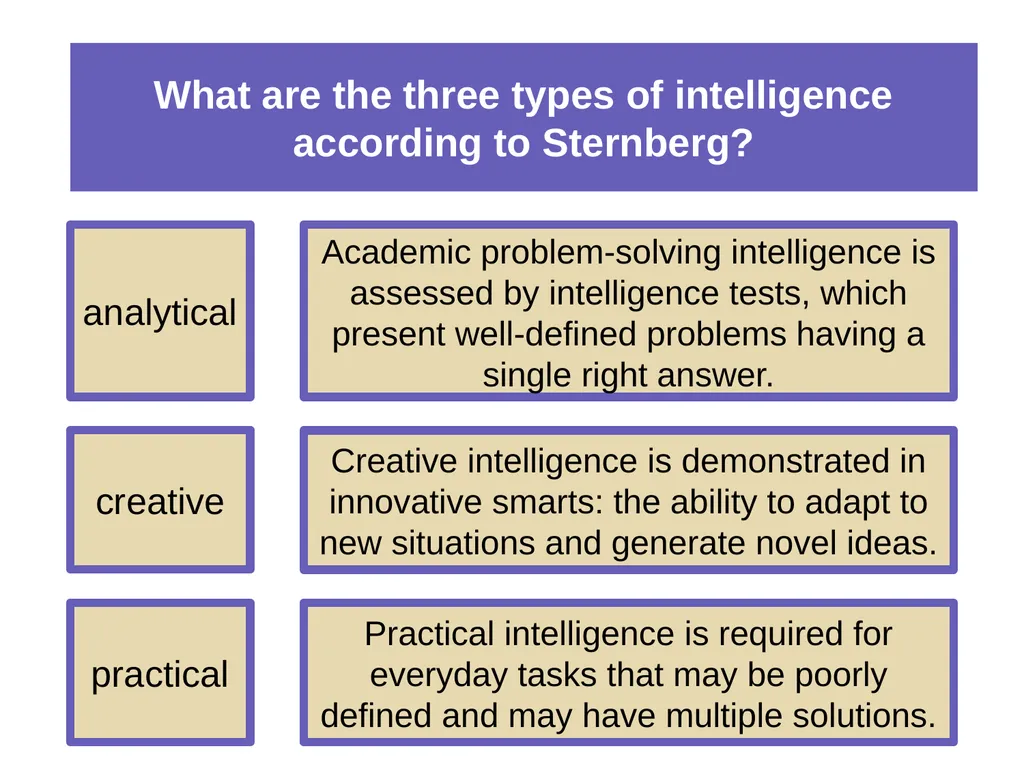
What are the three types of intelligence according to Sternberg? analytical Academic problem-solving intelligence is assessed by intelligence tests, which present well-defined problems having a single right answer. creative Creative intelligence is demonstrated in innovative smarts: the ability to adapt to new situations and generate novel ideas. practical Practical intelligence is required for everyday tasks that may be poorly defined and may have multiple solutions.<br>
20
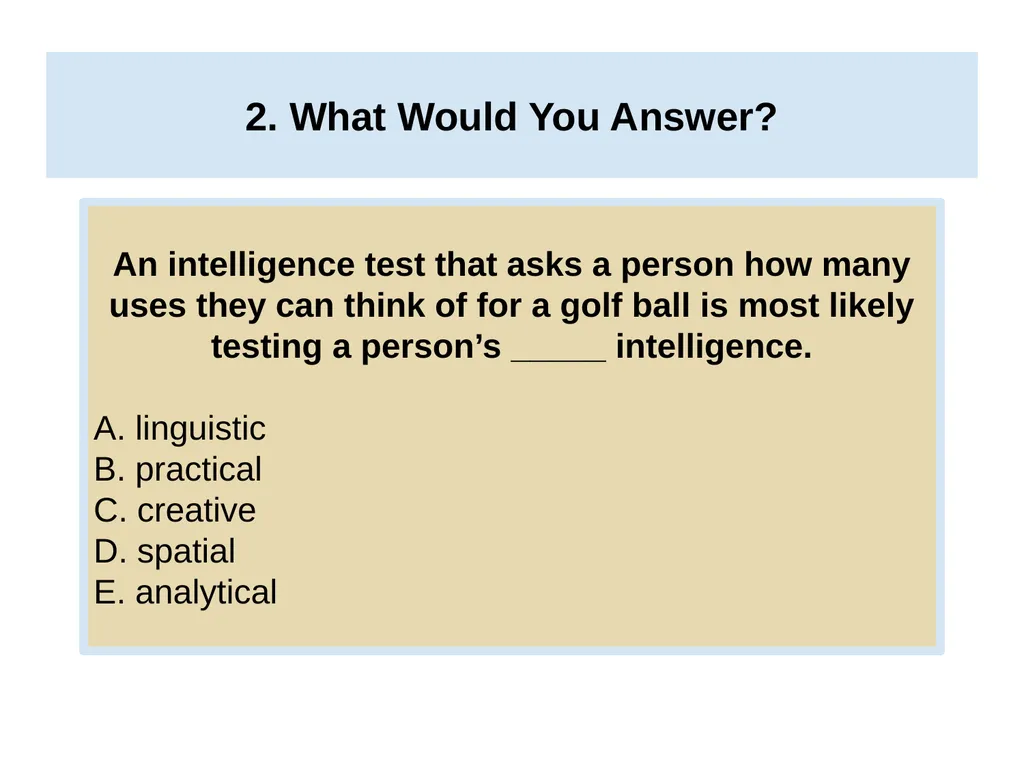
2. What Would You Answer? An intelligence test that asks a person how many uses they can think of for a golf ball is most likely testing a person’s _____ intelligence.
A. linguistic
B. practical
C. creative
D. spatial
E. analytical<br>
A. linguistic
B. practical
C. creative
D. spatial
E. analytical<br>
21
How important is “g”? Research using factor analysis confirms that there is a general intelligence factor: “g” matters
(Johnson et al., 2008)
It predicts performance on various complex
tasks and in various jobs.
(Gottfredson, 2002a,b, 2003a,b) And extremely high cognitive ability scores predict
exceptional achievements, such as doctoral degrees and publications. (Kuncel & Hezlett, 2010)<br>
(Johnson et al., 2008)
It predicts performance on various complex
tasks and in various jobs.
(Gottfredson, 2002a,b, 2003a,b) And extremely high cognitive ability scores predict
exceptional achievements, such as doctoral degrees and publications. (Kuncel & Hezlett, 2010)<br>
22
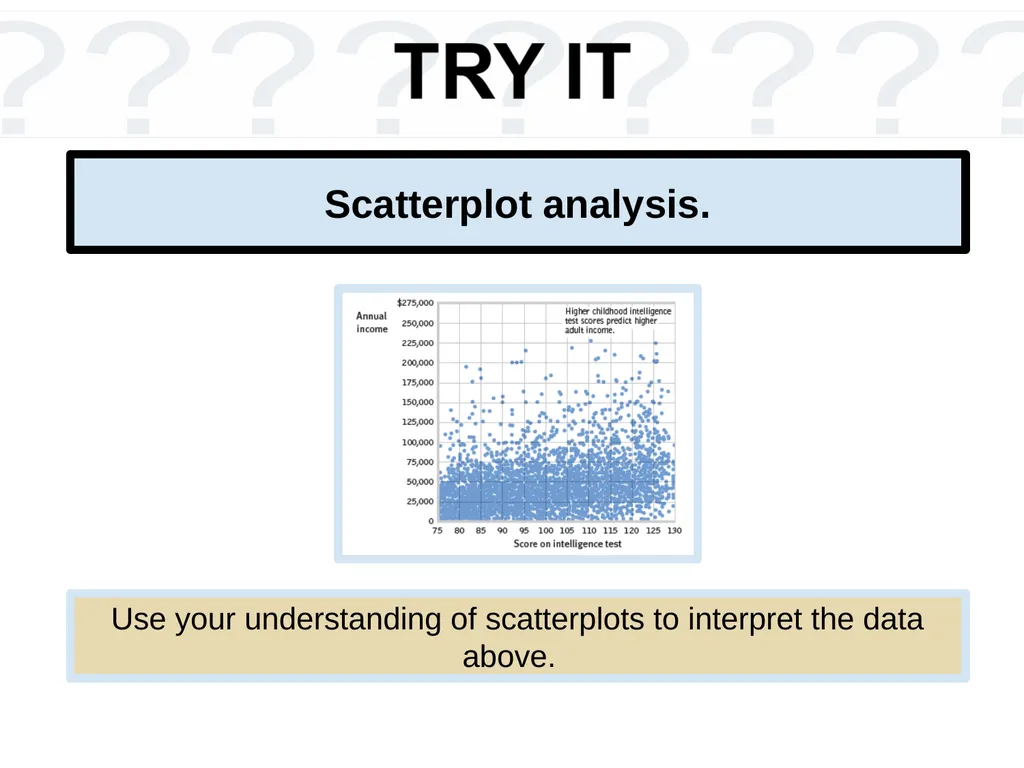
Scatterplot analysis. Use your understanding of scatterplots to interpret the data above.<br>
23
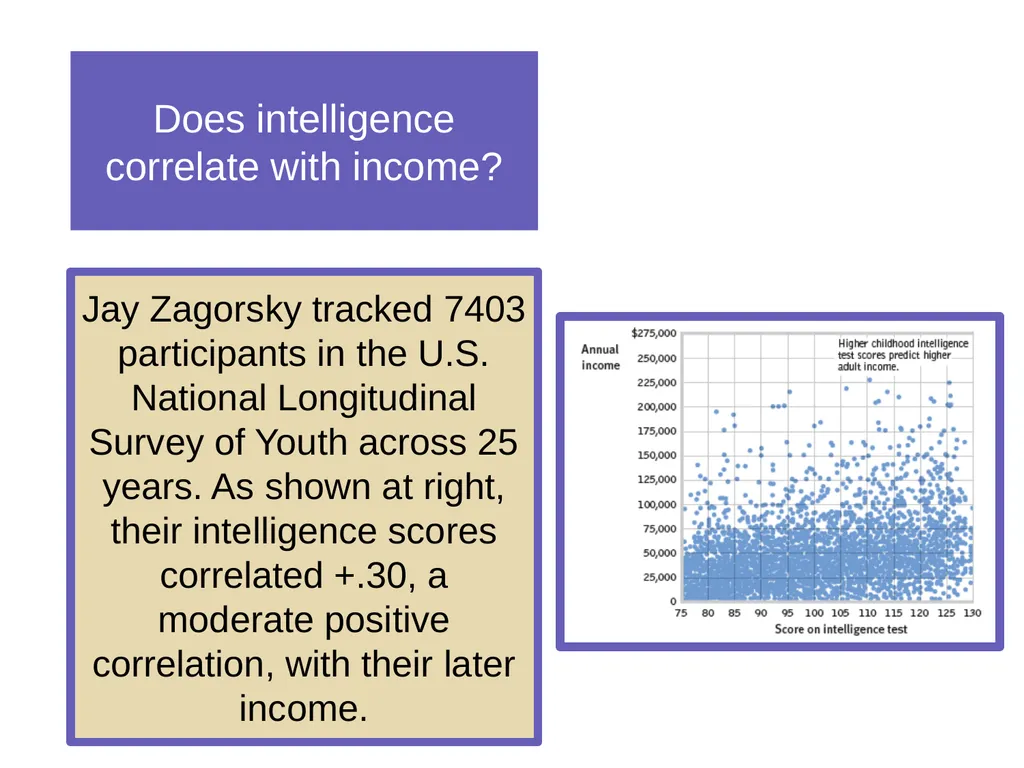
Does intelligence correlate with income? Jay Zagorsky tracked 7403 participants in the U.S. National Longitudinal Survey of Youth across 25 years. As shown at right, their intelligence scores correlated +.30, a moderate positive
correlation, with their later income.<br>
correlation, with their later income.<br>
24
What is grit? In psychology, grit is passion and perseverance in the pursuit of long-term goals. Success is not a one-ingredient recipe.
High intelligence may help you get into a good college and ultimately a desired profession, but it won’t make
you successful once there.
Success is a combination of talent and grit- those who become highly successful tend also to be conscientious, well-connected, and doggedly energetic.<br>
High intelligence may help you get into a good college and ultimately a desired profession, but it won’t make
you successful once there.
Success is a combination of talent and grit- those who become highly successful tend also to be conscientious, well-connected, and doggedly energetic.<br>
25
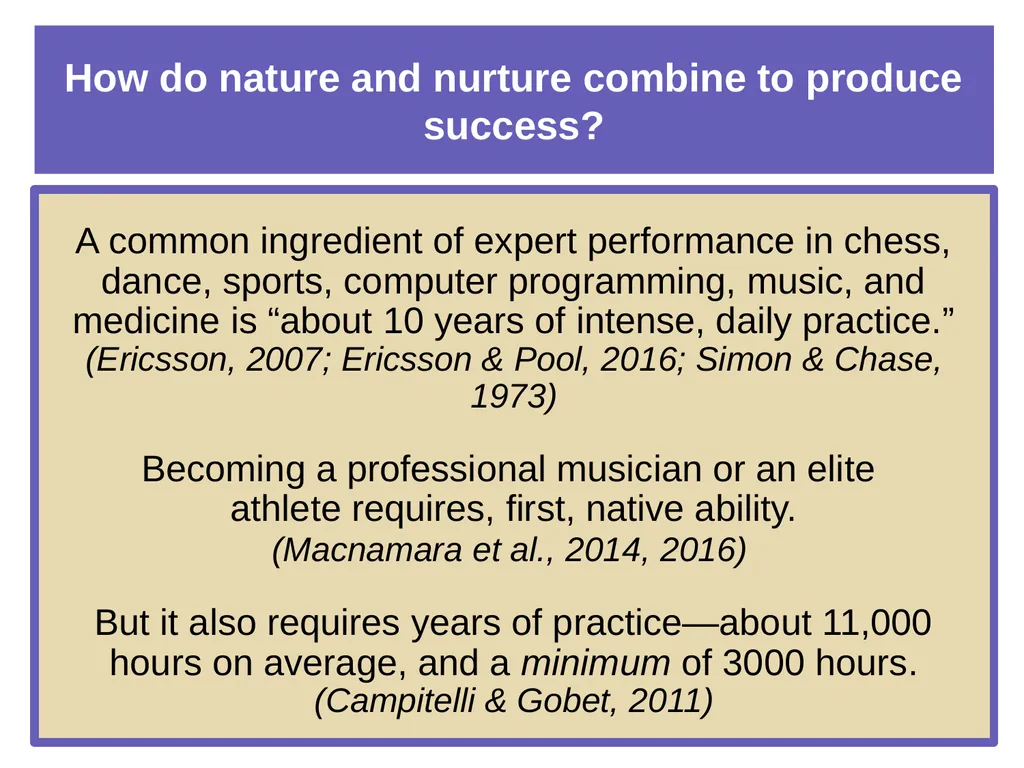
How do nature and nurture combine to produce success? A common ingredient of expert performance in chess, dance, sports, computer programming, music, and medicine is “about 10 years of intense, daily practice.”
(Ericsson, 2007; Ericsson & Pool, 2016; Simon & Chase, 1973)
Becoming a professional musician or an elite
athlete requires, first, native ability.
(Macnamara et al., 2014, 2016)
But it also requires years of practice—about 11,000 hours on average, and a minimum of 3000 hours. (Campitelli & Gobet, 2011)<br>
(Ericsson, 2007; Ericsson & Pool, 2016; Simon & Chase, 1973)
Becoming a professional musician or an elite
athlete requires, first, native ability.
(Macnamara et al., 2014, 2016)
But it also requires years of practice—about 11,000 hours on average, and a minimum of 3000 hours. (Campitelli & Gobet, 2011)<br>
26
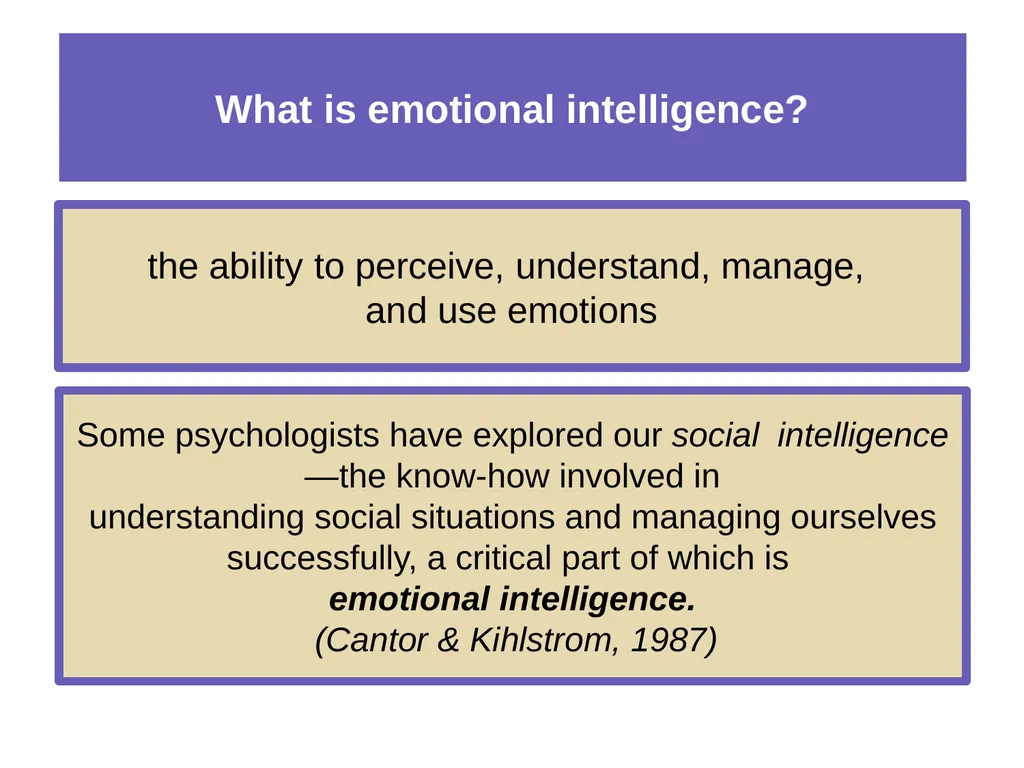
What is emotional intelligence? the ability to perceive, understand, manage,
and use emotions Some psychologists have explored our social intelligence—the know-how involved in
understanding social situations and managing ourselves successfully, a critical part of which is
emotional intelligence.
(Cantor & Kihlstrom, 1987)<br>
and use emotions Some psychologists have explored our social intelligence—the know-how involved in
understanding social situations and managing ourselves successfully, a critical part of which is
emotional intelligence.
(Cantor & Kihlstrom, 1987)<br>
27
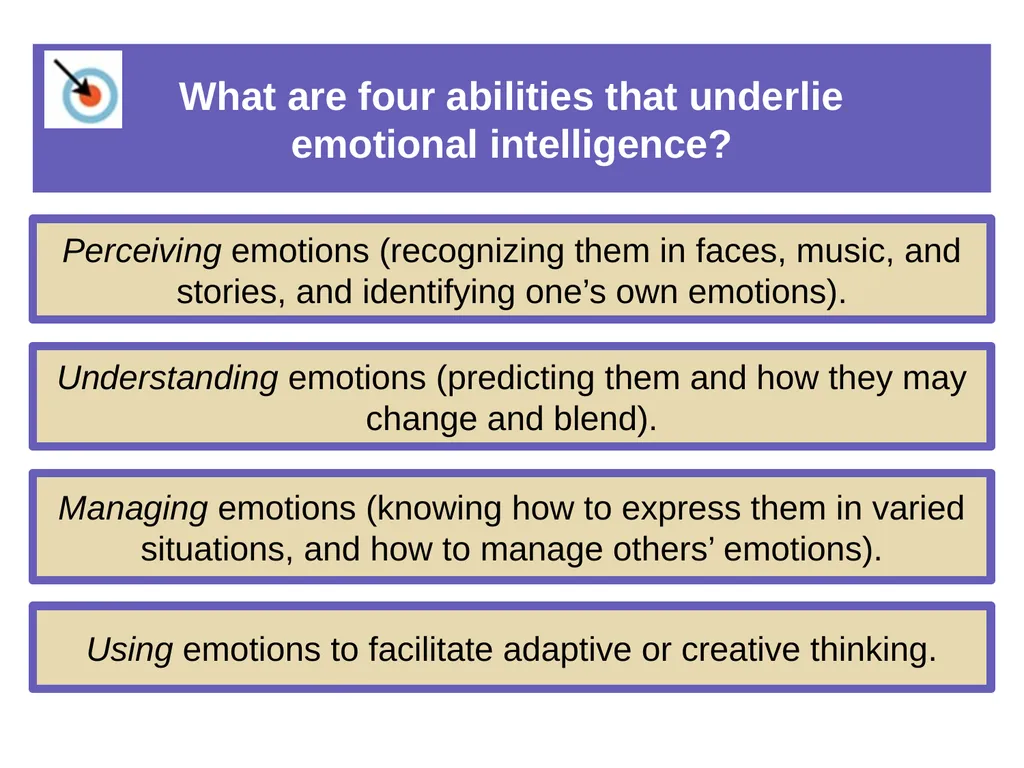
What are four abilities that underlie
emotional intelligence? Perceiving emotions (recognizing them in faces, music, and stories, and identifying one’s own emotions). Understanding emotions (predicting them and how they may change and blend). Managing emotions (knowing how to express them in varied situations, and how to manage others’ emotions). Using emotions to facilitate adaptive or creative thinking.<br>
28
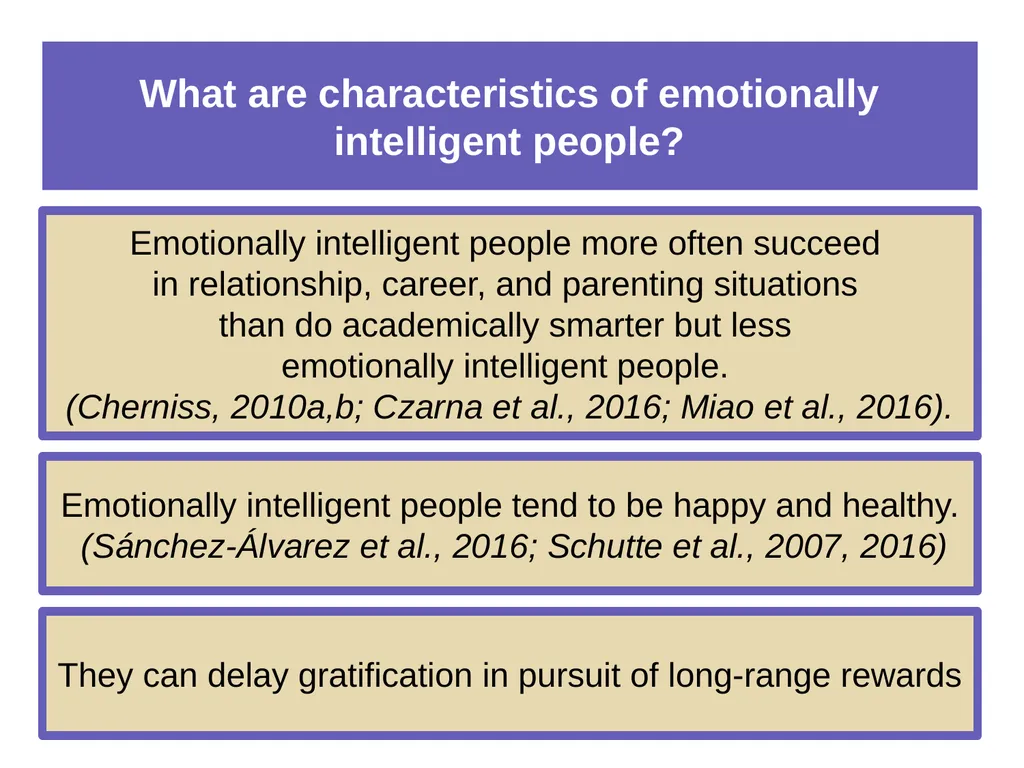
What are characteristics of emotionally intelligent people? Emotionally intelligent people more often succeed
in relationship, career, and parenting situations
than do academically smarter but less
emotionally intelligent people.
(Cherniss, 2010a,b; Czarna et al., 2016; Miao et al., 2016). Emotionally intelligent people tend to be happy and healthy.
(Sánchez-Álvarez et al., 2016; Schutte et al., 2007, 2016) They can delay gratification in pursuit of long-range rewards<br>
in relationship, career, and parenting situations
than do academically smarter but less
emotionally intelligent people.
(Cherniss, 2010a,b; Czarna et al., 2016; Miao et al., 2016). Emotionally intelligent people tend to be happy and healthy.
(Sánchez-Álvarez et al., 2016; Schutte et al., 2007, 2016) They can delay gratification in pursuit of long-range rewards<br>
29
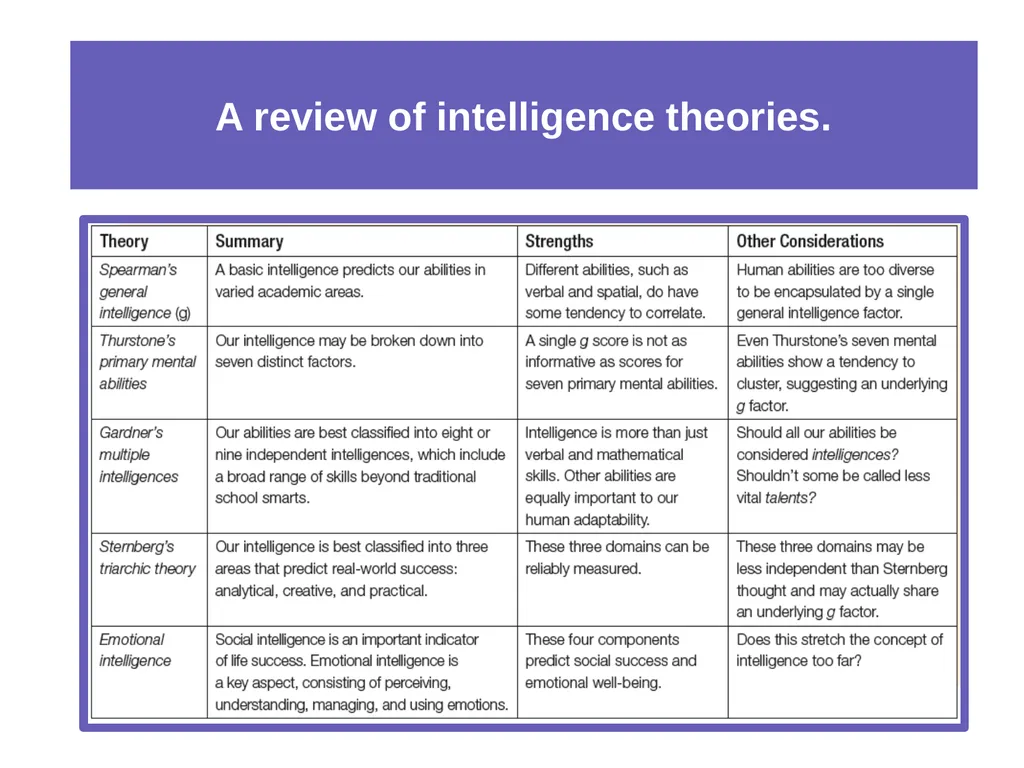
A review of intelligence theories.<br>
30
AP® Exam Tip Familiarize yourself with the table on the
previous slide.
Be able to compare and contrast the contributions
of the intelligence theorists
(e.g., Spearman, Gardner, Sternberg).<br>
previous slide.
Be able to compare and contrast the contributions
of the intelligence theorists
(e.g., Spearman, Gardner, Sternberg).<br>
31
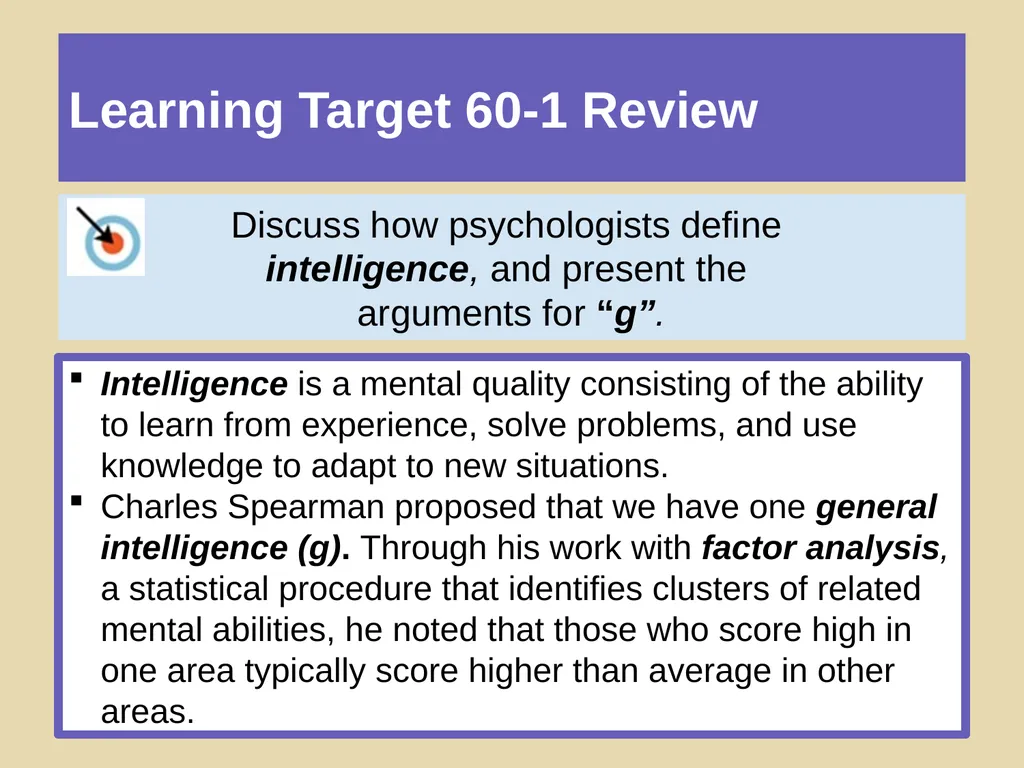
Learning Target 60-1 Review Discuss how psychologists define
intelligence, and present the
arguments for “g”. Intelligence is a mental quality consisting of the ability to learn from experience, solve problems, and use knowledge to adapt to new situations.
Charles Spearman proposed that we have one general intelligence (g). Through his work with factor analysis, a statistical procedure that identifies clusters of related mental abilities, he noted that those who score high in one area typically score higher than average in other areas.<br>
intelligence, and present the
arguments for “g”. Intelligence is a mental quality consisting of the ability to learn from experience, solve problems, and use knowledge to adapt to new situations.
Charles Spearman proposed that we have one general intelligence (g). Through his work with factor analysis, a statistical procedure that identifies clusters of related mental abilities, he noted that those who score high in one area typically score higher than average in other areas.<br>
32
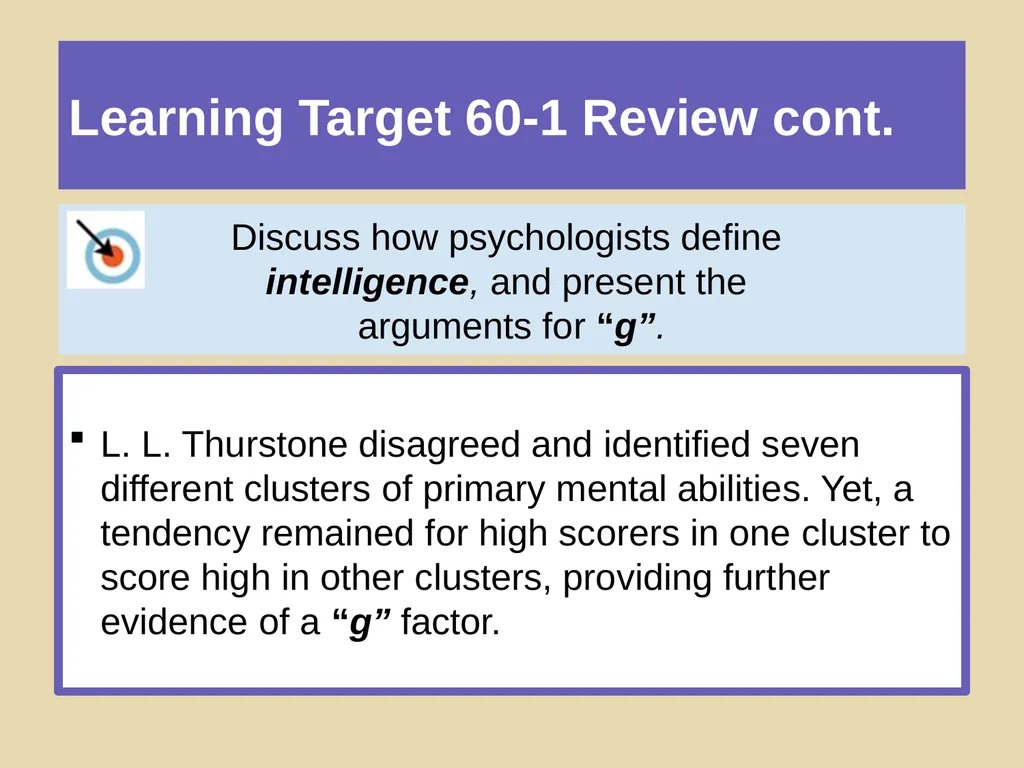
Learning Target 60-1 Review cont. Discuss how psychologists define
intelligence, and present the
arguments for “g”. L. L. Thurstone disagreed and identified seven different clusters of primary mental abilities. Yet, a tendency remained for high scorers in one cluster to score high in other clusters, providing further evidence of a “g” factor.<br>
intelligence, and present the
arguments for “g”. L. L. Thurstone disagreed and identified seven different clusters of primary mental abilities. Yet, a tendency remained for high scorers in one cluster to score high in other clusters, providing further evidence of a “g” factor.<br>
33
Learning Target 60-2 Review Compare Gardner’s and Sternberg’s
theories of multiple intelligences, and
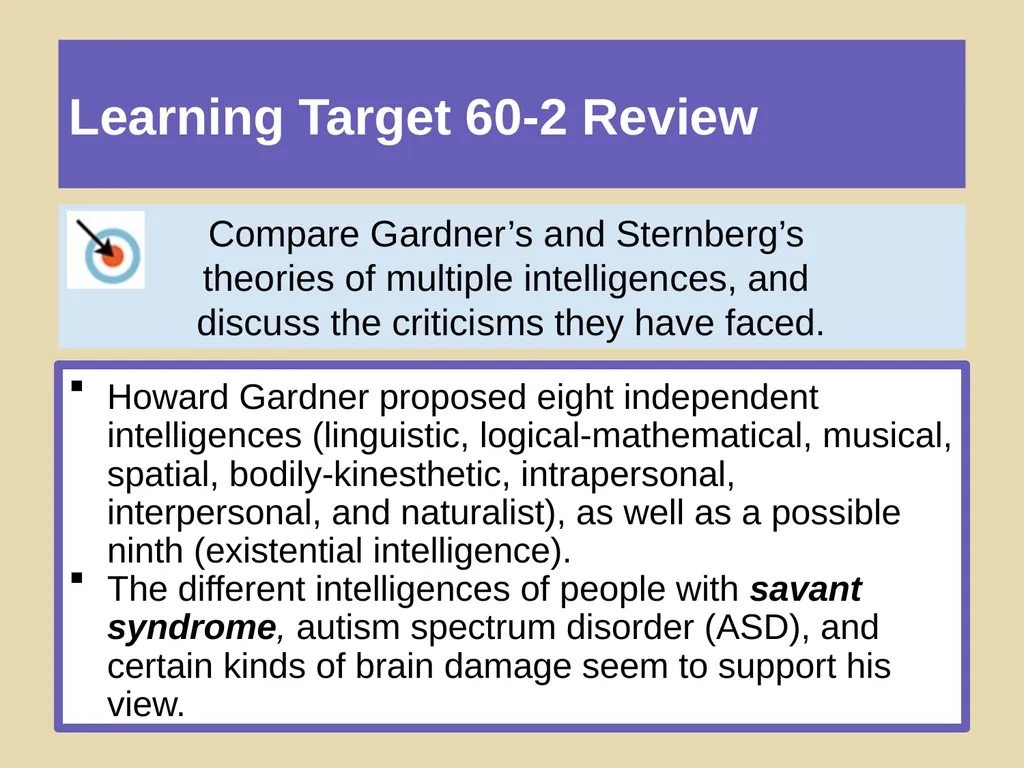
discuss the criticisms they have faced. Howard Gardner proposed eight independent intelligences (linguistic, logical-mathematical, musical, spatial, bodily-kinesthetic, intrapersonal, interpersonal, and naturalist), as well as a possible ninth (existential intelligence).
The different intelligences of people with savant syndrome, autism spectrum disorder (ASD), and certain kinds of brain damage seem to support his view.<br>
theories of multiple intelligences, and
discuss the criticisms they have faced. Howard Gardner proposed eight independent intelligences (linguistic, logical-mathematical, musical, spatial, bodily-kinesthetic, intrapersonal, interpersonal, and naturalist), as well as a possible ninth (existential intelligence).
The different intelligences of people with savant syndrome, autism spectrum disorder (ASD), and certain kinds of brain damage seem to support his view.<br>
34
Learning Target 60-2 Review cont. Compare Gardner’s and Sternberg’s
theories of multiple intelligences, and
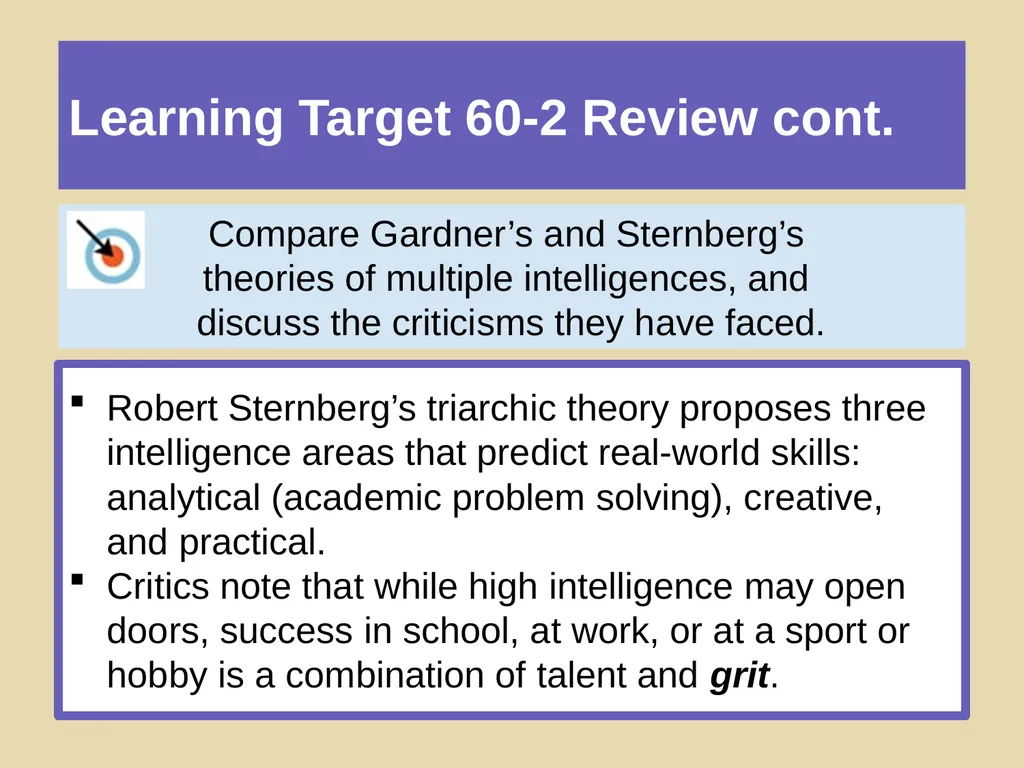
discuss the criticisms they have faced. Robert Sternberg’s triarchic theory proposes three intelligence areas that predict real-world skills: analytical (academic problem solving), creative, and practical.
Critics note that while high intelligence may open doors, success in school, at work, or at a sport or hobby is a combination of talent and grit.<br>
theories of multiple intelligences, and
discuss the criticisms they have faced. Robert Sternberg’s triarchic theory proposes three intelligence areas that predict real-world skills: analytical (academic problem solving), creative, and practical.
Critics note that while high intelligence may open doors, success in school, at work, or at a sport or hobby is a combination of talent and grit.<br>
35
Learning Target 60-3 Review Describe the four components of
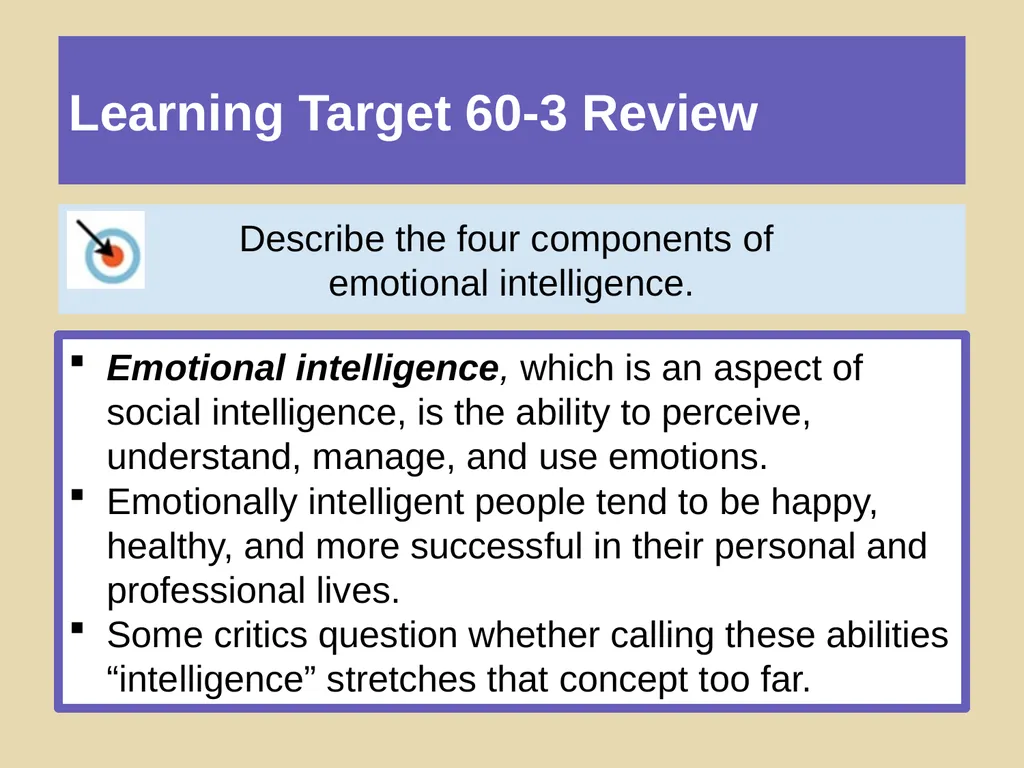
emotional intelligence. Emotional intelligence, which is an aspect of social intelligence, is the ability to perceive, understand, manage, and use emotions.
Emotionally intelligent people tend to be happy, healthy, and more successful in their personal and professional lives.
Some critics question whether calling these abilities “intelligence” stretches that concept too far.<br>
emotional intelligence. Emotional intelligence, which is an aspect of social intelligence, is the ability to perceive, understand, manage, and use emotions.
Emotionally intelligent people tend to be happy, healthy, and more successful in their personal and professional lives.
Some critics question whether calling these abilities “intelligence” stretches that concept too far.<br>