
Unit 12 Abnormal Behavior Module 69 Other
YM
Published · 41 slides · 0 views
1 / 1




Description
Unit 12 Abnormal Behavior Module 69 Other Disorders Learning Targets 69-1 Describe somatic symptom and related disorders. 69-2 Describe dissociative disorders, and explain why they are controversial. 69-3 Identify the three clusters of
Related Topics
Share
Embed code
Download this presentation From Below
"Unit 12 Abnormal Behavior Module 69 Other" is the property of its rightful owner. Permission is granted to download and print the materials on this website for personal, non-commercial use only, and to display it on your personal computer provided you do not modify the materials and that you retain all copyright notices contained in the materials. By downloading content from our website, you accept the terms of this agreement.
Presentation Transcript
01
Unit 12
Abnormal Behavior<br>
02
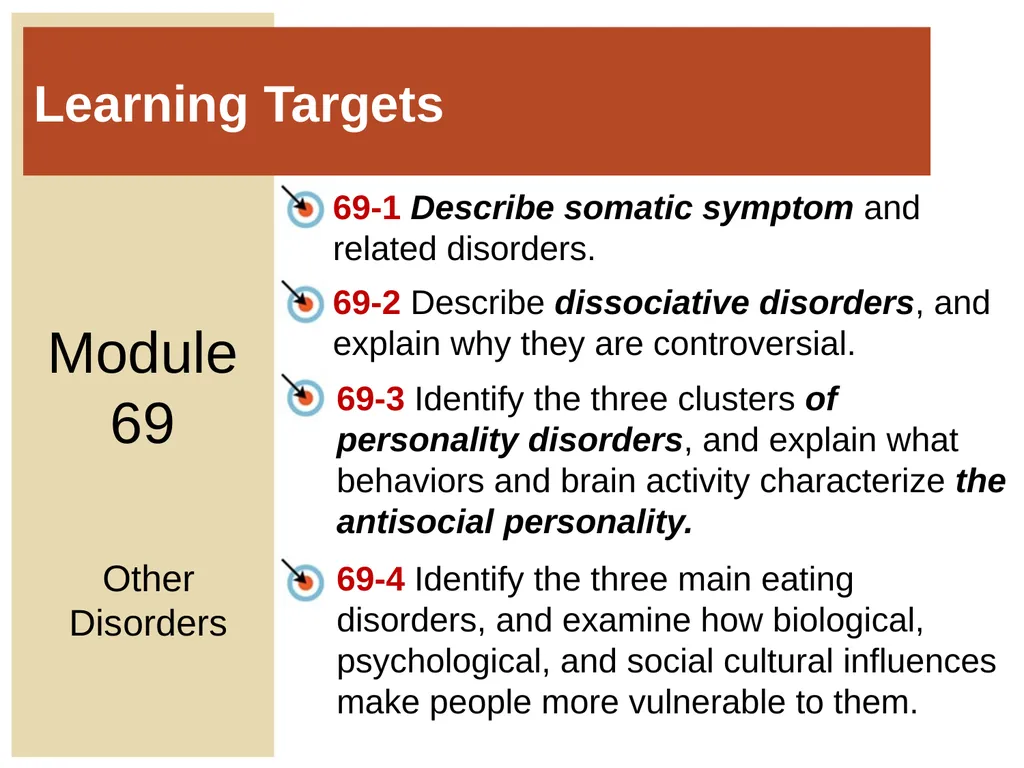
Module 69 Other Disorders Learning Targets 69-1 Describe somatic symptom and related disorders. 69-2 Describe dissociative disorders, and explain why they are controversial. 69-3 Identify the three clusters of personality disorders, and explain what behaviors and brain activity characterize the antisocial personality. 69-4 Identify the three main eating disorders, and examine how biological, psychological, and social cultural influences make people more vulnerable to them.<br>
03
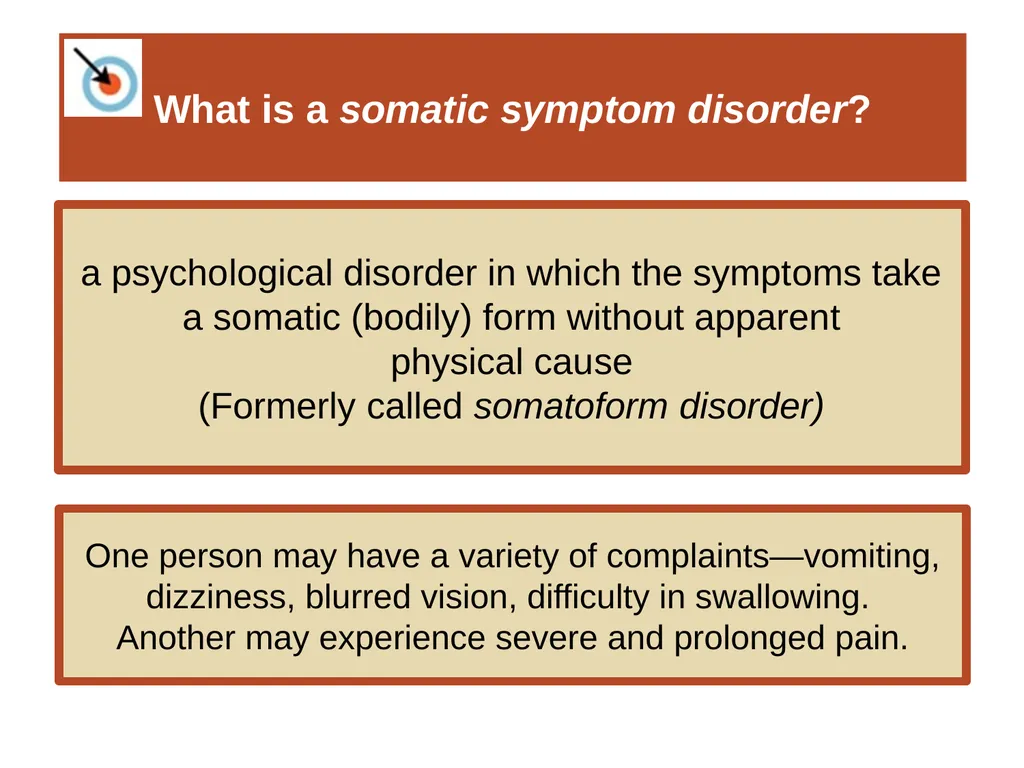
What is a somatic symptom disorder? a psychological disorder in which the symptoms take a somatic (bodily) form without apparent
physical cause
(Formerly called somatoform disorder) One person may have a variety of complaints—vomiting, dizziness, blurred vision, difficulty in swallowing.
Another may experience severe and prolonged pain.<br>
physical cause
(Formerly called somatoform disorder) One person may have a variety of complaints—vomiting, dizziness, blurred vision, difficulty in swallowing.
Another may experience severe and prolonged pain.<br>
04
What is a conversion disorder? a disorder in which a person experiences a very specific physical symptom that is not compatible with recognized medical or neurological conditions
(Also called functional neurological symptom disorder.) A patient with a conversion disorder might, for example, lose sensation in a way that makes no neurological sense. Other conversion disorder symptoms might be unexplained paralysis, blindness, or an inability to swallow.<br>
(Also called functional neurological symptom disorder.) A patient with a conversion disorder might, for example, lose sensation in a way that makes no neurological sense. Other conversion disorder symptoms might be unexplained paralysis, blindness, or an inability to swallow.<br>
05
What is illness anxiety disorder? a disorder in which a person interprets normal physical sensations as symptoms of a disease
(Formerly called hypochondriasis.) In this relatively common disorder, people interpret normal sensations (a stomach cramp today, a headache tomorrow) as symptoms of a dreaded disease.
Sympathy or temporary relief from everyday demands may reinforce such complaints.<br>
(Formerly called hypochondriasis.) In this relatively common disorder, people interpret normal sensations (a stomach cramp today, a headache tomorrow) as symptoms of a dreaded disease.
Sympathy or temporary relief from everyday demands may reinforce such complaints.<br>
06
What are dissociative disorders? controversial, rare disorders in which conscious awareness becomes separated (dissociated)
from previous memories, thoughts, and feelings The result may be a fugue state (not knowing who you are, perhaps accompanied by travel or relocation to a new place), a sudden loss of memory or change in identity, often in response to an overwhelmingly stressful situation.<br>
from previous memories, thoughts, and feelings The result may be a fugue state (not knowing who you are, perhaps accompanied by travel or relocation to a new place), a sudden loss of memory or change in identity, often in response to an overwhelmingly stressful situation.<br>
07
What is Dissociative Identity
Disorder (DID)? a rare dissociative disorder in which a
person exhibits two or more distinct and
alternating personalities
(Formerly called multiple personality disorder.) The disease is characterized by two or more distinct identities—each with its own voice and mannerisms—
seem to control a person’s behavior at different times. Thus, the person may be prim and proper one moment, loud and flirtatious the next.
Typically, the original personality denies any
awareness of the other(s).<br>
person exhibits two or more distinct and
alternating personalities
(Formerly called multiple personality disorder.) The disease is characterized by two or more distinct identities—each with its own voice and mannerisms—
seem to control a person’s behavior at different times. Thus, the person may be prim and proper one moment, loud and flirtatious the next.
Typically, the original personality denies any
awareness of the other(s).<br>
08
Could DID be an extension of
our normal capacity for personality shifts? Psychologist Nicholas Spanos asked college
students to pretend they were accused murderers being examined by a psychiatrist.
Under hypnosis, most spontaneously expressed a second personality. Perhaps dissociative identities are simply a more
extreme version of the varied “selves” we normally present—as when we display a goofy, loud
self while hanging out with friends, and a subdued, respectful self around grandparents.<br>
students to pretend they were accused murderers being examined by a psychiatrist.
Under hypnosis, most spontaneously expressed a second personality. Perhaps dissociative identities are simply a more
extreme version of the varied “selves” we normally present—as when we display a goofy, loud
self while hanging out with friends, and a subdued, respectful self around grandparents.<br>
09
How has the increase in diagnosis
caused doubt about the disorder? Skeptics also find it suspicious that the disorder
has such a short and localized history.
Between 1930 and 1960, the number of North American DID diagnoses averaged 2 per decade.
By the 1980s, when the American Psychiatric Association’s Diagnostic and Statistical
Manual of Mental Disorders (DSM) contained the first formal code for this disorder, the number had exploded to more than 20,000.
(McHugh, 1995a)<br>
has such a short and localized history.
Between 1930 and 1960, the number of North American DID diagnoses averaged 2 per decade.
By the 1980s, when the American Psychiatric Association’s Diagnostic and Statistical
Manual of Mental Disorders (DSM) contained the first formal code for this disorder, the number had exploded to more than 20,000.
(McHugh, 1995a)<br>
10
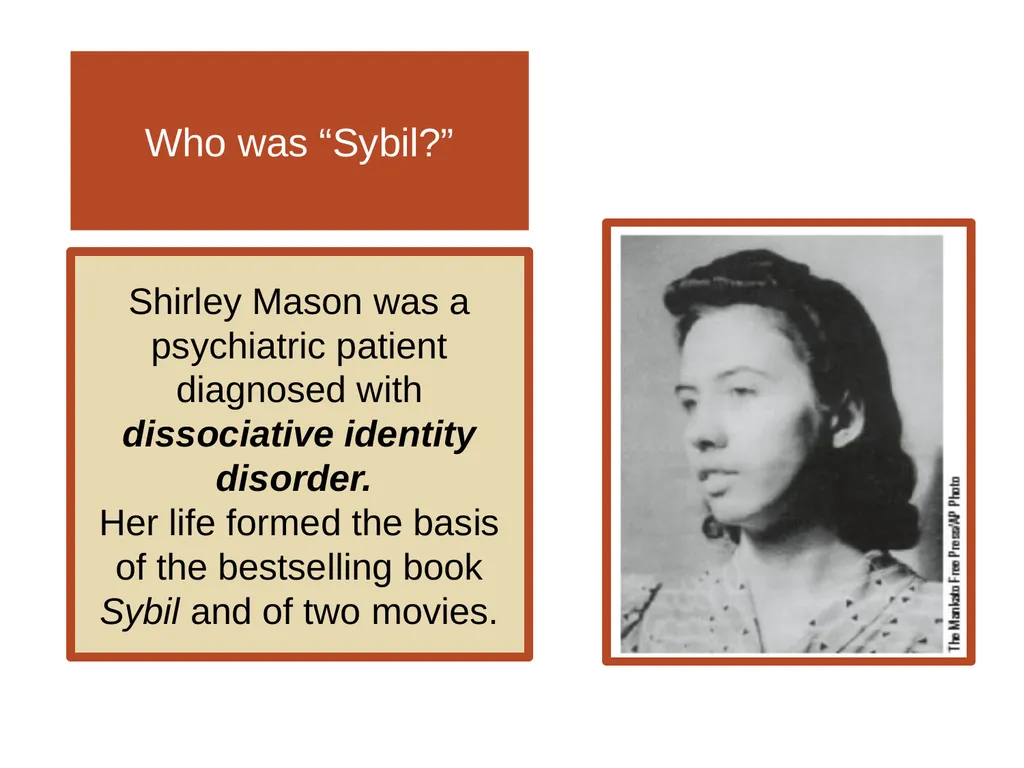
Who was “Sybil?” Shirley Mason was a psychiatric patient
diagnosed with dissociative identity disorder.
Her life formed the basis of the bestselling book Sybil and of two movies.<br>
diagnosed with dissociative identity disorder.
Her life formed the basis of the bestselling book Sybil and of two movies.<br>
11
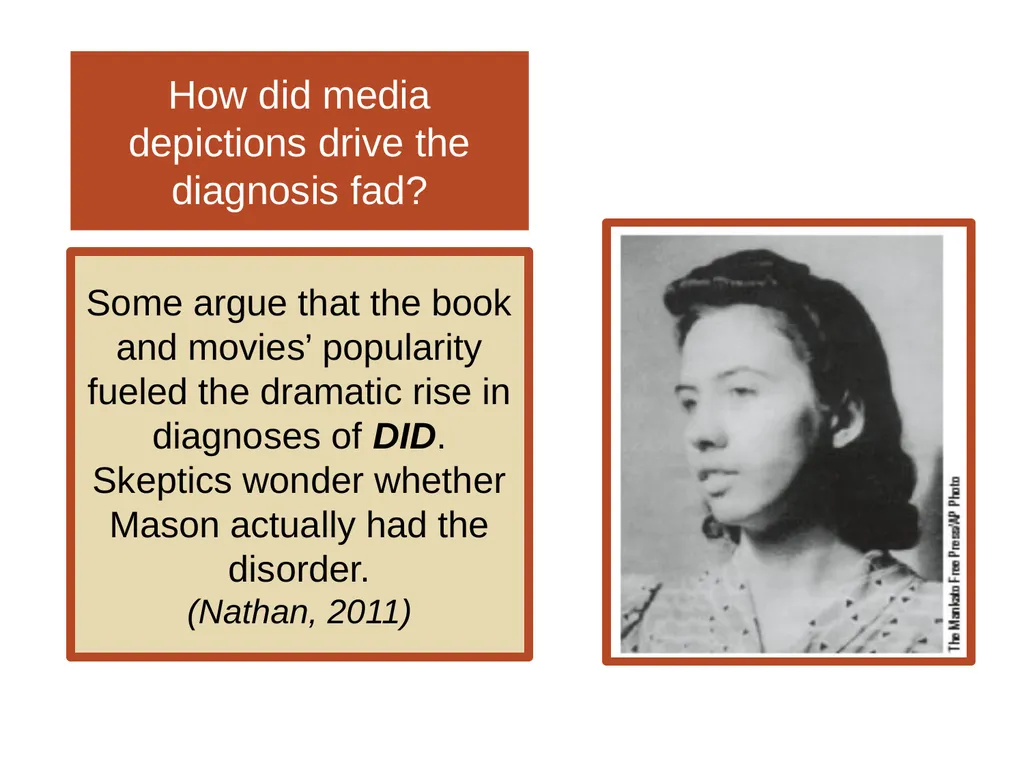
How did media depictions drive the diagnosis fad? Some argue that the book and movies’ popularity
fueled the dramatic rise in diagnoses of DID. Skeptics wonder whether
Mason actually had the disorder.
(Nathan, 2011)<br>
fueled the dramatic rise in diagnoses of DID. Skeptics wonder whether
Mason actually had the disorder.
(Nathan, 2011)<br>
12
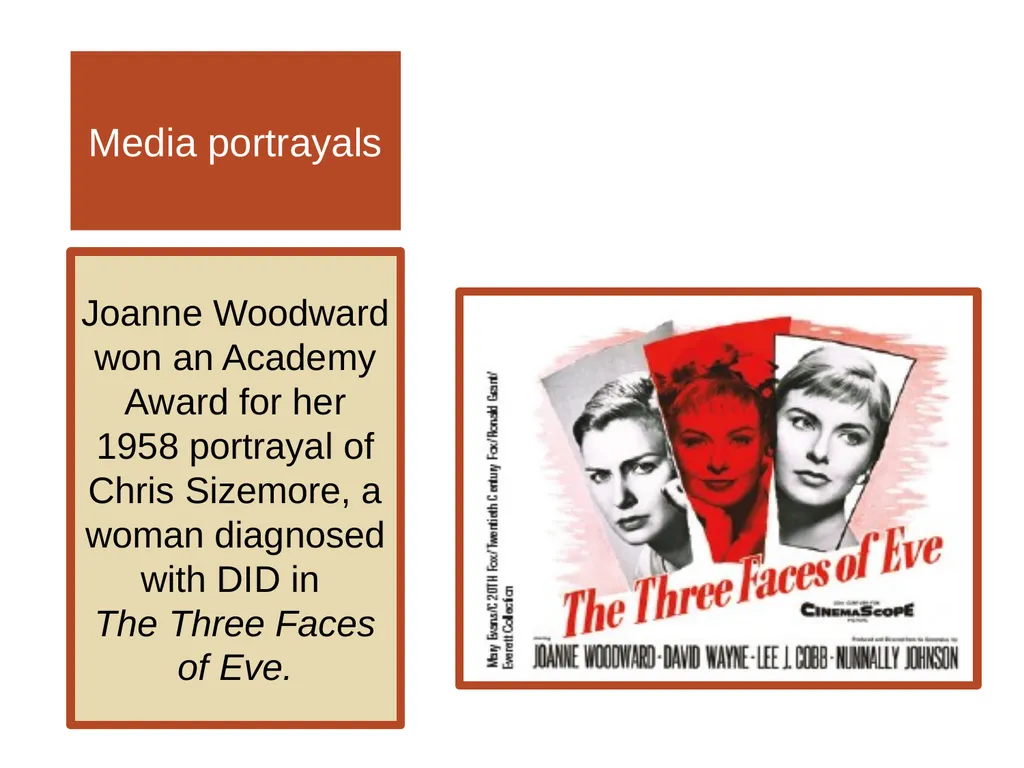
Media portrayals Joanne Woodward won an Academy Award for her 1958 portrayal of Chris Sizemore, a woman diagnosed with DID in
The Three Faces of Eve.<br>
The Three Faces of Eve.<br>
13
What research supports the
diagnosis of dissociative identity disorder? Researchers cite findings of distinct body and brain states associated with differing personalities. (Putnam, 1991) Abnormal brain anatomy and activity can also
accompany DID. Brain scans show shrinkage in
areas that aid memory and detection of threat.
(Vermetten et al., 2006) Heightened activity appears in brain areas associated with the control and inhibition of traumatic memories.
(Elzinga et al., 2007)<br>
accompany DID. Brain scans show shrinkage in
areas that aid memory and detection of threat.
(Vermetten et al., 2006) Heightened activity appears in brain areas associated with the control and inhibition of traumatic memories.
(Elzinga et al., 2007)<br>
14
How do the psychodynamic and learning perspectives view DID? Both the psychodynamic and learning perspectives have interpreted DID symptoms as ways of coping with anxiety.
Some psychodynamic theorists see DID symptoms as defenses against the anxiety caused by the eruption of unacceptable impulses. In this view, a second personality enables the discharge of forbidden impulses.
Learning theorists see dissociative disorders as behaviors reinforced by anxiety reduction.<br>
Some psychodynamic theorists see DID symptoms as defenses against the anxiety caused by the eruption of unacceptable impulses. In this view, a second personality enables the discharge of forbidden impulses.
Learning theorists see dissociative disorders as behaviors reinforced by anxiety reduction.<br>
15
1. What Would You Answer? Adela regularly interprets everyday aches and pains, such as stomach cramps and headaches, as serious medical problems. Her doctor is unable to convince her that her problems are not serious, so she turns to other doctors. Adela may suffer from
A. dissociative identity disorder.
B. conversion disorder.
C. a fugue state.
D. illness anxiety disorder.
E. somatic symptom disorder.<br>
A. dissociative identity disorder.
B. conversion disorder.
C. a fugue state.
D. illness anxiety disorder.
E. somatic symptom disorder.<br>
16
What are personality disorders? inflexible and enduring behavior patterns
that impair social functioning The inflexible and enduring behavior patterns of personality disorders interfere with social functioning.
The ten disorders in DSM-5 tend to form three clusters characterized by anxiety, eccentric behavior or dramatic and impulsive behavior.<br>
that impair social functioning The inflexible and enduring behavior patterns of personality disorders interfere with social functioning.
The ten disorders in DSM-5 tend to form three clusters characterized by anxiety, eccentric behavior or dramatic and impulsive behavior.<br>
17
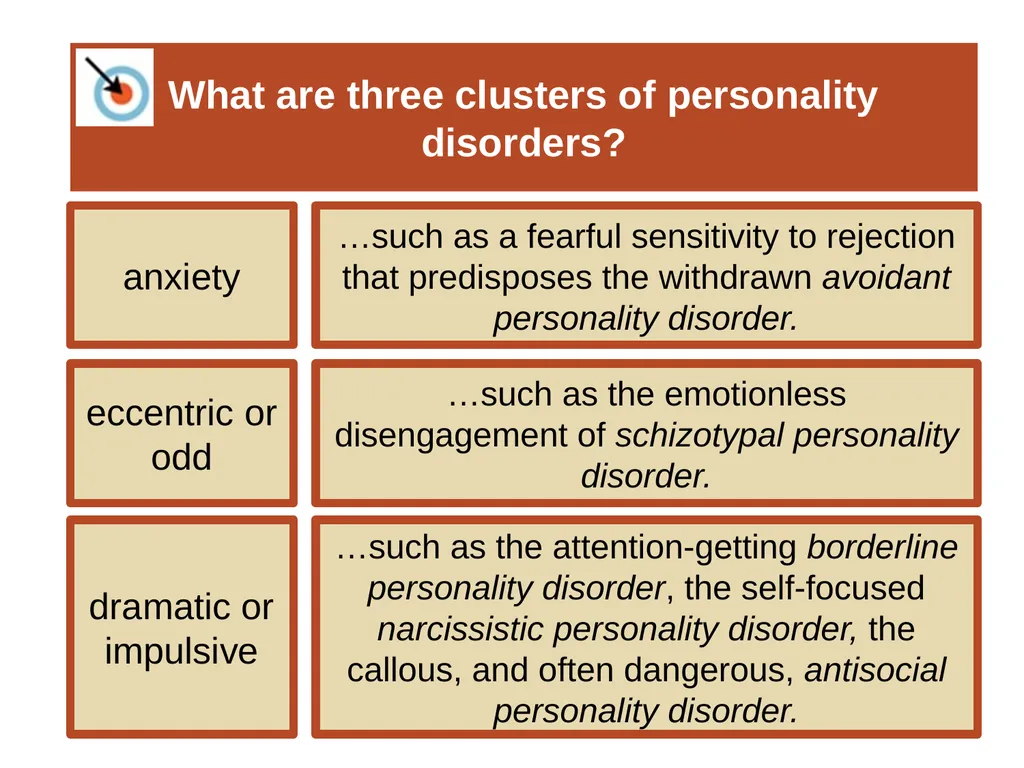
What are three clusters of personality disorders? anxiety …such as a fearful sensitivity to rejection that predisposes the withdrawn avoidant personality disorder. eccentric or odd …such as the emotionless disengagement of schizotypal personality disorder. dramatic or impulsive …such as the attention-getting borderline personality disorder, the self-focused narcissistic personality disorder, the callous, and often dangerous, antisocial personality disorder.<br>
18
What is antisocial personality disorder? a personality disorder in which a person (usually a man) exhibits a lack of conscience for wrongdoing, even toward friends and family members; may be
aggressive and ruthless or a clever con artist People with antisocial personality disorder can display symptoms by age 8.
Their lack of conscience becomes plain before age 15, as they begin to lie, steal, fight, or display unrestrained sexual behavior.
(Cale & Lilienfeld, 2002)<br>
aggressive and ruthless or a clever con artist People with antisocial personality disorder can display symptoms by age 8.
Their lack of conscience becomes plain before age 15, as they begin to lie, steal, fight, or display unrestrained sexual behavior.
(Cale & Lilienfeld, 2002)<br>
19
Is there a correlation between emotional
intelligence and antisocial
personality disorder? People with antisocial personality disorder (sometimes called sociopaths or psychopaths)
may show lower emotional intelligence—
the ability to understand, manage,
and perceive emotions.
(Ermer et al., 2012)<br>
may show lower emotional intelligence—
the ability to understand, manage,
and perceive emotions.
(Ermer et al., 2012)<br>
20
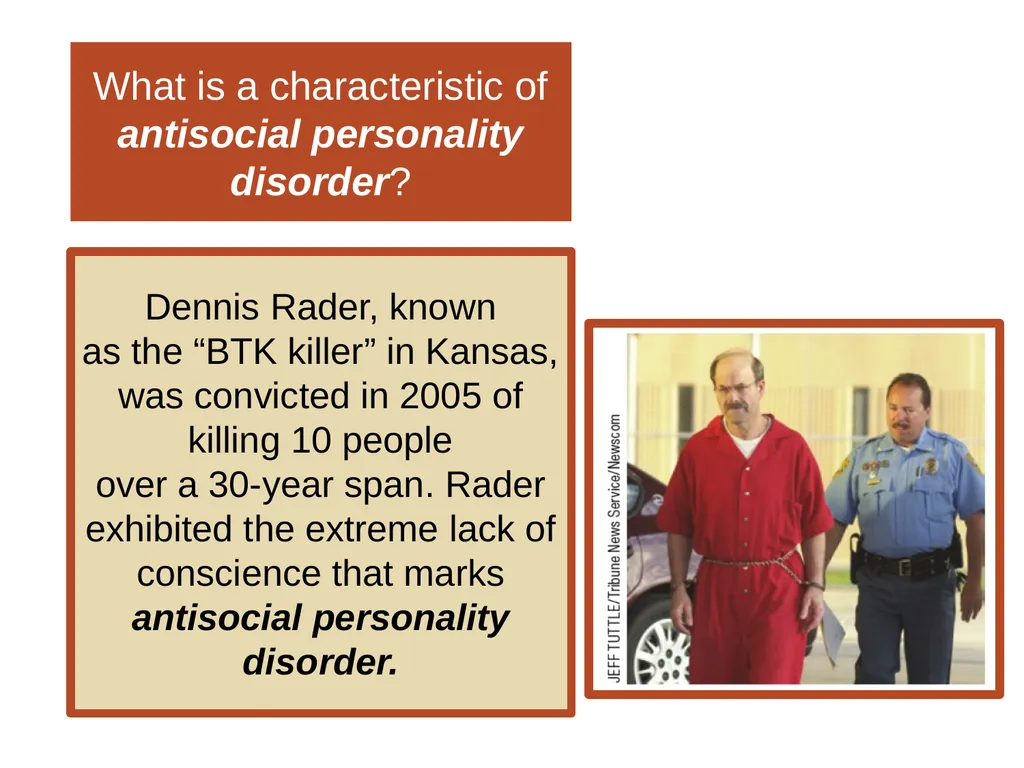
What is a characteristic of antisocial personality disorder? Dennis Rader, known
as the “BTK killer” in Kansas, was convicted in 2005 of killing 10 people
over a 30-year span. Rader exhibited the extreme lack of conscience that marks antisocial personality disorder.<br>
as the “BTK killer” in Kansas, was convicted in 2005 of killing 10 people
over a 30-year span. Rader exhibited the extreme lack of conscience that marks antisocial personality disorder.<br>
21
Do all criminals have antisocial personality disorder? Despite their remorseless and sometimes criminal behavior, criminality is not an essential component of antisocial behavior.
(Skeem & Cooke, 2010)
Many criminals do not fit the description of antisocial personality disorder; they’re not impulsive and they care for family and friends.
(Geurts et al., 2016)<br>
(Skeem & Cooke, 2010)
Many criminals do not fit the description of antisocial personality disorder; they’re not impulsive and they care for family and friends.
(Geurts et al., 2016)<br>
22
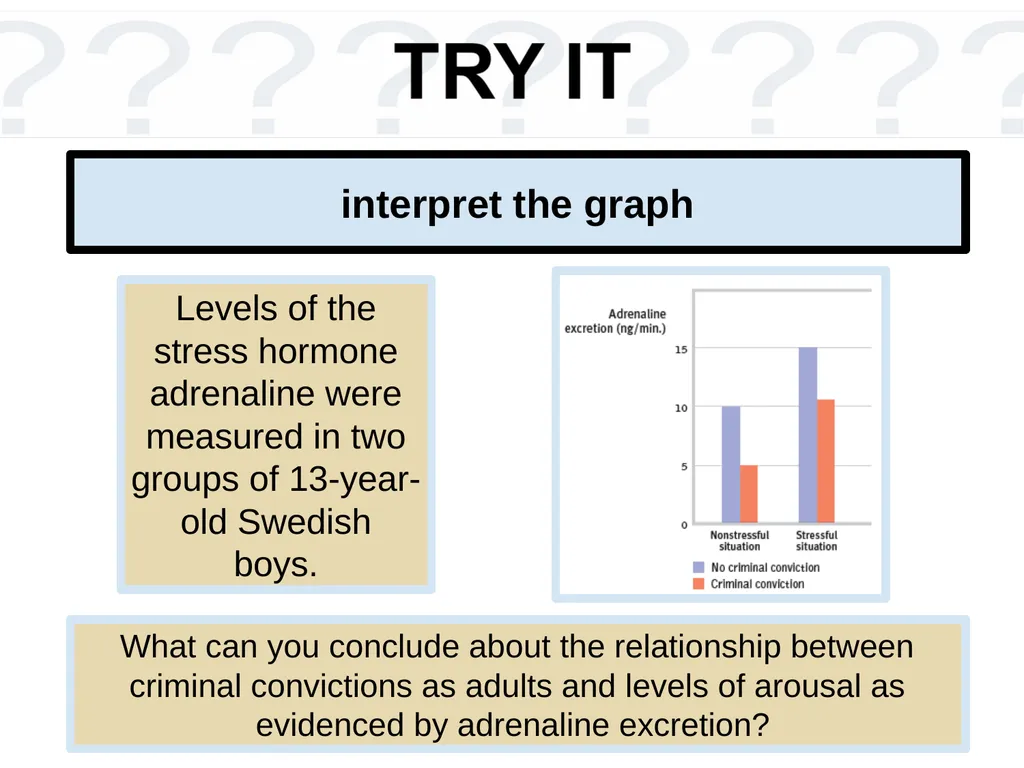
interpret the graph Levels of the stress hormone
adrenaline were measured in two
groups of 13-year-old Swedish
boys. What can you conclude about the relationship between criminal convictions as adults and levels of arousal as evidenced by adrenaline excretion?<br>
adrenaline were measured in two
groups of 13-year-old Swedish
boys. What can you conclude about the relationship between criminal convictions as adults and levels of arousal as evidenced by adrenaline excretion?<br>
23
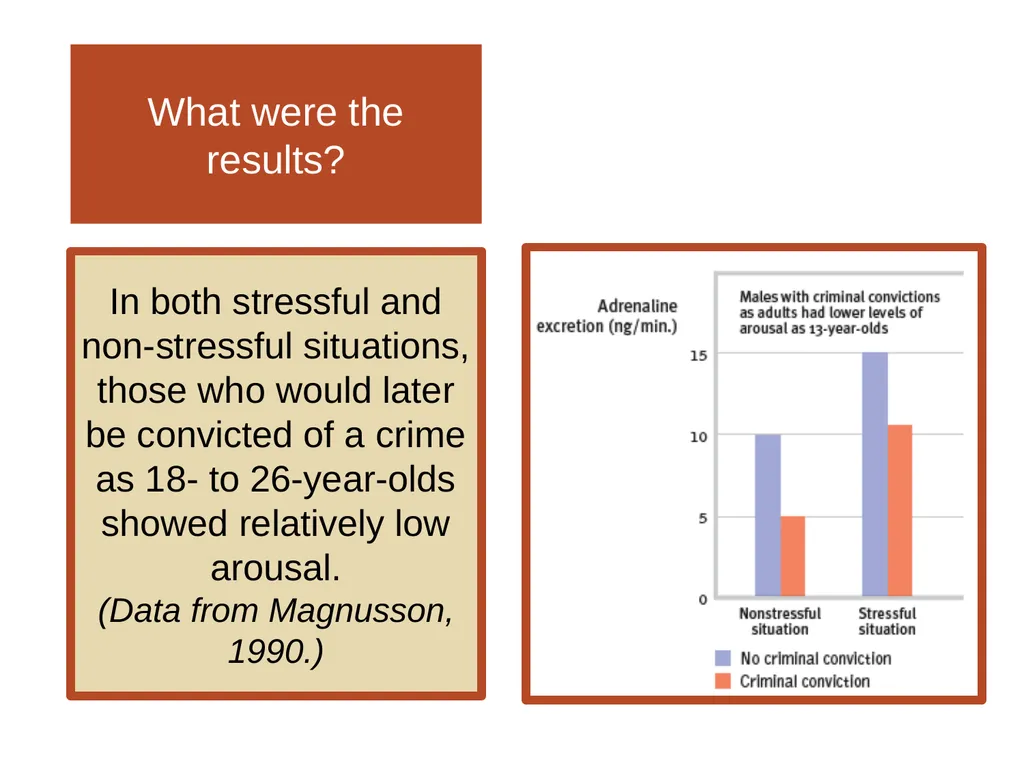
What were the results? In both stressful and
non-stressful situations, those who would later be convicted of a crime as 18- to 26-year-olds showed relatively low arousal.
(Data from Magnusson, 1990.)<br>
non-stressful situations, those who would later be convicted of a crime as 18- to 26-year-olds showed relatively low arousal.
(Data from Magnusson, 1990.)<br>
24
What are genetic factors in antisocial personality disorder? The genetic vulnerability of people with antisocial and unemotional tendencies appears as low arousal in response to threats.
Awaiting aversive events, such as electric shocks or
loud noises, they show little autonomic nervous system arousal.
(Hare, 1975; Hoppenbrouwers et al., 2016) Other studies have found that preschool boys who later became aggressive or antisocial adolescents tended to be impulsive, uninhibited, unconcerned with social rewards, and low in anxiety.
(Caspi et al., 1996; Tremblay et al., 1994).<br>
Awaiting aversive events, such as electric shocks or
loud noises, they show little autonomic nervous system arousal.
(Hare, 1975; Hoppenbrouwers et al., 2016) Other studies have found that preschool boys who later became aggressive or antisocial adolescents tended to be impulsive, uninhibited, unconcerned with social rewards, and low in anxiety.
(Caspi et al., 1996; Tremblay et al., 1994).<br>
25
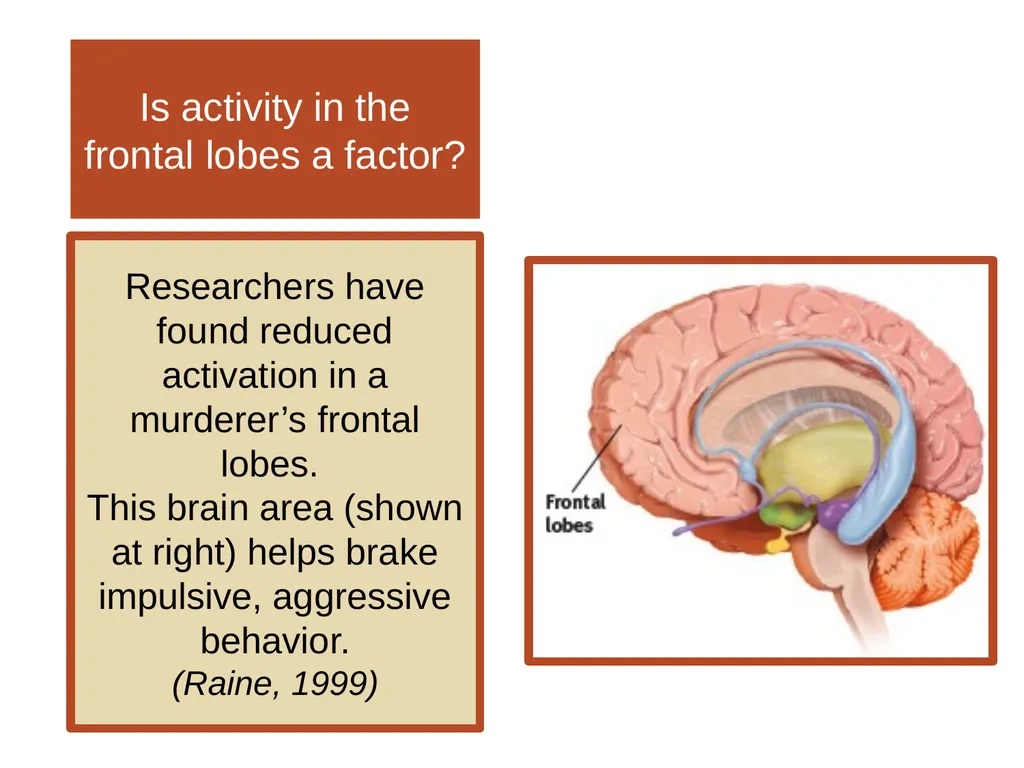
Is activity in the frontal lobes a factor? Researchers have found reduced
activation in a murderer’s frontal
lobes.
This brain area (shown at right) helps brake
impulsive, aggressive behavior.
(Raine, 1999)<br>
activation in a murderer’s frontal
lobes.
This brain area (shown at right) helps brake
impulsive, aggressive behavior.
(Raine, 1999)<br>
26
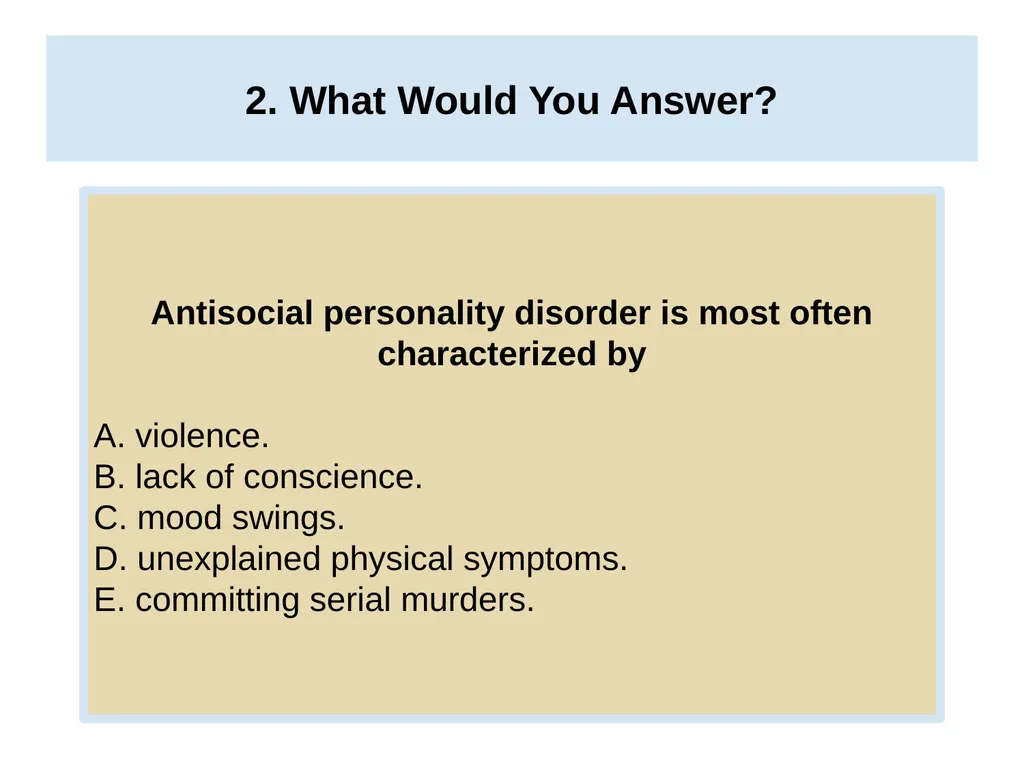
2. What Would You Answer? Antisocial personality disorder is most often characterized by
A. violence.
B. lack of conscience.
C. mood swings.
D. unexplained physical symptoms.
E. committing serial murders.<br>
A. violence.
B. lack of conscience.
C. mood swings.
D. unexplained physical symptoms.
E. committing serial murders.<br>
27
What is anorexia nervosa? a feeding and eating disorder in which a person
(usually an adolescent female) maintains a starvation diet despite being significantly underweight; sometimes accompanied by excessive exercise Anorexia nervosa typically begins as a weight-loss diet. People with anorexia drop significantly below normal weight, yet they feel fat, fear being fat, diet obsessively,
and sometimes exercise excessively.
About half of those with anorexia display a
binge-purge-depression cycle.<br>
(usually an adolescent female) maintains a starvation diet despite being significantly underweight; sometimes accompanied by excessive exercise Anorexia nervosa typically begins as a weight-loss diet. People with anorexia drop significantly below normal weight, yet they feel fat, fear being fat, diet obsessively,
and sometimes exercise excessively.
About half of those with anorexia display a
binge-purge-depression cycle.<br>
28
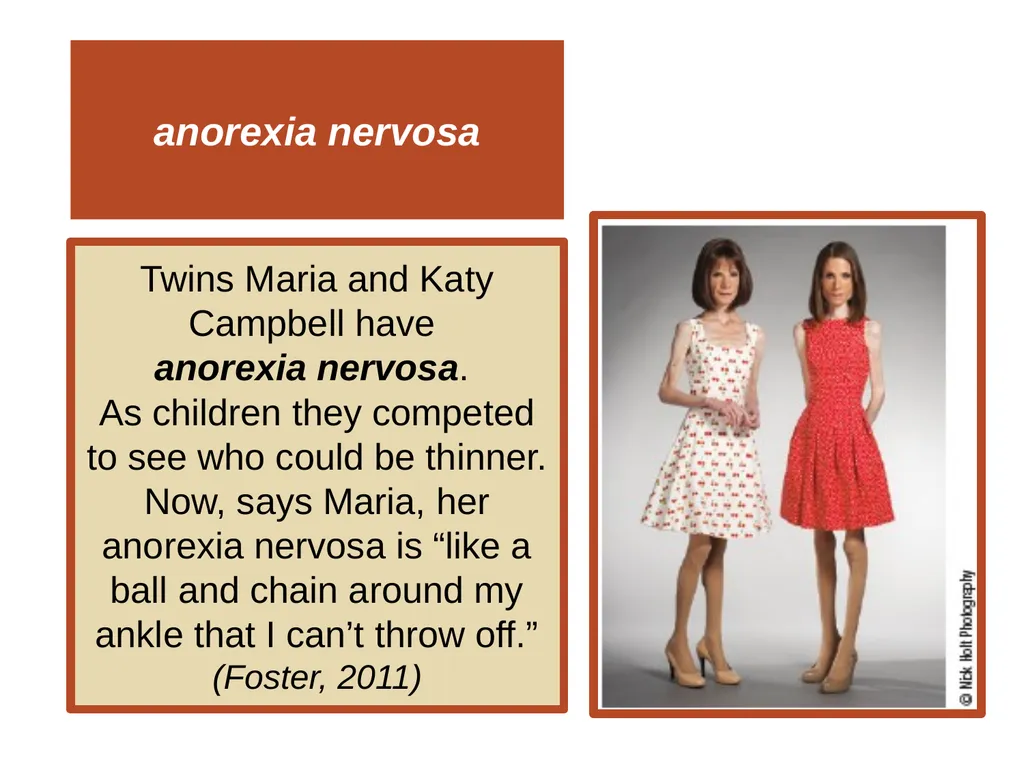
anorexia nervosa Twins Maria and Katy Campbell have
anorexia nervosa.
As children they competed to see who could be thinner. Now, says Maria, her anorexia nervosa is “like a
ball and chain around my ankle that I can’t throw off.” (Foster, 2011)<br>
anorexia nervosa.
As children they competed to see who could be thinner. Now, says Maria, her anorexia nervosa is “like a
ball and chain around my ankle that I can’t throw off.” (Foster, 2011)<br>
29
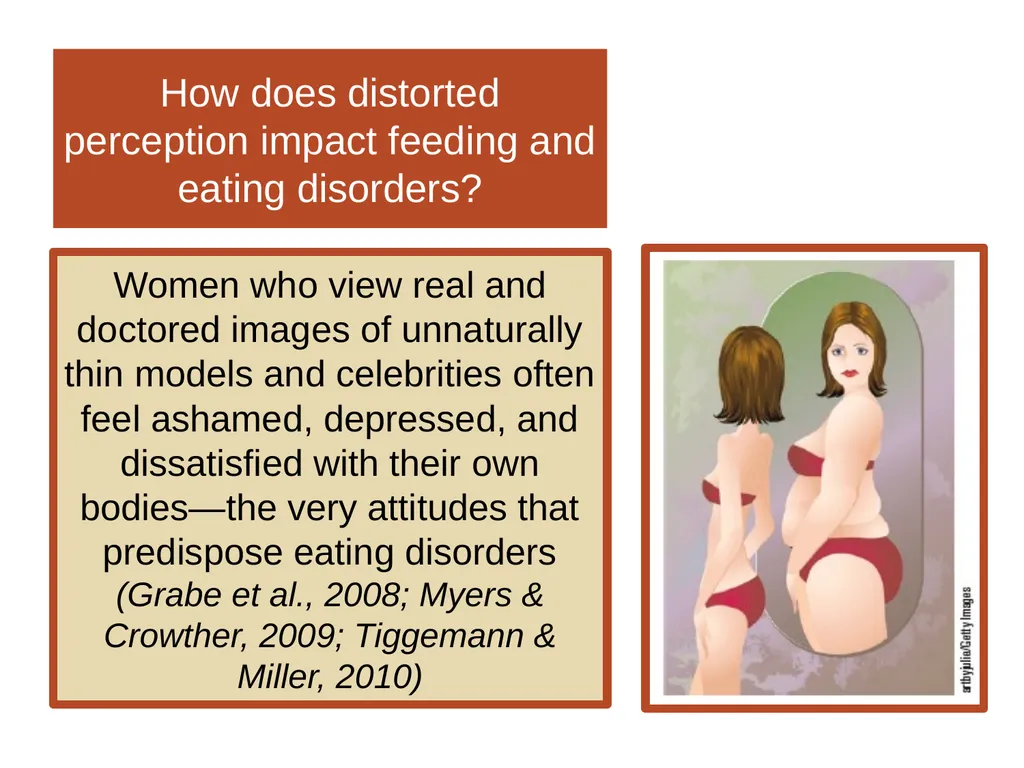
How does distorted perception impact feeding and eating disorders? Women who view real and doctored images of unnaturally thin models and celebrities often feel ashamed, depressed, and
dissatisfied with their own bodies—the very attitudes that predispose eating disorders (Grabe et al., 2008; Myers & Crowther, 2009; Tiggemann & Miller, 2010)<br>
dissatisfied with their own bodies—the very attitudes that predispose eating disorders (Grabe et al., 2008; Myers & Crowther, 2009; Tiggemann & Miller, 2010)<br>
30
What is bulimia nervosa? a feeding and eating disorder in which a person’s binge eating (usually of high-calorie foods) is followed by inappropriate weight-loss promoting behavior,
such as vomiting, laxative use, fasting, or excessive exercise Bulimia nervosa, unlike anorexia nervosa, is marked by weight fluctuations within or above normal ranges, making the condition easier to hide.
Bulimia may also be triggered by a weight-loss diet, broken by gorging on forbidden foods.<br>
such as vomiting, laxative use, fasting, or excessive exercise Bulimia nervosa, unlike anorexia nervosa, is marked by weight fluctuations within or above normal ranges, making the condition easier to hide.
Bulimia may also be triggered by a weight-loss diet, broken by gorging on forbidden foods.<br>
31
What is binge eating disorder? a feeding and eating disorder characterized by significant binge-eating episodes, followed by distress, disgust, or guilt, but without the compensatory behavior (purging, fasting or excessive exercise) that marks bulimia nervosa A U.S. National Institute of Mental Health-funded study
reported that, at some point during their lifetime, 0.6% of Americans met the criteria for anorexia, 1% for bulimia, and 2.8% for binge-eating disorder.
(Hudson et al., 2007)<br>
reported that, at some point during their lifetime, 0.6% of Americans met the criteria for anorexia, 1% for bulimia, and 2.8% for binge-eating disorder.
(Hudson et al., 2007)<br>
32
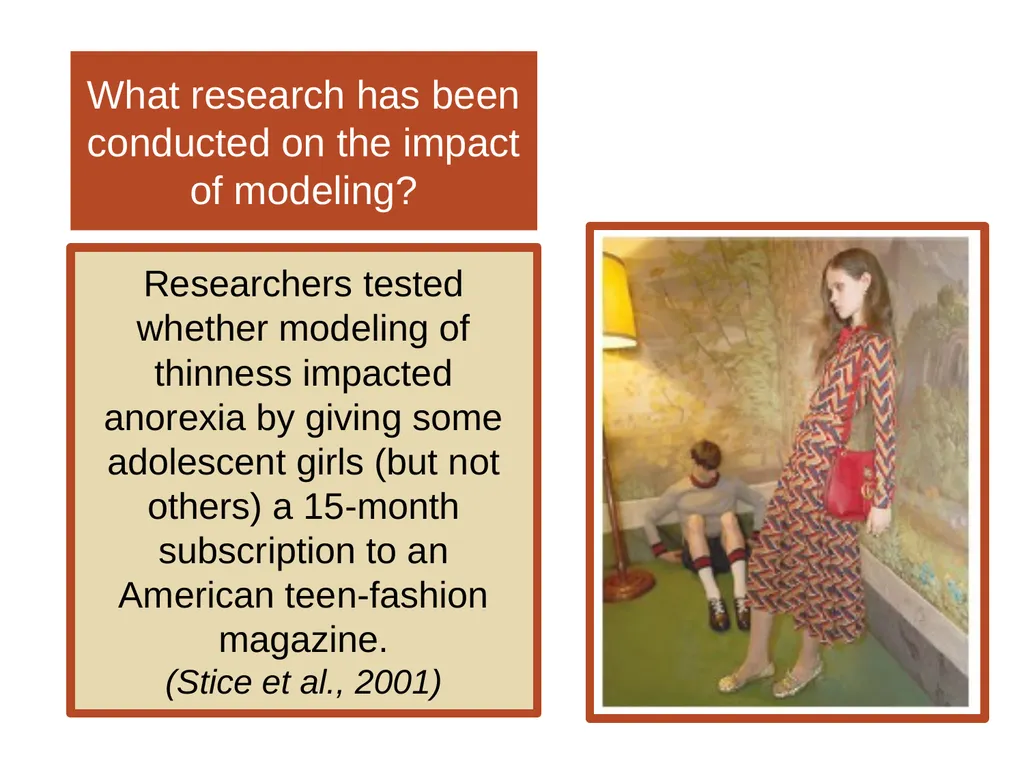
What research has been conducted on the impact of modeling? Researchers tested whether modeling of thinness impacted anorexia by giving some adolescent girls (but not others) a 15-month subscription to an American teen-fashion magazine.
(Stice et al., 2001)<br>
(Stice et al., 2001)<br>
33
What were the results of the study? Compared with those who had not received the magazine,
vulnerable girls—defined as those who were already dissatisfied, idealizing thinness, and lacking social support—exhibited increased body dissatisfaction and eating disorder tendencies.<br>
vulnerable girls—defined as those who were already dissatisfied, idealizing thinness, and lacking social support—exhibited increased body dissatisfaction and eating disorder tendencies.<br>
34
Learning Target 69-1 Review Describe somatic symptom
and related disorders. Somatic symptom disorder presents a somatic (bodily) symptom—a physiologically unexplained but genuinely felt ailment.
In the related conversion disorder (also called functional neurological symptom disorder), anxiety appears converted to a physical symptom that has no reasonable neurological or medical basis.
The more common illness anxiety disorder, another related disorder, involves the interpretation of normal sensations as a dreaded disorder.<br>
and related disorders. Somatic symptom disorder presents a somatic (bodily) symptom—a physiologically unexplained but genuinely felt ailment.
In the related conversion disorder (also called functional neurological symptom disorder), anxiety appears converted to a physical symptom that has no reasonable neurological or medical basis.
The more common illness anxiety disorder, another related disorder, involves the interpretation of normal sensations as a dreaded disorder.<br>
35
Learning Target 69-2 Review Describe dissociative disorders,
and explain why they are controversial. Dissociative disorders are conditions in which conscious awareness seems to become separated from previous memories, thoughts, and feelings.<br>
and explain why they are controversial. Dissociative disorders are conditions in which conscious awareness seems to become separated from previous memories, thoughts, and feelings.<br>
36
Learning Target 69-2 Review cont. Describe dissociative disorders,
and explain why they are controversial. Skeptics note that dissociative identity disorder, formerly known as multiple personality disorder, increased dramatically in the late twentieth century, that it is rarely found outside North America, and that it may reflect role-playing by people who are vulnerable to therapists’ suggestions.
Others view this disorder as a manifestation of feelings of anxiety, or as a response learned when behaviors are reinforced by anxiety reduction.<br>
and explain why they are controversial. Skeptics note that dissociative identity disorder, formerly known as multiple personality disorder, increased dramatically in the late twentieth century, that it is rarely found outside North America, and that it may reflect role-playing by people who are vulnerable to therapists’ suggestions.
Others view this disorder as a manifestation of feelings of anxiety, or as a response learned when behaviors are reinforced by anxiety reduction.<br>
37
Learning Target 69-3 Review Identify the three clusters of personality
disorders. Personality disorders are disruptive, inflexible, and enduring behavior patterns that impair social functioning.
These disorders form clusters, based on three main characteristics:
(1) anxiety;
(2) eccentric or odd behaviors; and
(3) dramatic or impulsive behaviors.<br>
disorders. Personality disorders are disruptive, inflexible, and enduring behavior patterns that impair social functioning.
These disorders form clusters, based on three main characteristics:
(1) anxiety;
(2) eccentric or odd behaviors; and
(3) dramatic or impulsive behaviors.<br>
38
Learning Target 69-3 Review cont. Explain what behaviors and brain activity
characterize the antisocial personality. Antisocial personality disorder is characterized by a lack of conscience and, sometimes, by aggressive and fearless behavior.
The amygdala is smaller and the frontal lobes less active in people with this disorder, leading to impaired frontal lobe cognitive functions and decreased responsiveness to others’ distress.
Genetic predispositions may interact with the environment to produce these characteristics.<br>
characterize the antisocial personality. Antisocial personality disorder is characterized by a lack of conscience and, sometimes, by aggressive and fearless behavior.
The amygdala is smaller and the frontal lobes less active in people with this disorder, leading to impaired frontal lobe cognitive functions and decreased responsiveness to others’ distress.
Genetic predispositions may interact with the environment to produce these characteristics.<br>
39
Learning Target 69-4 Review Identify the three main eating disorders,
and examine how biological,
psychological, and social cultural influences
make people more vulnerable to them. Anorexia nervosa, bulimia nervosa, and binge-eating disorder are the three main eating disorders.
Despite being significantly underweight, people with anorexia nervosa (usually adolescent females) continue to diet because they view themselves as fat.<br>
and examine how biological,
psychological, and social cultural influences
make people more vulnerable to them. Anorexia nervosa, bulimia nervosa, and binge-eating disorder are the three main eating disorders.
Despite being significantly underweight, people with anorexia nervosa (usually adolescent females) continue to diet because they view themselves as fat.<br>
40
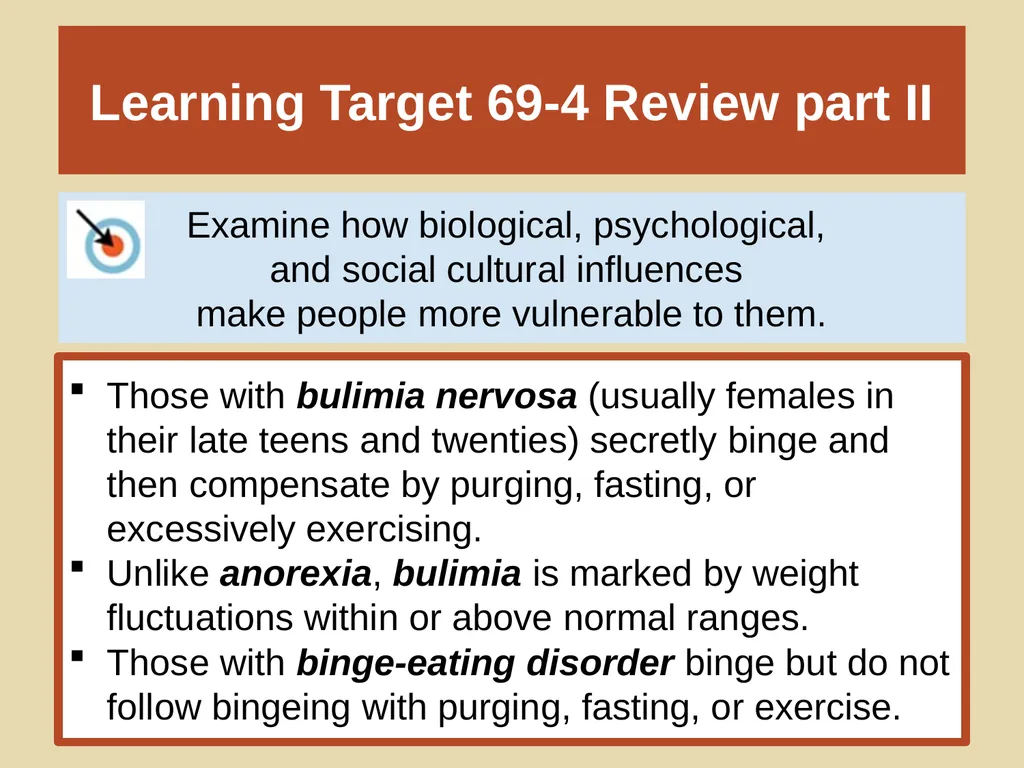
Learning Target 69-4 Review part II Examine how biological, psychological,
and social cultural influences
make people more vulnerable to them. Those with bulimia nervosa (usually females in their late teens and twenties) secretly binge and then compensate by purging, fasting, or excessively exercising.
Unlike anorexia, bulimia is marked by weight fluctuations within or above normal ranges.
Those with binge-eating disorder binge but do not follow bingeing with purging, fasting, or exercise.<br>
and social cultural influences
make people more vulnerable to them. Those with bulimia nervosa (usually females in their late teens and twenties) secretly binge and then compensate by purging, fasting, or excessively exercising.
Unlike anorexia, bulimia is marked by weight fluctuations within or above normal ranges.
Those with binge-eating disorder binge but do not follow bingeing with purging, fasting, or exercise.<br>
41
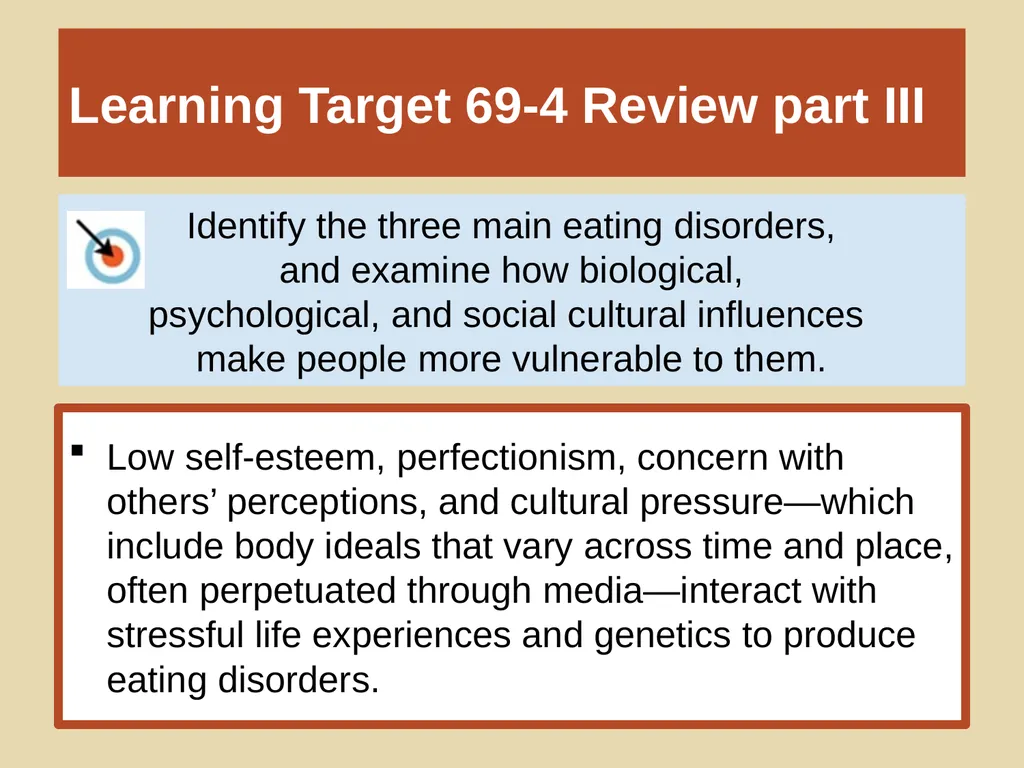
Learning Target 69-4 Review part III Identify the three main eating disorders,
and examine how biological,
psychological, and social cultural influences
make people more vulnerable to them. Low self-esteem, perfectionism, concern with others’ perceptions, and cultural pressure—which include body ideals that vary across time and place, often perpetuated through media—interact with stressful life experiences and genetics to produce eating disorders.<br>
and examine how biological,
psychological, and social cultural influences
make people more vulnerable to them. Low self-esteem, perfectionism, concern with others’ perceptions, and cultural pressure—which include body ideals that vary across time and place, often perpetuated through media—interact with stressful life experiences and genetics to produce eating disorders.<br>