
Unit 1Introduction to Group Work 1.4 Theoretical


Description: Unit 1Introduction to Group Work 1.4 Theoretical assumptions underlying social group work Dr. Jaimon Varghese 13-Jan-24 Social Group Work 1 Systems theory Psychodynamic theory Learning theory Field theory Social exchange theory Theoretical
Related Topics
Download Presentation
"Unit 1Introduction to Group Work 1.4 Theoretical" is the property of its rightful owner. Permission is granted to download and print the materials on this website for personal, non-commercial use only, and to display it on your personal computer provided you do not modify the materials and that you retain all copyright notices contained in the materials. By downloading content from our website, you accept the terms of this agreement.
Presentation Transcript
slide1. Unit 1Introduction to Group Work
1.4 Theoretical assumptions underlying social group work Dr. Jaimon Varghese 13-Jan-24 Social Group Work 1<br>
slide2. Systems theory
Psychodynamic theory
Learning theory
Field theory
Social exchange theory Theoretical assumptions underlying social group work (Thomas, 2010:189-196) 13-Jan-24 Social Group Work 2<br>
slide3. Groups are social systems with several interdependent members attempting to maintain order and a stable equilibrium while they function as a unified whole
constantly facing changing demands in their quest to attain goals and to maintain a stable equilibrium.
mobilize their resources and act to meet changing demands if they are to survive. Systems theory (Thomas, 2010:189-196) 13-Jan-24 Social Group Work 3<br>
slide4. Four major functional tasks for systems:
1) integration – ensuring that members of groups fit together;
2) adaptation – ensuring that groups change to cope with the demands of their environment;
3) pattern maintenance – ensuring that groups define and sustain their basic purposes, identities and procedures;
4) goal attainment – ensuring that groups pursue and accomplish their tasks 13-Jan-24 Social Group Work 4<br>
slide5. Groups have an internal system and an external system:
1) internal system consists of the patterns of activities, interactions, and norms occurring within the group as it attempts to function
2) external system represents a group’s way of handling the adaptive problems that result from its relationship with its social and physical environment 13-Jan-24 Social Group Work 5<br>
slide6. While interacting with the environment, groups are in a constant state of becoming, developing, and changing, which influence their equilibrium and continued existence 13-Jan-24 Social Group Work 6<br>
slide7. Freud (1922) Group Psychology & the Analysis of Ego
According to psychodynamic theory, group members act out in the group unresolved conflicts from early life experiences.
The group becomes a re-enactment of the family situation (Dear Zindagi).
Group leader as the all-powerful father figure reigns supreme over group members & the members identify with the group leader as the ‘ego-ideal’. Psychodynamic theory (Thomas, 2010:189-196) 13-Jan-24 Social Group Work 7<br>
slide8. Members form transference reactions to the group leader and to each other on the basis of their early life experiences.
The interactions that occur in the group reflect the personality structures and defense mechanisms that members began to develop early in life.
The group leader uses transference and counter transference reactions to help members work through unresolved conflicts by exploring past behaviour patterns and linking these patterns to current behaviours. 13-Jan-24 Social Group Work 8<br>
slide9. The group leader might interpret the behaviour of two group members who are struggling for the leader’s attention as unresolved sibling rivalry.
When interpretations made by the group worker are timed appropriately, members gain insight into their own behaviour.
According to the psychodynamic theory, insight is the essential ingredient in modifying and changing behaviour patterns inside and outside the group 13-Jan-24 Social Group Work 9<br>
slide10. From an analysis of the immediate behaviour patterns in the microcosm of the group, the leader can help members reconstruct unresolved childhood conflicts and have corrective emotional experiences.
Through direct, mutual interpersonal communications, members build interpersonal skills, adaptive capacities, and ego-strength, as well as gain insight into their behaviour.
The cohesiveness of the group encourages members to reveal intimate details about their personal lives and to describe and act out their conflicts in a safe and supportive environment. 13-Jan-24 Social Group Work 10<br>
slide11. Albert Bandura (1977) social learning theory
Most learning takes place through observation and vicarious reinforcement or punishment. Learning theory (Thomas, 2010:189-196) 13-Jan-24 Social Group Work 11<br>
slide12. When a group member is praised for a certain behaviour, that group member and other group members reproduce the behaviour later, hoping to receive similar praise
When a group member who performs a certain behaviour is ignored or punished by social sanctions, other group members learn not to behave in that manner because such behaviour results in a negative outcome 13-Jan-24 Social Group Work 12<br>
slide13. Kurt Lewin (1946) Field theory
‘A group has a life space, it occupies a position relative to other objects in space, it is oriented towards goals, it locomotes in pursuit of these goals, and it may encounter barriers in the process of locomotion’ Field theory (Thomas, 2010:189-196) 13-Jan-24 Social Group Work 13<br>
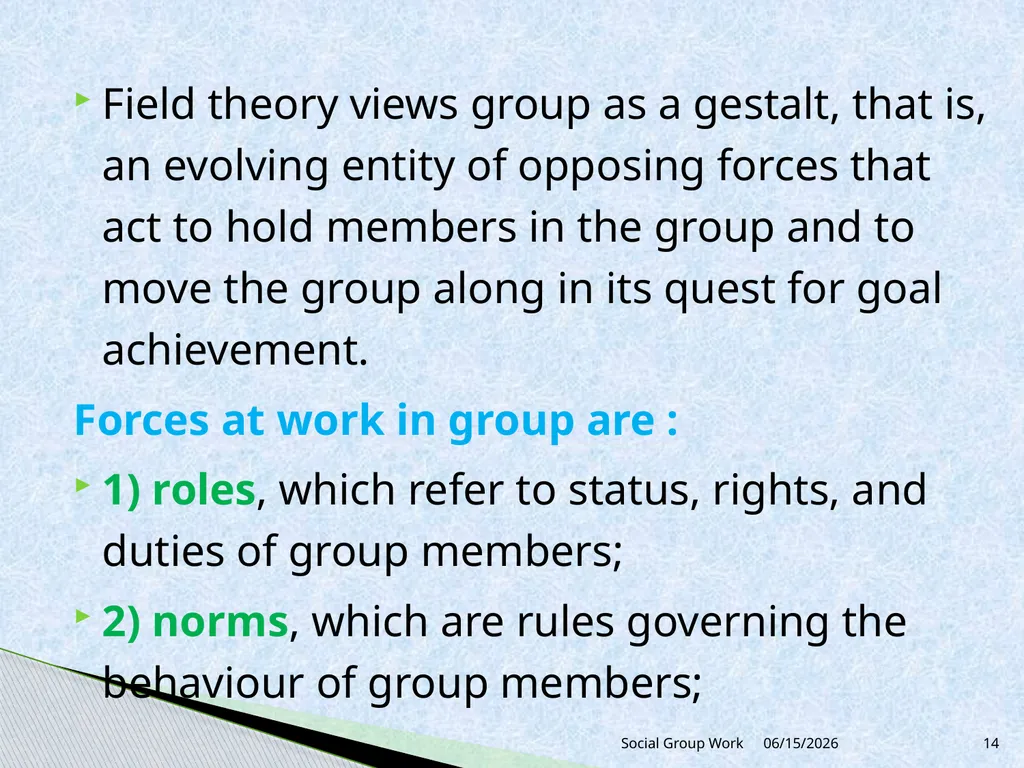
slide14. Field theory views group as a gestalt, that is, an evolving entity of opposing forces that act to hold members in the group and to move the group along in its quest for goal achievement.
Forces at work in group are :
1) roles, which refer to status, rights, and duties of group members;
2) norms, which are rules governing the behaviour of group members; 13-Jan-24 Social Group Work 14<br>
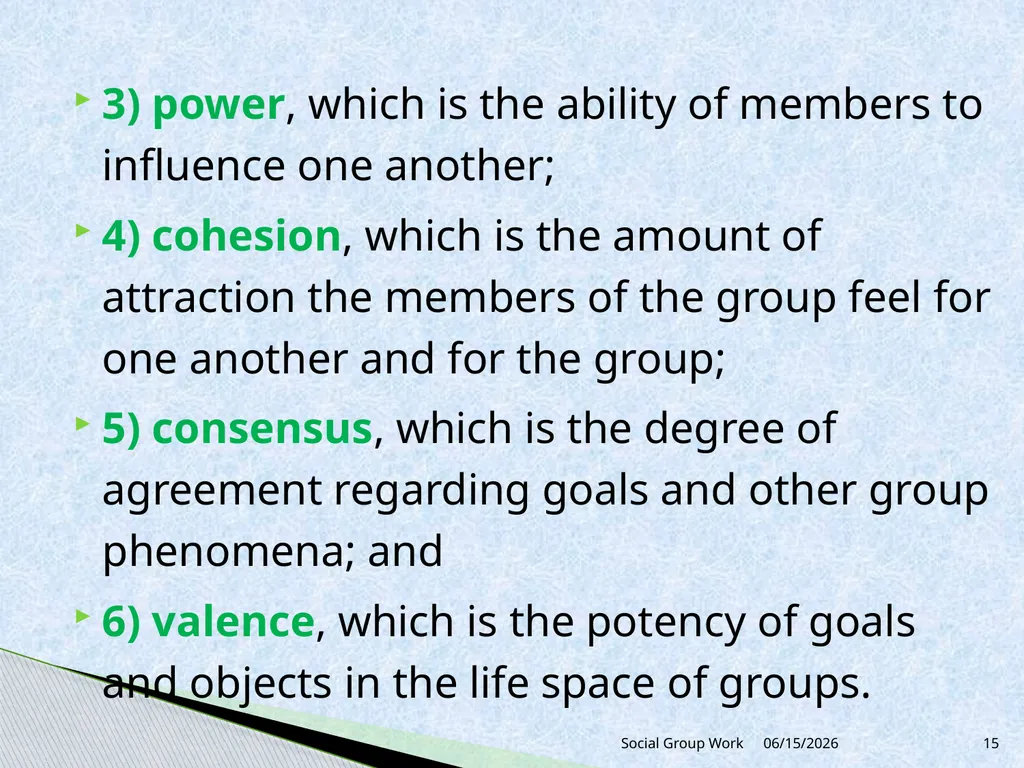
slide15. 3) power, which is the ability of members to influence one another;
4) cohesion, which is the amount of attraction the members of the group feel for one another and for the group;
5) consensus, which is the degree of agreement regarding goals and other group phenomena; and
6) valence, which is the potency of goals and objects in the life space of groups. 13-Jan-24 Social Group Work 15<br>
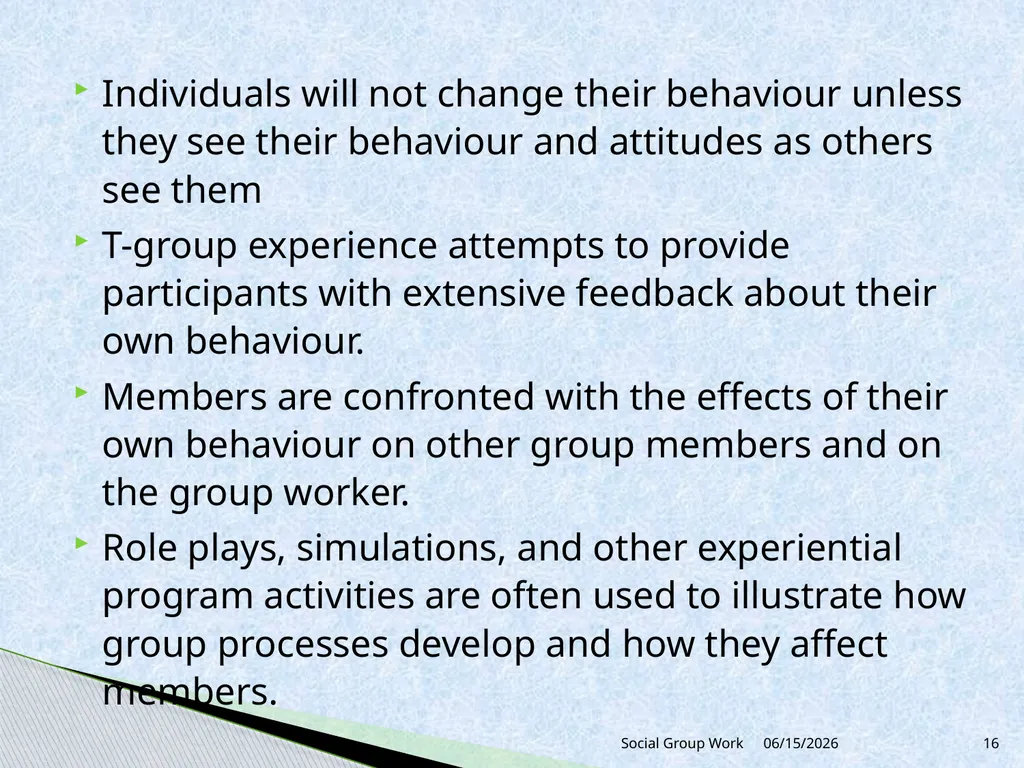
slide16. Individuals will not change their behaviour unless they see their behaviour and attitudes as others see them
T-group experience attempts to provide participants with extensive feedback about their own behaviour.
Members are confronted with the effects of their own behaviour on other group members and on the group worker.
Role plays, simulations, and other experiential program activities are often used to illustrate how group processes develop and how they affect members. 13-Jan-24 Social Group Work 16<br>
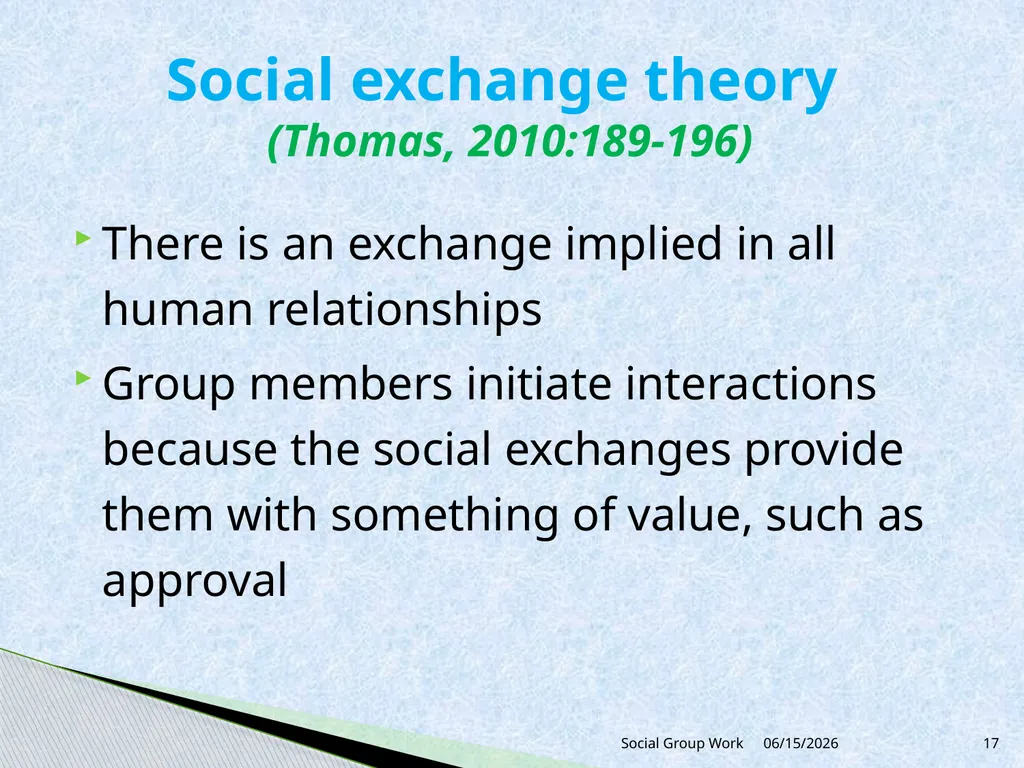
slide17. There is an exchange implied in all human relationships
Group members initiate interactions because the social exchanges provide them with something of value, such as approval Social exchange theory (Thomas, 2010:189-196) 13-Jan-24 Social Group Work 17<br>
slide18. group behaviour is analysed by observing how individual members seek rewards while dealing with the sustained social interaction occurring in a group.
For an individual in a group, the decision to express a given behaviour is based on a comparison of the rewards and punishments that are expected to be derived from the behaviour.
Group members act to increase positive consequences and decrease negative consequences 13-Jan-24 Social Group Work 18<br>
slide19. Guided group interaction and positive peer culture are two specialized group work methods used with delinquent adolescents in residential and institutional settings in which, structured groups are used to confront, challenge, and eliminate antisocial peer group norms and to replace them with pro-social norms through guided peer-group interaction 13-Jan-24 Social Group Work 19<br>
slide20. References Thomas Gracious (Ed.) (2010) Social Work Intervention with Individuals and Groups. New Delhi: School of Social Work, Indira Gandhi National Open University
Toseland W. Ronald & Rivas F. Robert (2012) An Introduction to Group Work Practice (7th Ed.). Boston: Allyn & Bacon (pp. 57-64) 13-Jan-24 Social Group Work 20<br>
slide21. Thank You 13-Jan-24 Social Group Work 21<br>
slide2. Systems theory
Psychodynamic theory
Learning theory
Field theory
Social exchange theory Theoretical assumptions underlying social group work (Thomas, 2010:189-196) 13-Jan-24 Social Group Work 2<br>
slide3. Groups are social systems with several interdependent members attempting to maintain order and a stable equilibrium while they function as a unified whole
constantly facing changing demands in their quest to attain goals and to maintain a stable equilibrium.
mobilize their resources and act to meet changing demands if they are to survive. Systems theory (Thomas, 2010:189-196) 13-Jan-24 Social Group Work 3<br>
slide4. Four major functional tasks for systems:
1) integration – ensuring that members of groups fit together;
2) adaptation – ensuring that groups change to cope with the demands of their environment;
3) pattern maintenance – ensuring that groups define and sustain their basic purposes, identities and procedures;
4) goal attainment – ensuring that groups pursue and accomplish their tasks 13-Jan-24 Social Group Work 4<br>
slide5. Groups have an internal system and an external system:
1) internal system consists of the patterns of activities, interactions, and norms occurring within the group as it attempts to function
2) external system represents a group’s way of handling the adaptive problems that result from its relationship with its social and physical environment 13-Jan-24 Social Group Work 5<br>
slide6. While interacting with the environment, groups are in a constant state of becoming, developing, and changing, which influence their equilibrium and continued existence 13-Jan-24 Social Group Work 6<br>
slide7. Freud (1922) Group Psychology & the Analysis of Ego
According to psychodynamic theory, group members act out in the group unresolved conflicts from early life experiences.
The group becomes a re-enactment of the family situation (Dear Zindagi).
Group leader as the all-powerful father figure reigns supreme over group members & the members identify with the group leader as the ‘ego-ideal’. Psychodynamic theory (Thomas, 2010:189-196) 13-Jan-24 Social Group Work 7<br>
slide8. Members form transference reactions to the group leader and to each other on the basis of their early life experiences.
The interactions that occur in the group reflect the personality structures and defense mechanisms that members began to develop early in life.
The group leader uses transference and counter transference reactions to help members work through unresolved conflicts by exploring past behaviour patterns and linking these patterns to current behaviours. 13-Jan-24 Social Group Work 8<br>
slide9. The group leader might interpret the behaviour of two group members who are struggling for the leader’s attention as unresolved sibling rivalry.
When interpretations made by the group worker are timed appropriately, members gain insight into their own behaviour.
According to the psychodynamic theory, insight is the essential ingredient in modifying and changing behaviour patterns inside and outside the group 13-Jan-24 Social Group Work 9<br>
slide10. From an analysis of the immediate behaviour patterns in the microcosm of the group, the leader can help members reconstruct unresolved childhood conflicts and have corrective emotional experiences.
Through direct, mutual interpersonal communications, members build interpersonal skills, adaptive capacities, and ego-strength, as well as gain insight into their behaviour.
The cohesiveness of the group encourages members to reveal intimate details about their personal lives and to describe and act out their conflicts in a safe and supportive environment. 13-Jan-24 Social Group Work 10<br>
slide11. Albert Bandura (1977) social learning theory
Most learning takes place through observation and vicarious reinforcement or punishment. Learning theory (Thomas, 2010:189-196) 13-Jan-24 Social Group Work 11<br>
slide12. When a group member is praised for a certain behaviour, that group member and other group members reproduce the behaviour later, hoping to receive similar praise
When a group member who performs a certain behaviour is ignored or punished by social sanctions, other group members learn not to behave in that manner because such behaviour results in a negative outcome 13-Jan-24 Social Group Work 12<br>
slide13. Kurt Lewin (1946) Field theory
‘A group has a life space, it occupies a position relative to other objects in space, it is oriented towards goals, it locomotes in pursuit of these goals, and it may encounter barriers in the process of locomotion’ Field theory (Thomas, 2010:189-196) 13-Jan-24 Social Group Work 13<br>
slide14. Field theory views group as a gestalt, that is, an evolving entity of opposing forces that act to hold members in the group and to move the group along in its quest for goal achievement.
Forces at work in group are :
1) roles, which refer to status, rights, and duties of group members;
2) norms, which are rules governing the behaviour of group members; 13-Jan-24 Social Group Work 14<br>
slide15. 3) power, which is the ability of members to influence one another;
4) cohesion, which is the amount of attraction the members of the group feel for one another and for the group;
5) consensus, which is the degree of agreement regarding goals and other group phenomena; and
6) valence, which is the potency of goals and objects in the life space of groups. 13-Jan-24 Social Group Work 15<br>
slide16. Individuals will not change their behaviour unless they see their behaviour and attitudes as others see them
T-group experience attempts to provide participants with extensive feedback about their own behaviour.
Members are confronted with the effects of their own behaviour on other group members and on the group worker.
Role plays, simulations, and other experiential program activities are often used to illustrate how group processes develop and how they affect members. 13-Jan-24 Social Group Work 16<br>
slide17. There is an exchange implied in all human relationships
Group members initiate interactions because the social exchanges provide them with something of value, such as approval Social exchange theory (Thomas, 2010:189-196) 13-Jan-24 Social Group Work 17<br>
slide18. group behaviour is analysed by observing how individual members seek rewards while dealing with the sustained social interaction occurring in a group.
For an individual in a group, the decision to express a given behaviour is based on a comparison of the rewards and punishments that are expected to be derived from the behaviour.
Group members act to increase positive consequences and decrease negative consequences 13-Jan-24 Social Group Work 18<br>
slide19. Guided group interaction and positive peer culture are two specialized group work methods used with delinquent adolescents in residential and institutional settings in which, structured groups are used to confront, challenge, and eliminate antisocial peer group norms and to replace them with pro-social norms through guided peer-group interaction 13-Jan-24 Social Group Work 19<br>
slide20. References Thomas Gracious (Ed.) (2010) Social Work Intervention with Individuals and Groups. New Delhi: School of Social Work, Indira Gandhi National Open University
Toseland W. Ronald & Rivas F. Robert (2012) An Introduction to Group Work Practice (7th Ed.). Boston: Allyn & Bacon (pp. 57-64) 13-Jan-24 Social Group Work 20<br>
slide21. Thank You 13-Jan-24 Social Group Work 21<br>