
UNIT-2 Fixed Income Securities UNIT-2 Basics of





Description: UNIT-2 Fixed Income Securities UNIT-2 Basics of bond investment Default risk and credit rating Basics of bond investment Concept of bond Types of bonds Risk associated with bond returns Measures of bond returns Concept of bond Basics of
Related Topics
Download Presentation
"UNIT-2 Fixed Income Securities UNIT-2 Basics of" is the property of its rightful owner. Permission is granted to download and print the materials on this website for personal, non-commercial use only, and to display it on your personal computer provided you do not modify the materials and that you retain all copyright notices contained in the materials. By downloading content from our website, you accept the terms of this agreement.
Presentation Transcript
slide1. UNIT-2 Fixed Income Securities<br>
slide2. UNIT-2 Basics of bond investment
Default risk and credit rating<br>
slide3. Basics of bond investment Concept of bond
Types of bonds
Risk associated with bond returns
Measures of bond returns<br>
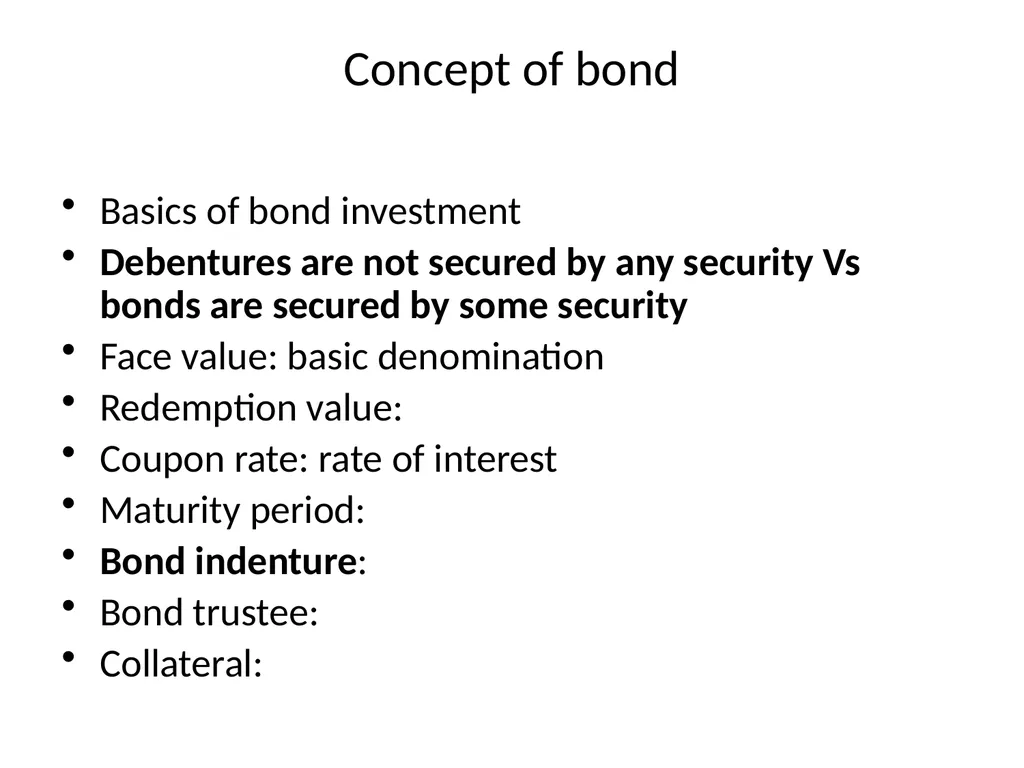
slide4. Concept of bond Basics of bond investment
Debentures are not secured by any security Vs bonds are secured by some security
Face value: basic denomination
Redemption value:
Coupon rate: rate of interest
Maturity period:
Bond indenture:
Bond trustee:
Collateral:<br>
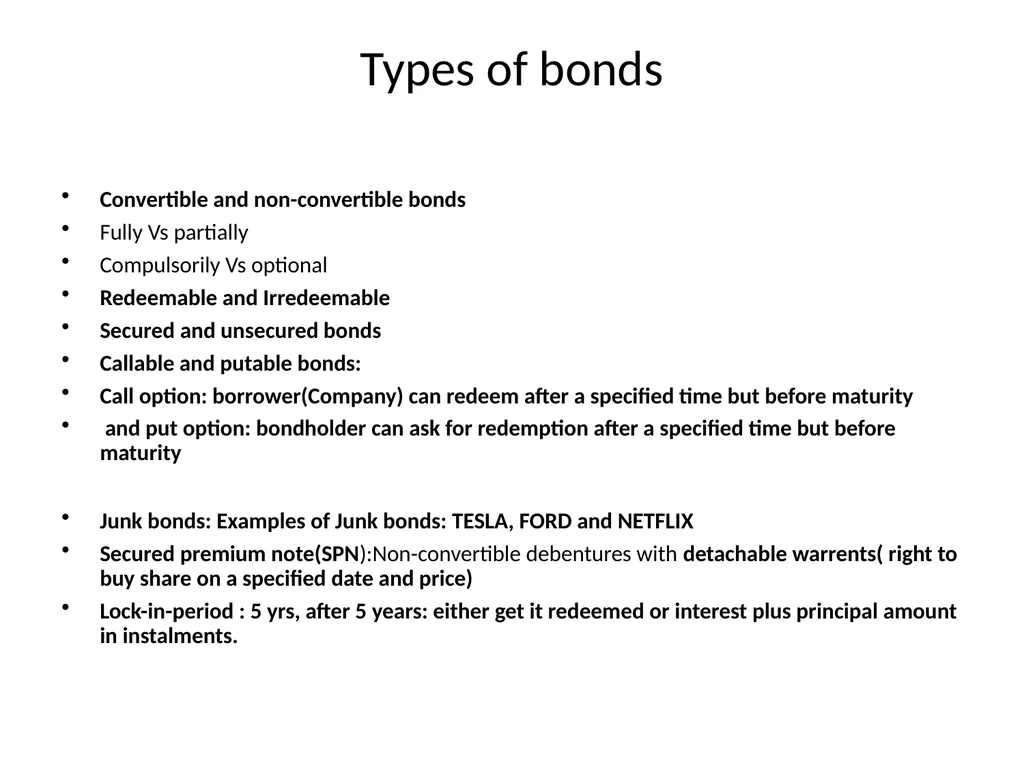
slide5. Types of bonds Convertible and non-convertible bonds
Fully Vs partially
Compulsorily Vs optional
Redeemable and Irredeemable
Secured and unsecured bonds
Callable and putable bonds:
Call option: borrower(Company) can redeem after a specified time but before maturity
and put option: bondholder can ask for redemption after a specified time but before maturity
Junk bonds: Examples of Junk bonds: TESLA, FORD and NETFLIX
Secured premium note(SPN):Non-convertible debentures with detachable warrents( right to buy share on a specified date and price)
Lock-in-period : 5 yrs, after 5 years: either get it redeemed or interest plus principal amount in instalments.<br>
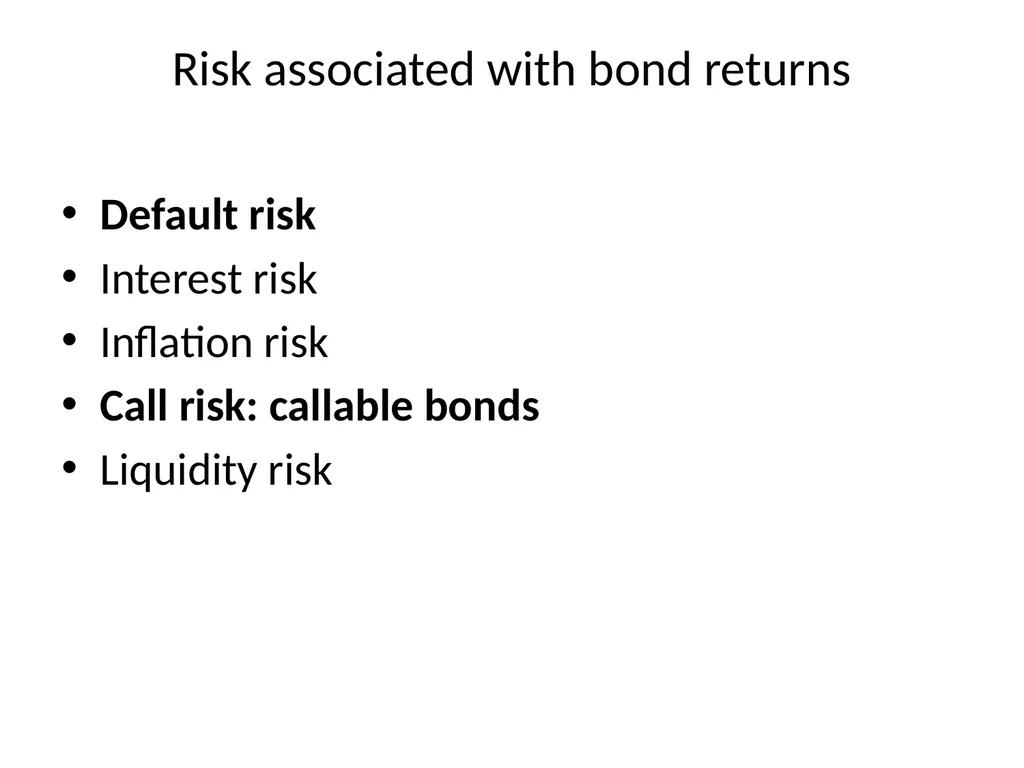
slide7. Risk associated with bond returns Default risk
Interest risk
Inflation risk
Call risk: callable bonds
Liquidity risk<br>
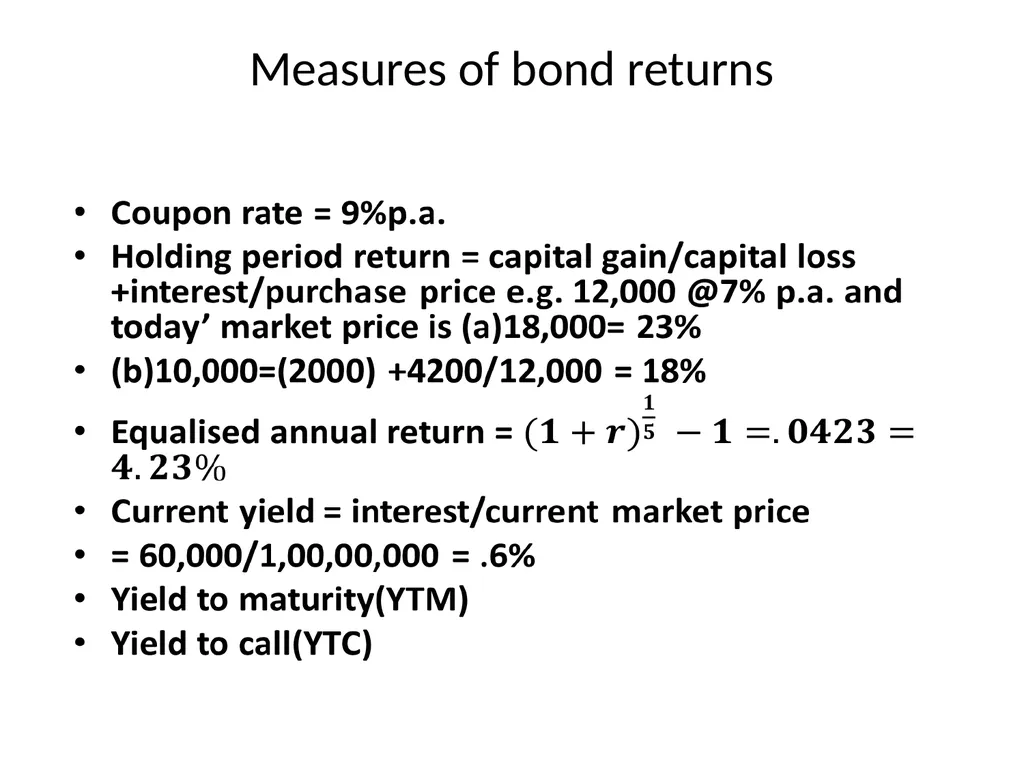
slide8. Measures of bond returns<br>
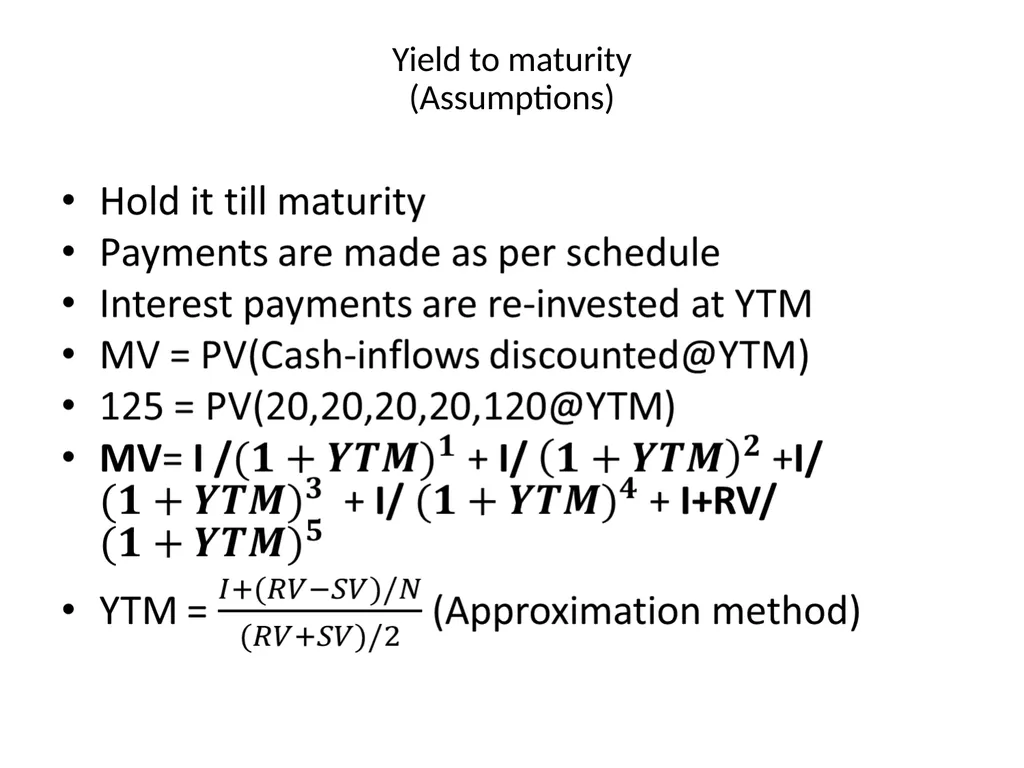
slide9. Yield to maturity (Assumptions)<br>
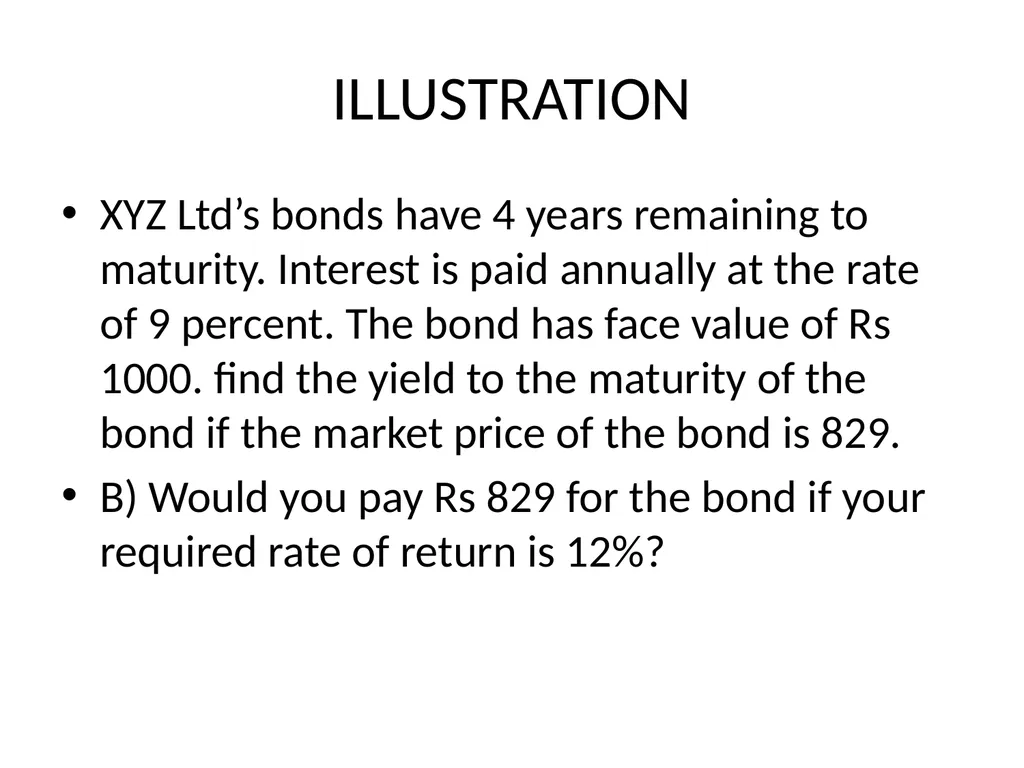
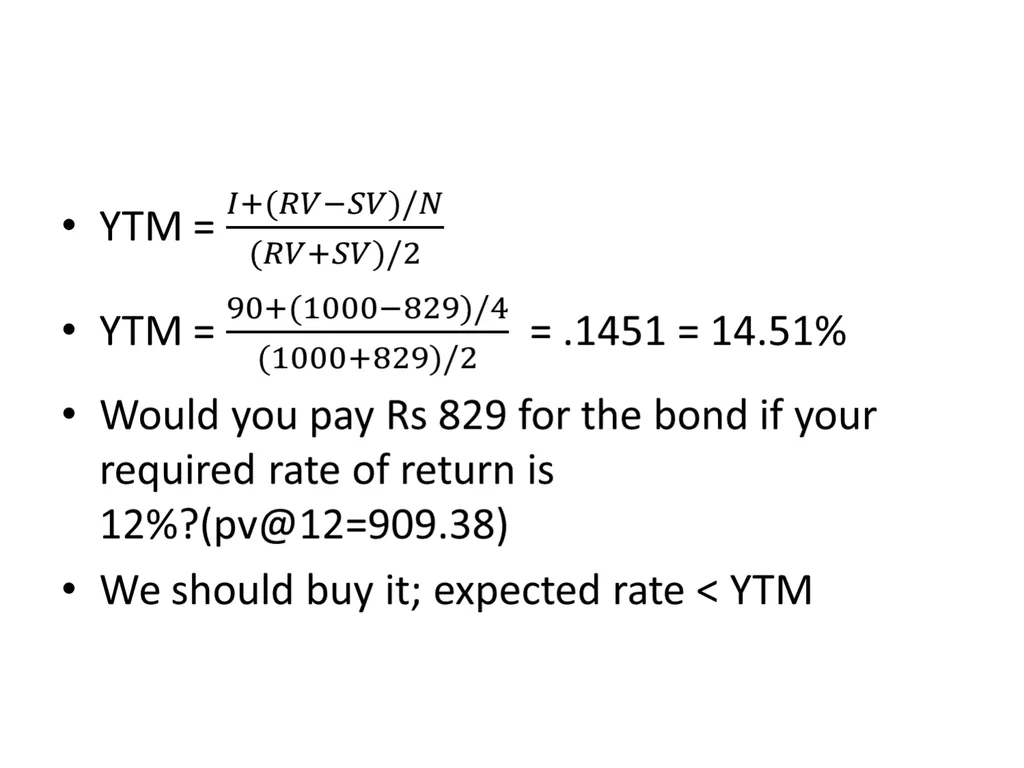
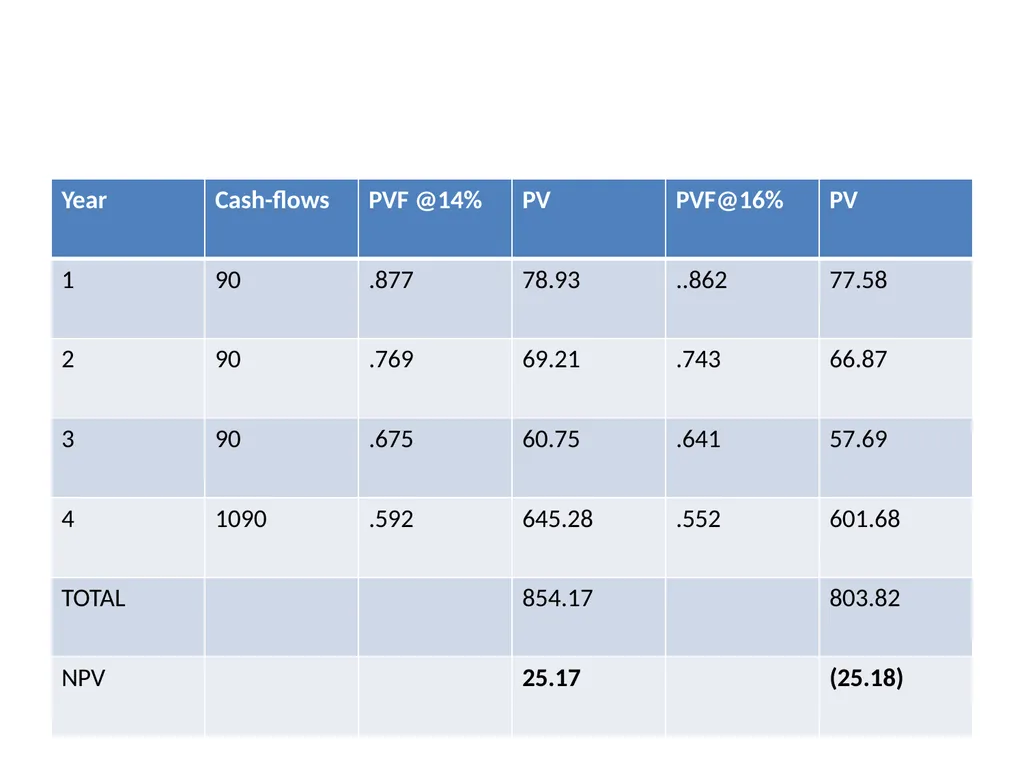
slide11. ILLUSTRATION XYZ Ltd’s bonds have 4 years remaining to maturity. Interest is paid annually at the rate of 9 percent. The bond has face value of Rs 1000. find the yield to the maturity of the bond if the market price of the bond is 829.
B) Would you pay Rs 829 for the bond if your required rate of return is 12%?<br>
slide15. Would you pay Rs 829 for the bond if your required rate of return is 12%? Real worth = PV(90,90,90,90,1090 @12%)
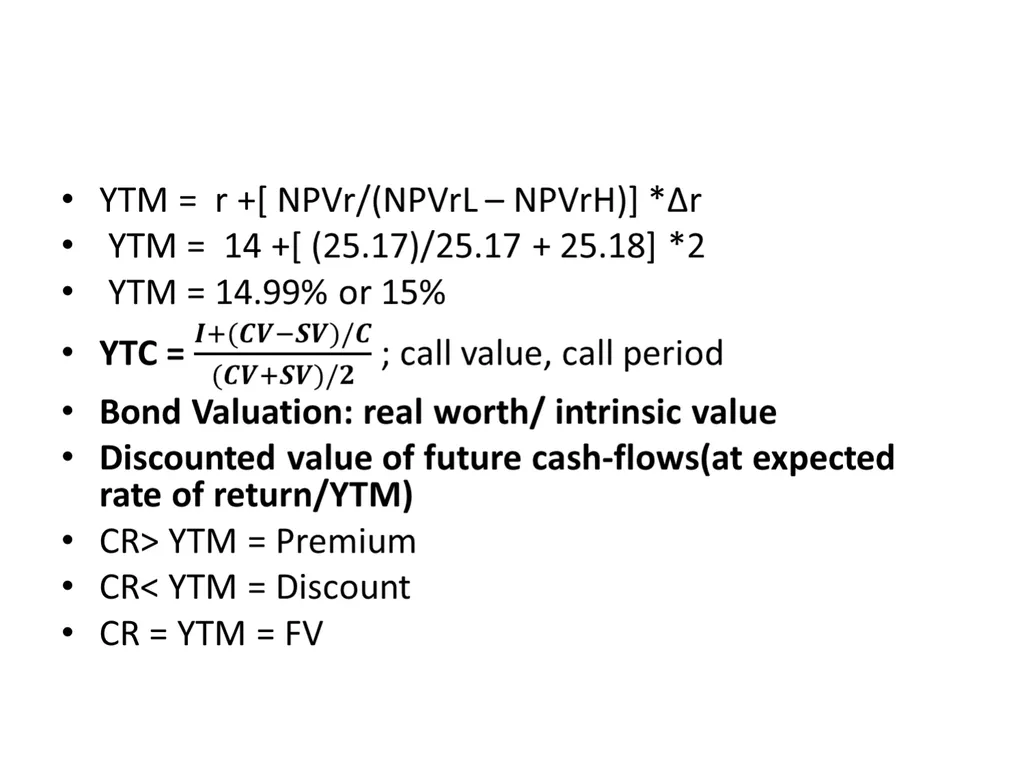
YTM = 15%, real value =829
Buy it as real value will be more than 829.<br>
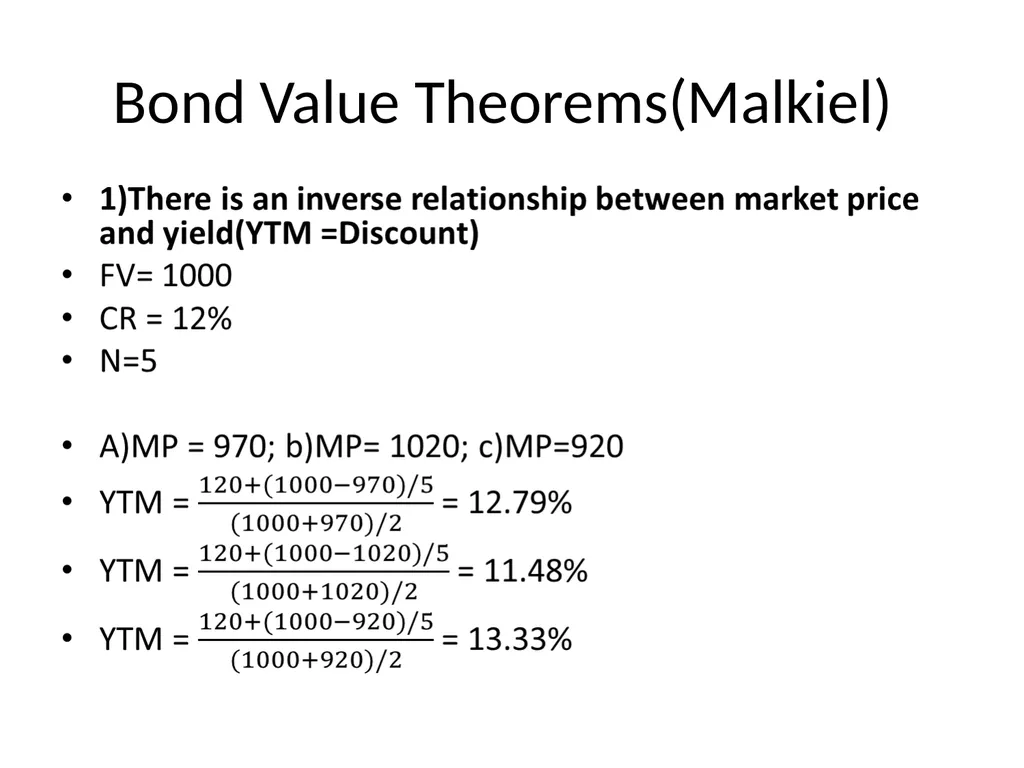
slide16. Bond Value Theorems(Malkiel)<br>
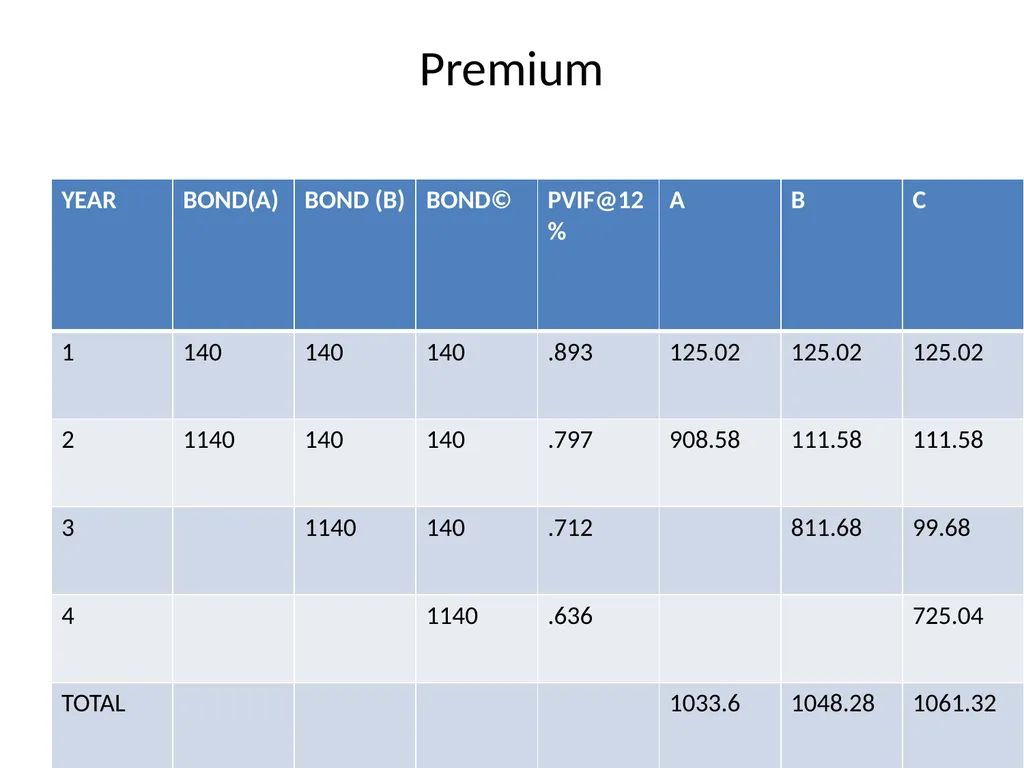
slide17. 2)The discount or premium on the bonds having same yield varies with the maturity period of the bonds Bond (A -2yrs), Bond (B-3yrs); Bond(C-4yrs)
FV = 1000
YTM = 12%(Discount rate)
CR = 14%
Next situation:
YTM =14%
CR=12%<br>
slide18. Premium<br>
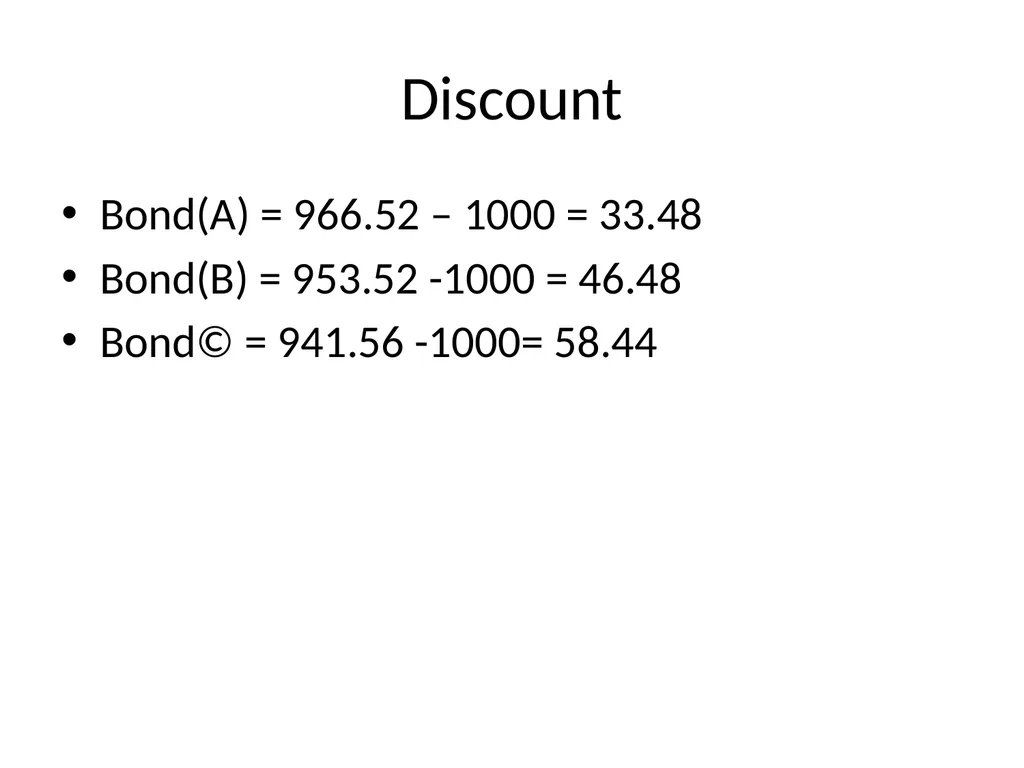
slide19. Discount Bond(A) = 966.52 – 1000 = 33.48
Bond(B) = 953.52 -1000 = 46.48
Bond© = 941.56 -1000= 58.44<br>
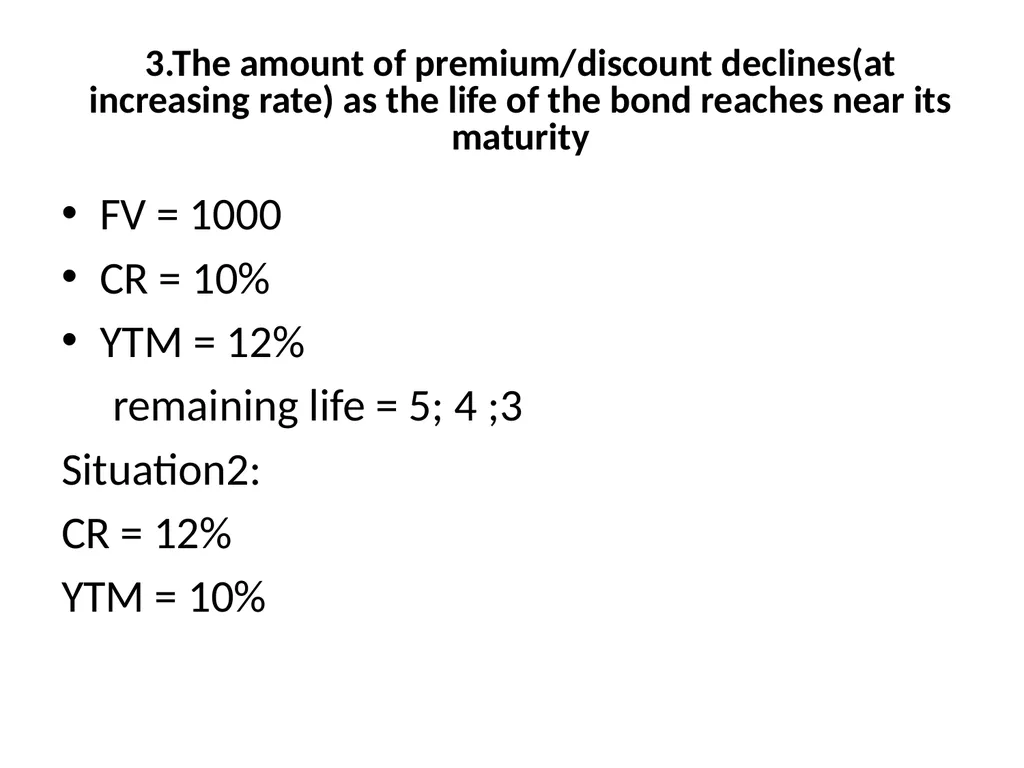
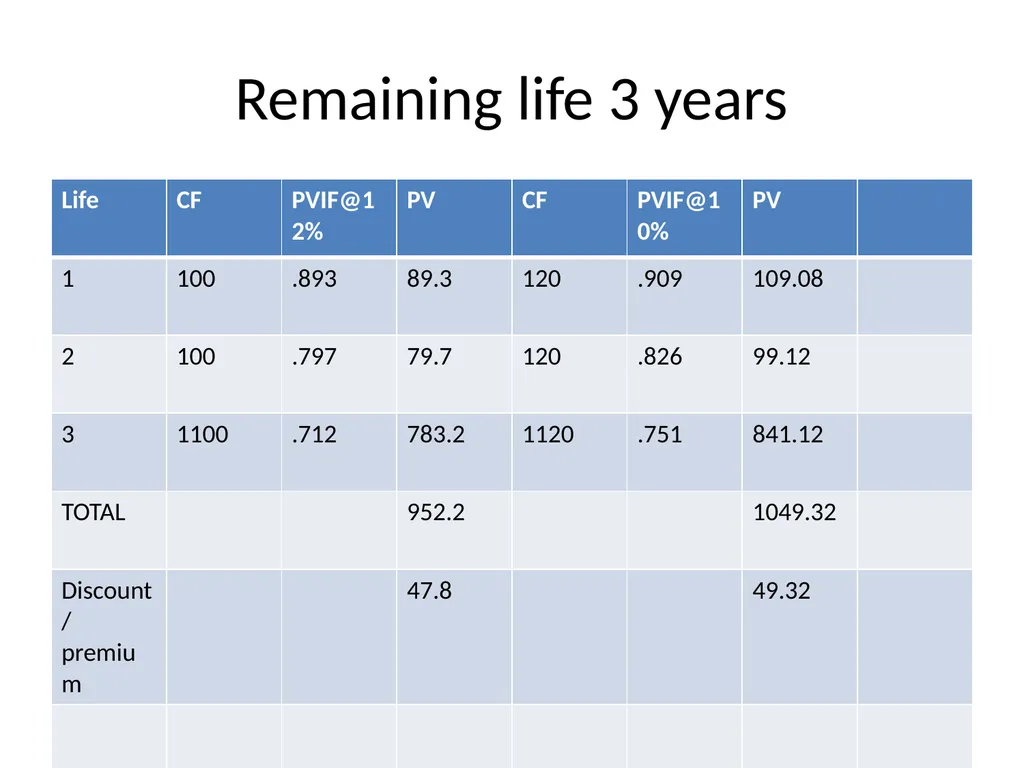
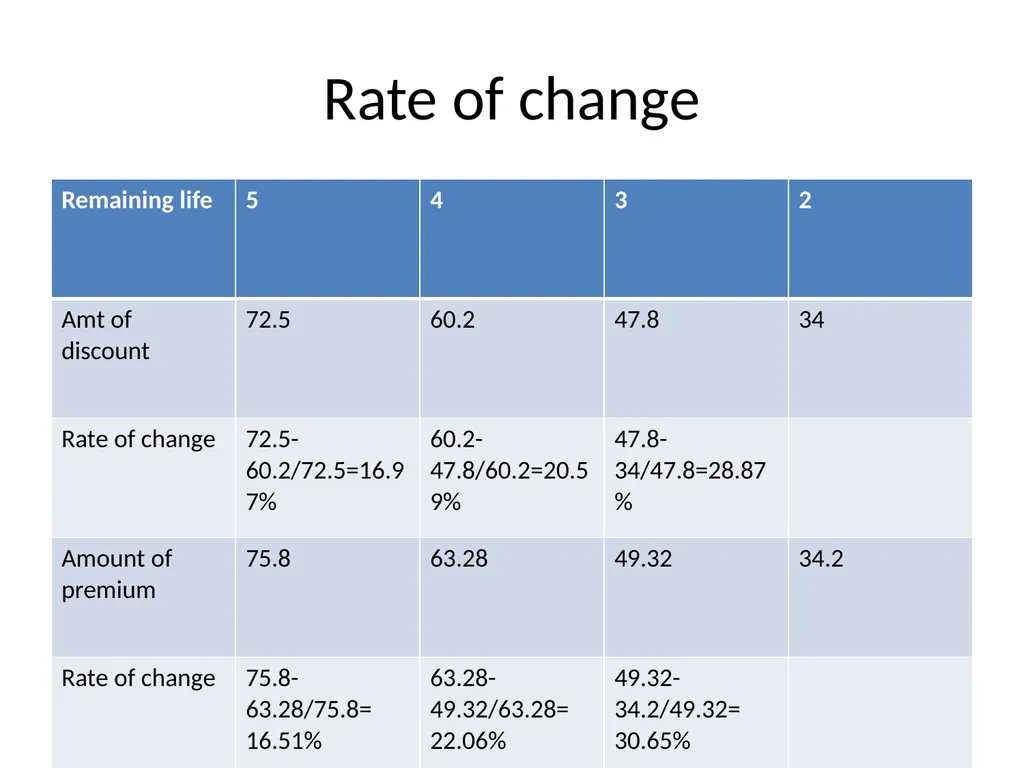
slide20. 3.The amount of premium/discount declines(at increasing rate) as the life of the bond reaches near its maturity FV = 1000
CR = 10%
YTM = 12%
remaining life = 5; 4 ;3
Situation2:
CR = 12%
YTM = 10%<br>
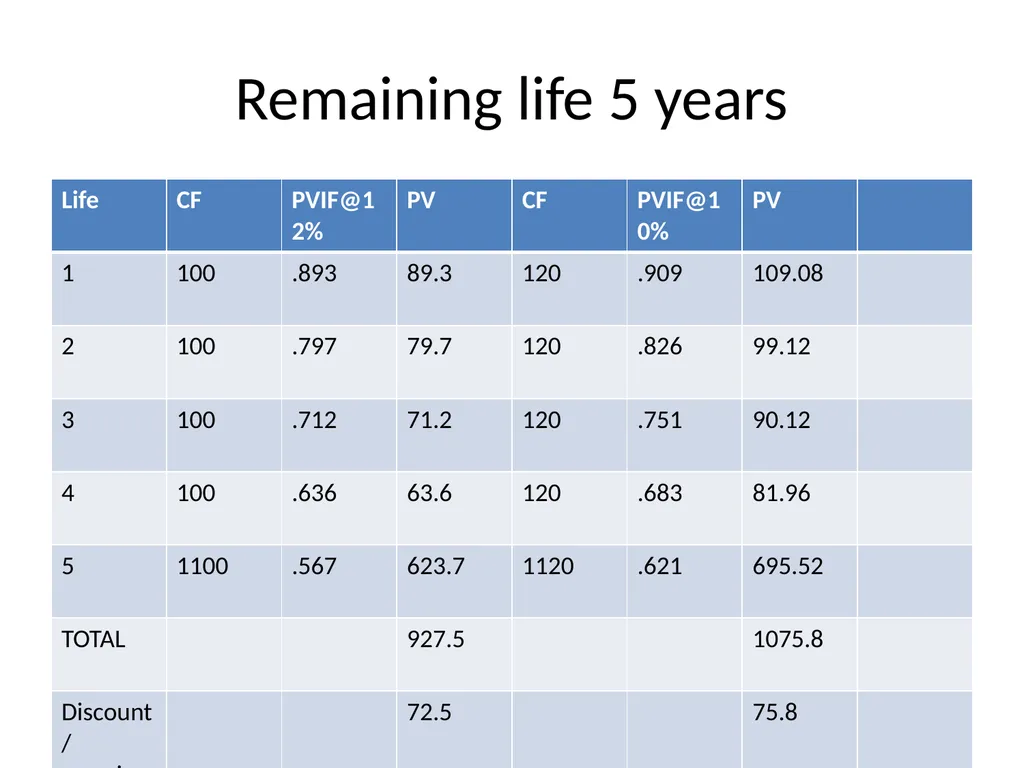
slide21. Remaining life 5 years<br>
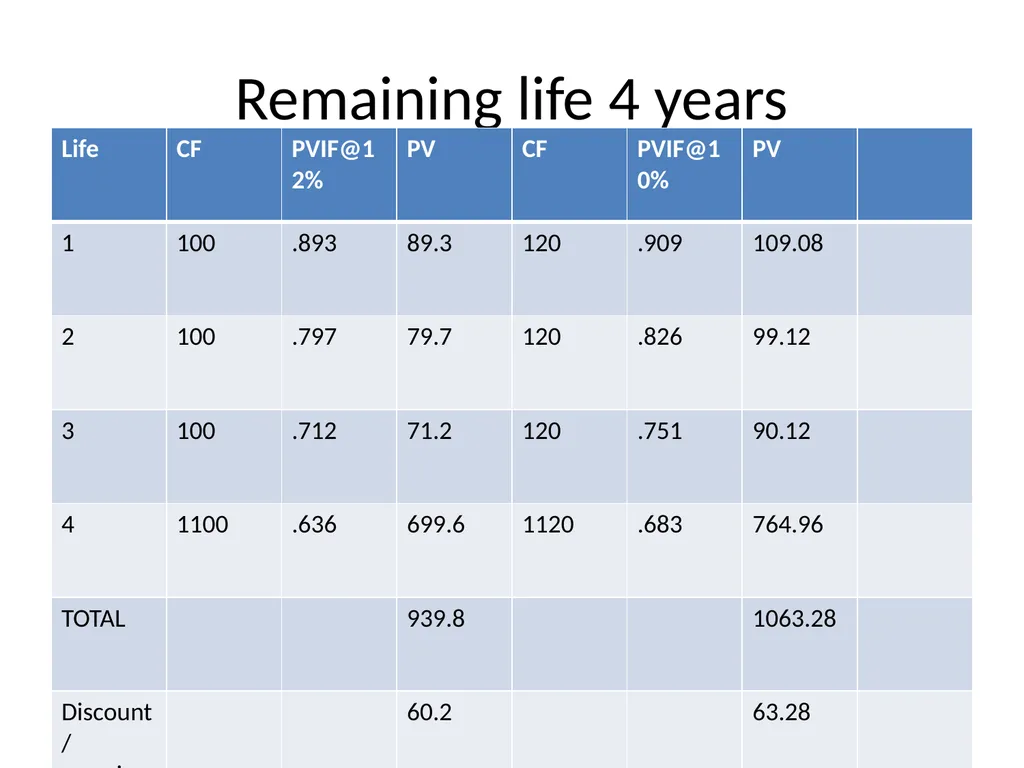
slide22. Remaining life 4 years<br>
slide23. Remaining life 3 years<br>
slide25. Rate of change<br>
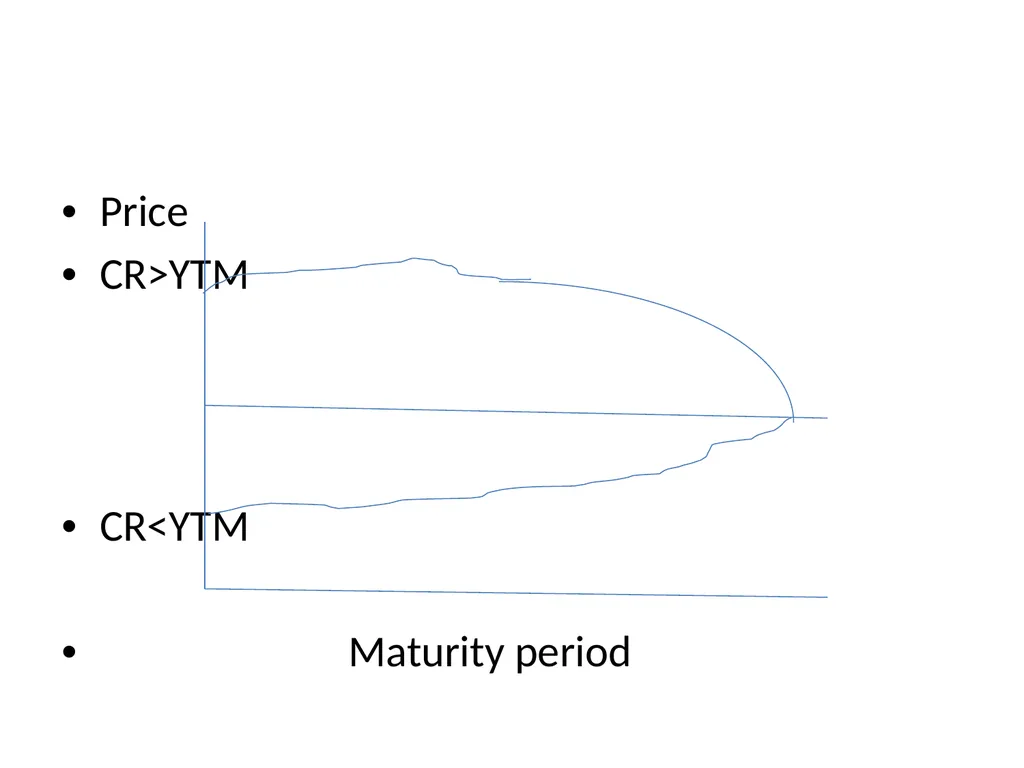
slide26. Price
CR>YTM
CR<YTM
Maturity period<br>
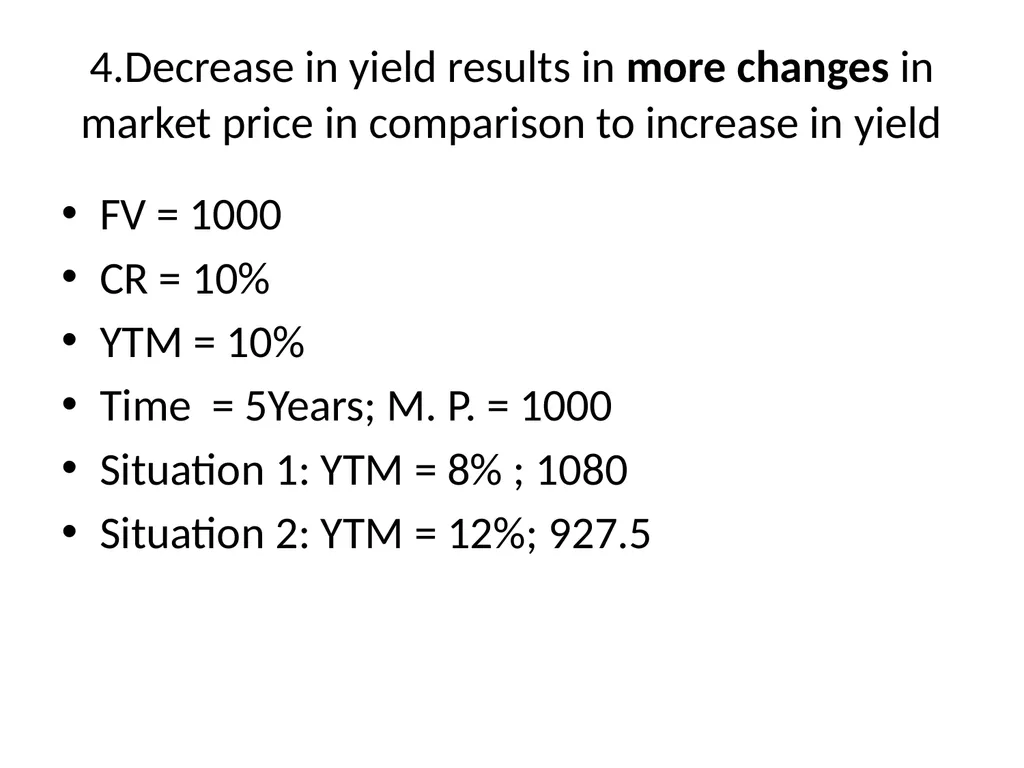
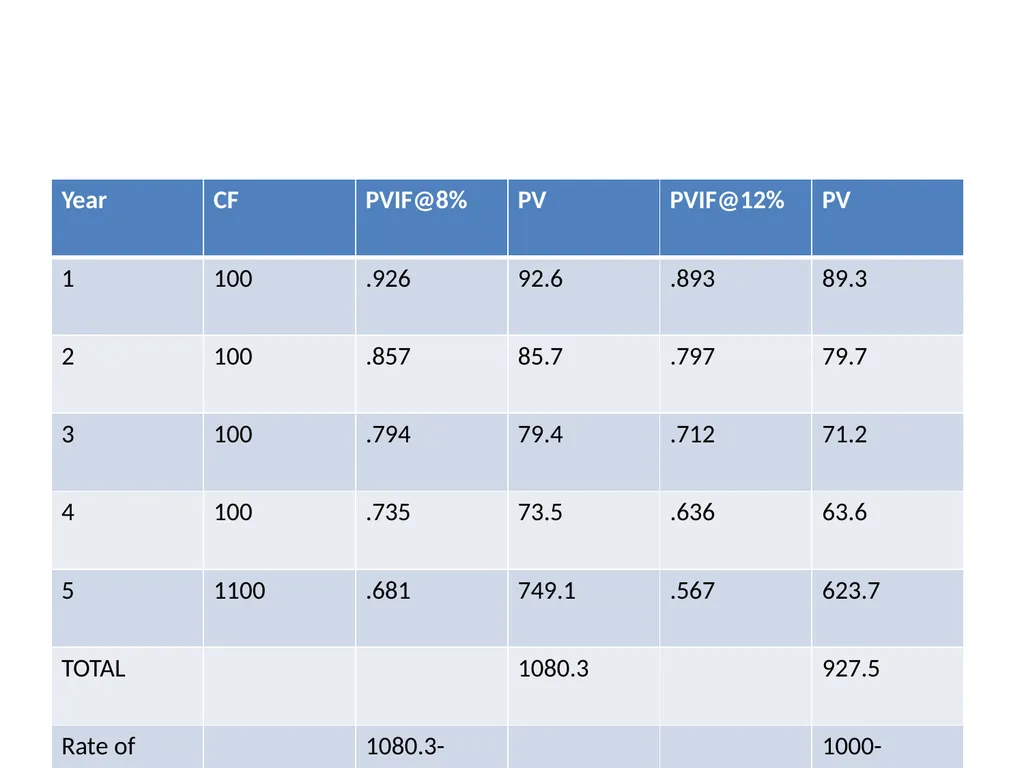
slide27. 4.Decrease in yield results in more changes in market price in comparison to increase in yield FV = 1000
CR = 10%
YTM = 10%
Time = 5Years; M. P. = 1000
Situation 1: YTM = 8% ; 1080
Situation 2: YTM = 12%; 927.5<br>
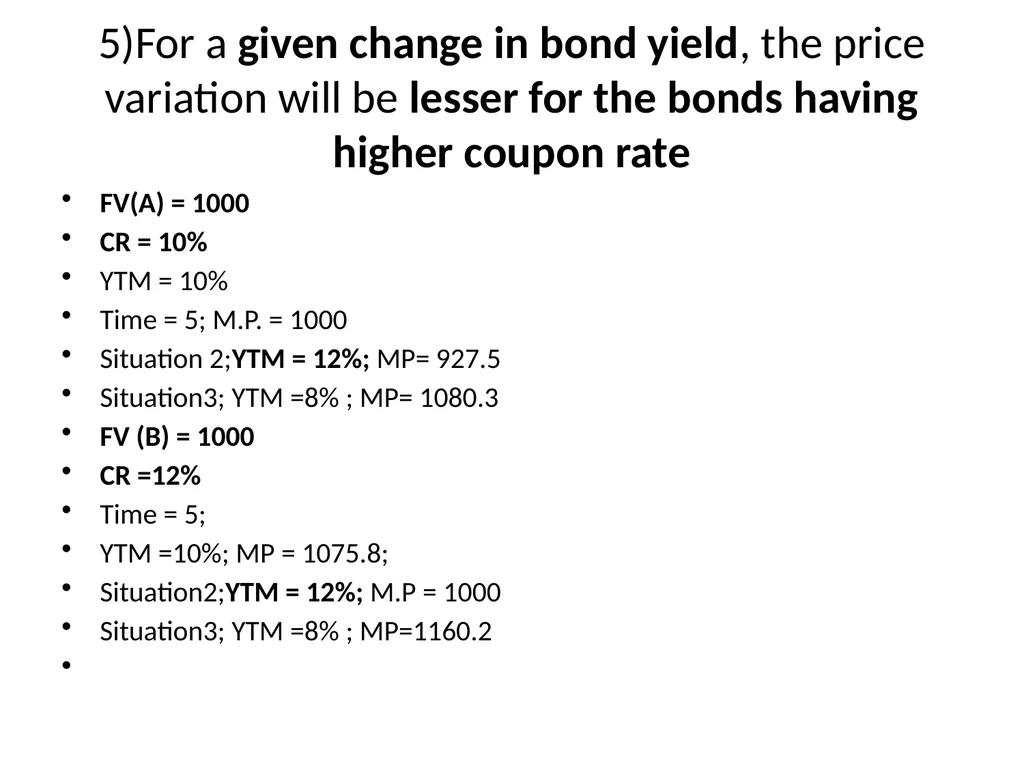
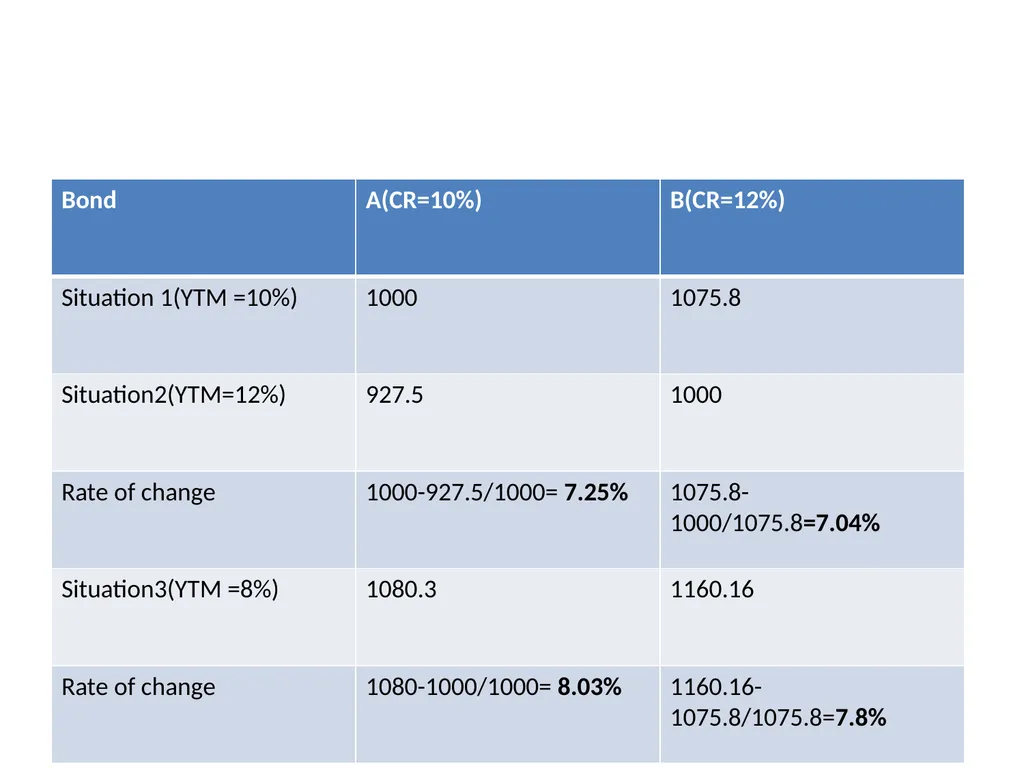
slide29. 5)For a given change in bond yield, the price variation will be lesser for the bonds having higher coupon rate FV(A) = 1000
CR = 10%
YTM = 10%
Time = 5; M.P. = 1000
Situation 2;YTM = 12%; MP= 927.5
Situation3; YTM =8% ; MP= 1080.3
FV (B) = 1000
CR =12%
Time = 5;
YTM =10%; MP = 1075.8;
Situation2;YTM = 12%; M.P = 1000
Situation3; YTM =8% ; MP=1160.2<br>
slide31. Impact of taxation on bond valuation Interest payment on due date; Coupon amt(1-t)
Capital gain/loss at the time of maturity
M P = PV(NetI +Net I +Net I +Net I + RV-tax on CG)
Long term /short term gain of bonds
Long term: more than 12 months for listed bonds and zero coupon
Benefit of indexation : not available
Rate of tax on short term (normal tax slab)/ long term gain(20%)<br>
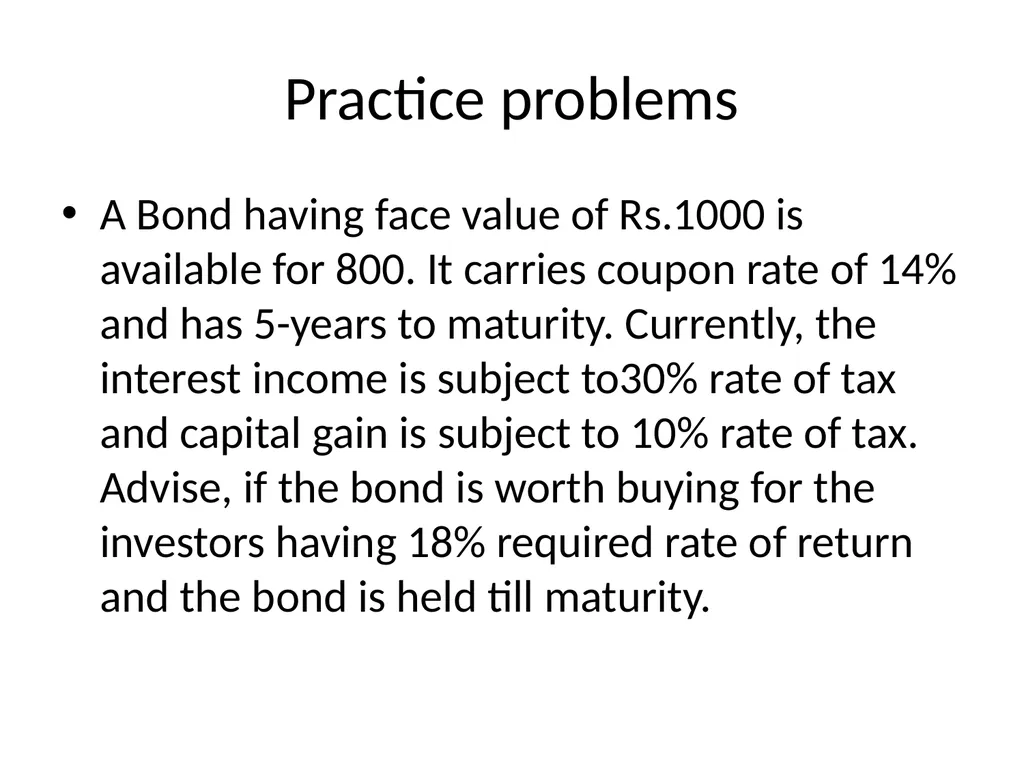
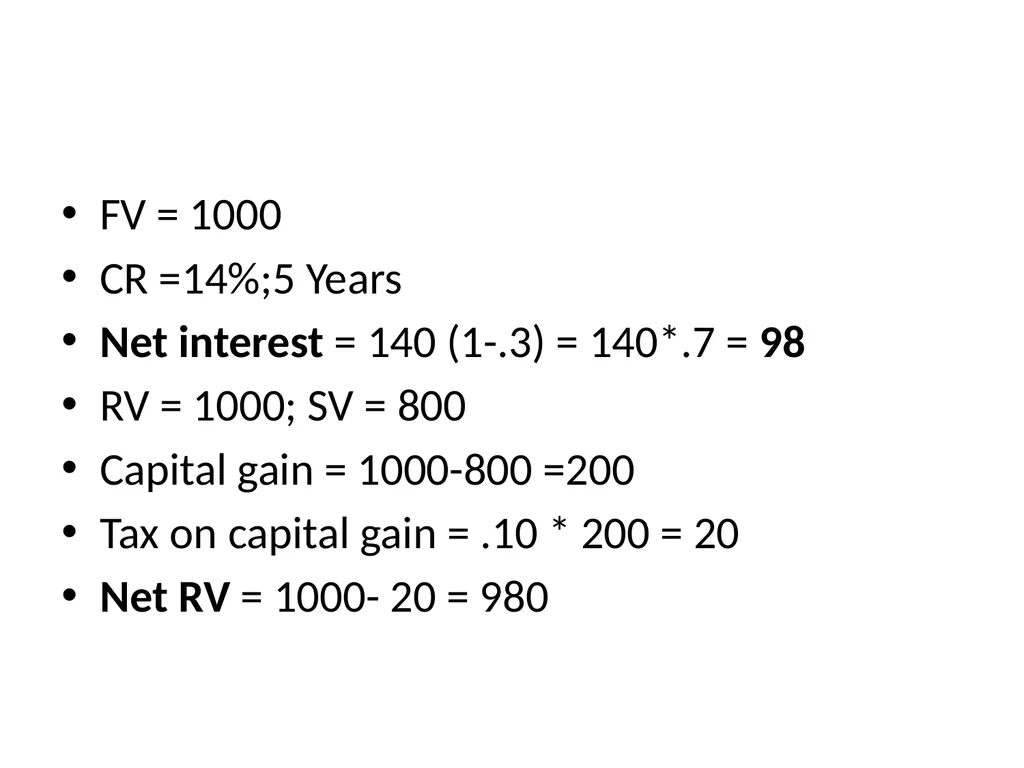
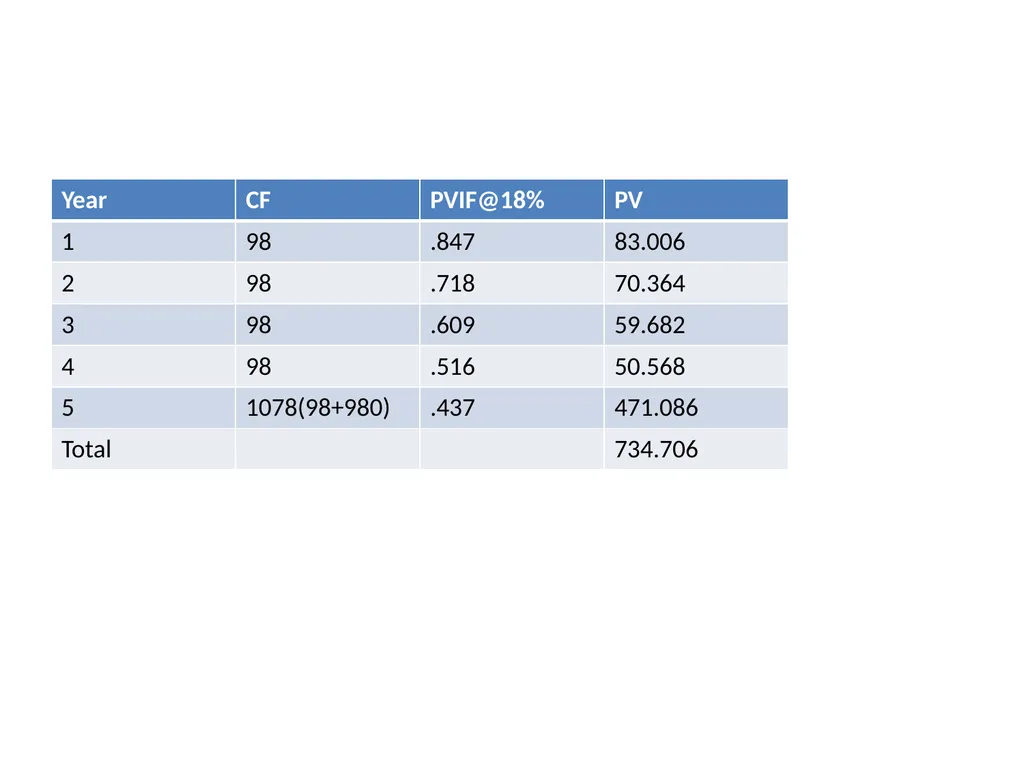
slide32. Practice problems A Bond having face value of Rs.1000 is available for 800. It carries coupon rate of 14% and has 5-years to maturity. Currently, the interest income is subject to30% rate of tax and capital gain is subject to 10% rate of tax. Advise, if the bond is worth buying for the investors having 18% required rate of return and the bond is held till maturity.<br>
slide33. FV = 1000
CR =14%;5 Years
Net interest = 140 (1-.3) = 140*.7 = 98
RV = 1000; SV = 800
Capital gain = 1000-800 =200
Tax on capital gain = .10 * 200 = 20
Net RV = 1000- 20 = 980<br>
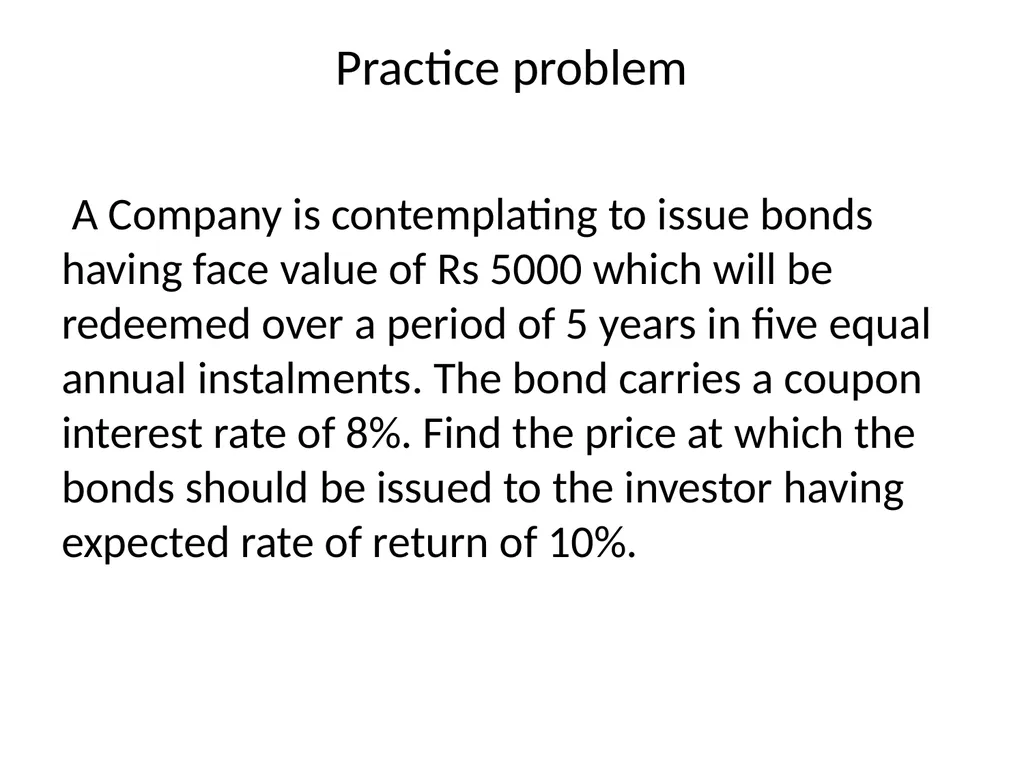
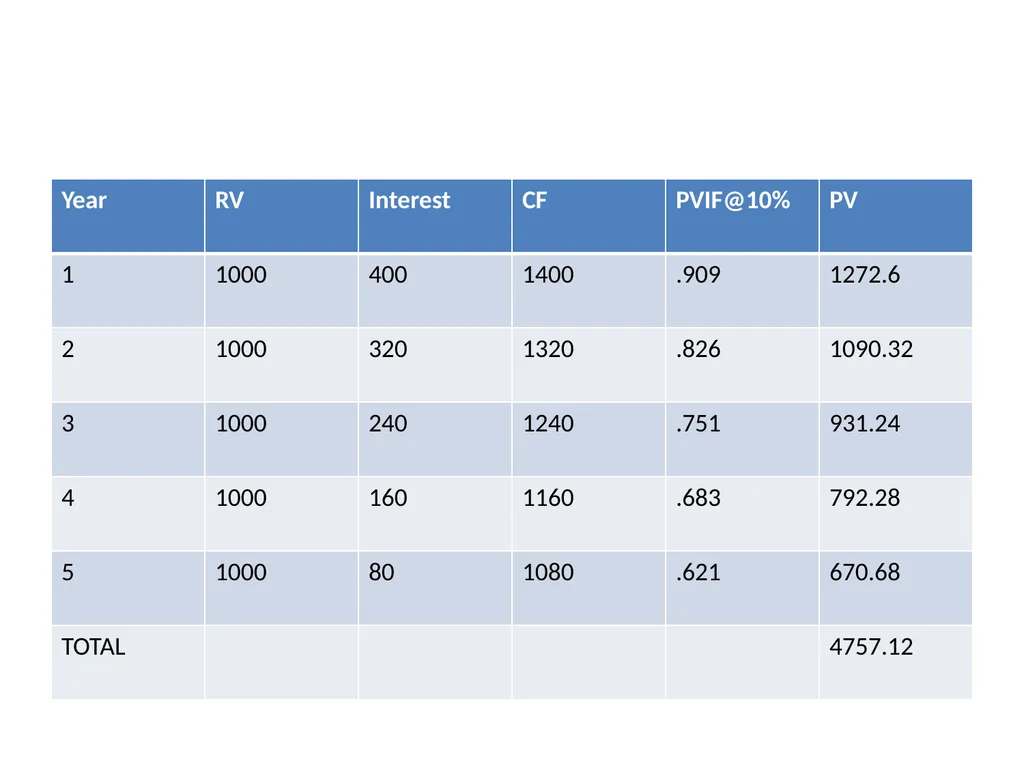
slide35. Practice problem A Company is contemplating to issue bonds having face value of Rs 5000 which will be redeemed over a period of 5 years in five equal annual instalments. The bond carries a coupon interest rate of 8%. Find the price at which the bonds should be issued to the investor having expected rate of return of 10%.<br>
slide37. Default Risk Bond market in India
Credit rating
Credit rating agencies; CRISIL, CARE
Benefits
Methodology<br>
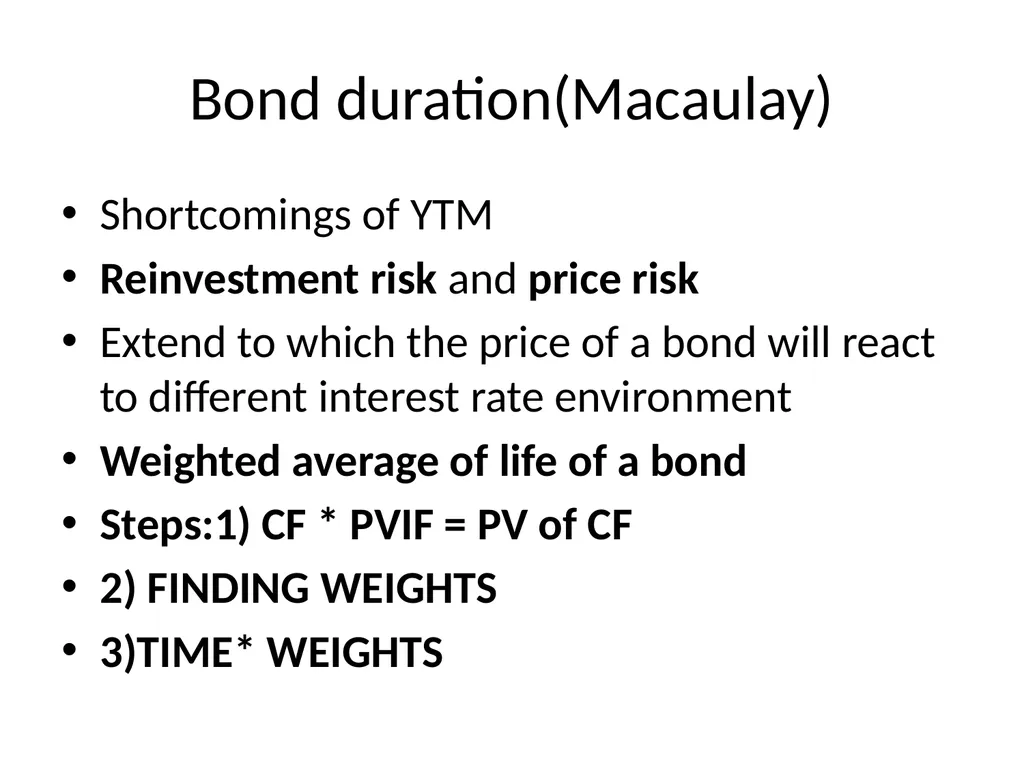
slide38. Bond duration(Macaulay) Shortcomings of YTM
Reinvestment risk and price risk
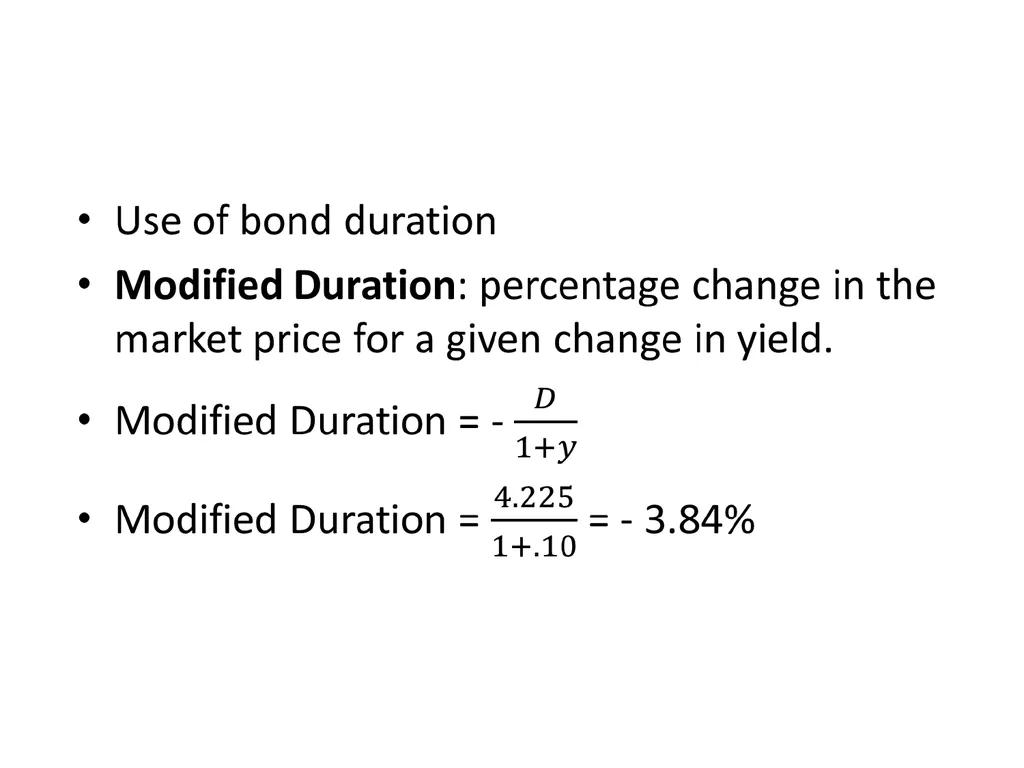
Extend to which the price of a bond will react to different interest rate environment
Weighted average of life of a bond
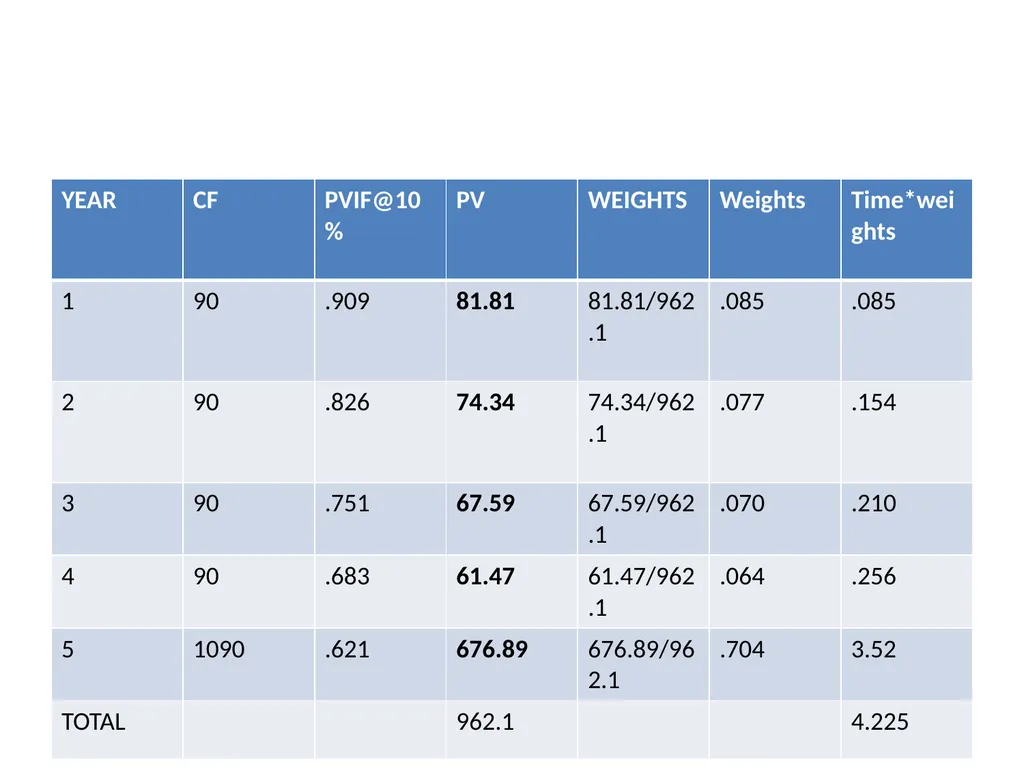
Steps:1) CF * PVIF = PV of CF
2) FINDING WEIGHTS
3)TIME* WEIGHTS<br>
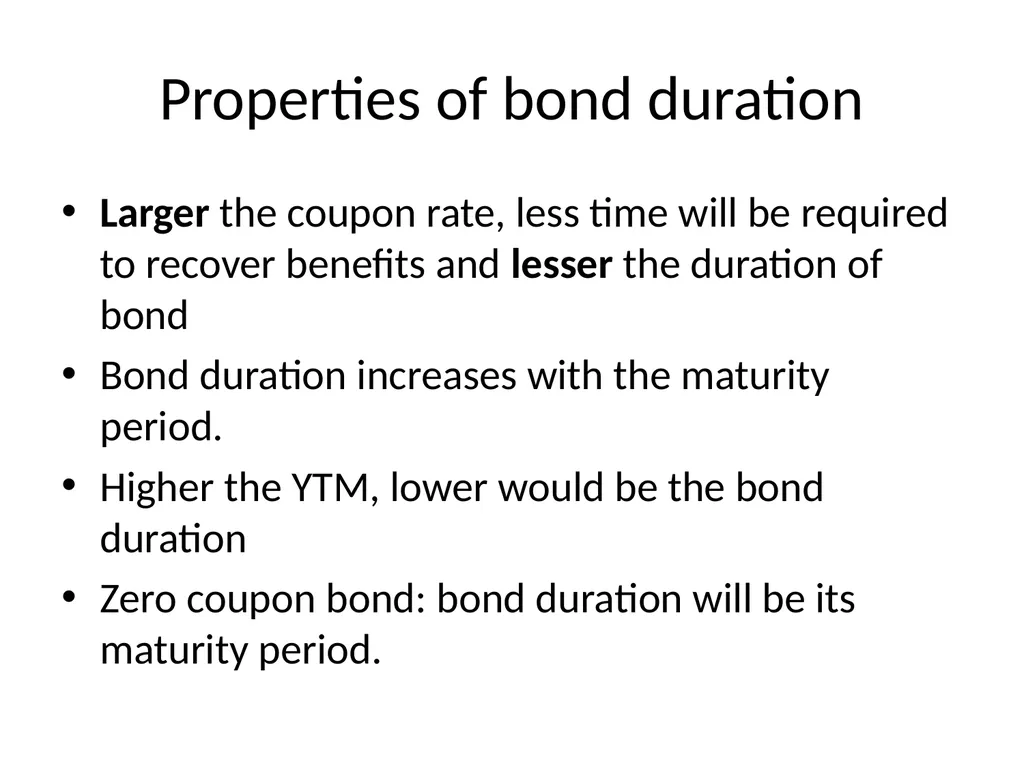
slide40. Properties of bond duration Larger the coupon rate, less time will be required to recover benefits and lesser the duration of bond
Bond duration increases with the maturity period.
Higher the YTM, lower would be the bond duration
Zero coupon bond: bond duration will be its maturity period.<br>
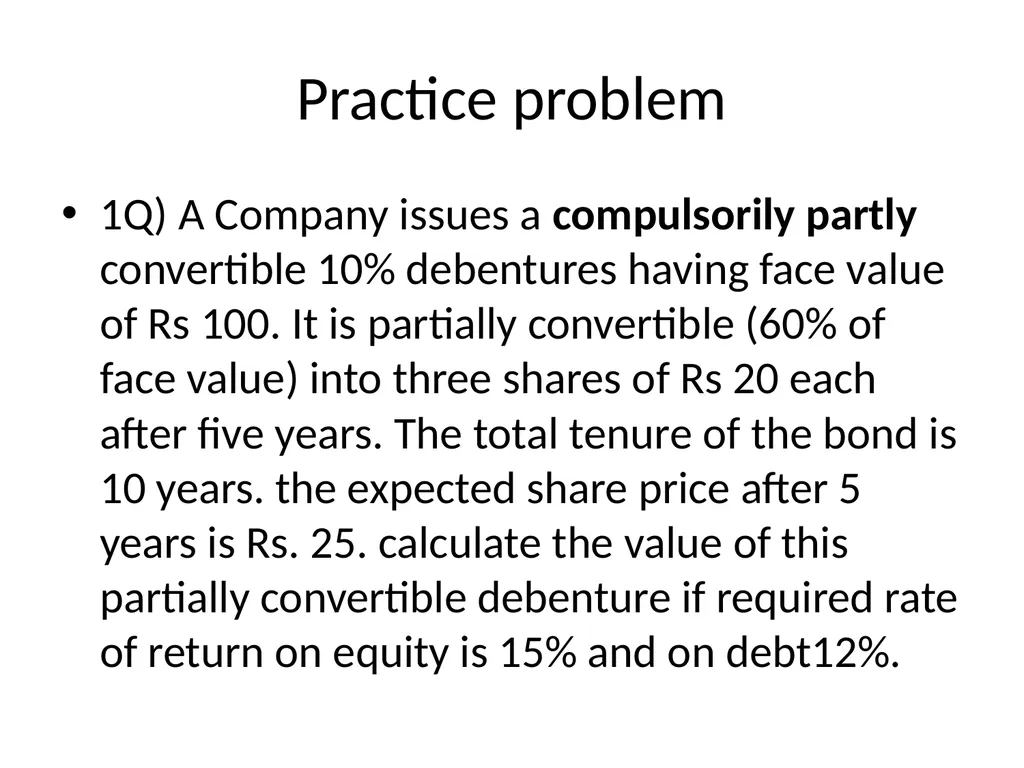
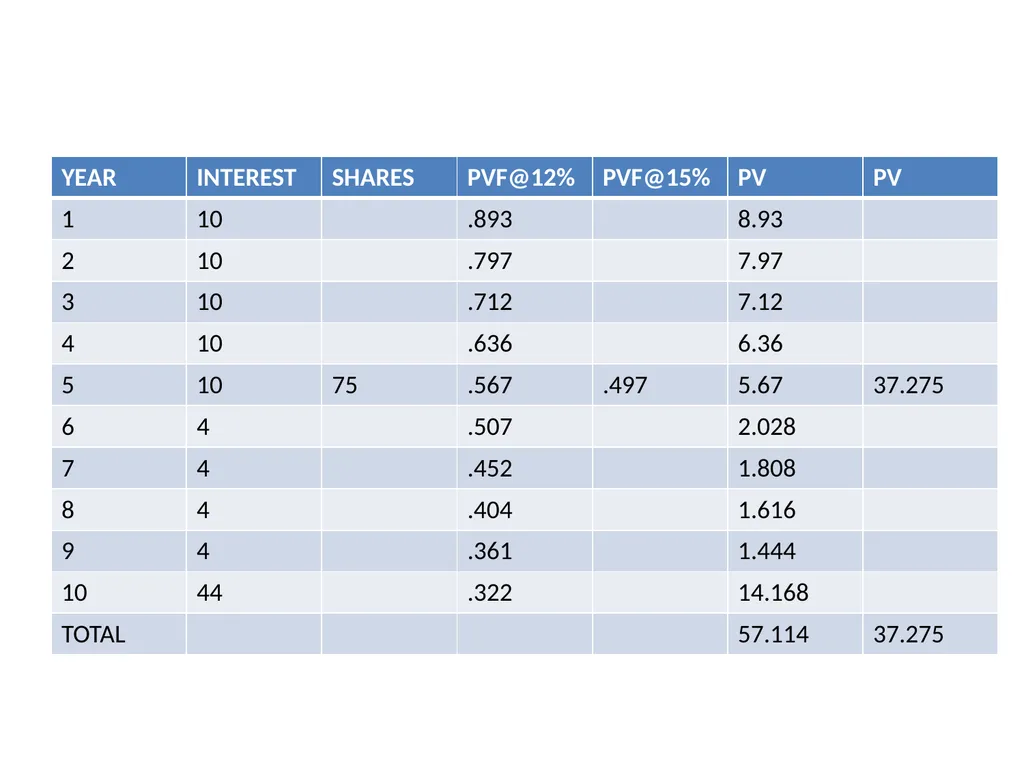
slide42. Practice problem 1Q) A Company issues a compulsorily partly convertible 10% debentures having face value of Rs 100. It is partially convertible (60% of face value) into three shares of Rs 20 each after five years. The total tenure of the bond is 10 years. the expected share price after 5 years is Rs. 25. calculate the value of this partially convertible debenture if required rate of return on equity is 15% and on debt12%.<br>
slide43. Interest + shares + interest<br>
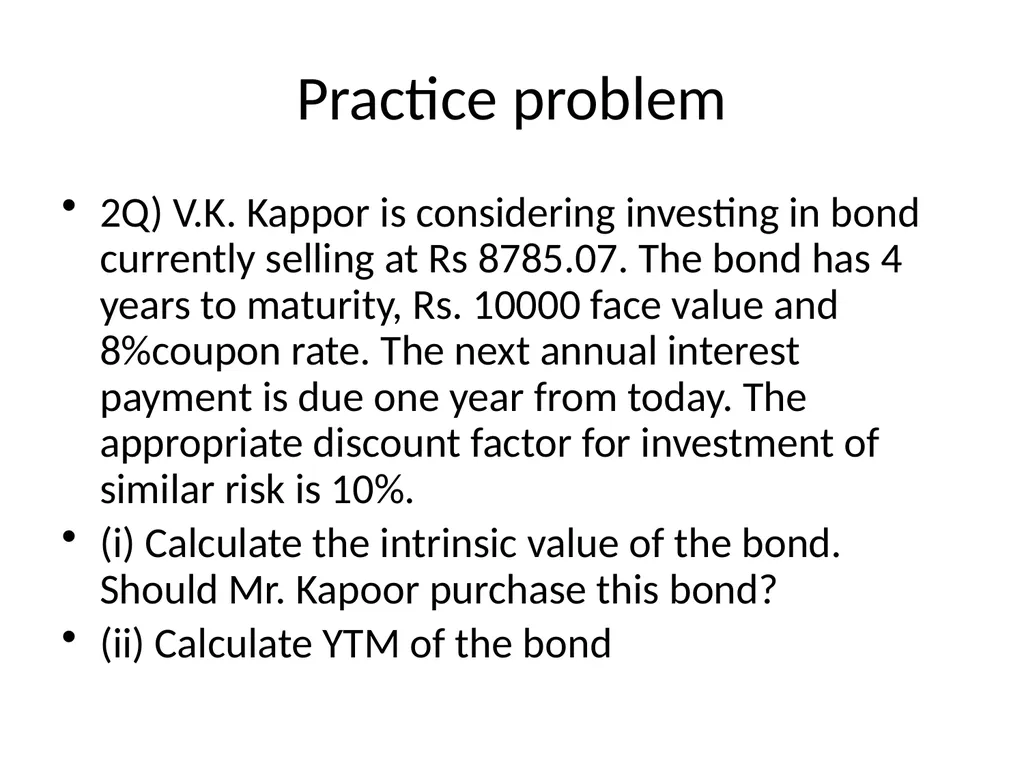
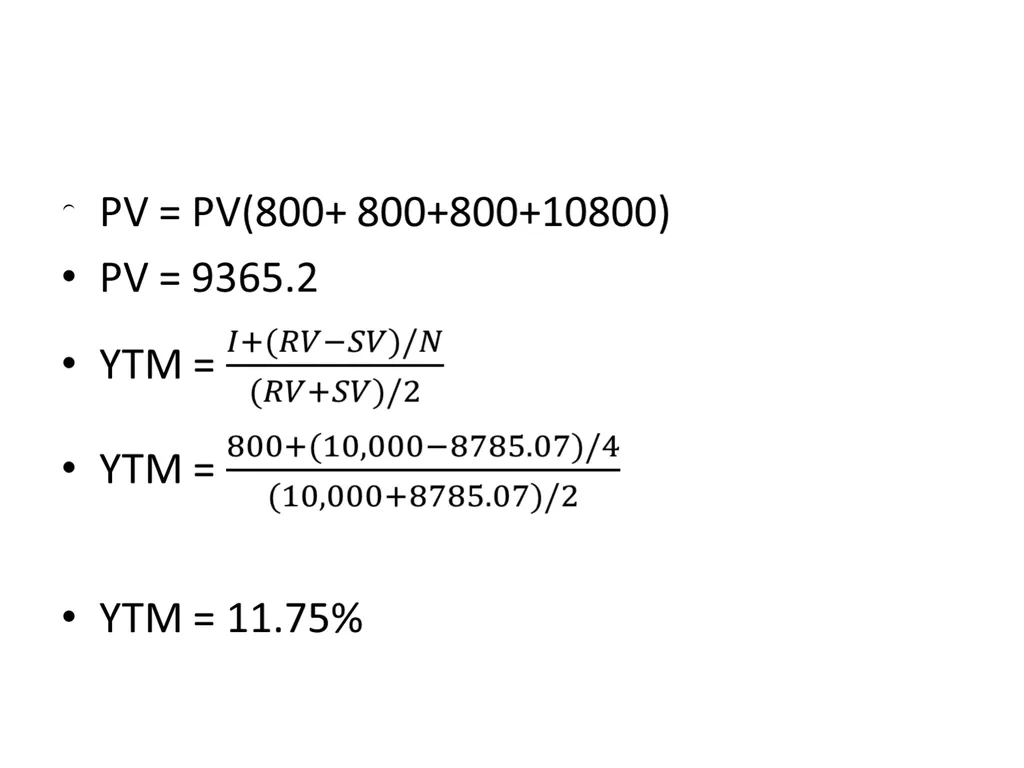
slide44. Practice problem 2Q) V.K. Kappor is considering investing in bond currently selling at Rs 8785.07. The bond has 4 years to maturity, Rs. 10000 face value and 8%coupon rate. The next annual interest payment is due one year from today. The appropriate discount factor for investment of similar risk is 10%.
(i) Calculate the intrinsic value of the bond. Should Mr. Kapoor purchase this bond?
(ii) Calculate YTM of the bond<br>
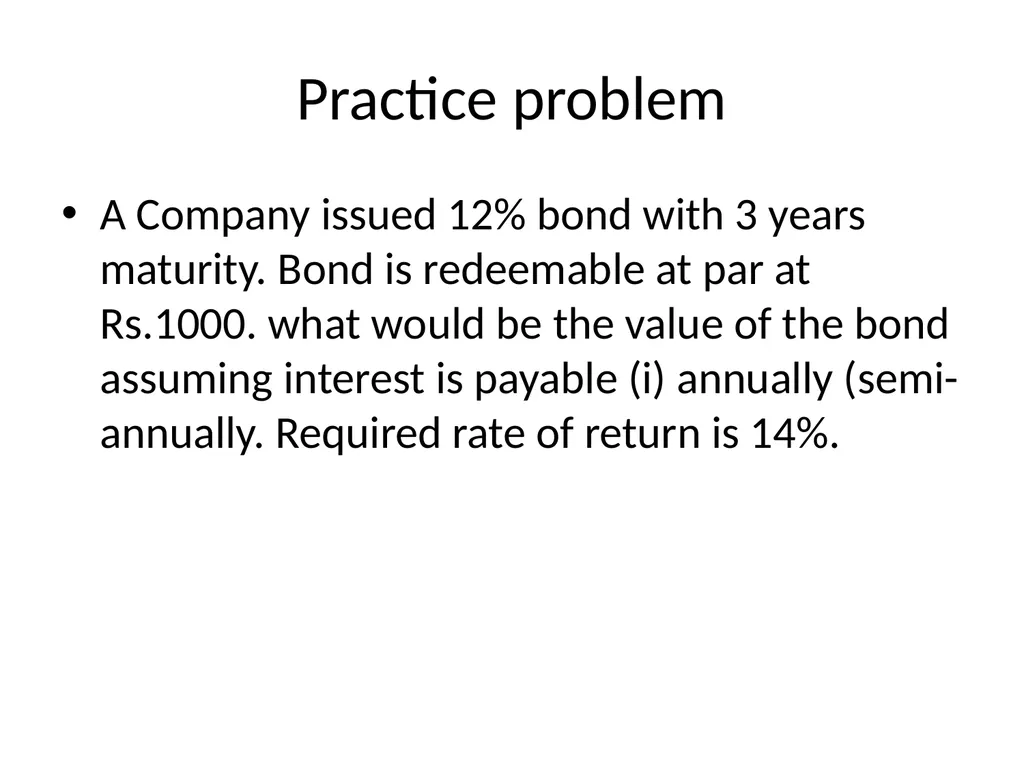
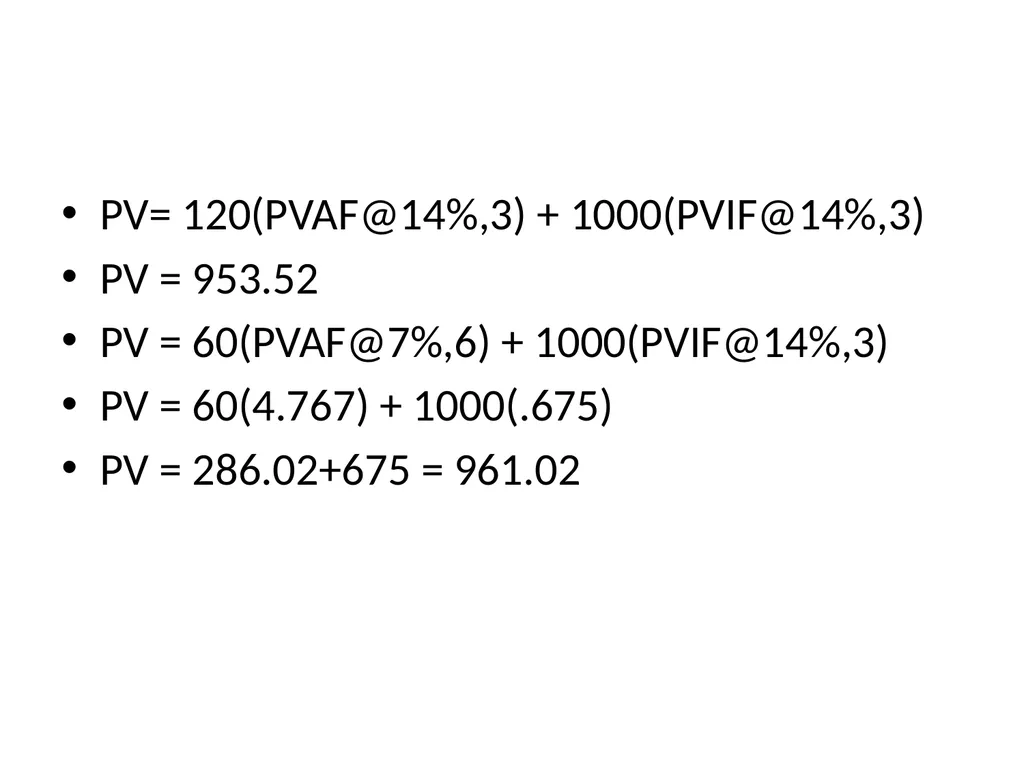
slide46. Practice problem A Company issued 12% bond with 3 years maturity. Bond is redeemable at par at Rs.1000. what would be the value of the bond assuming interest is payable (i) annually (semi-annually. Required rate of return is 14%.<br>
slide47. PV= 120(PVAF@14%,3) + 1000(PVIF@14%,3)
PV = 953.52
PV = 60(PVAF@7%,6) + 1000(PVIF@14%,3)
PV = 60(4.767) + 1000(.675)
PV = 286.02+675 = 961.02<br>
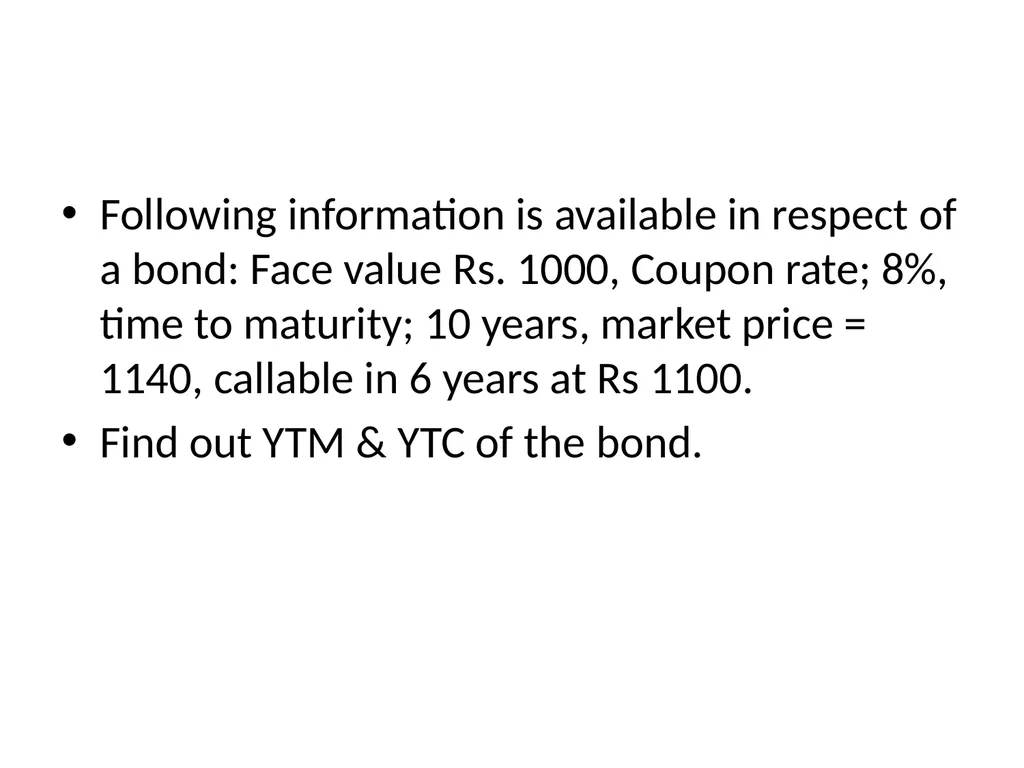
slide48. Following information is available in respect of a bond: Face value Rs. 1000, Coupon rate; 8%, time to maturity; 10 years, market price = 1140, callable in 6 years at Rs 1100.
Find out YTM & YTC of the bond.<br>
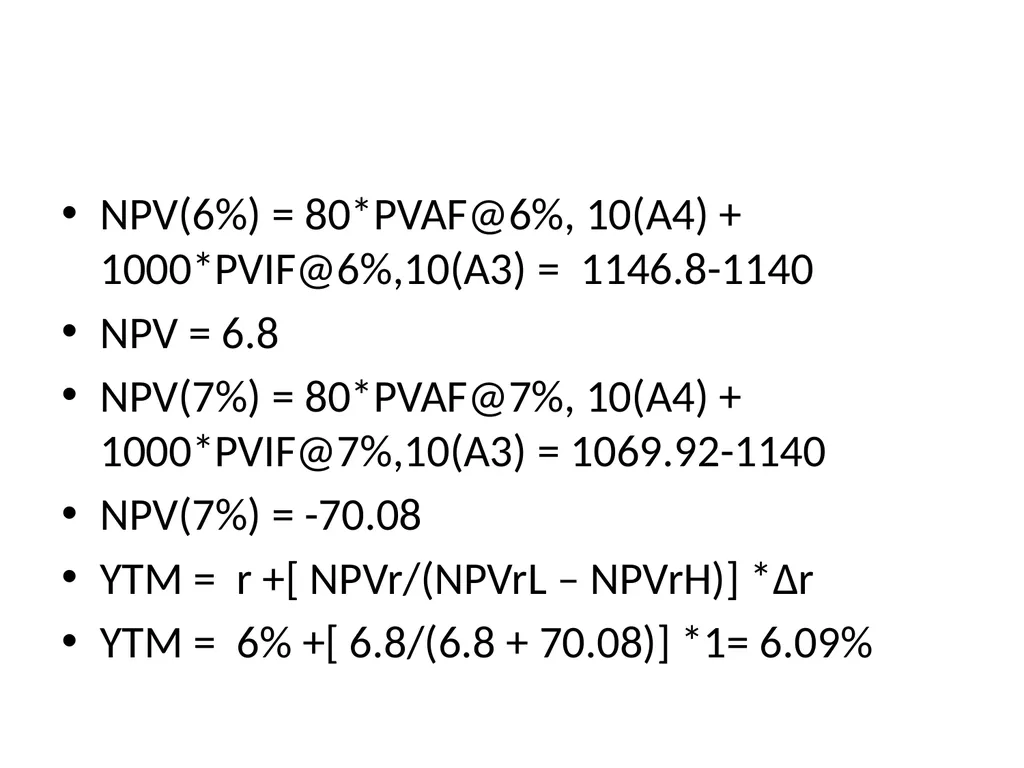
slide49. NPV(6%) = 80*PVAF@6%, 10(A4) + 1000*PVIF@6%,10(A3) = 1146.8-1140
NPV = 6.8
NPV(7%) = 80*PVAF@7%, 10(A4) + 1000*PVIF@7%,10(A3) = 1069.92-1140
NPV(7%) = -70.08
YTM = r +[ NPVr/(NPVrL – NPVrH)] *Δr
YTM = 6% +[ 6.8/(6.8 + 70.08)] *1= 6.09%<br>
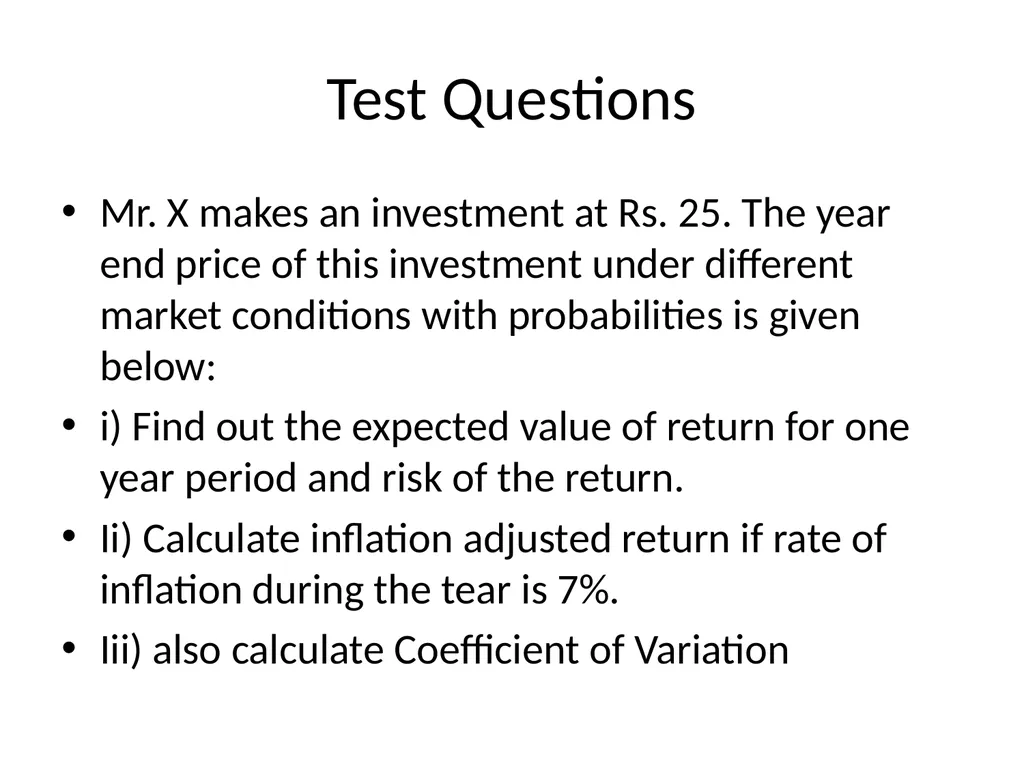
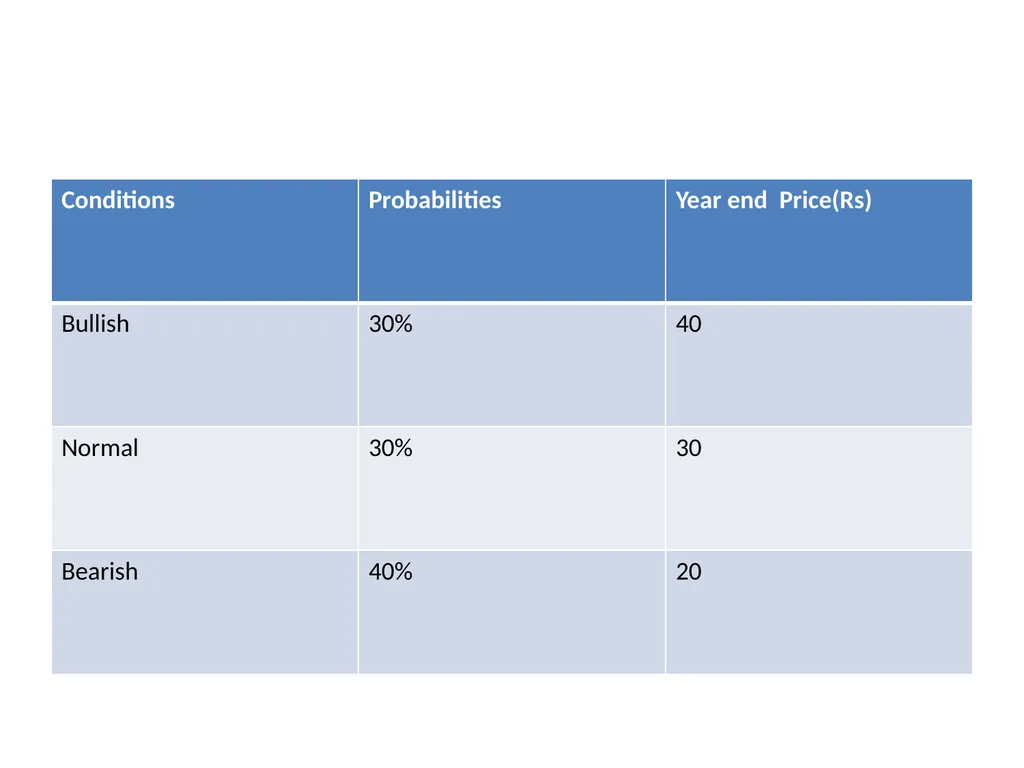
slide50. Test Questions Mr. X makes an investment at Rs. 25. The year end price of this investment under different market conditions with probabilities is given below:
i) Find out the expected value of return for one year period and risk of the return.
Ii) Calculate inflation adjusted return if rate of inflation during the tear is 7%.
Iii) also calculate Coefficient of Variation<br>
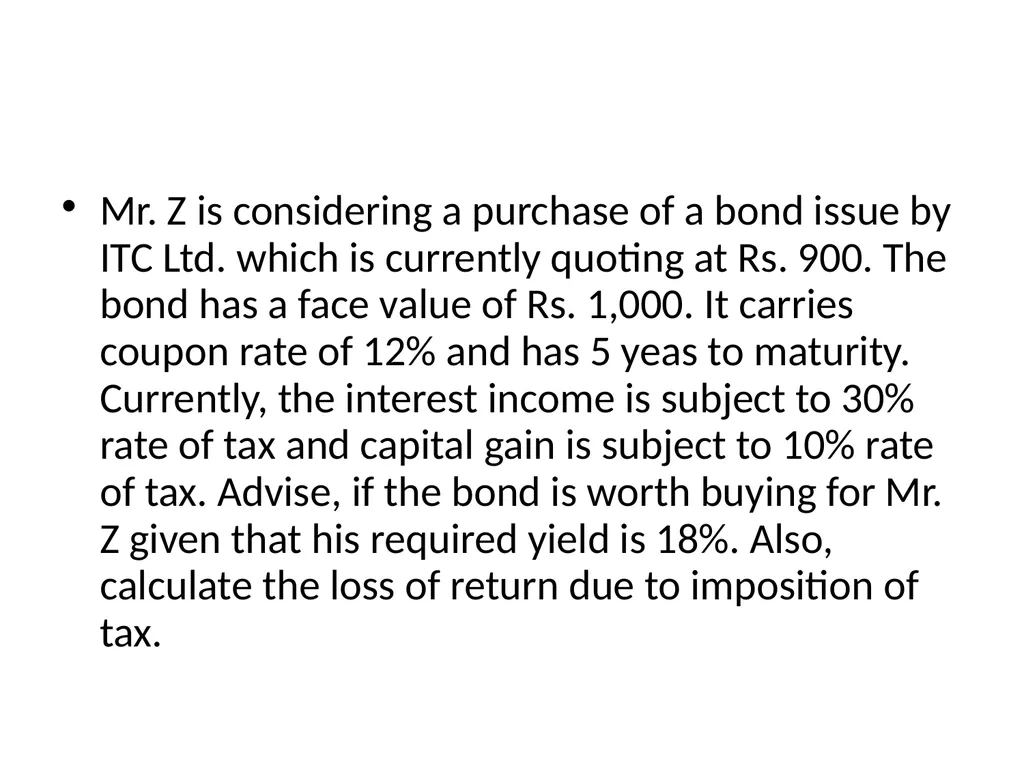
slide52. Mr. Z is considering a purchase of a bond issue by ITC Ltd. which is currently quoting at Rs. 900. The bond has a face value of Rs. 1,000. It carries coupon rate of 12% and has 5 yeas to maturity. Currently, the interest income is subject to 30% rate of tax and capital gain is subject to 10% rate of tax. Advise, if the bond is worth buying for Mr. Z given that his required yield is 18%. Also, calculate the loss of return due to imposition of tax.<br>
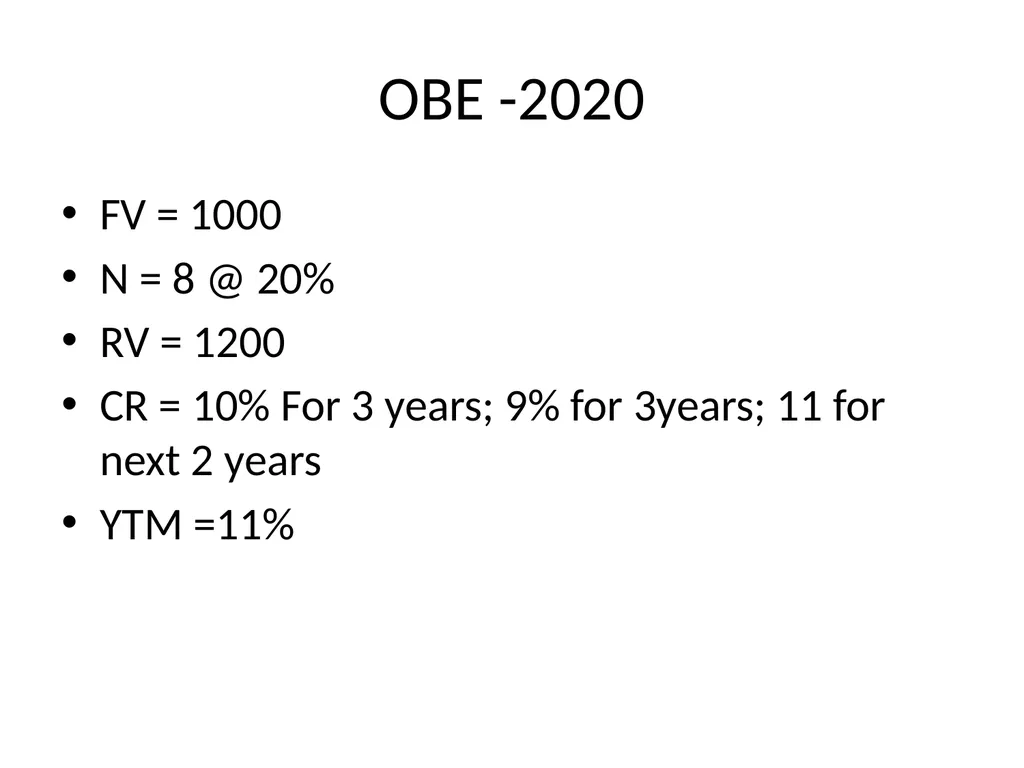
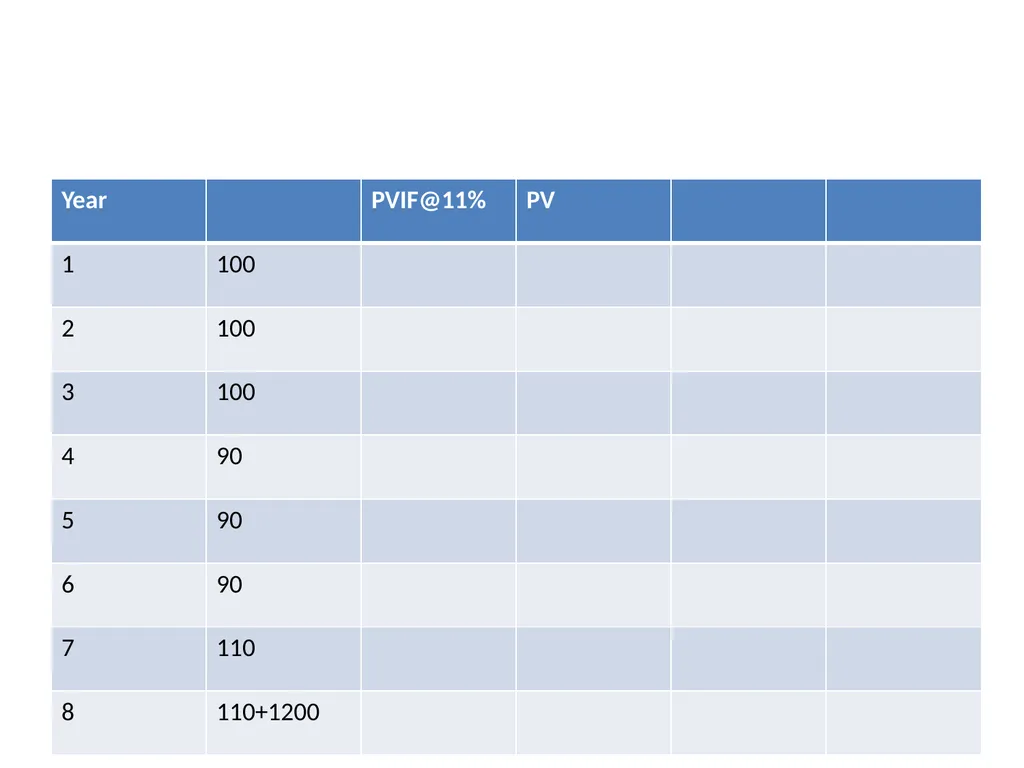
slide53. OBE -2020 FV = 1000
N = 8 @ 20%
RV = 1200
CR = 10% For 3 years; 9% for 3years; 11 for next 2 years
YTM =11%<br>
slide2. UNIT-2 Basics of bond investment
Default risk and credit rating<br>
slide3. Basics of bond investment Concept of bond
Types of bonds
Risk associated with bond returns
Measures of bond returns<br>
slide4. Concept of bond Basics of bond investment
Debentures are not secured by any security Vs bonds are secured by some security
Face value: basic denomination
Redemption value:
Coupon rate: rate of interest
Maturity period:
Bond indenture:
Bond trustee:
Collateral:<br>
slide5. Types of bonds Convertible and non-convertible bonds
Fully Vs partially
Compulsorily Vs optional
Redeemable and Irredeemable
Secured and unsecured bonds
Callable and putable bonds:
Call option: borrower(Company) can redeem after a specified time but before maturity
and put option: bondholder can ask for redemption after a specified time but before maturity
Junk bonds: Examples of Junk bonds: TESLA, FORD and NETFLIX
Secured premium note(SPN):Non-convertible debentures with detachable warrents( right to buy share on a specified date and price)
Lock-in-period : 5 yrs, after 5 years: either get it redeemed or interest plus principal amount in instalments.<br>
slide7. Risk associated with bond returns Default risk
Interest risk
Inflation risk
Call risk: callable bonds
Liquidity risk<br>
slide8. Measures of bond returns<br>
slide9. Yield to maturity (Assumptions)<br>
slide11. ILLUSTRATION XYZ Ltd’s bonds have 4 years remaining to maturity. Interest is paid annually at the rate of 9 percent. The bond has face value of Rs 1000. find the yield to the maturity of the bond if the market price of the bond is 829.
B) Would you pay Rs 829 for the bond if your required rate of return is 12%?<br>
slide15. Would you pay Rs 829 for the bond if your required rate of return is 12%? Real worth = PV(90,90,90,90,1090 @12%)
YTM = 15%, real value =829
Buy it as real value will be more than 829.<br>
slide16. Bond Value Theorems(Malkiel)<br>
slide17. 2)The discount or premium on the bonds having same yield varies with the maturity period of the bonds Bond (A -2yrs), Bond (B-3yrs); Bond(C-4yrs)
FV = 1000
YTM = 12%(Discount rate)
CR = 14%
Next situation:
YTM =14%
CR=12%<br>
slide18. Premium<br>
slide19. Discount Bond(A) = 966.52 – 1000 = 33.48
Bond(B) = 953.52 -1000 = 46.48
Bond© = 941.56 -1000= 58.44<br>
slide20. 3.The amount of premium/discount declines(at increasing rate) as the life of the bond reaches near its maturity FV = 1000
CR = 10%
YTM = 12%
remaining life = 5; 4 ;3
Situation2:
CR = 12%
YTM = 10%<br>
slide21. Remaining life 5 years<br>
slide22. Remaining life 4 years<br>
slide23. Remaining life 3 years<br>
slide25. Rate of change<br>
slide26. Price
CR>YTM
CR<YTM
Maturity period<br>
slide27. 4.Decrease in yield results in more changes in market price in comparison to increase in yield FV = 1000
CR = 10%
YTM = 10%
Time = 5Years; M. P. = 1000
Situation 1: YTM = 8% ; 1080
Situation 2: YTM = 12%; 927.5<br>
slide29. 5)For a given change in bond yield, the price variation will be lesser for the bonds having higher coupon rate FV(A) = 1000
CR = 10%
YTM = 10%
Time = 5; M.P. = 1000
Situation 2;YTM = 12%; MP= 927.5
Situation3; YTM =8% ; MP= 1080.3
FV (B) = 1000
CR =12%
Time = 5;
YTM =10%; MP = 1075.8;
Situation2;YTM = 12%; M.P = 1000
Situation3; YTM =8% ; MP=1160.2<br>
slide31. Impact of taxation on bond valuation Interest payment on due date; Coupon amt(1-t)
Capital gain/loss at the time of maturity
M P = PV(NetI +Net I +Net I +Net I + RV-tax on CG)
Long term /short term gain of bonds
Long term: more than 12 months for listed bonds and zero coupon
Benefit of indexation : not available
Rate of tax on short term (normal tax slab)/ long term gain(20%)<br>
slide32. Practice problems A Bond having face value of Rs.1000 is available for 800. It carries coupon rate of 14% and has 5-years to maturity. Currently, the interest income is subject to30% rate of tax and capital gain is subject to 10% rate of tax. Advise, if the bond is worth buying for the investors having 18% required rate of return and the bond is held till maturity.<br>
slide33. FV = 1000
CR =14%;5 Years
Net interest = 140 (1-.3) = 140*.7 = 98
RV = 1000; SV = 800
Capital gain = 1000-800 =200
Tax on capital gain = .10 * 200 = 20
Net RV = 1000- 20 = 980<br>
slide35. Practice problem A Company is contemplating to issue bonds having face value of Rs 5000 which will be redeemed over a period of 5 years in five equal annual instalments. The bond carries a coupon interest rate of 8%. Find the price at which the bonds should be issued to the investor having expected rate of return of 10%.<br>
slide37. Default Risk Bond market in India
Credit rating
Credit rating agencies; CRISIL, CARE
Benefits
Methodology<br>
slide38. Bond duration(Macaulay) Shortcomings of YTM
Reinvestment risk and price risk
Extend to which the price of a bond will react to different interest rate environment
Weighted average of life of a bond
Steps:1) CF * PVIF = PV of CF
2) FINDING WEIGHTS
3)TIME* WEIGHTS<br>
slide40. Properties of bond duration Larger the coupon rate, less time will be required to recover benefits and lesser the duration of bond
Bond duration increases with the maturity period.
Higher the YTM, lower would be the bond duration
Zero coupon bond: bond duration will be its maturity period.<br>
slide42. Practice problem 1Q) A Company issues a compulsorily partly convertible 10% debentures having face value of Rs 100. It is partially convertible (60% of face value) into three shares of Rs 20 each after five years. The total tenure of the bond is 10 years. the expected share price after 5 years is Rs. 25. calculate the value of this partially convertible debenture if required rate of return on equity is 15% and on debt12%.<br>
slide43. Interest + shares + interest<br>
slide44. Practice problem 2Q) V.K. Kappor is considering investing in bond currently selling at Rs 8785.07. The bond has 4 years to maturity, Rs. 10000 face value and 8%coupon rate. The next annual interest payment is due one year from today. The appropriate discount factor for investment of similar risk is 10%.
(i) Calculate the intrinsic value of the bond. Should Mr. Kapoor purchase this bond?
(ii) Calculate YTM of the bond<br>
slide46. Practice problem A Company issued 12% bond with 3 years maturity. Bond is redeemable at par at Rs.1000. what would be the value of the bond assuming interest is payable (i) annually (semi-annually. Required rate of return is 14%.<br>
slide47. PV= 120(PVAF@14%,3) + 1000(PVIF@14%,3)
PV = 953.52
PV = 60(PVAF@7%,6) + 1000(PVIF@14%,3)
PV = 60(4.767) + 1000(.675)
PV = 286.02+675 = 961.02<br>
slide48. Following information is available in respect of a bond: Face value Rs. 1000, Coupon rate; 8%, time to maturity; 10 years, market price = 1140, callable in 6 years at Rs 1100.
Find out YTM & YTC of the bond.<br>
slide49. NPV(6%) = 80*PVAF@6%, 10(A4) + 1000*PVIF@6%,10(A3) = 1146.8-1140
NPV = 6.8
NPV(7%) = 80*PVAF@7%, 10(A4) + 1000*PVIF@7%,10(A3) = 1069.92-1140
NPV(7%) = -70.08
YTM = r +[ NPVr/(NPVrL – NPVrH)] *Δr
YTM = 6% +[ 6.8/(6.8 + 70.08)] *1= 6.09%<br>
slide50. Test Questions Mr. X makes an investment at Rs. 25. The year end price of this investment under different market conditions with probabilities is given below:
i) Find out the expected value of return for one year period and risk of the return.
Ii) Calculate inflation adjusted return if rate of inflation during the tear is 7%.
Iii) also calculate Coefficient of Variation<br>
slide52. Mr. Z is considering a purchase of a bond issue by ITC Ltd. which is currently quoting at Rs. 900. The bond has a face value of Rs. 1,000. It carries coupon rate of 12% and has 5 yeas to maturity. Currently, the interest income is subject to 30% rate of tax and capital gain is subject to 10% rate of tax. Advise, if the bond is worth buying for Mr. Z given that his required yield is 18%. Also, calculate the loss of return due to imposition of tax.<br>
slide53. OBE -2020 FV = 1000
N = 8 @ 20%
RV = 1200
CR = 10% For 3 years; 9% for 3years; 11 for next 2 years
YTM =11%<br>