03
"Corporate Social Responsibility (CSR) is a way of ensuring that organisations make strategic decisions in an ethical, sustainable and responsible way. " - University of Edinburgh
Generally, it means showing due interest in the concerns of stakeholders and understanding the impacts of the organisation's activities. It is not an increasingly specialised aspect of management and has in recent years become a necessity, rather than a choice, due to:
Legal changes that have made aspects of CSR compulsory
Increased interest in environmental and ethical issues from consumers and employees.
A convincing business case linking CSR to improved performance
Shareholder pressure on businesses to show that they are operating ethically and sustainably<br>
04
Benefits of Corporate Social Responsibility Policies
CSR policies can help to benefit an organisation in a number of ways, including:
Developing or enhancing relationships with consumers and supplier
Attracting and retaining a strong and conscious workforce.
Improving the organisation's standing and reputation
Offering numerous benefits to society and the environment
Though these benefits may not be immediately apparent, they can be measured quantitatively and qualitatively in many ways over the long-term.<br>
05
To effectively operate responsibly, CSR has to be embedded into the everyday actions, systems and the entire culture of the organisation, mostly through propagation by individual leaders within the company, from top to bottom.
Often, specialists are employed to devise new systems, processes and policies which operate in accordance with the organisation's CSR gains. Due to the benefits which these policies can have for wider society, these individuals are often also involved in the communication and marketing of company activities to the general public, in order to develop and maintain the organisational reputation as a sustainable and responsible employer.<br>
06
Business Ethics - Gihan Aboueleish 6 Legal Ethical Unethical Illegal<br>
07
Business Ethics - Gihan Aboueleish 7<br>
08
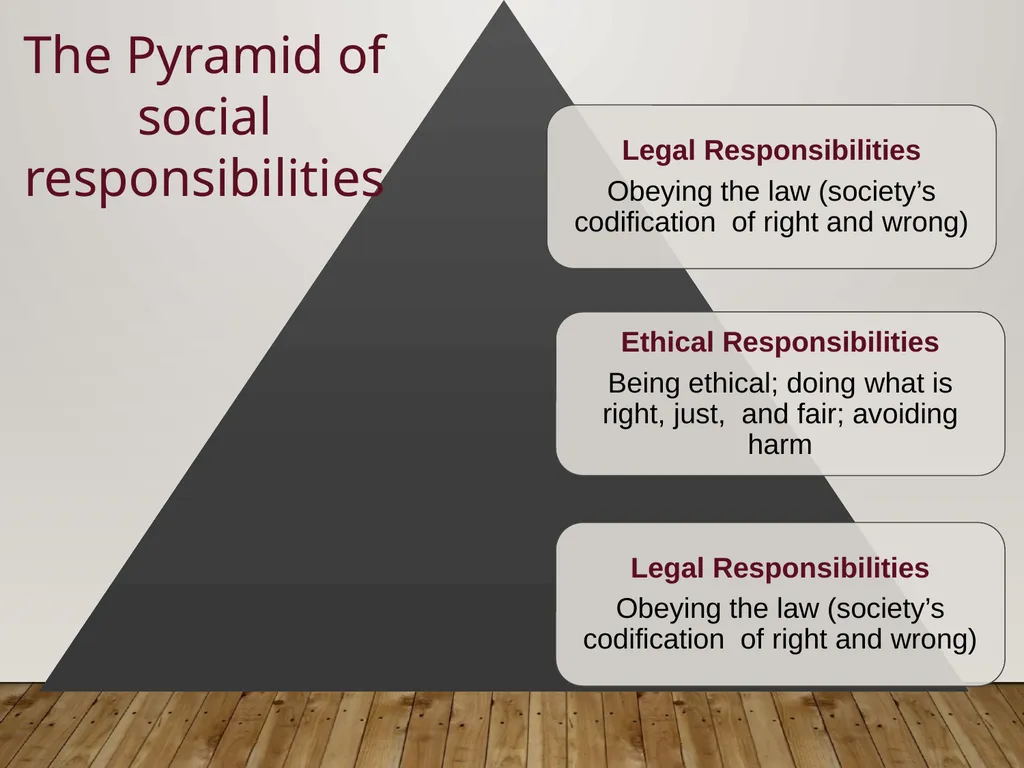
The Pyramid of social responsibilities<br>
09
Key Aspects of Corporate Social Responsibility
CSR generally refers to three main areas of responsibility:
Social
Economic
Environment<br>
10
These are often also sometimes referred to as People, Profit and Planet. There are many important aspects which contribute to each of the three main areas. Here are but a few for each.Social
Employee's working condition and rights.
Diversity and equal opportunities.
Health, safety and protection of all stakeholders
Relationships with the local community.
Relationships with the government and government departments.
Relationships with suppliers and their employees
Schemes and opportunities for learning and development
Philanthropist, volunteering and relationships with charities<br>
11
Economic
Company reporting
Corporate governance
Transparency and disclosure of information from management
Quality of goods and services
Safety of products and services
Responsible marketing
Record keeping
Data and information management/protection
Avoiding bribery and corruption<br>
12
Environmental
Recycling and re-using
Waste control
Preventing pollution (air, light, soil, ocean, etc.)
Sustainable energy and resource consumption
Travel efficiencies
Positive action to improve the local environment<br>
13
4 M- CSR Corporate Many of the philanthropist activities are not monitored or measured. Unlike Corporate CSR.
Four M of corporate social responsibility taken up By corporate has inbuilt 4 M
Meaningful, projects Managing the projects Monitor projects Measure projects
Bank of India does check NGOs how they operate Effectively and efficiency. Nearly rs 1 lak crores of fund Available with corporate for CSR activities.<br>
14
Business ethics �and �problem of self-‐interest<br>
15
Incompatible with ”the moral point of view” – self-‐interest can never be the basis for morality.The content of moral principles Beneficient for everyone
(Kurt Baier (1958) The moral point of view)
Incompatible with the ”minimum conception of morality”: Morality is the endeavor to guide one’s conduct by reason and simultaneously giving equal weight to the interest of each individual affected by ones conduct
(James Rachels (2011) The elements of moral philosophy) Self- Interest<br>
16
Economists assume that people make choices in in a rational manner motivated by their self-‐interest.
The rationality assumption: The assumption that people do not intentionally make decisions that would leave them worse off, but rather maximize their utility. So what about business?<br>
17
The economic way of thinking� (the basis for decision making) Economic questions arise because we want more than we can get.
Due to scarcity we cannot get everything we want. We therefore must make choices.
The choices we make depend on the incentives we face. Incentive = a reward that encourages an action or a sanction that discourages an action.<br>
18
Conceptions of self-‐interest Narrow self-‐interest - selfishness
Classical individualism- ”benefits all”
Persons ought to further their own self-‐interest by self-‐development of self-‐perfection, and by doing so they also further the interests of others.
Enlightened self-‐interest - reciprocity
Persons who act to further the interests of others ultimately serve their own self-‐interest<br>
19
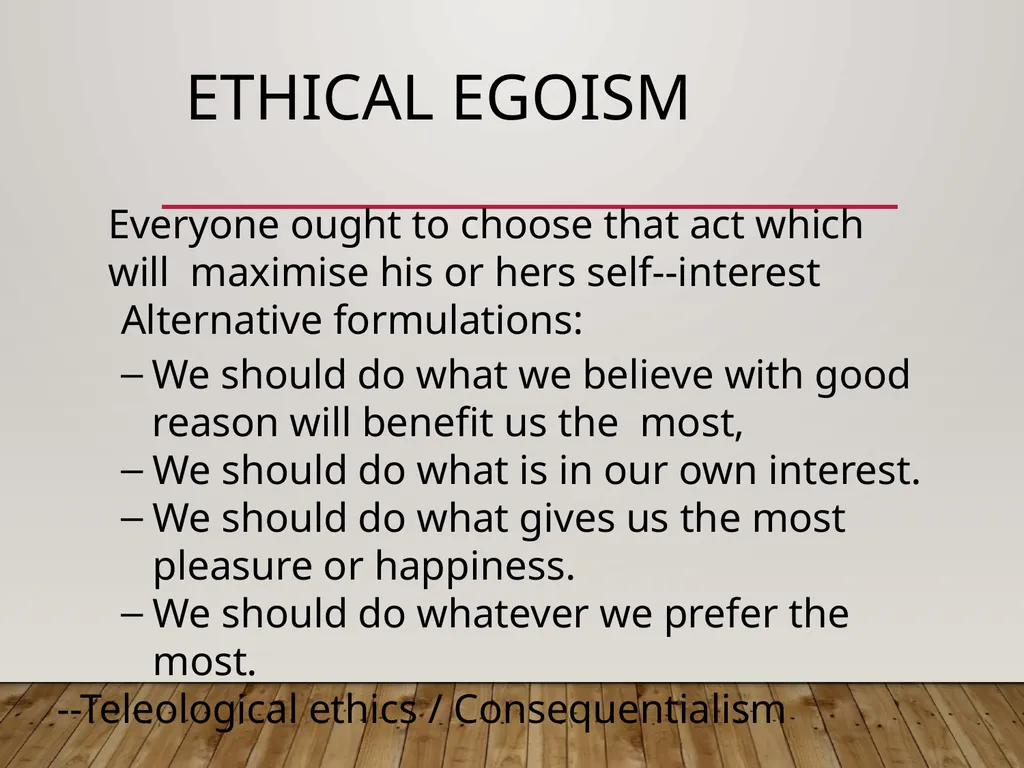
Ethical egoism Everyone ought to choose that act which will maximise his or hers self-‐interest
Alternative formulations:
We should do what we believe with good reason will benefit us the most,
We should do what is in our own interest.
We should do what gives us the most pleasure or happiness.
We should do whatever we prefer the most.
-‐ Teleological ethics / Consequentialism<br>
20
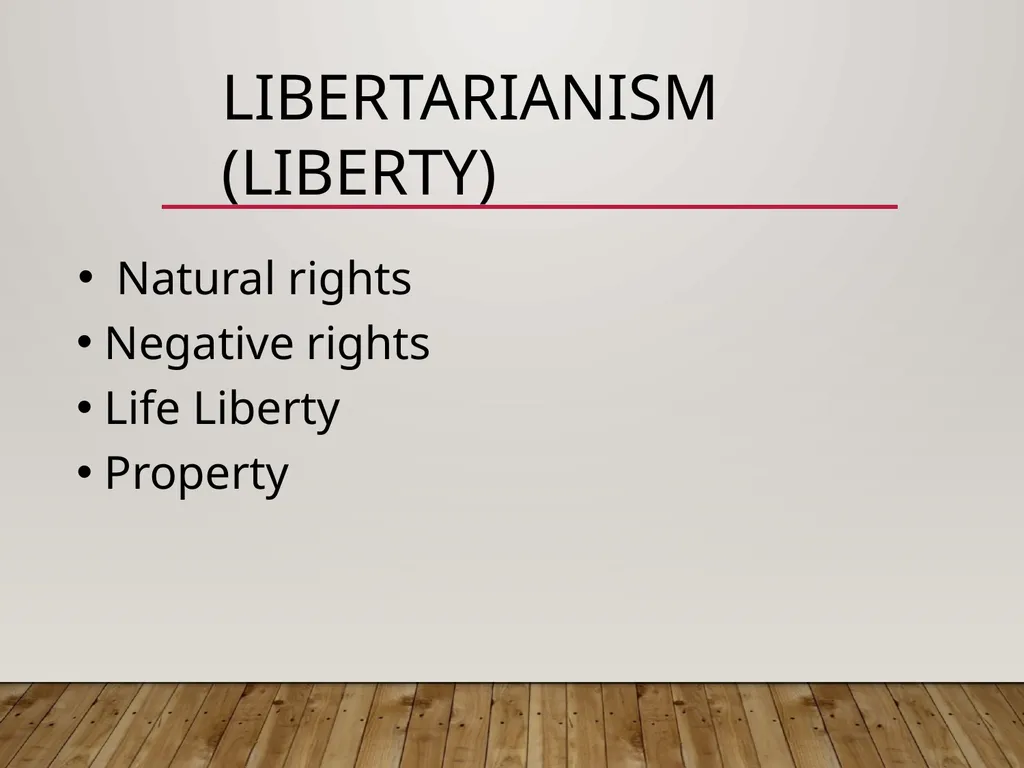
Libertarianism (liberty) Natural rights
Negative rights
Life Liberty
Property<br>
21
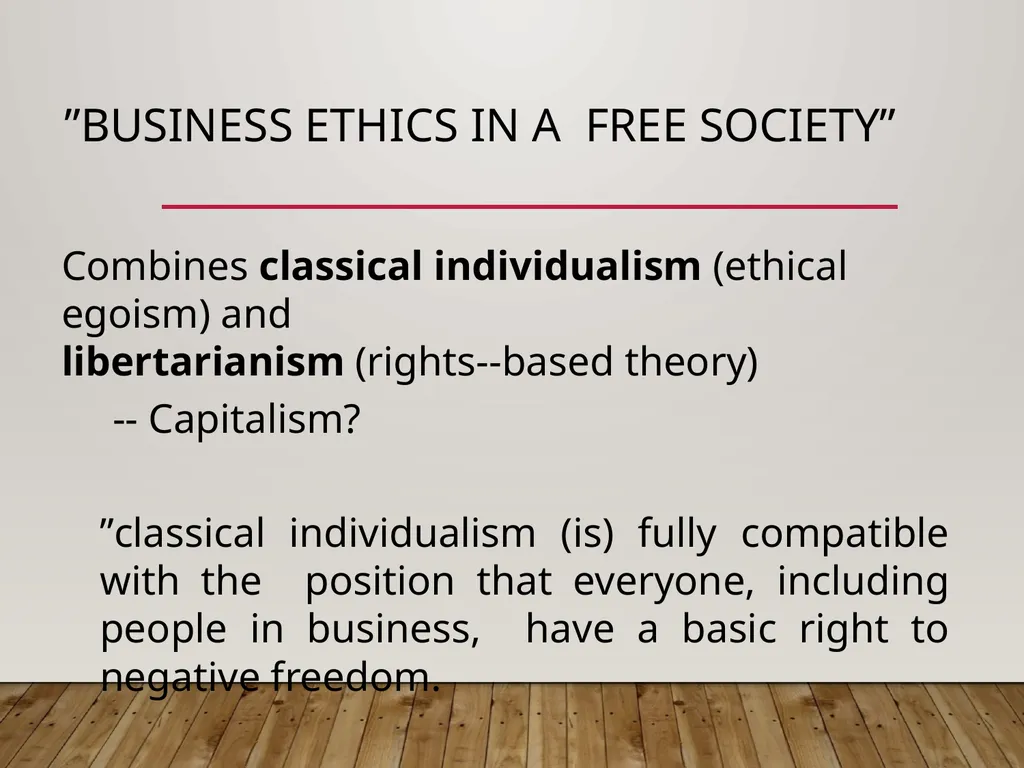
”Business ethics in a free society” Combines classical individualism (ethical egoism) and
libertarianism (rights-‐based theory)
-‐ Capitalism?
”classical individualism (is) fully compatible with the position that everyone, including people in business, have a basic right to negative freedom.<br>
22
Egoism, liberty, and business Freedom from regulation
Strong shareholder rights
The virtue of prudence<br>
23
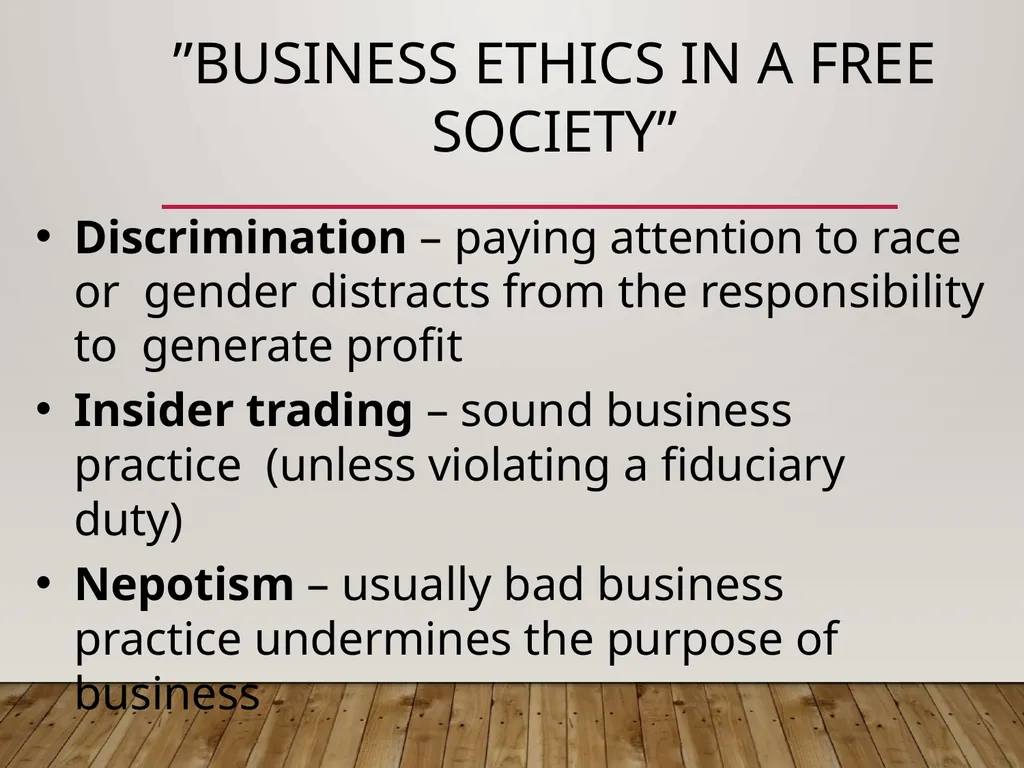
”Business ethics in a free society” Discrimination – paying attention to race or gender distracts from the responsibility to generate profit
Insider trading – sound business practice (unless violating a fiduciary duty)
Nepotism – usually bad business practice undermines the purpose of business<br>
24
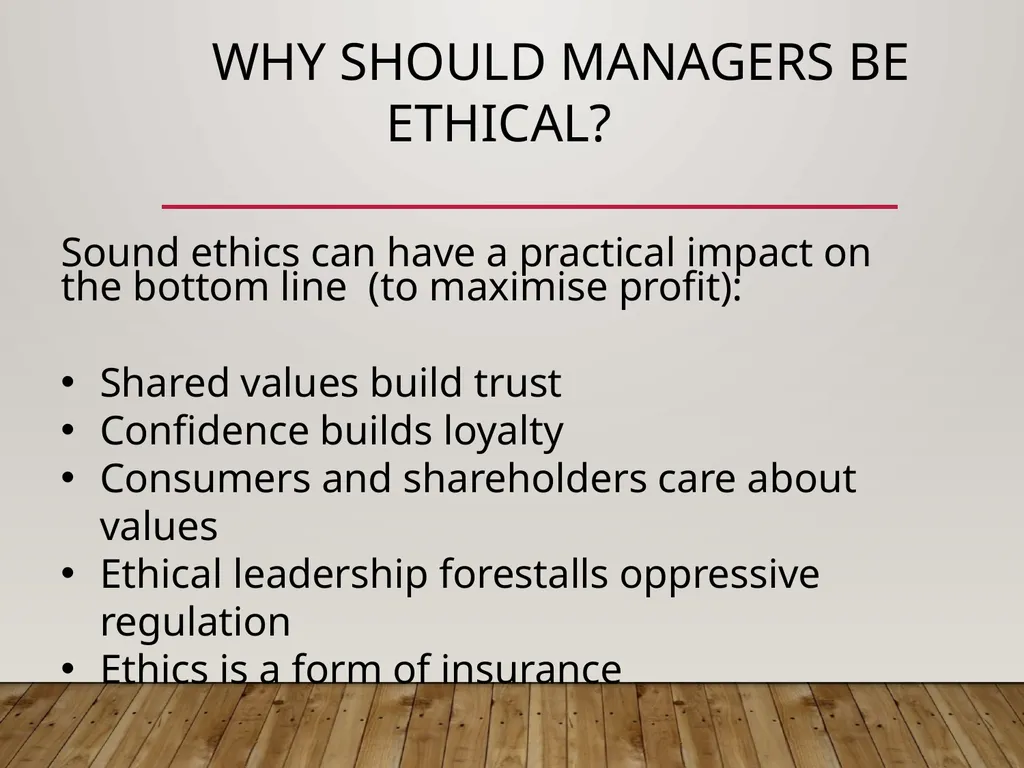
Why should managers be ethical? Sound ethics can have a practical impact on the bottom line (to maximise profit):
Shared values build trust
Confidence builds loyalty
Consumers and shareholders care about values
Ethical leadership forestalls oppressive regulation
Ethics is a form of insurance<br>
25
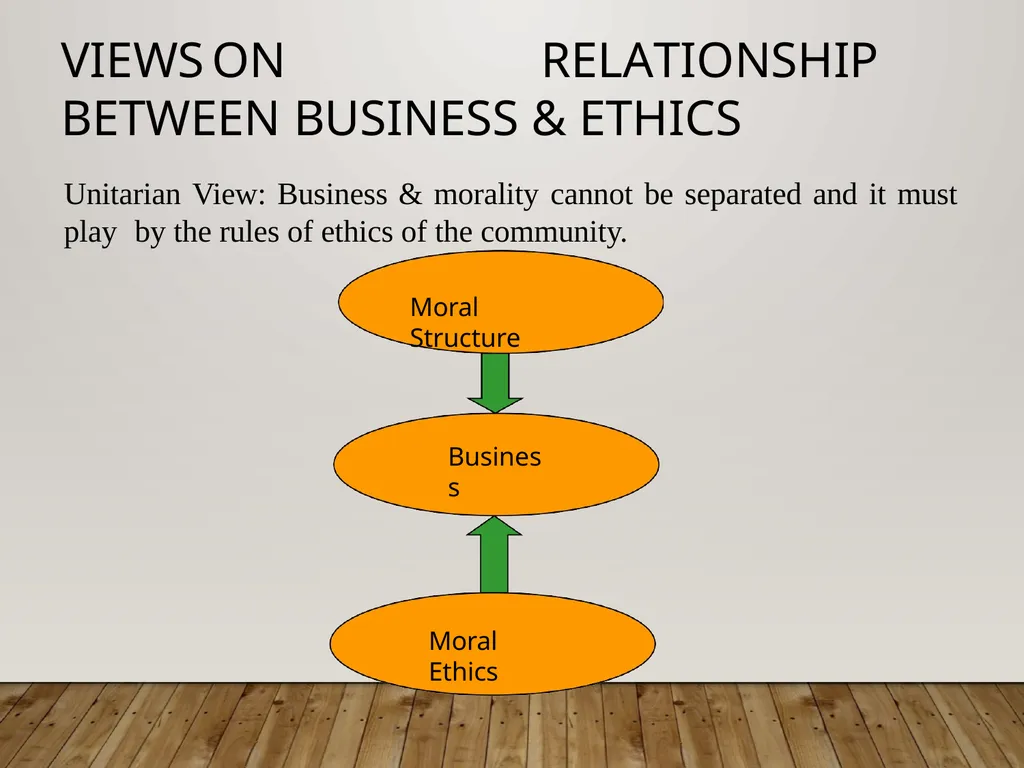
Unitarian View: Business & morality cannot be separated and it must
play by the rules of ethics of the community. Views on relationship �between Business & Ethics Moral Structure Business Moral Ethics<br>