Unit 3 Economic Growth and Development Meaning of economic growth Economic growth describes a rise in the production of goods and services in a country or region over a particular period. Economic growth is reflected by an increase in the
"Unit 3 Economic Growth and Development Meaning of" is the property of its rightful owner. Permission is granted to
download and print the materials on this website for personal, non-commercial use only, and to display it
on your personal computer provided you do not modify the materials and that you retain all copyright
notices contained in the materials. By downloading content from our website, you accept the terms of this
agreement.
Presentation Transcript
01
Unit 3 Economic Growth and Development Meaning of economic growth
Economic growth describes a rise in the production of goods and services in a country or region over a particular period.
Economic growth is reflected by an increase in the gross domestic product (GDP).
The GDP is the total monetary value attached to all goods and services produced in a country over a specified period of time.<br>
02
Definition of Economic Growth Amartya Sen: “one aspect of the process of economic development”.
Kindle Berger: “Economic growth means more output and economic development implies more output and changes in the technical and institutional arrangements, by which it is produced.”
Smith: “Economic growth is the result of an enhancement in productive processes, which delivers an increase in wealth and production with the same resources”<br>
03
Factors influencing economic growth Natural resources:
Among the natural resources we generally include land area and the quality of soil, forest wealth, good river system, minerals and oil resources etc.
A country deficient in natural resources may not be in a position to develop rapidly.
2.) Human resources:
Increase in skills and capabilities of a workforce ultimately increases the economic growth of a country.
Investment in human capital in the form of educational and medical and such other social schemes is very much desirable.<br>
04
3) Infrastructure development:
Improvements and increased investment in physical capital such as roadways, machinery, and factories will increase the efficiency of economic output by reducing cost.
4) Population growth:
An increase in population growth will result in availability of more human resources which in turn will increase the output in terms of quantity.
The population growth should be normal. A galloping rise in population retards economic progress.
5) Advancement in technology:
Application of advanced technology will result in increased productivity of labor and economic growth of a country.
Capital accumulation is not possible without technical progress.<br>
05
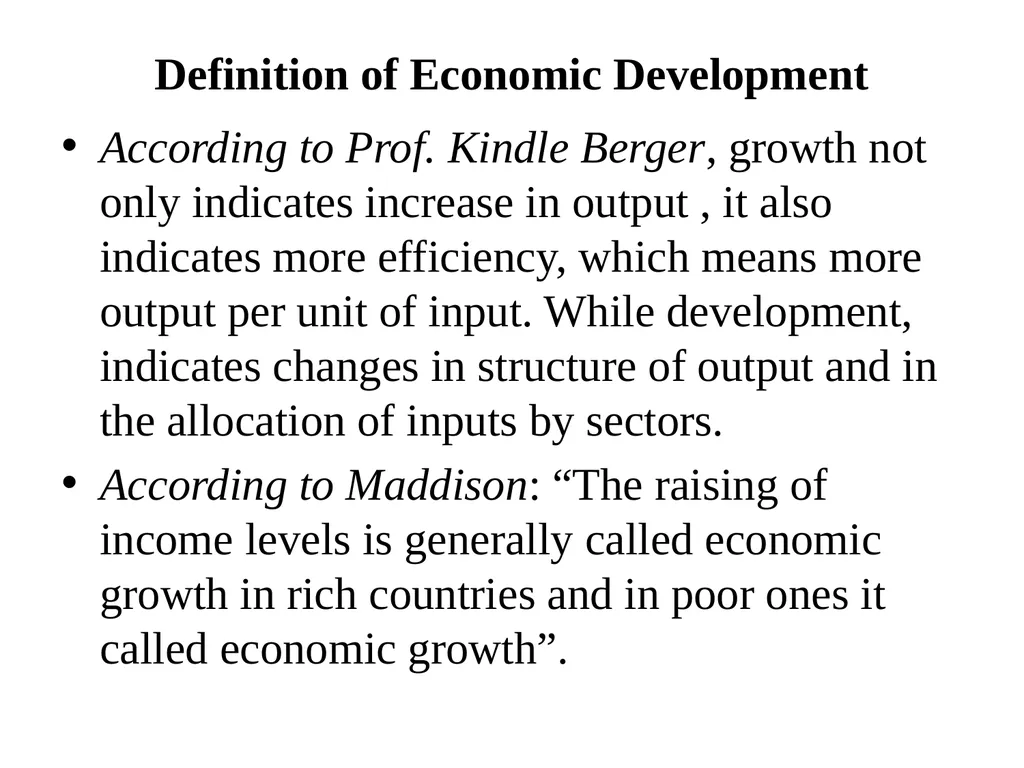
Definition of Economic Development According to Prof. Kindle Berger, growth not only indicates increase in output , it also indicates more efficiency, which means more output per unit of input. While development, indicates changes in structure of output and in the allocation of inputs by sectors.
According to Maddison: “The raising of income levels is generally called economic growth in rich countries and in poor ones it called economic growth”.<br>
06
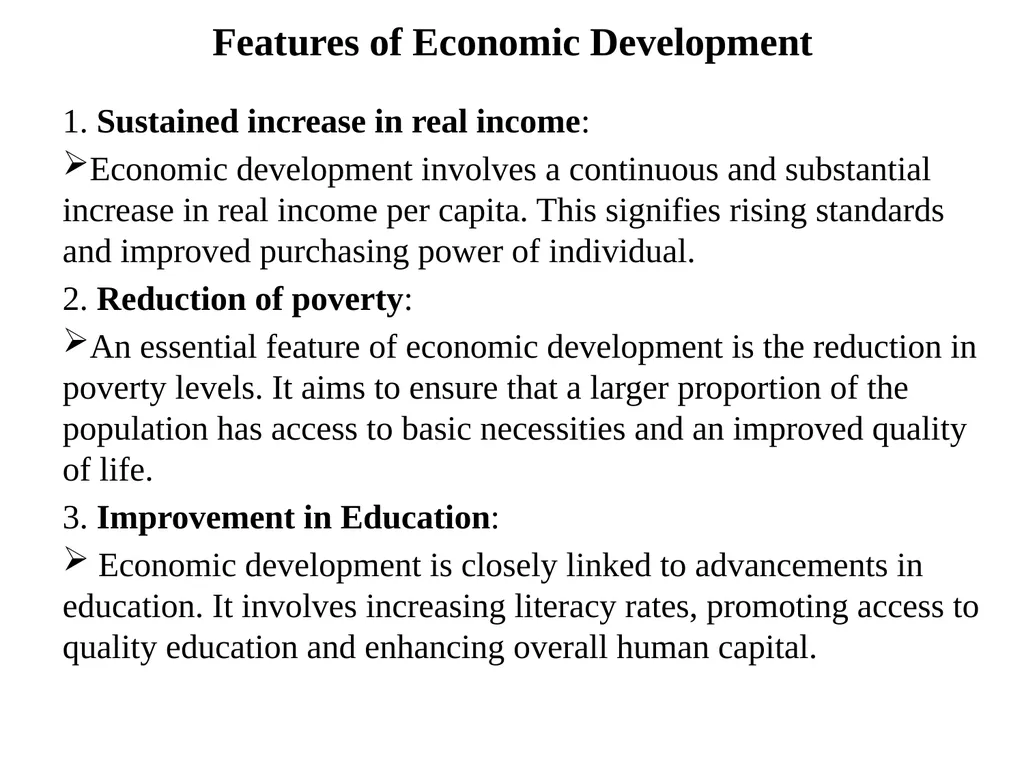
Features of Economic Development 1. Sustained increase in real income:
Economic development involves a continuous and substantial increase in real income per capita. This signifies rising standards and improved purchasing power of individual.
2. Reduction of poverty:
An essential feature of economic development is the reduction in poverty levels. It aims to ensure that a larger proportion of the population has access to basic necessities and an improved quality of life.
3. Improvement in Education:
Economic development is closely linked to advancements in education. It involves increasing literacy rates, promoting access to quality education and enhancing overall human capital.<br>
07
4. Enhanced healthcare and longer life expectancy:
Economic development includes improvement in healthcare infrastructure, increased access to medical services, and a subsequent increase in life expectancy.
5. Infrastructure development:
Development in infrastructure includes transportation, communication, energy and water supply.
Adequate infrastructure is crucial for economic activities and daily life.<br>
08
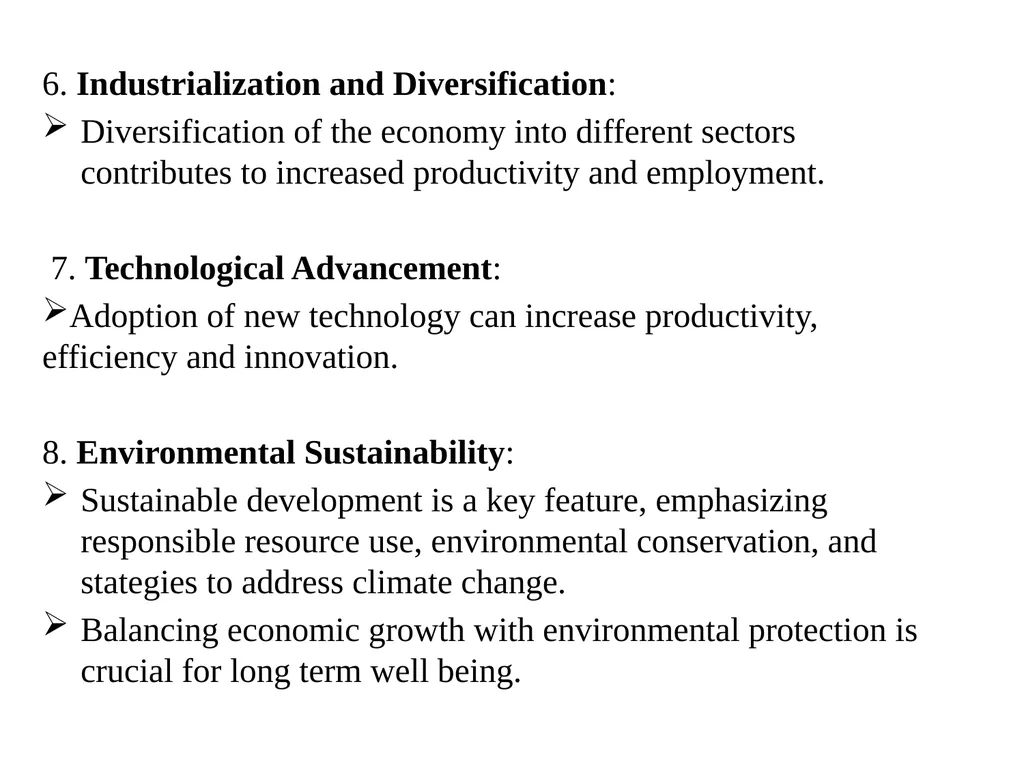
6. Industrialization and Diversification:
Diversification of the economy into different sectors contributes to increased productivity and employment.
7. Technological Advancement:
Adoption of new technology can increase productivity, efficiency and innovation.
8. Environmental Sustainability:
Sustainable development is a key feature, emphasizing responsible resource use, environmental conservation, and stategies to address climate change.
Balancing economic growth with environmental protection is crucial for long term well being.<br>
09
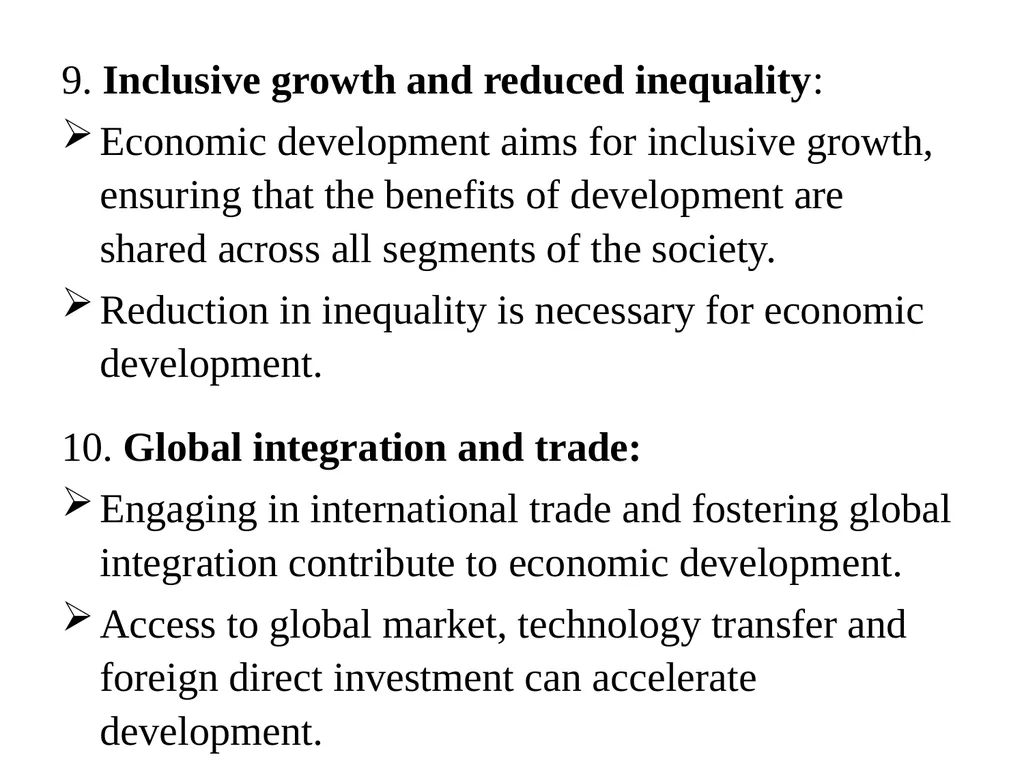
9. Inclusive growth and reduced inequality:
Economic development aims for inclusive growth, ensuring that the benefits of development are shared across all segments of the society.
Reduction in inequality is necessary for economic development.
10. Global integration and trade:
Engaging in international trade and fostering global integration contribute to economic development.
Access to global market, technology transfer and foreign direct investment can accelerate development.<br>
10
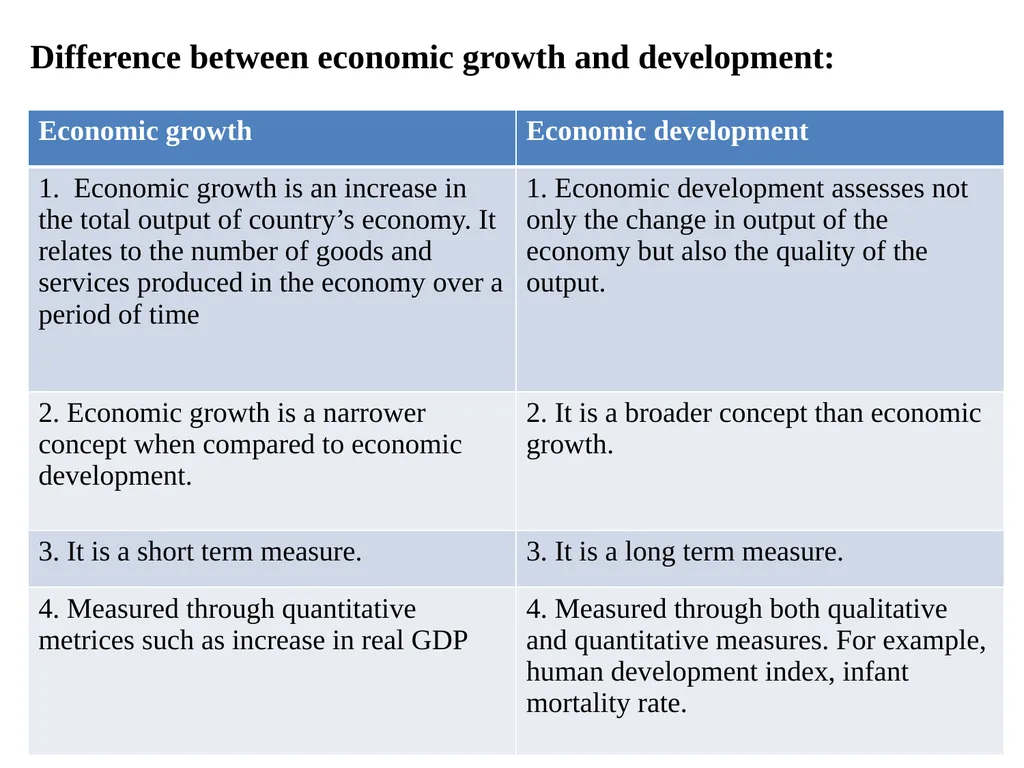
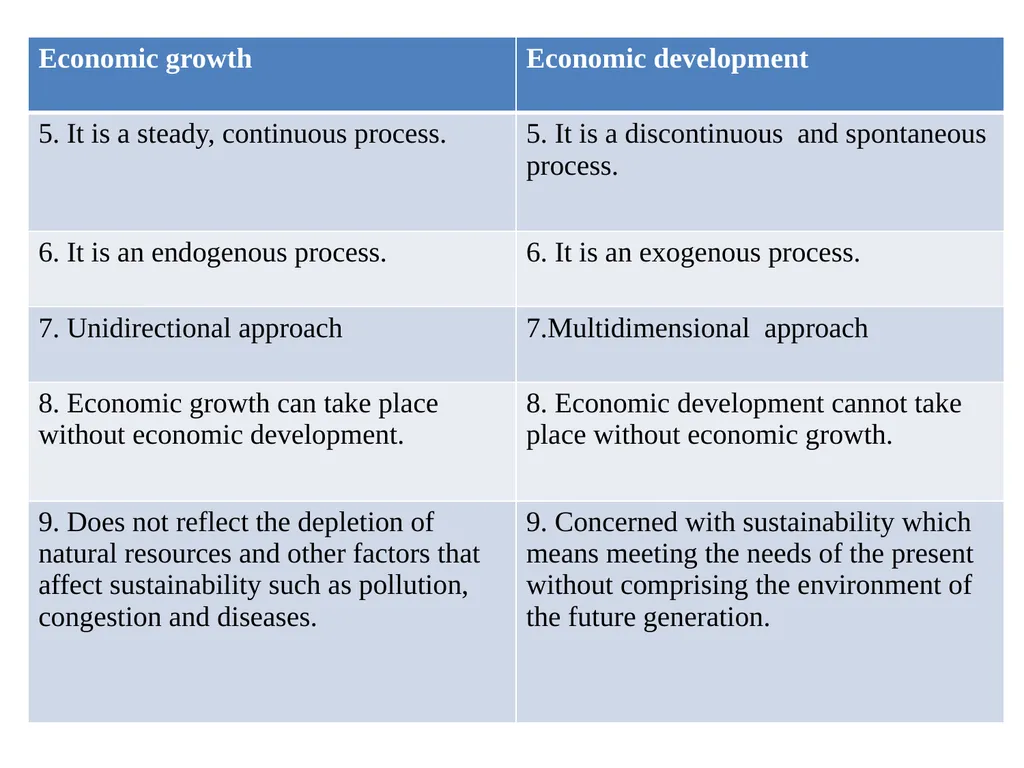
Difference between economic growth and development:<br>
11
Per capita income as a measure of development Per capita income can be defined as the income per head or the average income. Per capita income of a country can be obtained by dividing the national income by the total population of the country.
This per capita is used to measure the socio-economic status as well as the standard to living.
If the per capita income of a country is high then standard of living in the country is high and vice-versa.
The formula for calculating per capita income is
Per Capita Income=<br>
12
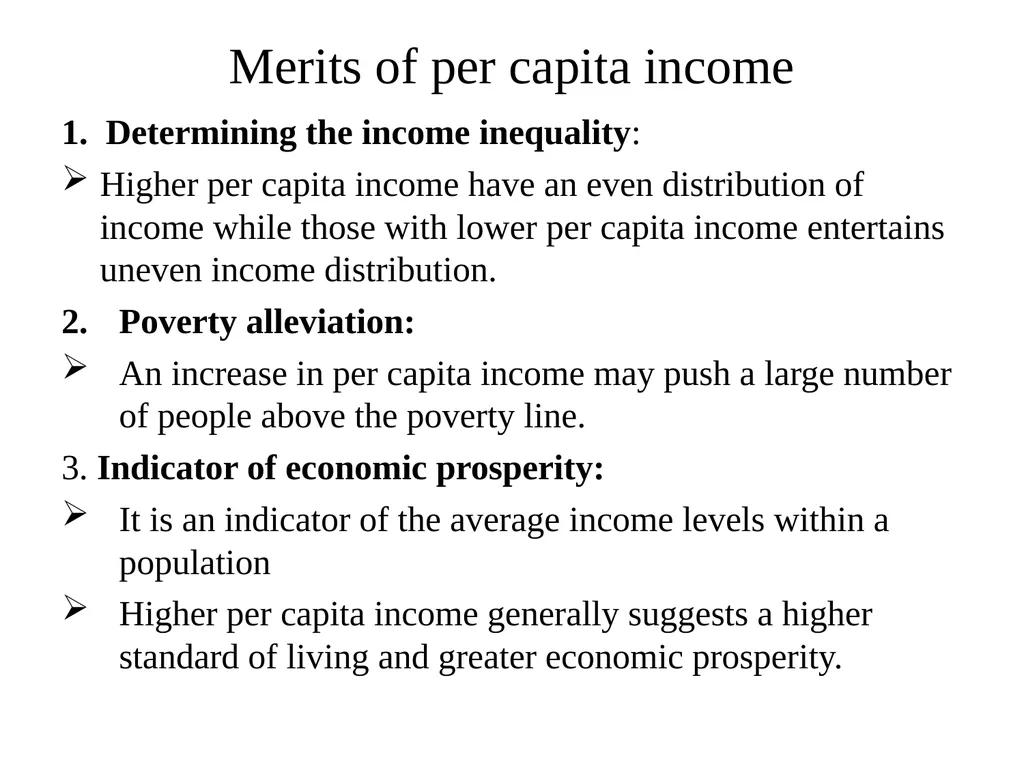
Merits of per capita income 1. Determining the income inequality:
Higher per capita income have an even distribution of income while those with lower per capita income entertains uneven income distribution.
Poverty alleviation:
An increase in per capita income may push a large number of people above the poverty line.
3. Indicator of economic prosperity:
It is an indicator of the average income levels within a population
Higher per capita income generally suggests a higher standard of living and greater economic prosperity.<br>
13
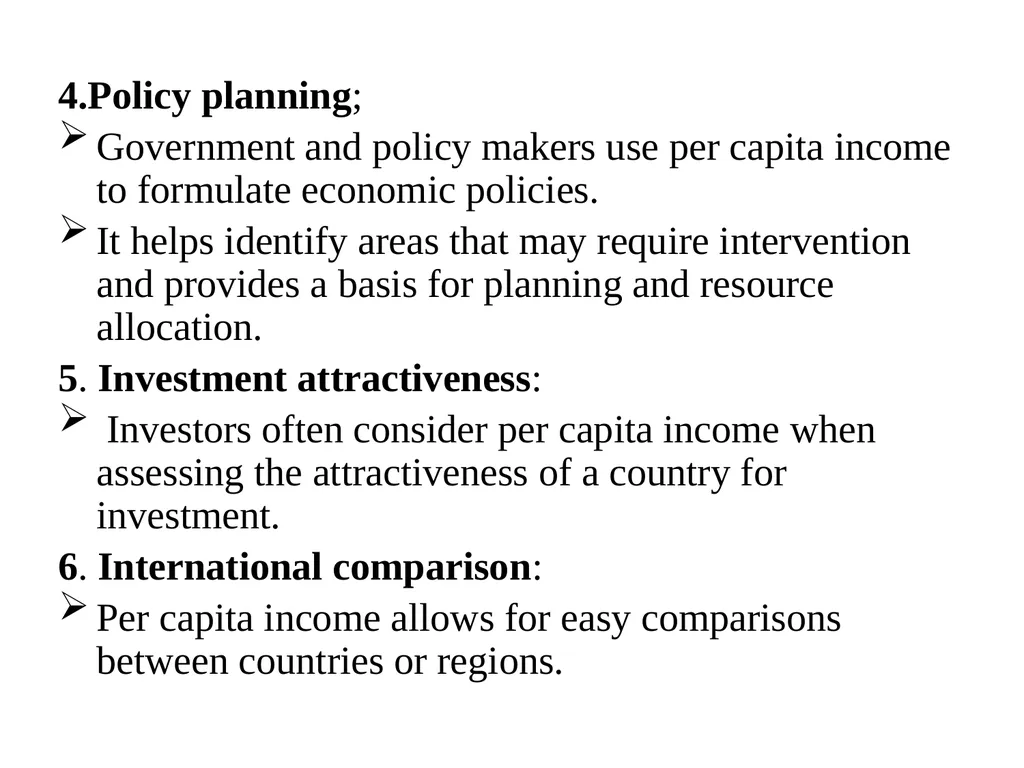
4.Policy planning;
Government and policy makers use per capita income to formulate economic policies.
It helps identify areas that may require intervention and provides a basis for planning and resource allocation.
5. Investment attractiveness:
Investors often consider per capita income when assessing the attractiveness of a country for investment.
6. International comparison:
Per capita income allows for easy comparisons between countries or regions.<br>
14
Demerits of per capita income Economic welfare:
The welfare of the people isn’t reflected in per capita income.
The quality of work conditions, the number of hours worked, education level and health benefits are not included in the per capita income.
2. Living standard:
Since per capita income uses the overall income of a population and divides it by the total number of people, it doesn’t always provide and accurate representation of the standard of living.
3. inflation:
Per capita income doesn’t reflect inflation in an economy, which is the rate at which price rise over time.
Per capita income can overstate income of a population.<br>
15
4. Non-monetary aspects:
Per capita income does not capture non-monetary aspects of development, such as health, education, and environmental sustainability.
5. Volatility:
Per capita income can be sensitive to short term economic fluctuations.
Unstable economic conditions may lead to misleading conclusions about long term development trends.
6. Cost of living:
Differences in the cost of living across regions are not reflected in per capita income.
Adjustments using Purchasing Power Parity (PPP) can address this issue to some extent.<br>