
Unit 3 Group process and group dynamics 3.2
Description: Unit 3 Group process and group dynamics 3.2 Typical patterns in group process and interpersonal communication Dr. Jaimon Varghese 25-Jan-24 Social Group Work 1 Norms Roles Culture Subgroup formation (unit 3.3) Conflict management (unit 3.3)
Related Topics
Download Presentation
"Unit 3 Group process and group dynamics 3.2" is the property of its rightful owner. Permission is granted to download and print the materials on this website for personal, non-commercial use only, and to display it on your personal computer provided you do not modify the materials and that you retain all copyright notices contained in the materials. By downloading content from our website, you accept the terms of this agreement.
Presentation Transcript
slide1. Unit 3 Group process and group dynamics
3.2 Typical patterns in group process and interpersonal communication Dr. Jaimon Varghese 25-Jan-24 Social Group Work 1<br>
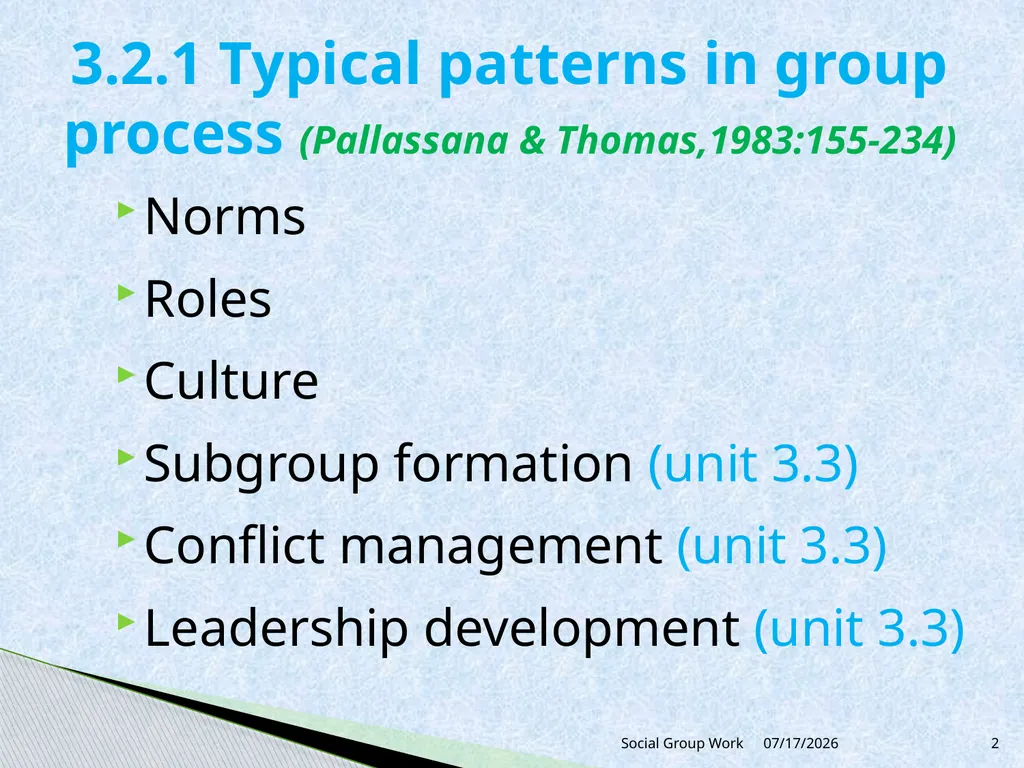
slide2. Norms
Roles
Culture
Subgroup formation (unit 3.3)
Conflict management (unit 3.3)
Leadership development (unit 3.3) 3.2.1 Typical patterns in group process (Pallassana & Thomas,1983:155-234) 25-Jan-24 Social Group Work 2<br>
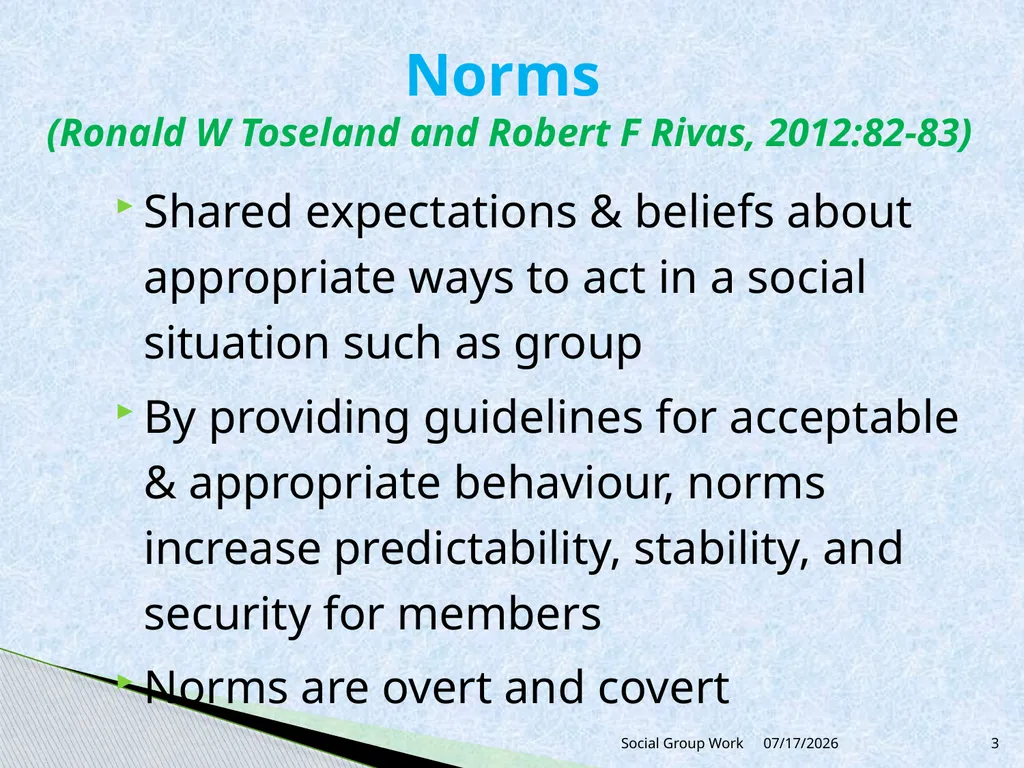
slide3. Shared expectations & beliefs about appropriate ways to act in a social situation such as group
By providing guidelines for acceptable & appropriate behaviour, norms increase predictability, stability, and security for members
Norms are overt and covert Norms (Ronald W Toseland and Robert F Rivas, 2012:82-83) 25-Jan-24 Social Group Work 3<br>
slide4. Emergence of norms as the group progresses reduces the need for structure and control by the worker
Norms discourage the capricious use of power by the leader
Deviations from norms are not necessarily harmful, sometimes help groups move in new directions or challenge the old ways of accomplishing the tasks 25-Jan-24 Social Group Work 4<br>
slide5. Discussing, diagnosing, & making explicit decisions about group norms
Directly intervening in the group to change a norm
Deviating from a norm & helping a group to adapt a new response
Helping the group become aware of external influences and their effect on the group’s norms Changing Norms (Ronald W Toseland and Robert F Rivas, 2012:82-84) 25-Jan-24 Social Group Work 5<br>
slide6. Hiring a consultant to work with the group to change its norms
3 Stages of norm change (Lewin, 1947)
Disequilibrium or unfreezing caused by a crisis that demonstrates dysfunction of old norm
Return to equilibrium accepting new norm or freezing
Refreezing: stabilizing the new norm 25-Jan-24 Social Group Work 6<br>
slide7. Roles are shared expectations about the functions of individuals in the group
Roles define behaviour in relation to a specific function or task that the group member is expected to perform
Roles ensure that vital group functions are taken care of. Roles (Ronald W Toseland and Robert F Rivas, 2012:84) 25-Jan-24 Social Group Work 7<br>
slide8. Discussion on each member’s role
Clarifying the responsibilities & the privileges of existing roles
Asking members to assume new roles
Adding new roles according to preferences expressed during the group’s discussion Change or modification of roles (Ronald W Toseland and Robert F Rivas, 2012:85) 25-Jan-24 Social Group Work 8<br>
slide9. Group culture emerges from the mix of values that members bring to the group. Worker helps members examine, compare and respect each other’s value systems
Group culture is also affected by the agency, community and society where the group is situated. Members need to identify and understand them Group Culture (Ronald W Toseland and Robert F Rivas, 2012:89) 25-Jan-24 Social Group Work 9<br>
slide10. Worker helps members to identify their own stereotypes and eliminate stereotyped ways of relating with each other
Value conflicts reduce group cohesion and lead to sudden demise of the group. Worker mediates value conflicts among members & between members and the larger society 25-Jan-24 Social Group Work 10<br>
slide11. A culture that emphasizes values of self-determination, openness, fairness, diversity of opinions and acceptance of differences facilitates the achievement of group & individual goals.
Groups are most satisfying when they meet members’ socioemotional & instrumental needs. Worker balances members’ emotional needs with their needs for task accomplishment 25-Jan-24 Social Group Work 11<br>
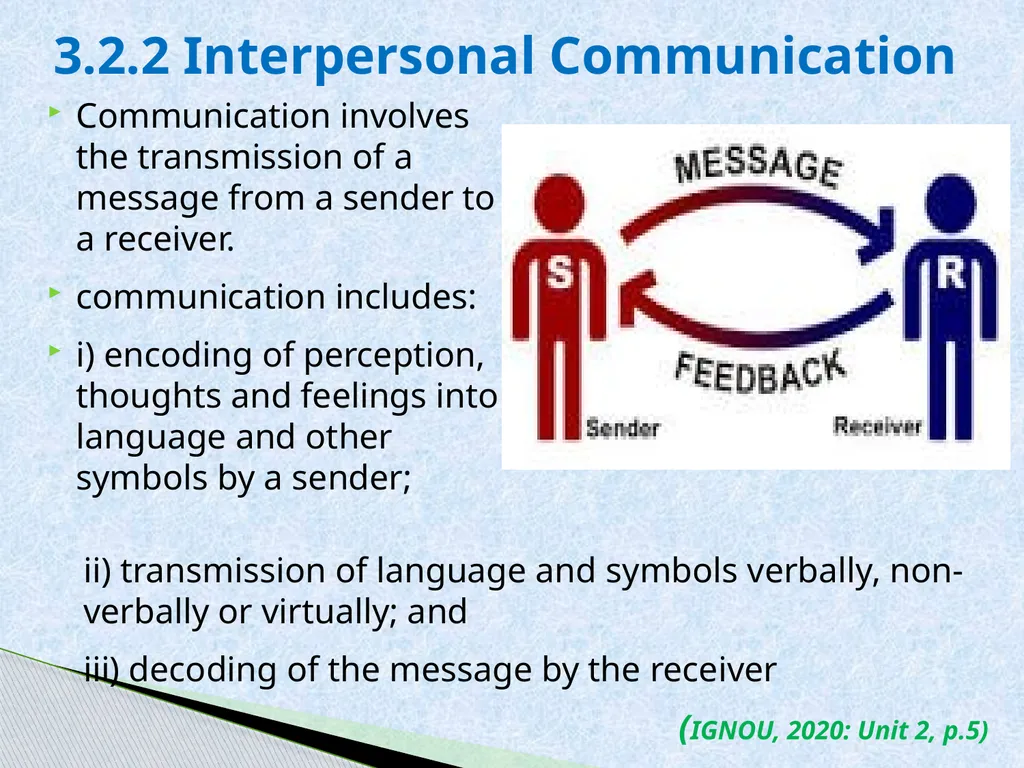
slide12. Communication involves the transmission of a message from a sender to a receiver.
communication includes:
i) encoding of perception, thoughts and feelings into language and other symbols by a sender; 3.2.2 Interpersonal Communication ii) transmission of language and symbols verbally, non-verbally or virtually; and
iii) decoding of the message by the receiver
(IGNOU, 2020: Unit 2, p.5)<br>
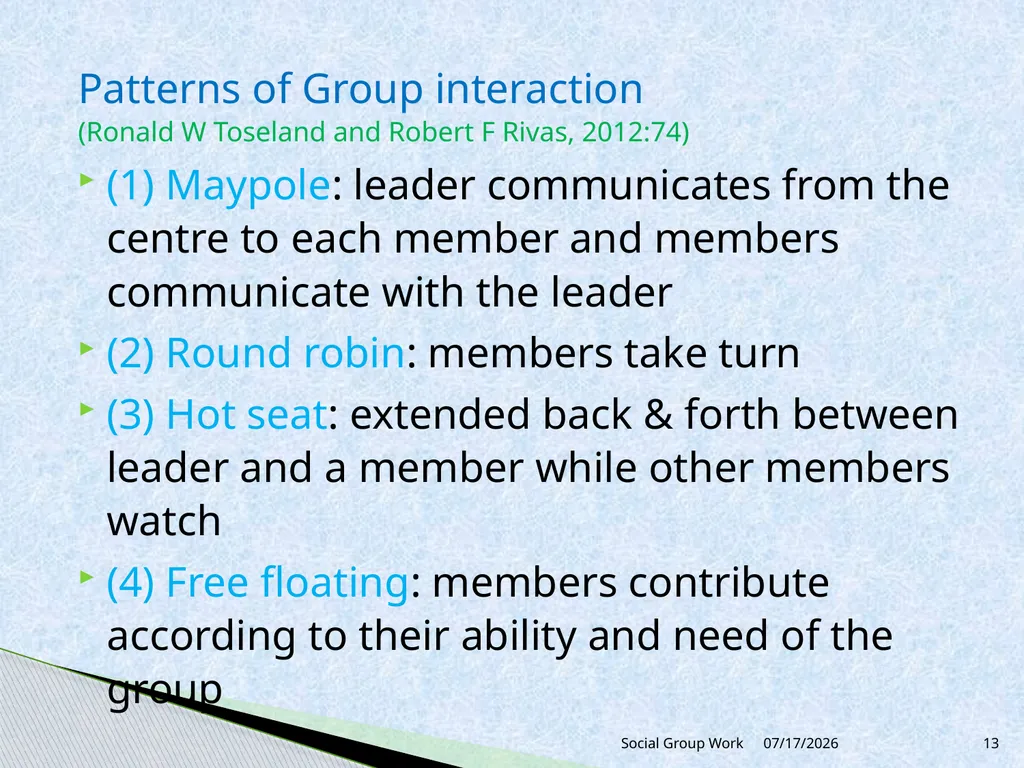
slide13. Patterns of Group interaction (Ronald W Toseland and Robert F Rivas, 2012:74)
(1) Maypole: leader communicates from the centre to each member and members communicate with the leader
(2) Round robin: members take turn
(3) Hot seat: extended back & forth between leader and a member while other members watch
(4) Free floating: members contribute according to their ability and need of the group 25-Jan-24 Social Group Work 13<br>
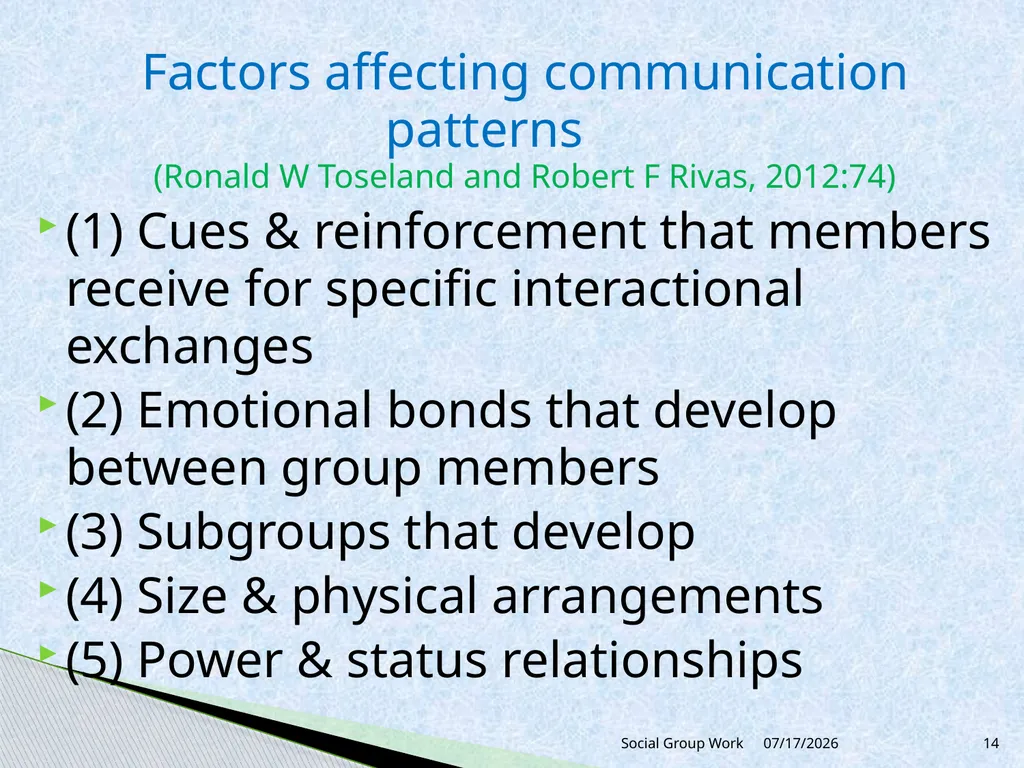
slide14. Factors affecting communication patterns (Ronald W Toseland and Robert F Rivas, 2012:74)
(1) Cues & reinforcement that members receive for specific interactional exchanges
(2) Emotional bonds that develop between group members
(3) Subgroups that develop
(4) Size & physical arrangements
(5) Power & status relationships 25-Jan-24 Social Group Work 14<br>
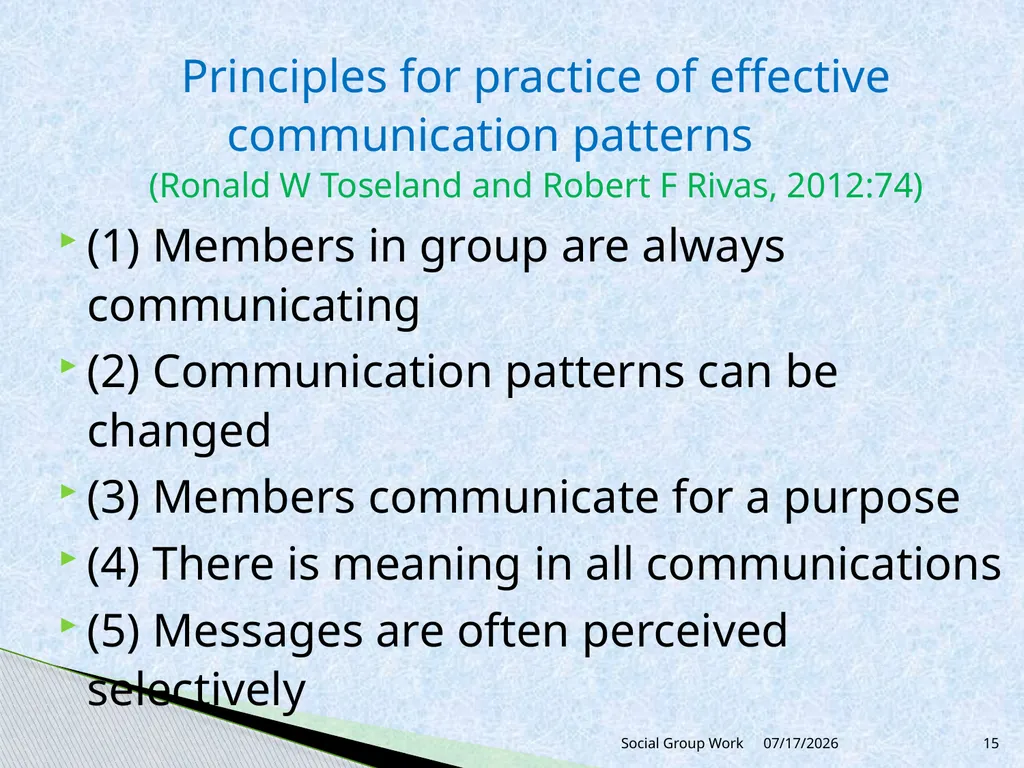
slide15. Principles for practice of effective communication patterns (Ronald W Toseland and Robert F Rivas, 2012:74)
(1) Members in group are always communicating
(2) Communication patterns can be changed
(3) Members communicate for a purpose
(4) There is meaning in all communications
(5) Messages are often perceived selectively 25-Jan-24 Social Group Work 15<br>
slide16. (6) Messages may be distorted in transmission
(7) Feedback & clarification enhance accurate understanding of communication
(8) Open, group-centred communications are often, but not always, the preferred pattern of interactions. Help the groups develop interaction patterns that meet members’ socioemotional needs while accomplishing the group purposes 25-Jan-24 Social Group Work 16<br>
slide17. References IGNOU (2020) MSW 008 - Social Group Work: Working with Groups (rev. ed.). New Delhi: School of Social Work, Indira Gandhi National Open University
Lewin Kurt (1947) Frontiers in group dynamics. Human Relations, 1, 2-38
Pallassana R. Balgopal & Vassil V. Thomas (1983) Groups in Social Work – An ecological perspective, New York: Macmillan Publishing Co.
Toseland W. Ronald & Rivas F. Robert (2012) An Introduction to Group Work Practice (7th Ed.). Boston: Allyn & Bacon 25-Jan-24 Social Group Work 17<br>
slide18. Thank You 25-Jan-24 Social Group Work 18<br>
slide2. Norms
Roles
Culture
Subgroup formation (unit 3.3)
Conflict management (unit 3.3)
Leadership development (unit 3.3) 3.2.1 Typical patterns in group process (Pallassana & Thomas,1983:155-234) 25-Jan-24 Social Group Work 2<br>
slide3. Shared expectations & beliefs about appropriate ways to act in a social situation such as group
By providing guidelines for acceptable & appropriate behaviour, norms increase predictability, stability, and security for members
Norms are overt and covert Norms (Ronald W Toseland and Robert F Rivas, 2012:82-83) 25-Jan-24 Social Group Work 3<br>
slide4. Emergence of norms as the group progresses reduces the need for structure and control by the worker
Norms discourage the capricious use of power by the leader
Deviations from norms are not necessarily harmful, sometimes help groups move in new directions or challenge the old ways of accomplishing the tasks 25-Jan-24 Social Group Work 4<br>
slide5. Discussing, diagnosing, & making explicit decisions about group norms
Directly intervening in the group to change a norm
Deviating from a norm & helping a group to adapt a new response
Helping the group become aware of external influences and their effect on the group’s norms Changing Norms (Ronald W Toseland and Robert F Rivas, 2012:82-84) 25-Jan-24 Social Group Work 5<br>
slide6. Hiring a consultant to work with the group to change its norms
3 Stages of norm change (Lewin, 1947)
Disequilibrium or unfreezing caused by a crisis that demonstrates dysfunction of old norm
Return to equilibrium accepting new norm or freezing
Refreezing: stabilizing the new norm 25-Jan-24 Social Group Work 6<br>
slide7. Roles are shared expectations about the functions of individuals in the group
Roles define behaviour in relation to a specific function or task that the group member is expected to perform
Roles ensure that vital group functions are taken care of. Roles (Ronald W Toseland and Robert F Rivas, 2012:84) 25-Jan-24 Social Group Work 7<br>
slide8. Discussion on each member’s role
Clarifying the responsibilities & the privileges of existing roles
Asking members to assume new roles
Adding new roles according to preferences expressed during the group’s discussion Change or modification of roles (Ronald W Toseland and Robert F Rivas, 2012:85) 25-Jan-24 Social Group Work 8<br>
slide9. Group culture emerges from the mix of values that members bring to the group. Worker helps members examine, compare and respect each other’s value systems
Group culture is also affected by the agency, community and society where the group is situated. Members need to identify and understand them Group Culture (Ronald W Toseland and Robert F Rivas, 2012:89) 25-Jan-24 Social Group Work 9<br>
slide10. Worker helps members to identify their own stereotypes and eliminate stereotyped ways of relating with each other
Value conflicts reduce group cohesion and lead to sudden demise of the group. Worker mediates value conflicts among members & between members and the larger society 25-Jan-24 Social Group Work 10<br>
slide11. A culture that emphasizes values of self-determination, openness, fairness, diversity of opinions and acceptance of differences facilitates the achievement of group & individual goals.
Groups are most satisfying when they meet members’ socioemotional & instrumental needs. Worker balances members’ emotional needs with their needs for task accomplishment 25-Jan-24 Social Group Work 11<br>
slide12. Communication involves the transmission of a message from a sender to a receiver.
communication includes:
i) encoding of perception, thoughts and feelings into language and other symbols by a sender; 3.2.2 Interpersonal Communication ii) transmission of language and symbols verbally, non-verbally or virtually; and
iii) decoding of the message by the receiver
(IGNOU, 2020: Unit 2, p.5)<br>
slide13. Patterns of Group interaction (Ronald W Toseland and Robert F Rivas, 2012:74)
(1) Maypole: leader communicates from the centre to each member and members communicate with the leader
(2) Round robin: members take turn
(3) Hot seat: extended back & forth between leader and a member while other members watch
(4) Free floating: members contribute according to their ability and need of the group 25-Jan-24 Social Group Work 13<br>
slide14. Factors affecting communication patterns (Ronald W Toseland and Robert F Rivas, 2012:74)
(1) Cues & reinforcement that members receive for specific interactional exchanges
(2) Emotional bonds that develop between group members
(3) Subgroups that develop
(4) Size & physical arrangements
(5) Power & status relationships 25-Jan-24 Social Group Work 14<br>
slide15. Principles for practice of effective communication patterns (Ronald W Toseland and Robert F Rivas, 2012:74)
(1) Members in group are always communicating
(2) Communication patterns can be changed
(3) Members communicate for a purpose
(4) There is meaning in all communications
(5) Messages are often perceived selectively 25-Jan-24 Social Group Work 15<br>
slide16. (6) Messages may be distorted in transmission
(7) Feedback & clarification enhance accurate understanding of communication
(8) Open, group-centred communications are often, but not always, the preferred pattern of interactions. Help the groups develop interaction patterns that meet members’ socioemotional needs while accomplishing the group purposes 25-Jan-24 Social Group Work 16<br>
slide17. References IGNOU (2020) MSW 008 - Social Group Work: Working with Groups (rev. ed.). New Delhi: School of Social Work, Indira Gandhi National Open University
Lewin Kurt (1947) Frontiers in group dynamics. Human Relations, 1, 2-38
Pallassana R. Balgopal & Vassil V. Thomas (1983) Groups in Social Work – An ecological perspective, New York: Macmillan Publishing Co.
Toseland W. Ronald & Rivas F. Robert (2012) An Introduction to Group Work Practice (7th Ed.). Boston: Allyn & Bacon 25-Jan-24 Social Group Work 17<br>
slide18. Thank You 25-Jan-24 Social Group Work 18<br>