Unit 4.2: Gender-responsive budgeting Gender in Adaptation Planning for the Agriculture Sectors Training Workshop Name of presenter Date Learning outcomes Part 1. Gender-responsive budgeting Aims to raise awareness of the gendered
"Unit 4.2: Gender-responsive budgeting Gender in" is the property of its rightful owner. Permission is granted to
download and print the materials on this website for personal, non-commercial use only, and to display it
on your personal computer provided you do not modify the materials and that you retain all copyright
notices contained in the materials. By downloading content from our website, you accept the terms of this
agreement.
Presentation Transcript
01
Unit 4.2: Gender-responsive budgeting Gender in Adaptation Planning for the Agriculture Sectors
Training Workshop
[Name of presenter]
[Date]<br>
02
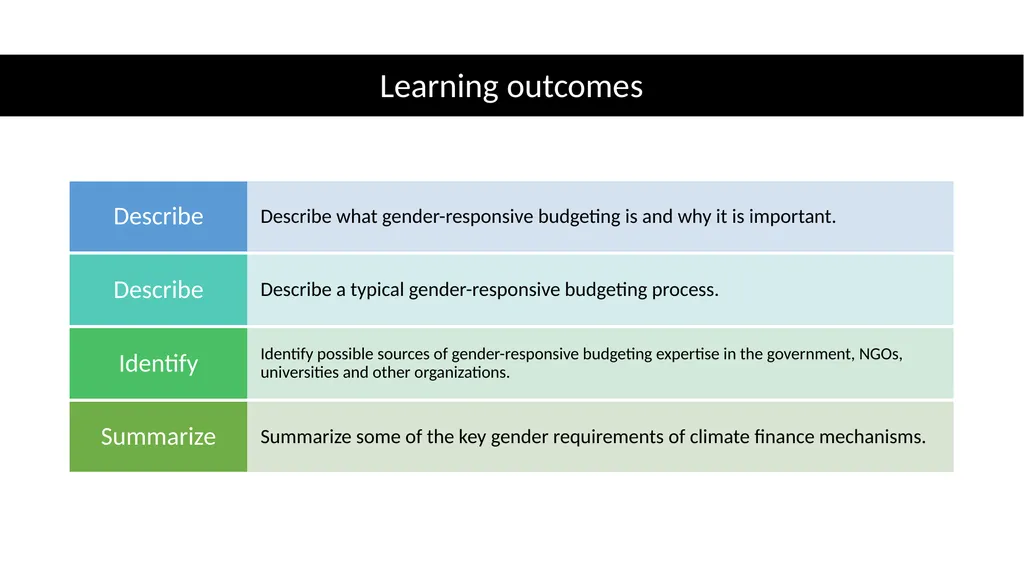
Learning outcomes<br>
03
Part 1. Gender-responsive budgeting Aims to raise awareness of the gendered impacts of budgets and to make governments accountable for ensuring their budgets promote the achievement of gender equality and women’s rights, especially among the poor.
Involves analysing government budgets for their effect on different genders.
Involves transforming these budgets to ensure that gender equality commitments are realised.<br>
04
GRB examines impacts on women and men, girls and boys of: How money is raised and how revenues are lost;
How money is spent;
Whether spending is sufficient to meet the practical and strategic needs of men, women, girls and boys, while at the same time contributing to closing the gender gap;
How decisions on raising and spending money affect unpaid care work and subsistence work, and the distribution of these between genders; and
Whether spending in practice matches budget plans.<br>
05
Why GRB? To correct gender biases in budgets and fiscal policy
To demonstrate how government commitments to gender equality and women’s empowerment are translated into allocations to public programmes
To account for the gender differences between and within households;
To address the unpaid labour burden of women and to monitor care-related programmes;
To increase transparency in use of public resources as well as in public policy formulation, implementation and impact;
To account for the costs that gender inequality has for women, the economy, and the broad developmental objectives of a society (e.g. overburdening women can lead to productivity losses).<br>
06
Key considerations in GRB Approach, e.g. Five-step Method
When during the adaptation process, e.g. as part of integrating climate change into a national budgeting process, or within a budgeting process for the agriculture sector.
Strong leadership and multiple stakeholders needed
Instigator may be a gender budgeting statement at national level<br>
07
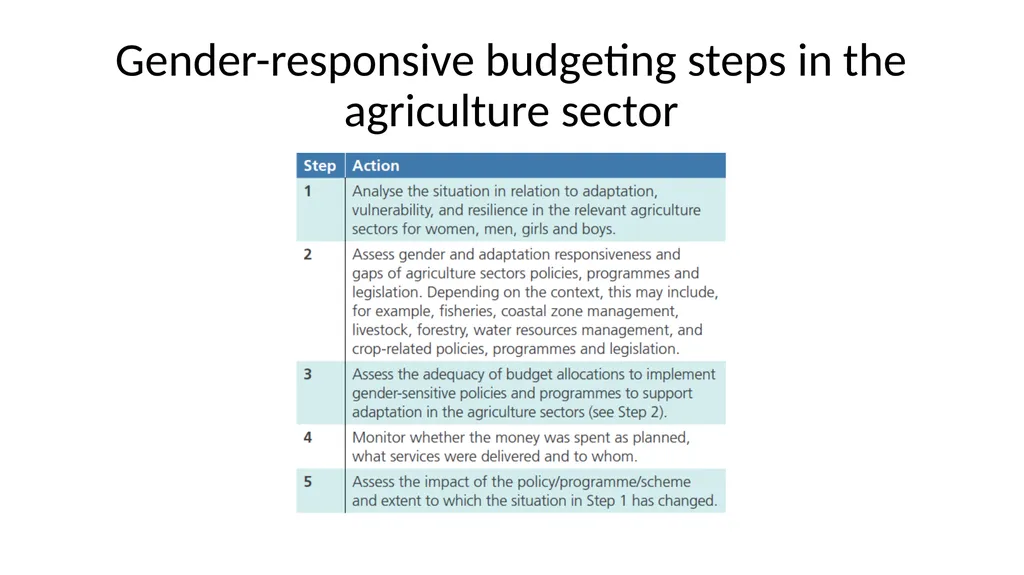
Gender-responsive budgeting steps in the agriculture sector<br>
08
Part 2. Gender in climate finance “Climate finance” encompasses local, national or transnational financing that seeks to support mitigation and adaptation actions that will address climate change.
Climate finance emerged under the UNFCCC negotiations as a means for countries with more resources to provide financial assistance to those with fewer resources and higher vulnerability to the impacts of climate change.
Climate finance comes from multiple sources:
Private
multilateral (World Bank, UN, etc.)
Bilateral (largely as part of overseas development assistance)
within the context of the UNFCCC
domestic allocations<br>
09
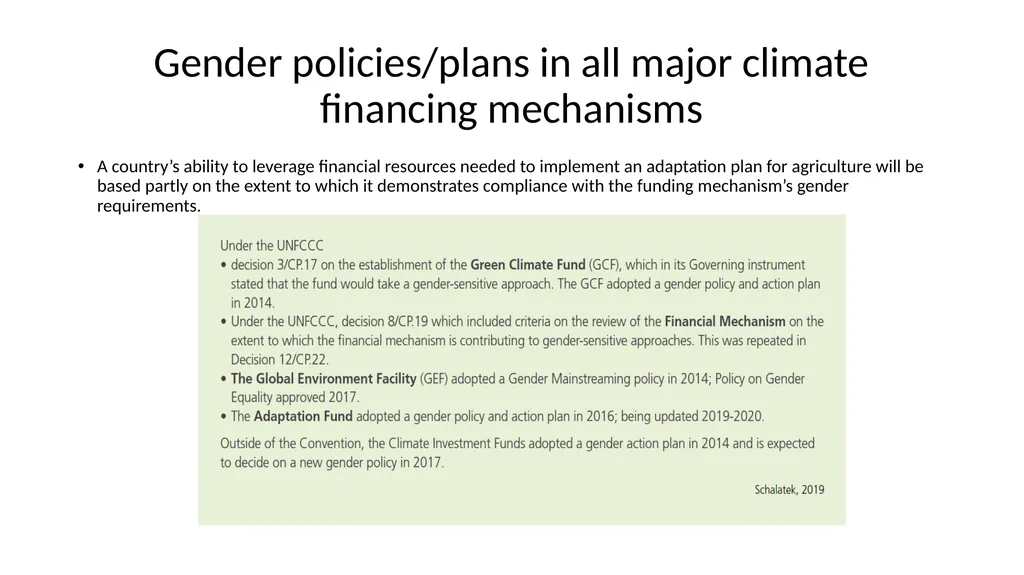
Gender policies/plans in all major climate financing mechanisms A country’s ability to leverage financial resources needed to implement an adaptation plan for agriculture will be based partly on the extent to which it demonstrates compliance with the funding mechanism’s gender requirements.<br>