
Unit 5: Develop an Engagement Plan 1 Objectives
KL
Published · 31 slides · 0 views
1 / 1

Description
Unit 5: Develop an Engagement Plan 1 Objectives Upon completion of this lesson, you should be able to: Determine ways religious and cultural communities can serve as partners Describe how using religious and cultural hierarchies and
Related Topics
Share
Embed code
Download this presentation From Below
"Unit 5: Develop an Engagement Plan 1 Objectives" is the property of its rightful owner. Permission is granted to download and print the materials on this website for personal, non-commercial use only, and to display it on your personal computer provided you do not modify the materials and that you retain all copyright notices contained in the materials. By downloading content from our website, you accept the terms of this agreement.
Presentation Transcript
01
Unit 5: Develop an Engagement Plan 1<br>
02
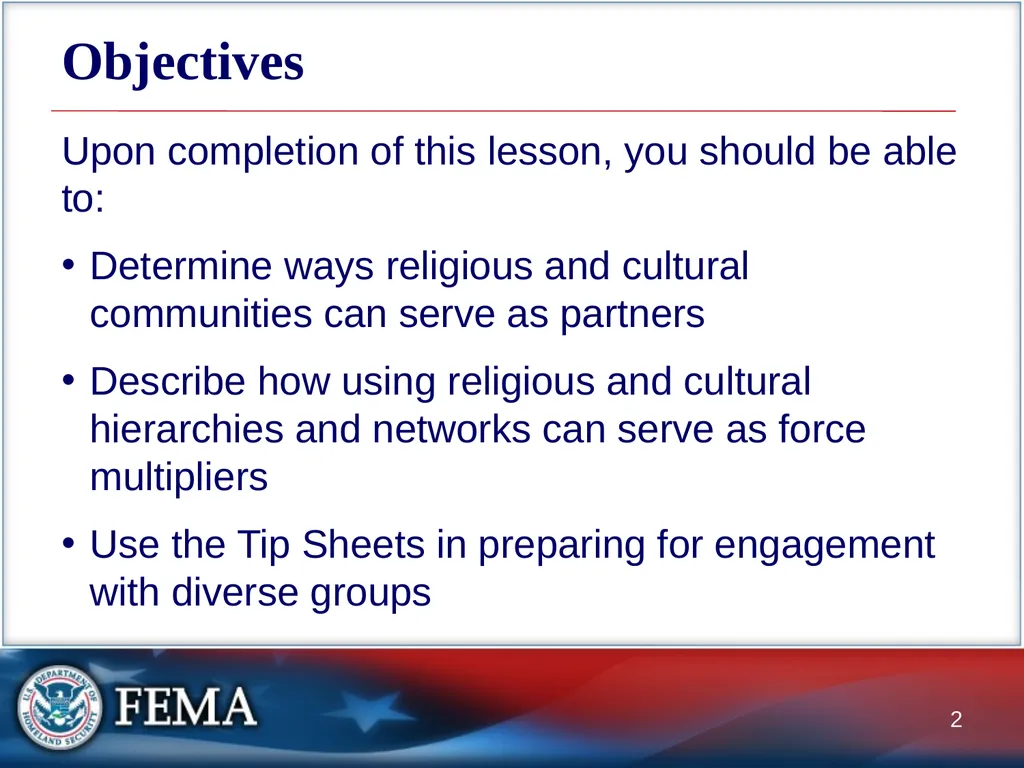
Objectives Upon completion of this lesson, you should be able to:
Determine ways religious and cultural communities can serve as partners
Describe how using religious and cultural hierarchies and networks can serve as force multipliers
Use the Tip Sheets in preparing for engagement with diverse groups 2<br>
Determine ways religious and cultural communities can serve as partners
Describe how using religious and cultural hierarchies and networks can serve as force multipliers
Use the Tip Sheets in preparing for engagement with diverse groups 2<br>
03
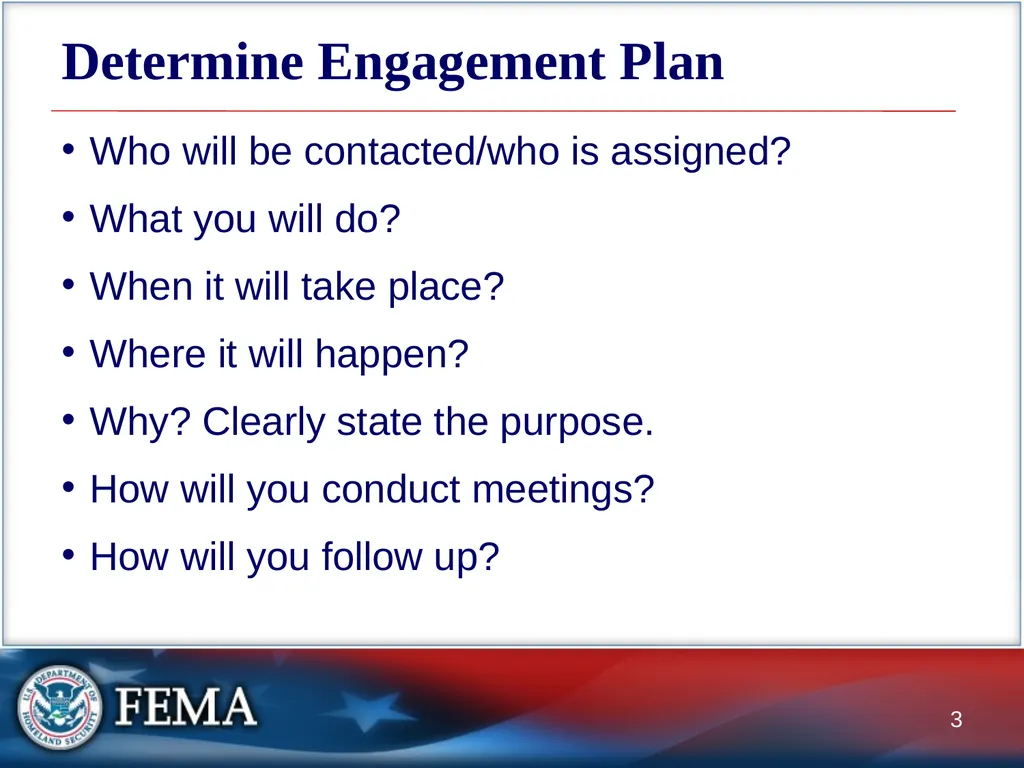
Determine Engagement Plan Who will be contacted/who is assigned?
What you will do?
When it will take place?
Where it will happen?
Why? Clearly state the purpose.
How will you conduct meetings?
How will you follow up? 3<br>
What you will do?
When it will take place?
Where it will happen?
Why? Clearly state the purpose.
How will you conduct meetings?
How will you follow up? 3<br>
04
Determine Engagement Plan (continued) Force multipliers
Factors that dramatically increase, or multiply, the effectiveness of your efforts
More efficient than trying to reach out to each individual that has been affected
Religious leaders act as force multipliers who can reach multiple congregates more quickly 4<br>
Factors that dramatically increase, or multiply, the effectiveness of your efforts
More efficient than trying to reach out to each individual that has been affected
Religious leaders act as force multipliers who can reach multiple congregates more quickly 4<br>
05
Determine Engagement Plan (continued) Who will you contact and in what sequence?
Local or county Emergency Management Divisions (EMDs)
Emergency management office partnerships coordinator
Faith-based social service providers
Designated state and local faith-based liaison offices
Designated county and city departments faith-based liaisons 5<br>
Local or county Emergency Management Divisions (EMDs)
Emergency management office partnerships coordinator
Faith-based social service providers
Designated state and local faith-based liaison offices
Designated county and city departments faith-based liaisons 5<br>
06
Determine Engagement Plan (continued) Who will you contact and in what sequence?
Interfaith centers and disaster interfaiths
Networks, associations, conferences, religious denominations, and governing bodies
Faith leaders
FEMA VAL and/or State VAL as VOAD liaison(s)
DHS Center for Faith-Based and Neighborhood Partnerships via the National Response Coordination Center (NRCC) 6<br>
07
Determine Engagement Plan (continued) What will you do?
Work with existing faith communities to coordinate activities in the area
Share any information youve gathered about faith communities with your team members
Discuss other people or entities that will attend to provide assistance as part of a town hall format 7<br>
Work with existing faith communities to coordinate activities in the area
Share any information youve gathered about faith communities with your team members
Discuss other people or entities that will attend to provide assistance as part of a town hall format 7<br>
08
Determine Engagement Plan (continued) Coordination of faith-based organizations
What are their core capabilities?
How have they helped in past?
What are they doing now? 8<br>
What are their core capabilities?
How have they helped in past?
What are they doing now? 8<br>
09
Determine Engagement Plan (continued) As you approach these organizations, you need keep the following in mind:
Government asks, not tasks. 9<br>
Government asks, not tasks. 9<br>
10
Determine Engagement Plan (continued) When will it take place?
Request days other than holy days, days of congregational worship, and other major religious or cultural holidays
Many religious leaders have a second job or take a weekday as their day off 10<br>
Request days other than holy days, days of congregational worship, and other major religious or cultural holidays
Many religious leaders have a second job or take a weekday as their day off 10<br>
11
Determine Engagement Plan (continued) Where will it take place?
Request a space that is neutral 11<br>
Request a space that is neutral 11<br>
12
Determine Engagement Plan (continued) Why?
Clearly state the purpose of the meeting
Clearly state your objectives
Be clear about what you can and cannot offer
Only offer what you can deliver
Follow up promptly and deliver what was offered 12<br>
Clearly state the purpose of the meeting
Clearly state your objectives
Be clear about what you can and cannot offer
Only offer what you can deliver
Follow up promptly and deliver what was offered 12<br>
13
Determine Engagement Plan (continued) How will meetings be conducted?
Conduct meetings with religious and cultural competency
Ensure that the process does not favor one community over another
Provide speakers who reflect the diversity of faith communities
Outreach may be conducted in the context of a worship service 13<br>
Conduct meetings with religious and cultural competency
Ensure that the process does not favor one community over another
Provide speakers who reflect the diversity of faith communities
Outreach may be conducted in the context of a worship service 13<br>
14
Determine Engagement Plan (continued) How will you follow up?
Determine the need for subsequent meetings
Develop a preliminary schedule
Share any information learned with the leadership
Continue to communicate with community religious leaders 14<br>
Determine the need for subsequent meetings
Develop a preliminary schedule
Share any information learned with the leadership
Continue to communicate with community religious leaders 14<br>
15
Activity 5.1: Determine Engagement Plan 15 Purpose:
Determine ways religious and cultural communities can serve as partners
Determine how to approach religious and cultural communities
Describe how using religious and cultural hierarchies and networks can serve as force multipliers
Estimated Time: 15 minutes
Instructions:
Locate Worksheet 5.1 in your Student Manual.
Use the Tip Sheets to answer the questions presented.<br>
16
Scheduling Meetings Scheduling or pre-planning appointments whenever possible
Learn and follow approved government protocols
Ask for meetings on days and times that are not usually designated for worship
Be prepared for multiple offerings
Periods of celebration and/or fasting will also require some flexibility
http://www.interfaith-calendar.org/
Choose a neutral meeting space
Avoid using sacred spaces within houses of worship
Not all groups will want to engage 16<br>
17
Customs and Etiquette Many cultures engage in rituals or relationship-building before discussing business
Not engaging in these customs may be considered rude, which will hurt your outreach efforts
Follow the lead of the religious leader you are meeting with
Make every effort to remain for the full duration of the meeting 17<br>
Not engaging in these customs may be considered rude, which will hurt your outreach efforts
Follow the lead of the religious leader you are meeting with
Make every effort to remain for the full duration of the meeting 17<br>
18
What Clothing to Wear Dressing appropriately can yield more successful outcomes
Wear modest or traditionally appropriate clothing when entering houses of worship
Clothing that covers your shoulders, chest, knees, or elbows
Both men and women should fully cover their legs
When in doubt, dress more formally
Observe what others are wearing and model your attire accordingly 18<br>
Wear modest or traditionally appropriate clothing when entering houses of worship
Clothing that covers your shoulders, chest, knees, or elbows
Both men and women should fully cover their legs
When in doubt, dress more formally
Observe what others are wearing and model your attire accordingly 18<br>
19
Footwear and Head Covering Etiquette Footwear
In gurdwaras, mosques, and temples, it is expected that you remove your shoes to respect the way community members treat their space
Head Covering
In Jewish and Sikh houses of worship, men should offer to cover their heads
In the prayer space of a mosque, women must cover their hair (they can leave their hair uncovered in other areas of the mosque)
When entering a church, and many other houses of worship, you would be expected to remove your hat 19<br>
20
Activity 5.2: Tip Sheets (Part 1) 20 Purpose: Use the tip sheets in preparing for engagement with diverse groups
Estimated Time: 15 minutes
Instructions:
Locate Worksheet 5.2 in your Student Manual.
Use the Tip Sheets to answer the questions presented.<br>
Estimated Time: 15 minutes
Instructions:
Locate Worksheet 5.2 in your Student Manual.
Use the Tip Sheets to answer the questions presented.<br>
21
6. Greeting Religious or Cultural Leaders When greeting religious and/or cultural leaders, use their proper title
Shows respect for their chosen leaders and traditions
Showing respect in this manner does not equal endorsement or conformity to another belief system
If you are unsure of the title, ask:
"What should I call you?
How would you like to be addressed? 21<br>
Shows respect for their chosen leaders and traditions
Showing respect in this manner does not equal endorsement or conformity to another belief system
If you are unsure of the title, ask:
"What should I call you?
How would you like to be addressed? 21<br>
22
Greeting Religious Leaders (continued) Know the appropriate protocols when greeting religious leaders
Words
Physical gestures
Especially important when interacting with senior leaders or elderly community members
Special greetings used by adherents are not required for non-adherents 22<br>
Words
Physical gestures
Especially important when interacting with senior leaders or elderly community members
Special greetings used by adherents are not required for non-adherents 22<br>
23
7. Physical Interaction In general, you should not initiate physical interaction
It is best to wait for the leader or adherent to initiate physical contact
Some religious leaders should not be touched
Some leaders can only be touched by members of their religious tradition
Some religious leaders cannot be touched at all by members of the opposite gender
Prepared to offer an alternate greeting to a handshake 23<br>
24
Physical Interaction (continued) Understand how different faith communities perceive physical contact
Touch can be seen as a friendly gesture, invasive, or even taboo
Some interactions may be commonplace in other cultures
Handholding by individuals of the same gender
Standing in close proximity
Use of the left hand 24<br>
Touch can be seen as a friendly gesture, invasive, or even taboo
Some interactions may be commonplace in other cultures
Handholding by individuals of the same gender
Standing in close proximity
Use of the left hand 24<br>
25
Door-to-Door Outreach Person who answers the door may be religious leader, a staff member, or a lay community member
Do not make any assumptions based on the dress or the appearance
Ask to speak to the appropriate leader who can speak on behalf of the congregation or community organization
The leader you are seeking may or may not be a member of clergy 25<br>
Do not make any assumptions based on the dress or the appearance
Ask to speak to the appropriate leader who can speak on behalf of the congregation or community organization
The leader you are seeking may or may not be a member of clergy 25<br>
26
9. Outreach in the Context of Worship Services While conducting outreach, you may be asked to attend worship services
You may politely decline participation and follow up after the service 26<br>
You may politely decline participation and follow up after the service 26<br>
27
9. Outreach in the Context of Worship Services If you do decide to attend, you should keep the following in mind:
Context matters
Prepare your team
Ask the amount of time the services typically take
If you are not going to stay for the entire service, let them know beforehand that you are going to leave early
Ask before participating in worship or prayer services, such as candle lighting or incense burning
Avoid touching religious items or books unless you are asked to do so
Keep any sacred books off the ground 27<br>
28
Provision of Food in a Disaster Setting Religious leaders and people of faith often follow dietary laws or choose to follow specific diets
Halal
Kosher
Vegetarian or Vegan
Every effort should be made to provide appropriate food sources during a disaster 28<br>
Halal
Kosher
Vegetarian or Vegan
Every effort should be made to provide appropriate food sources during a disaster 28<br>
29
Activity 5.3: Tip Sheets (Part 2) 29 Purpose: Use the tip sheets in preparing for engagement with diverse groups
Estimated Time: 20 minutes
Instructions:
Locate Worksheet 5.3 in your Student Manual.
Use the Tip Sheets to answer the questions presented.<br>
Estimated Time: 20 minutes
Instructions:
Locate Worksheet 5.3 in your Student Manual.
Use the Tip Sheets to answer the questions presented.<br>
30
Discussion: Engagement Plan (Part 4) 30 For this activity, you will review the following section:
Strategies for Engagement
Questions:
What tools or resources would you use to answer the questions in the Strategies for Engagement section?
How might this information differ from FEMA's point of view vs. a religious leader's point of view?
Is there any other information you might include?<br>
Strategies for Engagement
Questions:
What tools or resources would you use to answer the questions in the Strategies for Engagement section?
How might this information differ from FEMA's point of view vs. a religious leader's point of view?
Is there any other information you might include?<br>
31
Lesson Summary You should now be able to:
Determine ways religious and cultural communities can serve as partners
Describe how using religious and cultural hierarchies and networks can serve as force multipliers
Use the Tip Sheets in preparing for engagement with diverse groups 31<br>
Determine ways religious and cultural communities can serve as partners
Describe how using religious and cultural hierarchies and networks can serve as force multipliers
Use the Tip Sheets in preparing for engagement with diverse groups 31<br>