
UNIT-5 Microsoft (MS) Dynamics Table of contents



Description: UNIT-5 Microsoft (MS) Dynamics Table of contents Introduction Background Key Concepts Case Studies Future Outlook Conclusion Introduction Introduction to MICROSOFT DYNAMICS In todays business environment, financial processes have become
Related Topics
Download Presentation
"UNIT-5 Microsoft (MS) Dynamics Table of contents" is the property of its rightful owner. Permission is granted to download and print the materials on this website for personal, non-commercial use only, and to display it on your personal computer provided you do not modify the materials and that you retain all copyright notices contained in the materials. By downloading content from our website, you accept the terms of this agreement.
Presentation Transcript
slide1. UNIT-5 Microsoft (MS) Dynamics<br>
slide2. Table of contents Introduction
Background
Key Concepts
Case Studies
Future Outlook
Conclusion<br>
slide3. Introduction<br>
slide4. Introduction to MICROSOFT DYNAMICS In today's business environment, financial processes have become increasingly complex due to globalization, evolving regulations, and growing data volumes.
This complexity creates challenges for Chartered Accountants (CAs) conducting audits, demanding more efficient and effective tools.
Microsoft Dynamics (MS Dynamics or D365F), a leading Enterprise Resource Planning (ERP) solution, offers robust auditing capabilities that can empower CAs to streamline the audit process.<br>
slide5. Background<br>
slide6. Background MS Dynamics and Financial Process Automation
Microsoft Dynamics 365 for Finance is a leading Enterprise Resource Planning (ERP) solution that offers a comprehensive suite of financial management tools.
D365F goes beyond traditional accounting software by incorporating automation, streamlined workflows, and robust auditing functionalities.
Focus on Audit Needs
The increasing dependence on ERP systems requires specific auditing expertise to verify the precision and trustworthiness of financial information.
This presentation will explore how D365F can empower Chartered Accountants (CAs) to conduct more efficient, effective, and data-driven audits.<br>
slide7. Key Concepts<br>
slide8. Key Concepts General Ledger:
The foundation of D365F, providing a centralized system for recording all financial transactions. Enables auditors to easily track the flow of funds and verify account balances.
Accounts Payable (AP) & Accounts Receivable (AR)
Streamline accounts management with automated workflows for invoice processing, payment approvals, and collections. Improves auditability by providing a clear trail for all transactions.<br>
slide9. Key Concepts Expense Management
Simplifies expense tracking and reporting with features for categorizing, approving, and reimbursing employee expenses. Enhances audit control through automated expense rules and detailed transaction records.
Fixed Asset Management
Provides a comprehensive solution for tracking and managing fixed assets, including depreciation calculations and maintenance schedules. Facilitates fixed asset audits by ensuring accurate and up-to-date asset information.<br>
slide10. Key Concepts Budgeting & Forecasting:
Enables creation of detailed budgets and financial projections. Allows auditors to compare actual results to budgeted figures and identify any variances.
Audit trails
D365F maintains a comprehensive audit trail for all financial transactions, providing a detailed record of user activity and changes made to financial data. This empowers auditors to reconstruct transactions and ensure data integrity.<br>
slide11. Case Studies<br>
slide12. Inventory Discrepancies Case Scenario
A manufacturing company struggles with maintaining accurate inventory records due to a lack of real-time tracking and manual data entry. This leads to discrepancies during physical inventory counts and potential issues with financial reporting.
You are a Chartered Accountant auditing ABC Ltd., you are facing difficulty in verifying the accuracy of inventory valuation and identifying potential inventory shrinkage (loss of inventory) due to inadequate controls.<br>
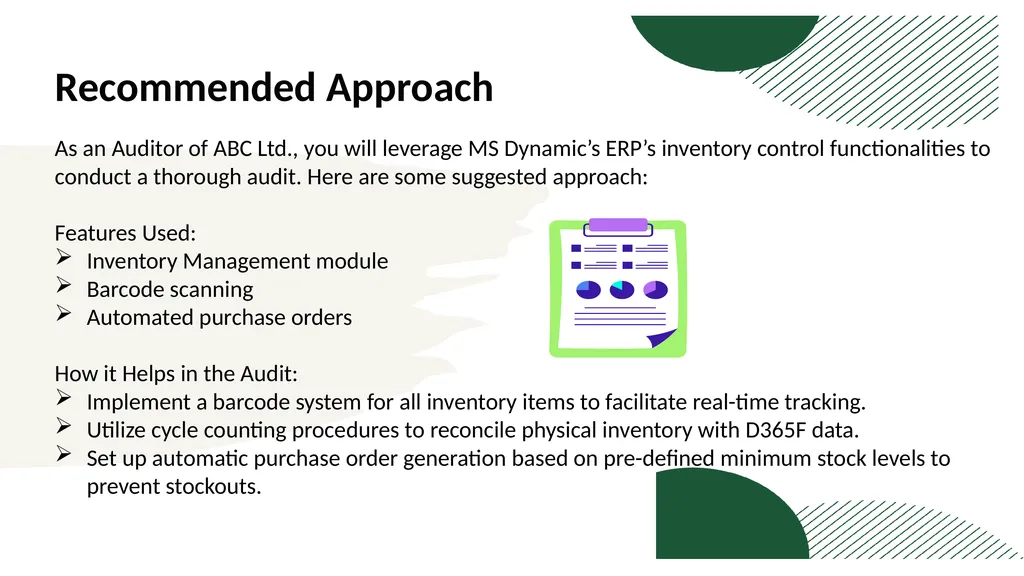
slide13. Recommended Approach As an Auditor of ABC Ltd., you will leverage MS Dynamic’s ERP’s inventory control functionalities to conduct a thorough audit. Here are some suggested approach:
Features Used:
Inventory Management module
Barcode scanning
Automated purchase orders
How it Helps in the Audit:
Implement a barcode system for all inventory items to facilitate real-time tracking.
Utilize cycle counting procedures to reconcile physical inventory with D365F data.
Set up automatic purchase order generation based on pre-defined minimum stock levels to prevent stockouts.<br>
slide14. Reconciling Cash Balances and Audit Trail Case Scenario
A healthcare organization experiences challenges in reconciling bank statements with their general ledger cash accounts. Manual processes and lack of clear audit trails make it difficult to identify and investigate discrepancies.
You are a Chartered Accountant auditing ABC Ltd., you are facing difficulties w.r.t. tracing transactions back to source documents, time-consuming manual reconciliations, and potential for errors or fraud going undetected.<br>
slide15. Recommended Approach As an Auditor of ABC Ltd., you will leverage MS Dynamic’s ERP’s bank reconciliation and audit trail functionalities to conduct a thorough audit. Here are some suggested approach:
Features Used:
Cash Management module
Bank feeds integration
Audit trails
How it Helps in the Audit:
Integrate D365F with bank accounts for automatic download of transactions.
Utilize comprehensive audit trails to track all transaction modifications and user activity.
Employ bank reconciliations with detailed matching capabilities to identify discrepancies.<br>
slide16. Reconciling Accounts Receivables Case Scenario
A professional lawyer experiences difficulty reconciling accounts receivable due to a lack of transparency in the client billing process and limited integration between various systems.
This leads to delays in collecting payments, potential write-offs, and difficulty in identifying uncollected receivables during the audit.
As an Auditor you experience that manual reconciliation processes are time-consuming and error-prone. It's challenging to track the status of individual client accounts and identify potential discrepancies between billing records and client payments.<br>
slide17. Recommended Approach As an Auditor of ABC Ltd., you will leverage MS Dynamic’s ERP’s receivable management functionalities to conduct a thorough audit. Here are some suggested approach:
Features Used:
Accounts Receivable module
Customer Relationship Management (CRM) integration
Automated payment reminders
How it Helps in the Audit:
Integrate D365F with the hospital's billing system to automatically capture patient charges and insurance information.
Utilize CRM features to track client’s account details, communication history, and payment status.
Automate email or SMS reminders for outstanding payments based on pre-defined timelines.<br>
slide18. Future Outlook<br>
slide19. Future Outlook Artificial Intelligence (AI):
Integration of AI for anomaly detection in financial transactions, potentially helping identify fraudulent activities or unusual patterns.
Utilizing AI-powered chatbots to answer auditors' questions about specific transactions or account details within D365F.
Enhanced Data Visualization:
Development of advanced data visualization tools within D365F to provide auditors with interactive dashboards and reports for easier identification of trends and potential risks.
Real-time generation of audit trails with visual representations for improved understanding of financial data flow.<br>
slide20. Future Outlook Cloud-Based Solutions:
Increased adoption of cloud-based ERP solutions like D365F, enabling real-time access to financial data for geographically dispersed audit teams.
Improved collaboration features within D365F to facilitate communication and information sharing between auditors and company personnel.<br>
slide21. Conclusion In conclusion, Microsoft Dynamics represents a powerful tool for CAs to conduct more efficient, effective, and future-proof audits. By embracing the potential of this technology, CAs can ensure continued relevance and contribute significantly to the financial health and transparency of businesses
We encourage you to explore the vast capabilities of D365F and unlock its potential for your auditing practice.<br>
slide2. Table of contents Introduction
Background
Key Concepts
Case Studies
Future Outlook
Conclusion<br>
slide3. Introduction<br>
slide4. Introduction to MICROSOFT DYNAMICS In today's business environment, financial processes have become increasingly complex due to globalization, evolving regulations, and growing data volumes.
This complexity creates challenges for Chartered Accountants (CAs) conducting audits, demanding more efficient and effective tools.
Microsoft Dynamics (MS Dynamics or D365F), a leading Enterprise Resource Planning (ERP) solution, offers robust auditing capabilities that can empower CAs to streamline the audit process.<br>
slide5. Background<br>
slide6. Background MS Dynamics and Financial Process Automation
Microsoft Dynamics 365 for Finance is a leading Enterprise Resource Planning (ERP) solution that offers a comprehensive suite of financial management tools.
D365F goes beyond traditional accounting software by incorporating automation, streamlined workflows, and robust auditing functionalities.
Focus on Audit Needs
The increasing dependence on ERP systems requires specific auditing expertise to verify the precision and trustworthiness of financial information.
This presentation will explore how D365F can empower Chartered Accountants (CAs) to conduct more efficient, effective, and data-driven audits.<br>
slide7. Key Concepts<br>
slide8. Key Concepts General Ledger:
The foundation of D365F, providing a centralized system for recording all financial transactions. Enables auditors to easily track the flow of funds and verify account balances.
Accounts Payable (AP) & Accounts Receivable (AR)
Streamline accounts management with automated workflows for invoice processing, payment approvals, and collections. Improves auditability by providing a clear trail for all transactions.<br>
slide9. Key Concepts Expense Management
Simplifies expense tracking and reporting with features for categorizing, approving, and reimbursing employee expenses. Enhances audit control through automated expense rules and detailed transaction records.
Fixed Asset Management
Provides a comprehensive solution for tracking and managing fixed assets, including depreciation calculations and maintenance schedules. Facilitates fixed asset audits by ensuring accurate and up-to-date asset information.<br>
slide10. Key Concepts Budgeting & Forecasting:
Enables creation of detailed budgets and financial projections. Allows auditors to compare actual results to budgeted figures and identify any variances.
Audit trails
D365F maintains a comprehensive audit trail for all financial transactions, providing a detailed record of user activity and changes made to financial data. This empowers auditors to reconstruct transactions and ensure data integrity.<br>
slide11. Case Studies<br>
slide12. Inventory Discrepancies Case Scenario
A manufacturing company struggles with maintaining accurate inventory records due to a lack of real-time tracking and manual data entry. This leads to discrepancies during physical inventory counts and potential issues with financial reporting.
You are a Chartered Accountant auditing ABC Ltd., you are facing difficulty in verifying the accuracy of inventory valuation and identifying potential inventory shrinkage (loss of inventory) due to inadequate controls.<br>
slide13. Recommended Approach As an Auditor of ABC Ltd., you will leverage MS Dynamic’s ERP’s inventory control functionalities to conduct a thorough audit. Here are some suggested approach:
Features Used:
Inventory Management module
Barcode scanning
Automated purchase orders
How it Helps in the Audit:
Implement a barcode system for all inventory items to facilitate real-time tracking.
Utilize cycle counting procedures to reconcile physical inventory with D365F data.
Set up automatic purchase order generation based on pre-defined minimum stock levels to prevent stockouts.<br>
slide14. Reconciling Cash Balances and Audit Trail Case Scenario
A healthcare organization experiences challenges in reconciling bank statements with their general ledger cash accounts. Manual processes and lack of clear audit trails make it difficult to identify and investigate discrepancies.
You are a Chartered Accountant auditing ABC Ltd., you are facing difficulties w.r.t. tracing transactions back to source documents, time-consuming manual reconciliations, and potential for errors or fraud going undetected.<br>
slide15. Recommended Approach As an Auditor of ABC Ltd., you will leverage MS Dynamic’s ERP’s bank reconciliation and audit trail functionalities to conduct a thorough audit. Here are some suggested approach:
Features Used:
Cash Management module
Bank feeds integration
Audit trails
How it Helps in the Audit:
Integrate D365F with bank accounts for automatic download of transactions.
Utilize comprehensive audit trails to track all transaction modifications and user activity.
Employ bank reconciliations with detailed matching capabilities to identify discrepancies.<br>
slide16. Reconciling Accounts Receivables Case Scenario
A professional lawyer experiences difficulty reconciling accounts receivable due to a lack of transparency in the client billing process and limited integration between various systems.
This leads to delays in collecting payments, potential write-offs, and difficulty in identifying uncollected receivables during the audit.
As an Auditor you experience that manual reconciliation processes are time-consuming and error-prone. It's challenging to track the status of individual client accounts and identify potential discrepancies between billing records and client payments.<br>
slide17. Recommended Approach As an Auditor of ABC Ltd., you will leverage MS Dynamic’s ERP’s receivable management functionalities to conduct a thorough audit. Here are some suggested approach:
Features Used:
Accounts Receivable module
Customer Relationship Management (CRM) integration
Automated payment reminders
How it Helps in the Audit:
Integrate D365F with the hospital's billing system to automatically capture patient charges and insurance information.
Utilize CRM features to track client’s account details, communication history, and payment status.
Automate email or SMS reminders for outstanding payments based on pre-defined timelines.<br>
slide18. Future Outlook<br>
slide19. Future Outlook Artificial Intelligence (AI):
Integration of AI for anomaly detection in financial transactions, potentially helping identify fraudulent activities or unusual patterns.
Utilizing AI-powered chatbots to answer auditors' questions about specific transactions or account details within D365F.
Enhanced Data Visualization:
Development of advanced data visualization tools within D365F to provide auditors with interactive dashboards and reports for easier identification of trends and potential risks.
Real-time generation of audit trails with visual representations for improved understanding of financial data flow.<br>
slide20. Future Outlook Cloud-Based Solutions:
Increased adoption of cloud-based ERP solutions like D365F, enabling real-time access to financial data for geographically dispersed audit teams.
Improved collaboration features within D365F to facilitate communication and information sharing between auditors and company personnel.<br>
slide21. Conclusion In conclusion, Microsoft Dynamics represents a powerful tool for CAs to conduct more efficient, effective, and future-proof audits. By embracing the potential of this technology, CAs can ensure continued relevance and contribute significantly to the financial health and transparency of businesses
We encourage you to explore the vast capabilities of D365F and unlock its potential for your auditing practice.<br>