
UNIT II INSURANCE INTERMEDIARIES AGENT In the
MT
Published · 13 slides · 0 views

1 / 1




Description
UNIT II INSURANCE INTERMEDIARIES AGENT In the insurance industry, the term agent is ordinarily applied to a person engaged by the insurer to procure new business. He is for all purposes, an authorized salesman for insurance and needs a
Related Topics
Share
Embed code
Download this presentation From Below
"UNIT II INSURANCE INTERMEDIARIES AGENT In the" is the property of its rightful owner. Permission is granted to download and print the materials on this website for personal, non-commercial use only, and to display it on your personal computer provided you do not modify the materials and that you retain all copyright notices contained in the materials. By downloading content from our website, you accept the terms of this agreement.
Presentation Transcript
01
UNIT II INSURANCE INTERMEDIARIES<br>
02
AGENT In the insurance industry, the term ‘agent’ is ordinarily applied to a person engaged by the insurer to procure new business.
He is for all purposes, an authorized salesman for insurance and needs a licence.<br>
He is for all purposes, an authorized salesman for insurance and needs a licence.<br>
03
PROCEDURE FOR BECOMING AN AGENT The insurance Act of 1938 lays down that an insurance agent must possess a licence under section 42 of that act.
The term of the licence, the manner of making an application etc. specified by IRDA.
A licence will not be given if the person is
A minor
found to be of unsound mind
found guilty of criminal misappropriation / cheating/forgery etc.
found guilty of or knowingly participating in or dishonesty or misinterpretation against an insurer or an insured
Not possessing the requisite qualifications and specified training.
Found violating the code of conduct as specified in the regulations.
A licence is granted for 3 years at a fee of Rs.250/- and may be renewed.
No agent is allowed to work for more than one life insurer or general insurer.<br>
The term of the licence, the manner of making an application etc. specified by IRDA.
A licence will not be given if the person is
A minor
found to be of unsound mind
found guilty of criminal misappropriation / cheating/forgery etc.
found guilty of or knowingly participating in or dishonesty or misinterpretation against an insurer or an insured
Not possessing the requisite qualifications and specified training.
Found violating the code of conduct as specified in the regulations.
A licence is granted for 3 years at a fee of Rs.250/- and may be renewed.
No agent is allowed to work for more than one life insurer or general insurer.<br>
04
FUNCTIONS OF AN AGENT -The agents main function is to solicit and procure life insurance business for the insurer at the same time advise a prospect keeping his needs and circumstances in mind.
-He is thus in the unique role of a person trusted by both parties to the transaction.
His functions would require him to :
Understand the prospects needs and persuade him to buy a plan of life insurance that suits his interests best.
Complete all formalities (paper work, medical examination) necessary to get the policy expeditiously.
Keep in touch to ensure – premium payments, nomination and other necessary alterations.
Facilitate quick settlement of claims.
Be totally honest with both the prospect and the insurer.
The reg. of IRDA code of conduct says interalia that the agent shall:
Identify himself and the insurance company of which he is an agent.
Disclose the licence to the prospect on demand.
Explain all the available options to the prospect.
Recommend a suitable plan –needs of the prospect.
Disclose the scales of commission if asked for by the prospect.
Impress the need to disclose all information required in the proposal form.
Convey to the prospect the acceptance or rejection of the proposal.
Make every attempt to ensure remittance of premium by the policyholders within the stipulated time, by giving notice orally and in writing.<br>
-He is thus in the unique role of a person trusted by both parties to the transaction.
His functions would require him to :
Understand the prospects needs and persuade him to buy a plan of life insurance that suits his interests best.
Complete all formalities (paper work, medical examination) necessary to get the policy expeditiously.
Keep in touch to ensure – premium payments, nomination and other necessary alterations.
Facilitate quick settlement of claims.
Be totally honest with both the prospect and the insurer.
The reg. of IRDA code of conduct says interalia that the agent shall:
Identify himself and the insurance company of which he is an agent.
Disclose the licence to the prospect on demand.
Explain all the available options to the prospect.
Recommend a suitable plan –needs of the prospect.
Disclose the scales of commission if asked for by the prospect.
Impress the need to disclose all information required in the proposal form.
Convey to the prospect the acceptance or rejection of the proposal.
Make every attempt to ensure remittance of premium by the policyholders within the stipulated time, by giving notice orally and in writing.<br>
05
RESPONSIBILITIES OF AN AGENT Contact prospects for life insurance, study their needs and persuade them to buy.
Complete all related formalities (filling up proposal forms, collecting premium, arranging medical examination, collecting proofs of age or income, reports etc).
After having sold a new insurance policy, ensure that the policy continues without a lapse, till it becomes a claim.
Keep in touch with the policyholder –renewal premiums are paid in time
Nominations are made or changed according to changing circumstances.
Assist in settlement of claims
He has to be familiar with benefits under various plans of insurance offered by his insurer
The office procedures for various matters(forms and documents).<br>
Complete all related formalities (filling up proposal forms, collecting premium, arranging medical examination, collecting proofs of age or income, reports etc).
After having sold a new insurance policy, ensure that the policy continues without a lapse, till it becomes a claim.
Keep in touch with the policyholder –renewal premiums are paid in time
Nominations are made or changed according to changing circumstances.
Assist in settlement of claims
He has to be familiar with benefits under various plans of insurance offered by his insurer
The office procedures for various matters(forms and documents).<br>
06
PRE-REQUISITES FOR AGENTS SUCCESS The agent must be familiar with the benefits of insurance as well as advantages of other financial instruments suitable for savings and investments and also the laws particularly on taxation matters, relevant to these instruments.
An agent is a professional and constantly needs to enhance his knowledge and skills. An agents dev is measured by the business done, commission earned and reputation enjoyed in the market. A good reputiation helps him collect more references from satisfied policyholders and expand his circle of contacts.
The agent must have knowledge of all the products offered by the insurer he works for and not only a few which are frequently sold. ( aware of drawbacks in the policy, tax implications, fit with the clients needs, precautions so that benefits may not be lost ….)
Customers are entitled to full information from those who provide services (principal of utmost good faith in insurance).<br>
An agent is a professional and constantly needs to enhance his knowledge and skills. An agents dev is measured by the business done, commission earned and reputation enjoyed in the market. A good reputiation helps him collect more references from satisfied policyholders and expand his circle of contacts.
The agent must have knowledge of all the products offered by the insurer he works for and not only a few which are frequently sold. ( aware of drawbacks in the policy, tax implications, fit with the clients needs, precautions so that benefits may not be lost ….)
Customers are entitled to full information from those who provide services (principal of utmost good faith in insurance).<br>
07
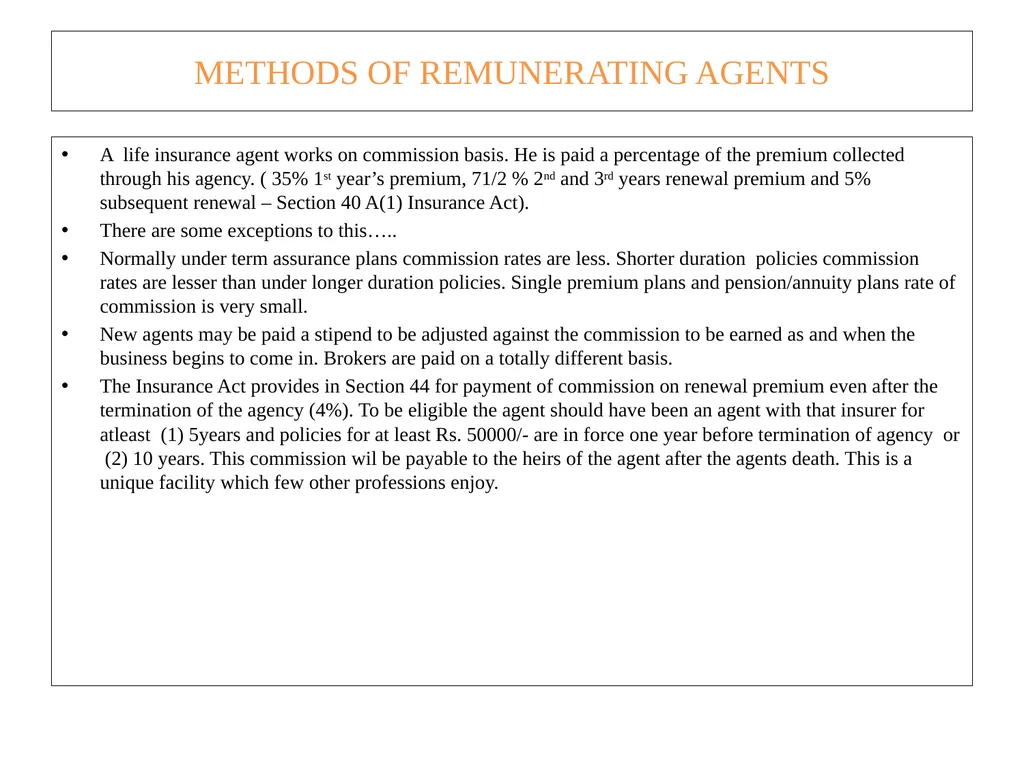
METHODS OF REMUNERATING AGENTS A life insurance agent works on commission basis. He is paid a percentage of the premium collected through his agency. ( 35% 1st year’s premium, 71/2 % 2nd and 3rd years renewal premium and 5% subsequent renewal – Section 40 A(1) Insurance Act).
There are some exceptions to this…..
Normally under term assurance plans commission rates are less. Shorter duration policies commission rates are lesser than under longer duration policies. Single premium plans and pension/annuity plans rate of commission is very small.
New agents may be paid a stipend to be adjusted against the commission to be earned as and when the business begins to come in. Brokers are paid on a totally different basis.
The Insurance Act provides in Section 44 for payment of commission on renewal premium even after the termination of the agency (4%). To be eligible the agent should have been an agent with that insurer for atleast (1) 5years and policies for at least Rs. 50000/- are in force one year before termination of agency or (2) 10 years. This commission wil be payable to the heirs of the agent after the agents death. This is a unique facility which few other professions enjoy.<br>
There are some exceptions to this…..
Normally under term assurance plans commission rates are less. Shorter duration policies commission rates are lesser than under longer duration policies. Single premium plans and pension/annuity plans rate of commission is very small.
New agents may be paid a stipend to be adjusted against the commission to be earned as and when the business begins to come in. Brokers are paid on a totally different basis.
The Insurance Act provides in Section 44 for payment of commission on renewal premium even after the termination of the agency (4%). To be eligible the agent should have been an agent with that insurer for atleast (1) 5years and policies for at least Rs. 50000/- are in force one year before termination of agency or (2) 10 years. This commission wil be payable to the heirs of the agent after the agents death. This is a unique facility which few other professions enjoy.<br>
08
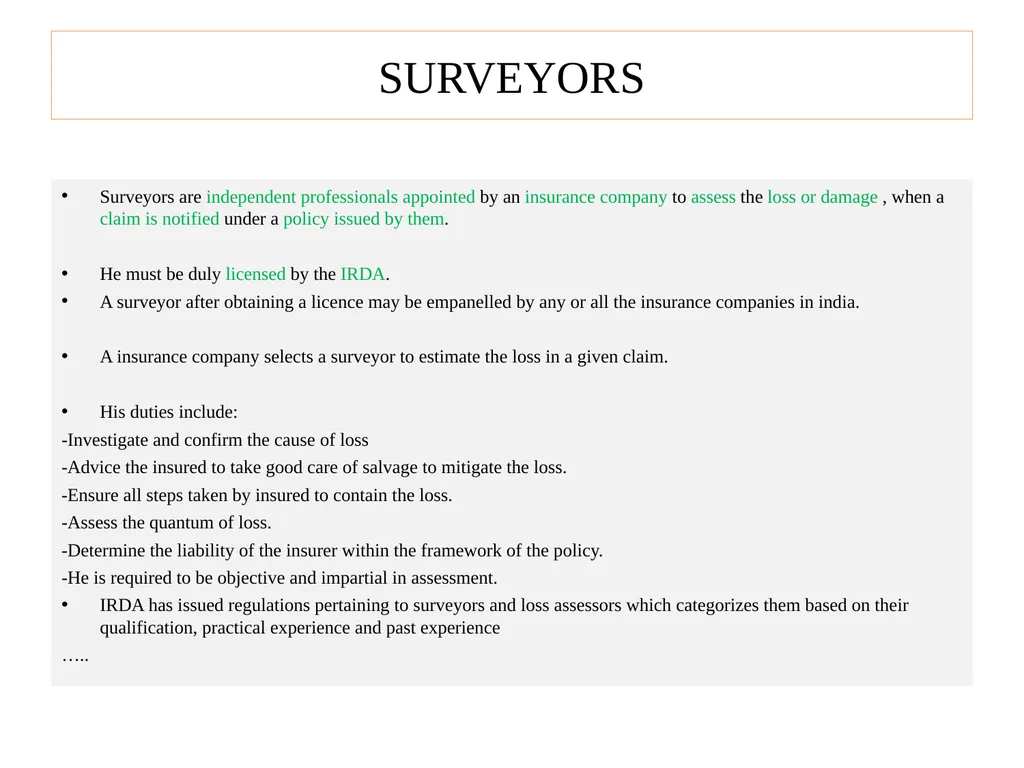
SURVEYORS Surveyors are independent professionals appointed by an insurance company to assess the loss or damage , when a claim is notified under a policy issued by them.
He must be duly licensed by the IRDA.
A surveyor after obtaining a licence may be empanelled by any or all the insurance companies in india.
A insurance company selects a surveyor to estimate the loss in a given claim.
His duties include:
-Investigate and confirm the cause of loss
-Advice the insured to take good care of salvage to mitigate the loss.
-Ensure all steps taken by insured to contain the loss.
-Assess the quantum of loss.
-Determine the liability of the insurer within the framework of the policy.
-He is required to be objective and impartial in assessment.
IRDA has issued regulations pertaining to surveyors and loss assessors which categorizes them based on their qualification, practical experience and past experience
…..<br>
He must be duly licensed by the IRDA.
A surveyor after obtaining a licence may be empanelled by any or all the insurance companies in india.
A insurance company selects a surveyor to estimate the loss in a given claim.
His duties include:
-Investigate and confirm the cause of loss
-Advice the insured to take good care of salvage to mitigate the loss.
-Ensure all steps taken by insured to contain the loss.
-Assess the quantum of loss.
-Determine the liability of the insurer within the framework of the policy.
-He is required to be objective and impartial in assessment.
IRDA has issued regulations pertaining to surveyors and loss assessors which categorizes them based on their qualification, practical experience and past experience
…..<br>
09
THIRD PARTY ADMINISTRATORS (TPA’S) TPA’s are the new breed of intermediaries in the health insurance sector which facilitates the access of the policyholder to a network of hospitals/nursing homes.
Benefit both the insured and insurer.
TPA’s maintain the database of policyholders and issue them identity cards with unique identification numbers and handle all the post policy issues including claim settlements.<br>
Benefit both the insured and insurer.
TPA’s maintain the database of policyholders and issue them identity cards with unique identification numbers and handle all the post policy issues including claim settlements.<br>
10
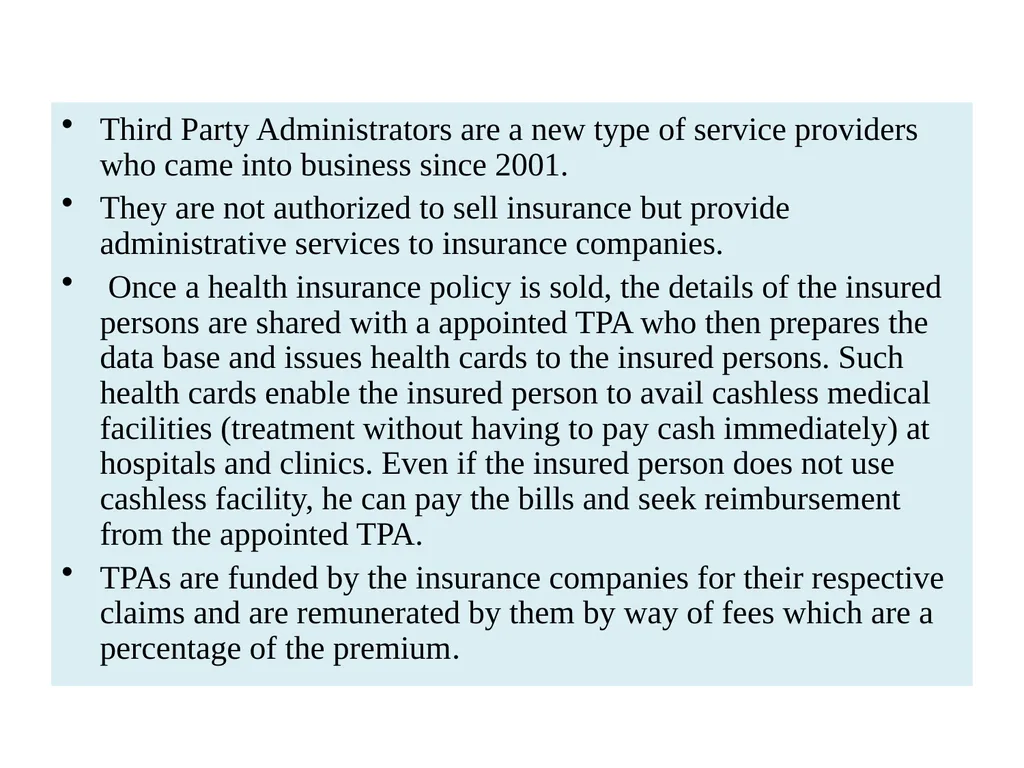
Third Party Administrators are a new type of service providers who came into business since 2001.
They are not authorized to sell insurance but provide administrative services to insurance companies.
Once a health insurance policy is sold, the details of the insured persons are shared with a appointed TPA who then prepares the data base and issues health cards to the insured persons. Such health cards enable the insured person to avail cashless medical facilities (treatment without having to pay cash immediately) at hospitals and clinics. Even if the insured person does not use cashless facility, he can pay the bills and seek reimbursement from the appointed TPA.
TPAs are funded by the insurance companies for their respective claims and are remunerated by them by way of fees which are a percentage of the premium.<br>
They are not authorized to sell insurance but provide administrative services to insurance companies.
Once a health insurance policy is sold, the details of the insured persons are shared with a appointed TPA who then prepares the data base and issues health cards to the insured persons. Such health cards enable the insured person to avail cashless medical facilities (treatment without having to pay cash immediately) at hospitals and clinics. Even if the insured person does not use cashless facility, he can pay the bills and seek reimbursement from the appointed TPA.
TPAs are funded by the insurance companies for their respective claims and are remunerated by them by way of fees which are a percentage of the premium.<br>
11
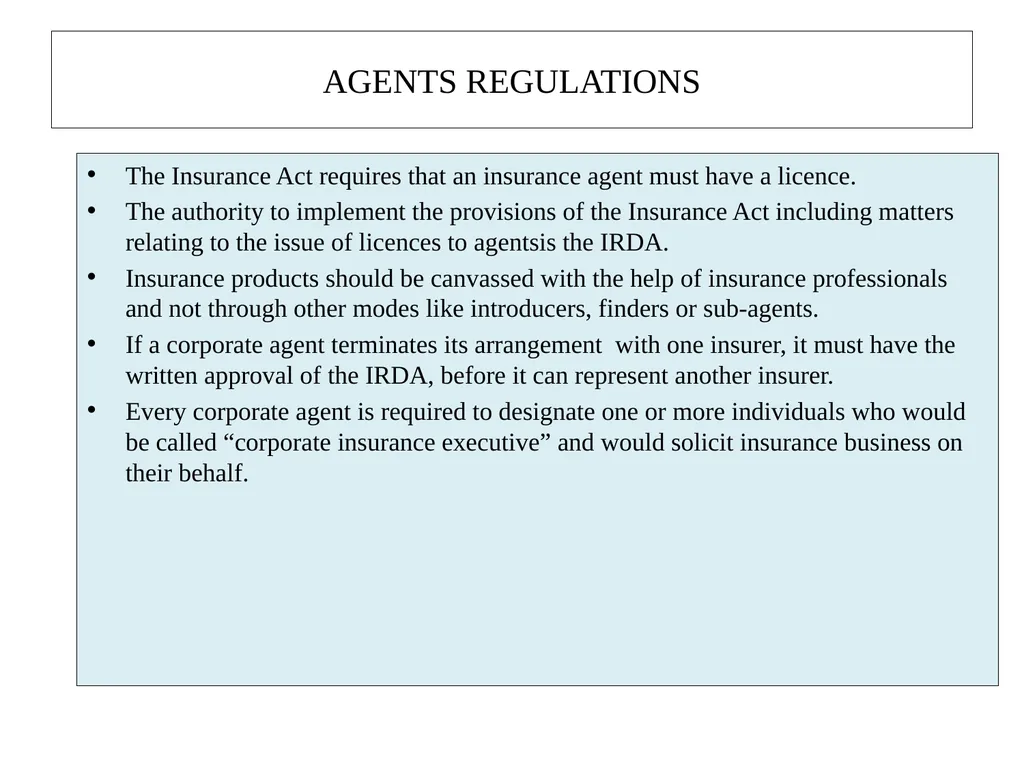
AGENTS REGULATIONS The Insurance Act requires that an insurance agent must have a licence.
The authority to implement the provisions of the Insurance Act including matters relating to the issue of licences to agentsis the IRDA.
Insurance products should be canvassed with the help of insurance professionals and not through other modes like introducers, finders or sub-agents.
If a corporate agent terminates its arrangement with one insurer, it must have the written approval of the IRDA, before it can represent another insurer.
Every corporate agent is required to designate one or more individuals who would be called “corporate insurance executive” and would solicit insurance business on their behalf.<br>
The authority to implement the provisions of the Insurance Act including matters relating to the issue of licences to agentsis the IRDA.
Insurance products should be canvassed with the help of insurance professionals and not through other modes like introducers, finders or sub-agents.
If a corporate agent terminates its arrangement with one insurer, it must have the written approval of the IRDA, before it can represent another insurer.
Every corporate agent is required to designate one or more individuals who would be called “corporate insurance executive” and would solicit insurance business on their behalf.<br>
12
AGENCY AS A PROFESSION An insurance agent, once licenced and appointed is an independent professional. (no fixed working hours, prescribed ways, close supervision)
He is not prevented from pursuing any other interest or vocation.
Many agents see the agency as a means to supplement their earnings.
Some study and understand the business in great detail, improve their skills, get recognized as experts in the field etc.
There are many agents who started as part-time and then became whole-time agents.
An insurance agent when dealing with the prospect should consider prospects interest and requirements and the best financial arrangement for his situation.
A good agent is a good financial planner and considers the interest of the prospect which may be met by schemes other than life insurance.
A life insurance agent is expected to obtain life insurance business and contribute to the revenues of the insurer. Also called primary underwriter ( in touch with the person to be insured, observed his lifestyle, habits,nature etc.)
Agents have the dual responsibility of being true to the interests of both the parties in the transaction. He should not mislead either.<br>
He is not prevented from pursuing any other interest or vocation.
Many agents see the agency as a means to supplement their earnings.
Some study and understand the business in great detail, improve their skills, get recognized as experts in the field etc.
There are many agents who started as part-time and then became whole-time agents.
An insurance agent when dealing with the prospect should consider prospects interest and requirements and the best financial arrangement for his situation.
A good agent is a good financial planner and considers the interest of the prospect which may be met by schemes other than life insurance.
A life insurance agent is expected to obtain life insurance business and contribute to the revenues of the insurer. Also called primary underwriter ( in touch with the person to be insured, observed his lifestyle, habits,nature etc.)
Agents have the dual responsibility of being true to the interests of both the parties in the transaction. He should not mislead either.<br>
13
Insurance Ethics Some of the world’s biggest companies have been found to have cheated through false accounts and dishonest audit certification. The funds of banks have been misused by their managements to bolster the greed of some friends. Officials have used their authority to promote personal benefits . Courts of justice have failed to render justice.
The insurance agent is in a position of trust. On his assurance the policyholders entrust their small savings to an insurer, trusting it to look after these funds and look after their dependents in later years.
Issues of propriety and ethics are extremely important in the business of insurance.
The Code of ethics spelt out by IRDA is directed towards ethical behaviour.
Some characteristics of good ethical behaviours are:
Placing the best interests of the clients above one’s own direct or indirect benefits.
Holding in the strictest confidence and considering as privileged all business and personal information pertaining to the client’s affairs.
Making full and adequate disclosure of all facts to enable clients make informed decisions.
There could be a likelihood of ethics being compromised in the following situations:
Having to choose between two plans, one giving much less commission than the other
Temptation to recommend discontinuance of an existing policy and taking out a new one
Becoming aware of circumstances that if known to the insurer, could adversely affect the interests of the clients or the beneficiaries of the claim.<br>
The insurance agent is in a position of trust. On his assurance the policyholders entrust their small savings to an insurer, trusting it to look after these funds and look after their dependents in later years.
Issues of propriety and ethics are extremely important in the business of insurance.
The Code of ethics spelt out by IRDA is directed towards ethical behaviour.
Some characteristics of good ethical behaviours are:
Placing the best interests of the clients above one’s own direct or indirect benefits.
Holding in the strictest confidence and considering as privileged all business and personal information pertaining to the client’s affairs.
Making full and adequate disclosure of all facts to enable clients make informed decisions.
There could be a likelihood of ethics being compromised in the following situations:
Having to choose between two plans, one giving much less commission than the other
Temptation to recommend discontinuance of an existing policy and taking out a new one
Becoming aware of circumstances that if known to the insurer, could adversely affect the interests of the clients or the beneficiaries of the claim.<br>