UNIT-II nuclear chemistry Course code: 17UCHC41 Course title: Inorganic ChemistryI Class: II B.Sc., Chemistry Dr. M. Jannathul Firdhouse Assistant Professor Department of Chemistry HKRH College Composition of the nucleus An atom consists
"UNIT-II nuclear chemistry Course code: 17UCHC41" is the property of its rightful owner. Permission is granted to
download and print the materials on this website for personal, non-commercial use only, and to display it
on your personal computer provided you do not modify the materials and that you retain all copyright
notices contained in the materials. By downloading content from our website, you accept the terms of this
agreement.
Dr. M. Jannathul Firdhouse
Assistant Professor
Department of Chemistry
HKRH College<br>
02
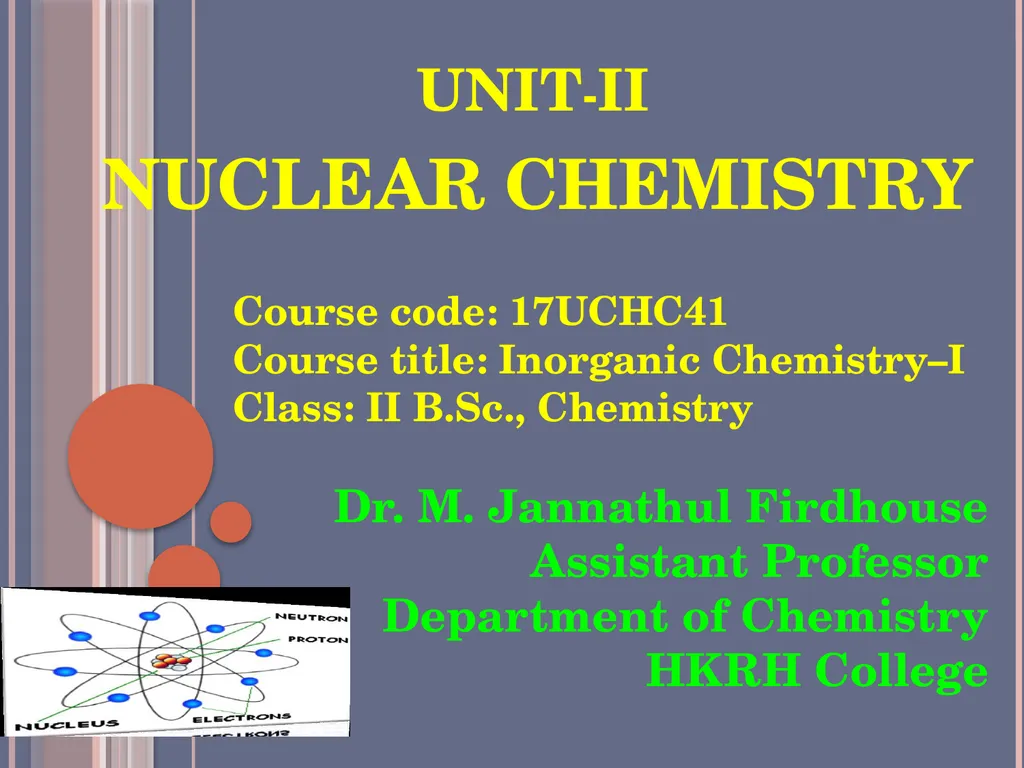
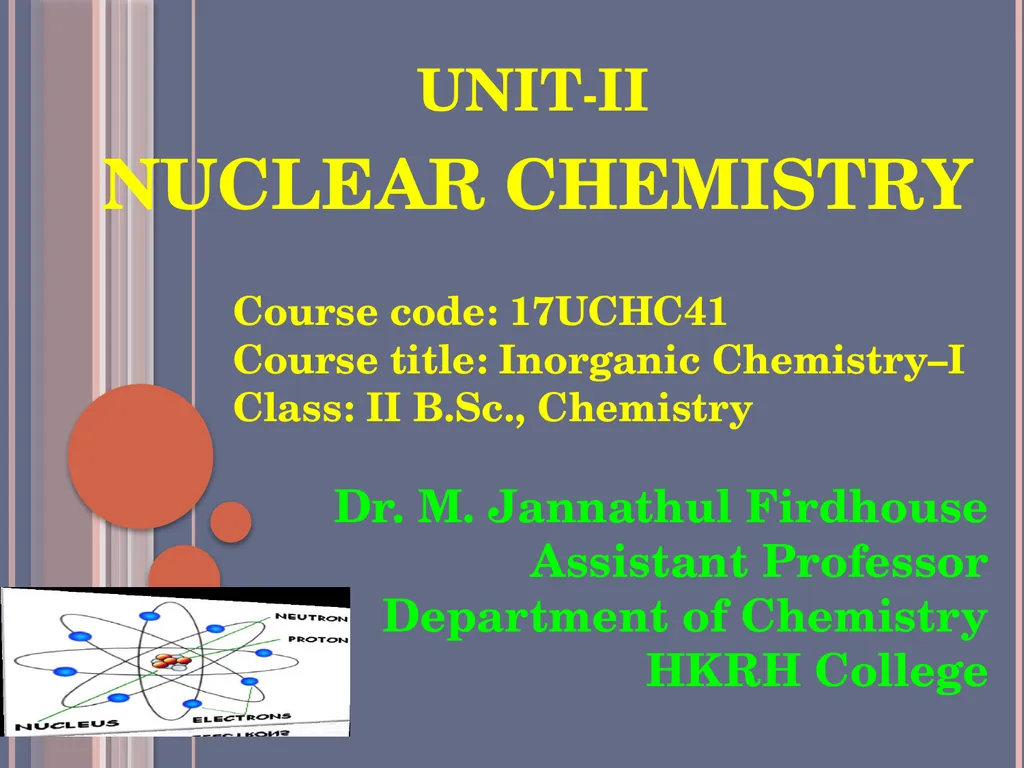
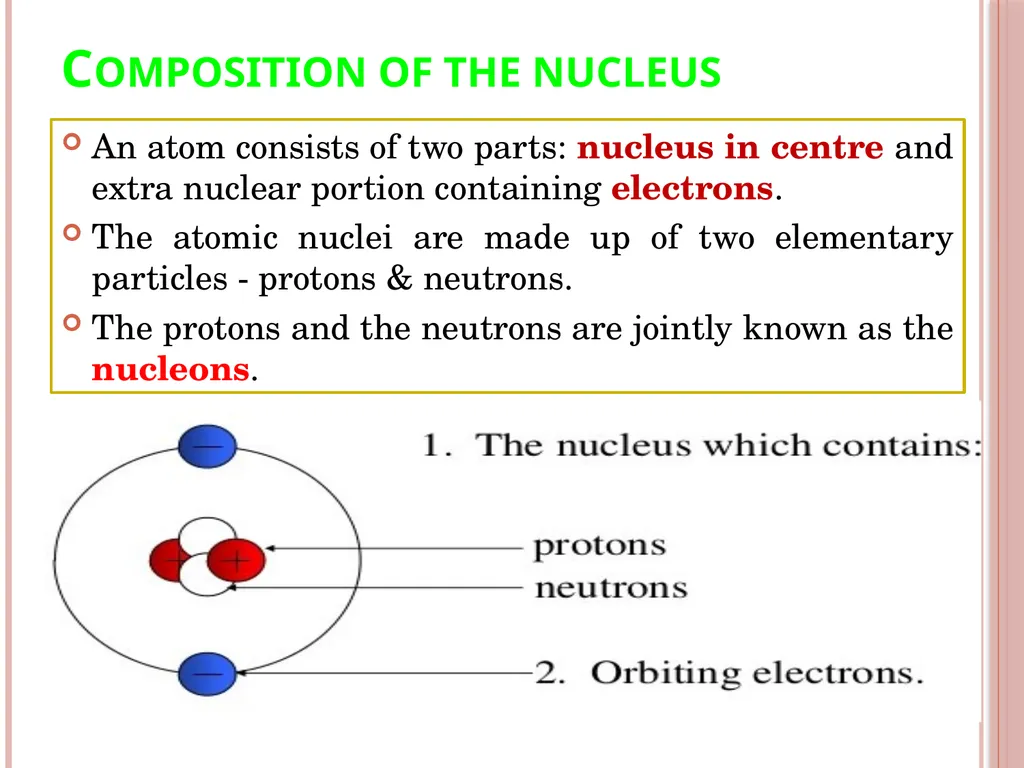
Composition of the nucleus An atom consists of two parts: nucleus in centre and extra nuclear portion containing electrons.
The atomic nuclei are made up of two elementary particles - protons & neutrons.
The protons and the neutrons are jointly known as the nucleons.<br>
03
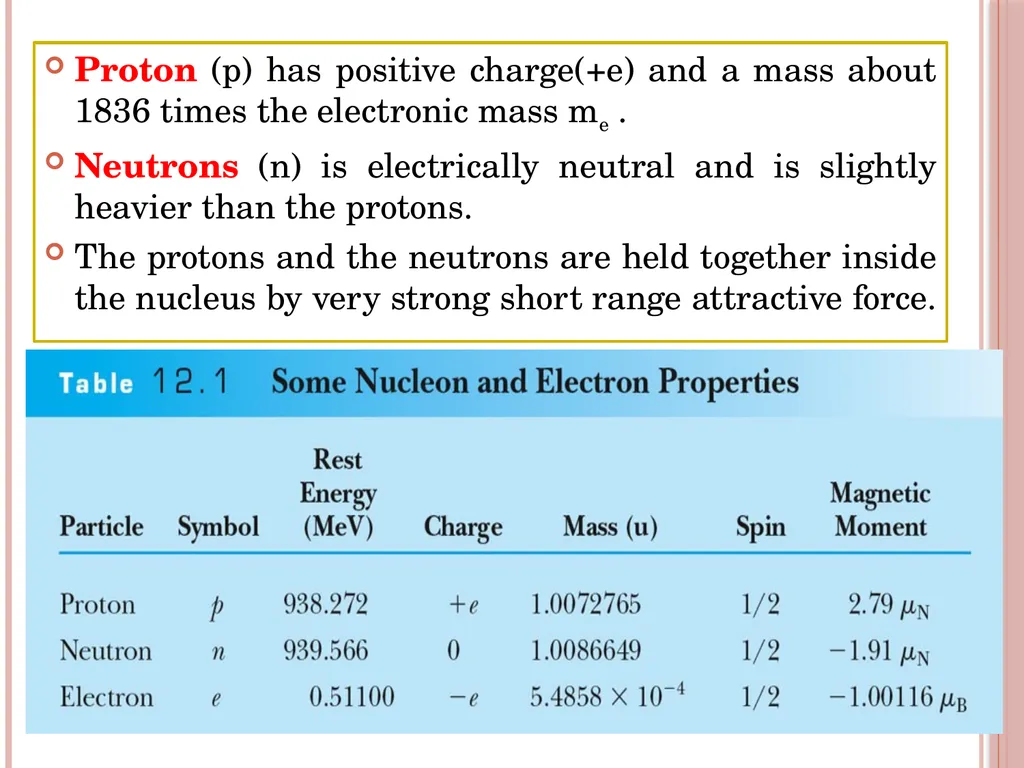
Proton (p) has positive charge(+e) and a mass about 1836 times the electronic mass me .
Neutrons (n) is electrically neutral and is slightly heavier than the protons.
The protons and the neutrons are held together inside the nucleus by very strong short range attractive force.<br>
04
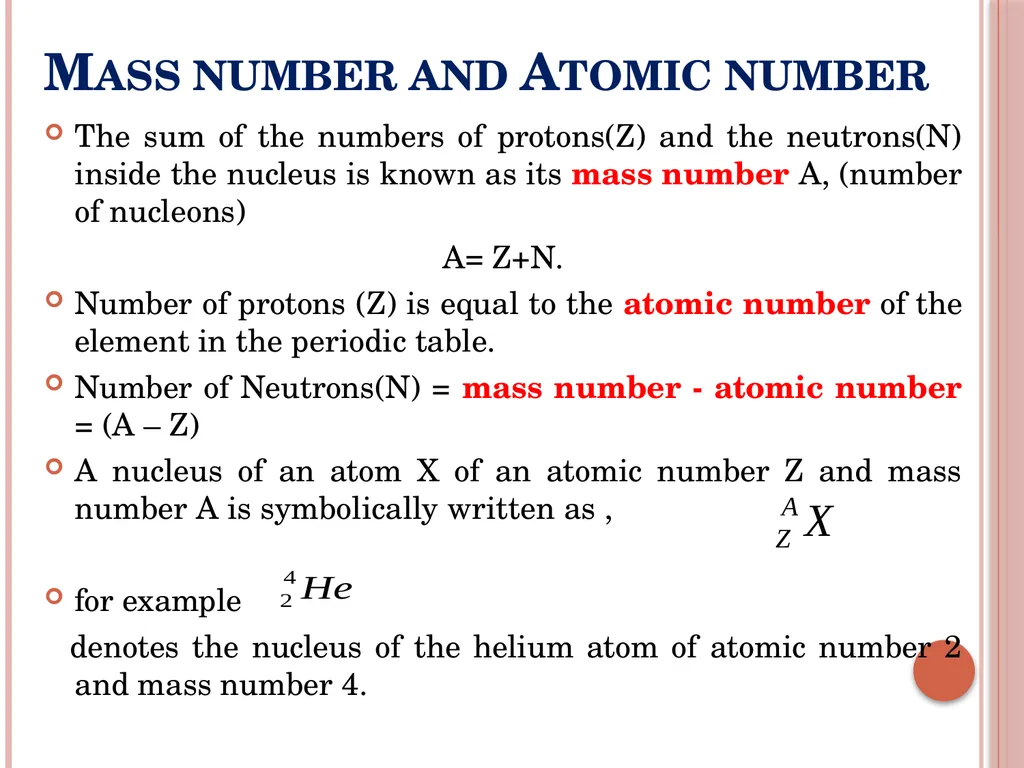
Mass number and Atomic number The sum of the numbers of protons(Z) and the neutrons(N) inside the nucleus is known as its mass number A, (number of nucleons)
A= Z+N.
Number of protons (Z) is equal to the atomic number of the element in the periodic table.
Number of Neutrons(N) = mass number - atomic number = (A – Z)
A nucleus of an atom X of an atomic number Z and mass number A is symbolically written as ,
for example
denotes the nucleus of the helium atom of atomic number 2 and mass number 4.<br>
05
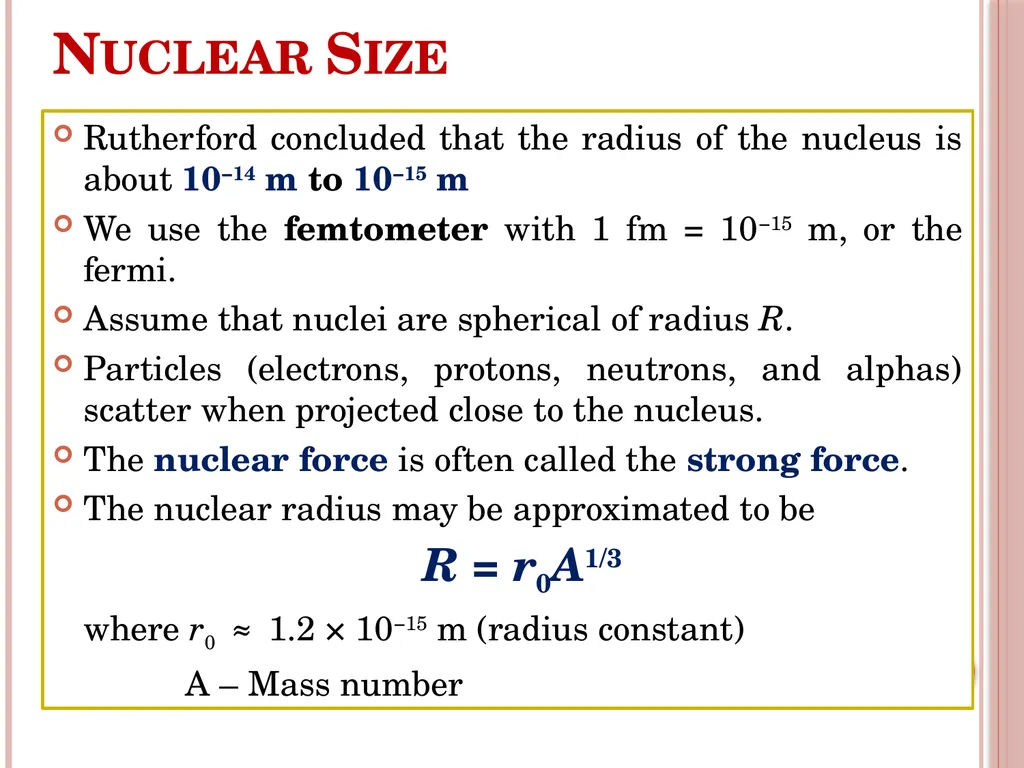
5 Nuclear Size Rutherford concluded that the radius of the nucleus is about 10−14 m to 10−15 m
We use the femtometer with 1 fm = 10−15 m, or the fermi.
Assume that nuclei are spherical of radius R.
Particles (electrons, protons, neutrons, and alphas) scatter when projected close to the nucleus.
The nuclear force is often called the strong force.
The nuclear radius may be approximated to be
R = r0A1/3
where r0 ≈ 1.2 × 10⁻¹⁵ m (radius constant)
A – Mass number<br>
06
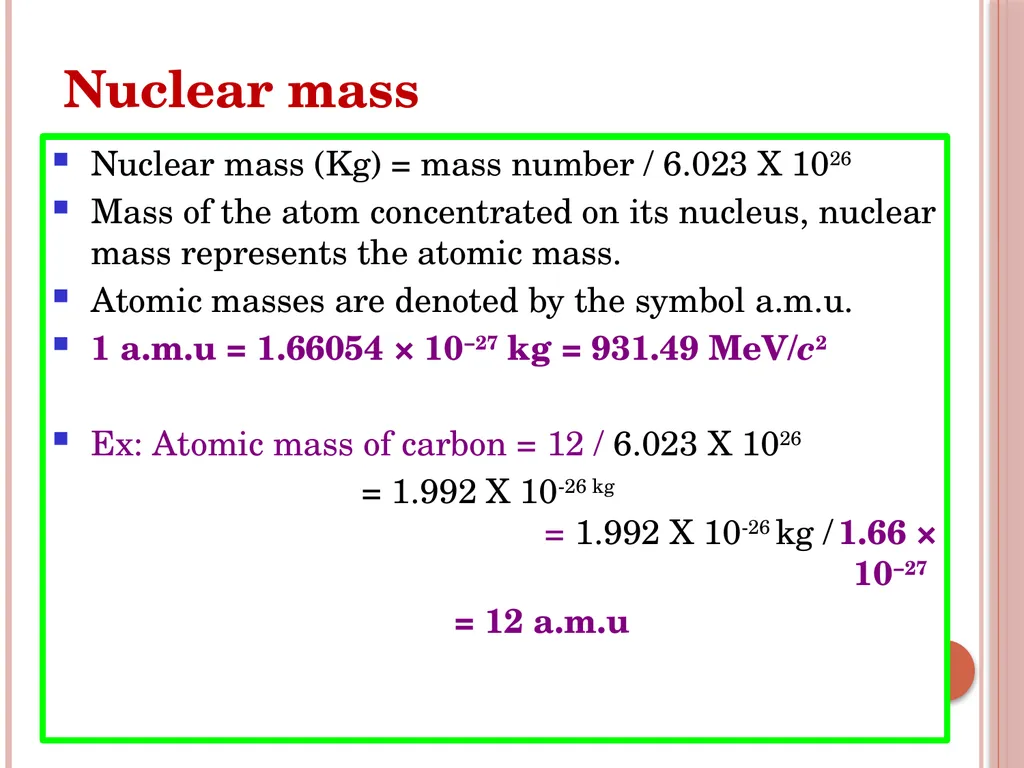
Nuclear mass (Kg) = mass number / 6.023 X 1026
Mass of the atom concentrated on its nucleus, nuclear mass represents the atomic mass.
Atomic masses are denoted by the symbol a.m.u.
1 a.m.u = 1.66054 × 10⁻²⁷ kg = 931.49 MeV/c2
Ex: Atomic mass of carbon = 12 / 6.023 X 1026
= 1.992 X 10⁻²⁶ kg = 1.992 X 10⁻²⁶ kg / 1.66 × 10−27
= 12 a.m.u Nuclear mass<br>
07
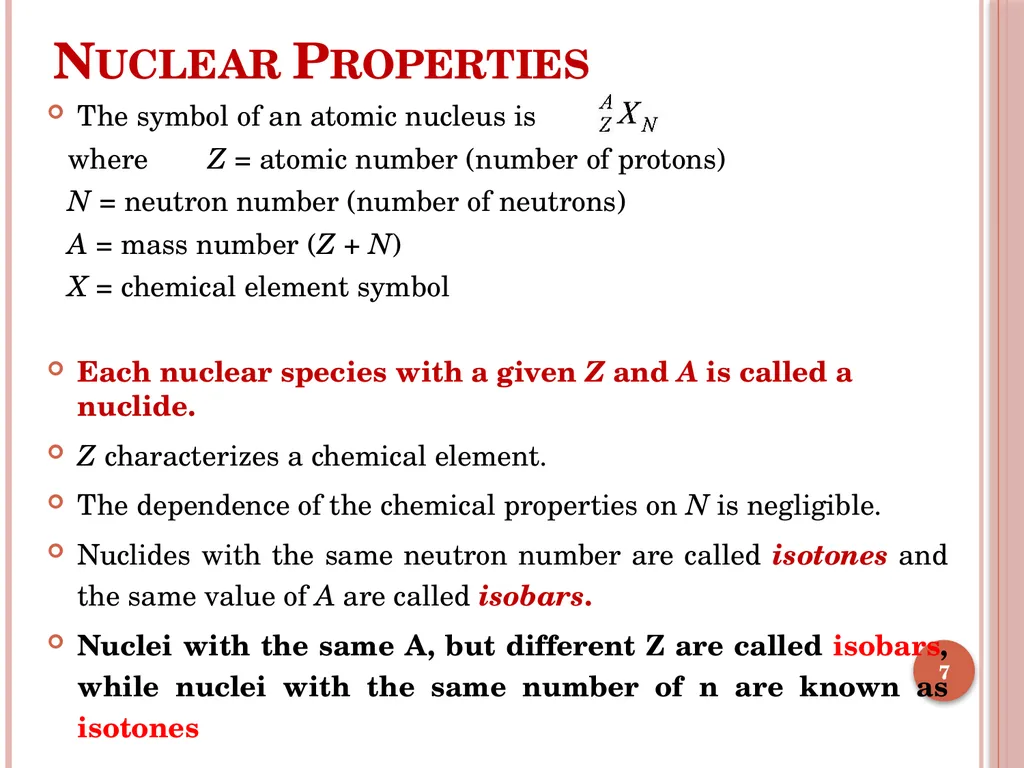
7 Nuclear Properties The symbol of an atomic nucleus is .
where Z = atomic number (number of protons)
N = neutron number (number of neutrons)
A = mass number (Z + N)
X = chemical element symbol
Each nuclear species with a given Z and A is called a nuclide.
Z characterizes a chemical element.
The dependence of the chemical properties on N is negligible.
Nuclides with the same neutron number are called isotones and the same value of A are called isobars.
Nuclei with the same A, but different Z are called isobars, while nuclei with the same number of n are known as isotones<br>
08
Isotopes Nuclei with the same Z, but different A are called isotopes.
A particular element with a given Z may have isotopes of different mass numbers. Their nuclei contain the same number of protons and different number of neutrons.
J.J. Thomson was the first to discover stable isotopes of neon (Z=10), viz., 20Ne and 22Ne
Many elements have more than one stable isotope. Elements having more than one stable isotope in the natural state are mixtures of these isotopes in fixed proportions, known as their relative abundances .<br>
09
Hydrogen’s isotopes:
Deuterium: Heavy hydrogen. Has a neutron as well as a proton in its nucleus.
Tritium: Has two neutrons and one proton.
The nuclei of the deuterium and tritium atoms are called deuterons and tritons.
Atoms with the same Z, but different mass number A, are called isotopes.<br>
10
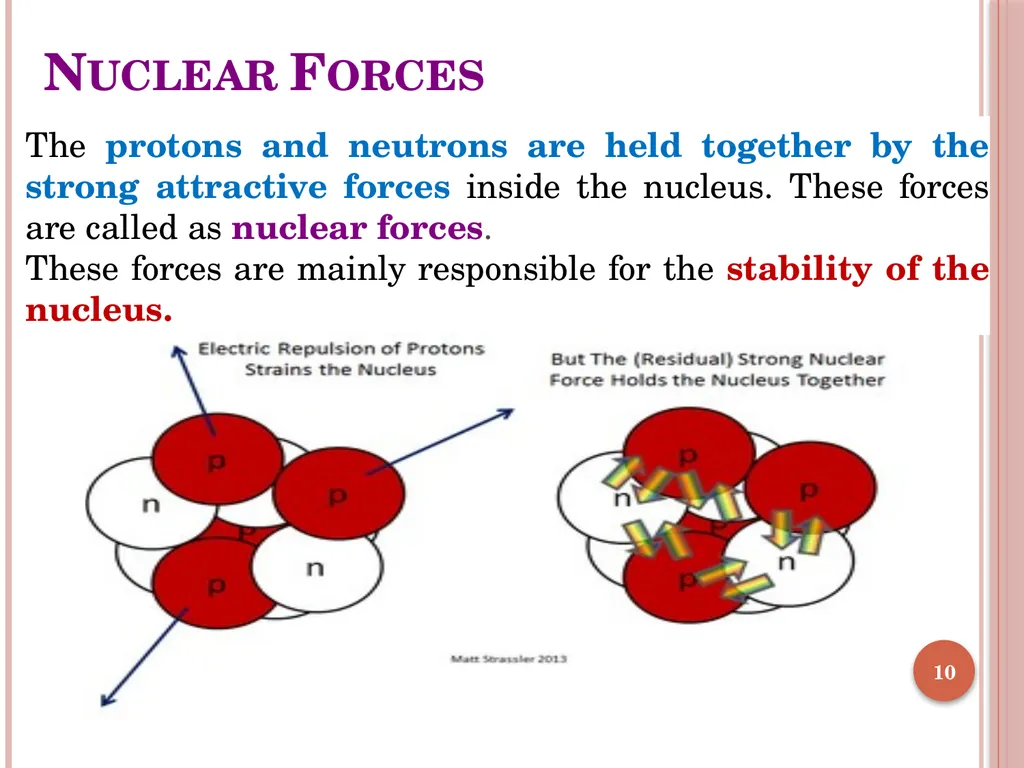
10 Nuclear Forces The protons and neutrons are held together by the strong attractive forces inside the nucleus. These forces are called as nuclear forces.
These forces are mainly responsible for the stability of the nucleus.<br>
11
11 Various characteristics of nuclear forces are given below:
(a) Nuclear forces are attractive in nature.
(b) Nuclear forces are charge independent.
(c) These are short range forces.
(d)Nuclear forces decrease very quickly with distance between two nucleons. The forces become negligible when the nucleons are more than 10-12 cm apart.
(v) Nuclear forces are spin dependent.<br>
12
Meson Theory
They are the forces between p – p, p – n or n – n in the nucleus.
They can be explained by Meson Theory.
There are three kinds of mesons – positive (π+), negative (π-) and neutral (π0).
π+ and π- are 273 times heavier than an electron.
π0 is 264 times heavier than an electron.
Nucleons (protons and neutrons) are surrounded by mesons.
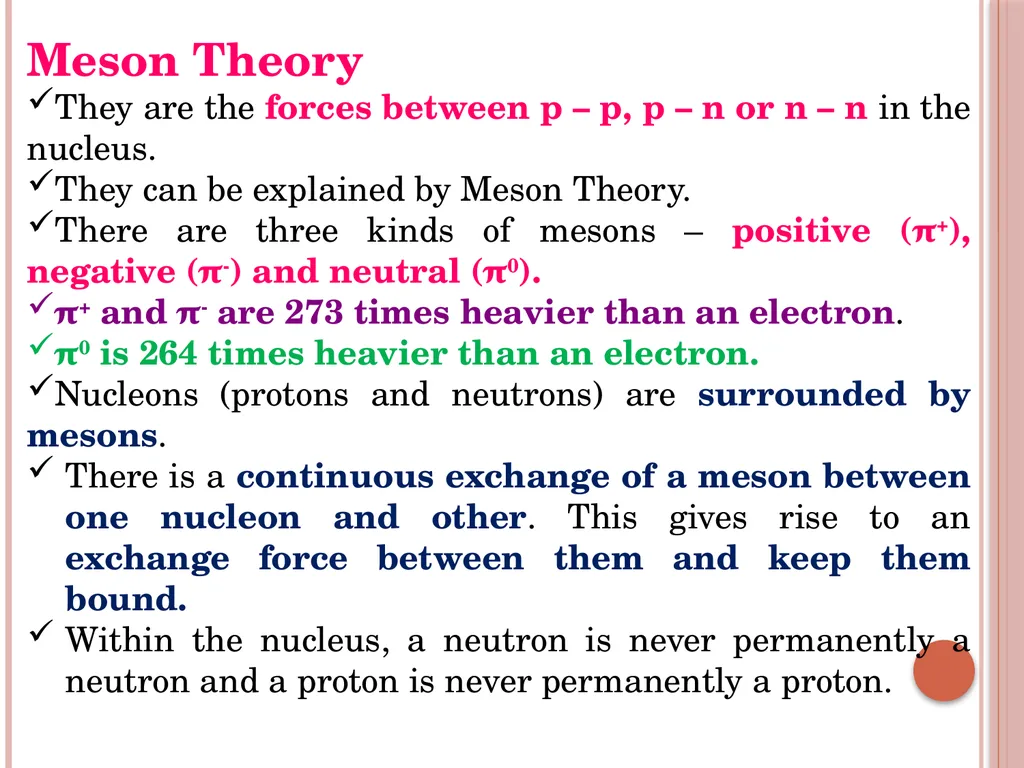
There is a continuous exchange of a meson between one nucleon and other. This gives rise to an exchange force between them and keep them bound.
Within the nucleus, a neutron is never permanently a neutron and a proton is never permanently a proton.<br>
13
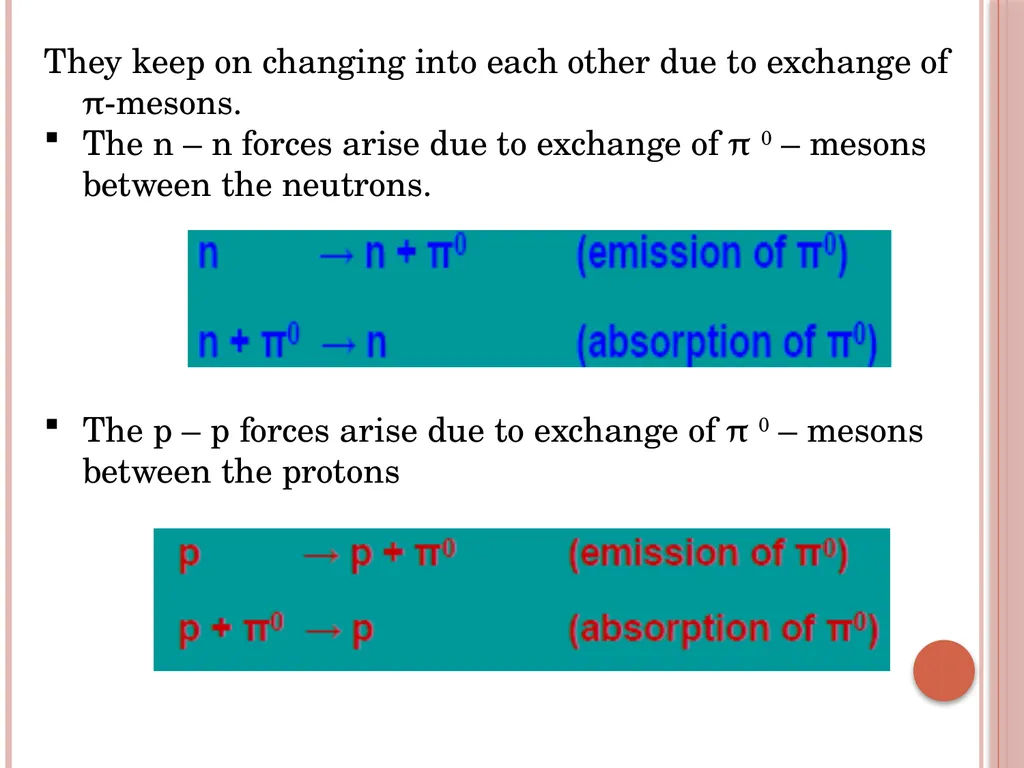
They keep on changing into each other due to exchange of π-mesons.
The n – n forces arise due to exchange of π 0 – mesons between the neutrons.
The p – p forces arise due to exchange of π 0 – mesons between the protons<br>
14
The n – p forces arise due to exchange of π+ and π- mesons between the nucleons.
The time involved in such an exchange is so small that the free meson particles cannot be detected as such.<br>
15
References
PL. Soni–Textbook of Inorganic chemistry.
Puri, Sharma and Kalia – Principles of Inorganic Chemistry.
R.D.Madan–Modern Inorganic Chemistry.
Arnikar – Nuclear chemistry.<br>