
Unit – III ENGINEERING AS SOCIAL EXPERIMENTATION
DJ
Published · 50 slides · 0 views
1 / 1
Description
Unit III ENGINEERING AS SOCIAL EXPERIMENTATION ENGINEERING AS SOCIAL EXPERIMENTATION Engineering as Experimentation Engineers as responsible Experimenters Codes of Ethics A Balanced Outlook on Law. ENGINEERING AS EXPERIMENTATION
Related Topics
Share
Embed code
Download this presentation From Below
"Unit – III ENGINEERING AS SOCIAL EXPERIMENTATION" is the property of its rightful owner. Permission is granted to download and print the materials on this website for personal, non-commercial use only, and to display it on your personal computer provided you do not modify the materials and that you retain all copyright notices contained in the materials. By downloading content from our website, you accept the terms of this agreement.
Presentation Transcript
01
Unit – III
ENGINEERING AS SOCIAL EXPERIMENTATION<br>
02
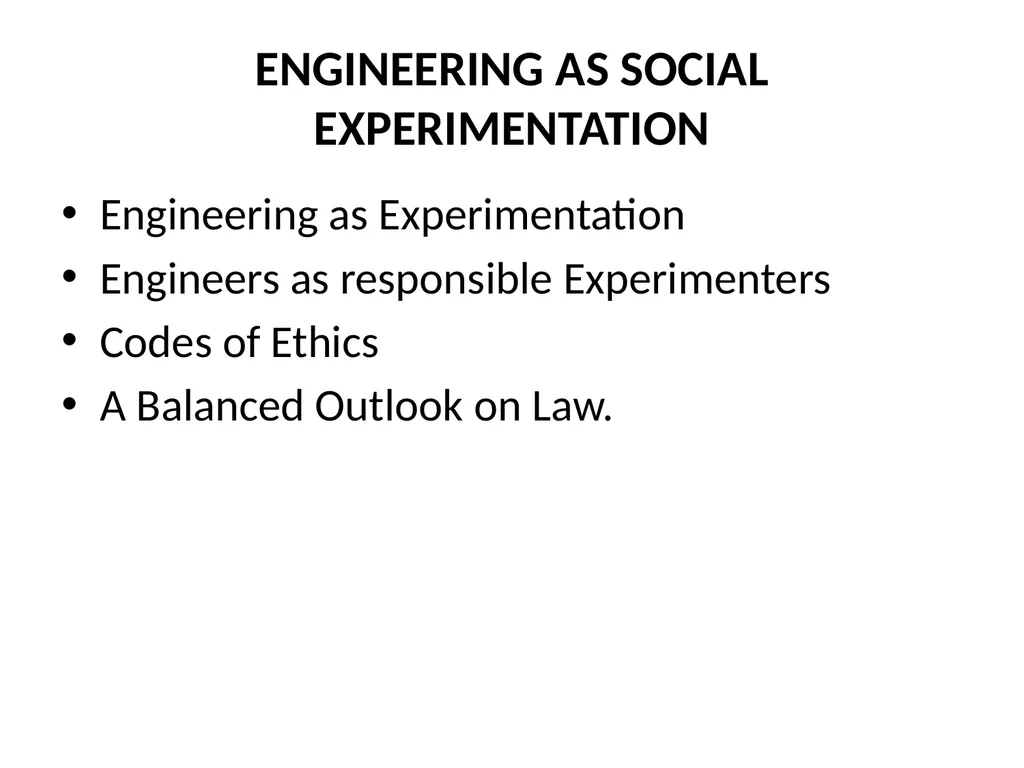
ENGINEERING AS SOCIAL EXPERIMENTATION Engineering as Experimentation
Engineers as responsible Experimenters
Codes of Ethics
A Balanced Outlook on Law.<br>
Engineers as responsible Experimenters
Codes of Ethics
A Balanced Outlook on Law.<br>
03
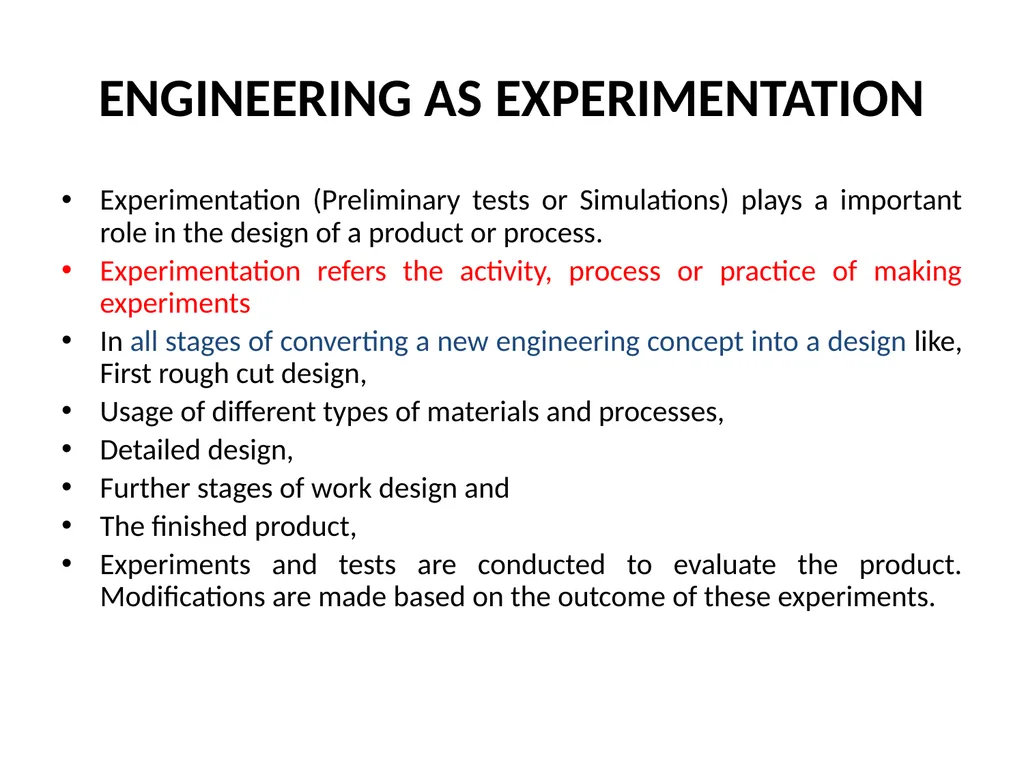
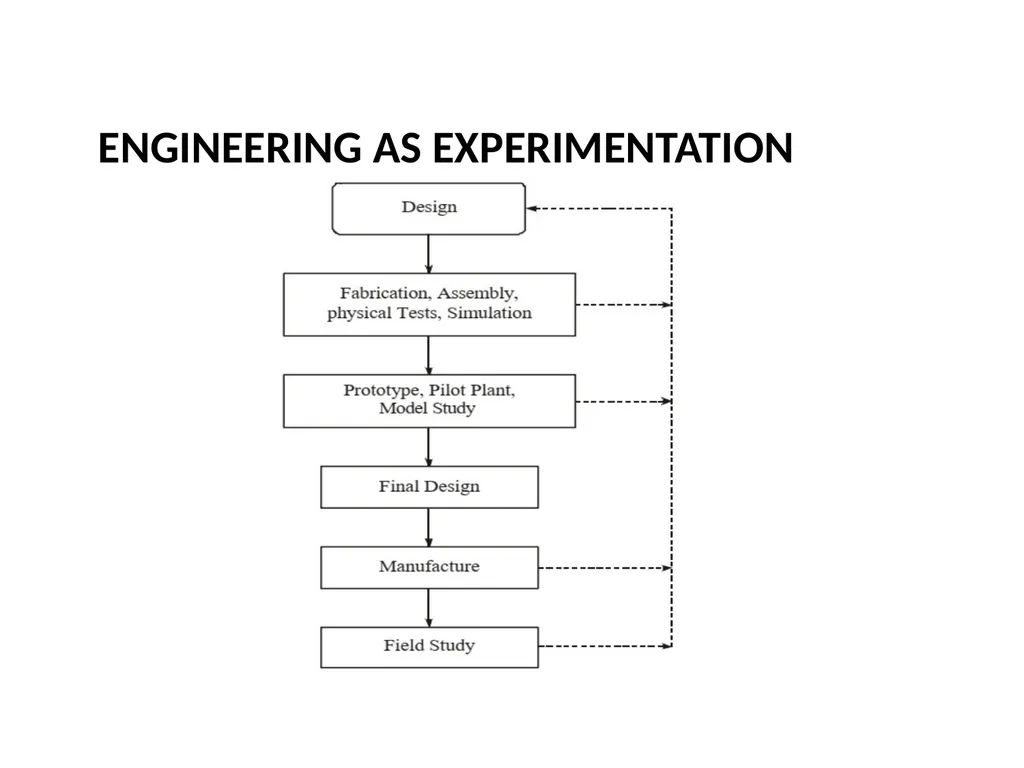
ENGINEERING AS EXPERIMENTATION Experimentation (Preliminary tests or Simulations) plays a important role in the design of a product or process.
Experimentation refers the activity, process or practice of making experiments
In all stages of converting a new engineering concept into a design like, First rough cut design,
Usage of different types of materials and processes,
Detailed design,
Further stages of work design and
The finished product,
Experiments and tests are conducted to evaluate the product. Modifications are made based on the outcome of these experiments.<br>
Experimentation refers the activity, process or practice of making experiments
In all stages of converting a new engineering concept into a design like, First rough cut design,
Usage of different types of materials and processes,
Detailed design,
Further stages of work design and
The finished product,
Experiments and tests are conducted to evaluate the product. Modifications are made based on the outcome of these experiments.<br>
04
ENGINEERING AS EXPERIMENTATION<br>
05
Engineering Projects VS. Standard Experiments
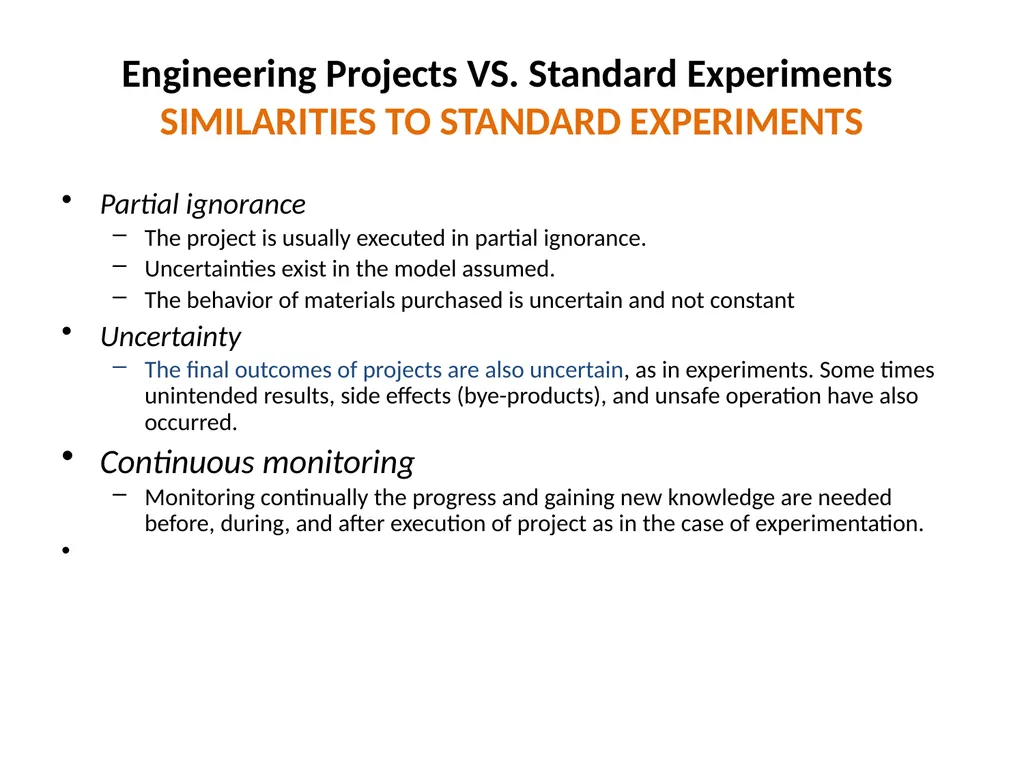
SIMILARITIES TO STANDARD EXPERIMENTS Partial ignorance
The project is usually executed in partial ignorance.
Uncertainties exist in the model assumed.
The behavior of materials purchased is uncertain and not constant
Uncertainty
The final outcomes of projects are also uncertain, as in experiments. Some times unintended results, side effects (bye-products), and unsafe operation have also occurred.
Continuous monitoring
Monitoring continually the progress and gaining new knowledge are needed before, during, and after execution of project as in the case of experimentation.<br>
The project is usually executed in partial ignorance.
Uncertainties exist in the model assumed.
The behavior of materials purchased is uncertain and not constant
Uncertainty
The final outcomes of projects are also uncertain, as in experiments. Some times unintended results, side effects (bye-products), and unsafe operation have also occurred.
Continuous monitoring
Monitoring continually the progress and gaining new knowledge are needed before, during, and after execution of project as in the case of experimentation.<br>
06
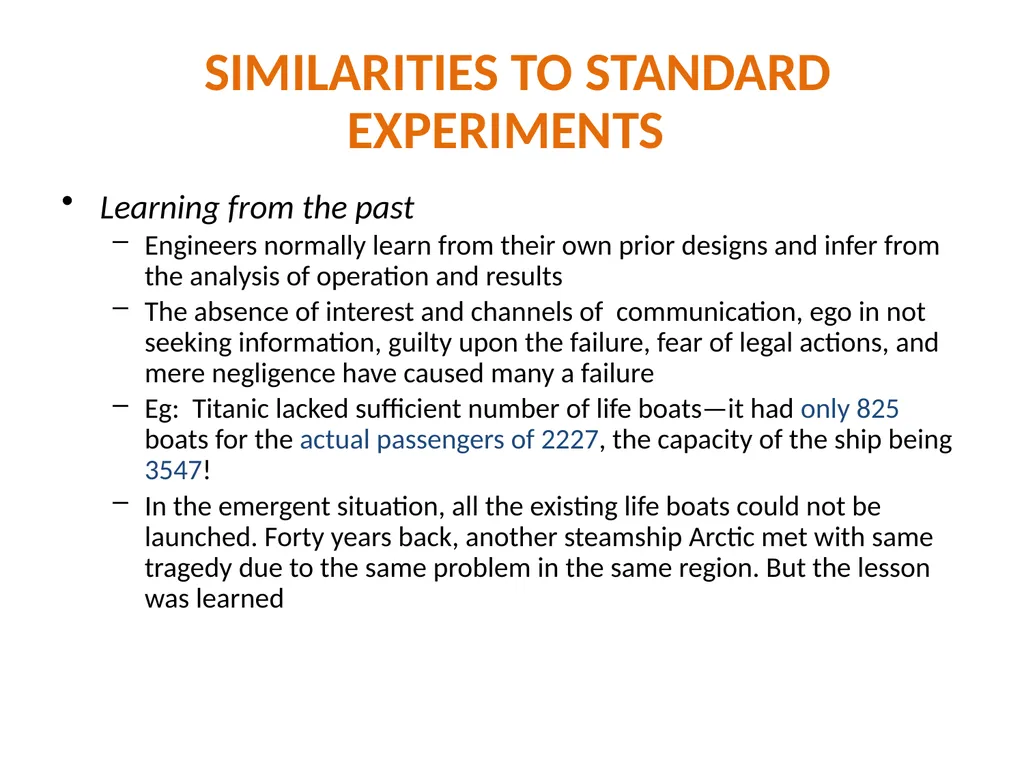
SIMILARITIES TO STANDARD EXPERIMENTS Learning from the past
Engineers normally learn from their own prior designs and infer from the analysis of operation and results
The absence of interest and channels of communication, ego in not seeking information, guilty upon the failure, fear of legal actions, and mere negligence have caused many a failure
Eg: Titanic lacked sufficient number of life boats—it had only 825 boats for the actual passengers of 2227, the capacity of the ship being 3547!
In the emergent situation, all the existing life boats could not be launched. Forty years back, another steamship Arctic met with same tragedy due to the same problem in the same region. But the lesson was learned<br>
Engineers normally learn from their own prior designs and infer from the analysis of operation and results
The absence of interest and channels of communication, ego in not seeking information, guilty upon the failure, fear of legal actions, and mere negligence have caused many a failure
Eg: Titanic lacked sufficient number of life boats—it had only 825 boats for the actual passengers of 2227, the capacity of the ship being 3547!
In the emergent situation, all the existing life boats could not be launched. Forty years back, another steamship Arctic met with same tragedy due to the same problem in the same region. But the lesson was learned<br>
07
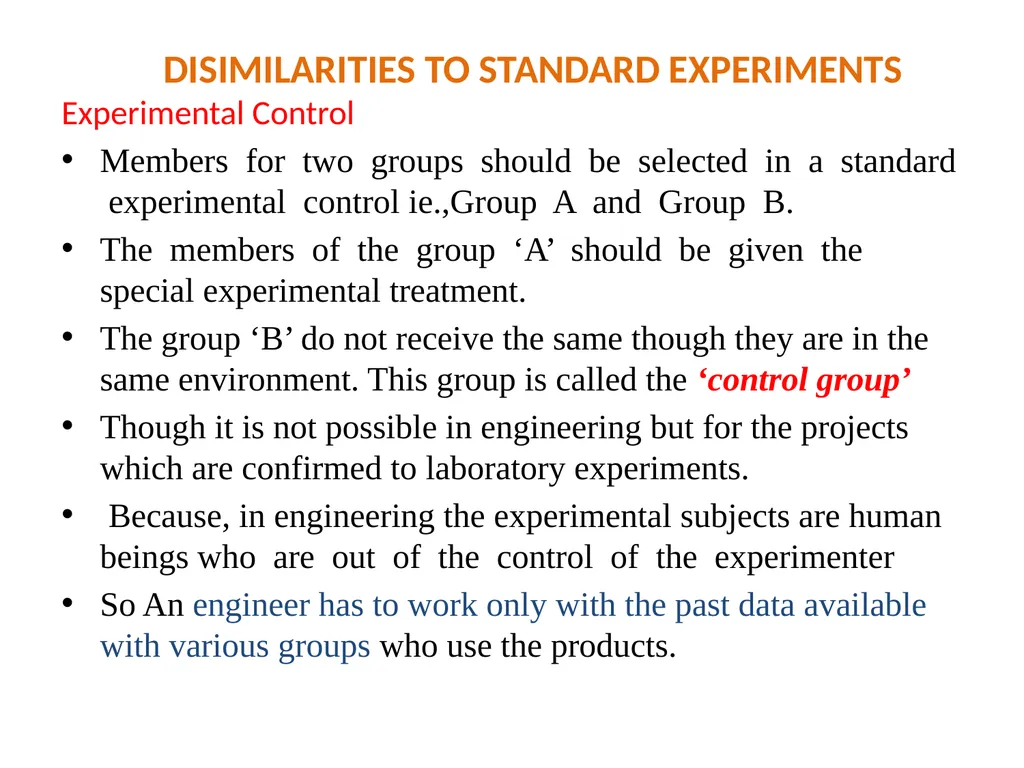
DISIMILARITIES TO STANDARD EXPERIMENTS Experimental Control
Members for two groups should be selected in a standard experimental control ie.,Group A and Group B.
The members of the group ‘A’ should be given the special experimental treatment.
The group ‘B’ do not receive the same though they are in the same environment. This group is called the ‘control group’
Though it is not possible in engineering but for the projects which are confirmed to laboratory experiments.
Because, in engineering the experimental subjects are human beings who are out of the control of the experimenter
So An engineer has to work only with the past data available with various groups who use the products.<br>
Members for two groups should be selected in a standard experimental control ie.,Group A and Group B.
The members of the group ‘A’ should be given the special experimental treatment.
The group ‘B’ do not receive the same though they are in the same environment. This group is called the ‘control group’
Though it is not possible in engineering but for the projects which are confirmed to laboratory experiments.
Because, in engineering the experimental subjects are human beings who are out of the control of the experimenter
So An engineer has to work only with the past data available with various groups who use the products.<br>
08
DISIMILARITIES TO STANDARD EXPERIMENTS Humane touch
Engineering experiments involve human souls, their needs, views, expectations, and creative use as in case of social experimentation<br>
Engineering experiments involve human souls, their needs, views, expectations, and creative use as in case of social experimentation<br>
09
DISIMILARITIES TO STANDARD EXPERIMENTS Informed Consent
Engineering experimentation is viewed as Societal Experiment since the subject and the beneficiary are human beings
When new medicines have been tested, it should be informed to the persons who undergo the test.
They have moral and legal rights to know about the fact which is based on “informed consent” before take part in the experiment. Engineering must also recognize these rights.
Informed consent has two main principles such as knowledge and voluntariness
Knowledge: The persons who are put under the experiment has to be given all the needed information to make an appropriate decision
Voluntariness: they must enter into the experiment without any force, fraud and deception<br>
Engineering experimentation is viewed as Societal Experiment since the subject and the beneficiary are human beings
When new medicines have been tested, it should be informed to the persons who undergo the test.
They have moral and legal rights to know about the fact which is based on “informed consent” before take part in the experiment. Engineering must also recognize these rights.
Informed consent has two main principles such as knowledge and voluntariness
Knowledge: The persons who are put under the experiment has to be given all the needed information to make an appropriate decision
Voluntariness: they must enter into the experiment without any force, fraud and deception<br>
10
Valid informed consent The consent must be given voluntarily and not by any force.
All relevant information shall be presented/stated in a clearly understandable form
The consenter must be capable of processing the information and to make rational decisions in a quick manner.
The information needed by a rational person must be stated in a form to understand without any difficulty and has to be spread widely.
The experimenter’s consent has to be offered in absentia of the experimenter by a group which represents many experiments.<br>
All relevant information shall be presented/stated in a clearly understandable form
The consenter must be capable of processing the information and to make rational decisions in a quick manner.
The information needed by a rational person must be stated in a form to understand without any difficulty and has to be spread widely.
The experimenter’s consent has to be offered in absentia of the experimenter by a group which represents many experiments.<br>
11
Informed consent - Engineering the knowledge about the product
risks and benefits of using the product
all relevant information on the product<br>
risks and benefits of using the product
all relevant information on the product<br>
12
DISIMILARITIES TO STANDARD EXPERIMENTS Knowledge Gain:
Scientific experiments have been conducted to acquire new knowledge. Whereas engineering projects are conducted as experiments not for getting new knowledge
Suppose the outcomes of the experiment is best, it tells us nothing new.
Mean while, the unexpected outcomes put us search for new knowledge.
Engineering experiments at the most help us to
verify the adequacy of the design
to check the stability of the design parameters
prepare for the unexpected outcomes<br>
Scientific experiments have been conducted to acquire new knowledge. Whereas engineering projects are conducted as experiments not for getting new knowledge
Suppose the outcomes of the experiment is best, it tells us nothing new.
Mean while, the unexpected outcomes put us search for new knowledge.
Engineering experiments at the most help us to
verify the adequacy of the design
to check the stability of the design parameters
prepare for the unexpected outcomes<br>
13
Responsible engineers in social experimentation The engineers have so many responsibilities for serving society
Conscientiousness: A primary obligation to protect the safety of human subjects and respect their right of consent.
Relevant information: A constant awareness of the experimental nature of any project, imaginative forecasting of its possible side effects and a reasonable effort to monitor them.
Moral autonomy: Autonomous, personal involvement in all steps of the project.
Accountability: Accepting accountability for the results of the project.<br>
Conscientiousness: A primary obligation to protect the safety of human subjects and respect their right of consent.
Relevant information: A constant awareness of the experimental nature of any project, imaginative forecasting of its possible side effects and a reasonable effort to monitor them.
Moral autonomy: Autonomous, personal involvement in all steps of the project.
Accountability: Accepting accountability for the results of the project.<br>
14
CONSCIENTIOUSNESS (sense of awareness) Conscientious means showing that one cares about the doing things well and thoroughly
It means commitment to live according to certain values
Engineers have to be sensitive to range of moral values and responsibilities
Willingness to develop the skill and expend the effort needed to reach the best balance possible among various considerations.
Conscientiousness means consciousness because mere intent is not sufficient.
Respect foremost the safety and health of the affected, while they seek to enrich their knowledge, rush for the profit, follow the rules, or care for only the beneficiary<br>
It means commitment to live according to certain values
Engineers have to be sensitive to range of moral values and responsibilities
Willingness to develop the skill and expend the effort needed to reach the best balance possible among various considerations.
Conscientiousness means consciousness because mere intent is not sufficient.
Respect foremost the safety and health of the affected, while they seek to enrich their knowledge, rush for the profit, follow the rules, or care for only the beneficiary<br>
15
RELEVANT INFORMATION: Conscientiousness is impossible without relevant factual information.
Engineers have to show the commitment to obtain and properly gauge all the information related to meeting one’s moral obligations.
Moral concern involves a commitment to obtain and assess all available pertinent information.<br>
Engineers have to show the commitment to obtain and properly gauge all the information related to meeting one’s moral obligations.
Moral concern involves a commitment to obtain and assess all available pertinent information.<br>
16
Comprehensive Perspective The engineer should grasp the context of his work and ensure that the work involved results in only moral ends.
Not to Accept Design :-A product has a built-in obsolete or redundant component to boost sales with a false claim<br>
Not to Accept Design :-A product has a built-in obsolete or redundant component to boost sales with a false claim<br>
17
Moral Autonomy Viewing engineering as social experimentation, and anticipating unknown consequences should promote an attitude of questioning about the adequacy of the existing economic and safety standards.<br>
18
Accountablility Means - The capacity to understand and act on moral reasons
Means being responsible, liable, answerable or obligated.
Morally responsible peoples are expected to accept morally responsibility for their actions
According to standley milgram, people are not willing to accept personal accountability when placed under authority<br>
Means being responsible, liable, answerable or obligated.
Morally responsible peoples are expected to accept morally responsibility for their actions
According to standley milgram, people are not willing to accept personal accountability when placed under authority<br>
19
CODES OF ETHICS Engineering Codes of Ethics have evolved over time
Codes of ethics are propagated by various professional societies
These codes of conduct are guidelines for specific group of professionals to help them to perform their role
What are codes of ethics:
it is also referred as codes of conduct.
It express the commitment to the ethical conduct shared by members of a profession.
It also define the roles and responsibilities of professions
This is used to help the professionals to apply moral & ethical principles to the specific situations encountered in professional practice
The codes are based on 5canons- principles of ethics-integrity, competence, individual responsibilities , professional responsibilities and human concerns
It is also noticed that ethical codes do not establish new ethical principles<br>
Codes of ethics are propagated by various professional societies
These codes of conduct are guidelines for specific group of professionals to help them to perform their role
What are codes of ethics:
it is also referred as codes of conduct.
It express the commitment to the ethical conduct shared by members of a profession.
It also define the roles and responsibilities of professions
This is used to help the professionals to apply moral & ethical principles to the specific situations encountered in professional practice
The codes are based on 5canons- principles of ethics-integrity, competence, individual responsibilities , professional responsibilities and human concerns
It is also noticed that ethical codes do not establish new ethical principles<br>
20
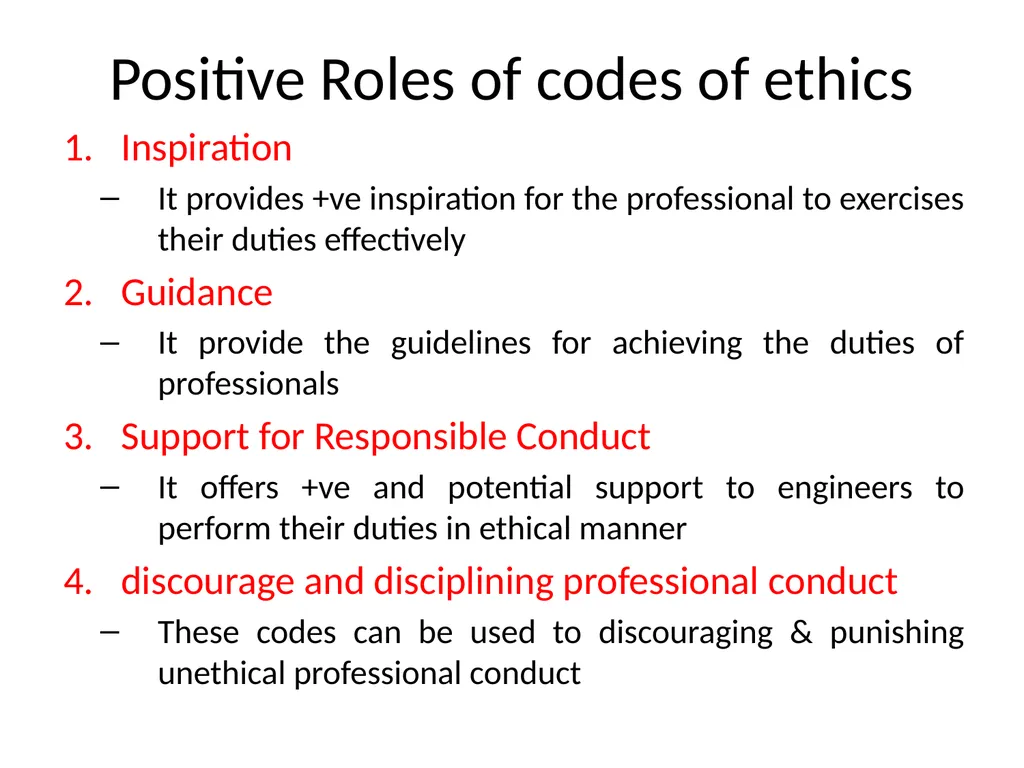
Positive Roles of codes of ethics Inspiration
It provides +ve inspiration for the professional to exercises their duties effectively
Guidance
It provide the guidelines for achieving the duties of professionals
Support for Responsible Conduct
It offers +ve and potential support to engineers to perform their duties in ethical manner
discourage and disciplining professional conduct
These codes can be used to discouraging & punishing unethical professional conduct<br>
It provides +ve inspiration for the professional to exercises their duties effectively
Guidance
It provide the guidelines for achieving the duties of professionals
Support for Responsible Conduct
It offers +ve and potential support to engineers to perform their duties in ethical manner
discourage and disciplining professional conduct
These codes can be used to discouraging & punishing unethical professional conduct<br>
21
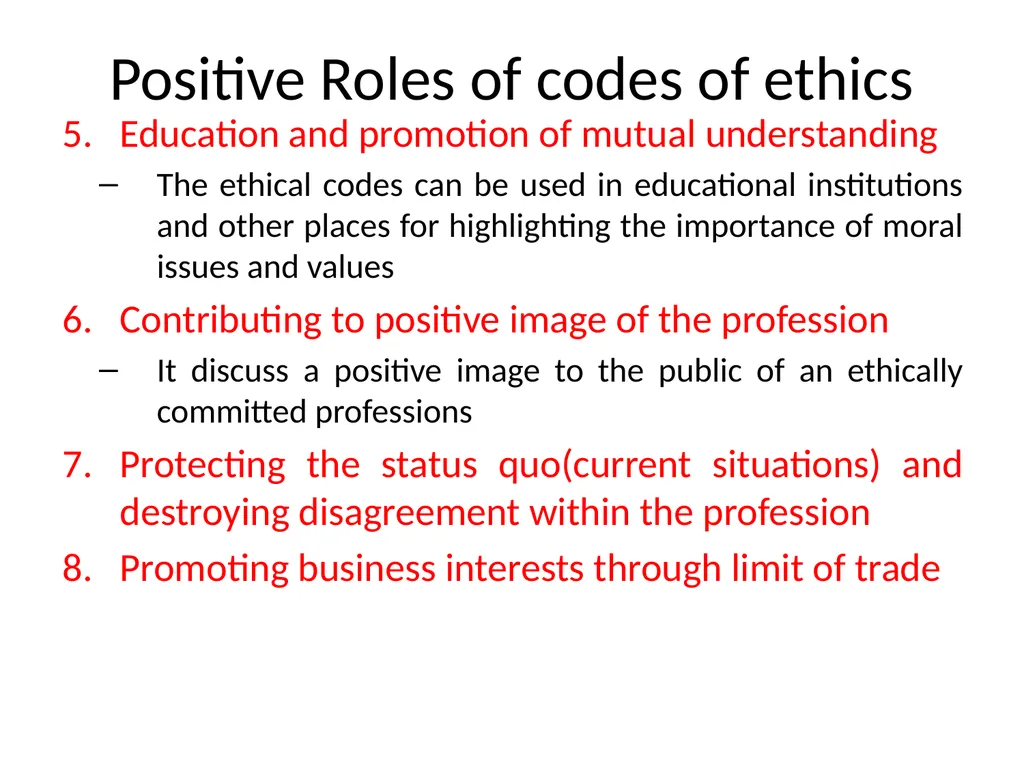
Positive Roles of codes of ethics Education and promotion of mutual understanding
The ethical codes can be used in educational institutions and other places for highlighting the importance of moral issues and values
Contributing to positive image of the profession
It discuss a positive image to the public of an ethically committed professions
Protecting the status quo(current situations) and destroying disagreement within the profession
Promoting business interests through limit of trade<br>
The ethical codes can be used in educational institutions and other places for highlighting the importance of moral issues and values
Contributing to positive image of the profession
It discuss a positive image to the public of an ethically committed professions
Protecting the status quo(current situations) and destroying disagreement within the profession
Promoting business interests through limit of trade<br>
22
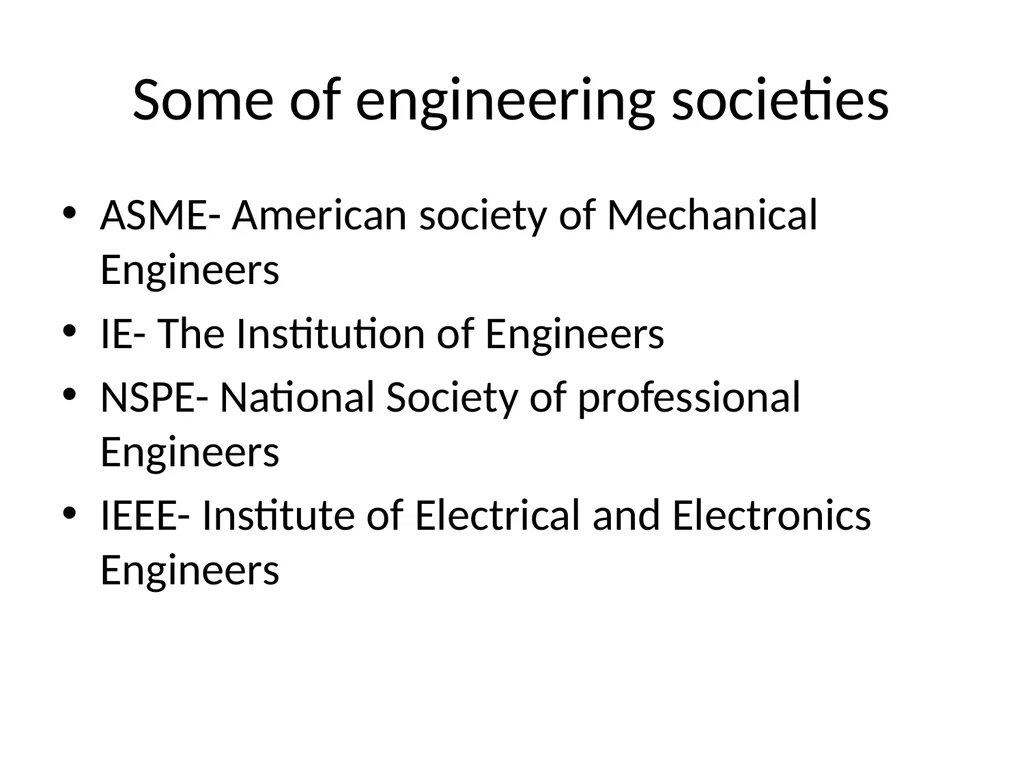
Some of engineering societies ASME- American society of Mechanical Engineers
IE- The Institution of Engineers
NSPE- National Society of professional Engineers
IEEE- Institute of Electrical and Electronics Engineers<br>
IE- The Institution of Engineers
NSPE- National Society of professional Engineers
IEEE- Institute of Electrical and Electronics Engineers<br>
23
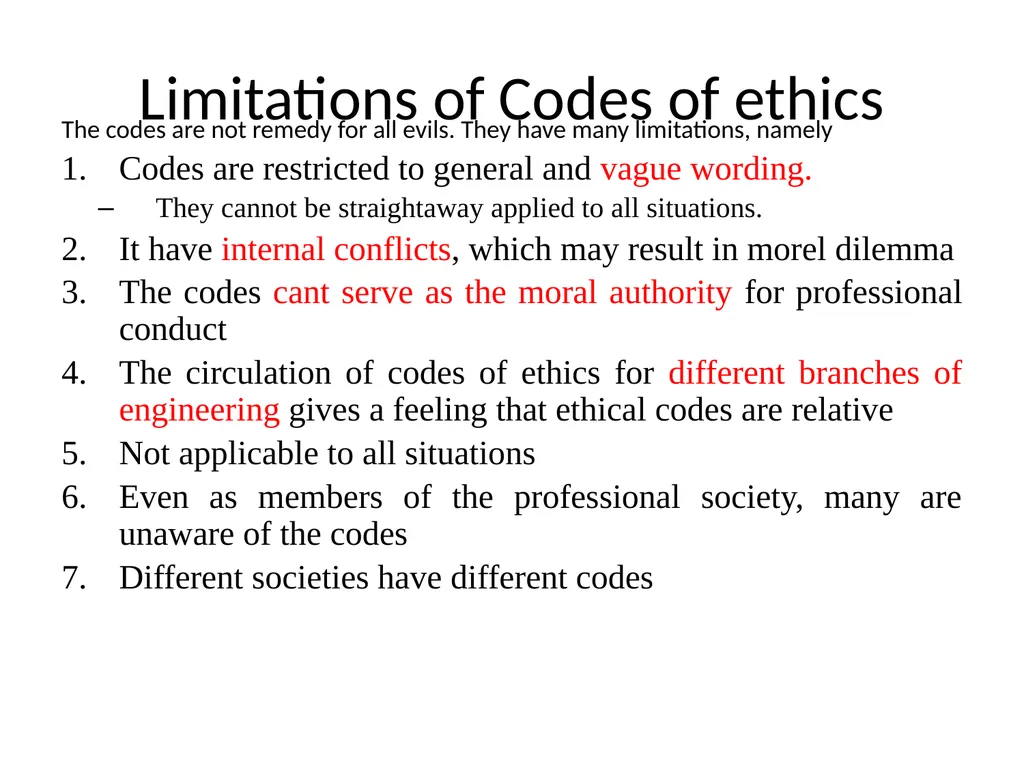
Limitations of Codes of ethics The codes are not remedy for all evils. They have many limitations, namely
Codes are restricted to general and vague wording.
They cannot be straightaway applied to all situations.
It have internal conflicts, which may result in morel dilemma
The codes cant serve as the moral authority for professional conduct
The circulation of codes of ethics for different branches of engineering gives a feeling that ethical codes are relative
Not applicable to all situations
Even as members of the professional society, many are unaware of the codes
Different societies have different codes<br>
Codes are restricted to general and vague wording.
They cannot be straightaway applied to all situations.
It have internal conflicts, which may result in morel dilemma
The codes cant serve as the moral authority for professional conduct
The circulation of codes of ethics for different branches of engineering gives a feeling that ethical codes are relative
Not applicable to all situations
Even as members of the professional society, many are unaware of the codes
Different societies have different codes<br>
24
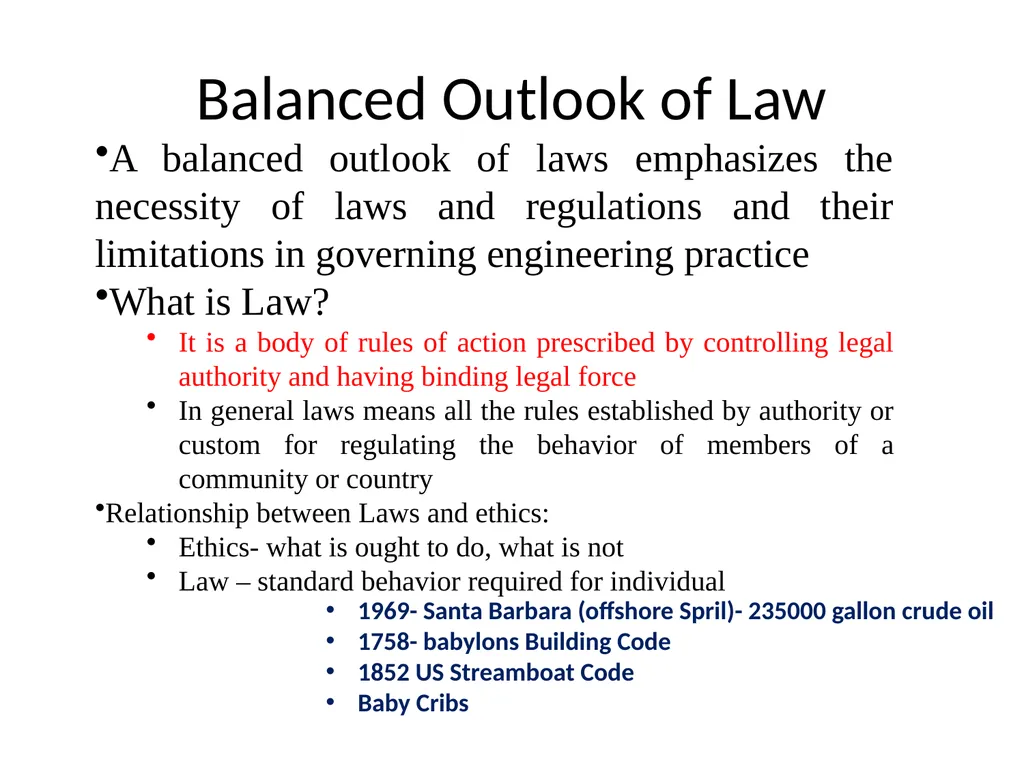
Balanced Outlook of Law A balanced outlook of laws emphasizes the necessity of laws and regulations and their limitations in governing engineering practice
What is Law?
It is a body of rules of action prescribed by controlling legal authority and having binding legal force
In general laws means all the rules established by authority or custom for regulating the behavior of members of a community or country
Relationship between Laws and ethics:
Ethics- what is ought to do, what is not
Law – standard behavior required for individual 1969- Santa Barbara (offshore Spril)- 235000 gallon crude oil
1758- babylons Building Code
1852 US Streamboat Code
Baby Cribs<br>
What is Law?
It is a body of rules of action prescribed by controlling legal authority and having binding legal force
In general laws means all the rules established by authority or custom for regulating the behavior of members of a community or country
Relationship between Laws and ethics:
Ethics- what is ought to do, what is not
Law – standard behavior required for individual 1969- Santa Barbara (offshore Spril)- 235000 gallon crude oil
1758- babylons Building Code
1852 US Streamboat Code
Baby Cribs<br>
25
Balanced Outlook of Law Laws with respect to social implementation
Laws are necessary because
People are not fully responsible
The companies are not encouraged to have moral initiative due to competition
Engineers are expected to play vital role in framing implementing and propagating the rules of engineering. Strictly follow rules
Laws lag in technological development
Industries feel that laws are imposing excessive restrictions on engineering applications<br>
Laws are necessary because
People are not fully responsible
The companies are not encouraged to have moral initiative due to competition
Engineers are expected to play vital role in framing implementing and propagating the rules of engineering. Strictly follow rules
Laws lag in technological development
Industries feel that laws are imposing excessive restrictions on engineering applications<br>
26
Proper Role of Laws The rules which govern engineering practice should be construed as of responsible experimentation rather than rules of a game.
In situations where the experimentation is large and time consuming, the rules must not try to cover all possible outcomes, and they should not compel the engineers to follow inflexible courses of action.
The regulation should be broad, but make engineers accountable for their decisions,<br>
In situations where the experimentation is large and time consuming, the rules must not try to cover all possible outcomes, and they should not compel the engineers to follow inflexible courses of action.
The regulation should be broad, but make engineers accountable for their decisions,<br>
27
Industrial Standards Standardization primarily means setting up standards by which level, quality, quantity, value performance or service may be evaluated
Simply, It is the process of defining and applying conditions required to ensure that a given range of requirements can be easily met with minimum changes in an economical and reproducible manner by the latest technique.
What are standards?
They are formed by companies for their in-house use and by professional associations and trade associations for industry-wide use.
Some times standards are parts of laws and official regulations
ISO 9000-2000 series are typical examples in this direction The financial industry has given us countless scandals and front-page news stories about financial professionals who have defrauded investors, employers and their peers.
There is no doubt that greed is a powerful emotion, but sometimes unethical behavior boils down to a lack of education on basic principles of financial standards<br>
Simply, It is the process of defining and applying conditions required to ensure that a given range of requirements can be easily met with minimum changes in an economical and reproducible manner by the latest technique.
What are standards?
They are formed by companies for their in-house use and by professional associations and trade associations for industry-wide use.
Some times standards are parts of laws and official regulations
ISO 9000-2000 series are typical examples in this direction The financial industry has given us countless scandals and front-page news stories about financial professionals who have defrauded investors, employers and their peers.
There is no doubt that greed is a powerful emotion, but sometimes unethical behavior boils down to a lack of education on basic principles of financial standards<br>
28
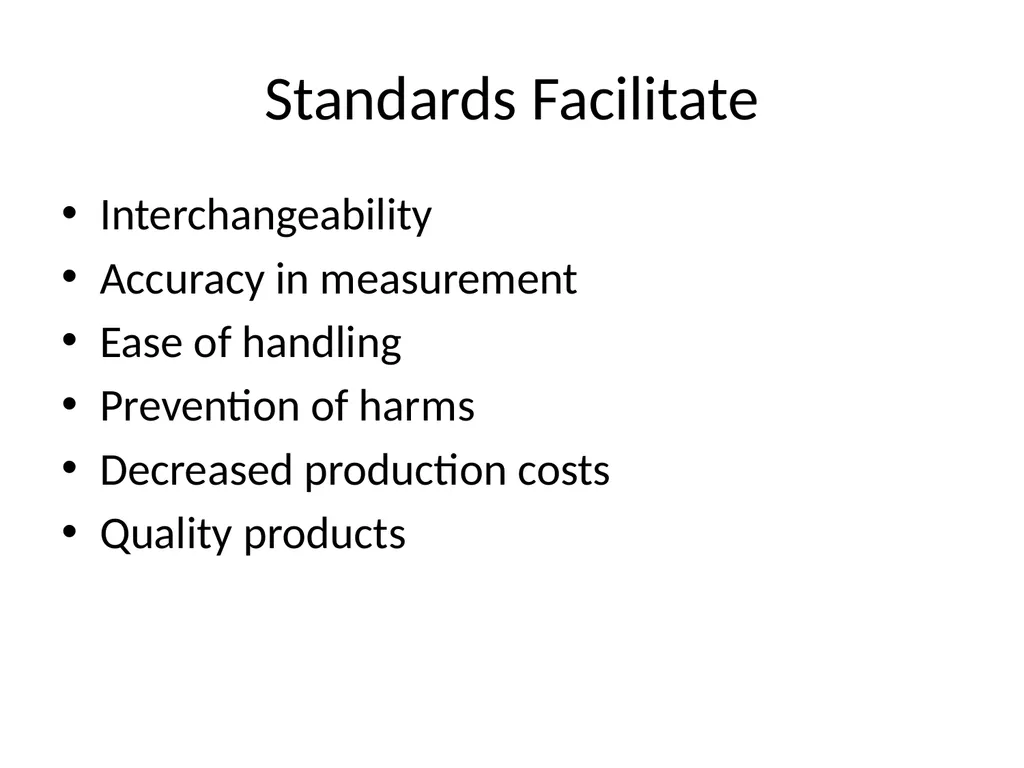
Standards Facilitate Interchangeability
Accuracy in measurement
Ease of handling
Prevention of harms
Decreased production costs
Quality products<br>
Accuracy in measurement
Ease of handling
Prevention of harms
Decreased production costs
Quality products<br>
29
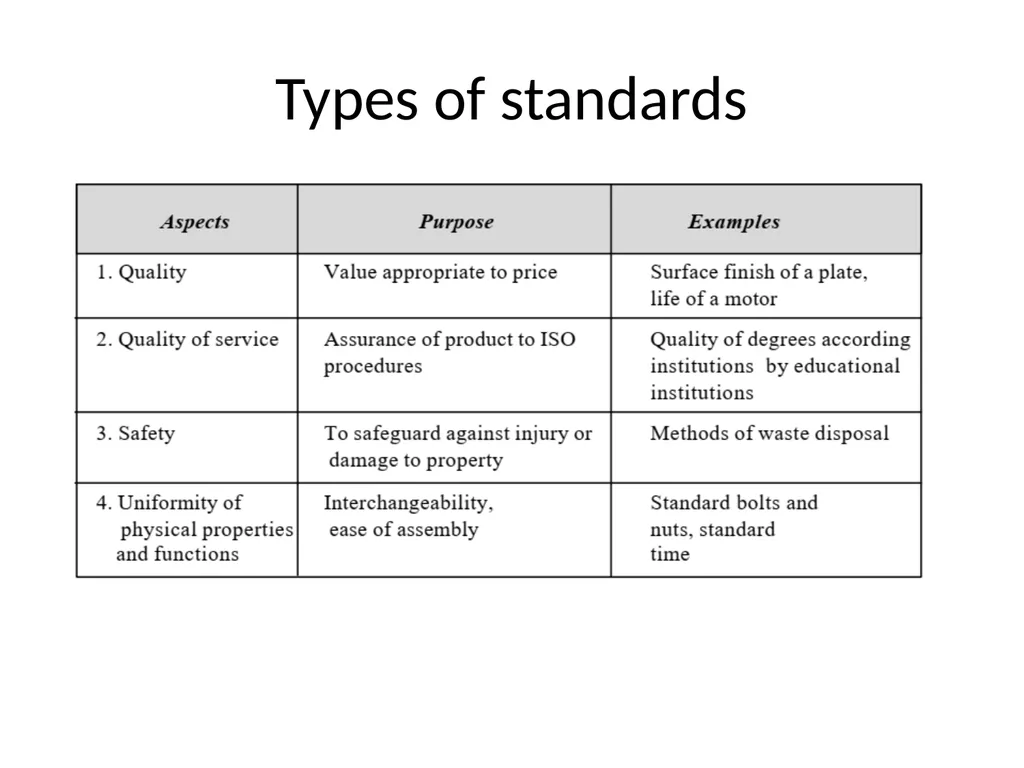
Types of standards<br>
30
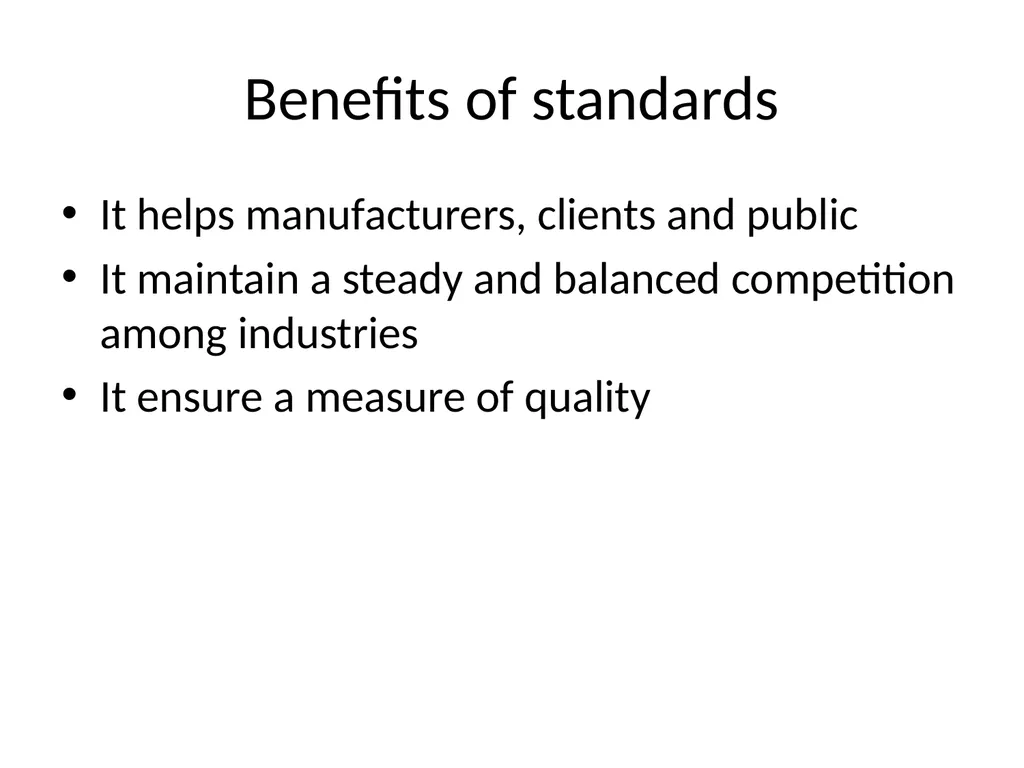
Benefits of standards It helps manufacturers, clients and public
It maintain a steady and balanced competition among industries
It ensure a measure of quality<br>
It maintain a steady and balanced competition among industries
It ensure a measure of quality<br>
31
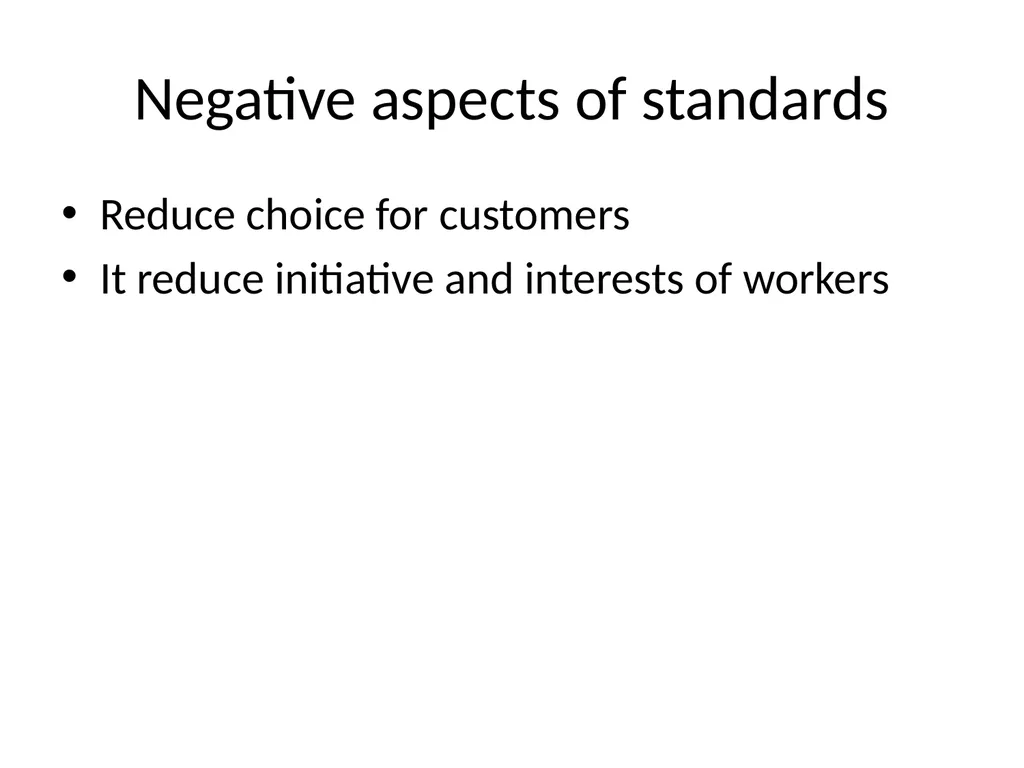
Negative aspects of standards Reduce choice for customers
It reduce initiative and interests of workers<br>
It reduce initiative and interests of workers<br>
32
Problems with law in engineering Minimal compliance
Technological development
Many laws are ‘nolaws’ (without enforceable sanctions)
Influential powerful persons violate the laws<br>
Technological development
Many laws are ‘nolaws’ (without enforceable sanctions)
Influential powerful persons violate the laws<br>
33
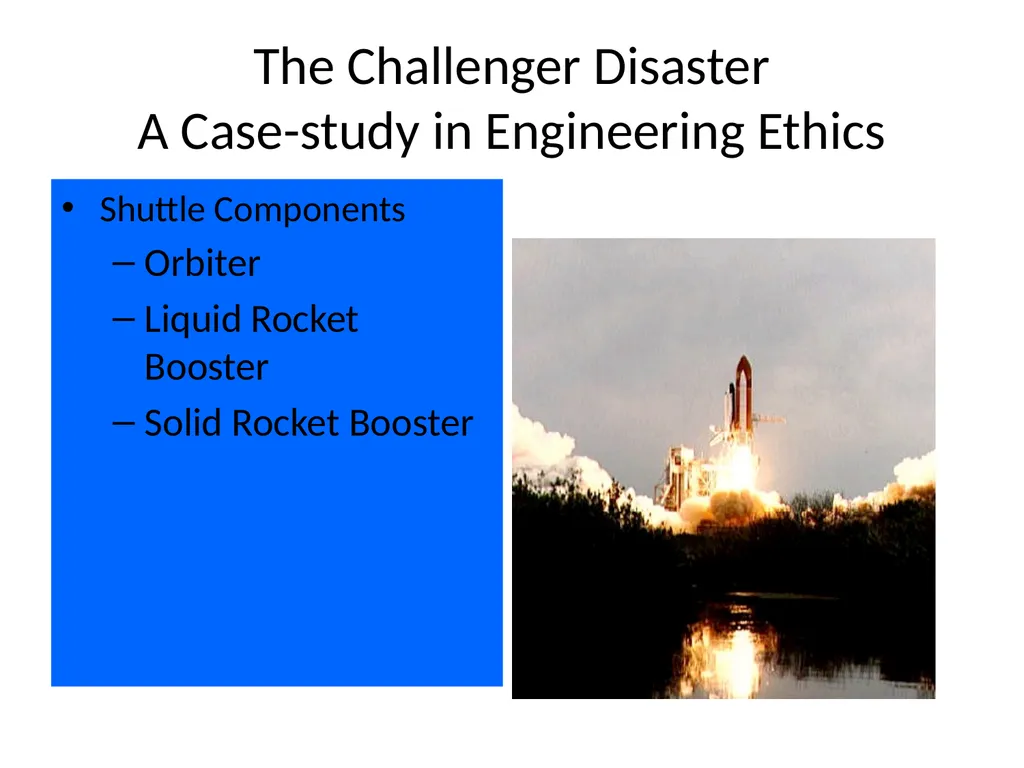
The Challenger Disaster
A Case-study in Engineering Ethics Shuttle Components
Orbiter
Liquid Rocket Booster
Solid Rocket Booster<br>
Orbiter
Liquid Rocket Booster
Solid Rocket Booster<br>
34
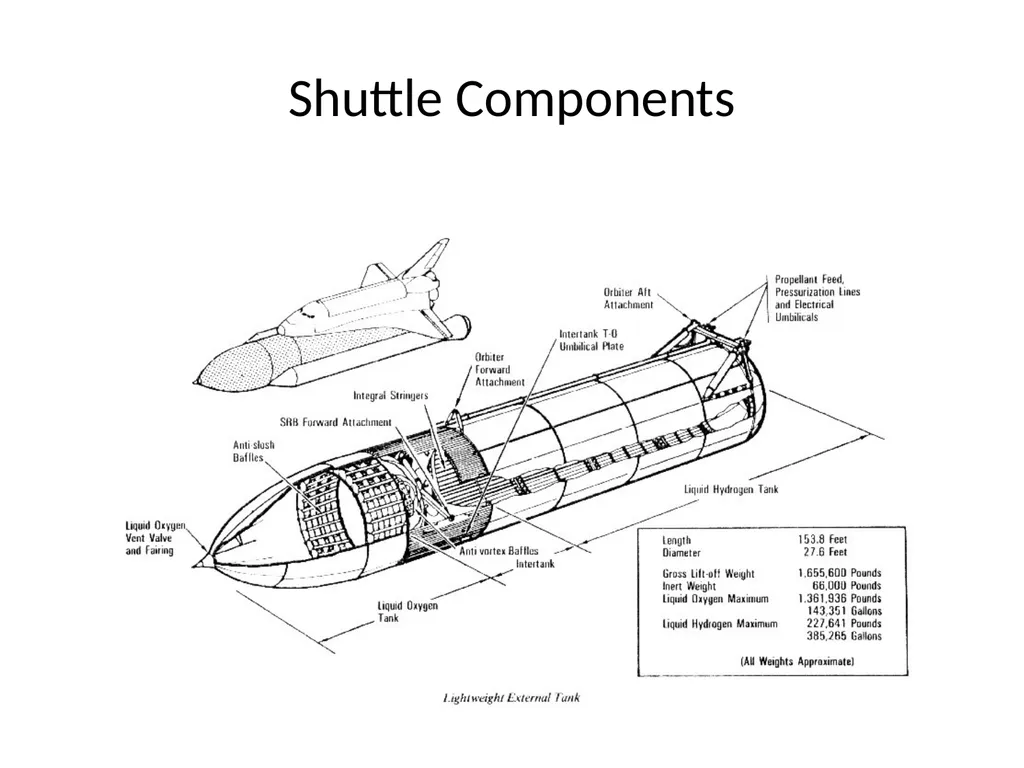
Shuttle Components<br>
35
Chronology of the Related Events 1974
NASA contracts Morton Thiokol
1976
NASA accepts the design based on the Titan missiles
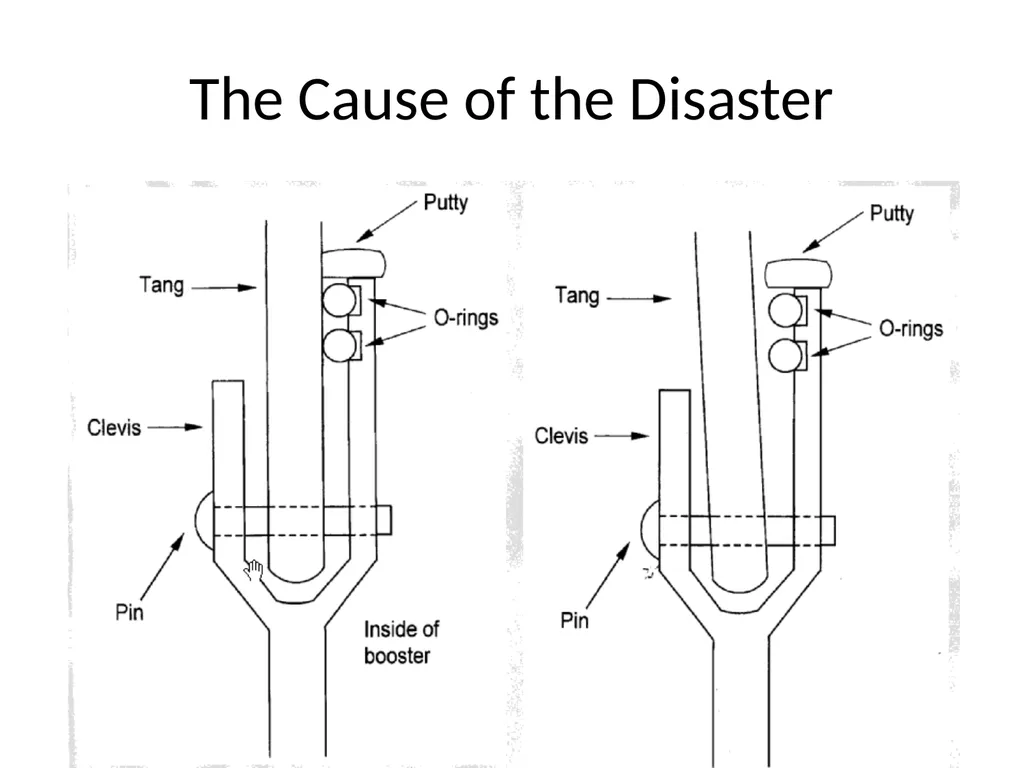
The joints are sealed by
Two synthetic rubber O-rings,
177 clevis pins,
Heat shield putty<br>
NASA contracts Morton Thiokol
1976
NASA accepts the design based on the Titan missiles
The joints are sealed by
Two synthetic rubber O-rings,
177 clevis pins,
Heat shield putty<br>
36
The Cause of the Disaster<br>
37
Early Problems 1977
Tests at Thiokol show O-ring leakage
Joint is made stronger by changing sizes
1981
Post-launch investigation showed O-ring erosion due to hot gages.<br>
Tests at Thiokol show O-ring leakage
Joint is made stronger by changing sizes
1981
Post-launch investigation showed O-ring erosion due to hot gages.<br>
38
Early Problems January of 1985 launch
First cold-weather launch
Post-launch investigation showed joint failure
Tests showed O-rings inability to fill the gap due to joint rotation at lower temperatures<br>
First cold-weather launch
Post-launch investigation showed joint failure
Tests showed O-rings inability to fill the gap due to joint rotation at lower temperatures<br>
39
Early Problems July 1985
Thiokol redesigns the joints w/o O-rings – The design was not ready for Challenger launch<br>
Thiokol redesigns the joints w/o O-rings – The design was not ready for Challenger launch<br>
40
Political Climate Congress is unhappy with NASA
Competition with Russians to be the first to observe Halley’s comet.
Pressure to launch before President Reagan’s State of the Union Address<br>
Competition with Russians to be the first to observe Halley’s comet.
Pressure to launch before President Reagan’s State of the Union Address<br>
41
Days before Launch First launch attempt postponed
The next launch date was set and was to be attended by Vice President Bush.
The temperature at launch: 29 degrees F.<br>
The next launch date was set and was to be attended by Vice President Bush.
The temperature at launch: 29 degrees F.<br>
42
Days Before Launch NASA starts an investigation of the effect of low temperatures on the O-ring seals
Organization involved
NASA
Marshall Space Flight Center
Morton Thiokol<br>
Organization involved
NASA
Marshall Space Flight Center
Morton Thiokol<br>
43
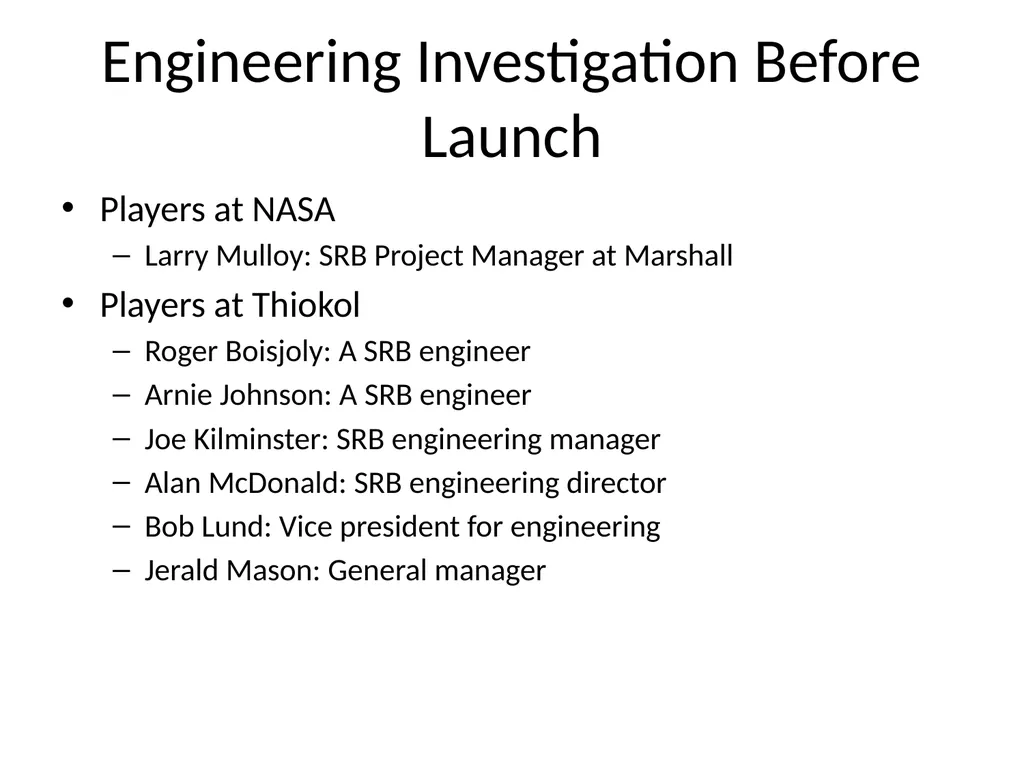
Engineering Investigation Before Launch Players at NASA
Larry Mulloy: SRB Project Manager at Marshall
Players at Thiokol
Roger Boisjoly: A SRB engineer
Arnie Johnson: A SRB engineer
Joe Kilminster: SRB engineering manager
Alan McDonald: SRB engineering director
Bob Lund: Vice president for engineering
Jerald Mason: General manager<br>
Larry Mulloy: SRB Project Manager at Marshall
Players at Thiokol
Roger Boisjoly: A SRB engineer
Arnie Johnson: A SRB engineer
Joe Kilminster: SRB engineering manager
Alan McDonald: SRB engineering director
Bob Lund: Vice president for engineering
Jerald Mason: General manager<br>
44
Engineering Investigation Before Launch Boisjoly and Johnson recommend the launch to be postponed.
Bob Lund, the VP for engineering agrees and makes a similar recommendation.<br>
Bob Lund, the VP for engineering agrees and makes a similar recommendation.<br>
45
Investigation Before Launch Larry Mulloy, the NASA manager of SRB asks Joe Kilminister, the SRB manager at Thiokol, for his opinion.
Kilminister agrees with other Thiokol engineers and recommends a launch delay.<br>
Kilminister agrees with other Thiokol engineers and recommends a launch delay.<br>
46
Investigation Before Launch After discussion with Mason
Lund reverses his decision regarding launch!
Thiokol recommend the launch to proceed<br>
Lund reverses his decision regarding launch!
Thiokol recommend the launch to proceed<br>
47
The Launch in January 1986 The overnight temperatures drop to 8 F
The temperature of SRB at launch is 28 F
There is an immediate blow-by of hot gas at launch. The seal fails quickly over an arc of 70 degrees.<br>
The temperature of SRB at launch is 28 F
There is an immediate blow-by of hot gas at launch. The seal fails quickly over an arc of 70 degrees.<br>
48
The Launch in January 1986 The by-products of combustion forms a glassy oxide that reseals the joint.
The brittle oxide is shattered
Hot gases quickly burn through the liquid rocket booster<br>
The brittle oxide is shattered
Hot gases quickly burn through the liquid rocket booster<br>
49
The Aftermath Causes of the accident are attributed to
Inability of the O-rings to expand and seal at low temperatures.
Heat shield putty did not perform at low temperatures
Fits and seating of the O-ring was affected by low temperature.<br>
Inability of the O-rings to expand and seal at low temperatures.
Heat shield putty did not perform at low temperatures
Fits and seating of the O-ring was affected by low temperature.<br>
50
The Aftermath After all the testimonials
Biosjoly is taken off the project and subtly harassed by Thiokol management.<br>
Biosjoly is taken off the project and subtly harassed by Thiokol management.<br>