
United Nations Statistics Division ISWGNA Task
Description: United Nations Statistics Division ISWGNA Task Force on Capacity Building 12th Meeting of the Advisory Expert Group on National Accounts 27-29 November 2018, Luxembourg Background This year marked the 10th anniversary of the adoption of the
Related Topics
Download Presentation
"United Nations Statistics Division ISWGNA Task" is the property of its rightful owner. Permission is granted to download and print the materials on this website for personal, non-commercial use only, and to display it on your personal computer provided you do not modify the materials and that you retain all copyright notices contained in the materials. By downloading content from our website, you accept the terms of this agreement.
Presentation Transcript
slide1. United Nations Statistics Division ISWGNA Task Force on
Capacity Building 12th Meeting of the Advisory Expert Group on National Accounts
27-29 November 2018, Luxembourg<br>
slide2. Background This year marked the 10th anniversary of the adoption of the 2008 SNA
There has been noticeable progress in the reporting of national accounts data from analyzing replies to United Nations national accounts questionnaire in terms of
Conceptual compliance with the SNA
Compliance with minimum required data set (MRDS)
Timeliness 2<br>
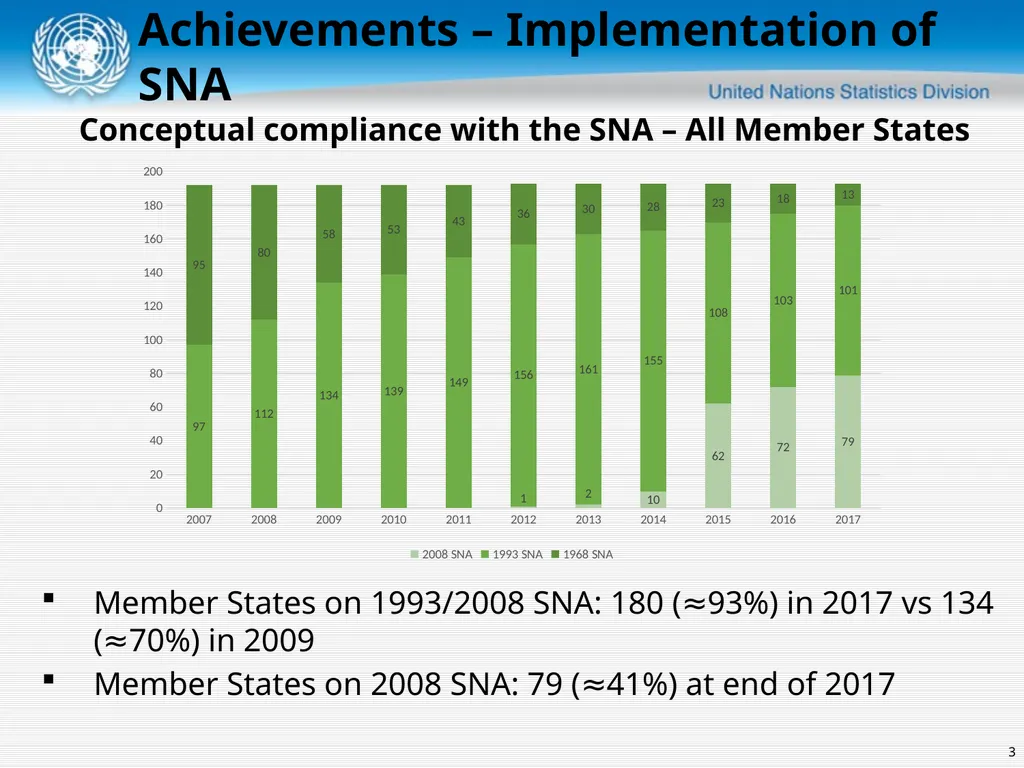
slide3. Achievements – Implementation of SNA 3 Conceptual compliance with the SNA – All Member States Member States on 1993/2008 SNA: 180 (≈93%) in 2017 vs 134 (≈70%) in 2009
Member States on 2008 SNA: 79 (≈41%) at end of 2017<br>
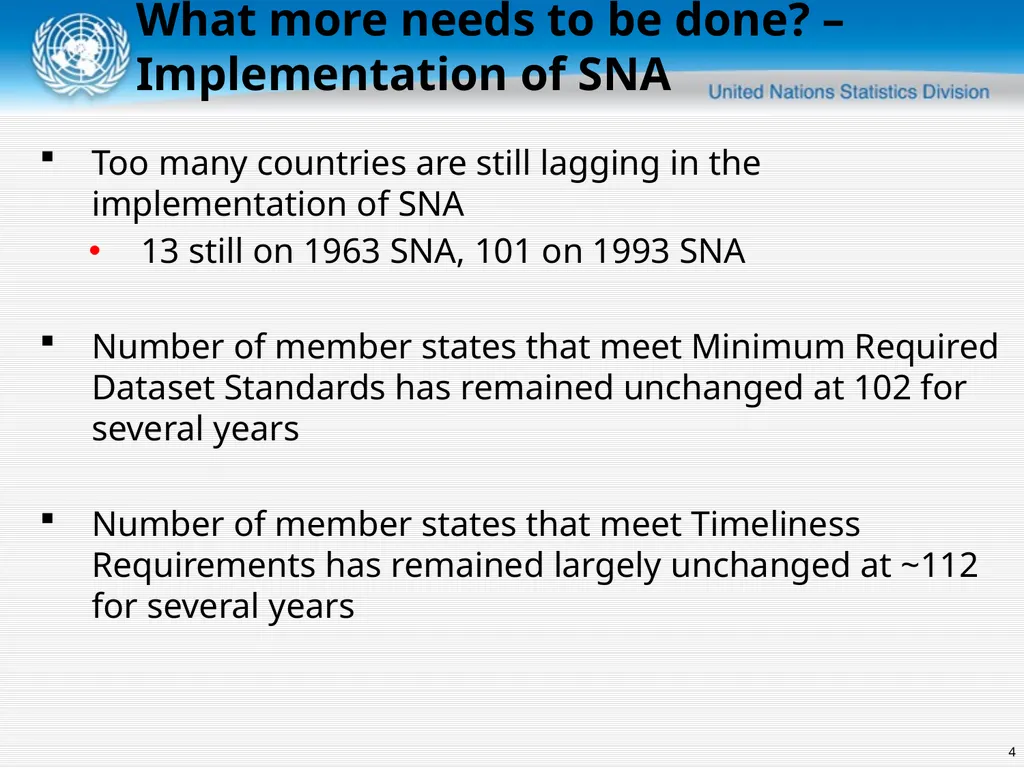
slide4. What more needs to be done? – Implementation of SNA Too many countries are still lagging in the implementation of SNA
13 still on 1963 SNA, 101 on 1993 SNA
Number of member states that meet Minimum Required Dataset Standards has remained unchanged at 102 for several years
Number of member states that meet Timeliness Requirements has remained largely unchanged at ~112 for several years 4<br>
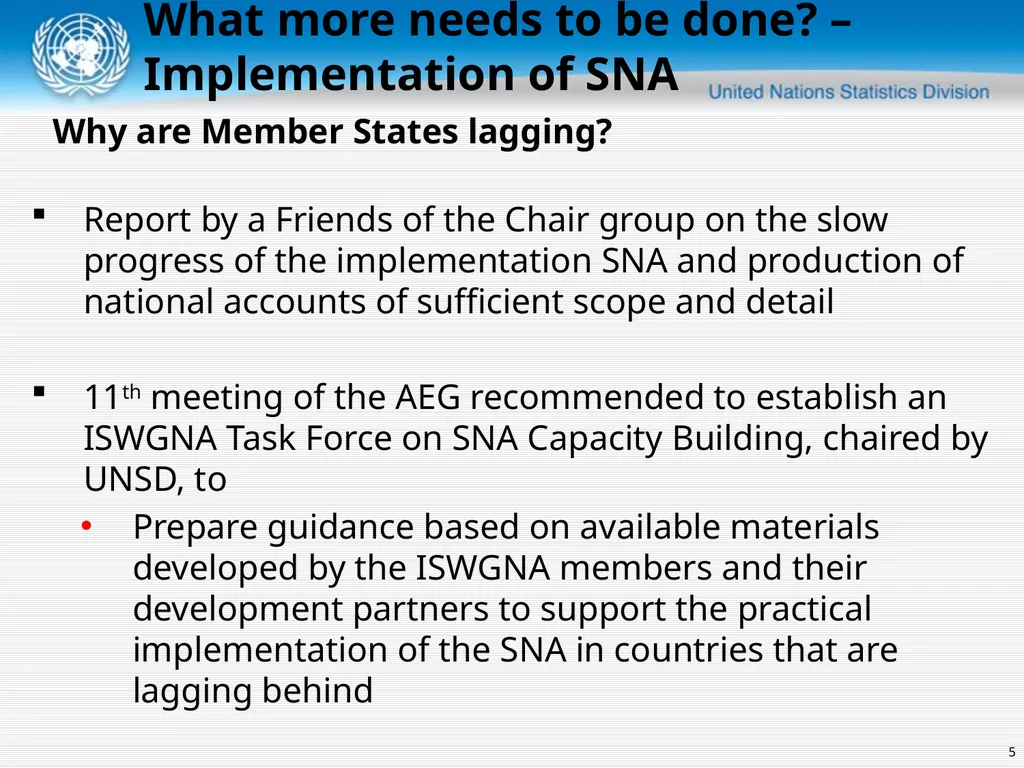
slide5. What more needs to be done? – Implementation of SNA Report by a Friends of the Chair group on the slow progress of the implementation SNA and production of national accounts of sufficient scope and detail
11th meeting of the AEG recommended to establish an ISWGNA Task Force on SNA Capacity Building, chaired by UNSD, to
Prepare guidance based on available materials developed by the ISWGNA members and their development partners to support the practical implementation of the SNA in countries that are lagging behind 5 Why are Member States lagging?<br>
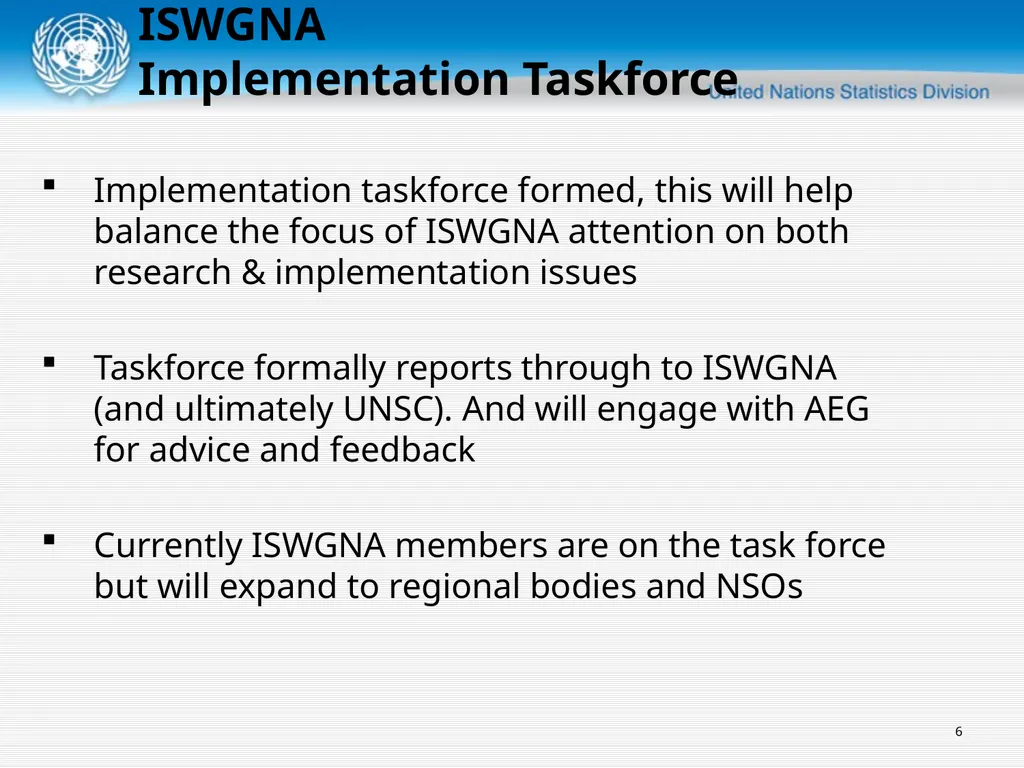
slide6. ISWGNA Implementation Taskforce Implementation taskforce formed, this will help balance the focus of ISWGNA attention on both research & implementation issues
Taskforce formally reports through to ISWGNA (and ultimately UNSC). And will engage with AEG for advice and feedback
Currently ISWGNA members are on the task force but will expand to regional bodies and NSOs 6<br>
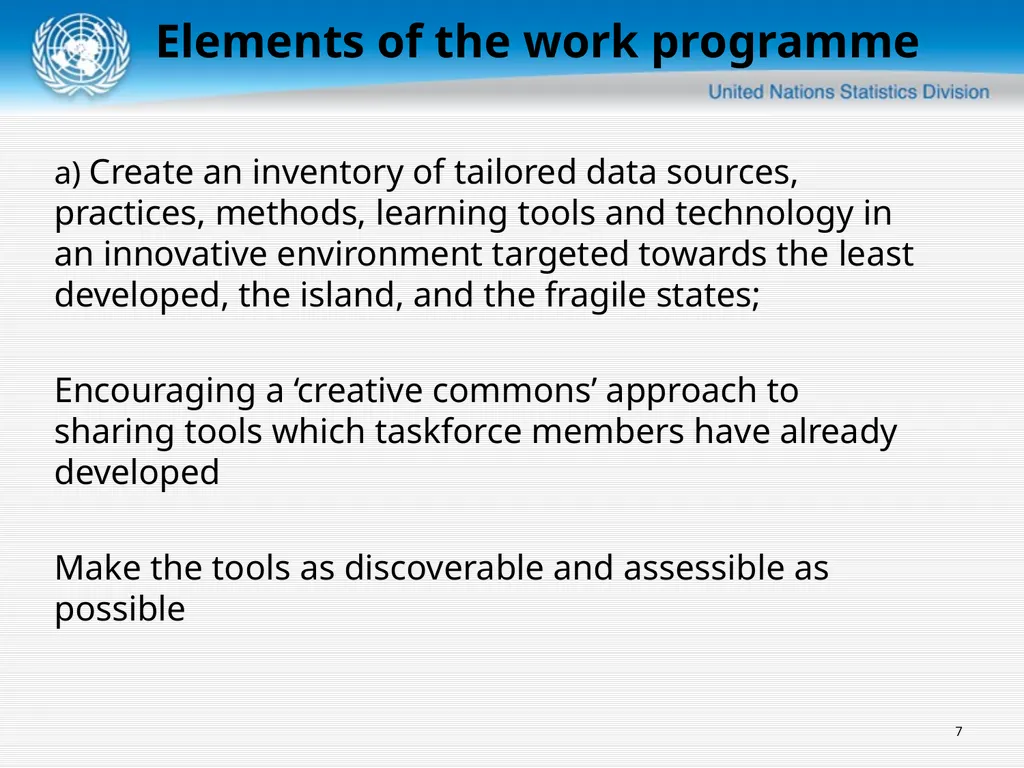
slide7. Elements of the work programme a) Create an inventory of tailored data sources, practices, methods, learning tools and technology in an innovative environment targeted towards the least developed, the island, and the fragile states;
Encouraging a ‘creative commons’ approach to sharing tools which taskforce members have already developed
Make the tools as discoverable and assessible as possible 7<br>
slide8. Elements of the work programme b) Develop, test and share new ways of working in capacity development. Using new technology and concepts of ‘just enough design’ or ‘iteration’ to increase the pace of national accounts capacity development and national accounts production;
c) Encourage members of the taskforce to participate in joint capacity development programs in partnerships with countries and regional agencies specifically targeted regions of the world (while noting that the actual capacity building activities are outside of the remit of the taskforce and need to be run as separate projects). 8<br>
slide9. Current Focus - Inventory The task team commenced with a stocktake of existing capacity building efforts and tools across the current members (UNSD, IMF, World Bank, Eurostat). Results of the stocktake unsurprisingly show that there is a wide range of activities occurring with a great many countries.
Members have agreed to expand the UNSD National Accounts knowledge database to include capacity development ‘tools’ beyond the current catalogue of handbooks. 9<br>
slide10. Current Focus – Knowledge Hub Knowledge Hub – targeted towards least developed countries and those with little current capacity for national accounts
Should ‘guide’ users through the process and ensure tools and resources are accessible and discoverable
Examples: catalogue of training materials; guidance notes; and IT tools. 10<br>
slide11. Examples of ‘tools’ to be included Information about IT systems: cost, functionality, resource requirements etc
Eretes
SNAP
Hendyplan
IMF tools
Etc
Catalogue of training resources
Course material and content (when made available)
Description of courses being run
E-learning modules 11<br>
slide12. Current Focus – Sharing information on new initiatives Regular meetings (conducted via teleconference) enable members to share any new developments on capacity building and to identify opportunities for collaboration 12<br>
slide13. AEG is requested to: provide its opinion on global capacity building efforts and the work of the Task Force;
volunteer to provide any capacity building tools/resources that they have developed;
volunteer to join the Task Force, particularly if they are currently engaged in substantive capacity building initiatives 13<br>
slide14. 14 Thank you<br>
Capacity Building 12th Meeting of the Advisory Expert Group on National Accounts
27-29 November 2018, Luxembourg<br>
slide2. Background This year marked the 10th anniversary of the adoption of the 2008 SNA
There has been noticeable progress in the reporting of national accounts data from analyzing replies to United Nations national accounts questionnaire in terms of
Conceptual compliance with the SNA
Compliance with minimum required data set (MRDS)
Timeliness 2<br>
slide3. Achievements – Implementation of SNA 3 Conceptual compliance with the SNA – All Member States Member States on 1993/2008 SNA: 180 (≈93%) in 2017 vs 134 (≈70%) in 2009
Member States on 2008 SNA: 79 (≈41%) at end of 2017<br>
slide4. What more needs to be done? – Implementation of SNA Too many countries are still lagging in the implementation of SNA
13 still on 1963 SNA, 101 on 1993 SNA
Number of member states that meet Minimum Required Dataset Standards has remained unchanged at 102 for several years
Number of member states that meet Timeliness Requirements has remained largely unchanged at ~112 for several years 4<br>
slide5. What more needs to be done? – Implementation of SNA Report by a Friends of the Chair group on the slow progress of the implementation SNA and production of national accounts of sufficient scope and detail
11th meeting of the AEG recommended to establish an ISWGNA Task Force on SNA Capacity Building, chaired by UNSD, to
Prepare guidance based on available materials developed by the ISWGNA members and their development partners to support the practical implementation of the SNA in countries that are lagging behind 5 Why are Member States lagging?<br>
slide6. ISWGNA Implementation Taskforce Implementation taskforce formed, this will help balance the focus of ISWGNA attention on both research & implementation issues
Taskforce formally reports through to ISWGNA (and ultimately UNSC). And will engage with AEG for advice and feedback
Currently ISWGNA members are on the task force but will expand to regional bodies and NSOs 6<br>
slide7. Elements of the work programme a) Create an inventory of tailored data sources, practices, methods, learning tools and technology in an innovative environment targeted towards the least developed, the island, and the fragile states;
Encouraging a ‘creative commons’ approach to sharing tools which taskforce members have already developed
Make the tools as discoverable and assessible as possible 7<br>
slide8. Elements of the work programme b) Develop, test and share new ways of working in capacity development. Using new technology and concepts of ‘just enough design’ or ‘iteration’ to increase the pace of national accounts capacity development and national accounts production;
c) Encourage members of the taskforce to participate in joint capacity development programs in partnerships with countries and regional agencies specifically targeted regions of the world (while noting that the actual capacity building activities are outside of the remit of the taskforce and need to be run as separate projects). 8<br>
slide9. Current Focus - Inventory The task team commenced with a stocktake of existing capacity building efforts and tools across the current members (UNSD, IMF, World Bank, Eurostat). Results of the stocktake unsurprisingly show that there is a wide range of activities occurring with a great many countries.
Members have agreed to expand the UNSD National Accounts knowledge database to include capacity development ‘tools’ beyond the current catalogue of handbooks. 9<br>
slide10. Current Focus – Knowledge Hub Knowledge Hub – targeted towards least developed countries and those with little current capacity for national accounts
Should ‘guide’ users through the process and ensure tools and resources are accessible and discoverable
Examples: catalogue of training materials; guidance notes; and IT tools. 10<br>
slide11. Examples of ‘tools’ to be included Information about IT systems: cost, functionality, resource requirements etc
Eretes
SNAP
Hendyplan
IMF tools
Etc
Catalogue of training resources
Course material and content (when made available)
Description of courses being run
E-learning modules 11<br>
slide12. Current Focus – Sharing information on new initiatives Regular meetings (conducted via teleconference) enable members to share any new developments on capacity building and to identify opportunities for collaboration 12<br>
slide13. AEG is requested to: provide its opinion on global capacity building efforts and the work of the Task Force;
volunteer to provide any capacity building tools/resources that they have developed;
volunteer to join the Task Force, particularly if they are currently engaged in substantive capacity building initiatives 13<br>
slide14. 14 Thank you<br>