
Update Training on CIWA and COWS Clinical

Description: Update Training on CIWA and COWS Clinical Institute Withdrawal Assessment of Alcohol Scale, Revised (CIWA-Ar) 2008 Rush University Medical Center Alcohol Withdrawal 101 2008 Rush University Medical Center Symptoms of Alcohol Withdrawal
Related Topics
Download Presentation
"Update Training on CIWA and COWS Clinical" is the property of its rightful owner. Permission is granted to download and print the materials on this website for personal, non-commercial use only, and to display it on your personal computer provided you do not modify the materials and that you retain all copyright notices contained in the materials. By downloading content from our website, you accept the terms of this agreement.
Presentation Transcript
slide1. Update Training on CIWA and COWS<br>
slide2. Clinical Institute Withdrawal Assessment of Alcohol Scale, Revised (CIWA-Ar) ©2008 Rush University Medical Center<br>
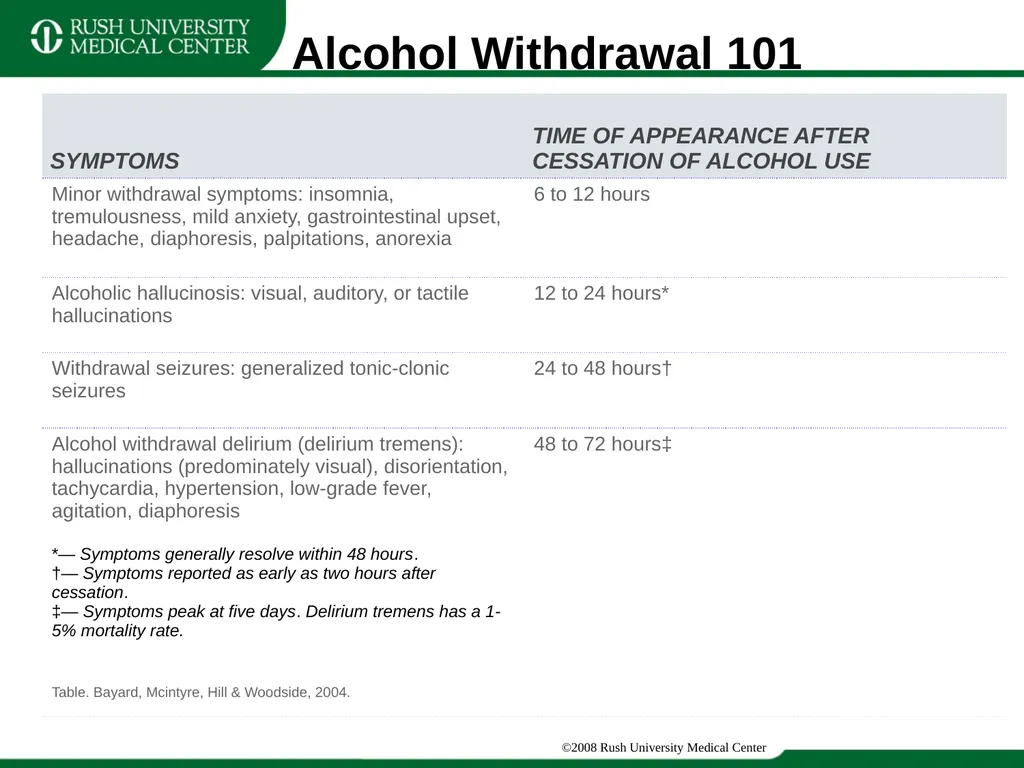
slide3. Alcohol Withdrawal 101 ©2008 Rush University Medical Center Symptoms of Alcohol Withdrawal Syndrome *— Symptoms generally resolve within 48 hours.
†— Symptoms reported as early as two hours after cessation.
‡— Symptoms peak at five days.<br>
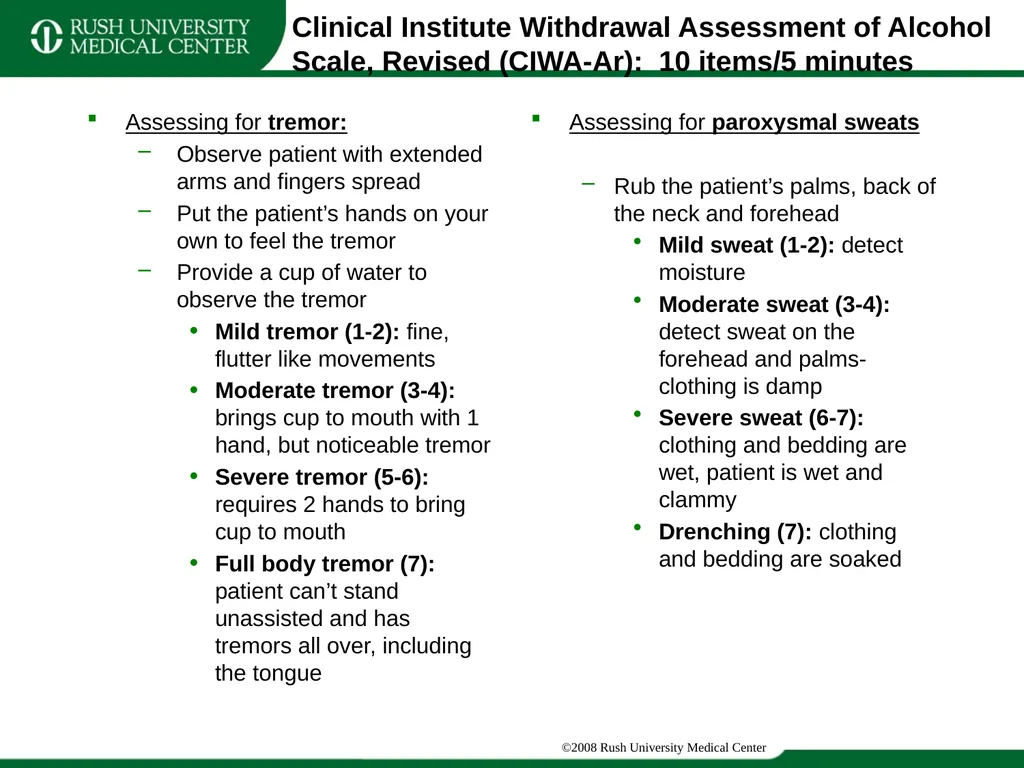
slide4. Clinical Institute Withdrawal Assessment of Alcohol Scale, Revised (CIWA-Ar): 10 items/5 minutes Assessing for tremor:
Observe patient with extended arms and fingers spread
Put the patient’s hands on your own to feel the tremor
Provide a cup of water to observe the tremor
Mild tremor (1-2): fine, flutter like movements
Moderate tremor (3-4): brings cup to mouth with 1 hand, but noticeable tremor
Severe tremor (5-6): requires 2 hands to bring cup to mouth
Full body tremor (7): patient can’t stand unassisted and has tremors all over, including the tongue Assessing for paroxysmal sweats
Rub the patient’s palms, back of the neck and forehead
Mild sweat (1-2): detect moisture
Moderate sweat (3-4): detect sweat on the forehead and palms- clothing is damp
Severe sweat (6-7): clothing and bedding are wet, patient is wet and clammy
Drenching (7): clothing and bedding are soaked ©2008 Rush University Medical Center<br>
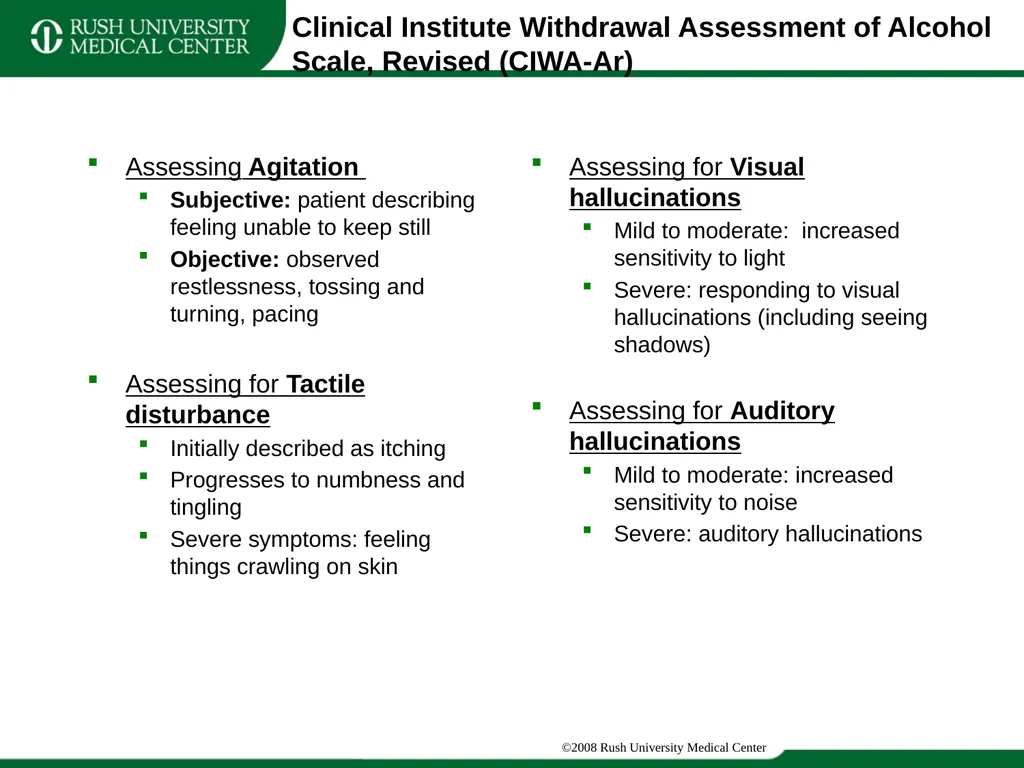
slide5. Clinical Institute Withdrawal Assessment of Alcohol Scale, Revised (CIWA-Ar) Assessing Agitation
Subjective: patient describing feeling unable to keep still
Objective: observed restlessness, tossing and turning, pacing
Assessing for Tactile disturbance
Initially described as itching
Progresses to numbness and tingling
Severe symptoms: feeling things crawling on skin Assessing for Visual hallucinations
Mild to moderate: increased sensitivity to light
Severe: responding to visual hallucinations (including seeing shadows)
Assessing for Auditory hallucinations
Mild to moderate: increased sensitivity to noise
Severe: auditory hallucinations ©2008 Rush University Medical Center<br>
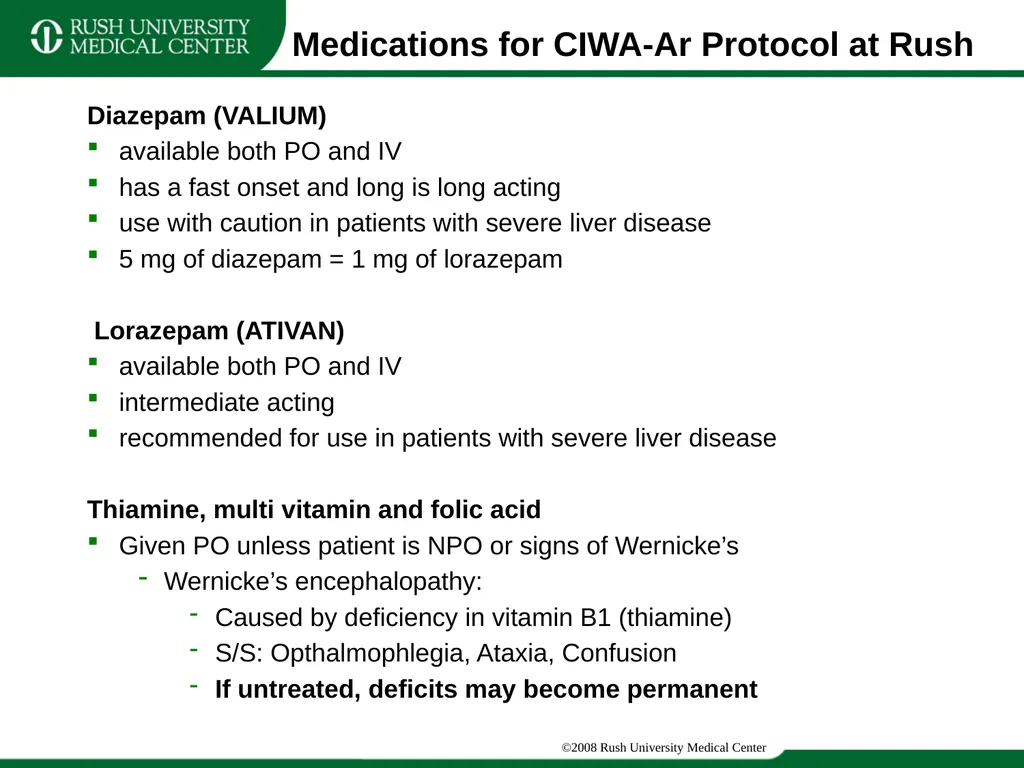
slide6. Medications for CIWA-Ar Protocol at Rush Diazepam (VALIUM)
available both PO and IV
has a fast onset and long is long acting
use with caution in patients with severe liver disease
5 mg of diazepam = 1 mg of lorazepam
Lorazepam (ATIVAN)
available both PO and IV
intermediate acting
recommended for use in patients with severe liver disease
Thiamine, multi vitamin and folic acid
Given PO unless patient is NPO or signs of Wernicke’s
Wernicke’s encephalopathy:
Caused by deficiency in vitamin B1 (thiamine)
S/S: Opthalmophlegia, Ataxia, Confusion
If untreated, deficits may become permanent ©2008 Rush University Medical Center<br>
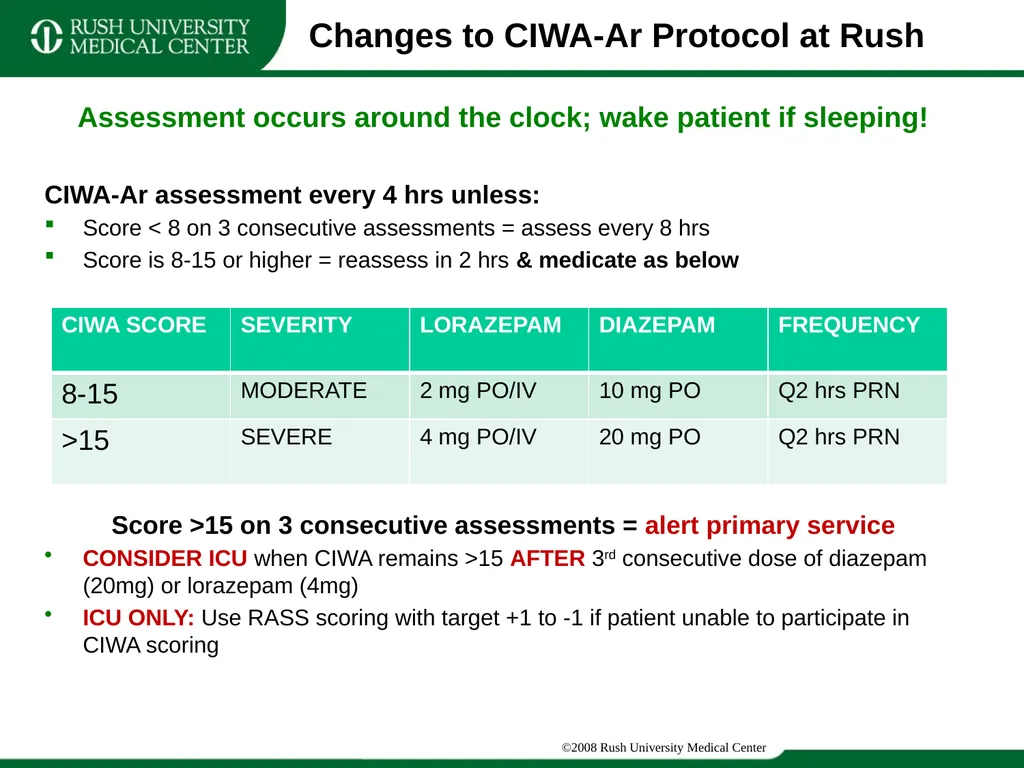
slide7. Changes to CIWA-Ar Protocol at Rush Assessment occurs around the clock; wake patient if sleeping!
CIWA-Ar assessment every 4 hrs unless:
Score < 8 on 3 consecutive assessments = assess every 8 hrs
Score is 8-15 or higher = reassess in 2 hrs & medicate as below
Score >15 on 3 consecutive assessments = alert primary service
CONSIDER ICU when CIWA remains >15 AFTER 3rd consecutive dose of diazepam (20mg) or lorazepam (4mg)
ICU ONLY: Use RASS scoring with target +1 to -1 if patient unable to participate in CIWA scoring ©2008 Rush University Medical Center<br>
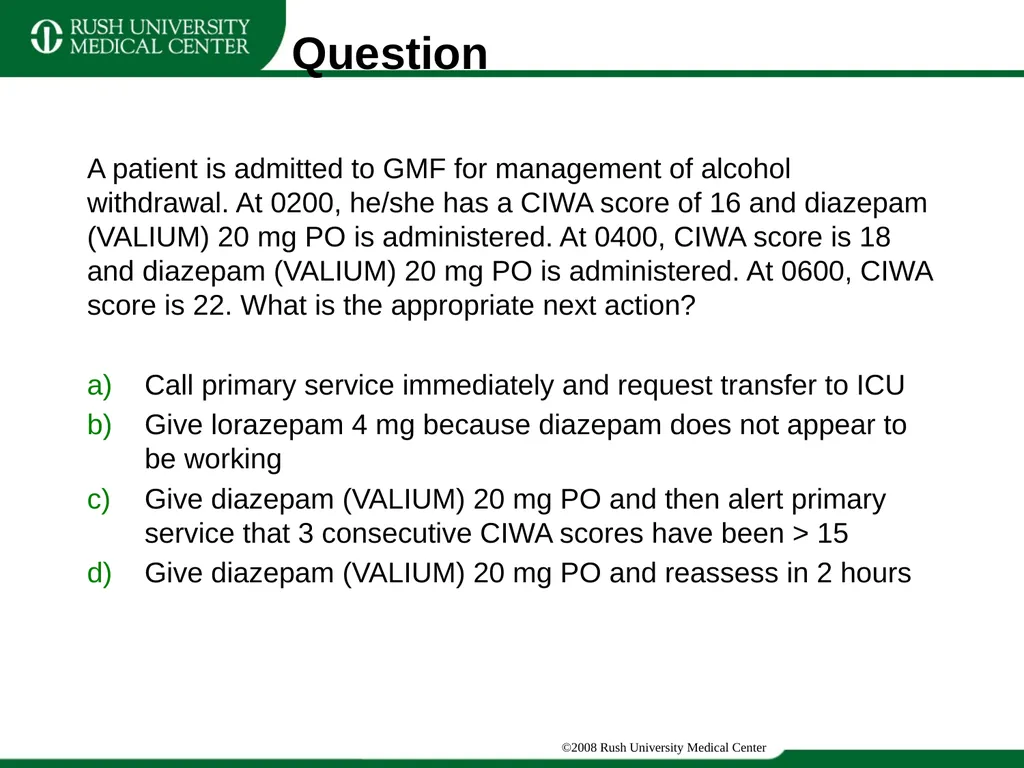
slide8. Question A patient is admitted to GMF for management of alcohol withdrawal. At 0200, he/she has a CIWA score of 16 and diazepam (VALIUM) 20 mg PO is administered. At 0400, CIWA score is 18 and diazepam (VALIUM) 20 mg PO is administered. At 0600, CIWA score is 22. What is the appropriate next action?
Call primary service immediately and request transfer to ICU
Give lorazepam 4 mg because diazepam does not appear to be working
Give diazepam (VALIUM) 20 mg PO and then alert primary service that 3 consecutive CIWA scores have been > 15
Give diazepam (VALIUM) 20 mg PO and reassess in 2 hours ©2008 Rush University Medical Center<br>
slide9. Clinical Opioid Withdrawal Scale (COWS) ©2008 Rush University Medical Center<br>
slide10. Opioid Withdrawal 101 Onset of symptoms:
Heroin: begins within hours of last use & diminish by day 4
Methadone: begins within days and diminish by day 10
Prescription opioids: varies based on ½ life of opioid ©2008 Rush University Medical Center<br>
slide11. Clinical Opioid Withdrawal Scale COWS
Previously referred to as the “CIWA Opioids Scale”
2- 10 minute to complete including observation and scoring ©2008 Rush University Medical Center<br>
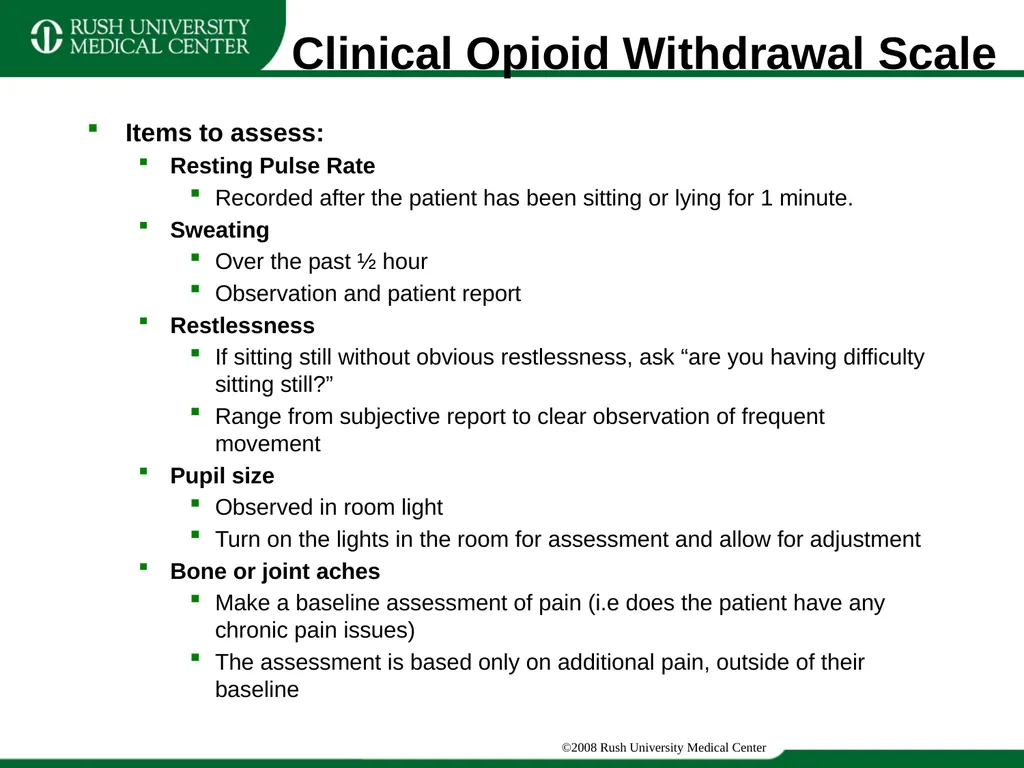
slide12. Clinical Opioid Withdrawal Scale Items to assess:
Resting Pulse Rate
Recorded after the patient has been sitting or lying for 1 minute.
Sweating
Over the past ½ hour
Observation and patient report
Restlessness
If sitting still without obvious restlessness, ask “are you having difficulty sitting still?”
Range from subjective report to clear observation of frequent movement
Pupil size
Observed in room light
Turn on the lights in the room for assessment and allow for adjustment
Bone or joint aches
Make a baseline assessment of pain (i.e does the patient have any chronic pain issues)
The assessment is based only on additional pain, outside of their baseline ©2008 Rush University Medical Center<br>
slide13. Clinical Opioid Withdrawal Scale Items to assess:
Runny nose or tearing
Range in severity from patient report to observation
Often observed “sniffling”
GI upset
Over the last 30 minutes
Ask patients to show staff when they have episodes of diarrhea or vomiting
Tremor
Put patient hands on top of yours to be able to feel a fine tremor
Yawning
Scored based on the frequency of yawning during observation
Anxiety or Irritability
Combination of self-report and observation
Gooseflesh skin
Ask patient to hold out arm, run fingers on arm to feel piloerection ©2008 Rush University Medical Center<br>
slide14. Medications Available for Management of Opioid Withdrawal Buprenorphine-naloxone (SUBOXONE)
available to all patients experiencing opioid withdrawal
dosing as follows:
COWS score 8-12 give 1 tablet (2-0.5 mg)
COWS score 13 or more give 2 tablets (2-0.5 mg)
When buprenorphine is given:
reassess COWS scale in 2 hours
re-dose as indicated
not to exceed 8 mg in 12 hours
Hold for excessive sedation or POSS of 3 or more ©2008 Rush University Medical Center<br>
slide15. Changes to Opioid Withdrawal Protocol Use the same flowsheet; no assessment changes
Referred to only as COWS
Administered around the clock, not “only when awake”
After buprenorphine-naloxone (SUBOXONE) is given, reassess COWS in 2 hours and give additional medication as indicated.
Lorazepam not indicated in opioid withdrawal ©2008 Rush University Medical Center<br>
slide16. Question Patient is evaluated and has a COWS score of 10: 2 points for anxiety or irritability, 2 points for bone or joint aches and 2 points for runny nose or tearing and 2 points for GI distress. What is the appropriate intervention?
Re-evaluate in 4 hours
Administer buprenorphine-naloxone (SUBOXONE) 2-0.5 mg and reassess in 2 hours
Offer hydroxyzine (VISTARIL/ATARAX) 25 mg and ibuprofen 600 mg
Request 1 time dose of lorazepam (ATIVAN) ©2008 Rush University Medical Center<br>
slide17. References Bayard, M., Mcintyre, J., Hill, K.R., & Woodside, J. Jr. (2004). Alcohol withdrawal syndrome. Am Fam Physician, 69(3), 1443-1450.
Center for Substance Abuse Treatment. Detoxification and Substance Abuse Treatment. Treatment Improvement Protocol (TIP) Series, No. 45. HHS Publication No. (SMA) 15-4131. Rockville, MD: Center for Substance Abuse Treatment, 2006
Hurst, G.B. (2012). Caring for patients in alcohol withdrawal.) American Nurse Today, 7(6).
Retrieved from https://www.americannursetoday.com/caring-for-patients-in-alcohol-withdrawal/
Sullivan JT, Sykora K, Schneiderman J, Naranjo CA, Sellers EM. (1989). Assessment of alcohol withdrawal: the revised Clinical Institute Withdrawal Assessment for alcohol scale (CIWA-Ar). Br J Addict, 84(11),1353-1357.
Wesson D.R. & Ling, W. (2003). The Clinical Opiate Withdrawal Scale [COWS]. J Psychoactive Drugs, 35(2), 253-259. ©2008 Rush University Medical Center<br>
slide2. Clinical Institute Withdrawal Assessment of Alcohol Scale, Revised (CIWA-Ar) ©2008 Rush University Medical Center<br>
slide3. Alcohol Withdrawal 101 ©2008 Rush University Medical Center Symptoms of Alcohol Withdrawal Syndrome *— Symptoms generally resolve within 48 hours.
†— Symptoms reported as early as two hours after cessation.
‡— Symptoms peak at five days.<br>
slide4. Clinical Institute Withdrawal Assessment of Alcohol Scale, Revised (CIWA-Ar): 10 items/5 minutes Assessing for tremor:
Observe patient with extended arms and fingers spread
Put the patient’s hands on your own to feel the tremor
Provide a cup of water to observe the tremor
Mild tremor (1-2): fine, flutter like movements
Moderate tremor (3-4): brings cup to mouth with 1 hand, but noticeable tremor
Severe tremor (5-6): requires 2 hands to bring cup to mouth
Full body tremor (7): patient can’t stand unassisted and has tremors all over, including the tongue Assessing for paroxysmal sweats
Rub the patient’s palms, back of the neck and forehead
Mild sweat (1-2): detect moisture
Moderate sweat (3-4): detect sweat on the forehead and palms- clothing is damp
Severe sweat (6-7): clothing and bedding are wet, patient is wet and clammy
Drenching (7): clothing and bedding are soaked ©2008 Rush University Medical Center<br>
slide5. Clinical Institute Withdrawal Assessment of Alcohol Scale, Revised (CIWA-Ar) Assessing Agitation
Subjective: patient describing feeling unable to keep still
Objective: observed restlessness, tossing and turning, pacing
Assessing for Tactile disturbance
Initially described as itching
Progresses to numbness and tingling
Severe symptoms: feeling things crawling on skin Assessing for Visual hallucinations
Mild to moderate: increased sensitivity to light
Severe: responding to visual hallucinations (including seeing shadows)
Assessing for Auditory hallucinations
Mild to moderate: increased sensitivity to noise
Severe: auditory hallucinations ©2008 Rush University Medical Center<br>
slide6. Medications for CIWA-Ar Protocol at Rush Diazepam (VALIUM)
available both PO and IV
has a fast onset and long is long acting
use with caution in patients with severe liver disease
5 mg of diazepam = 1 mg of lorazepam
Lorazepam (ATIVAN)
available both PO and IV
intermediate acting
recommended for use in patients with severe liver disease
Thiamine, multi vitamin and folic acid
Given PO unless patient is NPO or signs of Wernicke’s
Wernicke’s encephalopathy:
Caused by deficiency in vitamin B1 (thiamine)
S/S: Opthalmophlegia, Ataxia, Confusion
If untreated, deficits may become permanent ©2008 Rush University Medical Center<br>
slide7. Changes to CIWA-Ar Protocol at Rush Assessment occurs around the clock; wake patient if sleeping!
CIWA-Ar assessment every 4 hrs unless:
Score < 8 on 3 consecutive assessments = assess every 8 hrs
Score is 8-15 or higher = reassess in 2 hrs & medicate as below
Score >15 on 3 consecutive assessments = alert primary service
CONSIDER ICU when CIWA remains >15 AFTER 3rd consecutive dose of diazepam (20mg) or lorazepam (4mg)
ICU ONLY: Use RASS scoring with target +1 to -1 if patient unable to participate in CIWA scoring ©2008 Rush University Medical Center<br>
slide8. Question A patient is admitted to GMF for management of alcohol withdrawal. At 0200, he/she has a CIWA score of 16 and diazepam (VALIUM) 20 mg PO is administered. At 0400, CIWA score is 18 and diazepam (VALIUM) 20 mg PO is administered. At 0600, CIWA score is 22. What is the appropriate next action?
Call primary service immediately and request transfer to ICU
Give lorazepam 4 mg because diazepam does not appear to be working
Give diazepam (VALIUM) 20 mg PO and then alert primary service that 3 consecutive CIWA scores have been > 15
Give diazepam (VALIUM) 20 mg PO and reassess in 2 hours ©2008 Rush University Medical Center<br>
slide9. Clinical Opioid Withdrawal Scale (COWS) ©2008 Rush University Medical Center<br>
slide10. Opioid Withdrawal 101 Onset of symptoms:
Heroin: begins within hours of last use & diminish by day 4
Methadone: begins within days and diminish by day 10
Prescription opioids: varies based on ½ life of opioid ©2008 Rush University Medical Center<br>
slide11. Clinical Opioid Withdrawal Scale COWS
Previously referred to as the “CIWA Opioids Scale”
2- 10 minute to complete including observation and scoring ©2008 Rush University Medical Center<br>
slide12. Clinical Opioid Withdrawal Scale Items to assess:
Resting Pulse Rate
Recorded after the patient has been sitting or lying for 1 minute.
Sweating
Over the past ½ hour
Observation and patient report
Restlessness
If sitting still without obvious restlessness, ask “are you having difficulty sitting still?”
Range from subjective report to clear observation of frequent movement
Pupil size
Observed in room light
Turn on the lights in the room for assessment and allow for adjustment
Bone or joint aches
Make a baseline assessment of pain (i.e does the patient have any chronic pain issues)
The assessment is based only on additional pain, outside of their baseline ©2008 Rush University Medical Center<br>
slide13. Clinical Opioid Withdrawal Scale Items to assess:
Runny nose or tearing
Range in severity from patient report to observation
Often observed “sniffling”
GI upset
Over the last 30 minutes
Ask patients to show staff when they have episodes of diarrhea or vomiting
Tremor
Put patient hands on top of yours to be able to feel a fine tremor
Yawning
Scored based on the frequency of yawning during observation
Anxiety or Irritability
Combination of self-report and observation
Gooseflesh skin
Ask patient to hold out arm, run fingers on arm to feel piloerection ©2008 Rush University Medical Center<br>
slide14. Medications Available for Management of Opioid Withdrawal Buprenorphine-naloxone (SUBOXONE)
available to all patients experiencing opioid withdrawal
dosing as follows:
COWS score 8-12 give 1 tablet (2-0.5 mg)
COWS score 13 or more give 2 tablets (2-0.5 mg)
When buprenorphine is given:
reassess COWS scale in 2 hours
re-dose as indicated
not to exceed 8 mg in 12 hours
Hold for excessive sedation or POSS of 3 or more ©2008 Rush University Medical Center<br>
slide15. Changes to Opioid Withdrawal Protocol Use the same flowsheet; no assessment changes
Referred to only as COWS
Administered around the clock, not “only when awake”
After buprenorphine-naloxone (SUBOXONE) is given, reassess COWS in 2 hours and give additional medication as indicated.
Lorazepam not indicated in opioid withdrawal ©2008 Rush University Medical Center<br>
slide16. Question Patient is evaluated and has a COWS score of 10: 2 points for anxiety or irritability, 2 points for bone or joint aches and 2 points for runny nose or tearing and 2 points for GI distress. What is the appropriate intervention?
Re-evaluate in 4 hours
Administer buprenorphine-naloxone (SUBOXONE) 2-0.5 mg and reassess in 2 hours
Offer hydroxyzine (VISTARIL/ATARAX) 25 mg and ibuprofen 600 mg
Request 1 time dose of lorazepam (ATIVAN) ©2008 Rush University Medical Center<br>
slide17. References Bayard, M., Mcintyre, J., Hill, K.R., & Woodside, J. Jr. (2004). Alcohol withdrawal syndrome. Am Fam Physician, 69(3), 1443-1450.
Center for Substance Abuse Treatment. Detoxification and Substance Abuse Treatment. Treatment Improvement Protocol (TIP) Series, No. 45. HHS Publication No. (SMA) 15-4131. Rockville, MD: Center for Substance Abuse Treatment, 2006
Hurst, G.B. (2012). Caring for patients in alcohol withdrawal.) American Nurse Today, 7(6).
Retrieved from https://www.americannursetoday.com/caring-for-patients-in-alcohol-withdrawal/
Sullivan JT, Sykora K, Schneiderman J, Naranjo CA, Sellers EM. (1989). Assessment of alcohol withdrawal: the revised Clinical Institute Withdrawal Assessment for alcohol scale (CIWA-Ar). Br J Addict, 84(11),1353-1357.
Wesson D.R. & Ling, W. (2003). The Clinical Opiate Withdrawal Scale [COWS]. J Psychoactive Drugs, 35(2), 253-259. ©2008 Rush University Medical Center<br>