
Updated 13/03/20 OFFICIAL SENSITIVE HMPPS –

Description: Updated 130320 OFFICIAL SENSITIVE HMPPS Probation COVID-19 Exceptional Delivery Model SUMMARY 2 The following slides set out our response to the threat posed by Covid 19 (see Annex F for list of risks) to the normal functioning of the
Related Topics
Download Presentation
"Updated 13/03/20 OFFICIAL SENSITIVE HMPPS –" is the property of its rightful owner. Permission is granted to download and print the materials on this website for personal, non-commercial use only, and to display it on your personal computer provided you do not modify the materials and that you retain all copyright notices contained in the materials. By downloading content from our website, you accept the terms of this agreement.
Presentation Transcript
slide1. Updated 13/03/20 OFFICIAL SENSITIVE HMPPS – Probation
COVID-19 Exceptional Delivery Model<br>
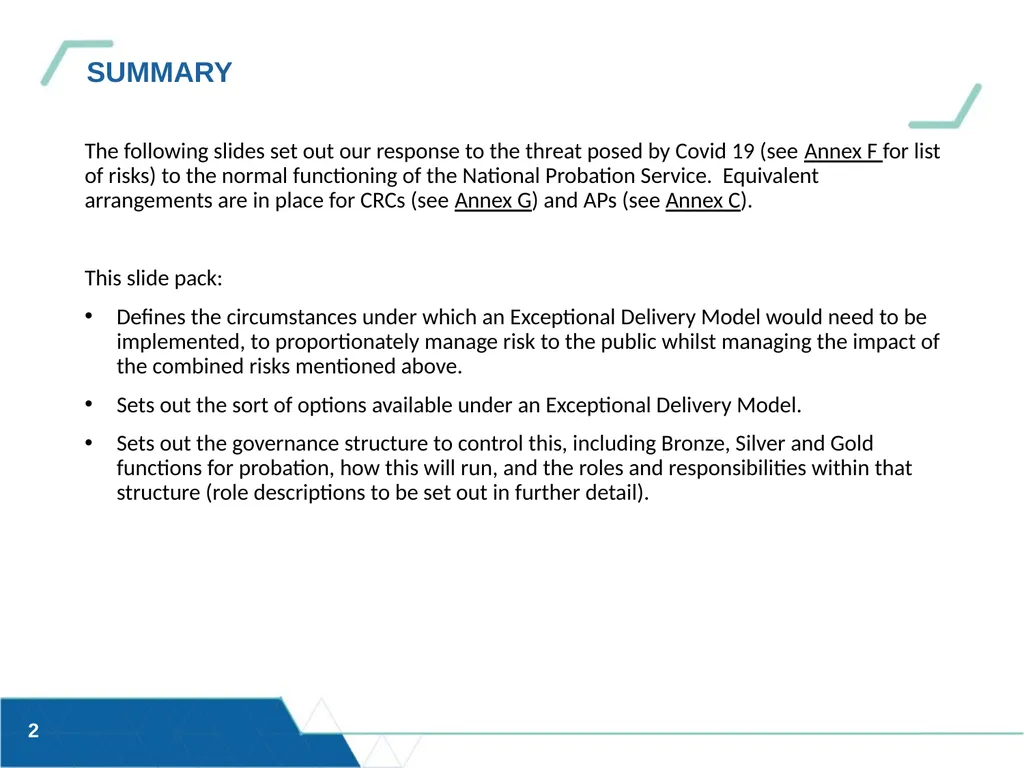
slide2. SUMMARY 2 The following slides set out our response to the threat posed by Covid 19 (see Annex F for list of risks) to the normal functioning of the National Probation Service. Equivalent arrangements are in place for CRCs (see Annex G) and APs (see Annex C).
This slide pack:
Defines the circumstances under which an Exceptional Delivery Model would need to be implemented, to proportionately manage risk to the public whilst managing the impact of the combined risks mentioned above.
Sets out the sort of options available under an Exceptional Delivery Model.
Sets out the governance structure to control this, including Bronze, Silver and Gold functions for probation, how this will run, and the roles and responsibilities within that structure (role descriptions to be set out in further detail).<br>
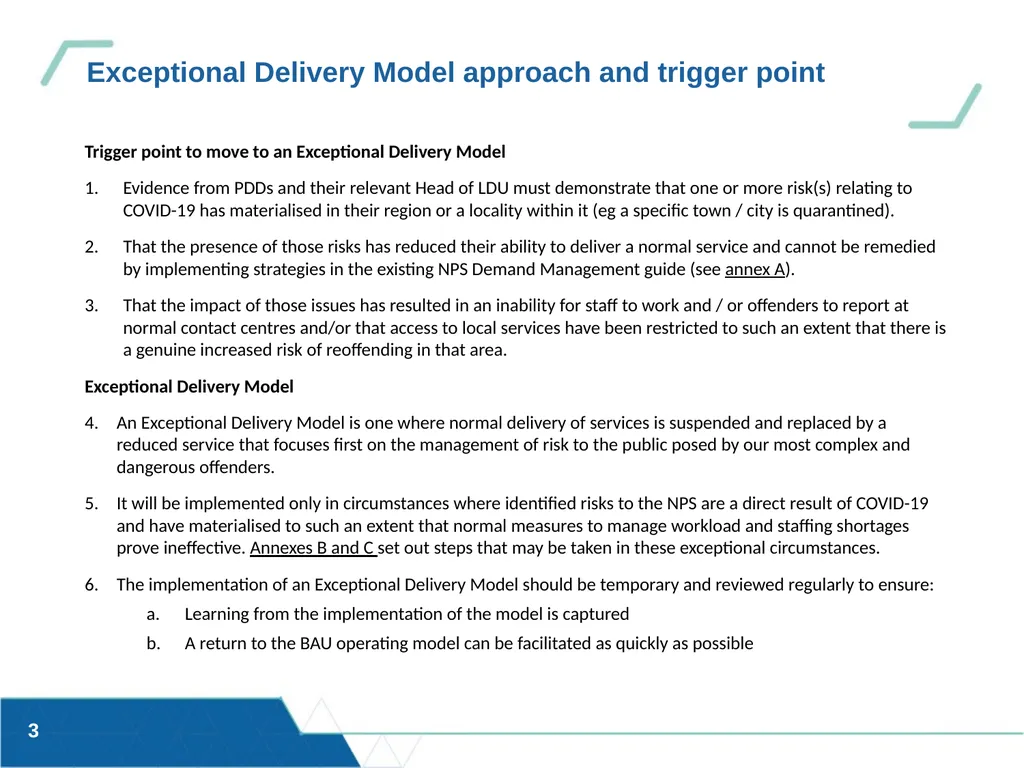
slide3. Exceptional Delivery Model approach and trigger point 3 Trigger point to move to an Exceptional Delivery Model
Evidence from PDDs and their relevant Head of LDU must demonstrate that one or more risk(s) relating to COVID-19 has materialised in their region or a locality within it (eg a specific town / city is quarantined).
That the presence of those risks has reduced their ability to deliver a normal service and cannot be remedied by implementing strategies in the existing NPS Demand Management guide (see annex A).
That the impact of those issues has resulted in an inability for staff to work and / or offenders to report at normal contact centres and/or that access to local services have been restricted to such an extent that there is a genuine increased risk of reoffending in that area.
Exceptional Delivery Model
An Exceptional Delivery Model is one where normal delivery of services is suspended and replaced by a reduced service that focuses first on the management of risk to the public posed by our most complex and dangerous offenders.
It will be implemented only in circumstances where identified risks to the NPS are a direct result of COVID-19 and have materialised to such an extent that normal measures to manage workload and staffing shortages prove ineffective. Annexes B and C set out steps that may be taken in these exceptional circumstances.
The implementation of an Exceptional Delivery Model should be temporary and reviewed regularly to ensure:
Learning from the implementation of the model is captured
A return to the BAU operating model can be facilitated as quickly as possible<br>
slide4. Probation COVID-19 incident governance: Silver and Bronze 4 Bronze and Silver functions (regional level structures):
In probation, this will be covered by usual line management arrangements. PDDs (and Deputy Director Sue Taylor for APs and BASS) will fulfil the role of “Silver” in their divisions and are responsible for –
Receiving information in from LDU / AP heads (Bronze) regarding frontline issues eg staffing gaps, challenges in maintaining normal offender management etc.
Making decisions that can be taken at a divisional level without needing to use the Exceptional Delivery Model eg pursuing actions outlined in Annex A.
Applying to Gold when they wish to request moving to the Exceptional Delivery Model (EDM) eg actions outlined in Annex B or C.
All PDDs who have implemented an EDM must report back on status using the report template at Annex D.
Ensuring good quality record keeping of decision making at individual service user level (on Delius).
(This will be replaced by regional directors from 1st April when wider governance arrangements change.)
Each PDD must assign two deputies who could stand in for them in the event of sickness.
There is a governance model set up for CRC decisions which will escalate to Gold in the same way via the contract management team – see Annex G.<br>
slide5. Probation COVID-19 incident governance: Gold 5 Gold function (national level structure):
Initially stood up 9am-5pm Mon-Fri (subject to review) from Monday 16th March IF the government change their advice and activate any of the 3 policy measures being considered.
To be physically located in Amy’s room (7.30A) in 102PF with dial in available as necessary (likely to be needed throughout for business continuity leads).
The 5 probation Executive Directors with operational experience (Ian Barrow, Ian Poree, Sonia Flynn, Jim Barton and Chris Jennings) will be Gold Commander on rotation.
Supported by (more detailed role descriptions to be developed) –
A business continuity lead (from Matt Wilson’s team) – to provide daily information being reported in through national reporting system and to advise from a business continuity perspective.
A staff officer (an Exec directors’ business manager)– to support the Gold Commander discharge their duties.
A log keeper (an Exec directors’ diary manager) – to complete and maintain an accurate record of all pertinent activities and events in Gold Command. Good record keeping will be very important in this process.
A CRC Contract Management SPOC will also be available to Gold (by phone as needed) for advice when operational decisions have commercial/contractual implications (Rupert Nesbitt-Day 07892 724632 and Matt Douglas – 07580 910653 or deputies nominated by them on their answerphones).
NB This Gold function replaces the twice weekly Sonia chaired meeting that we had previously proposed.<br>
slide6. Probation COVID-19 incident governance: Gold 6 COVID 19 Probation Gold will command our national level response to the COVID 19 situation and is responsible for national co-ordination of NPS resource to best support local delivery throughout the COVID 19 situation.
In practice its responsibilities will be –
To receive and review daily information flow on Covid 19 impacts across the probation system (from Business Strategy and Change team) and request further detail where needed.
To decide and review any requests by PDDs for moving to the Exceptional Delivery Model and which components of that are required.
To attend the HMPPS meeting convened by Richard Pickering’s team to check and coordinate the cross HMPPS position with the prisons gold (twice daily).
To attend the CJSSC (cross CJS meeting) and escalate to CJSSC any NPS level requirements for approval.
To ensure accurate record keeping of all decisions made.
CJSSC will not have the collective authority to issue executive orders to individual responder agencies. Each organisation retains its own responsibilities and command authority. CJSSC will provide strategic command across CJS services taking advice from members as necessary, and ensure that the strategy and tactics of constituent agencies represented at CJSSC are in line with the overall strategy set by Public Health.<br>
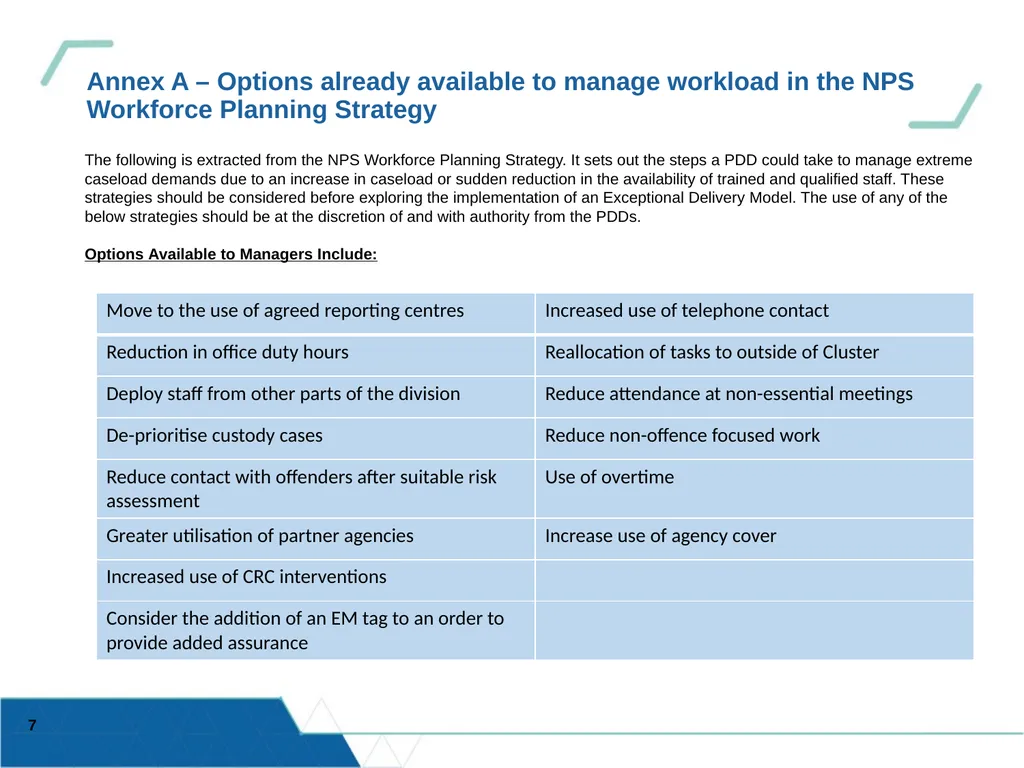
slide7. Annex A – Options already available to manage workload in the NPS Workforce Planning Strategy 7 The following is extracted from the NPS Workforce Planning Strategy. It sets out the steps a PDD could take to manage extreme caseload demands due to an increase in caseload or sudden reduction in the availability of trained and qualified staff. These strategies should be considered before exploring the implementation of an Exceptional Delivery Model. The use of any of the below strategies should be at the discretion of and with authority from the PDDs.
Options Available to Managers Include:<br>
slide8. Annex B – Options for PDDs in an Exceptional Delivery Model Part 1 8 The following is intended to guide PDDs in the implementation of an Exceptional Delivery Model to account for the specific challenges faced in their division (some may also be appropriate for CRCs). PDDs should have discretion to determine which of the following options are utilised in order to prioritise public protection and carrying out the orders of the courts but must record their use carefully (see Annex D). PDDs will be required to report back on the effectiveness of the option[s] they have implemented to inform future choices. More detailed advice is available for court work, offender management and APs.
PDDs may decide to: Prioritise service users within each offender contact site and AP, based on immediate risk to the public, using the criteria outlined in the NPS Workload Management Strategy (Annex 2) and focus activity on high-risk offenders, reducing other activity as necessary. Similar prioritisation approach within a court setting,
Move resources between offender contact sites and APs or request support from other divisions less severely impacted.
Return operationally qualified staff in non-operational roles to operational roles to support continuity of service.
Explore options for sharing premises or staff with local CRCs (working with CRC contract management team).
Contact offenders via telephone to replace face to face contact where service user illness / self-isolation restricts face-to-face contact or where this is a more efficient use of available staff.
Consider home visits for maintaining face to face contact with very high risk offenders where the usual offender contact site is not available or where the offender is self-isolating (Health & Safety should be consulted about suitable disease control steps to take).
Increased use of Electronic Monitoring (EM) and curfew for high risk offenders to be negotiated with Courts, Prisons and Providers. NPS Monitoring of EM to be increased in consultation with providers.
Appointments system in offices for high / very high-risk offenders. Parole Board /courts to be informed.
For service users and pre-sentence report preparation - reporting to office using technology in interview rooms for skype meetings from within the same office thereby reporting and seen but no direct contact.<br>
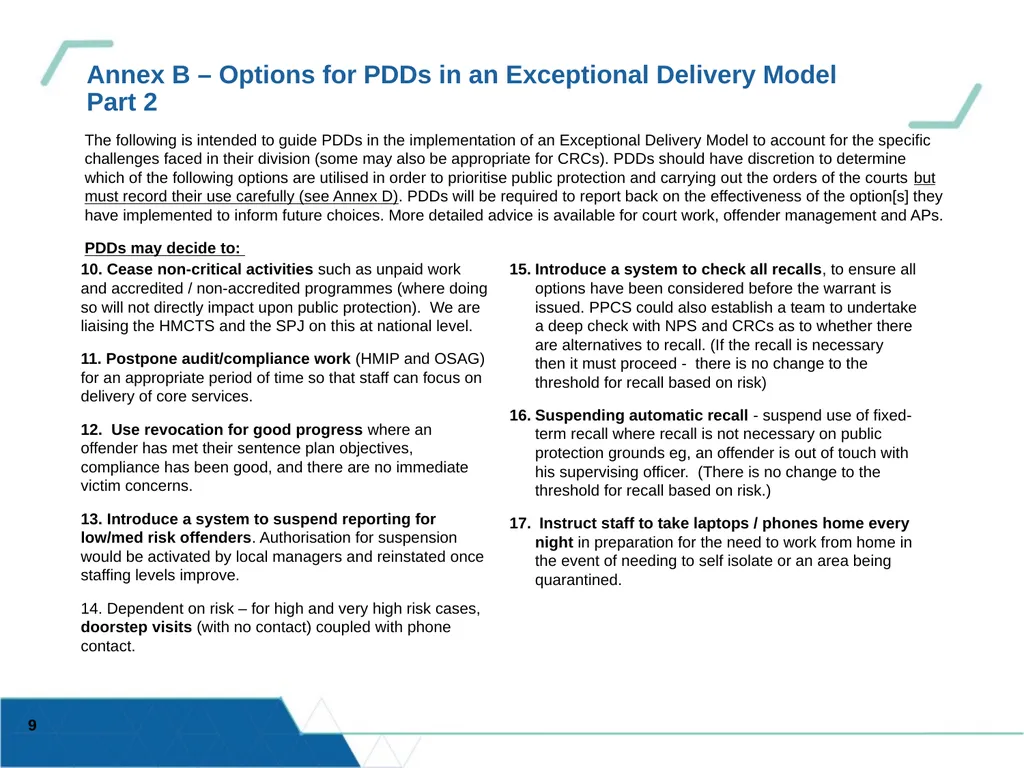
slide9. Annex B – Options for PDDs in an Exceptional Delivery Model Part 2 9 The following is intended to guide PDDs in the implementation of an Exceptional Delivery Model to account for the specific challenges faced in their division (some may also be appropriate for CRCs). PDDs should have discretion to determine which of the following options are utilised in order to prioritise public protection and carrying out the orders of the courts but must record their use carefully (see Annex D). PDDs will be required to report back on the effectiveness of the option[s] they have implemented to inform future choices. More detailed advice is available for court work, offender management and APs.
PDDs may decide to: 10. Cease non-critical activities such as unpaid work and accredited / non-accredited programmes (where doing so will not directly impact upon public protection). We are liaising the HMCTS and the SPJ on this at national level.
11. Postpone audit/compliance work (HMIP and OSAG) for an appropriate period of time so that staff can focus on delivery of core services.
12. Use revocation for good progress where an offender has met their sentence plan objectives, compliance has been good, and there are no immediate victim concerns.
13. Introduce a system to suspend reporting for low/med risk offenders. Authorisation for suspension would be activated by local managers and reinstated once staffing levels improve.
14. Dependent on risk – for high and very high risk cases, doorstep visits (with no contact) coupled with phone contact.
Introduce a system to check all recalls, to ensure all options have been considered before the warrant is issued. PPCS could also establish a team to undertake a deep check with NPS and CRCs as to whether there are alternatives to recall. (If the recall is necessary then it must proceed - there is no change to the threshold for recall based on risk)
Suspending automatic recall - suspend use of fixed-term recall where recall is not necessary on public protection grounds eg, an offender is out of touch with his supervising officer. (There is no change to the threshold for recall based on risk.)
Instruct staff to take laptops / phones home every night in preparation for the need to work from home in the event of needing to self isolate or an area being quarantined.<br>
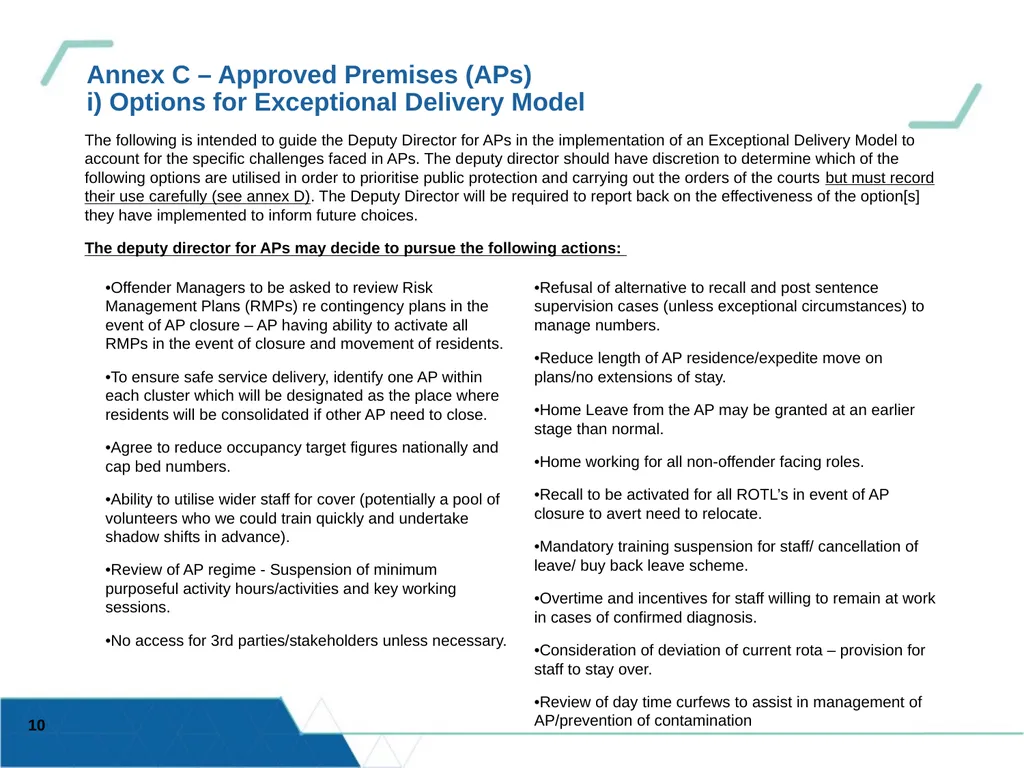
slide10. Annex C – Approved Premises (APs) i) Options for Exceptional Delivery Model 10 The following is intended to guide the Deputy Director for APs in the implementation of an Exceptional Delivery Model to account for the specific challenges faced in APs. The deputy director should have discretion to determine which of the following options are utilised in order to prioritise public protection and carrying out the orders of the courts but must record their use carefully (see annex D). The Deputy Director will be required to report back on the effectiveness of the option[s] they have implemented to inform future choices.
The deputy director for APs may decide to pursue the following actions: •Offender Managers to be asked to review Risk Management Plans (RMPs) re contingency plans in the event of AP closure – AP having ability to activate all RMPs in the event of closure and movement of residents.
•To ensure safe service delivery, identify one AP within each cluster which will be designated as the place where residents will be consolidated if other AP need to close.
•Agree to reduce occupancy target figures nationally and cap bed numbers.
•Ability to utilise wider staff for cover (potentially a pool of volunteers who we could train quickly and undertake shadow shifts in advance).
•Review of AP regime - Suspension of minimum purposeful activity hours/activities and key working sessions.
•No access for 3rd parties/stakeholders unless necessary.
•Refusal of alternative to recall and post sentence supervision cases (unless exceptional circumstances) to manage numbers.
•Reduce length of AP residence/expedite move on plans/no extensions of stay.
•Home Leave from the AP may be granted at an earlier stage than normal.
•Home working for all non-offender facing roles.
•Recall to be activated for all ROTL’s in event of AP closure to avert need to relocate.
•Mandatory training suspension for staff/ cancellation of leave/ buy back leave scheme.
•Overtime and incentives for staff willing to remain at work in cases of confirmed diagnosis.
•Consideration of deviation of current rota – provision for staff to stay over.
•Review of day time curfews to assist in management of AP/prevention of contamination<br>
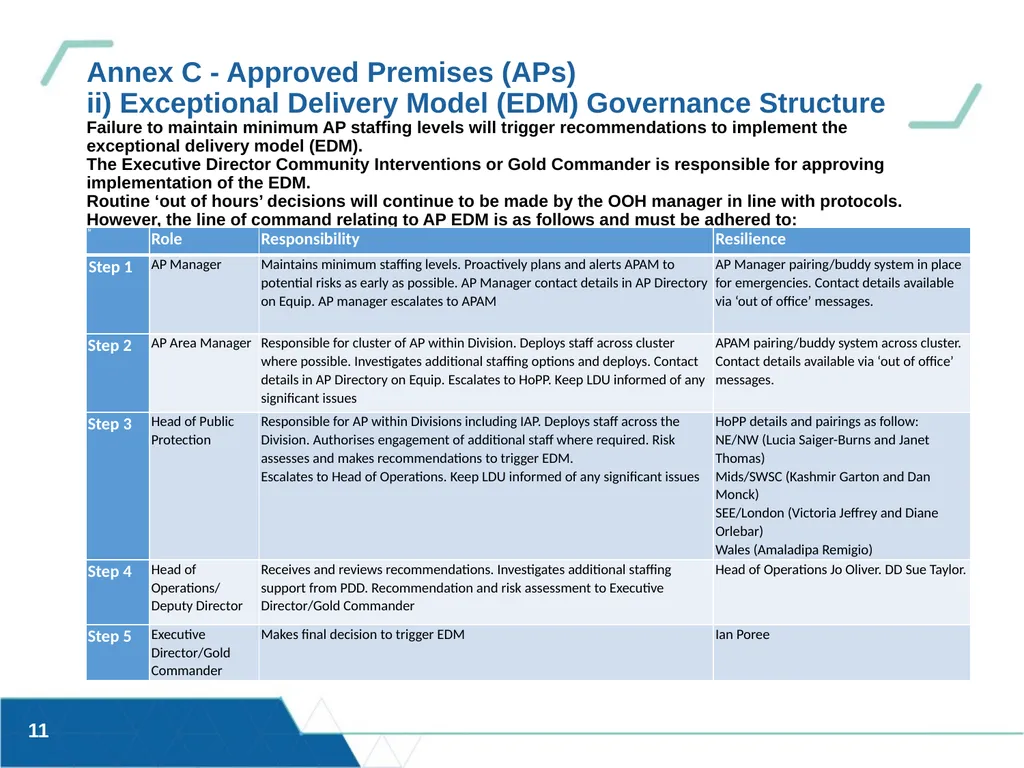
slide11. Annex C - Approved Premises (APs) ii) Exceptional Delivery Model (EDM) Governance Structure Failure to maintain minimum AP staffing levels will trigger recommendations to implement the exceptional delivery model (EDM). The Executive Director Community Interventions or Gold Commander is responsible for approving implementation of the EDM. Routine ‘out of hours’ decisions will continue to be made by the OOH manager in line with protocols. However, the line of command relating to AP EDM is as follows and must be adhered to: 11<br>
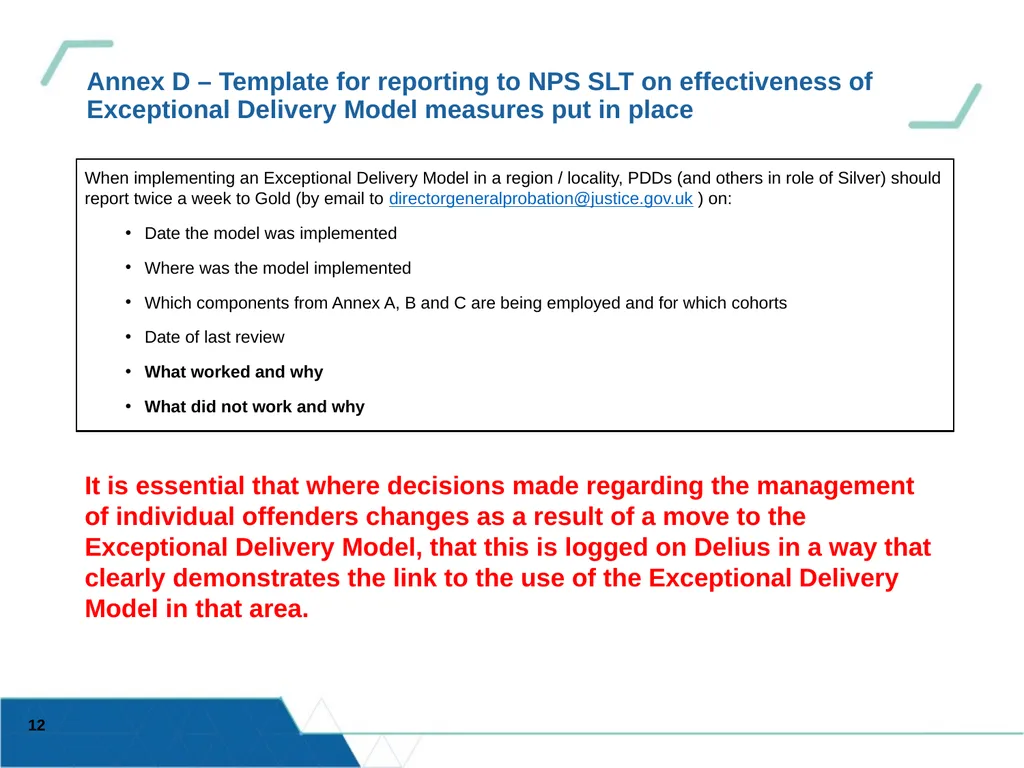
slide12. Annex D – Template for reporting to NPS SLT on effectiveness of Exceptional Delivery Model measures put in place 12 When implementing an Exceptional Delivery Model in a region / locality, PDDs (and others in role of Silver) should report twice a week to Gold (by email to directorgeneralprobation@justice.gov.uk ) on:
Date the model was implemented
Where was the model implemented
Which components from Annex A, B and C are being employed and for which cohorts
Date of last review
What worked and why
What did not work and why It is essential that where decisions made regarding the management of individual offenders changes as a result of a move to the Exceptional Delivery Model, that this is logged on Delius in a way that clearly demonstrates the link to the use of the Exceptional Delivery Model in that area.<br>
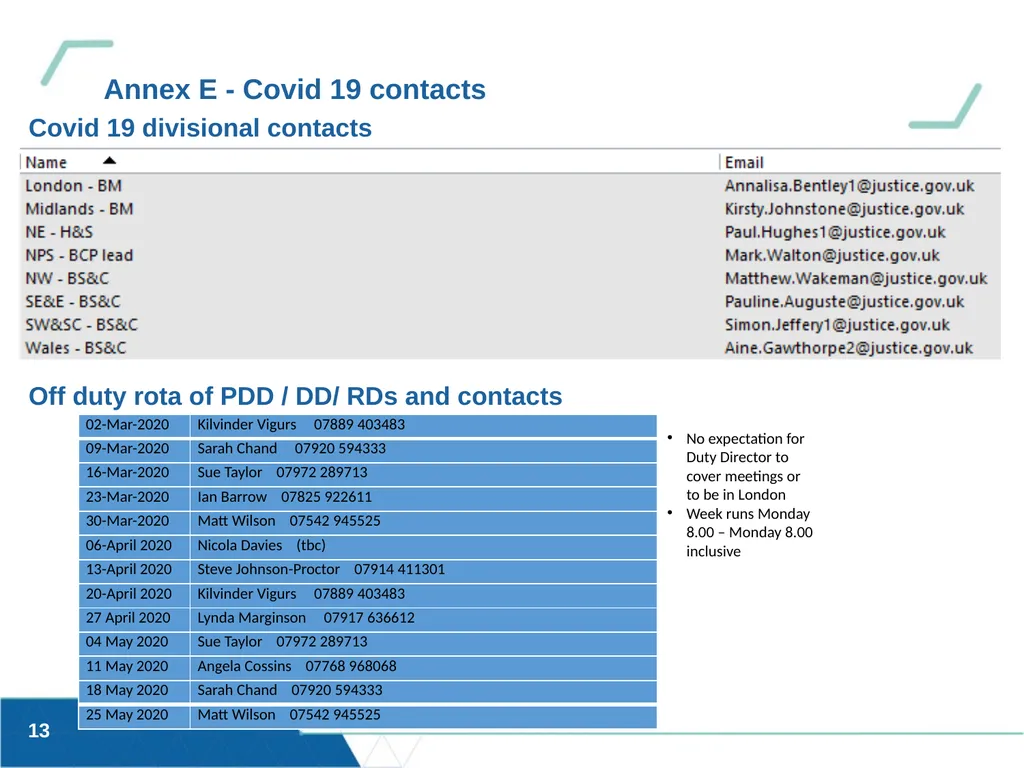
slide13. Off duty rota of PDD / DD/ RDs and contacts 13 Annex E - Covid 19 contacts Covid 19 divisional contacts No expectation for Duty Director to cover meetings or to be in London
Week runs Monday 8.00 – Monday 8.00 inclusive<br>
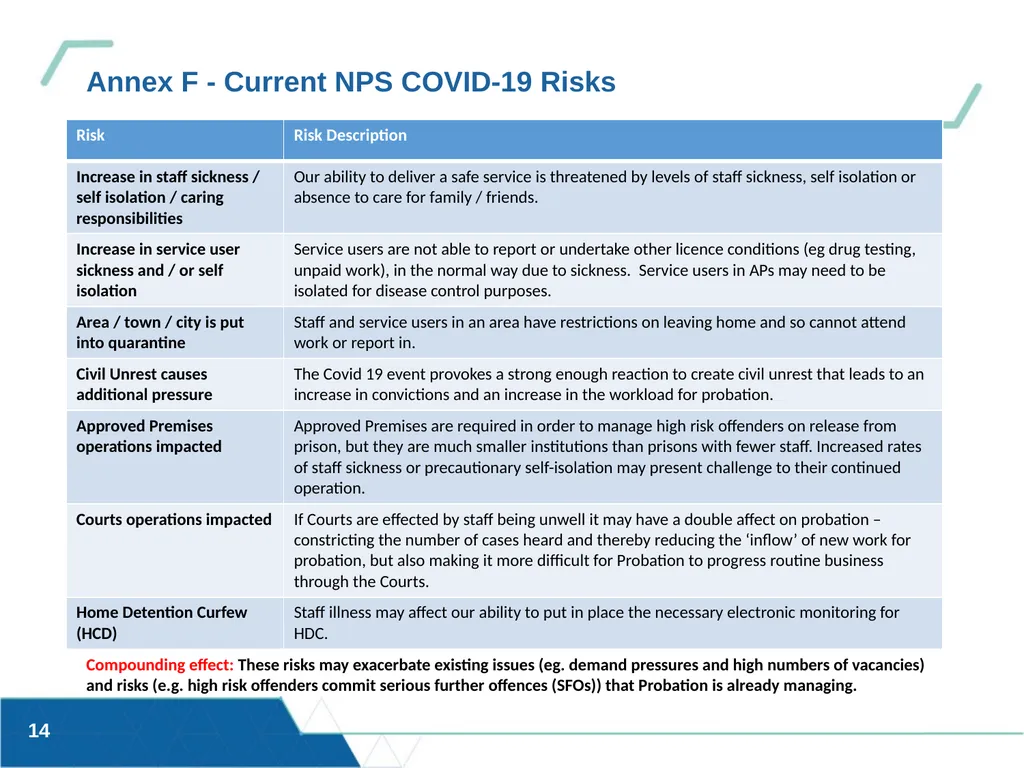
slide14. Annex F - Current NPS COVID-19 Risks 14 Compounding effect: These risks may exacerbate existing issues (eg. demand pressures and high numbers of vacancies) and risks (e.g. high risk offenders commit serious further offences (SFOs)) that Probation is already managing.<br>
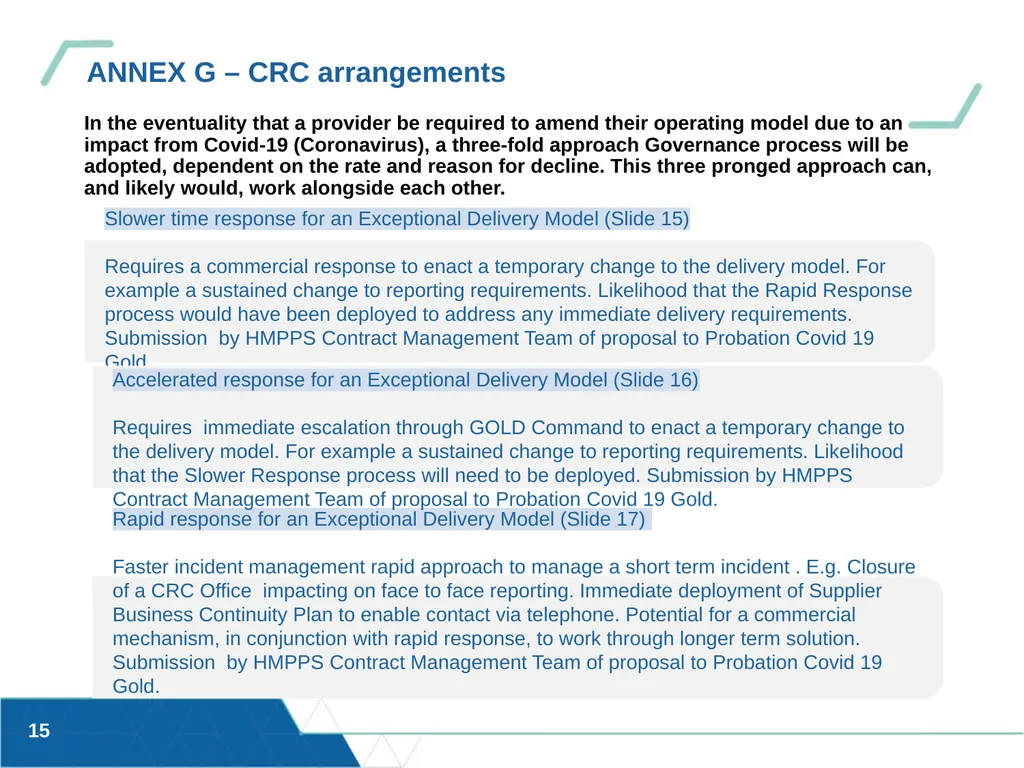
slide15. ANNEX G – CRC arrangements 15 In the eventuality that a provider be required to amend their operating model due to an impact from Covid-19 (Coronavirus), a three-fold approach Governance process will be adopted, dependent on the rate and reason for decline. This three pronged approach can, and likely would, work alongside each other. Slower time response for an Exceptional Delivery Model (Slide 15)
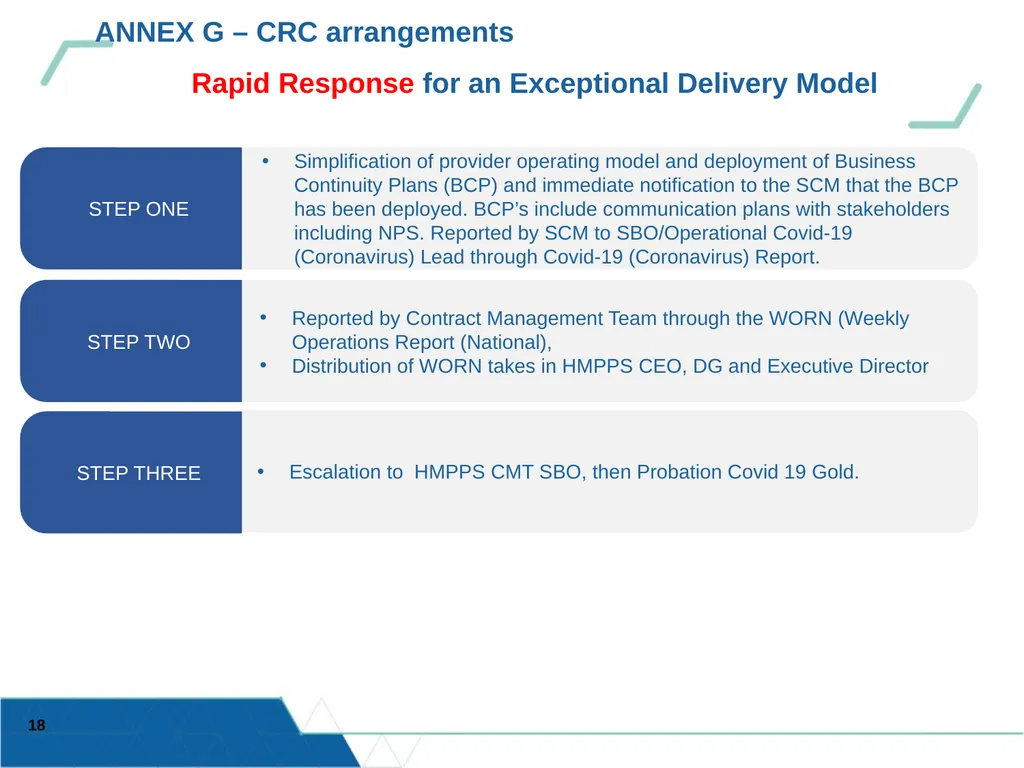
Requires a commercial response to enact a temporary change to the delivery model. For example a sustained change to reporting requirements. Likelihood that the Rapid Response process would have been deployed to address any immediate delivery requirements. Submission by HMPPS Contract Management Team of proposal to Probation Covid 19 Gold. Rapid response for an Exceptional Delivery Model (Slide 17)
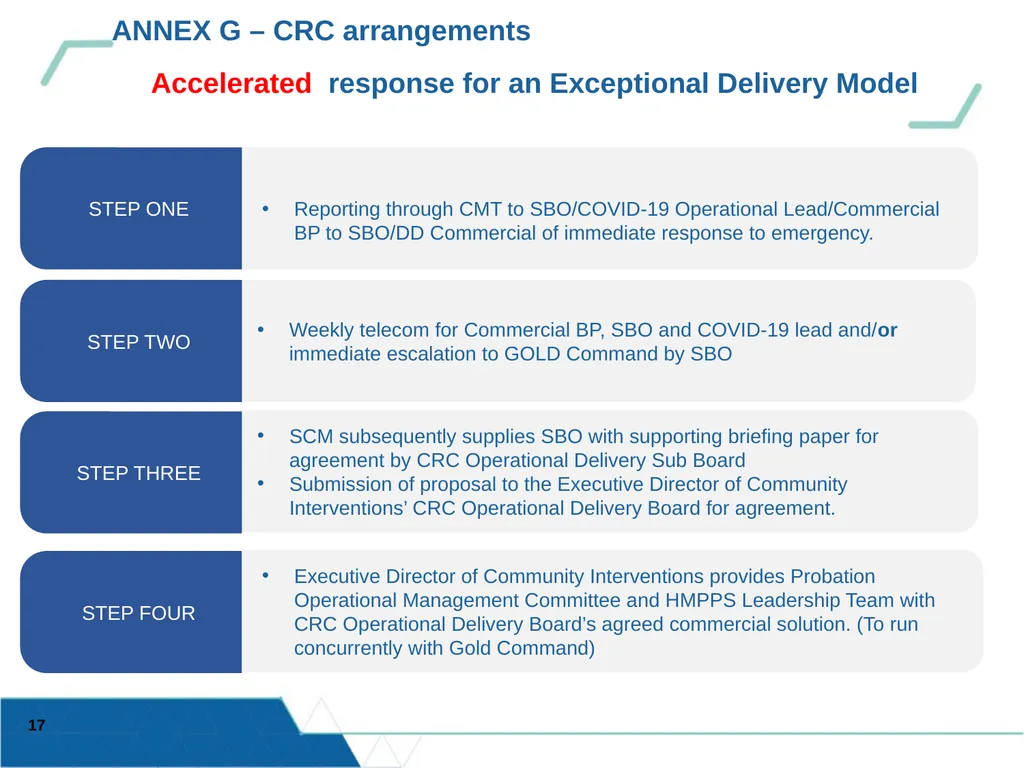
Faster incident management rapid approach to manage a short term incident . E.g. Closure of a CRC Office impacting on face to face reporting. Immediate deployment of Supplier Business Continuity Plan to enable contact via telephone. Potential for a commercial mechanism, in conjunction with rapid response, to work through longer term solution. Submission by HMPPS Contract Management Team of proposal to Probation Covid 19 Gold. Accelerated response for an Exceptional Delivery Model (Slide 16)
Requires immediate escalation through GOLD Command to enact a temporary change to the delivery model. For example a sustained change to reporting requirements. Likelihood that the Slower Response process will need to be deployed. Submission by HMPPS Contract Management Team of proposal to Probation Covid 19 Gold.<br>
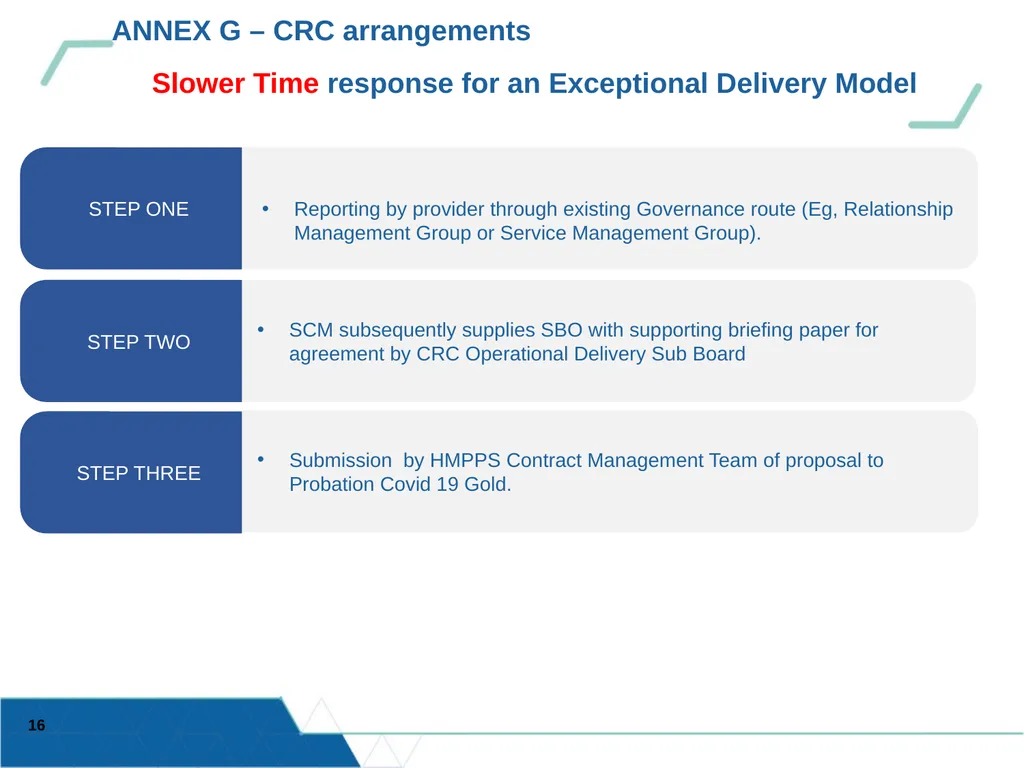
slide16. Slower Time response for an Exceptional Delivery Model 16 SCM subsequently supplies SBO with supporting briefing paper for agreement by CRC Operational Delivery Sub Board STEP TWO Submission by HMPPS Contract Management Team of proposal to Probation Covid 19 Gold. STEP THREE Reporting by provider through existing Governance route (Eg, Relationship Management Group or Service Management Group). STEP ONE ANNEX G – CRC arrangements<br>
slide17. Accelerated response for an Exceptional Delivery Model 17 Weekly telecom for Commercial BP, SBO and COVID-19 lead and/or immediate escalation to GOLD Command by SBO STEP TWO SCM subsequently supplies SBO with supporting briefing paper for agreement by CRC Operational Delivery Sub Board
Submission of proposal to the Executive Director of Community Interventions’ CRC Operational Delivery Board for agreement. STEP THREE Reporting through CMT to SBO/COVID-19 Operational Lead/Commercial BP to SBO/DD Commercial of immediate response to emergency. STEP ONE STEP FOUR Executive Director of Community Interventions provides Probation Operational Management Committee and HMPPS Leadership Team with CRC Operational Delivery Board’s agreed commercial solution. (To run concurrently with Gold Command) ANNEX G – CRC arrangements<br>
slide18. Rapid Response for an Exceptional Delivery Model 18 Reported by Contract Management Team through the WORN (Weekly Operations Report (National),
Distribution of WORN takes in HMPPS CEO, DG and Executive Director STEP TWO Escalation to HMPPS CMT SBO, then Probation Covid 19 Gold. STEP THREE Simplification of provider operating model and deployment of Business Continuity Plans (BCP) and immediate notification to the SCM that the BCP has been deployed. BCP’s include communication plans with stakeholders including NPS. Reported by SCM to SBO/Operational Covid-19 (Coronavirus) Lead through Covid-19 (Coronavirus) Report. STEP ONE ANNEX G – CRC arrangements<br>
slide2. SUMMARY 2 The following slides set out our response to the threat posed by Covid 19 (see Annex F for list of risks) to the normal functioning of the National Probation Service. Equivalent arrangements are in place for CRCs (see Annex G) and APs (see Annex C).
This slide pack:
Defines the circumstances under which an Exceptional Delivery Model would need to be implemented, to proportionately manage risk to the public whilst managing the impact of the combined risks mentioned above.
Sets out the sort of options available under an Exceptional Delivery Model.
Sets out the governance structure to control this, including Bronze, Silver and Gold functions for probation, how this will run, and the roles and responsibilities within that structure (role descriptions to be set out in further detail).<br>
slide3. Exceptional Delivery Model approach and trigger point 3 Trigger point to move to an Exceptional Delivery Model
Evidence from PDDs and their relevant Head of LDU must demonstrate that one or more risk(s) relating to COVID-19 has materialised in their region or a locality within it (eg a specific town / city is quarantined).
That the presence of those risks has reduced their ability to deliver a normal service and cannot be remedied by implementing strategies in the existing NPS Demand Management guide (see annex A).
That the impact of those issues has resulted in an inability for staff to work and / or offenders to report at normal contact centres and/or that access to local services have been restricted to such an extent that there is a genuine increased risk of reoffending in that area.
Exceptional Delivery Model
An Exceptional Delivery Model is one where normal delivery of services is suspended and replaced by a reduced service that focuses first on the management of risk to the public posed by our most complex and dangerous offenders.
It will be implemented only in circumstances where identified risks to the NPS are a direct result of COVID-19 and have materialised to such an extent that normal measures to manage workload and staffing shortages prove ineffective. Annexes B and C set out steps that may be taken in these exceptional circumstances.
The implementation of an Exceptional Delivery Model should be temporary and reviewed regularly to ensure:
Learning from the implementation of the model is captured
A return to the BAU operating model can be facilitated as quickly as possible<br>
slide4. Probation COVID-19 incident governance: Silver and Bronze 4 Bronze and Silver functions (regional level structures):
In probation, this will be covered by usual line management arrangements. PDDs (and Deputy Director Sue Taylor for APs and BASS) will fulfil the role of “Silver” in their divisions and are responsible for –
Receiving information in from LDU / AP heads (Bronze) regarding frontline issues eg staffing gaps, challenges in maintaining normal offender management etc.
Making decisions that can be taken at a divisional level without needing to use the Exceptional Delivery Model eg pursuing actions outlined in Annex A.
Applying to Gold when they wish to request moving to the Exceptional Delivery Model (EDM) eg actions outlined in Annex B or C.
All PDDs who have implemented an EDM must report back on status using the report template at Annex D.
Ensuring good quality record keeping of decision making at individual service user level (on Delius).
(This will be replaced by regional directors from 1st April when wider governance arrangements change.)
Each PDD must assign two deputies who could stand in for them in the event of sickness.
There is a governance model set up for CRC decisions which will escalate to Gold in the same way via the contract management team – see Annex G.<br>
slide5. Probation COVID-19 incident governance: Gold 5 Gold function (national level structure):
Initially stood up 9am-5pm Mon-Fri (subject to review) from Monday 16th March IF the government change their advice and activate any of the 3 policy measures being considered.
To be physically located in Amy’s room (7.30A) in 102PF with dial in available as necessary (likely to be needed throughout for business continuity leads).
The 5 probation Executive Directors with operational experience (Ian Barrow, Ian Poree, Sonia Flynn, Jim Barton and Chris Jennings) will be Gold Commander on rotation.
Supported by (more detailed role descriptions to be developed) –
A business continuity lead (from Matt Wilson’s team) – to provide daily information being reported in through national reporting system and to advise from a business continuity perspective.
A staff officer (an Exec directors’ business manager)– to support the Gold Commander discharge their duties.
A log keeper (an Exec directors’ diary manager) – to complete and maintain an accurate record of all pertinent activities and events in Gold Command. Good record keeping will be very important in this process.
A CRC Contract Management SPOC will also be available to Gold (by phone as needed) for advice when operational decisions have commercial/contractual implications (Rupert Nesbitt-Day 07892 724632 and Matt Douglas – 07580 910653 or deputies nominated by them on their answerphones).
NB This Gold function replaces the twice weekly Sonia chaired meeting that we had previously proposed.<br>
slide6. Probation COVID-19 incident governance: Gold 6 COVID 19 Probation Gold will command our national level response to the COVID 19 situation and is responsible for national co-ordination of NPS resource to best support local delivery throughout the COVID 19 situation.
In practice its responsibilities will be –
To receive and review daily information flow on Covid 19 impacts across the probation system (from Business Strategy and Change team) and request further detail where needed.
To decide and review any requests by PDDs for moving to the Exceptional Delivery Model and which components of that are required.
To attend the HMPPS meeting convened by Richard Pickering’s team to check and coordinate the cross HMPPS position with the prisons gold (twice daily).
To attend the CJSSC (cross CJS meeting) and escalate to CJSSC any NPS level requirements for approval.
To ensure accurate record keeping of all decisions made.
CJSSC will not have the collective authority to issue executive orders to individual responder agencies. Each organisation retains its own responsibilities and command authority. CJSSC will provide strategic command across CJS services taking advice from members as necessary, and ensure that the strategy and tactics of constituent agencies represented at CJSSC are in line with the overall strategy set by Public Health.<br>
slide7. Annex A – Options already available to manage workload in the NPS Workforce Planning Strategy 7 The following is extracted from the NPS Workforce Planning Strategy. It sets out the steps a PDD could take to manage extreme caseload demands due to an increase in caseload or sudden reduction in the availability of trained and qualified staff. These strategies should be considered before exploring the implementation of an Exceptional Delivery Model. The use of any of the below strategies should be at the discretion of and with authority from the PDDs.
Options Available to Managers Include:<br>
slide8. Annex B – Options for PDDs in an Exceptional Delivery Model Part 1 8 The following is intended to guide PDDs in the implementation of an Exceptional Delivery Model to account for the specific challenges faced in their division (some may also be appropriate for CRCs). PDDs should have discretion to determine which of the following options are utilised in order to prioritise public protection and carrying out the orders of the courts but must record their use carefully (see Annex D). PDDs will be required to report back on the effectiveness of the option[s] they have implemented to inform future choices. More detailed advice is available for court work, offender management and APs.
PDDs may decide to: Prioritise service users within each offender contact site and AP, based on immediate risk to the public, using the criteria outlined in the NPS Workload Management Strategy (Annex 2) and focus activity on high-risk offenders, reducing other activity as necessary. Similar prioritisation approach within a court setting,
Move resources between offender contact sites and APs or request support from other divisions less severely impacted.
Return operationally qualified staff in non-operational roles to operational roles to support continuity of service.
Explore options for sharing premises or staff with local CRCs (working with CRC contract management team).
Contact offenders via telephone to replace face to face contact where service user illness / self-isolation restricts face-to-face contact or where this is a more efficient use of available staff.
Consider home visits for maintaining face to face contact with very high risk offenders where the usual offender contact site is not available or where the offender is self-isolating (Health & Safety should be consulted about suitable disease control steps to take).
Increased use of Electronic Monitoring (EM) and curfew for high risk offenders to be negotiated with Courts, Prisons and Providers. NPS Monitoring of EM to be increased in consultation with providers.
Appointments system in offices for high / very high-risk offenders. Parole Board /courts to be informed.
For service users and pre-sentence report preparation - reporting to office using technology in interview rooms for skype meetings from within the same office thereby reporting and seen but no direct contact.<br>
slide9. Annex B – Options for PDDs in an Exceptional Delivery Model Part 2 9 The following is intended to guide PDDs in the implementation of an Exceptional Delivery Model to account for the specific challenges faced in their division (some may also be appropriate for CRCs). PDDs should have discretion to determine which of the following options are utilised in order to prioritise public protection and carrying out the orders of the courts but must record their use carefully (see Annex D). PDDs will be required to report back on the effectiveness of the option[s] they have implemented to inform future choices. More detailed advice is available for court work, offender management and APs.
PDDs may decide to: 10. Cease non-critical activities such as unpaid work and accredited / non-accredited programmes (where doing so will not directly impact upon public protection). We are liaising the HMCTS and the SPJ on this at national level.
11. Postpone audit/compliance work (HMIP and OSAG) for an appropriate period of time so that staff can focus on delivery of core services.
12. Use revocation for good progress where an offender has met their sentence plan objectives, compliance has been good, and there are no immediate victim concerns.
13. Introduce a system to suspend reporting for low/med risk offenders. Authorisation for suspension would be activated by local managers and reinstated once staffing levels improve.
14. Dependent on risk – for high and very high risk cases, doorstep visits (with no contact) coupled with phone contact.
Introduce a system to check all recalls, to ensure all options have been considered before the warrant is issued. PPCS could also establish a team to undertake a deep check with NPS and CRCs as to whether there are alternatives to recall. (If the recall is necessary then it must proceed - there is no change to the threshold for recall based on risk)
Suspending automatic recall - suspend use of fixed-term recall where recall is not necessary on public protection grounds eg, an offender is out of touch with his supervising officer. (There is no change to the threshold for recall based on risk.)
Instruct staff to take laptops / phones home every night in preparation for the need to work from home in the event of needing to self isolate or an area being quarantined.<br>
slide10. Annex C – Approved Premises (APs) i) Options for Exceptional Delivery Model 10 The following is intended to guide the Deputy Director for APs in the implementation of an Exceptional Delivery Model to account for the specific challenges faced in APs. The deputy director should have discretion to determine which of the following options are utilised in order to prioritise public protection and carrying out the orders of the courts but must record their use carefully (see annex D). The Deputy Director will be required to report back on the effectiveness of the option[s] they have implemented to inform future choices.
The deputy director for APs may decide to pursue the following actions: •Offender Managers to be asked to review Risk Management Plans (RMPs) re contingency plans in the event of AP closure – AP having ability to activate all RMPs in the event of closure and movement of residents.
•To ensure safe service delivery, identify one AP within each cluster which will be designated as the place where residents will be consolidated if other AP need to close.
•Agree to reduce occupancy target figures nationally and cap bed numbers.
•Ability to utilise wider staff for cover (potentially a pool of volunteers who we could train quickly and undertake shadow shifts in advance).
•Review of AP regime - Suspension of minimum purposeful activity hours/activities and key working sessions.
•No access for 3rd parties/stakeholders unless necessary.
•Refusal of alternative to recall and post sentence supervision cases (unless exceptional circumstances) to manage numbers.
•Reduce length of AP residence/expedite move on plans/no extensions of stay.
•Home Leave from the AP may be granted at an earlier stage than normal.
•Home working for all non-offender facing roles.
•Recall to be activated for all ROTL’s in event of AP closure to avert need to relocate.
•Mandatory training suspension for staff/ cancellation of leave/ buy back leave scheme.
•Overtime and incentives for staff willing to remain at work in cases of confirmed diagnosis.
•Consideration of deviation of current rota – provision for staff to stay over.
•Review of day time curfews to assist in management of AP/prevention of contamination<br>
slide11. Annex C - Approved Premises (APs) ii) Exceptional Delivery Model (EDM) Governance Structure Failure to maintain minimum AP staffing levels will trigger recommendations to implement the exceptional delivery model (EDM). The Executive Director Community Interventions or Gold Commander is responsible for approving implementation of the EDM. Routine ‘out of hours’ decisions will continue to be made by the OOH manager in line with protocols. However, the line of command relating to AP EDM is as follows and must be adhered to: 11<br>
slide12. Annex D – Template for reporting to NPS SLT on effectiveness of Exceptional Delivery Model measures put in place 12 When implementing an Exceptional Delivery Model in a region / locality, PDDs (and others in role of Silver) should report twice a week to Gold (by email to directorgeneralprobation@justice.gov.uk ) on:
Date the model was implemented
Where was the model implemented
Which components from Annex A, B and C are being employed and for which cohorts
Date of last review
What worked and why
What did not work and why It is essential that where decisions made regarding the management of individual offenders changes as a result of a move to the Exceptional Delivery Model, that this is logged on Delius in a way that clearly demonstrates the link to the use of the Exceptional Delivery Model in that area.<br>
slide13. Off duty rota of PDD / DD/ RDs and contacts 13 Annex E - Covid 19 contacts Covid 19 divisional contacts No expectation for Duty Director to cover meetings or to be in London
Week runs Monday 8.00 – Monday 8.00 inclusive<br>
slide14. Annex F - Current NPS COVID-19 Risks 14 Compounding effect: These risks may exacerbate existing issues (eg. demand pressures and high numbers of vacancies) and risks (e.g. high risk offenders commit serious further offences (SFOs)) that Probation is already managing.<br>
slide15. ANNEX G – CRC arrangements 15 In the eventuality that a provider be required to amend their operating model due to an impact from Covid-19 (Coronavirus), a three-fold approach Governance process will be adopted, dependent on the rate and reason for decline. This three pronged approach can, and likely would, work alongside each other. Slower time response for an Exceptional Delivery Model (Slide 15)
Requires a commercial response to enact a temporary change to the delivery model. For example a sustained change to reporting requirements. Likelihood that the Rapid Response process would have been deployed to address any immediate delivery requirements. Submission by HMPPS Contract Management Team of proposal to Probation Covid 19 Gold. Rapid response for an Exceptional Delivery Model (Slide 17)
Faster incident management rapid approach to manage a short term incident . E.g. Closure of a CRC Office impacting on face to face reporting. Immediate deployment of Supplier Business Continuity Plan to enable contact via telephone. Potential for a commercial mechanism, in conjunction with rapid response, to work through longer term solution. Submission by HMPPS Contract Management Team of proposal to Probation Covid 19 Gold. Accelerated response for an Exceptional Delivery Model (Slide 16)
Requires immediate escalation through GOLD Command to enact a temporary change to the delivery model. For example a sustained change to reporting requirements. Likelihood that the Slower Response process will need to be deployed. Submission by HMPPS Contract Management Team of proposal to Probation Covid 19 Gold.<br>
slide16. Slower Time response for an Exceptional Delivery Model 16 SCM subsequently supplies SBO with supporting briefing paper for agreement by CRC Operational Delivery Sub Board STEP TWO Submission by HMPPS Contract Management Team of proposal to Probation Covid 19 Gold. STEP THREE Reporting by provider through existing Governance route (Eg, Relationship Management Group or Service Management Group). STEP ONE ANNEX G – CRC arrangements<br>
slide17. Accelerated response for an Exceptional Delivery Model 17 Weekly telecom for Commercial BP, SBO and COVID-19 lead and/or immediate escalation to GOLD Command by SBO STEP TWO SCM subsequently supplies SBO with supporting briefing paper for agreement by CRC Operational Delivery Sub Board
Submission of proposal to the Executive Director of Community Interventions’ CRC Operational Delivery Board for agreement. STEP THREE Reporting through CMT to SBO/COVID-19 Operational Lead/Commercial BP to SBO/DD Commercial of immediate response to emergency. STEP ONE STEP FOUR Executive Director of Community Interventions provides Probation Operational Management Committee and HMPPS Leadership Team with CRC Operational Delivery Board’s agreed commercial solution. (To run concurrently with Gold Command) ANNEX G – CRC arrangements<br>
slide18. Rapid Response for an Exceptional Delivery Model 18 Reported by Contract Management Team through the WORN (Weekly Operations Report (National),
Distribution of WORN takes in HMPPS CEO, DG and Executive Director STEP TWO Escalation to HMPPS CMT SBO, then Probation Covid 19 Gold. STEP THREE Simplification of provider operating model and deployment of Business Continuity Plans (BCP) and immediate notification to the SCM that the BCP has been deployed. BCP’s include communication plans with stakeholders including NPS. Reported by SCM to SBO/Operational Covid-19 (Coronavirus) Lead through Covid-19 (Coronavirus) Report. STEP ONE ANNEX G – CRC arrangements<br>