Urban Infrastructure and Earthquakes Schoolprogram name Date Background Information (for facilitator) Earthquakes are caused by the stress built up in rocks that make up the crust of the earth. As plates move along the mantle, they
"Urban Infrastructure and Earthquakes" is the property of its rightful owner. Permission is granted to
download and print the materials on this website for personal, non-commercial use only, and to display it
on your personal computer provided you do not modify the materials and that you retain all copyright
notices contained in the materials. By downloading content from our website, you accept the terms of this
agreement.
Presentation Transcript
01
Urban Infrastructure and Earthquakes School/program name
Date<br>
02
Background Information (for facilitator) Earthquakes are caused by the stress built up in rocks that make up the crust of the earth. As plates move along the mantle, they collide, move away from each other, and slide past each other at plate boundaries. These motions cause a build up of energy in the crust, and when the energy reaches a threshold, the energy is released as seismic waves or earthquakes. Earthquakes most frequently occur along plate boundaries.
There are three types of plate boundaries: convergent, divergent, and transform. At convergent plate boundaries, continental-continental or oceanic-continental plates move toward each other. An example of a well-known convergent boundary is the Himalayas, where the Indian Plate is colliding with the Eurasian Plate. Divergent plate boundaries describe plates that move away from each other. The most recognizable oceanic-oceanic divergent plate boundary is the Mid Atlantic Ocean Ridge, where the Eurasian Plate is moving away from the North American Plate. The San Andreas Fault in California is the site of a transform boundary, where two continental plates are moving in opposite directions of each other. Frequent earthquakes are a result of this active plate boundary.
Major earthquakes typically cause significant damage to infrastructure and property, including bridges, buildings, and homes. Engineers design structures to minimize the damage caused by earthquakes, particularly in areas where frequent earthquakes occur. When engineers design these structures, they consider materials that are both strong and flexible to withstand the swaying motion resulting from earthquakes.
People can take preventative measures to prepare for an earthquake by gathering and storing supplies and food. Immediately after an earthquake, grocery stores are often closed and food and medical supplies can be in short supply or unavailable. Learning CPR or First Aid or taking an emergency medical training course can help people better tend to those injured during the earthquake.
Although aftershocks and tremors are concerns for people after earthquakes, earthquake epicenters located near an ocean may also have to contend with potential tsunamis—tidal waves resulting from earthquakes that happen underwater. In such places, preventative measures are taken to minimize damage to cities, including buildings, homes and people. In densely populated areas, engineers may build artificial barriers to block out tsunami waves that approach coastlines.<br>
03
Agenda Opening (30 minutes)
Setting the Stage (45 minutes)
Activity: Introduce Building for an Earthquake (15 minutes)
Break (15 minutes)
Activity: Building for an Earthquake (45 minutes)
Activity: People Move (60 minutes)
Lunch (30 minutes)
Recess: Earthquake Block Building (30 minutes)
STEM-tastic Careers (20 minutes)
Dream School Engineering Challenge: Phase Three (55 minutes)
Mind Snacks (20 minutes)
Dream School Engineering Challenge: Phase Four (30 minutes)
STEM Camp Notebook Reflection (15 minutes)
Wrap Up (10 minutes)
Dive Into Digital Project (60 minutes)<br>
04
Learning Objectives To understand why certain areas are more prone to earthquakes
To understand how earthquakes damage urban areas
To understand how buildings and other structures can be designed to withstand earthquakes<br>
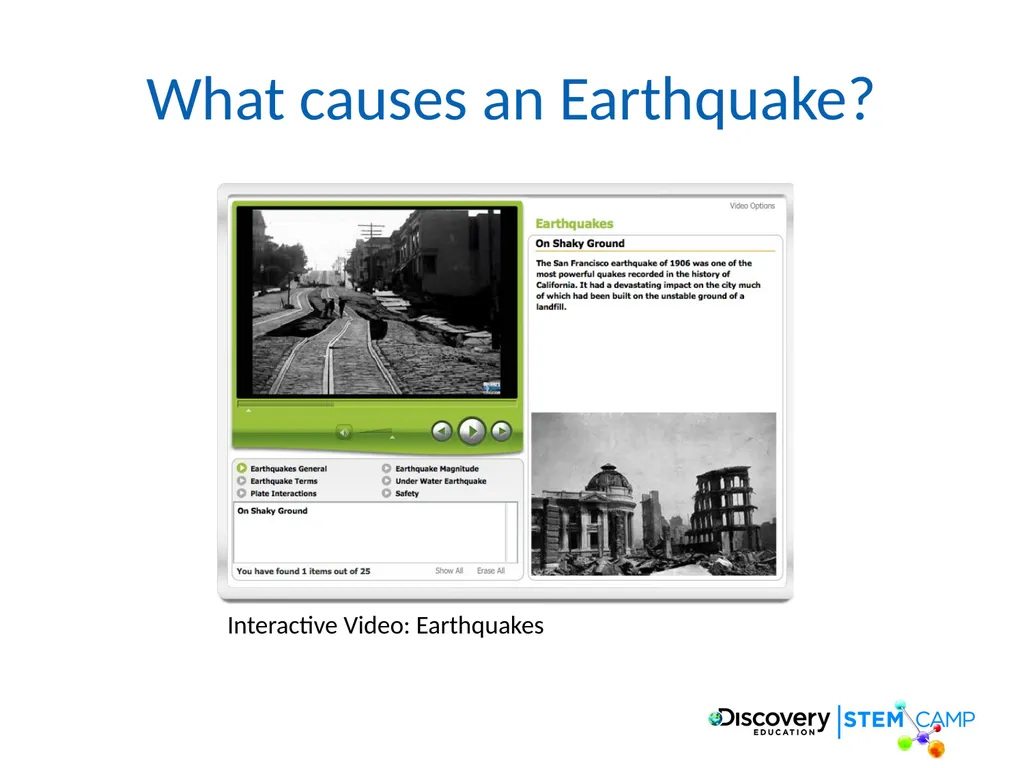
What causes an Earthquake? Interactive Video: Earthquakes<br>
08
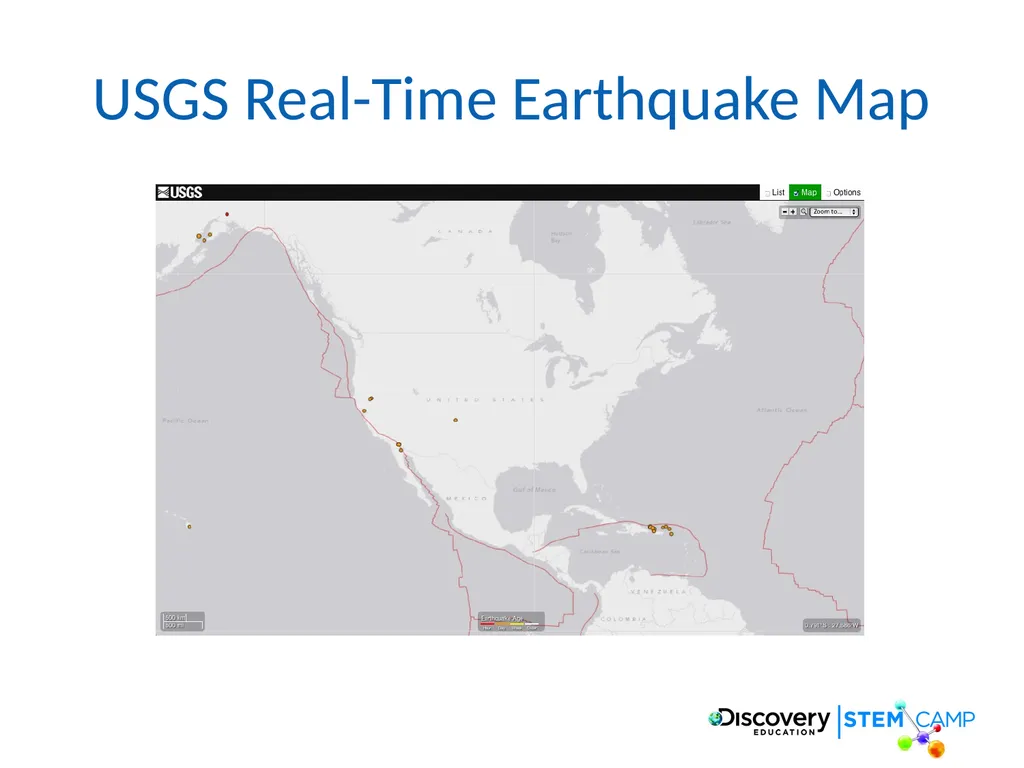
USGS Real-Time Earthquake Map<br>
09
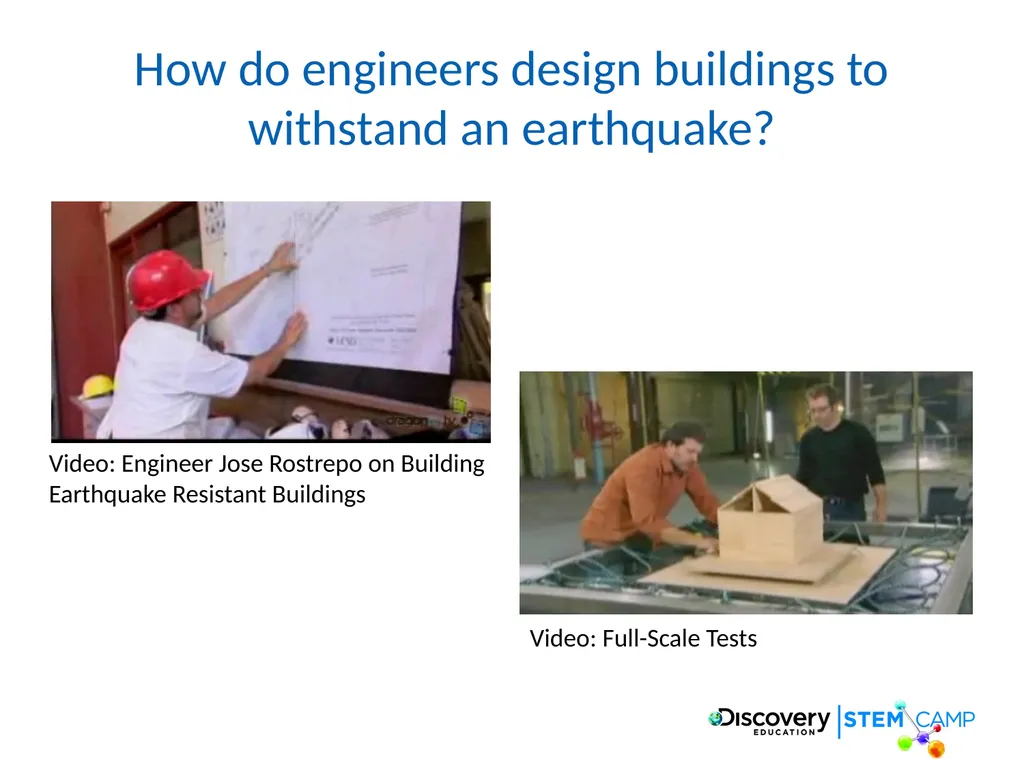
How do engineers design buildings to withstand an earthquake? Video: Engineer Jose Rostrepo on Building Earthquake Resistant Buildings Video: Full-Scale Tests<br>
10
Activity: Building for an Earthquake<br>
11
Activity: People Move<br>
12
STEMtastic Careers<br>
13
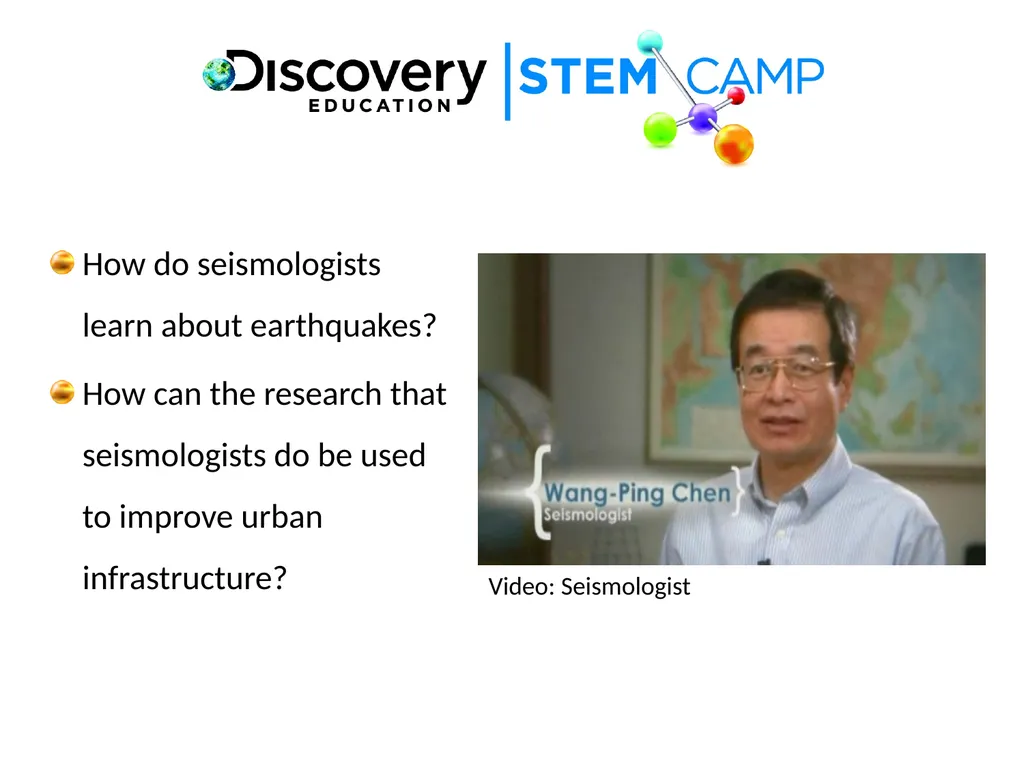
How do seismologists learn about earthquakes?
How can the research that seismologists do be used to improve urban infrastructure? Video: Seismologist<br>
14
Dream School Engineering Challenge: Phase Three<br>
15
Mind Snacks<br>
16
Dream School Engineering Challenge: Phase Four<br>
17
Notebook Reflection Based on what have you learned about urban infrastructure and earthquakes, what measures is your team taking to make sure your school is safe?<br>
18
Wrap Up<br>
19
What other geologic factors do you think must be accounted for when designing urban infrastructure? Think about this…<br>