
USAID ECONOMIC DEVELOPMENT, GOVERNANCE AND
TF
Published · 54 slides · 0 views
1 / 1


Description
USAID ECONOMIC DEVELOPMENT, GOVERNANCE AND ENTERPRISE GROWTH PROJECT (EDGE) USAID PROJECT - PARTNERSHIP FOR BETTER BUSINESS REGULATION Workforce Assessment Report ICT Industry Objective: To provide a comprehensive picture of the
Related Topics
Share
Embed code
Download this presentation From Below
"USAID ECONOMIC DEVELOPMENT, GOVERNANCE AND" is the property of its rightful owner. Permission is granted to download and print the materials on this website for personal, non-commercial use only, and to display it on your personal computer provided you do not modify the materials and that you retain all copyright notices contained in the materials. By downloading content from our website, you accept the terms of this agreement.
Presentation Transcript
01
USAID ECONOMIC DEVELOPMENT, GOVERNANCE AND ENTERPRISE GROWTH PROJECT (EDGE)
USAID PROJECT - PARTNERSHIP FOR BETTER BUSINESS REGULATION<br>
02
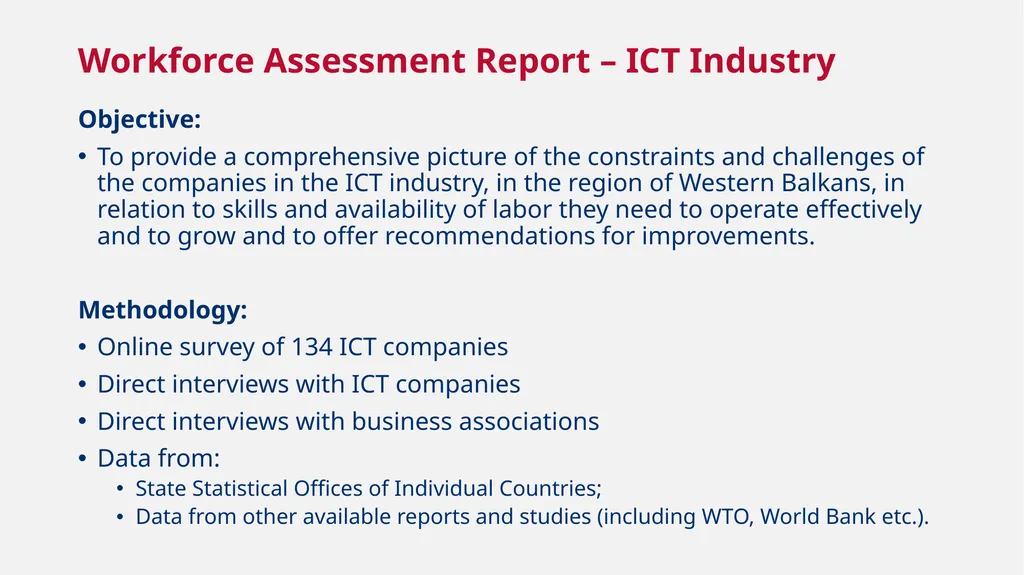
Workforce Assessment Report – ICT Industry Objective:
To provide a comprehensive picture of the constraints and challenges of the companies in the ICT industry, in the region of Western Balkans, in relation to skills and availability of labor they need to operate effectively and to grow and to offer recommendations for improvements.
Methodology:
Online survey of 134 ICT companies
Direct interviews with ICT companies
Direct interviews with business associations
Data from:
State Statistical Offices of Individual Countries;
Data from other available reports and studies (including WTO, World Bank etc.).<br>
To provide a comprehensive picture of the constraints and challenges of the companies in the ICT industry, in the region of Western Balkans, in relation to skills and availability of labor they need to operate effectively and to grow and to offer recommendations for improvements.
Methodology:
Online survey of 134 ICT companies
Direct interviews with ICT companies
Direct interviews with business associations
Data from:
State Statistical Offices of Individual Countries;
Data from other available reports and studies (including WTO, World Bank etc.).<br>
03
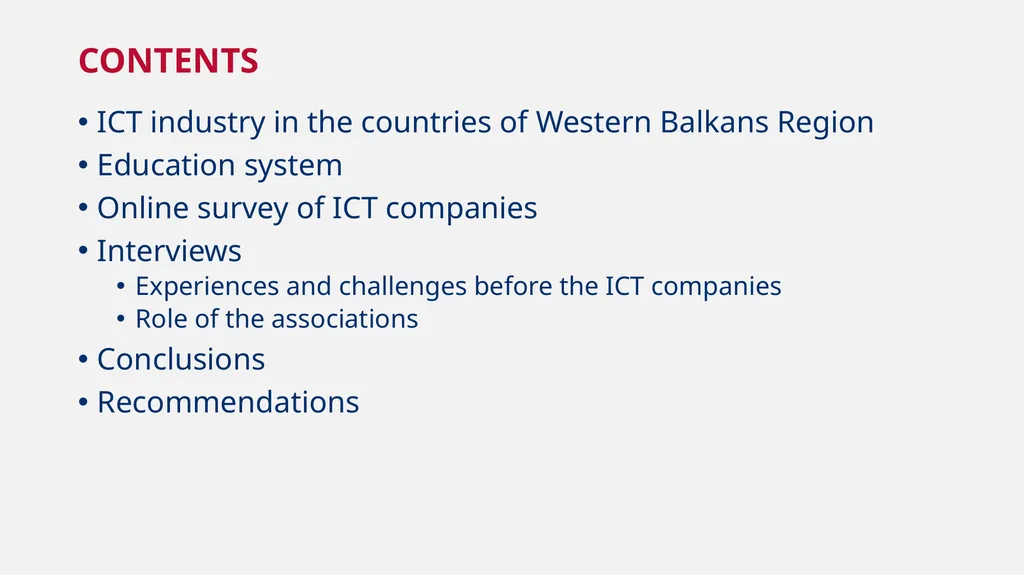
CONTENTS ICT industry in the countries of Western Balkans Region
Education system
Online survey of ICT companies
Interviews
Experiences and challenges before the ICT companies
Role of the associations
Conclusions
Recommendations<br>
Education system
Online survey of ICT companies
Interviews
Experiences and challenges before the ICT companies
Role of the associations
Conclusions
Recommendations<br>
04
ICT INDUSTRY IN THE WESTERN BALKANS<br>
05
ICT Industry in the Western Balkans Region Steady growth in the last five years
Important employer
Increase in exports of ICT services
An industry with an important contribution to the GDP<br>
Important employer
Increase in exports of ICT services
An industry with an important contribution to the GDP<br>
06
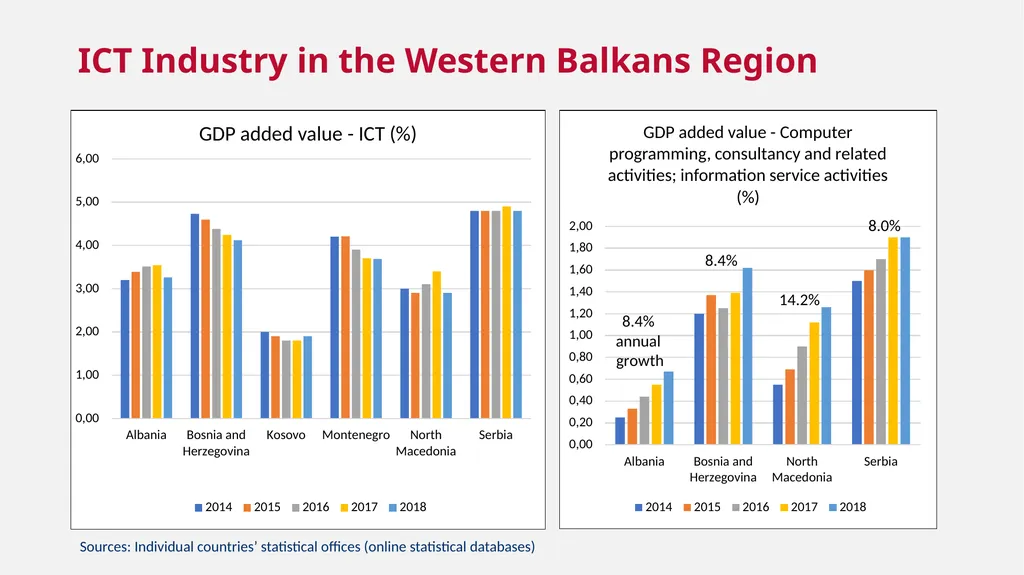
ICT Industry in the Western Balkans Region Sources: Individual countries’ statistical offices (online statistical databases)<br>
07
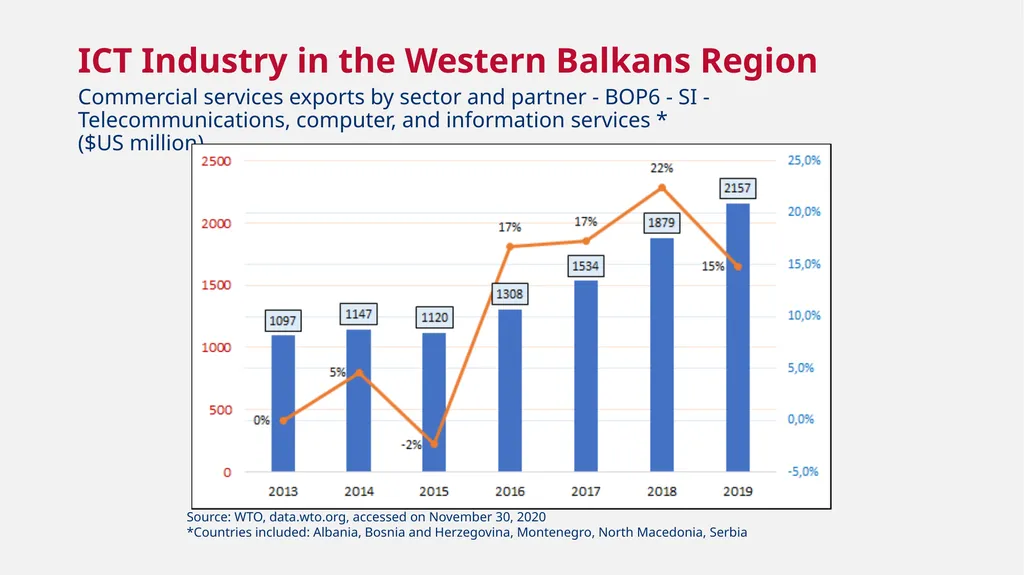
ICT Industry in the Western Balkans Region Commercial services exports by sector and partner - BOP6 - SI - Telecommunications, computer, and information services * ($US million) Source: WTO, data.wto.org, accessed on November 30, 2020
*Countries included: Albania, Bosnia and Herzegovina, Montenegro, North Macedonia, Serbia<br>
*Countries included: Albania, Bosnia and Herzegovina, Montenegro, North Macedonia, Serbia<br>
08
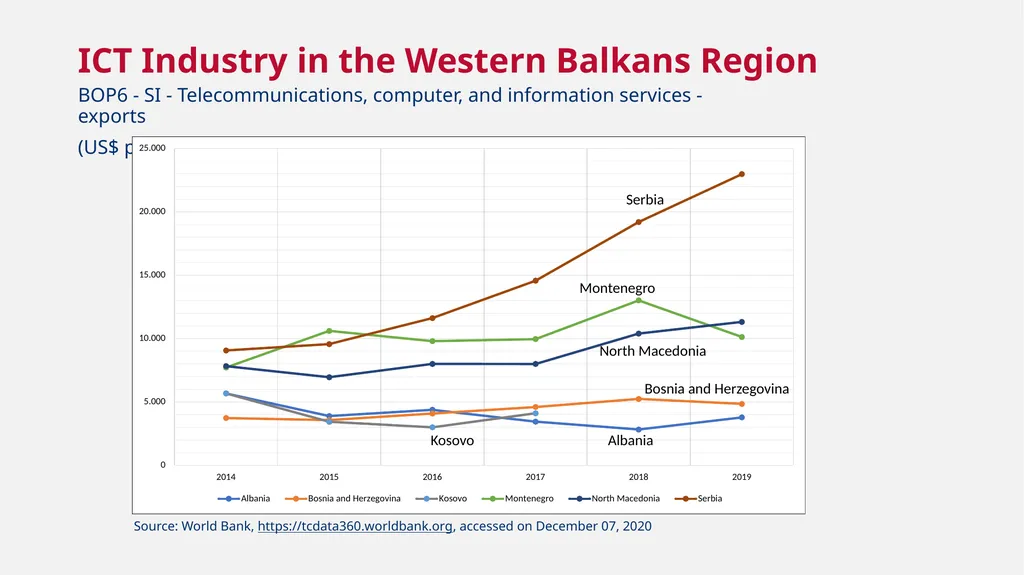
ICT Industry in the Western Balkans Region BOP6 - SI - Telecommunications, computer, and information services - exports
(US$ per 100 people) Source: World Bank, https://tcdata360.worldbank.org, accessed on December 07, 2020 Serbia Montenegro North Macedonia Bosnia and Herzegovina Albania Kosovo<br>
(US$ per 100 people) Source: World Bank, https://tcdata360.worldbank.org, accessed on December 07, 2020 Serbia Montenegro North Macedonia Bosnia and Herzegovina Albania Kosovo<br>
09
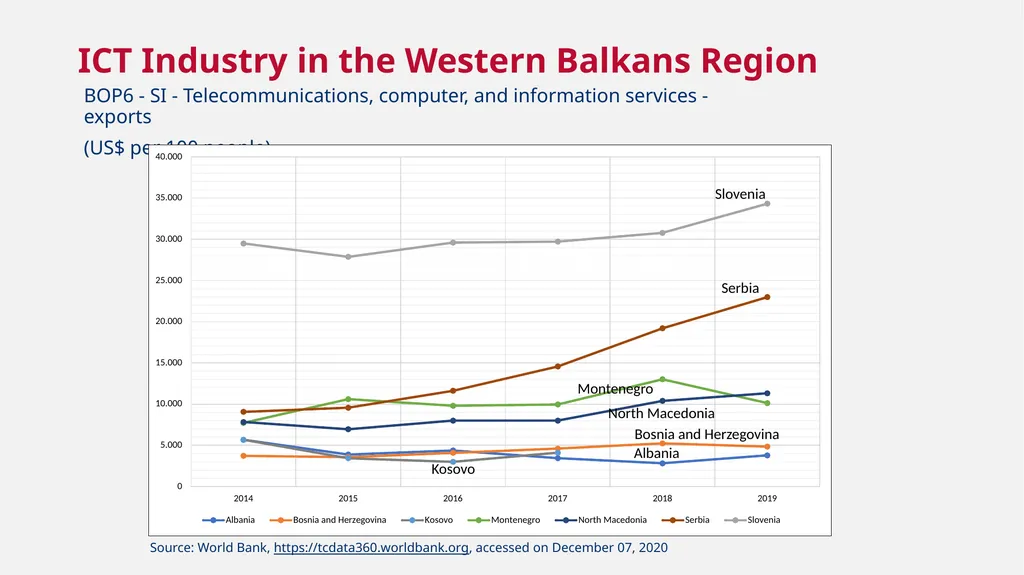
ICT Industry in the Western Balkans Region BOP6 - SI - Telecommunications, computer, and information services - exports
(US$ per 100 people) Source: World Bank, https://tcdata360.worldbank.org, accessed on December 07, 2020 Serbia Montenegro North Macedonia Bosnia and Herzegovina Albania Kosovo Slovenia<br>
(US$ per 100 people) Source: World Bank, https://tcdata360.worldbank.org, accessed on December 07, 2020 Serbia Montenegro North Macedonia Bosnia and Herzegovina Albania Kosovo Slovenia<br>
10
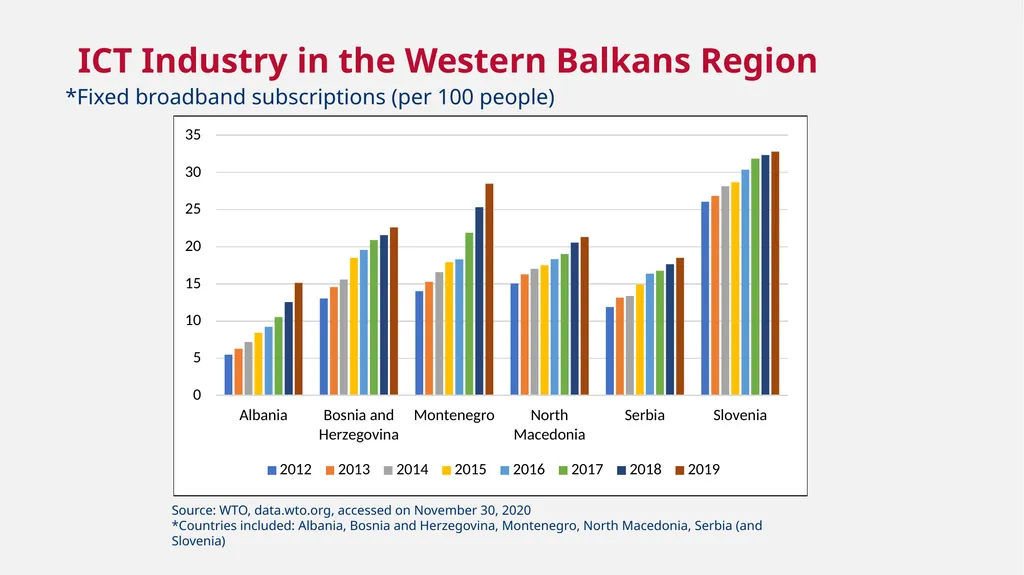
ICT Industry in the Western Balkans Region *Fixed broadband subscriptions (per 100 people) Source: WTO, data.wto.org, accessed on November 30, 2020
*Countries included: Albania, Bosnia and Herzegovina, Montenegro, North Macedonia, Serbia (and Slovenia)<br>
*Countries included: Albania, Bosnia and Herzegovina, Montenegro, North Macedonia, Serbia (and Slovenia)<br>
11
EDUCATION SYSTEMS IN WESTERN BALKANS<br>
12
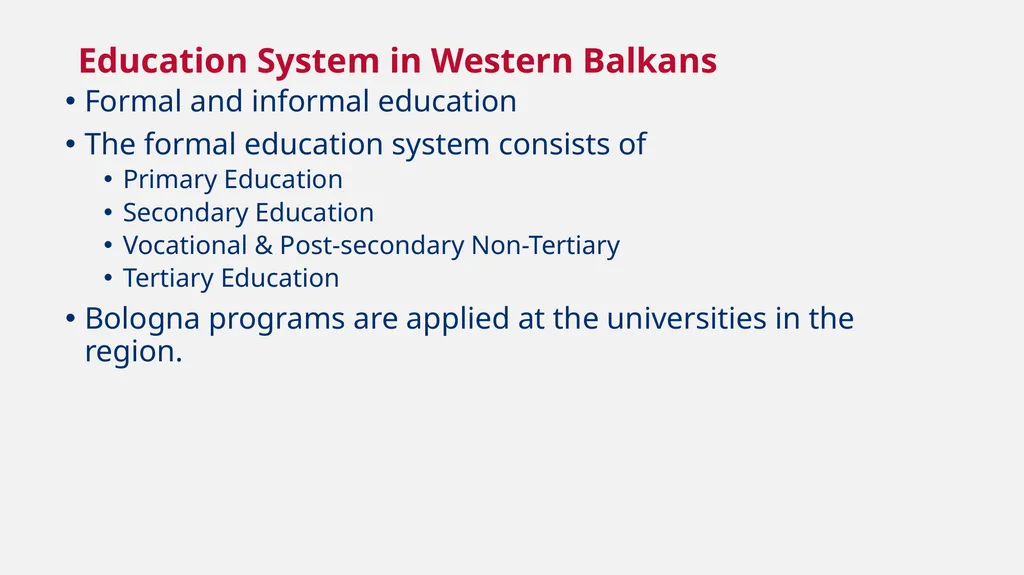
Education System in Western Balkans Formal and informal education
The formal education system consists of
Primary Education
Secondary Education
Vocational & Post-secondary Non-Tertiary
Tertiary Education
Bologna programs are applied at the universities in the region.<br>
The formal education system consists of
Primary Education
Secondary Education
Vocational & Post-secondary Non-Tertiary
Tertiary Education
Bologna programs are applied at the universities in the region.<br>
13
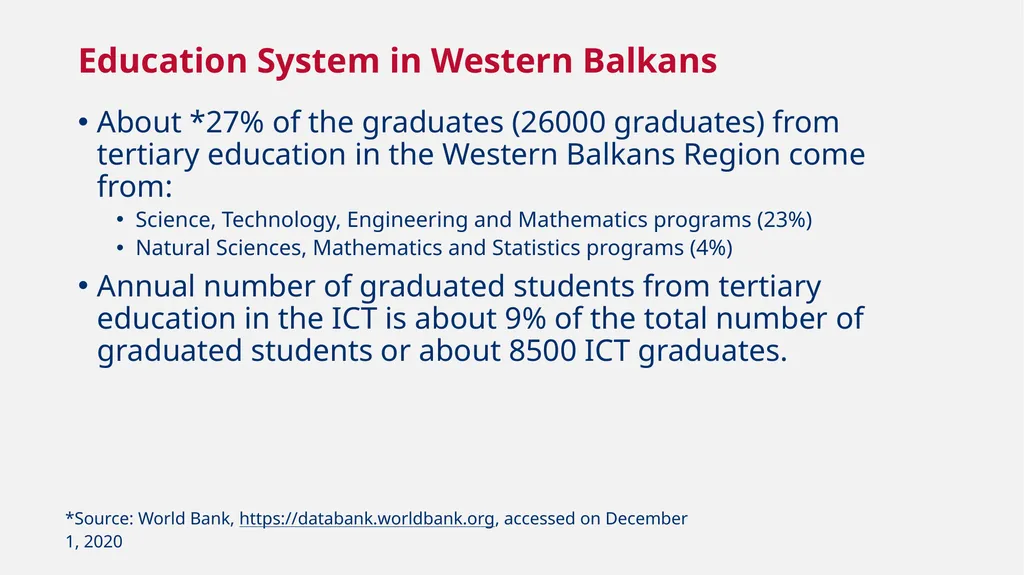
Education System in Western Balkans About *27% of the graduates (26000 graduates) from tertiary education in the Western Balkans Region come from:
Science, Technology, Engineering and Mathematics programs (23%)
Natural Sciences, Mathematics and Statistics programs (4%)
Annual number of graduated students from tertiary education in the ICT is about 9% of the total number of graduated students or about 8500 ICT graduates. *Source: World Bank, https://databank.worldbank.org, accessed on December 1, 2020<br>
Science, Technology, Engineering and Mathematics programs (23%)
Natural Sciences, Mathematics and Statistics programs (4%)
Annual number of graduated students from tertiary education in the ICT is about 9% of the total number of graduated students or about 8500 ICT graduates. *Source: World Bank, https://databank.worldbank.org, accessed on December 1, 2020<br>
14
LABOR MARKET ICT<br>
15
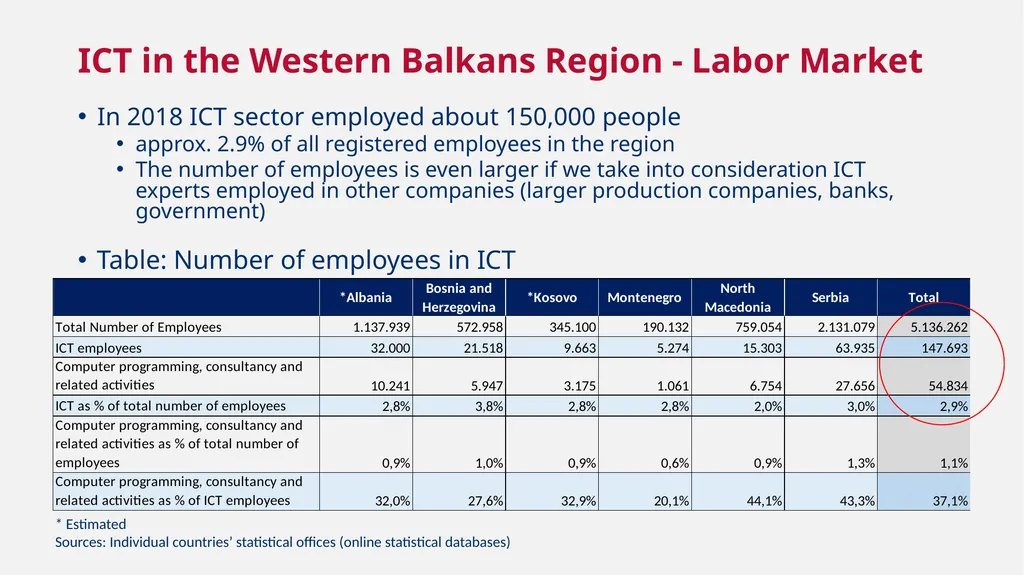
ICT in the Western Balkans Region - Labor Market Table: Number of employees in ICT * Estimated
Sources: Individual countries’ statistical offices (online statistical databases) In 2018 ICT sector employed about 150,000 people
approx. 2.9% of all registered employees in the region
The number of employees is even larger if we take into consideration ICT experts employed in other companies (larger production companies, banks, government)<br>
Sources: Individual countries’ statistical offices (online statistical databases) In 2018 ICT sector employed about 150,000 people
approx. 2.9% of all registered employees in the region
The number of employees is even larger if we take into consideration ICT experts employed in other companies (larger production companies, banks, government)<br>
16
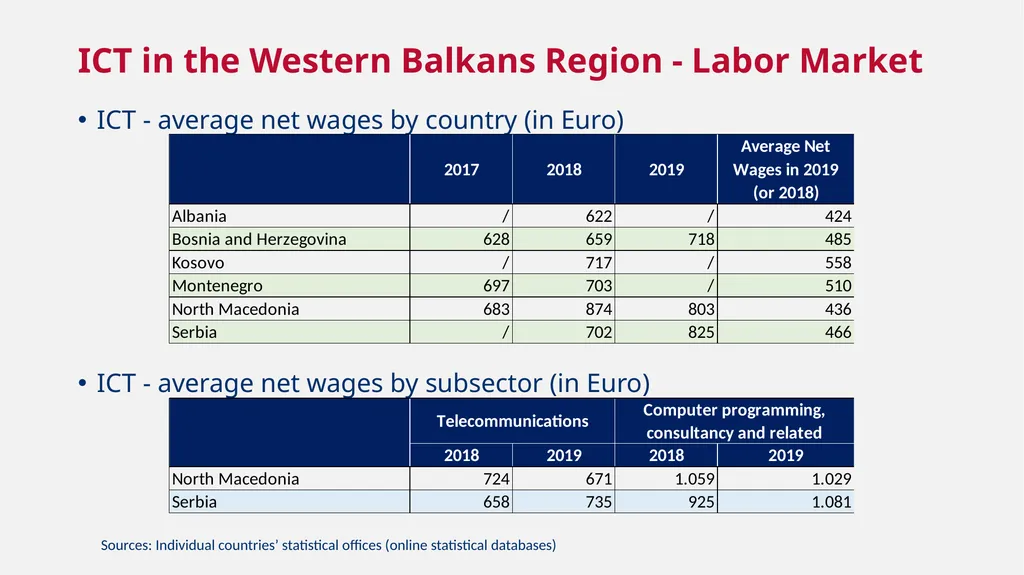
ICT in the Western Balkans Region - Labor Market ICT - average net wages by country (in Euro) Sources: Individual countries’ statistical offices (online statistical databases) ICT - average net wages by subsector (in Euro)<br>
17
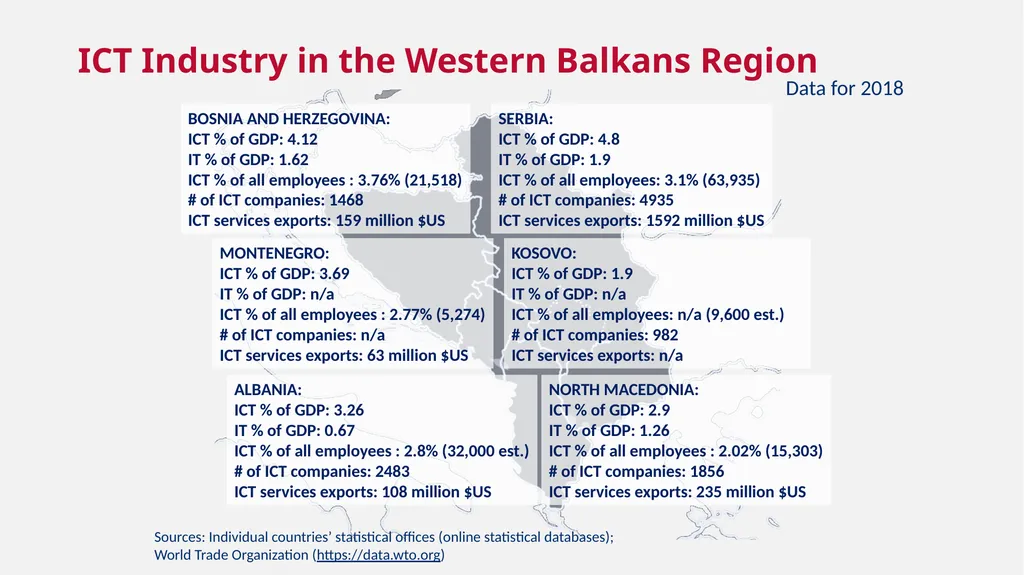
ICT Industry in the Western Balkans Region SERBIA:
ICT % of GDP: 4.8
IT % of GDP: 1.9
ICT % of all employees: 3.1% (63,935)
# of ICT companies: 4935
ICT services exports: 1592 million $US NORTH MACEDONIA:
ICT % of GDP: 2.9
IT % of GDP: 1.26
ICT % of all employees : 2.02% (15,303)
# of ICT companies: 1856
ICT services exports: 235 million $US ALBANIA:
ICT % of GDP: 3.26
IT % of GDP: 0.67
ICT % of all employees : 2.8% (32,000 est.)
# of ICT companies: 2483
ICT services exports: 108 million $US BOSNIA AND HERZEGOVINA:
ICT % of GDP: 4.12
IT % of GDP: 1.62
ICT % of all employees : 3.76% (21,518)
# of ICT companies: 1468
ICT services exports: 159 million $US MONTENEGRO:
ICT % of GDP: 3.69
IT % of GDP: n/a
ICT % of all employees : 2.77% (5,274)
# of ICT companies: n/a
ICT services exports: 63 million $US KOSOVO:
ICT % of GDP: 1.9
IT % of GDP: n/a
ICT % of all employees: n/a (9,600 est.)
# of ICT companies: 982
ICT services exports: n/a Sources: Individual countries’ statistical offices (online statistical databases);
World Trade Organization (https://data.wto.org) Data for 2018<br>
ICT % of GDP: 4.8
IT % of GDP: 1.9
ICT % of all employees: 3.1% (63,935)
# of ICT companies: 4935
ICT services exports: 1592 million $US NORTH MACEDONIA:
ICT % of GDP: 2.9
IT % of GDP: 1.26
ICT % of all employees : 2.02% (15,303)
# of ICT companies: 1856
ICT services exports: 235 million $US ALBANIA:
ICT % of GDP: 3.26
IT % of GDP: 0.67
ICT % of all employees : 2.8% (32,000 est.)
# of ICT companies: 2483
ICT services exports: 108 million $US BOSNIA AND HERZEGOVINA:
ICT % of GDP: 4.12
IT % of GDP: 1.62
ICT % of all employees : 3.76% (21,518)
# of ICT companies: 1468
ICT services exports: 159 million $US MONTENEGRO:
ICT % of GDP: 3.69
IT % of GDP: n/a
ICT % of all employees : 2.77% (5,274)
# of ICT companies: n/a
ICT services exports: 63 million $US KOSOVO:
ICT % of GDP: 1.9
IT % of GDP: n/a
ICT % of all employees: n/a (9,600 est.)
# of ICT companies: 982
ICT services exports: n/a Sources: Individual countries’ statistical offices (online statistical databases);
World Trade Organization (https://data.wto.org) Data for 2018<br>
18
ONLINE SURVEY OF ICT COMPANIES<br>
19
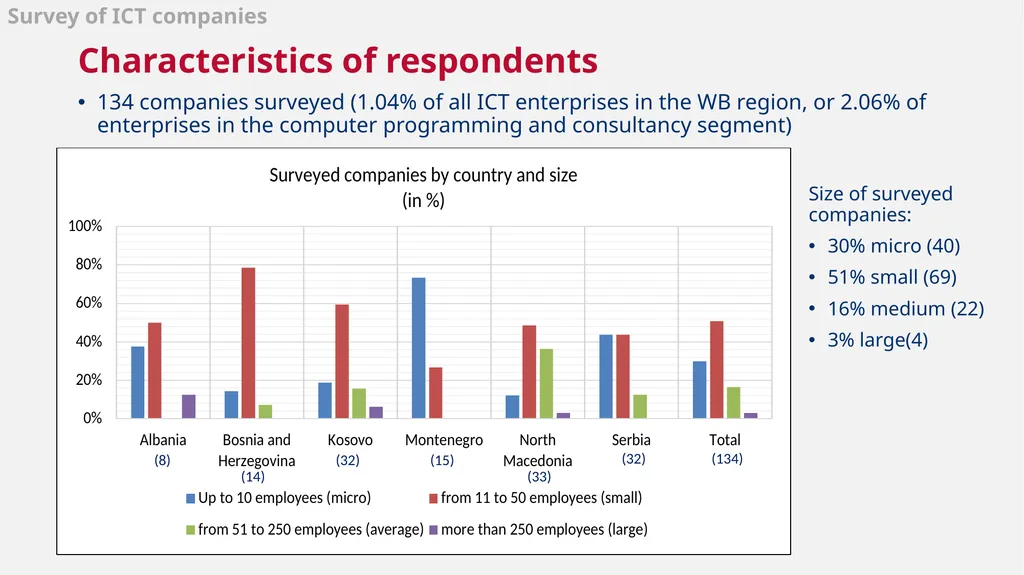
Characteristics of respondents 134 companies surveyed (1.04% of all ICT enterprises in the WB region, or 2.06% of enterprises in the computer programming and consultancy segment) Survey of ICT companies Size of surveyed companies:
30% micro (40)
51% small (69)
16% medium (22)
3% large(4)<br>
30% micro (40)
51% small (69)
16% medium (22)
3% large(4)<br>
20
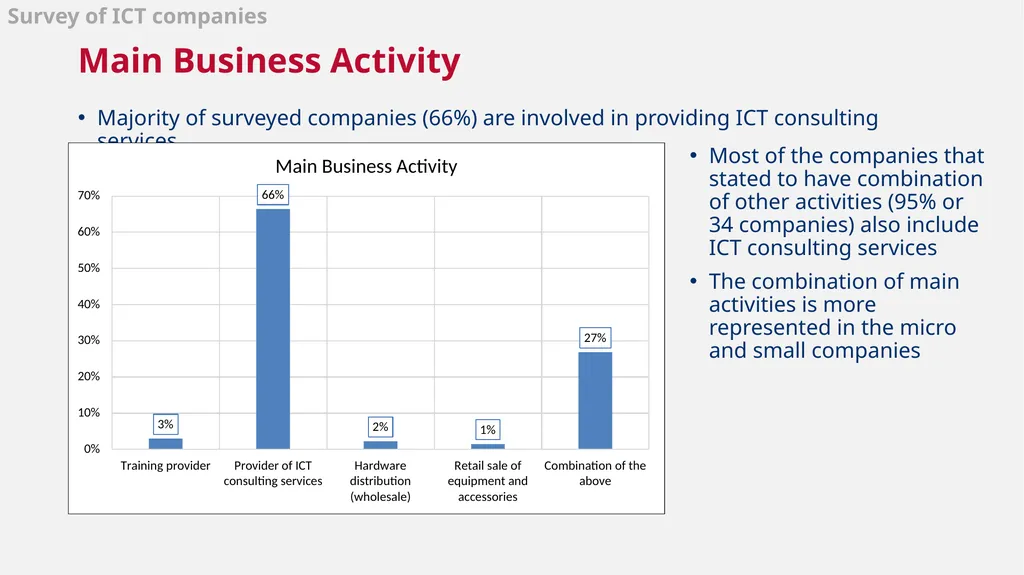
Main Business Activity Majority of surveyed companies (66%) are involved in providing ICT consulting services Survey of ICT companies Most of the companies that stated to have combination of other activities (95% or 34 companies) also include ICT consulting services
The combination of main activities is more represented in the micro and small companies<br>
The combination of main activities is more represented in the micro and small companies<br>
21
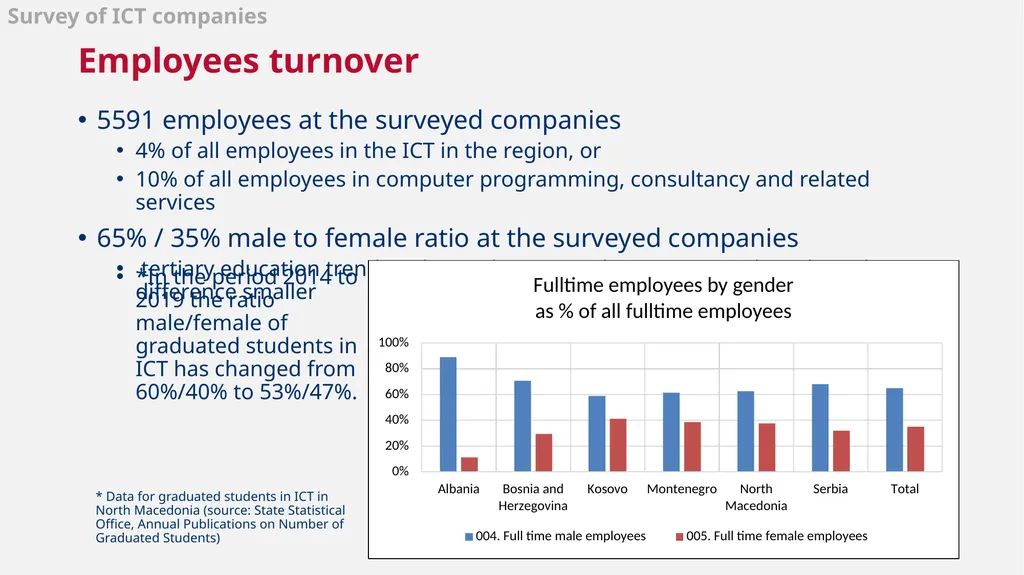
Employees turnover 5591 employees at the surveyed companies
4% of all employees in the ICT in the region, or
10% of all employees in computer programming, consultancy and related services
65% / 35% male to female ratio at the surveyed companies
tertiary education trends indicate changes in this ratio towards making the difference smaller Survey of ICT companies *In the period 2014 to 2019 the ratio male/female of graduated students in ICT has changed from 60%/40% to 53%/47%. * Data for graduated students in ICT in North Macedonia (source: State Statistical Office, Annual Publications on Number of Graduated Students)<br>
4% of all employees in the ICT in the region, or
10% of all employees in computer programming, consultancy and related services
65% / 35% male to female ratio at the surveyed companies
tertiary education trends indicate changes in this ratio towards making the difference smaller Survey of ICT companies *In the period 2014 to 2019 the ratio male/female of graduated students in ICT has changed from 60%/40% to 53%/47%. * Data for graduated students in ICT in North Macedonia (source: State Statistical Office, Annual Publications on Number of Graduated Students)<br>
22
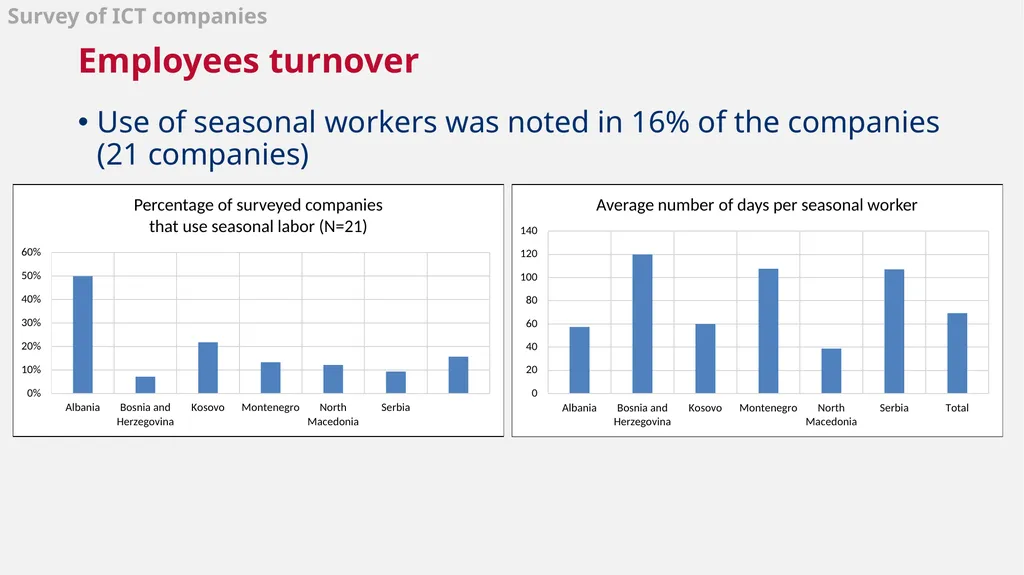
Employees turnover Use of seasonal workers was noted in 16% of the companies (21 companies) Survey of ICT companies<br>
23
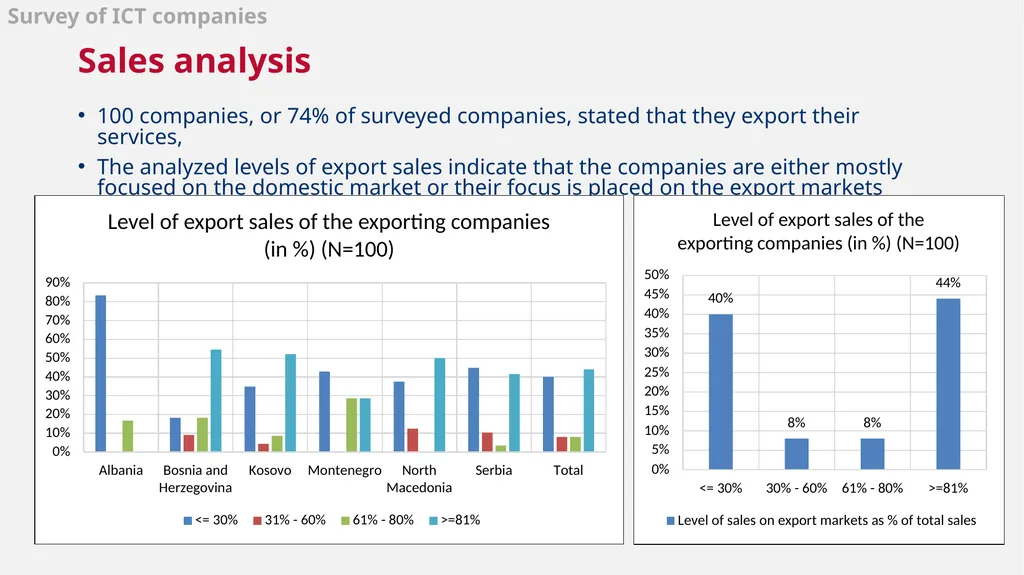
Sales analysis 100 companies, or 74% of surveyed companies, stated that they export their services,
The analyzed levels of export sales indicate that the companies are either mostly focused on the domestic market or their focus is placed on the export markets Survey of ICT companies<br>
The analyzed levels of export sales indicate that the companies are either mostly focused on the domestic market or their focus is placed on the export markets Survey of ICT companies<br>
24
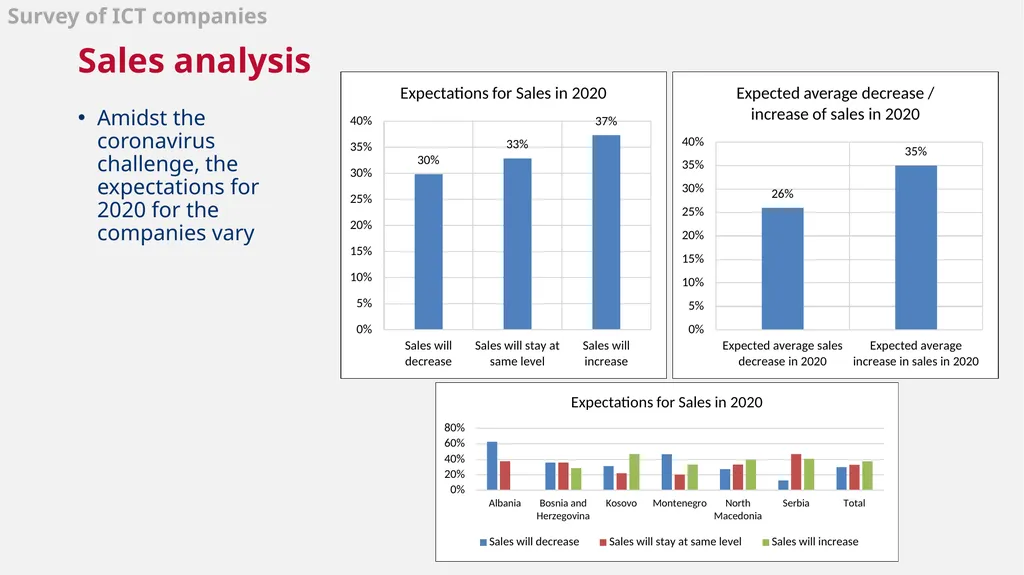
Sales analysis Amidst the coronavirus challenge, the expectations for 2020 for the companies vary Survey of ICT companies<br>
25
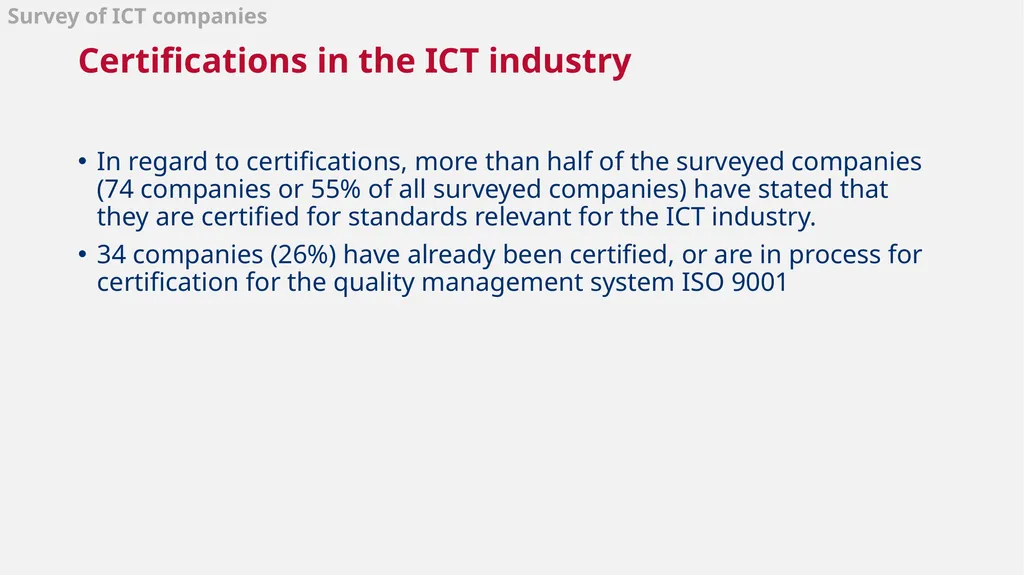
Certifications in the ICT industry In regard to certifications, more than half of the surveyed companies (74 companies or 55% of all surveyed companies) have stated that they are certified for standards relevant for the ICT industry.
34 companies (26%) have already been certified, or are in process for certification for the quality management system ISO 9001 Survey of ICT companies<br>
34 companies (26%) have already been certified, or are in process for certification for the quality management system ISO 9001 Survey of ICT companies<br>
26
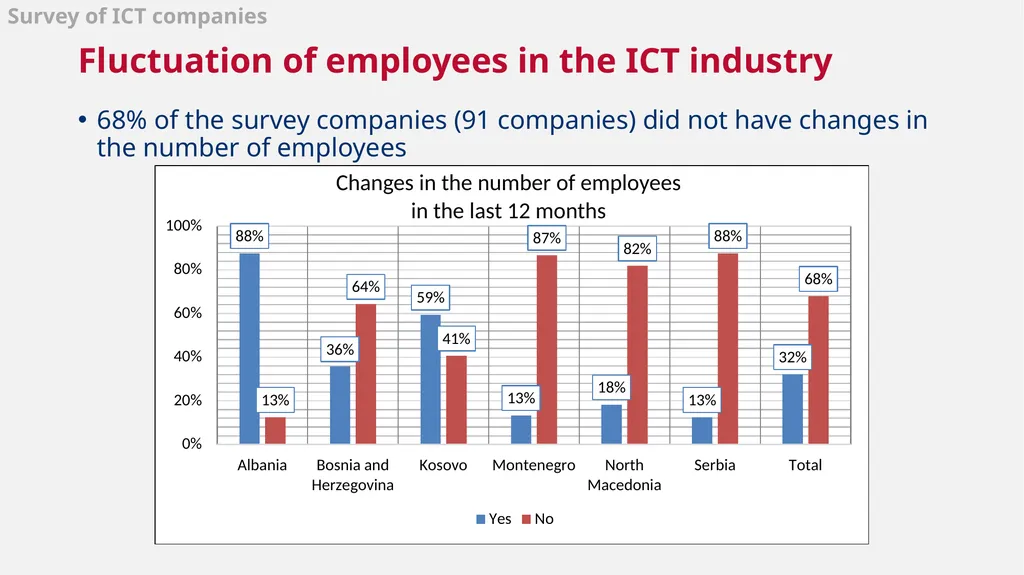
Fluctuation of employees in the ICT industry 68% of the survey companies (91 companies) did not have changes in the number of employees Survey of ICT companies<br>
27
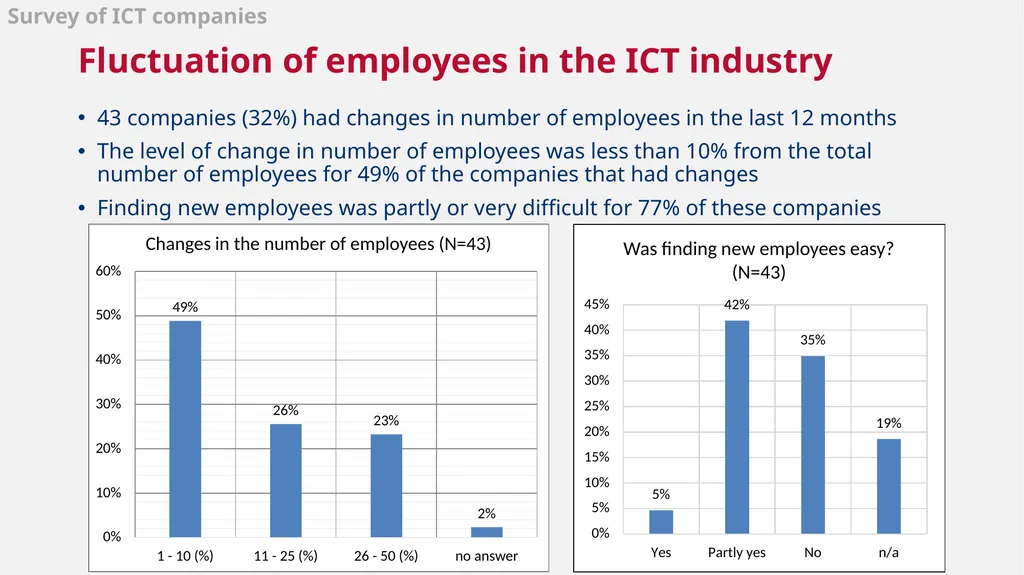
Fluctuation of employees in the ICT industry 43 companies (32%) had changes in number of employees in the last 12 months
The level of change in number of employees was less than 10% from the total number of employees for 49% of the companies that had changes
Finding new employees was partly or very difficult for 77% of these companies Survey of ICT companies<br>
The level of change in number of employees was less than 10% from the total number of employees for 49% of the companies that had changes
Finding new employees was partly or very difficult for 77% of these companies Survey of ICT companies<br>
28
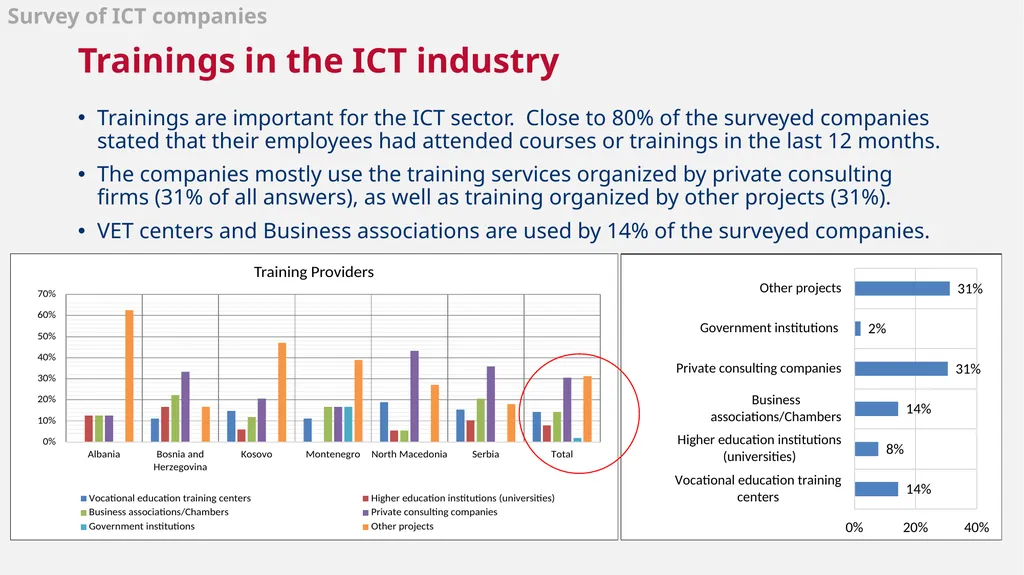
Trainings in the ICT industry Trainings are important for the ICT sector. Close to 80% of the surveyed companies stated that their employees had attended courses or trainings in the last 12 months.
The companies mostly use the training services organized by private consulting firms (31% of all answers), as well as training organized by other projects (31%).
VET centers and Business associations are used by 14% of the surveyed companies. Survey of ICT companies<br>
The companies mostly use the training services organized by private consulting firms (31% of all answers), as well as training organized by other projects (31%).
VET centers and Business associations are used by 14% of the surveyed companies. Survey of ICT companies<br>
29
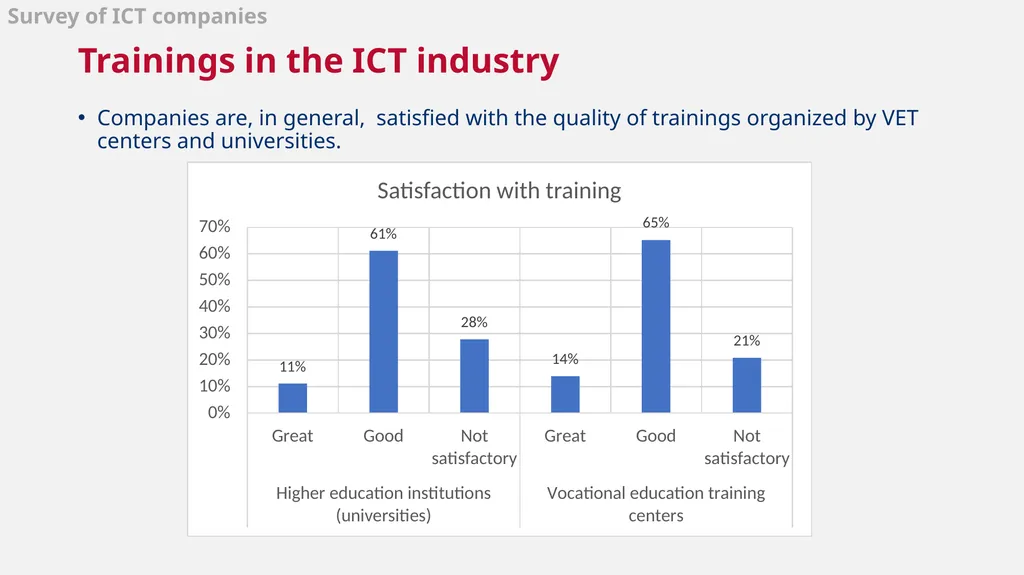
Trainings in the ICT industry Companies are, in general, satisfied with the quality of trainings organized by VET centers and universities. Survey of ICT companies<br>
30
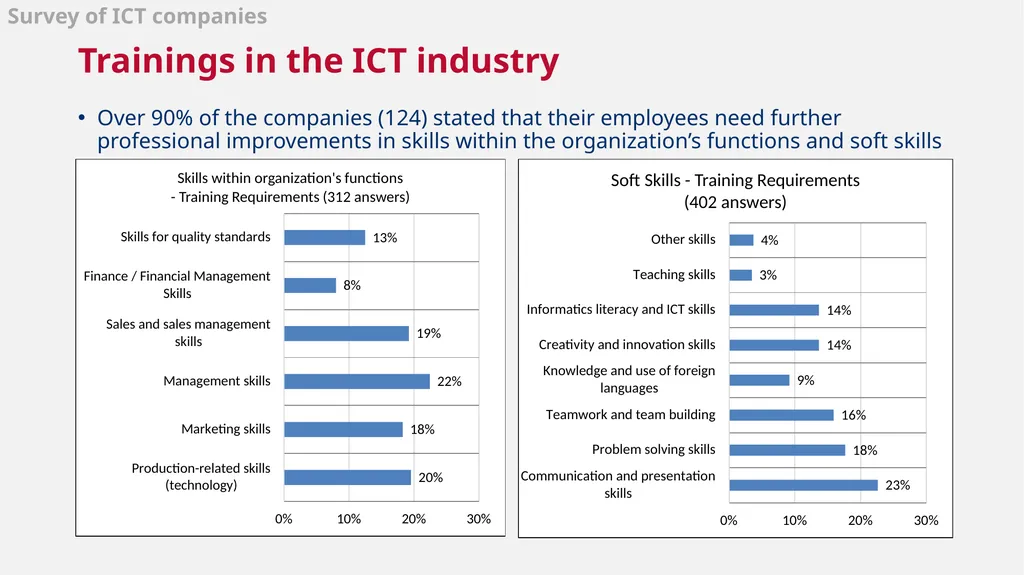
Trainings in the ICT industry Over 90% of the companies (124) stated that their employees need further professional improvements in skills within the organization’s functions and soft skills Survey of ICT companies<br>
31
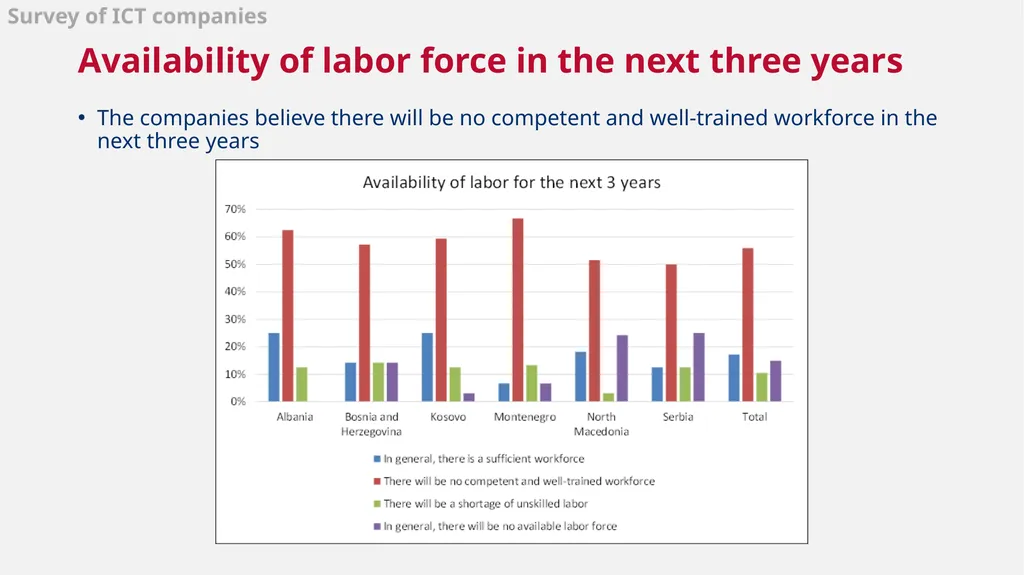
Availability of labor force in the next three years The companies believe there will be no competent and well-trained workforce in the next three years Survey of ICT companies<br>
32
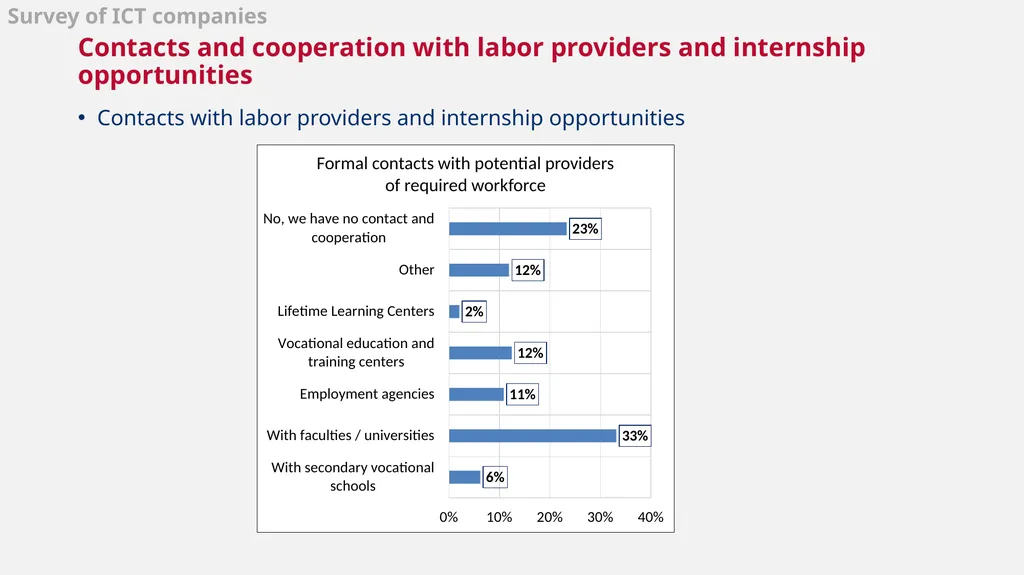
Contacts and cooperation with labor providers and internship opportunities Contacts with labor providers and internship opportunities Survey of ICT companies<br>
33
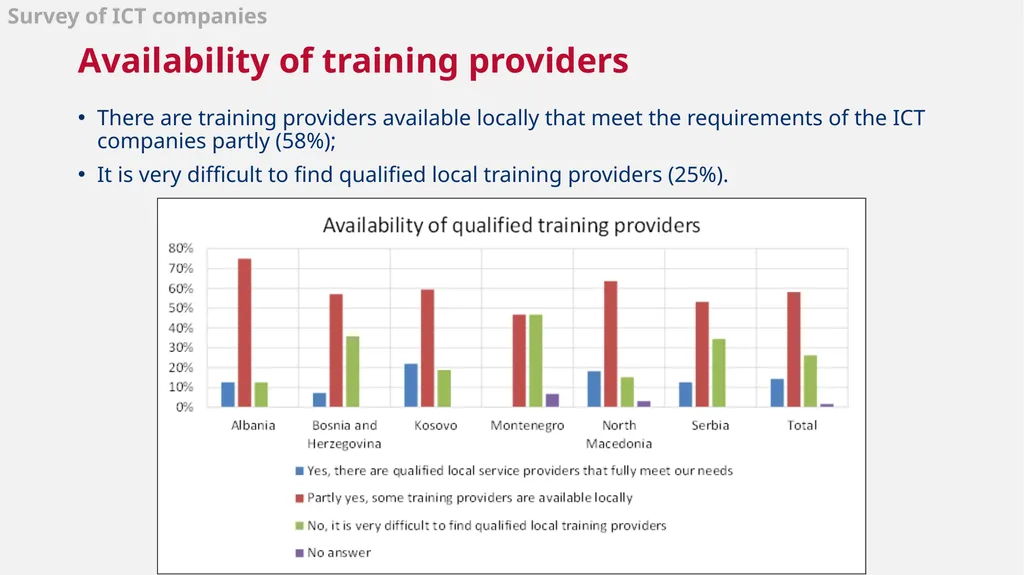
Availability of training providers There are training providers available locally that meet the requirements of the ICT companies partly (58%);
It is very difficult to find qualified local training providers (25%). Survey of ICT companies<br>
It is very difficult to find qualified local training providers (25%). Survey of ICT companies<br>
34
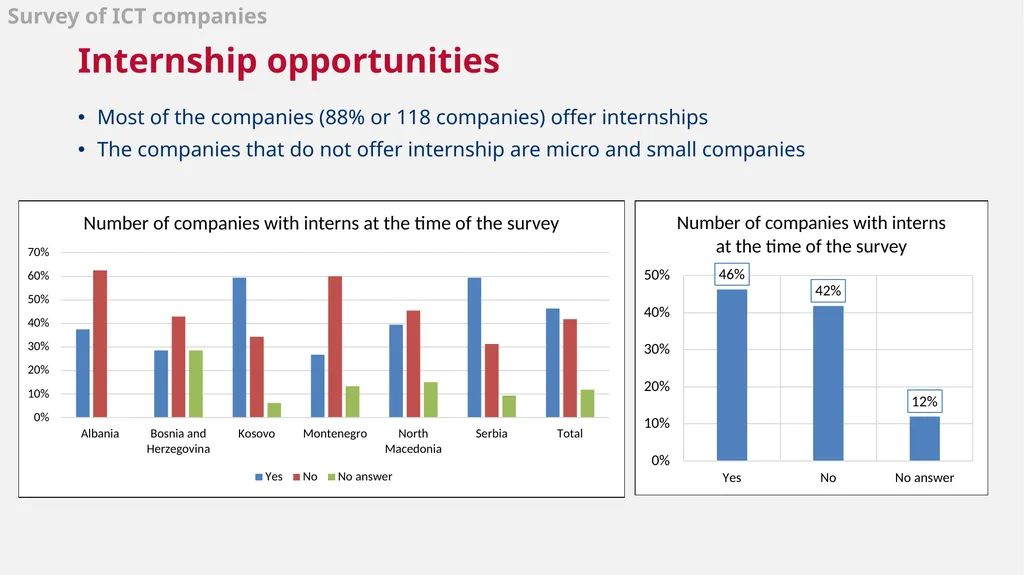
Internship opportunities Most of the companies (88% or 118 companies) offer internships
The companies that do not offer internship are micro and small companies Survey of ICT companies<br>
The companies that do not offer internship are micro and small companies Survey of ICT companies<br>
35
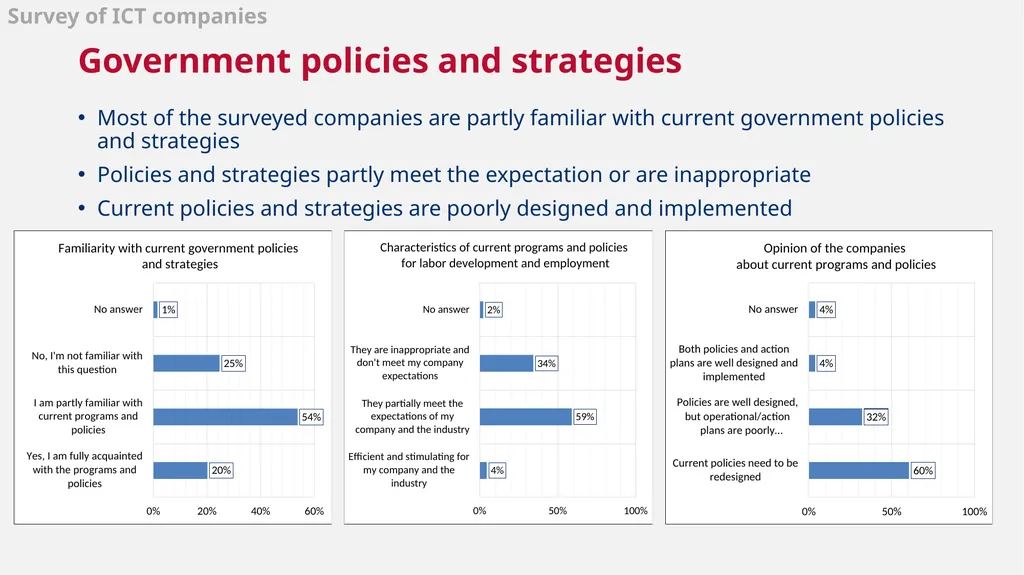
Government policies and strategies Most of the surveyed companies are partly familiar with current government policies and strategies
Policies and strategies partly meet the expectation or are inappropriate
Current policies and strategies are poorly designed and implemented Survey of ICT companies<br>
Policies and strategies partly meet the expectation or are inappropriate
Current policies and strategies are poorly designed and implemented Survey of ICT companies<br>
36
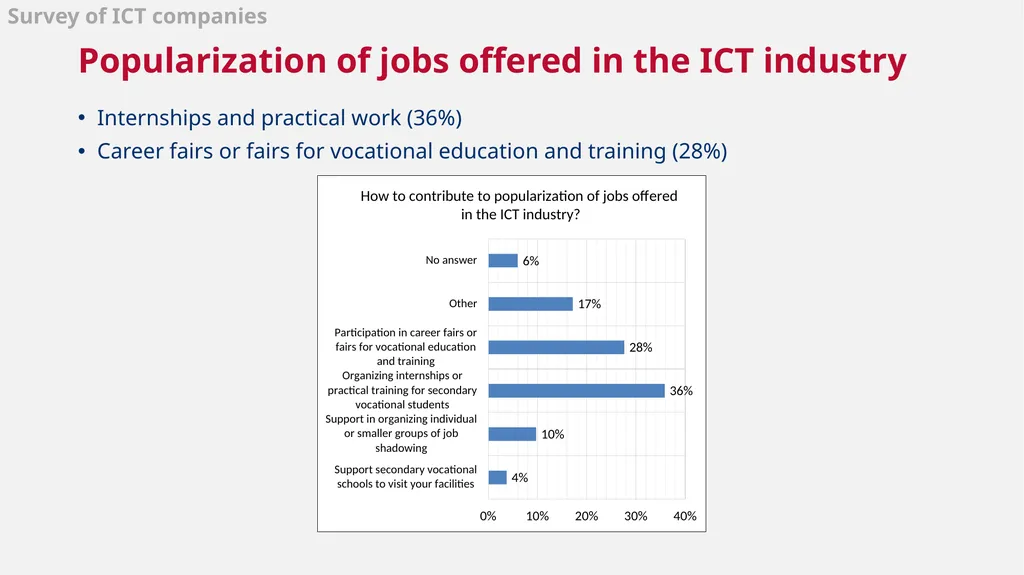
Popularization of jobs offered in the ICT industry Internships and practical work (36%)
Career fairs or fairs for vocational education and training (28%) Survey of ICT companies<br>
Career fairs or fairs for vocational education and training (28%) Survey of ICT companies<br>
37
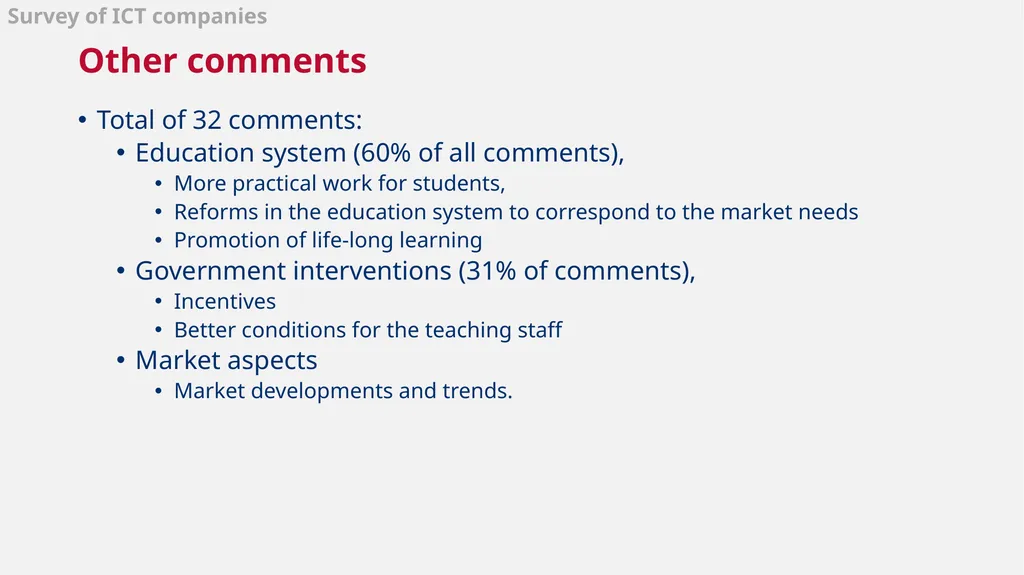
Other comments Total of 32 comments:
Education system (60% of all comments),
More practical work for students,
Reforms in the education system to correspond to the market needs
Promotion of life-long learning
Government interventions (31% of comments),
Incentives
Better conditions for the teaching staff
Market aspects
Market developments and trends. Survey of ICT companies<br>
Education system (60% of all comments),
More practical work for students,
Reforms in the education system to correspond to the market needs
Promotion of life-long learning
Government interventions (31% of comments),
Incentives
Better conditions for the teaching staff
Market aspects
Market developments and trends. Survey of ICT companies<br>
38
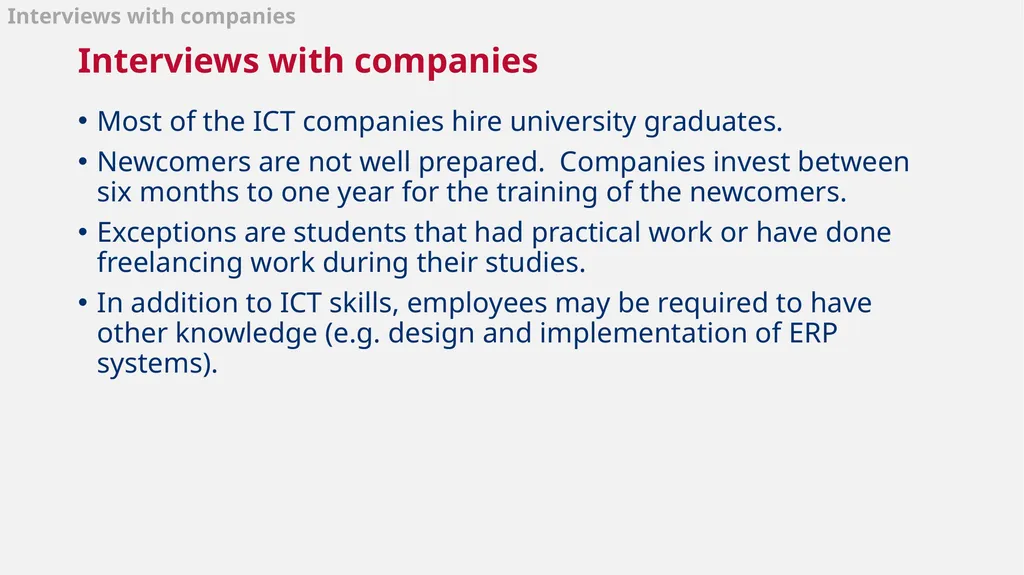
Interviews with companies Most of the ICT companies hire university graduates.
Newcomers are not well prepared. Companies invest between six months to one year for the training of the newcomers.
Exceptions are students that had practical work or have done freelancing work during their studies.
In addition to ICT skills, employees may be required to have other knowledge (e.g. design and implementation of ERP systems). Interviews with companies<br>
Newcomers are not well prepared. Companies invest between six months to one year for the training of the newcomers.
Exceptions are students that had practical work or have done freelancing work during their studies.
In addition to ICT skills, employees may be required to have other knowledge (e.g. design and implementation of ERP systems). Interviews with companies<br>
39
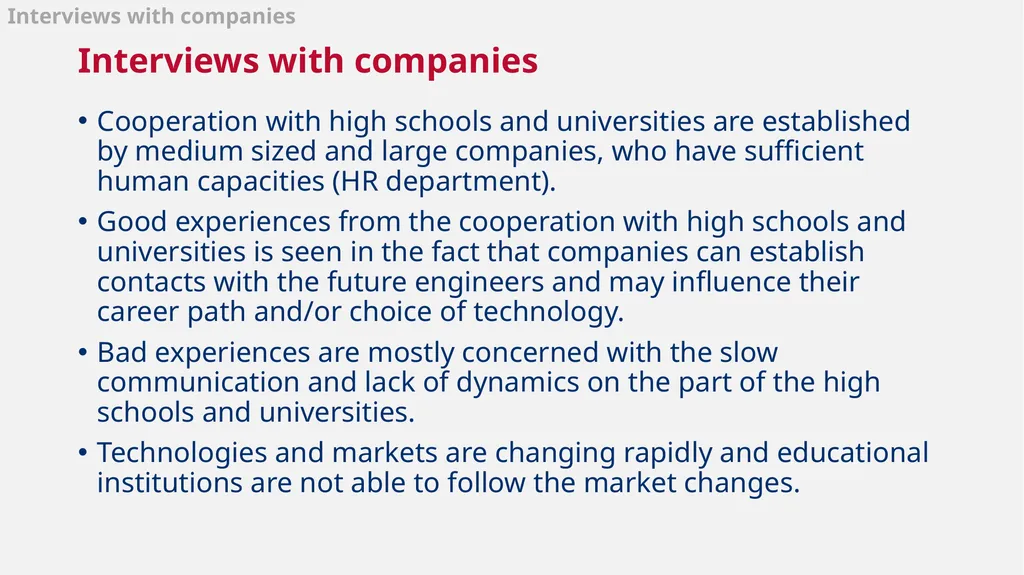
Interviews with companies Cooperation with high schools and universities are established by medium sized and large companies, who have sufficient human capacities (HR department).
Good experiences from the cooperation with high schools and universities is seen in the fact that companies can establish contacts with the future engineers and may influence their career path and/or choice of technology.
Bad experiences are mostly concerned with the slow communication and lack of dynamics on the part of the high schools and universities.
Technologies and markets are changing rapidly and educational institutions are not able to follow the market changes. Interviews with companies<br>
Good experiences from the cooperation with high schools and universities is seen in the fact that companies can establish contacts with the future engineers and may influence their career path and/or choice of technology.
Bad experiences are mostly concerned with the slow communication and lack of dynamics on the part of the high schools and universities.
Technologies and markets are changing rapidly and educational institutions are not able to follow the market changes. Interviews with companies<br>
40
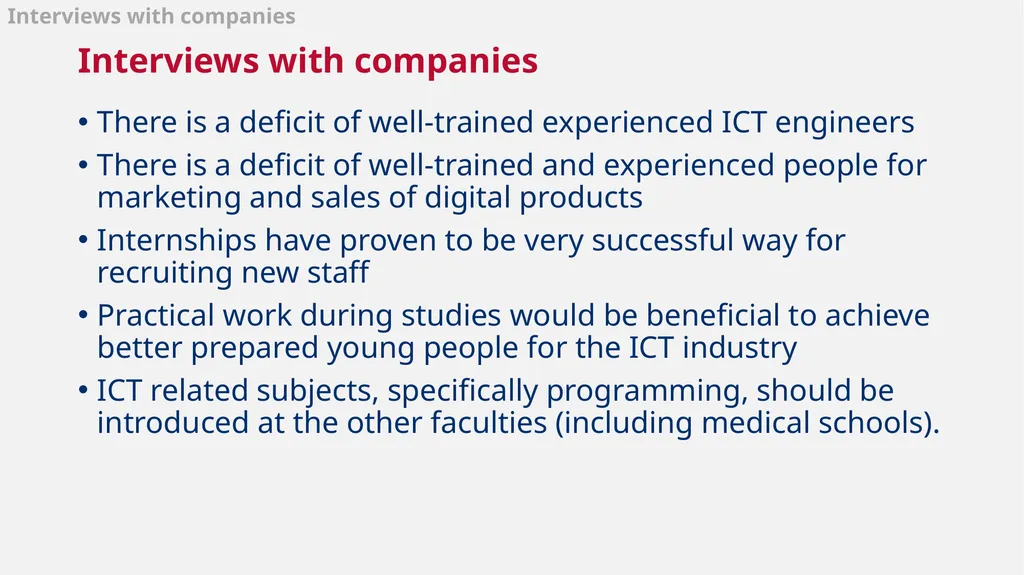
Interviews with companies There is a deficit of well-trained experienced ICT engineers
There is a deficit of well-trained and experienced people for marketing and sales of digital products
Internships have proven to be very successful way for recruiting new staff
Practical work during studies would be beneficial to achieve better prepared young people for the ICT industry
ICT related subjects, specifically programming, should be introduced at the other faculties (including medical schools). Interviews with companies<br>
There is a deficit of well-trained and experienced people for marketing and sales of digital products
Internships have proven to be very successful way for recruiting new staff
Practical work during studies would be beneficial to achieve better prepared young people for the ICT industry
ICT related subjects, specifically programming, should be introduced at the other faculties (including medical schools). Interviews with companies<br>
41
Interviews with ICT associations Associations are closely monitoring the changes in the technologies and trends
Information of training requirements:
Daily communications with the members
Regular business meetings with the members
Regular annual surveys
Regular contacts with VET schools and universities
Specialized technical trainings can be expensive, and some of the SMEs cannot finance the training. International donor support is welcome. Interviews with associations<br>
Information of training requirements:
Daily communications with the members
Regular business meetings with the members
Regular annual surveys
Regular contacts with VET schools and universities
Specialized technical trainings can be expensive, and some of the SMEs cannot finance the training. International donor support is welcome. Interviews with associations<br>
42
Interviews with ICT associations External training is mostly used by the companies when there is some kind of certification related to and required for their work.
Promotion of the concepts of life-long learning and collaborative learning on all levels.
The number of certified trainers is still low, although increasing in the last several years. Interviews with associations<br>
Promotion of the concepts of life-long learning and collaborative learning on all levels.
The number of certified trainers is still low, although increasing in the last several years. Interviews with associations<br>
43
Conclusions ICT companies:
Most of the companies are micro or small – this may mean lack of management functions and/or skills within the company;
ICT companies “specialize” working:
Mostly on the local market(s), or
Mostly subcontracting for export markets (with exceptions)
Local markets are small;
There are great potentials for export of ICT services;
Lack of well trained and experienced new employees;
Companies invest time and resources for the training.<br>
Most of the companies are micro or small – this may mean lack of management functions and/or skills within the company;
ICT companies “specialize” working:
Mostly on the local market(s), or
Mostly subcontracting for export markets (with exceptions)
Local markets are small;
There are great potentials for export of ICT services;
Lack of well trained and experienced new employees;
Companies invest time and resources for the training.<br>
44
Conclusions ICT experts:
The employees in the industry are mostly engineers;
The students are interested in the ICT sector because of the working conditions, wages and the possibilities for personal growth;
Continuous education is required for both technical and soft skills.<br>
The employees in the industry are mostly engineers;
The students are interested in the ICT sector because of the working conditions, wages and the possibilities for personal growth;
Continuous education is required for both technical and soft skills.<br>
45
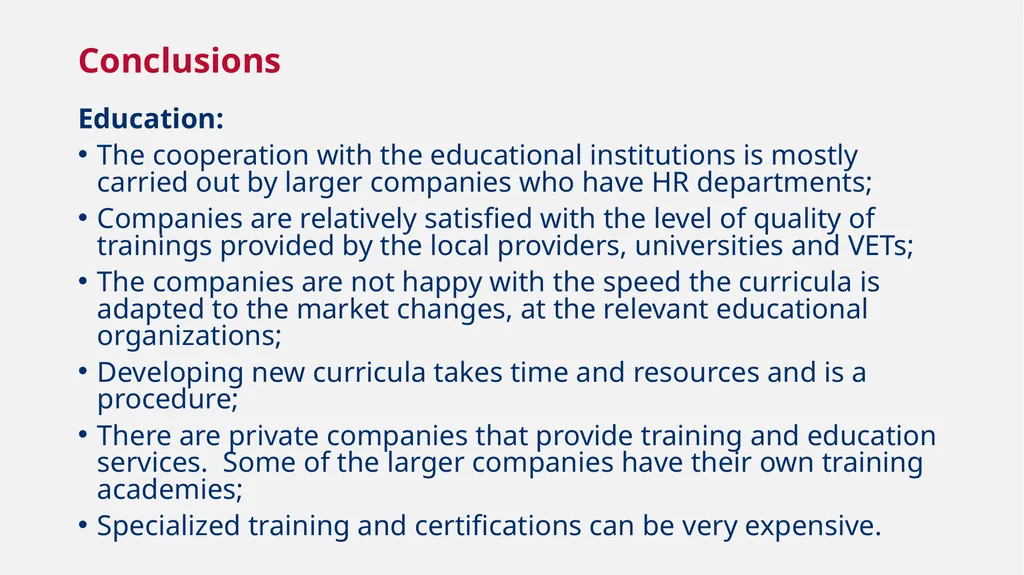
Conclusions Education:
The cooperation with the educational institutions is mostly carried out by larger companies who have HR departments;
Companies are relatively satisfied with the level of quality of trainings provided by the local providers, universities and VETs;
The companies are not happy with the speed the curricula is adapted to the market changes, at the relevant educational organizations;
Developing new curricula takes time and resources and is a procedure;
There are private companies that provide training and education services. Some of the larger companies have their own training academies;
Specialized training and certifications can be very expensive.<br>
The cooperation with the educational institutions is mostly carried out by larger companies who have HR departments;
Companies are relatively satisfied with the level of quality of trainings provided by the local providers, universities and VETs;
The companies are not happy with the speed the curricula is adapted to the market changes, at the relevant educational organizations;
Developing new curricula takes time and resources and is a procedure;
There are private companies that provide training and education services. Some of the larger companies have their own training academies;
Specialized training and certifications can be very expensive.<br>
46
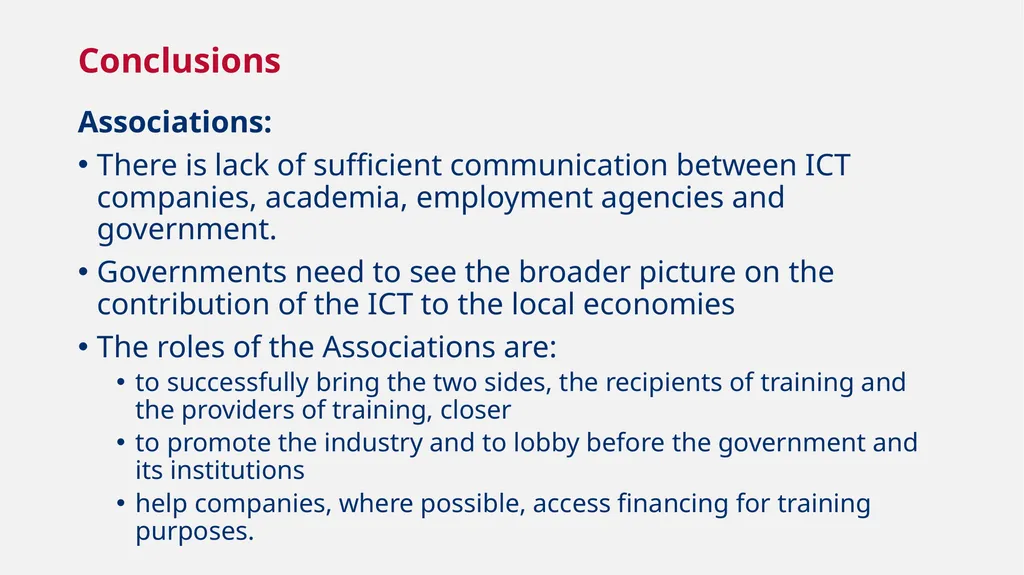
Conclusions Associations:
There is lack of sufficient communication between ICT companies, academia, employment agencies and government.
Governments need to see the broader picture on the contribution of the ICT to the local economies
The roles of the Associations are:
to successfully bring the two sides, the recipients of training and the providers of training, closer
to promote the industry and to lobby before the government and its institutions
help companies, where possible, access financing for training purposes.<br>
There is lack of sufficient communication between ICT companies, academia, employment agencies and government.
Governments need to see the broader picture on the contribution of the ICT to the local economies
The roles of the Associations are:
to successfully bring the two sides, the recipients of training and the providers of training, closer
to promote the industry and to lobby before the government and its institutions
help companies, where possible, access financing for training purposes.<br>
47
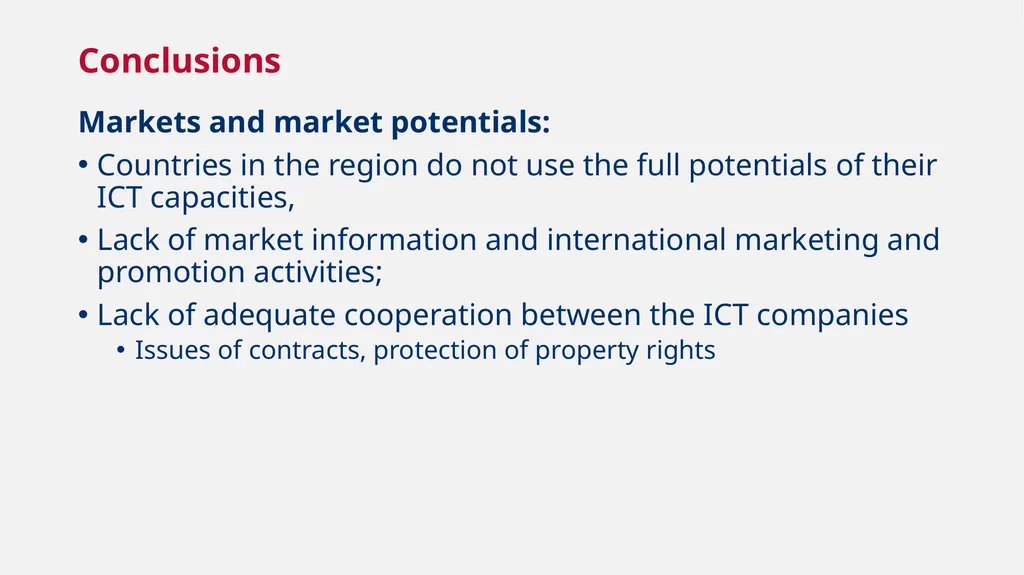
Conclusions Markets and market potentials:
Countries in the region do not use the full potentials of their ICT capacities,
Lack of market information and international marketing and promotion activities;
Lack of adequate cooperation between the ICT companies
Issues of contracts, protection of property rights<br>
Countries in the region do not use the full potentials of their ICT capacities,
Lack of market information and international marketing and promotion activities;
Lack of adequate cooperation between the ICT companies
Issues of contracts, protection of property rights<br>
48
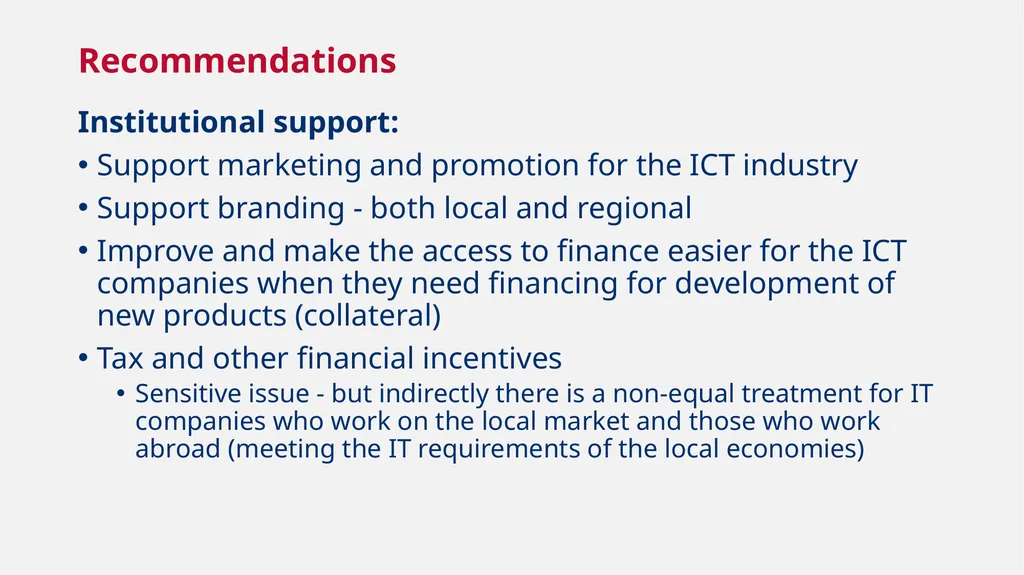
Recommendations Institutional support:
Support marketing and promotion for the ICT industry
Support branding - both local and regional
Improve and make the access to finance easier for the ICT companies when they need financing for development of new products (collateral)
Tax and other financial incentives
Sensitive issue - but indirectly there is a non-equal treatment for IT companies who work on the local market and those who work abroad (meeting the IT requirements of the local economies)<br>
Support marketing and promotion for the ICT industry
Support branding - both local and regional
Improve and make the access to finance easier for the ICT companies when they need financing for development of new products (collateral)
Tax and other financial incentives
Sensitive issue - but indirectly there is a non-equal treatment for IT companies who work on the local market and those who work abroad (meeting the IT requirements of the local economies)<br>
49
Recommendations Education:
Obligatory IT subjects in primary education starting from lower levels of education (programming, informatics);
Introduction of obligatory practical education and its full implementation in real business environment, for the students in the secondary and tertiary education;
Introduce procedures for quicker adaptation of the curricula to the needs of the ICT companies;
Promotion of life-long learning and collaborative learning on all levels of education.<br>
Obligatory IT subjects in primary education starting from lower levels of education (programming, informatics);
Introduction of obligatory practical education and its full implementation in real business environment, for the students in the secondary and tertiary education;
Introduce procedures for quicker adaptation of the curricula to the needs of the ICT companies;
Promotion of life-long learning and collaborative learning on all levels of education.<br>
50
Recommendations Role of associations:
Integrators of all stakeholders in the ICT industry
Increase membership
Accumulate and disseminate market trends and potentials data
Develop services/products, including training<br>
Integrators of all stakeholders in the ICT industry
Increase membership
Accumulate and disseminate market trends and potentials data
Develop services/products, including training<br>
51
Recommendations Employment and recruitment agencies:
Specialization of the employment agencies for ICT (most of the ICT freelancers in the region are recruited online by foreign recruitment agencies)
Retraining (requalification) opportunities for people who want to change career paths.<br>
Specialization of the employment agencies for ICT (most of the ICT freelancers in the region are recruited online by foreign recruitment agencies)
Retraining (requalification) opportunities for people who want to change career paths.<br>
52
Recommendations for ICT companies:
Create local/regional partnerships for joint approach to markets;
Increase the use of consultants (legal, marketing, management, access to finance);
Improve on the job training;
Establish procedures and culture of collaborative learning, job shadowing.<br>
Create local/regional partnerships for joint approach to markets;
Increase the use of consultants (legal, marketing, management, access to finance);
Improve on the job training;
Establish procedures and culture of collaborative learning, job shadowing.<br>
53
Recommendations for all stakeholders:
Preparatory activities for education and training in the areas that are expected to be dominant in the following period, such as:
Artificial Intelligence,
Internet of Things,
Big Data,
Virtual Reality,
Robotics,
Data mining,
Etc.<br>
Preparatory activities for education and training in the areas that are expected to be dominant in the following period, such as:
Artificial Intelligence,
Internet of Things,
Big Data,
Virtual Reality,
Robotics,
Data mining,
Etc.<br>
54
Ви благодарам на вниманието.<br>