04
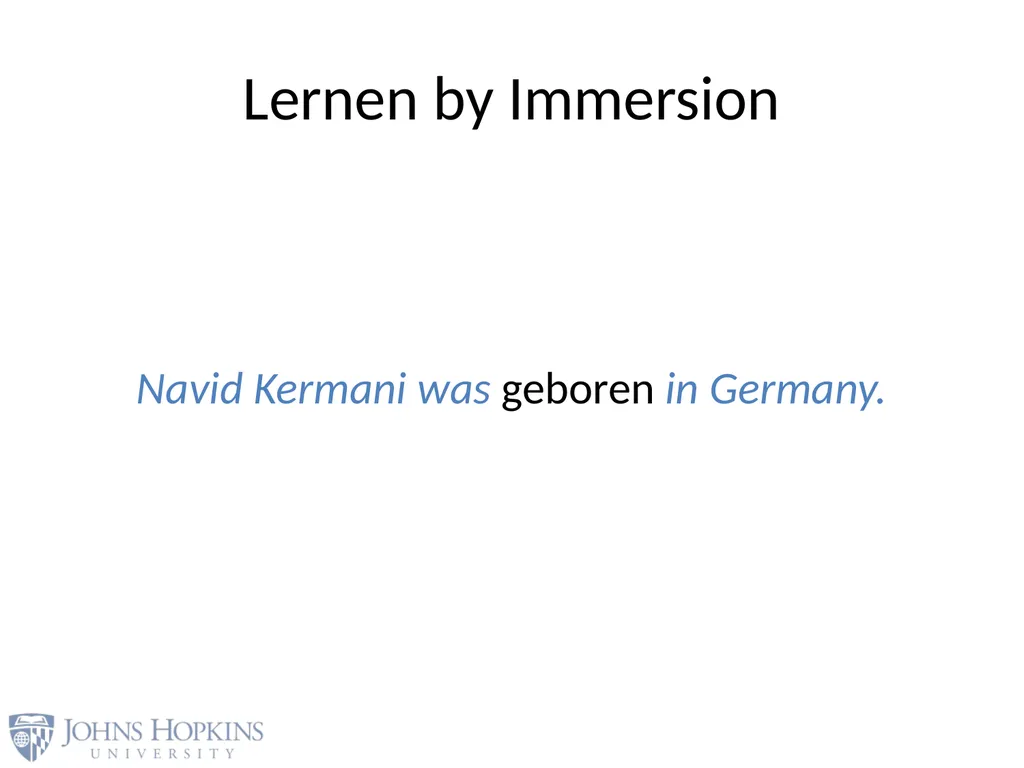
The German BookSeller’s Peace Prize was awarded to Navid Kermani in June last year. Navid Kermani was geboren in Germany. He started his career as a reporter for a popular newspaper. Later he studied philosophy, drama and oriental studies.<br>
05
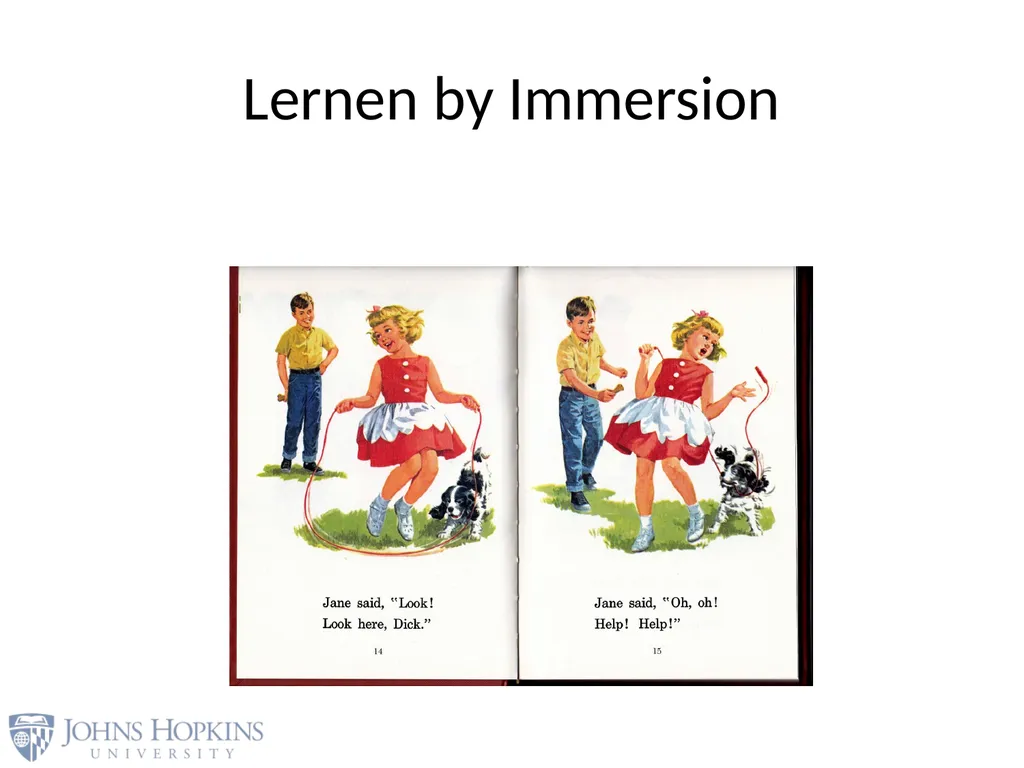
Lernen by Immersion We know this works to acquire L1 (native)<br>
06
Lernen by Immersion We know this works to acquire L1
We also know this to work to acquire L2 (second language)
“It is widely agreed that much second language vocabulary learning occurs incidentally while the learner is engaged in extensive reading.” (Huckin & Coady, 1999)<br>
07
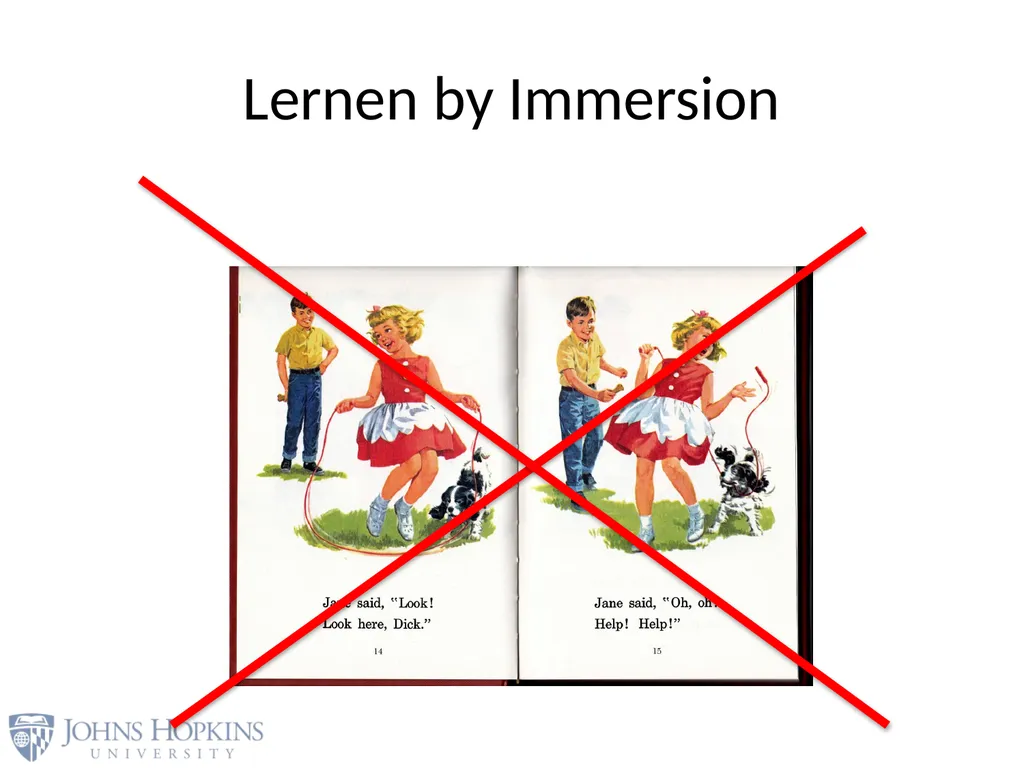
Lernen by Immersion Some obvious problems… If you want to learn German
start reading German!<br>
08
Lernen by Immersion Some obvious problems… If you want to learn German
start reading German! Some obvious problems…<br>
09
Lernen by Immersion Start reading German!<br>
10
Lernen by Immersion Start reading German!<br>
11
Lernen by Immersion Can we leverage mixing L1 and L2 to learn new L2 vocabulary?<br>
12
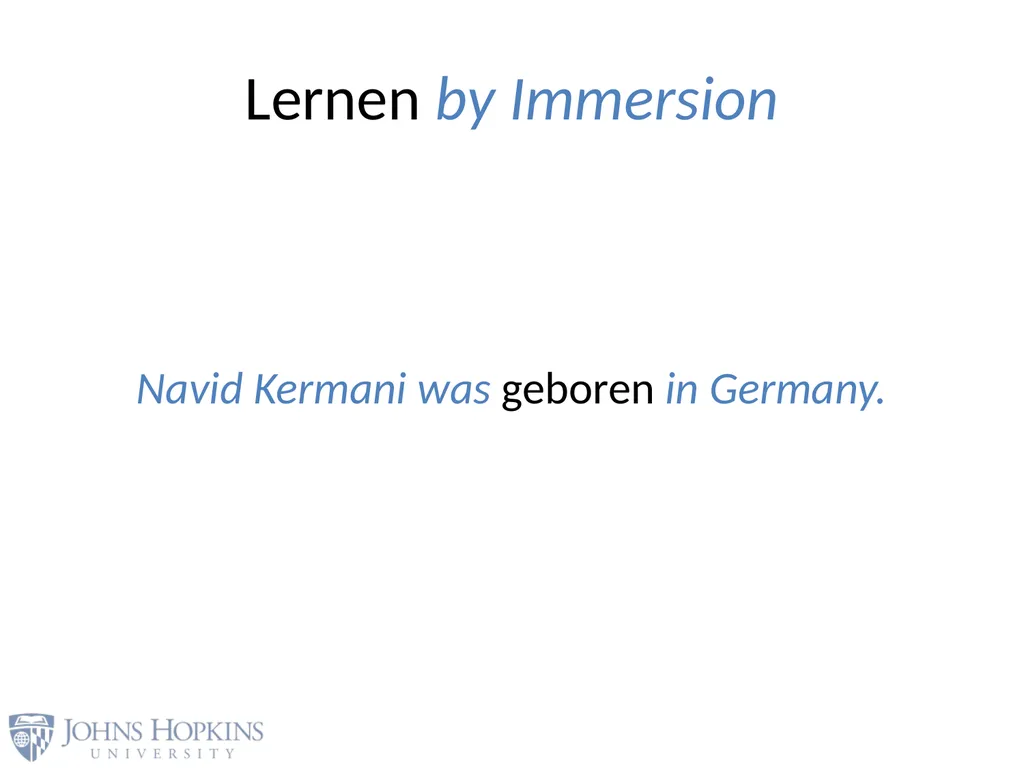
Lernen by Immersion Navid Kermani was geboren in Germany.<br>
13
Lernen by Immersion Navid Kermani was geboren in Germany.<br>
14
Macaronic Text Macaronic:
Of or containing a mixture of vernacular words with Latin words or with vernacular words given Latinate endings: macaronic verse.
Of or involving a mixture of two or more languages.
Like code-switching but more deliberate and often for humor.<br>
15
Research Goal We want to investigate macaronic immersion as a tool for language learning.<br>
16
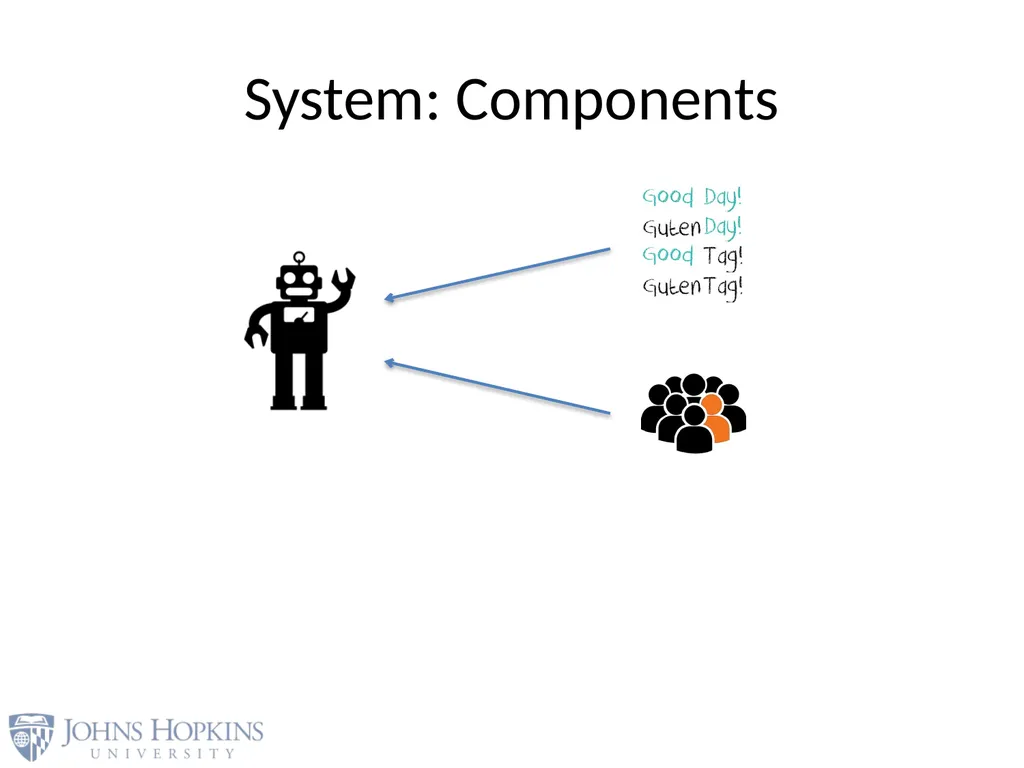
System: Components<br>
17
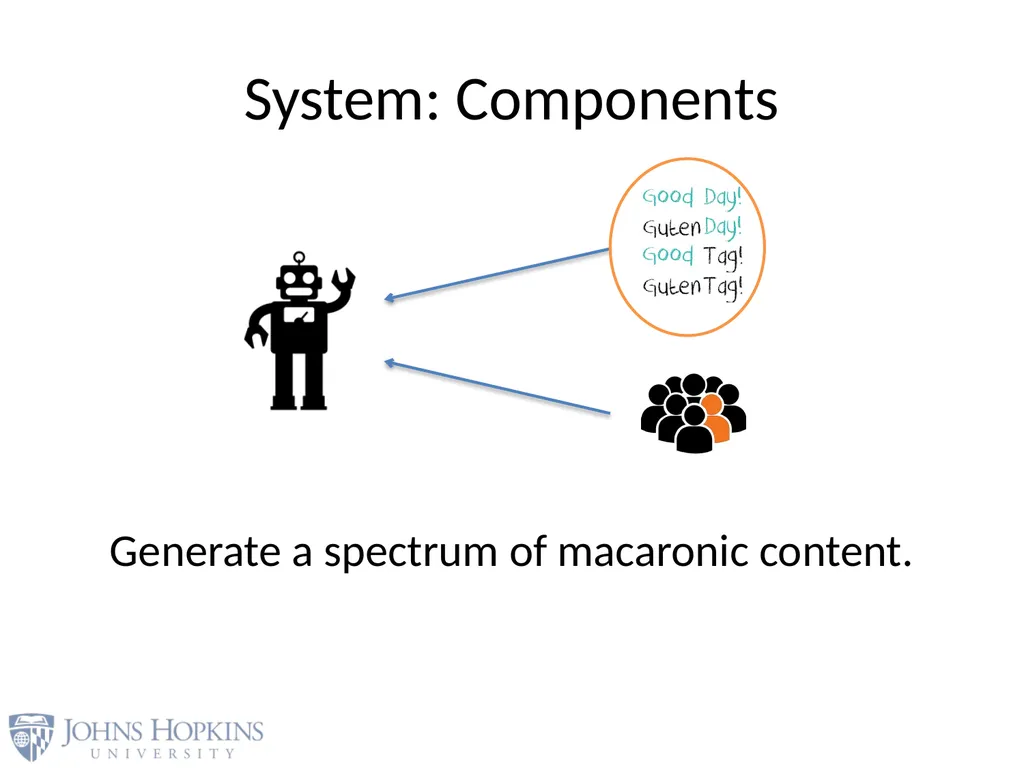
System: Components Generate a spectrum of macaronic content.<br>
18
System: Components Demonstration of Macaronic Interface<br>
19
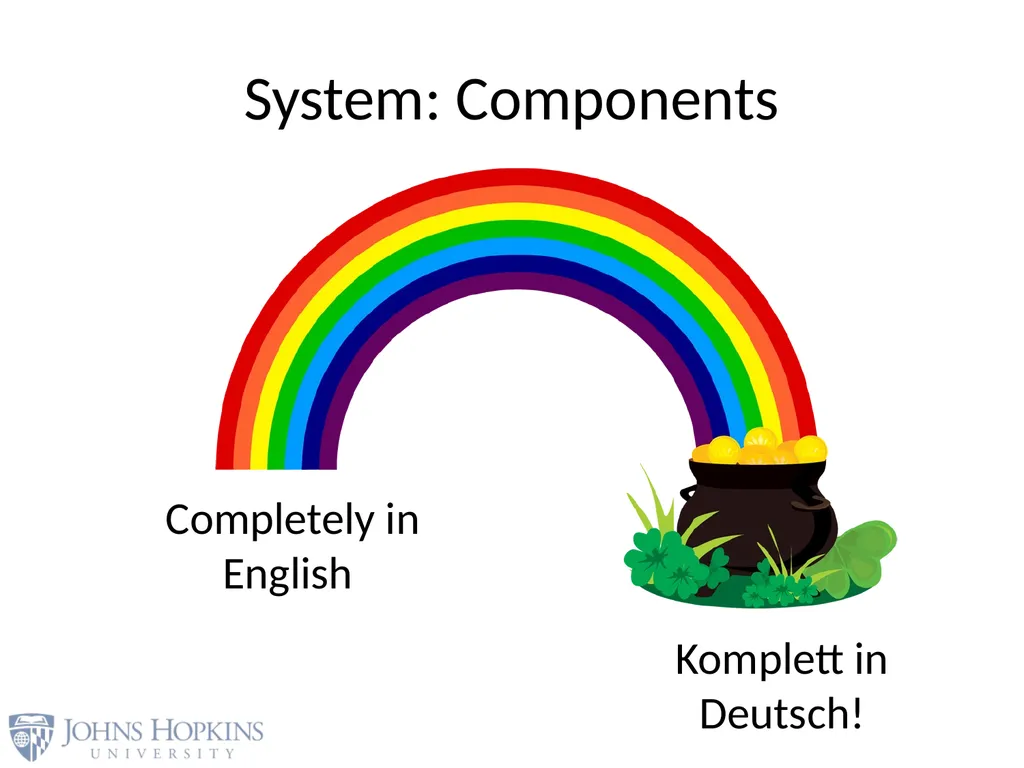
System: Components Completely in English Komplett in Deutsch!<br>
20
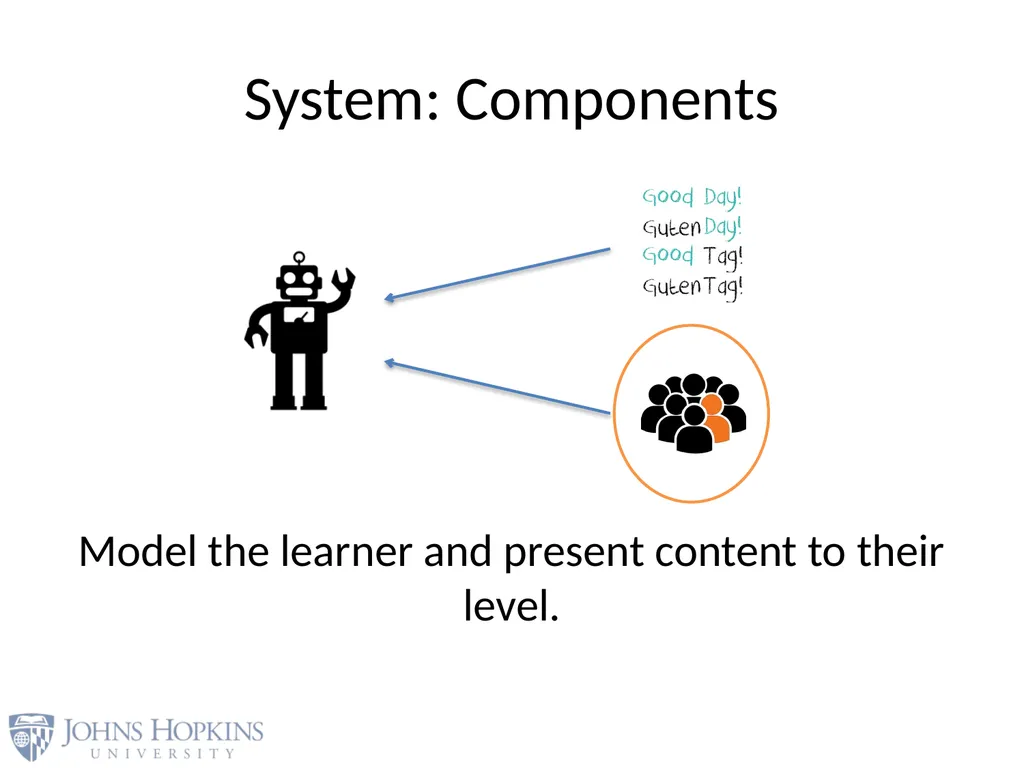
System: Components Model the learner and present content to their level.<br>
21
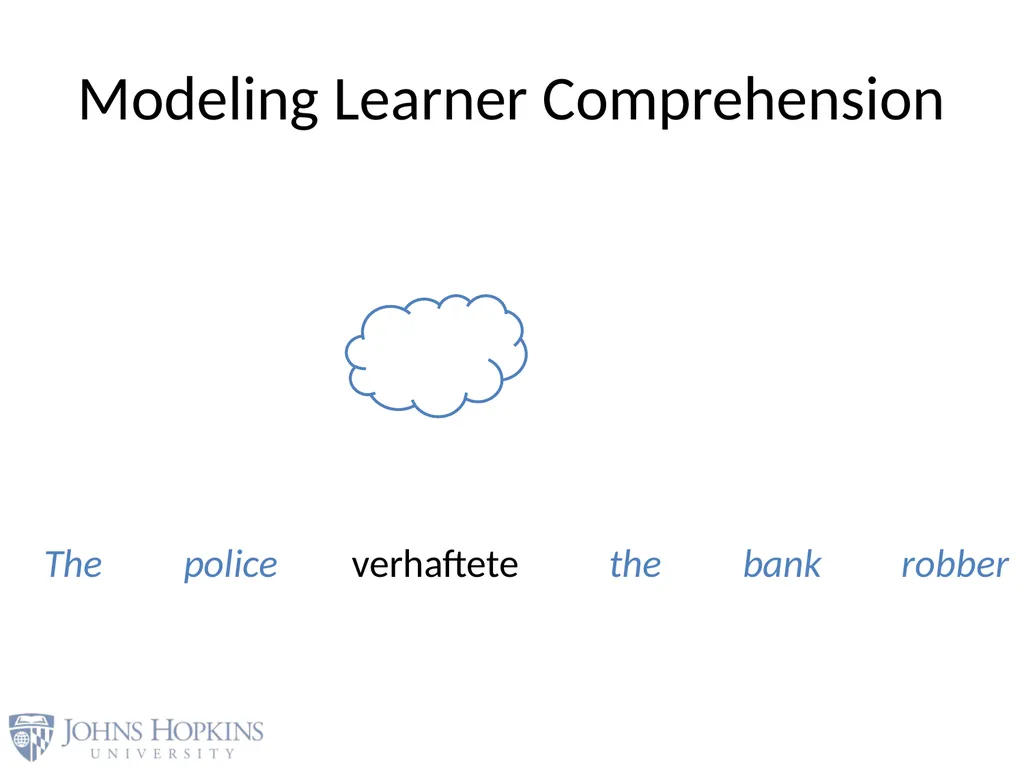
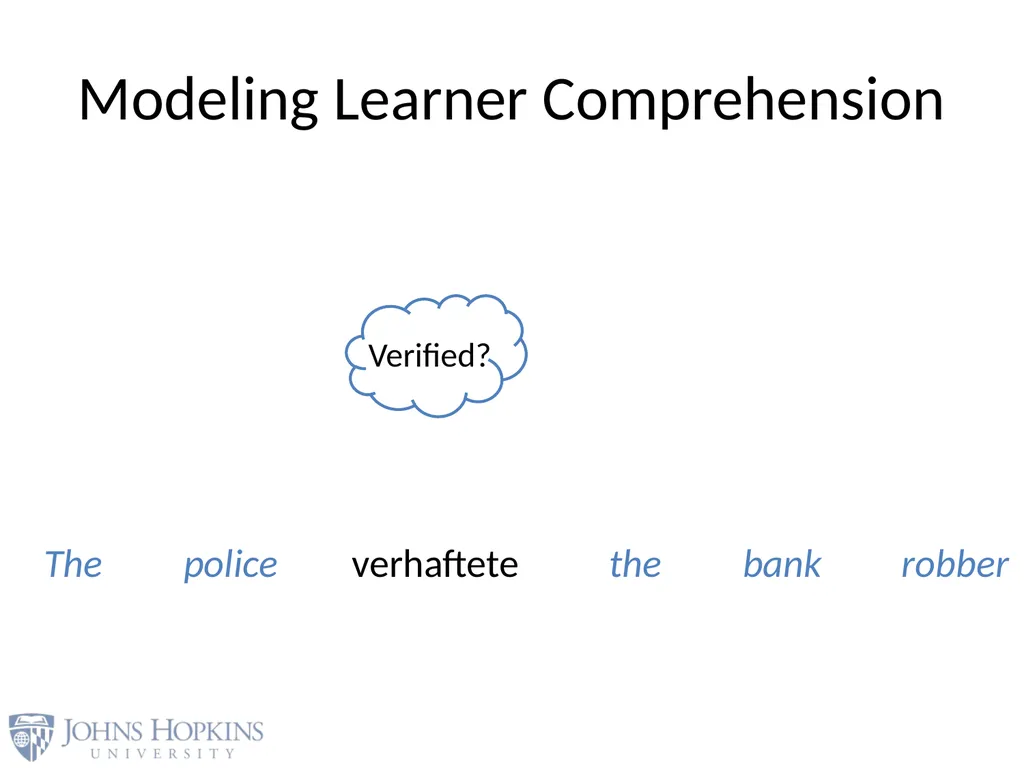
Modeling Learner Comprehension The police verhaftete the bank robber<br>
22
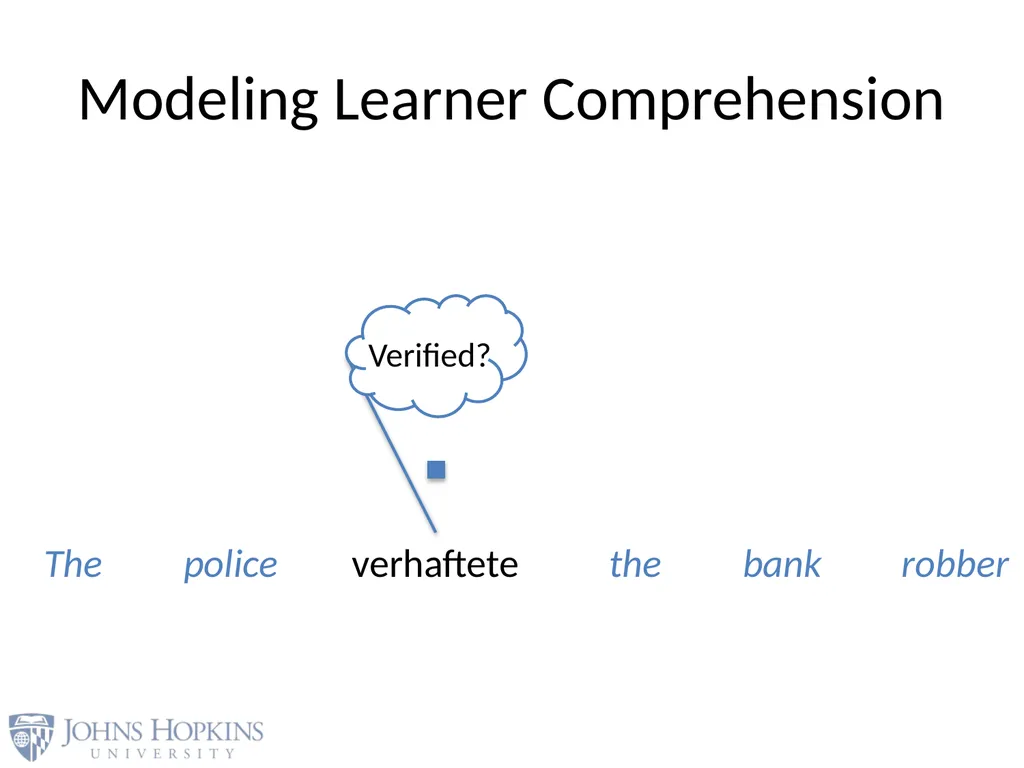
Modeling Learner Comprehension The police verhaftete the bank robber Verified?<br>
23
Modeling Learner Comprehension The police verhaftete the bank robber Verified?<br>
24
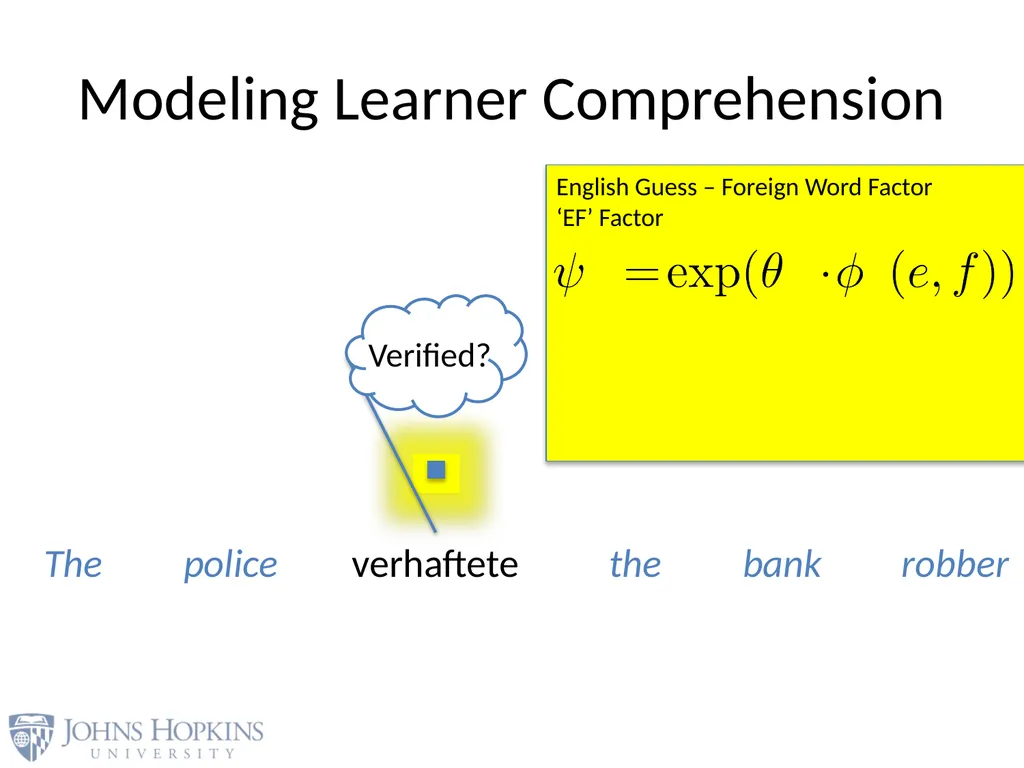
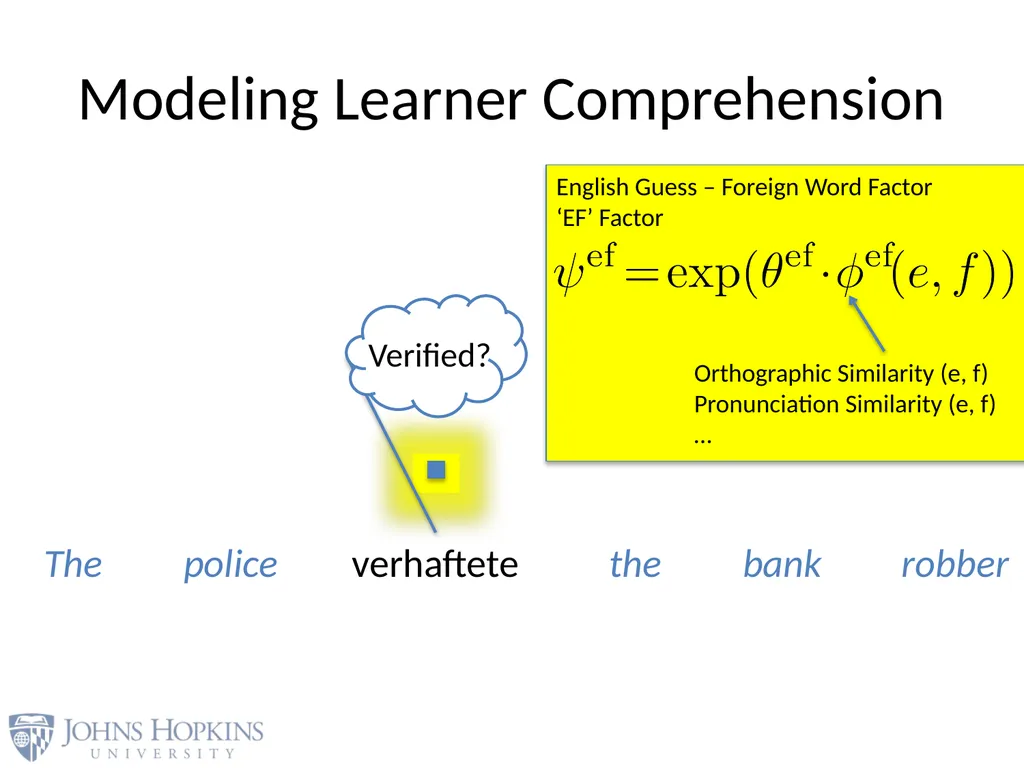
English Guess – Foreign Word Factor
‘EF’ Factor Modeling Learner Comprehension The police verhaftete the bank robber Verified?<br>
25
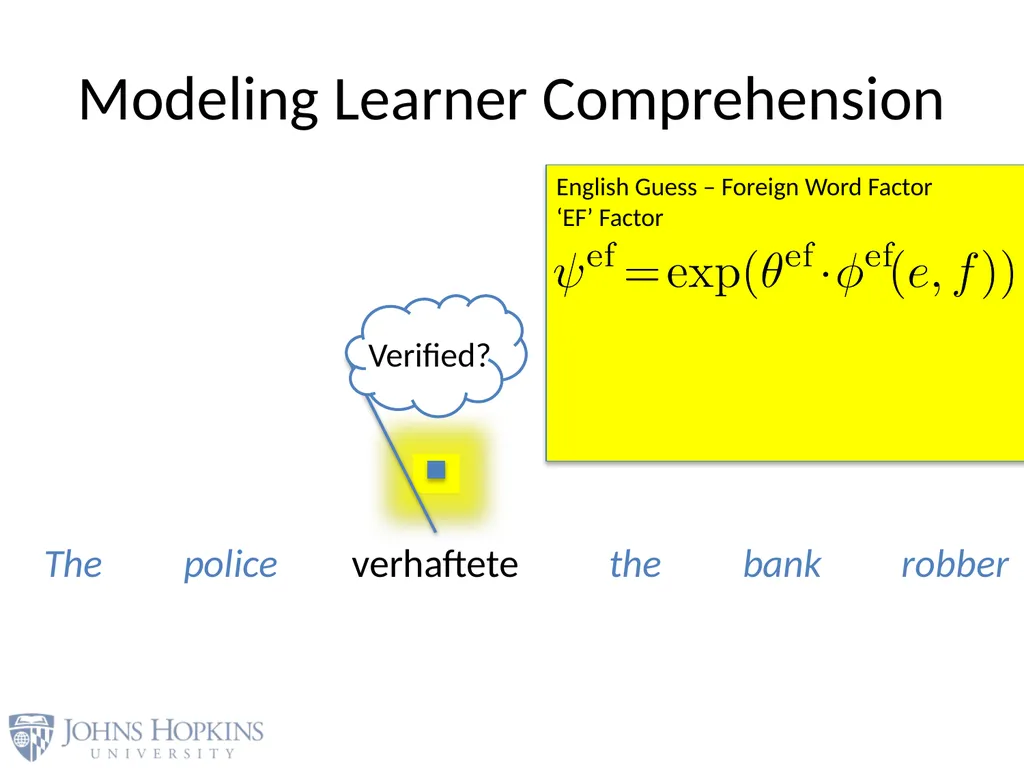
Modeling Learner Comprehension The police verhaftete the bank robber Verified? English Guess – Foreign Word Factor
‘EF’ Factor<br>
26
Modeling Learner Comprehension The police verhaftete the bank robber Verified? Orthographic Similarity (e, f)
Pronunciation Similarity (e, f)
… English Guess – Foreign Word Factor
‘EF’ Factor<br>
27
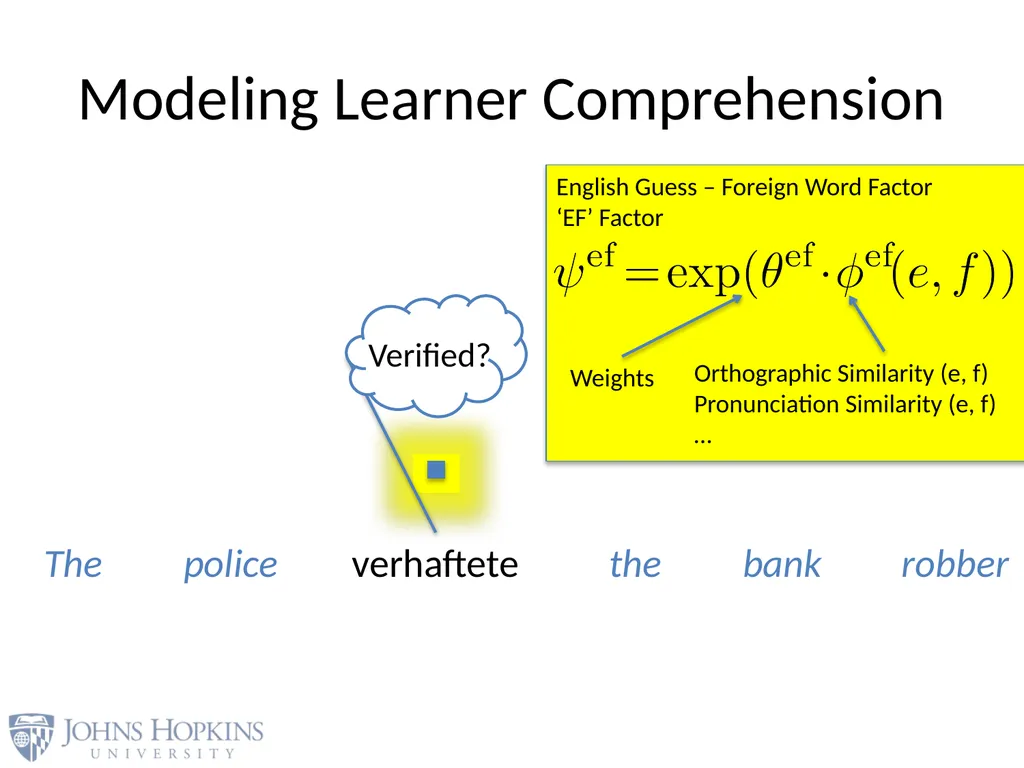
Modeling Learner Comprehension The police verhaftete the bank robber Verified? Orthographic Similarity (e, f)
Pronunciation Similarity (e, f)
… Weights English Guess – Foreign Word Factor
‘EF’ Factor<br>
28
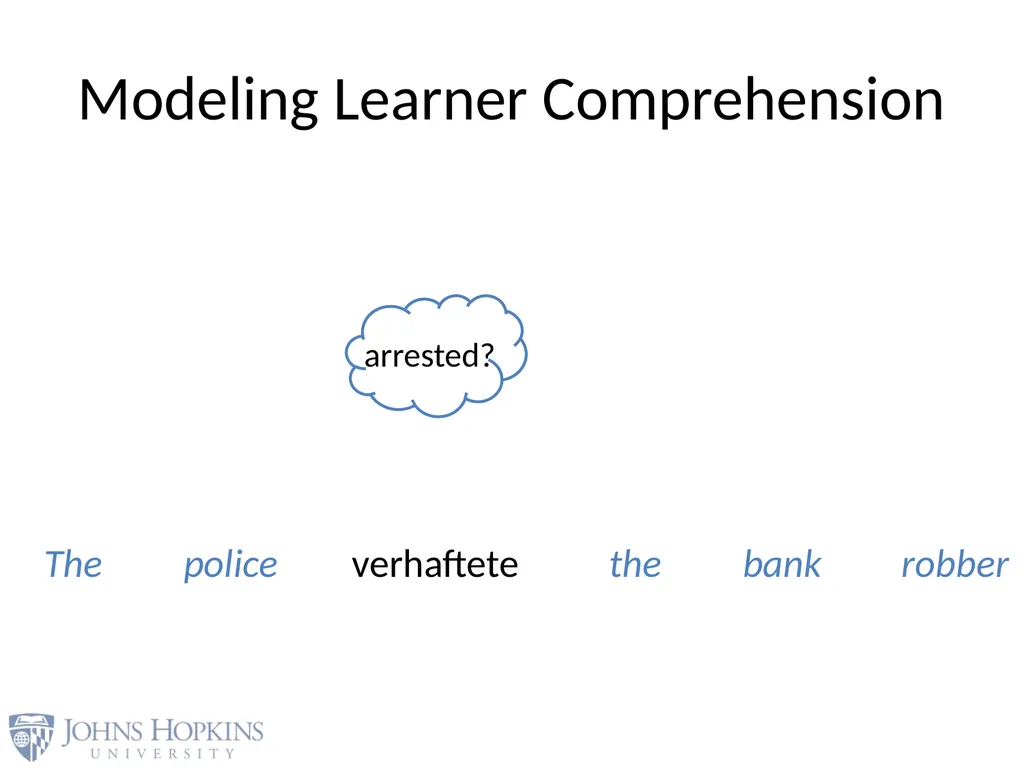
Modeling Learner Comprehension The police verhaftete the bank robber arrested?<br>
29
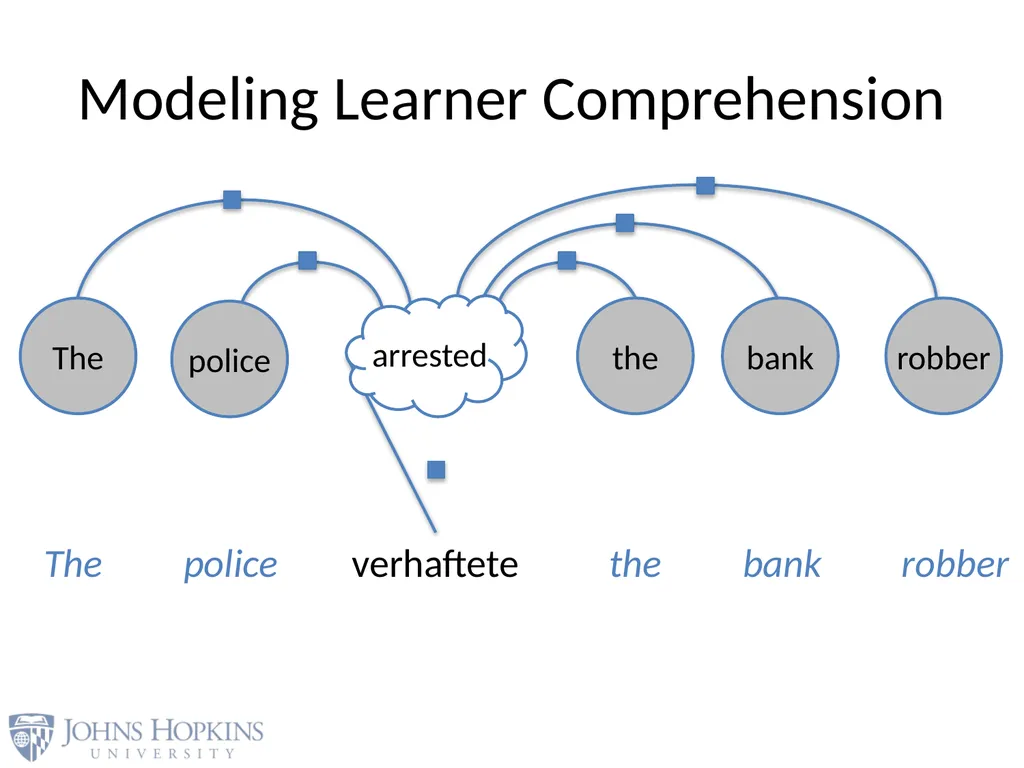
Modeling Learner Comprehension The police verhaftete the bank robber robber bank the The arrested police<br>
30
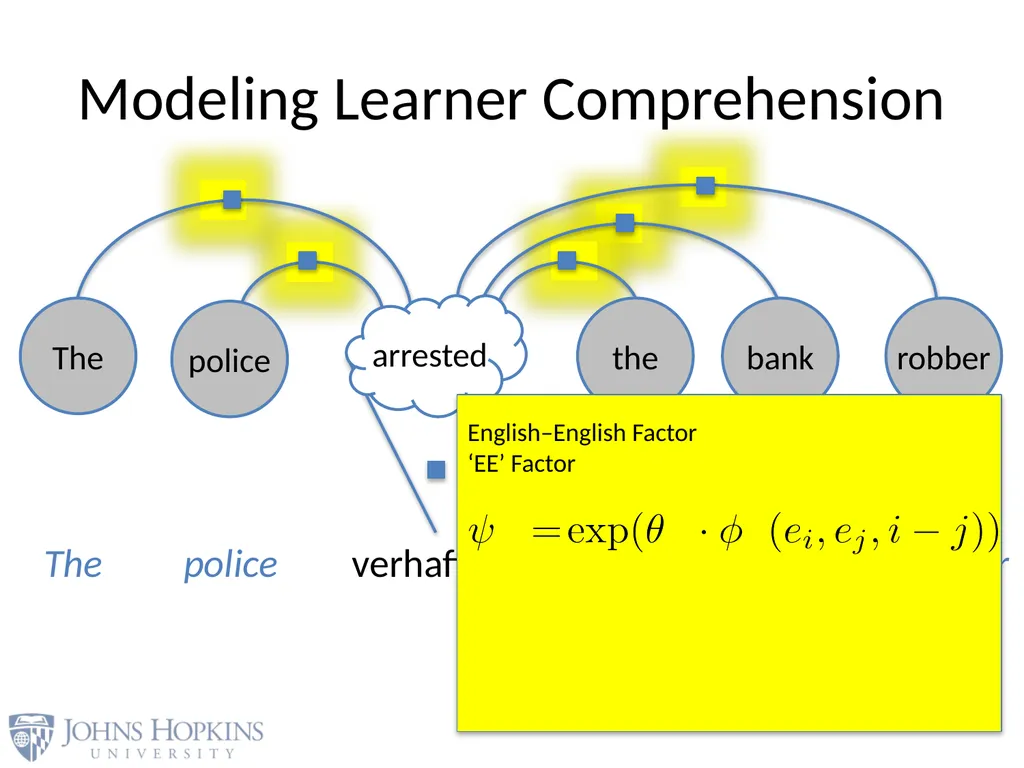
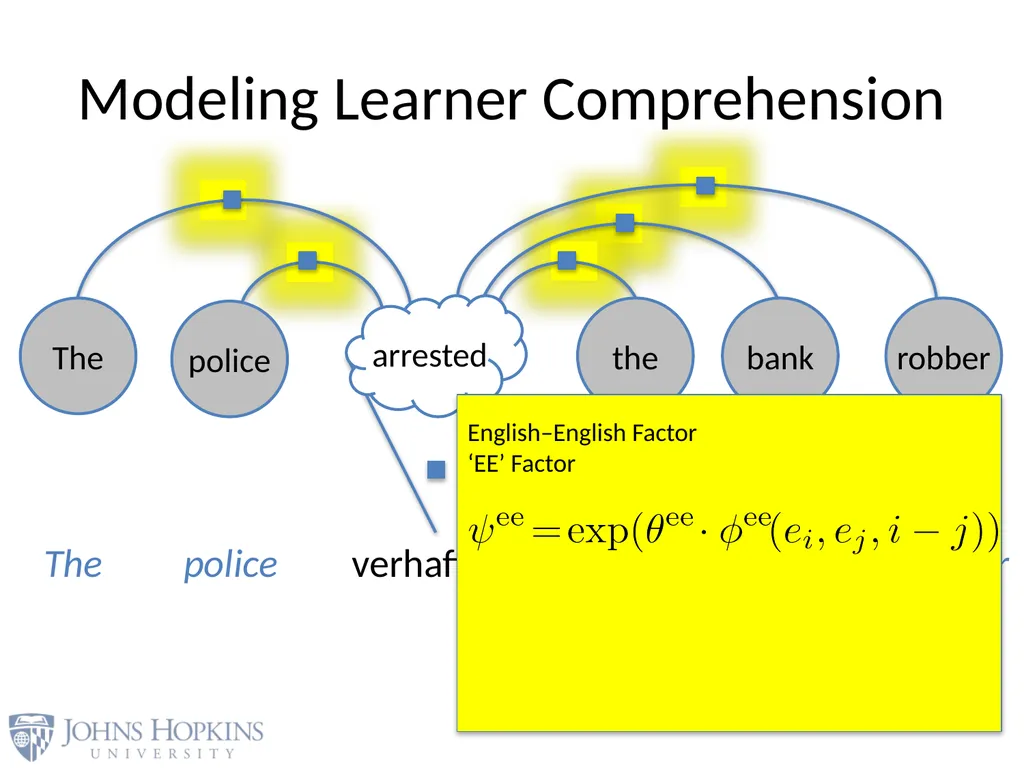
Modeling Learner Comprehension The police verhaftete the bank robber robber bank the The arrested police English–English Factor
‘EE’ Factor<br>
31
Modeling Learner Comprehension The police verhaftete the bank robber robber bank the The arrested police English–English Factor
‘EE’ Factor<br>
32
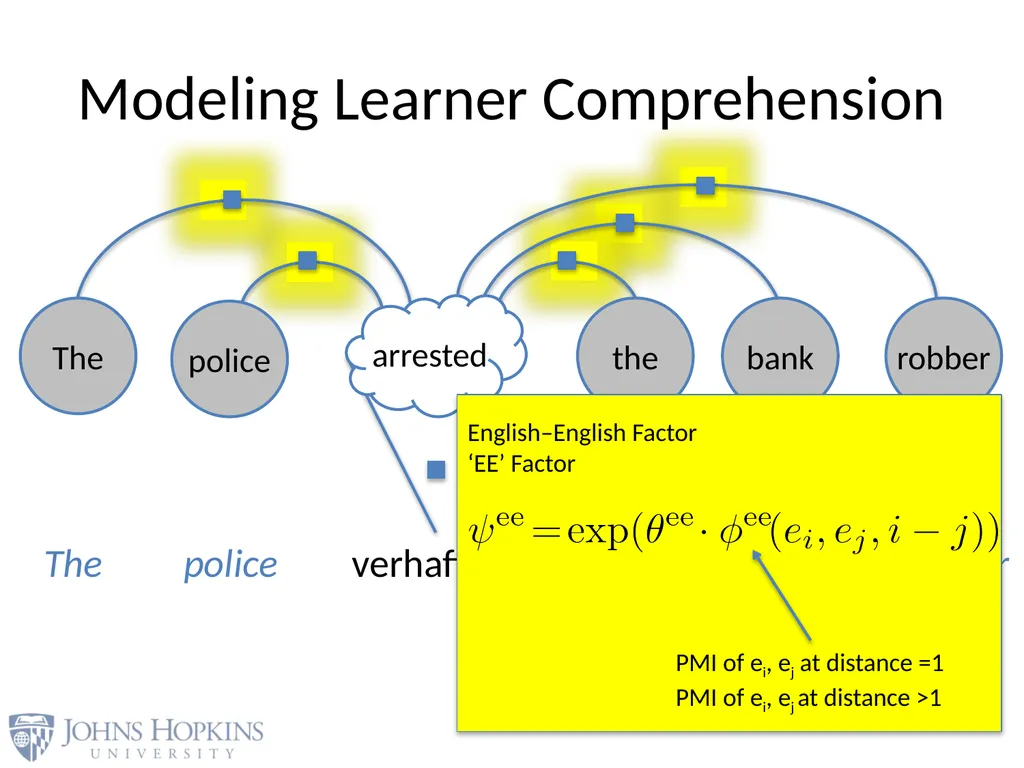
Modeling Learner Comprehension The police verhaftete the bank robber robber bank the The arrested police English–English Factor
‘EE’ Factor PMI of ei, ej at distance =1
PMI of ei, ej at distance >1<br>
33
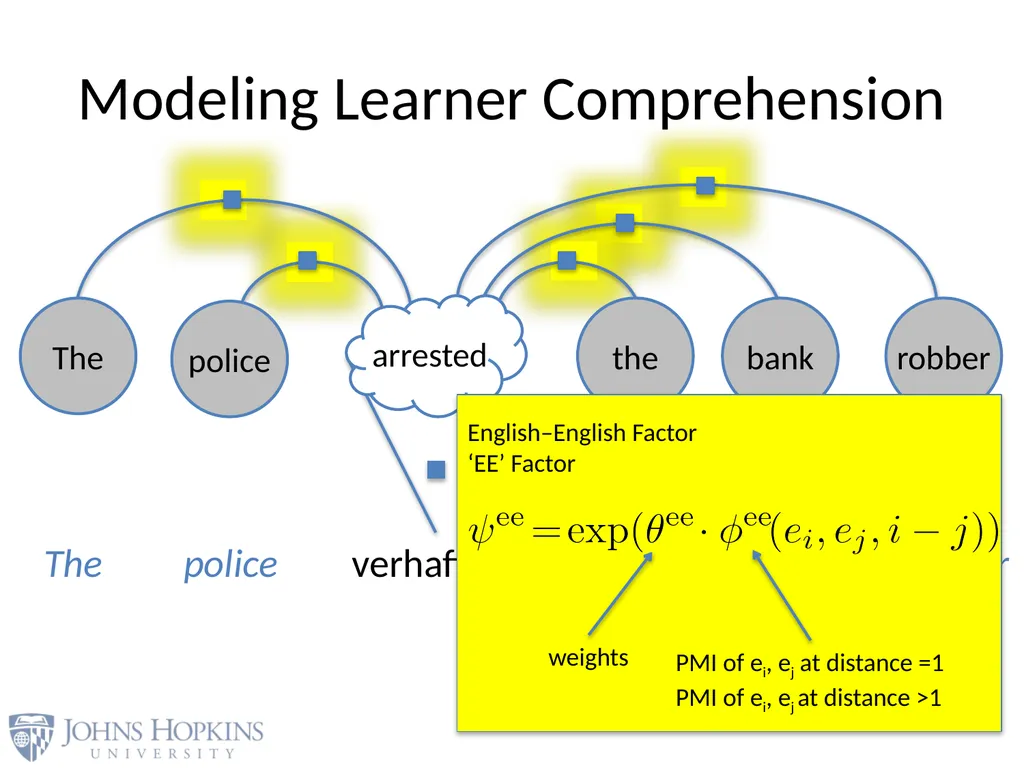
Modeling Learner Comprehension The police verhaftete the bank robber robber bank the The arrested police English–English Factor
‘EE’ Factor PMI of ei, ej at distance =1
PMI of ei, ej at distance >1 weights<br>
34
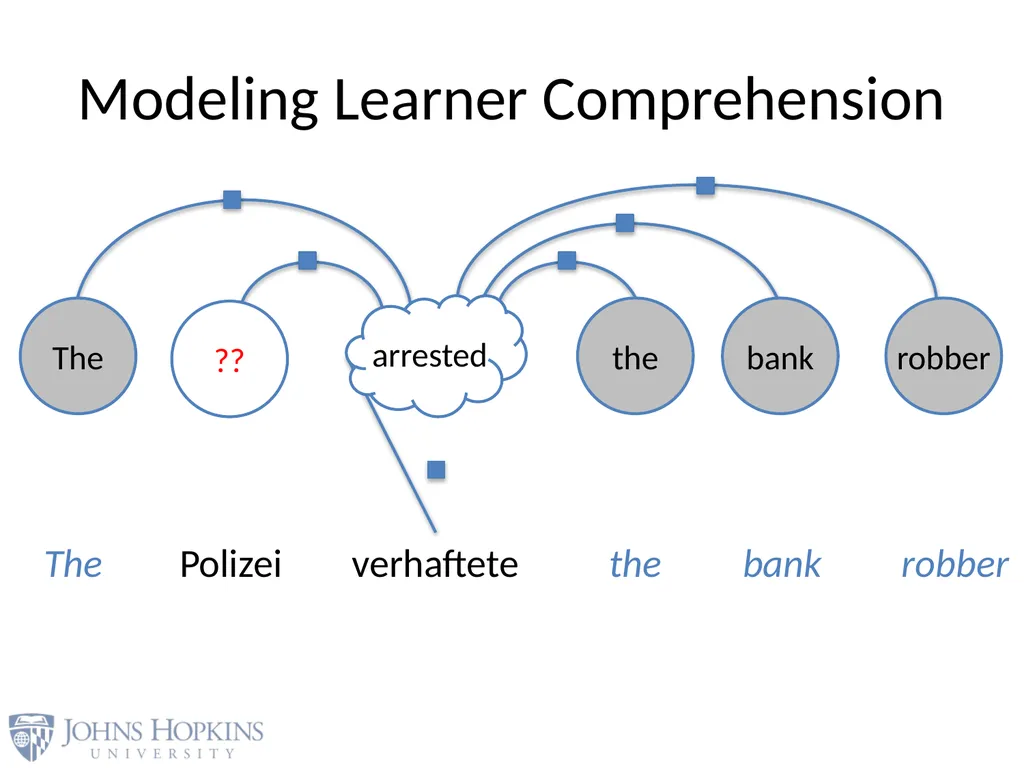
Modeling Learner Comprehension The Polizei verhaftete the bank robber robber bank the The arrested ??<br>
35
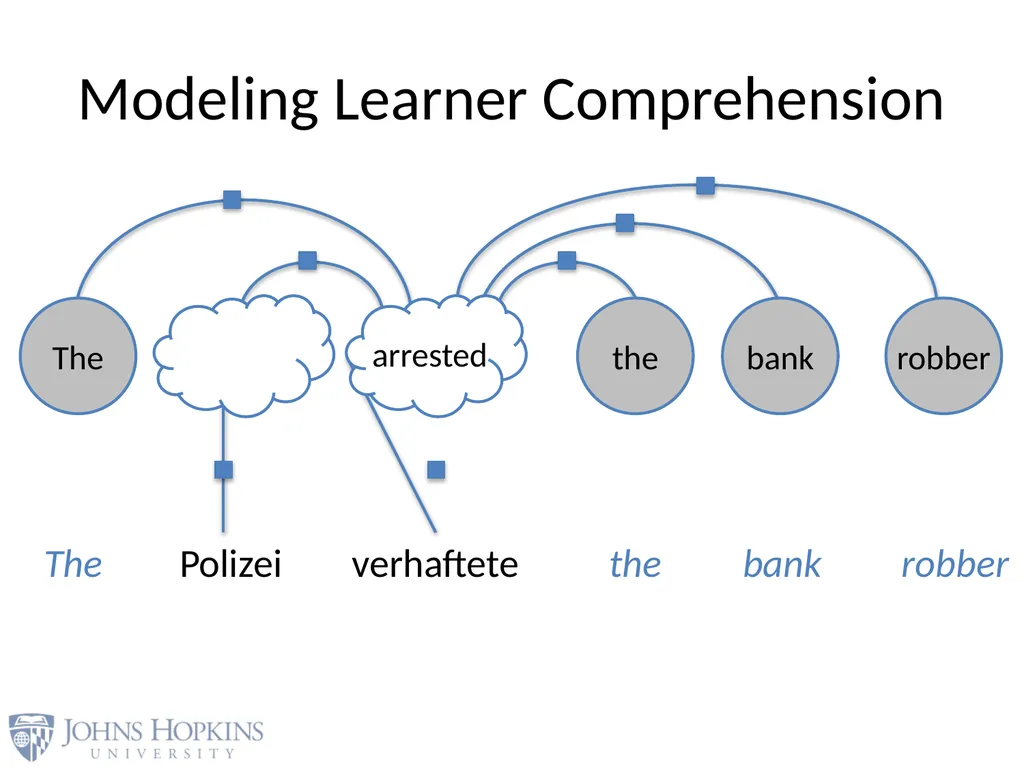
Modeling Learner Comprehension The Polizei verhaftete the bank robber robber bank the The arrested<br>
36
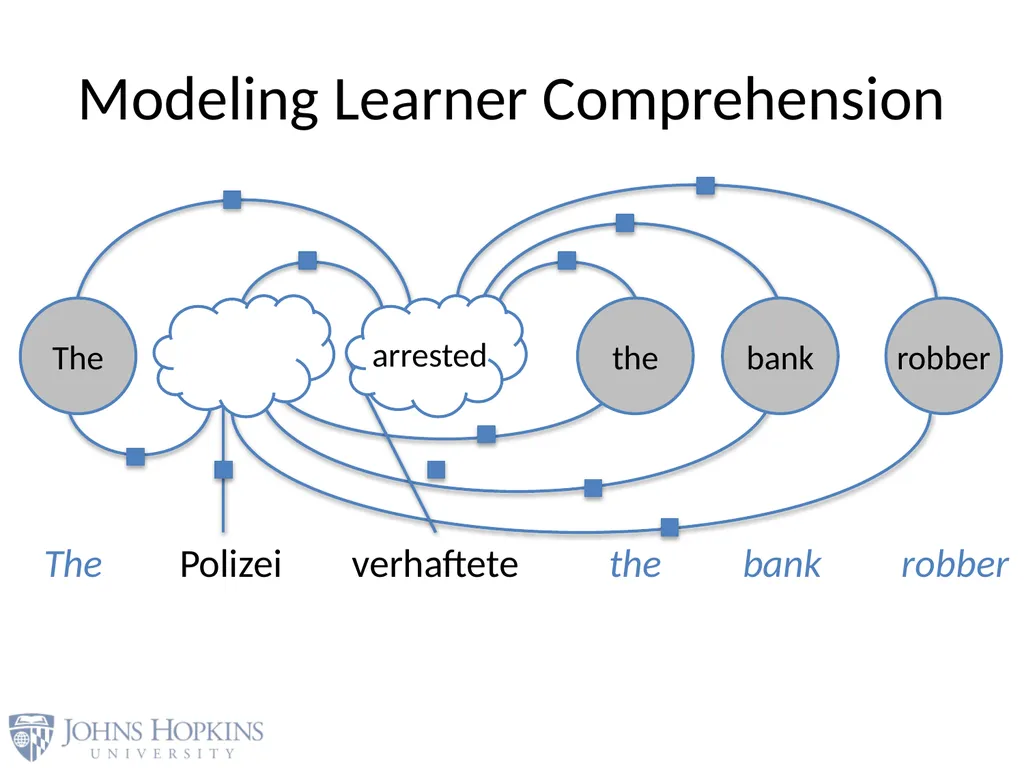
Modeling Learner Comprehension The Polizei verhaftete the bank robber robber bank the The arrested<br>
37
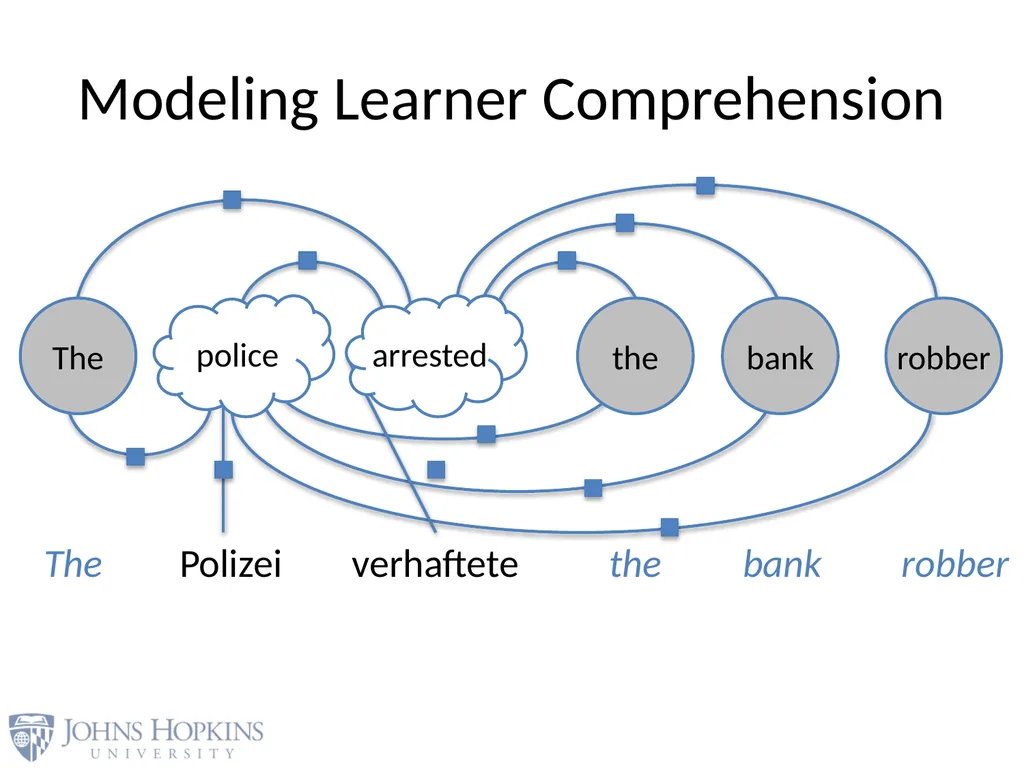
Modeling Learner Comprehension The Polizei verhaftete the bank robber robber bank the The arrested police<br>
38
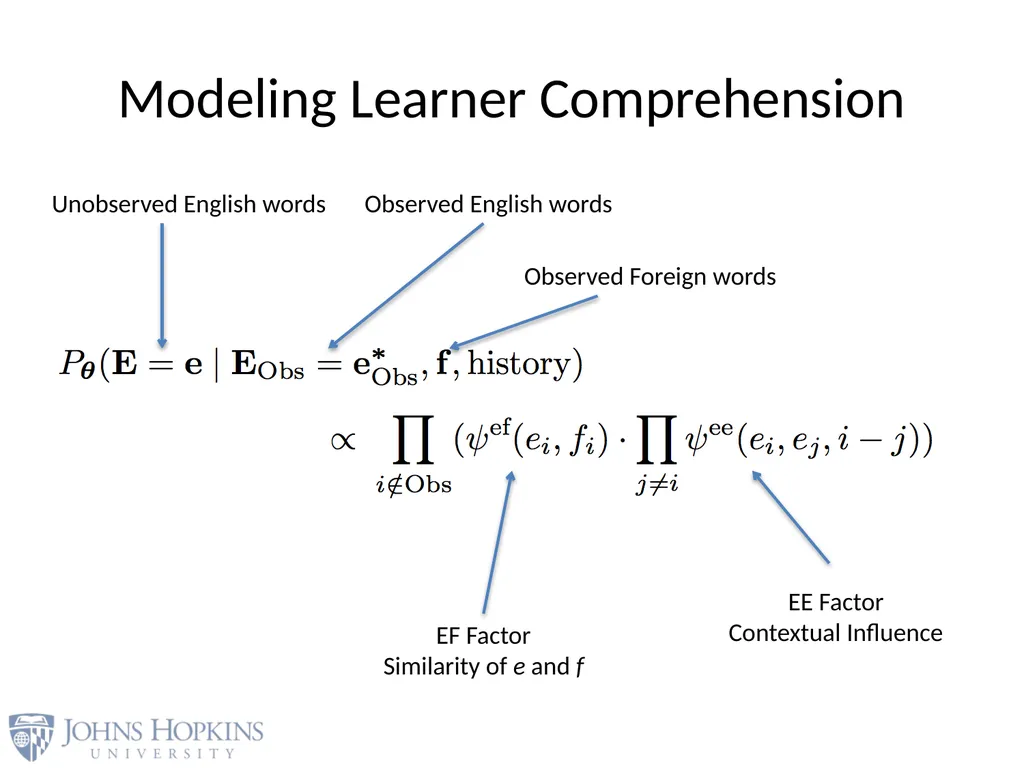
Modeling Learner Comprehension EE Factor
Contextual Influence EF Factor
Similarity of e and f Unobserved English words Observed English words Observed Foreign words<br>
39
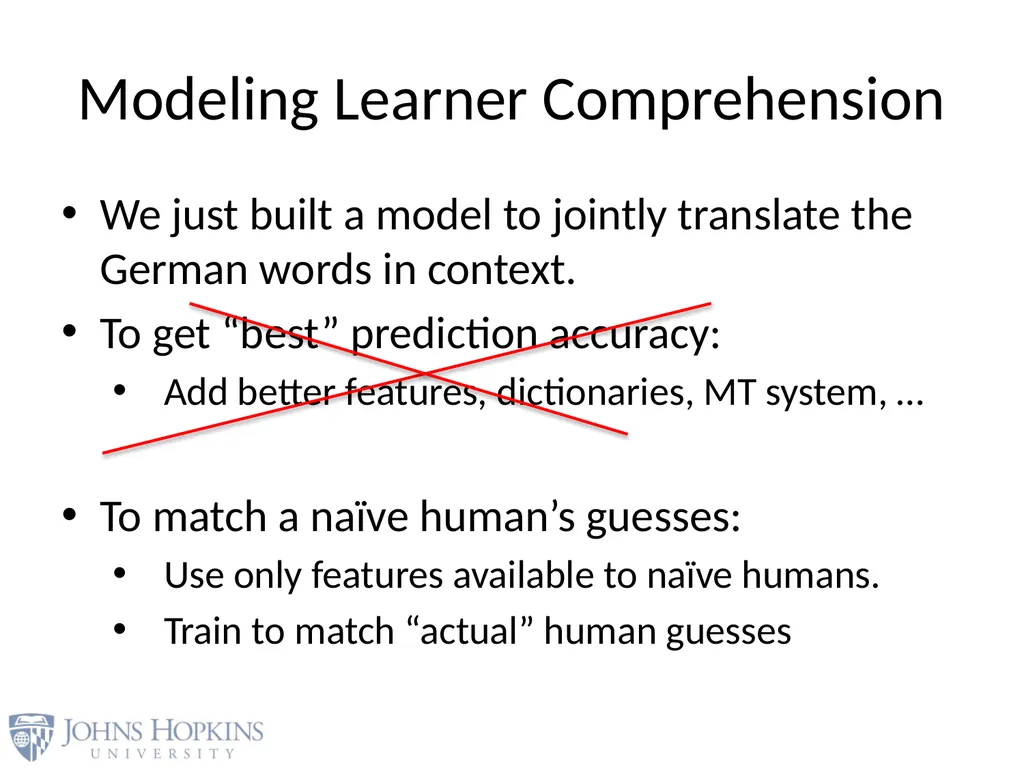
Modeling Learner Comprehension We just built a model to jointly translate the German words in context.
To get “best” prediction accuracy:
Add better features, dictionaries, MT system, …
To match a naïve human’s guesses:
Use only features available to naïve humans.
Train to match “actual” human guesses<br>
40
Modeling Learner Comprehension So how do we get the training data?
Demo of Data Collection.<br>
41
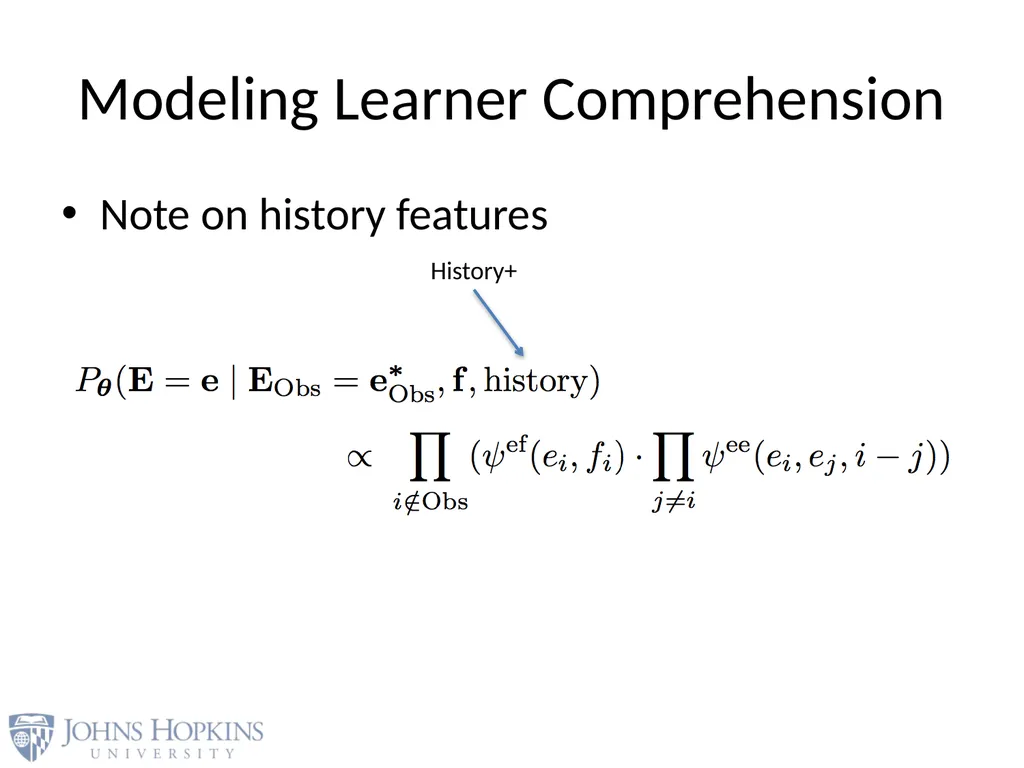
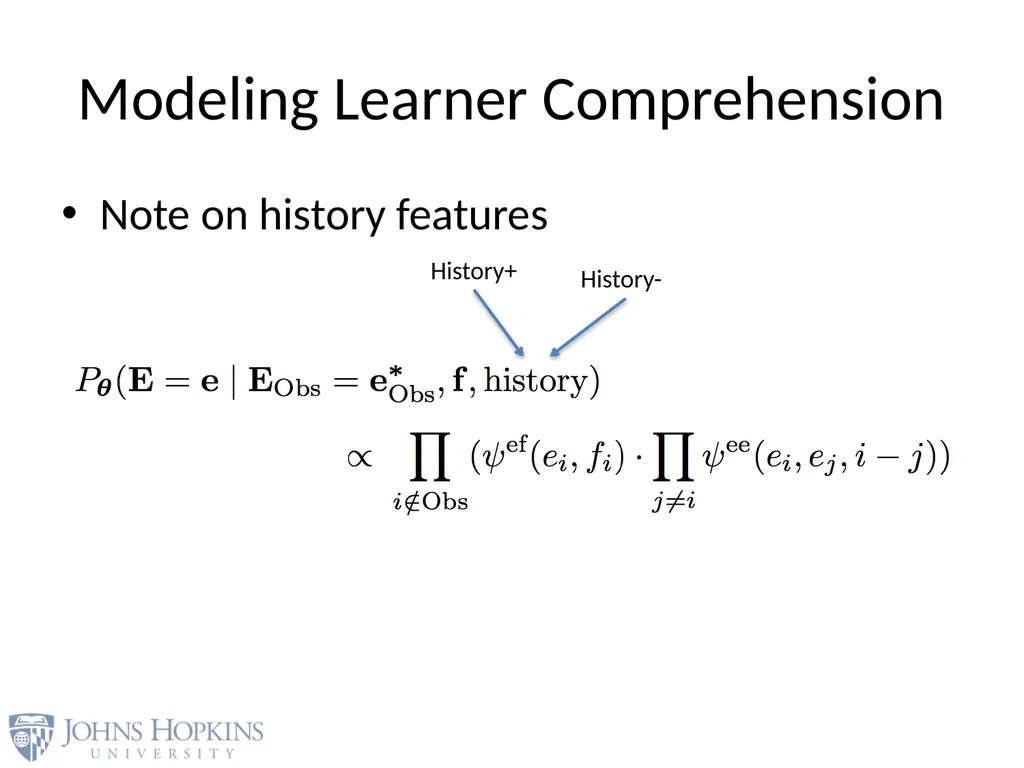
Modeling Learner Comprehension Note on history features History+<br>
42
Modeling Learner Comprehension Note on history features History+ History-<br>
43
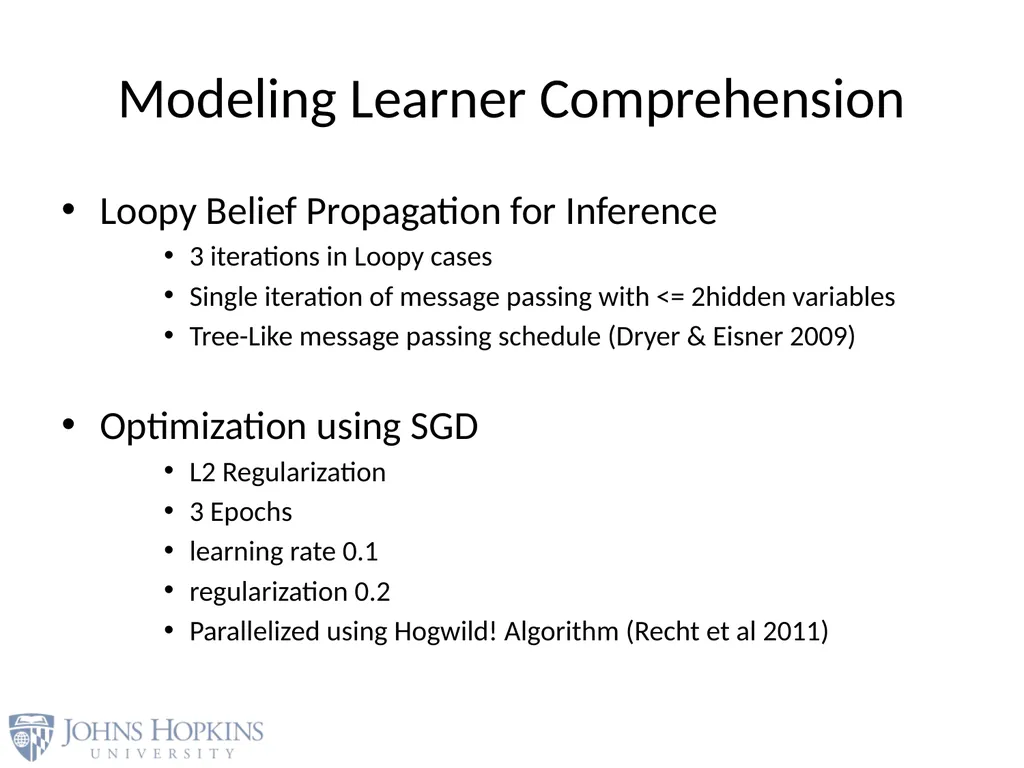
Modeling Learner Comprehension Loopy Belief Propagation for Inference
3 iterations in Loopy cases
Single iteration of message passing with <= 2hidden variables
Tree-Like message passing schedule (Dryer & Eisner 2009)
Optimization using SGD
L2 Regularization
3 Epochs
learning rate 0.1
regularization 0.2
Parallelized using Hogwild! Algorithm (Recht et al 2011)<br>
44
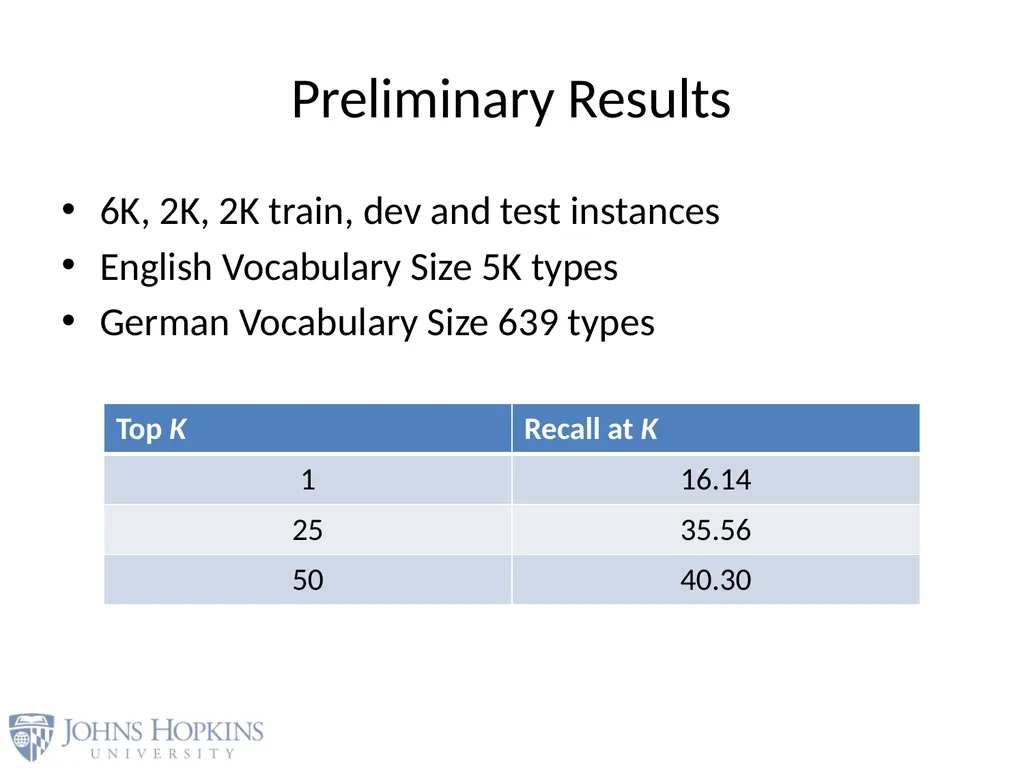
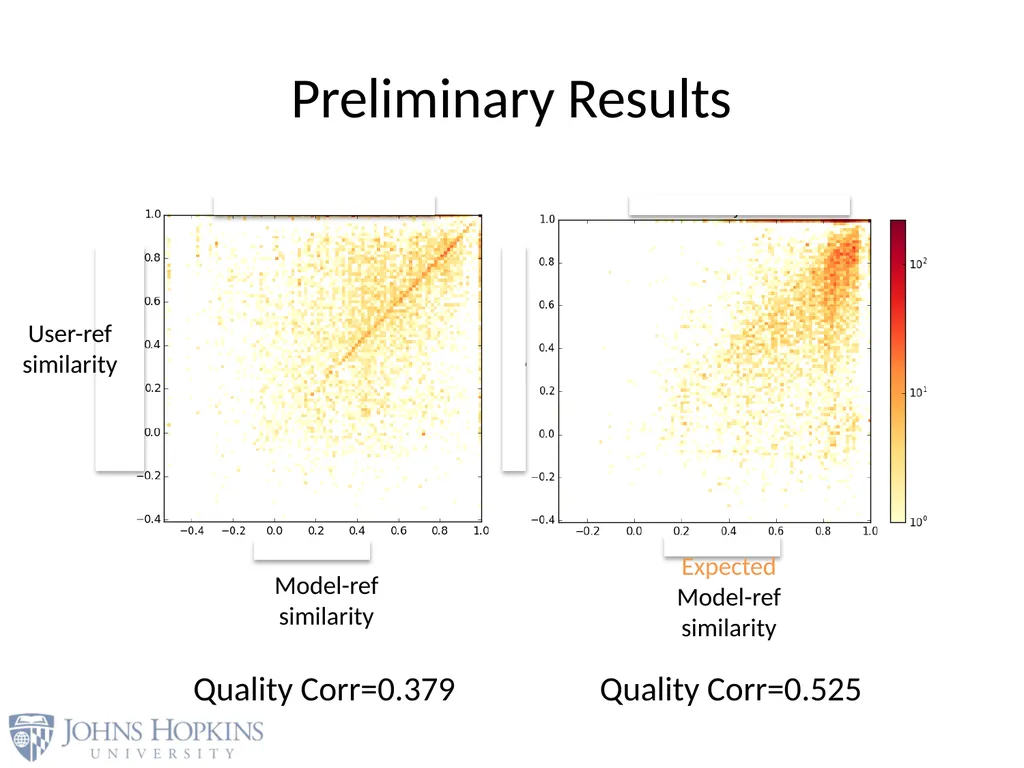
Preliminary Results 6K, 2K, 2K train, dev and test instances
English Vocabulary Size 5K types
German Vocabulary Size 639 types<br>
45
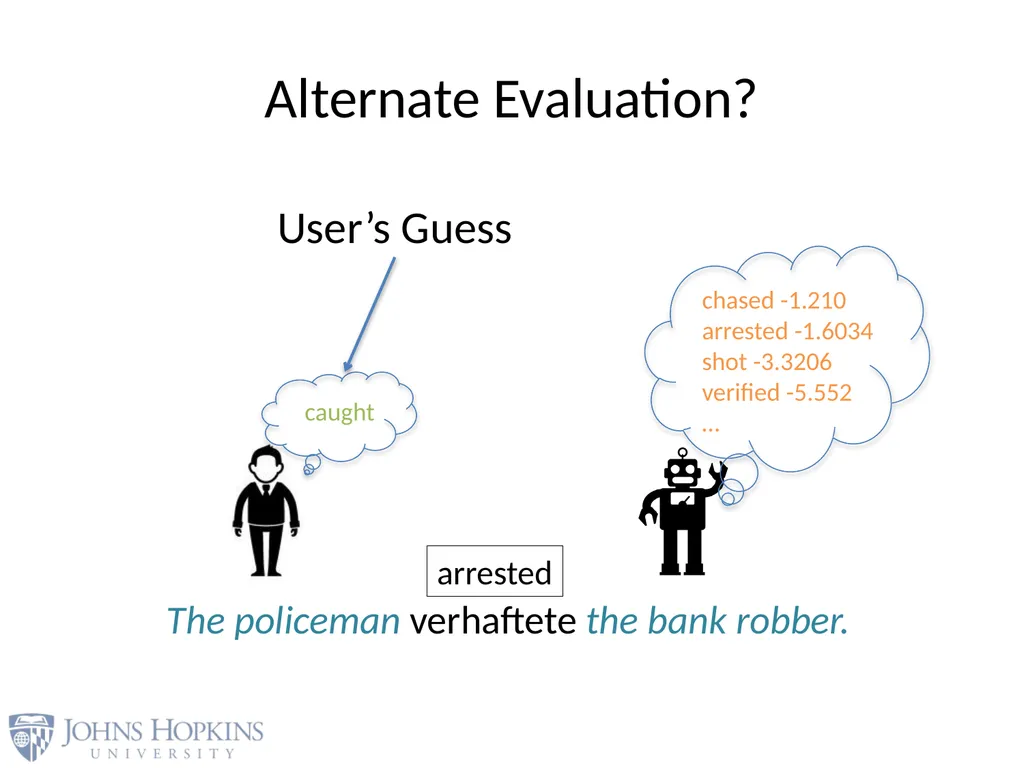
The policeman verhaftete the bank robber. Alternate Evaluation?<br>
46
The policeman verhaftete the bank robber. arrested Alternate Evaluation? Reference<br>
47
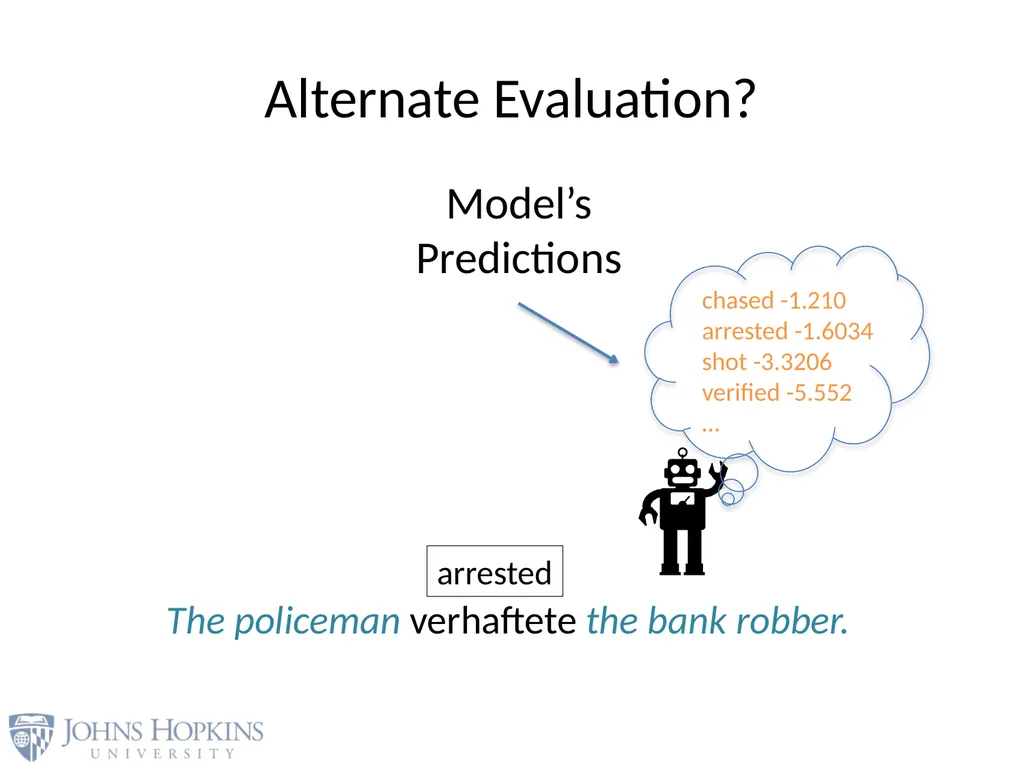
Alternate Evaluation? The policeman verhaftete the bank robber. chased -1.210
arrested -1.6034
shot -3.3206
verified -5.552
… arrested Model’s Predictions<br>
48
Alternate Evaluation? The policeman verhaftete the bank robber. chased -1.210
arrested -1.6034
shot -3.3206
verified -5.552
… arrested caught User’s Guess<br>
49
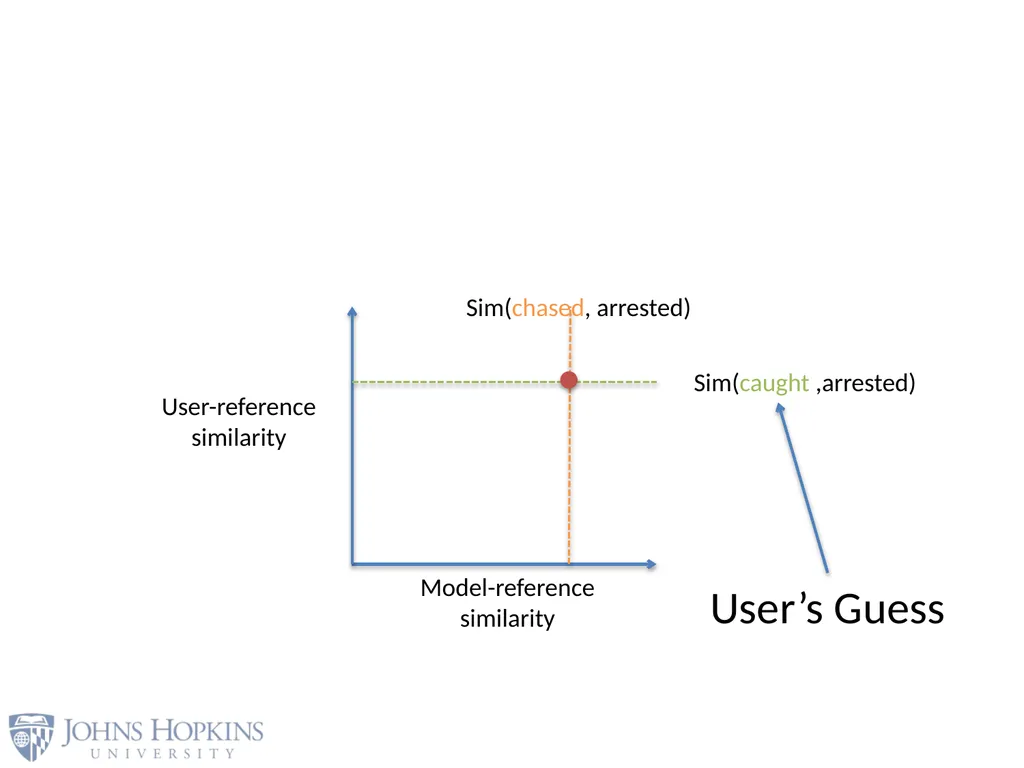
User-reference
similarity Model-reference
similarity Sim(caught ,arrested) Sim(chased, arrested) User’s Guess<br>
50
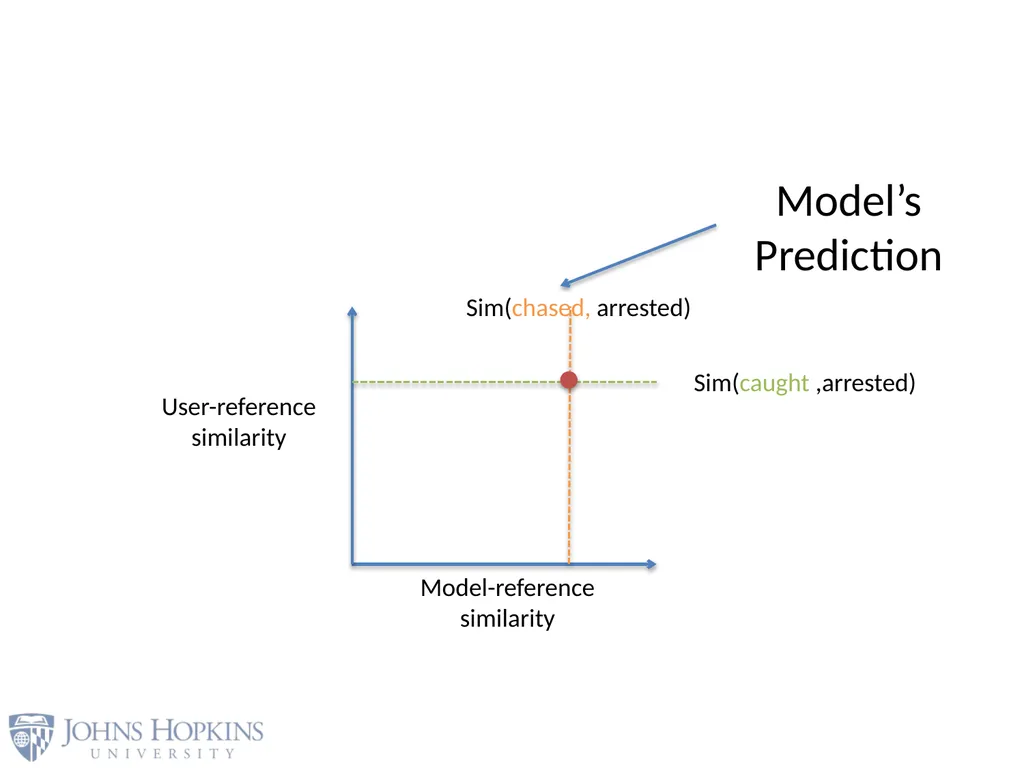
User-reference
similarity Model-reference
similarity Sim(caught ,arrested) Sim(chased, arrested) Model’s
Prediction<br>
51
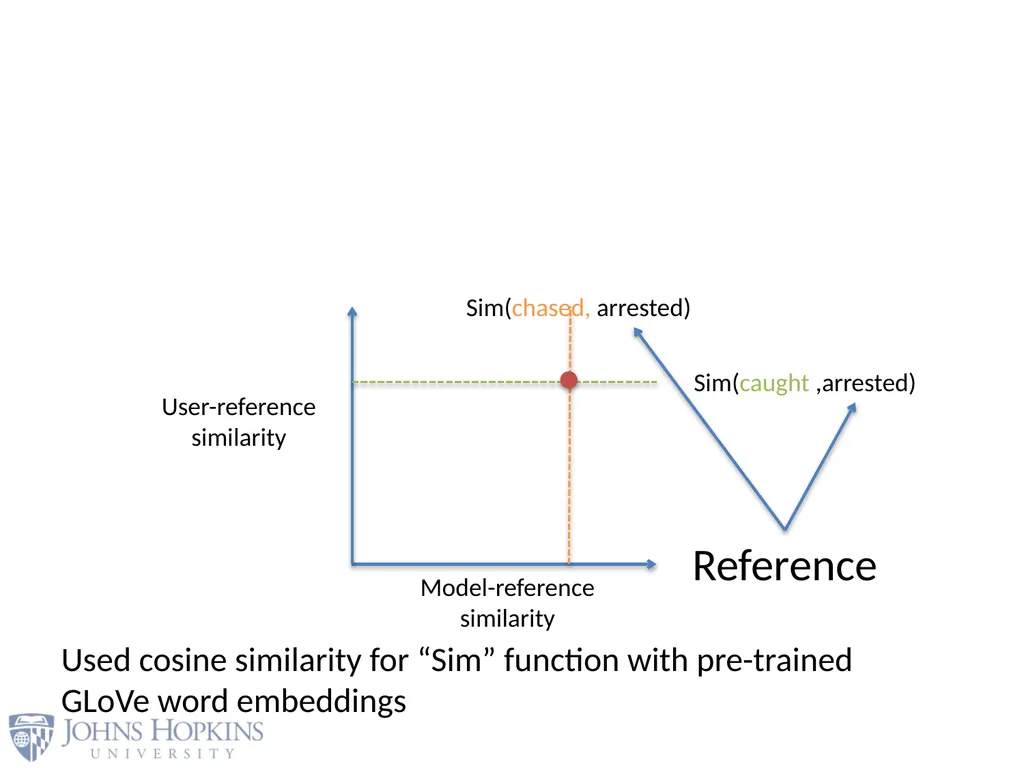
User-reference
similarity Model-reference
similarity Sim(caught ,arrested) Sim(chased, arrested) Reference Used cosine similarity for “Sim” function with pre-trained GLoVe word embeddings<br>
52
Preliminary Results Quality Corr=0.379 Quality Corr=0.525 Expected
Model-ref
similarity Model-ref
similarity User-ref
similarity<br>
53
User Learning Styles Also trained a user-adapted model.
79 different users in our data pool.
Learned 6 basic feature weights with 79 x 6 user adapted feature weights
Hal Daume III. Frustratingly easy domain adaptation. In Proceedings of ACL, pages 256–263, June 2007<br>
54
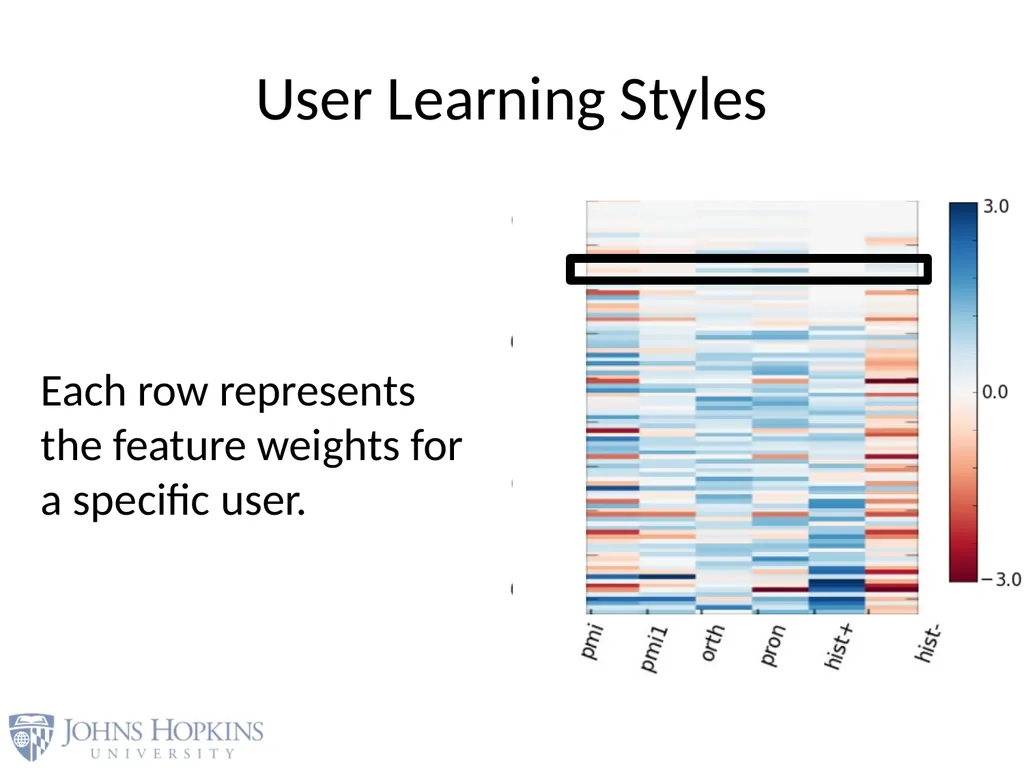
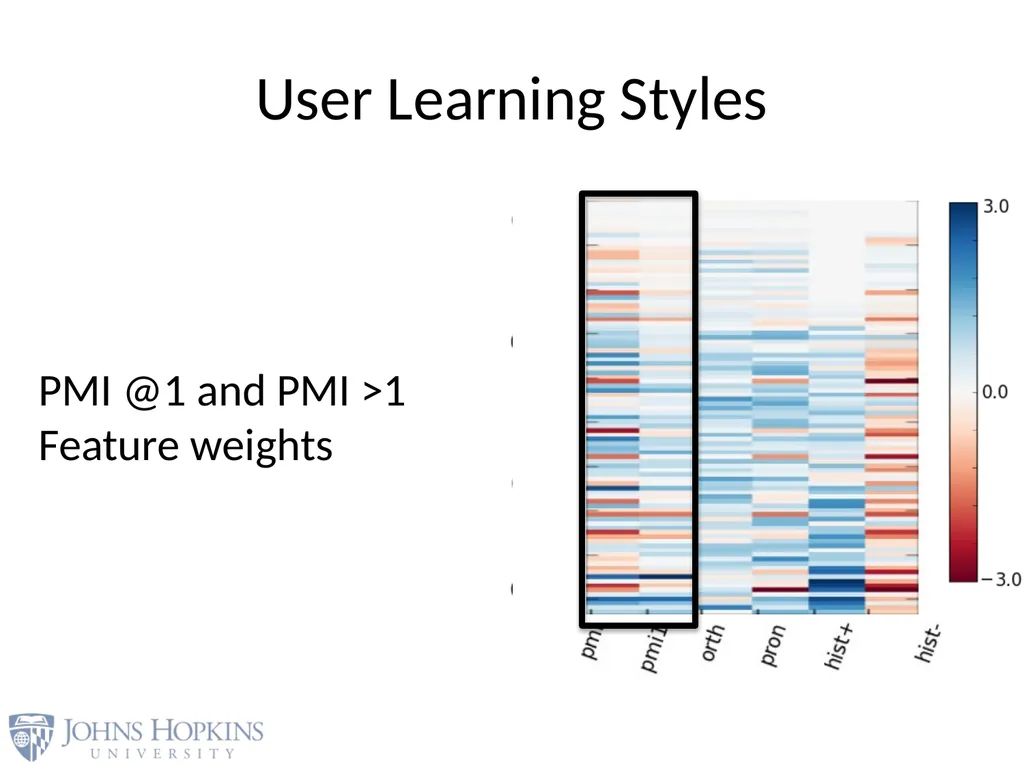
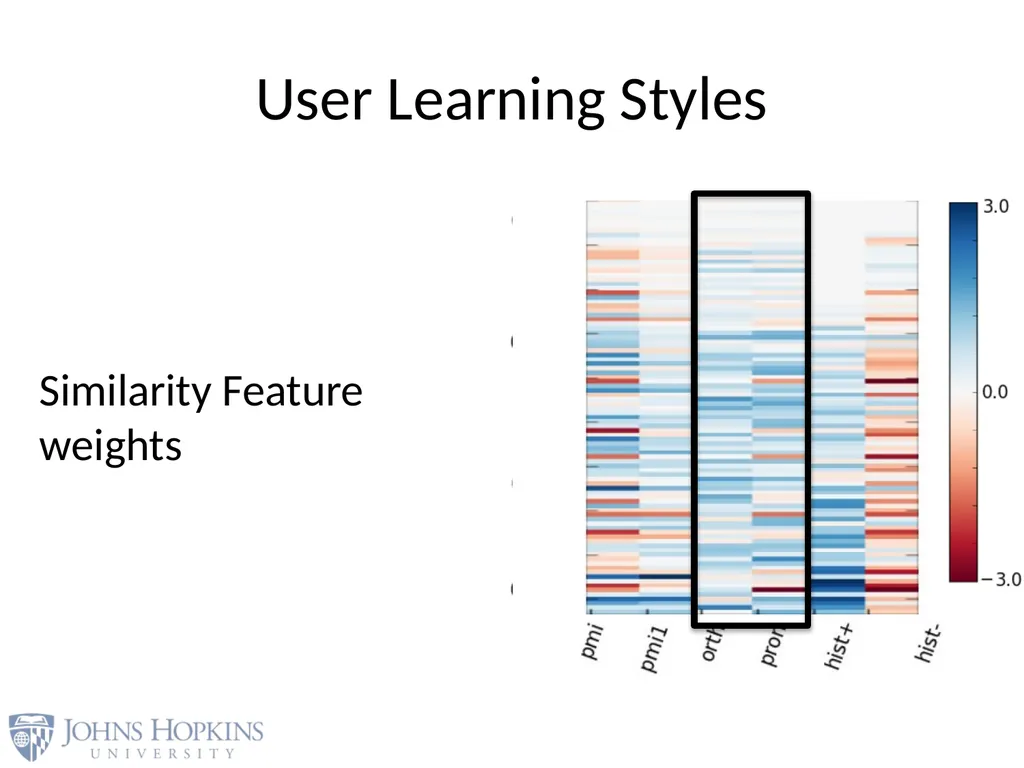
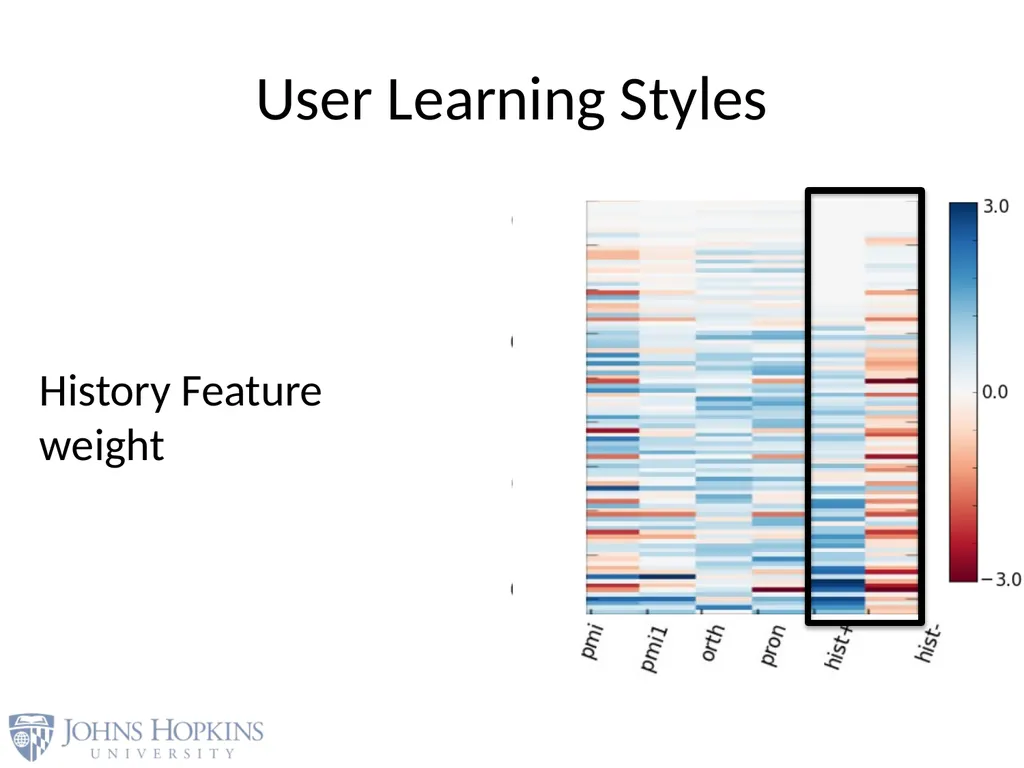
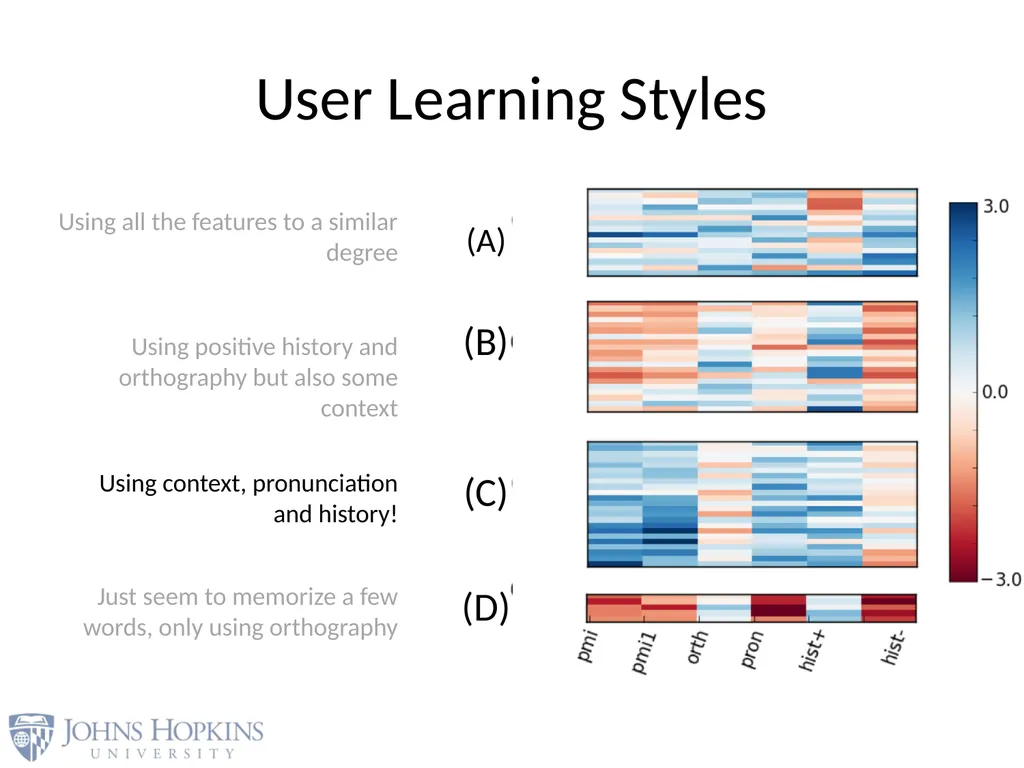
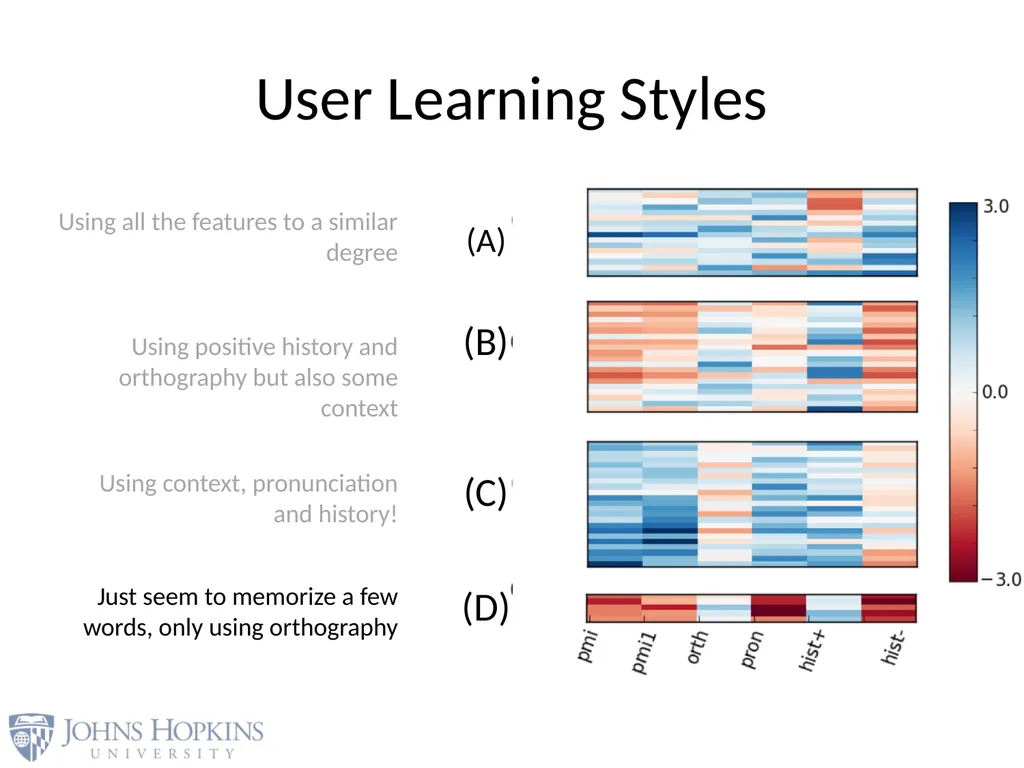
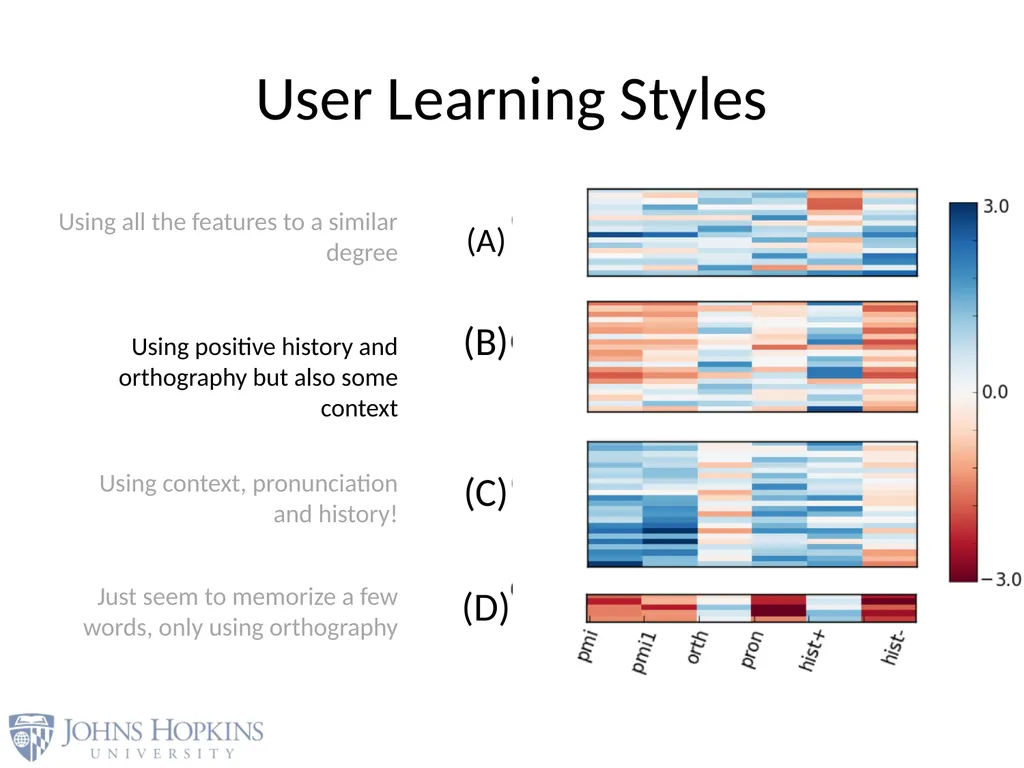
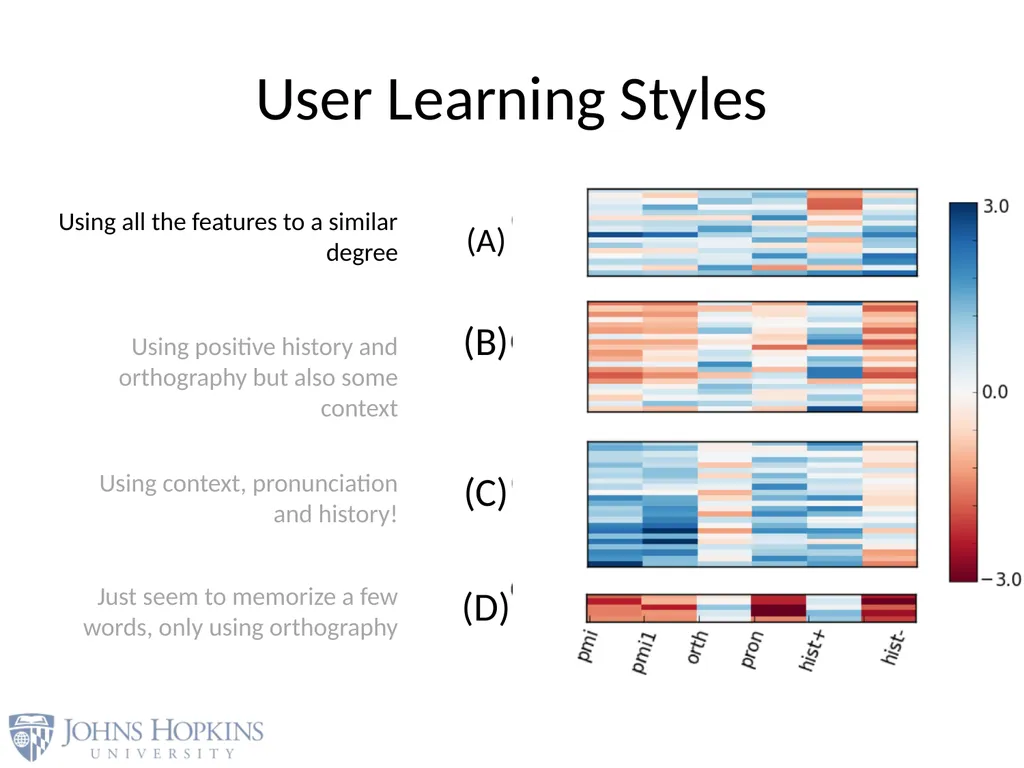
User Learning Styles Each row represents
the feature weights for
a specific user.<br>
55
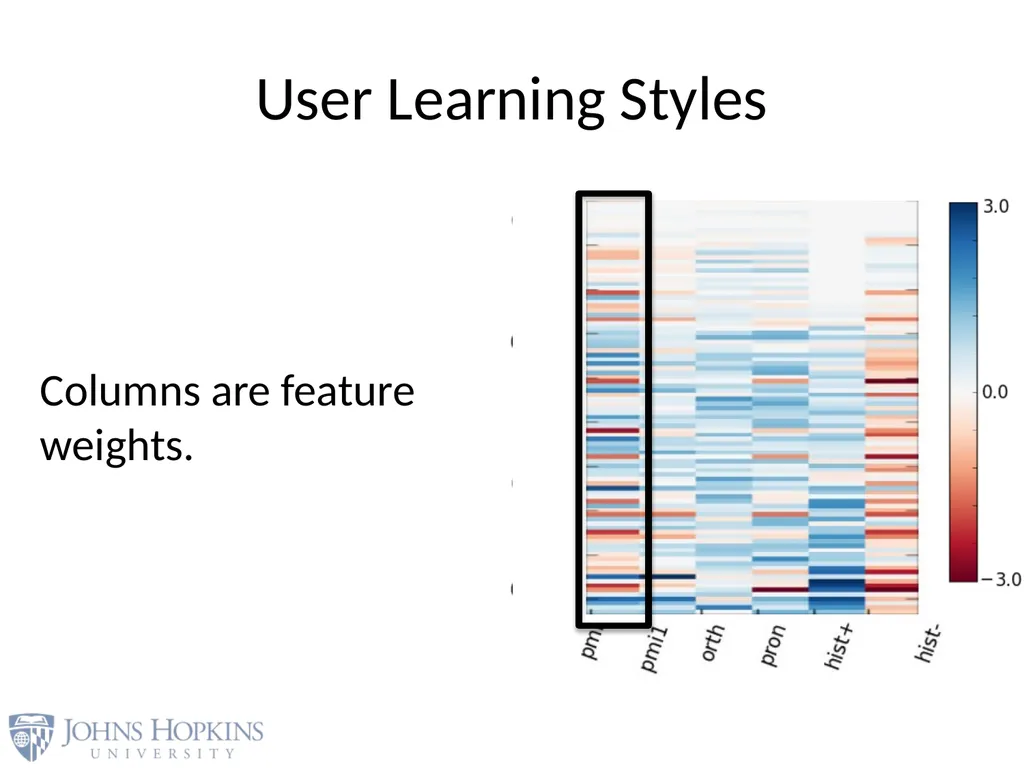
User Learning Styles Columns are feature
weights.<br>
56
User Learning Styles PMI @1 and PMI >1
Feature weights<br>
57
User Learning Styles Similarity Feature
weights<br>
58
User Learning Styles History Feature
weight<br>
59
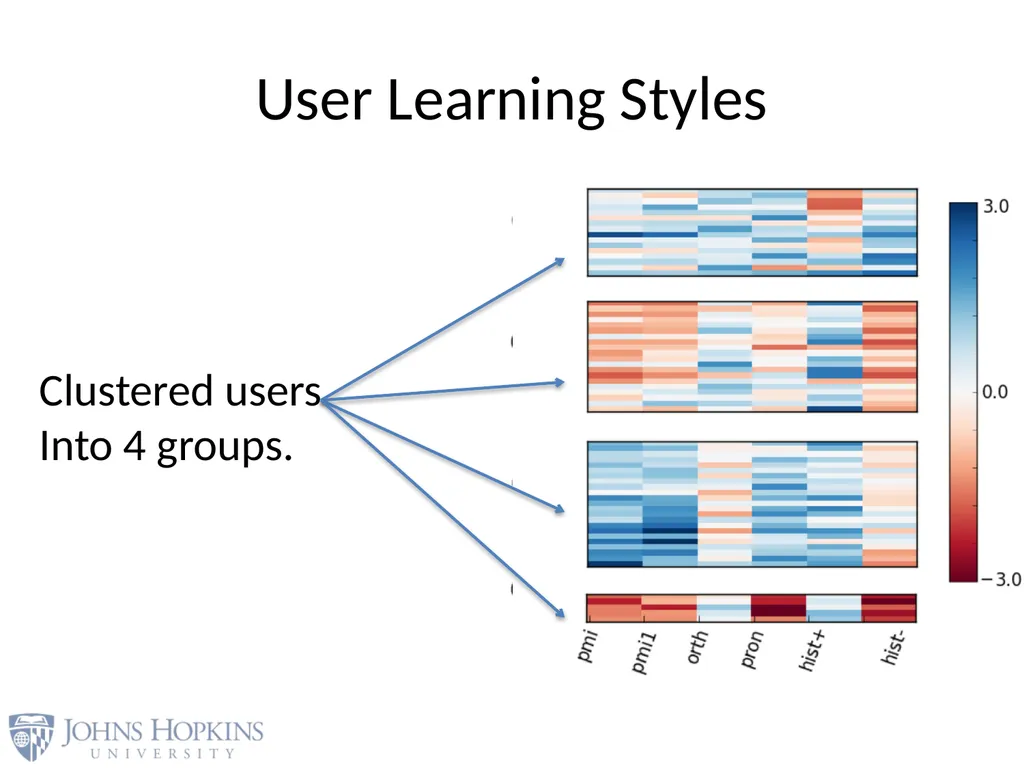
User Learning Styles Clustered users
Into 4 groups.<br>
60
User Learning Styles (A) (B) (C) (D) Just seem to memorize a few words, only using orthography Using context, pronunciation and history! Using positive history and orthography but also some context Using all the features to a similar degree<br>
61
User Learning Styles (A) (B) (C) (D) Just seem to memorize a few words, only using orthography Using context, pronunciation and history! Using positive history and orthography but also some context Using all the features to a similar degree<br>
62
User Learning Styles (A) (B) (C) (D) Just seem to memorize a few words, only using orthography Using context, pronunciation and history! Using positive history and orthography but also some context Using all the features to a similar degree<br>
63
User Learning Styles (A) (B) (C) (D) Just seem to memorize a few words, only using orthography Using context, pronunciation and history! Using positive history and orthography but also some context Using all the features to a similar degree<br>
64
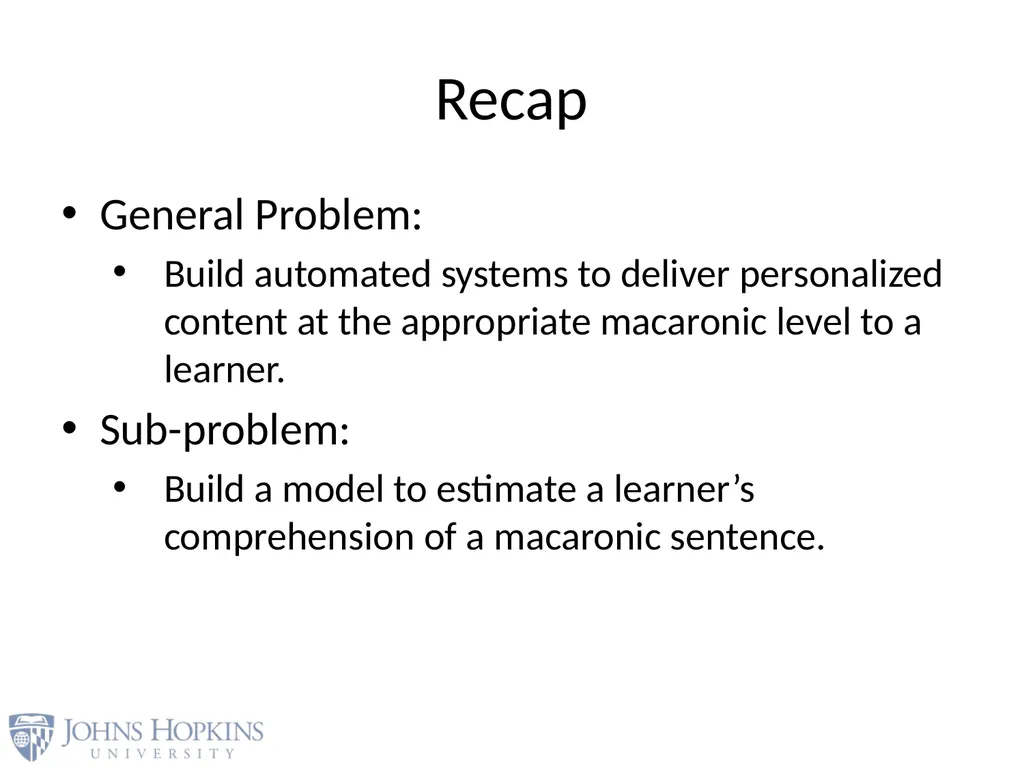
Recap General Problem:
Build automated systems to deliver personalized content at the appropriate macaronic level to a learner.
Sub-problem:
Build a model to estimate a learner’s comprehension of a macaronic sentence.<br>
65
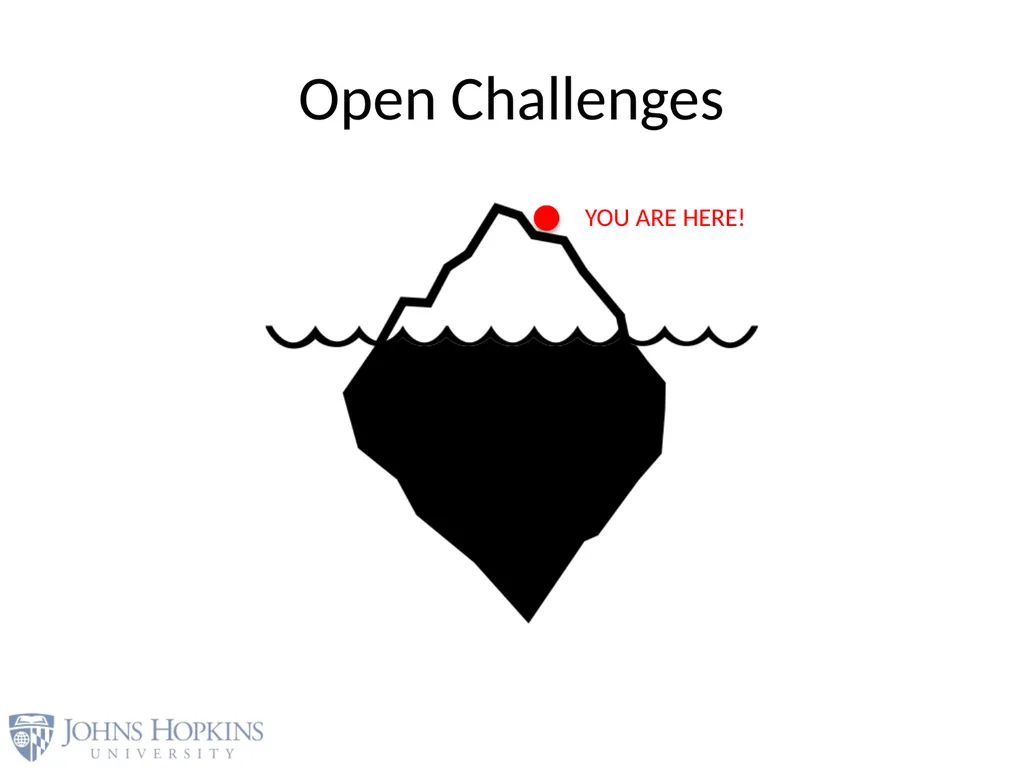
Open Challenges YOU ARE HERE!<br>
66
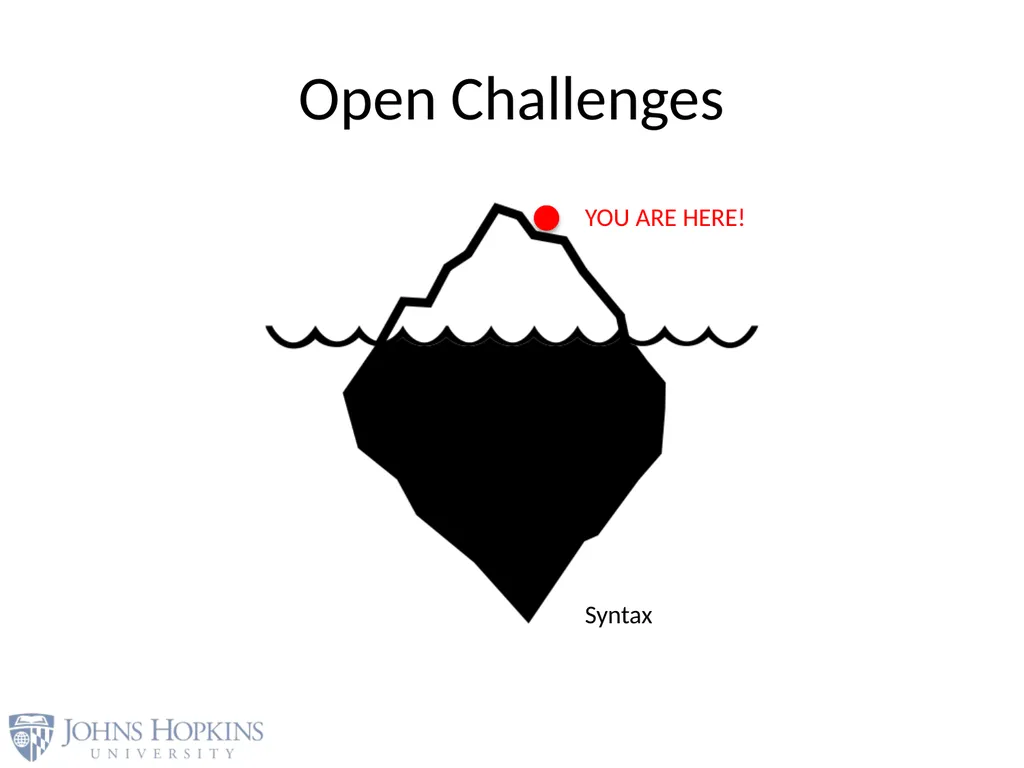
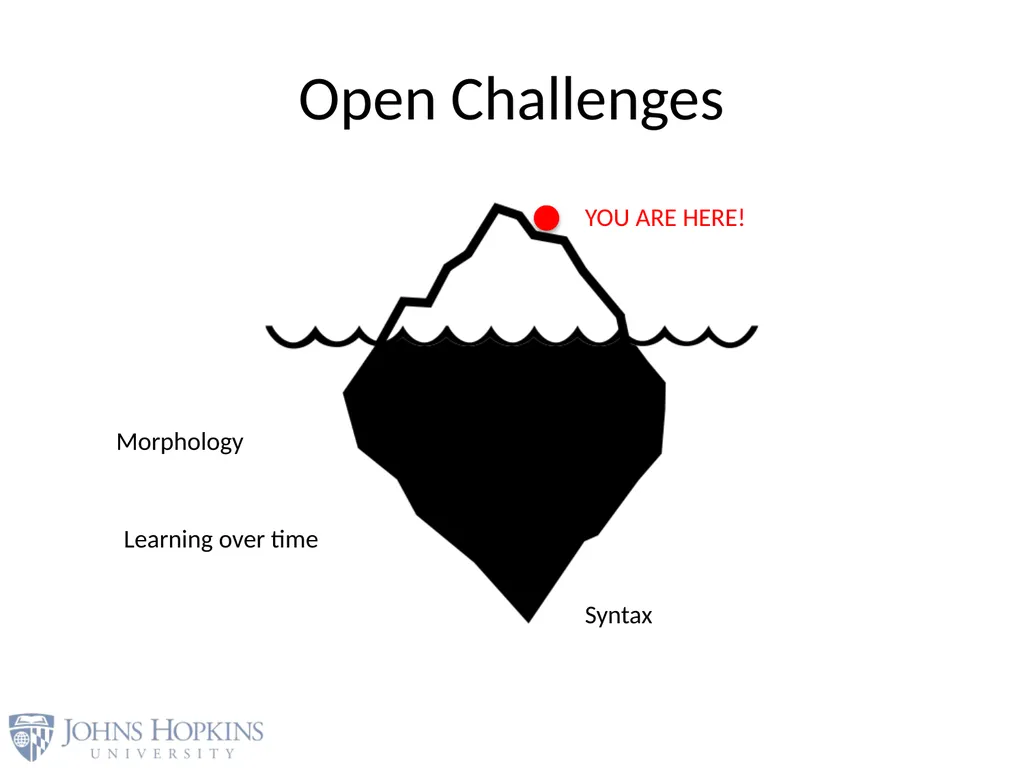
Open Challenges YOU ARE HERE! Syntax<br>
67
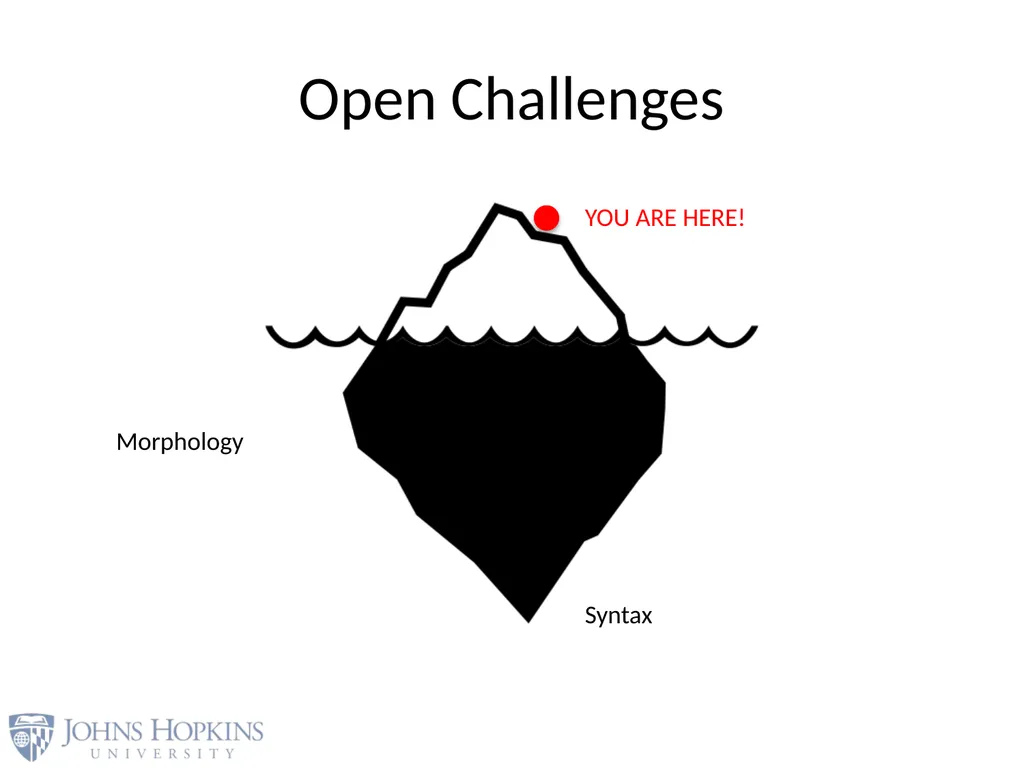
Open Challenges YOU ARE HERE! Morphology Syntax<br>
68
Open Challenges YOU ARE HERE! Morphology Learning over time Syntax<br>
69
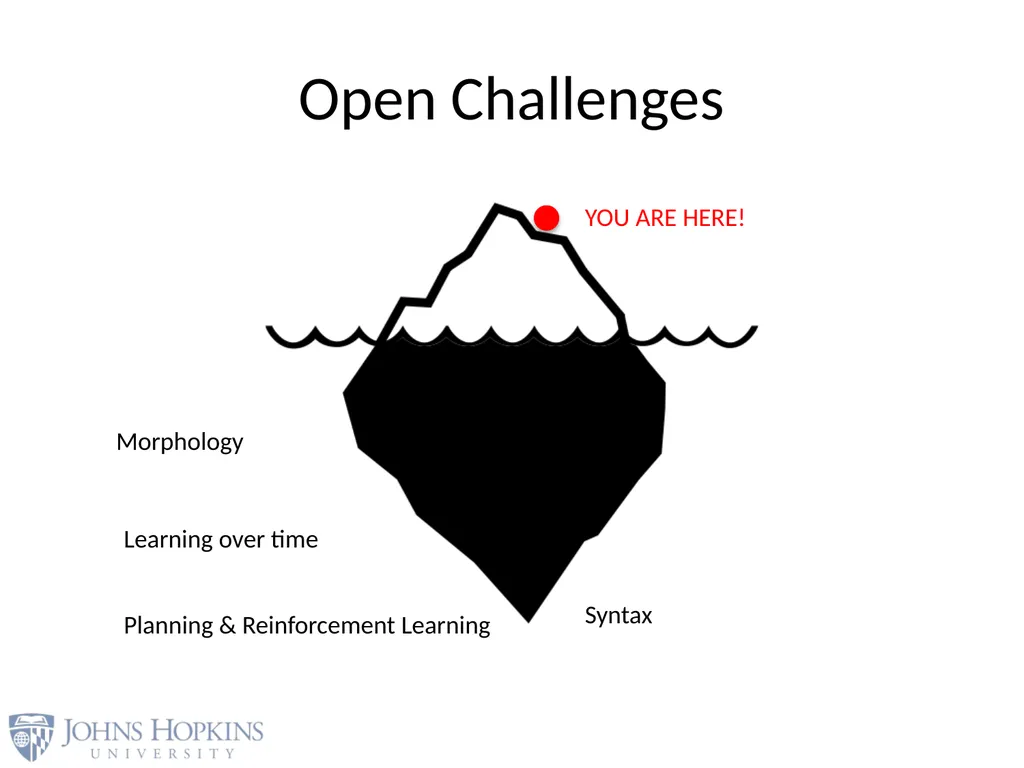
Open Challenges YOU ARE HERE! Morphology Learning over time Planning & Reinforcement Learning Syntax<br>
70
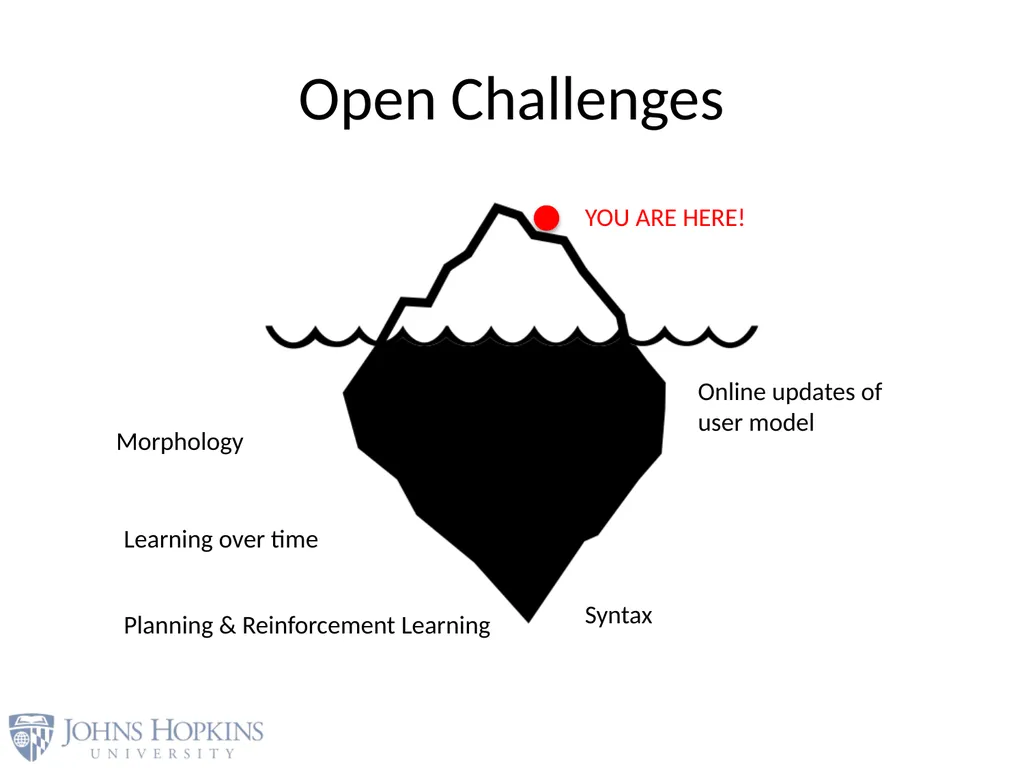
Open Challenges YOU ARE HERE! Morphology Learning over time Planning & Reinforcement Learning Online updates of user model Syntax<br>
71
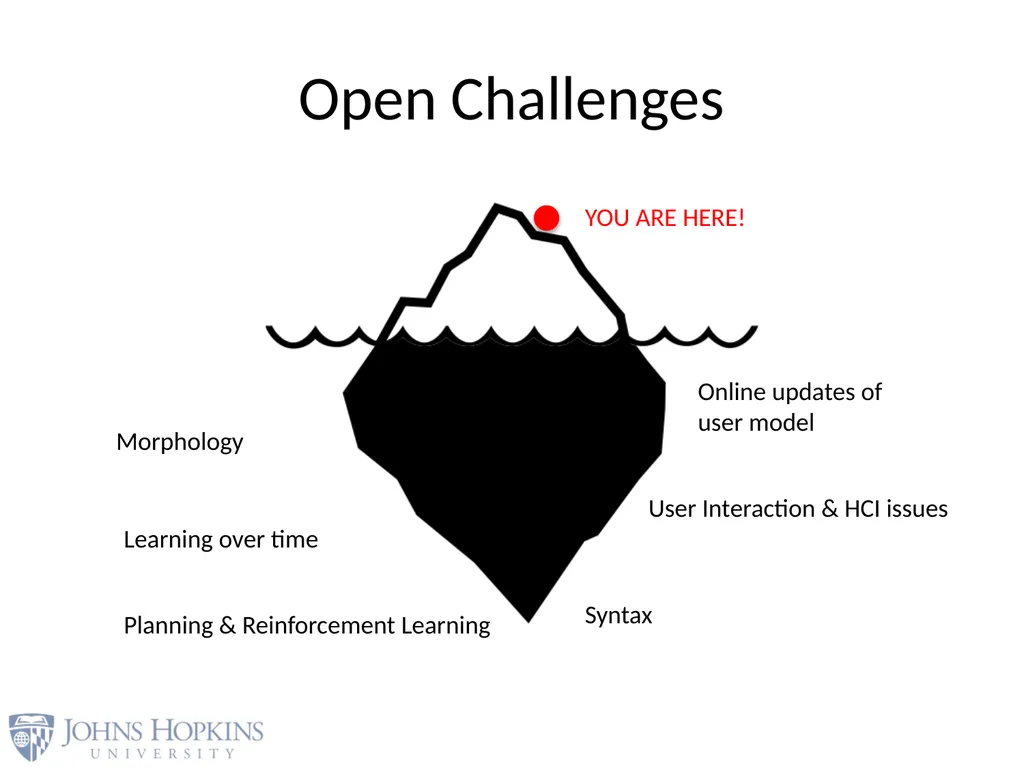
Open Challenges YOU ARE HERE! Morphology Learning over time Planning & Reinforcement Learning Online updates of user model User Interaction & HCI issues Syntax<br>
73
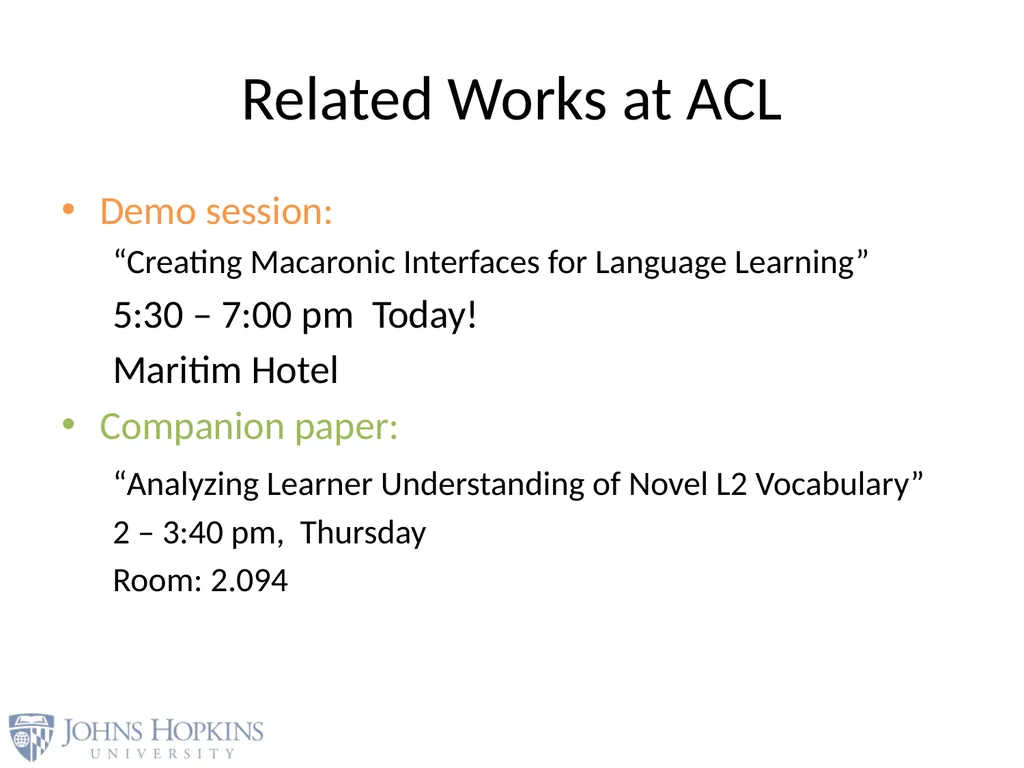
Related Works at ACL Demo session:
“Creating Macaronic Interfaces for Language Learning”
5:30 – 7:00 pm Today!
Maritim Hotel
Companion paper:
“Analyzing Learner Understanding of Novel L2 Vocabulary”
2 – 3:40 pm, Thursday
Room: 2.094<br>