
User Summit Agenda 8:45 – 9 AM Opening Remarks
DP
Published · 13 slides · 0 views

1 / 1
Description
User Summit Agenda 8:45 9 AM Opening Remarks Craig Behm, CRISP 12 PM 12:30 PM Health IT Supporting Opioid Response Efforts Marianne Gibson, OOCC Maia Gottlieb, CRISP 9 - 10 AM Keynote Panel Discussion How can health IT promote health
Related Topics
Share
Embed code
Download this presentation From Below
"User Summit Agenda 8:45 – 9 AM Opening Remarks" is the property of its rightful owner. Permission is granted to download and print the materials on this website for personal, non-commercial use only, and to display it on your personal computer provided you do not modify the materials and that you retain all copyright notices contained in the materials. By downloading content from our website, you accept the terms of this agreement.
Presentation Transcript
01
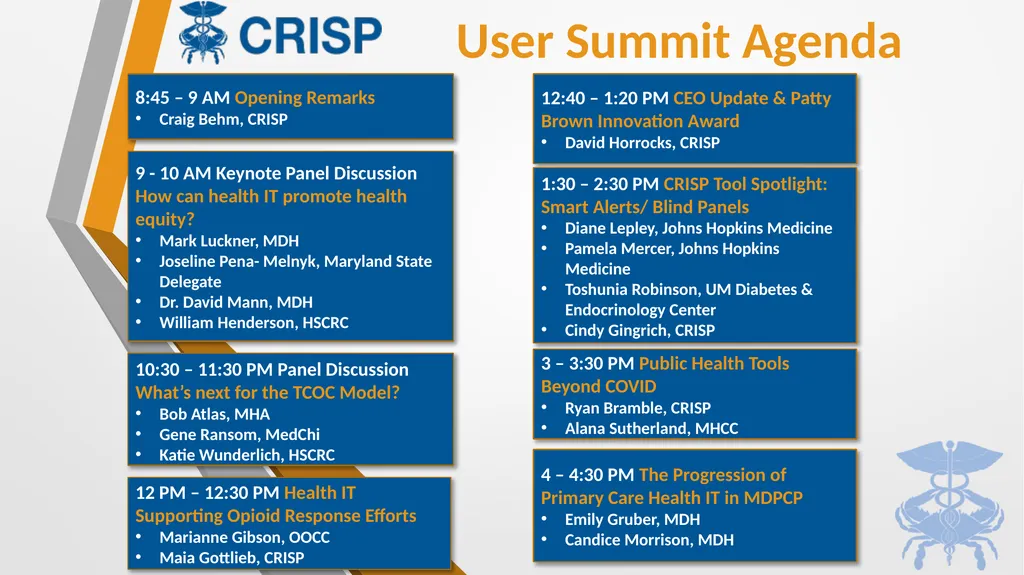
User Summit Agenda 8:45 – 9 AM Opening Remarks
Craig Behm, CRISP 12 PM – 12:30 PM Health IT Supporting Opioid Response Efforts
Marianne Gibson, OOCC
Maia Gottlieb, CRISP 9 - 10 AM Keynote Panel Discussion
How can health IT promote health equity?
Mark Luckner, MDH
Joseline Pena- Melnyk, Maryland State Delegate
Dr. David Mann, MDH
William Henderson, HSCRC 10:30 – 11:30 PM Panel Discussion
What’s next for the TCOC Model?
Bob Atlas, MHA
Gene Ransom, MedChi
Katie Wunderlich, HSCRC 12:40 – 1:20 PM CEO Update & Patty Brown Innovation Award
David Horrocks, CRISP 1:30 – 2:30 PM CRISP Tool Spotlight: Smart Alerts/ Blind Panels
Diane Lepley, Johns Hopkins Medicine
Pamela Mercer, Johns Hopkins Medicine
Toshunia Robinson, UM Diabetes & Endocrinology Center
Cindy Gingrich, CRISP 3 – 3:30 PM Public Health Tools Beyond COVID
Ryan Bramble, CRISP
Alana Sutherland, MHCC 4 – 4:30 PM The Progression of Primary Care Health IT in MDPCP
Emily Gruber, MDH
Candice Morrison, MDH<br>
Craig Behm, CRISP 12 PM – 12:30 PM Health IT Supporting Opioid Response Efforts
Marianne Gibson, OOCC
Maia Gottlieb, CRISP 9 - 10 AM Keynote Panel Discussion
How can health IT promote health equity?
Mark Luckner, MDH
Joseline Pena- Melnyk, Maryland State Delegate
Dr. David Mann, MDH
William Henderson, HSCRC 10:30 – 11:30 PM Panel Discussion
What’s next for the TCOC Model?
Bob Atlas, MHA
Gene Ransom, MedChi
Katie Wunderlich, HSCRC 12:40 – 1:20 PM CEO Update & Patty Brown Innovation Award
David Horrocks, CRISP 1:30 – 2:30 PM CRISP Tool Spotlight: Smart Alerts/ Blind Panels
Diane Lepley, Johns Hopkins Medicine
Pamela Mercer, Johns Hopkins Medicine
Toshunia Robinson, UM Diabetes & Endocrinology Center
Cindy Gingrich, CRISP 3 – 3:30 PM Public Health Tools Beyond COVID
Ryan Bramble, CRISP
Alana Sutherland, MHCC 4 – 4:30 PM The Progression of Primary Care Health IT in MDPCP
Emily Gruber, MDH
Candice Morrison, MDH<br>
02
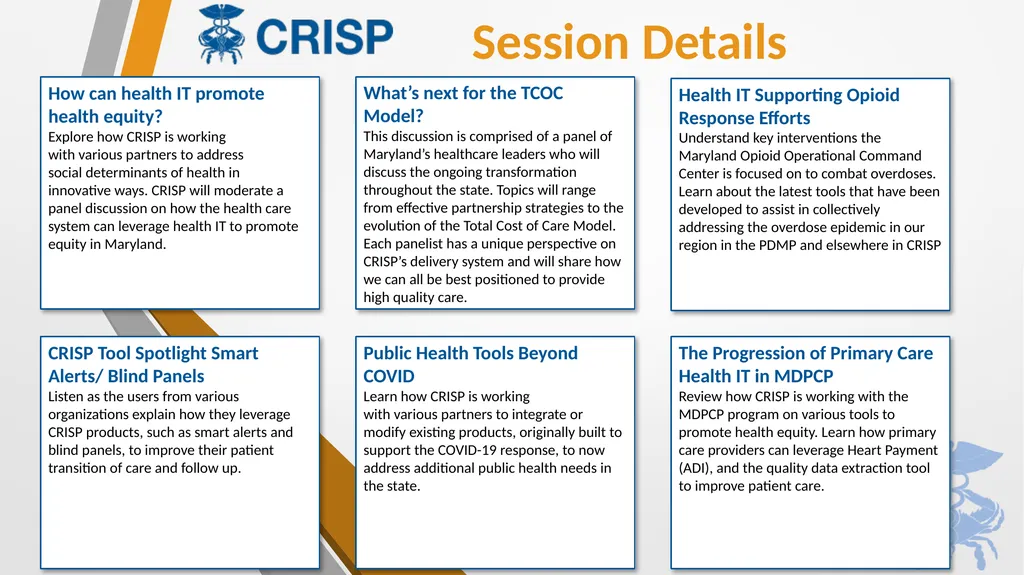
Session Details How can health IT promote health equity?
Explore how CRISP is working
with various partners to address
social determinants of health in
innovative ways. CRISP will moderate a panel discussion on how the health care system can leverage health IT to promote equity in Maryland. What’s next for the TCOC Model?
This discussion is comprised of a panel of Maryland’s healthcare leaders who will discuss the ongoing transformation throughout the state. Topics will range from effective partnership strategies to the evolution of the Total Cost of Care Model. Each panelist has a unique perspective on CRISP’s delivery system and will share how we can all be best positioned to provide high quality care. Health IT Supporting Opioid Response Efforts
Understand key interventions the Maryland Opioid Operational Command Center is focused on to combat overdoses.
Learn about the latest tools that have been developed to assist in collectively addressing the overdose epidemic in our region in the PDMP and elsewhere in CRISP CRISP Tool Spotlight Smart Alerts/ Blind Panels
Listen as the users from various organizations explain how they leverage CRISP products, such as smart alerts and blind panels, to improve their patient transition of care and follow up. Public Health Tools Beyond COVID
Learn how CRISP is working
with various partners to integrate or modify existing products, originally built to support the COVID-19 response, to now address additional public health needs in the state. The Progression of Primary Care Health IT in MDPCP
Review how CRISP is working with the MDPCP program on various tools to promote health equity. Learn how primary care providers can leverage Heart Payment (ADI), and the quality data extraction tool to improve patient care.<br>
Explore how CRISP is working
with various partners to address
social determinants of health in
innovative ways. CRISP will moderate a panel discussion on how the health care system can leverage health IT to promote equity in Maryland. What’s next for the TCOC Model?
This discussion is comprised of a panel of Maryland’s healthcare leaders who will discuss the ongoing transformation throughout the state. Topics will range from effective partnership strategies to the evolution of the Total Cost of Care Model. Each panelist has a unique perspective on CRISP’s delivery system and will share how we can all be best positioned to provide high quality care. Health IT Supporting Opioid Response Efforts
Understand key interventions the Maryland Opioid Operational Command Center is focused on to combat overdoses.
Learn about the latest tools that have been developed to assist in collectively addressing the overdose epidemic in our region in the PDMP and elsewhere in CRISP CRISP Tool Spotlight Smart Alerts/ Blind Panels
Listen as the users from various organizations explain how they leverage CRISP products, such as smart alerts and blind panels, to improve their patient transition of care and follow up. Public Health Tools Beyond COVID
Learn how CRISP is working
with various partners to integrate or modify existing products, originally built to support the COVID-19 response, to now address additional public health needs in the state. The Progression of Primary Care Health IT in MDPCP
Review how CRISP is working with the MDPCP program on various tools to promote health equity. Learn how primary care providers can leverage Heart Payment (ADI), and the quality data extraction tool to improve patient care.<br>
03
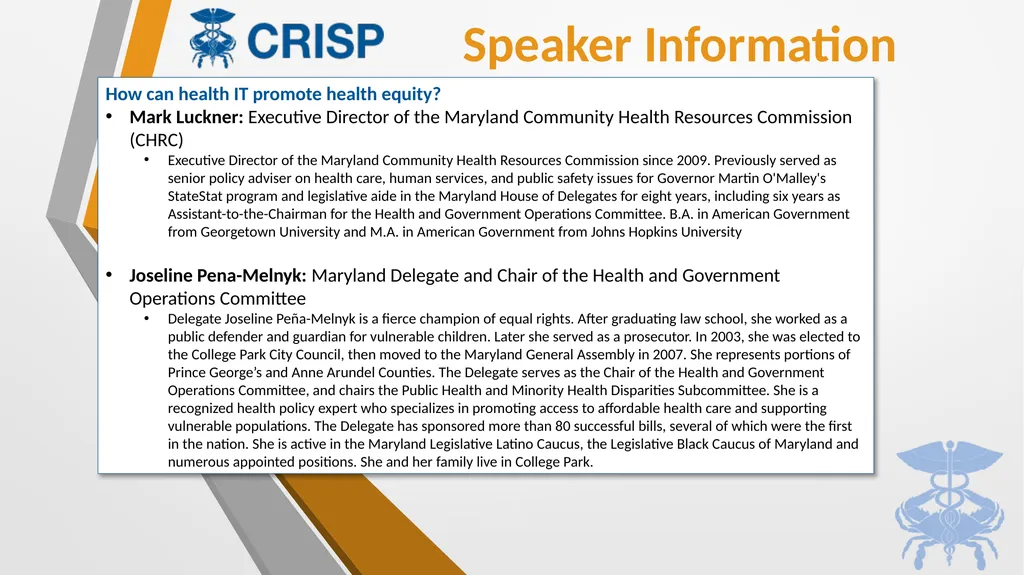
Speaker Information How can health IT promote health equity?
Mark Luckner: Executive Director of the Maryland Community Health Resources Commission (CHRC)
Executive Director of the Maryland Community Health Resources Commission since 2009. Previously served as senior policy adviser on health care, human services, and public safety issues for Governor Martin O'Malley's StateStat program and legislative aide in the Maryland House of Delegates for eight years, including six years as Assistant-to-the-Chairman for the Health and Government Operations Committee. B.A. in American Government from Georgetown University and M.A. in American Government from Johns Hopkins University
Joseline Pena-Melnyk: Maryland Delegate and Chair of the Health and Government Operations Committee
Delegate Joseline Peña-Melnyk is a fierce champion of equal rights. After graduating law school, she worked as a public defender and guardian for vulnerable children. Later she served as a prosecutor. In 2003, she was elected to the College Park City Council, then moved to the Maryland General Assembly in 2007. She represents portions of Prince George’s and Anne Arundel Counties. The Delegate serves as the Chair of the Health and Government Operations Committee, and chairs the Public Health and Minority Health Disparities Subcommittee. She is a recognized health policy expert who specializes in promoting access to affordable health care and supporting vulnerable populations. The Delegate has sponsored more than 80 successful bills, several of which were the first in the nation. She is active in the Maryland Legislative Latino Caucus, the Legislative Black Caucus of Maryland and numerous appointed positions. She and her family live in College Park.<br>
Mark Luckner: Executive Director of the Maryland Community Health Resources Commission (CHRC)
Executive Director of the Maryland Community Health Resources Commission since 2009. Previously served as senior policy adviser on health care, human services, and public safety issues for Governor Martin O'Malley's StateStat program and legislative aide in the Maryland House of Delegates for eight years, including six years as Assistant-to-the-Chairman for the Health and Government Operations Committee. B.A. in American Government from Georgetown University and M.A. in American Government from Johns Hopkins University
Joseline Pena-Melnyk: Maryland Delegate and Chair of the Health and Government Operations Committee
Delegate Joseline Peña-Melnyk is a fierce champion of equal rights. After graduating law school, she worked as a public defender and guardian for vulnerable children. Later she served as a prosecutor. In 2003, she was elected to the College Park City Council, then moved to the Maryland General Assembly in 2007. She represents portions of Prince George’s and Anne Arundel Counties. The Delegate serves as the Chair of the Health and Government Operations Committee, and chairs the Public Health and Minority Health Disparities Subcommittee. She is a recognized health policy expert who specializes in promoting access to affordable health care and supporting vulnerable populations. The Delegate has sponsored more than 80 successful bills, several of which were the first in the nation. She is active in the Maryland Legislative Latino Caucus, the Legislative Black Caucus of Maryland and numerous appointed positions. She and her family live in College Park.<br>
04
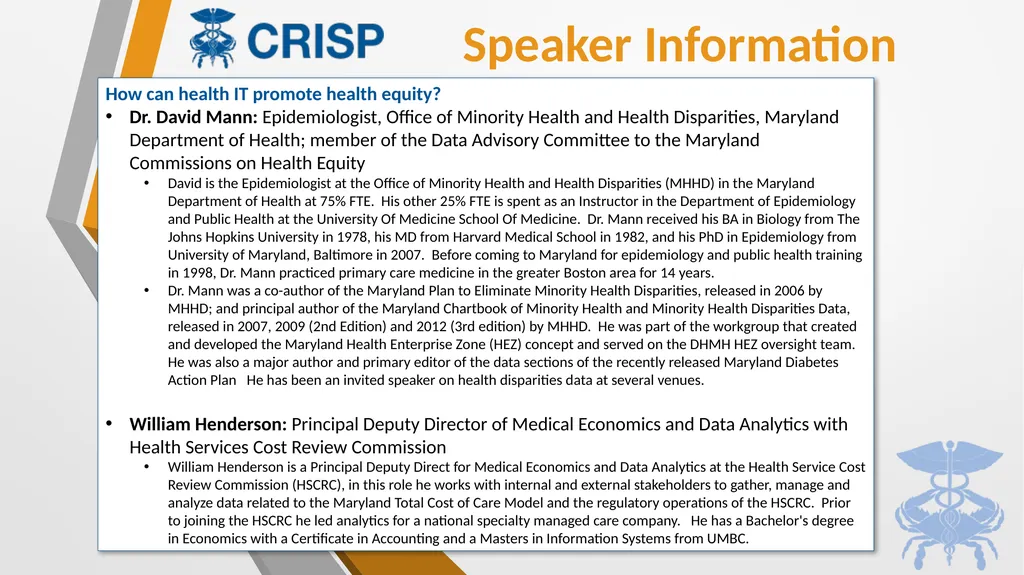
Speaker Information How can health IT promote health equity?
Dr. David Mann: Epidemiologist, Office of Minority Health and Health Disparities, Maryland Department of Health; member of the Data Advisory Committee to the Maryland Commissions on Health Equity
David is the Epidemiologist at the Office of Minority Health and Health Disparities (MHHD) in the Maryland Department of Health at 75% FTE. His other 25% FTE is spent as an Instructor in the Department of Epidemiology and Public Health at the University Of Medicine School Of Medicine. Dr. Mann received his BA in Biology from The Johns Hopkins University in 1978, his MD from Harvard Medical School in 1982, and his PhD in Epidemiology from University of Maryland, Baltimore in 2007. Before coming to Maryland for epidemiology and public health training in 1998, Dr. Mann practiced primary care medicine in the greater Boston area for 14 years.
Dr. Mann was a co-author of the Maryland Plan to Eliminate Minority Health Disparities, released in 2006 by MHHD; and principal author of the Maryland Chartbook of Minority Health and Minority Health Disparities Data, released in 2007, 2009 (2nd Edition) and 2012 (3rd edition) by MHHD. He was part of the workgroup that created and developed the Maryland Health Enterprise Zone (HEZ) concept and served on the DHMH HEZ oversight team. He was also a major author and primary editor of the data sections of the recently released Maryland Diabetes Action Plan He has been an invited speaker on health disparities data at several venues.
William Henderson: Principal Deputy Director of Medical Economics and Data Analytics with Health Services Cost Review Commission
William Henderson is a Principal Deputy Direct for Medical Economics and Data Analytics at the Health Service Cost Review Commission (HSCRC), in this role he works with internal and external stakeholders to gather, manage and analyze data related to the Maryland Total Cost of Care Model and the regulatory operations of the HSCRC. Prior to joining the HSCRC he led analytics for a national specialty managed care company. He has a Bachelor's degree in Economics with a Certificate in Accounting and a Masters in Information Systems from UMBC.<br>
Dr. David Mann: Epidemiologist, Office of Minority Health and Health Disparities, Maryland Department of Health; member of the Data Advisory Committee to the Maryland Commissions on Health Equity
David is the Epidemiologist at the Office of Minority Health and Health Disparities (MHHD) in the Maryland Department of Health at 75% FTE. His other 25% FTE is spent as an Instructor in the Department of Epidemiology and Public Health at the University Of Medicine School Of Medicine. Dr. Mann received his BA in Biology from The Johns Hopkins University in 1978, his MD from Harvard Medical School in 1982, and his PhD in Epidemiology from University of Maryland, Baltimore in 2007. Before coming to Maryland for epidemiology and public health training in 1998, Dr. Mann practiced primary care medicine in the greater Boston area for 14 years.
Dr. Mann was a co-author of the Maryland Plan to Eliminate Minority Health Disparities, released in 2006 by MHHD; and principal author of the Maryland Chartbook of Minority Health and Minority Health Disparities Data, released in 2007, 2009 (2nd Edition) and 2012 (3rd edition) by MHHD. He was part of the workgroup that created and developed the Maryland Health Enterprise Zone (HEZ) concept and served on the DHMH HEZ oversight team. He was also a major author and primary editor of the data sections of the recently released Maryland Diabetes Action Plan He has been an invited speaker on health disparities data at several venues.
William Henderson: Principal Deputy Director of Medical Economics and Data Analytics with Health Services Cost Review Commission
William Henderson is a Principal Deputy Direct for Medical Economics and Data Analytics at the Health Service Cost Review Commission (HSCRC), in this role he works with internal and external stakeholders to gather, manage and analyze data related to the Maryland Total Cost of Care Model and the regulatory operations of the HSCRC. Prior to joining the HSCRC he led analytics for a national specialty managed care company. He has a Bachelor's degree in Economics with a Certificate in Accounting and a Masters in Information Systems from UMBC.<br>
05
Speaker Information What’s next for the TCOC Model?
Bob Atlas: President and CEO of the Maryland Hospital Association
The Maryland Hospital Association serves as a strategic resource and advocate for all of the state’s hospitals and health systems. President and CEO of MHA since 2018, Bob Atlas has a long professional history in health policy and the business of health care. Bob led premier health care consultancies and served as strategic counselor to leading health care organizations, insurers, health technology firms, and state governments. He brings a national perspective and a focus on innovations in health care delivery and financing that produce value for people and payers.
Gene Ransom: CEO of MedChi, The Maryland State Medical Society
Gene is the CEO of MedChi, The Maryland State Medical Society. As the largest physician organization in Maryland, MedChi’s mission is to serve as the foremost advocate for physicians, their patients, and the public health of Maryland. Mr. Ransom has been with the organization since 1996. He graduated Cum Laude from the University of Maryland in 1993 and received his law degree from the University of Baltimore in 1996.
Mr. Ransom’s career has been distinguished by a commitment to public service. From 2002 to 2010, he served as an elected commissioner in Queen Anne’s County, Maryland. The Queen Anne’s County Commission consists of five elected commissioners, and Gene served both as President and Vice President of the Commission. He was instrumental in securing passage of legislation to improve growth management, health, and environmental policy in Queen Anne’s County. Gene currently serves on several important boards and commissions, including the Maryland Primary Care Advisory Board and the Maryland Advisory Council on the Implementation of Population-based and Patient-centered Payment Systems.
Gene lives with his wife, Nicole, and their children, Theo and Claire, in Queenstown on Maryland’s historic Eastern Shore.<br>
Bob Atlas: President and CEO of the Maryland Hospital Association
The Maryland Hospital Association serves as a strategic resource and advocate for all of the state’s hospitals and health systems. President and CEO of MHA since 2018, Bob Atlas has a long professional history in health policy and the business of health care. Bob led premier health care consultancies and served as strategic counselor to leading health care organizations, insurers, health technology firms, and state governments. He brings a national perspective and a focus on innovations in health care delivery and financing that produce value for people and payers.
Gene Ransom: CEO of MedChi, The Maryland State Medical Society
Gene is the CEO of MedChi, The Maryland State Medical Society. As the largest physician organization in Maryland, MedChi’s mission is to serve as the foremost advocate for physicians, their patients, and the public health of Maryland. Mr. Ransom has been with the organization since 1996. He graduated Cum Laude from the University of Maryland in 1993 and received his law degree from the University of Baltimore in 1996.
Mr. Ransom’s career has been distinguished by a commitment to public service. From 2002 to 2010, he served as an elected commissioner in Queen Anne’s County, Maryland. The Queen Anne’s County Commission consists of five elected commissioners, and Gene served both as President and Vice President of the Commission. He was instrumental in securing passage of legislation to improve growth management, health, and environmental policy in Queen Anne’s County. Gene currently serves on several important boards and commissions, including the Maryland Primary Care Advisory Board and the Maryland Advisory Council on the Implementation of Population-based and Patient-centered Payment Systems.
Gene lives with his wife, Nicole, and their children, Theo and Claire, in Queenstown on Maryland’s historic Eastern Shore.<br>
06
Speaker Information What’s next for the TCOC Model?
Katie Wunderlich: Executive Director of the Health Services Cost Review Commission
Katie Wunderlich began her tenure as Executive Director of the Health Services Cost Review Commission in September 2018. In that role, she has lead the Commission through the transition from the hospital-based All-Payer Model to the Total Cost of Care Model, which focuses on hospital and non-hospital system transformation to enhance patient care, improve health, and lower costs. In order to successfully transform the delivery system, the new Total Cost of Care Model gives the State the flexibility to tailor initiatives to the Maryland health care context, encourages providers to drive health care innovation, and provides new tools and resources for primary care clinicians to better meet the needs of patients with complex and chronic conditions and help Marylanders achieve better health status overall. Previously, Ms. Wunderlich was the Principal Deputy Director at HSCRC overseeing the Center for Provider Alignment and Engagement that works with hospitals, physicians and other health care providers in partnership with patients to achieve the goals of the new model and transform healthcare delivery. Before joining the HSCRC in 2016, Ms. Wunderlich was a Deputy Legislative Officer in Governor Hogan’s Legislative Office. She also served as Director of Government Relations for the Maryland Hospital Association and as a budget analyst for the General Assembly’s Legislative Services department. She has a Masters in Public Policy from George Washington University.<br>
Katie Wunderlich: Executive Director of the Health Services Cost Review Commission
Katie Wunderlich began her tenure as Executive Director of the Health Services Cost Review Commission in September 2018. In that role, she has lead the Commission through the transition from the hospital-based All-Payer Model to the Total Cost of Care Model, which focuses on hospital and non-hospital system transformation to enhance patient care, improve health, and lower costs. In order to successfully transform the delivery system, the new Total Cost of Care Model gives the State the flexibility to tailor initiatives to the Maryland health care context, encourages providers to drive health care innovation, and provides new tools and resources for primary care clinicians to better meet the needs of patients with complex and chronic conditions and help Marylanders achieve better health status overall. Previously, Ms. Wunderlich was the Principal Deputy Director at HSCRC overseeing the Center for Provider Alignment and Engagement that works with hospitals, physicians and other health care providers in partnership with patients to achieve the goals of the new model and transform healthcare delivery. Before joining the HSCRC in 2016, Ms. Wunderlich was a Deputy Legislative Officer in Governor Hogan’s Legislative Office. She also served as Director of Government Relations for the Maryland Hospital Association and as a budget analyst for the General Assembly’s Legislative Services department. She has a Masters in Public Policy from George Washington University.<br>
07
Speaker Information Health IT Supporting Opioid Response Efforts
Marianne Gibson: Project Coordinator at OOCC
Marianne joined the Opioid Operational Command Center, the state's principle coordinating office for responding to the opioid and overdose crisis, in 2019. Her responsibilities include directing special projects to reduce opioid-related morbidity and mortality, including the Data-Informed Overdose Risk Mitigation (DORM) initiative, which links individual-level datasets from overdose decedents to develop overdose risk profiles. CRISP is an important partner for this project and provides data management and linkage support. Marianne received her Bachelor's degree from Salisbury University in Social Work and her Master's of Science in Health Science from Towson University.
Maia Gottleib: PDMP Project Manager at CRISP
Maia joined the CRISP team as the PDMP Program Manager in June 2020. In addition to working closely with the Office of Provider Education and Regulation on PDMP efforts, she works with the Office of Population Health Improvement team on the Overdose Fatality Review dashboard and helps support the Opioid Operational Command Center as needed. Prior to joining CRISP, she worked as a Program Manager for an addiction center at a safety net hospital. Maia earned her Master’s in Public Health, focused on Health Policy, from Harvard University and her Bachelor of Arts from the University of Pennsylvania.<br>
Marianne Gibson: Project Coordinator at OOCC
Marianne joined the Opioid Operational Command Center, the state's principle coordinating office for responding to the opioid and overdose crisis, in 2019. Her responsibilities include directing special projects to reduce opioid-related morbidity and mortality, including the Data-Informed Overdose Risk Mitigation (DORM) initiative, which links individual-level datasets from overdose decedents to develop overdose risk profiles. CRISP is an important partner for this project and provides data management and linkage support. Marianne received her Bachelor's degree from Salisbury University in Social Work and her Master's of Science in Health Science from Towson University.
Maia Gottleib: PDMP Project Manager at CRISP
Maia joined the CRISP team as the PDMP Program Manager in June 2020. In addition to working closely with the Office of Provider Education and Regulation on PDMP efforts, she works with the Office of Population Health Improvement team on the Overdose Fatality Review dashboard and helps support the Opioid Operational Command Center as needed. Prior to joining CRISP, she worked as a Program Manager for an addiction center at a safety net hospital. Maia earned her Master’s in Public Health, focused on Health Policy, from Harvard University and her Bachelor of Arts from the University of Pennsylvania.<br>
08
Speaker Information Public Health Tools Beyond COVID
Ryan Bramble: Chief Operating Officer of CRISP Shared Services
Ryan joined the CRISP team as part of the planning project in 2008. Although he began as an HIE expert and consultant for Dynamed Solutions, he has since served as a Business Analyst, Project Manager, the Director of Integrations, and finally the Executive Director of CRISP DC. As the head of products, Ryan leads all technology projects and implementations. Ryan is a Lean Six Sigma Green Belt, has a Bachelor of Arts from Loyola University Maryland and a Master of Science from the University of Maryland, Baltimore County.
Alana Sutherland: Chief of Health Information Exchange in the Maryland Health Care Commission’s Center for Health Information Technology and Innovative Care Delivery
Alana Sutherland serves as the Chief of Health Information Exchange in the Maryland Health Care Commission’s Center for Health Information Technology and Innovative Care Delivery. In this role, she leads initiatives to advance health information technology and support innovative care delivery. She has a decade of professional experience engaging stakeholders and implementing data driven approaches for public health improvement programs. Ms. Sutherland received a Bachelor of Science in Nutritional Science from Morgan State University, a Master of Public Health in Health Promotion from the George Washington University Milken Institute School of Public Health and is a certified Project Management Professional.<br>
Ryan Bramble: Chief Operating Officer of CRISP Shared Services
Ryan joined the CRISP team as part of the planning project in 2008. Although he began as an HIE expert and consultant for Dynamed Solutions, he has since served as a Business Analyst, Project Manager, the Director of Integrations, and finally the Executive Director of CRISP DC. As the head of products, Ryan leads all technology projects and implementations. Ryan is a Lean Six Sigma Green Belt, has a Bachelor of Arts from Loyola University Maryland and a Master of Science from the University of Maryland, Baltimore County.
Alana Sutherland: Chief of Health Information Exchange in the Maryland Health Care Commission’s Center for Health Information Technology and Innovative Care Delivery
Alana Sutherland serves as the Chief of Health Information Exchange in the Maryland Health Care Commission’s Center for Health Information Technology and Innovative Care Delivery. In this role, she leads initiatives to advance health information technology and support innovative care delivery. She has a decade of professional experience engaging stakeholders and implementing data driven approaches for public health improvement programs. Ms. Sutherland received a Bachelor of Science in Nutritional Science from Morgan State University, a Master of Public Health in Health Promotion from the George Washington University Milken Institute School of Public Health and is a certified Project Management Professional.<br>
09
Speaker Information CEO Update
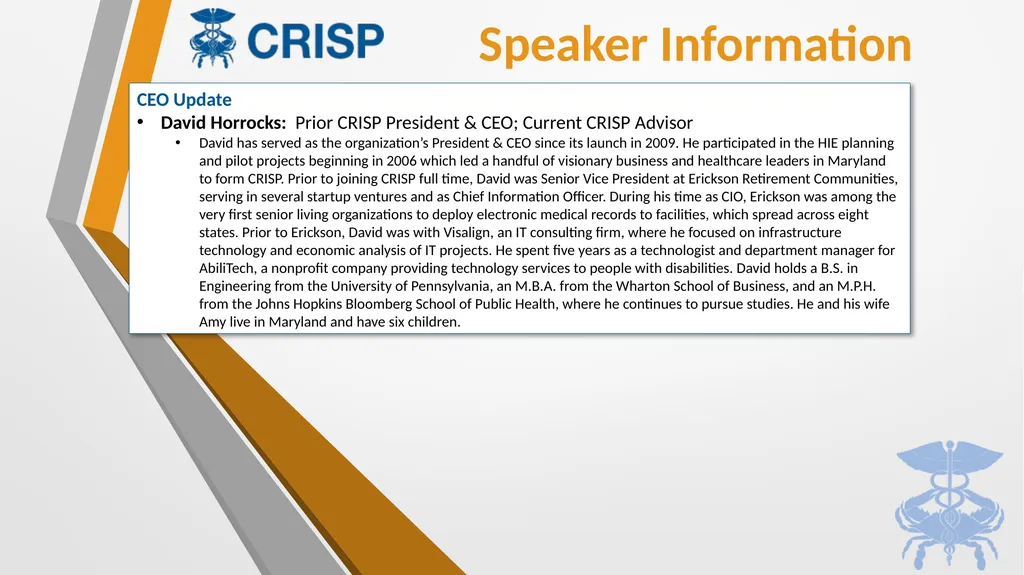
David Horrocks: Prior CRISP President & CEO; Current CRISP Advisor
David has served as the organization’s President & CEO since its launch in 2009. He participated in the HIE planning and pilot projects beginning in 2006 which led a handful of visionary business and healthcare leaders in Maryland to form CRISP. Prior to joining CRISP full time, David was Senior Vice President at Erickson Retirement Communities, serving in several startup ventures and as Chief Information Officer. During his time as CIO, Erickson was among the very first senior living organizations to deploy electronic medical records to facilities, which spread across eight states. Prior to Erickson, David was with Visalign, an IT consulting firm, where he focused on infrastructure technology and economic analysis of IT projects. He spent five years as a technologist and department manager for AbiliTech, a nonprofit company providing technology services to people with disabilities. David holds a B.S. in Engineering from the University of Pennsylvania, an M.B.A. from the Wharton School of Business, and an M.P.H. from the Johns Hopkins Bloomberg School of Public Health, where he continues to pursue studies. He and his wife Amy live in Maryland and have six children.<br>
David Horrocks: Prior CRISP President & CEO; Current CRISP Advisor
David has served as the organization’s President & CEO since its launch in 2009. He participated in the HIE planning and pilot projects beginning in 2006 which led a handful of visionary business and healthcare leaders in Maryland to form CRISP. Prior to joining CRISP full time, David was Senior Vice President at Erickson Retirement Communities, serving in several startup ventures and as Chief Information Officer. During his time as CIO, Erickson was among the very first senior living organizations to deploy electronic medical records to facilities, which spread across eight states. Prior to Erickson, David was with Visalign, an IT consulting firm, where he focused on infrastructure technology and economic analysis of IT projects. He spent five years as a technologist and department manager for AbiliTech, a nonprofit company providing technology services to people with disabilities. David holds a B.S. in Engineering from the University of Pennsylvania, an M.B.A. from the Wharton School of Business, and an M.P.H. from the Johns Hopkins Bloomberg School of Public Health, where he continues to pursue studies. He and his wife Amy live in Maryland and have six children.<br>
10
Speaker Information Panel Moderators:
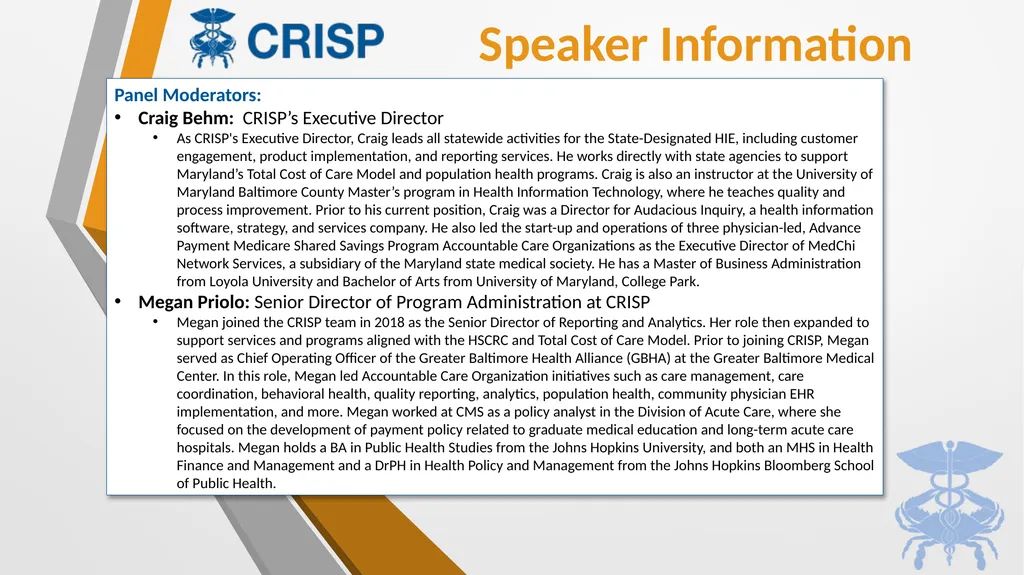
Craig Behm: CRISP’s Executive Director
As CRISP's Executive Director, Craig leads all statewide activities for the State-Designated HIE, including customer engagement, product implementation, and reporting services. He works directly with state agencies to support Maryland’s Total Cost of Care Model and population health programs. Craig is also an instructor at the University of Maryland Baltimore County Master’s program in Health Information Technology, where he teaches quality and process improvement. Prior to his current position, Craig was a Director for Audacious Inquiry, a health information software, strategy, and services company. He also led the start-up and operations of three physician-led, Advance Payment Medicare Shared Savings Program Accountable Care Organizations as the Executive Director of MedChi Network Services, a subsidiary of the Maryland state medical society. He has a Master of Business Administration from Loyola University and Bachelor of Arts from University of Maryland, College Park.
Megan Priolo: Senior Director of Program Administration at CRISP
Megan joined the CRISP team in 2018 as the Senior Director of Reporting and Analytics. Her role then expanded to support services and programs aligned with the HSCRC and Total Cost of Care Model. Prior to joining CRISP, Megan served as Chief Operating Officer of the Greater Baltimore Health Alliance (GBHA) at the Greater Baltimore Medical Center. In this role, Megan led Accountable Care Organization initiatives such as care management, care coordination, behavioral health, quality reporting, analytics, population health, community physician EHR implementation, and more. Megan worked at CMS as a policy analyst in the Division of Acute Care, where she focused on the development of payment policy related to graduate medical education and long-term acute care hospitals. Megan holds a BA in Public Health Studies from the Johns Hopkins University, and both an MHS in Health Finance and Management and a DrPH in Health Policy and Management from the Johns Hopkins Bloomberg School of Public Health.<br>
Craig Behm: CRISP’s Executive Director
As CRISP's Executive Director, Craig leads all statewide activities for the State-Designated HIE, including customer engagement, product implementation, and reporting services. He works directly with state agencies to support Maryland’s Total Cost of Care Model and population health programs. Craig is also an instructor at the University of Maryland Baltimore County Master’s program in Health Information Technology, where he teaches quality and process improvement. Prior to his current position, Craig was a Director for Audacious Inquiry, a health information software, strategy, and services company. He also led the start-up and operations of three physician-led, Advance Payment Medicare Shared Savings Program Accountable Care Organizations as the Executive Director of MedChi Network Services, a subsidiary of the Maryland state medical society. He has a Master of Business Administration from Loyola University and Bachelor of Arts from University of Maryland, College Park.
Megan Priolo: Senior Director of Program Administration at CRISP
Megan joined the CRISP team in 2018 as the Senior Director of Reporting and Analytics. Her role then expanded to support services and programs aligned with the HSCRC and Total Cost of Care Model. Prior to joining CRISP, Megan served as Chief Operating Officer of the Greater Baltimore Health Alliance (GBHA) at the Greater Baltimore Medical Center. In this role, Megan led Accountable Care Organization initiatives such as care management, care coordination, behavioral health, quality reporting, analytics, population health, community physician EHR implementation, and more. Megan worked at CMS as a policy analyst in the Division of Acute Care, where she focused on the development of payment policy related to graduate medical education and long-term acute care hospitals. Megan holds a BA in Public Health Studies from the Johns Hopkins University, and both an MHS in Health Finance and Management and a DrPH in Health Policy and Management from the Johns Hopkins Bloomberg School of Public Health.<br>
11
Speaker Information Smart Alerts/ Blind Panels
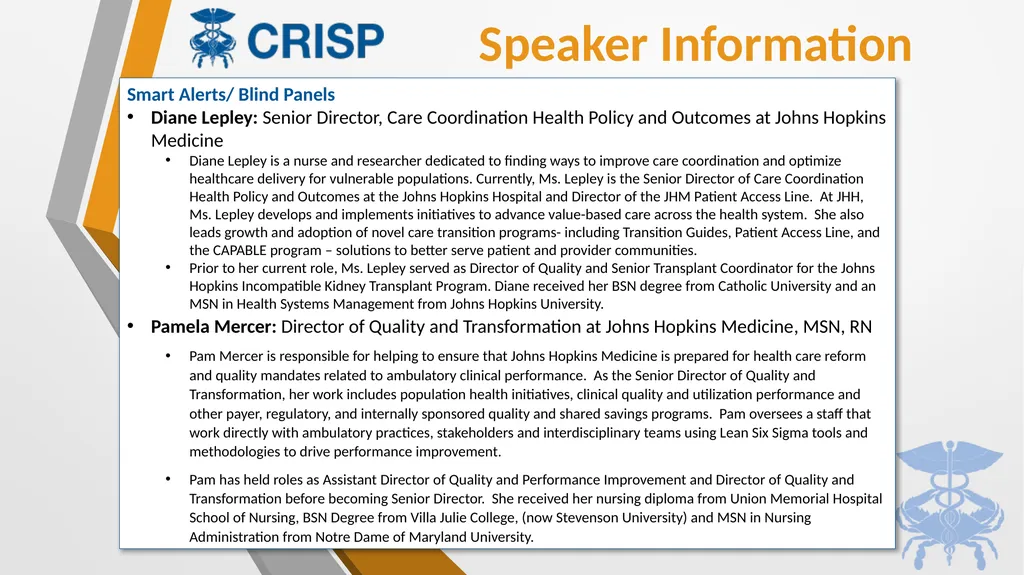
Diane Lepley: Senior Director, Care Coordination Health Policy and Outcomes at Johns Hopkins Medicine
Diane Lepley is a nurse and researcher dedicated to finding ways to improve care coordination and optimize healthcare delivery for vulnerable populations. Currently, Ms. Lepley is the Senior Director of Care Coordination Health Policy and Outcomes at the Johns Hopkins Hospital and Director of the JHM Patient Access Line. At JHH, Ms. Lepley develops and implements initiatives to advance value-based care across the health system. She also leads growth and adoption of novel care transition programs- including Transition Guides, Patient Access Line, and the CAPABLE program – solutions to better serve patient and provider communities.
Prior to her current role, Ms. Lepley served as Director of Quality and Senior Transplant Coordinator for the Johns Hopkins Incompatible Kidney Transplant Program. Diane received her BSN degree from Catholic University and an MSN in Health Systems Management from Johns Hopkins University.
Pamela Mercer: Director of Quality and Transformation at Johns Hopkins Medicine, MSN, RN
Pam Mercer is responsible for helping to ensure that Johns Hopkins Medicine is prepared for health care reform and quality mandates related to ambulatory clinical performance. As the Senior Director of Quality and Transformation, her work includes population health initiatives, clinical quality and utilization performance and other payer, regulatory, and internally sponsored quality and shared savings programs. Pam oversees a staff that work directly with ambulatory practices, stakeholders and interdisciplinary teams using Lean Six Sigma tools and methodologies to drive performance improvement.
Pam has held roles as Assistant Director of Quality and Performance Improvement and Director of Quality and Transformation before becoming Senior Director. She received her nursing diploma from Union Memorial Hospital School of Nursing, BSN Degree from Villa Julie College, (now Stevenson University) and MSN in Nursing Administration from Notre Dame of Maryland University.<br>
Diane Lepley: Senior Director, Care Coordination Health Policy and Outcomes at Johns Hopkins Medicine
Diane Lepley is a nurse and researcher dedicated to finding ways to improve care coordination and optimize healthcare delivery for vulnerable populations. Currently, Ms. Lepley is the Senior Director of Care Coordination Health Policy and Outcomes at the Johns Hopkins Hospital and Director of the JHM Patient Access Line. At JHH, Ms. Lepley develops and implements initiatives to advance value-based care across the health system. She also leads growth and adoption of novel care transition programs- including Transition Guides, Patient Access Line, and the CAPABLE program – solutions to better serve patient and provider communities.
Prior to her current role, Ms. Lepley served as Director of Quality and Senior Transplant Coordinator for the Johns Hopkins Incompatible Kidney Transplant Program. Diane received her BSN degree from Catholic University and an MSN in Health Systems Management from Johns Hopkins University.
Pamela Mercer: Director of Quality and Transformation at Johns Hopkins Medicine, MSN, RN
Pam Mercer is responsible for helping to ensure that Johns Hopkins Medicine is prepared for health care reform and quality mandates related to ambulatory clinical performance. As the Senior Director of Quality and Transformation, her work includes population health initiatives, clinical quality and utilization performance and other payer, regulatory, and internally sponsored quality and shared savings programs. Pam oversees a staff that work directly with ambulatory practices, stakeholders and interdisciplinary teams using Lean Six Sigma tools and methodologies to drive performance improvement.
Pam has held roles as Assistant Director of Quality and Performance Improvement and Director of Quality and Transformation before becoming Senior Director. She received her nursing diploma from Union Memorial Hospital School of Nursing, BSN Degree from Villa Julie College, (now Stevenson University) and MSN in Nursing Administration from Notre Dame of Maryland University.<br>
12
Speaker Information Smart Alerts/ Blind Panels
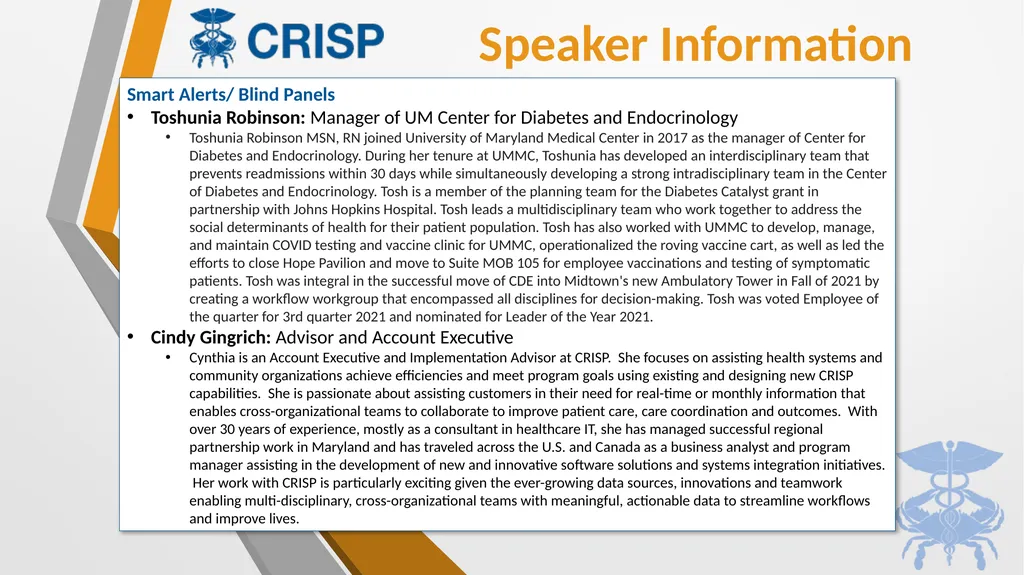
Toshunia Robinson: Manager of UM Center for Diabetes and Endocrinology
Toshunia Robinson MSN, RN joined University of Maryland Medical Center in 2017 as the manager of Center for Diabetes and Endocrinology. During her tenure at UMMC, Toshunia has developed an interdisciplinary team that prevents readmissions within 30 days while simultaneously developing a strong intradisciplinary team in the Center of Diabetes and Endocrinology. Tosh is a member of the planning team for the Diabetes Catalyst grant in partnership with Johns Hopkins Hospital. Tosh leads a multidisciplinary team who work together to address the social determinants of health for their patient population. Tosh has also worked with UMMC to develop, manage, and maintain COVID testing and vaccine clinic for UMMC, operationalized the roving vaccine cart, as well as led the efforts to close Hope Pavilion and move to Suite MOB 105 for employee vaccinations and testing of symptomatic patients. Tosh was integral in the successful move of CDE into Midtown's new Ambulatory Tower in Fall of 2021 by creating a workflow workgroup that encompassed all disciplines for decision-making. Tosh was voted Employee of the quarter for 3rd quarter 2021 and nominated for Leader of the Year 2021.
Cindy Gingrich: Advisor and Account Executive
Cynthia is an Account Executive and Implementation Advisor at CRISP. She focuses on assisting health systems and community organizations achieve efficiencies and meet program goals using existing and designing new CRISP capabilities. She is passionate about assisting customers in their need for real-time or monthly information that enables cross-organizational teams to collaborate to improve patient care, care coordination and outcomes. With over 30 years of experience, mostly as a consultant in healthcare IT, she has managed successful regional partnership work in Maryland and has traveled across the U.S. and Canada as a business analyst and program manager assisting in the development of new and innovative software solutions and systems integration initiatives. Her work with CRISP is particularly exciting given the ever-growing data sources, innovations and teamwork enabling multi-disciplinary, cross-organizational teams with meaningful, actionable data to streamline workflows and improve lives.<br>
Toshunia Robinson: Manager of UM Center for Diabetes and Endocrinology
Toshunia Robinson MSN, RN joined University of Maryland Medical Center in 2017 as the manager of Center for Diabetes and Endocrinology. During her tenure at UMMC, Toshunia has developed an interdisciplinary team that prevents readmissions within 30 days while simultaneously developing a strong intradisciplinary team in the Center of Diabetes and Endocrinology. Tosh is a member of the planning team for the Diabetes Catalyst grant in partnership with Johns Hopkins Hospital. Tosh leads a multidisciplinary team who work together to address the social determinants of health for their patient population. Tosh has also worked with UMMC to develop, manage, and maintain COVID testing and vaccine clinic for UMMC, operationalized the roving vaccine cart, as well as led the efforts to close Hope Pavilion and move to Suite MOB 105 for employee vaccinations and testing of symptomatic patients. Tosh was integral in the successful move of CDE into Midtown's new Ambulatory Tower in Fall of 2021 by creating a workflow workgroup that encompassed all disciplines for decision-making. Tosh was voted Employee of the quarter for 3rd quarter 2021 and nominated for Leader of the Year 2021.
Cindy Gingrich: Advisor and Account Executive
Cynthia is an Account Executive and Implementation Advisor at CRISP. She focuses on assisting health systems and community organizations achieve efficiencies and meet program goals using existing and designing new CRISP capabilities. She is passionate about assisting customers in their need for real-time or monthly information that enables cross-organizational teams to collaborate to improve patient care, care coordination and outcomes. With over 30 years of experience, mostly as a consultant in healthcare IT, she has managed successful regional partnership work in Maryland and has traveled across the U.S. and Canada as a business analyst and program manager assisting in the development of new and innovative software solutions and systems integration initiatives. Her work with CRISP is particularly exciting given the ever-growing data sources, innovations and teamwork enabling multi-disciplinary, cross-organizational teams with meaningful, actionable data to streamline workflows and improve lives.<br>
13
Speaker Information The Progression of Primary Care Health IT in MDPCP:
Candice Morrison: MDPCP Coach and CRISP SME
Candice Morrison is also a MDPCP practice coach. Her work at the MDPCP includes providing technical assistance and support to primary care practices on best practices as well as acting as the CRISP liaison for the PMO to support MDPCP data collection efforts.
Emily Gruber: MDPCP Health Equity Program Manager
Emily Gruber is the MDPCP Health Equity Manager. Her work at the MDPCP includes strategizing and implementing MDPCP's health equity agenda, including work around the new HEART payments to address Social Determinants of Health. She also manages distribution of Covid-19 vaccine to primary care practices as part of the State's Covid-19 response team.<br>
Candice Morrison: MDPCP Coach and CRISP SME
Candice Morrison is also a MDPCP practice coach. Her work at the MDPCP includes providing technical assistance and support to primary care practices on best practices as well as acting as the CRISP liaison for the PMO to support MDPCP data collection efforts.
Emily Gruber: MDPCP Health Equity Program Manager
Emily Gruber is the MDPCP Health Equity Manager. Her work at the MDPCP includes strategizing and implementing MDPCP's health equity agenda, including work around the new HEART payments to address Social Determinants of Health. She also manages distribution of Covid-19 vaccine to primary care practices as part of the State's Covid-19 response team.<br>