Using average bond enthalpies to calculate a theoretical enthalpy change VCE Unit 3 Chemistry new study design 2024 Louise Lennard Lorikeet Science 2024 Context The new VCE Chemistry Sample Examination includes a question (Part B Q2bii)
"Using average bond enthalpies to calculate a" is the property of its rightful owner. Permission is granted to
download and print the materials on this website for personal, non-commercial use only, and to display it
on your personal computer provided you do not modify the materials and that you retain all copyright
notices contained in the materials. By downloading content from our website, you accept the terms of this
agreement.
Presentation Transcript
01
Using average bond enthalpies to calculate a theoretical enthalpy change VCE Unit 3 Chemistry new study design 2024
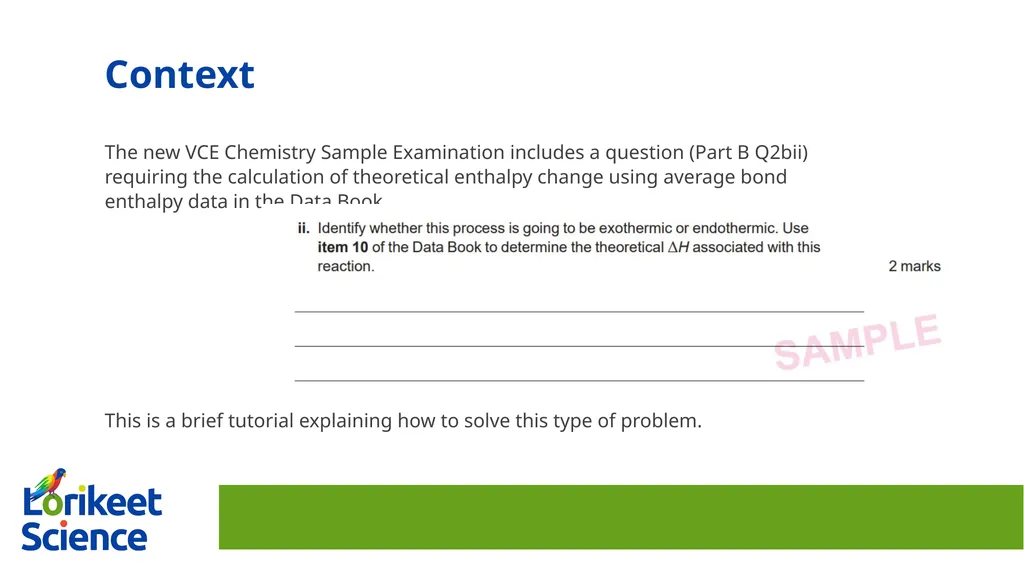
Context The new VCE Chemistry Sample Examination includes a question (Part B Q2bii) requiring the calculation of theoretical enthalpy change using average bond enthalpy data in the Data Book
This is a brief tutorial explaining how to solve this type of problem.<br>
03
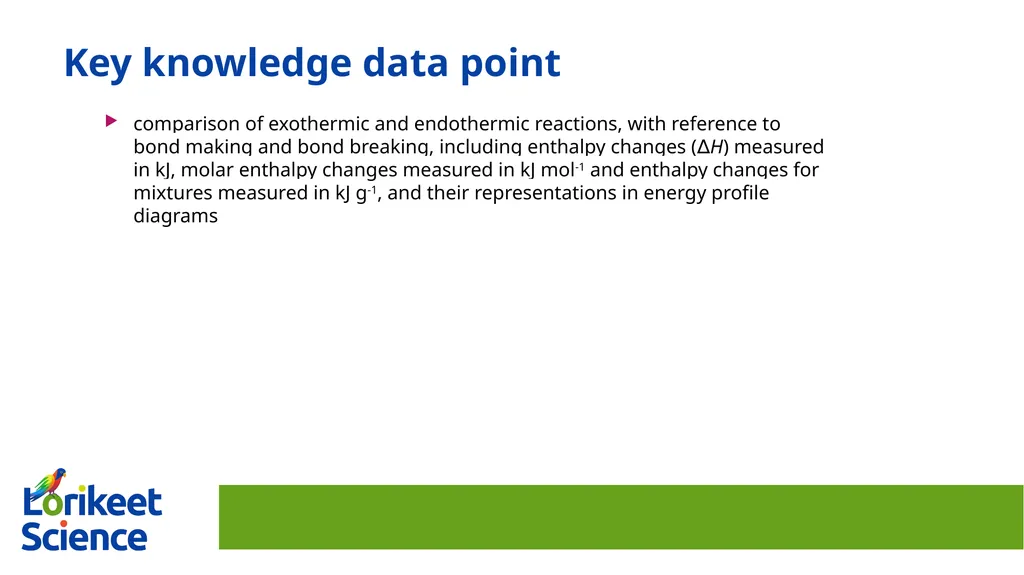
Key knowledge data point comparison of exothermic and endothermic reactions, with reference to bond making and bond breaking, including enthalpy changes (∆H) measured in kJ, molar enthalpy changes measured in kJ mol-1 and enthalpy changes for mixtures measured in kJ g-1, and their representations in energy profile diagrams<br>
04
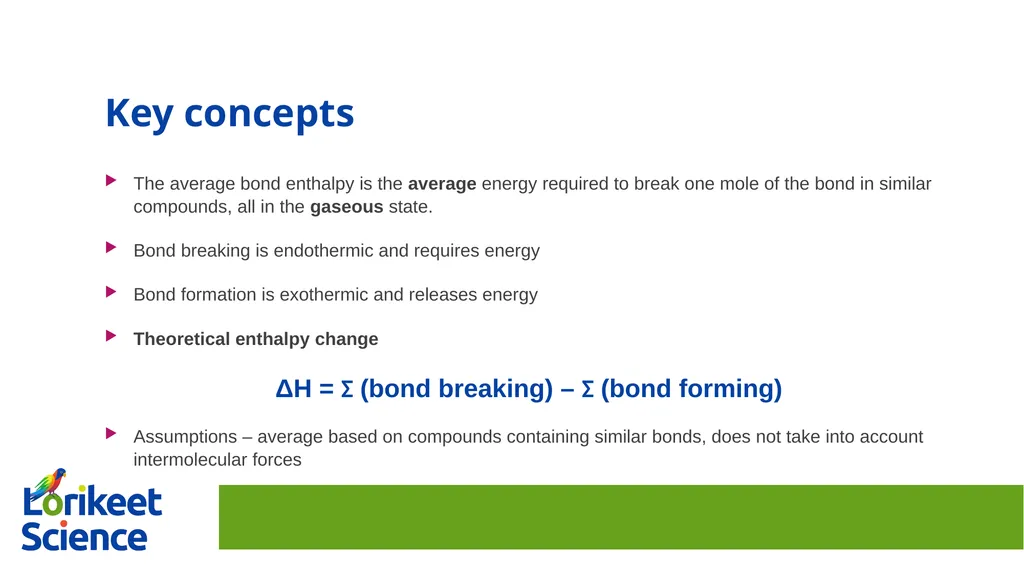
Key concepts The average bond enthalpy is the average energy required to break one mole of the bond in similar compounds, all in the gaseous state.
Bond breaking is endothermic and requires energy
Bond formation is exothermic and releases energy
Theoretical enthalpy change
ΔH = Σ (bond breaking) – Σ (bond forming)
Assumptions – average based on compounds containing similar bonds, does not take into account intermolecular forces<br>
05
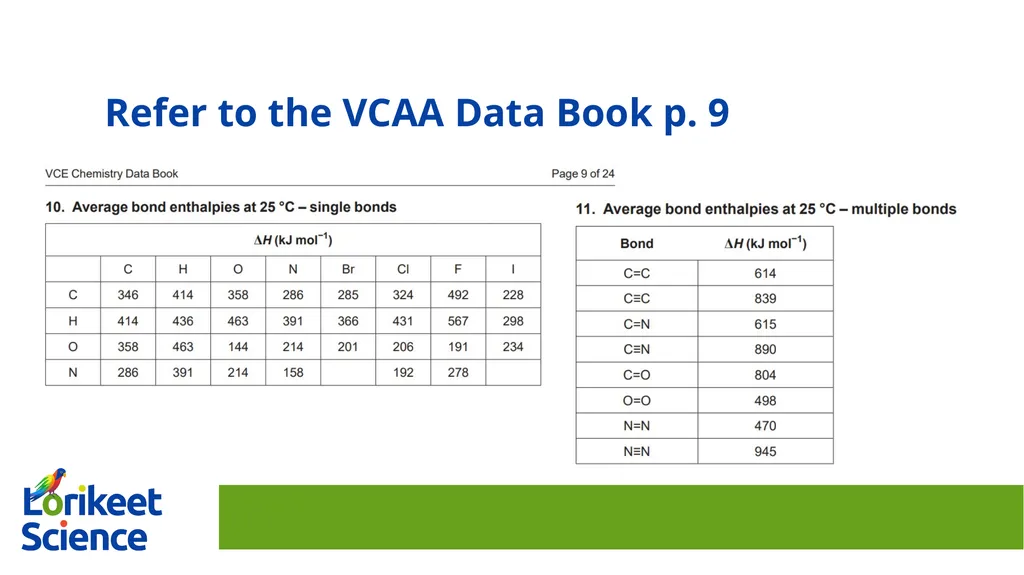
Refer to the VCAA Data Book p. 9<br>
06
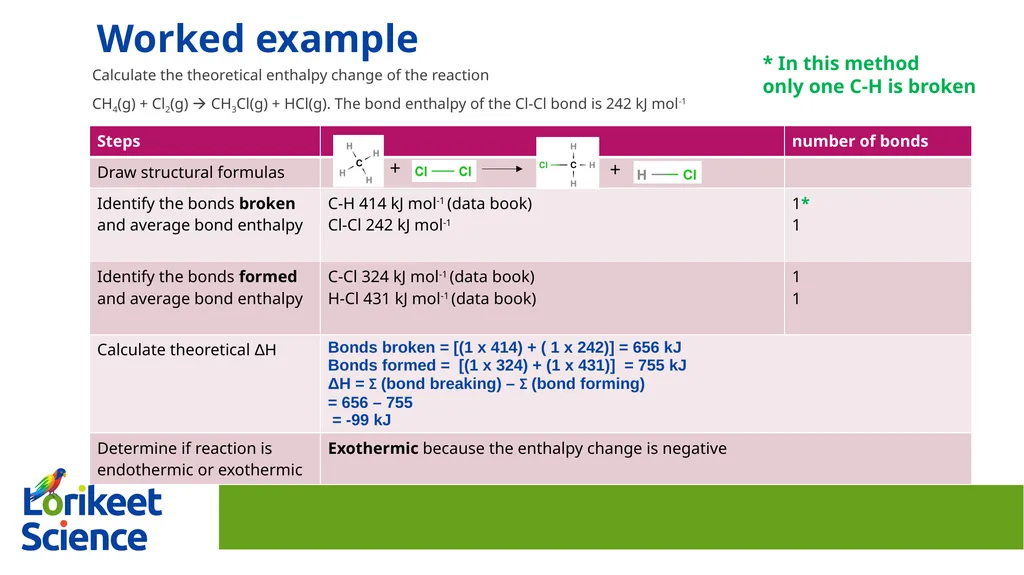
Worked example Calculate the theoretical enthalpy change of the reaction
CH4(g) + Cl2(g) CH3Cl(g) + HCl(g). The bond enthalpy of the Cl-Cl bond is 242 kJ mol-1 + + * In this method
only one C-H is broken<br>
07
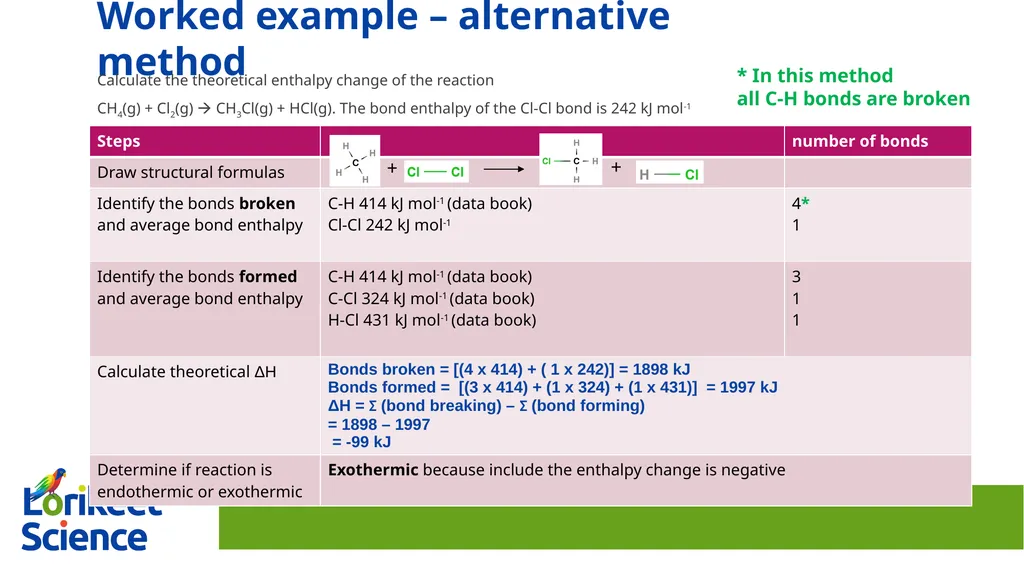
Worked example – alternative method Calculate the theoretical enthalpy change of the reaction
CH4(g) + Cl2(g) CH3Cl(g) + HCl(g). The bond enthalpy of the Cl-Cl bond is 242 kJ mol-1 + + * In this method
all C-H bonds are broken<br>
08
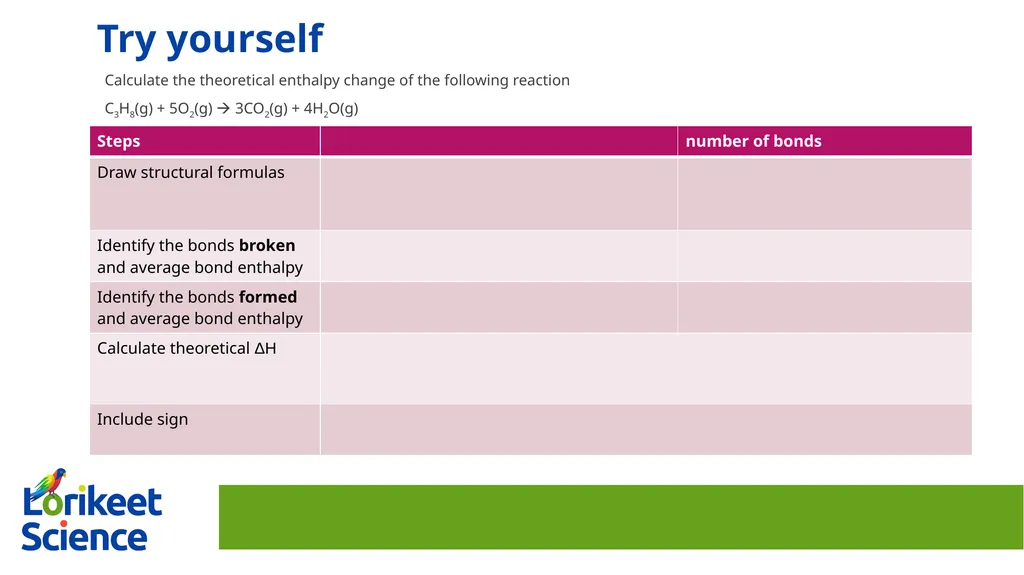
Try yourself Calculate the theoretical enthalpy change of the following reaction
C3H8(g) + 5O2(g) 3CO2(g) + 4H2O(g)<br>
09
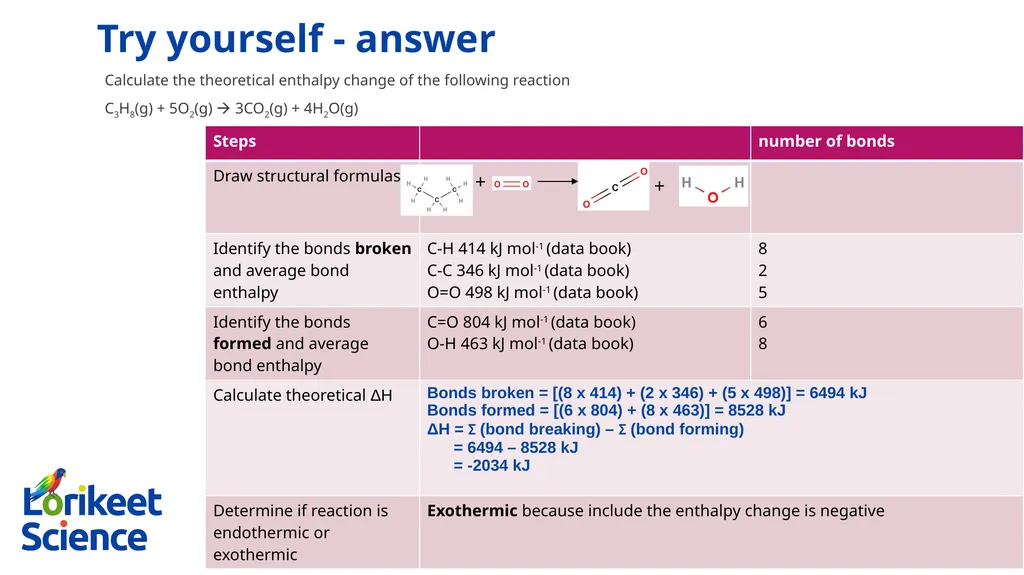
Try yourself - answer Calculate the theoretical enthalpy change of the following reaction
C3H8(g) + 5O2(g) 3CO2(g) + 4H2O(g) + +<br>
10
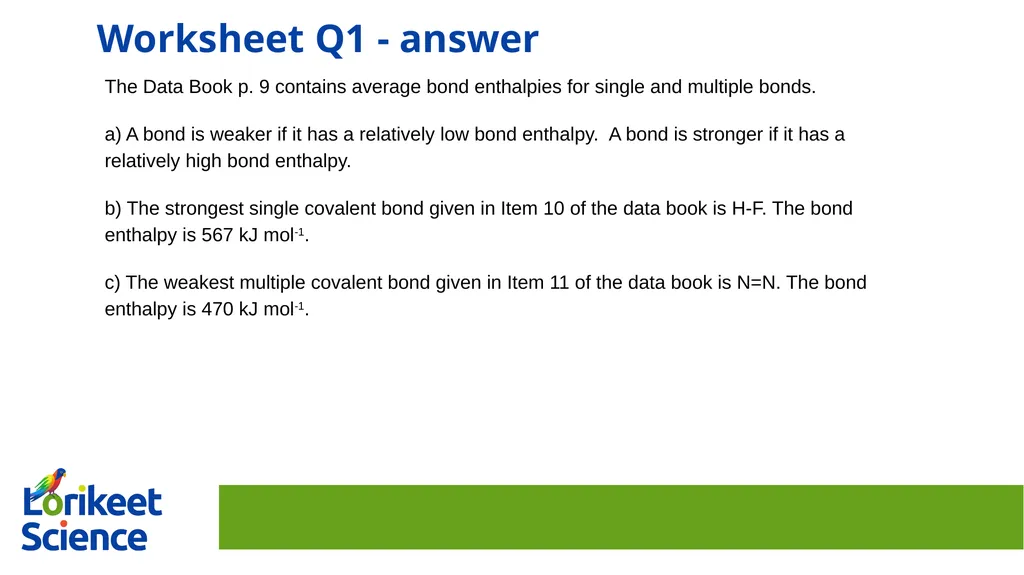
Worksheet Q1 - answer The Data Book p. 9 contains average bond enthalpies for single and multiple bonds.
a) A bond is weaker if it has a relatively low bond enthalpy. A bond is stronger if it has a relatively high bond enthalpy.
b) The strongest single covalent bond given in Item 10 of the data book is H-F. The bond enthalpy is 567 kJ mol-1.
c) The weakest multiple covalent bond given in Item 11 of the data book is N=N. The bond enthalpy is 470 kJ mol-1.<br>
11
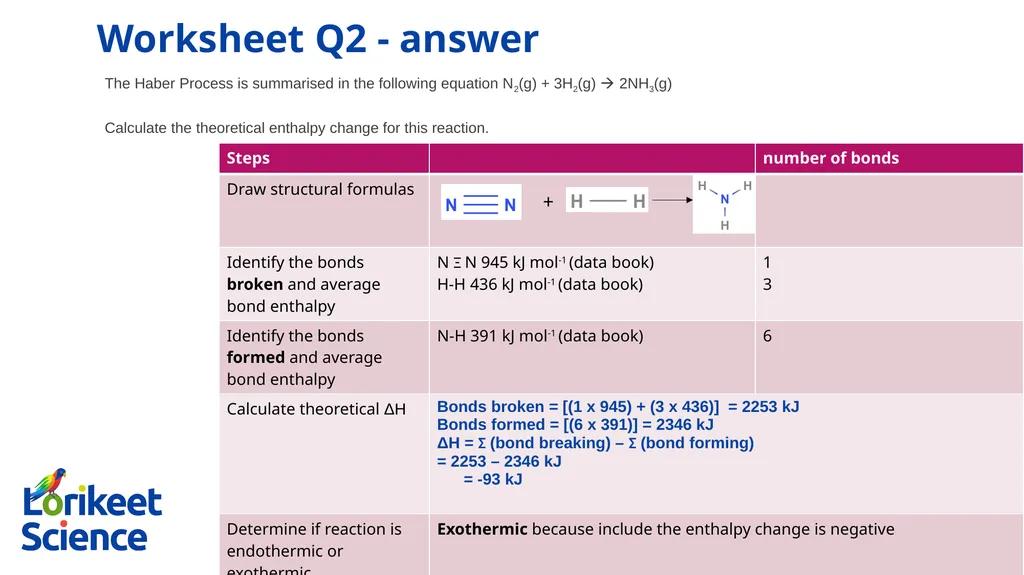
Worksheet Q2 - answer The Haber Process is summarised in the following equation N2(g) + 3H2(g) 2NH3(g)
Calculate the theoretical enthalpy change for this reaction. +<br>
12
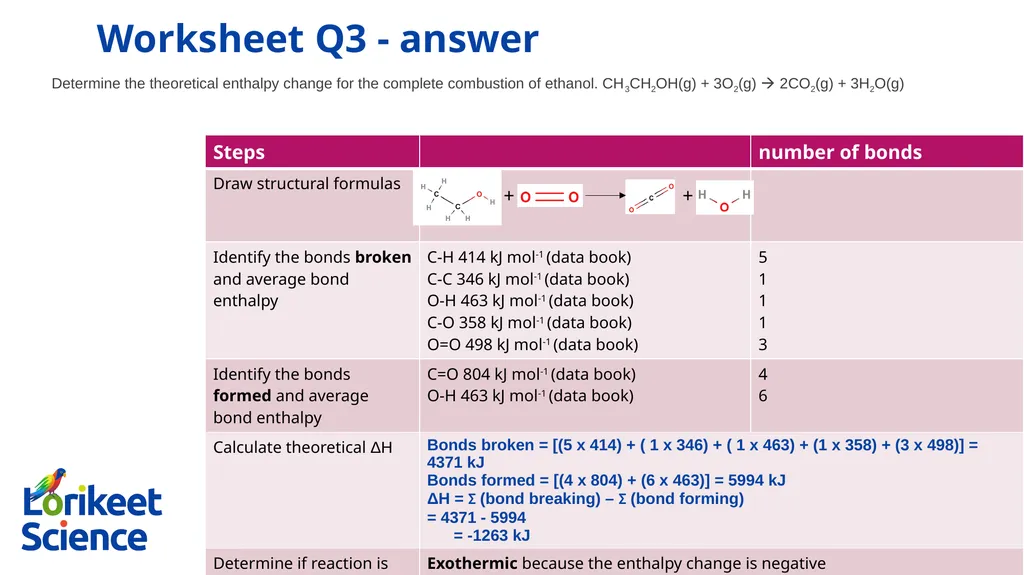
Worksheet Q3 - answer Determine the theoretical enthalpy change for the complete combustion of ethanol. CH3CH2OH(g) + 3O2(g) 2CO2(g) + 3H2O(g) + +<br>
13
Limitations Reactants and products must be in the gaseous state
Average bond enthalpy values are based on compounds containing the same bonds (For example even though the bond enthalpy of the C=O bond in CO2 is likely to be different to the bond enthalpy of the C=O bond in a ketone, the same average value is applied for a C=O bond in any molecule using this method.)
Average bond enthalpy values do not take into account intermolecular forces<br>