Using data to improve outcomes for children Dealing with Data Conference 15 Jan 2020 1 Dealing with Data Conference 2 Title: The Data for Children Collaborative with UNICEF The Data Opportunities Challenges when Collaborating across
"Using data to improve outcomes for children" is the property of its rightful owner. Permission is granted to
download and print the materials on this website for personal, non-commercial use only, and to display it
on your personal computer provided you do not modify the materials and that you retain all copyright
notices contained in the materials. By downloading content from our website, you accept the terms of this
agreement.
Presentation Transcript
01
Using data to improve outcomes for children Dealing with Data Conference
15 Jan 2020 1<br>
02
Dealing with Data Conference 2 Title: The Data for Children Collaborative with UNICEF –
The Data Opportunities & Challenges when Collaborating across Organisations
Abstract: This new partnership between UNICEF, the University of Edinburgh and the Scottish Government presents some unique opportunities and challenges for a variety of reasons. This talk will take you through the story so far in building up this cross sectoral partnership which looks to deliver impact and insight to childhood issues, locally, nationally and globally, through the use of innovative data and data science.
Understand more about project selection processes, governance frameworks, ethics and child safeguarding, all whilst highlighting the need for extra caution when working with data relating to children.<br>
03
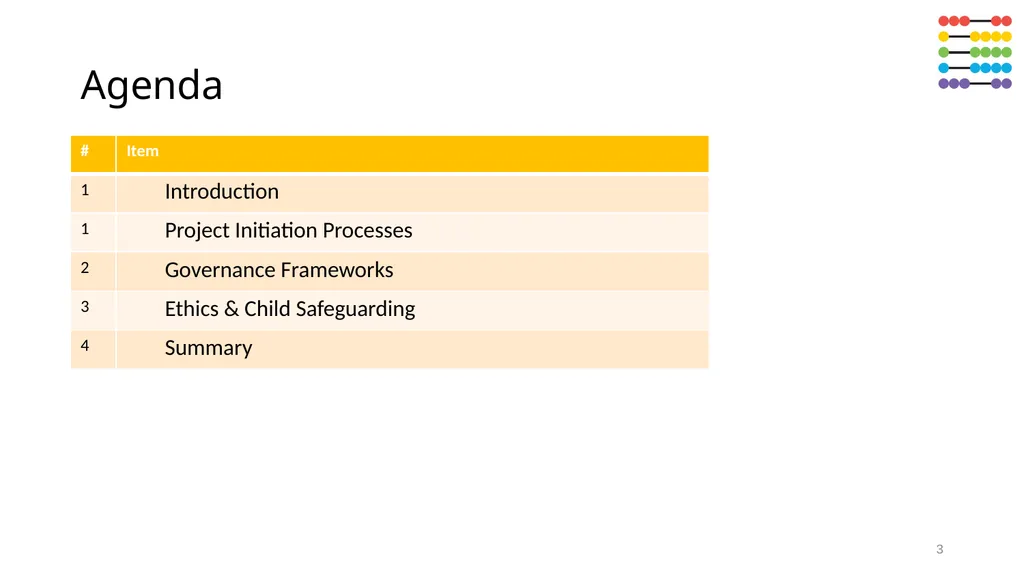
Agenda 3<br>
04
1.1 Data for Children Collaborative with UNICEF - Introduction Using data to improve outcomes for children.
The Data for Children Collaborative with UNICEF is a joint partnership between UNICEF, The Scottish Government and the University of Edinburgh. The Collaborative seeks to improve outcomes for children locally, nationally and globally. It draws on the strengths of all partners to bring insight and solve problems using data and data science.
The Collaborative prioritises and enables data projects linking academics, UNICEF subject matter experts and Scottish Government childhood policy and analyst experts, whilst also fostering partnerships with other organisations. These projects will have a focus on adoption of actionable insights to inform policy and practice.
The Collaborative is funded jointly by the Scottish Government, through the Scottish Funding Council, and the University of Edinburgh for a start-up period of three years.
Increased availability and use of data has highlighted innovative new techniques to solve real-world problems across all sectors. The Collaborative believes that the capabilities and capacity of the partners and wider partnerships can be leveraged to tackle key problems across some of the world’s fundamental childhood issues.
The challenge for the Collaborative is finding the right data for the right problem and gaining access to use it in the right way. With the right support from all partners and other stakeholders, we feel that this is a challenge that can be met, learnt from and shared with others. 4<br>
05
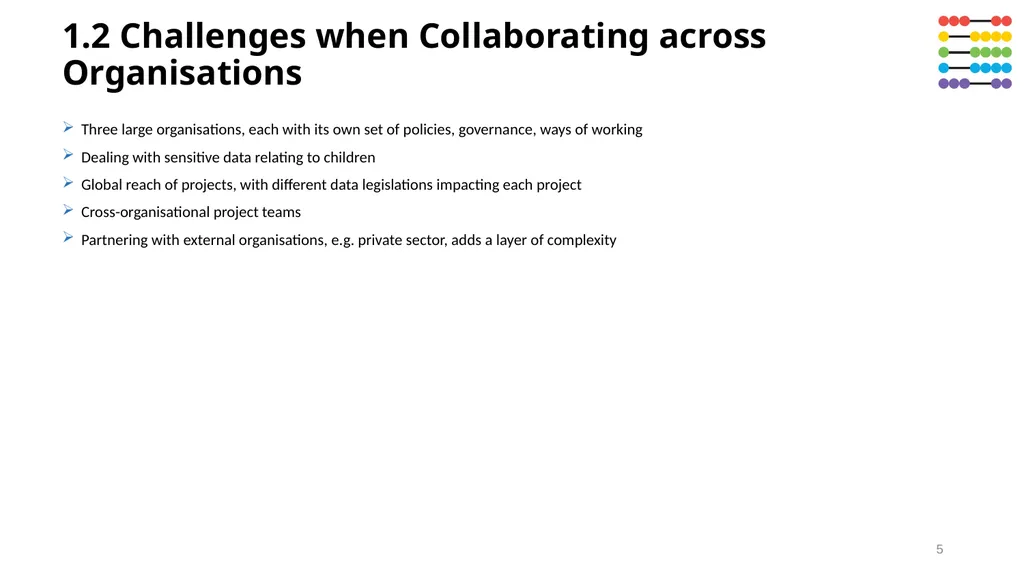
1.2 Challenges when Collaborating across Organisations Three large organisations, each with its own set of policies, governance, ways of working
Dealing with sensitive data relating to children
Global reach of projects, with different data legislations impacting each project
Cross-organisational project teams
Partnering with external organisations, e.g. private sector, adds a layer of complexity 5<br>
06
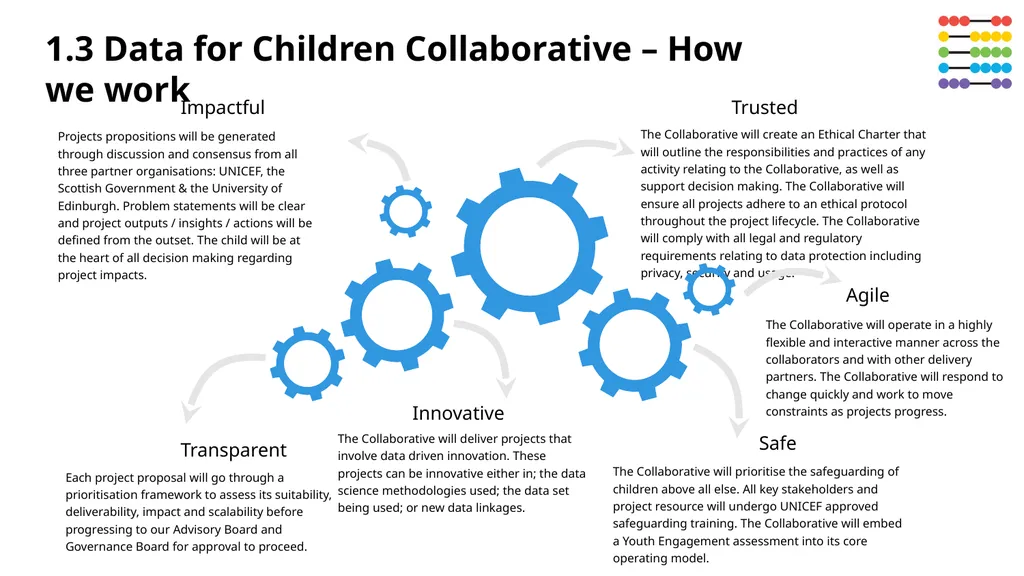
1.3 Data for Children Collaborative – How we work The Collaborative will operate in a highly flexible and interactive manner across the collaborators and with other delivery partners. The Collaborative will respond to change quickly and work to move constraints as projects progress. Agile<br>
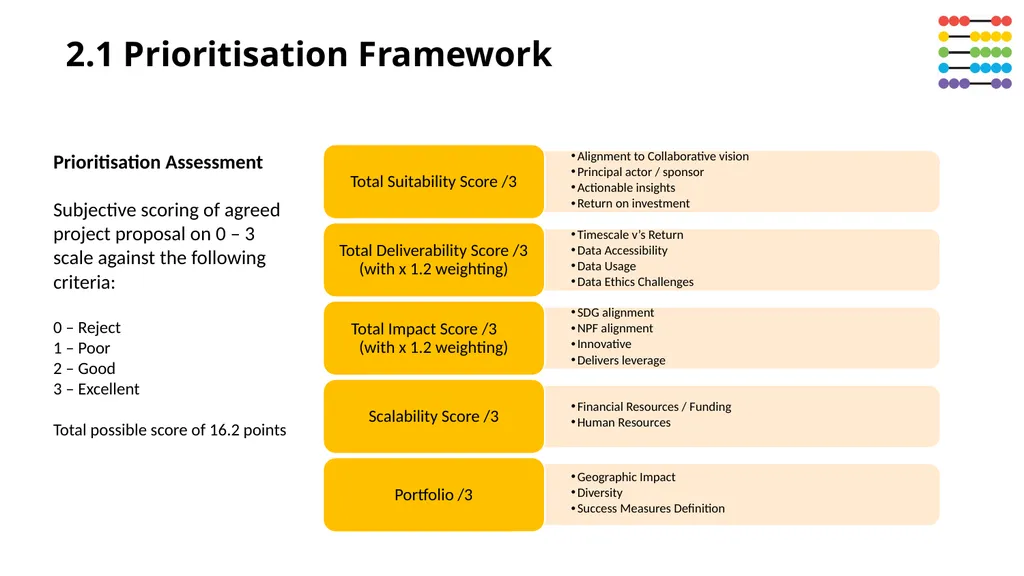
Subjective scoring of agreed project proposal on 0 – 3 scale against the following criteria:
0 – Reject
1 – Poor
2 – Good
3 – Excellent
Total possible score of 16.2 points<br>
08
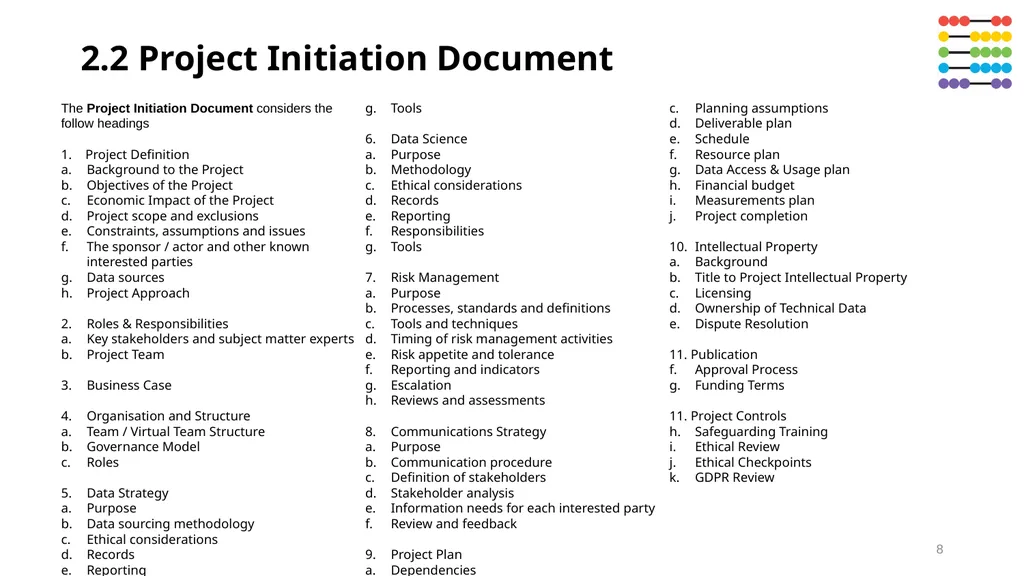
2.2 Project Initiation Document 8 The Project Initiation Document considers the follow headings
Project Definition
Background to the Project
Objectives of the Project
Economic Impact of the Project
Project scope and exclusions
Constraints, assumptions and issues
The sponsor / actor and other known interested parties
Data sources
Project Approach
Roles & Responsibilities
Key stakeholders and subject matter experts
Project Team
Business Case
Organisation and Structure
Team / Virtual Team Structure
Governance Model
Roles
Data Strategy
Purpose
Data sourcing methodology
Ethical considerations
Records
Reporting
Responsibilities
Tools
Data Science
Purpose
Methodology
Ethical considerations
Records
Reporting
Responsibilities
Tools
Risk Management
Purpose
Processes, standards and definitions
Tools and techniques
Timing of risk management activities
Risk appetite and tolerance
Reporting and indicators
Escalation
Reviews and assessments
Communications Strategy
Purpose
Communication procedure
Definition of stakeholders
Stakeholder analysis
Information needs for each interested party
Review and feedback
Project Plan
Dependencies
Tolerances
Planning assumptions
Deliverable plan
Schedule
Resource plan
Data Access & Usage plan
Financial budget
Measurements plan
Project completion
Intellectual Property
Background
Title to Project Intellectual Property
Licensing
Ownership of Technical Data
Dispute Resolution
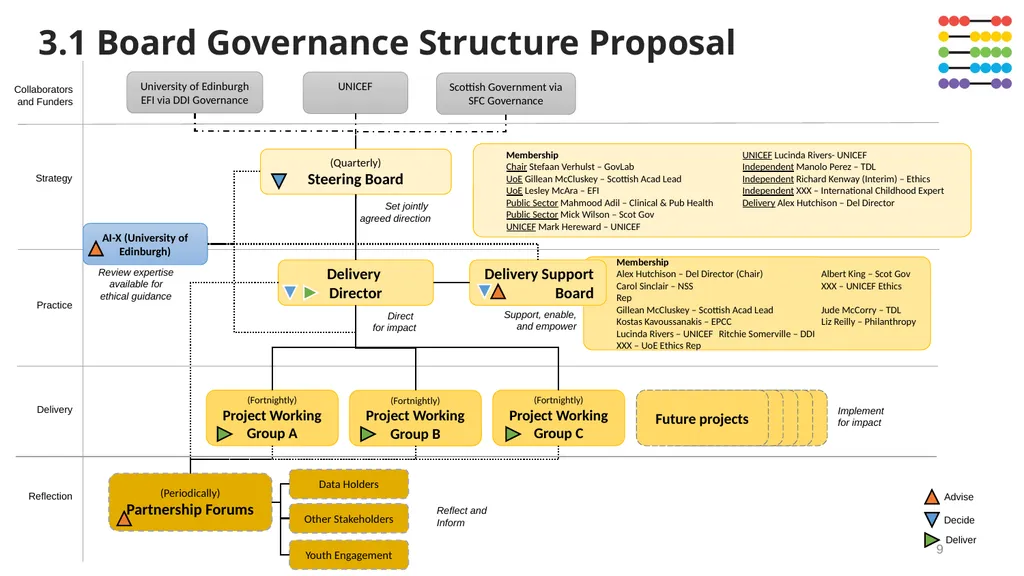
Membership
Alex Hutchison – Del Director (Chair) Albert King – Scot Gov
Carol Sinclair – NSS XXX – UNICEF Ethics Rep
Gillean McCluskey – Scottish Acad Lead Jude McCorry – TDL
Kostas Kavoussanakis – EPCC Liz Reilly – Philanthropy Lucinda Rivers – UNICEF Ritchie Somerville – DDI
XXX – UoE Ethics Rep Membership
Chair Stefaan Verhulst – GovLab
UoE Gillean McCluskey – Scottish Acad Lead
UoE Lesley McAra – EFI
Public Sector Mahmood Adil – Clinical & Pub Health
Public Sector Mick Wilson – Scot Gov
UNICEF Mark Hereward – UNICEF
UNICEF Lucinda Rivers- UNICEF
Independent Manolo Perez – TDL
Independent Richard Kenway (Interim) – Ethics
Independent XXX – International Childhood Expert
Delivery Alex Hutchison – Del Director 3.1 Board Governance Structure Proposal Collaborators and Funders Strategy Delivery Reflection UNICEF University of Edinburgh EFI via DDI Governance Scottish Government via SFC Governance (Quarterly)
Steering Board Delivery
Director Delivery Support
Board (Periodically)
Partnership Forums Practice (Fortnightly)
Project Working Group A (Fortnightly)
Project Working Group B (Fortnightly)
Project Working Group C Set jointly
agreed direction Direct
for impact Support, enable, and empower Implement
for impact Reflect and
Inform Data Holders Other Stakeholders Youth Engagement 9 AI-X (University of Edinburgh) Review expertise available for ethical guidance<br>
10
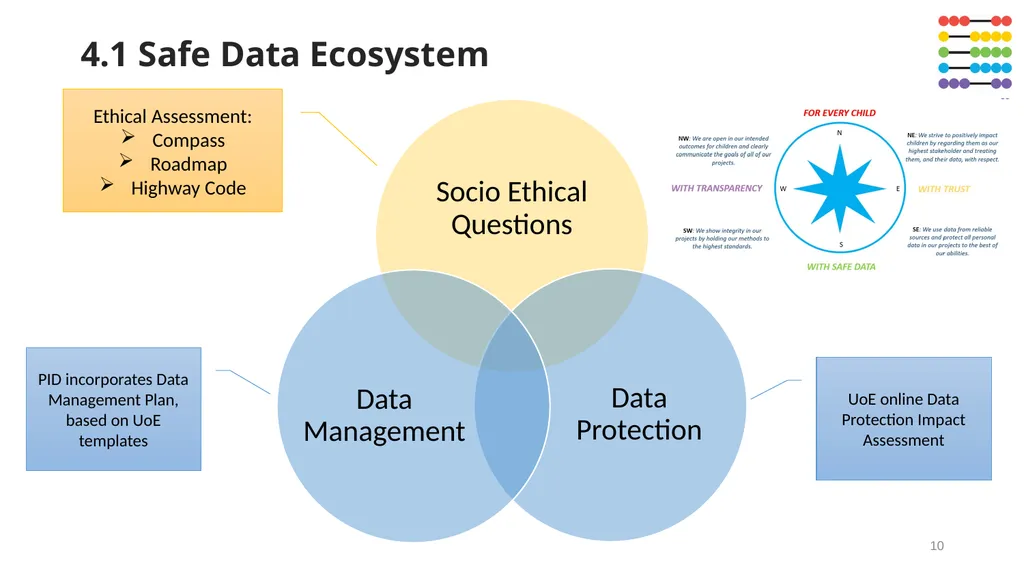
4.1 Safe Data Ecosystem 10 UoE online Data Protection Impact Assessment PID incorporates Data Management Plan, based on UoE templates Ethical Assessment:
Compass
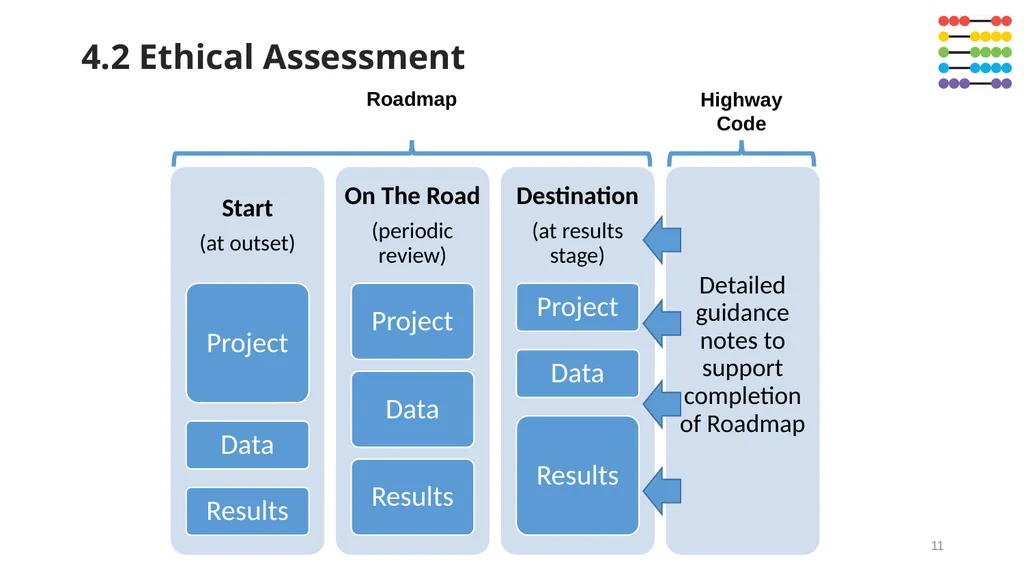
Roadmap
Highway Code<br>
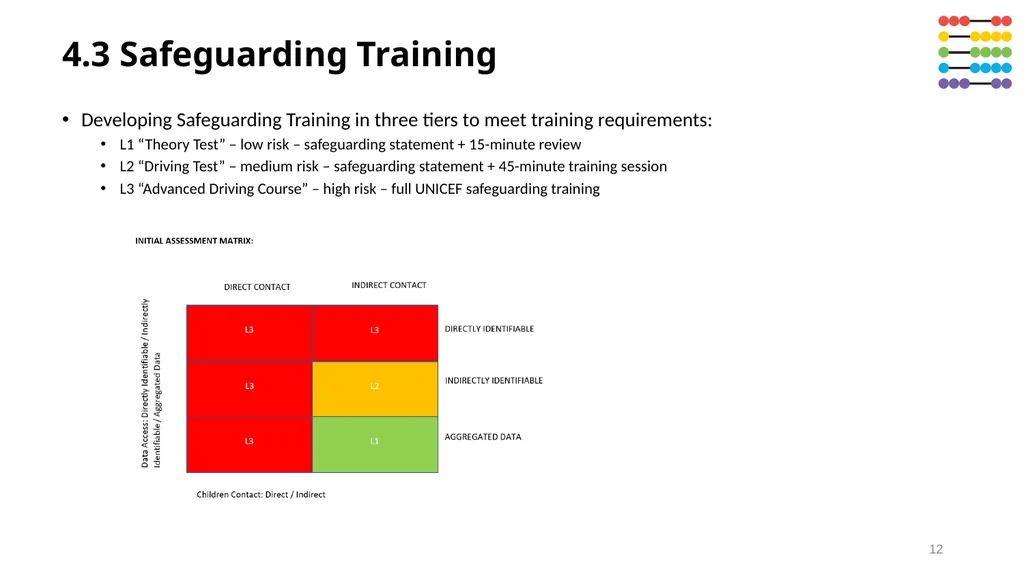
4.3 Safeguarding Training 12 Developing Safeguarding Training in three tiers to meet training requirements:
L1 “Theory Test” – low risk – safeguarding statement + 15-minute review
L2 “Driving Test” – medium risk – safeguarding statement + 45-minute training session
L3 “Advanced Driving Course” – high risk – full UNICEF safeguarding training<br>
13
5. Summary Three large organisations, each with its own set of policies, governance, ways of working
Leverage the strengths of each organisation
Be transparent on which policies will be used to manage data
Make sure all decisions are clearly agreed at the appropriate governance forum
Dealing with sensitive data relating to children
Build a clear framework of project initiation for each project to adhere to
Engage relevant experts in review of any assessments / project documentation
Global reach of projects, with different data legislations impacting each project
Seek local expertise for different requirements
Cross-organisational project teams & external organisations
Build trust via clear ways of working and expectations on stakeholders
Communicate code of conduct to all involved in project and appropriate level of safeguarding training 13<br>