Using free online courses to support entry into
Description: Using free online courses to support entry into Higher Education: Open to all LM Christie Postgraduate Education Group, Institute of Applied Health Sciences, School of Medicine, Medical Sciences and Nutrition The Rise of the MOOC Massive
Related Topics
Download Presentation
"Using free online courses to support entry into" is the property of its rightful owner. Permission is granted to download and print the materials on this website for personal, non-commercial use only, and to display it on your personal computer provided you do not modify the materials and that you retain all copyright notices contained in the materials. By downloading content from our website, you accept the terms of this agreement.
Presentation Transcript
slide1. Using free online courses to support entry into Higher Education: “Open to all”
LM Christie
Postgraduate Education Group, Institute of Applied Health Sciences,
School of Medicine, Medical Sciences and Nutrition The Rise of the MOOC
Massive Open Online Courses (MOOCs) have surged in popularity over the last decade as an alternative to the existing distance learning format. With the increased availability of internet access they offer learning to a global audience, free of charge, without having to even leave your house. Threat or Opportunity?
With MOOC popularity rising the potential threat to existing higher education (HE) institutions was popularised via the following themes
“It will devalue Higher Education”
“It’s just a cost-cutting measure”
“It will reduce the need for as many universities and staff”
So far, MOOCs have not displaced standard university teaching as we know it. Some even suggest the MOOC bubble has already burst. However, many institutions are looking at the MOOC format as an opportunity
“I can reach a global audience with my course”
“I can reach 1000s of students at once”
“It removes some of the existing barriers to education” The Open University, FutureLearn and Us
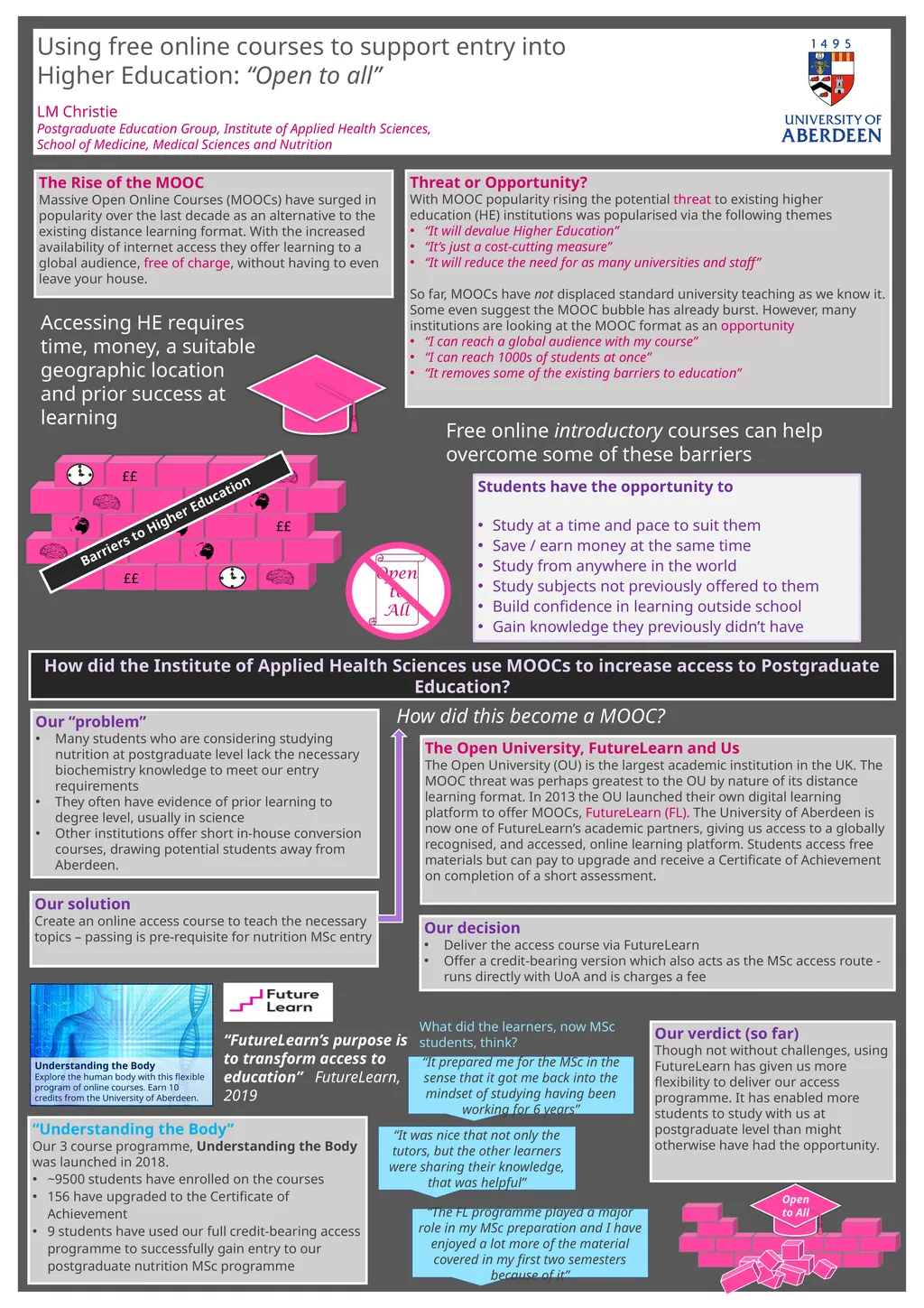
The Open University (OU) is the largest academic institution in the UK. The MOOC threat was perhaps greatest to the OU by nature of its distance learning format. In 2013 the OU launched their own digital learning platform to offer MOOCs, FutureLearn (FL). The University of Aberdeen is now one of FutureLearn’s academic partners, giving us access to a globally recognised, and accessed, online learning platform. Students access free materials but can pay to upgrade and receive a Certificate of Achievement on completion of a short assessment. “FutureLearn’s purpose is to transform access to education” FutureLearn, 2019 How did the Institute of Applied Health Sciences use MOOCs to increase access to Postgraduate Education? Accessing HE requires time, money, a suitable geographic location and prior success at learning Free online introductory courses can help overcome some of these barriers Students have the opportunity to
Study at a time and pace to suit them
Save / earn money at the same time
Study from anywhere in the world
Study subjects not previously offered to them
Build confidence in learning outside school
Gain knowledge they previously didn’t have Our “problem”
Many students who are considering studying nutrition at postgraduate level lack the necessary biochemistry knowledge to meet our entry requirements
They often have evidence of prior learning to degree level, usually in science
Other institutions offer short in-house conversion courses, drawing potential students away from Aberdeen. Our solution
Create an online access course to teach the necessary topics – passing is pre-requisite for nutrition MSc entry How did this become a MOOC? Our decision
Deliver the access course via FutureLearn
Offer a credit-bearing version which also acts as the MSc access route - runs directly with UoA and is charges a fee “Understanding the Body”
Our 3 course programme, Understanding the Body was launched in 2018.
~9500 students have enrolled on the courses
156 have upgraded to the Certificate of Achievement
9 students have used our full credit-bearing access programme to successfully gain entry to our postgraduate nutrition MSc programme “It prepared me for the MSc in the sense that it got me back into the mindset of studying having been working for 6 years” “It was nice that not only the tutors, but the other learners were sharing their knowledge, that was helpful” What did the learners, now MSc students, think? “The FL programme played a major role in my MSc preparation and I have enjoyed a lot more of the material covered in my first two semesters because of it” Our verdict (so far)
Though not without challenges, using FutureLearn has given us more flexibility to deliver our access programme. It has enabled more students to study with us at postgraduate level than might otherwise have had the opportunity. Barriers to Higher Education Open
to All<br>

LM Christie
Postgraduate Education Group, Institute of Applied Health Sciences,
School of Medicine, Medical Sciences and Nutrition The Rise of the MOOC
Massive Open Online Courses (MOOCs) have surged in popularity over the last decade as an alternative to the existing distance learning format. With the increased availability of internet access they offer learning to a global audience, free of charge, without having to even leave your house. Threat or Opportunity?
With MOOC popularity rising the potential threat to existing higher education (HE) institutions was popularised via the following themes
“It will devalue Higher Education”
“It’s just a cost-cutting measure”
“It will reduce the need for as many universities and staff”
So far, MOOCs have not displaced standard university teaching as we know it. Some even suggest the MOOC bubble has already burst. However, many institutions are looking at the MOOC format as an opportunity
“I can reach a global audience with my course”
“I can reach 1000s of students at once”
“It removes some of the existing barriers to education” The Open University, FutureLearn and Us
The Open University (OU) is the largest academic institution in the UK. The MOOC threat was perhaps greatest to the OU by nature of its distance learning format. In 2013 the OU launched their own digital learning platform to offer MOOCs, FutureLearn (FL). The University of Aberdeen is now one of FutureLearn’s academic partners, giving us access to a globally recognised, and accessed, online learning platform. Students access free materials but can pay to upgrade and receive a Certificate of Achievement on completion of a short assessment. “FutureLearn’s purpose is to transform access to education” FutureLearn, 2019 How did the Institute of Applied Health Sciences use MOOCs to increase access to Postgraduate Education? Accessing HE requires time, money, a suitable geographic location and prior success at learning Free online introductory courses can help overcome some of these barriers Students have the opportunity to
Study at a time and pace to suit them
Save / earn money at the same time
Study from anywhere in the world
Study subjects not previously offered to them
Build confidence in learning outside school
Gain knowledge they previously didn’t have Our “problem”
Many students who are considering studying nutrition at postgraduate level lack the necessary biochemistry knowledge to meet our entry requirements
They often have evidence of prior learning to degree level, usually in science
Other institutions offer short in-house conversion courses, drawing potential students away from Aberdeen. Our solution
Create an online access course to teach the necessary topics – passing is pre-requisite for nutrition MSc entry How did this become a MOOC? Our decision
Deliver the access course via FutureLearn
Offer a credit-bearing version which also acts as the MSc access route - runs directly with UoA and is charges a fee “Understanding the Body”
Our 3 course programme, Understanding the Body was launched in 2018.
~9500 students have enrolled on the courses
156 have upgraded to the Certificate of Achievement
9 students have used our full credit-bearing access programme to successfully gain entry to our postgraduate nutrition MSc programme “It prepared me for the MSc in the sense that it got me back into the mindset of studying having been working for 6 years” “It was nice that not only the tutors, but the other learners were sharing their knowledge, that was helpful” What did the learners, now MSc students, think? “The FL programme played a major role in my MSc preparation and I have enjoyed a lot more of the material covered in my first two semesters because of it” Our verdict (so far)
Though not without challenges, using FutureLearn has given us more flexibility to deliver our access programme. It has enabled more students to study with us at postgraduate level than might otherwise have had the opportunity. Barriers to Higher Education Open
to All<br>