
Using the SBAR Technique for Effective

Description: Using the SBAR Technique for Effective Communication NURS 3209 Holistic Nursing Modupeola Adebayo, DNP, RN-BC Informatics Adapted with permission from original PowerPoint presentation by Linda Sutton, MSN, RN. Utilize a standardized
Related Topics
Download Presentation
"Using the SBAR Technique for Effective" is the property of its rightful owner. Permission is granted to download and print the materials on this website for personal, non-commercial use only, and to display it on your personal computer provided you do not modify the materials and that you retain all copyright notices contained in the materials. By downloading content from our website, you accept the terms of this agreement.
Presentation Transcript
slide1. Using the SBAR Technique
for Effective Communication NURS 3209 – Holistic Nursing
Modupeola Adebayo, DNP, RN-BC Informatics
**Adapted with permission from original PowerPoint presentation by Linda Sutton, MSN, RN.<br>
slide2. Utilize a standardized communication technique as the SBAR to communicate with other nurses and other health care providers
Identify steps in the SBAR process
Use SBAR technique to facilitate clinical reasoning and clinical judgement in a case scenario
Demonstrate effective communication using role-playing with SBAR tool Learning Objectives<br>
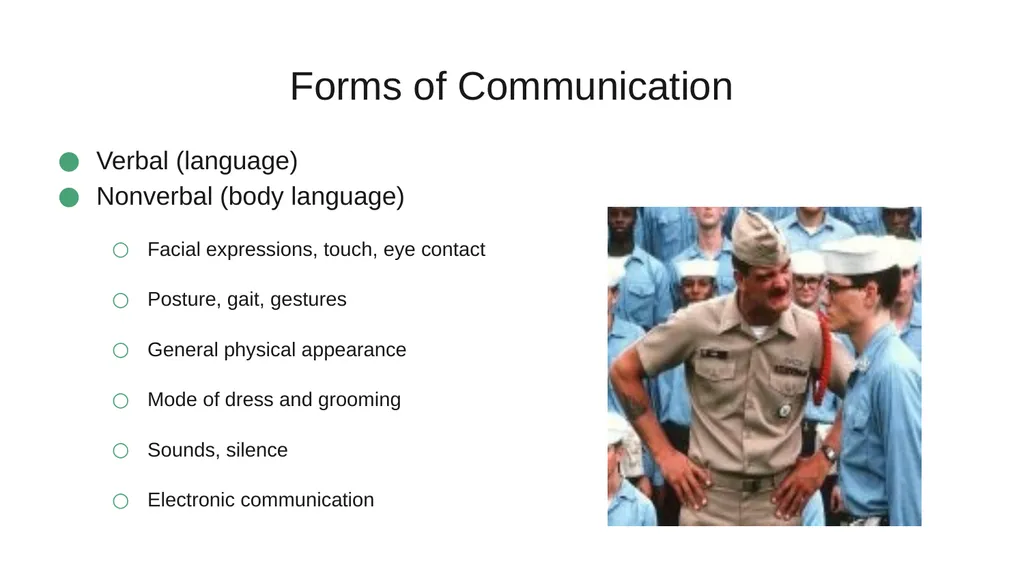
slide3. Forms of Communication Verbal (language)
Nonverbal (body language)
Facial expressions, touch, eye contact
Posture, gait, gestures
General physical appearance
Mode of dress and grooming
Sounds, silence
Electronic communication<br>
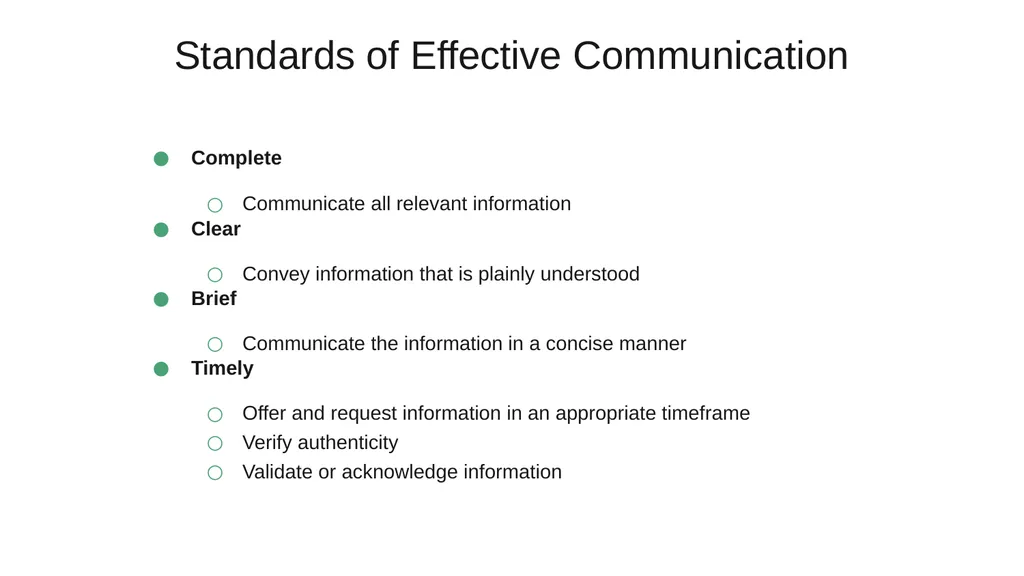
slide4. Standards of Effective Communication Complete
Communicate all relevant information
Clear
Convey information that is plainly understood
Brief
Communicate the information in a concise manner
Timely
Offer and request information in an appropriate timeframe
Verify authenticity
Validate or acknowledge information<br>
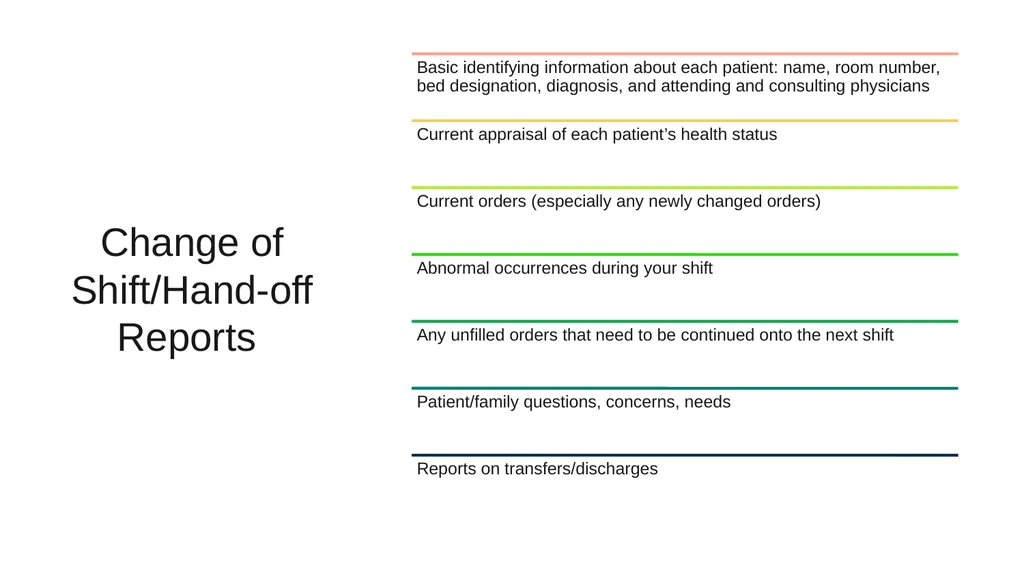
slide5. Change of Shift/Hand-off Reports<br>
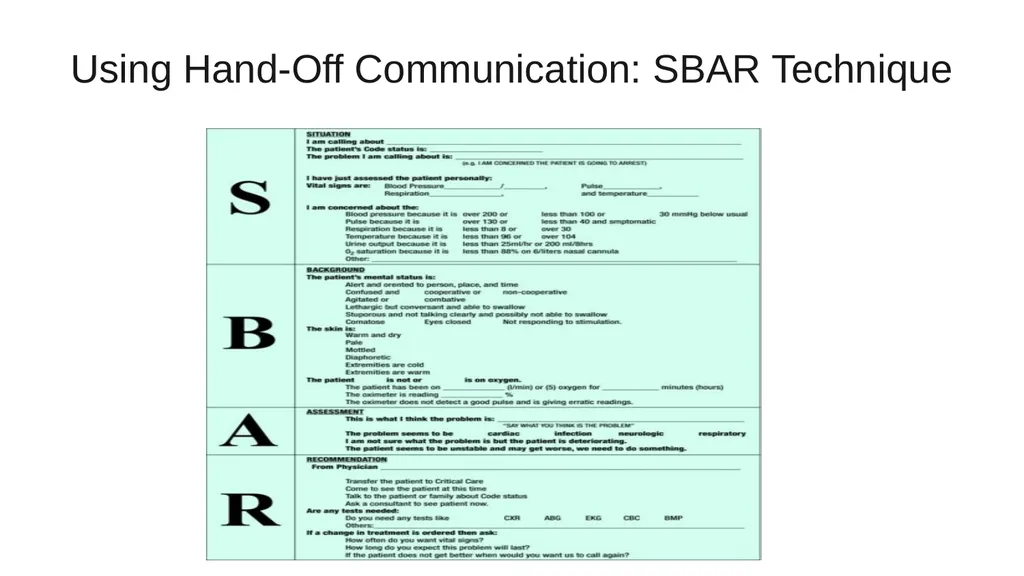
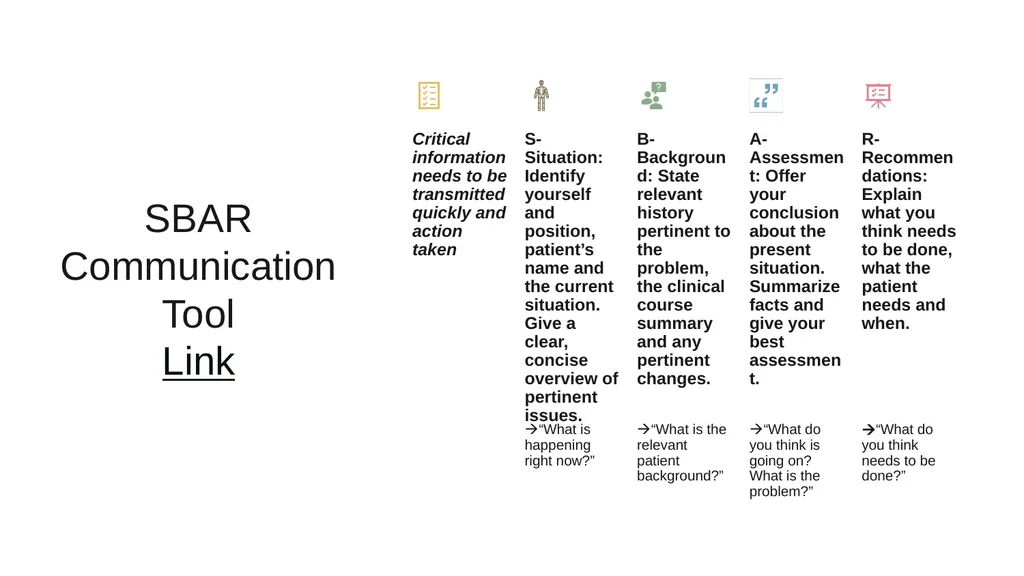
slide7. Using Hand-Off Communication: SBAR Technique<br>
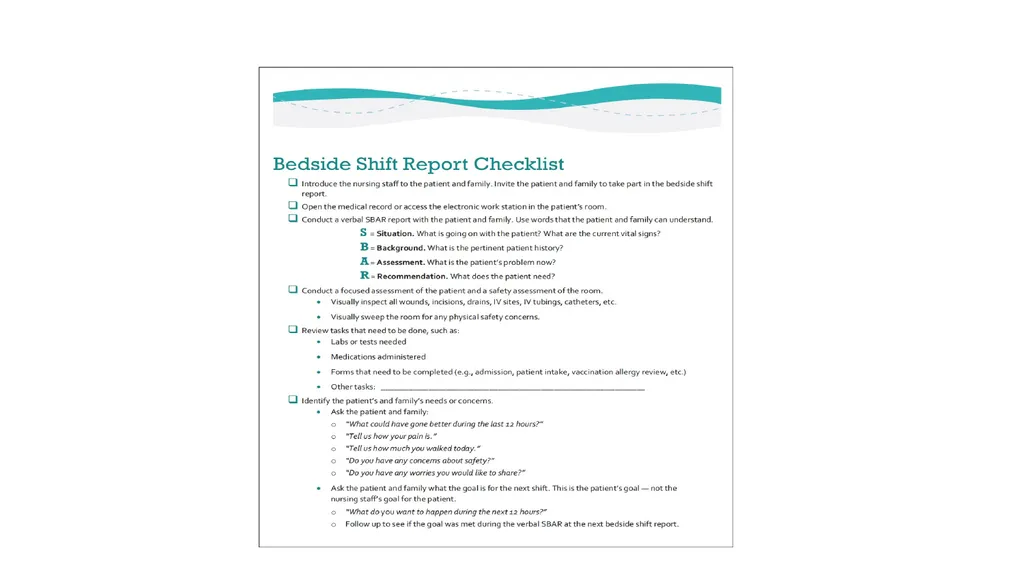
slide8. SBAR Communication Tool Link<br>
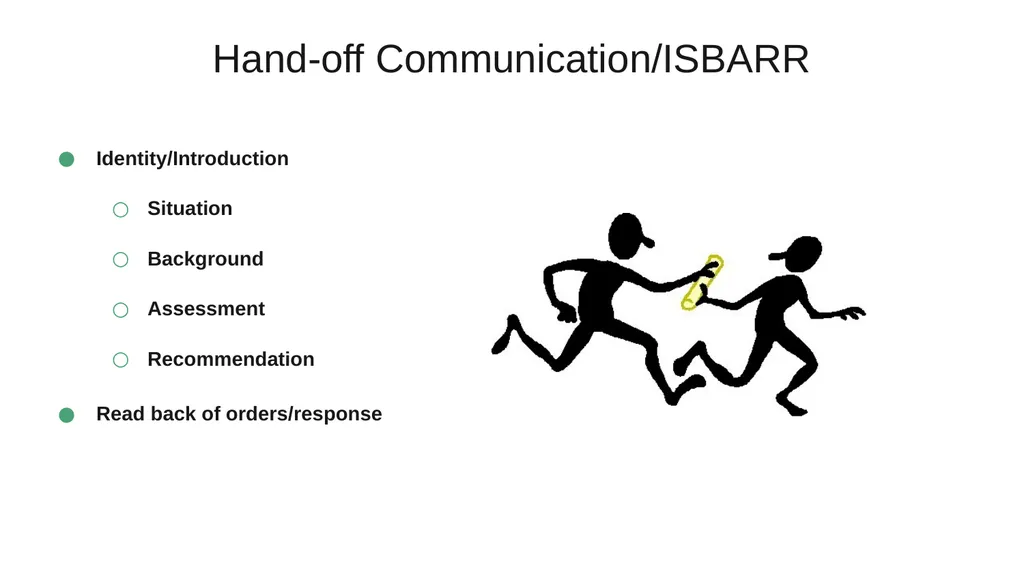
slide9. Hand-off Communication/ISBARR Identity/Introduction
Situation
Background
Assessment
Recommendation
Read back of orders/response<br>
slide10. Why Use SBAR? Implemented by US Navy for submarine duty hand-off
Implemented first in healthcare by Kaiser Permanente in 2003 for RN-MD critical communication
Validated and reliable tool shown to reduce adverse patient events, improve communication, & promote patient safety
Recommended by Joint Commission, AHRQ, WHO as effective communication and hand-off tool
Joint Commission article
Easily modified for variety of uses: critical situation, hand-off, transfer, bedside report, etc<br>
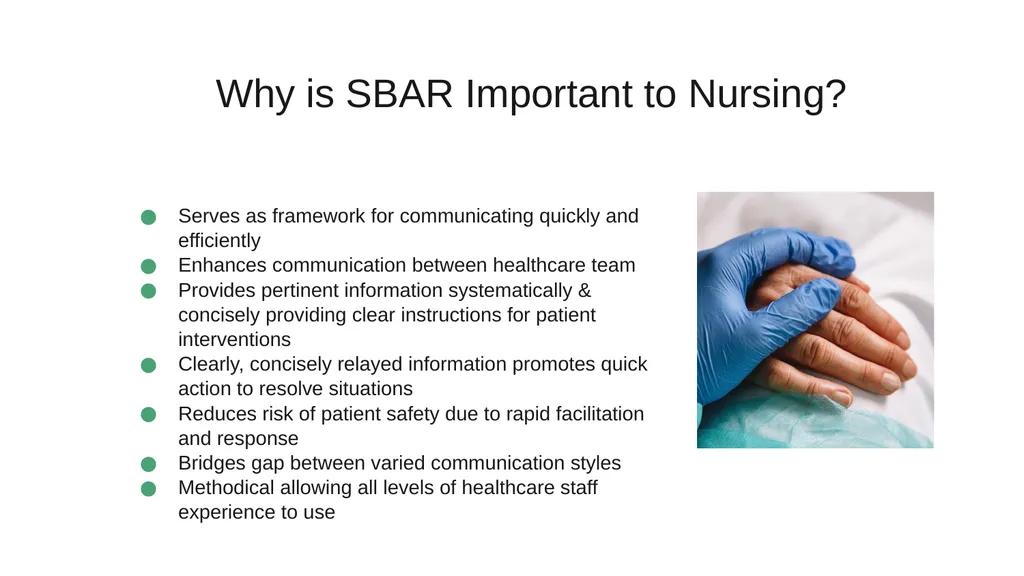
slide11. Why is SBAR Important to Nursing? Serves as framework for communicating quickly and efficiently
Enhances communication between healthcare team
Provides pertinent information systematically & concisely providing clear instructions for patient interventions
Clearly, concisely relayed information promotes quick action to resolve situations
Reduces risk of patient safety due to rapid facilitation and response
Bridges gap between varied communication styles
Methodical allowing all levels of healthcare staff experience to use<br>
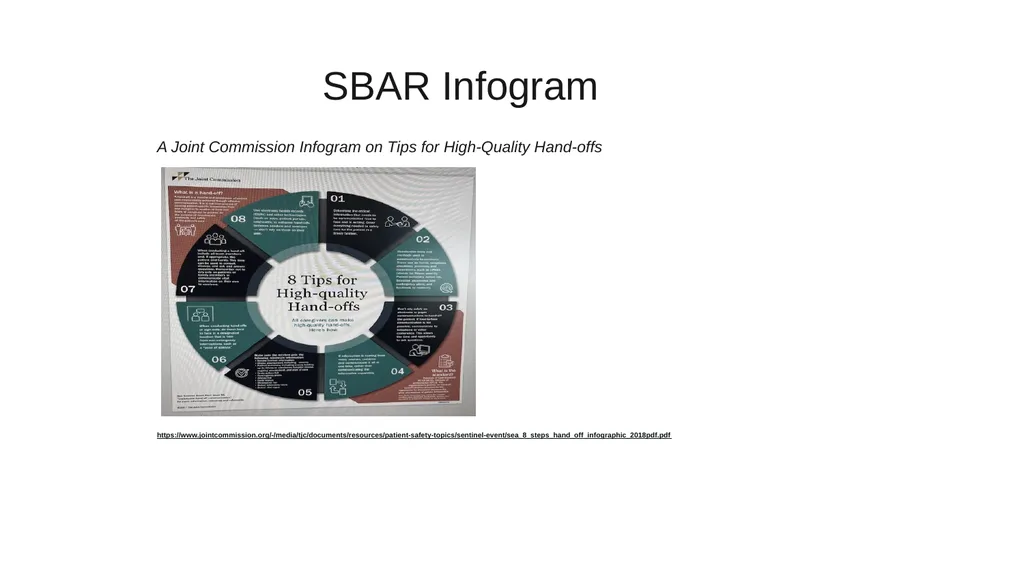
slide12. SBAR Infogram A Joint Commission Infogram on Tips for High-Quality Hand-offs
https://www.jointcommission.org/-/media/tjc/documents/resources/patient-safety-topics/sentinel-event/sea_8_steps_hand_off_infographic_2018pdf.pdf<br>
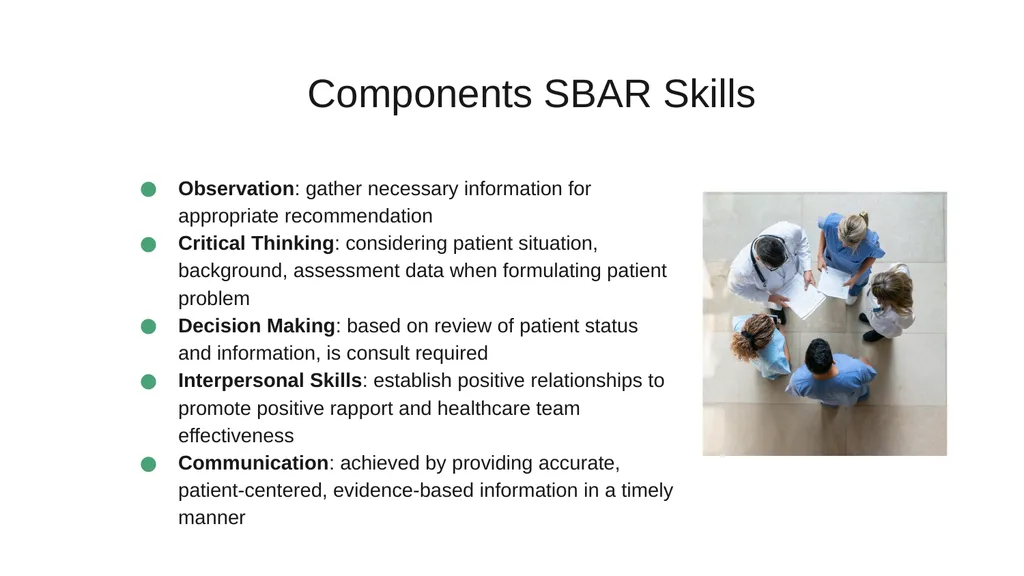
slide13. Components SBAR Skills Observation: gather necessary information for appropriate recommendation
Critical Thinking: considering patient situation, background, assessment data when formulating patient problem
Decision Making: based on review of patient status and information, is consult required
Interpersonal Skills: establish positive relationships to promote positive rapport and healthcare team effectiveness
Communication: achieved by providing accurate, patient-centered, evidence-based information in a timely manner<br>
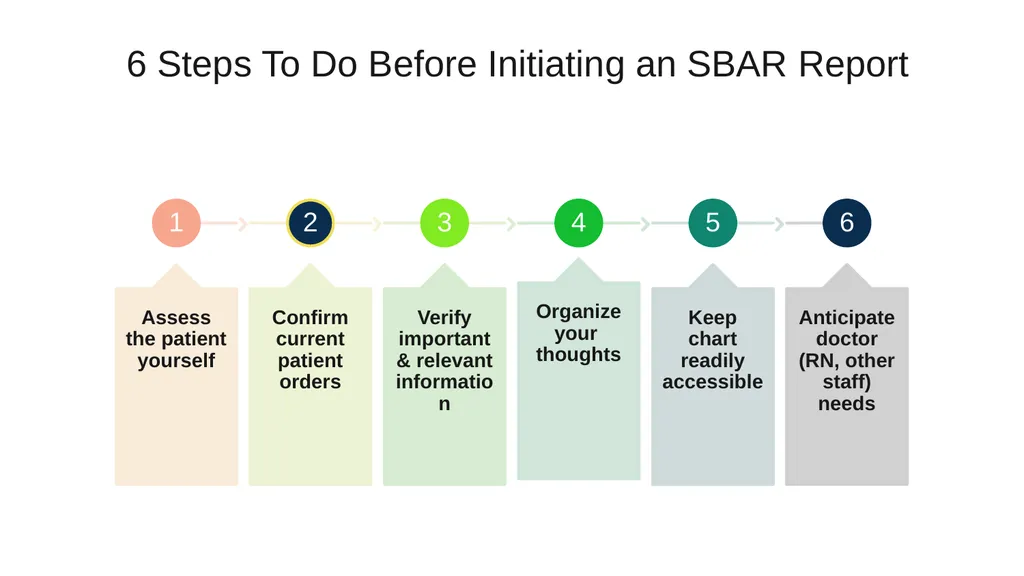
slide14. 6 Steps To Do Before Initiating an SBAR Report<br>
slide15. John Smith, DOB 1/10/1965
Attending MD: Dr. Joanna Wynn.
58-year-old male with h/o hypertension, diabetes mellitus II, hyperlipidemia, myocardial infarction in 2016 s/p 2 coronary stents, 42 years of 1ppd tobacco use. Admitted to ICU Room 4 yesterday for hypertensive crisis. With no known drug allergies, and a full code status.
Per night shift RN, mild intermittent SOB.
2 hours into your shift, Mr. Smith c/o SOB & CP
VS: BP 140/86, HR 124, RR 26, O2 98% 2L NC, T 37C, pain 6/10 mid sternal, constant, unrelieved
Labs: WBC WNL, hemoglobin & hematocrit 12.1 & 36, basic metabolic panel: WNL. AAOx3, anxious, clammy, pale, shallow breathing, moves all extremities well.
Recommendation (s)? Patient
Age:
Gender:
Allergies:
Location:
Reason for the call:
History:
Current status:
Observations/information gathered:
Thoughts: Scenario – Change in Patient Status<br>
slide16. References American Association of Colleges of Nursing. (2021). The essentials: Core competencies for professional nursing education. https://www.aacnnursing.org/Portals/0/PDFs/Publications/Essentials-2021.pdf
SBAR Nursing Example: Nurse-to-physician communication report NCLEX (2021). YouTube Video retrieved from https://youtu.be/ltloXhUvi1Y?si=ZLBuXVUFJNz9sllJ
Taylor, C., Lynn, P., & Bartlett, J. (2023). Fundamentals of nursing:
The art and science of person-centered care 10th Edition. Mexico: Wolters Kluwer.
The Joint Commission (2017). Inadequate hand-off communication. Sentinel Alert Event, 58. Retrieved from https://www.jointcommission.org/-/media/tjc/newsletters/sea-58-hand-off-comm-9-6-17-final2.pdf<br>
slide17. Thank You For questions, please send contact electronic mail at:
madebay2@kennesaw.edu
mgarring@kennesaw.edu
awhiddo5@kennesaw.edu
mhawks2@kennesaw.edu
Kennesaw State University, Kennesaw Georgia, 30144<br>
Modupeola Adebayo, DNP, RN-BC Informatics
**Adapted with permission from original PowerPoint presentation by Linda Sutton, MSN, RN.<br>
slide2. Utilize a standardized communication technique as the SBAR to communicate with other nurses and other health care providers
Identify steps in the SBAR process
Use SBAR technique to facilitate clinical reasoning and clinical judgement in a case scenario
Demonstrate effective communication using role-playing with SBAR tool Learning Objectives<br>
slide3. Forms of Communication Verbal (language)
Nonverbal (body language)
Facial expressions, touch, eye contact
Posture, gait, gestures
General physical appearance
Mode of dress and grooming
Sounds, silence
Electronic communication<br>
slide4. Standards of Effective Communication Complete
Communicate all relevant information
Clear
Convey information that is plainly understood
Brief
Communicate the information in a concise manner
Timely
Offer and request information in an appropriate timeframe
Verify authenticity
Validate or acknowledge information<br>
slide5. Change of Shift/Hand-off Reports<br>
slide7. Using Hand-Off Communication: SBAR Technique<br>
slide8. SBAR Communication Tool Link<br>
slide9. Hand-off Communication/ISBARR Identity/Introduction
Situation
Background
Assessment
Recommendation
Read back of orders/response<br>
slide10. Why Use SBAR? Implemented by US Navy for submarine duty hand-off
Implemented first in healthcare by Kaiser Permanente in 2003 for RN-MD critical communication
Validated and reliable tool shown to reduce adverse patient events, improve communication, & promote patient safety
Recommended by Joint Commission, AHRQ, WHO as effective communication and hand-off tool
Joint Commission article
Easily modified for variety of uses: critical situation, hand-off, transfer, bedside report, etc<br>
slide11. Why is SBAR Important to Nursing? Serves as framework for communicating quickly and efficiently
Enhances communication between healthcare team
Provides pertinent information systematically & concisely providing clear instructions for patient interventions
Clearly, concisely relayed information promotes quick action to resolve situations
Reduces risk of patient safety due to rapid facilitation and response
Bridges gap between varied communication styles
Methodical allowing all levels of healthcare staff experience to use<br>
slide12. SBAR Infogram A Joint Commission Infogram on Tips for High-Quality Hand-offs
https://www.jointcommission.org/-/media/tjc/documents/resources/patient-safety-topics/sentinel-event/sea_8_steps_hand_off_infographic_2018pdf.pdf<br>
slide13. Components SBAR Skills Observation: gather necessary information for appropriate recommendation
Critical Thinking: considering patient situation, background, assessment data when formulating patient problem
Decision Making: based on review of patient status and information, is consult required
Interpersonal Skills: establish positive relationships to promote positive rapport and healthcare team effectiveness
Communication: achieved by providing accurate, patient-centered, evidence-based information in a timely manner<br>
slide14. 6 Steps To Do Before Initiating an SBAR Report<br>
slide15. John Smith, DOB 1/10/1965
Attending MD: Dr. Joanna Wynn.
58-year-old male with h/o hypertension, diabetes mellitus II, hyperlipidemia, myocardial infarction in 2016 s/p 2 coronary stents, 42 years of 1ppd tobacco use. Admitted to ICU Room 4 yesterday for hypertensive crisis. With no known drug allergies, and a full code status.
Per night shift RN, mild intermittent SOB.
2 hours into your shift, Mr. Smith c/o SOB & CP
VS: BP 140/86, HR 124, RR 26, O2 98% 2L NC, T 37C, pain 6/10 mid sternal, constant, unrelieved
Labs: WBC WNL, hemoglobin & hematocrit 12.1 & 36, basic metabolic panel: WNL. AAOx3, anxious, clammy, pale, shallow breathing, moves all extremities well.
Recommendation (s)? Patient
Age:
Gender:
Allergies:
Location:
Reason for the call:
History:
Current status:
Observations/information gathered:
Thoughts: Scenario – Change in Patient Status<br>
slide16. References American Association of Colleges of Nursing. (2021). The essentials: Core competencies for professional nursing education. https://www.aacnnursing.org/Portals/0/PDFs/Publications/Essentials-2021.pdf
SBAR Nursing Example: Nurse-to-physician communication report NCLEX (2021). YouTube Video retrieved from https://youtu.be/ltloXhUvi1Y?si=ZLBuXVUFJNz9sllJ
Taylor, C., Lynn, P., & Bartlett, J. (2023). Fundamentals of nursing:
The art and science of person-centered care 10th Edition. Mexico: Wolters Kluwer.
The Joint Commission (2017). Inadequate hand-off communication. Sentinel Alert Event, 58. Retrieved from https://www.jointcommission.org/-/media/tjc/newsletters/sea-58-hand-off-comm-9-6-17-final2.pdf<br>
slide17. Thank You For questions, please send contact electronic mail at:
madebay2@kennesaw.edu
mgarring@kennesaw.edu
awhiddo5@kennesaw.edu
mhawks2@kennesaw.edu
Kennesaw State University, Kennesaw Georgia, 30144<br>