
Using the Serious Leisure Perspective in Mental
PC
Published · 36 slides · 0 views
1 / 1






Description
Using the Serious Leisure Perspective in Mental Health Counseling: An Extension of Wellness and Case Examples By Rodney B. Dieser Ph.D. CTRS, LMHC University of Northern Iowa Health, Recreation and Community Services Practicing LMHC at
Related Topics
Share
Embed code
Download this presentation From Below
"Using the Serious Leisure Perspective in Mental" is the property of its rightful owner. Permission is granted to download and print the materials on this website for personal, non-commercial use only, and to display it on your personal computer provided you do not modify the materials and that you retain all copyright notices contained in the materials. By downloading content from our website, you accept the terms of this agreement.
Presentation Transcript
01
Using the Serious Leisure Perspective in Mental Health Counseling: An Extension of Wellness and Case Examples By
Rodney B. Dieser Ph.D. CTRS, LMHC
University of Northern Iowa
Health, Recreation and Community Services
&
Practicing LMHC at Wartburg College<br>
Rodney B. Dieser Ph.D. CTRS, LMHC
University of Northern Iowa
Health, Recreation and Community Services
&
Practicing LMHC at Wartburg College<br>
02
Outline Serious Leisure Perspective (SLP)
Research-based outcomes of SLP
Three case examples
Four step approach in counseling and professional recommendations<br>
Research-based outcomes of SLP
Three case examples
Four step approach in counseling and professional recommendations<br>
03
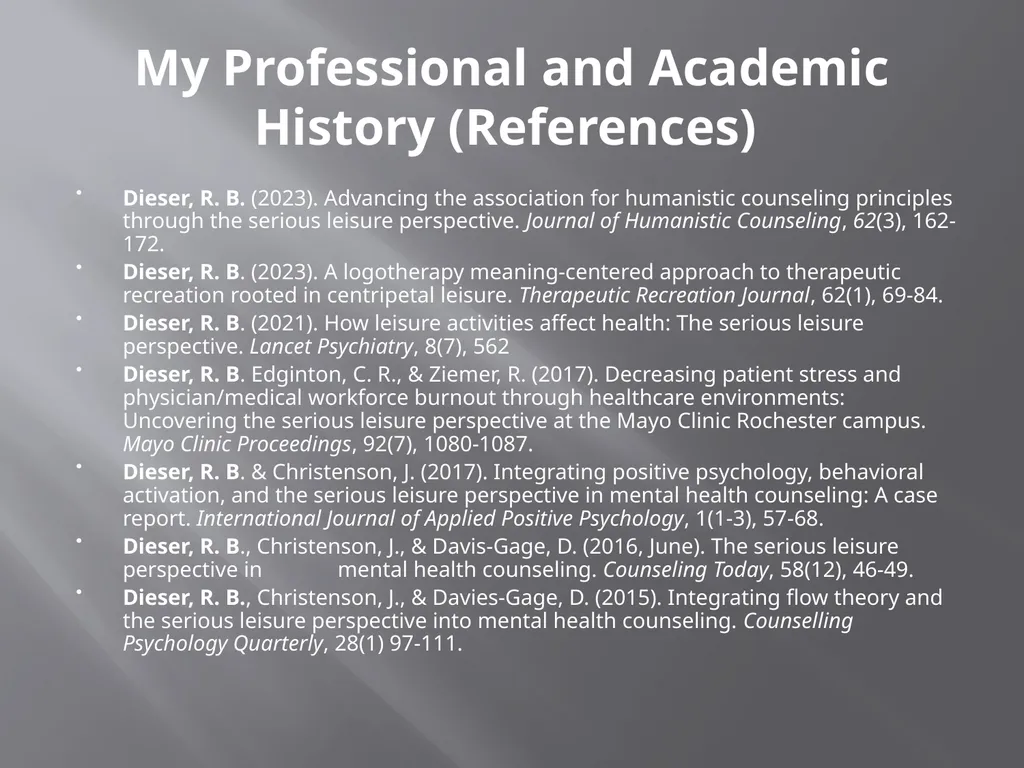
My Professional and Academic History (References) Dieser, R. B. (2023). Advancing the association for humanistic counseling principles through the serious leisure perspective. Journal of Humanistic Counseling, 62(3), 162-172.
Dieser, R. B. (2023). A logotherapy meaning-centered approach to therapeutic recreation rooted in centripetal leisure. Therapeutic Recreation Journal, 62(1), 69-84.
Dieser, R. B. (2021). How leisure activities affect health: The serious leisure perspective. Lancet Psychiatry, 8(7), 562
Dieser, R. B. Edginton, C. R., & Ziemer, R. (2017). Decreasing patient stress and physician/medical workforce burnout through healthcare environments: Uncovering the serious leisure perspective at the Mayo Clinic Rochester campus. Mayo Clinic Proceedings, 92(7), 1080-1087.
Dieser, R. B. & Christenson, J. (2017). Integrating positive psychology, behavioral activation, and the serious leisure perspective in mental health counseling: A case report. International Journal of Applied Positive Psychology, 1(1-3), 57-68.
Dieser, R. B., Christenson, J., & Davis-Gage, D. (2016, June). The serious leisure perspective in mental health counseling. Counseling Today, 58(12), 46-49.
Dieser, R. B., Christenson, J., & Davies-Gage, D. (2015). Integrating flow theory and the serious leisure perspective into mental health counseling. Counselling Psychology Quarterly, 28(1) 97-111.<br>
Dieser, R. B. (2023). A logotherapy meaning-centered approach to therapeutic recreation rooted in centripetal leisure. Therapeutic Recreation Journal, 62(1), 69-84.
Dieser, R. B. (2021). How leisure activities affect health: The serious leisure perspective. Lancet Psychiatry, 8(7), 562
Dieser, R. B. Edginton, C. R., & Ziemer, R. (2017). Decreasing patient stress and physician/medical workforce burnout through healthcare environments: Uncovering the serious leisure perspective at the Mayo Clinic Rochester campus. Mayo Clinic Proceedings, 92(7), 1080-1087.
Dieser, R. B. & Christenson, J. (2017). Integrating positive psychology, behavioral activation, and the serious leisure perspective in mental health counseling: A case report. International Journal of Applied Positive Psychology, 1(1-3), 57-68.
Dieser, R. B., Christenson, J., & Davis-Gage, D. (2016, June). The serious leisure perspective in mental health counseling. Counseling Today, 58(12), 46-49.
Dieser, R. B., Christenson, J., & Davies-Gage, D. (2015). Integrating flow theory and the serious leisure perspective into mental health counseling. Counselling Psychology Quarterly, 28(1) 97-111.<br>
04
Question Related to free time (not work) take two minutes and visit with someone close and share an activity you have done where time fly's by
A one hour activity seems like 10 minutes<br>
A one hour activity seems like 10 minutes<br>
05
Flow Theory
(Csikszentmihalyi, 1990, 2014) Optimal experience or enjoyment
A person becomes so ingrained in an activity or experience that nothing else matters
Positive emotion
“In flow we feel totally involved, lost in a seemingly effortless performance. Paradoxically, we feel 100 percent alive when we are so committed to the task at hand that we lose track of time, our interests—even of our own existence” (Gardner, Csikszentmihalyi, & Damon, 2001, p. 5)<br>
A person becomes so ingrained in an activity or experience that nothing else matters
Positive emotion
“In flow we feel totally involved, lost in a seemingly effortless performance. Paradoxically, we feel 100 percent alive when we are so committed to the task at hand that we lose track of time, our interests—even of our own existence” (Gardner, Csikszentmihalyi, & Damon, 2001, p. 5)<br>
06
Csikszentmihalyi (1934 – 2021)<br>
07
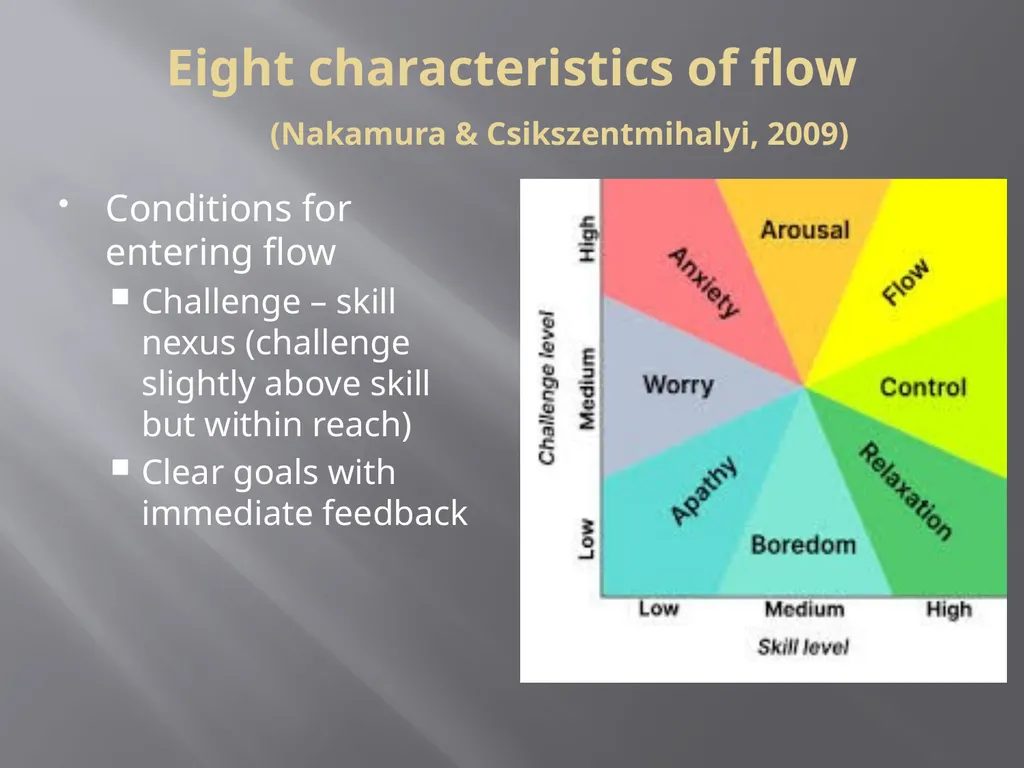
Eight characteristics of flow
(Nakamura & Csikszentmihalyi, 2009) Conditions for entering flow
Challenge – skill nexus (challenge slightly above skill but within reach)
Clear goals with immediate feedback<br>
Challenge – skill nexus (challenge slightly above skill but within reach)
Clear goals with immediate feedback<br>
08
Eight characteristics of flow
(Nakamura & Csikszentmihalyi, 2009) Second condition—a subjective state after the entering stage
Action and awareness merge
Intense concentration
Loss of self-consciousness
Strong sense of control
Altered sense of time
An autotelic experience<br>
Action and awareness merge
Intense concentration
Loss of self-consciousness
Strong sense of control
Altered sense of time
An autotelic experience<br>
09
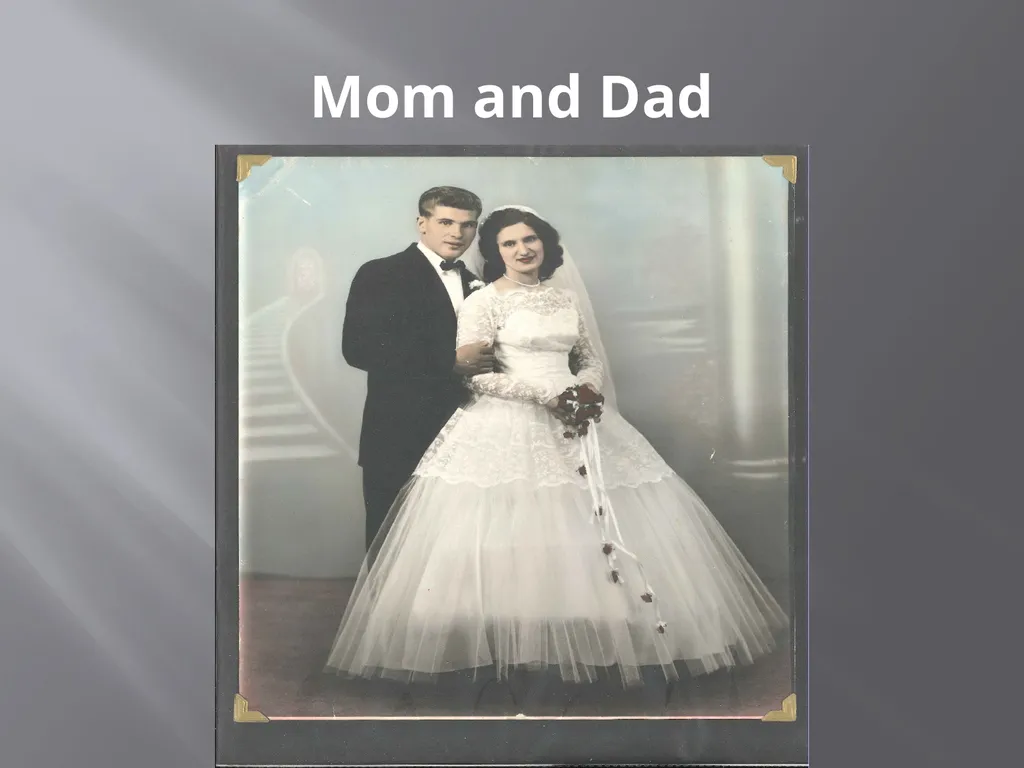
Mom and Dad<br>
10
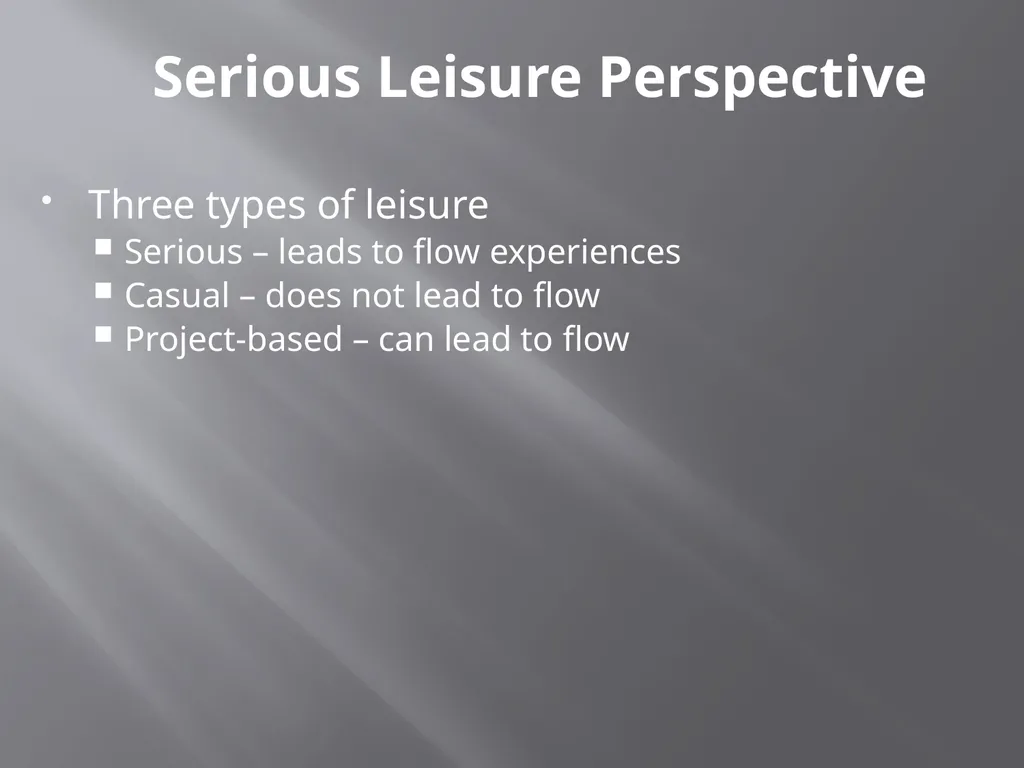
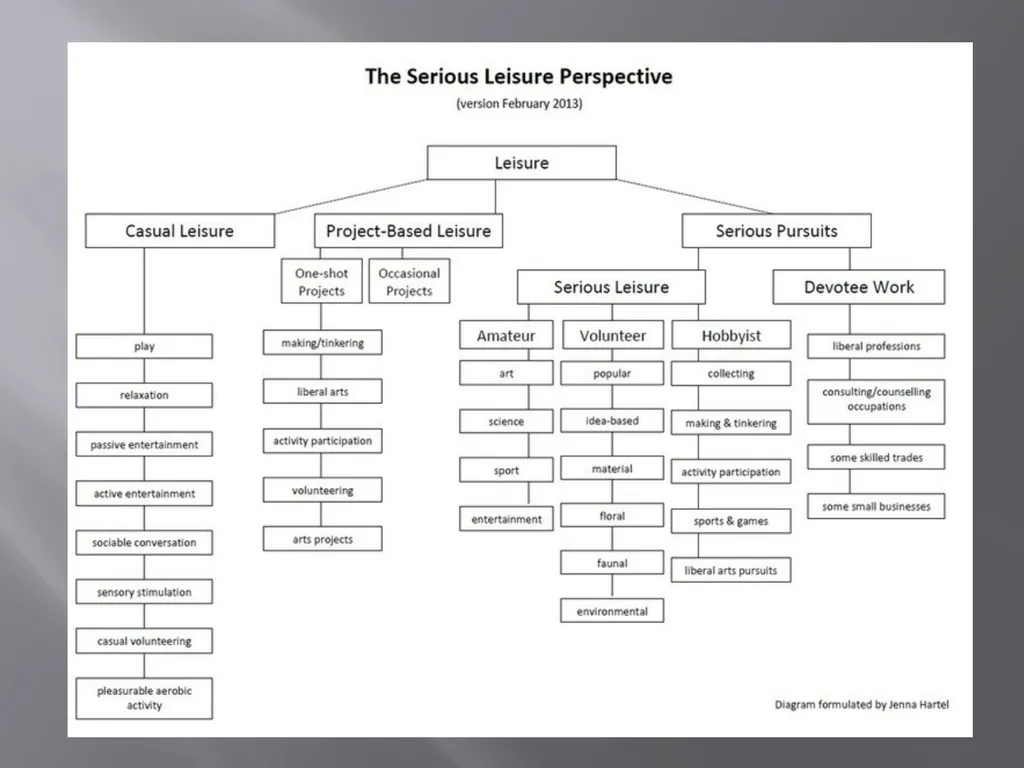
Serious Leisure Perspective Three types of leisure
Serious – leads to flow experiences
Casual – does not lead to flow
Project-based – can lead to flow<br>
Serious – leads to flow experiences
Casual – does not lead to flow
Project-based – can lead to flow<br>
11
Optimal Leisure Lifestyle (OLL) One serious leisure activity, supplemented by casual and project-based leisure.<br>
12
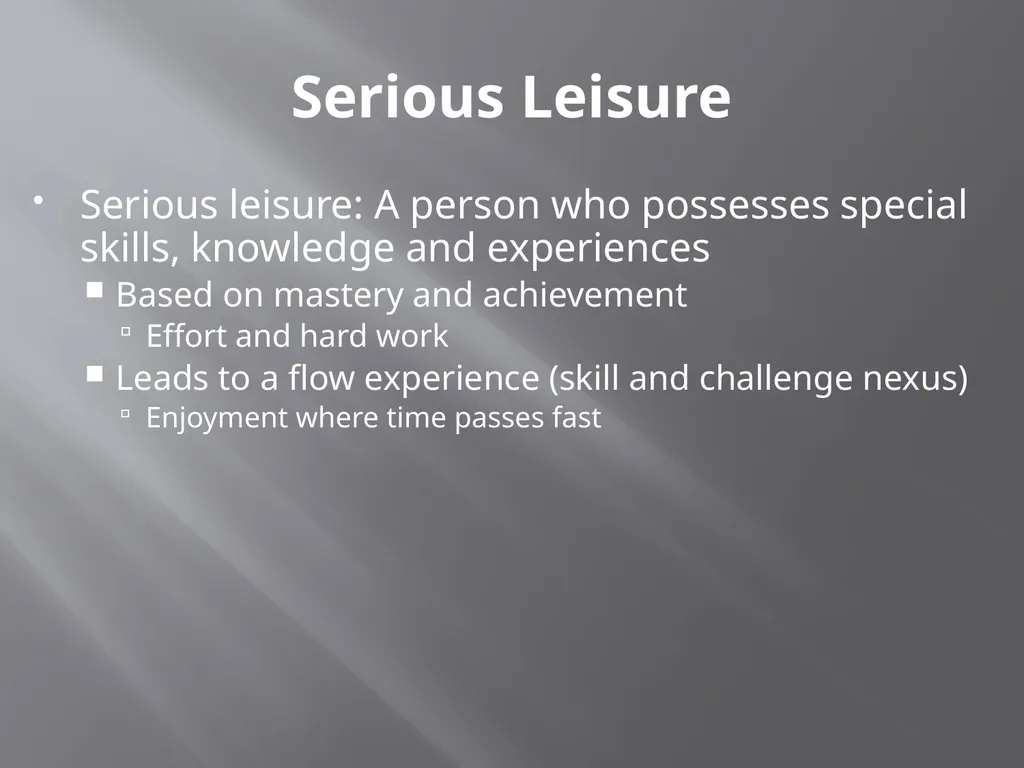
Serious Leisure Serious leisure: A person who possesses special skills, knowledge and experiences
Based on mastery and achievement
Effort and hard work
Leads to a flow experience (skill and challenge nexus)
Enjoyment where time passes fast<br>
Based on mastery and achievement
Effort and hard work
Leads to a flow experience (skill and challenge nexus)
Enjoyment where time passes fast<br>
13
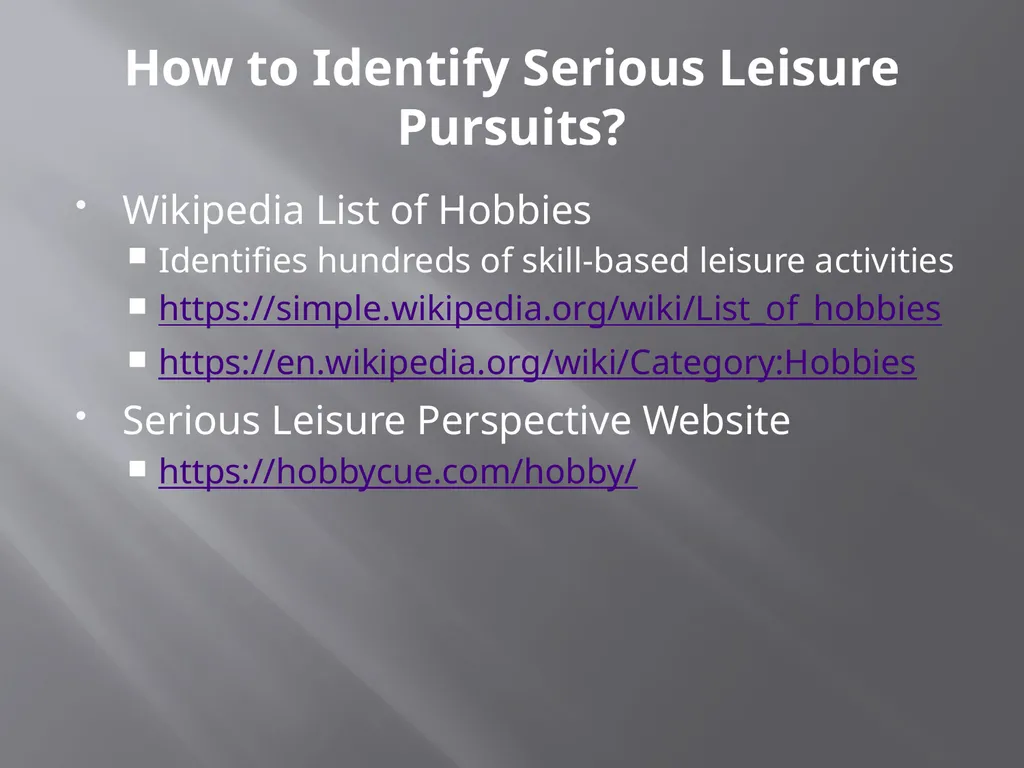
How to Identify Serious Leisure Pursuits? Wikipedia List of Hobbies
Identifies hundreds of skill-based leisure activities
https://simple.wikipedia.org/wiki/List_of_hobbies
https://en.wikipedia.org/wiki/Category:Hobbies
Serious Leisure Perspective Website
https://hobbycue.com/hobby/<br>
Identifies hundreds of skill-based leisure activities
https://simple.wikipedia.org/wiki/List_of_hobbies
https://en.wikipedia.org/wiki/Category:Hobbies
Serious Leisure Perspective Website
https://hobbycue.com/hobby/<br>
14
Research: Serious Leisure Can Result In Self-actualization (Heo et al., 2012)
Personal growth and happiness (Kim et al., 2015)
Life satisfaction (Kim et al., 2011)
Increased levels of confidence, skills, and self‐esteem (Patterson & Pegg, 2009)
Friendship and successful aging (Lee et al., 2019)
Sense of community and belonging (Gallant et al. 2013a)
Meaning in life (Konoa et al., 2020; Kuusi & Haukola, 2017: Stebbins, 1998)<br>
Personal growth and happiness (Kim et al., 2015)
Life satisfaction (Kim et al., 2011)
Increased levels of confidence, skills, and self‐esteem (Patterson & Pegg, 2009)
Friendship and successful aging (Lee et al., 2019)
Sense of community and belonging (Gallant et al. 2013a)
Meaning in life (Konoa et al., 2020; Kuusi & Haukola, 2017: Stebbins, 1998)<br>
15
Serious Leisure Aligns with the Association for Humanistic Counseling (AHC) Principles Discovering meaning and purpose
Developing deep connections with people and nature
Establishing growth and change
Maintaining a holistic approach to humanity
Developing creativity<br>
Developing deep connections with people and nature
Establishing growth and change
Maintaining a holistic approach to humanity
Developing creativity<br>
16
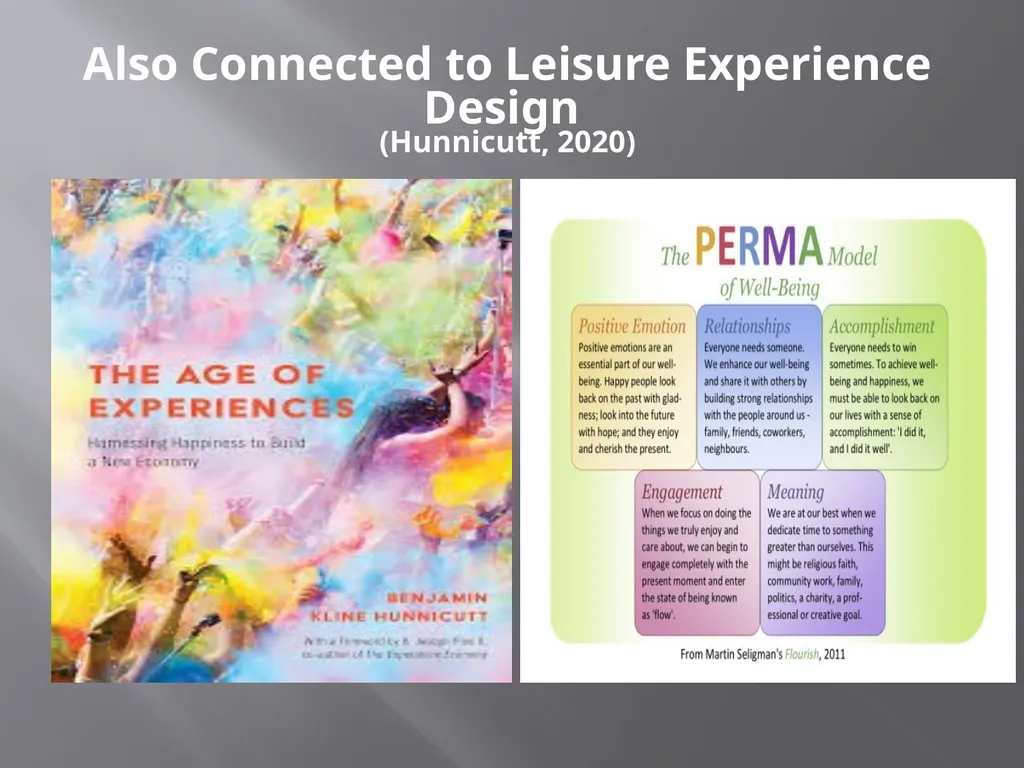
Also Connected to Leisure Experience Design
(Hunnicutt, 2020)<br>
17
Overlap Between Occupational Devotion and Serious Leisure Employment in which the person feels a powerful devotion or a strong positive attachment, often leading to self-enhancement, purpose, and a sense of achievement (Stebbins, 2022)
In such work, the core tasks or activities are endowed with such intense appeal that the line between work and leisure is virtually erased (Stebbins, 2004/2014).<br>
In such work, the core tasks or activities are endowed with such intense appeal that the line between work and leisure is virtually erased (Stebbins, 2004/2014).<br>
18
Casual Leisure Immediate, intrinsically rewarding, relatively short-lived pleasurable activity requiring little or no special training
Focus is relaxation and pleasure (distractions)
Examples
Relaxing (e.g., sun tanning)
Passive entertainment (watching TV)
Active entertainment (x-box, board games)
Social conversation (e.g., eating)
Sensory stimulation (e.g., viewing art)
Casual volunteering (e.g., directing traffic)<br>
Focus is relaxation and pleasure (distractions)
Examples
Relaxing (e.g., sun tanning)
Passive entertainment (watching TV)
Active entertainment (x-box, board games)
Social conversation (e.g., eating)
Sensory stimulation (e.g., viewing art)
Casual volunteering (e.g., directing traffic)<br>
19
Research: Casual Leisure Can Result In Balance/regeneration in life (MacCosham et al., 2015)
Relaxation (Patterson, 2004)
Interpersonal relationships/friendships (Stebbins, 2020)<br>
Relaxation (Patterson, 2004)
Interpersonal relationships/friendships (Stebbins, 2020)<br>
20
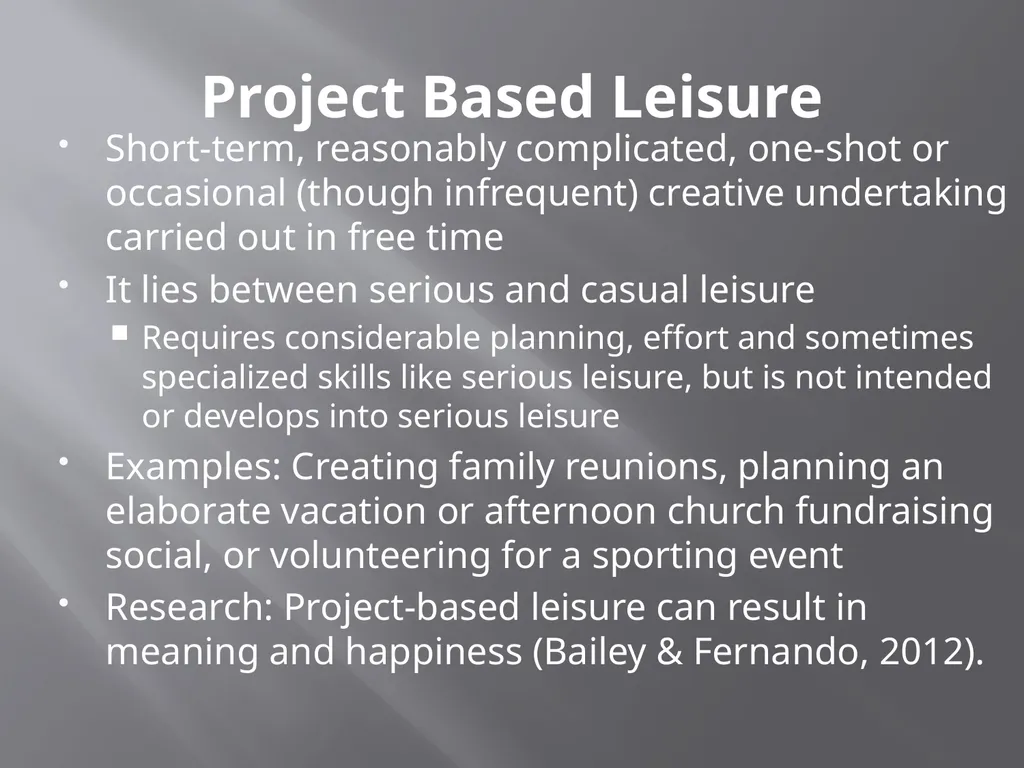
Project Based Leisure Short-term, reasonably complicated, one-shot or occasional (though infrequent) creative undertaking carried out in free time
It lies between serious and casual leisure
Requires considerable planning, effort and sometimes specialized skills like serious leisure, but is not intended or develops into serious leisure
Examples: Creating family reunions, planning an elaborate vacation or afternoon church fundraising social, or volunteering for a sporting event
Research: Project-based leisure can result in meaning and happiness (Bailey & Fernando, 2012).<br>
It lies between serious and casual leisure
Requires considerable planning, effort and sometimes specialized skills like serious leisure, but is not intended or develops into serious leisure
Examples: Creating family reunions, planning an elaborate vacation or afternoon church fundraising social, or volunteering for a sporting event
Research: Project-based leisure can result in meaning and happiness (Bailey & Fernando, 2012).<br>
21
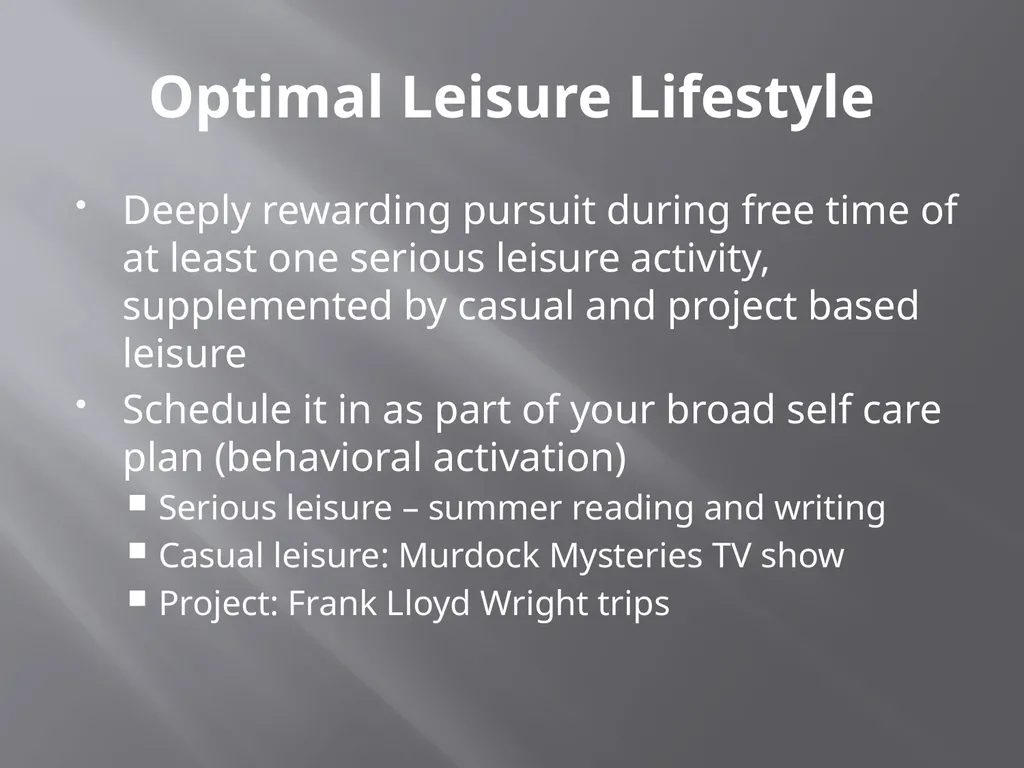
Optimal Leisure Lifestyle Deeply rewarding pursuit during free time of at least one serious leisure activity, supplemented by casual and project based leisure
Schedule it in as part of your broad self care plan (behavioral activation)
Serious leisure – summer reading and writing
Casual leisure: Murdock Mysteries TV show
Project: Frank Lloyd Wright trips<br>
Schedule it in as part of your broad self care plan (behavioral activation)
Serious leisure – summer reading and writing
Casual leisure: Murdock Mysteries TV show
Project: Frank Lloyd Wright trips<br>
22
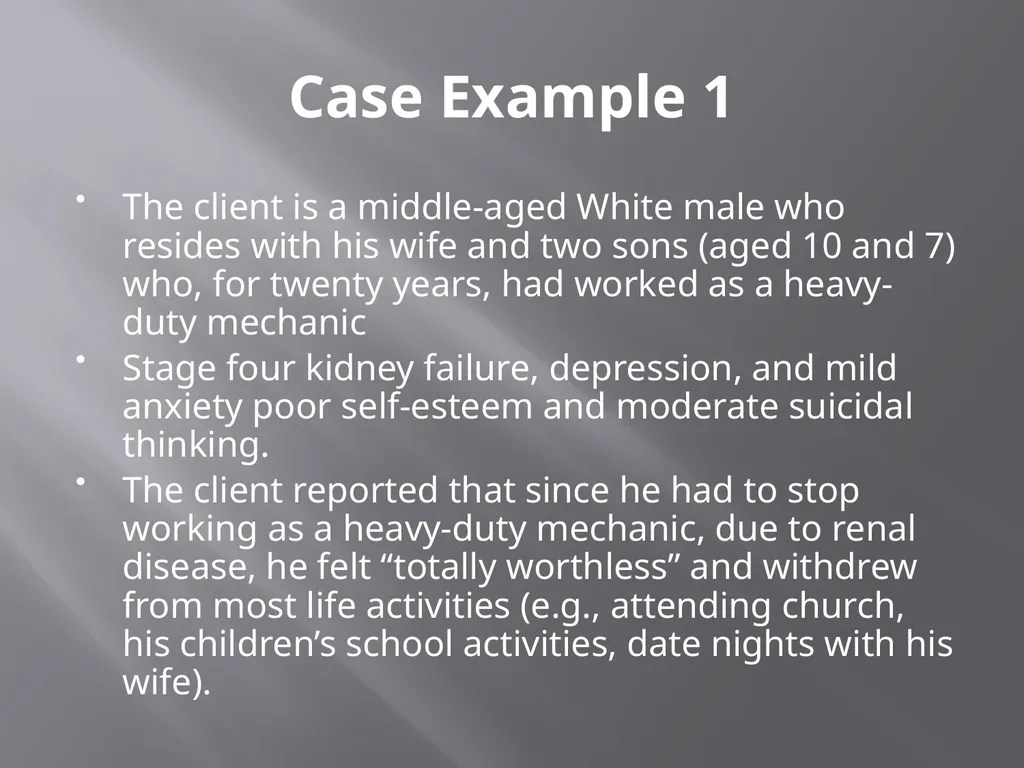
Case Example 1 The client is a middle-aged White male who resides with his wife and two sons (aged 10 and 7) who, for twenty years, had worked as a heavy-duty mechanic
Stage four kidney failure, depression, and mild anxiety poor self-esteem and moderate suicidal thinking.
The client reported that since he had to stop working as a heavy-duty mechanic, due to renal disease, he felt “totally worthless” and withdrew from most life activities (e.g., attending church, his children’s school activities, date nights with his wife).<br>
Stage four kidney failure, depression, and mild anxiety poor self-esteem and moderate suicidal thinking.
The client reported that since he had to stop working as a heavy-duty mechanic, due to renal disease, he felt “totally worthless” and withdrew from most life activities (e.g., attending church, his children’s school activities, date nights with his wife).<br>
23
Case Report 1 Continued Initial assessment listed his favorite leisure activities as cooking, listening to music, being in nature/outdoors, and dogs
Used to love to go fishing with his grandpa and client reported advanced skills related to fishing and that he had not fished for years,
Had dozens of fishing rods and a tackle box full of fishing equipment<br>
Used to love to go fishing with his grandpa and client reported advanced skills related to fishing and that he had not fished for years,
Had dozens of fishing rods and a tackle box full of fishing equipment<br>
24
Case Example 1 Client completed the VIA (Values-In-Action) Survey of Character Strengths, which is a 240–item Likert scale
Positive Psychology Center website
Top three character strengths
Creativity
Spirituality
Humor
(Client agreed with these findings)<br>
Positive Psychology Center website
Top three character strengths
Creativity
Spirituality
Humor
(Client agreed with these findings)<br>
25
Case Study 1 OLL Financial stress was re-framed as an opportunity to use his creativity signature strength to make interesting, unusual, and low-cost food
Crock-pot cooking (project based leisure)
Taught his sons how to fish (which he had never done but thought about) and went once or twice a month (serious leisure)
Framed as a “father-son activity” and Christian beliefs
Client lived close to a river and lake where he could go fishing.<br>
Crock-pot cooking (project based leisure)
Taught his sons how to fish (which he had never done but thought about) and went once or twice a month (serious leisure)
Framed as a “father-son activity” and Christian beliefs
Client lived close to a river and lake where he could go fishing.<br>
26
Case Study 1 OLL Volunteer once a week at the local humane society where he could walk and play ball with larger dogs (as he liked larger dogs) in order to feel worthwhile to his community within a framework of pleasure (casual leisure)<br>
27
Four Months Later Posttest score from the Beck Depression Inventory II was 27 indicating a change to moderate depression from severe depression, exceeding the treatment goal of having a 25% decrease in depression level
Client reported feelings of enjoyable accomplishment related to being able to cook for his family and to teach his son’s how to fish.
Although recognizing the severe limitation of renal disease, the client was able to acknowledge how his medical condition helped him to engage with his sons more and to live his core value as an active father<br>
Client reported feelings of enjoyable accomplishment related to being able to cook for his family and to teach his son’s how to fish.
Although recognizing the severe limitation of renal disease, the client was able to acknowledge how his medical condition helped him to engage with his sons more and to live his core value as an active father<br>
28
Case Example 2 A wealthy educated middle aged woman struggling with PTSD and chronic pain was able to find meaning by skill-based volunteerism for a nonprofit agency in her community that supported women in developing countries<br>
29
Discovering Leisure and Meaning: A Three Step Act Completed the VIA (Values-In-Action) Survey of Character Strengths
Homework assignment, write her eulogy (value clarification activity) so she could locate her logos, by reflecting on what she wants to be remembered in life for after her death
Went to Wikipedia List of Hobbies website
The two hobbies she found on this list were “trade-fair visiting” and “travel”<br>
Homework assignment, write her eulogy (value clarification activity) so she could locate her logos, by reflecting on what she wants to be remembered in life for after her death
Went to Wikipedia List of Hobbies website
The two hobbies she found on this list were “trade-fair visiting” and “travel”<br>
30
Leisure Outcome Became a serious volunteer in a nonprofit fair-trade agency that helped women artisans in third world countries, thus using her business and creative skills, and travel
Made financial donations and enjoyed reports
Talked about traveling to meet these female artisans<br>
Made financial donations and enjoyed reports
Talked about traveling to meet these female artisans<br>
31
Case Example 3 Woman with significant anxiety
Begins quilting as a distraction (casual leisure)
Learned the skills years previously
Realizes she forgot how much she enjoyed this activity and creates quilting gifts for people in the community (project based leisure)
Eventually joins a community quilting group and teaches others how to quilt (serious leisure)<br>
Begins quilting as a distraction (casual leisure)
Learned the skills years previously
Realizes she forgot how much she enjoyed this activity and creates quilting gifts for people in the community (project based leisure)
Eventually joins a community quilting group and teaches others how to quilt (serious leisure)<br>
32
Professional Recommendations Useful to start by scheduling casual leisure
Casual leisure requires far less planning and have more immediate benefits than serious leisure
If a therapist encouraged serious leisure pursuits, it might be best to link them to past leisure behaviors that used specialized skills, knowledge and experiences
May be helpful to break participation in such activities down into small steps that are easier for the client to accomplish<br>
Casual leisure requires far less planning and have more immediate benefits than serious leisure
If a therapist encouraged serious leisure pursuits, it might be best to link them to past leisure behaviors that used specialized skills, knowledge and experiences
May be helpful to break participation in such activities down into small steps that are easier for the client to accomplish<br>
33
Professional Recommendations Therapist should take time to understand leisure pursuits from a serious, casual, and project-based perspective during the assessment process<br>
34
Four Step Model Understand leisure in assessment and create treatment goals linked to leisure
Exploration of the three types of leisure through Socratic and maieutic dialog
Use, if need, leisure interest finders
Holland leisure activities finder
Wikipedia List of Hobbies
Inclusion to leisure
How to overcome barriers and constraints<br>
Exploration of the three types of leisure through Socratic and maieutic dialog
Use, if need, leisure interest finders
Holland leisure activities finder
Wikipedia List of Hobbies
Inclusion to leisure
How to overcome barriers and constraints<br>
35
Questions or comments
Rodney.Dieser@uni.edu<br>