
Using UBRP Barcoding in the Identification of
PT
Published · 1 slides · 0 views
1 / 1
Description
Using UBRP Barcoding in the Identification of Artemisia Plants Taskin Arisha , Arin Faruque , Richard Li Stuyvesant High School, John Jay College of Criminal Justice, CUNY Tables Figures Abstract The Artemisia genus, belonging to the
Related Topics
Share
Embed code
Download this presentation From Below
"Using UBRP Barcoding in the Identification of" is the property of its rightful owner. Permission is granted to download and print the materials on this website for personal, non-commercial use only, and to display it on your personal computer provided you do not modify the materials and that you retain all copyright notices contained in the materials. By downloading content from our website, you accept the terms of this agreement.
Presentation Transcript
01
Using UBRP Barcoding in the Identification of Artemisia Plants Taskin Arisha , Arin Faruque , Richard Li
Stuyvesant High School, John Jay College of Criminal Justice, CUNY Tables & Figures Abstract
The Artemisia genus, belonging to the Asteraceae family, is a diverse and important group of plants due to its medicinal and culinary uses. Reflected in their similar characteristics, chemical composition and geographic distribution, many of these species are closely related. To address this issue, this study used DNA barcoding, a species identification tool, to analyze Artemisia species. In this research, we analyzed a small sample set of Artemisia and tested if the species of the plant samples can be differentiated by comparing three DNA barcodes. It was concluded that the use of multiple barcodes as well as morphological analysis is likely needed to correctly identify species of the Artemisia genus.
Introduction
Generally found in temperate regions with dry, infertile soil in Asia, Europe, and North America, the Artemisia plant belongs to the Asteraceae family. With about 380 species that have similar general physical properties of Artemisia worldwide, the genus is incredibly diverse and one of the largest genera of Asteraceae. Although the plants can potentially poison humans, livestock, and pets, they have long been used for medicinal purposes through herbal or culinary applications. DNA barcoding is a way to efficiently identify and differentiate species based on differences in short regions of their DNA. However, identifying specific species of Artemisia is particularly difficult because of how closely related the species are. DNA barcoding is a way to efficiently identify and differentiate species based on differences in short regions of their DNA. This study’s objective is to determine the best way to successfully determine Artemisia plants by using three commonly used DNA barcodes and analyzing a small set of plants previously collected that were determined as Artemisia plants.
Materials & Methods
Species Identification by Sequencing. The plants were previously collected and morphologically determined as Artemisia plants. DNA from each sample was previously extracted using the method according to the UBRP protocol (Cold Spring Harbor Laboratory DNA Learning Center, 2014). The plant species test was performed using the DNA barcoding technique. The amplification of the barcoding regions of the plant DNA was carried out. The PCR reactions using primers were carried out according to the UBRP protocol (Cold Spring Harbor Laboratory DNA Learning Center, 2014). The PCR fragments of the barcoding regions were sequenced from both directions. To compare the identification of the rbcL locus (existing sequences), we conducted the same procedure for the matK and ITS2 region of these samples.
Data Interpretation. The sequencing analysis was carried out using DNA Subway software according to the UBRP protocol (Cold Spring Harbor Laboratory DNA Learning Center, 2014). To barcode our plant samples, the DNA sequences obtained were compared to the sequences in the GenBank nucleotide database using BLAST search. The species of plant samples can be identified using a combination of BLAST results and morphological analysis. In addition, we also used DNA Subway’s phylogenetic analysis to find out the relationships among our plant samples.
Results
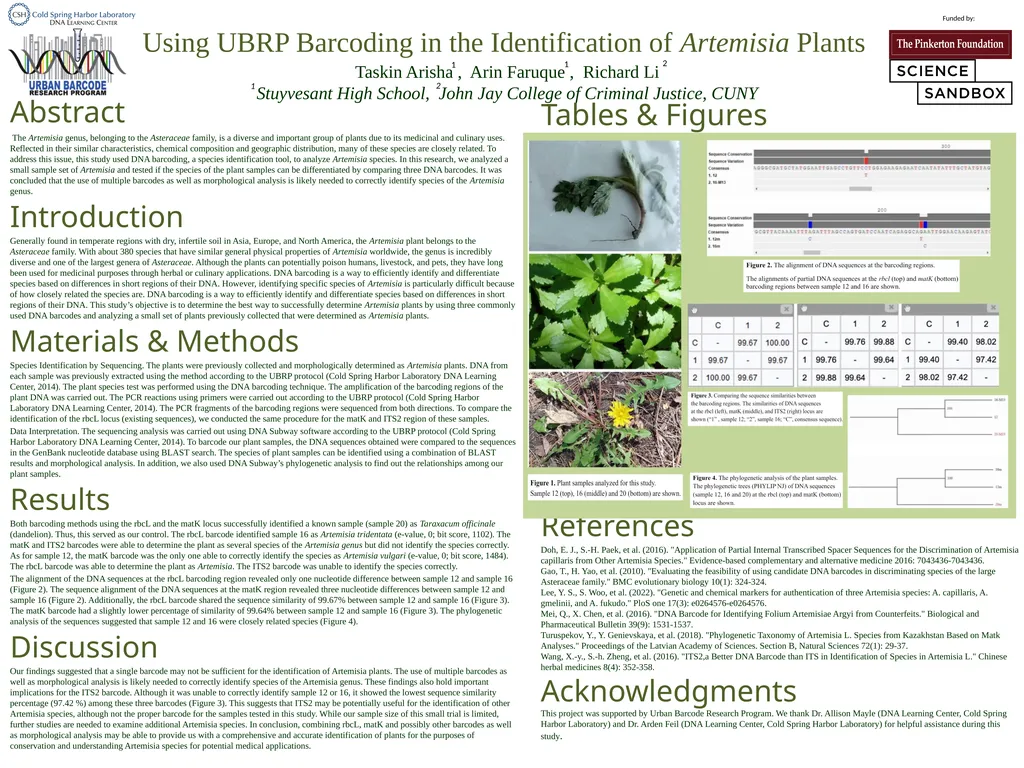
Both barcoding methods using the rbcL and the matK locus successfully identified a known sample (sample 20) as Taraxacum officinale (dandelion). Thus, this served as our control. The rbcL barcode identified sample 16 as Artemisia tridentata (e-value, 0; bit score, 1102). The matK and ITS2 barcodes were able to determine the plant as several species of the Artemisia genus but did not identify the species correctly. As for sample 12, the matK barcode was the only one able to correctly identify the species as Artemisia vulgari (e-value, 0; bit score, 1484). The rbcL barcode was able to determine the plant as Artemisia. The ITS2 barcode was unable to identify the species correctly.
The alignment of the DNA sequences at the rbcL barcoding region revealed only one nucleotide difference between sample 12 and sample 16 (Figure 2). The sequence alignment of the DNA sequences at the matK region revealed three nucleotide differences between sample 12 and sample 16 (Figure 2). Additionally, the rbcL barcode shared the sequence similarity of 99.67% between sample 12 and sample 16 (Figure 3). The matK barcode had a slightly lower percentage of similarity of 99.64% between sample 12 and sample 16 (Figure 3). The phylogenetic analysis of the sequences suggested that sample 12 and 16 were closely related species (Figure 4).
Discussion
Our findings suggested that a single barcode may not be sufficient for the identification of Artemisia plants. The use of multiple barcodes as well as morphological analysis is likely needed to correctly identify species of the Artemisia genus. These findings also hold important implications for the ITS2 barcode. Although it was unable to correctly identify sample 12 or 16, it showed the lowest sequence similarity percentage (97.42 %) among these three barcodes (Figure 3). This suggests that ITS2 may be potentially useful for the identification of other Artemisia species, although not the proper barcode for the samples tested in this study. While our sample size of this small trial is limited, further studies are needed to examine additional Artemisia species. In conclusion, combining rbcL, matK and possibly other barcodes as well as morphological analysis may be able to provide us with a comprehensive and accurate identification of plants for the purposes of conservation and understanding Artemisia species for potential medical applications. References
Doh, E. J., S.-H. Paek, et al. (2016). "Application of Partial Internal Transcribed Spacer Sequences for the Discrimination of Artemisia capillaris from Other Artemisia Species." Evidence-based complementary and alternative medicine 2016: 7043436-7043436.
Gao, T., H. Yao, et al. (2010). "Evaluating the feasibility of using candidate DNA barcodes in discriminating species of the large Asteraceae family." BMC evolutionary biology 10(1): 324-324.
Lee, Y. S., S. Woo, et al. (2022). "Genetic and chemical markers for authentication of three Artemisia species: A. capillaris, A. gmelinii, and A. fukudo." PloS one 17(3): e0264576-e0264576.
Mei, Q., X. Chen, et al. (2016). "DNA Barcode for Identifying Folium Artemisiae Argyi from Counterfeits." Biological and Pharmaceutical Bulletin 39(9): 1531-1537.
Turuspekov, Y., Y. Genievskaya, et al. (2018). "Phylogenetic Taxonomy of Artemisia L. Species from Kazakhstan Based on Matk Analyses." Proceedings of the Latvian Academy of Sciences. Section B, Natural Sciences 72(1): 29-37.
Wang, X.-y., S.-h. Zheng, et al. (2016). "ITS2,a Better DNA Barcode than ITS in Identification of Species in Artemisia L." Chinese herbal medicines 8(4): 352-358.
Acknowledgments
This project was supported by Urban Barcode Research Program. We thank Dr. Allison Mayle (DNA Learning Center, Cold Spring Harbor Laboratory) and Dr. Arden Feil (DNA Learning Center, Cold Spring Harbor Laboratory) for helpful assistance during this study. Funded by: 1 1 2 1 2<br>
Stuyvesant High School, John Jay College of Criminal Justice, CUNY Tables & Figures Abstract
The Artemisia genus, belonging to the Asteraceae family, is a diverse and important group of plants due to its medicinal and culinary uses. Reflected in their similar characteristics, chemical composition and geographic distribution, many of these species are closely related. To address this issue, this study used DNA barcoding, a species identification tool, to analyze Artemisia species. In this research, we analyzed a small sample set of Artemisia and tested if the species of the plant samples can be differentiated by comparing three DNA barcodes. It was concluded that the use of multiple barcodes as well as morphological analysis is likely needed to correctly identify species of the Artemisia genus.
Introduction
Generally found in temperate regions with dry, infertile soil in Asia, Europe, and North America, the Artemisia plant belongs to the Asteraceae family. With about 380 species that have similar general physical properties of Artemisia worldwide, the genus is incredibly diverse and one of the largest genera of Asteraceae. Although the plants can potentially poison humans, livestock, and pets, they have long been used for medicinal purposes through herbal or culinary applications. DNA barcoding is a way to efficiently identify and differentiate species based on differences in short regions of their DNA. However, identifying specific species of Artemisia is particularly difficult because of how closely related the species are. DNA barcoding is a way to efficiently identify and differentiate species based on differences in short regions of their DNA. This study’s objective is to determine the best way to successfully determine Artemisia plants by using three commonly used DNA barcodes and analyzing a small set of plants previously collected that were determined as Artemisia plants.
Materials & Methods
Species Identification by Sequencing. The plants were previously collected and morphologically determined as Artemisia plants. DNA from each sample was previously extracted using the method according to the UBRP protocol (Cold Spring Harbor Laboratory DNA Learning Center, 2014). The plant species test was performed using the DNA barcoding technique. The amplification of the barcoding regions of the plant DNA was carried out. The PCR reactions using primers were carried out according to the UBRP protocol (Cold Spring Harbor Laboratory DNA Learning Center, 2014). The PCR fragments of the barcoding regions were sequenced from both directions. To compare the identification of the rbcL locus (existing sequences), we conducted the same procedure for the matK and ITS2 region of these samples.
Data Interpretation. The sequencing analysis was carried out using DNA Subway software according to the UBRP protocol (Cold Spring Harbor Laboratory DNA Learning Center, 2014). To barcode our plant samples, the DNA sequences obtained were compared to the sequences in the GenBank nucleotide database using BLAST search. The species of plant samples can be identified using a combination of BLAST results and morphological analysis. In addition, we also used DNA Subway’s phylogenetic analysis to find out the relationships among our plant samples.
Results
Both barcoding methods using the rbcL and the matK locus successfully identified a known sample (sample 20) as Taraxacum officinale (dandelion). Thus, this served as our control. The rbcL barcode identified sample 16 as Artemisia tridentata (e-value, 0; bit score, 1102). The matK and ITS2 barcodes were able to determine the plant as several species of the Artemisia genus but did not identify the species correctly. As for sample 12, the matK barcode was the only one able to correctly identify the species as Artemisia vulgari (e-value, 0; bit score, 1484). The rbcL barcode was able to determine the plant as Artemisia. The ITS2 barcode was unable to identify the species correctly.
The alignment of the DNA sequences at the rbcL barcoding region revealed only one nucleotide difference between sample 12 and sample 16 (Figure 2). The sequence alignment of the DNA sequences at the matK region revealed three nucleotide differences between sample 12 and sample 16 (Figure 2). Additionally, the rbcL barcode shared the sequence similarity of 99.67% between sample 12 and sample 16 (Figure 3). The matK barcode had a slightly lower percentage of similarity of 99.64% between sample 12 and sample 16 (Figure 3). The phylogenetic analysis of the sequences suggested that sample 12 and 16 were closely related species (Figure 4).
Discussion
Our findings suggested that a single barcode may not be sufficient for the identification of Artemisia plants. The use of multiple barcodes as well as morphological analysis is likely needed to correctly identify species of the Artemisia genus. These findings also hold important implications for the ITS2 barcode. Although it was unable to correctly identify sample 12 or 16, it showed the lowest sequence similarity percentage (97.42 %) among these three barcodes (Figure 3). This suggests that ITS2 may be potentially useful for the identification of other Artemisia species, although not the proper barcode for the samples tested in this study. While our sample size of this small trial is limited, further studies are needed to examine additional Artemisia species. In conclusion, combining rbcL, matK and possibly other barcodes as well as morphological analysis may be able to provide us with a comprehensive and accurate identification of plants for the purposes of conservation and understanding Artemisia species for potential medical applications. References
Doh, E. J., S.-H. Paek, et al. (2016). "Application of Partial Internal Transcribed Spacer Sequences for the Discrimination of Artemisia capillaris from Other Artemisia Species." Evidence-based complementary and alternative medicine 2016: 7043436-7043436.
Gao, T., H. Yao, et al. (2010). "Evaluating the feasibility of using candidate DNA barcodes in discriminating species of the large Asteraceae family." BMC evolutionary biology 10(1): 324-324.
Lee, Y. S., S. Woo, et al. (2022). "Genetic and chemical markers for authentication of three Artemisia species: A. capillaris, A. gmelinii, and A. fukudo." PloS one 17(3): e0264576-e0264576.
Mei, Q., X. Chen, et al. (2016). "DNA Barcode for Identifying Folium Artemisiae Argyi from Counterfeits." Biological and Pharmaceutical Bulletin 39(9): 1531-1537.
Turuspekov, Y., Y. Genievskaya, et al. (2018). "Phylogenetic Taxonomy of Artemisia L. Species from Kazakhstan Based on Matk Analyses." Proceedings of the Latvian Academy of Sciences. Section B, Natural Sciences 72(1): 29-37.
Wang, X.-y., S.-h. Zheng, et al. (2016). "ITS2,a Better DNA Barcode than ITS in Identification of Species in Artemisia L." Chinese herbal medicines 8(4): 352-358.
Acknowledgments
This project was supported by Urban Barcode Research Program. We thank Dr. Allison Mayle (DNA Learning Center, Cold Spring Harbor Laboratory) and Dr. Arden Feil (DNA Learning Center, Cold Spring Harbor Laboratory) for helpful assistance during this study. Funded by: 1 1 2 1 2<br>