
Value of CSDM, adoption, implementation The Common
LV
Published · 39 slides · 0 views
1 / 1
Description
Value of CSDM, adoption, implementation The Common Services Data Model knowledge share Speaker Name Date Ref: 0002163 Overview Common Service Data Model Data Model A recommended standard CMDB Data Model across our products and platform that
Related Topics
Share
Embed code
Download this presentation From Below
"Value of CSDM, adoption, implementation The Common" is the property of its rightful owner. Permission is granted to download and print the materials on this website for personal, non-commercial use only, and to display it on your personal computer provided you do not modify the materials and that you retain all copyright notices contained in the materials. By downloading content from our website, you accept the terms of this agreement.
Presentation Transcript
01
Value of CSDM, adoption, implementation The Common Services Data Model knowledge share Speaker Name Date Ref: 0002163<br>
02
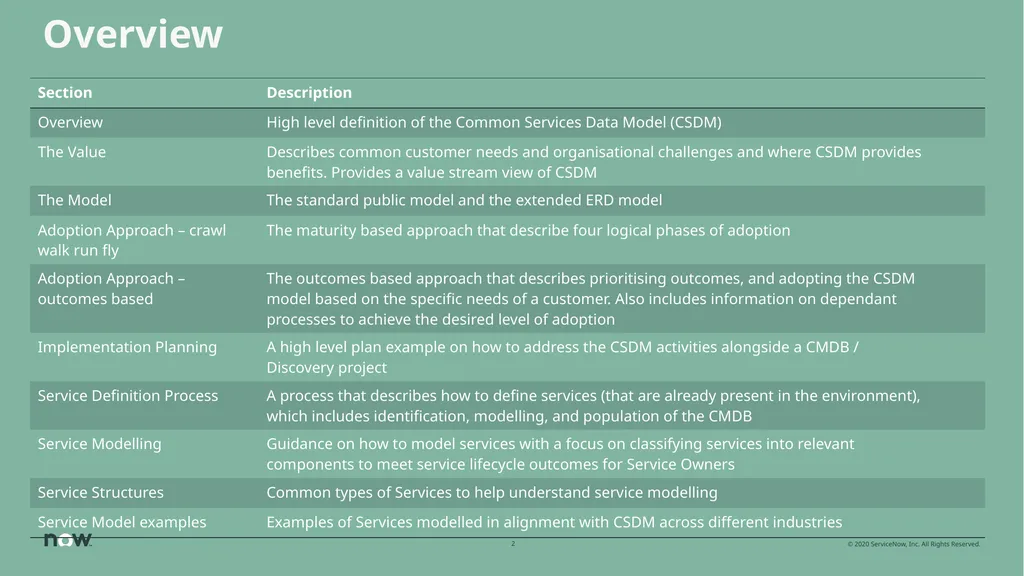
Overview<br>
03
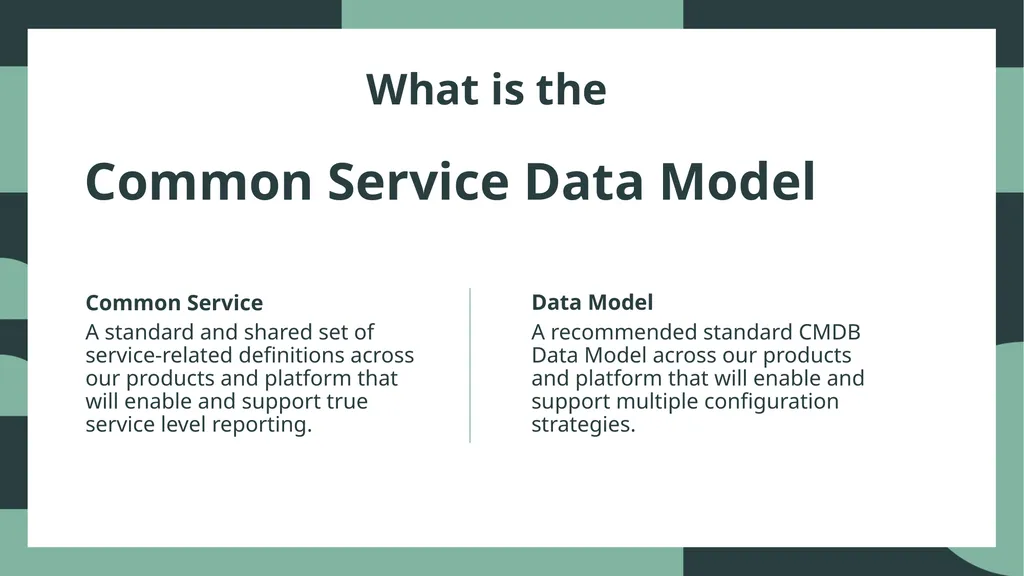
Common Service Data Model Data Model
A recommended standard CMDB Data Model across our products and platform that will enable and support multiple configuration strategies. Common Service
A standard and shared set of service-related definitions across our products and platform that will enable and support true service level reporting. What is the<br>
A recommended standard CMDB Data Model across our products and platform that will enable and support multiple configuration strategies. Common Service
A standard and shared set of service-related definitions across our products and platform that will enable and support true service level reporting. What is the<br>
04
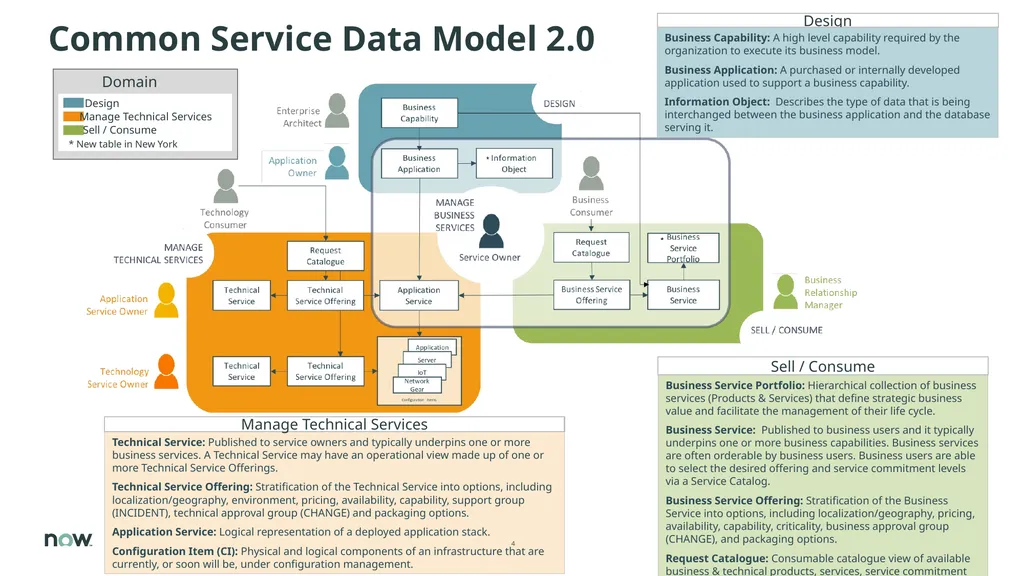
Common Service Data Model 2.0 * New table in New York<br>
05
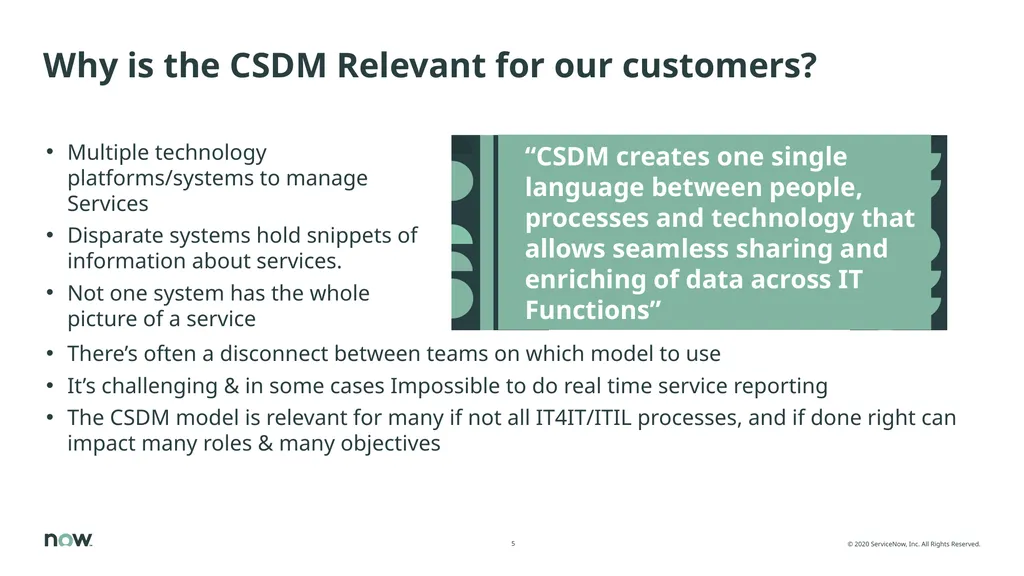
Why is the CSDM Relevant for our customers? There’s often a disconnect between teams on which model to use
It’s challenging & in some cases Impossible to do real time service reporting
The CSDM model is relevant for many if not all IT4IT/ITIL processes, and if done right can impact many roles & many objectives “CSDM creates one single language between people, processes and technology that allows seamless sharing and enriching of data across IT Functions” Multiple technology platforms/systems to manage Services
Disparate systems hold snippets of information about services.
Not one system has the whole picture of a service<br>
It’s challenging & in some cases Impossible to do real time service reporting
The CSDM model is relevant for many if not all IT4IT/ITIL processes, and if done right can impact many roles & many objectives “CSDM creates one single language between people, processes and technology that allows seamless sharing and enriching of data across IT Functions” Multiple technology platforms/systems to manage Services
Disparate systems hold snippets of information about services.
Not one system has the whole picture of a service<br>
06
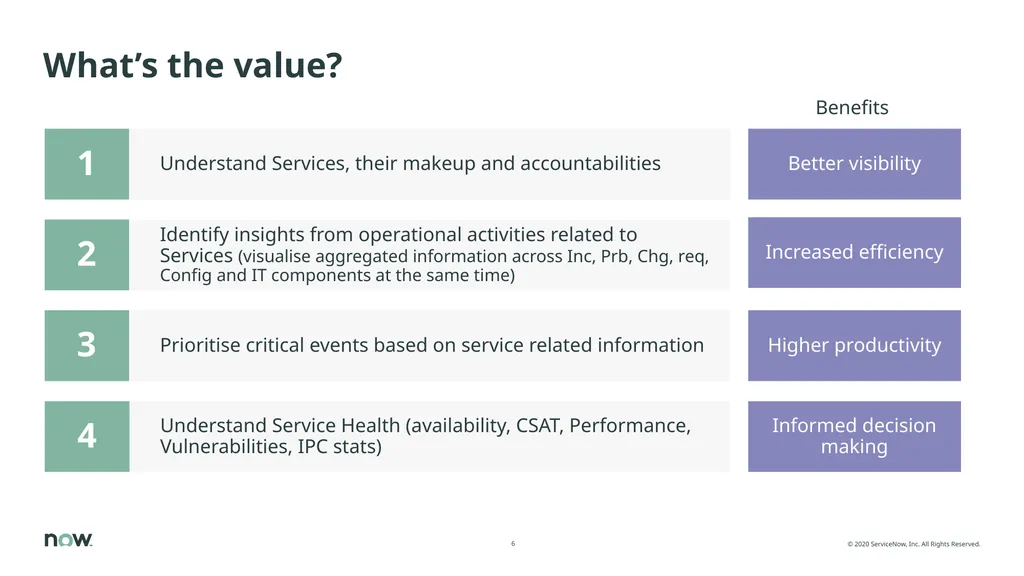
What’s the value? 1 Understand Services, their makeup and accountabilities 2 Identify insights from operational activities related to Services (visualise aggregated information across Inc, Prb, Chg, req, Config and IT components at the same time) 3 Prioritise critical events based on service related information 4 Understand Service Health (availability, CSAT, Performance, Vulnerabilities, IPC stats) Better visibility Increased efficiency Informed decision making Higher productivity Benefits<br>
07
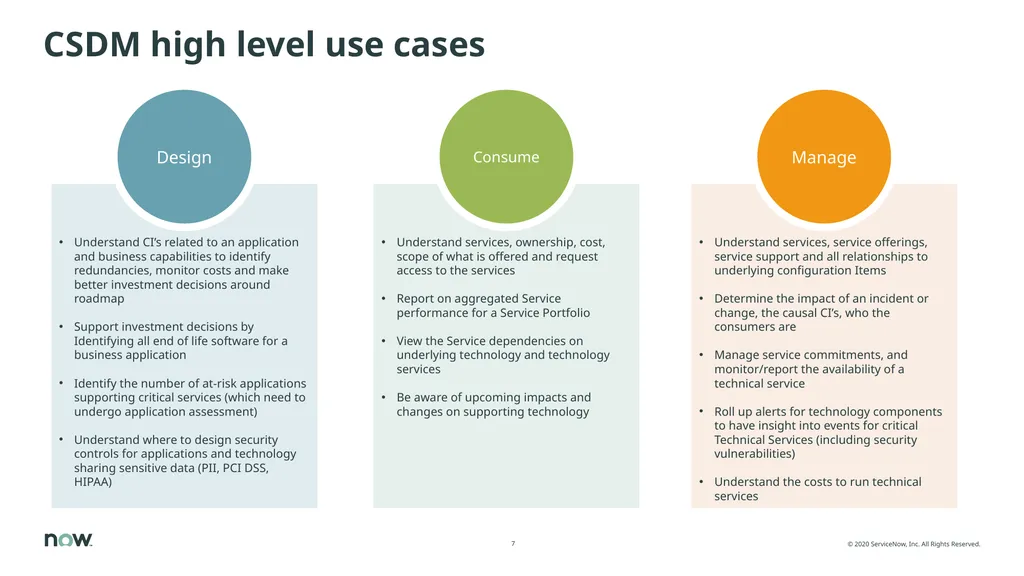
CSDM high level use cases Understand CI’s related to an application and business capabilities to identify redundancies, monitor costs and make better investment decisions around roadmap
Support investment decisions by Identifying all end of life software for a business application
Identify the number of at-risk applications supporting critical services (which need to undergo application assessment)
Understand where to design security controls for applications and technology sharing sensitive data (PII, PCI DSS, HIPAA) Understand services, ownership, cost, scope of what is offered and request access to the services
Report on aggregated Service performance for a Service Portfolio
View the Service dependencies on underlying technology and technology services
Be aware of upcoming impacts and changes on supporting technology Understand services, service offerings, service support and all relationships to underlying configuration Items
Determine the impact of an incident or change, the causal CI’s, who the consumers are
Manage service commitments, and monitor/report the availability of a technical service
Roll up alerts for technology components to have insight into events for critical Technical Services (including security vulnerabilities)
Understand the costs to run technical services<br>
Support investment decisions by Identifying all end of life software for a business application
Identify the number of at-risk applications supporting critical services (which need to undergo application assessment)
Understand where to design security controls for applications and technology sharing sensitive data (PII, PCI DSS, HIPAA) Understand services, ownership, cost, scope of what is offered and request access to the services
Report on aggregated Service performance for a Service Portfolio
View the Service dependencies on underlying technology and technology services
Be aware of upcoming impacts and changes on supporting technology Understand services, service offerings, service support and all relationships to underlying configuration Items
Determine the impact of an incident or change, the causal CI’s, who the consumers are
Manage service commitments, and monitor/report the availability of a technical service
Roll up alerts for technology components to have insight into events for critical Technical Services (including security vulnerabilities)
Understand the costs to run technical services<br>
08
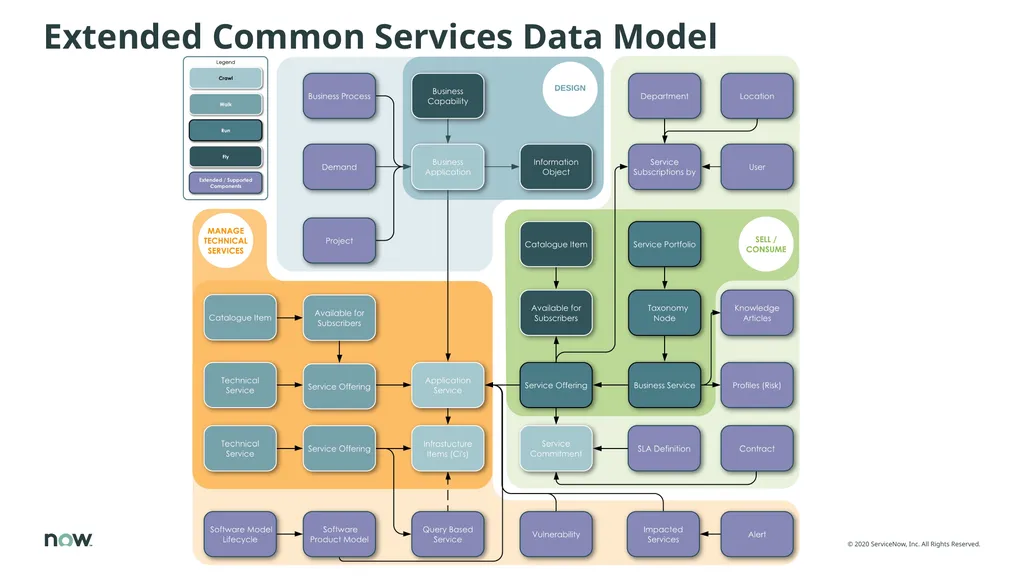
Extended Common Services Data Model<br>
09
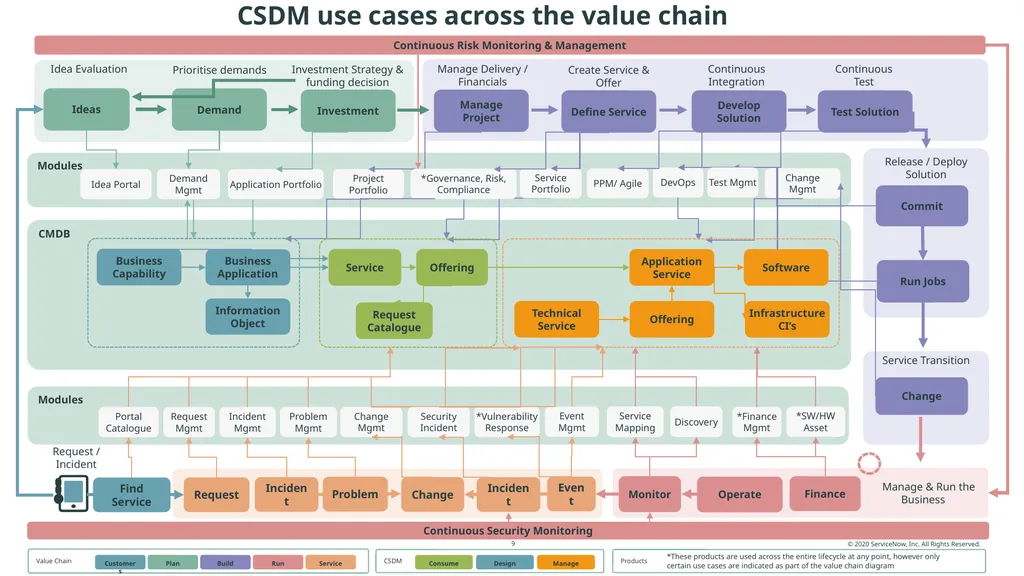
Modules CMDB Modules CSDM use cases across the value chain<br>
10
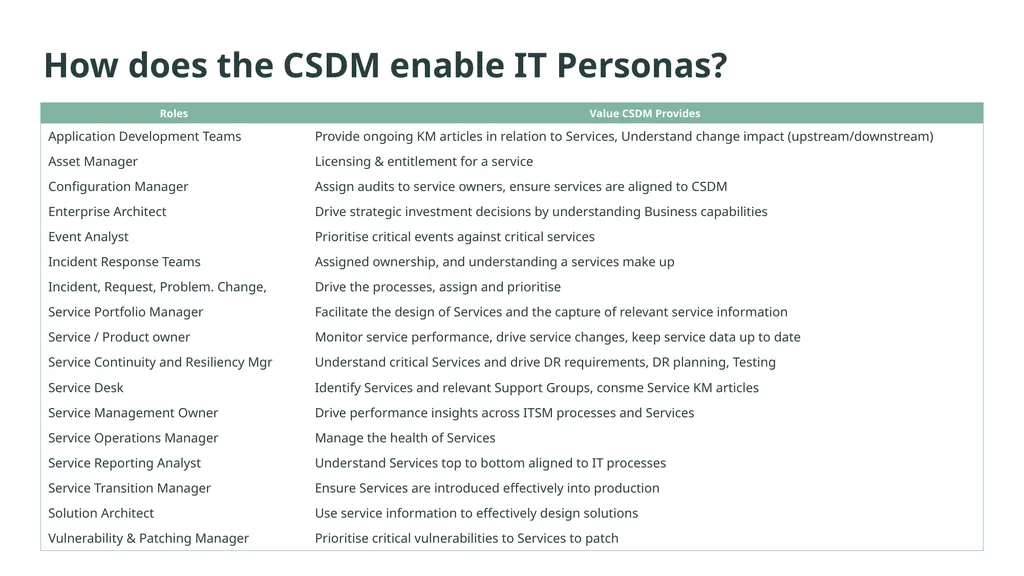
How does the CSDM enable IT Personas?<br>
11
Adoption Approaches Help customers adopt the CSDM<br>
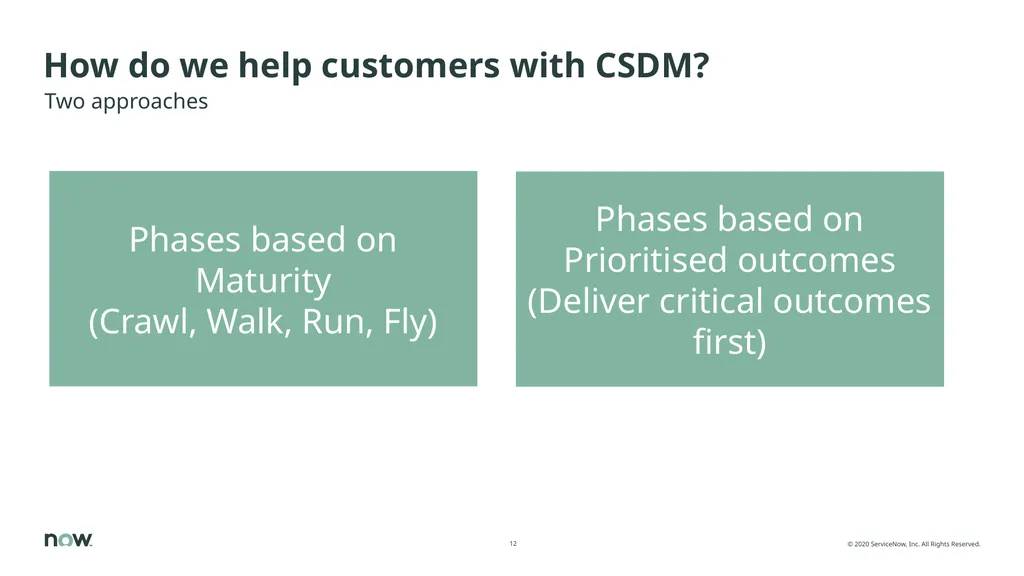
12
How do we help customers with CSDM? Two approaches<br>
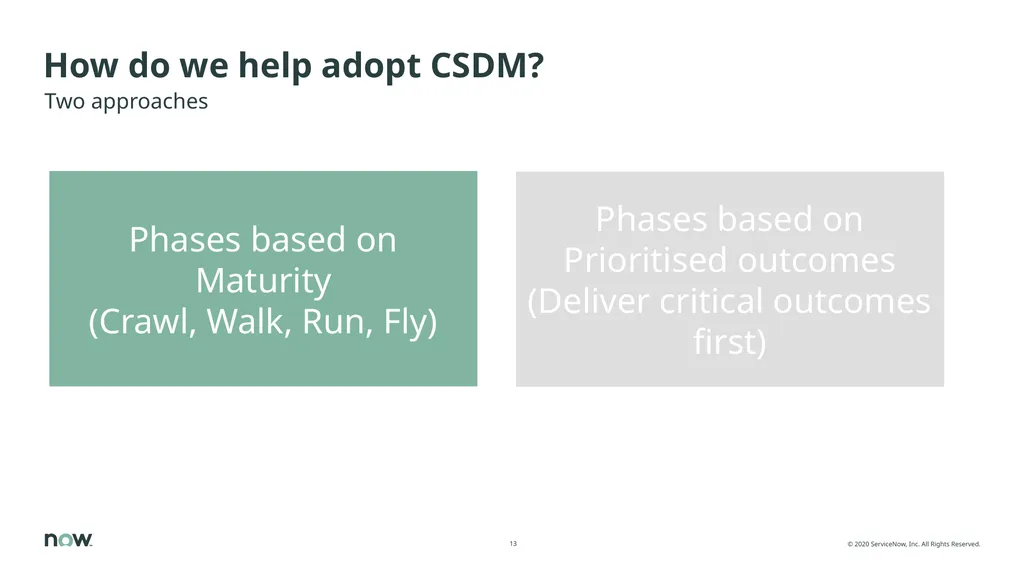
13
How do we help adopt CSDM? Two approaches<br>
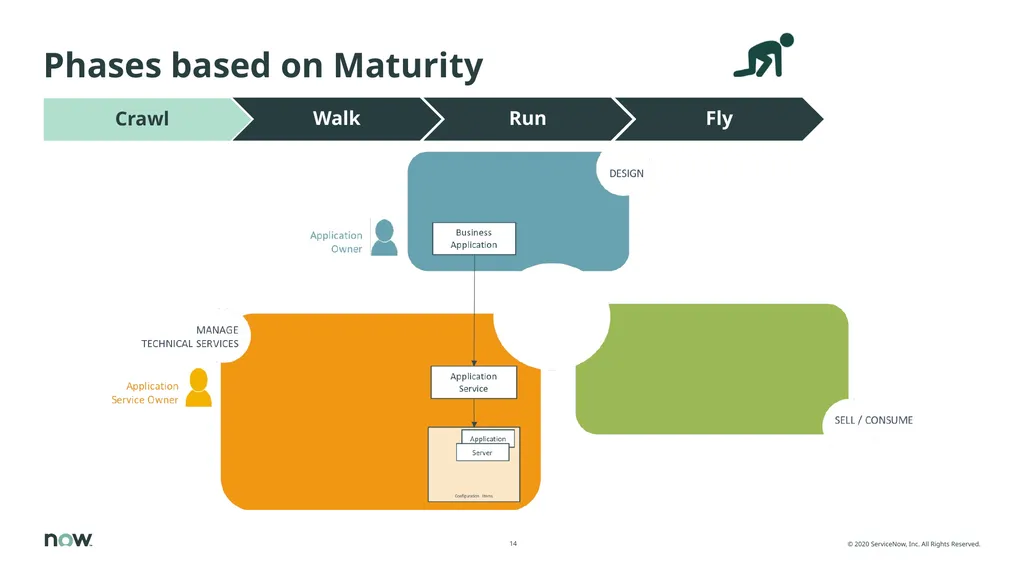
14
Phases based on Maturity<br>
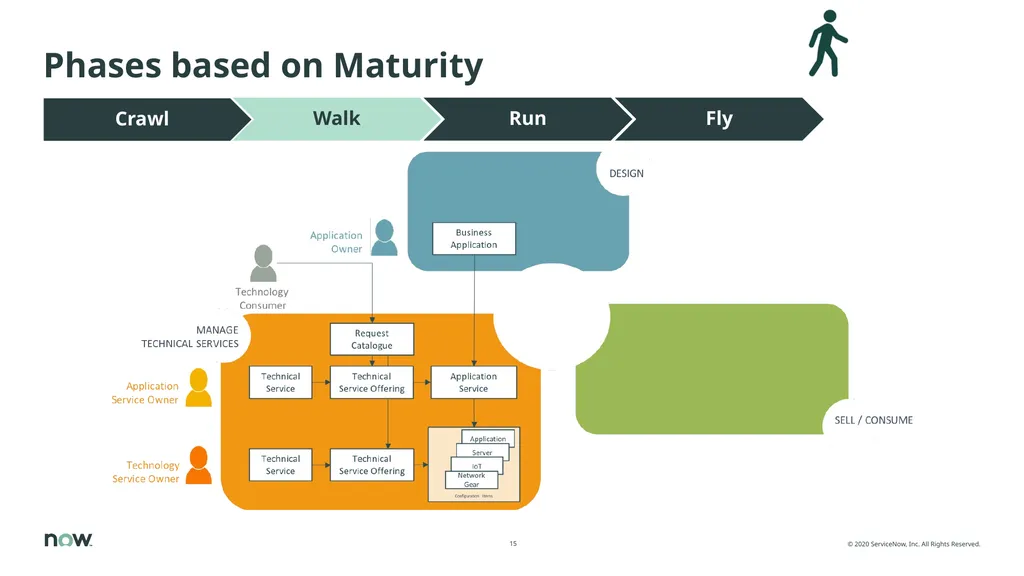
15
Phases based on Maturity Crawl Walk Run Fly<br>
16
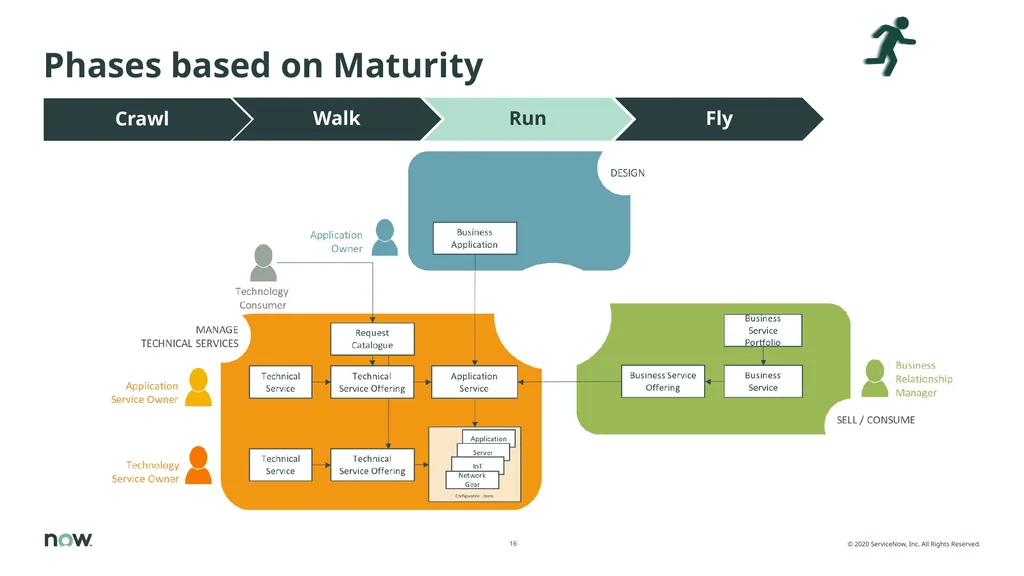
Crawl Walk Run Fly Phases based on Maturity<br>
17
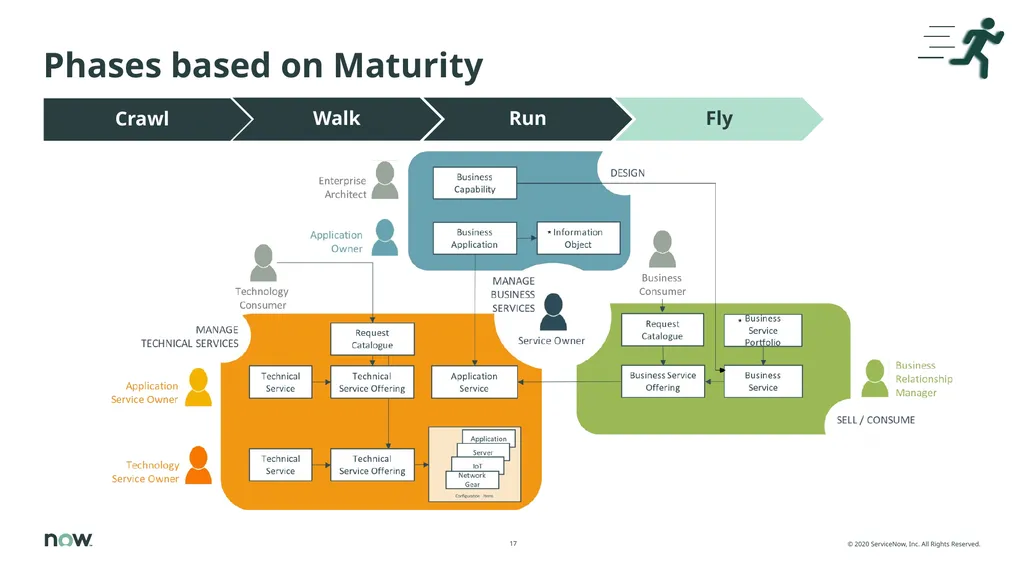
Crawl Walk Run Fly Phases based on Maturity<br>
18
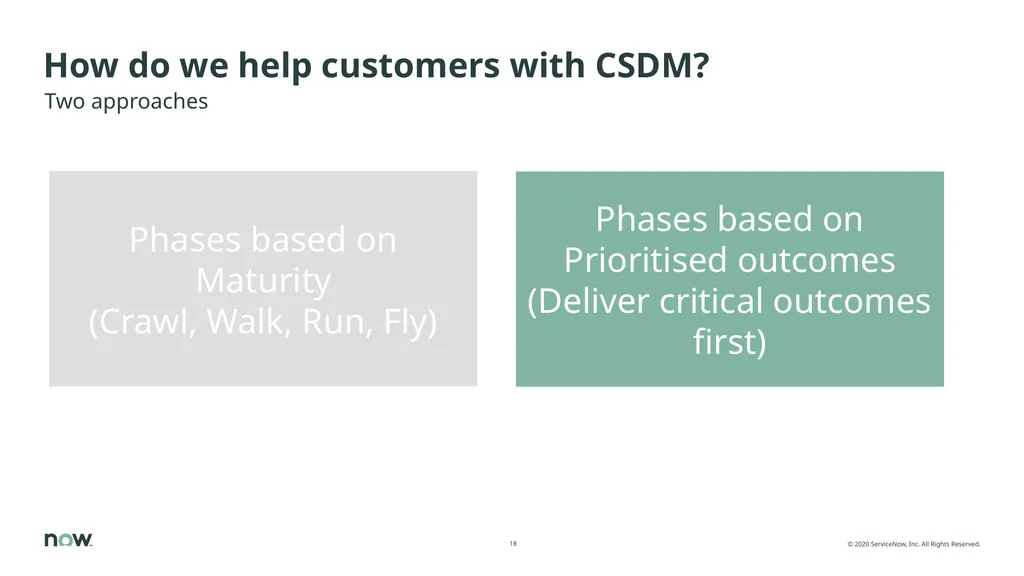
How do we help customers with CSDM? Two approaches<br>
19
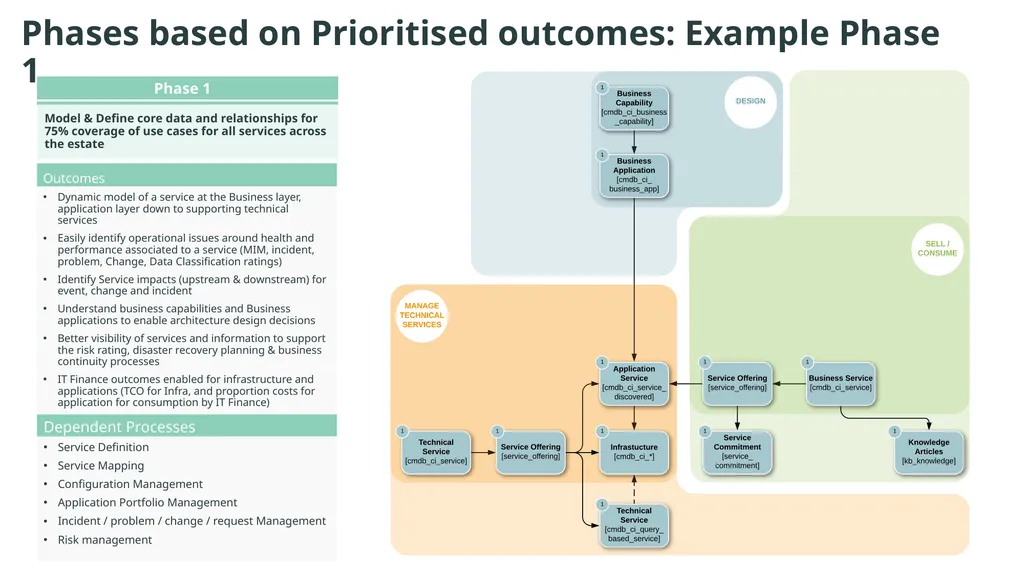
Phases based on Prioritised outcomes: Example Phase 1 Phase 1 Phase 1<br>
20
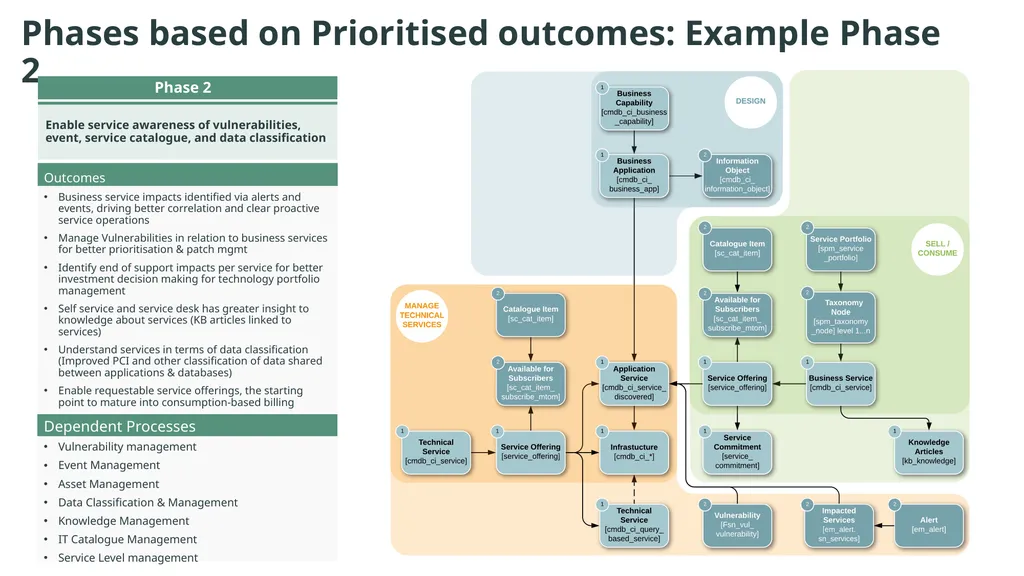
Phases based on Prioritised outcomes: Example Phase 2 Phase 2 Phase 2<br>
21
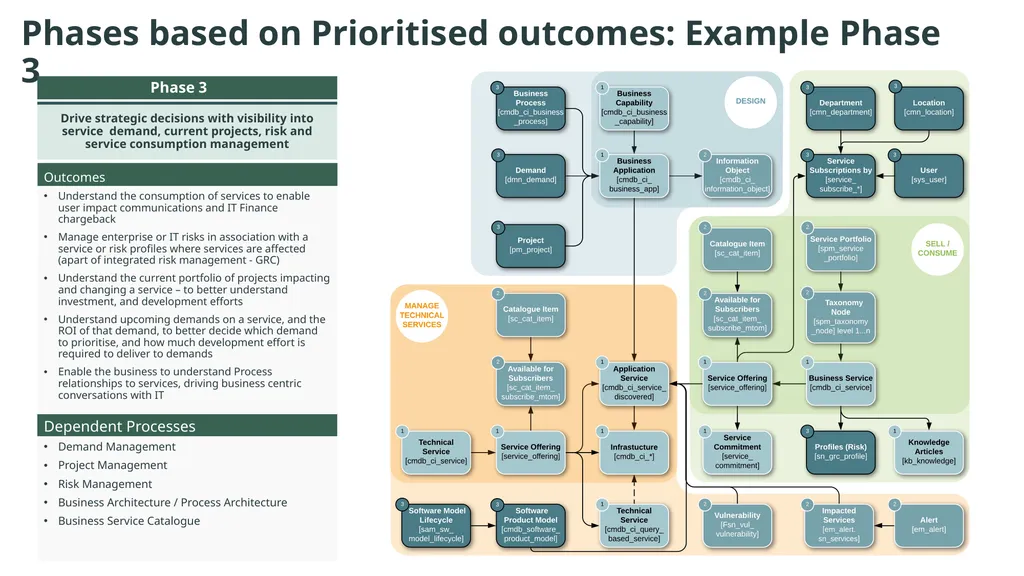
Phases based on Prioritised outcomes: Example Phase 3 Phase 3 Phase 3<br>
22
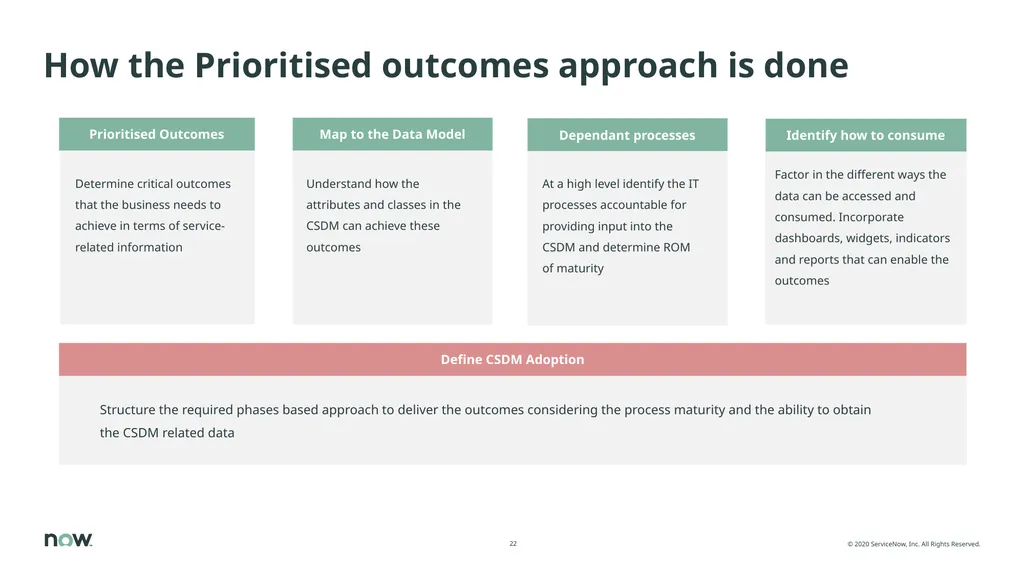
How the Prioritised outcomes approach is done<br>
23
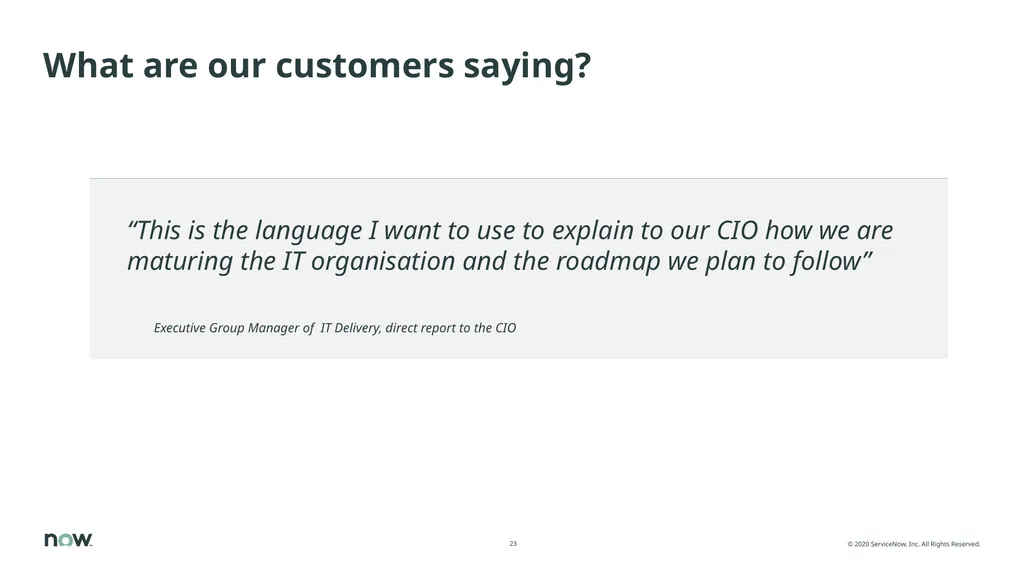
What are our customers saying? “This is the language I want to use to explain to our CIO how we are maturing the IT organisation and the roadmap we plan to follow”<br>
24
Implementation Helping customers adopt the CSDM<br>
25
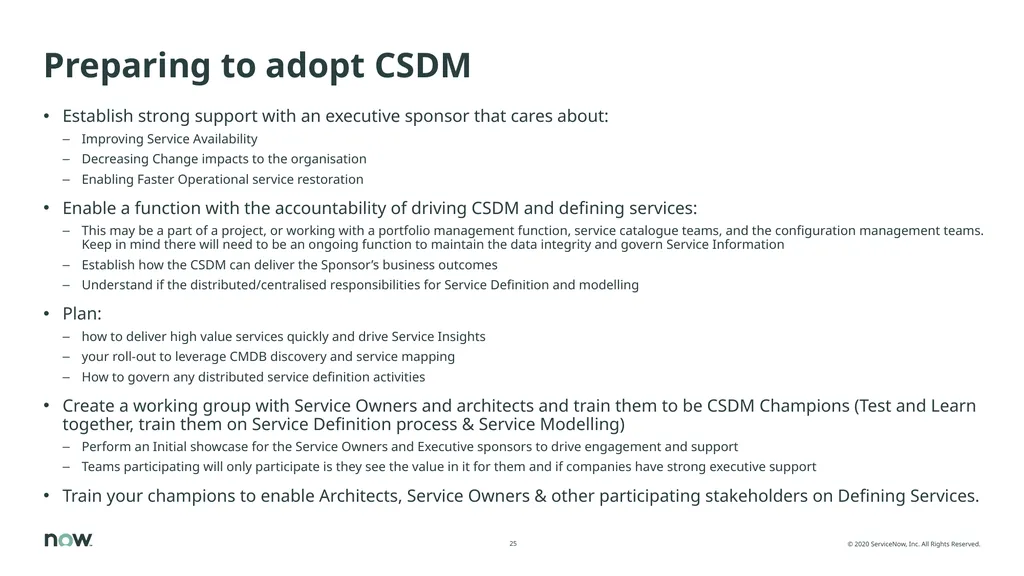
Preparing to adopt CSDM Establish strong support with an executive sponsor that cares about:
Improving Service Availability
Decreasing Change impacts to the organisation
Enabling Faster Operational service restoration
Enable a function with the accountability of driving CSDM and defining services:
This may be a part of a project, or working with a portfolio management function, service catalogue teams, and the configuration management teams. Keep in mind there will need to be an ongoing function to maintain the data integrity and govern Service Information
Establish how the CSDM can deliver the Sponsor’s business outcomes
Understand if the distributed/centralised responsibilities for Service Definition and modelling
Plan:
how to deliver high value services quickly and drive Service Insights
your roll-out to leverage CMDB discovery and service mapping
How to govern any distributed service definition activities
Create a working group with Service Owners and architects and train them to be CSDM Champions (Test and Learn together, train them on Service Definition process & Service Modelling)
Perform an Initial showcase for the Service Owners and Executive sponsors to drive engagement and support
Teams participating will only participate is they see the value in it for them and if companies have strong executive support
Train your champions to enable Architects, Service Owners & other participating stakeholders on Defining Services.<br>
Improving Service Availability
Decreasing Change impacts to the organisation
Enabling Faster Operational service restoration
Enable a function with the accountability of driving CSDM and defining services:
This may be a part of a project, or working with a portfolio management function, service catalogue teams, and the configuration management teams. Keep in mind there will need to be an ongoing function to maintain the data integrity and govern Service Information
Establish how the CSDM can deliver the Sponsor’s business outcomes
Understand if the distributed/centralised responsibilities for Service Definition and modelling
Plan:
how to deliver high value services quickly and drive Service Insights
your roll-out to leverage CMDB discovery and service mapping
How to govern any distributed service definition activities
Create a working group with Service Owners and architects and train them to be CSDM Champions (Test and Learn together, train them on Service Definition process & Service Modelling)
Perform an Initial showcase for the Service Owners and Executive sponsors to drive engagement and support
Teams participating will only participate is they see the value in it for them and if companies have strong executive support
Train your champions to enable Architects, Service Owners & other participating stakeholders on Defining Services.<br>
26
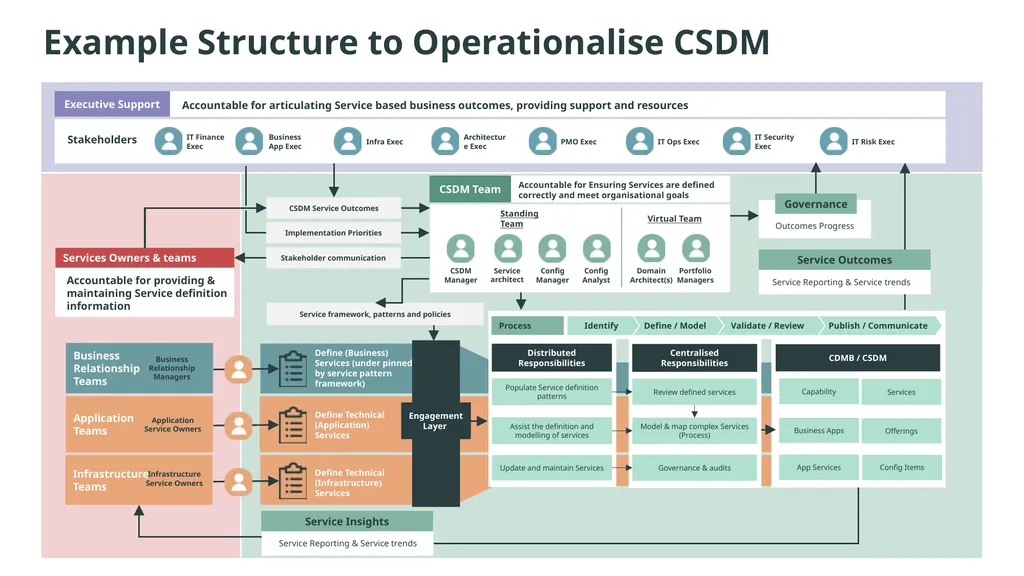
Example Structure to Operationalise CSDM<br>
27
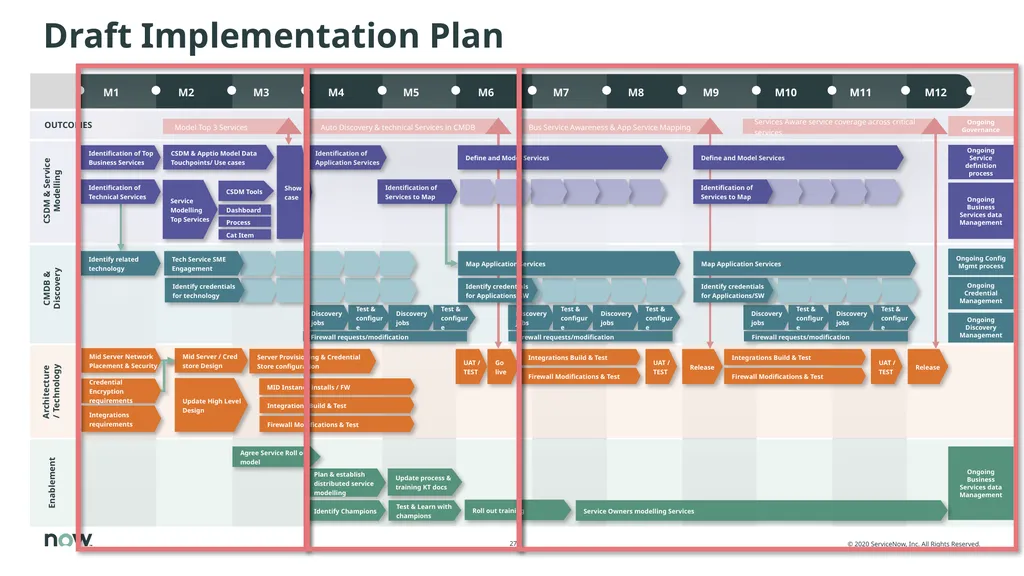
Draft Implementation Plan M1 M11 M10 M2 M3 M4 M5 M6 M7 M8 M9 M12 Architecture
/ Technology Mid Server Network Placement & Security Model Top 3 Services Mid Server / Cred store Design Credential Encryption requirements Server Provisioning & Credential Store configuration CMDB & Discovery CSDM & Service Modelling MID Instance installs / FW Integrations Build & Test Integrations requirements UAT / TEST Enablement Identification of Technical Services Identify related technology Identification of Top Business Services Service Modelling Top Services Discovery jobs Test & configure Identify credentials for technology Tech Service SME Engagement Plan & establish distributed service modelling Agree Service Roll out model Update process & training KT docs Identify Champions Test & Learn with champions Discovery jobs Test & configure CSDM Tools Dashboard Process Cat Item CSDM & Apptio Model Data Touchpoints/ Use cases Show case Identification of Services to Map Identification of Application Services Discovery jobs Test & configure Discovery jobs Test & configure UAT / TEST Release Discovery jobs Test & configure Discovery jobs Test & configure Firewall requests/modification Firewall requests/modification Firewall requests/modification Integrations Build & Test Firewall Modifications & Test Firewall Modifications & Test UAT / TEST Release Integrations Build & Test Firewall Modifications & Test Update High Level Design Auto Discovery & technical Services in CMDB Map Application Services Identify credentials for Applications/SW Define and Model Services Bus Service Awareness & App Service Mapping Map Application Services Identify credentials for Applications/SW Define and Model Services Identification of Services to Map Services Aware service coverage across critical services OUTCOMES Roll out training Go live Service Owners modelling Services<br>
/ Technology Mid Server Network Placement & Security Model Top 3 Services Mid Server / Cred store Design Credential Encryption requirements Server Provisioning & Credential Store configuration CMDB & Discovery CSDM & Service Modelling MID Instance installs / FW Integrations Build & Test Integrations requirements UAT / TEST Enablement Identification of Technical Services Identify related technology Identification of Top Business Services Service Modelling Top Services Discovery jobs Test & configure Identify credentials for technology Tech Service SME Engagement Plan & establish distributed service modelling Agree Service Roll out model Update process & training KT docs Identify Champions Test & Learn with champions Discovery jobs Test & configure CSDM Tools Dashboard Process Cat Item CSDM & Apptio Model Data Touchpoints/ Use cases Show case Identification of Services to Map Identification of Application Services Discovery jobs Test & configure Discovery jobs Test & configure UAT / TEST Release Discovery jobs Test & configure Discovery jobs Test & configure Firewall requests/modification Firewall requests/modification Firewall requests/modification Integrations Build & Test Firewall Modifications & Test Firewall Modifications & Test UAT / TEST Release Integrations Build & Test Firewall Modifications & Test Update High Level Design Auto Discovery & technical Services in CMDB Map Application Services Identify credentials for Applications/SW Define and Model Services Bus Service Awareness & App Service Mapping Map Application Services Identify credentials for Applications/SW Define and Model Services Identification of Services to Map Services Aware service coverage across critical services OUTCOMES Roll out training Go live Service Owners modelling Services<br>
28
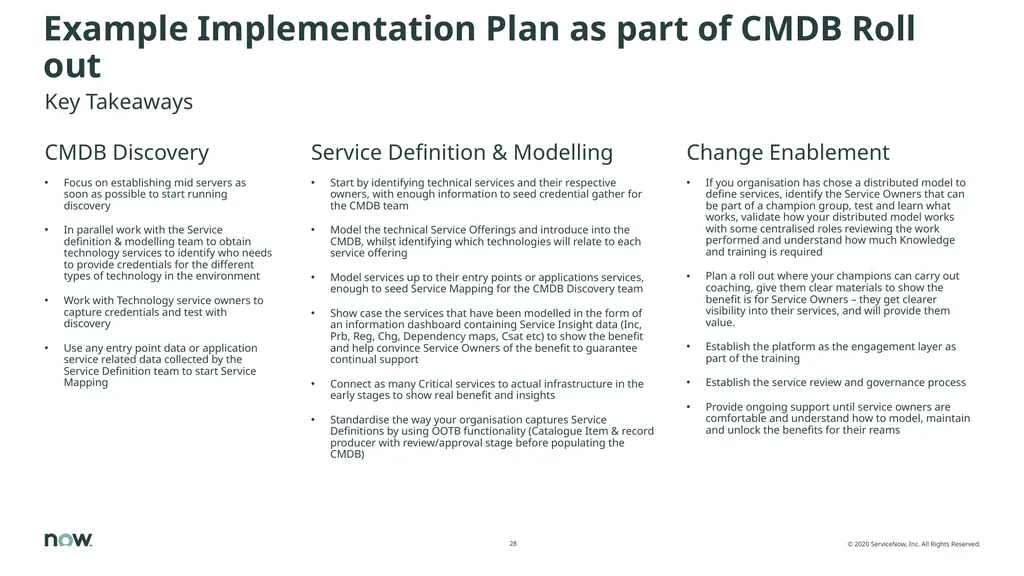
Example Implementation Plan as part of CMDB Roll out CMDB Discovery
Focus on establishing mid servers as soon as possible to start running discovery
In parallel work with the Service definition & modelling team to obtain technology services to identify who needs to provide credentials for the different types of technology in the environment
Work with Technology service owners to capture credentials and test with discovery
Use any entry point data or application service related data collected by the Service Definition team to start Service Mapping Service Definition & Modelling
Start by identifying technical services and their respective owners, with enough information to seed credential gather for the CMDB team
Model the technical Service Offerings and introduce into the CMDB, whilst identifying which technologies will relate to each service offering
Model services up to their entry points or applications services, enough to seed Service Mapping for the CMDB Discovery team
Show case the services that have been modelled in the form of an information dashboard containing Service Insight data (Inc, Prb, Reg, Chg, Dependency maps, Csat etc) to show the benefit and help convince Service Owners of the benefit to guarantee continual support
Connect as many Critical services to actual infrastructure in the early stages to show real benefit and insights
Standardise the way your organisation captures Service Definitions by using OOTB functionality (Catalogue Item & record producer with review/approval stage before populating the CMDB) Key Takeaways Change Enablement
If you organisation has chose a distributed model to define services, identify the Service Owners that can be part of a champion group, test and learn what works, validate how your distributed model works with some centralised roles reviewing the work performed and understand how much Knowledge and training is required
Plan a roll out where your champions can carry out coaching, give them clear materials to show the benefit is for Service Owners – they get clearer visibility into their services, and will provide them value.
Establish the platform as the engagement layer as part of the training
Establish the service review and governance process
Provide ongoing support until service owners are comfortable and understand how to model, maintain and unlock the benefits for their reams<br>
Focus on establishing mid servers as soon as possible to start running discovery
In parallel work with the Service definition & modelling team to obtain technology services to identify who needs to provide credentials for the different types of technology in the environment
Work with Technology service owners to capture credentials and test with discovery
Use any entry point data or application service related data collected by the Service Definition team to start Service Mapping Service Definition & Modelling
Start by identifying technical services and their respective owners, with enough information to seed credential gather for the CMDB team
Model the technical Service Offerings and introduce into the CMDB, whilst identifying which technologies will relate to each service offering
Model services up to their entry points or applications services, enough to seed Service Mapping for the CMDB Discovery team
Show case the services that have been modelled in the form of an information dashboard containing Service Insight data (Inc, Prb, Reg, Chg, Dependency maps, Csat etc) to show the benefit and help convince Service Owners of the benefit to guarantee continual support
Connect as many Critical services to actual infrastructure in the early stages to show real benefit and insights
Standardise the way your organisation captures Service Definitions by using OOTB functionality (Catalogue Item & record producer with review/approval stage before populating the CMDB) Key Takeaways Change Enablement
If you organisation has chose a distributed model to define services, identify the Service Owners that can be part of a champion group, test and learn what works, validate how your distributed model works with some centralised roles reviewing the work performed and understand how much Knowledge and training is required
Plan a roll out where your champions can carry out coaching, give them clear materials to show the benefit is for Service Owners – they get clearer visibility into their services, and will provide them value.
Establish the platform as the engagement layer as part of the training
Establish the service review and governance process
Provide ongoing support until service owners are comfortable and understand how to model, maintain and unlock the benefits for their reams<br>
29
Defining & Modelling Services Help customers with the service definition process & consistent service modelling<br>
30
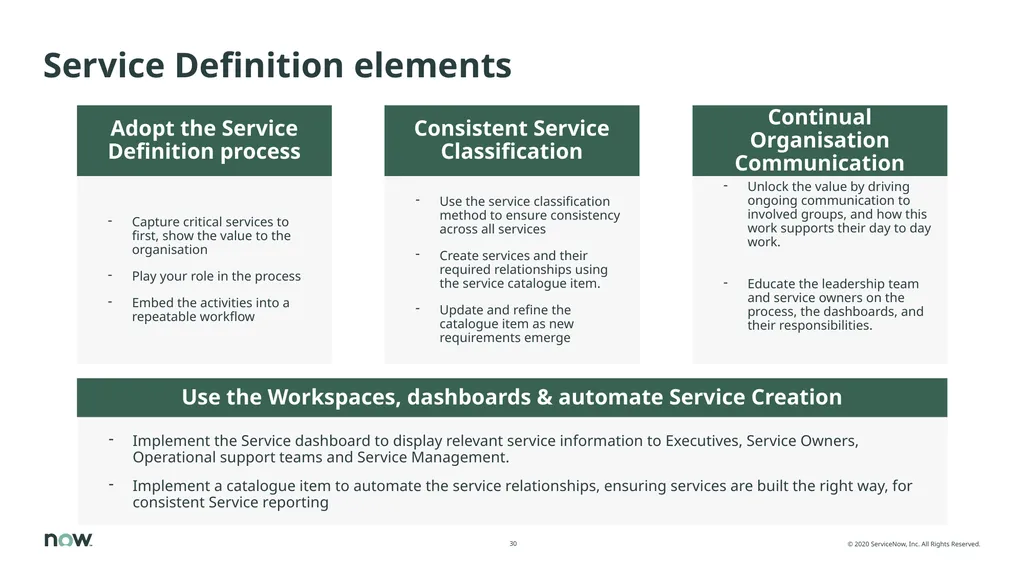
Service Definition elements<br>
31
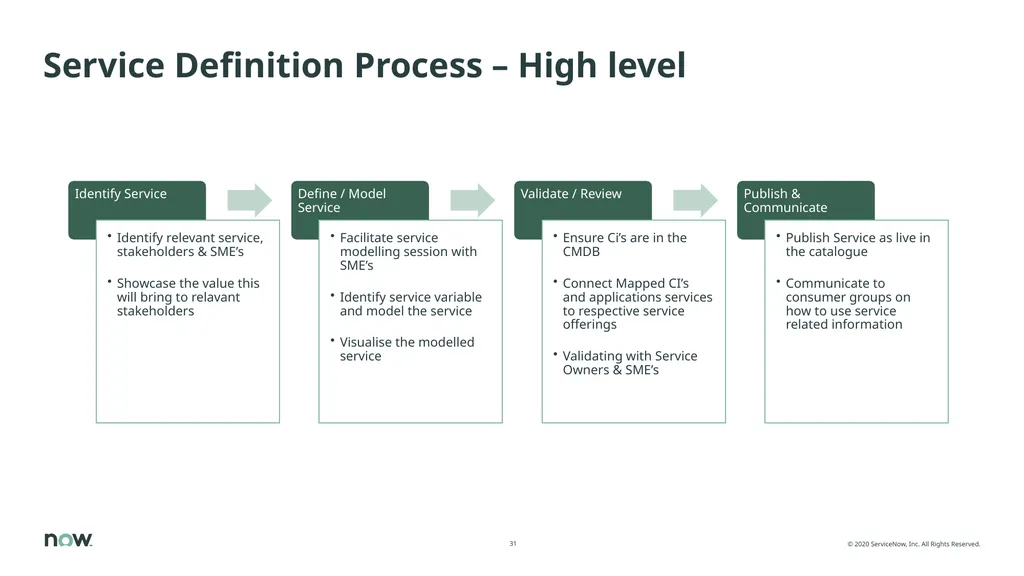
Service Definition Process – High level<br>
32
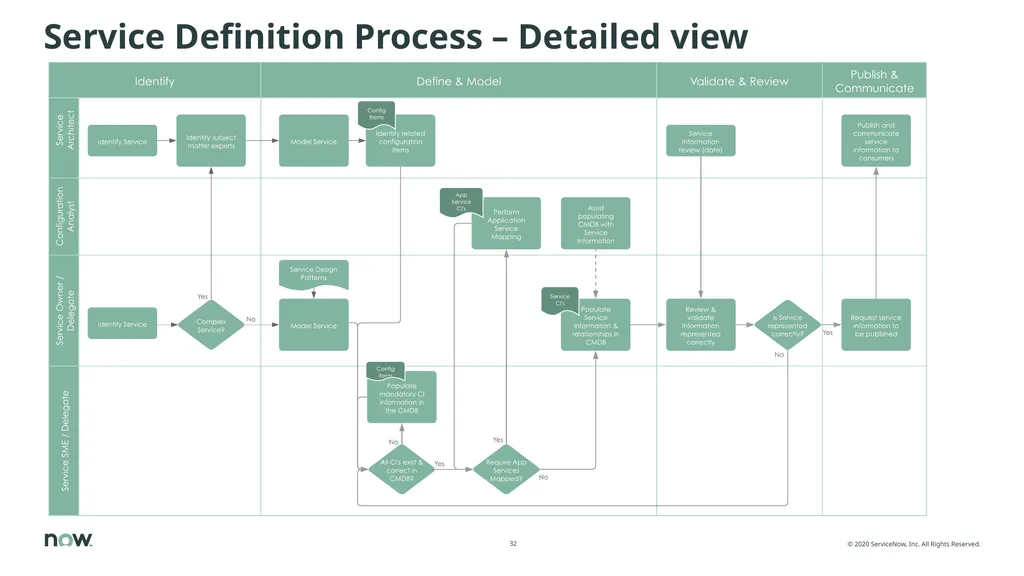
Service Definition Process – Detailed view<br>
33
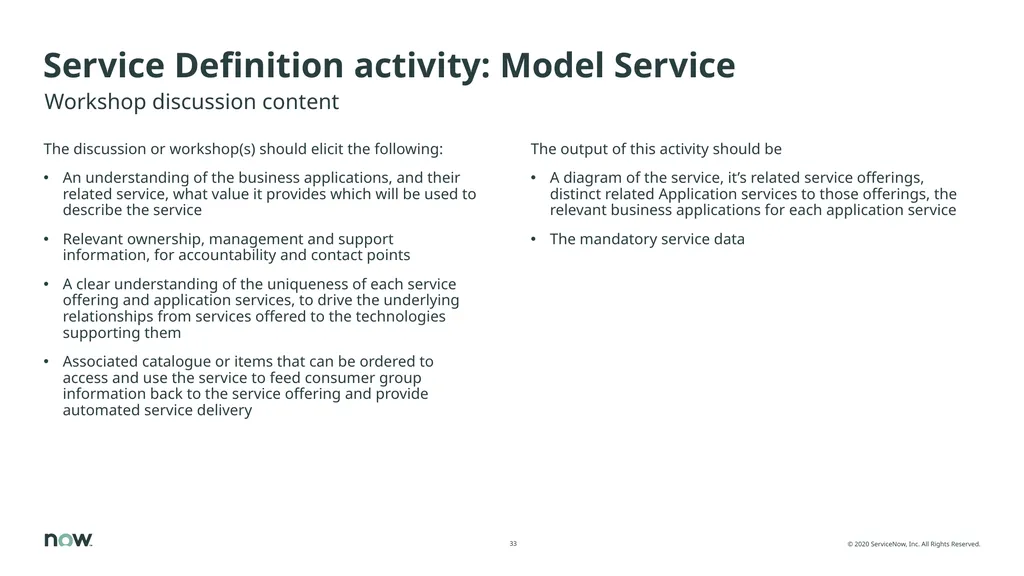
Service Definition activity: Model Service The discussion or workshop(s) should elicit the following:
An understanding of the business applications, and their related service, what value it provides which will be used to describe the service
Relevant ownership, management and support information, for accountability and contact points
A clear understanding of the uniqueness of each service offering and application services, to drive the underlying relationships from services offered to the technologies supporting them
Associated catalogue or items that can be ordered to access and use the service to feed consumer group information back to the service offering and provide automated service delivery The output of this activity should be
A diagram of the service, it’s related service offerings, distinct related Application services to those offerings, the relevant business applications for each application service
The mandatory service data Workshop discussion content<br>
An understanding of the business applications, and their related service, what value it provides which will be used to describe the service
Relevant ownership, management and support information, for accountability and contact points
A clear understanding of the uniqueness of each service offering and application services, to drive the underlying relationships from services offered to the technologies supporting them
Associated catalogue or items that can be ordered to access and use the service to feed consumer group information back to the service offering and provide automated service delivery The output of this activity should be
A diagram of the service, it’s related service offerings, distinct related Application services to those offerings, the relevant business applications for each application service
The mandatory service data Workshop discussion content<br>
34
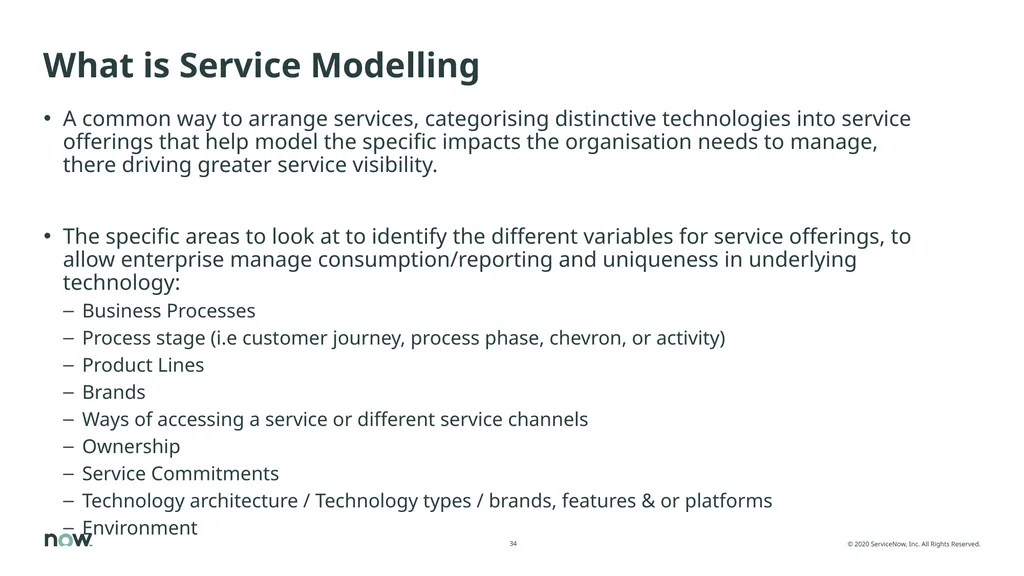
What is Service Modelling A common way to arrange services, categorising distinctive technologies into service offerings that help model the specific impacts the organisation needs to manage, there driving greater service visibility.
The specific areas to look at to identify the different variables for service offerings, to allow enterprise manage consumption/reporting and uniqueness in underlying technology:
Business Processes
Process stage (i.e customer journey, process phase, chevron, or activity)
Product Lines
Brands
Ways of accessing a service or different service channels
Ownership
Service Commitments
Technology architecture / Technology types / brands, features & or platforms
Environment<br>
The specific areas to look at to identify the different variables for service offerings, to allow enterprise manage consumption/reporting and uniqueness in underlying technology:
Business Processes
Process stage (i.e customer journey, process phase, chevron, or activity)
Product Lines
Brands
Ways of accessing a service or different service channels
Ownership
Service Commitments
Technology architecture / Technology types / brands, features & or platforms
Environment<br>
35
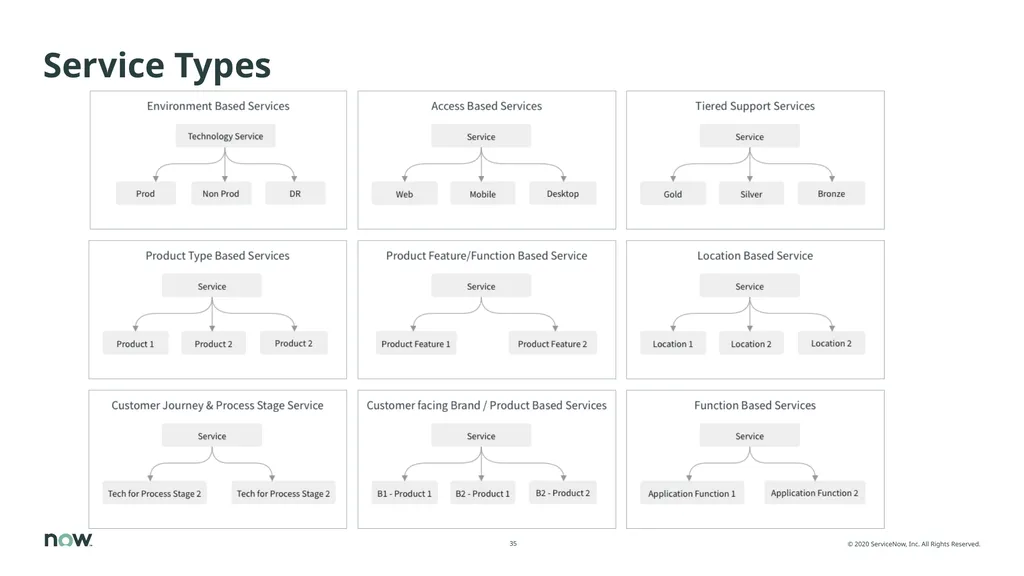
Service Types<br>
36
Understanding Different Types of Services<br>
37
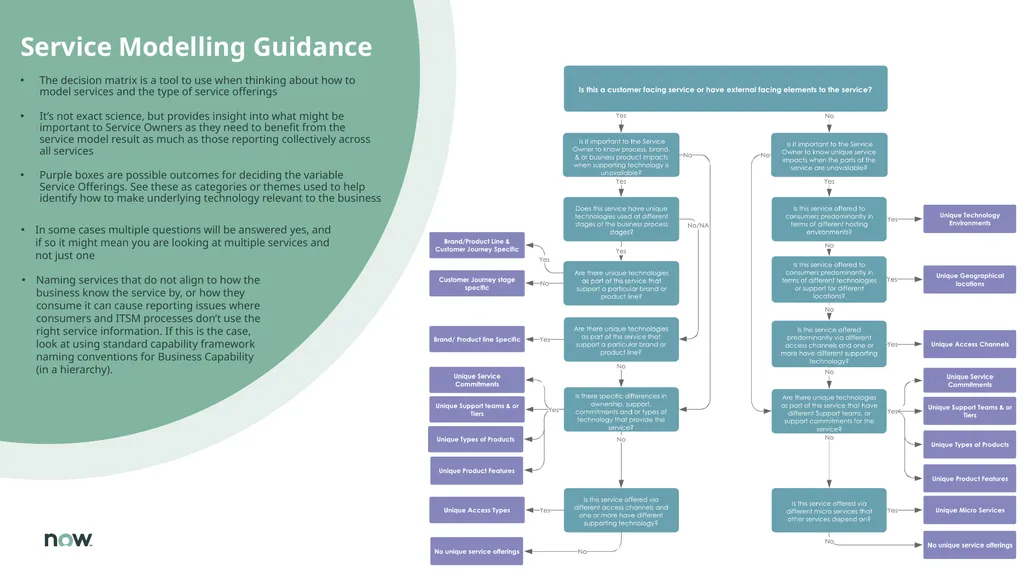
Service Modelling Guidance The decision matrix is a tool to use when thinking about how to model services and the type of service offerings
It’s not exact science, but provides insight into what might be important to Service Owners as they need to benefit from the service model result as much as those reporting collectively across all services
Purple boxes are possible outcomes for deciding the variable Service Offerings. See these as categories or themes used to help identify how to make underlying technology relevant to the business Naming services that do not align to how the business know the service by, or how they consume it can cause reporting issues where consumers and ITSM processes don’t use the right service information. If this is the case, look at using standard capability framework naming conventions for Business Capability (in a hierarchy). In some cases multiple questions will be answered yes, and if so it might mean you are looking at multiple services and not just one<br>
It’s not exact science, but provides insight into what might be important to Service Owners as they need to benefit from the service model result as much as those reporting collectively across all services
Purple boxes are possible outcomes for deciding the variable Service Offerings. See these as categories or themes used to help identify how to make underlying technology relevant to the business Naming services that do not align to how the business know the service by, or how they consume it can cause reporting issues where consumers and ITSM processes don’t use the right service information. If this is the case, look at using standard capability framework naming conventions for Business Capability (in a hierarchy). In some cases multiple questions will be answered yes, and if so it might mean you are looking at multiple services and not just one<br>
38
Service Offering Naming Standards<br>
39
Service Structure – Infra Services based on Environment<br>
40
Default Service Structure – Infra Services based on product and features<br>
41
Default Service Structure – End User and Digital Services, access based<br>
42
Default Service Structure – End User and Digital Services, product based<br>
43
Default Service Structure – Services Based on Geography & Support<br>
44
Default Service Structure – Process or Customer Journey based<br>
45
Default Service Structure – Process or Customer Journey based<br>
46
Service Model Examples<br>
47
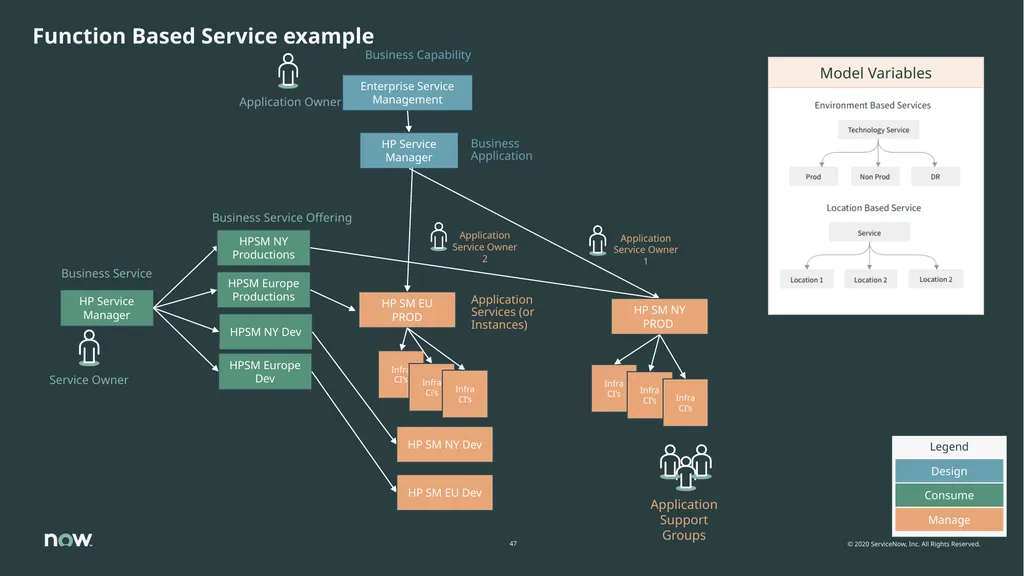
Function Based Service example<br>
48
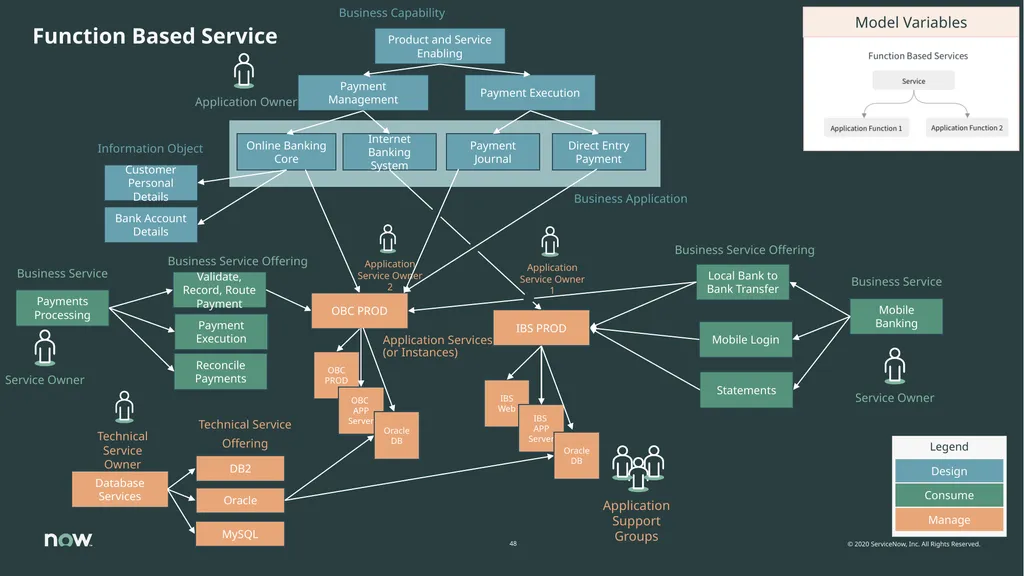
Function Based Service<br>