
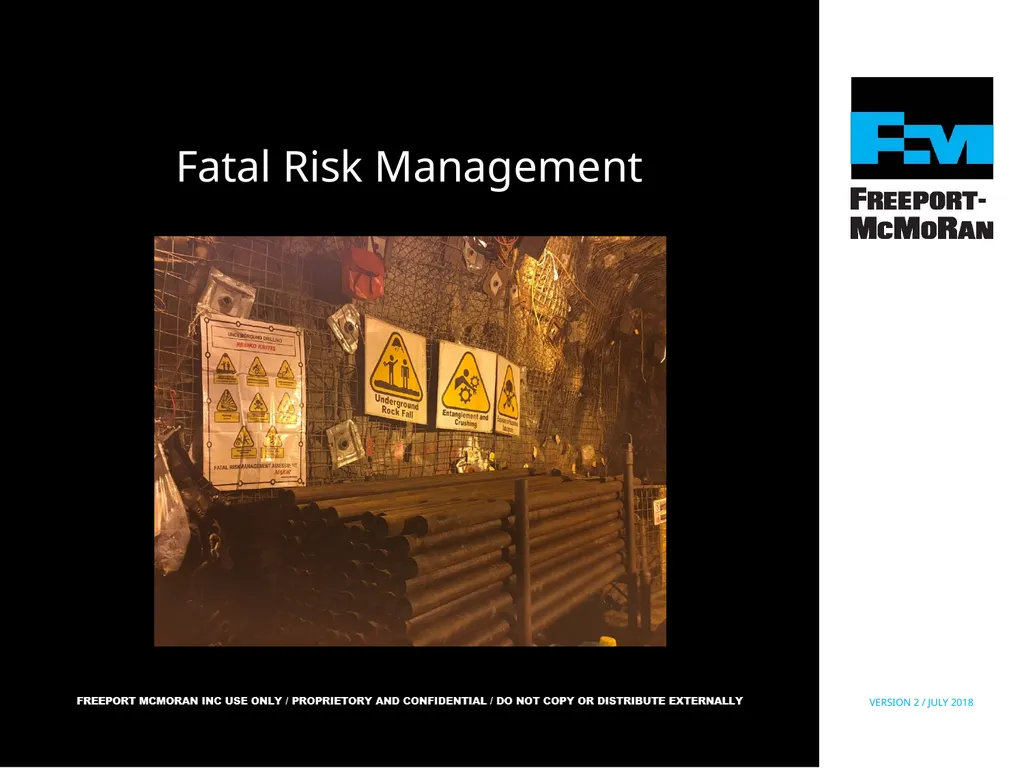
VERSION 2 / JULY 2018 Fatal Risk Management Fatal


Description: VERSION 2 JULY 2018 Fatal Risk Management Fatal Risk MANAGEMENT 2 Introductions and Icebreaker activity Reasons for Rolling Out FRM Explanation of the FRM Concept How FRM Works FRM Exercises FRM Implementation Progression Questions
Related Topics
Download Presentation
"VERSION 2 / JULY 2018 Fatal Risk Management Fatal" is the property of its rightful owner. Permission is granted to download and print the materials on this website for personal, non-commercial use only, and to display it on your personal computer provided you do not modify the materials and that you retain all copyright notices contained in the materials. By downloading content from our website, you accept the terms of this agreement.
Presentation Transcript
slide1. VERSION 2 / JULY 2018 Fatal Risk Management<br>
slide2. Fatal Risk MANAGEMENT 2 Introductions and Icebreaker activity
Reasons for Rolling Out FRM
Explanation of the FRM Concept
How FRM Works
FRM Exercises
FRM Implementation & Progression
Questions Agenda<br>
slide3. Fatal Risk MANAGEMENT 3 Write your name on a table tent
Introduce yourself to the group
Name
Position
Length of time with the Company Introductions<br>
slide4. Activity 1 Directions
In your group, create a list of five things that everyone has in common
Cannot be related to work, body parts, or clothes
Designate one person to write down the responses
Designate one person to speak for the group
Be prepared to share your responses Icebreaker Fatal Risk MANAGEMENT<br>
slide5. Fatal Risk MANAGEMENT 5 Upon completion of this course, students will be able to:
Select the appropriate Fatal Risk Management icons based on the hazards associated with the task and environment
Identify appropriate Fatal Risk Management tools specific to the needs of the work area and employees
Differentiate the roles and responsibilities of employees, supervisors, and managers
Demonstrate effective communication skills for transferring program concepts to employees Learning Objectives<br>
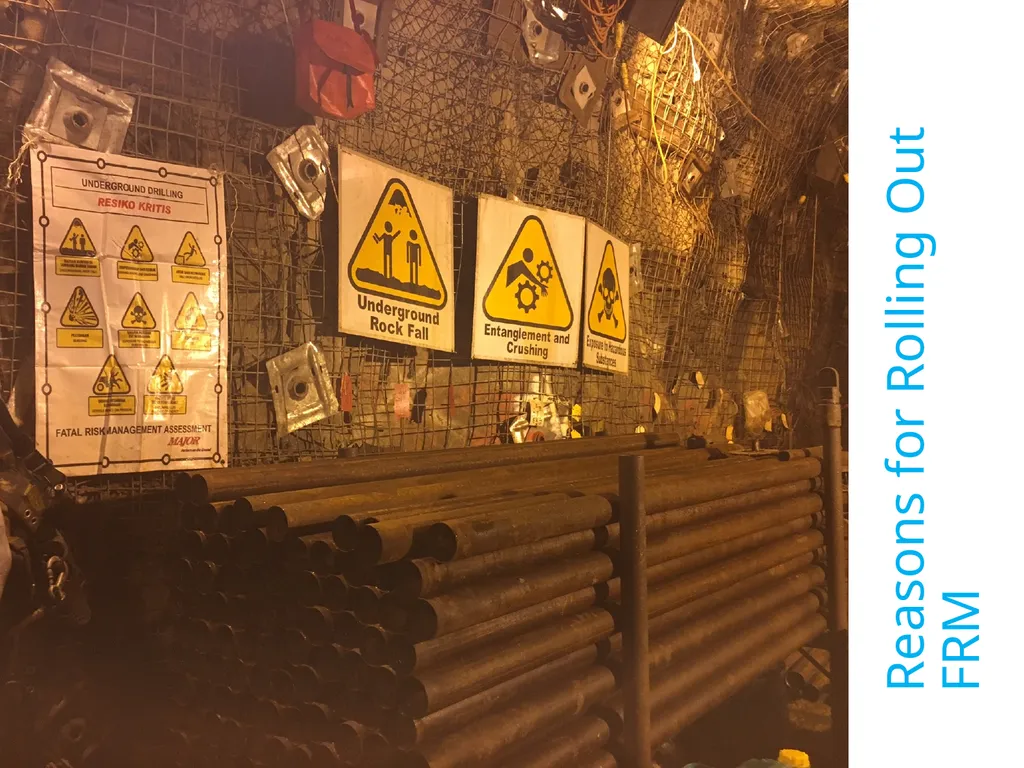
slide6. Reasons for Rolling Out FRM<br>
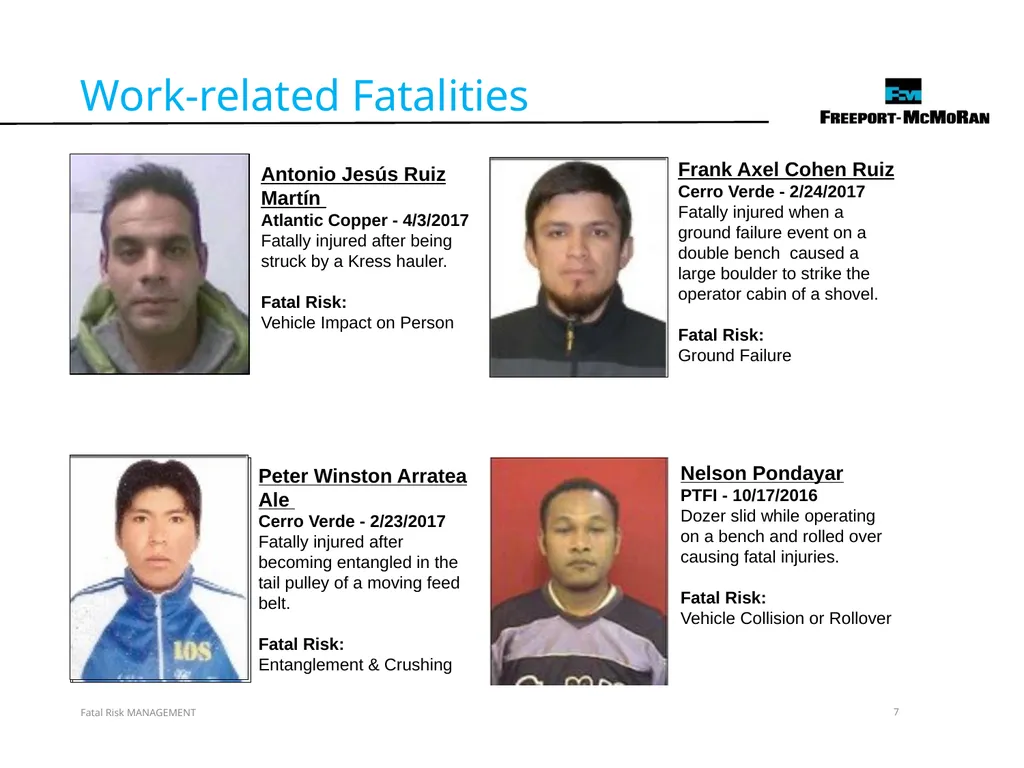
slide7. 7 Work-related Fatalities Antonio Jesús Ruiz Martín
Atlantic Copper - 4/3/2017
Fatally injured after being struck by a Kress hauler.
Fatal Risk:
Vehicle Impact on Person Frank Axel Cohen Ruiz
Cerro Verde - 2/24/2017
Fatally injured when a ground failure event on a double bench caused a large boulder to strike the operator cabin of a shovel.
Fatal Risk:
Ground Failure Peter Winston Arratea Ale
Cerro Verde - 2/23/2017
Fatally injured after becoming entangled in the tail pulley of a moving feed belt.
Fatal Risk:
Entanglement & Crushing Nelson Pondayar
PTFI - 10/17/2016
Dozer slid while operating on a bench and rolled over causing fatal injuries.
Fatal Risk:
Vehicle Collision or Rollover Fatal Risk MANAGEMENT<br>
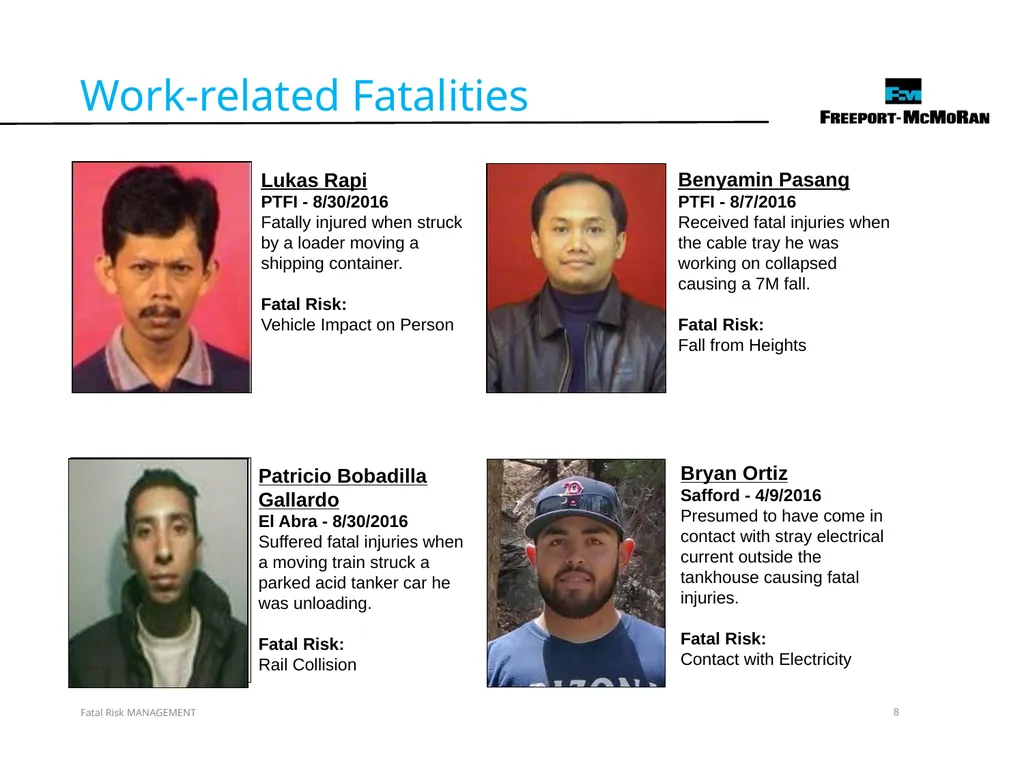
slide8. 8 Work-related Fatalities Lukas Rapi
PTFI - 8/30/2016
Fatally injured when struck by a loader moving a shipping container.
Fatal Risk:
Vehicle Impact on Person Benyamin Pasang
PTFI - 8/7/2016
Received fatal injuries when the cable tray he was working on collapsed causing a 7M fall.
Fatal Risk:
Fall from Heights Patricio Bobadilla Gallardo
El Abra - 8/30/2016
Suffered fatal injuries when a moving train struck a parked acid tanker car he was unloading.
Fatal Risk:
Rail Collision Bryan Ortiz
Safford - 4/9/2016
Presumed to have come in contact with stray electrical current outside the tankhouse causing fatal injuries.
Fatal Risk:
Contact with Electricity Fatal Risk MANAGEMENT<br>
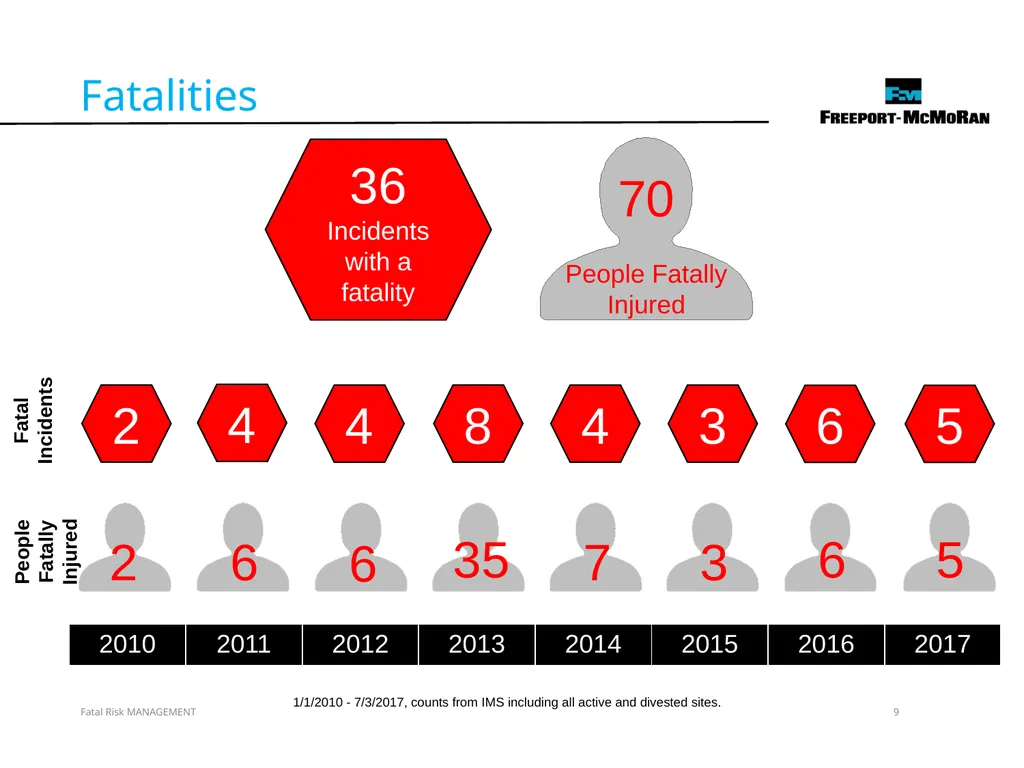
slide9. Fatal Risk MANAGEMENT 9 Fatalities Fatal Incidents People Fatally Injured 2 6 6 35 7 3 6 5 2 4 4 8 4 3 6 5 1/1/2010 - 7/3/2017, counts from IMS including all active and divested sites. 36
Incidents with a fatality 70
People Fatally Injured<br>
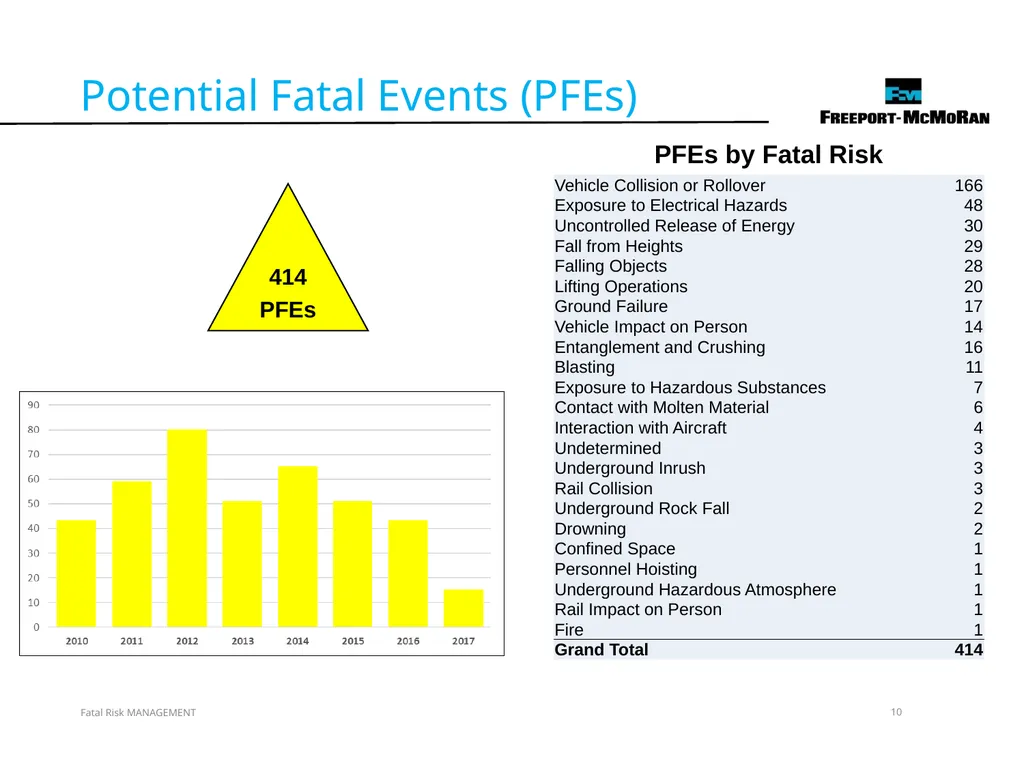
slide10. 10 Potential Fatal Events (PFEs) 414
PFEs PFEs by Fatal Risk PFEs by Year Fatal Risk MANAGEMENT<br>
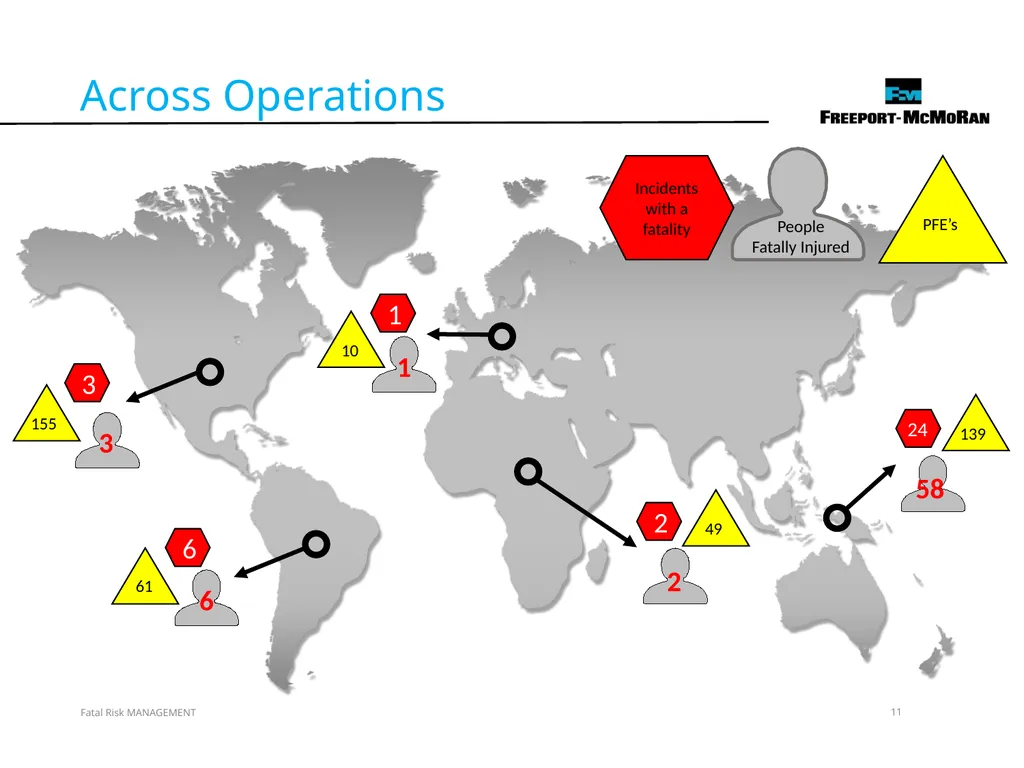
slide11. 11 Across Operations Fatal Risk MANAGEMENT 3 3 1 6 2 1 6 2 58 24 Incidents with a fatality People
Fatally Injured PFE’s<br>
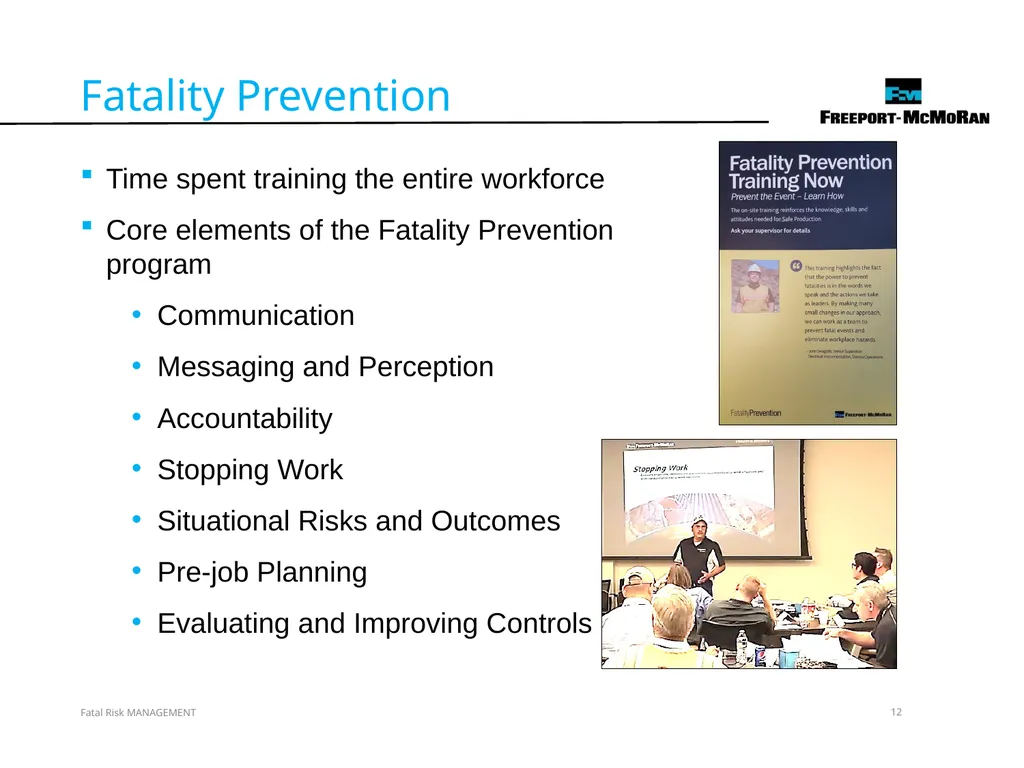
slide12. 12 Time spent training the entire workforce
Core elements of the Fatality Prevention program
Communication
Messaging and Perception
Accountability
Stopping Work
Situational Risks and Outcomes
Pre-job Planning
Evaluating and Improving Controls Fatality Prevention Fatal Risk MANAGEMENT<br>
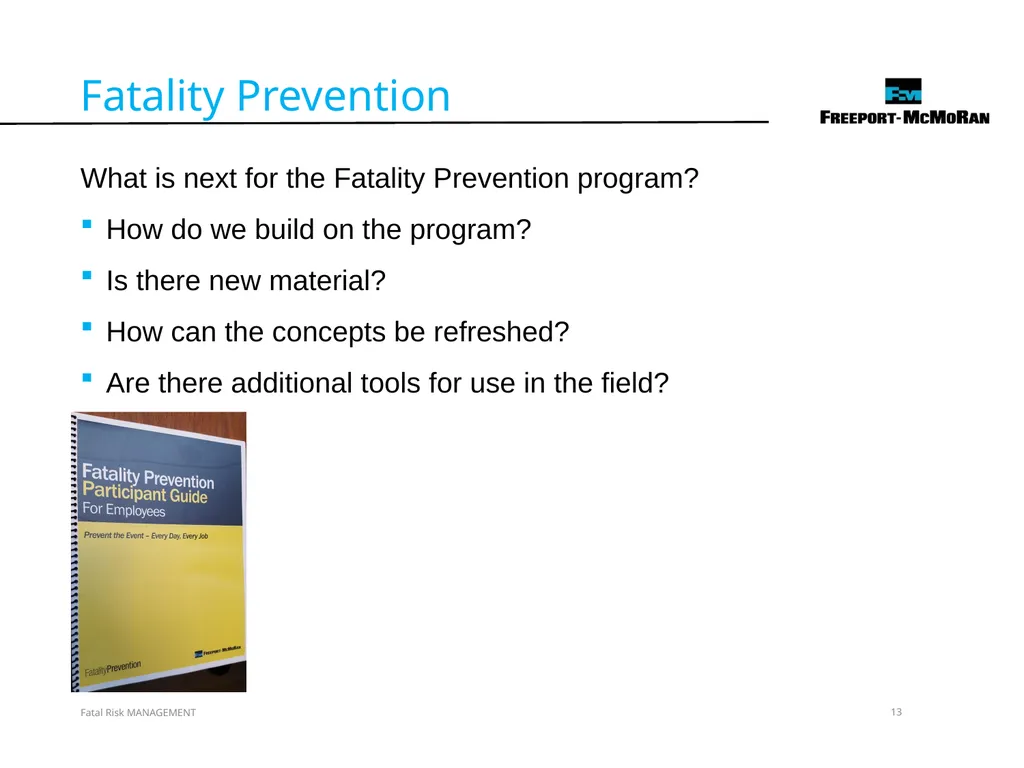
slide13. 13 What is next for the Fatality Prevention program?
How do we build on the program?
Is there new material?
How can the concepts be refreshed?
Are there additional tools for use in the field? Fatality Prevention Fatal Risk MANAGEMENT<br>
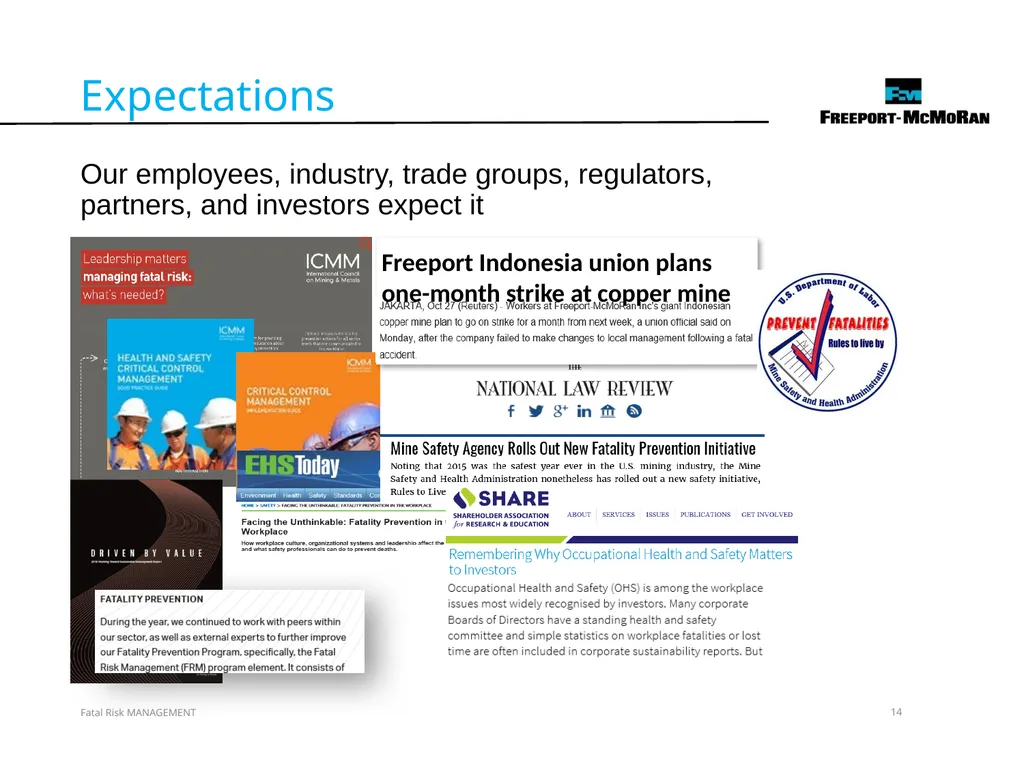
slide14. 14 Our employees, industry, trade groups, regulators, partners, and investors expect it Expectations Fatal Risk MANAGEMENT<br>
slide15. 15 Everyone has a reason to go home safely Expectations Fatal Risk MANAGEMENT<br>
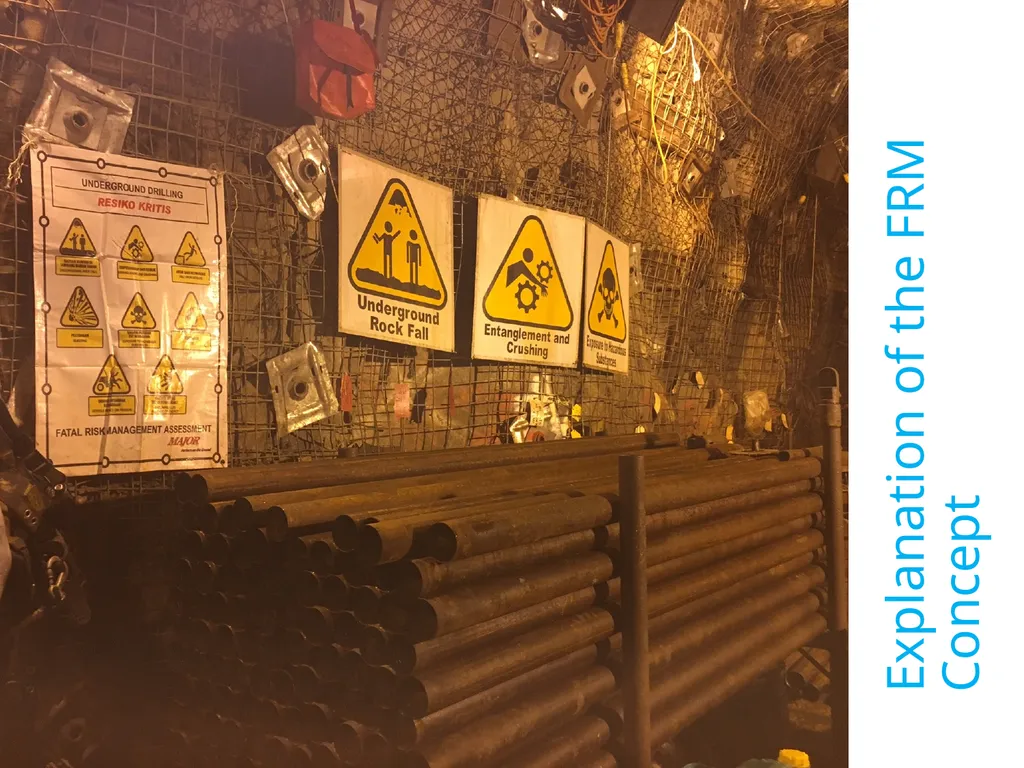
slide16. Explanation of the FRM Concept<br>
slide17. 17 Fatal Risk Management (FRM) is the next step in the Fatality Prevention Program
It builds on the core elements presented in Fatality Prevention Training
Focused on improving identification of Fatal Risks and implementing Critical Controls
It consists of several tools to be used in the field FRM Concept Fatal Risk MANAGEMENT<br>
slide18. 18 FRM was developed to:
Clarify the potential for Fatal Risks
Identify Critical Controls to manage those risks
Standardize communication FRM Concept Fatal Risk MANAGEMENT<br>
slide19. 19 Fatal Risks versus other risks
Fatal Risks are the risks that will get you killed; When not controlled, they have the potential to cause serious injury or death
Other risks are still potentially harmful, but carry a lesser risk FRM Concept Fatal Risk MANAGEMENT<br>
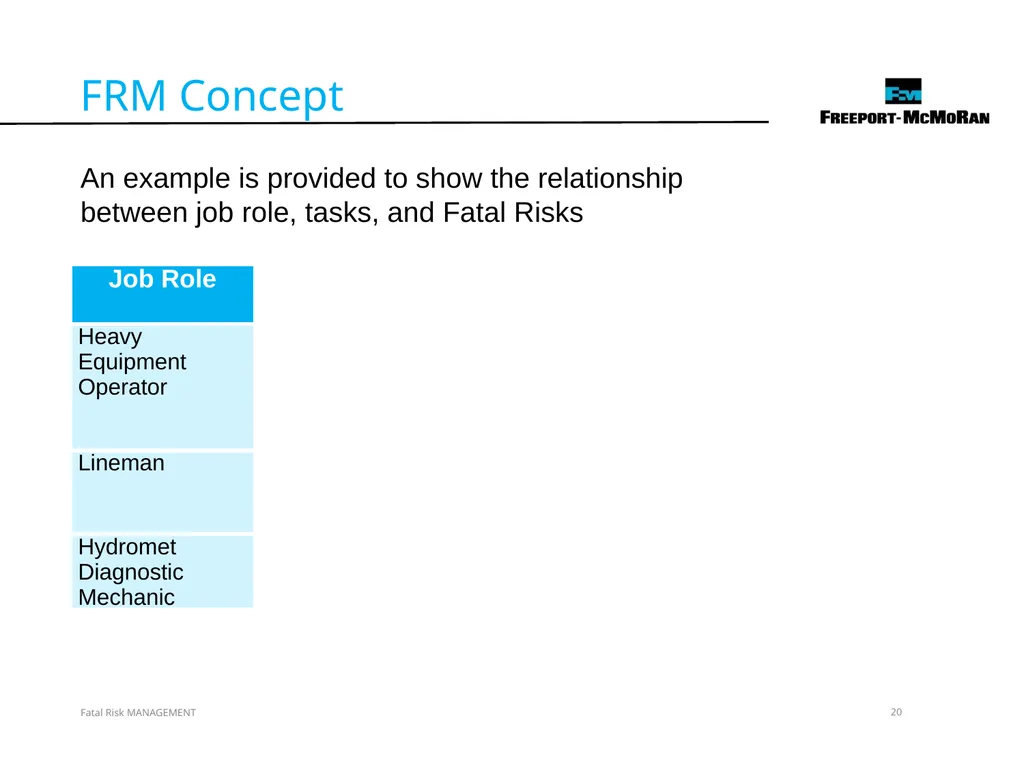
slide20. 20 An example is provided to show the relationship between job role, tasks, and Fatal Risks FRM Concept Fatal Risk MANAGEMENT<br>
slide21. 21 Critical Controls were developed for each Fatal Risk. A Critical Control is
A device, system, or process crucial to preventing death or mitigating the consequences of the event
Previously established based on data FRM Concept Fatal Risk MANAGEMENT<br>
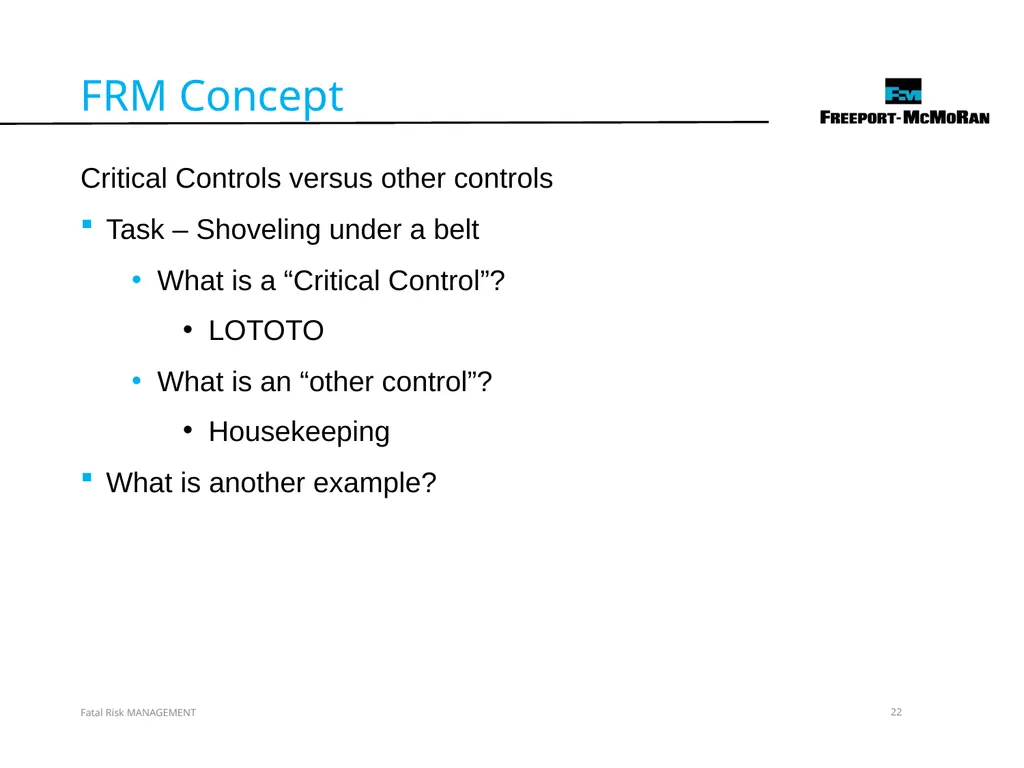
slide22. 22 Critical Controls versus other controls
Task – Shoveling under a belt
What is a “Critical Control”?
LOTOTO
What is an “other control”?
Housekeeping
What is another example? FRM Concept Fatal Risk MANAGEMENT<br>
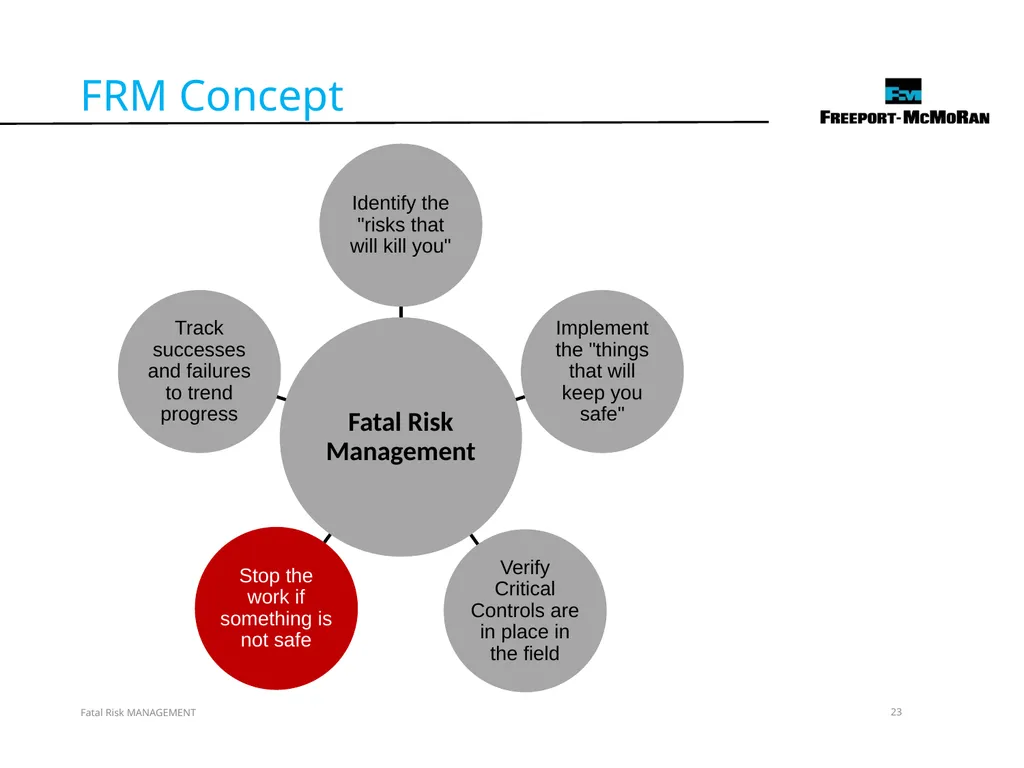
slide23. 23 FRM Concept Fatal Risk MANAGEMENT<br>
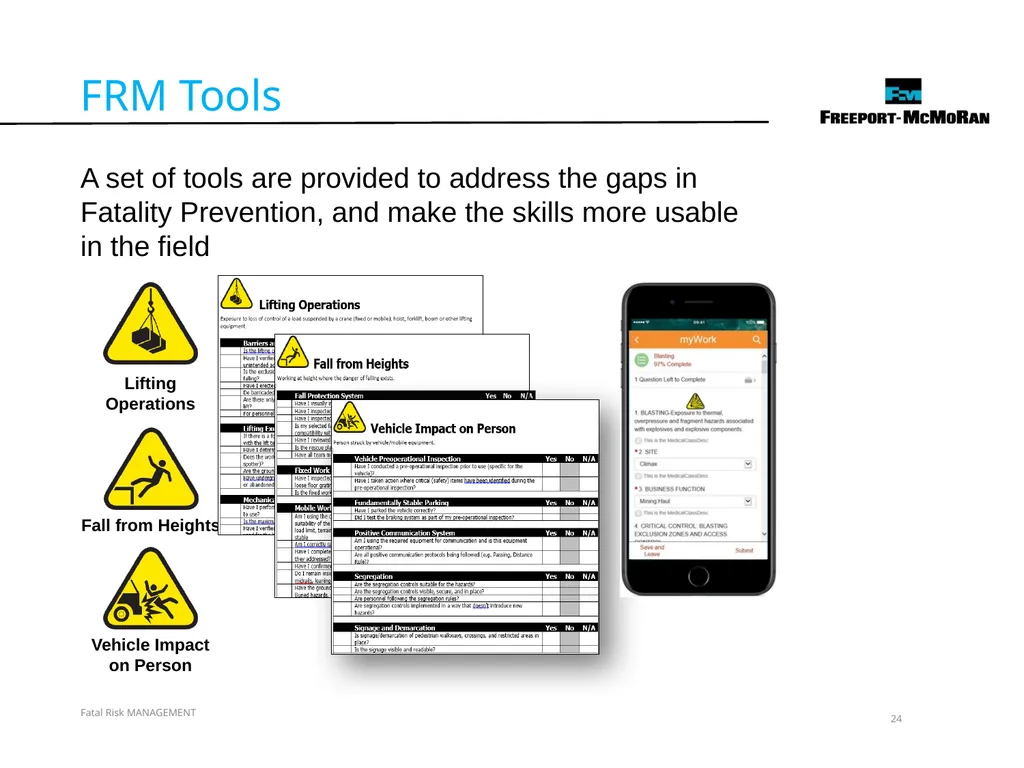
slide24. 24 A set of tools are provided to address the gaps in Fatality Prevention, and make the skills more usable in the field FRM Tools Fall from Heights Lifting Operations Vehicle Impact on Person Fatal Risk MANAGEMENT<br>
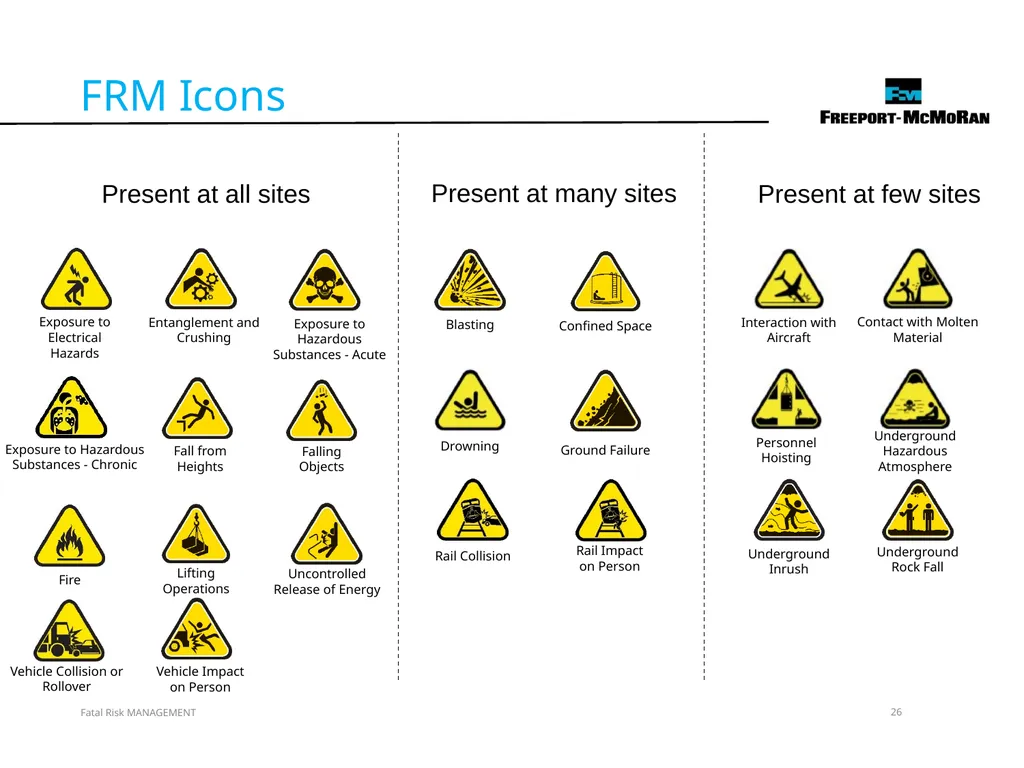
slide25. Purpose of icons
Visually recognizable
Standardize message
To ensure success of the message, the icons need to be understood (consider language barriers and culture)
An in-depth analysis of the past ten years aided in the selection of the twenty-three most significant Fatal Risks FRM Icons Fatal Risk MANAGEMENT<br>
slide26. 26 FRM Icons Fatal Risk MANAGEMENT Blasting Vehicle Collision or Rollover Fall from Heights Lifting Operations Fire Underground Rock Fall Underground Inrush Underground Hazardous Atmosphere Personnel Hoisting Falling Objects Entanglement and Crushing Interaction with Aircraft Drowning Ground Failure Confined Space Contact with Molten Material Rail Collision Rail Impact on Person Present at all sites Present at many sites Present at few sites Vehicle Impact on Person Uncontrolled Release of Energy Exposure to Electrical Hazards Exposure to Hazardous Substances - Acute Exposure to Hazardous Substances - Chronic<br>
slide27. Activity 2 Directions
As a class, discuss 2-4 Fatal Risks and answer the question in the SG for each icon
In small groups, discuss the Fatal Risks you are assigned and answer the question in the SG for each icon
You have 10 minutes to complete
Share your responses (2 minute max for each Fatal Risk) Introduction to Each Icon Fatal Risk MANAGEMENT<br>
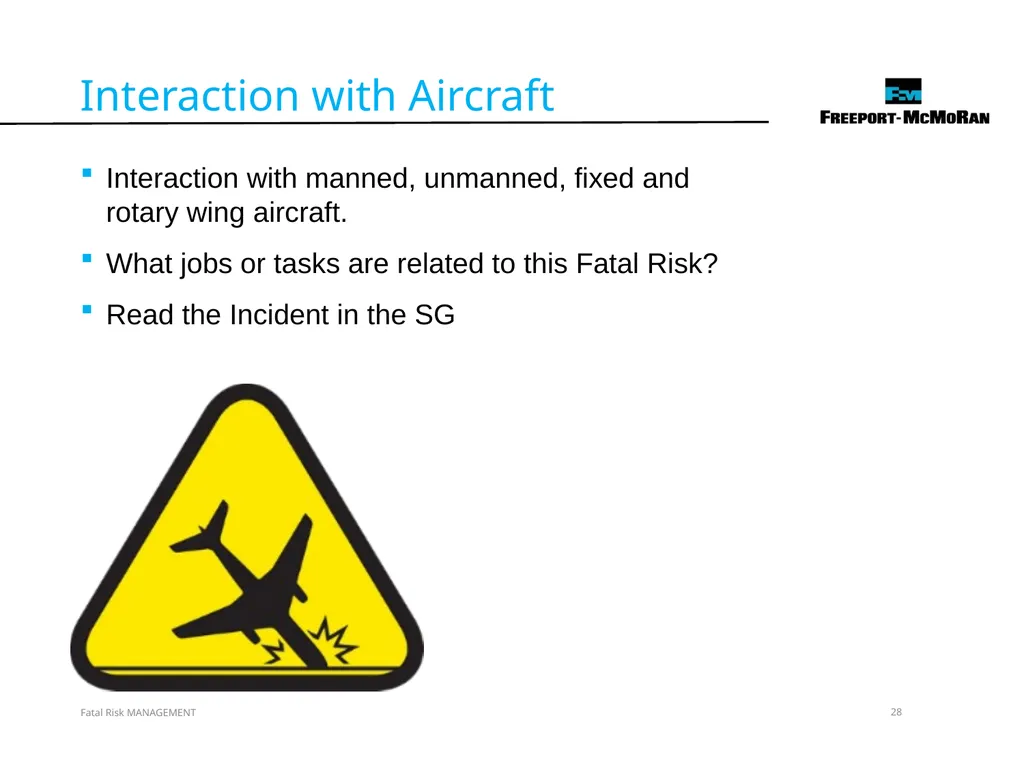
slide28. 28 Interaction with manned, unmanned, fixed and rotary wing aircraft.
What jobs or tasks are related to this Fatal Risk?
Read the Incident in the SG Interaction with Aircraft Fatal Risk MANAGEMENT<br>
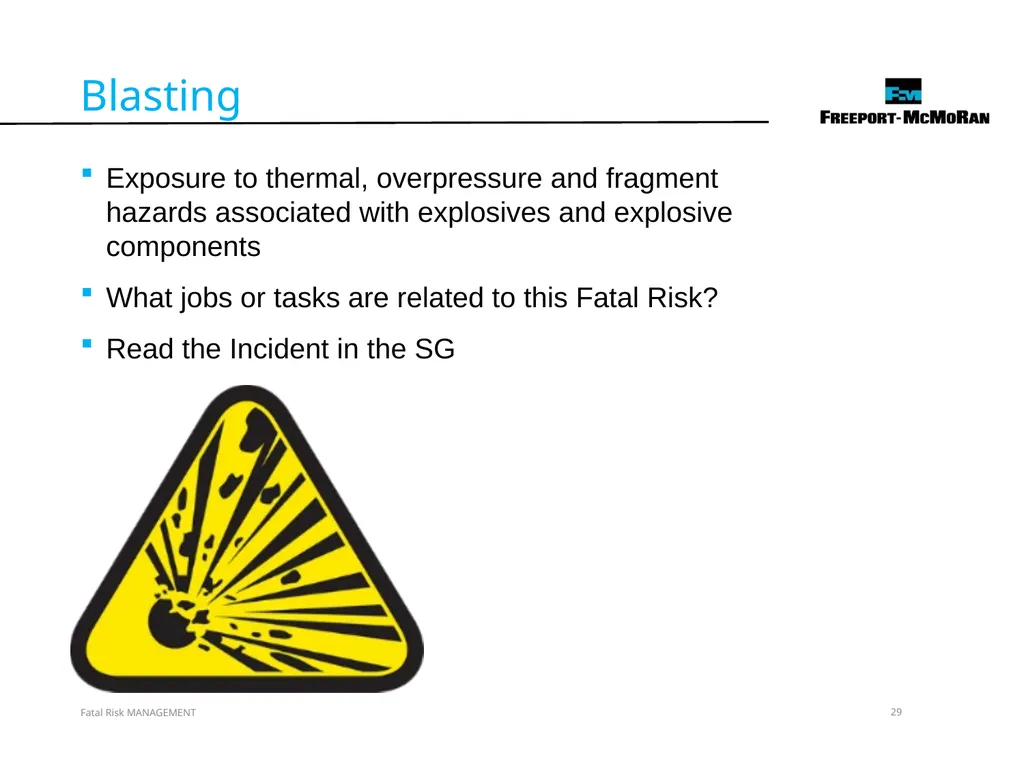
slide29. 29 Exposure to thermal, overpressure and fragment hazards associated with explosives and explosive components
What jobs or tasks are related to this Fatal Risk?
Read the Incident in the SG Blasting Fatal Risk MANAGEMENT<br>
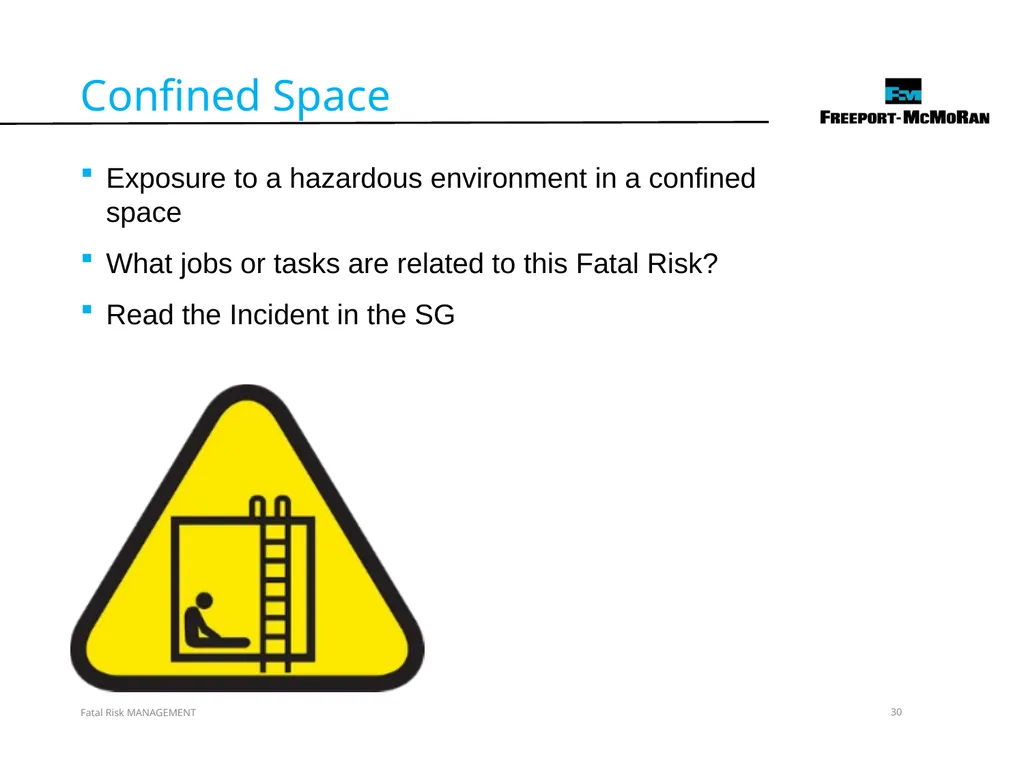
slide30. 30 Exposure to a hazardous environment in a confined space
What jobs or tasks are related to this Fatal Risk?
Read the Incident in the SG Confined Space Fatal Risk MANAGEMENT<br>
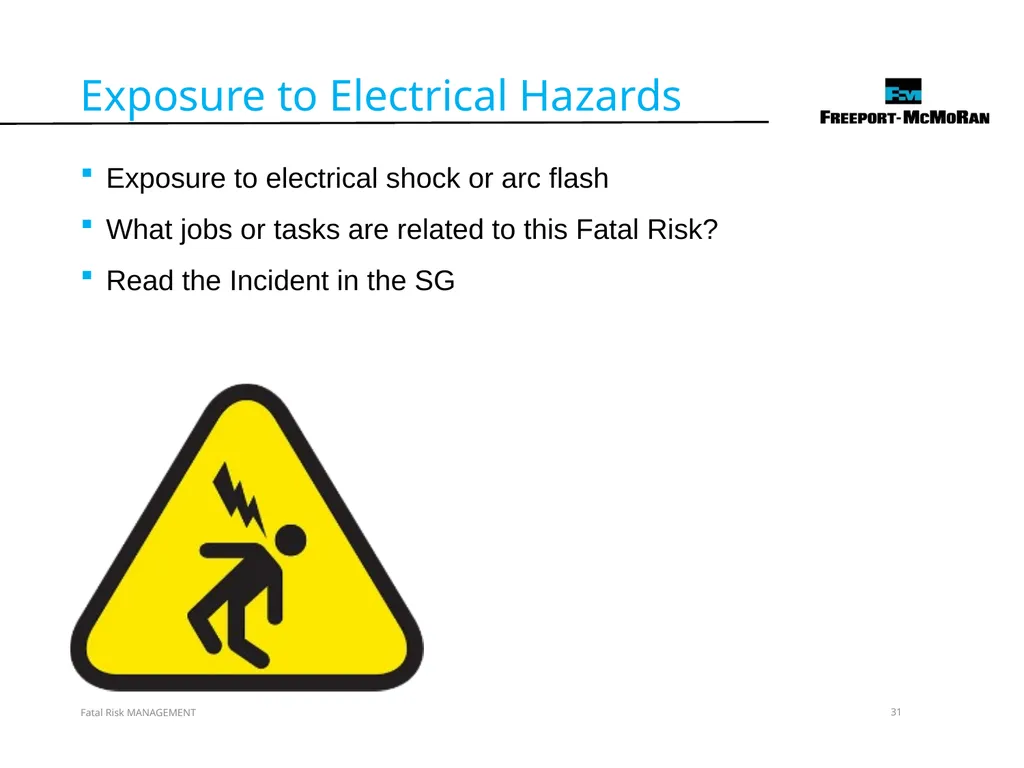
slide31. 31 Exposure to electrical shock or arc flash
What jobs or tasks are related to this Fatal Risk?
Read the Incident in the SG Exposure to Electrical Hazards Fatal Risk MANAGEMENT<br>
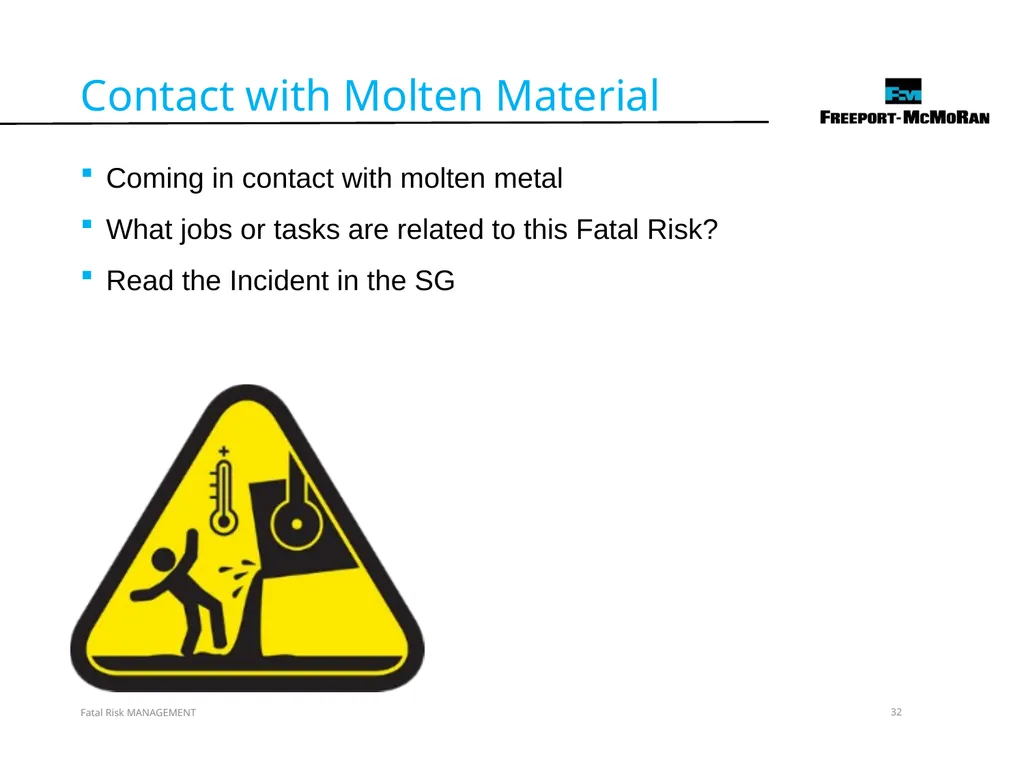
slide32. 32 Coming in contact with molten metal
What jobs or tasks are related to this Fatal Risk?
Read the Incident in the SG Contact with Molten Material Fatal Risk MANAGEMENT<br>
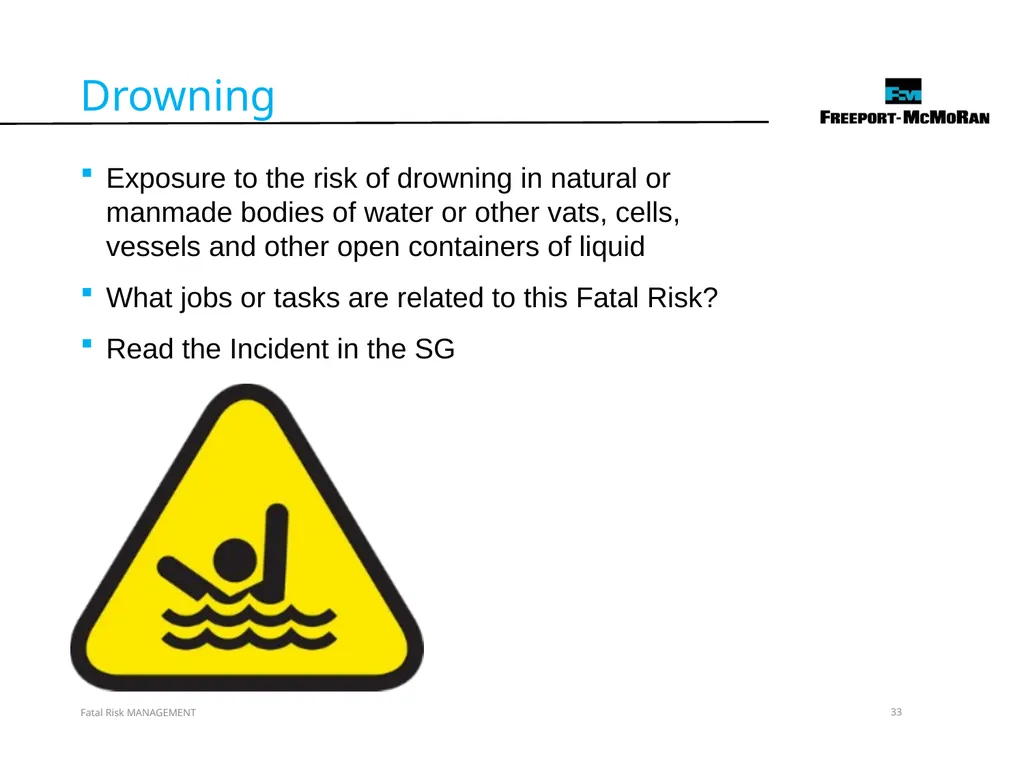
slide33. 33 Exposure to the risk of drowning in natural or manmade bodies of water or other vats, cells, vessels and other open containers of liquid
What jobs or tasks are related to this Fatal Risk?
Read the Incident in the SG Drowning Fatal Risk MANAGEMENT<br>
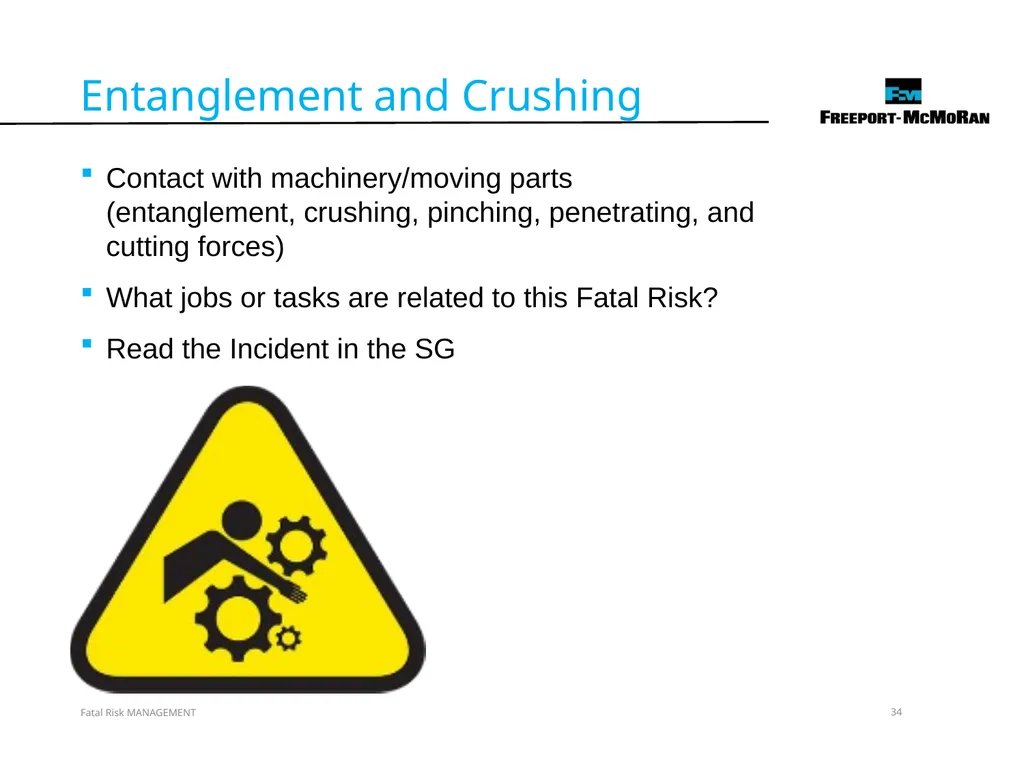
slide34. 34 Contact with machinery/moving parts (entanglement, crushing, pinching, penetrating, and cutting forces)
What jobs or tasks are related to this Fatal Risk?
Read the Incident in the SG Entanglement and Crushing Fatal Risk MANAGEMENT<br>
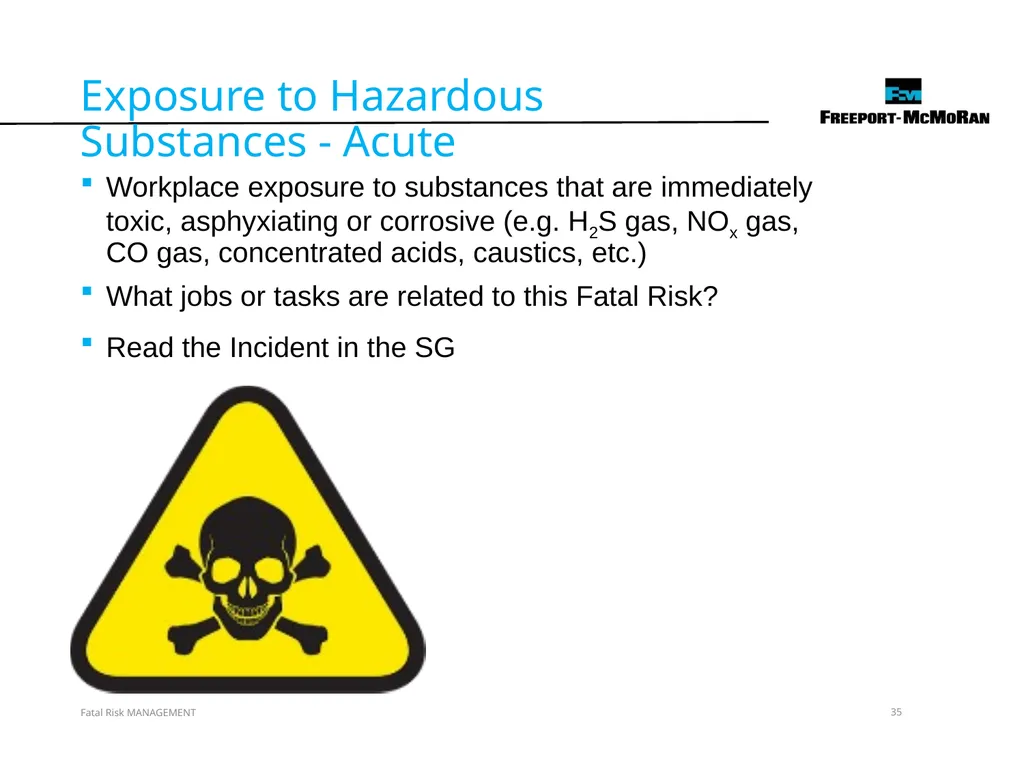
slide35. 35 Workplace exposure to substances that are immediately toxic, asphyxiating or corrosive (e.g. H2S gas, NOx gas, CO gas, concentrated acids, caustics, etc.)
What jobs or tasks are related to this Fatal Risk?
Read the Incident in the SG Exposure to Hazardous Substances - Acute Fatal Risk MANAGEMENT<br>
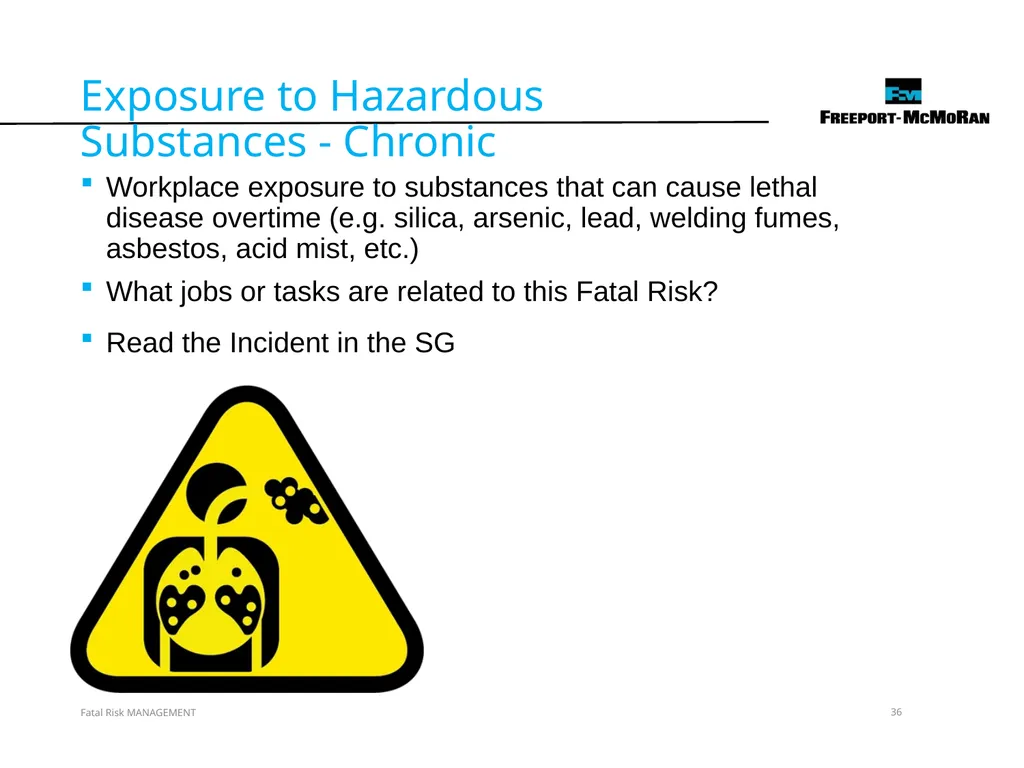
slide36. 36 Workplace exposure to substances that can cause lethal disease overtime (e.g. silica, arsenic, lead, welding fumes, asbestos, acid mist, etc.)
What jobs or tasks are related to this Fatal Risk?
Read the Incident in the SG Exposure to Hazardous Substances - Chronic Fatal Risk MANAGEMENT<br>
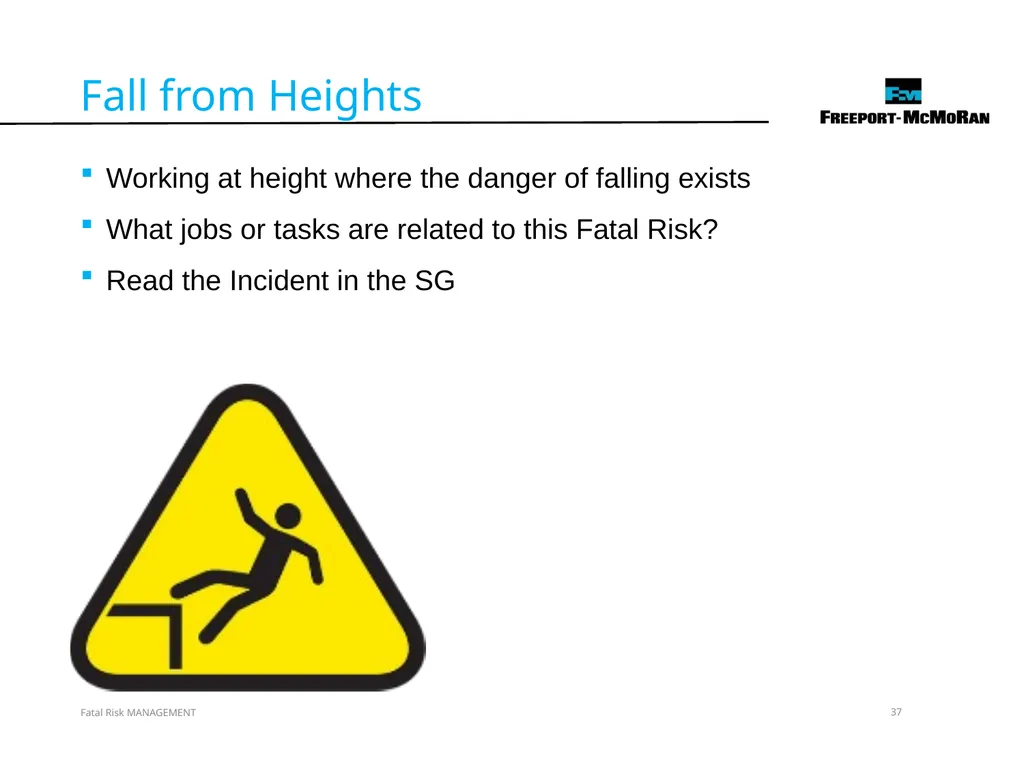
slide37. 37 Working at height where the danger of falling exists
What jobs or tasks are related to this Fatal Risk?
Read the Incident in the SG Fall from Heights Fatal Risk MANAGEMENT<br>
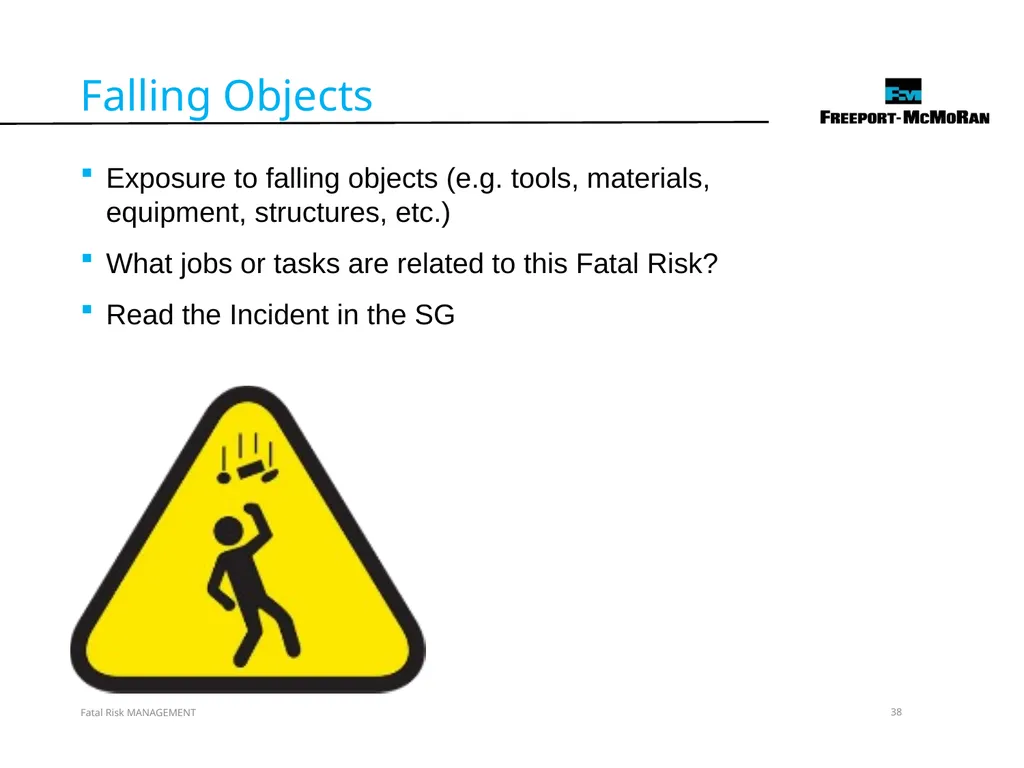
slide38. 38 Exposure to falling objects (e.g. tools, materials, equipment, structures, etc.)
What jobs or tasks are related to this Fatal Risk?
Read the Incident in the SG Falling Objects Fatal Risk MANAGEMENT<br>
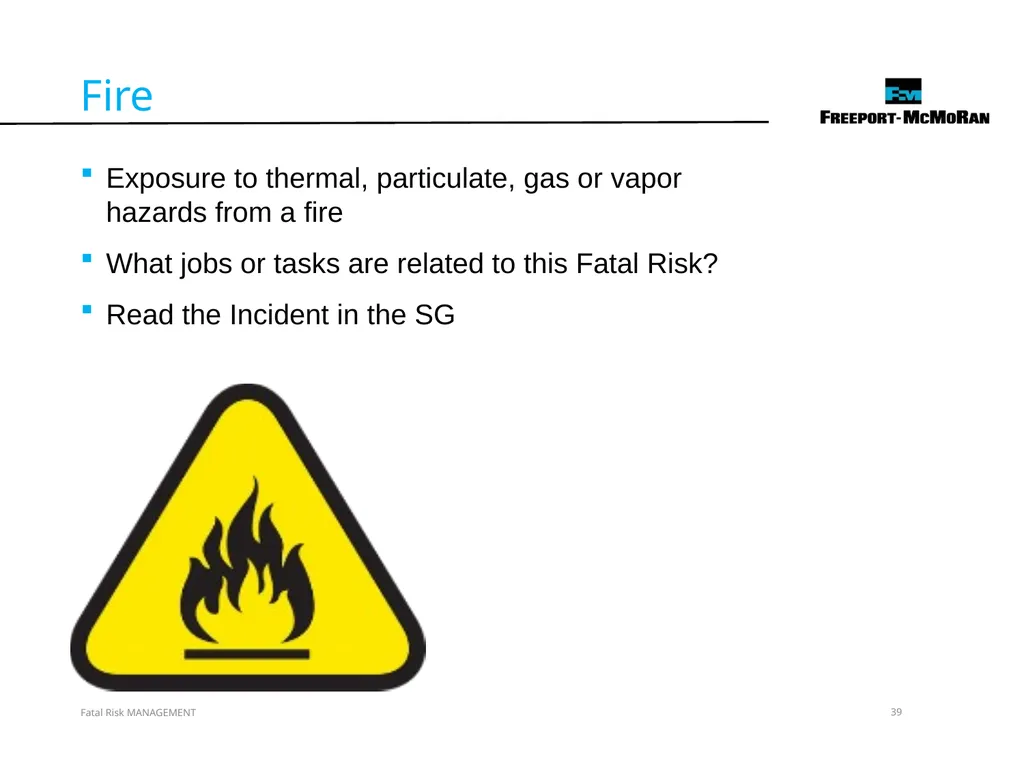
slide39. 39 Exposure to thermal, particulate, gas or vapor hazards from a fire
What jobs or tasks are related to this Fatal Risk?
Read the Incident in the SG Fire Fatal Risk MANAGEMENT<br>
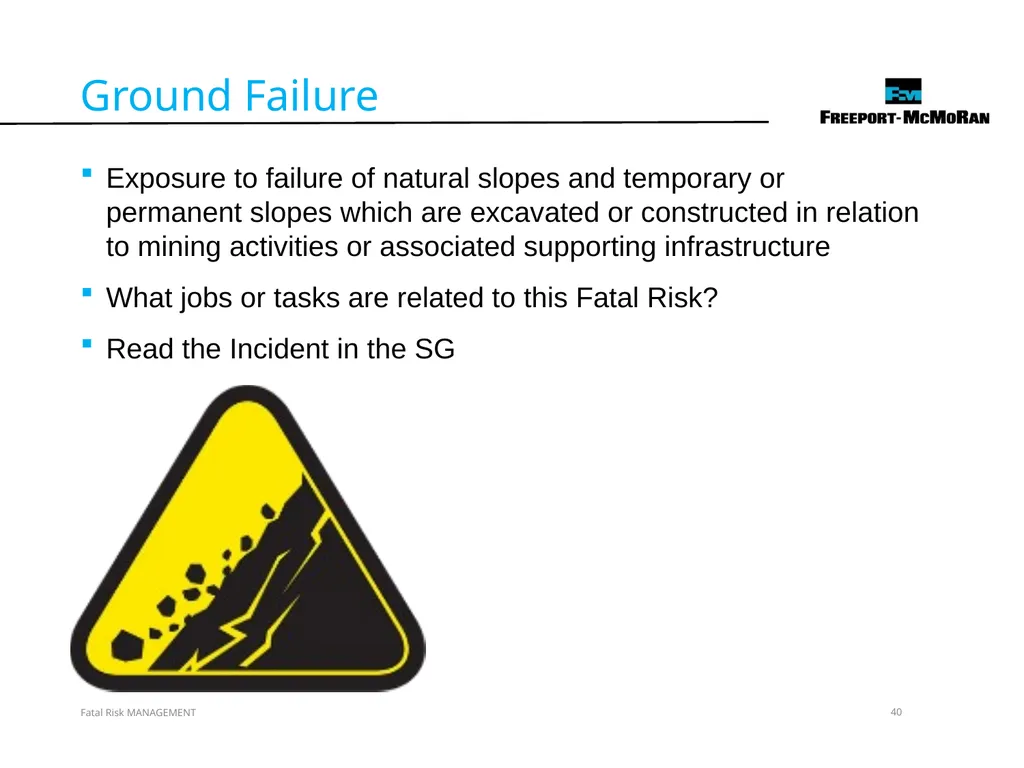
slide40. 40 Exposure to failure of natural slopes and temporary or permanent slopes which are excavated or constructed in relation to mining activities or associated supporting infrastructure
What jobs or tasks are related to this Fatal Risk?
Read the Incident in the SG Ground Failure Fatal Risk MANAGEMENT<br>
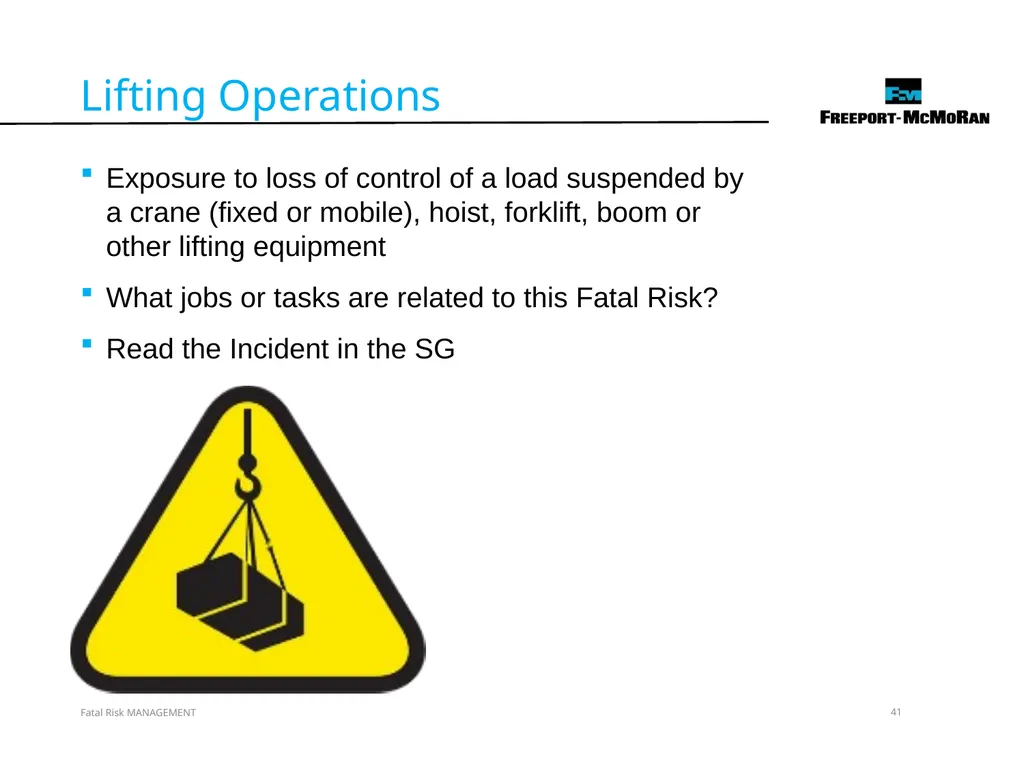
slide41. 41 Exposure to loss of control of a load suspended by a crane (fixed or mobile), hoist, forklift, boom or other lifting equipment
What jobs or tasks are related to this Fatal Risk?
Read the Incident in the SG Lifting Operations Fatal Risk MANAGEMENT<br>
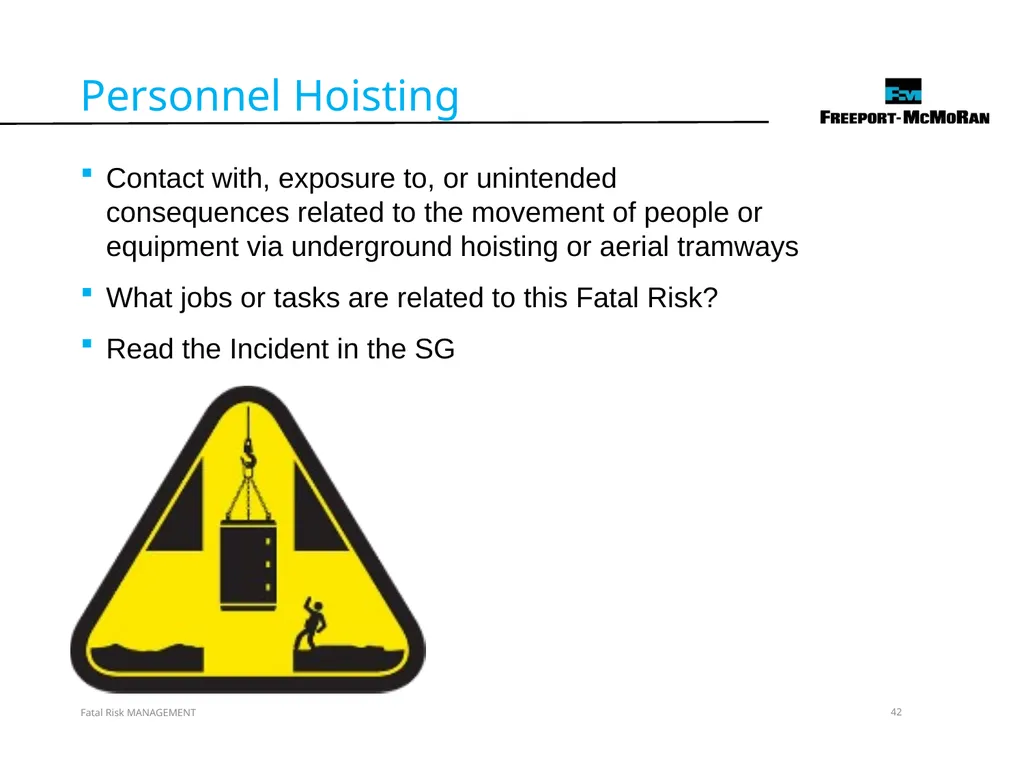
slide42. 42 Contact with, exposure to, or unintended consequences related to the movement of people or equipment via underground hoisting or aerial tramways
What jobs or tasks are related to this Fatal Risk?
Read the Incident in the SG Personnel Hoisting Fatal Risk MANAGEMENT<br>
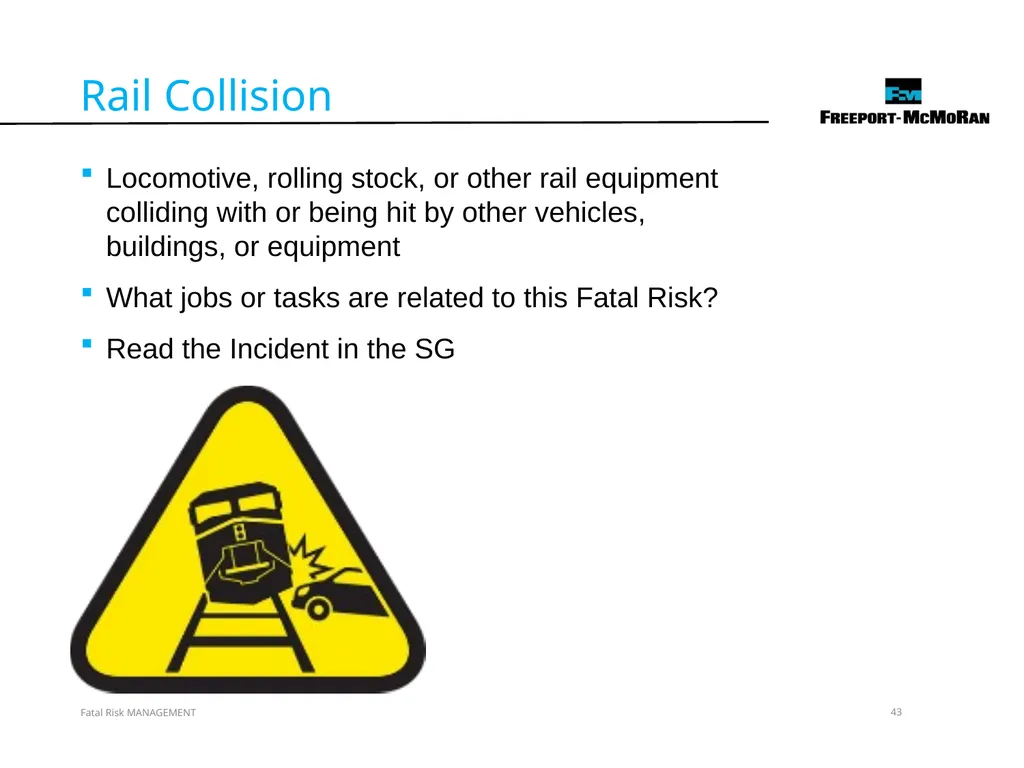
slide43. 43 Locomotive, rolling stock, or other rail equipment colliding with or being hit by other vehicles, buildings, or equipment
What jobs or tasks are related to this Fatal Risk?
Read the Incident in the SG Rail Collision Fatal Risk MANAGEMENT<br>
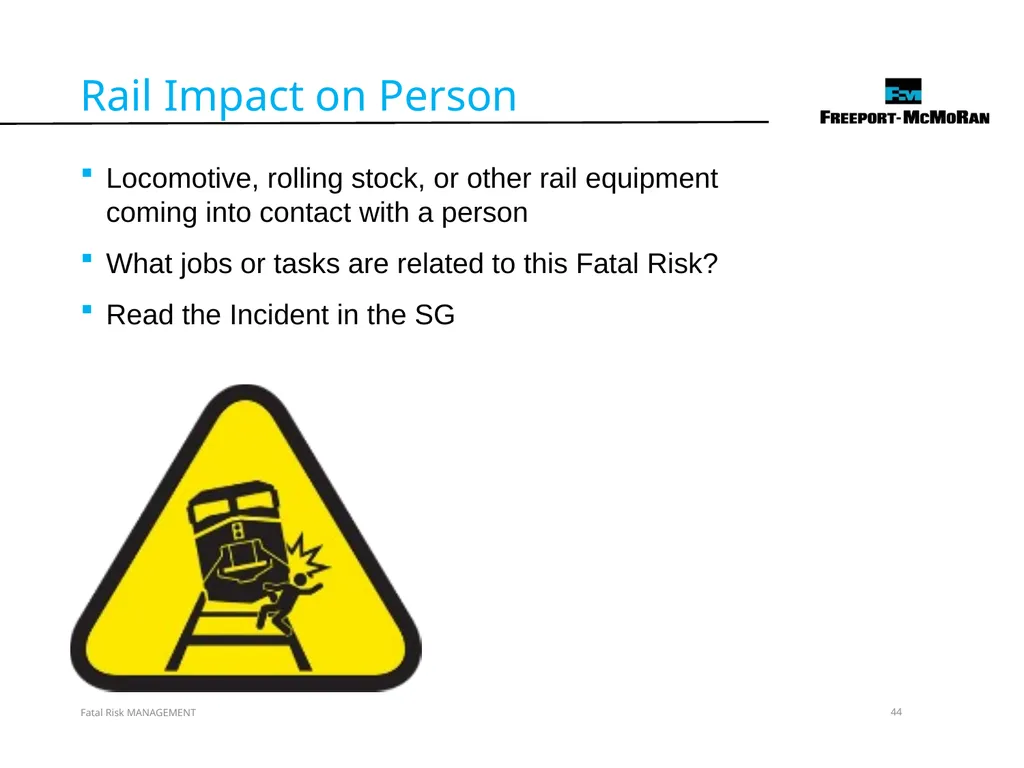
slide44. 44 Locomotive, rolling stock, or other rail equipment coming into contact with a person
What jobs or tasks are related to this Fatal Risk?
Read the Incident in the SG Rail Impact on Person Fatal Risk MANAGEMENT<br>
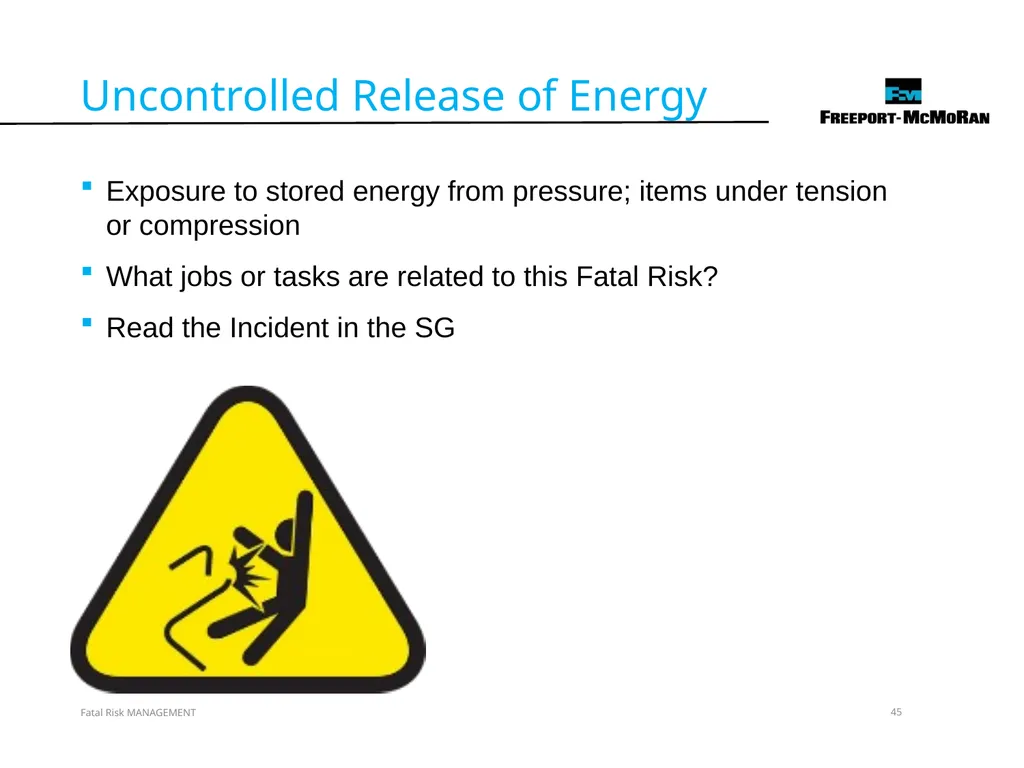
slide45. 45 Exposure to stored energy from pressure; items under tension or compression
What jobs or tasks are related to this Fatal Risk?
Read the Incident in the SG Uncontrolled Release of Energy Fatal Risk MANAGEMENT<br>
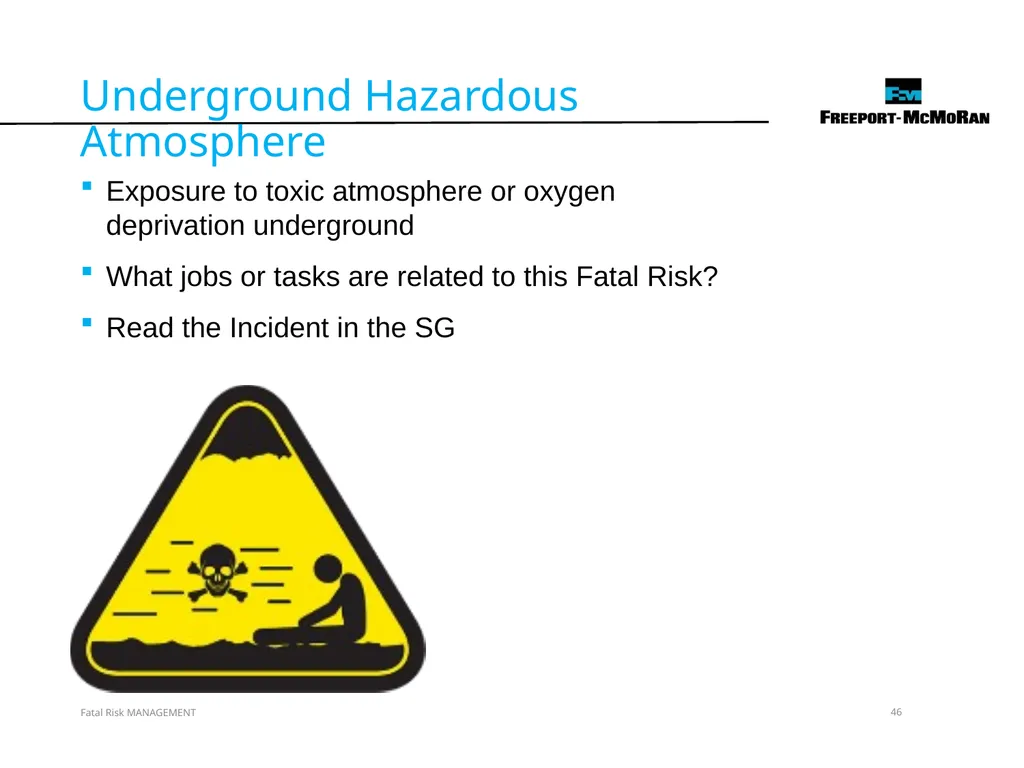
slide46. 46 Exposure to toxic atmosphere or oxygen deprivation underground
What jobs or tasks are related to this Fatal Risk?
Read the Incident in the SG Underground Hazardous Atmosphere Fatal Risk MANAGEMENT<br>
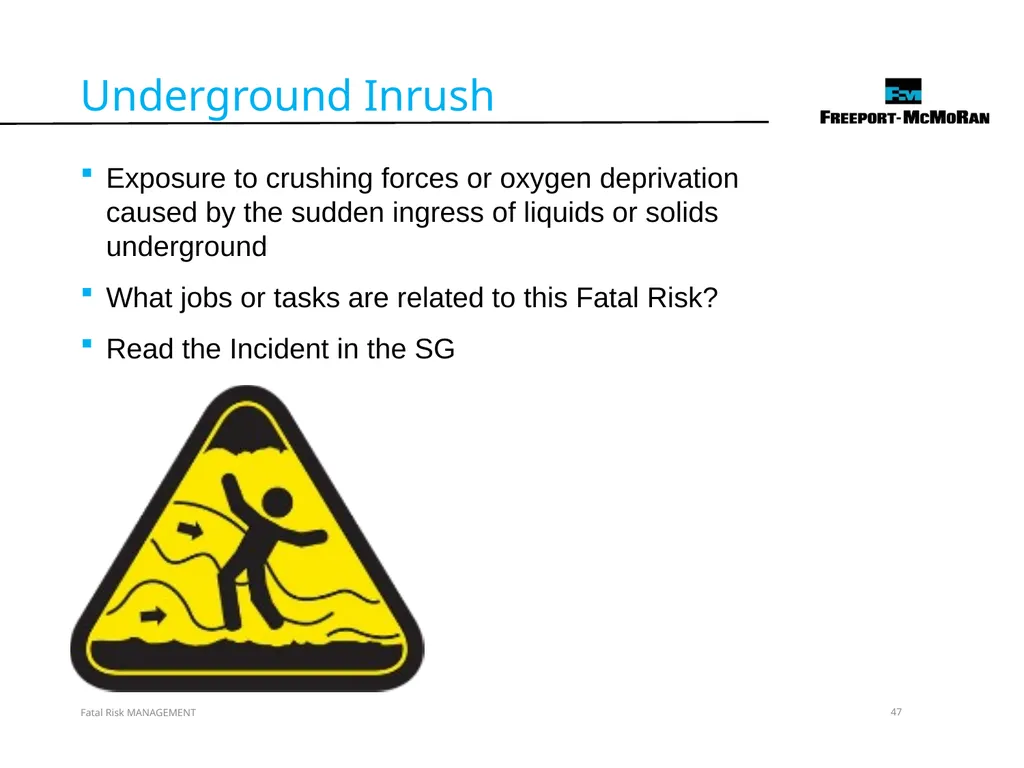
slide47. 47 Exposure to crushing forces or oxygen deprivation caused by the sudden ingress of liquids or solids underground
What jobs or tasks are related to this Fatal Risk?
Read the Incident in the SG Underground Inrush Fatal Risk MANAGEMENT<br>
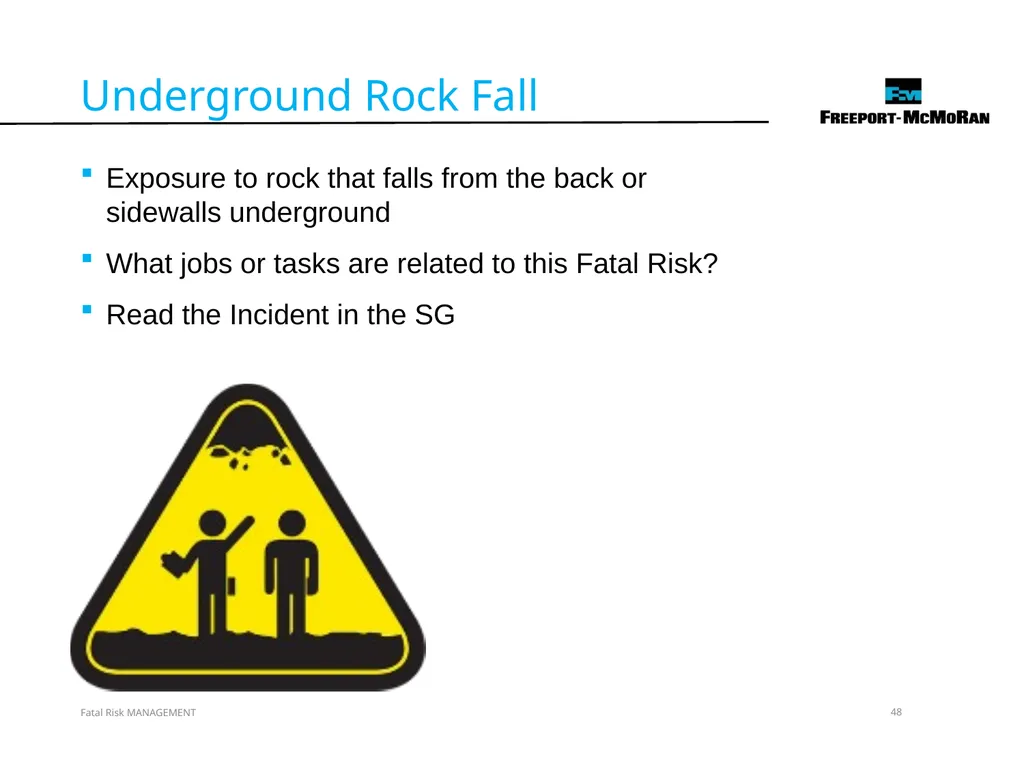
slide48. 48 Exposure to rock that falls from the back or sidewalls underground
What jobs or tasks are related to this Fatal Risk?
Read the Incident in the SG Underground Rock Fall Fatal Risk MANAGEMENT<br>
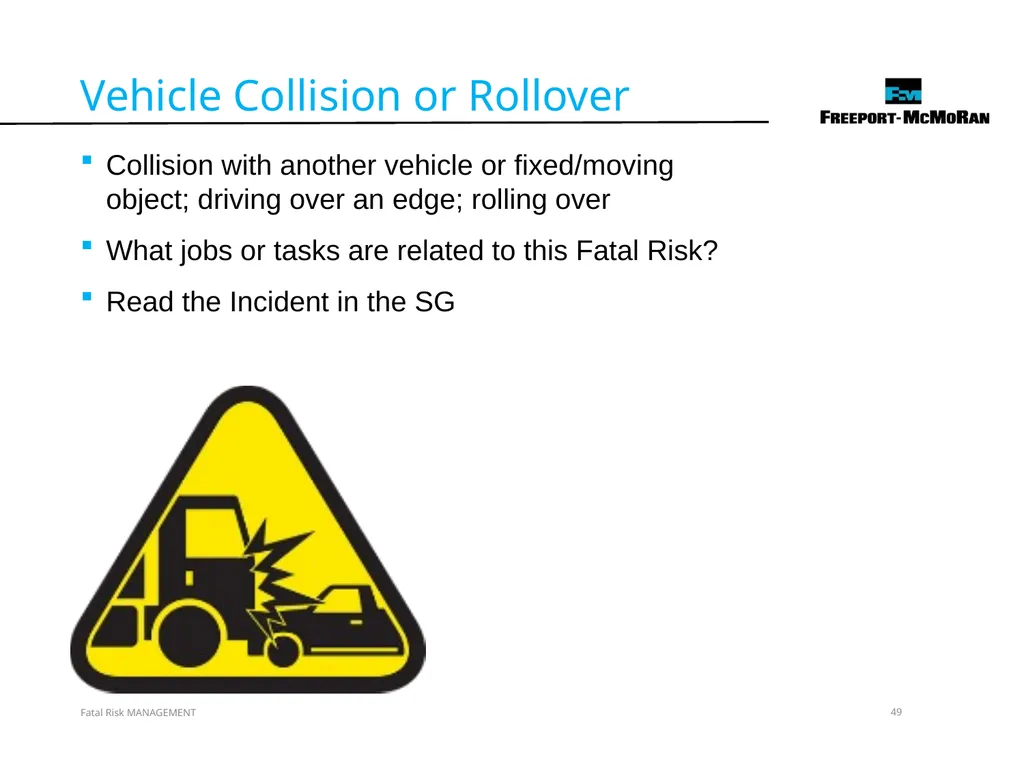
slide49. 49 Collision with another vehicle or fixed/moving object; driving over an edge; rolling over
What jobs or tasks are related to this Fatal Risk?
Read the Incident in the SG Vehicle Collision or Rollover Fatal Risk MANAGEMENT<br>
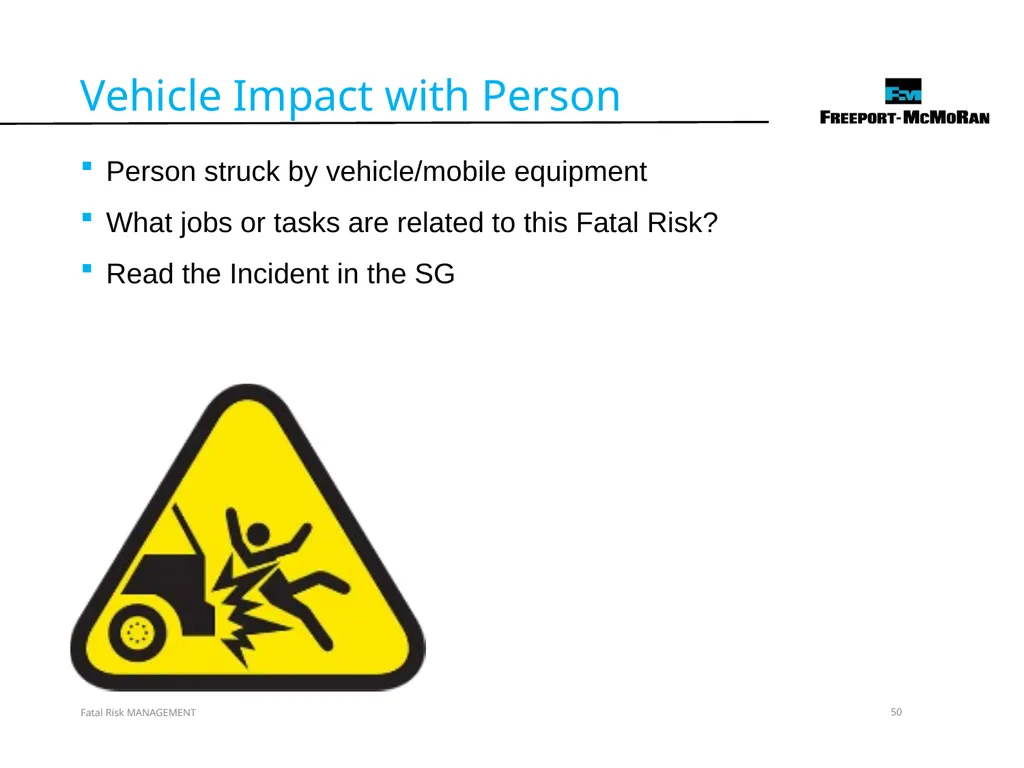
slide50. 50 Person struck by vehicle/mobile equipment
What jobs or tasks are related to this Fatal Risk?
Read the Incident in the SG Vehicle Impact with Person Fatal Risk MANAGEMENT<br>
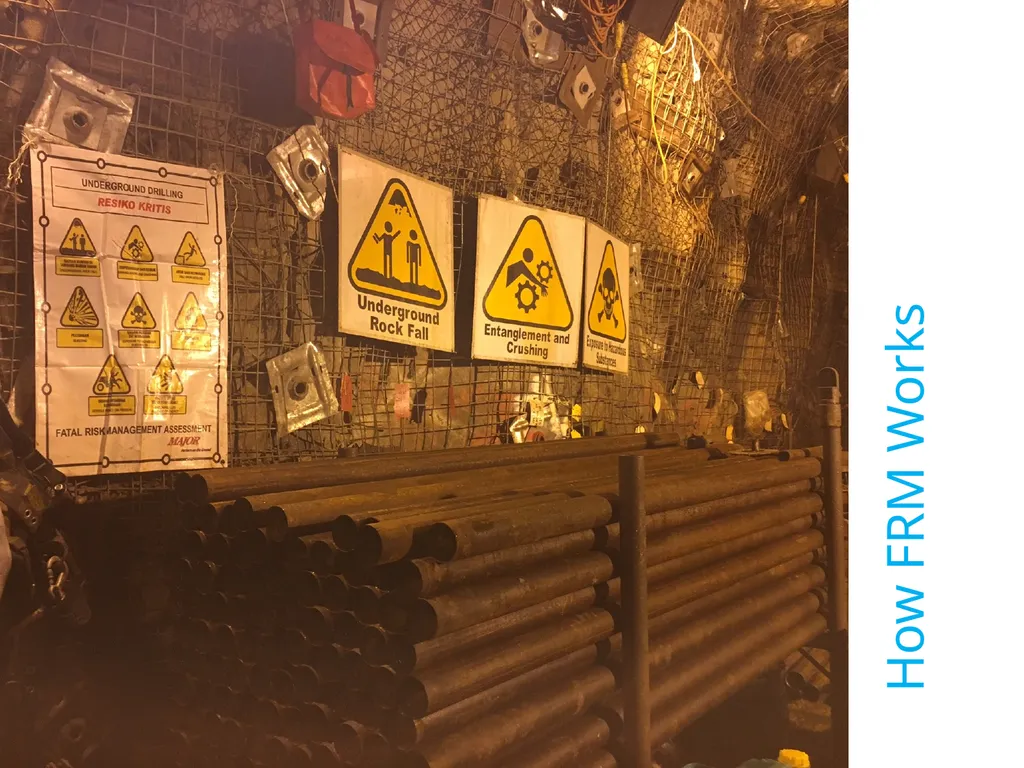
slide51. How FRM Works<br>
slide52. 52 What are some of the tools we use in the field to plan work?
SOP
JSA
Risk assessment
Work instruction
The Fatal Risk Management system can combine and eliminate some of the repetition How FRM Works Toolbox Talk
Critical Control Audits
Field Verifications
Others? Fatal Risk MANAGEMENT<br>
slide53. 53 Watch the video to see utilization of the FRM tools
Think of ways you can implement some of the ideas at your property How FRM Works Fatal Risk MANAGEMENT https://web.microsoftstream.com/video/29b89c5f-1a6c-408f-a743-ed410e14f6a9<br>
slide54. 54 Fatal Risk Management tools
Icons
Cority System
Verification questions
Supervisors can use these tools to
Enhance tailgate meetings
Improve field verification of Critical Controls
Empower employees to stop work How FRM Works Fatal Risk MANAGEMENT<br>
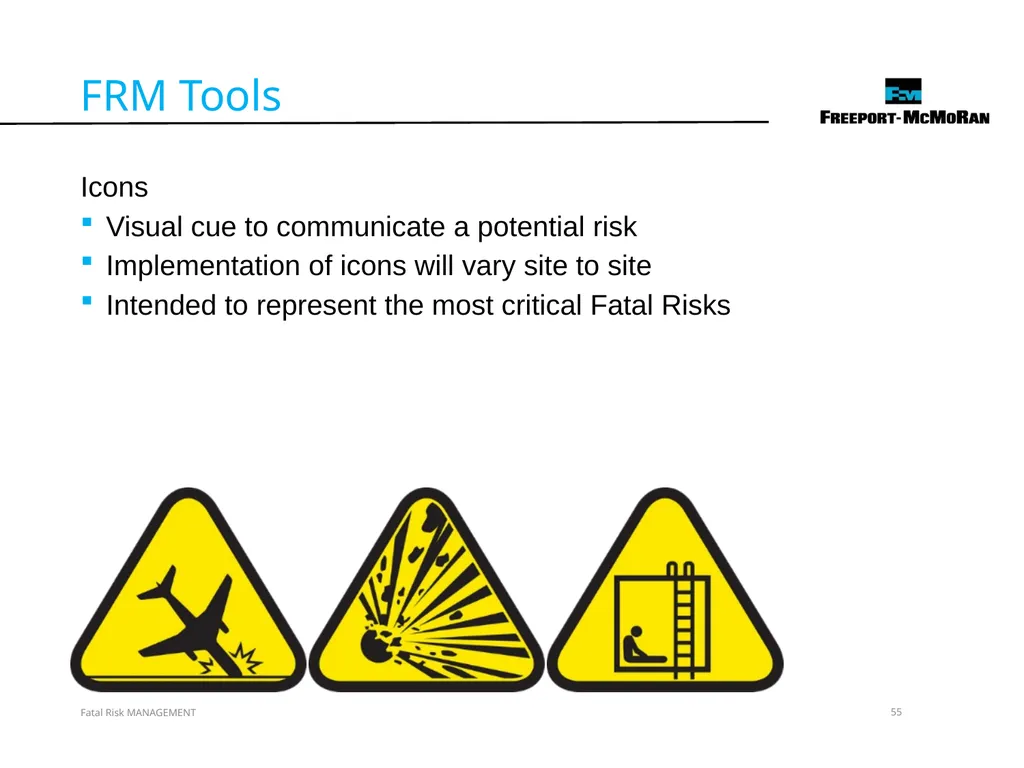
slide55. 55 Icons
Visual cue to communicate a potential risk
Implementation of icons will vary site to site
Intended to represent the most critical Fatal Risks FRM Tools Fatal Risk MANAGEMENT<br>
slide56. 56 Verification Questions
Tasks can have multiple Fatal Risks
As an operator, the verification questions help identify if appropriate controls are in place and effective
Supervisors can use the verification questions to help prioritize their time in the field FRM Tools Fatal Risk MANAGEMENT<br>
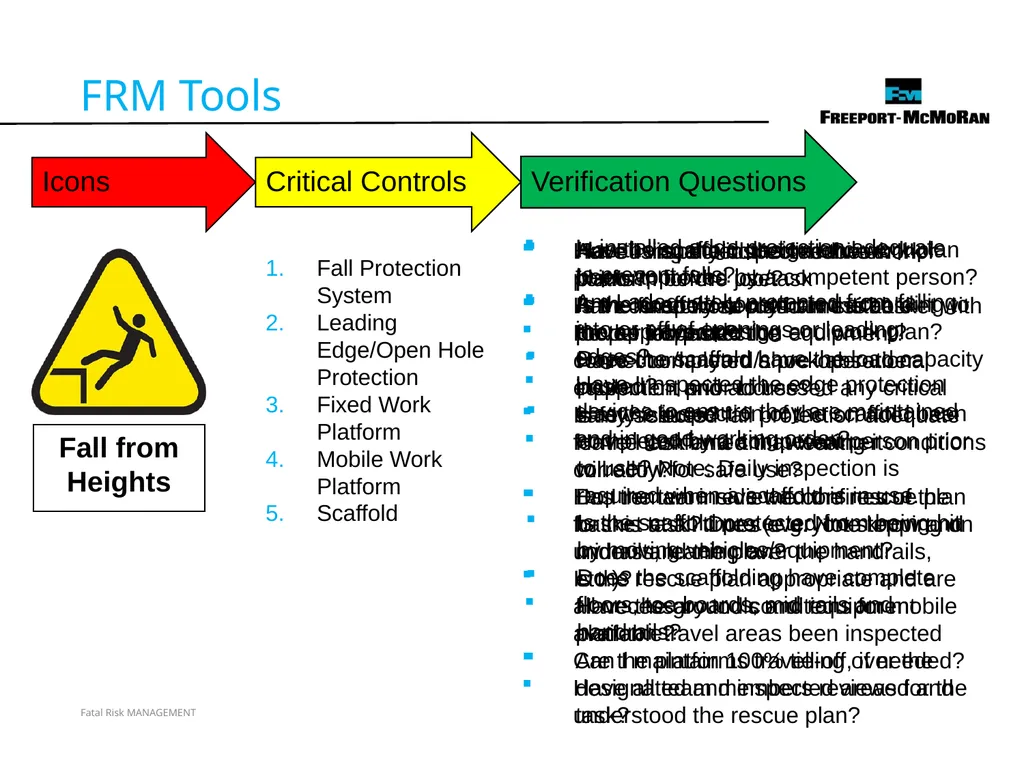
slide57. FRM Tools Verification Questions Icons Critical Controls Have I visually inspected the anchor points?
Have I inspected my harness?
Have I inspected the connector/lanyard/shock absorber equipment prior to use?
Is my selected fall protection adequate for the task and am I wearing it correctly?
Has the team reviewed the rescue plan for this task? Does everyone know and understand the plan?
Is the rescue plan appropriate and are all necessary tools and equipment available?
Can I maintain 100% tie-off, if needed?
Have all team members reviewed and understood the rescue plan? Fall Protection System
Leading Edge/Open Hole Protection
Fixed Work Platform
Mobile Work Platform
Scaffold Is installed edge protection adequate to prevent falls?
Am I adequately protected from falling into or off of openings or leading edges?
Have I inspected the edge protection devices to ensure they are maintained and in good working order? Have I inspected the fixed work platform before use?
Is the fixed work platform suitable for the job/task? Fatal Risk MANAGEMENT Am I using the correct mobile work platform for the job/task
Am I correctly secured in the basket with proper fall protection equipment?
Have I completed a pre-operational inspection and addressed any critical safety issues?
Have I confirmed that weather conditions will allow for safe use?
Do I remain inside the confines of the basket at all times (e.g. Not stepping on midrails, leaning over the handrails, etc.)?
Have the ground conditions for mobile platform travel areas been inspected
Are the platforms travelling over the designated and inspected areas for the task? Has the scaffold design and work plan been approved by a competent person?
Is the scaffold constructed according to the approved design and work plan?
Does the scaffold have the load capacity posted?
Has the inspection of the scaffold been completed by a competent person prior to use? Note: Daily inspection is required when a scaffold is in use.
Is the scaffold protected from being hit by moving vehicles/equipment?
Does the scaffolding have complete floors, toe boards, mid rails and handrails?<br>
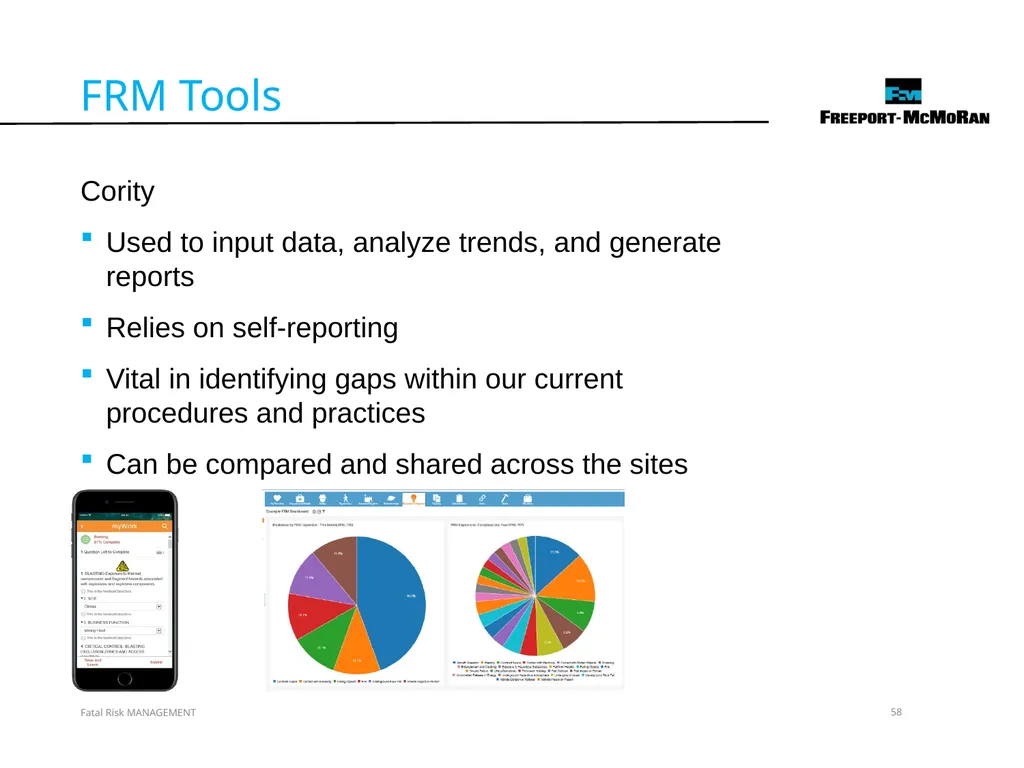
slide58. 58 Cority
Used to input data, analyze trends, and generate reports
Relies on self-reporting
Vital in identifying gaps within our current procedures and practices
Can be compared and shared across the sites FRM Tools Fatal Risk MANAGEMENT<br>
slide59. 59 Application of the Tools
Each location will implement the tools in a way most effective for their employees
Possible suggestions
Laminating checklists
Displaying posters
Creating icon stickers/magnets
Building notebooks with relevant checklists
Key to success is to educate and communicate FRM Tools Fatal Risk MANAGEMENT<br>
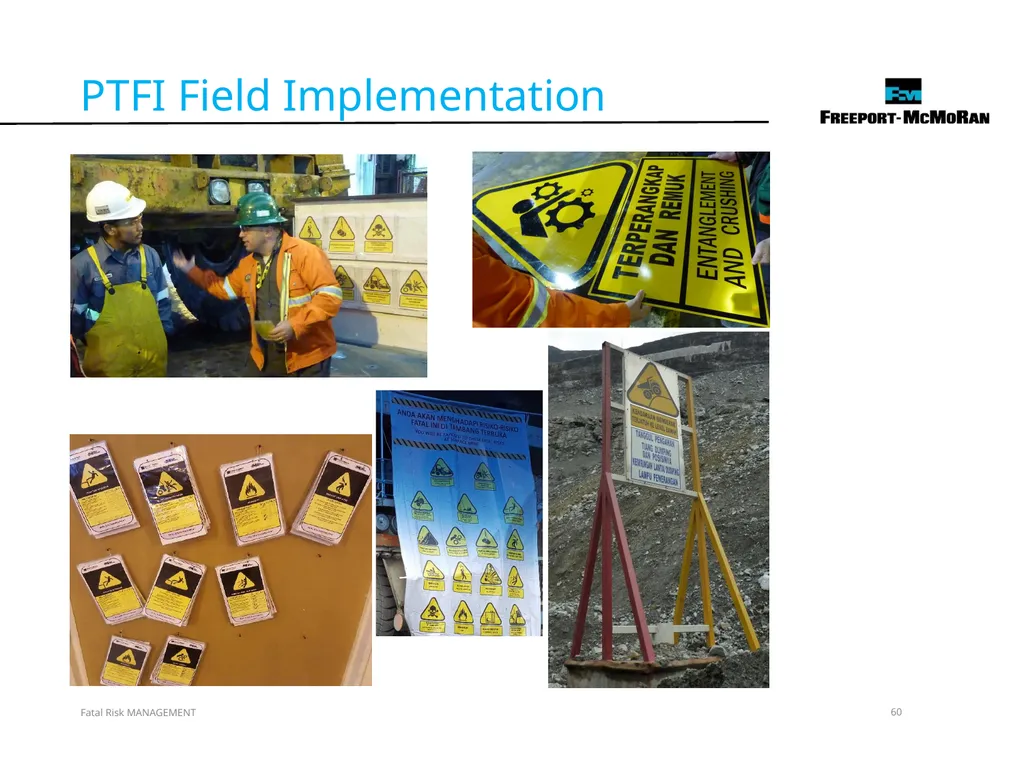
slide60. 60 PTFI Field Implementation Fatal Risk MANAGEMENT<br>
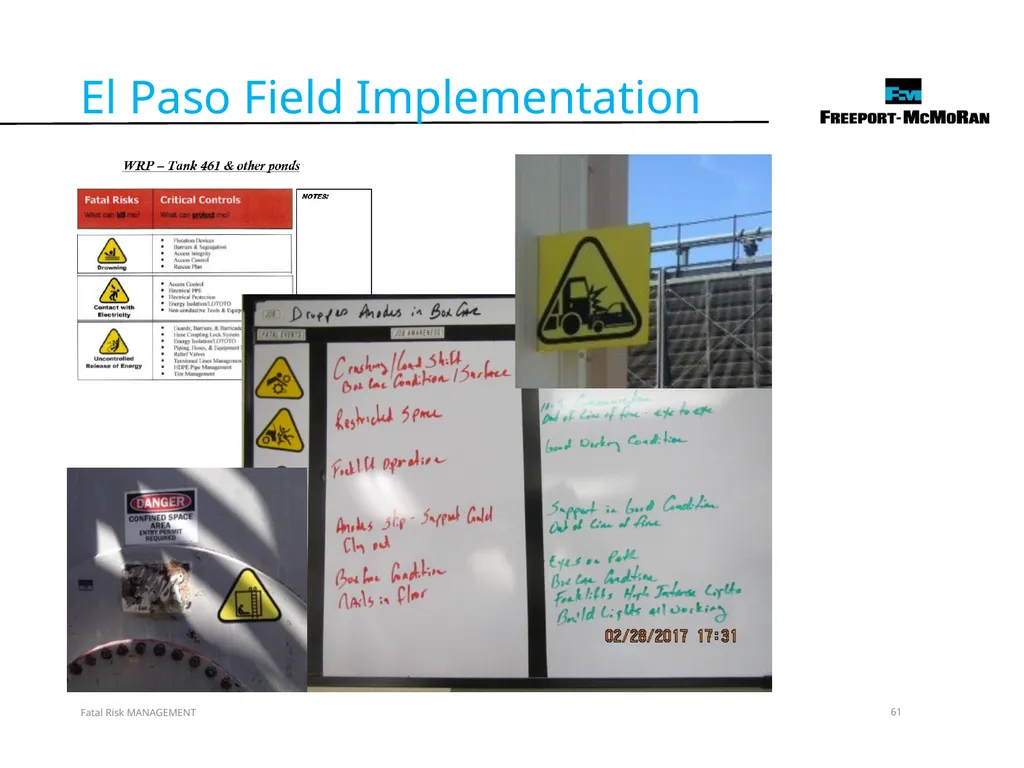
slide61. 61 El Paso Field Implementation Fatal Risk MANAGEMENT<br>
slide62. 62 Each Fatal Risk has a set of Critical Controls that should be known by all applicable employees
The Critical Controls must be in place prior to beginning work
If a Critical Control is missing or not working, immediately stop the job until controls are implemented
Prioritization can take many forms; should not be limited to only those tasks that are more controlled by behavior FRM Expectations Fatal Risk MANAGEMENT<br>
slide63. 63 All approved FRM material is found on the DOHS SharePoint site
Utilize only approved icons and verification questions in the field
Be creative with how they are utilized but remember overuse can make them ineffective
Do not modify or add verification questions unless approved by DOHS FRM Expectations Fatal Risk MANAGEMENT<br>
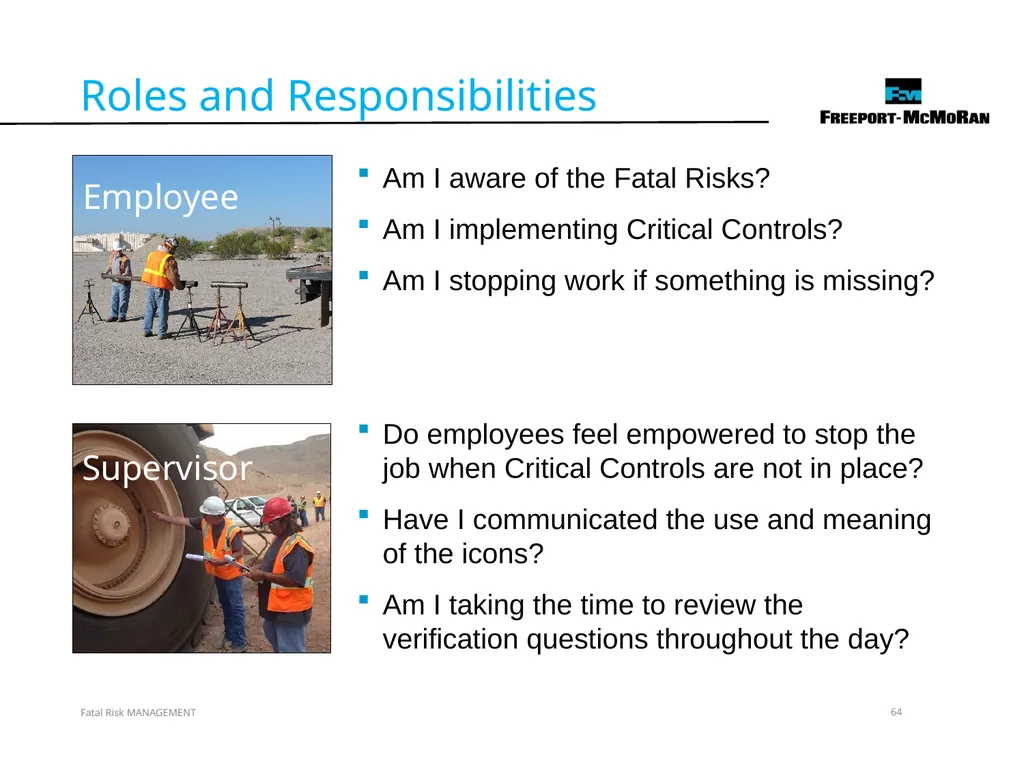
slide64. 64 Am I aware of the Fatal Risks?
Am I implementing Critical Controls?
Am I stopping work if something is missing?
Do employees feel empowered to stop the job when Critical Controls are not in place?
Have I communicated the use and meaning of the icons?
Am I taking the time to review the verification questions throughout the day? Roles and Responsibilities Fatal Risk MANAGEMENT Employee Supervisor<br>
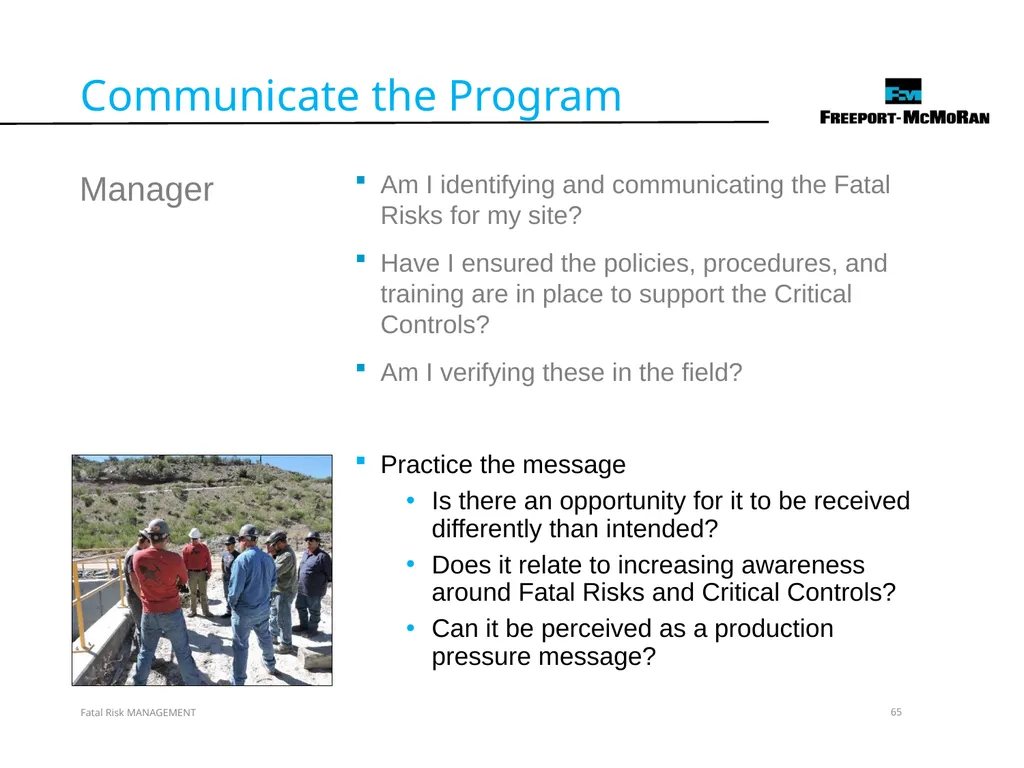
slide65. 65 Am I identifying and communicating the Fatal Risks for my site?
Have I ensured the policies, procedures, and training are in place to support the Critical Controls?
Am I verifying these in the field?
Practice the message
Is there an opportunity for it to be received differently than intended?
Does it relate to increasing awareness around Fatal Risks and Critical Controls?
Can it be perceived as a production pressure message? Communicate the Program Fatal Risk MANAGEMENT Manager<br>
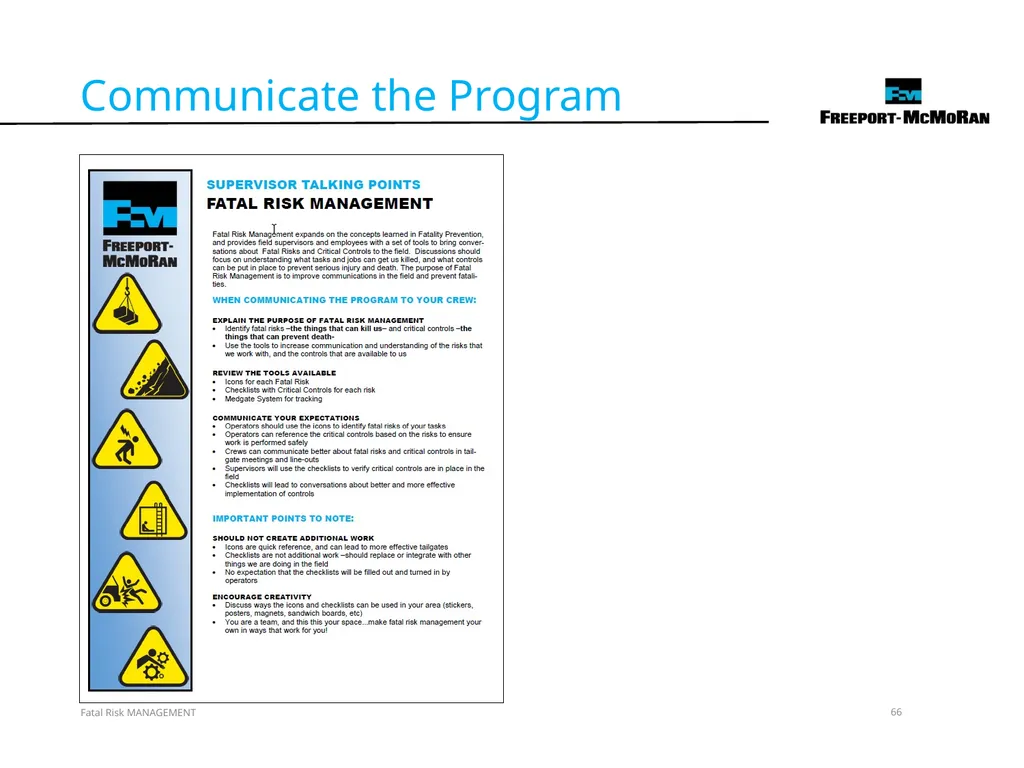
slide66. 66 There are many ways that you can further develop the tools to maintain communication
Supervisor Talking Points
Overall summary of the training
Purpose of the training
Expectations for before/after employee attends Communicate the Program Fatal Risk MANAGEMENT<br>
slide67. Activity 3 Directions
Break into groups
Review each photo on the worksheet in the SG
Use the Fatal Risk icons in the SG, to determine which Fatal Risks are present for that job and choose the appropriate icon(s). Remember that tasks/jobs can have multiple Fatal Risks
You have 5 minutes to complete
Be prepared to share your responses Identifying Fatal Risks Fatal Risk MANAGEMENT<br>
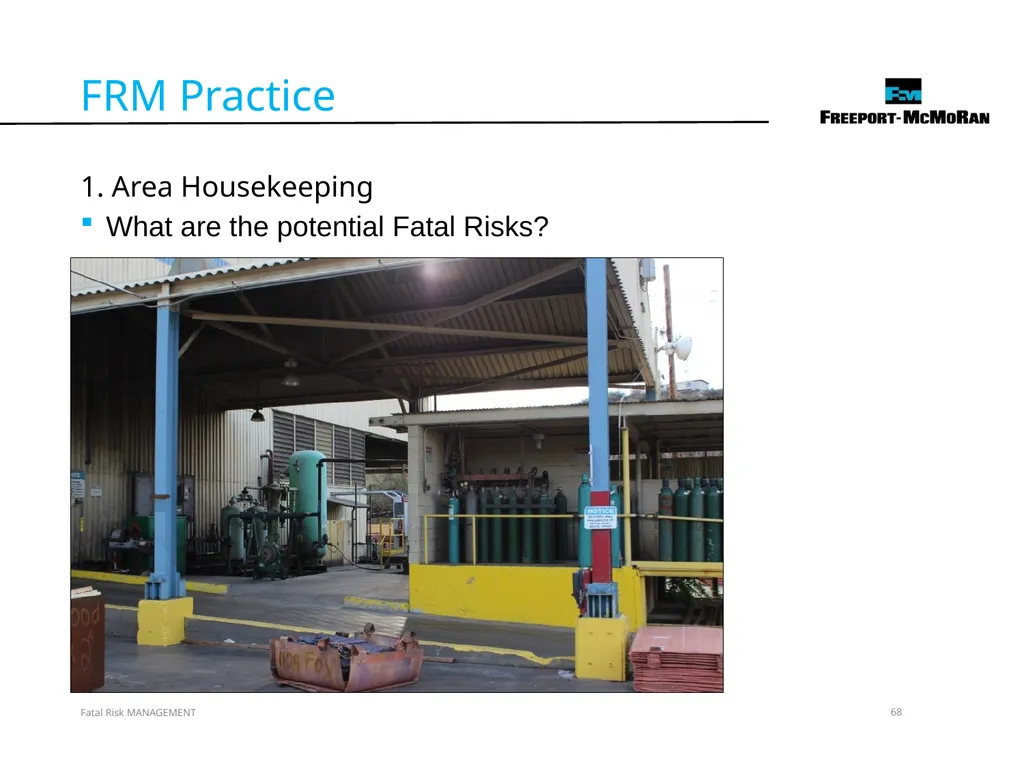
slide68. 68 1. Area Housekeeping
What are the potential Fatal Risks? FRM Practice Fatal Risk MANAGEMENT<br>
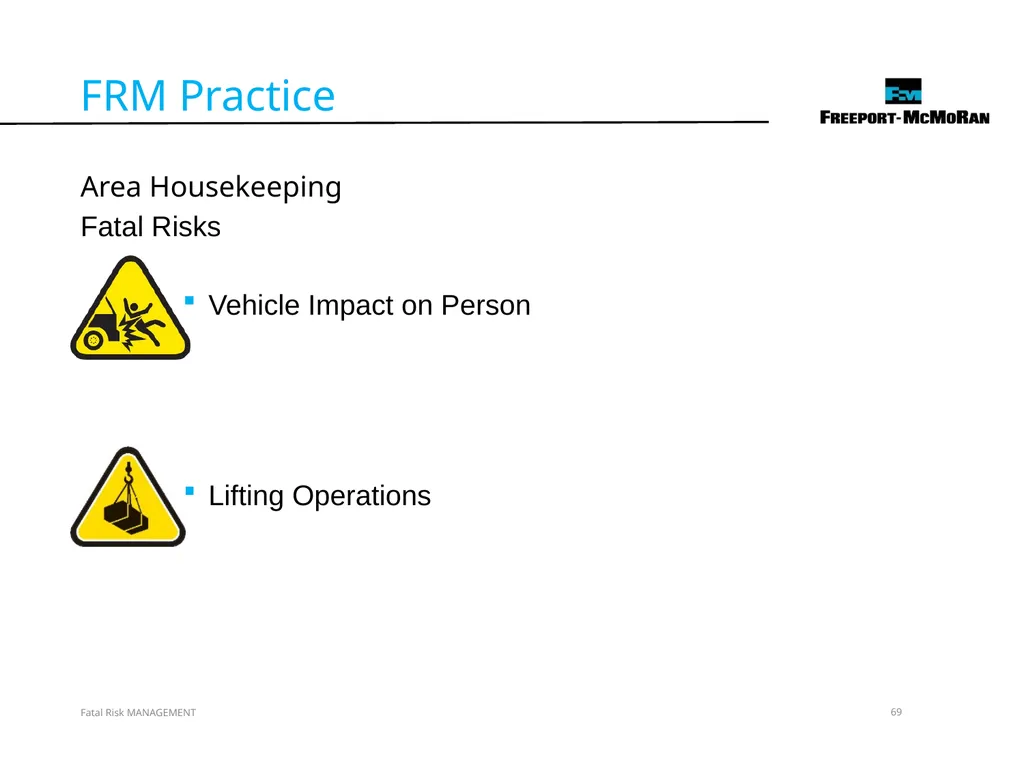
slide69. 69 Area Housekeeping
Fatal Risks
Vehicle Impact on Person
Lifting Operations FRM Practice Fatal Risk MANAGEMENT<br>
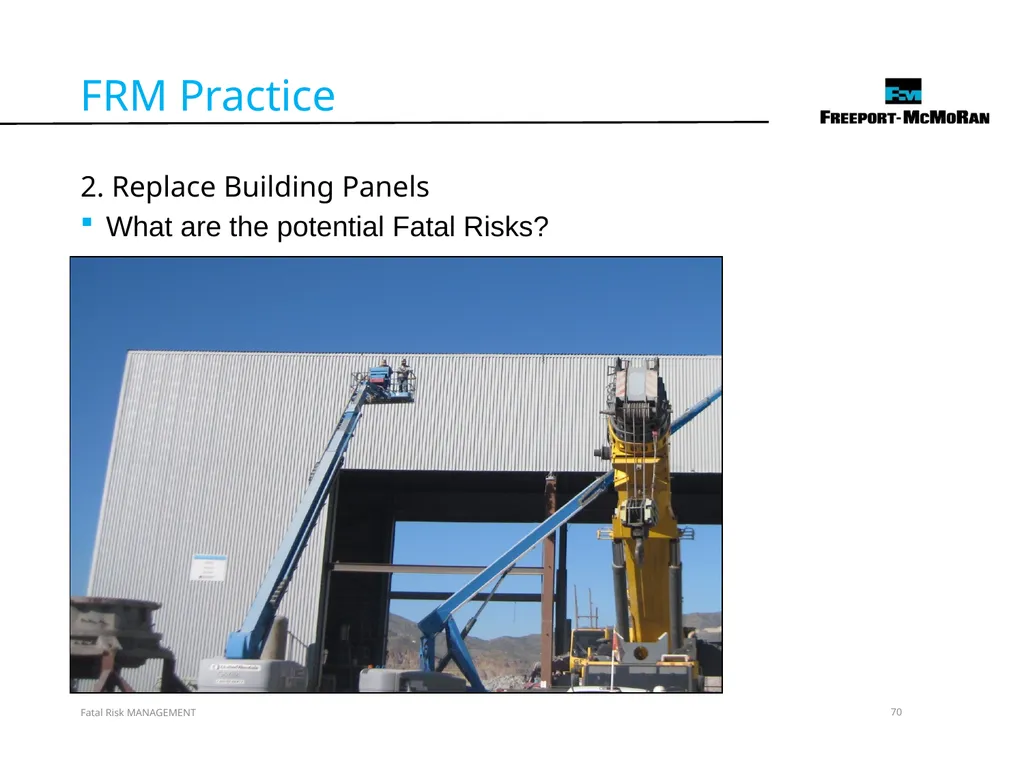
slide70. 70 2. Replace Building Panels
What are the potential Fatal Risks? FRM Practice Fatal Risk MANAGEMENT<br>
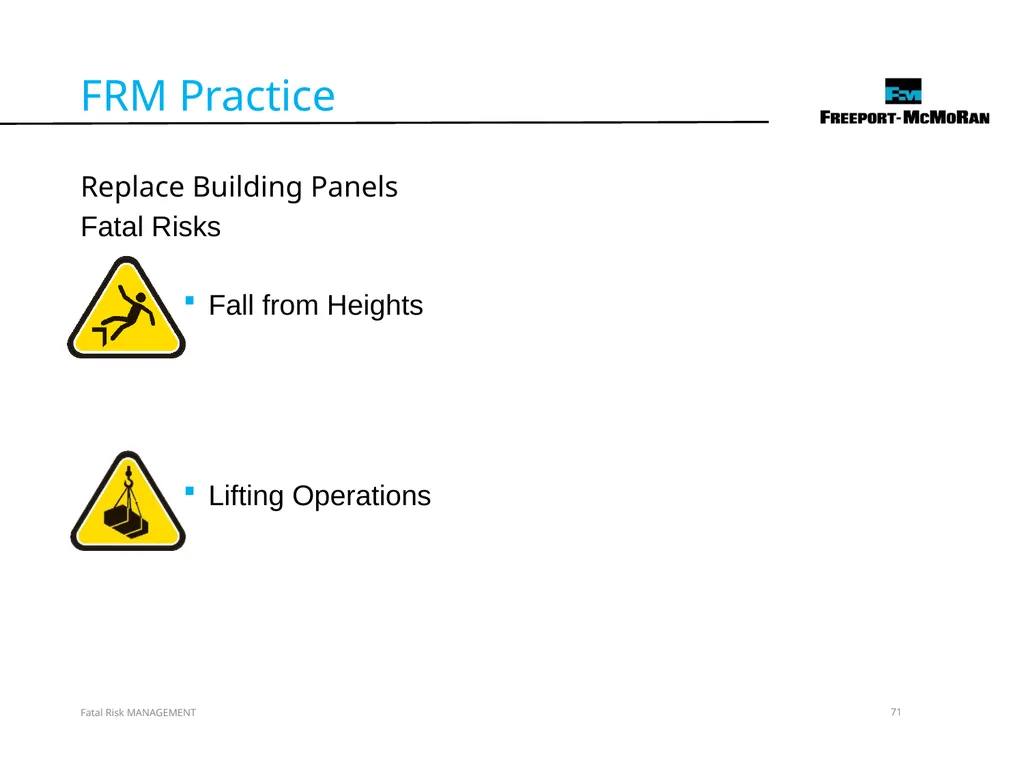
slide71. 71 Replace Building Panels
Fatal Risks
Fall from Heights
Lifting Operations FRM Practice Fatal Risk MANAGEMENT<br>
slide72. Activity 4 Directions
Continue working in groups
Review each photo on the worksheet in the SG
Use the Fatal Risk and Critical Control pages in the SG to determine which Fatal Risks are present for that job and choose the appropriate icon(s). Remember that tasks/jobs can have multiple Fatal Risks
List the Critical Controls
You have 10 minutes to complete
Be prepared to share your responses Fatal Risk MANAGEMENT Fatal Risks and Critical Controls Part Two<br>
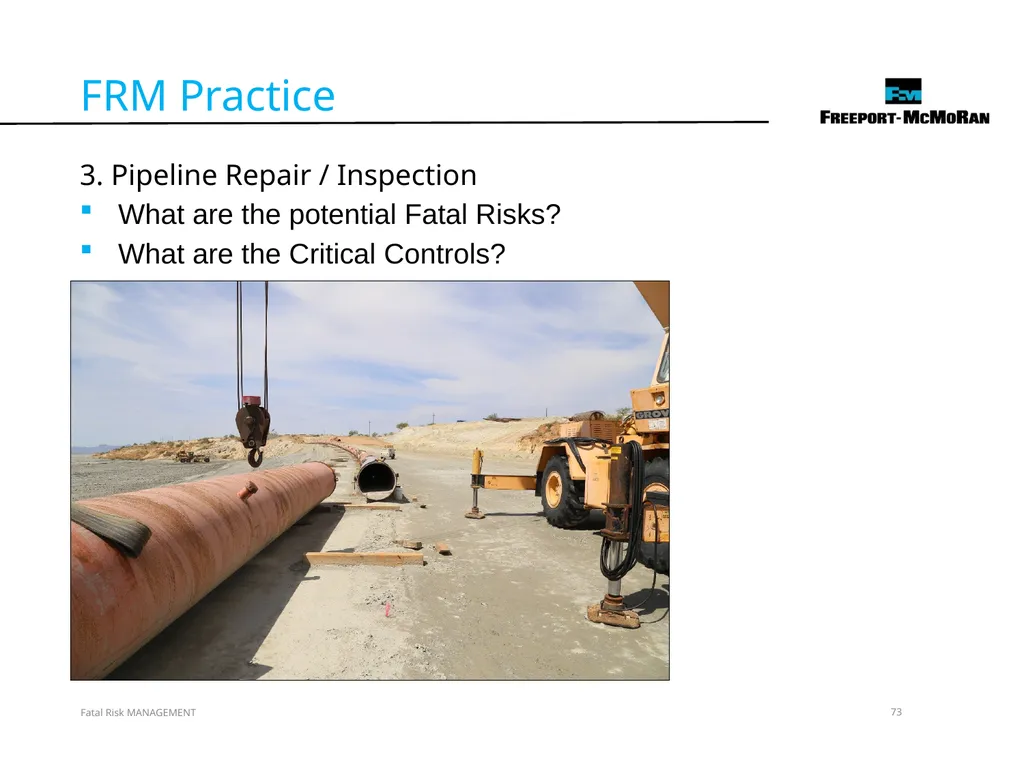
slide73. 73 3. Pipeline Repair / Inspection
What are the potential Fatal Risks?
What are the Critical Controls? FRM Practice Fatal Risk MANAGEMENT<br>
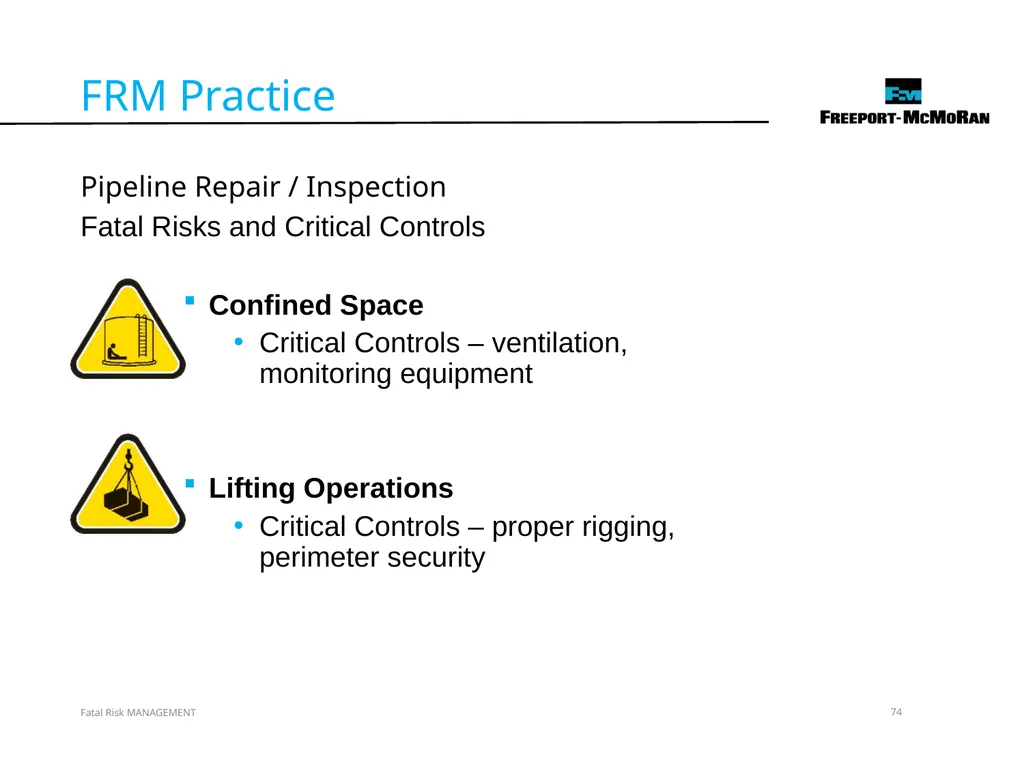
slide74. 74 Pipeline Repair / Inspection
Fatal Risks and Critical Controls
Confined Space
Critical Controls – ventilation, monitoring equipment
Lifting Operations
Critical Controls – proper rigging, perimeter security FRM Practice Fatal Risk MANAGEMENT<br>
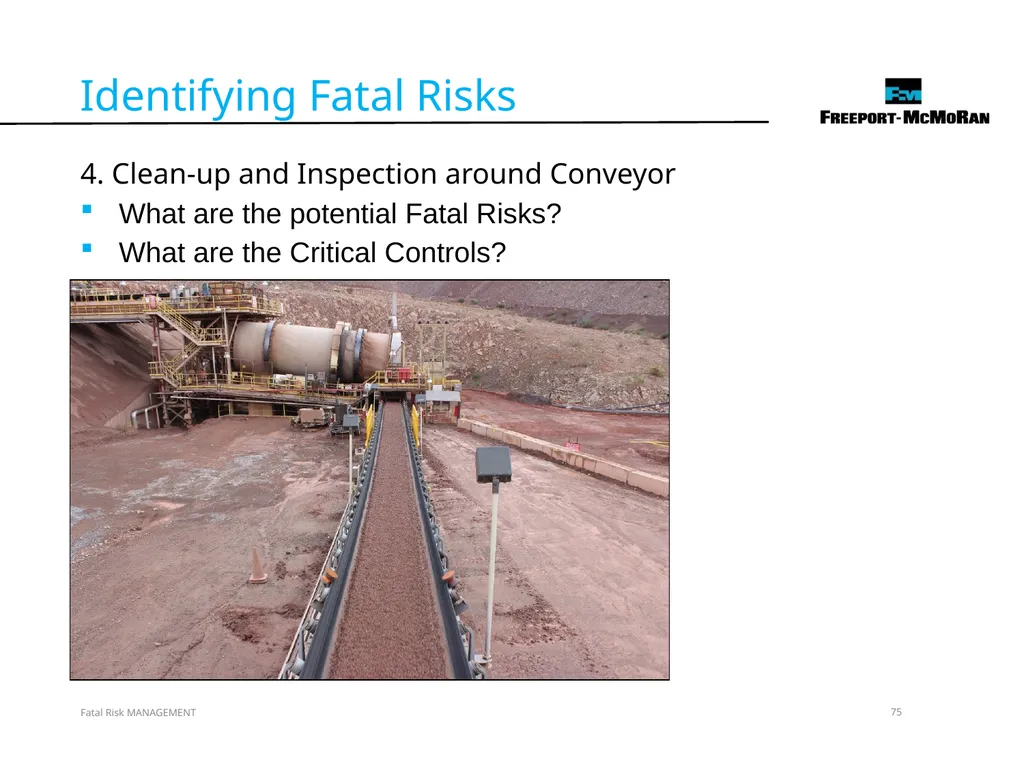
slide75. 75 4. Clean-up and Inspection around Conveyor
What are the potential Fatal Risks?
What are the Critical Controls? Identifying Fatal Risks Fatal Risk MANAGEMENT<br>
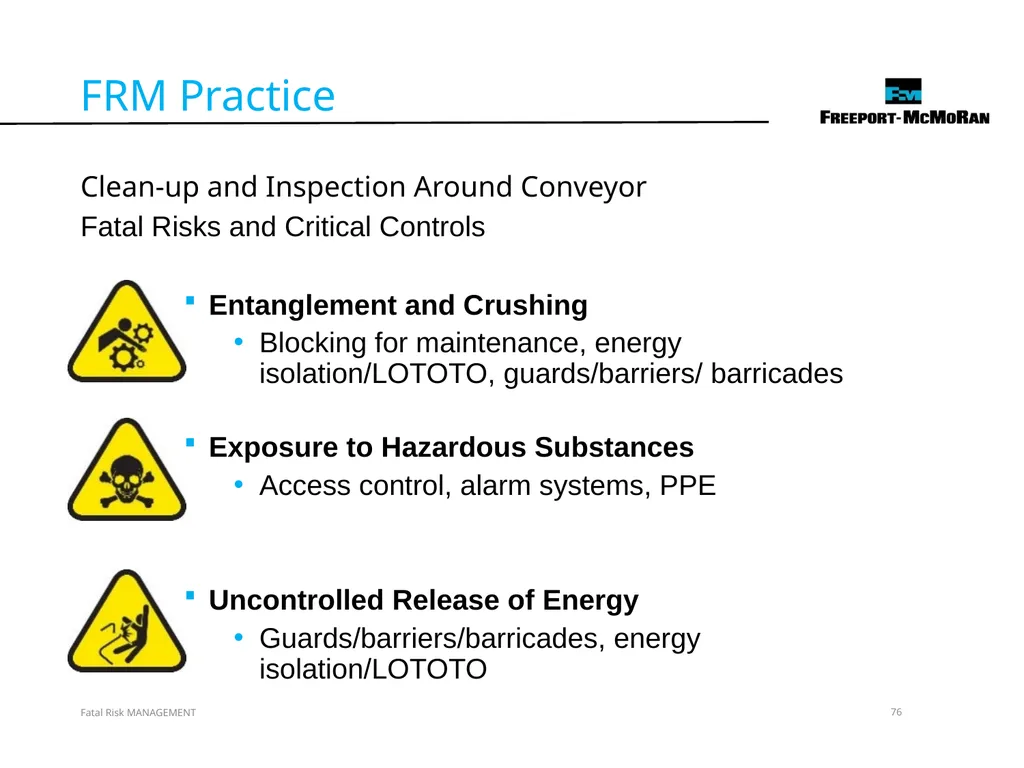
slide76. 76 Clean-up and Inspection Around Conveyor
Fatal Risks and Critical Controls
Entanglement and Crushing
Blocking for maintenance, energy isolation/LOTOTO, guards/barriers/ barricades
Exposure to Hazardous Substances
Access control, alarm systems, PPE
Uncontrolled Release of Energy
Guards/barriers/barricades, energy isolation/LOTOTO FRM Practice Fatal Risk MANAGEMENT<br>
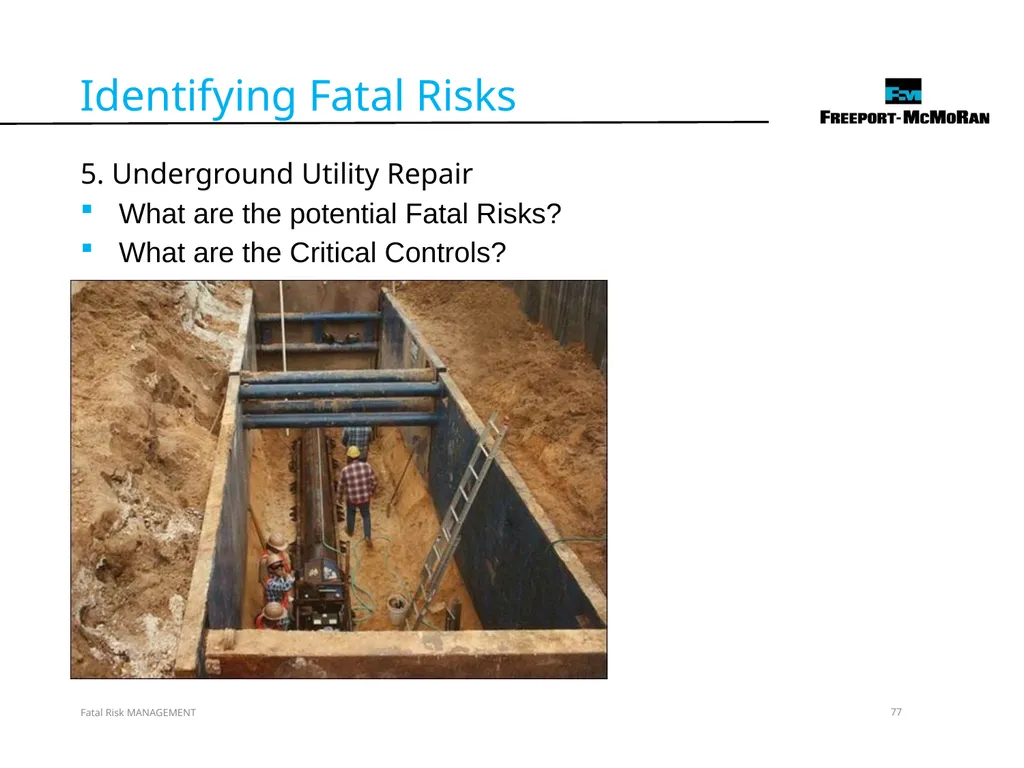
slide77. 77 5. Underground Utility Repair
What are the potential Fatal Risks?
What are the Critical Controls? Identifying Fatal Risks Fatal Risk MANAGEMENT<br>
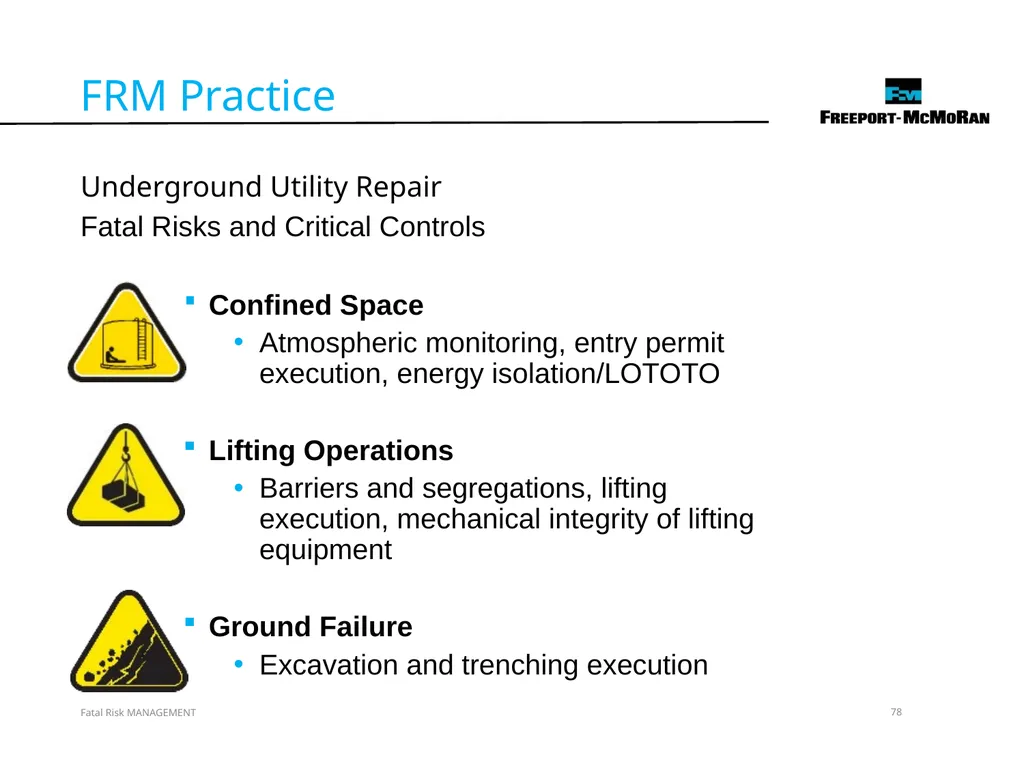
slide78. 78 Underground Utility Repair
Fatal Risks and Critical Controls
Confined Space
Atmospheric monitoring, entry permit execution, energy isolation/LOTOTO
Lifting Operations
Barriers and segregations, lifting execution, mechanical integrity of lifting equipment
Ground Failure
Excavation and trenching execution FRM Practice Fatal Risk MANAGEMENT<br>
slide79. Activity 5 Directions
In the same group, review each photo on the worksheet in the SG
Receive FRM Operator Reference Guide
Determine which Fatal Risks are present for that job and choose the appropriate icon(s). Remember that tasks/jobs can have multiple Fatal Risks
List the Critical Controls
You have 20 minutes to complete
Be prepared to share your responses Fatal Risks and Critical Controls Part Two Fatal Risk MANAGEMENT<br>
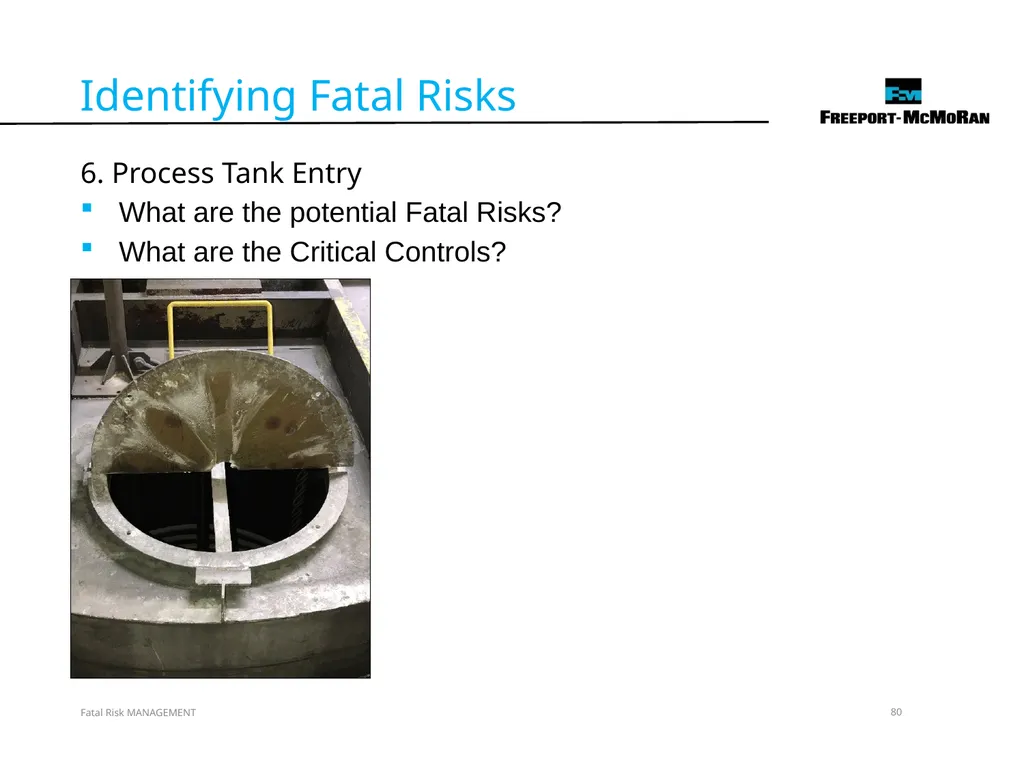
slide80. 80 6. Process Tank Entry
What are the potential Fatal Risks?
What are the Critical Controls? Identifying Fatal Risks Fatal Risk MANAGEMENT<br>
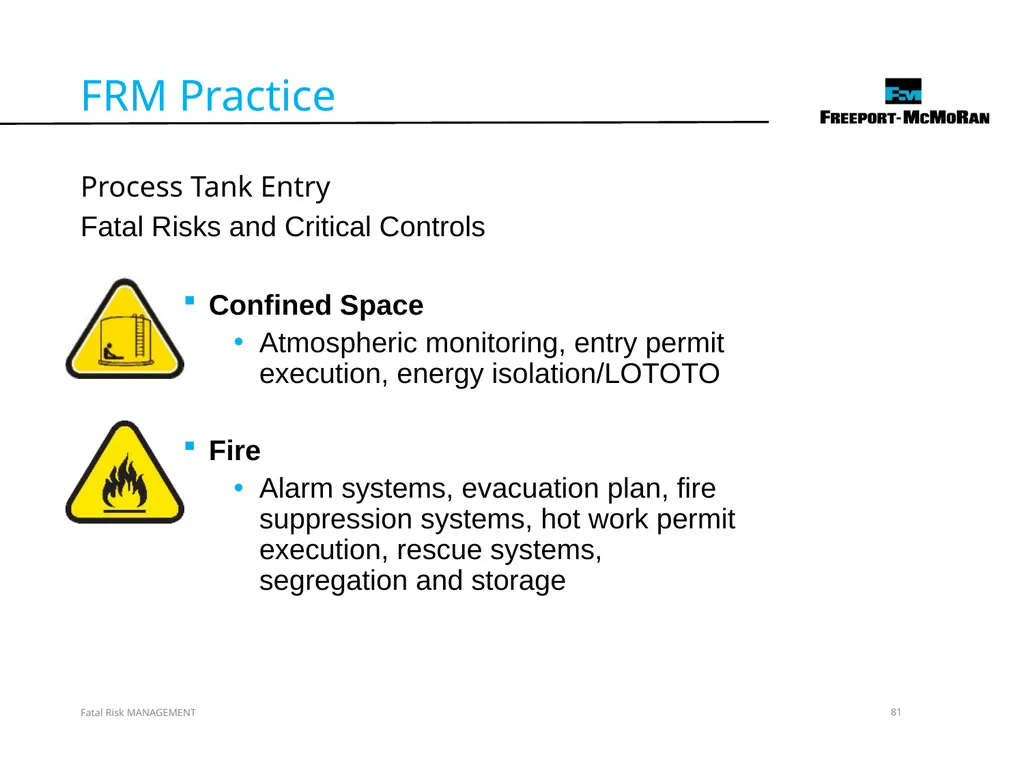
slide81. 81 Process Tank Entry
Fatal Risks and Critical Controls
Confined Space
Atmospheric monitoring, entry permit execution, energy isolation/LOTOTO
Fire
Alarm systems, evacuation plan, fire suppression systems, hot work permit execution, rescue systems, segregation and storage FRM Practice Fatal Risk MANAGEMENT<br>
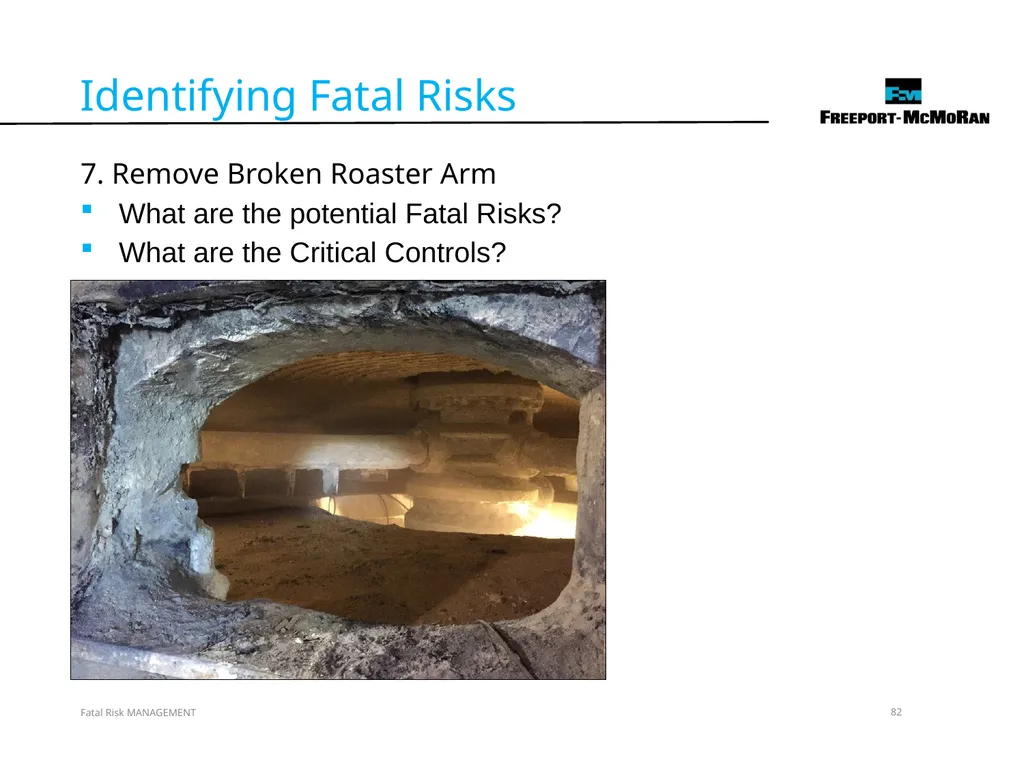
slide82. 82 7. Remove Broken Roaster Arm
What are the potential Fatal Risks?
What are the Critical Controls? Identifying Fatal Risks Fatal Risk MANAGEMENT<br>
slide83. 83 Remove Broken Roaster Arm
Fatal Risks and Critical Controls
Lifting Operations
Barriers and segregation, mechanical integrity of lifting equipment, lifting execution
Vehicle Impact on Person
Vehicle pre-operational inspection, positive communication system, segregation, signage and demarcation, fundamentally stable parking FRM Practice Fatal Risk MANAGEMENT<br>
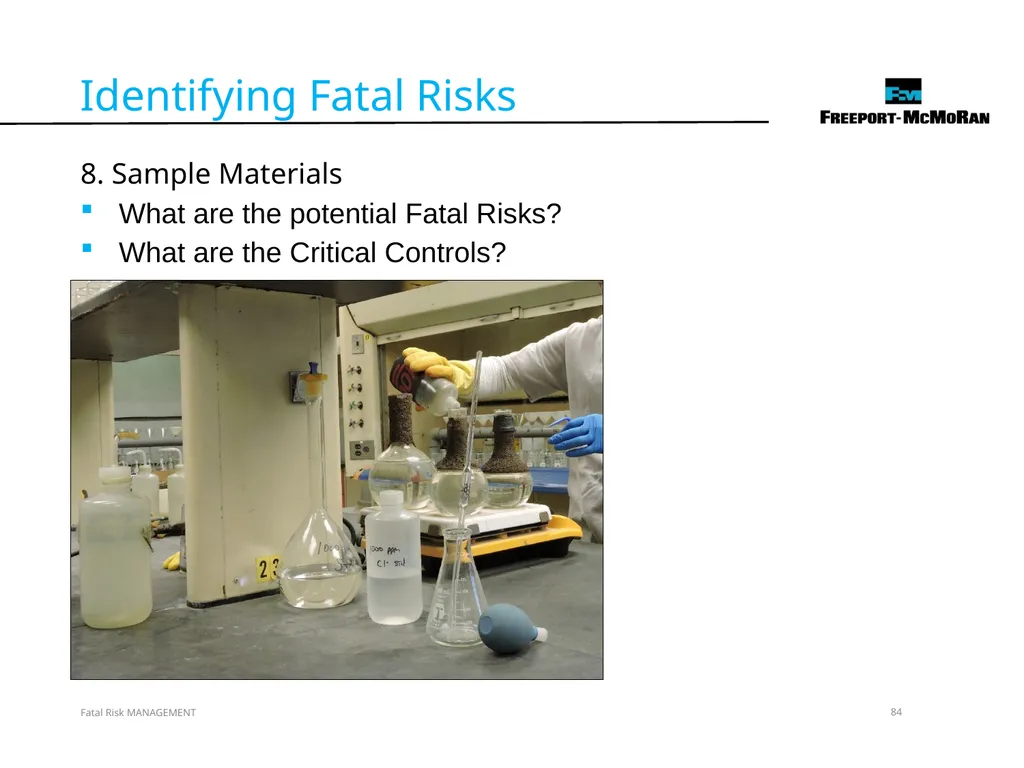
slide84. 84 8. Sample Materials
What are the potential Fatal Risks?
What are the Critical Controls? Identifying Fatal Risks Fatal Risk MANAGEMENT<br>
slide85. 85 Sample Materials
Fatal Risks and Critical Controls
Exposure to Hazardous Substances
Access control, alarm systems, engineered controls, handling requirements, loading and unloading protection, mechanical integrity of storage and distribution, PPE
Fire
Alarm systems, evacuation plan, fire suppression systems, hot work permit execution, rescue systems, segregation and storage FRM Practice Fatal Risk MANAGEMENT<br>
slide86. 86 How will these tools make you more efficient in discussing Fatal Risks and Critical Controls?
What are some other ways the tools can be used?
What do you need to help you be successful using this approach in the field? Debrief Fatal Risk MANAGEMENT<br>
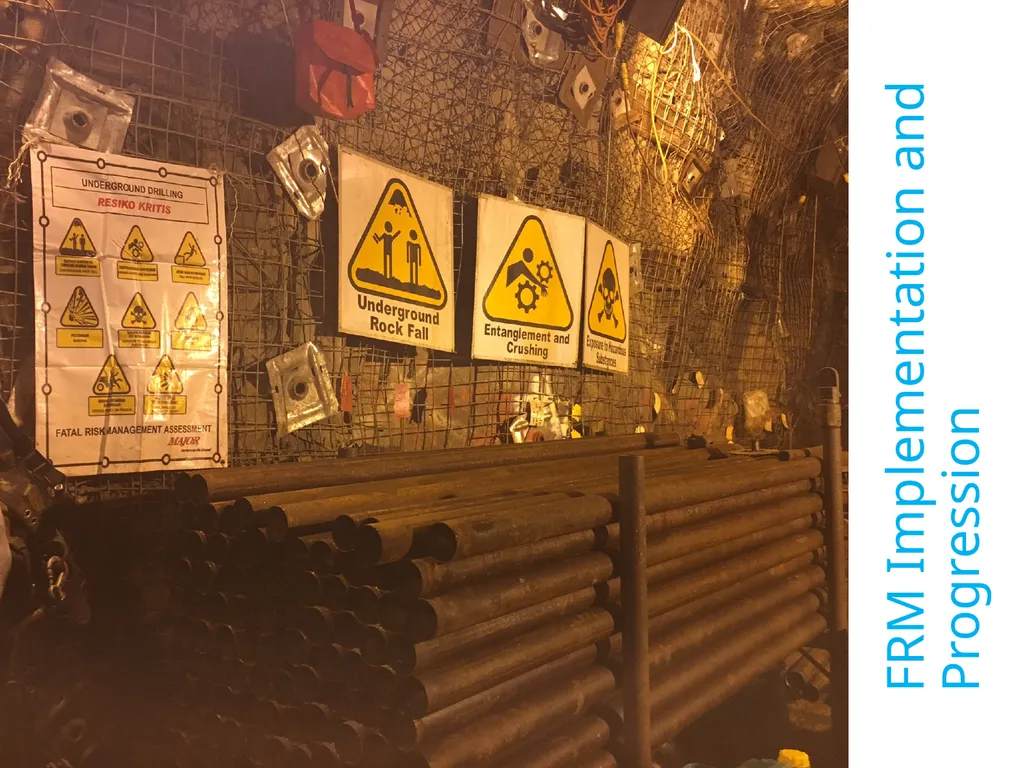
slide87. FRM Implementation and Progression<br>
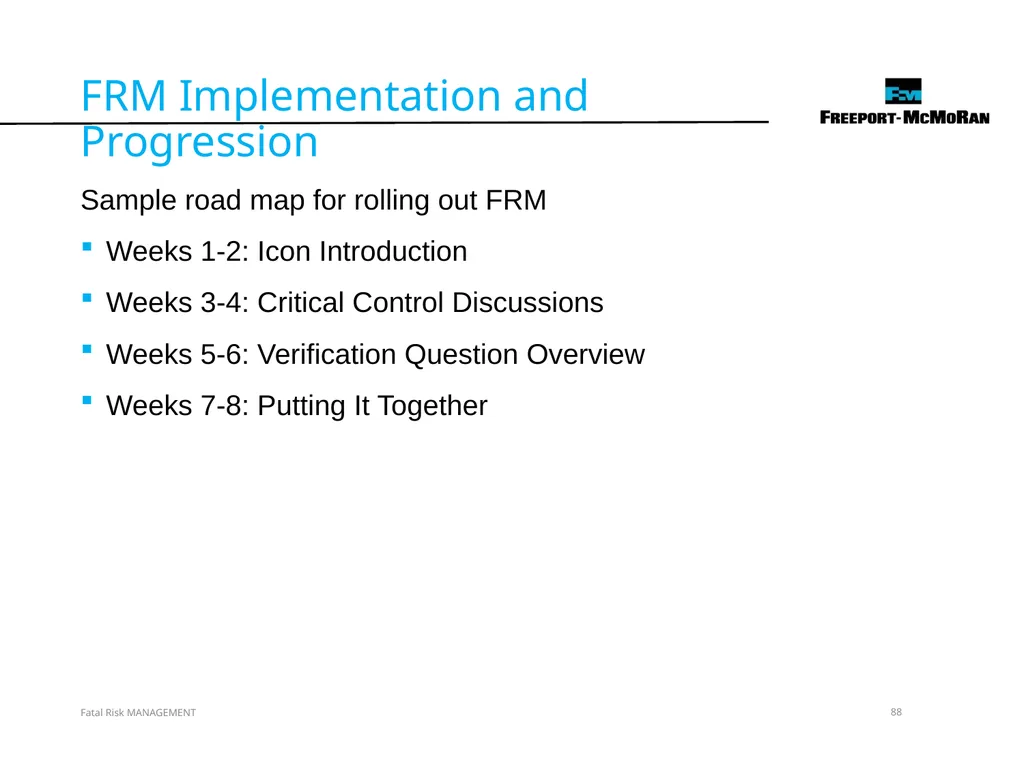
slide88. 88 Sample road map for rolling out FRM
Weeks 1-2: Icon Introduction
Weeks 3-4: Critical Control Discussions
Weeks 5-6: Verification Question Overview
Weeks 7-8: Putting It Together FRM Implementation and Progression Fatal Risk MANAGEMENT<br>
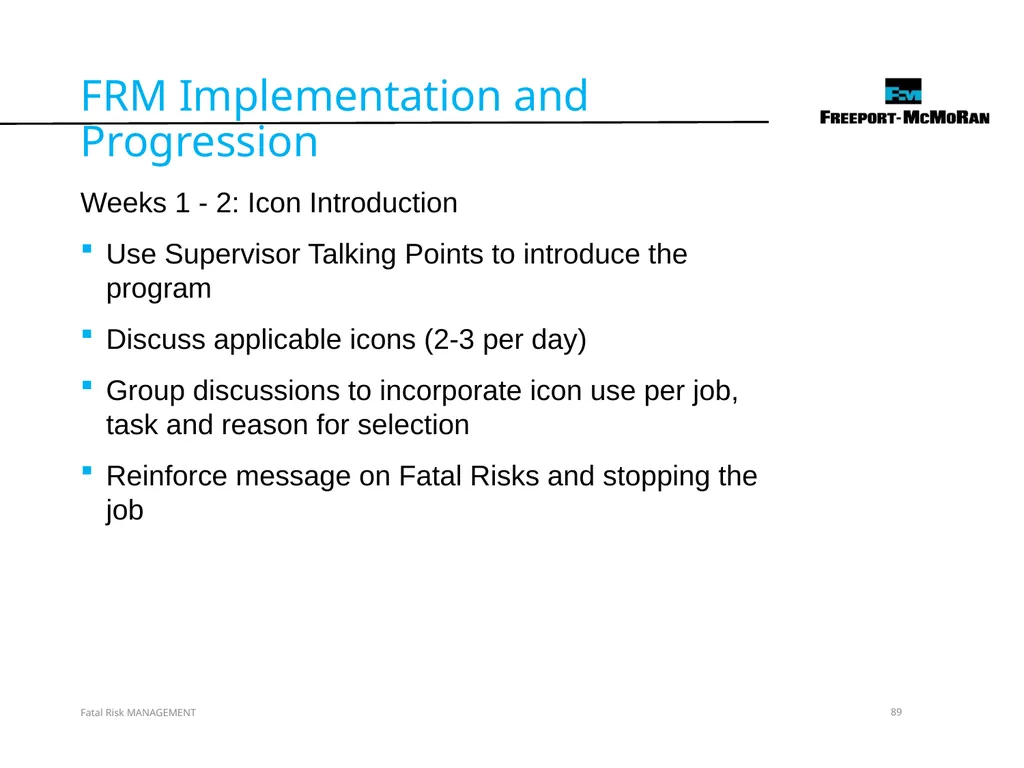
slide89. 89 Weeks 1 - 2: Icon Introduction
Use Supervisor Talking Points to introduce the program
Discuss applicable icons (2-3 per day)
Group discussions to incorporate icon use per job, task and reason for selection
Reinforce message on Fatal Risks and stopping the job FRM Implementation and Progression Fatal Risk MANAGEMENT<br>
slide90. 90 Weeks 3 - 4: Critical Control Discussions
Introduce Critical Control concepts
Group discussions around Critical Controls FRM Implementation and Progression Fatal Risk MANAGEMENT<br>
slide91. 91 Weeks 5 - 6: Verification Question Overview
Introduce verification questions
Continue discussions on Fatal Risks, icons, and Critical Controls FRM Implementation and Progression Fatal Risk MANAGEMENT<br>
slide92. 92 Weeks 7 - 8: Putting It Together
Each day, use one job or task to discuss all Fatal Risks, Critical Controls, and verification questions
Employees will lead further discussions FRM Implementation and Progression Fatal Risk MANAGEMENT<br>
slide93. Activity 6 Directions
Using the worksheet in the SG, create a tailgate or discussion explaining each of the tools
Propose at least one way that you would implement use of the icons for your crew
You have 10 minutes to complete
Be prepared to share your responses Tailgate Talk Fatal Risk MANAGEMENT<br>
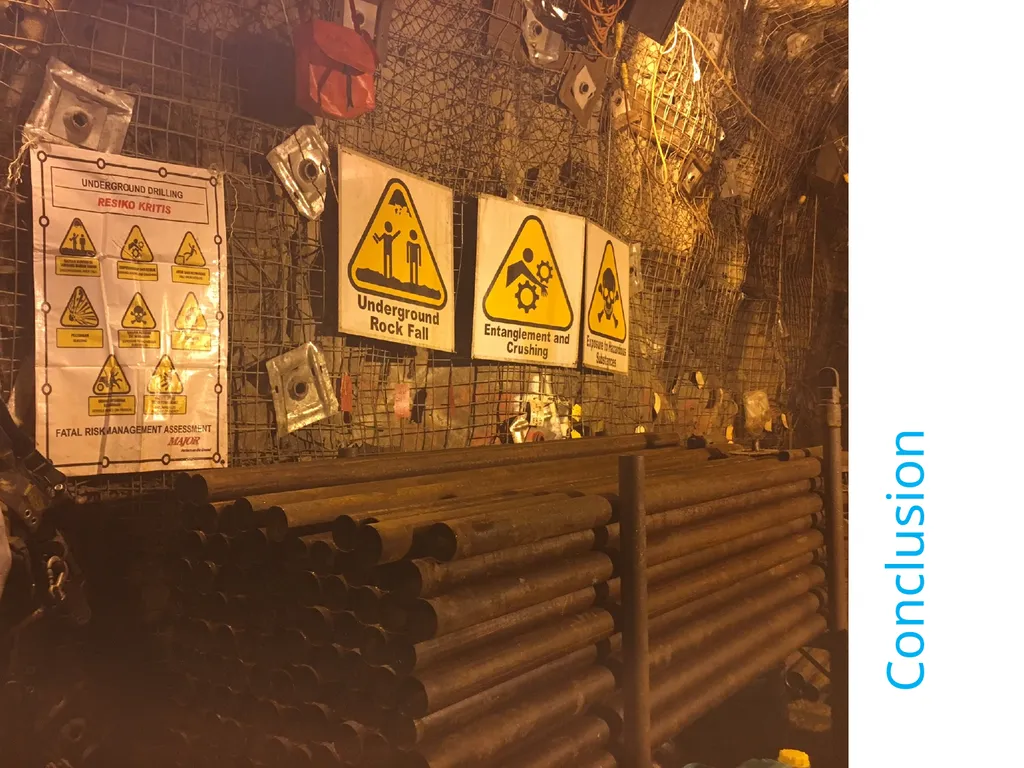
slide94. Conclusion<br>
slide95. 95 Fatality Prevention is a living process
It needs to be nurtured to grow
It is owned by you, and it lives in the field with our frontline employees, supervisors, managers, and leaders
Take the concepts of Fatal Risk Management to your employees and work together to meet your needs
What questions do you have? Conclusion Fatal Risk MANAGEMENT<br>
slide96. 96 What information surprised you?
What are some key concepts from this course? Debrief Fatal Risk MANAGEMENT<br>
slide2. Fatal Risk MANAGEMENT 2 Introductions and Icebreaker activity
Reasons for Rolling Out FRM
Explanation of the FRM Concept
How FRM Works
FRM Exercises
FRM Implementation & Progression
Questions Agenda<br>
slide3. Fatal Risk MANAGEMENT 3 Write your name on a table tent
Introduce yourself to the group
Name
Position
Length of time with the Company Introductions<br>
slide4. Activity 1 Directions
In your group, create a list of five things that everyone has in common
Cannot be related to work, body parts, or clothes
Designate one person to write down the responses
Designate one person to speak for the group
Be prepared to share your responses Icebreaker Fatal Risk MANAGEMENT<br>
slide5. Fatal Risk MANAGEMENT 5 Upon completion of this course, students will be able to:
Select the appropriate Fatal Risk Management icons based on the hazards associated with the task and environment
Identify appropriate Fatal Risk Management tools specific to the needs of the work area and employees
Differentiate the roles and responsibilities of employees, supervisors, and managers
Demonstrate effective communication skills for transferring program concepts to employees Learning Objectives<br>
slide6. Reasons for Rolling Out FRM<br>
slide7. 7 Work-related Fatalities Antonio Jesús Ruiz Martín
Atlantic Copper - 4/3/2017
Fatally injured after being struck by a Kress hauler.
Fatal Risk:
Vehicle Impact on Person Frank Axel Cohen Ruiz
Cerro Verde - 2/24/2017
Fatally injured when a ground failure event on a double bench caused a large boulder to strike the operator cabin of a shovel.
Fatal Risk:
Ground Failure Peter Winston Arratea Ale
Cerro Verde - 2/23/2017
Fatally injured after becoming entangled in the tail pulley of a moving feed belt.
Fatal Risk:
Entanglement & Crushing Nelson Pondayar
PTFI - 10/17/2016
Dozer slid while operating on a bench and rolled over causing fatal injuries.
Fatal Risk:
Vehicle Collision or Rollover Fatal Risk MANAGEMENT<br>
slide8. 8 Work-related Fatalities Lukas Rapi
PTFI - 8/30/2016
Fatally injured when struck by a loader moving a shipping container.
Fatal Risk:
Vehicle Impact on Person Benyamin Pasang
PTFI - 8/7/2016
Received fatal injuries when the cable tray he was working on collapsed causing a 7M fall.
Fatal Risk:
Fall from Heights Patricio Bobadilla Gallardo
El Abra - 8/30/2016
Suffered fatal injuries when a moving train struck a parked acid tanker car he was unloading.
Fatal Risk:
Rail Collision Bryan Ortiz
Safford - 4/9/2016
Presumed to have come in contact with stray electrical current outside the tankhouse causing fatal injuries.
Fatal Risk:
Contact with Electricity Fatal Risk MANAGEMENT<br>
slide9. Fatal Risk MANAGEMENT 9 Fatalities Fatal Incidents People Fatally Injured 2 6 6 35 7 3 6 5 2 4 4 8 4 3 6 5 1/1/2010 - 7/3/2017, counts from IMS including all active and divested sites. 36
Incidents with a fatality 70
People Fatally Injured<br>
slide10. 10 Potential Fatal Events (PFEs) 414
PFEs PFEs by Fatal Risk PFEs by Year Fatal Risk MANAGEMENT<br>
slide11. 11 Across Operations Fatal Risk MANAGEMENT 3 3 1 6 2 1 6 2 58 24 Incidents with a fatality People
Fatally Injured PFE’s<br>
slide12. 12 Time spent training the entire workforce
Core elements of the Fatality Prevention program
Communication
Messaging and Perception
Accountability
Stopping Work
Situational Risks and Outcomes
Pre-job Planning
Evaluating and Improving Controls Fatality Prevention Fatal Risk MANAGEMENT<br>
slide13. 13 What is next for the Fatality Prevention program?
How do we build on the program?
Is there new material?
How can the concepts be refreshed?
Are there additional tools for use in the field? Fatality Prevention Fatal Risk MANAGEMENT<br>
slide14. 14 Our employees, industry, trade groups, regulators, partners, and investors expect it Expectations Fatal Risk MANAGEMENT<br>
slide15. 15 Everyone has a reason to go home safely Expectations Fatal Risk MANAGEMENT<br>
slide16. Explanation of the FRM Concept<br>
slide17. 17 Fatal Risk Management (FRM) is the next step in the Fatality Prevention Program
It builds on the core elements presented in Fatality Prevention Training
Focused on improving identification of Fatal Risks and implementing Critical Controls
It consists of several tools to be used in the field FRM Concept Fatal Risk MANAGEMENT<br>
slide18. 18 FRM was developed to:
Clarify the potential for Fatal Risks
Identify Critical Controls to manage those risks
Standardize communication FRM Concept Fatal Risk MANAGEMENT<br>
slide19. 19 Fatal Risks versus other risks
Fatal Risks are the risks that will get you killed; When not controlled, they have the potential to cause serious injury or death
Other risks are still potentially harmful, but carry a lesser risk FRM Concept Fatal Risk MANAGEMENT<br>
slide20. 20 An example is provided to show the relationship between job role, tasks, and Fatal Risks FRM Concept Fatal Risk MANAGEMENT<br>
slide21. 21 Critical Controls were developed for each Fatal Risk. A Critical Control is
A device, system, or process crucial to preventing death or mitigating the consequences of the event
Previously established based on data FRM Concept Fatal Risk MANAGEMENT<br>
slide22. 22 Critical Controls versus other controls
Task – Shoveling under a belt
What is a “Critical Control”?
LOTOTO
What is an “other control”?
Housekeeping
What is another example? FRM Concept Fatal Risk MANAGEMENT<br>
slide23. 23 FRM Concept Fatal Risk MANAGEMENT<br>
slide24. 24 A set of tools are provided to address the gaps in Fatality Prevention, and make the skills more usable in the field FRM Tools Fall from Heights Lifting Operations Vehicle Impact on Person Fatal Risk MANAGEMENT<br>
slide25. Purpose of icons
Visually recognizable
Standardize message
To ensure success of the message, the icons need to be understood (consider language barriers and culture)
An in-depth analysis of the past ten years aided in the selection of the twenty-three most significant Fatal Risks FRM Icons Fatal Risk MANAGEMENT<br>
slide26. 26 FRM Icons Fatal Risk MANAGEMENT Blasting Vehicle Collision or Rollover Fall from Heights Lifting Operations Fire Underground Rock Fall Underground Inrush Underground Hazardous Atmosphere Personnel Hoisting Falling Objects Entanglement and Crushing Interaction with Aircraft Drowning Ground Failure Confined Space Contact with Molten Material Rail Collision Rail Impact on Person Present at all sites Present at many sites Present at few sites Vehicle Impact on Person Uncontrolled Release of Energy Exposure to Electrical Hazards Exposure to Hazardous Substances - Acute Exposure to Hazardous Substances - Chronic<br>
slide27. Activity 2 Directions
As a class, discuss 2-4 Fatal Risks and answer the question in the SG for each icon
In small groups, discuss the Fatal Risks you are assigned and answer the question in the SG for each icon
You have 10 minutes to complete
Share your responses (2 minute max for each Fatal Risk) Introduction to Each Icon Fatal Risk MANAGEMENT<br>
slide28. 28 Interaction with manned, unmanned, fixed and rotary wing aircraft.
What jobs or tasks are related to this Fatal Risk?
Read the Incident in the SG Interaction with Aircraft Fatal Risk MANAGEMENT<br>
slide29. 29 Exposure to thermal, overpressure and fragment hazards associated with explosives and explosive components
What jobs or tasks are related to this Fatal Risk?
Read the Incident in the SG Blasting Fatal Risk MANAGEMENT<br>
slide30. 30 Exposure to a hazardous environment in a confined space
What jobs or tasks are related to this Fatal Risk?
Read the Incident in the SG Confined Space Fatal Risk MANAGEMENT<br>
slide31. 31 Exposure to electrical shock or arc flash
What jobs or tasks are related to this Fatal Risk?
Read the Incident in the SG Exposure to Electrical Hazards Fatal Risk MANAGEMENT<br>
slide32. 32 Coming in contact with molten metal
What jobs or tasks are related to this Fatal Risk?
Read the Incident in the SG Contact with Molten Material Fatal Risk MANAGEMENT<br>
slide33. 33 Exposure to the risk of drowning in natural or manmade bodies of water or other vats, cells, vessels and other open containers of liquid
What jobs or tasks are related to this Fatal Risk?
Read the Incident in the SG Drowning Fatal Risk MANAGEMENT<br>
slide34. 34 Contact with machinery/moving parts (entanglement, crushing, pinching, penetrating, and cutting forces)
What jobs or tasks are related to this Fatal Risk?
Read the Incident in the SG Entanglement and Crushing Fatal Risk MANAGEMENT<br>
slide35. 35 Workplace exposure to substances that are immediately toxic, asphyxiating or corrosive (e.g. H2S gas, NOx gas, CO gas, concentrated acids, caustics, etc.)
What jobs or tasks are related to this Fatal Risk?
Read the Incident in the SG Exposure to Hazardous Substances - Acute Fatal Risk MANAGEMENT<br>
slide36. 36 Workplace exposure to substances that can cause lethal disease overtime (e.g. silica, arsenic, lead, welding fumes, asbestos, acid mist, etc.)
What jobs or tasks are related to this Fatal Risk?
Read the Incident in the SG Exposure to Hazardous Substances - Chronic Fatal Risk MANAGEMENT<br>
slide37. 37 Working at height where the danger of falling exists
What jobs or tasks are related to this Fatal Risk?
Read the Incident in the SG Fall from Heights Fatal Risk MANAGEMENT<br>
slide38. 38 Exposure to falling objects (e.g. tools, materials, equipment, structures, etc.)
What jobs or tasks are related to this Fatal Risk?
Read the Incident in the SG Falling Objects Fatal Risk MANAGEMENT<br>
slide39. 39 Exposure to thermal, particulate, gas or vapor hazards from a fire
What jobs or tasks are related to this Fatal Risk?
Read the Incident in the SG Fire Fatal Risk MANAGEMENT<br>
slide40. 40 Exposure to failure of natural slopes and temporary or permanent slopes which are excavated or constructed in relation to mining activities or associated supporting infrastructure
What jobs or tasks are related to this Fatal Risk?
Read the Incident in the SG Ground Failure Fatal Risk MANAGEMENT<br>
slide41. 41 Exposure to loss of control of a load suspended by a crane (fixed or mobile), hoist, forklift, boom or other lifting equipment
What jobs or tasks are related to this Fatal Risk?
Read the Incident in the SG Lifting Operations Fatal Risk MANAGEMENT<br>
slide42. 42 Contact with, exposure to, or unintended consequences related to the movement of people or equipment via underground hoisting or aerial tramways
What jobs or tasks are related to this Fatal Risk?
Read the Incident in the SG Personnel Hoisting Fatal Risk MANAGEMENT<br>
slide43. 43 Locomotive, rolling stock, or other rail equipment colliding with or being hit by other vehicles, buildings, or equipment
What jobs or tasks are related to this Fatal Risk?
Read the Incident in the SG Rail Collision Fatal Risk MANAGEMENT<br>
slide44. 44 Locomotive, rolling stock, or other rail equipment coming into contact with a person
What jobs or tasks are related to this Fatal Risk?
Read the Incident in the SG Rail Impact on Person Fatal Risk MANAGEMENT<br>
slide45. 45 Exposure to stored energy from pressure; items under tension or compression
What jobs or tasks are related to this Fatal Risk?
Read the Incident in the SG Uncontrolled Release of Energy Fatal Risk MANAGEMENT<br>
slide46. 46 Exposure to toxic atmosphere or oxygen deprivation underground
What jobs or tasks are related to this Fatal Risk?
Read the Incident in the SG Underground Hazardous Atmosphere Fatal Risk MANAGEMENT<br>
slide47. 47 Exposure to crushing forces or oxygen deprivation caused by the sudden ingress of liquids or solids underground
What jobs or tasks are related to this Fatal Risk?
Read the Incident in the SG Underground Inrush Fatal Risk MANAGEMENT<br>
slide48. 48 Exposure to rock that falls from the back or sidewalls underground
What jobs or tasks are related to this Fatal Risk?
Read the Incident in the SG Underground Rock Fall Fatal Risk MANAGEMENT<br>
slide49. 49 Collision with another vehicle or fixed/moving object; driving over an edge; rolling over
What jobs or tasks are related to this Fatal Risk?
Read the Incident in the SG Vehicle Collision or Rollover Fatal Risk MANAGEMENT<br>
slide50. 50 Person struck by vehicle/mobile equipment
What jobs or tasks are related to this Fatal Risk?
Read the Incident in the SG Vehicle Impact with Person Fatal Risk MANAGEMENT<br>
slide51. How FRM Works<br>
slide52. 52 What are some of the tools we use in the field to plan work?
SOP
JSA
Risk assessment
Work instruction
The Fatal Risk Management system can combine and eliminate some of the repetition How FRM Works Toolbox Talk
Critical Control Audits
Field Verifications
Others? Fatal Risk MANAGEMENT<br>
slide53. 53 Watch the video to see utilization of the FRM tools
Think of ways you can implement some of the ideas at your property How FRM Works Fatal Risk MANAGEMENT https://web.microsoftstream.com/video/29b89c5f-1a6c-408f-a743-ed410e14f6a9<br>
slide54. 54 Fatal Risk Management tools
Icons
Cority System
Verification questions
Supervisors can use these tools to
Enhance tailgate meetings
Improve field verification of Critical Controls
Empower employees to stop work How FRM Works Fatal Risk MANAGEMENT<br>
slide55. 55 Icons
Visual cue to communicate a potential risk
Implementation of icons will vary site to site
Intended to represent the most critical Fatal Risks FRM Tools Fatal Risk MANAGEMENT<br>
slide56. 56 Verification Questions
Tasks can have multiple Fatal Risks
As an operator, the verification questions help identify if appropriate controls are in place and effective
Supervisors can use the verification questions to help prioritize their time in the field FRM Tools Fatal Risk MANAGEMENT<br>
slide57. FRM Tools Verification Questions Icons Critical Controls Have I visually inspected the anchor points?
Have I inspected my harness?
Have I inspected the connector/lanyard/shock absorber equipment prior to use?
Is my selected fall protection adequate for the task and am I wearing it correctly?
Has the team reviewed the rescue plan for this task? Does everyone know and understand the plan?
Is the rescue plan appropriate and are all necessary tools and equipment available?
Can I maintain 100% tie-off, if needed?
Have all team members reviewed and understood the rescue plan? Fall Protection System
Leading Edge/Open Hole Protection
Fixed Work Platform
Mobile Work Platform
Scaffold Is installed edge protection adequate to prevent falls?
Am I adequately protected from falling into or off of openings or leading edges?
Have I inspected the edge protection devices to ensure they are maintained and in good working order? Have I inspected the fixed work platform before use?
Is the fixed work platform suitable for the job/task? Fatal Risk MANAGEMENT Am I using the correct mobile work platform for the job/task
Am I correctly secured in the basket with proper fall protection equipment?
Have I completed a pre-operational inspection and addressed any critical safety issues?
Have I confirmed that weather conditions will allow for safe use?
Do I remain inside the confines of the basket at all times (e.g. Not stepping on midrails, leaning over the handrails, etc.)?
Have the ground conditions for mobile platform travel areas been inspected
Are the platforms travelling over the designated and inspected areas for the task? Has the scaffold design and work plan been approved by a competent person?
Is the scaffold constructed according to the approved design and work plan?
Does the scaffold have the load capacity posted?
Has the inspection of the scaffold been completed by a competent person prior to use? Note: Daily inspection is required when a scaffold is in use.
Is the scaffold protected from being hit by moving vehicles/equipment?
Does the scaffolding have complete floors, toe boards, mid rails and handrails?<br>
slide58. 58 Cority
Used to input data, analyze trends, and generate reports
Relies on self-reporting
Vital in identifying gaps within our current procedures and practices
Can be compared and shared across the sites FRM Tools Fatal Risk MANAGEMENT<br>
slide59. 59 Application of the Tools
Each location will implement the tools in a way most effective for their employees
Possible suggestions
Laminating checklists
Displaying posters
Creating icon stickers/magnets
Building notebooks with relevant checklists
Key to success is to educate and communicate FRM Tools Fatal Risk MANAGEMENT<br>
slide60. 60 PTFI Field Implementation Fatal Risk MANAGEMENT<br>
slide61. 61 El Paso Field Implementation Fatal Risk MANAGEMENT<br>
slide62. 62 Each Fatal Risk has a set of Critical Controls that should be known by all applicable employees
The Critical Controls must be in place prior to beginning work
If a Critical Control is missing or not working, immediately stop the job until controls are implemented
Prioritization can take many forms; should not be limited to only those tasks that are more controlled by behavior FRM Expectations Fatal Risk MANAGEMENT<br>
slide63. 63 All approved FRM material is found on the DOHS SharePoint site
Utilize only approved icons and verification questions in the field
Be creative with how they are utilized but remember overuse can make them ineffective
Do not modify or add verification questions unless approved by DOHS FRM Expectations Fatal Risk MANAGEMENT<br>
slide64. 64 Am I aware of the Fatal Risks?
Am I implementing Critical Controls?
Am I stopping work if something is missing?
Do employees feel empowered to stop the job when Critical Controls are not in place?
Have I communicated the use and meaning of the icons?
Am I taking the time to review the verification questions throughout the day? Roles and Responsibilities Fatal Risk MANAGEMENT Employee Supervisor<br>
slide65. 65 Am I identifying and communicating the Fatal Risks for my site?
Have I ensured the policies, procedures, and training are in place to support the Critical Controls?
Am I verifying these in the field?
Practice the message
Is there an opportunity for it to be received differently than intended?
Does it relate to increasing awareness around Fatal Risks and Critical Controls?
Can it be perceived as a production pressure message? Communicate the Program Fatal Risk MANAGEMENT Manager<br>
slide66. 66 There are many ways that you can further develop the tools to maintain communication
Supervisor Talking Points
Overall summary of the training
Purpose of the training
Expectations for before/after employee attends Communicate the Program Fatal Risk MANAGEMENT<br>
slide67. Activity 3 Directions
Break into groups
Review each photo on the worksheet in the SG
Use the Fatal Risk icons in the SG, to determine which Fatal Risks are present for that job and choose the appropriate icon(s). Remember that tasks/jobs can have multiple Fatal Risks
You have 5 minutes to complete
Be prepared to share your responses Identifying Fatal Risks Fatal Risk MANAGEMENT<br>
slide68. 68 1. Area Housekeeping
What are the potential Fatal Risks? FRM Practice Fatal Risk MANAGEMENT<br>
slide69. 69 Area Housekeeping
Fatal Risks
Vehicle Impact on Person
Lifting Operations FRM Practice Fatal Risk MANAGEMENT<br>
slide70. 70 2. Replace Building Panels
What are the potential Fatal Risks? FRM Practice Fatal Risk MANAGEMENT<br>
slide71. 71 Replace Building Panels
Fatal Risks
Fall from Heights
Lifting Operations FRM Practice Fatal Risk MANAGEMENT<br>
slide72. Activity 4 Directions
Continue working in groups
Review each photo on the worksheet in the SG
Use the Fatal Risk and Critical Control pages in the SG to determine which Fatal Risks are present for that job and choose the appropriate icon(s). Remember that tasks/jobs can have multiple Fatal Risks
List the Critical Controls
You have 10 minutes to complete
Be prepared to share your responses Fatal Risk MANAGEMENT Fatal Risks and Critical Controls Part Two<br>
slide73. 73 3. Pipeline Repair / Inspection
What are the potential Fatal Risks?
What are the Critical Controls? FRM Practice Fatal Risk MANAGEMENT<br>
slide74. 74 Pipeline Repair / Inspection
Fatal Risks and Critical Controls
Confined Space
Critical Controls – ventilation, monitoring equipment
Lifting Operations
Critical Controls – proper rigging, perimeter security FRM Practice Fatal Risk MANAGEMENT<br>
slide75. 75 4. Clean-up and Inspection around Conveyor
What are the potential Fatal Risks?
What are the Critical Controls? Identifying Fatal Risks Fatal Risk MANAGEMENT<br>
slide76. 76 Clean-up and Inspection Around Conveyor
Fatal Risks and Critical Controls
Entanglement and Crushing
Blocking for maintenance, energy isolation/LOTOTO, guards/barriers/ barricades
Exposure to Hazardous Substances
Access control, alarm systems, PPE
Uncontrolled Release of Energy
Guards/barriers/barricades, energy isolation/LOTOTO FRM Practice Fatal Risk MANAGEMENT<br>
slide77. 77 5. Underground Utility Repair
What are the potential Fatal Risks?
What are the Critical Controls? Identifying Fatal Risks Fatal Risk MANAGEMENT<br>
slide78. 78 Underground Utility Repair
Fatal Risks and Critical Controls
Confined Space
Atmospheric monitoring, entry permit execution, energy isolation/LOTOTO
Lifting Operations
Barriers and segregations, lifting execution, mechanical integrity of lifting equipment
Ground Failure
Excavation and trenching execution FRM Practice Fatal Risk MANAGEMENT<br>
slide79. Activity 5 Directions
In the same group, review each photo on the worksheet in the SG
Receive FRM Operator Reference Guide
Determine which Fatal Risks are present for that job and choose the appropriate icon(s). Remember that tasks/jobs can have multiple Fatal Risks
List the Critical Controls
You have 20 minutes to complete
Be prepared to share your responses Fatal Risks and Critical Controls Part Two Fatal Risk MANAGEMENT<br>
slide80. 80 6. Process Tank Entry
What are the potential Fatal Risks?
What are the Critical Controls? Identifying Fatal Risks Fatal Risk MANAGEMENT<br>
slide81. 81 Process Tank Entry
Fatal Risks and Critical Controls
Confined Space
Atmospheric monitoring, entry permit execution, energy isolation/LOTOTO
Fire
Alarm systems, evacuation plan, fire suppression systems, hot work permit execution, rescue systems, segregation and storage FRM Practice Fatal Risk MANAGEMENT<br>
slide82. 82 7. Remove Broken Roaster Arm
What are the potential Fatal Risks?
What are the Critical Controls? Identifying Fatal Risks Fatal Risk MANAGEMENT<br>
slide83. 83 Remove Broken Roaster Arm
Fatal Risks and Critical Controls
Lifting Operations
Barriers and segregation, mechanical integrity of lifting equipment, lifting execution
Vehicle Impact on Person
Vehicle pre-operational inspection, positive communication system, segregation, signage and demarcation, fundamentally stable parking FRM Practice Fatal Risk MANAGEMENT<br>
slide84. 84 8. Sample Materials
What are the potential Fatal Risks?
What are the Critical Controls? Identifying Fatal Risks Fatal Risk MANAGEMENT<br>
slide85. 85 Sample Materials
Fatal Risks and Critical Controls
Exposure to Hazardous Substances
Access control, alarm systems, engineered controls, handling requirements, loading and unloading protection, mechanical integrity of storage and distribution, PPE
Fire
Alarm systems, evacuation plan, fire suppression systems, hot work permit execution, rescue systems, segregation and storage FRM Practice Fatal Risk MANAGEMENT<br>
slide86. 86 How will these tools make you more efficient in discussing Fatal Risks and Critical Controls?
What are some other ways the tools can be used?
What do you need to help you be successful using this approach in the field? Debrief Fatal Risk MANAGEMENT<br>
slide87. FRM Implementation and Progression<br>
slide88. 88 Sample road map for rolling out FRM
Weeks 1-2: Icon Introduction
Weeks 3-4: Critical Control Discussions
Weeks 5-6: Verification Question Overview
Weeks 7-8: Putting It Together FRM Implementation and Progression Fatal Risk MANAGEMENT<br>
slide89. 89 Weeks 1 - 2: Icon Introduction
Use Supervisor Talking Points to introduce the program
Discuss applicable icons (2-3 per day)
Group discussions to incorporate icon use per job, task and reason for selection
Reinforce message on Fatal Risks and stopping the job FRM Implementation and Progression Fatal Risk MANAGEMENT<br>
slide90. 90 Weeks 3 - 4: Critical Control Discussions
Introduce Critical Control concepts
Group discussions around Critical Controls FRM Implementation and Progression Fatal Risk MANAGEMENT<br>
slide91. 91 Weeks 5 - 6: Verification Question Overview
Introduce verification questions
Continue discussions on Fatal Risks, icons, and Critical Controls FRM Implementation and Progression Fatal Risk MANAGEMENT<br>
slide92. 92 Weeks 7 - 8: Putting It Together
Each day, use one job or task to discuss all Fatal Risks, Critical Controls, and verification questions
Employees will lead further discussions FRM Implementation and Progression Fatal Risk MANAGEMENT<br>
slide93. Activity 6 Directions
Using the worksheet in the SG, create a tailgate or discussion explaining each of the tools
Propose at least one way that you would implement use of the icons for your crew
You have 10 minutes to complete
Be prepared to share your responses Tailgate Talk Fatal Risk MANAGEMENT<br>
slide94. Conclusion<br>
slide95. 95 Fatality Prevention is a living process
It needs to be nurtured to grow
It is owned by you, and it lives in the field with our frontline employees, supervisors, managers, and leaders
Take the concepts of Fatal Risk Management to your employees and work together to meet your needs
What questions do you have? Conclusion Fatal Risk MANAGEMENT<br>
slide96. 96 What information surprised you?
What are some key concepts from this course? Debrief Fatal Risk MANAGEMENT<br>