Vertical Wind Profile and Aerodynamic Roughness Length Basim ALknani The Nature of Airflow over the surface: The fluid moving over a level surface exerts a horizontal force on the surface in the direction of motion of the fluid. conversely,
"Vertical Wind Profile and Aerodynamic Roughness" is the property of its rightful owner. Permission is granted to
download and print the materials on this website for personal, non-commercial use only, and to display it
on your personal computer provided you do not modify the materials and that you retain all copyright
notices contained in the materials. By downloading content from our website, you accept the terms of this
agreement.
Presentation Transcript
01
Vertical Wind Profile and Aerodynamic Roughness Length Basim ALknani<br>
02
The Nature of Airflow over the surface:
The fluid moving over a level surface exerts a horizontal force on the surface in the direction of motion of the fluid. conversely, the surface exerts an equal and opposite retarding force on the fluid this force does not act on the bulk of the fluid but only on its lower boundary, known as the fluid boundary layer .
At heights in excess of 500m above the earth surface, horizontal air motions proceed in a largely geostrophic manner (friction force decay in this height).
between a level of 50m or so and the earth surface , the speed of the wind reduces more and more rapidly towards zero .
the region between 500m and 50m is in effect a zone of transition between the smooth geostrophic flow in the free atmosphere and flow of an essentially turbulent nature near the ground .<br>
03
Vertical Wind Profile in boundary layer
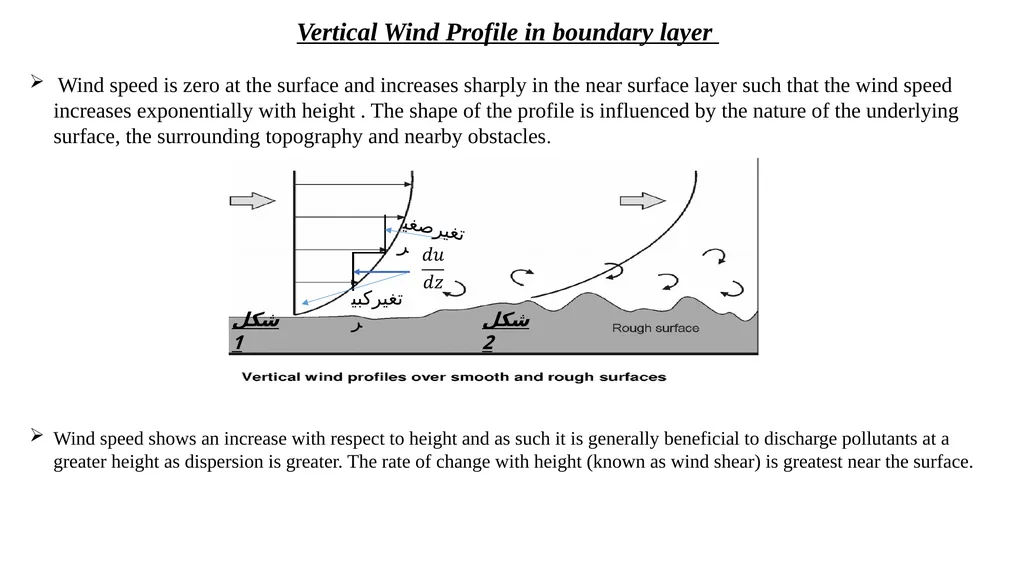
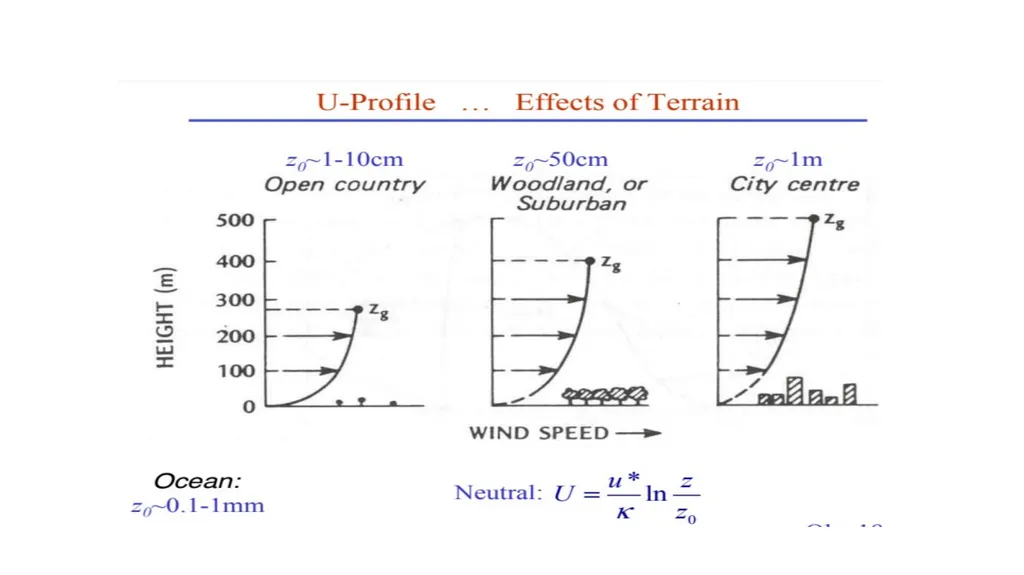
Wind speed is zero at the surface and increases sharply in the near surface layer such that the wind speed increases exponentially with height . The shape of the profile is influenced by the nature of the underlying surface, the surrounding topography and nearby obstacles. Wind speed shows an increase with respect to height and as such it is generally beneficial to discharge pollutants at a greater height as dispersion is greater. The rate of change with height (known as wind shear) is greatest near the surface. شكل 2 شكل 1 تغيركبير تغيرصغير<br>
04
Aerodynamic Roughness Length:
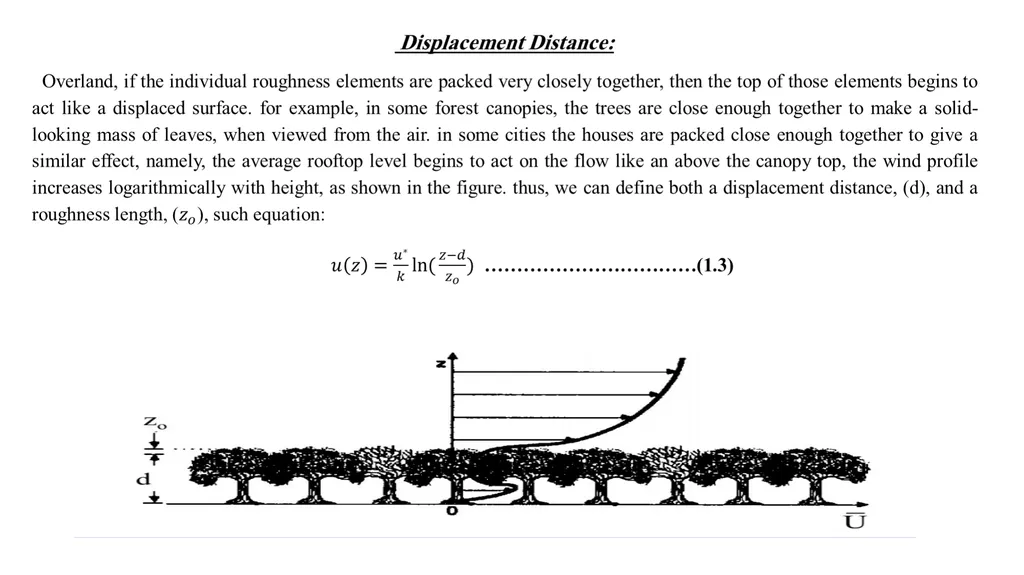
the aerodynamic roughness length, z0, is defined as the height where the wind speed becomes zero. the aerodynamic roughness length is determined for a particular surface, it does not change with wind speed, stability, or stress. it can change if the roughness elements on the surface change such as caused by changes in the height and coverage of vegetation, manufacture of fences, construction of houses, deforestation or lumbering, etc. Letta (1969) suggested a method for estimating the aerodynamic roughness length based on the average vertical extent of the roughness elements (𝒉∗), the average vertical cross –section area obtainable to the wind by one element (S𝒔), and [ SL = (total ground surface area / number of elements)].
𝑧0 = 0.5 ℎ∗ (S𝑠/ 𝑆𝐿) ………………………………… (1.1) This relationship is acceptable when the roughness elements are evenly spaced, not too close together, and have similar height and shape.<br>
05
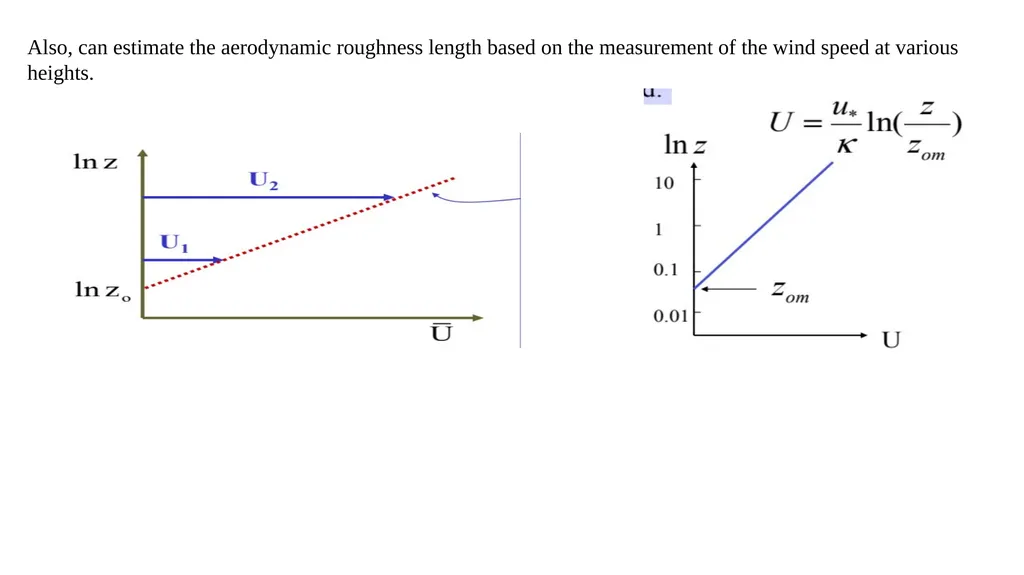
Also, can estimate the aerodynamic roughness length based on the measurement of the wind speed at various heights.<br>
06
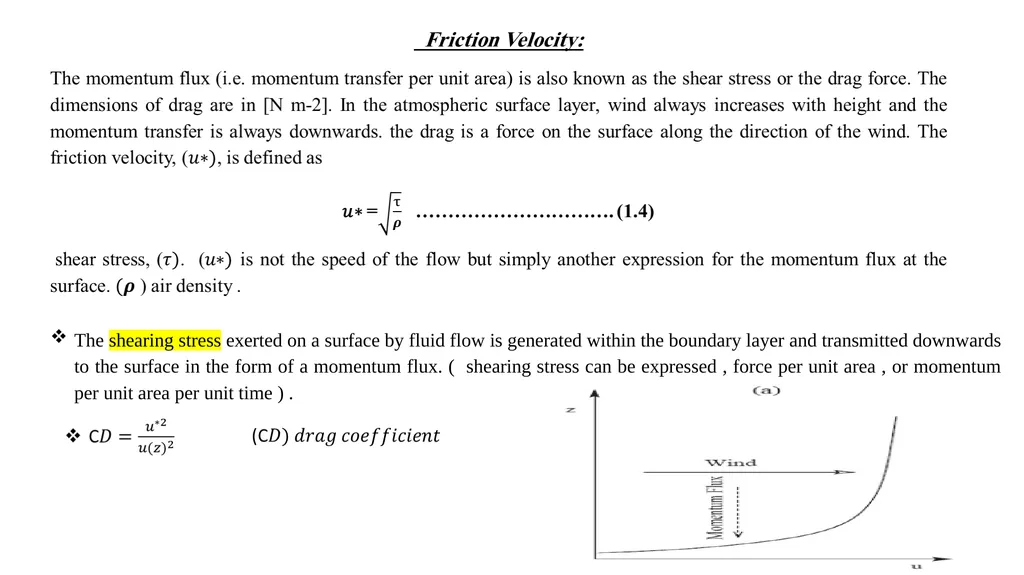
The shearing stress exerted on a surface by fluid flow is generated within the boundary layer and transmitted downwards to the surface in the form of a momentum flux. ( shearing stress can be expressed , force per unit area , or momentum per unit area per unit time ) .<br>