
Veterinary Physiology- It is concerned with the
CP
Published · 29 slides · 0 views
1 / 1



Description
Veterinary Physiology- It is concerned with the intact organ or the whole organism and may be defined as the study of the integrated functions of the body and the functions of all its parts like, systems, organs, tissues, cells and cell
Related Topics
Share
Embed code
Download this presentation From Below
"Veterinary Physiology- It is concerned with the" is the property of its rightful owner. Permission is granted to download and print the materials on this website for personal, non-commercial use only, and to display it on your personal computer provided you do not modify the materials and that you retain all copyright notices contained in the materials. By downloading content from our website, you accept the terms of this agreement.
Presentation Transcript
01
Veterinary Physiology- It is concerned with the intact organ or the whole organism and may be defined as the study of the integrated functions of the body and the functions of all its parts like, systems, organs, tissues, cells and cell components including the biophysical and biochemical process involved.<br>
02
BLOOD<br>
03
Blood It consist of a pale yellow fluid called plasma in which the formed elements, the red cells, the white cells & the platelets are suspended.
FUNCTIONS:-
It carries nutrients made available by the digestive tract to body tissues.
It plays an important role in exchange of gases from blood to tissue and vice-versa.
The waste products from various tissues are carried out to the kidney for excretion.
Hormones are carried via blood from endocrine glands to other organs of the body.
It play an important role in temperature control by transporting heat from deeper structures to the surface of the body
Water balance is maintained partly by the blood.<br>
FUNCTIONS:-
It carries nutrients made available by the digestive tract to body tissues.
It plays an important role in exchange of gases from blood to tissue and vice-versa.
The waste products from various tissues are carried out to the kidney for excretion.
Hormones are carried via blood from endocrine glands to other organs of the body.
It play an important role in temperature control by transporting heat from deeper structures to the surface of the body
Water balance is maintained partly by the blood.<br>
04
Buffer such as bicarbonate in the blood help to maintain a constant pH of tissues & body fluids.
The clotting ability of blood prevents access loss of blood from injuries.
It contains important factors for defense of the body against disease.
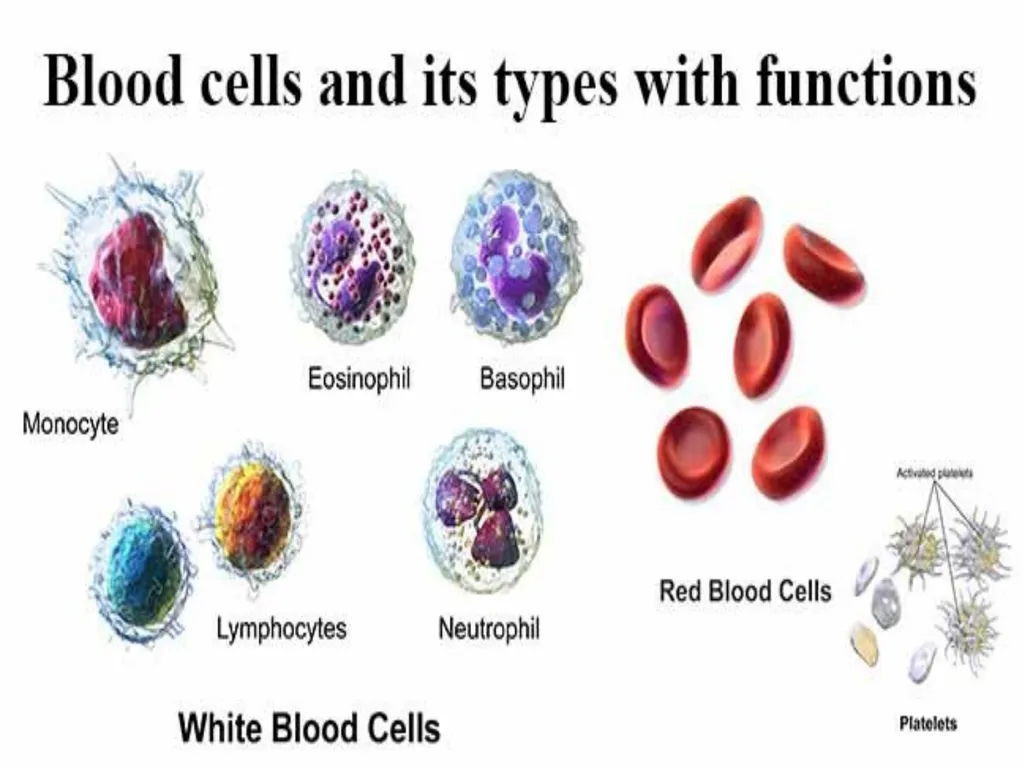
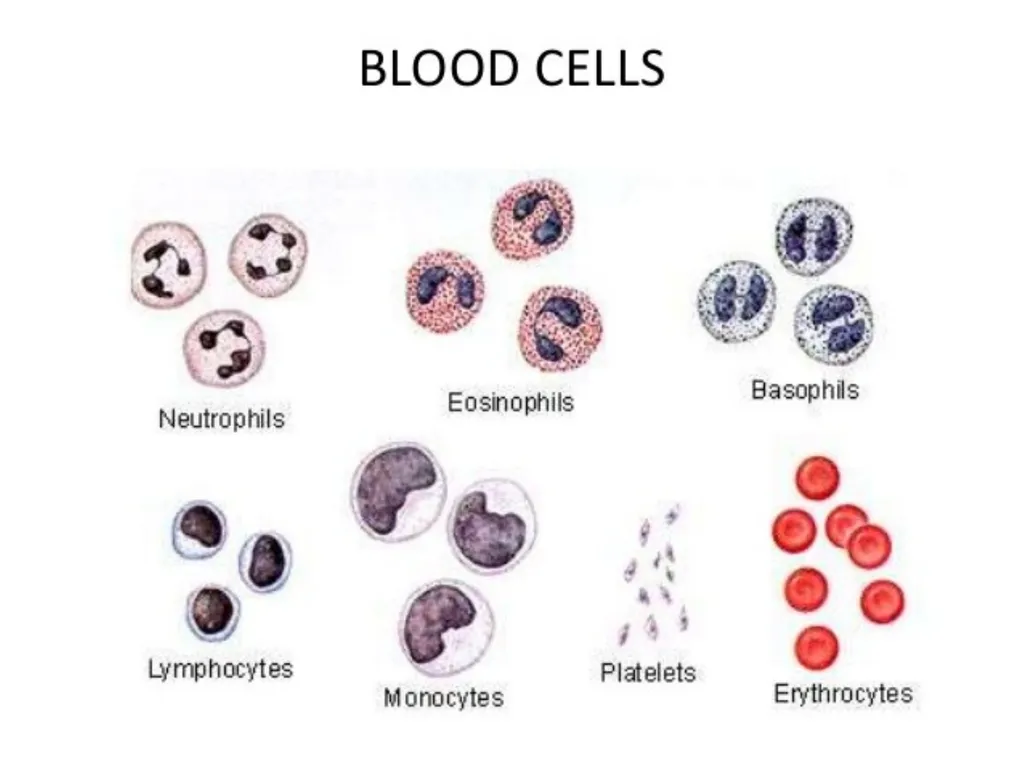
BLOOD CELLS
Erythocytes:
Biconcave disks
Averaging 7.5 µm in diameter
Thick 1.5 µm circular margin & a thin centre
Doesn`t have nucleus
Shape can be remarkably changed into almost any shape
Average volume is 87±6 cubic microns
Average count is 7 – 11 million/cu mm<br>
The clotting ability of blood prevents access loss of blood from injuries.
It contains important factors for defense of the body against disease.
BLOOD CELLS
Erythocytes:
Biconcave disks
Averaging 7.5 µm in diameter
Thick 1.5 µm circular margin & a thin centre
Doesn`t have nucleus
Shape can be remarkably changed into almost any shape
Average volume is 87±6 cubic microns
Average count is 7 – 11 million/cu mm<br>
05
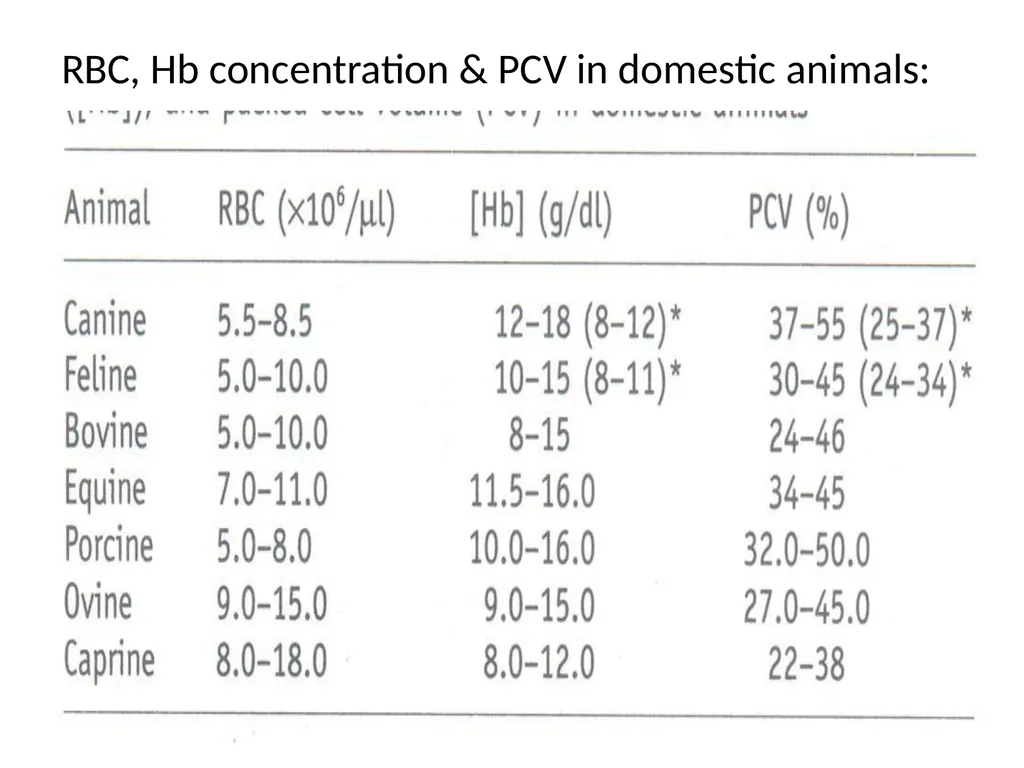
RBC, Hb concentration & PCV in domestic animals:<br>
06
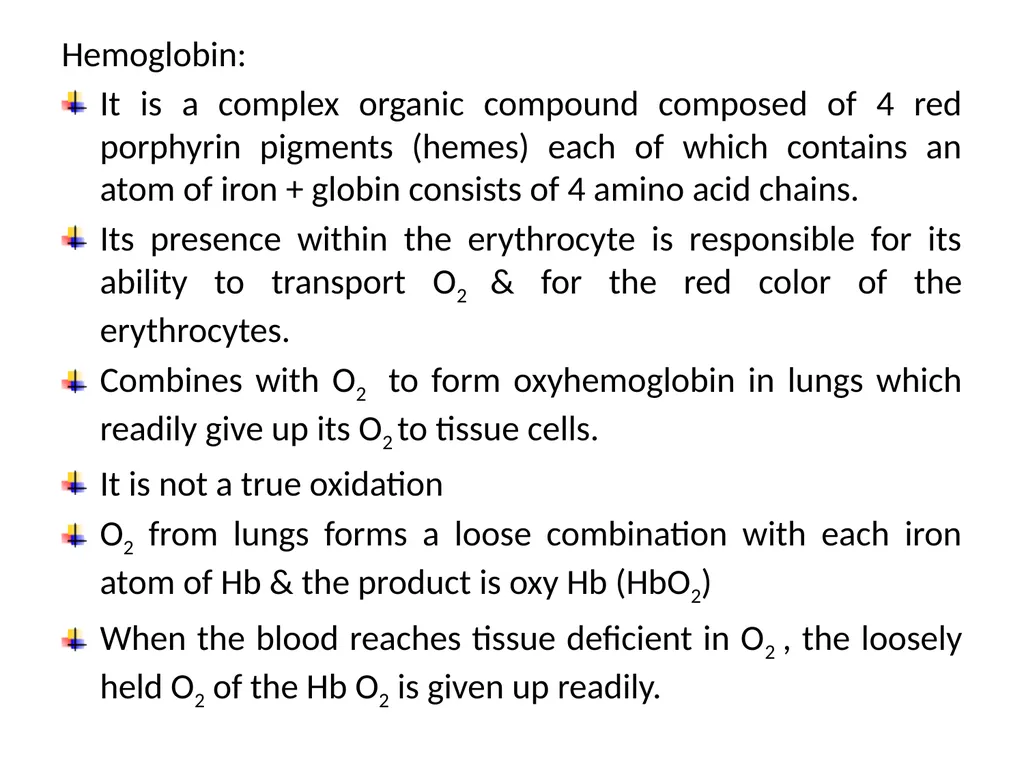
Hemoglobin:
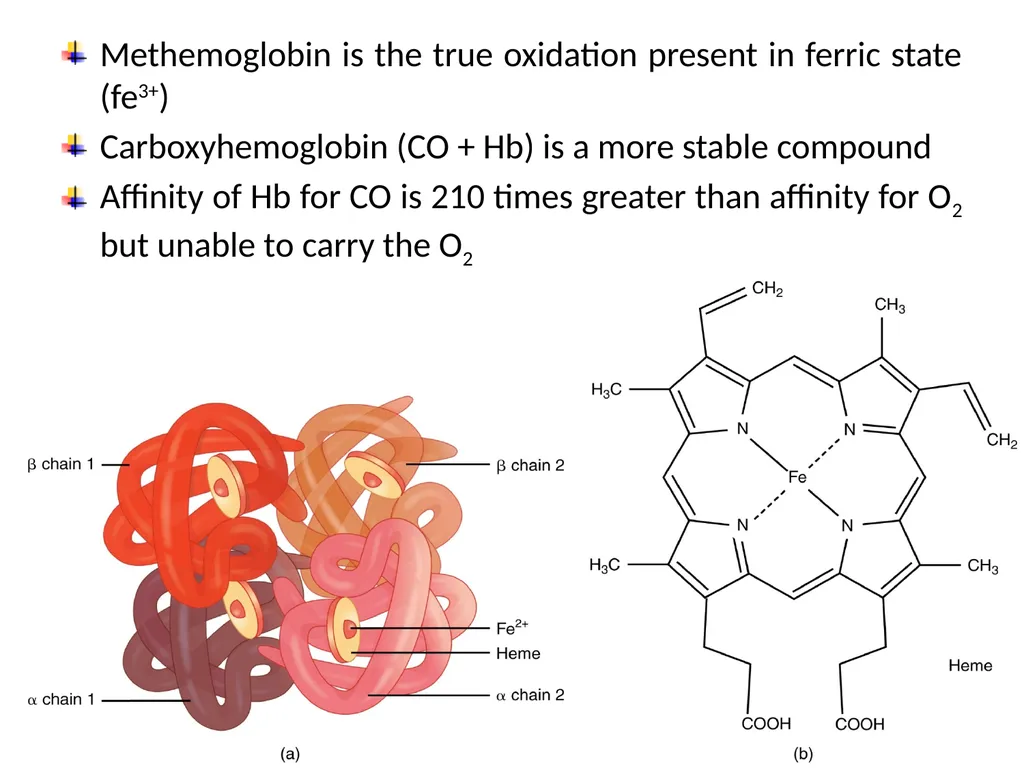
It is a complex organic compound composed of 4 red porphyrin pigments (hemes) each of which contains an atom of iron + globin consists of 4 amino acid chains.
Its presence within the erythrocyte is responsible for its ability to transport O2 & for the red color of the erythrocytes.
Combines with O2 to form oxyhemoglobin in lungs which readily give up its O2 to tissue cells.
It is not a true oxidation
O2 from lungs forms a loose combination with each iron atom of Hb & the product is oxy Hb (HbO2)
When the blood reaches tissue deficient in O2 , the loosely held O2 of the Hb O2 is given up readily.<br>
It is a complex organic compound composed of 4 red porphyrin pigments (hemes) each of which contains an atom of iron + globin consists of 4 amino acid chains.
Its presence within the erythrocyte is responsible for its ability to transport O2 & for the red color of the erythrocytes.
Combines with O2 to form oxyhemoglobin in lungs which readily give up its O2 to tissue cells.
It is not a true oxidation
O2 from lungs forms a loose combination with each iron atom of Hb & the product is oxy Hb (HbO2)
When the blood reaches tissue deficient in O2 , the loosely held O2 of the Hb O2 is given up readily.<br>
07
Methemoglobin is the true oxidation present in ferric state (fe3+)
Carboxyhemoglobin (CO + Hb) is a more stable compound
Affinity of Hb for CO is 210 times greater than affinity for O2 but unable to carry the O2<br>
Carboxyhemoglobin (CO + Hb) is a more stable compound
Affinity of Hb for CO is 210 times greater than affinity for O2 but unable to carry the O2<br>
08
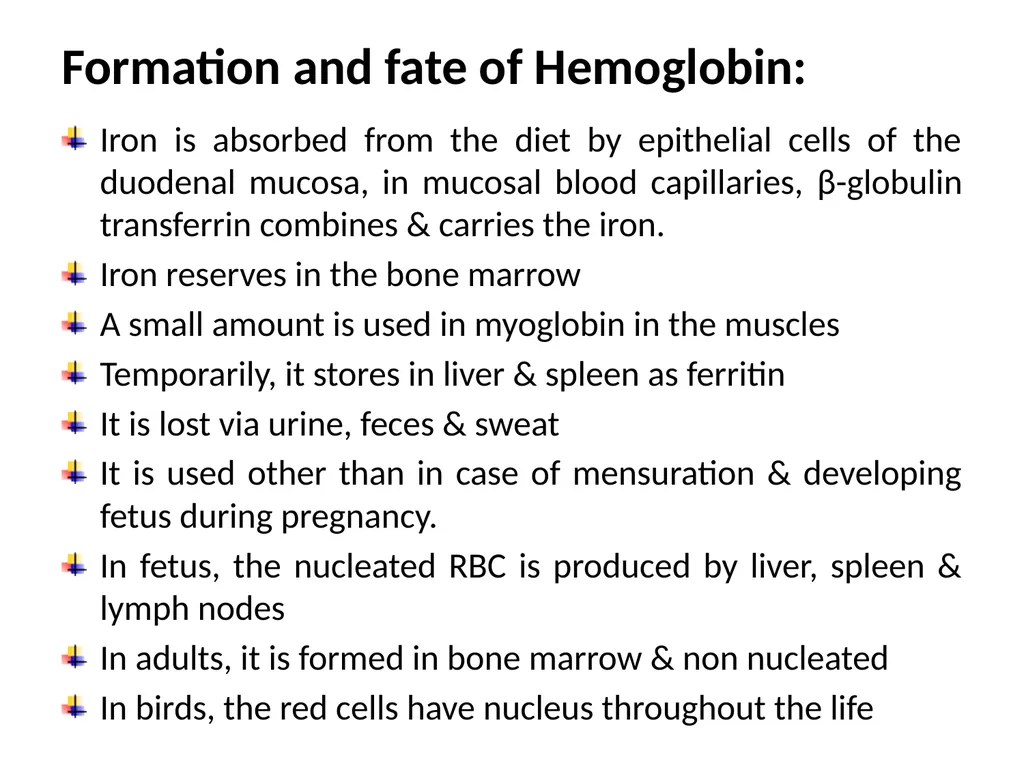
Formation and fate of Hemoglobin: Iron is absorbed from the diet by epithelial cells of the duodenal mucosa, in mucosal blood capillaries, β-globulin transferrin combines & carries the iron.
Iron reserves in the bone marrow
A small amount is used in myoglobin in the muscles
Temporarily, it stores in liver & spleen as ferritin
It is lost via urine, feces & sweat
It is used other than in case of mensuration & developing fetus during pregnancy.
In fetus, the nucleated RBC is produced by liver, spleen & lymph nodes
In adults, it is formed in bone marrow & non nucleated
In birds, the red cells have nucleus throughout the life<br>
Iron reserves in the bone marrow
A small amount is used in myoglobin in the muscles
Temporarily, it stores in liver & spleen as ferritin
It is lost via urine, feces & sweat
It is used other than in case of mensuration & developing fetus during pregnancy.
In fetus, the nucleated RBC is produced by liver, spleen & lymph nodes
In adults, it is formed in bone marrow & non nucleated
In birds, the red cells have nucleus throughout the life<br>
09
Contd…
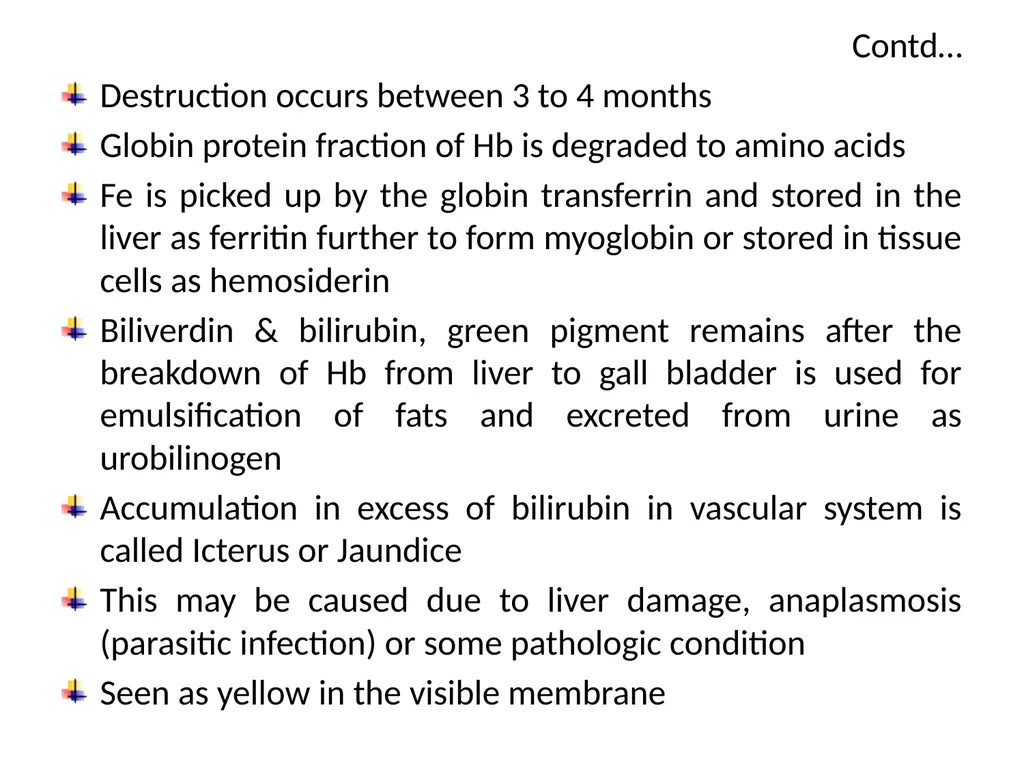
Destruction occurs between 3 to 4 months
Globin protein fraction of Hb is degraded to amino acids
Fe is picked up by the globin transferrin and stored in the liver as ferritin further to form myoglobin or stored in tissue cells as hemosiderin
Biliverdin & bilirubin, green pigment remains after the breakdown of Hb from liver to gall bladder is used for emulsification of fats and excreted from urine as urobilinogen
Accumulation in excess of bilirubin in vascular system is called Icterus or Jaundice
This may be caused due to liver damage, anaplasmosis (parasitic infection) or some pathologic condition
Seen as yellow in the visible membrane<br>
Destruction occurs between 3 to 4 months
Globin protein fraction of Hb is degraded to amino acids
Fe is picked up by the globin transferrin and stored in the liver as ferritin further to form myoglobin or stored in tissue cells as hemosiderin
Biliverdin & bilirubin, green pigment remains after the breakdown of Hb from liver to gall bladder is used for emulsification of fats and excreted from urine as urobilinogen
Accumulation in excess of bilirubin in vascular system is called Icterus or Jaundice
This may be caused due to liver damage, anaplasmosis (parasitic infection) or some pathologic condition
Seen as yellow in the visible membrane<br>
10
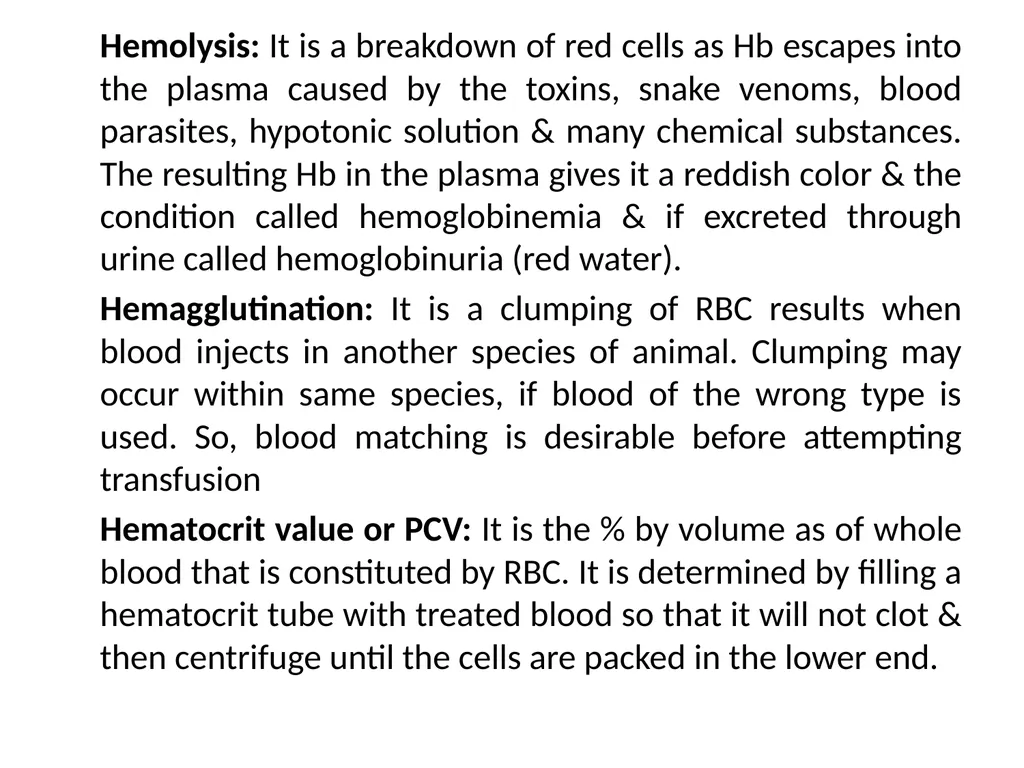
Hemolysis: It is a breakdown of red cells as Hb escapes into the plasma caused by the toxins, snake venoms, blood parasites, hypotonic solution & many chemical substances. The resulting Hb in the plasma gives it a reddish color & the condition called hemoglobinemia & if excreted through urine called hemoglobinuria (red water).
Hemagglutination: It is a clumping of RBC results when blood injects in another species of animal. Clumping may occur within same species, if blood of the wrong type is used. So, blood matching is desirable before attempting transfusion
Hematocrit value or PCV: It is the % by volume as of whole blood that is constituted by RBC. It is determined by filling a hematocrit tube with treated blood so that it will not clot & then centrifuge until the cells are packed in the lower end.<br>
Hemagglutination: It is a clumping of RBC results when blood injects in another species of animal. Clumping may occur within same species, if blood of the wrong type is used. So, blood matching is desirable before attempting transfusion
Hematocrit value or PCV: It is the % by volume as of whole blood that is constituted by RBC. It is determined by filling a hematocrit tube with treated blood so that it will not clot & then centrifuge until the cells are packed in the lower end.<br>
11
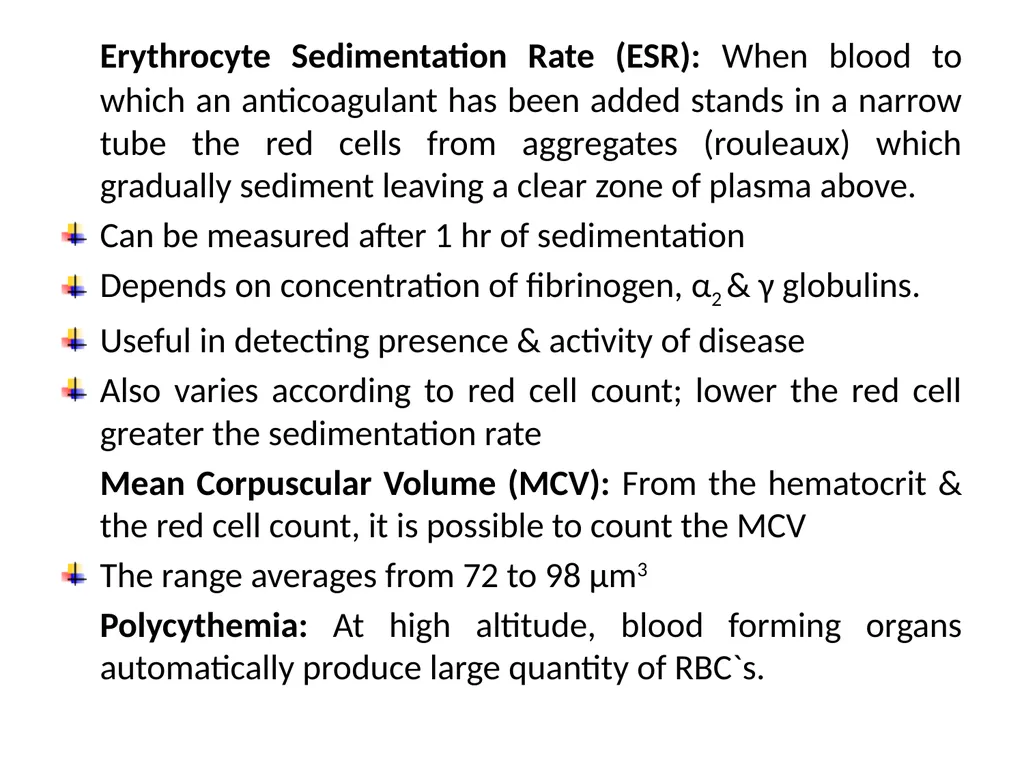
Erythrocyte Sedimentation Rate (ESR): When blood to which an anticoagulant has been added stands in a narrow tube the red cells from aggregates (rouleaux) which gradually sediment leaving a clear zone of plasma above.
Can be measured after 1 hr of sedimentation
Depends on concentration of fibrinogen, α2 & γ globulins.
Useful in detecting presence & activity of disease
Also varies according to red cell count; lower the red cell greater the sedimentation rate
Mean Corpuscular Volume (MCV): From the hematocrit & the red cell count, it is possible to count the MCV
The range averages from 72 to 98 µm3
Polycythemia: At high altitude, blood forming organs automatically produce large quantity of RBC`s.<br>
Can be measured after 1 hr of sedimentation
Depends on concentration of fibrinogen, α2 & γ globulins.
Useful in detecting presence & activity of disease
Also varies according to red cell count; lower the red cell greater the sedimentation rate
Mean Corpuscular Volume (MCV): From the hematocrit & the red cell count, it is possible to count the MCV
The range averages from 72 to 98 µm3
Polycythemia: At high altitude, blood forming organs automatically produce large quantity of RBC`s.<br>
12
Erythropoiesis: The process of formation of erythrocyte Regulation:-
It is governed in bone marrow by the reduced level of O2 in tissues & cells
The glycoprotein (erythropoietin) of plasma & the enzyme of kidney (renal erythropoietic factor) combindely act to do so
↓Concentration of RBC is controlled by –ve feedback for the mechanism of erythropoiesis
Other humoral factors governing erythropoietin are-
Cobalamin & folic acid
Copper
pyridoxine<br>
It is governed in bone marrow by the reduced level of O2 in tissues & cells
The glycoprotein (erythropoietin) of plasma & the enzyme of kidney (renal erythropoietic factor) combindely act to do so
↓Concentration of RBC is controlled by –ve feedback for the mechanism of erythropoiesis
Other humoral factors governing erythropoietin are-
Cobalamin & folic acid
Copper
pyridoxine<br>
13
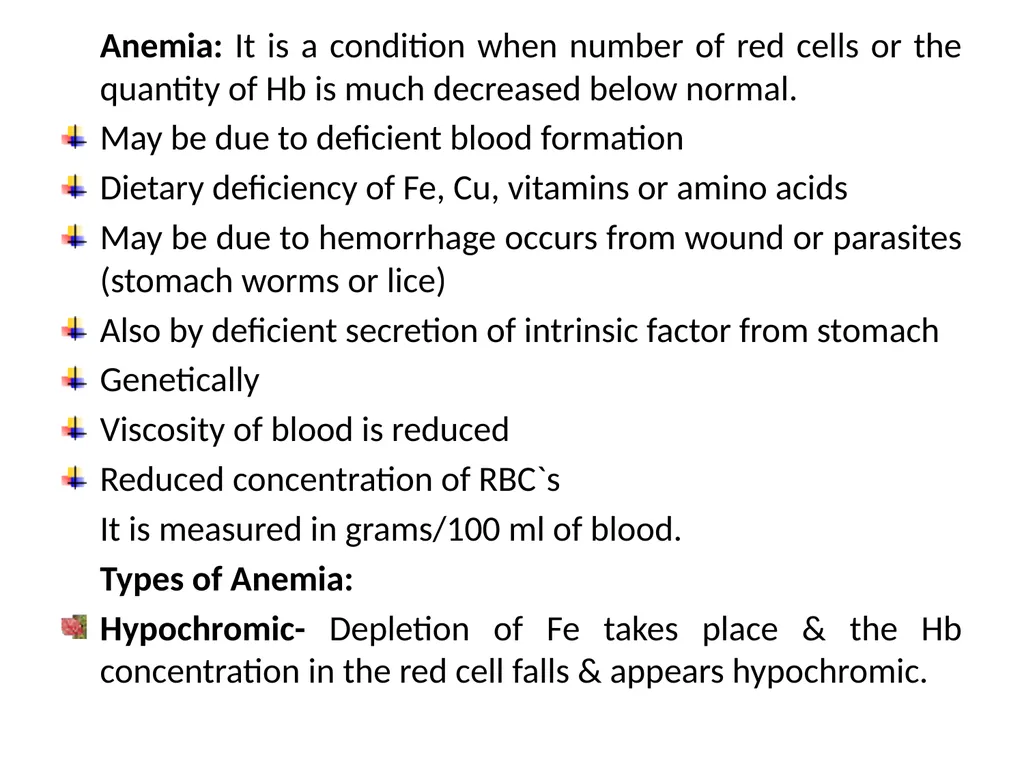
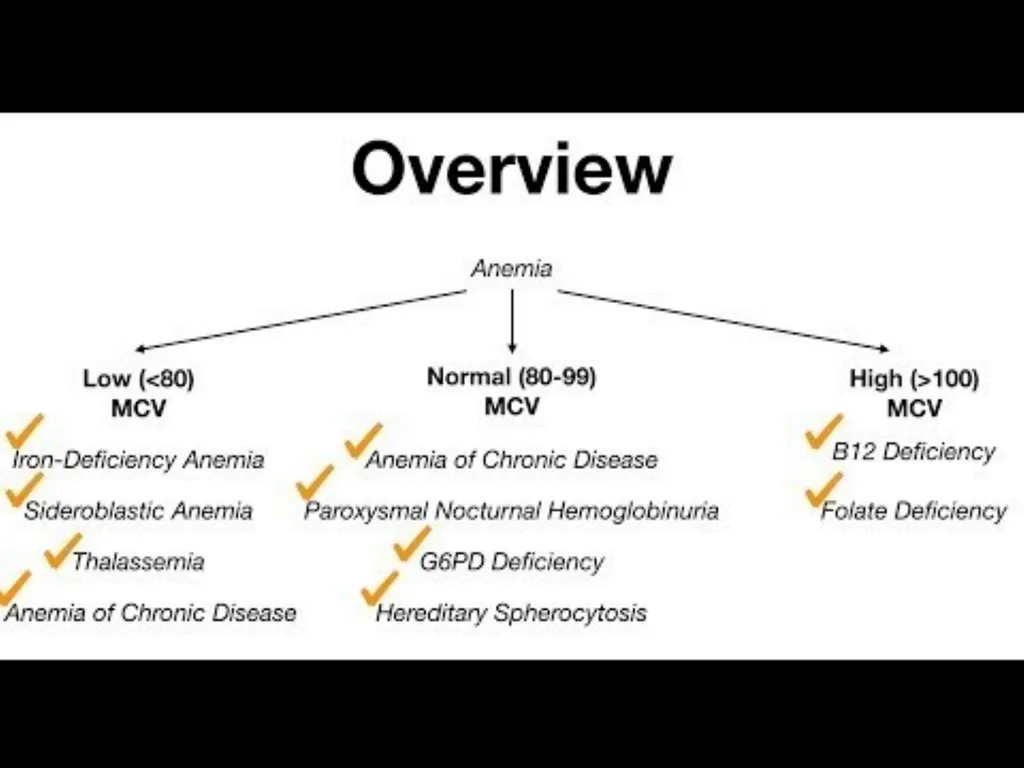
Anemia: It is a condition when number of red cells or the quantity of Hb is much decreased below normal.
May be due to deficient blood formation
Dietary deficiency of Fe, Cu, vitamins or amino acids
May be due to hemorrhage occurs from wound or parasites (stomach worms or lice)
Also by deficient secretion of intrinsic factor from stomach
Genetically
Viscosity of blood is reduced
Reduced concentration of RBC`s
It is measured in grams/100 ml of blood.
Types of Anemia:
Hypochromic- Depletion of Fe takes place & the Hb concentration in the red cell falls & appears hypochromic.<br>
May be due to deficient blood formation
Dietary deficiency of Fe, Cu, vitamins or amino acids
May be due to hemorrhage occurs from wound or parasites (stomach worms or lice)
Also by deficient secretion of intrinsic factor from stomach
Genetically
Viscosity of blood is reduced
Reduced concentration of RBC`s
It is measured in grams/100 ml of blood.
Types of Anemia:
Hypochromic- Depletion of Fe takes place & the Hb concentration in the red cell falls & appears hypochromic.<br>
14
Contd…
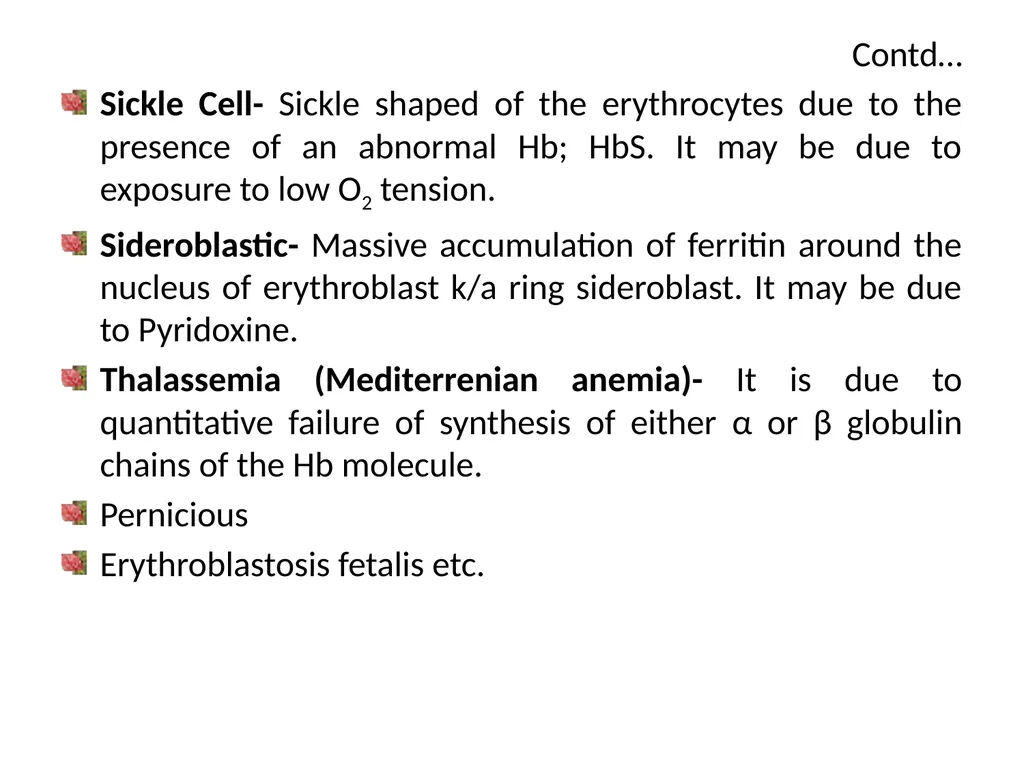
Sickle Cell- Sickle shaped of the erythrocytes due to the presence of an abnormal Hb; HbS. It may be due to exposure to low O2 tension.
Sideroblastic- Massive accumulation of ferritin around the nucleus of erythroblast k/a ring sideroblast. It may be due to Pyridoxine.
Thalassemia (Mediterrenian anemia)- It is due to quantitative failure of synthesis of either α or β globulin chains of the Hb molecule.
Pernicious
Erythroblastosis fetalis etc.<br>
Sickle Cell- Sickle shaped of the erythrocytes due to the presence of an abnormal Hb; HbS. It may be due to exposure to low O2 tension.
Sideroblastic- Massive accumulation of ferritin around the nucleus of erythroblast k/a ring sideroblast. It may be due to Pyridoxine.
Thalassemia (Mediterrenian anemia)- It is due to quantitative failure of synthesis of either α or β globulin chains of the Hb molecule.
Pernicious
Erythroblastosis fetalis etc.<br>
15
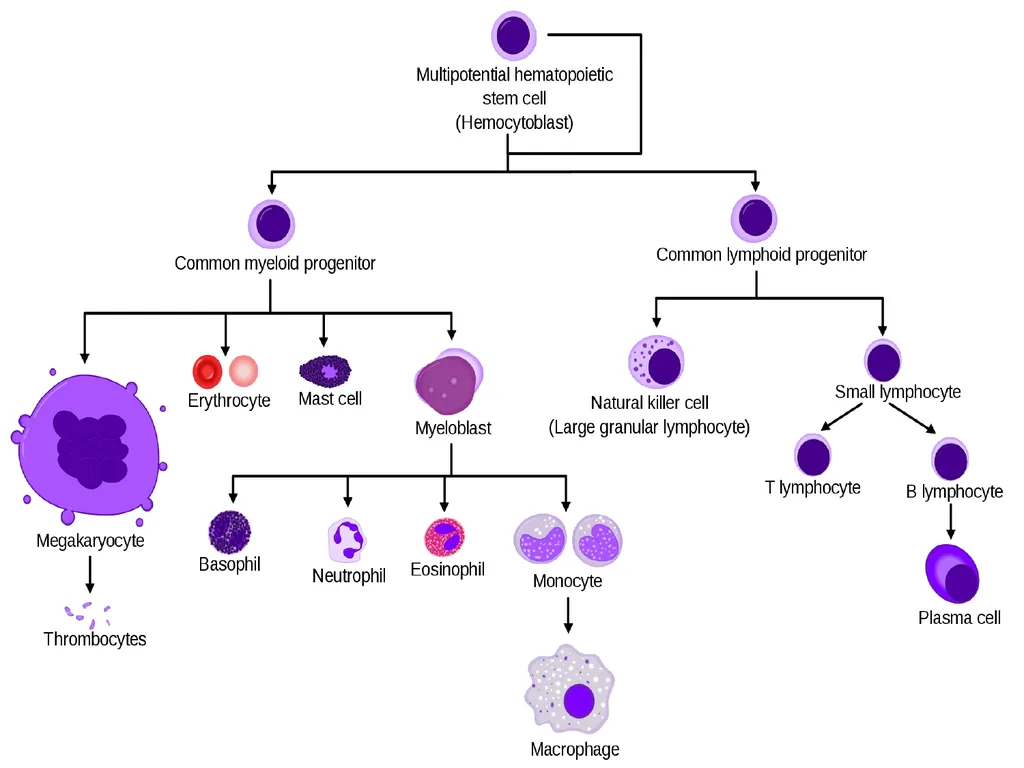
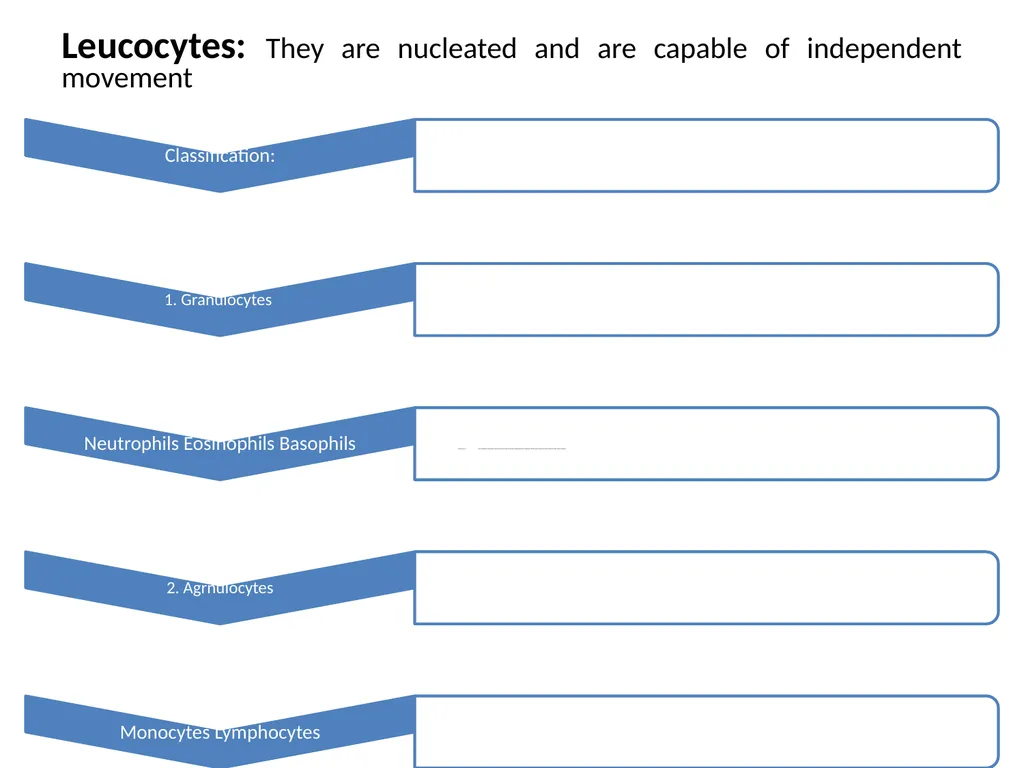
Leucocytes: They are nucleated and are capable of independent movement<br>
16
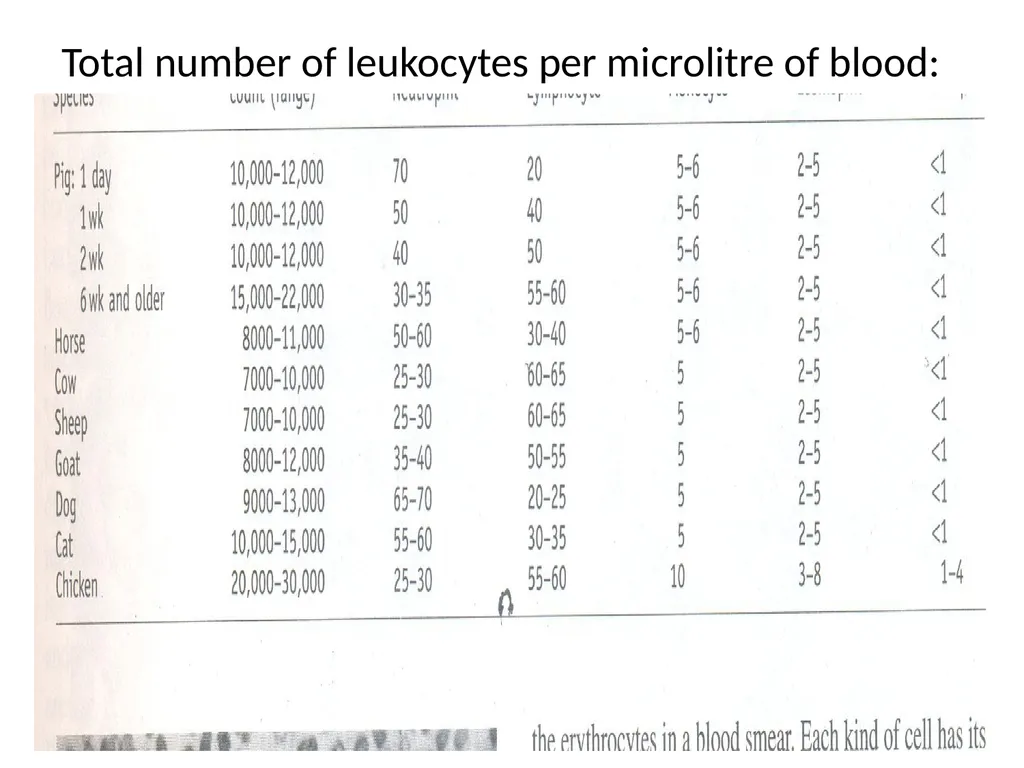
Total number of leukocytes per microlitre of blood:<br>
17
Plasma: Sample of untreated blood, permitted to slant position & cells settled down leaving a straw color fluid Water- 92%, Based on MW 7% are proteins & 1% consists of glucose, lipids, hormones, electrolytes, mineral salts, metabolic waste products etc.
Functions of Plasma Proteins-
Carrier- solubilized & carry Fe, thyroxine, cortisol etc. Also acts as storage pool, when needed leaves to act at targets
Immunity- γ globulin is associated with immunity & resistance to disease (antibodies react with antigen to neutralize or to break it)
Buffering- prevent to change in pH of blood because of ionized carboxyl & amides
Maintenance of Osmotic pressure- It is 290mOsm/l at RT, mainly done by low MW colloids (proteins)<br>
Functions of Plasma Proteins-
Carrier- solubilized & carry Fe, thyroxine, cortisol etc. Also acts as storage pool, when needed leaves to act at targets
Immunity- γ globulin is associated with immunity & resistance to disease (antibodies react with antigen to neutralize or to break it)
Buffering- prevent to change in pH of blood because of ionized carboxyl & amides
Maintenance of Osmotic pressure- It is 290mOsm/l at RT, mainly done by low MW colloids (proteins)<br>
18
Serum: Plasma - Fibrinogen Contains antibodies, useful in prevention & treatment
Immune/Hyperimmune serum- By inoculating repeatedly of a specific antigen in an animal as passive protection
Blood pH: It refers to H+ ion concentration & determines relative acidity or alkalinity of the solution. NaHCO3 as buffer maintains blood within narrow limits. pH 7.35 – 7.45
pH →7 (neutral), pH >7 (acidic) & pH < 7 (alkaline)
Blood clotting: When coagulation occurs a jelly mass results & shrinks to produce a firm clot & clear fluid, while the actual clot consists of fibrin.
Blood vessel damaged or cut
Reflex will be twitching to walls due to myogenic contract
Spasm/sympathetic nerve reflex stimulate adrenergic fibre
Constriction & narrow the vessel for reduce in blood flow<br>
Immune/Hyperimmune serum- By inoculating repeatedly of a specific antigen in an animal as passive protection
Blood pH: It refers to H+ ion concentration & determines relative acidity or alkalinity of the solution. NaHCO3 as buffer maintains blood within narrow limits. pH 7.35 – 7.45
pH →7 (neutral), pH >7 (acidic) & pH < 7 (alkaline)
Blood clotting: When coagulation occurs a jelly mass results & shrinks to produce a firm clot & clear fluid, while the actual clot consists of fibrin.
Blood vessel damaged or cut
Reflex will be twitching to walls due to myogenic contract
Spasm/sympathetic nerve reflex stimulate adrenergic fibre
Constriction & narrow the vessel for reduce in blood flow<br>
19
Platelet plug- Blood platelets exposed to endothelium of a cut vessel, they adhere to collagen & elastic fibres causes metamorphosis (swelling of BP) which becomes sticky & secrete ADP so as to trigger metamorphosis to make platelet aggregation
Clotting/Coagulation- Begins between 15 sec to 2 min after injury & completes in 5 min followed by clot where fibroblasts change into fibrous tissue by 7 to 10 days with the help of different substances k/a factors.
Fibrin- forms loose clot & present as precursor, fibrinogen.
Dicoumarins- Antagonistic to vit. K, reduces the amount of prothrombin. Excess of this causes sweet clover disease.
Warfarin- Rodent poison, animal dies due to internal bleeding.
Heparin- It is a mucopolysaccharide, isolated from hepatic cells & stored in metachromatic granules of mast cells in the walls of blood vessels.<br>
Clotting/Coagulation- Begins between 15 sec to 2 min after injury & completes in 5 min followed by clot where fibroblasts change into fibrous tissue by 7 to 10 days with the help of different substances k/a factors.
Fibrin- forms loose clot & present as precursor, fibrinogen.
Dicoumarins- Antagonistic to vit. K, reduces the amount of prothrombin. Excess of this causes sweet clover disease.
Warfarin- Rodent poison, animal dies due to internal bleeding.
Heparin- It is a mucopolysaccharide, isolated from hepatic cells & stored in metachromatic granules of mast cells in the walls of blood vessels.<br>
20
Coagulation time- Length of time from drawing a fresh blood sample until coagulation occurs.
Specific gravity of blood- Index/ratio of weights of a substance compared to the wt. of an equal volume of water & measured by hydrometer
Blood volume- It refers the total amount of blood in an animal body.
Lymph: It is a clear, colorless fluid like blood plasma from which it derived.
Consists numerous lymphocytes & few red cells
Also inorganic salts
Specific gravity is 1.015
Plasma picked up by lymphatics (capillary system) which are not absorbed in the capillary walls of the tissue spaces.
Chyle, results from the absorption of lipids are derived from the lymph of the intestine
Filtered by nodular structures called lymph nodes<br>
Specific gravity of blood- Index/ratio of weights of a substance compared to the wt. of an equal volume of water & measured by hydrometer
Blood volume- It refers the total amount of blood in an animal body.
Lymph: It is a clear, colorless fluid like blood plasma from which it derived.
Consists numerous lymphocytes & few red cells
Also inorganic salts
Specific gravity is 1.015
Plasma picked up by lymphatics (capillary system) which are not absorbed in the capillary walls of the tissue spaces.
Chyle, results from the absorption of lipids are derived from the lymph of the intestine
Filtered by nodular structures called lymph nodes<br>
21
Cerebrospinal fluid: Formed by choroid plexus in the ventricles of the brain. It circulates through sub-arachnoid space between the pia mater & arachnoids membrane.
Resembles blood plasma from they are derived
Less numbers of lipids, proteins, glucose & K+
Serves as cushioning agent
Provides nutrition & lubrication to the brain & spinal cord
Synovial fluid: It is a vascular CT consists of formed elements also k/a matrix.
thick, tenacious liquid which is colorless to deep yellow varies with species & types of joints.
Contains fibroblasts, macrophages, mast cells, fat cells & nerve fibres
Provides lubrication (muco-polysaccharides & hyaluronic acid)
Nourish the articular cartilages & reduce friction in joints<br>
Resembles blood plasma from they are derived
Less numbers of lipids, proteins, glucose & K+
Serves as cushioning agent
Provides nutrition & lubrication to the brain & spinal cord
Synovial fluid: It is a vascular CT consists of formed elements also k/a matrix.
thick, tenacious liquid which is colorless to deep yellow varies with species & types of joints.
Contains fibroblasts, macrophages, mast cells, fat cells & nerve fibres
Provides lubrication (muco-polysaccharides & hyaluronic acid)
Nourish the articular cartilages & reduce friction in joints<br>
22
Serous fluid: It is found in body cavities include peritoneal, pericardial & pleural fluids.
Reduces friction between apposed surfaces
Nourish the sacs
Prevents from the inflammation or infection by ↑ the production of serous fluids like pleuritis, peritonitis & pericarditis.<br>
Reduces friction between apposed surfaces
Nourish the sacs
Prevents from the inflammation or infection by ↑ the production of serous fluids like pleuritis, peritonitis & pericarditis.<br>
23
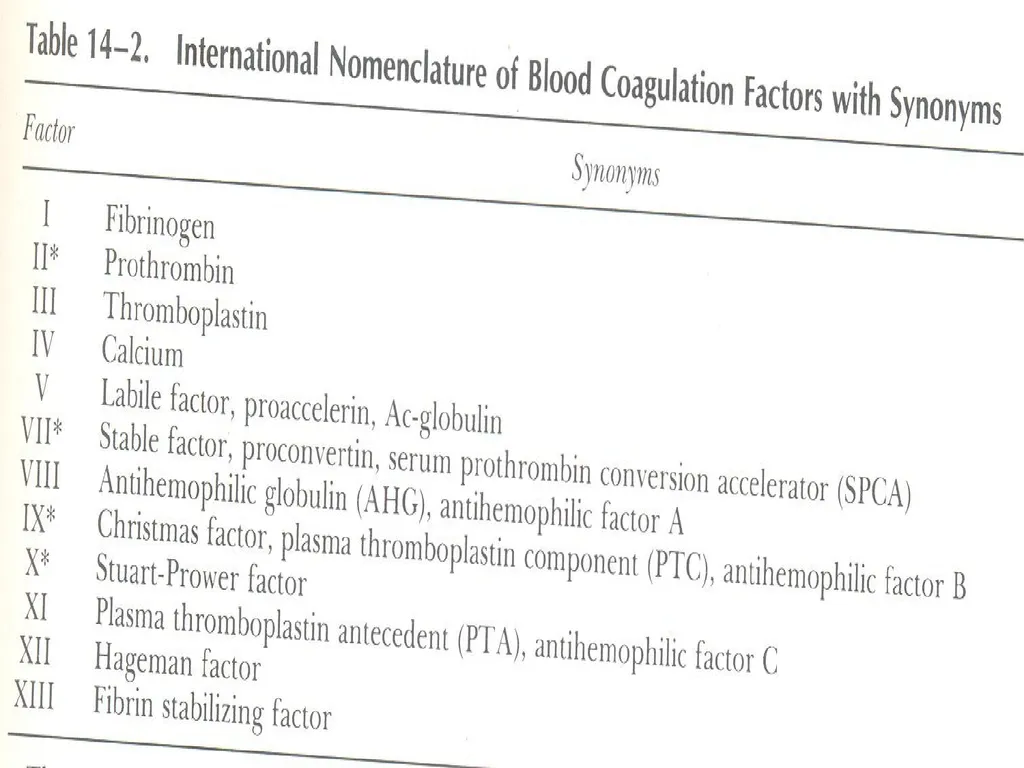
Blood clotting factors:
I Fibrinogen
II Prothrombin
III Thromboplastin
IV Calcium
V Proaccelerin (labile factor, accelerator globulin)
VII Proconvertin (stable factor, anti-prothrombin 1)
VIII Anti-hemophilic factor (AHF-A, platelet co-factor)
IX Christmas factor (AHF-B, plasma prothromboplastin component)
X Stuart factor (anti-prothrombin III, stuart prower factor)
XI Plasma thromboplastin anticedent (AHF-C)
XII Hagemen factor (contact factor)
XIII Fibrin stabilizing factor (plasma transglutaminase)<br>
I Fibrinogen
II Prothrombin
III Thromboplastin
IV Calcium
V Proaccelerin (labile factor, accelerator globulin)
VII Proconvertin (stable factor, anti-prothrombin 1)
VIII Anti-hemophilic factor (AHF-A, platelet co-factor)
IX Christmas factor (AHF-B, plasma prothromboplastin component)
X Stuart factor (anti-prothrombin III, stuart prower factor)
XI Plasma thromboplastin anticedent (AHF-C)
XII Hagemen factor (contact factor)
XIII Fibrin stabilizing factor (plasma transglutaminase)<br>
24
Mechanism involved in blood clotting:<br>