
Vietnam 1964 - 1975 Revision Presentation Key





Description: Vietnam 1964 - 1975 Revision Presentation Key issue: How effective were guerrilla tactics during the Vietnam War? The French defeat at Dien Bien Phu and its consequences US policy and intervention following French defeat The theory of
Related Topics
Download Presentation
"Vietnam 1964 - 1975 Revision Presentation Key" is the property of its rightful owner. Permission is granted to download and print the materials on this website for personal, non-commercial use only, and to display it on your personal computer provided you do not modify the materials and that you retain all copyright notices contained in the materials. By downloading content from our website, you accept the terms of this agreement.
Presentation Transcript
slide1. Vietnam 1964 - 1975 Revision Presentation<br>
slide2. Key issue: How effective were guerrilla tactics during the Vietnam War?
The French defeat at Dien Bien Phu and its consequences
US policy and intervention following French defeat
The theory of Guerrilla warfare
Guerrilla tactics, 1964–1968
The US response to guerrilla tactics: Operation Rolling Thunder; ‘Hearts and Minds’; Agent Orange and Napalm; Search and Destroy
The My Lai Massacre, 1968.
Key issue: How did the coverage of the Vietnam War in the USA lead to demands for peace?
TV and media coverage of the war, from the Gulf of Tonkin to the evacuation of Saigon
Protest movements in the USA, 1968–1973
The public reaction to the My Lai Massacre, the trial of Lieutenant Calley
The Kent State University protest, 1970
The Fulbright Hearings, 1971.
Key issue: Why were the US actions to end the Vietnam War unsuccessful?
The Tet Offensive and its impact on the war, 1968
Attacks on Laos and Cambodia, 1970
US bombing of the North and attacks on Laos and Cambodia, 1970 –1972
The Paris Peace Conference and US withdrawal
The fall of Saigon, 1975.<br>
slide3. Essential Background Vietnam had been part of the French empire of Indo-China, occupied by Japan during WW2
Communist leader Ho Chi Minh had formed the Vietminh to fight Japan during WW2, and the French afterwards – he wanted independence for Vietnam
The French were defeated by the Vietminh at Dien Bien Phu in 1954
This led to the Geneva Agreement of 1954<br>
slide4. Essential Background The Geneva Agreement created North and South Vietnam (Communist North, pro-US South)
The Agreement also provided for elections in 1956 for a united Vietnam
The Americans did not sign the Geneva Agreement, and supported the South’s opposition to elections in 1956
They were worried that Communist leader Ho Chi Minh would win any united elections<br>
slide5. Why Were the Americans Concerned About Vietnam? Successive American administrations believed in the Domino Theory
They thought that if South Vietnam fell to communism, then other South East Asian states would follow
The politics of the Cold War led US presidents to commit to a policy of containment, opposing any further spread of communism
For Eisenhower, Kennedy and Johnson, South Vietnam was an important country to defend<br>
slide6. Why did President Johnson find himself going to war in Vietnam? When Johnson became president in 1963, American military advisers were supporting the South Vietnamese regime, but they were not directly at war
Kennedy had increased the number of advisers in South Vietnam, sending around 16,000 by the end of his presidency plus military hardware
However, South Vietnam was effectively involved in a civil war, with Communist guerrillas (the Vietcong) supported by the North Vietnamese, fighting the South Vietnamese Army (ARVN)<br>
slide7. Why did President Johnson find himself going to war in Vietnam? The South Vietnamese regime was finding it increasingly difficult to fight the Vietcong
The Americans had supported the overthrow and murder of former South Vietnamese leader Diem in 1963
Diem’s successors were no more able than he to improve the situation in South Vietnam
Johnson did not initially want a full scale war in Vietnam, as he was committed to a sweeping programme of domestic reform in the USA which he called the “Great Society”<br>
slide8. Why did President Johnson find himself going to war in Vietnam? However, Johnson was also aware that US public opinion expected him to prevent further Communist expansion
He decided that the only way to stop South Vietnam becoming overwhelmed by the North and the Vietcong was to send US forces to help in the fight, not just as advisers
Johnson was partly persuaded by the hawkish leanings of Defence Secretary Robert McNamara<br>
slide9. How did President Johnson find himself going to war in Vietnam? August 1964, North Vietnamese patrol boats opened fire on US ships in Gulf of Tonkin
Congress passed the ‘Tonkin Resolution’, giving Johnson full war powers to use when he wanted
Johnson waited until after the November elections in America before exercising his powers
In February 1965 Vietcong forces attacked the US air base at Pleiku
Johnson chose to retaliate, and began escalating the troop numbers in Vietnam, as well as authorising the bombing campaign that came to be known as Rolling Thunder<br>
slide10. What Sort of War Was Vietnam? US politicians like Secretary of Defence McNamara and Secretary of State Dean Rusk, as well as the head of US forces in South Vietnam, General Westmoreland, thought that this war would be easily won
They believed superior American technology and firepower, and significant troop numbers, would defeat the Vietcong
They had not anticipated the nature of the guerrilla war that would follow<br>
slide11. Guerrilla War “In guerrilla war, a conventional army loses if it does not win, and a guerrilla army wins if it does not lose”
“In a conventional war, a success rate in battle of 75% would guarantee victory. In a guerrilla war, protecting the population only 75% of the time ensures defeat”
- Henry Kissinger, “Diplomacy”<br>
slide12. Vietcong Tactics Communist forces were well supplied by China and the USSR
But they were outnumbered and outgunned by the US and their South Vietnamese allies
In open warfare they were no match for US forces
Nov 1965, La Dreng Valley – US forces kill 2,000 Vietcong for loss of 300 US soldiers
Ho Chi Minh and his military chief, General Giap, knew they had to avoid open warfare and fight with guerrilla tactics<br>
slide13. Vietcong Tactics The principle of the Vietcong guerrilla tactics was to
retreat when the enemy attacks; raid when the enemy camps; attack when the enemy tires; pursue when the enemy retreats.<br>
slide14. Vietcong Tactics Guerrillas did not wear uniform.
They had no known base camp or headquarters.
They worked in small groups with limited weapons.
They were hard to tell apart from the peasants in the villages.
They attacked and then disappeared into the jungle, into the villages or into their tunnels<br>
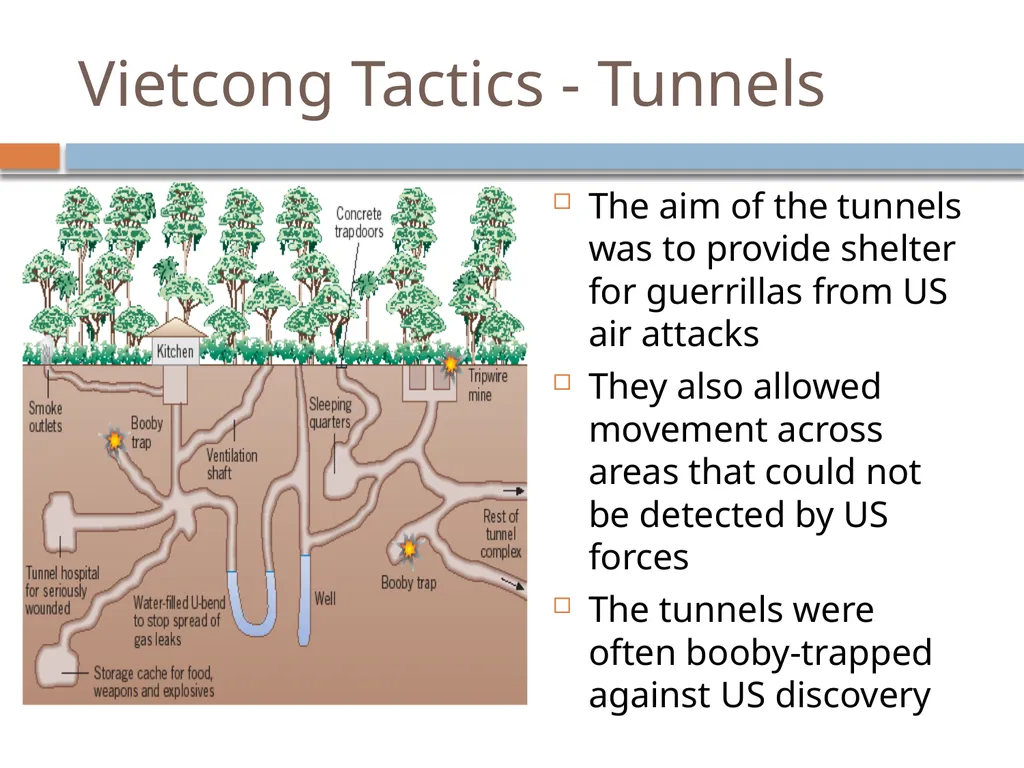
slide15. Vietcong Tactics - Tunnels The aim of the tunnels was to provide shelter for guerrillas from US air attacks
They also allowed movement across areas that could not be detected by US forces
The tunnels were often booby-trapped against US discovery<br>
slide16. Vietcong Tactics – Attitude to Local Population Ho knew how important it was to keep the population on his side. The Viet Cong fighters were expected to be courteous and respectful to the Vietnamese peasants. They often helped the peasants in the fields during busy periods.
However, the Viet Cong could be ruthless – they were quite prepared to kill peasants who opposed them or who co-operated with their enemies. They also conducted a campaign of terror against the police, tax collectors, teachers and any other employees of the South Vietnamese government.
Between 1966 and 1971 the Viet Cong killed an estimated 27,000 civilians.<br>
slide17. Ho Chi Minh Trail The Viet Cong depended on supplies from North Vietnam that came along the Ho Chi Minh trail.
US and South Vietnamese planes bombed this constantly, but 40,000 Vietnamese worked to keep it open whatever the cost.<br>
slide18. Vietcong Losses The total of Viet Cong and North Vietnamese dead in the war has been estimated at 1 million – far higher than US losses (58,000).
However, this was a price that Ho Chi Minh was prepared to pay.
Whatever the casualties, there were replacement troops available.
Ho’s North Vietnamese regime was an authoritarian one – all citizens were forced to play their part in the war, encouraged by north Vietnamese proaganda<br>
slide19. Vietcong Tactics - Summary Gain support of the villages
Attack in small groups by ambush, then use jungle for cover to disappear
Spread revolutionary propaganda amongst peasants
Use of networks of booby-trapped tunnels; also doubled as supply dumps
Use of secret routes – notably Ho Chi Minh Trail – to keep supplies going
Murdering local officials<br>
slide20. US Tactics - Bombing Rolling Thunder began an air offensive that lasted until 1972
Initially targeted military and industrial sites in north Vietnam
Towns and cities in North and South were later included<br>
slide21. US Tactics – How effective was bombing? It certainly damaged North Vietnam’s war effort and it disrupted supply routes.
It enabled the USA to strike at Communist forces even when it was reducing US ground forces in Vietnam after 1969.
From 1970 to 1972, intense bombing campaigns against Hanoi (North Vietnam’s capital) and the port of Haiphong forced the North Vietnamese to the negotiating table.
However, US air power could not defeat the Communists – it could only slow them down. The Viet Cong continued to operate its supply lines. Even after major air raids on North Vietnam in 1972, the Communists were still able to launch a major assault on the South.<br>
slide22. US Tactics – How effective was bombing? The cost of the air war was horrendous.
The Communists shot down 14,000 US and South Vietnamese aircraft.
In 1967 the American Life magazine calculated that it cost the USA $400,000 to kill one Viet Cong fighter, a figure that included 75 bombs and 400 artillery shells.<br>
slide23. US Tactics – Chemical Weapons Agent Orange was widely used
Highly toxic ‘weedkiller’. Used to destroy the jungle where the Viet Cong hid.
The Americans used 82 million litres of Agent Orange to spray thousands of square kilometres of jungle.
Napalm was another widely-used chemical weapon. It destroyed jungles where guerrillas might hide. It also burned through skin to the bone. Many civilians and soldiers were also killed by these chemical weapons.<br>
slide24. US Tactics – Search and Destroy Helicopters took forces to remote villages to search for and kill Vietcong; BUT
The raids were often based on inadequate information.
Inexperienced US troops often walked into traps.
Innocent villages were mistaken for Viet Cong strongholds.
Civilian casualties were extremely high in these raids. For every Viet Cong weapon captured by search-and-destroy, there was a body count of six. Many of these were innocent civilians.
Search-and-destroy tactics made the US and South Vietnamese forces very unpopular with the peasants. It pushed them towards supporting the Viet Cong.<br>
slide25. Turning Point – The Tet Offensive 1968 Major Communist offensive launched during Tet New Year holiday
Vietcong fighters attacked over 100 cities and other military targets
One commando unit tried to capture US embassy in Saigon – ambassador fled in his pyjamas
Aim was also to have South Vietnamese rise up in support<br>
slide26. Turning Point – Tet 1968 The offensive failed in its objectives
South Vietnamese did not rise up
Communists forces suffered huge casualties (10,000 experienced fighters killed)
Communist gains were eventually recovered by US forces<br>
slide27. Turning Point – Tet 1968 However, Tet was also a defeat for the Americans
Attack had taken them by surprise, despite huge expenditure and large force numbers
Took 11,000 men to recover Saigon alone
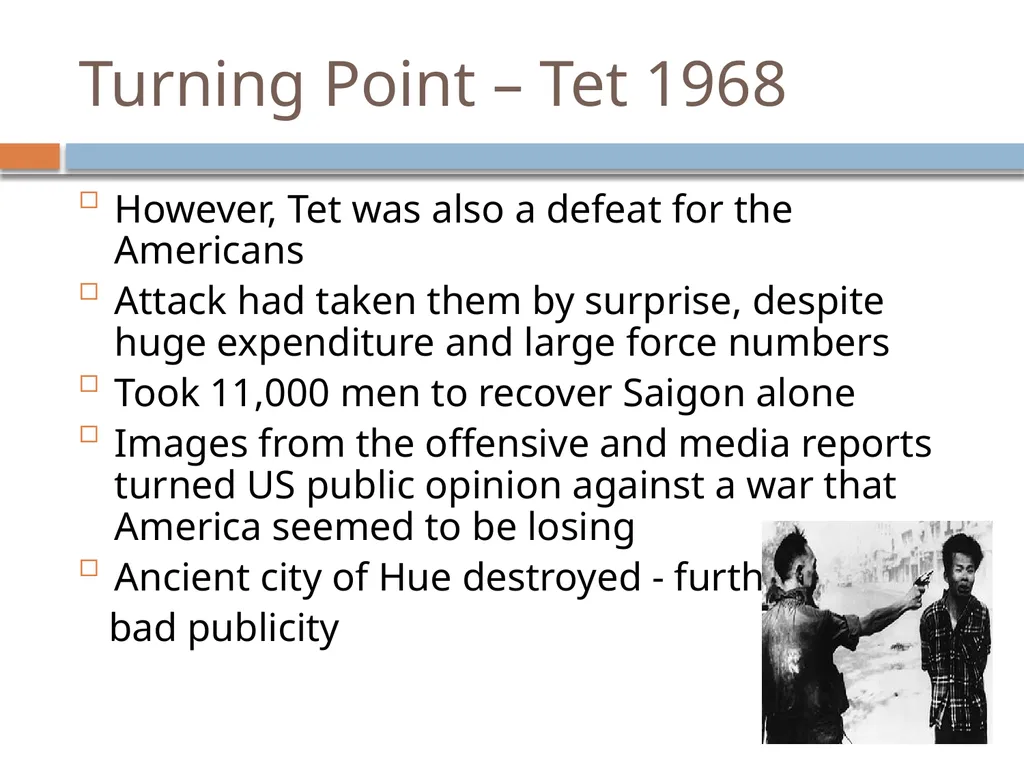
Images from the offensive and media reports turned US public opinion against a war that America seemed to be losing
Ancient city of Hue destroyed - further
bad publicity<br>
slide28. What was the reaction in America to the war? The draft (conscription) caused young men to oppose the war
Anti-war demonstrations intensified as casualty rates increased
Tax rises caused further opposition – the war’s costs seemed to be spiralling out of control
Media coverage became more antagonistic – Tet offensive was a key turning point, as was reaction of respected reporter Walter Cronkite (“I thought we were winning this war?”)<br>
slide29. What was the reaction in America to the war? Revelation of the My Lai Massacre in March 1969 (the event actually took place a year earlier) had a huge impact
“The revelations about My Lai deeply shocked the American public. It was the clearest evidence that the war had gone wrong. In November 1969, almost 700,000 anti-war protesters demonstrated in Washington DC. It was the largest political protest in American history.”
Fulbright Hearings 1971 – the Senate was now questioning the exercise of the war; evidence from veteran John Kerry – where he spoke candidly about orders given to soldiers to rape, torture and destroy whole villages – created a media sensation<br>
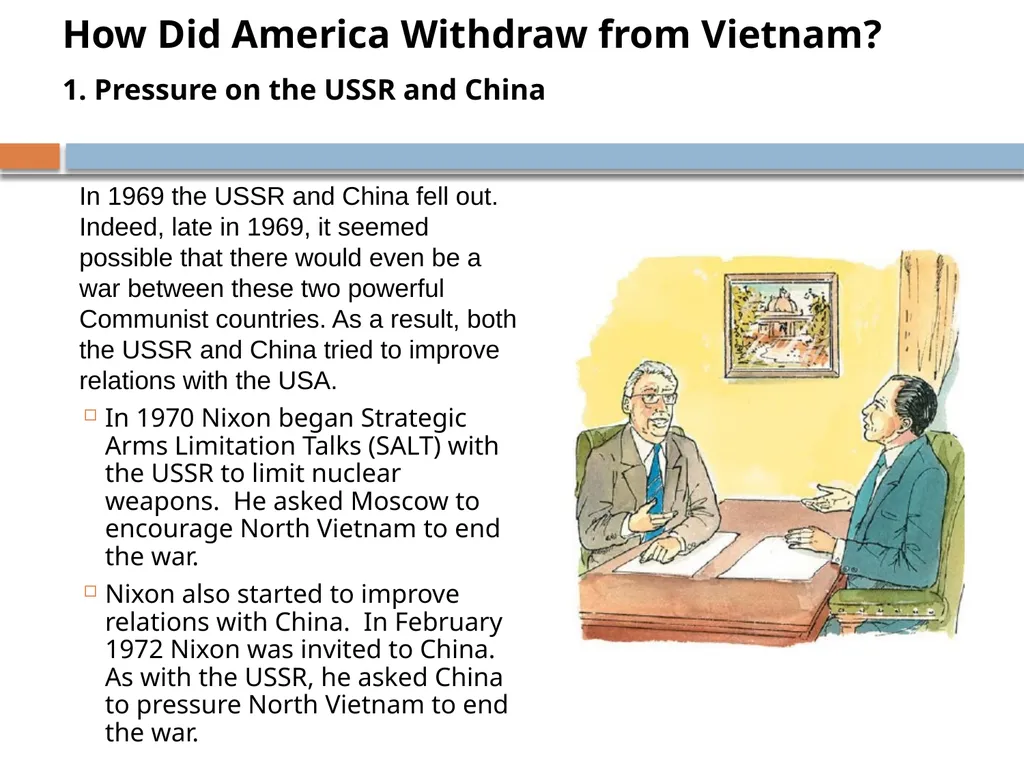
slide30. How Did America Withdraw from Vietnam? 1. Pressure on the USSR and China In 1970 Nixon began Strategic Arms Limitation Talks (SALT) with the USSR to limit nuclear weapons. He asked Moscow to encourage North Vietnam to end the war.
Nixon also started to improve relations with China. In February 1972 Nixon was invited to China. As with the USSR, he asked China to pressure North Vietnam to end the war. In 1969 the USSR and China fell out. Indeed, late in 1969, it seemed possible that there would even be a war between these two powerful Communist countries. As a result, both the USSR and China tried to improve relations with the USA.<br>
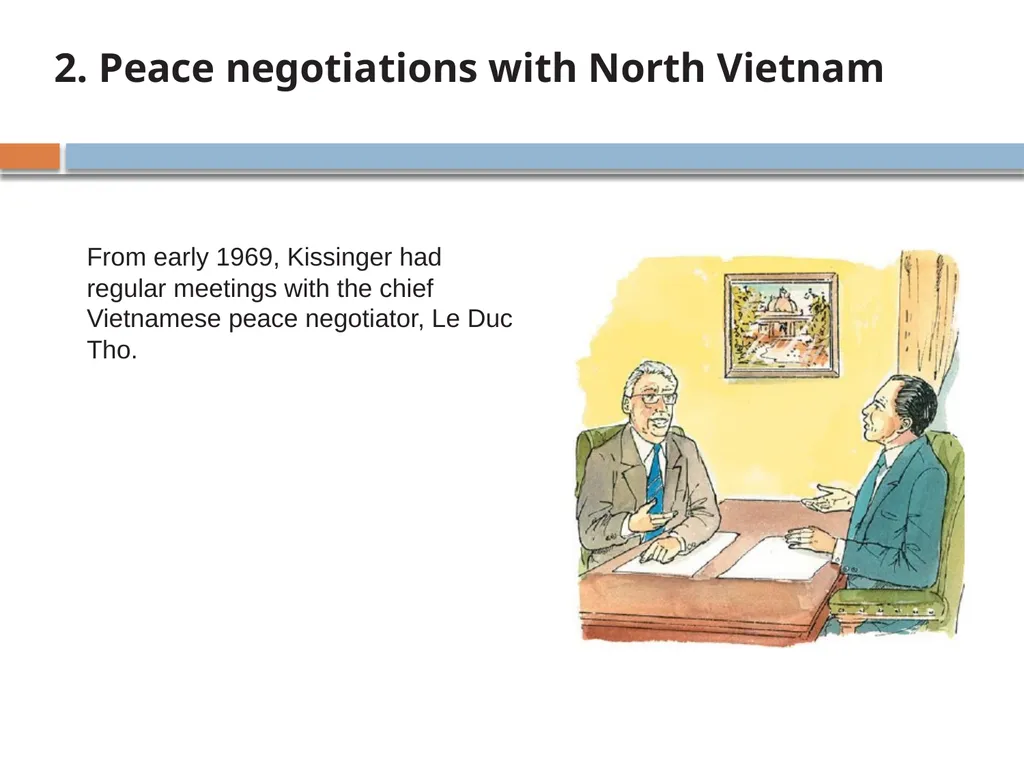
slide31. 2. Peace negotiations with North Vietnam From early 1969, Kissinger had regular meetings with the chief Vietnamese peace negotiator, Le Duc Tho.<br>
slide32. 3. ‘Vietnamisation’ of the war effort In Vietnam Nixon began the process of Vietnamisation – building up South Vietnamese forces and withdrawing US troops. Between April 1969 and the end of 1971 almost 400,000 US troops left Vietnam.<br>
slide33. 4. Bombing Nixon increased bombing campaigns against North Vietnam to show he was not weak. He also invaded Viet Cong bases in Cambodia, causing outrage across the world, and even in the USA.<br>
slide34. How Did America Withdraw from Vietnam? Jan 1973 – Ceasefire agreed
1974 – President Nixon’s resignation over Watergate removed guarantee of US support for South Vietnamese regime of President Thieu
April 1975 – Saigon occupied by Vietcong and North Vietnamese forces
American personnel fled by helicopter from US embassy roof<br>
slide35. Why did the USA Lose in Vietnam? Vietcong had widespread support amongst South Vietnamese people, compared to alienation from US and corrupt South Vietnamese regime
US could not combat guerrilla warfare successfully
Vietcong received help from China and USSR, as well as North Vietnam
Media coverage in USA and increasing domestic hostility
Costs eventually helped wear America down
Utter dedication of North Vietnamese leadership, regardless of human cost<br>
slide36. Vietnam – Question (a)s – 8 marks Explain the consequences of French defeat in Vietnam in 1954 for both Vietnam and the USA.
Why did Saigon fall to the Communists in 1975?<br>
slide37. Vietnam – Question (b)s – 12 marks June 11 - ‘The My Lai Massacre (1968) was the main reason why American public opinion turned against US involvement in Vietnam.’ Do you agree? Explain your answer. (Every question adds this)
June 12 - ‘Media coverage of the Vietnam War was the most important reason for growing
demands for peace from the American public.’
‘The bombing of North Vietnam in the 1960s was the USA’s main response to the Vietcong’s use of guerrilla tactics.’<br>
slide2. Key issue: How effective were guerrilla tactics during the Vietnam War?
The French defeat at Dien Bien Phu and its consequences
US policy and intervention following French defeat
The theory of Guerrilla warfare
Guerrilla tactics, 1964–1968
The US response to guerrilla tactics: Operation Rolling Thunder; ‘Hearts and Minds’; Agent Orange and Napalm; Search and Destroy
The My Lai Massacre, 1968.
Key issue: How did the coverage of the Vietnam War in the USA lead to demands for peace?
TV and media coverage of the war, from the Gulf of Tonkin to the evacuation of Saigon
Protest movements in the USA, 1968–1973
The public reaction to the My Lai Massacre, the trial of Lieutenant Calley
The Kent State University protest, 1970
The Fulbright Hearings, 1971.
Key issue: Why were the US actions to end the Vietnam War unsuccessful?
The Tet Offensive and its impact on the war, 1968
Attacks on Laos and Cambodia, 1970
US bombing of the North and attacks on Laos and Cambodia, 1970 –1972
The Paris Peace Conference and US withdrawal
The fall of Saigon, 1975.<br>
slide3. Essential Background Vietnam had been part of the French empire of Indo-China, occupied by Japan during WW2
Communist leader Ho Chi Minh had formed the Vietminh to fight Japan during WW2, and the French afterwards – he wanted independence for Vietnam
The French were defeated by the Vietminh at Dien Bien Phu in 1954
This led to the Geneva Agreement of 1954<br>
slide4. Essential Background The Geneva Agreement created North and South Vietnam (Communist North, pro-US South)
The Agreement also provided for elections in 1956 for a united Vietnam
The Americans did not sign the Geneva Agreement, and supported the South’s opposition to elections in 1956
They were worried that Communist leader Ho Chi Minh would win any united elections<br>
slide5. Why Were the Americans Concerned About Vietnam? Successive American administrations believed in the Domino Theory
They thought that if South Vietnam fell to communism, then other South East Asian states would follow
The politics of the Cold War led US presidents to commit to a policy of containment, opposing any further spread of communism
For Eisenhower, Kennedy and Johnson, South Vietnam was an important country to defend<br>
slide6. Why did President Johnson find himself going to war in Vietnam? When Johnson became president in 1963, American military advisers were supporting the South Vietnamese regime, but they were not directly at war
Kennedy had increased the number of advisers in South Vietnam, sending around 16,000 by the end of his presidency plus military hardware
However, South Vietnam was effectively involved in a civil war, with Communist guerrillas (the Vietcong) supported by the North Vietnamese, fighting the South Vietnamese Army (ARVN)<br>
slide7. Why did President Johnson find himself going to war in Vietnam? The South Vietnamese regime was finding it increasingly difficult to fight the Vietcong
The Americans had supported the overthrow and murder of former South Vietnamese leader Diem in 1963
Diem’s successors were no more able than he to improve the situation in South Vietnam
Johnson did not initially want a full scale war in Vietnam, as he was committed to a sweeping programme of domestic reform in the USA which he called the “Great Society”<br>
slide8. Why did President Johnson find himself going to war in Vietnam? However, Johnson was also aware that US public opinion expected him to prevent further Communist expansion
He decided that the only way to stop South Vietnam becoming overwhelmed by the North and the Vietcong was to send US forces to help in the fight, not just as advisers
Johnson was partly persuaded by the hawkish leanings of Defence Secretary Robert McNamara<br>
slide9. How did President Johnson find himself going to war in Vietnam? August 1964, North Vietnamese patrol boats opened fire on US ships in Gulf of Tonkin
Congress passed the ‘Tonkin Resolution’, giving Johnson full war powers to use when he wanted
Johnson waited until after the November elections in America before exercising his powers
In February 1965 Vietcong forces attacked the US air base at Pleiku
Johnson chose to retaliate, and began escalating the troop numbers in Vietnam, as well as authorising the bombing campaign that came to be known as Rolling Thunder<br>
slide10. What Sort of War Was Vietnam? US politicians like Secretary of Defence McNamara and Secretary of State Dean Rusk, as well as the head of US forces in South Vietnam, General Westmoreland, thought that this war would be easily won
They believed superior American technology and firepower, and significant troop numbers, would defeat the Vietcong
They had not anticipated the nature of the guerrilla war that would follow<br>
slide11. Guerrilla War “In guerrilla war, a conventional army loses if it does not win, and a guerrilla army wins if it does not lose”
“In a conventional war, a success rate in battle of 75% would guarantee victory. In a guerrilla war, protecting the population only 75% of the time ensures defeat”
- Henry Kissinger, “Diplomacy”<br>
slide12. Vietcong Tactics Communist forces were well supplied by China and the USSR
But they were outnumbered and outgunned by the US and their South Vietnamese allies
In open warfare they were no match for US forces
Nov 1965, La Dreng Valley – US forces kill 2,000 Vietcong for loss of 300 US soldiers
Ho Chi Minh and his military chief, General Giap, knew they had to avoid open warfare and fight with guerrilla tactics<br>
slide13. Vietcong Tactics The principle of the Vietcong guerrilla tactics was to
retreat when the enemy attacks; raid when the enemy camps; attack when the enemy tires; pursue when the enemy retreats.<br>
slide14. Vietcong Tactics Guerrillas did not wear uniform.
They had no known base camp or headquarters.
They worked in small groups with limited weapons.
They were hard to tell apart from the peasants in the villages.
They attacked and then disappeared into the jungle, into the villages or into their tunnels<br>
slide15. Vietcong Tactics - Tunnels The aim of the tunnels was to provide shelter for guerrillas from US air attacks
They also allowed movement across areas that could not be detected by US forces
The tunnels were often booby-trapped against US discovery<br>
slide16. Vietcong Tactics – Attitude to Local Population Ho knew how important it was to keep the population on his side. The Viet Cong fighters were expected to be courteous and respectful to the Vietnamese peasants. They often helped the peasants in the fields during busy periods.
However, the Viet Cong could be ruthless – they were quite prepared to kill peasants who opposed them or who co-operated with their enemies. They also conducted a campaign of terror against the police, tax collectors, teachers and any other employees of the South Vietnamese government.
Between 1966 and 1971 the Viet Cong killed an estimated 27,000 civilians.<br>
slide17. Ho Chi Minh Trail The Viet Cong depended on supplies from North Vietnam that came along the Ho Chi Minh trail.
US and South Vietnamese planes bombed this constantly, but 40,000 Vietnamese worked to keep it open whatever the cost.<br>
slide18. Vietcong Losses The total of Viet Cong and North Vietnamese dead in the war has been estimated at 1 million – far higher than US losses (58,000).
However, this was a price that Ho Chi Minh was prepared to pay.
Whatever the casualties, there were replacement troops available.
Ho’s North Vietnamese regime was an authoritarian one – all citizens were forced to play their part in the war, encouraged by north Vietnamese proaganda<br>
slide19. Vietcong Tactics - Summary Gain support of the villages
Attack in small groups by ambush, then use jungle for cover to disappear
Spread revolutionary propaganda amongst peasants
Use of networks of booby-trapped tunnels; also doubled as supply dumps
Use of secret routes – notably Ho Chi Minh Trail – to keep supplies going
Murdering local officials<br>
slide20. US Tactics - Bombing Rolling Thunder began an air offensive that lasted until 1972
Initially targeted military and industrial sites in north Vietnam
Towns and cities in North and South were later included<br>
slide21. US Tactics – How effective was bombing? It certainly damaged North Vietnam’s war effort and it disrupted supply routes.
It enabled the USA to strike at Communist forces even when it was reducing US ground forces in Vietnam after 1969.
From 1970 to 1972, intense bombing campaigns against Hanoi (North Vietnam’s capital) and the port of Haiphong forced the North Vietnamese to the negotiating table.
However, US air power could not defeat the Communists – it could only slow them down. The Viet Cong continued to operate its supply lines. Even after major air raids on North Vietnam in 1972, the Communists were still able to launch a major assault on the South.<br>
slide22. US Tactics – How effective was bombing? The cost of the air war was horrendous.
The Communists shot down 14,000 US and South Vietnamese aircraft.
In 1967 the American Life magazine calculated that it cost the USA $400,000 to kill one Viet Cong fighter, a figure that included 75 bombs and 400 artillery shells.<br>
slide23. US Tactics – Chemical Weapons Agent Orange was widely used
Highly toxic ‘weedkiller’. Used to destroy the jungle where the Viet Cong hid.
The Americans used 82 million litres of Agent Orange to spray thousands of square kilometres of jungle.
Napalm was another widely-used chemical weapon. It destroyed jungles where guerrillas might hide. It also burned through skin to the bone. Many civilians and soldiers were also killed by these chemical weapons.<br>
slide24. US Tactics – Search and Destroy Helicopters took forces to remote villages to search for and kill Vietcong; BUT
The raids were often based on inadequate information.
Inexperienced US troops often walked into traps.
Innocent villages were mistaken for Viet Cong strongholds.
Civilian casualties were extremely high in these raids. For every Viet Cong weapon captured by search-and-destroy, there was a body count of six. Many of these were innocent civilians.
Search-and-destroy tactics made the US and South Vietnamese forces very unpopular with the peasants. It pushed them towards supporting the Viet Cong.<br>
slide25. Turning Point – The Tet Offensive 1968 Major Communist offensive launched during Tet New Year holiday
Vietcong fighters attacked over 100 cities and other military targets
One commando unit tried to capture US embassy in Saigon – ambassador fled in his pyjamas
Aim was also to have South Vietnamese rise up in support<br>
slide26. Turning Point – Tet 1968 The offensive failed in its objectives
South Vietnamese did not rise up
Communists forces suffered huge casualties (10,000 experienced fighters killed)
Communist gains were eventually recovered by US forces<br>
slide27. Turning Point – Tet 1968 However, Tet was also a defeat for the Americans
Attack had taken them by surprise, despite huge expenditure and large force numbers
Took 11,000 men to recover Saigon alone
Images from the offensive and media reports turned US public opinion against a war that America seemed to be losing
Ancient city of Hue destroyed - further
bad publicity<br>
slide28. What was the reaction in America to the war? The draft (conscription) caused young men to oppose the war
Anti-war demonstrations intensified as casualty rates increased
Tax rises caused further opposition – the war’s costs seemed to be spiralling out of control
Media coverage became more antagonistic – Tet offensive was a key turning point, as was reaction of respected reporter Walter Cronkite (“I thought we were winning this war?”)<br>
slide29. What was the reaction in America to the war? Revelation of the My Lai Massacre in March 1969 (the event actually took place a year earlier) had a huge impact
“The revelations about My Lai deeply shocked the American public. It was the clearest evidence that the war had gone wrong. In November 1969, almost 700,000 anti-war protesters demonstrated in Washington DC. It was the largest political protest in American history.”
Fulbright Hearings 1971 – the Senate was now questioning the exercise of the war; evidence from veteran John Kerry – where he spoke candidly about orders given to soldiers to rape, torture and destroy whole villages – created a media sensation<br>
slide30. How Did America Withdraw from Vietnam? 1. Pressure on the USSR and China In 1970 Nixon began Strategic Arms Limitation Talks (SALT) with the USSR to limit nuclear weapons. He asked Moscow to encourage North Vietnam to end the war.
Nixon also started to improve relations with China. In February 1972 Nixon was invited to China. As with the USSR, he asked China to pressure North Vietnam to end the war. In 1969 the USSR and China fell out. Indeed, late in 1969, it seemed possible that there would even be a war between these two powerful Communist countries. As a result, both the USSR and China tried to improve relations with the USA.<br>
slide31. 2. Peace negotiations with North Vietnam From early 1969, Kissinger had regular meetings with the chief Vietnamese peace negotiator, Le Duc Tho.<br>
slide32. 3. ‘Vietnamisation’ of the war effort In Vietnam Nixon began the process of Vietnamisation – building up South Vietnamese forces and withdrawing US troops. Between April 1969 and the end of 1971 almost 400,000 US troops left Vietnam.<br>
slide33. 4. Bombing Nixon increased bombing campaigns against North Vietnam to show he was not weak. He also invaded Viet Cong bases in Cambodia, causing outrage across the world, and even in the USA.<br>
slide34. How Did America Withdraw from Vietnam? Jan 1973 – Ceasefire agreed
1974 – President Nixon’s resignation over Watergate removed guarantee of US support for South Vietnamese regime of President Thieu
April 1975 – Saigon occupied by Vietcong and North Vietnamese forces
American personnel fled by helicopter from US embassy roof<br>
slide35. Why did the USA Lose in Vietnam? Vietcong had widespread support amongst South Vietnamese people, compared to alienation from US and corrupt South Vietnamese regime
US could not combat guerrilla warfare successfully
Vietcong received help from China and USSR, as well as North Vietnam
Media coverage in USA and increasing domestic hostility
Costs eventually helped wear America down
Utter dedication of North Vietnamese leadership, regardless of human cost<br>
slide36. Vietnam – Question (a)s – 8 marks Explain the consequences of French defeat in Vietnam in 1954 for both Vietnam and the USA.
Why did Saigon fall to the Communists in 1975?<br>
slide37. Vietnam – Question (b)s – 12 marks June 11 - ‘The My Lai Massacre (1968) was the main reason why American public opinion turned against US involvement in Vietnam.’ Do you agree? Explain your answer. (Every question adds this)
June 12 - ‘Media coverage of the Vietnam War was the most important reason for growing
demands for peace from the American public.’
‘The bombing of North Vietnam in the 1960s was the USA’s main response to the Vietcong’s use of guerrilla tactics.’<br>