
VIRGINIA DEFENSE FORCE Administration, Personnel

Description: VIRGINIA DEFENSE FORCE Administration, Personnel Procedures, Communication and Forms (ALC) ALC version 91724 Administrative and Personnel Procedures VDF Regulation 600-10 Administrative and Personnel Procedures in the Virginia Defense
Related Topics
Download Presentation
"VIRGINIA DEFENSE FORCE Administration, Personnel" is the property of its rightful owner. Permission is granted to download and print the materials on this website for personal, non-commercial use only, and to display it on your personal computer provided you do not modify the materials and that you retain all copyright notices contained in the materials. By downloading content from our website, you accept the terms of this agreement.
Presentation Transcript
slide1. VIRGINIA DEFENSE FORCE
Administration, Personnel Procedures, Communication and Forms
(ALC) ALC version 9/17/24<br>
slide2. Administrative and Personnel Procedures VDF Regulation 600-10 Administrative and Personnel Procedures in the Virginia Defense Force
This regulation prescribes, using a modular approach, the policies, procedures, and programs for Virginia Defense Force (VDF) personnel and administrative matters.
This regulation applies to personnel and administration management for the VDF Force Headquarters (FORHQ), Major Subordinate Commands (MSCs), and individually to all VDF members.
Users are invited to send comments and suggested improvements directly to Headquarters, Virginia Defense Force, Attention: G-1, 5001 Waller Road, Richmond, Virginia 23230-2915.
The proponent is the Assistant Chief of Staff, Personnel and Administration, G1. The exception authority is the VDF Commanding General (CG). Any revisions or exceptions to this regulation are prohibited without the CG’s prior written approval.<br>
slide3. VDF Regulation 600-10 Chapter 1 General Provisions
1-1. Purpose and Authority
This VDF Regulation (VDFR) 600-10 prescribes, using a modular approach, the policies, procedures, and programs for VDF administrative and personnel matters. This regulation is to be read and interpreted as a stand-alone document. If any provisions of another military service regulation/instruction/order conflict with any provision herein, the provisions of VDFR 600-10 are controlling, except to the extent that it conflicts with controlling statutory or higher headquarters (HHQ)regulatory law.
1-2. References and Replacement
Reference publications are listed Appendix A. This VDFR 600-10 replaces VDFR 600-10 dated OCT 2006. Each Appendix listed above cites those VDF regulations the particular Appendix replaces.<br>
slide4. VDF Regulation 600-10 1-3. Commanding General’s Intent and Guidance
a. The VDF provides an organized, trained, and disciplined military force to assist the Virginia
Department of Military Affairs (DMA) and the Virginia National Guard (VANG) conduct domestic
operations in support of civilian authorities, and other Commonwealth of Virginia agencies as directed
by competent authority. Accordingly, the VDF must recruit, equip, and administer personnel programs
to produce troops ready to meet DMA missions. Personnel management is the backbone for the Force.
Regulations must be comprehensive, yet logical and as simple as possible.
b. VDFR 600-10 is a comprehensive treatment of all administrative and personnel management
subjects. It uses a modular approach (“Appendixes”) to address every administrative aspect of VDF
service, from recruitment to separation and retirement. Each Appendix (APDX) will focus on one
administration and personnel management aspect, and may refer to other Appendixes, without
duplicating other Appendixes’ information. Thus, an Appendix can be updated without cascading
changes to other Appendixes.<br>
slide5. VDF Regulation 600-10 Chapter 2 Administration and Personnel Management
2-1. Positions and Responsibilities
The following actions are routine actions, which may be modified at the CG’s, or in his absence, the Deputy Commanding Officer’s (DCO) direction.
a. Chief of Staff. The VDF Chief of Staff (COS) will monitor all staff action and will ensure all administrative actions are timely and accurately completed. The COS will further ensure the G1 conducts ongoing review of the Appendixes contained in this regulation.
b. VDF G1. The VDF Assistant Chief of Staff, Personnel and Administration (G1) – or the Deputy G1 in his absence -- will be the principal coordinator for all administrative, correspondence, and personnel management actions.
(1) The G1 will manage Appendixes creation and review, leveraging subject matter expert (SME) proponents as appropriate. The Appendixes will be in accordance with U.S. Army correspondence letter, rather than regulations, standards, and each follow the same essential construction approach.
(2) The G1, leveraging SME proponents as appropriate, will review and, as needed, revise the Appendixes for currency and accuracy on a rolling four-year basis (approximately a fourth of regulations in the Appendixes per year). Revisions will be staffed to the CG via the COS. VDF personnel may suggest changes in any Appendix via VDF Action Request (VAR) to the G1, per Appendix D, “Administration and Correspondence Standard Operating Procedures.”<br>
slide6. VDF Regulation 600-10 Appendix A. A & P Procedures in the VDF: References, Authorized Abbreviations, Brevity Codes, and Office Codes
Appendix B. Accession of Unrestricted Line VDF Personnel
Appendix C. Accession of Professional Branch VDF Personnel
Appendix D. Administration and Correspondence Standard Operating Procedures
Appendix E. Awards, Service Ribbons, and Skills Devices for VDF
Appendix F. Background Checks
Appendix G. Identification Cards
Appendix H. Performance Evaluation Report and Counselling
Appendix I. Personnel Assets Attendance and Unit Strength Accounting
Appendix J. Personnel Boards
Appendix K. Personnel Management of Professionals Branches
Appendix L. Personnel Promotions
Appendix M. Personnel Records Management
Appendix N. Reductions (Voluntary)
Appendix O. Reserves
Appendix P. Separations, Retirement, and Placement on the Retired List of the Virginia Militia, Unorganized
Appendix Q. Uniform Wear and Appearance.<br>
slide7. VDFR 600-10 Appendix A References, Abbreviations, Brevity Codes, and Office Codes Purpose: This VDF Regulation (VDFR) 600-10, “Virginia Defense Force Administrative and Personnel Procedures,” Appendix A, provides Administration and Personnel Procedures regulation (A&P) “References, Abbreviations and Brevity Codes, and Office Codes.”
Enclosure (1) A & P Procedures Regulation References: List of Army References that the VDF has been prescribed to use.<br>
slide8. VDFR 600-10 Appendix A References, Abbreviations, Brevity Codes, and Office Codes Enclosure (2) Authorized Abbreviations
GENERAL RULES FOR ABBREVIATIONS. Abbreviations listed below are authorized for use by the Virginia Defense Force. Additional abbreviations are published in Army Regulation 310-50, which is on line or on file in any Army National Guard unit library. Abbreviations will be used only when the meaning is clear. Normally, abbreviations of words are lower case letters. Brevity codes (groups of words) are normally in capital letters. In general, the listed abbreviations and brevity codes may be used, without being changed, to signify any of the various derivatives of the root word (al, ally, ance, ed, er, ian, ies, ility, ing, ive, ment, etc.).
Action
Review VDFR 600-1 Appendix A for full list – Should be used for all correspondence. Students will be tested on this material.<br>
slide9. VDFR 600-10 Appendix A References, Abbreviations, Brevity Codes, and Office Codes Enclosure (3) Office Codes
Example
Action
Review VDFR 600-1 Appendix A for full list – Should be used for all correspondence. Students will be tested on this material.<br>
slide10. VDFR 600-10 Appendix B Accession of Unrestricted Line VDF Personnel Purpose: This Virginia Defense Force VDF Regulation (VDFR) 600-10, Appendix (APDX) B establishes accession guidelines and requirements for “Unrestricted Line” personnel. Professional Branch recruiting is covered by VDFR 600-10, APDX C, “Accession of Professional Branch VDF Personnel.” APDX B provides the general recruiting standards equally applicable to all new entrants, followed by enclosures containing specific recruitment qualifying standards applicable to Officers, Warrant Officers, and Enlisted personnel respectively. These guidelines further establish criteria for commissioning prior service and non-prior service officers, appointing prior service and non-prior service WO, and enlisting prior service and non-prior service enlisted personnel.<br>
slide11. VDFR 600-10 Appendix B Accession of Unrestricted Line VDF Personnel Explanation of Terms. Unless otherwise defined herein, the following terms used in this regulation are defined to mean the following:
“Armed Forces”: a federal uniformed military or naval service: the Army, Navy, Air Force, Marine Corps, and Coast Guard. For purposes of this regulation, the Public Health Service, the National Oceanic and Atmospheric Administration (NOAA), the Civil Air Patrol, and the US Coast Guard Auxiliary are not federal military or naval forces and are not included within the term “Armed Forces”.
“Board action”: action taken by a duly appointed and convened officer’s promotion and screening board.
“Prior service”: service as a member of the Armed Forces or of a State Defense Force.
“State Defense Force”: a non-federal, state military organization created pursuant to the authority of 32 USC section 109(c) and which has been recognized by the Government of the state in which it was created.<br>
slide12. VDFR 600-10 Appendix B Accession of Unrestricted Line VDF Personnel Policy
(1) Nondiscrimination.
(2) Qualification.
(3) Character and Loyalty.
(4) Application Records.
(5) Waivers of Standards.
Action
Review VDFR 600-1 Appendix B Section e. for an explanation of the polices above –Students will be tested on this material.<br>
slide13. VDFR 600-10 Appendix B Accession of Unrestricted Line VDF Personnel Commissioned Officer Sources. The below categories of personnel qualify for commissions as officers in the VDF, subject to meeting the requirements of this regulation.
(1) Graduates of the Corps of Cadets from the Virginia Military Institute, Virginia Polytechnic Institute, and The Virginia Women’s Institute for Leadership (VWIL), who request initial appointment in the VDF, per Commanding General (CG) and Adjutant General of Virginia (TAG) guidance.
(2) Graduates of the VDF OCS.
(3) Graduates of the federal Reserve Officers Training Corps (ROTC).
(4) Honorably discharged or retired commissioned officers of the Armed Forces, or State Defense Forces (SDF).
(5) Professional Officers recruitment is described in VDFR 600-10, APDX C, “Accession of Professional Branch VDF Personnel.”<br>
slide14. VDFR 600-10 Appendix B Accession of Unrestricted Line VDF Personnel Warrant Officer Sources. The below categories of personnel qualify for commissions as officers in the VDF, subject to meeting the requirements of this regulation.
(1) Honorably discharged or retired warrant officers of any of the Armed Forces or SDF.
(2) Honorably discharged or retired commissioned officers of any of the Armed Forces or SDF.
(3) Individuals with specific skills or training may be tendered direct appointments in the VDF. See Enclosure (2). Packages shall be forwarded to the Command Chief Warrant Officer for review and recommendation to the CG. Final appointments by the CG are contingent upon successful completion of VDF OCS for unrestricted line WO, or the VDF Professional Officer Development Course (PODC) for Professional WO.
(4) Highly-qualified enlisted personnel of the VDF, subject to education and/or licensing requirements and recommendation of their chain of command, as described in Enclosure (2) or VDFR 600-10, Appendix C, and successfully completing OCS or PODC.<br>
slide15. VDFR 600-10 Appendix B Accession of Unrestricted Line VDF Personnel Enlisted Sources and Standards. The below categories of personnel qualify for enlistment in the VDF, subject to meeting the requirements of this regulation.
(1) Honorably discharged or retired WO of any of the Armed Forces or SDF. Persons discharged from any component of the Armed Services without completing entry level training are considered non-prior service for the purposes of this regulation.
(2) Non-prior service personnel.<br>
slide16. VDFR 600-10 Appendix B Accession of Unrestricted Line VDF Personnel VDFR 600-10 Appendix B contains the following additional sections:
Citizenship and Residency
Medical and Fitness standards
Age Requirements
Language Skills Educational requirements
Military or Civilian Court Convictions
Ineligibility for Enlistment or Appointment
Service Obligation
Reduction from Rank held in Federal Service upon Enlistment or Appointment
Initial Training
Action
Review VDFR 600-1 Appendix B for an explanation of the sections above –Students will be tested on this material.<br>
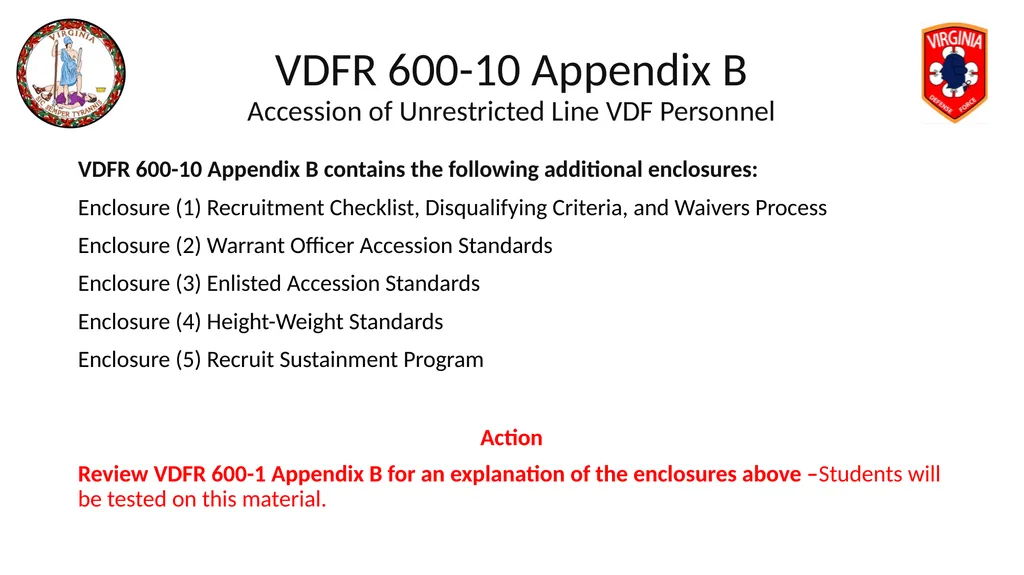
slide17. VDFR 600-10 Appendix B Accession of Unrestricted Line VDF Personnel VDFR 600-10 Appendix B contains the following additional enclosures:
Enclosure (1) Recruitment Checklist, Disqualifying Criteria, and Waivers Process
Enclosure (2) Warrant Officer Accession Standards
Enclosure (3) Enlisted Accession Standards
Enclosure (4) Height-Weight Standards
Enclosure (5) Recruit Sustainment Program
Action
Review VDFR 600-1 Appendix B for an explanation of the enclosures above –Students will be tested on this material.<br>
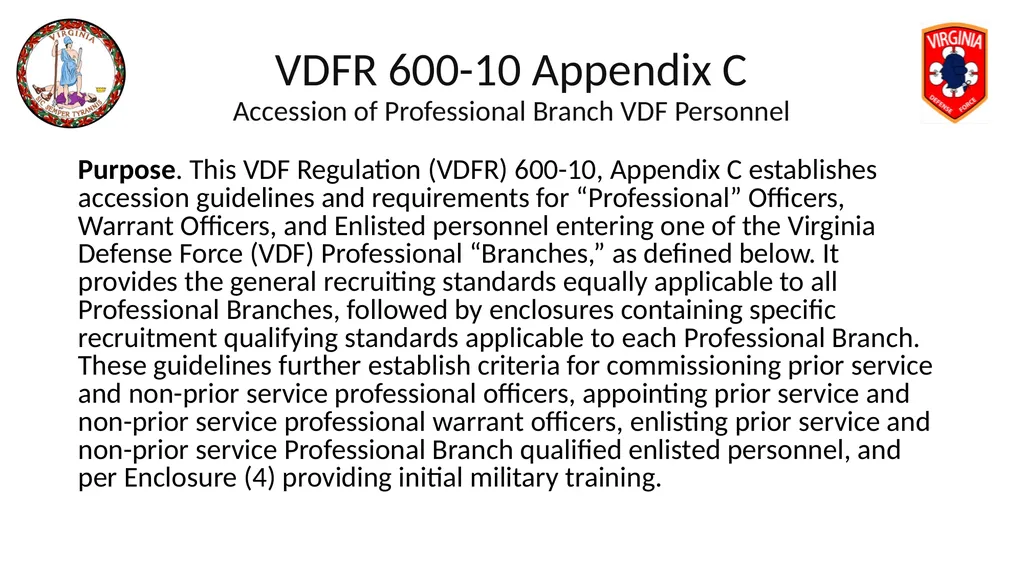
slide18. VDFR 600-10 Appendix C Accession of Professional Branch VDF Personnel Purpose. This VDF Regulation (VDFR) 600-10, Appendix C establishes accession guidelines and requirements for “Professional” Officers, Warrant Officers, and Enlisted personnel entering one of the Virginia Defense Force (VDF) Professional “Branches,” as defined below. It provides the general recruiting standards equally applicable to all Professional Branches, followed by enclosures containing specific recruitment qualifying standards applicable to each Professional Branch. These guidelines further establish criteria for commissioning prior service and non-prior service professional officers, appointing prior service and non-prior service professional warrant officers, enlisting prior service and non-prior service Professional Branch qualified enlisted personnel, and per Enclosure (4) providing initial military training.<br>
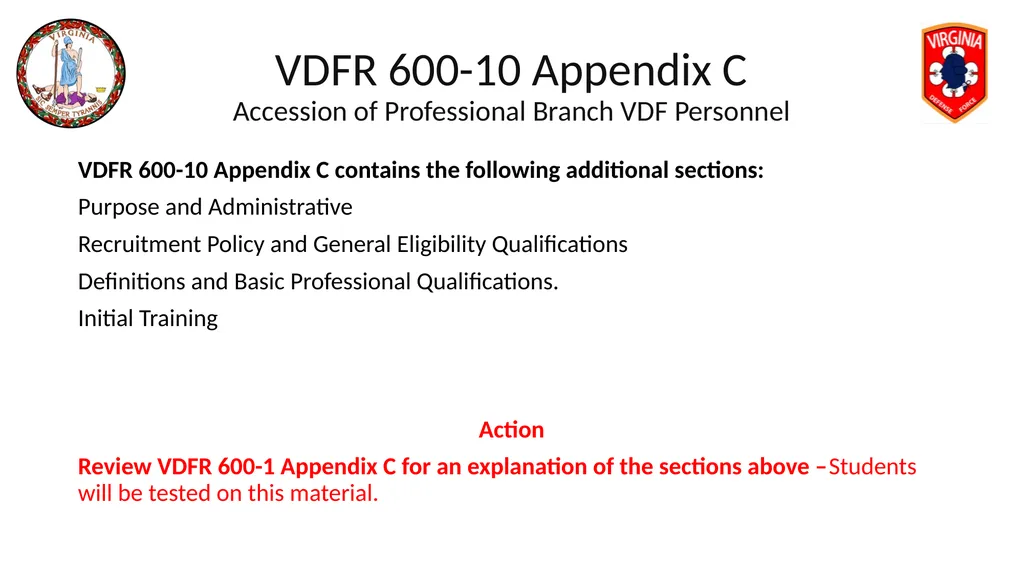
slide19. VDFR 600-10 Appendix C Accession of Professional Branch VDF Personnel VDFR 600-10 Appendix C contains the following additional sections:
Purpose and Administrative
Recruitment Policy and General Eligibility Qualifications
Definitions and Basic Professional Qualifications.
Initial Training
Action
Review VDFR 600-1 Appendix C for an explanation of the sections above –Students will be tested on this material.<br>
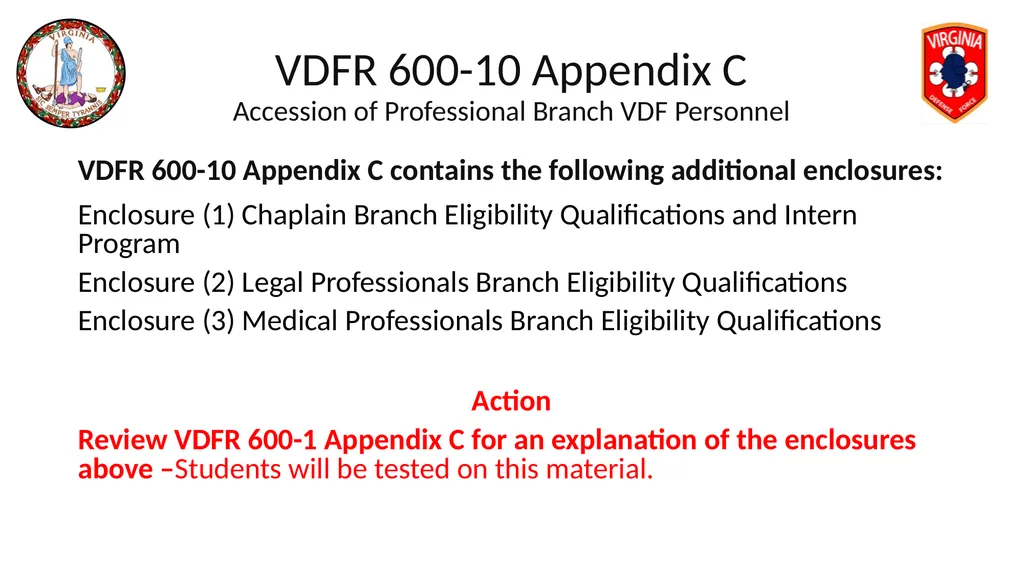
slide20. VDFR 600-10 Appendix C Accession of Professional Branch VDF Personnel VDFR 600-10 Appendix C contains the following additional enclosures:
Enclosure (1) Chaplain Branch Eligibility Qualifications and Intern Program
Enclosure (2) Legal Professionals Branch Eligibility Qualifications
Enclosure (3) Medical Professionals Branch Eligibility Qualifications
Action
Review VDFR 600-1 Appendix C for an explanation of the enclosures above –Students will be tested on this material.<br>
slide21. VDFR 600-10 Appendix D Administration and Correspondence Standard Operating Procedures Purpose. This VDF Regulation (VDFR) 600-10, Appendix (APDX) D prescribes Administration and Correspondence (A&C) Standard Operating Procedures (SOP). This APDX and its enclosures outline the most common A&C responsibilities, forms, and guidance for the VDF. The SOP is intended to simplify common A&C matters, so leaders can spend more time with troop training, and less time navigating common A&C processes. The SOP applies to all VDF personnel, should be distributed to the lowest levels, and should be kept on electronic media for quick reference and access to printable procedures and formats. Enclosed Forms, other forms, and VDF Regulations (VDFR)VDFR 600-10 Appendix D, Administration and Correspondence Standard Operating Procedures mentioned here are available on the VDF web site: https://vdf.virginia.gov/vdf-formsand-publications/ If this SOP conflicts with a current published directive, the directive overrides this SOP. In such case, notify the VDF Assistant Chief of Staff, Personnel and Administration ((A/CS), G-1) about the conflict.<br>
slide22. VDFR 600-10 Appendix D Administration and Correspondence Standard Operating Procedures VDF Action Request (VAR) The VAR (VDFR 600-10 Appendix D Enclosure 2) will be the primary method used to initiate and track Administrative, logistics, or training requests, and staffing actions. Transparency and accountability in staffing and administrative procedures are key to maintaining Force efficiency and morale. VAR is a two-way device to initiate actions, meaning it may go from units to FORHQ, or from FORHQ to units. The COS or designee coordinates all VAR. Requesting units attach a VDF Form 3R or other forms normally used for the below areas to the requesting VAR for administrative actions.<br>
slide23. VDFR 600-10 Appendix D Administration and Correspondence Standard Operating Procedures VDF Action Request (VAR) Process
(1) The initiator fills the VAR out, attaches supporting documents, and electronically delivers to their activity’s designated VAR coordinator (usually S1 at units).
(2) The VAR coordinator checks the VAR and any attached documents, corrects deficiencies, then sends to the VDF FORHQ email address g1@vdf.virginia.gov or an alternate published email (see below guidance for protecting sensitive information).
(3) The COS or designated FORHQ Point of Contact (POC) (a) checks the VAR and any attached documents, corrects deficiencies; (b) after deficiencies are corrected assign a VAR tracking number and in date to requests coming from units to FORHQ, or VAR going from FORHQ activities to units for tracking purposes; (c) then forward to the action unit or FORHQ activity via email (cc the VAR originator).
(4) FORHQ POC (usually G1) will enter the VAR in a tracking spreadsheet and will audit the existing open VARs monthly with the COS, and prompt action persons toward completion. MSCs and staff leaders will receive an electronic a copy of the status spreadsheet monthly.
(5) When the action is complete, the action lead will return the completed VAR to the FORHQ POC for logout and forwarding to the VAR originator. Only the FORHQ POC may close a VAR upon completion or withdrawal.<br>
slide24. VDFR 600-10 Appendix D Administration and Correspondence Standard Operating Procedures VDF Action Request (VAR)
Header Information. Every VAR must have date of request (e.g., 1 MONTH 20**), section/unit title, contact email, and contact telephone number.
Action Requested. Check one action box only and submit one action only unless the actions are related, such as one request for a ribbon going to multiple name persons for the same action). Ensure the correct documentation is attached and correctly filled out (see below sections for more details). Note that ID Card requests will go to the VAR email box, and once the VAR is reviewed, the FORHQ POC will forward the VAR to the ID Card email box.
Action: “Non-Admin/Personnel”. Use for training, logistic (supply, maintenance), support requests, and miscellaneous staffing actions. One action per VAR. Name every staff section/leader needing to act on the VAR.
“Brief Description of Requested Action & Suspense Date”. Where a matter does not explain itself (e.g., no need to explain an award request), discuss briefly the who/what/why/where. “Suspense date” if used must be reasonable and needed. Generally, the monthly VAR database audits will drive timely VAR completion.
FORHQ-Assigned VAR #/Date In/Date Complete/Returned. Again, only the FORHQ POC may log in a VAR, assign it a number, and close it.
Action Agent Information. The “Action” person is the one for completing and/or coordinating the requested action. The Action person will provide the listed information when the VAR action is complete, for any needed follow up.<br>
slide25. VDFR 600-10 Appendix D Administration and Correspondence Standard Operating Procedures Attendance/Accountability. Consult VDFR 600-10, APDX I, “Personnel Assets Attendance and Unit Strength Accounting.” for details. Attendance reports are not submitted via a VAR. Personnel Accountability is a key metric. Accurate monthly reporting of attendance are critically important not only for VDF reporting to higher headquarters (HHQ), but because those persons not properly reported will not be covered by State Workman’s Compensation for their duty days.<br>
slide26. VDFR 600-10 Appendix D Administration and Correspondence Standard Operating Procedures Attendance/Accountability.
Sign-in or spread sheet assessing the same information (and the sign in rollup/report shall be submitted to the G1 within 72 hours after UTA. VDF Form 680-1-1 is the authorized form for signing-in, but MSC S1 may consult with G1 on a modified spread sheet approach. VDF Form 680-1-2 is the authorized MR and is used to summarize all personnel gains and losses; assignments and reassignments within the unit; training subjects covered at the UTA; impacts of personnel actions; and events appropriate for entry in the morning report, but MSC S1 may consult with G1 on a modified spread sheet approach.<br>
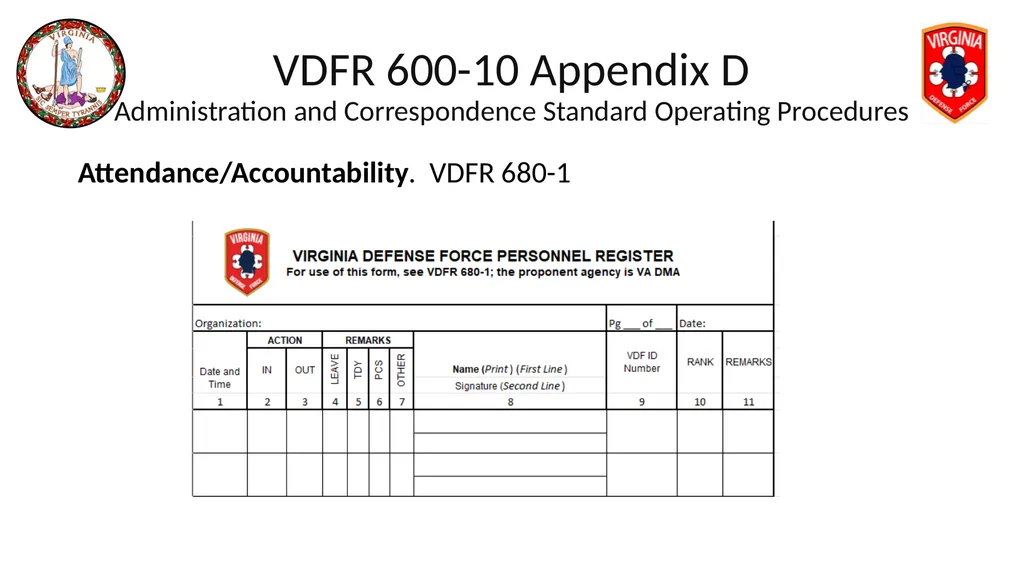
slide27. VDFR 600-10 Appendix D Administration and Correspondence Standard Operating Procedures Attendance/Accountability. VDFR 680-1<br>
slide28. VDFR 600-10 Appendix D Administration and Correspondence Standard Operating Procedures Attendance/Accountability.
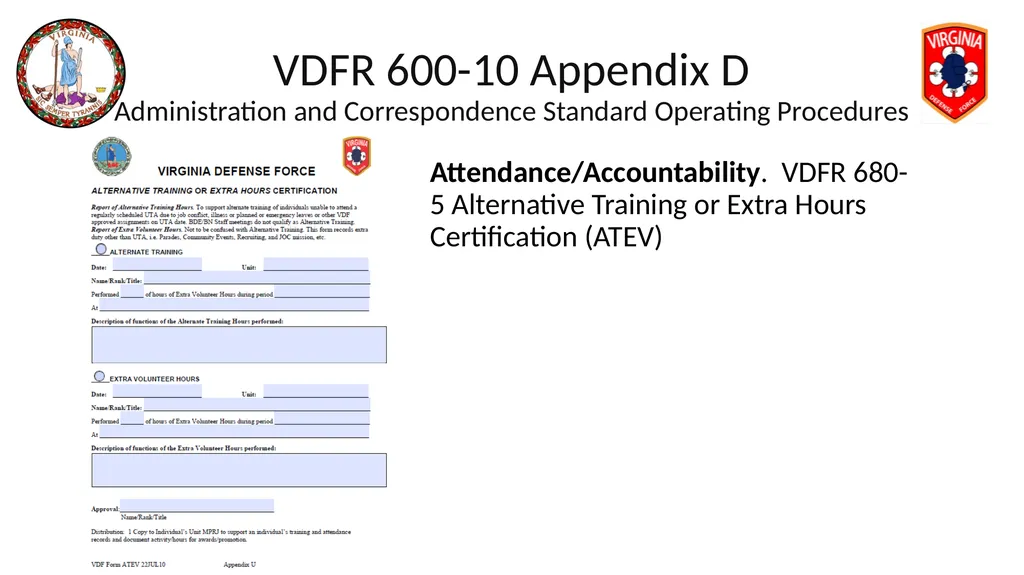
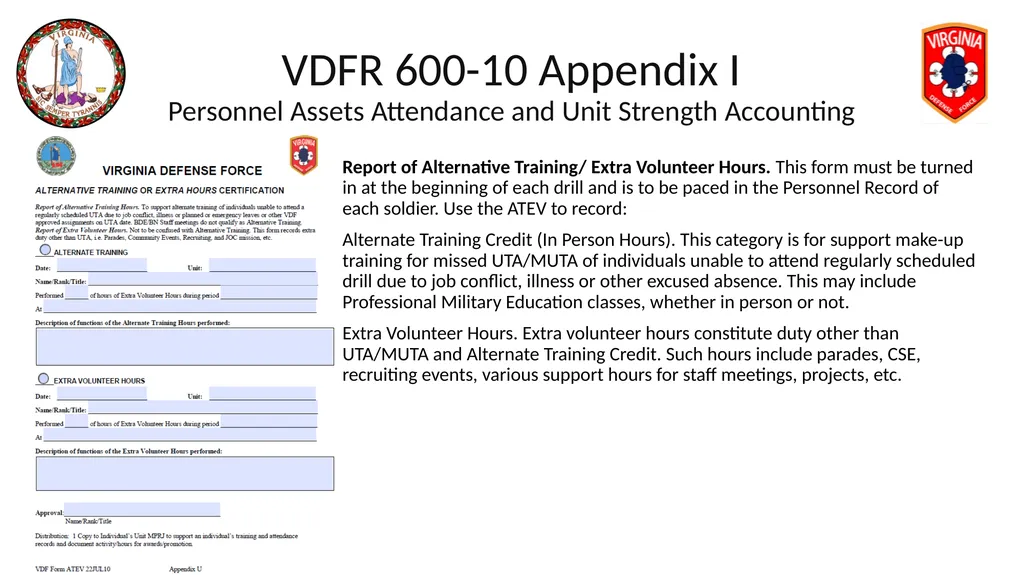
Use VDF Form 680-1-5 (ATEV) to support make-up training of individuals unable to attend regularly scheduled drill due to job conflict, illness, or planned/emergency leaves. MSC S1 may consult with G1 on a modified spread sheet approach. “This form will be turned in at UTA and will be placed in unit personnel files.
Units should use the sign-in-process to have members verify (and correct as needed) their information on the ACTDET “Alpha Roster” and the VDF “Manning Table of Organization (MTO).” Changes to these documents should be submitted to ACTDET monthly.<br>
slide29. VDFR 600-10 Appendix D Administration and Correspondence Standard Operating Procedures Attendance/Accountability. VDFR 680-5 Alternative Training or Extra Hours Certification (ATEV)<br>
slide30. VDFR 600-10 Appendix D Administration and Correspondence Standard Operating Procedures Awards, Service Ribbons, and Skills Devices. Consult VDFR 600-10, APDX E, “Awards, Service Ribbons, and Skills Devices for VDF” for details. Award nominations must fully comply with regulation, including a well -written justification – and be attached to a VAR. Enclosure (3) is a blank VDF Form 638-1 for an award nomination. The G1 will upon request provide units samples of successful past recommendations to consult.
Common Errors. Common errors include: (1) 638-1 not fully completed; (2) untimely submissions/last-second award dates; (3) “Achievements” which do not fit listed criteria in 600-8-22, are generic, undescriptive, or simply describe normal duty performance; (4) Citation missing key words- for certain awards per APDX E; (5) not getting chain-of command (COC) approval. Do not submit a VDF Form 3R.
Use VDF Form 638-B Enclosure (4) for award of service ribbons and 638-D Enclosure (4) badges/tabs.
Use VDF Form 600-8-22, and VDF Form 638-C for unit awards.<br>
slide31. VDFR 600-10 Appendix D Administration and Correspondence Standard Operating Procedures Pay/Reimbursement. State Active Duty (SAD) pay matters are exclusively processed by the G1. Pay forms -- such as the IRS Form W-4 and Department of Military Affairs (DMA) Direct Deposit form -- are normally processed while the member is still on SAD. However, the VAR may request pay-related action to the G1 when the subject member is not on SAD.<br>
slide32. VDFR 600-10 Appendix D Administration and Correspondence Standard Operating Procedures Correspondence, Including Emails. Routine correspondence within VDF generally consists of telephone calls, emails, and “Memorandum (Memo) For.” Only VDF MSC Cdrs and FORHQ staff section heads may contact the VDF Commanding General (CG) directly, unless “direct liaison (with CG) is authorized (DIRLAUTH). Correspondence/communication outside of VDF is limited to those the CG expressly authorizes. VDF members must use the COC to conduct business with VDF FORHQ staff section heads, MSC commanders, or the VDF senior leaders.
When a “Memo For” is going to be used for correspondence, employ the guidance in VDFR 600-10 Appendix D Enclosure (5).
When using email correspondence, there are several important rules of use and etiquette outlined in VDFR 600-10 Appendix D Enclosure (6).<br>
slide33. VDFR 600-10 Appendix D Administration and Correspondence Standard Operating Procedures Personal Identifiable Information (PII). PII is non-public, information held or used by the government (including VDF) about a person, which can improperly reveal an individual’s identity and/or contact information. PII is information that (1) directly identifies an individual (e.g., name, address, social security number, telephone number, email address, etc.) or (2) can indirectly identify a person via information such as gender, race, birth date, geographic indicator, and other descriptors which may be assembled to improperly identify the individual). PII loss can substantially harm individuals, including identity theft or other fraudulent information use.
VDF personnel will not: (1) electronically transmit PII outside protected email accounts like .gov and .mil accounts, or commercial software approved by the G1 for containing and protecting PII; (2) store electronic PII on private accounts or media(storage may only be on state infrastructure that complies with applicable state law, regulations and security guidelines for safeguarding PII); (3) fail to use commercial encryption keys for documents containing PII; (4) share PII with someone who lacks the “need to know” the information for official duties; (5) store paper files containing PII except under lock and key; (6) store PII information beyond what is needed for the holder’s official-duty needs; and (7) solicit, transmit, or store PII except for official purposes.
Any VDF member who personally violates or becomes aware of theft, loss, improper handling or storage of PII, must immediately inform their COC or the VDF Inspector General.<br>
slide34. VDFR 600-10 Appendix D Administration and Correspondence Standard Operating Procedures ID Cards, PR Management, Vehicle Tax Waivers, and Vanity Plates.
ID Cards. Consult VDFR 600-10, APDX G, “Identification Cards” for details.
Use VDF Form 600-8-14, at https://vdf.virginia.gov/vdf-forms-and-publications/ and submit the scanned, signed, Form fully filled out, with a face-chest “mug shot” photograph in BDU (neutral background) with VAR to g1@vdf.virginia.gov or designated alternate email. Re-issue of damaged or lost ID cards may require a fee.
ID cards are state property and must be recovered from the VDF member leaving or who has left the VDF. (Note: personnel possessing issued uniforms or other VDF property must also return those upon departure from VDF.)<br>
slide35. VDFR 600-10 Appendix D Administration and Correspondence Standard Operating Procedures ID Cards, PR Management, Vehicle Tax Waivers, and Vanity Plates.
VDF Personnel Record (PR). Consult VDFR 600-10, APDX L, “Personnel Records Management” for details. PRs are electronically maintained at the FORHQ level and MSC/small unit/company level should only maintain temporary personnel records on official VDF-owned devices for use while the member is in the unit. The PR contains enlistment/personnel documents, property receipts, orders, awards, current professional certifications, and training certificates. Training records are limited to those needed for promotion or substantiating professional qualification certifications. For instance, Federal Emergency Management Agency (FEMA) course completion certificates for IC 100, 200, 300, 400, 700 and 800 are needed for promotions to certain ranks. Other FEMA course completion certificates should not be submitted for the PR, but instead held by the individual Soldier.
Action: File records. A VAR will be used to transmit attached files for a Soldier’s FORHQ PR.
Action: Correct record. VAR must explain which record aspect must be corrected, and fully explain why. The applicant’s unit POC must verify the justification.<br>
slide36. VDFR 600-10 Appendix D Administration and Correspondence Standard Operating Procedures ID Cards, PR Management, Vehicle Tax Waivers, and Vanity Plates.
Vehicle Tax Waiver Request. Per Code of Virginia § 58.1-3506.A.44, and The Adjutant General (TAG) guidance, active members may use VDF Form 600-90 at https://vdf.virginia.gov/vdf-forms-and-publications/ to request a vehicle tax waiver from their local taxing authority (note that the local tax authorities are not required to grant the request). The request may be submitted for one vehicle per member (the vehicle the member uses to perform VDF duties). A member wishing to submit the request will fill out the form, attaching a copy of the vehicle’s registration. The form will be sent (using a VAR) annually to the ACTDET not later than (NLT) 15 NOV. After compilation, the requests are forwarded to TAG for signature, then returned via ACTDET to the member NLT 20 DEC. The member must then submit the form annually to the local tax authority NLT 31 JAN.
VDF Vanity License Plates. Active VDF members may download from the VDF web site at https://vdf.virginia.gov/vdf-forms-and-publications/ a VDF FORM 9 LICENSE PLATE AUTHORIZATION 17 JUNE 2010, fill it out, attach it to a VAR, and submit to G1 for authorizing signature. Once it is authorized and returned, consult the VA Department of Motor Vehicles web site for submittal instructions.<br>
slide37. VDFR 600-10 Appendix D Administration and Correspondence Standard Operating Procedures Orders.
MSC Orders Authority. MSC Cdrs may issue duty orders (non-pay), assignment orders within their MSC, and enlisted promotion orders within their promotion authority. VDFR 600-10 Appendix D Enclosure (7) provides examples.
FORHQ Orders. The VAR should be used to request FORHQ pay or non-pay orders for training, or a request for transfer between units and FORHQ line numbers within VDF, and promotion orders. A VAR for Reassignment or Transfer will be initiated by the Cdr or staff leader of the losing unit/section, then signed by the Cdr/leader of the gaining unit/section. The position title, unit title, Manning Table of Authorization (MTO) paragraph number, and MTO billet line number for position from, and position to, must be filled out.
Prohibition on Working Two Paid Positions Simultaneously. DMA has identified possible conflicts of interest for VDF members who, while deployed on extended State Active Duty (SAD) orders, continue to work full time simultaneously in their civilian status for their employers. VDF members will generally not be allowed to also remain on full time work status if on extended SAD. There should be some form of leave status from their employer, unless on case-by-case basis they are reviewed by DMA, VDF Commanding General and a VDF Judge Advocate. Any possible conflicts of interest issues shall be submitted to a VDF FORHQ Judge Advocate before any waiver request.<br>
slide38. VDFR 600-10 Appendix D Administration and Correspondence Standard Operating Procedures Personnel Evaluation System and Counseling. Consult “VDFR 600-10 APDX H, “Personnel Evaluation Reports and Counselling,” for details.
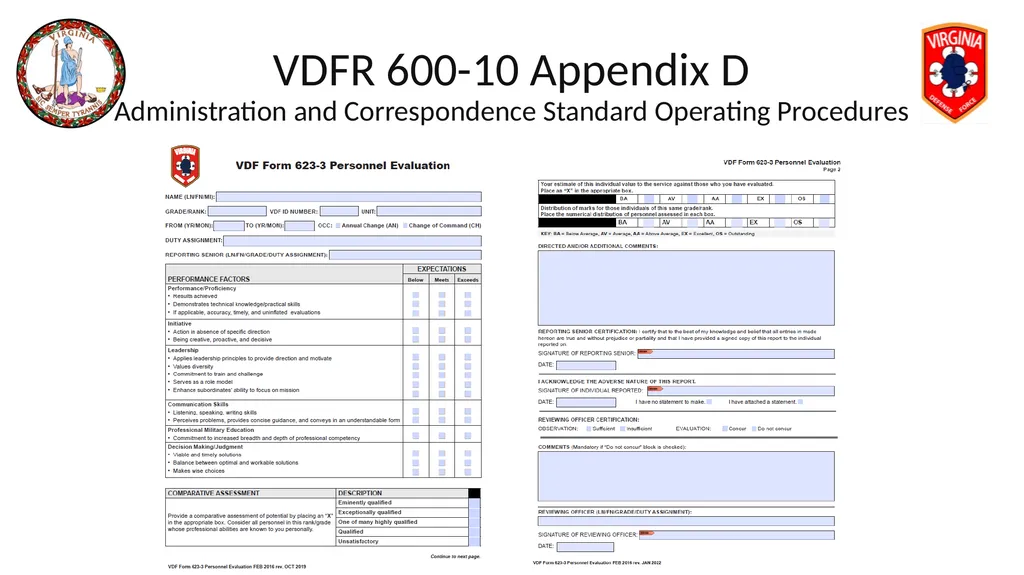
Performance Evaluation Reports (PERs), VDF Form 623-3 (See Enclosure 8), are the primary tool a promotion board has to evaluate a member, so raters should ensure these are timely, properly completed, and thoughtfully written. Every enlisted member, E-5 and above, and all commissioned and warrant officers will receive (1) “CR” when the Reporting Senior (RS) changes, and “SP” for promotion and position board applications, evaluated by the current RS. Each rated member must be counselled by the RS before the report is submitted to the Reviewing Officer (RO). The rated member must receive a complete PER copy for her/his records after RO comments are added.<br>
slide39. VDFR 600-10 Appendix D Administration and Correspondence Standard Operating Procedures<br>
slide40. VDFR 600-10 Appendix D Administration and Correspondence Standard Operating Procedures Submission. The RS must have the completed CR PER to the RO within 21 days after the end of the reporting period, and the RO will send the PER attached to a VAR to the G-1 within 60 calendar days after the reporting period ends. For boards, follow board guidance.
Common Errors. Common errors include: (1) 623-3 not fully completed; (2) untimely submissions; (3) VDF number missing; (4) comments are generic, undescriptive, or not accurate; (5) signatures missing; (6) RS not following up to ensure the RO completed and forwarded the PER; and (7) submitting a VDF Form 3R (not needed; submit using VAR).
“Grade” will be abbreviated: SGT; SSG; SFC; MSG; 1SG; SGM; 1LT; 2LT; CPT; MAJ; LTC; COL.
“Position” means the MTO position description the individual is assigned to.<br>
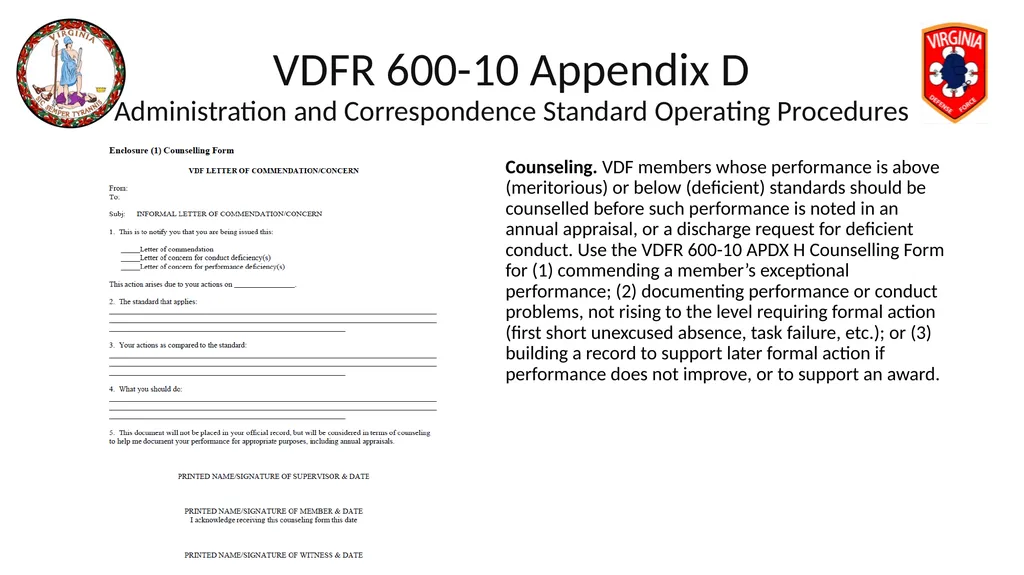
slide41. VDFR 600-10 Appendix D Administration and Correspondence Standard Operating Procedures Counseling. VDF members whose performance is above (meritorious) or below (deficient) standards should be counselled before such performance is noted in an annual appraisal, or a discharge request for deficient conduct. Use the VDFR 600-10 APDX H Counselling Form for (1) commending a member’s exceptional performance; (2) documenting performance or conduct problems, not rising to the level requiring formal action (first short unexcused absence, task failure, etc.); or (3) building a record to support later formal action if performance does not improve, or to support an award.<br>
slide42. VDFR 600-10 Appendix D Administration and Correspondence Standard Operating Procedures Promotions. Consult VDFR 600-10, APDX L, “Personnel Promotions” for details. G-1 will provide Promotion Certificates when the VAR requesting that the promotion action be taken is processed.
E-2 and E-3. Soldiers meeting the VDFR 600-10, APDX L, Table 3 E-2 and E-3 requirements may be authorized for promotion by their HHC/company-level Cdr. Submit a VAR for promotion order with a Form 3R to G-1, to be placed to the electronic PR.
E-4 and E-5. Soldiers meeting the VDFR 600-10, APDX L, Table 3 requirements for E-4 and E-5 will be screened by the HHC or the Soldier’s MSC. A subsequent VAR requesting promotion must include (1) VDF Form 624-1-1, Commander’s Certificate of Promotion Eligibility/Promotion Screening Report (See Enclosure 9); (2) VDFR 35R Promotion Screen Board Results (See Enclosure 10); (3) Letter of Recommendation (LOR) by the member’s Cdr and Command Sergeant Major (CSM); and, (4) VDF Form 3R -- signed by the Cdr requesting promotion.
E-6 and above. Soldiers meeting the VDFR 600-10, APDX L, Table 1 (for officers), Table 2 (for Warrant Officers) or Table 3 (for enlisted) for promotion to the next rank E-6 and above (but not O-1 to O-2 which are per CDR request via VAR), will be screened by a promotion board convened by the FORHQ. E-8/9 and filed grade officers’ boards will meet about NOV each year, usually at the fall Multiple UTA (MUTA). E-6/7, CPT/CWO boards will meet about MAR each year, usually at the spring MUTA. G-1 will publish the board dates and promotion package due date. Normally A VAR requesting promotion consideration must include (1) VDF Form 624-1-1, Commander’s Certificate of Promotion Eligibility/Promotion Screening Report (See Enclosure 9); (2) VDFR 35R Promotion Screen Board Results (See Enclosure 10); (3) (optional) LOR by the Soldier’s commander and, for enlisted, CSM; (4) VDF Form 623-3 PER (number and dates per G-1); and (5) VDF Form 3R signed by the commander requesting promotion.<br>
slide43. VDFR 600-10 Appendix D Administration and Correspondence Standard Operating Procedures Commander’s Critical Information Reports (CCIR) and Serious Incident Reports (SIR). The VANG and CG need certain kinds of information reported upon the precipitating serious event happening. When the events outlined by the Joint Force Headquarters (JFHQ) in Enclosure (11) happen, the senior person present should complete and forward a Serious Incident Report (SIR) per the format at the bottom of Enclosure (12) to the VDF G-1 and G-3 (G-3 will forward to the JFHQ Joint Operations Center (JOC)). Immediately report injury to/illness/death of VDF member while participating in a VDF activity; death of any VDF member, or death of any person that occurs on Virginia Department of Military Affairs (DMA) property (Readiness Center, training base, or facility); or serious crime committed on DMA property. Other incidents require less urgent treatment – but must be reported via SIR within 24 hours – as listed at Enclosure (11). When in doubt (for instance a VDF member being arrested off duty), error on the side of filling out an SIR.<br>
slide44. VDFR 600-10 Appendix D Administration and Correspondence Standard Operating Procedures Worker’s Compensation Insurance, Injuries, and Death Reports.
Worker’s Compensation Insurance. All VDF personnel are covered by Commonwealth of Virginia Workman’s Compensation Insurance while traveling from (home of record (HOR)), to, and during UTA, MUTA, SAD, and other events under official duty travel orders (or as ordered by a signed Training Schedule). However, personnel making a stopover for personal reasons to/from those events who are injured are not covered. A workman’s compensation claim is a claim against the Commonwealth and a VDF Judge Advocate cannot assist the injured member in filing and adjudicating a claim.
Reporting Injuries. When a VDF member suffers an injury or significant illness during UTA/MUTA/CSE/SAD/VANG support, an Enclosure (12) SIR and DMA Accident Investigation (Workman’s Compensation) Form must be filled out electronically by the immediate supervisor of the injured/ill member claiming workman’s compensation, within 24 hours. Consult the G1 for details, but minimally the submissions (1) fill out the DMA accident report form under direction of the appointed G1 member after assessment of injury by qualified VDF medical personnel; (2) under no circumstances will these two (2) forms – VANG JOC SIR or the DMA Investigation Form (Workman’s Comp Form) – be filled out by the injured member, a safety officer, G3 personnel, or G-1 personnel; it is a command leadership responsibility. must be double checked for completeness; (3) the report should include photographs of the accident scene to supplement the narrative; (4) If the accident/incident occurs at Fort Barfoot, the injured member’s supervising NCO/Officer shall fill out Fort Barfoot Training Accident Report (TAR) form (G1 shall file TAR Form with Fort Barfoot Range Office); and (4) G1 shall keep all documents of filed line of duty claims for three years from date of incident on file at VDF FORHQ ACTDET.<br>
slide45. VDFR 600-10 Appendix D Administration and Correspondence Standard Operating Procedures Worker’s Compensation Insurance, Injuries, and Death Reports.
Reporting a Death. The death of VDF member while on duty is covered by the Code of Virginia § 9.1-400-407 (http://leg1.state.va.us/cgi-bin/legp504.exe?000+cod+9.1-400) Virginia Line of Duty (LOD) Act Fund. (http://valoda.org/). General information for this can be found at:
http://www.doa.virginia.gov/Admin_Services/Line_Of_Duty/Line_of_Duty_Handout.pdf .
The VDF Inspector General in conjunction with the G1 will investigate the incident following receipt of the DMA Accident Investigation form from the deceased VDF member’s supervisor. The report is to be completed within seven (7) days of the member’s death, contingent upon final report from any investigation by law enforcement. VDF G1 or designee shall render any necessary aid in assisting survivors of deceased VDF member in filing application for LOD compensation from the Commonwealth.
The process for application is at:
http://www.oag.state.va.us/FAQs/LineofDuty_State.html.<br>
slide46. VDFR 600-10 Appendix D Administration and Correspondence Standard Operating Procedures Administrative Investigations. The Commanding General or designee may appoint administrative investigations into accidents/incidents, per Enclosure (13). Line of duty investigations MSC Cdrs may appoint administrative investigations into matters within their command. The Inspector General may conduct investigations IAW CG guidance. Only the CG or his designee may refer suspected criminal wrongdoing to appropriate law enforcement authorities for investigation.<br>
slide47. VDFR 600-10 Appendix D Administration and Correspondence Standard Operating Procedures Weight Control. Members must remain within the height-to-weight ratio described
in VDFR 600-10, APDX B, “Accession of Unrestricted Line VDF Personnel,”
Enclosure (4) Tables, unless the member has a medical exemption, approved by the VDF
Force Surgeon or designee.<br>
slide48. VDFR 600-10 Appendix D Administration and Correspondence Standard Operating Procedures Memorandum. The basic format for Army correspondence is the formal memorandum. It is used to correspond formally (internally and externally) with any command, staff, or activity within the Virginia Department of Military Affairs. Enclosure 5 of VDFR 600-10 Appendix D show how to write these.
The Informal Memorandum. Commands use the informal memorandum to communicate informally within a unit, organization, or agency. Its format is the same as the formal memorandum, except that you do not use letterhead stationery.
The Memorandum for Record. The purpose of the Memorandum for Record (MFR) is to document conversations, meetings, and other events for future reference. Its format is the same as the informal memorandum, except the word "RECORD" appears in the place of the addressee.
The Memorandum of Agreement (or Understanding). The Memorandum of Agreement (or the Memorandum of Understanding) is to document agreements or understandings. The format is the same as the memorandum except for two changes. First the phrase "MEMORANDUM OF AGREEMENT" or "MEMORANDUM OF UNDERSTANDING" appears on the second line below the seal. Second, a signature block appears for each party entering into the agreement or understanding.
Action
Review VDFR 600-1 Appendix D for an explanation of the enclosure above –Students will be tested on this material. Students will also be required to create a MEMORANDUM as part of the Go/No Go requirements for ALC.<br>
slide49. VDFR 600-10 Appendix E Awards, Service Ribbons, and Skills Devices for VDF Purpose. This VDF Regulation (VDFR) 600-10, Appendix (APDX) E establishes policy, criteria and administrative instructions for personal awards, service ribbons, unit awards, and training skill badges, and qualification tabs (collectively “skills devices”). Local supplementation of this regulation is prohibited except for administrative procedures to ensure prompt recognition of deserving members. Commanders at all levels will ensure the integrity of the awards program and that awards are made in accordance with the standards of this regulation.
Policy. The CG’s policy is that all leaders assess their personnel continually to recognize those personnel whose exceptional service and/or achievements improve the VDF’s mission accomplishment in support of the Department of Military Affairs (DMA) and the citizens of the Commonwealth. VDF personnel will be recognized with the applicable personal military decorations (in Army regulation called “PMDs”) for qualifying acts of valor, meritorious service or achievement, and accomplishment of badge and tab curricula. Recognition for noteworthy efforts and training accomplishments benefit morale and esprit de corps, and provide a powerful incentive, rewarding those who display a high level of effort and accomplishment.<br>
slide50. VDFR 600-10 Appendix E Awards, Service Ribbons, and Skills Devices for VDF Categories and Approval Authority.
Virginia National Guard (VANG) Awards. The Adjutant General (TAG) is the awarding authority for VANG awards and may award such, or even federal awards, directly to VDF members for notable performance. The CG may as well nominate VDF members to the TAG for VANG awards for special situations such as retirement, in which case the CG may direct the Deputy Commanding Officer (DCO), Chief of Staff (COS), or G1 to coordinate such nominations with the VDF Active Detachment (ACTDET), and pertinent personnel within the VANG J1. Major Subordinate Command (MSC) Commanders (Cdr) may recommend VANG awards to the CG but may not directly nominate personnel to the VANG.<br>
slide51. VDFR 600-10 Appendix E Awards, Service Ribbons, and Skills Devices for VDF Categories and Approval Authority.
Awards and Skills Badges/Tabs from Outside Organizations. Outside military organizations (such as active services and other State Guards (SG)), quasi-military organizations (such as the State Guard Association of the United States (SGAUS)), or non-military organizations (such as the Daughters of the American Revolution) may offer awards or skills badges/tabs to VDF or offer individual awards to VDF members. Acceptance and wear are per below.
Outside Organization Skills Programs. Only the CG may authorize VDF member or unit participation in outside organization skills programs. However, only badges and tabs specified in this regulation are authorized for wear on VDF member uniforms.
Outside Organization Awards. (a) Only the CG may authorize VDF member or unit participation in outside organization awards programs. However, only awards specified in this regulation are authorized for wear on VDF member uniforms. Generally federal awards and SG awards may be worn on VDF uniforms. The VDF Adjutant (G) will be consulted for exceptions. (b) If a MSC leader or Force Headquarters (FORHQ leader is notified that any outside organization intends to present an award to a VDF member (outside awards programs discussed above), the G1 will be informed and will in turn notify the CG and the VDF Public Affairs Officer to coordinate any matters of award appropriateness and/or publicity. VDF senior leaders will thank offering organizations –whether accepted or not.<br>
slide52. VDFR 600-10 Appendix E Awards, Service Ribbons, and Skills Devices for VDF VDF Awards for Meritorious Service or Achievements. Meritorious effort may be recognized for sustained service (such as upon the nominee being transferred from a position to another after two-to-three years’ service) or a VDF Achievement Medal on-the-spot for “impact” in a single action in a small timeframe (such as a member exhibiting a high level of performance during a State Active Duty (SAD) period). Enclosure (1) contains meritorious service or achievements medals award standards and citations language.
The VDF decorations awarded for meritorious service are (in order of precedence): Life Saving Medal (VDFLSM); Distinguished Service Medal (VDFDSM); Meritorious Service Medal (VDFMSM) Commendation Medal (VDFCM) Achievement Medal (VDFAM)
The CG will award the Life Saving Medal, Distinguished Service Medal, and Meritorious Service Medal for all VDF personnel. Major Subordinate Commanders (Colonel/O-6) and, the Deputy Commanding Officer (DCO), the Chief of Staff (COS) for Force Headquarters (FORHQs) personnel, will award the Commendation Medal and Achievement Medal.<br>
slide53. VDFR 600-10 Appendix E Awards, Service Ribbons, and Skills Devices for VDF VDF Awards for Meritorious Service or Achievements. Meritorious effort may be recognized for sustained service (such as upon the nominee being transferred from a position to another after two-to-three years’ service) or a VDF Achievement Medal on-the-spot for “impact” in a single action in a small timeframe (such as a member exhibiting a high level of performance during a State Active Duty (SAD) period). VDFR 600-10 Appendix E Enclosure (1) contains meritorious service or achievements medals award standards and citations language.
The VDF decorations awarded for meritorious service are (in order of precedence): Life Saving Medal (VDFLSM); Distinguished Service Medal (VDFDSM); Meritorious Service Medal (VDFMSM) Commendation Medal (VDFCM) Achievement Medal (VDFAM)
The CG will award the Life Saving Medal, Distinguished Service Medal, and Meritorious Service Medal for all VDF personnel. Major Subordinate Commanders (Colonel/O-6) and, the Deputy Commanding Officer (DCO), the Chief of Staff (COS) for Force Headquarters (FORHQs) personnel, will award the Commendation Medal and Achievement Medal.
Action
Review VDFR 600-1 Appendix E for an explanation of the Enclosure (1) above –Students will be tested on this material. Students will also be required to identify VDF awards as part of the Go/No Go requirements for ALC.<br>
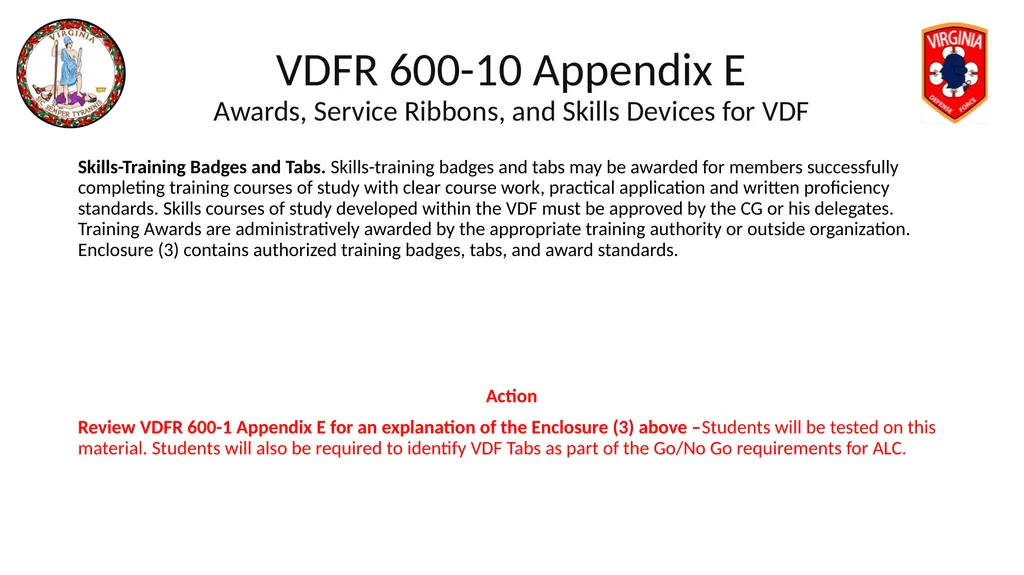
slide54. VDFR 600-10 Appendix E Awards, Service Ribbons, and Skills Devices for VDF Service Ribbons. Service ribbons are earned for service to support DMA, to support the community, for perfect attendance, and for recruiting new members. Service Awards are administratively awarded by Commanders at all levels based on VDF members satisfying the criteria in this regulation. Enclosure (2) contains authorized service ribbons and award standards and citations language.
Action
Review VDFR 600-1 Appendix E for an explanation of the Enclosure (2) above –Students will be tested on this material. Students will also be required to identify VDF awards as part of the Go/No Go requirements for ALC. VDF Active Service Ribbon
-State Active Duty Missions VDF Service Ribbon
- Support of State missions VDF PME Ribbon
-Taking approved VDF training courses VDF Attendance Ribbon
-one year of perfect attendance<br>
slide55. VDFR 600-10 Appendix E Awards, Service Ribbons, and Skills Devices for VDF Skills-Training Badges and Tabs. Skills-training badges and tabs may be awarded for members successfully completing training courses of study with clear course work, practical application and written proficiency standards. Skills courses of study developed within the VDF must be approved by the CG or his delegates. Training Awards are administratively awarded by the appropriate training authority or outside organization. Enclosure (3) contains authorized training badges, tabs, and award standards.
Action
Review VDFR 600-1 Appendix E for an explanation of the Enclosure (3) above –Students will be tested on this material. Students will also be required to identify VDF Tabs as part of the Go/No Go requirements for ALC.<br>
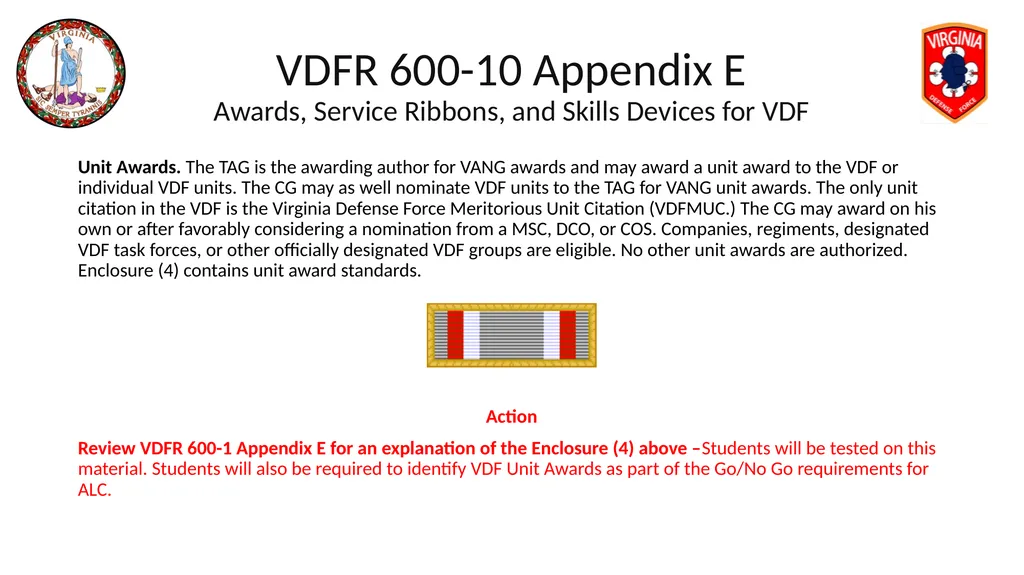
slide56. VDFR 600-10 Appendix E Awards, Service Ribbons, and Skills Devices for VDF Unit Awards. The TAG is the awarding author for VANG awards and may award a unit award to the VDF or individual VDF units. The CG may as well nominate VDF units to the TAG for VANG unit awards. The only unit citation in the VDF is the Virginia Defense Force Meritorious Unit Citation (VDFMUC.) The CG may award on his own or after favorably considering a nomination from a MSC, DCO, or COS. Companies, regiments, designated VDF task forces, or other officially designated VDF groups are eligible. No other unit awards are authorized. Enclosure (4) contains unit award standards.
Action
Review VDFR 600-1 Appendix E for an explanation of the Enclosure (4) above –Students will be tested on this material. Students will also be required to identify VDF Unit Awards as part of the Go/No Go requirements for ALC.<br>
slide57. VDFR 600-10 Appendix E Awards, Service Ribbons, and Skills Devices for VDF Other Forms of Recognition, Including Letters of Appreciation and Commendation.
Commendatory letters, appreciation certificates, plaques, and personal commendations are important ways to recognize members and other organizations for contributions to the success of the Virginia Defense Force. Each commander, at every level, will evaluate and develop awards for the performance of the members of his or her unit to identify opportunities to recognize members for a job well done. Cdrs and Command Sergeants Major (CSM) may present members who perform well but below the level of a meritorious medal, Letters of Appreciation and Commendation. Enclosure (5) provides additional guidance and samples.
Action
Review VDFR 600-1 Appendix E for an explanation of the Enclosure (5) above –Students will be tested on this material.<br>
slide58. VDFR 600-10 Appendix E Awards, Service Ribbons, and Skills Devices for VDF Administration, Process, and Logistics.
Commanders at all levels will ensure assigned personnel are considered appropriate for meritorious awards and awarded service and training skills awards as soon as the individual is eligible.
Commanders will ensure that awards will not be presented to any individual whose entire service subsequent to the time of the qualifying act, achievement, or service has not been honorable. Honorable service is faithful service in accordance with the standards of conduct, courage, and duty required by law and service customs.
Action
Review VDFR 600-1 Appendix E section 4, Administration, Process, and Logistics for more information. Students will be tested on this material.<br>
slide59. VDFR 600-10 Appendix E Awards, Service Ribbons, and Skills Devices for VDF Wear of Awards, Service Ribbons, and Skills Devices.
Prior Service Awards. All federal awards, service ribbons, and skills devices may be worn on the appropriate VDF uniforms. (All devices worn on the Class C uniform must be subdued.) Decorations earned while serving in other State Guards are also authorized.
Displaying Prior Service Awards on VDF Uniforms. Consult the VDF Uniform Regulations for wear guidance.
Wearing Superseded Service Awards and Skills Devices. Awards, service ribbons, and training devices previously authorized by VDF regulations but no longer authorized here, may be worn until no longer serviceable. These include: (1) Basic Officers Qualification Course graduation ribbon; (2) Response Management Staff College graduation ribbon; (3) State Military Police Badge; and VDF Aerial Observer Badge.
Second and Subsequent Awards. With the exception of Professional Military Education training ribbon awards, each Virginia Defense Force decoration, service, recruiting award, and unit citation may be awarded an unlimited number of times. Only one medal/ribbon may be awarded for the same act or achievement. This does not preclude an individual from receiving credit for service toward the Active Service or Community Service Award and a decoration for superior performance in a VDF event. Criteria for a second and subsequent award of decorations, service awards and unit citations are the same as for the initial award.
Action
Review VDFR 600-1 Appendix E section 5, Second and Subsequent Awards. Students will be tested on this material.<br>
slide60. VDFR 600-10 Appendix G Identification Cards Purpose. This VDF Regulation (VDFR) 600-10, Appendix (APDX) G establishes the procedures, responsibility, and authority for the issuance of Identification Cards (ID) within the VDF so that they may be issued in a standardized and systematic procedure and conform to all applicable Department of Homeland Security and Virginia Department of Military Affairs (DMA) regulations. The provisions of this regulation will apply to officers, warrant officers, and enlisted personnel.
Initial Issuance. Only the ACTDET may issue ID cards. ID cards are for members of the active VDF, the Active Reserve, and the Individual Ready Reserve. Members of the Standby Reserve will not be issued VDF ID cards unless called to active duty. No cards are issued for retirement/retirees. ID Cards will be issued only to VDF personnel who have completed the Recruit Sustainment Program (RSP) – whether prior service, or non-prior service. The RSP administrative support staff will request ID Cards from ACTDET.
Action
Review VDFR 600-1 Appendix G. Students will be tested on this material.<br>
slide61. VDFR 600-10 Appendix H Personnel Evaluation Report and Counselling Purpose. This VDF Regulation (VDFR) 600-10, Appendix (APDX) H prescribes policy regulation describes a performance evaluation system as an essential component in the sustained growth and development of the professionalism of the Virginia Defense Force.
Commanding General’s Guidance. This system is being implemented in the VDF not only to aid senior leaders in various career decisions impacting individual members, but also to provide a repeatable means for individuals to obtain performance and career development feedback.<br>
slide62. VDFR 600-10 Appendix H Personnel Evaluation Report and Counselling An individual’s performance is an essential component in personnel selection for promotion, retention, command and duty assignments. Completing a subordinate’s evaluation report is one of an officer’s most basic leadership responsibilities. Inherent within this duty is each reporting senior and reviewing officer’s commitment to ensuring the integrity of the system by close attention to accurate and detailed markings and timely reporting. Every officer serves an essential role in maintaining the integrity of the evaluation processes. Inflationary markings dilute the report and the value of the evaluation. Reviewing officers should not concur with inflated reports and should return them to the reporting officer for correction.
While the PER is a performance tool, it also serves as a key element to enable professional development and career progression conversation between the reporting senior and individual. Reporting seniors should use the beginning of each new rating period to set expectations and establish goals for the individual. During the reporting period, the individual is periodically counseled. Individuals should never be surprised by their PER markings if continual engagement is maintained throughout the reporting period.
A fair and timely evaluation of one’s subordinates is a primary leadership responsibility. During the reporting period, the individual is periodically counseled. Individuals should never be surprised by their PER markings if continual engagement is maintained throughout the reporting period.<br>
slide63. VDFR 600-10 Appendix H Personnel Evaluation Report and Counselling An individual’s performance is an essential component in personnel selection for promotion, retention, command and duty assignments. Completing a subordinate’s evaluation report is one of an officer’s most basic leadership responsibilities. Inherent within this duty is each reporting senior and reviewing officer’s commitment to ensuring the integrity of the system by close attention to accurate and detailed markings and timely reporting. Every officer serves an essential role in maintaining the integrity of the evaluation processes. Inflationary markings dilute the report and the value of the evaluation. Reviewing officers should not concur with inflated reports and should return them to the reporting officer for correction.
While the PER is a performance tool, it also serves as a key element to enable professional development and career progression conversation between the reporting senior and individual. Reporting seniors should use the beginning of each new rating period to set expectations and establish goals for the individual. During the reporting period, the individual is periodically counseled. Individuals should never be surprised by their PER markings if continual engagement is maintained throughout the reporting period.
A fair and timely evaluation of one’s subordinates is a primary leadership responsibility. During the reporting period, the individual is periodically counseled. Individuals should never be surprised by their PER markings if continual engagement is maintained throughout the reporting period.<br>
slide64. VDFR 600-10 Appendix H Personnel Evaluation Report and Counselling An individual’s performance is an essential component in personnel selection for promotion, retention, command and duty assignments. Completing a subordinate’s evaluation report is one of an officer’s most basic leadership responsibilities. Inherent within this duty is each reporting senior and reviewing officer’s commitment to ensuring the integrity of the system by close attention to accurate and detailed markings and timely reporting. Every officer serves an essential role in maintaining the integrity of the evaluation processes. Inflationary markings dilute the report and the value of the evaluation. Reviewing officers should not concur with inflated reports and should return them to the reporting officer for correction.
While the PER is a performance tool, it also serves as a key element to enable professional development and career progression conversation between the reporting senior and individual. Reporting seniors should use the beginning of each new rating period to set expectations and establish goals for the individual. During the reporting period, the individual is periodically counseled. Individuals should never be surprised by their PER markings if continual engagement is maintained throughout the reporting period.
A fair and timely evaluation of one’s subordinates is a primary leadership responsibility. During the reporting period, the individual is periodically counseled. Individuals should never be surprised by their PER markings if continual engagement is maintained throughout the reporting period.<br>
slide65. VDFR 600-10 Appendix H Personnel Evaluation Report and Counselling Responsibilities. The Assistant Chief of Staff, G–1 is responsible for oversight and execution of this program, to include supervising all prescribed personnel administrative functions to enable an effective program. VDF Commanders and senior leaders will process all evaluations in accordance with this regulation.
Occasions. A report will be completed on two occasions: Change of position/or change of Reporting Senior (CH), which would cover a maximum of 24 months of the Reporting Senior observing the member reported on. A special situation such as appearance before a Promotion Board (SP), which would cover a maximum of 24 months of the Reporting Officer observing the member reported on. PERs are not required for personnel separating from the VDF.
Documentation. The signed Performance Evaluation Report (PER) original copy shall be logged in by the subordinate command in a unit electronic “logbook” and forwarded to VDF Force Headquarters, ATTN: G-1, using a VDF Action Requests (VAR) as described in APDX D, Administration and Correspondence Standard Operating Procedures, for retention in the individual’s Personnel Records (PR) file. A copy of the completed report shall be provided to the individual member by the reporting senior (RS). Reporting Seniors and Reviewing Officers (RO) shall also retain copies of report in their personal records. No local copies will be retained by the local commands.<br>
slide66. VDFR 600-10 Appendix H Personnel Evaluation Report and Counselling Procedures.
Eligibility. Every enlisted member in the rank of E-5 and above and all commissioned and warrant officers will receive PERs in accordance with the two occasions shown above. Counselling forms should be used to mark commendable or problematic performance and used to support the PER.
Reporting Seniors. Reports will be written by the first officer in the individual’s chain of command. The RS shall have a minimum of ninety (90) consecutive calendar days of observed time of the individual in order to write a report, although for SP reports the period may be less if the RS believes s/he has substantive observations for the Board.
Reporting Form. Use the VDF Form 623-3 from the VDF web site.
Deadlines. Completed CH reports with appropriate signatures are due to the G-1 no later than sixty (60) calendar days after the reporting period ends. SP reports will be submitted per Board announcement directions. The RS must get the RS-signed PER to the RO for review by twenty-one (21) calendar days after the end of the reporting period. SP reports will be submitted per Board announcement directions. For non-adverse reports, ROs will return the completed report to the RS for member signature and processing not later than twenty-one (21) calendar days as receiving it form the RS. The timely submission is both the responsibility of the reporting senior and reviewing officer.<br>
slide67. VDFR 600-10 Appendix H Personnel Evaluation Report and Counselling Procedures.
Eligibility. Every enlisted member in the rank of E-5 and above and all commissioned and warrant officers will receive PERs in accordance with the two occasions shown above. Counselling forms should be used to mark commendable or problematic performance and used to support the PER.
Reporting Seniors. Reports will be written by the first officer in the individual’s chain of command. The RS shall have a minimum of ninety (90) consecutive calendar days of observed time of the individual in order to write a report, although for SP reports the period may be less if the RS believes s/he has substantive observations for the Board.
Reporting Form. Use the VDF Form 623-3 from the VDF web site.
Deadlines. Completed CH reports with appropriate signatures are due to the G-1 no later than sixty (60) calendar days after the reporting period ends. SP reports will be submitted per Board announcement directions. The RS must get the RS-signed PER to the RO for review by twenty-one (21) calendar days after the end of the reporting period. SP reports will be submitted per Board announcement directions. For non-adverse reports, ROs will return the completed report to the RS for member signature and processing not later than twenty-one (21) calendar days as receiving it form the RS. The timely submission is both the responsibility of the reporting senior and reviewing officer.<br>
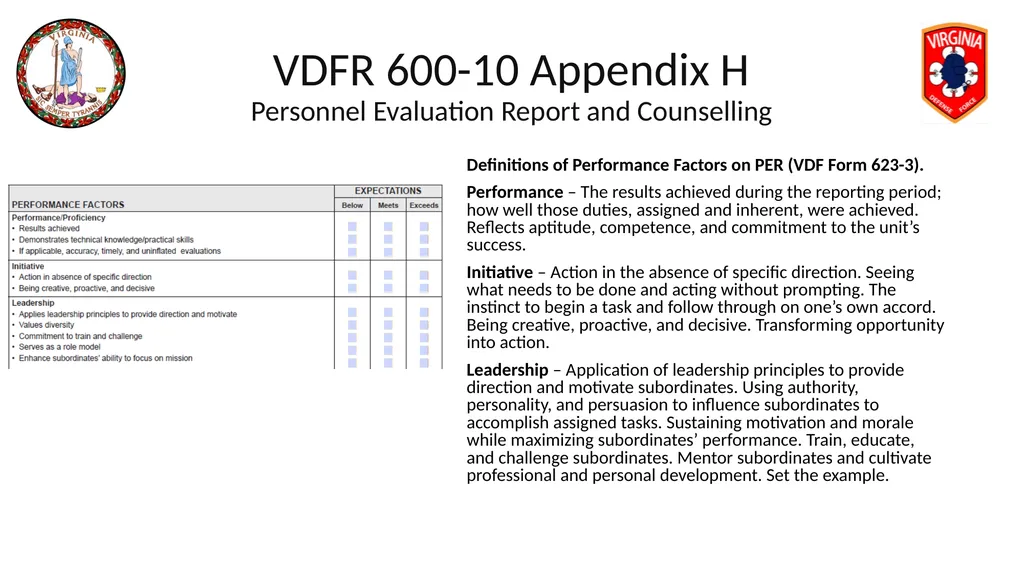
slide68. VDFR 600-10 Appendix H Personnel Evaluation Report and Counselling Definitions of Performance Factors on PER (VDF Form 623-3).
Performance – The results achieved during the reporting period; how well those duties, assigned and inherent, were achieved. Reflects aptitude, competence, and commitment to the unit’s success.
Initiative – Action in the absence of specific direction. Seeing what needs to be done and acting without prompting. The instinct to begin a task and follow through on one’s own accord. Being creative, proactive, and decisive. Transforming opportunity into action.
Leadership – Application of leadership principles to provide direction and motivate subordinates. Using authority, personality, and persuasion to influence subordinates to accomplish assigned tasks. Sustaining motivation and morale while maximizing subordinates’ performance. Train, educate, and challenge subordinates. Mentor subordinates and cultivate professional and personal development. Set the example.<br>
slide69. VDFR 600-10 Appendix H Personnel Evaluation Report and Counselling Definitions of Performance Factors on PER (VDF Form 623-3).
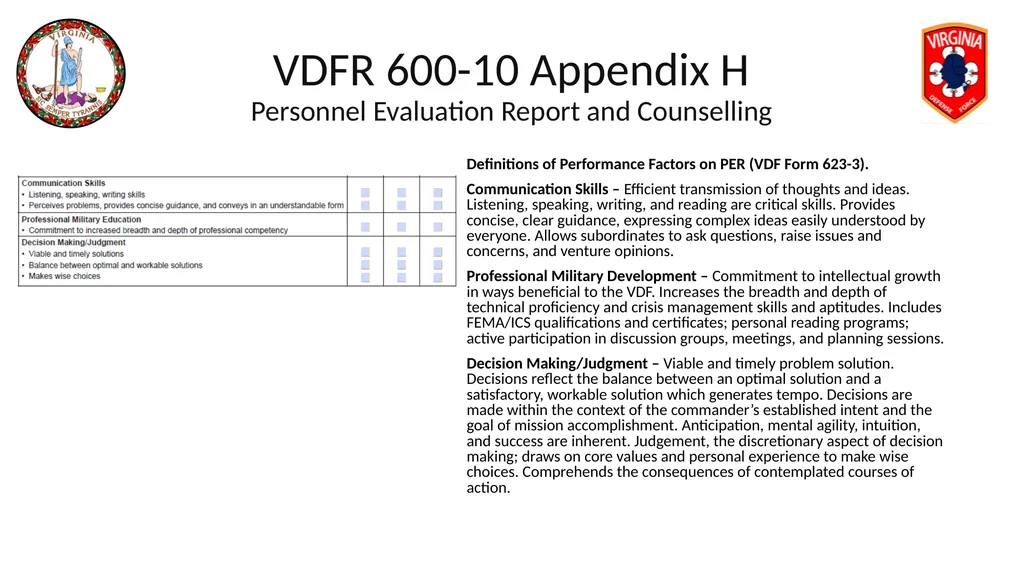
Communication Skills – Efficient transmission of thoughts and ideas. Listening, speaking, writing, and reading are critical skills. Provides concise, clear guidance, expressing complex ideas easily understood by everyone. Allows subordinates to ask questions, raise issues and concerns, and venture opinions.
Professional Military Development – Commitment to intellectual growth in ways beneficial to the VDF. Increases the breadth and depth of technical proficiency and crisis management skills and aptitudes. Includes FEMA/ICS qualifications and certificates; personal reading programs; active participation in discussion groups, meetings, and planning sessions.
Decision Making/Judgment – Viable and timely problem solution. Decisions reflect the balance between an optimal solution and a satisfactory, workable solution which generates tempo. Decisions are made within the context of the commander’s established intent and the goal of mission accomplishment. Anticipation, mental agility, intuition, and success are inherent. Judgement, the discretionary aspect of decision making; draws on core values and personal experience to make wise choices. Comprehends the consequences of contemplated courses of action.<br>
slide70. VDFR 600-10 Appendix H Personnel Evaluation Report and Counselling Adverse Reports. If a VDF volunteer receives any of the following, the report is considered adverse: (1) Three or more of the performance factors marked “below expectations”; and/or (2) An “unsatisfactory” and/or “below average” (BA) marking in the comparative assessments. a. For an adverse report, the RS must give a justification in the DIRECTED &/OR ADDITIONAL COMMENTS section of the PER. Additional sheets may be used, as required. The RS must forward this report to the individual reported on for review and comment no later than twenty-one (21) days after the end of the reporting period.
Upon receipt of the PER, the individual reported on has ten (10) calendar days to attach a statement, if desired, and forward to the RS.
After receiving the report from the individual reported on, the RS will immediate forward the report to the RO. The RS must also inform the RO that the report is considered adverse and has been provided to the individual reported on for review and comment.
The RO will comment on the adverse nature of the report in the COMMENTS section of the PER by addressing the RS markings/comments and any additional comments as provided by the individual reported on. The RO will then forward this report back to the individual reported on within fifteen (15) calendar days with identification of the designated third officer.
The volunteer will have five (5) calendar days to review the reviewing officer comments, attach a final statement, if desired, and forward to a designated third (senior to RO) officer.<br>
slide71. VDFR 600-10 Appendix H Personnel Evaluation Report and Counselling Adverse Reports.
In the event the RS and RO disagree on the characterization of a report as adverse, and/or the individual does not agree with the RS’s comments, then a third officer, preferably the next senior officer to the RO, will within five (5) calendar days review the report for accuracy/completeness and forward to VDF HQs ATTN: G-1 via VAR with his comments.<br>
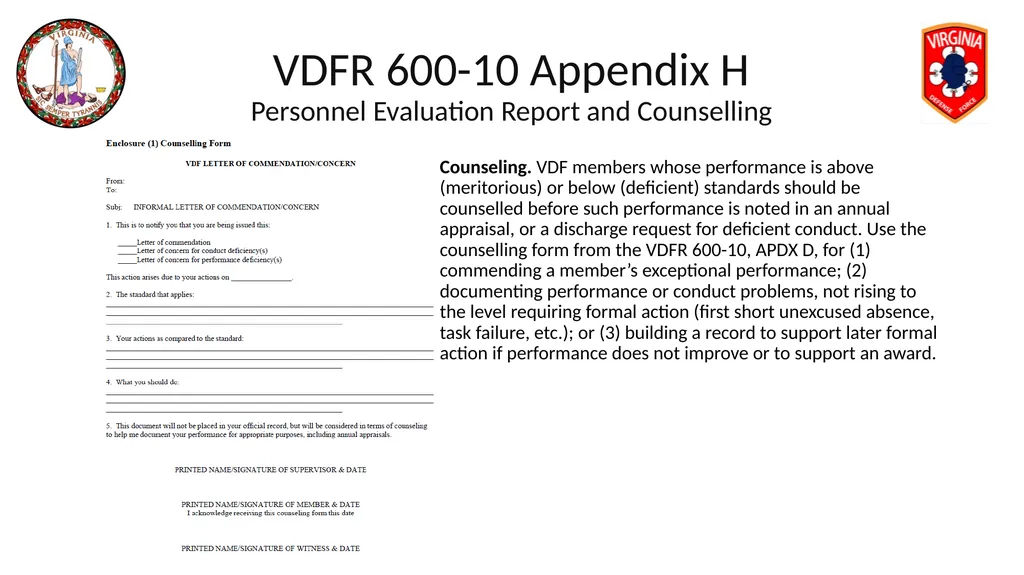
slide72. VDFR 600-10 Appendix H Personnel Evaluation Report and Counselling Counseling. VDF members whose performance is above (meritorious) or below (deficient) standards should be counselled before such performance is noted in an annual appraisal, or a discharge request for deficient conduct. Use the counselling form from the VDFR 600-10, APDX D, for (1) commending a member’s exceptional performance; (2) documenting performance or conduct problems, not rising to the level requiring formal action (first short unexcused absence, task failure, etc.); or (3) building a record to support later formal action if performance does not improve or to support an award.<br>
slide73. VDFR 600-10 Appendix I Personnel Assets Attendance and Unit Strength Accounting Purpose. This VDF Regulation (VDFR) 600-10, Appendix (APDX) I addresses VDF Personnel Assets Attendance and Unit Strength Accounting policy and practices.
Responsibilities.
Assistant Chief of Staff for Personnel and Administration. The G1 will ensure subordinate commands provide personnel assets attendance and unit strength accounting, and seek streamlined, modern methods to reduce paperwork, while meeting reporting metrics requirements.
ACTDET. The ACTDET will prescribe policy, procedures and implementing instructions on personnel assets attendance and unit strength accounting.<br>
slide74. VDFR 600-10 Appendix I Personnel Assets Attendance and Unit Strength Accounting Information Security and Transmitting Personnel Records. Units will protect Personal Identifiable Information (PII) when gathering attendance and unit strength data. PII is nonpublic, information held or used by the government (including VDF) about a person, which can improperly reveal an individual’s identity and/or contact information. PII is information that (1) directly identifies an individual (e.g., name, address, social security number, telephone number, email address, etc.), or (2) can indirectly identify a person via information such as gender, race, birth date, geographic indicator, and other descriptors which may be assembled to improperly identify the individual). PII loss can substantially harm individuals, including identity theft or other fraudulent information use. When PII is transmitted from VDF units to ACTDET the sensitive information must be password protected, and the sender will contact ACTDET to determine how ACTDET desires to receive the password.<br>
slide75. VDFR 600-10 Appendix I Personnel Assets Attendance and Unit Strength Accounting Information Security and Transmitting Personnel Records. Units will protect Personal Identifiable Information (PII) when gathering attendance and unit strength data. PII is nonpublic, information held or used by the government (including VDF) about a person, which can improperly reveal an individual’s identity and/or contact information. PII is information that (1) directly identifies an individual (e.g., name, address, social security number, telephone number, email address, etc.), or (2) can indirectly identify a person via information such as gender, race, birth date, geographic indicator, and other descriptors which may be assembled to improperly identify the individual). PII loss can substantially harm individuals, including identity theft or other fraudulent information use. When PII is transmitted from VDF units to ACTDET the sensitive information must be password protected, and the sender will contact ACTDET to determine how ACTDET desires to receive the password.<br>
slide76. VDFR 600-10 Appendix I Personnel Assets Attendance and Unit Strength Accounting Procedures. The procedures prescribed below and the forms used in accounting for personnel and positions will be used as described below to report statistical data of VDF members to VDF Force Headquarters (FORHQ), and as an historic reference document, until an online reporting substitute is promulgated:
Sign-In Sheets. VDF Form 680-1-1 is the only authorized form for signing-in. This document is used to verify morning reports and actual attendance. All personnel will sign-in upon arrival at their Unit Training Assembly (UTA), Multiple UTA (MUTA), or mission assignment. Administrative officers and clerks will set up sign in tables and ensure all unit members are reminded to sign in, and stragglers tracked down. The Sign-In Sheets will account for persons present at UTA, and for persons not present. The Sign-In Sheets must accompany each Morning Report.<br>
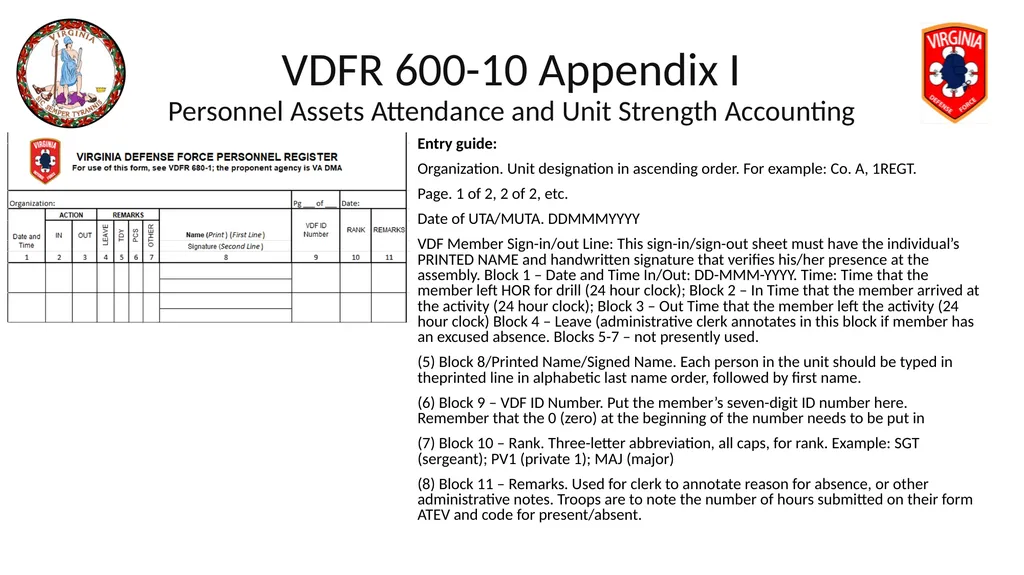
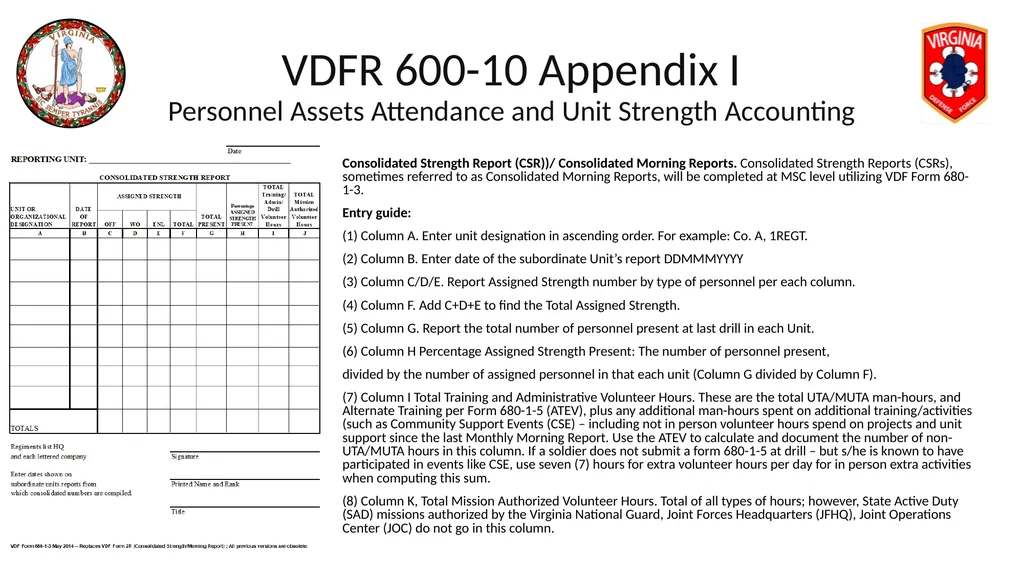
slide77. VDFR 600-10 Appendix I Personnel Assets Attendance and Unit Strength Accounting Entry guide:
Organization. Unit designation in ascending order. For example: Co. A, 1REGT.
Page. 1 of 2, 2 of 2, etc.
Date of UTA/MUTA. DDMMMYYYY
VDF Member Sign-in/out Line: This sign-in/sign-out sheet must have the individual’s PRINTED NAME and handwritten signature that verifies his/her presence at the assembly. Block 1 – Date and Time In/Out: DD-MMM-YYYY. Time: Time that the member left HOR for drill (24 hour clock); Block 2 – In Time that the member arrived at the activity (24 hour clock); Block 3 – Out Time that the member left the activity (24 hour clock) Block 4 – Leave (administrative clerk annotates in this block if member has an excused absence. Blocks 5-7 – not presently used.
(5) Block 8/Printed Name/Signed Name. Each person in the unit should be typed in theprinted line in alphabetic last name order, followed by first name.
(6) Block 9 – VDF ID Number. Put the member’s seven-digit ID number here. Remember that the 0 (zero) at the beginning of the number needs to be put in
(7) Block 10 – Rank. Three-letter abbreviation, all caps, for rank. Example: SGT (sergeant); PV1 (private 1); MAJ (major)
(8) Block 11 – Remarks. Used for clerk to annotate reason for absence, or other administrative notes. Troops are to note the number of hours submitted on their form ATEV and code for present/absent.<br>
slide78. VDFR 600-10 Appendix I Personnel Assets Attendance and Unit Strength Accounting Submission: Completed Sign-in sheets are to be scanned (.pdf preferred). Each page is to be part of the same file. The sign-in sheet(s) is/are to be scanned as a separate document from the morning report. It is required to be submitted with the Morning Report within 72-hours of completion of drill, but always to ensure that all higher level submission suspense dates are met.
Attendance Codes: P – Present U – Unexcused absence AS – Absent due to illness AJ – Absent due to employment conflict AT – Absent (Excused) using alternative training AV – Absent (Excused) on TDY with another VDF unit or on SAD AD – Absent due to separation/discharge AR – Absent due to transfer to VDF Reserve Component AN – Absent due to transfer to different VDF unit<br>
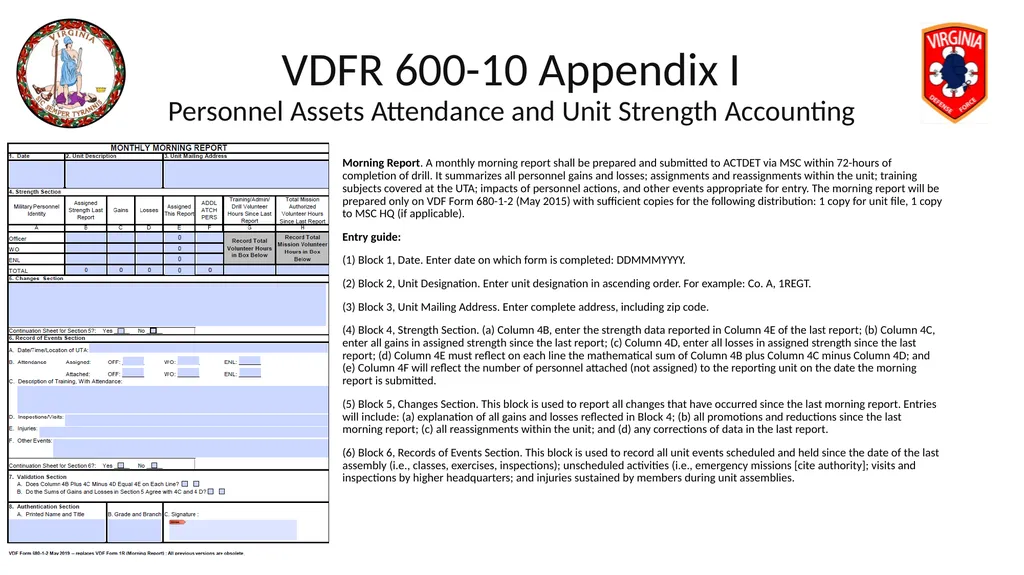
slide79. VDFR 600-10 Appendix I Personnel Assets Attendance and Unit Strength Accounting Morning Report. A monthly morning report shall be prepared and submitted to ACTDET via MSC within 72-hours of completion of drill. It summarizes all personnel gains and losses; assignments and reassignments within the unit; training subjects covered at the UTA; impacts of personnel actions, and other events appropriate for entry. The morning report will be prepared only on VDF Form 680-1-2 (May 2015) with sufficient copies for the following distribution: 1 copy for unit file, 1 copy to MSC HQ (if applicable).
Entry guide:
(1) Block 1, Date. Enter date on which form is completed: DDMMMYYYY.
(2) Block 2, Unit Designation. Enter unit designation in ascending order. For example: Co. A, 1REGT.
(3) Block 3, Unit Mailing Address. Enter complete address, including zip code.
(4) Block 4, Strength Section. (a) Column 4B, enter the strength data reported in Column 4E of the last report; (b) Column 4C, enter all gains in assigned strength since the last report; (c) Column 4D, enter all losses in assigned strength since the last report; (d) Column 4E must reflect on each line the mathematical sum of Column 4B plus Column 4C minus Column 4D; and (e) Column 4F will reflect the number of personnel attached (not assigned) to the reporting unit on the date the morning report is submitted.
(5) Block 5, Changes Section. This block is used to report all changes that have occurred since the last morning report. Entries will include: (a) explanation of all gains and losses reflected in Block 4; (b) all promotions and reductions since the last morning report; (c) all reassignments within the unit; and (d) any corrections of data in the last report.
(6) Block 6, Records of Events Section. This block is used to record all unit events scheduled and held since the date of the last assembly (i.e., classes, exercises, inspections); unscheduled activities (i.e., emergency missions [cite authority]; visits and inspections by higher headquarters; and injuries sustained by members during unit assemblies.<br>
slide80. VDFR 600-10 Appendix I Personnel Assets Attendance and Unit Strength Accounting Entry guide:
Block 7, Validation Section. This block is used to verify accuracy of entries, which are independent. When the answer to a listed question is “no”, the difference must be resolved before the morning report can be submitted to higher headquarters (HHQ).
(8) Block 8, Authentication Section. This block will identify the reporting Cdr, or a delegee, and be signed.<br>
slide81. VDFR 600-10 Appendix I Personnel Assets Attendance and Unit Strength Accounting Consolidated Strength Report (CSR))/ Consolidated Morning Reports. Consolidated Strength Reports (CSRs), sometimes referred to as Consolidated Morning Reports, will be completed at MSC level utilizing VDF Form 680-1-3.
Entry guide:
(1) Column A. Enter unit designation in ascending order. For example: Co. A, 1REGT.
(2) Column B. Enter date of the subordinate Unit’s report DDMMMYYYY
(3) Column C/D/E. Report Assigned Strength number by type of personnel per each column.
(4) Column F. Add C+D+E to find the Total Assigned Strength.
(5) Column G. Report the total number of personnel present at last drill in each Unit.
(6) Column H Percentage Assigned Strength Present: The number of personnel present,
divided by the number of assigned personnel in that each unit (Column G divided by Column F).
(7) Column I Total Training and Administrative Volunteer Hours. These are the total UTA/MUTA man-hours, and Alternate Training per Form 680-1-5 (ATEV), plus any additional man-hours spent on additional training/activities (such as Community Support Events (CSE) – including not in person volunteer hours spend on projects and unit support since the last Monthly Morning Report. Use the ATEV to calculate and document the number of non-UTA/MUTA hours in this column. If a soldier does not submit a form 680-1-5 at drill – but s/he is known to have participated in events like CSE, use seven (7) hours for extra volunteer hours per day for in person extra activities when computing this sum.
(8) Column K, Total Mission Authorized Volunteer Hours. Total of all types of hours; however, State Active Duty (SAD) missions authorized by the Virginia National Guard, Joint Forces Headquarters (JFHQ), Joint Operations Center (JOC) do not go in this column.<br>
slide82. VDFR 600-10 Appendix I Personnel Assets Attendance and Unit Strength Accounting Report of Alternative Training/ Extra Volunteer Hours. This form must be turned in at the beginning of each drill and is to be paced in the Personnel Record of each soldier. Use the ATEV to record:
Alternate Training Credit (In Person Hours). This category is for support make-up training for missed UTA/MUTA of individuals unable to attend regularly scheduled drill due to job conflict, illness or other excused absence. This may include Professional Military Education classes, whether in person or not.
Extra Volunteer Hours. Extra volunteer hours constitute duty other than UTA/MUTA and Alternate Training Credit. Such hours include parades, CSE, recruiting events, various support hours for staff meetings, projects, etc.<br>
slide83. VDFR 600-10 Appendix I Personnel Assets Attendance and Unit Strength Accounting Alpha Rosters. HHQs (DMA) requires a uniform and accurate Alpha Roster. Only the ACTDET produces Alpha Rosters. ACTDET will use an Excel spreadsheet to provide monthly rosters to reporting units. Reporting units may not change the ACTDET Alpha Roster format in any way, but per below will make data entry changes for members as needed, and notify ACTDET. Reporting units will ensure every member reporting to UTA sights and verifies the member’s information, and the unit clerk will update corrections on the spot, highlight the changes as the ACTDET directs, and return the Alpha Roster to the ACTDET (cc G1 and HHQ S1).
Submittal to FORHQ. The MSC HQ will forward (1) MSC and all subordinate unit sign-in sheets; (2) MSC and subordinate unit Morning Reports; (3) MSC CSR; and (4) MSC all subordinate unit and Alpha Roster to FORHQ ACTDET and cc the G-1 no later than close of business 10th of each month for the previous month<br>
slide84. VDFR 600-10 Appendix J Personnel Boards Purpose. This VDF Regulation (VDFR) 600-10, Appendix J, prescribes policy and processes for conducting personnel boards within the Virginia Defense Force (VDF). This regulation pertains to all promotion and selection boards conducted in the VDF (e.g., note promotions up to E-4 for enlisted and O-2 for officers occur without a board).
Responsibilities. The G-1 or Deputy Commanding Officer will announce Force level personnel boards and conform such boards IAW this regulation. Major Subordinated Command (MSC) Commanders (Cdr) (O-6 commands) and Headquarters and Headquarters Company Commandant (HHC CMDT) will conduct boards they convene IAW this regulation.<br>
slide85. VDFR 600-10 Appendix J Personnel Boards General Procedures.
Convening Authority. Boards will be convened by the CG via the G1 or DCO for Force level promotions or selections. MSC Cdrs (O-6 commands) and HHC CMDT will convene boards for promotions or selections within their authority. The Convening Authority, as part of a Convening Order, will detail any precepts that the board should consider in selection.
Convening Orders Convening Orders will strictly follow the Enclosure (1) format, including the instructions to board members.
Board Announcements. Enclosures (2) to (4) will be strictly followed for the relevant boards. The Board President must ensure the receiving agent title and email address is present, and the announcement emphasizes incomplete packages will not be considered (though minor deviations will be worked with submitter). For uniformity, announcements should include the Enclosure (5) applicant cover letter template.
In –Person Boards v. Virtual Boards. Boards will normally be in-person meetings, with candidates appearing in person before the board. Virtual boards will only occur with the Convening Authority’s permission, in consultation with the pertinent CSM for enlisted boards.<br>
slide86. VDFR 600-10 Appendix J Personnel Boards General Procedures.
Board Composition. Each board will consist of at least three but not more than five members. For Force level boards, each MSC will provide one board representative. A President will preside over each board, and a Recorder will administer the board at the President’s direction. See detailed composition instructions below.
Board Report. Board Presidents must provide the Convening Authority a signed board report, strictly in the Enclosure (6) format.
Promotion Board Criteria. All promotion criteria must be met by the date the board’s convenes. Time-in-Service (TIS) and Time-in-Grade (TIG) will be calculated based upon the date the board convenes.
Results Announcement and Execution. All board results are confidential until the Convening Authority approves the results (as needed including legal review and The Adjutant General approval)). Upon the Convening Authority’s approval of a board report, the Convening Authority’s administrative section will publish promotion orders, or orders effectuating other selection board results. The effective date of approved promotions is that which is specified in the promotion order, but not more than one month from the Convening Authority’s approving the board report. Selected individuals may not wear the selected-to grade/rank insignia, nor change rank title until formally promoted during a ceremony on or after the effective date. A copy of each order will be placed in the promotee’s or selectee’s FORHQ Personnel Record.<br>
slide87. VDFR 600-10 Appendix J Personnel Boards Promotion and Selection Boards.
Officer Promotion Boards. Officer promotion boards will be convened by FORHQ Convening Order on the schedules described below for specific ranks. (1) Personnel meeting the VDFR 600-10, APDX L, “Personnel Promotions.” Table 1 (for Officers) for promotion to the next rank O-3 and above will be screened by a promotion board convened by the G-1 on the CG’s behalf, who will publish the board dates and promotion package due date. The promotion board Convening Order will follow the Enclosure (1) format, and the board announcement to subordinate elements will follow the Enclosure (2) format.
The President of each Officer Promotion Board will be two ranks higher than the board target rank, and members at least one rank higher. A Recorder for the proceedings will be appointed as a non-voting member.
Warrant Officer Promotion Boards. Warrant Officer promotion boards will be convened by FORHQ Convening Order on the schedules described below for specific ranks.
Personnel meeting the VDFR 600-10, APDX L, Table 2 (for Warrant Officers) for promotion to the next rank WO-2 and above will be screened by a promotion board convened by the G-1 on the CG’s behalf, who will publish the board dates and promotion package due date. The Promotion Board Convening Order will follow the Enclosure (1) format, and the board announcement to subordinate elements will follow the Enclosure (2) format.
The President of each Officer Promotion Board will be two ranks higher than the board target rank, and members at least one rank higher. A Recorder for the proceedings will be appointed as a non-voting member.<br>
slide88. VDFR 600-10 Appendix J Personnel Boards Enlisted Promotion Boards. Force-level enlisted promotion boards will be convened by FORHQ Convening Order, and MSC enlisted promotion boards will be convened by the MSC Convening Order on the schedules described below for specific ranks.
Force-level Enlisted Promotion Boards will be comprised of five non-commissioned officers, two grades higher to the grade of those members being considered for promotion apart from the E-9 board. A non-commissioned officer will be appointed to serve as the Recorder and shall be a non-voting member.
MSC-level boards will be comprised of at least three non-commissioned officers. The President of each Promotion Board will be two ranks higher than the board target rank, and members at least one rank higher.
All packets for enlisted boards shall be reviewed by the enlisted service members’ company First Sergeant or equivalent, who shall forward the reviewed package to the MSC CSM for review if for a Force-level board. The packages will be submitted per the board announcement to the Convening Authority’s administrative designee for logging and forwarding to the board President.<br>
slide89. VDFR 600-10 Appendix J Personnel Boards E-5. Personnel meeting the VDFR 600-10, APDX L, Table 3 (for Enlisted) requirements for E-5 will be screened by a promotion board convened by the HHC CMDT, or the member’s MSC Cdr. The promotion board convening order is issued at the responsible Cdr’s timing and discretion up to semi-annually, but will follow the VDFR 600-10 Appendix J Enclosure (1) format, and the board announcement to subordinate elements will follow the VDFR 600-10 Appendix J Enclosure (2) format. While at the MSC level an announcement may seem unneeded, an announcement provides a key service by announcing the date a promotion package is due, the promotion package content requirements, and board procedures.
E-6 to E-9. Personnel meeting the VDFR 600-10, APDX L. Table 3 (for Enlisted) for promotion to the next rank, E-6 and above, will be screened by a promotion board convened by the G-1, who will publish the board dates and promotion package due date. The promotion board convening order will follow the VDFR 600-10 Appendix J Enclosure (1) format, and the board announcement to subordinate elements will follow the VDFR 600-10 Appendix J Enclosure (2) format.
Timing. E-6/7, O-3, and CWO-2/3/4 boards will meet about March each year, usually at the spring Multiple Unit Training Assembly (MUTA). E-8/9, and O-4/5 Boards will meet about November each year, usually at the fall MUTA. O-6 selection boards will be conducted at the CG’s periodic direction. (Note: The Command Chief Warrant Officer is the only VDF WO5 position and will be screened for the CG and The Adjutant General by a Position Vacancy Board.)<br>
slide90. VDFR 600-10 Appendix J Personnel Boards Other Selection Boards. Irregular promotion selection boards, such as meritorious promotion boards will follow the same procedures as the above promotion boards and the enclosures. The selection board convening order will follow the VDFR 600-10 Appendix J Enclosure (1) format, and the board announcement to subordinate elements will follow the Enclosure (2) format.
Position Vacancy Boards. Per CG guidance, positions at the Colonel/O-6 level and FORHQ General, and selected Special and Personal Staff positions, will be filled via selection board screening and recommendation to the CG. The Position Vacancy Board convening order is issued at the CG’s direction and will follow the VDFR 600-10 Appendix J Enclosure (1) format, and the board announcement to subordinate elements will follow the Enclosure (3) format. MSC Cdrs may conduct Position Vacancy Boards for positions under their command at their discretion, but must use the VDFR 600-10 Appendix J Enclosures (1) and (3) formats.
Retention Board for VDF Members 65 Years of Age or Older. Code of Virginia Title 44 only states “The Adjutant General may, on a case-by-case basis, authorize volunteer members of the Virginia Defense Force to be retained beyond age 65 to age 75.” The inferred meaning of “case-by-case basis” is service beyond 65 should be merit based and other than routine. The Retention Board for VDF Members 65 Years of Age or Older Board convening order is issued at the CG’s direction and will follow the VDFR 600-10 Appendix J Enclosure (1) format. Announcement to subordinate elements will follow the Enclosure (4) format.<br>
slide91. VDFR 600-10 Appendix M Personnel Records Management Purpose. The VDF Personnel Records System, formerly known as the “MPRJ (Military Personnel Record Jacket),” or “201 File,” or “MHRR (Military Human Resource Record),” is an administrative record, as well as the official permanent record of VDF military service for each VDF member. Its purpose is to preserve key permanent documents pertaining to enlistment, appointment, professional qualifications, duty assignments, training, qualifications, performance, awards, disciplinary actions, insurance, emergency data, separation, retirement, casualty, administrative remarks, and any other personnel actions. This VDF Regulation (VDFR) 600-10, Appendix (APDX) M addresses the VDF Personnel Records (PR) policy and practices.<br>
slide92. VDFR 600-10 Appendix M Personnel Records Management Information Security and Other Personnel Records. PR records are Commonwealth of Virginia/State personnel records. They hold Controlled Unclassified Information (CUI), specifically Personal Identifiable Information (PII). PII is non-public, information held or used by the government (including VDF) about a person, which can improperly reveal an individual’s identity and/or contact information. PII is information that: (1) directly identifies an individual (e.g., name, address, social security number, telephone number, email address, etc.); or (2) can indirectly identify a person via information such as gender, race, birth date, geographic indicator, and other descriptors which may be assembled to improperly identify the individual). PII loss can substantially harm individuals, including identity theft or other fraudulent information use.
CUI/PII information requires a secure location. ACTDET maintains the VDF’s secure data base of record. Accordingly, only ACTDET may create and keep PRs.
When CUI/PII is transmitted from VDF units to ACTDET – including for inclusion in PRs per below -- the sensitive information must be password protected, and the submitter will coordinate with ACTDET how to separately supply ACTDET the password.
VDF HHC, staff, MSC, or subordinate commands, may not create or hold PRs, and to the extent they have limited documents on their assigned member’s continuing PII -- such as informal counselling notes -- such records must be securely maintained on VDF-owned state media repositories, and only transmitted for official purposes and per above and below instructions.<br>
slide93. VDFR 600-10 Appendix M Personnel Records Management Personnel Record Contents. ACTDET will maintain PR files on all VDF personnel, which
will include:
Enlistment documents
VDF Form 3R (Personnel Action Request)
VDF Form 2-428R (VDF Application)
VDF Form 337R, 601-100, or 601-210 (VDF Oath)
VDF Form 14-R (VDF Parental Consent) (Only if needed for enlistment)
Prior military service documents (DD214, NGB 22, etc.)
Professional Branches accreditation and licensing documents
Awards.
Records of professional military education and/or skills training required for promotion.
Letters, memorandums, and other correspondence pertaining to a member, other than duty orders
All VDF Performance Evaluations (VDF Forms 623-3).
All promotion and assignment orders issued by the Force Headquarters (FORHQ).<br>
slide94. VDFR 600-10 Appendix M Personnel Records Management Electronic Storage of PRs.
An electronic file for each individual is to be created being named with: Last name, First Name Middle Initial, Jr. (if needed) VDF ID Number.
Each document in the file is to be scanned in .pdf format only
Each document in the file is to be scanned separately
Each document is to be named in the following format: Last name, First name MI VDF ID Number, form number, date of form (DDMMMYYY), brief description. EXAMPLE: Jones, James M. 1234567 3-R 16JUN2012 Trans to A 3rd REGT<br>
slide95. VDFR 600-10 Appendix M Personnel Records Management Disposition of PRs.
Temporary Records. As stated above, HHC, staff, MSC, and subordinate Cdrs will not create PRs. Any supervisor notes or other documents containing member PII held per above allowances, will be destroyed upon a member’s transfer to another unit or transferred to the receiving unit Cdr, who in turn will ensure correct storage per above. Upon member discharge, any such records will be destroyed, unless the holder is directed by FORHQ to provide the records to FORHQ for an investigation or other official-use stated reason.
Disposition Upon Discharge or Death. When a VDF member is discharged or dies, the ACTDET will coordinate disposition of the records in accordance with (IAW) State records storage requirements.
Member Review of PR. VDF members have the right to review their own PR at any time, upon coordination with the ACTDET through the member’s chain of command.<br>
slide96. VDFR 600-10 Appendix N Reductions (Voluntary) Purpose. This VDF Regulation (VDFR) 600-10, Appendix (APDX) N addresses the Voluntary Grade Reductions policy and practices.
Policy. VDF members may request voluntary reduction for the good of the service and/or to facilitate their career goals to fill a verified vacant billet -- with an authorized grade at least two grades below the requesting member’s present grade. The Commanding General may authorize the reduction in grade and placement in the requested vacant position, which position the member must occupy at least 12 months before requesting and being granted restoration to the member’s former grade. The member upon restoration will be placed in a vacant position commensurate with the member’s restored grade. The time in grade (TIG) accrued prior to voluntary reduction will be maintained and will be credited back to the member upon the member’s restoration to his or her previous grade.<br>
slide97. VDFR 600-10 Appendix N Reductions (Voluntary) Reduction Process.
Officers in a Captain/O-3 or higher position, Warrant Officers in a Chief Warrant Officer -3 (CW-3) or higher position, or Staff Non-Commissioned Officers in a Sergeant First Class or higher position, may request voluntary administrative reduction to fill a position vacancy at least two grades below the requester’s present grade.
The member will draft a voluntary reduction request from the member, via the member’s Force Headquarters Staff Leader or Major Subordinate Commander (MSC), to the G1.
The request must state “I voluntarily request administrative reduction from my present grade of [fill in] to the grade of [fill in at least two grades below present grade] in order to be placed in Manning Table of Organization (MTO) number [fill in]; Paragraph [fill in]; line number[fill in]; position description [fill in]; authorized grade [fill in]. I understand that I must remain in the described position at least 12 months and will not accrue Time in Grade (TIG) for my former grade while in that new position. I further understand that after 12 or more months I may request restoration to my former grade, and TIG in that grade. I further understand that upon restoration to my former grade, I will be placed in a vacant MTO position commensurate with my restored grade, and that while I may express my preference, placement will depend on available vacancies and the needs of the service.”
The request will be accompanied by a VAR per VDFR 600-10, APDX D, and a Form 3R requesting orders, with the “From” position being the member’s current assigned position, and the “To” position being the vacant position to which the member requests assignment.
The G1 will ensure the request and 3R conform with this regulation, confirm the member’s MSC Cdr has signed the 3R, and the “To” position is vacant, and then forward the request to the CG for decision.
Upon the CG approving the reduction and placement requests, the G1 will request that the ACTDET prepare reduction orders, stating “Voluntary Reduction without Prejudice.”<br>
slide98. VDFR 600-10 Appendix N Reductions (Voluntary) Restoration Process.
The member must occupy the new position at least 12 months before requesting restoration to the CG -- using the same process as for requesting reduction. The member may request placement in any vacant position in the format shown above, but placement will be in accordance with the service’s needs.
The G1 will review the request as described above, and forward to the CG for decision.
Upon the CG approving the restoration and placement requests (or directing a different placement commensurate with the restored grade), the G1 will request that the ACTDET prepare restoration orders, stating “Voluntary Restoration. The time in grade accrued prior to voluntary reduction will be credited back to the member.”<br>
slide99. VDFR 600-10 Appendix O Reserves Purpose. This VDF Regulation (VDFR) 600-10, Appendix (APDX) O addresses the VDF Reserves policy and practices.
Policy. The Virginia Defense Force Reserve is titled the “Individual Ready Reserve and as discussed below state statute further describes a “Virginia Unorganized Militia.” The IRR has its own way of contributing to the successful completion of the overall VDF mission. Personnel assigned to the IRR must fulfill all administrative and training requirements IAW the below requirements in order to remain in the VDF.<br>
slide100. VDFR 600-10 Appendix O Reserves VDF Tactical Reserve: Individual Ready Reserve. The IRR component is composed of personnel who are unable to actively participate in monthly drills, but are able to participate in periodic Unit Training Assemblies (UTAs) and Multiple-day UTAs (/MUTAs) training, project support, etc., until their personal time restrictions mitigate, and they are able to return to active status. The IRR provides a temporary reduced requirements haven for members, while providing VDF active leaders with a pool of talent to leverage for support. Individuals unable to attend UTAs regularly may request transfer by orders from their active duty MTO line number to the IRR, and orders to an active unit when their ability to participate improves. While in IRR, the following guidelines must be followed:
IRR members must remain available for SAD.
IRR members must attend during the calendar year at least one UTA, MUTA, other organized activity, or be on SAD. Service requirements may be satisfied if an IRR member performs documented, significant special project work for at least eight hours.
IRR members may select their own day or more of service, but must contact the IRR OIC, Deputy OIC, or Staff Non-Commissioned OIC to schedule the date(s).
IRR leadership will offer IRR members service opportunities to choose from, providing specific service dates or projects – and arrange orders as needed. Failure to attend one of these activities during the calendar year shall be sufficient grounds for discharge from the VDF.<br>
slide101. VDFR 600-10 Appendix O Reserves VDF Tactical Reserve: Individual Ready Reserve.
Ensure the IRR leadership has a current mailing address, physical home address (if different from their mailing address), at least one telephone number, and an email address, and the name, address and contact information of their next of kin or other emergency contact person.
Advise of any physical limitations that would prevent him/her from meeting VDF physical or mental standards.
Promptly (within 24 hours) complete and return any military correspondence, including emails or other form of electronic communications from the VDF.
Keeping minimum service requirements in mind, and having agreed to a duty assignment, report for duty when directed by the proper authority.
Maintain uniforms, abide by current VDF uniform regulations, and not wear the uniform unless on VDF orders authorizing its wear.
Maintain standards of conduct; i.e., convictions of serious misdemeanors, felonies, or involvement with civil authorities which might reflect poorly on the VDF must be reported immediately upon the event happening, to the IRR leadership. Criminal offenses can lead to administrative separation.<br>
slide102. VDFR 600-10 Appendix P Separations, Retirement, and Placement on the Retired List of the Virginia Militia, Unorganized Purpose. This VDF Regulation (VDFR) 600-10, Appendix (APDX) P addresses the policy and practices regarding separations and retirement from the VDF. This is a Headquarters, Virginia Defense Force regulation and may not be supplemented by Major Subordinate Commands (MSC).
Separations. Characterization of Discharge.
Honorable Discharge. An “Honorable Discharge” characterizes service which was honest and faithful, including meeting attendance requirements. Members are issued VDF Form 635-200-1 (Honorable Discharge) along with the separation order.
General Discharge (under Honorable Conditions). A “General Discharge (under Honorable Conditions)” characterizes service which was honest but generally not faithful, meaning attendance fell below standards as described below. This characterization is a presumptive bar to re-enlistment in the VDF. VDF Form 635-200-2 (General Discharge (under Honorable Conditions)) along with the separation order will be issued.
General Discharge. A “General Discharge” characterizes service which was “other than honorable,” meaning the service was dishonest or discreditable. This characterization is a bar to re-enlistment in the VDF. Members are issued VDF Form 635-200-3 (General Discharge) along with the separation order<br>
slide103. VDFR 600-10 Appendix P Separations, Retirement, and Placement on the Retired List of the Virginia Militia, Unorganized Purpose. This VDF Regulation (VDFR) 600-10, Appendix (APDX) P addresses the policy and practices regarding separations and retirement from the VDF. This is a Headquarters, Virginia Defense Force regulation and may not be supplemented by Major Subordinate Commands (MSC).
Separations. Characterization of Discharge.
Honorable Discharge. An “Honorable Discharge” characterizes service which was honest and faithful, including meeting attendance requirements. Members are issued VDF Form 635-200-1 (Honorable Discharge) along with the separation order.
General Discharge (under Honorable Conditions). A “General Discharge (under Honorable Conditions)” characterizes service which was honest but generally not faithful, meaning attendance fell below standards as described below. This characterization is a presumptive bar to re-enlistment in the VDF. VDF Form 635-200-2 (General Discharge (under Honorable Conditions)) along with the separation order will be issued.
General Discharge. A “General Discharge” characterizes service which was “other than honorable,” meaning the service was dishonest or discreditable. This characterization is a bar to re-enlistment in the VDF. Members are issued VDF Form 635-200-3 (General Discharge) along with the separation order<br>
slide104. VDFR 600-10 Appendix P Separations, Retirement, and Placement on the Retired List of the Virginia Militia, Unorganized Separation at the Member’s Request. VDF is a volunteer organization. There is no service requirement. Therefore, any member may submit a resignation, requesting discharge at any time.
Members will submit a discharge request via their Major Subordinate Command (MSC) (O-6 Commander (Cdr)) or Headquarters and Headquarters Company (HHC) for FORHQ members, to ACTDET using the VDF Action Request (VAR) system and Form 3R (see VDFR 600-10 APDX D, “Administration and Correspondence Standard Operating Procedures”). The member’s MSC Cdr or staff leader will discuss the reasons for requesting discharge with the member.
If the reasons for requesting discharge allow the option, the leader will recommend the member transfer to the Individual Ready Reserve (IRR) per VDFR 600-10 APDX O, “Reserves,” to take at least as a one-year reconsideration period. The decision, however, is the member’s. Cdrs will ensure property issued to the member, including the VDF Identification Card (ID) and uniforms, are recovered prior to the member’s last day.<br>
slide105. VDFR 600-10 Appendix P Separations, Retirement, and Placement on the Retired List of the Virginia Militia, Unorganized Failing to Regularly Attend Unit Training Assemblies (UTA). VDF members failing to attend 50% of UTAs within a twelve (12) month period, without a clearly valid excuse, will normally be discharged. MSCs or HHC for FORHQ members, will submit a request for discharge to ACTDET using the VAR and Form 3R (see VDFR 600-10 APDX D). If the member being discharged has less than three years of creditable service (including 80% or UTA attendance during the two other years) the discharge characterization will be “General Under Honorable Conditions.” If the members has three years or more creditable service, the discharge characterization will be “Honorable.” If the member’s leadership believe the member to be high quality, the leader may contact the member prior to requesting discharge and determine if the member should be offered, and wishes to enter and serve in, the IRR per VDFR 600-10 APDX O. Cdrs will ensure property issued to the member, including the VDF Identification Card (ID) and uniforms, are recovered prior to the member’s last day.<br>
slide106. VDFR 600-10 Appendix P Separations, Retirement, and Placement on the Retired List of the Virginia Militia, Unorganized Misconduct. Members found to have committed misconduct by a preponderance of evidence as substantiated by an investigation will be discharged if the CG finds the misconduct properly substantiated and significant enough to warrant discharge. The CG will confer with a Staff Judge Advocate on the decision and they will further confer to determine if the characterization is under “Other than honorable” or “General Under Honorable Conditions.” Cdrs will ensure property issued to the member, including VDF Identification Card (ID) is recovered prior to the member’s last day. Note that if during the investigation, if the member is available, s/he must be afforded to opportunity to answer the charge(s) of alleged misconduct, and such offer recorded in writing.<br>
slide107. VDFR 600-10 Appendix P Separations, Retirement, and Placement on the Retired List of the Virginia Militia, Unorganized Conversion to Officer. Enlisted VDF personnel who are to be appointed as Warrant Officers or Officers must first resign, in writing, from their enlisted position. VDF Warrant Officers who are to be appointed as Officers also must resign, in writing, from their Warrant Appointment. An Honorable Discharge will be issued.
Attainment of Maximum Age.
Discharge at Age 65. Per the Code of Virginia (COV) Title 44, VDF members will be discharged upon turned 65 years of age. If the member has not committed misconduct and attended UTA regularly, the discharge characterization will be “Honorable.”
Discharge at Age 65 to 75. In the event there is no suitable replacement for the member’s Manning Table of Organization (MTO) position, s/he remains physically fit, and duty performance has been outstanding, The Adjutant General (TAG), may authorize retention beyond age 65, but not beyond the members 75th birthday.
Members who are age 65 to 74 seeking retention must apply to a Retention Board per the procedures found in VDFR 600-10 APDX J, “Personnel Boards.”
When a member reaches his or her 75th birthday, s/he will be retired and discharged. See retirement procedures below.<br>
slide108. VDFR 600-10 Appendix P Separations, Retirement, and Placement on the Retired List of the Virginia Militia, Unorganized Retirement Policy.
All VDF officers, warrant officers, and enlisted personnel who have completed at least ten years satisfactory service (as described above) are eligible to request retirement from the VDF. Time in Service (TIS) for inclusion on the retired list may include periods of active service in the VDF, the Virginia National Guard, and/or the Armed Forces of the United States. The fact a VDF member may be a retired (pension eligible) former National Guard or Federal Reserves, or Federal active duty forces member, does not prevent such member from using some of such time to reach the 10-year measure.
All VDF officers, warrant officers, and enlisted personnel who have completed at least ten years satisfactory service in the VDF are eligible to request placement on the Retired List of the Virginia Militia, Unorganized. TIS for inclusion on the retired list may include periods of active service in the VDF, the Virginia National Guard, or Federal Reserves, or Federal active duty forces.
Time spent in the VDF Individual Ready Reserve (IRR) – unless serving in an active supervisory-and-numbered MTO position (meeting service requirements of all VDF active members) does not count as TIS credit toward retirement from the VDF, nor being placed on the retired list.
Action
Review VDFR 600-1 Appendix P for information regarding retirement procedures–Students may be tested on this material.<br>
slide109. VDFR 600-10 Appendix Q Uniforms and Insignia Wear and Appearance in the VDF Purpose. This VDF Regulation (VDFR) 600-10, Appendix (APDX) Q prescribes the classification and authorization for uniforms in the Virginia Defense Force (VDF). It also prescribes the wear of uniforms, insignias and accouterments authorized for VDF uniforms. This regulation is not intended to be all inclusive and should be viewed as a supplement to Army Regulation (AR) 670-1,”Wear and Appearance of Army Uniforms and Insignia,” and Department of the Army (DA) Pamphlet (PAM) 670-1,”Guide to the Wear and Appearance of Army Uniforms and Insignia.”
VDF Will Wear Army Uniforms as Specified by Properly-Constituted Authority. AR 670-1 prescribes the Department of the Army (DA) policies and procedures for wearing Army Uniforms and insignia. AR 670-1 Paragraph 2-7k states: "State defense forces (SDF) may adopt the Army service and [Class C/utility] uniforms, provided all service uniform buttons, cap devices, and other insignia differ significantly from that prescribed for wear by members of the U.S. Army. State insignia will not include "United States, ""U.S., ""U.S. Army," or the Great Seal of the United States. Personnel of the SDF may wear a State-designed SDF distinguishing badge or insignia centered on the [service uniform] pocket flap. The red nametape or nameplate will include the full title of the SDF (for example, "Texas State Guard"). The [Class C] utility uniforms will contain a State SDF tape in lieu of "U.S. Army" over the left breast pocket. States wishing to adopt the Army service and utility uniforms will register with the Chief, National Guard Bureau [NGB]."<br>
slide110. VDFR 600-10 Appendix Q Uniforms and Insignia Wear and Appearance in the VDF The Adjutant General (TAG) is the Properly-Constituted Authorizing Official for VDF Uniforms. The Department of Military Affairs’ (DMA) TAG is the deciding official for authorizing VDF uniforms based on his representing the NGB as the senior NG Commander in the state, under whom the VDF serves by law. The CG advises the TAG and decides details of how each uniform will be worn to best follow Army regulations, while maintaining a distinctive VDF flavor. An Advisory Council will advise the CG as described above.
VDF Members will Maintain High-Quality Personal and Uniform Appearance, with the Following Particulars.
Members will only wear uniforms authorized by the TAG, with distinctive items as specified by the CG.
VDF personnel will follow wear, appearance, and grooming standards promulgated in (a) AR-670-1 and DA PAM 670-1; (b) this regulation; and (c) other VDF regulations addressing such matters (specifically, “professional appearance” including being within the height-to- weight ratio described in VDFR 600-10, APDX B, Enclosure (4) Tables, unless the member has a medical exemption, approved by the VDF Force Surgeon or designee).
Minimally VDF personnel will wear only clean and serviceable uniforms (not torn, patched, stitched, mismatched shades, or faded). Class C uniforms should be pressed without starch and, and caps formed with light starch or equivalent.
All insignia, badges, and tabs on Class C uniforms will be subdued in accordance with Army policy, except for the Virginia (VA) flag patch. All awarded ribbons, badges, tabs, and devices worn on any other authorized VDF uniform per below will be authorized per VDFR 600-10 APDX E, “Awards, Service Ribbons, and Skills Devices for VDF,” and be worn IAW AR 670-1.<br>
slide111. VDFR 600-10 Appendix Q Uniforms and Insignia Wear and Appearance in the VDF The Adjutant General (TAG) is the Properly-Constituted Authorizing Official for VDF Uniforms. The Department of Military Affairs’ (DMA) TAG is the deciding official for authorizing VDF uniforms based on his representing the NGB as the senior NG Commander in the state, under whom the VDF serves by law. The CG advises the TAG and decides details of how each uniform will be worn to best follow Army regulations, while maintaining a distinctive VDF flavor. An Advisory Council will advise the CG as described above.
VDF Members will Maintain High-Quality Personal and Uniform Appearance, with the Following Particulars.
Members will only wear uniforms authorized by the TAG, with distinctive items as specified by the CG.
VDF personnel will follow wear, appearance, and grooming standards promulgated in (a) AR-670-1 and DA PAM 670-1; (b) this regulation; and (c) other VDF regulations addressing such matters (specifically, “professional appearance” including being within the height-to- weight ratio described in VDFR 600-10, APDX B, Enclosure (4) Tables, unless the member has a medical exemption, approved by the VDF Force Surgeon or designee).
Minimally VDF personnel will wear only clean and serviceable uniforms (not torn, patched, stitched, mismatched shades, or faded). Class C uniforms should be pressed without starch and, and caps formed with light starch or equivalent.
All insignia, badges, and tabs on Class C uniforms will be subdued in accordance with Army policy, except for the Virginia (VA) flag patch. All awarded ribbons, badges, tabs, and devices worn on any other authorized VDF uniform per below will be authorized per VDFR 600-10 APDX E, “Awards, Service Ribbons, and Skills Devices for VDF,” and be worn IAW AR 670-1.<br>
slide112. VDFR 600-10 Appendix Q Uniforms and Insignia Wear and Appearance in the VDF Authorized VDF Uniforms.
The Army Combat Uniform (ACU)/Class C. The VDF ACU uniform is worn in the woodland pattern. Specifics of ACU/Class C wear and appearance are in Enclosure (1) to this APDX. The ACU/Class C is the only mandatory VDF uniform. Mandatory uniform items and equipment, and associated optional equipment like load-carrying equipment (LCE), are also discussed in Enclosure (1). Further consult Enclosure (1) and AR 670-1/DA PAM 670-1 for details as to wear and VDF distinctions.
Army Blue Service Uniform (ABSU)/Class A/B. The ABSU is an optional uniform for VDF members, and may be worn for regular duty commitments and formal occasions.
The ABSU includes a midnight blue coat worn with lighter blue trousers for male soldiers and a midnight blue coat worn with either lighter blue slacks or midnight blue skirt for female soldiers. The trousers/slacks for non-commissioned and commissioned officers include a stripe of gold braid on the outer side of the leg. Generals wear midnight blue trousers/slacks with gold braid instead of the lighter blue used in lower ranks. The blue service uniform is worn with a white shirt, a black four-in-hand necktie for males, or black neck tab for females, and black leather shoes.
Consult Enclosure (2) to this APDX and AR 670-1/DA PAM 670-1 for details as to wear and VDF distinctions.
Army Blue/White Mess Uniform. The Mess Dress is an optional uniform for VDF members, and may be worn only for formal occasions. Mess dress is the military term for the formal evening dress worn in the mess or at other formal occasions. This is generally worn as the military equivalent of white tie or black tie. The Army has two versions, a blue winter version and a white summer version, each worn with different accessories depending on the formality of the occasion. Consult AR 670-1/DA PAM 670-1 for details as to wear. Consult with the G1 as to VDF distinctions.<br>
slide113. VDFR 600-10 Appendix Q Uniforms and Insignia Wear and Appearance in the VDF Authorized VDF Uniforms.
The Army Combat Uniform (ACU)/Class C. The VDF ACU uniform is worn in the woodland pattern. Specifics of ACU/Class C wear and appearance are in Enclosure (1) to this APDX. The ACU/Class C is the only mandatory VDF uniform. Mandatory uniform items and equipment, and associated optional equipment like load-carrying equipment (LCE), are also discussed in Enclosure (1). Further consult Enclosure (1) and AR 670-1/DA PAM 670-1 for details as to wear and VDF distinctions.
Army Blue Service Uniform (ABSU)/Class A/B. The ABSU is an optional uniform for VDF members, and may be worn for regular duty commitments and formal occasions.
The ABSU includes a midnight blue coat worn with lighter blue trousers for male soldiers and a midnight blue coat worn with either lighter blue slacks or midnight blue skirt for female soldiers. The trousers/slacks for non-commissioned and commissioned officers include a stripe of gold braid on the outer side of the leg. Generals wear midnight blue trousers/slacks with gold braid instead of the lighter blue used in lower ranks. The blue service uniform is worn with a white shirt, a black four-in-hand necktie for males, or black neck tab for females, and black leather shoes.
Consult Enclosure (2) to this APDX and AR 670-1/DA PAM 670-1 for details as to wear and VDF distinctions.
Army Blue/White Mess Uniform. The Mess Dress is an optional uniform for VDF members, and may be worn only for formal occasions. Mess dress is the military term for the formal evening dress worn in the mess or at other formal occasions. This is generally worn as the military equivalent of white tie or black tie. The Army has two versions, a blue winter version and a white summer version, each worn with different accessories depending on the formality of the occasion. Consult AR 670-1/DA PAM 670-1 for details as to wear. Consult with the G1 as to VDF distinctions.<br>
slide114. VDFR 600-10 Appendix Q Uniforms and Insignia Wear and Appearance in the VDF Other Service Retiree Uniforms. Any VDF member whose DD-214 or NGB Form 22 shows s/he retired from a Federal armed service, or comparable evidence of retirement from another SDF, may wear that services’/SDF uniform with their retired rank to ceremonial and formal occasions when the VDF member is representing only him or herself, and not the VDF.
Uniform Item Sources. Per VDFR 600-10 Appendix Q Enclosure (1), VDF supplies members, E-1 to E-6, certain required uniform items. VDF members, E-7 and above, must purchase their own uniforms, insignia, and devices found in the Enclosure (1) required uniform items list, except as indicated by double asterisks. Enclosure (3) contains a non-exhaustive list of known uniform items providers. It is provided to assist members buying their own uniform items, but is not an endorsement or directed source.<br>
slide115. VDFR 600-10 Appendix Q Uniforms and Insignia Wear and Appearance in the VDF VDFR 600-10 Appendix Q contains the following additional enclosures:
Enclosure (1) Wear and Appearance of VDF Army Combat/Class C Uniform
Enclosure (2) Wear and Appearance of VDF ABSU/Class A/B Uniform
Enclosure (3) Uniforms and Insignia Providers
Action
Review VDFR 600-1 Appendix Q for an explanation of the enclosures above –Students will be tested on this material.<br>
slide116. Testing The test is online. Use the below link to take the test:
NCO Administrative Procedures and Forms - Step 3 of 5 of the ALC Series
You are required to get a score of 100% and can take the test as many times as you need to.<br>
slide2. Administrative and Personnel Procedures VDF Regulation 600-10 Administrative and Personnel Procedures in the Virginia Defense Force
This regulation prescribes, using a modular approach, the policies, procedures, and programs for Virginia Defense Force (VDF) personnel and administrative matters.
This regulation applies to personnel and administration management for the VDF Force Headquarters (FORHQ), Major Subordinate Commands (MSCs), and individually to all VDF members.
Users are invited to send comments and suggested improvements directly to Headquarters, Virginia Defense Force, Attention: G-1, 5001 Waller Road, Richmond, Virginia 23230-2915.
The proponent is the Assistant Chief of Staff, Personnel and Administration, G1. The exception authority is the VDF Commanding General (CG). Any revisions or exceptions to this regulation are prohibited without the CG’s prior written approval.<br>
slide3. VDF Regulation 600-10 Chapter 1 General Provisions
1-1. Purpose and Authority
This VDF Regulation (VDFR) 600-10 prescribes, using a modular approach, the policies, procedures, and programs for VDF administrative and personnel matters. This regulation is to be read and interpreted as a stand-alone document. If any provisions of another military service regulation/instruction/order conflict with any provision herein, the provisions of VDFR 600-10 are controlling, except to the extent that it conflicts with controlling statutory or higher headquarters (HHQ)regulatory law.
1-2. References and Replacement
Reference publications are listed Appendix A. This VDFR 600-10 replaces VDFR 600-10 dated OCT 2006. Each Appendix listed above cites those VDF regulations the particular Appendix replaces.<br>
slide4. VDF Regulation 600-10 1-3. Commanding General’s Intent and Guidance
a. The VDF provides an organized, trained, and disciplined military force to assist the Virginia
Department of Military Affairs (DMA) and the Virginia National Guard (VANG) conduct domestic
operations in support of civilian authorities, and other Commonwealth of Virginia agencies as directed
by competent authority. Accordingly, the VDF must recruit, equip, and administer personnel programs
to produce troops ready to meet DMA missions. Personnel management is the backbone for the Force.
Regulations must be comprehensive, yet logical and as simple as possible.
b. VDFR 600-10 is a comprehensive treatment of all administrative and personnel management
subjects. It uses a modular approach (“Appendixes”) to address every administrative aspect of VDF
service, from recruitment to separation and retirement. Each Appendix (APDX) will focus on one
administration and personnel management aspect, and may refer to other Appendixes, without
duplicating other Appendixes’ information. Thus, an Appendix can be updated without cascading
changes to other Appendixes.<br>
slide5. VDF Regulation 600-10 Chapter 2 Administration and Personnel Management
2-1. Positions and Responsibilities
The following actions are routine actions, which may be modified at the CG’s, or in his absence, the Deputy Commanding Officer’s (DCO) direction.
a. Chief of Staff. The VDF Chief of Staff (COS) will monitor all staff action and will ensure all administrative actions are timely and accurately completed. The COS will further ensure the G1 conducts ongoing review of the Appendixes contained in this regulation.
b. VDF G1. The VDF Assistant Chief of Staff, Personnel and Administration (G1) – or the Deputy G1 in his absence -- will be the principal coordinator for all administrative, correspondence, and personnel management actions.
(1) The G1 will manage Appendixes creation and review, leveraging subject matter expert (SME) proponents as appropriate. The Appendixes will be in accordance with U.S. Army correspondence letter, rather than regulations, standards, and each follow the same essential construction approach.
(2) The G1, leveraging SME proponents as appropriate, will review and, as needed, revise the Appendixes for currency and accuracy on a rolling four-year basis (approximately a fourth of regulations in the Appendixes per year). Revisions will be staffed to the CG via the COS. VDF personnel may suggest changes in any Appendix via VDF Action Request (VAR) to the G1, per Appendix D, “Administration and Correspondence Standard Operating Procedures.”<br>
slide6. VDF Regulation 600-10 Appendix A. A & P Procedures in the VDF: References, Authorized Abbreviations, Brevity Codes, and Office Codes
Appendix B. Accession of Unrestricted Line VDF Personnel
Appendix C. Accession of Professional Branch VDF Personnel
Appendix D. Administration and Correspondence Standard Operating Procedures
Appendix E. Awards, Service Ribbons, and Skills Devices for VDF
Appendix F. Background Checks
Appendix G. Identification Cards
Appendix H. Performance Evaluation Report and Counselling
Appendix I. Personnel Assets Attendance and Unit Strength Accounting
Appendix J. Personnel Boards
Appendix K. Personnel Management of Professionals Branches
Appendix L. Personnel Promotions
Appendix M. Personnel Records Management
Appendix N. Reductions (Voluntary)
Appendix O. Reserves
Appendix P. Separations, Retirement, and Placement on the Retired List of the Virginia Militia, Unorganized
Appendix Q. Uniform Wear and Appearance.<br>
slide7. VDFR 600-10 Appendix A References, Abbreviations, Brevity Codes, and Office Codes Purpose: This VDF Regulation (VDFR) 600-10, “Virginia Defense Force Administrative and Personnel Procedures,” Appendix A, provides Administration and Personnel Procedures regulation (A&P) “References, Abbreviations and Brevity Codes, and Office Codes.”
Enclosure (1) A & P Procedures Regulation References: List of Army References that the VDF has been prescribed to use.<br>
slide8. VDFR 600-10 Appendix A References, Abbreviations, Brevity Codes, and Office Codes Enclosure (2) Authorized Abbreviations
GENERAL RULES FOR ABBREVIATIONS. Abbreviations listed below are authorized for use by the Virginia Defense Force. Additional abbreviations are published in Army Regulation 310-50, which is on line or on file in any Army National Guard unit library. Abbreviations will be used only when the meaning is clear. Normally, abbreviations of words are lower case letters. Brevity codes (groups of words) are normally in capital letters. In general, the listed abbreviations and brevity codes may be used, without being changed, to signify any of the various derivatives of the root word (al, ally, ance, ed, er, ian, ies, ility, ing, ive, ment, etc.).
Action
Review VDFR 600-1 Appendix A for full list – Should be used for all correspondence. Students will be tested on this material.<br>
slide9. VDFR 600-10 Appendix A References, Abbreviations, Brevity Codes, and Office Codes Enclosure (3) Office Codes
Example
Action
Review VDFR 600-1 Appendix A for full list – Should be used for all correspondence. Students will be tested on this material.<br>
slide10. VDFR 600-10 Appendix B Accession of Unrestricted Line VDF Personnel Purpose: This Virginia Defense Force VDF Regulation (VDFR) 600-10, Appendix (APDX) B establishes accession guidelines and requirements for “Unrestricted Line” personnel. Professional Branch recruiting is covered by VDFR 600-10, APDX C, “Accession of Professional Branch VDF Personnel.” APDX B provides the general recruiting standards equally applicable to all new entrants, followed by enclosures containing specific recruitment qualifying standards applicable to Officers, Warrant Officers, and Enlisted personnel respectively. These guidelines further establish criteria for commissioning prior service and non-prior service officers, appointing prior service and non-prior service WO, and enlisting prior service and non-prior service enlisted personnel.<br>
slide11. VDFR 600-10 Appendix B Accession of Unrestricted Line VDF Personnel Explanation of Terms. Unless otherwise defined herein, the following terms used in this regulation are defined to mean the following:
“Armed Forces”: a federal uniformed military or naval service: the Army, Navy, Air Force, Marine Corps, and Coast Guard. For purposes of this regulation, the Public Health Service, the National Oceanic and Atmospheric Administration (NOAA), the Civil Air Patrol, and the US Coast Guard Auxiliary are not federal military or naval forces and are not included within the term “Armed Forces”.
“Board action”: action taken by a duly appointed and convened officer’s promotion and screening board.
“Prior service”: service as a member of the Armed Forces or of a State Defense Force.
“State Defense Force”: a non-federal, state military organization created pursuant to the authority of 32 USC section 109(c) and which has been recognized by the Government of the state in which it was created.<br>
slide12. VDFR 600-10 Appendix B Accession of Unrestricted Line VDF Personnel Policy
(1) Nondiscrimination.
(2) Qualification.
(3) Character and Loyalty.
(4) Application Records.
(5) Waivers of Standards.
Action
Review VDFR 600-1 Appendix B Section e. for an explanation of the polices above –Students will be tested on this material.<br>
slide13. VDFR 600-10 Appendix B Accession of Unrestricted Line VDF Personnel Commissioned Officer Sources. The below categories of personnel qualify for commissions as officers in the VDF, subject to meeting the requirements of this regulation.
(1) Graduates of the Corps of Cadets from the Virginia Military Institute, Virginia Polytechnic Institute, and The Virginia Women’s Institute for Leadership (VWIL), who request initial appointment in the VDF, per Commanding General (CG) and Adjutant General of Virginia (TAG) guidance.
(2) Graduates of the VDF OCS.
(3) Graduates of the federal Reserve Officers Training Corps (ROTC).
(4) Honorably discharged or retired commissioned officers of the Armed Forces, or State Defense Forces (SDF).
(5) Professional Officers recruitment is described in VDFR 600-10, APDX C, “Accession of Professional Branch VDF Personnel.”<br>
slide14. VDFR 600-10 Appendix B Accession of Unrestricted Line VDF Personnel Warrant Officer Sources. The below categories of personnel qualify for commissions as officers in the VDF, subject to meeting the requirements of this regulation.
(1) Honorably discharged or retired warrant officers of any of the Armed Forces or SDF.
(2) Honorably discharged or retired commissioned officers of any of the Armed Forces or SDF.
(3) Individuals with specific skills or training may be tendered direct appointments in the VDF. See Enclosure (2). Packages shall be forwarded to the Command Chief Warrant Officer for review and recommendation to the CG. Final appointments by the CG are contingent upon successful completion of VDF OCS for unrestricted line WO, or the VDF Professional Officer Development Course (PODC) for Professional WO.
(4) Highly-qualified enlisted personnel of the VDF, subject to education and/or licensing requirements and recommendation of their chain of command, as described in Enclosure (2) or VDFR 600-10, Appendix C, and successfully completing OCS or PODC.<br>
slide15. VDFR 600-10 Appendix B Accession of Unrestricted Line VDF Personnel Enlisted Sources and Standards. The below categories of personnel qualify for enlistment in the VDF, subject to meeting the requirements of this regulation.
(1) Honorably discharged or retired WO of any of the Armed Forces or SDF. Persons discharged from any component of the Armed Services without completing entry level training are considered non-prior service for the purposes of this regulation.
(2) Non-prior service personnel.<br>
slide16. VDFR 600-10 Appendix B Accession of Unrestricted Line VDF Personnel VDFR 600-10 Appendix B contains the following additional sections:
Citizenship and Residency
Medical and Fitness standards
Age Requirements
Language Skills Educational requirements
Military or Civilian Court Convictions
Ineligibility for Enlistment or Appointment
Service Obligation
Reduction from Rank held in Federal Service upon Enlistment or Appointment
Initial Training
Action
Review VDFR 600-1 Appendix B for an explanation of the sections above –Students will be tested on this material.<br>
slide17. VDFR 600-10 Appendix B Accession of Unrestricted Line VDF Personnel VDFR 600-10 Appendix B contains the following additional enclosures:
Enclosure (1) Recruitment Checklist, Disqualifying Criteria, and Waivers Process
Enclosure (2) Warrant Officer Accession Standards
Enclosure (3) Enlisted Accession Standards
Enclosure (4) Height-Weight Standards
Enclosure (5) Recruit Sustainment Program
Action
Review VDFR 600-1 Appendix B for an explanation of the enclosures above –Students will be tested on this material.<br>
slide18. VDFR 600-10 Appendix C Accession of Professional Branch VDF Personnel Purpose. This VDF Regulation (VDFR) 600-10, Appendix C establishes accession guidelines and requirements for “Professional” Officers, Warrant Officers, and Enlisted personnel entering one of the Virginia Defense Force (VDF) Professional “Branches,” as defined below. It provides the general recruiting standards equally applicable to all Professional Branches, followed by enclosures containing specific recruitment qualifying standards applicable to each Professional Branch. These guidelines further establish criteria for commissioning prior service and non-prior service professional officers, appointing prior service and non-prior service professional warrant officers, enlisting prior service and non-prior service Professional Branch qualified enlisted personnel, and per Enclosure (4) providing initial military training.<br>
slide19. VDFR 600-10 Appendix C Accession of Professional Branch VDF Personnel VDFR 600-10 Appendix C contains the following additional sections:
Purpose and Administrative
Recruitment Policy and General Eligibility Qualifications
Definitions and Basic Professional Qualifications.
Initial Training
Action
Review VDFR 600-1 Appendix C for an explanation of the sections above –Students will be tested on this material.<br>
slide20. VDFR 600-10 Appendix C Accession of Professional Branch VDF Personnel VDFR 600-10 Appendix C contains the following additional enclosures:
Enclosure (1) Chaplain Branch Eligibility Qualifications and Intern Program
Enclosure (2) Legal Professionals Branch Eligibility Qualifications
Enclosure (3) Medical Professionals Branch Eligibility Qualifications
Action
Review VDFR 600-1 Appendix C for an explanation of the enclosures above –Students will be tested on this material.<br>
slide21. VDFR 600-10 Appendix D Administration and Correspondence Standard Operating Procedures Purpose. This VDF Regulation (VDFR) 600-10, Appendix (APDX) D prescribes Administration and Correspondence (A&C) Standard Operating Procedures (SOP). This APDX and its enclosures outline the most common A&C responsibilities, forms, and guidance for the VDF. The SOP is intended to simplify common A&C matters, so leaders can spend more time with troop training, and less time navigating common A&C processes. The SOP applies to all VDF personnel, should be distributed to the lowest levels, and should be kept on electronic media for quick reference and access to printable procedures and formats. Enclosed Forms, other forms, and VDF Regulations (VDFR)VDFR 600-10 Appendix D, Administration and Correspondence Standard Operating Procedures mentioned here are available on the VDF web site: https://vdf.virginia.gov/vdf-formsand-publications/ If this SOP conflicts with a current published directive, the directive overrides this SOP. In such case, notify the VDF Assistant Chief of Staff, Personnel and Administration ((A/CS), G-1) about the conflict.<br>
slide22. VDFR 600-10 Appendix D Administration and Correspondence Standard Operating Procedures VDF Action Request (VAR) The VAR (VDFR 600-10 Appendix D Enclosure 2) will be the primary method used to initiate and track Administrative, logistics, or training requests, and staffing actions. Transparency and accountability in staffing and administrative procedures are key to maintaining Force efficiency and morale. VAR is a two-way device to initiate actions, meaning it may go from units to FORHQ, or from FORHQ to units. The COS or designee coordinates all VAR. Requesting units attach a VDF Form 3R or other forms normally used for the below areas to the requesting VAR for administrative actions.<br>
slide23. VDFR 600-10 Appendix D Administration and Correspondence Standard Operating Procedures VDF Action Request (VAR) Process
(1) The initiator fills the VAR out, attaches supporting documents, and electronically delivers to their activity’s designated VAR coordinator (usually S1 at units).
(2) The VAR coordinator checks the VAR and any attached documents, corrects deficiencies, then sends to the VDF FORHQ email address g1@vdf.virginia.gov or an alternate published email (see below guidance for protecting sensitive information).
(3) The COS or designated FORHQ Point of Contact (POC) (a) checks the VAR and any attached documents, corrects deficiencies; (b) after deficiencies are corrected assign a VAR tracking number and in date to requests coming from units to FORHQ, or VAR going from FORHQ activities to units for tracking purposes; (c) then forward to the action unit or FORHQ activity via email (cc the VAR originator).
(4) FORHQ POC (usually G1) will enter the VAR in a tracking spreadsheet and will audit the existing open VARs monthly with the COS, and prompt action persons toward completion. MSCs and staff leaders will receive an electronic a copy of the status spreadsheet monthly.
(5) When the action is complete, the action lead will return the completed VAR to the FORHQ POC for logout and forwarding to the VAR originator. Only the FORHQ POC may close a VAR upon completion or withdrawal.<br>
slide24. VDFR 600-10 Appendix D Administration and Correspondence Standard Operating Procedures VDF Action Request (VAR)
Header Information. Every VAR must have date of request (e.g., 1 MONTH 20**), section/unit title, contact email, and contact telephone number.
Action Requested. Check one action box only and submit one action only unless the actions are related, such as one request for a ribbon going to multiple name persons for the same action). Ensure the correct documentation is attached and correctly filled out (see below sections for more details). Note that ID Card requests will go to the VAR email box, and once the VAR is reviewed, the FORHQ POC will forward the VAR to the ID Card email box.
Action: “Non-Admin/Personnel”. Use for training, logistic (supply, maintenance), support requests, and miscellaneous staffing actions. One action per VAR. Name every staff section/leader needing to act on the VAR.
“Brief Description of Requested Action & Suspense Date”. Where a matter does not explain itself (e.g., no need to explain an award request), discuss briefly the who/what/why/where. “Suspense date” if used must be reasonable and needed. Generally, the monthly VAR database audits will drive timely VAR completion.
FORHQ-Assigned VAR #/Date In/Date Complete/Returned. Again, only the FORHQ POC may log in a VAR, assign it a number, and close it.
Action Agent Information. The “Action” person is the one for completing and/or coordinating the requested action. The Action person will provide the listed information when the VAR action is complete, for any needed follow up.<br>
slide25. VDFR 600-10 Appendix D Administration and Correspondence Standard Operating Procedures Attendance/Accountability. Consult VDFR 600-10, APDX I, “Personnel Assets Attendance and Unit Strength Accounting.” for details. Attendance reports are not submitted via a VAR. Personnel Accountability is a key metric. Accurate monthly reporting of attendance are critically important not only for VDF reporting to higher headquarters (HHQ), but because those persons not properly reported will not be covered by State Workman’s Compensation for their duty days.<br>
slide26. VDFR 600-10 Appendix D Administration and Correspondence Standard Operating Procedures Attendance/Accountability.
Sign-in or spread sheet assessing the same information (and the sign in rollup/report shall be submitted to the G1 within 72 hours after UTA. VDF Form 680-1-1 is the authorized form for signing-in, but MSC S1 may consult with G1 on a modified spread sheet approach. VDF Form 680-1-2 is the authorized MR and is used to summarize all personnel gains and losses; assignments and reassignments within the unit; training subjects covered at the UTA; impacts of personnel actions; and events appropriate for entry in the morning report, but MSC S1 may consult with G1 on a modified spread sheet approach.<br>
slide27. VDFR 600-10 Appendix D Administration and Correspondence Standard Operating Procedures Attendance/Accountability. VDFR 680-1<br>
slide28. VDFR 600-10 Appendix D Administration and Correspondence Standard Operating Procedures Attendance/Accountability.
Use VDF Form 680-1-5 (ATEV) to support make-up training of individuals unable to attend regularly scheduled drill due to job conflict, illness, or planned/emergency leaves. MSC S1 may consult with G1 on a modified spread sheet approach. “This form will be turned in at UTA and will be placed in unit personnel files.
Units should use the sign-in-process to have members verify (and correct as needed) their information on the ACTDET “Alpha Roster” and the VDF “Manning Table of Organization (MTO).” Changes to these documents should be submitted to ACTDET monthly.<br>
slide29. VDFR 600-10 Appendix D Administration and Correspondence Standard Operating Procedures Attendance/Accountability. VDFR 680-5 Alternative Training or Extra Hours Certification (ATEV)<br>
slide30. VDFR 600-10 Appendix D Administration and Correspondence Standard Operating Procedures Awards, Service Ribbons, and Skills Devices. Consult VDFR 600-10, APDX E, “Awards, Service Ribbons, and Skills Devices for VDF” for details. Award nominations must fully comply with regulation, including a well -written justification – and be attached to a VAR. Enclosure (3) is a blank VDF Form 638-1 for an award nomination. The G1 will upon request provide units samples of successful past recommendations to consult.
Common Errors. Common errors include: (1) 638-1 not fully completed; (2) untimely submissions/last-second award dates; (3) “Achievements” which do not fit listed criteria in 600-8-22, are generic, undescriptive, or simply describe normal duty performance; (4) Citation missing key words- for certain awards per APDX E; (5) not getting chain-of command (COC) approval. Do not submit a VDF Form 3R.
Use VDF Form 638-B Enclosure (4) for award of service ribbons and 638-D Enclosure (4) badges/tabs.
Use VDF Form 600-8-22, and VDF Form 638-C for unit awards.<br>
slide31. VDFR 600-10 Appendix D Administration and Correspondence Standard Operating Procedures Pay/Reimbursement. State Active Duty (SAD) pay matters are exclusively processed by the G1. Pay forms -- such as the IRS Form W-4 and Department of Military Affairs (DMA) Direct Deposit form -- are normally processed while the member is still on SAD. However, the VAR may request pay-related action to the G1 when the subject member is not on SAD.<br>
slide32. VDFR 600-10 Appendix D Administration and Correspondence Standard Operating Procedures Correspondence, Including Emails. Routine correspondence within VDF generally consists of telephone calls, emails, and “Memorandum (Memo) For.” Only VDF MSC Cdrs and FORHQ staff section heads may contact the VDF Commanding General (CG) directly, unless “direct liaison (with CG) is authorized (DIRLAUTH). Correspondence/communication outside of VDF is limited to those the CG expressly authorizes. VDF members must use the COC to conduct business with VDF FORHQ staff section heads, MSC commanders, or the VDF senior leaders.
When a “Memo For” is going to be used for correspondence, employ the guidance in VDFR 600-10 Appendix D Enclosure (5).
When using email correspondence, there are several important rules of use and etiquette outlined in VDFR 600-10 Appendix D Enclosure (6).<br>
slide33. VDFR 600-10 Appendix D Administration and Correspondence Standard Operating Procedures Personal Identifiable Information (PII). PII is non-public, information held or used by the government (including VDF) about a person, which can improperly reveal an individual’s identity and/or contact information. PII is information that (1) directly identifies an individual (e.g., name, address, social security number, telephone number, email address, etc.) or (2) can indirectly identify a person via information such as gender, race, birth date, geographic indicator, and other descriptors which may be assembled to improperly identify the individual). PII loss can substantially harm individuals, including identity theft or other fraudulent information use.
VDF personnel will not: (1) electronically transmit PII outside protected email accounts like .gov and .mil accounts, or commercial software approved by the G1 for containing and protecting PII; (2) store electronic PII on private accounts or media(storage may only be on state infrastructure that complies with applicable state law, regulations and security guidelines for safeguarding PII); (3) fail to use commercial encryption keys for documents containing PII; (4) share PII with someone who lacks the “need to know” the information for official duties; (5) store paper files containing PII except under lock and key; (6) store PII information beyond what is needed for the holder’s official-duty needs; and (7) solicit, transmit, or store PII except for official purposes.
Any VDF member who personally violates or becomes aware of theft, loss, improper handling or storage of PII, must immediately inform their COC or the VDF Inspector General.<br>
slide34. VDFR 600-10 Appendix D Administration and Correspondence Standard Operating Procedures ID Cards, PR Management, Vehicle Tax Waivers, and Vanity Plates.
ID Cards. Consult VDFR 600-10, APDX G, “Identification Cards” for details.
Use VDF Form 600-8-14, at https://vdf.virginia.gov/vdf-forms-and-publications/ and submit the scanned, signed, Form fully filled out, with a face-chest “mug shot” photograph in BDU (neutral background) with VAR to g1@vdf.virginia.gov or designated alternate email. Re-issue of damaged or lost ID cards may require a fee.
ID cards are state property and must be recovered from the VDF member leaving or who has left the VDF. (Note: personnel possessing issued uniforms or other VDF property must also return those upon departure from VDF.)<br>
slide35. VDFR 600-10 Appendix D Administration and Correspondence Standard Operating Procedures ID Cards, PR Management, Vehicle Tax Waivers, and Vanity Plates.
VDF Personnel Record (PR). Consult VDFR 600-10, APDX L, “Personnel Records Management” for details. PRs are electronically maintained at the FORHQ level and MSC/small unit/company level should only maintain temporary personnel records on official VDF-owned devices for use while the member is in the unit. The PR contains enlistment/personnel documents, property receipts, orders, awards, current professional certifications, and training certificates. Training records are limited to those needed for promotion or substantiating professional qualification certifications. For instance, Federal Emergency Management Agency (FEMA) course completion certificates for IC 100, 200, 300, 400, 700 and 800 are needed for promotions to certain ranks. Other FEMA course completion certificates should not be submitted for the PR, but instead held by the individual Soldier.
Action: File records. A VAR will be used to transmit attached files for a Soldier’s FORHQ PR.
Action: Correct record. VAR must explain which record aspect must be corrected, and fully explain why. The applicant’s unit POC must verify the justification.<br>
slide36. VDFR 600-10 Appendix D Administration and Correspondence Standard Operating Procedures ID Cards, PR Management, Vehicle Tax Waivers, and Vanity Plates.
Vehicle Tax Waiver Request. Per Code of Virginia § 58.1-3506.A.44, and The Adjutant General (TAG) guidance, active members may use VDF Form 600-90 at https://vdf.virginia.gov/vdf-forms-and-publications/ to request a vehicle tax waiver from their local taxing authority (note that the local tax authorities are not required to grant the request). The request may be submitted for one vehicle per member (the vehicle the member uses to perform VDF duties). A member wishing to submit the request will fill out the form, attaching a copy of the vehicle’s registration. The form will be sent (using a VAR) annually to the ACTDET not later than (NLT) 15 NOV. After compilation, the requests are forwarded to TAG for signature, then returned via ACTDET to the member NLT 20 DEC. The member must then submit the form annually to the local tax authority NLT 31 JAN.
VDF Vanity License Plates. Active VDF members may download from the VDF web site at https://vdf.virginia.gov/vdf-forms-and-publications/ a VDF FORM 9 LICENSE PLATE AUTHORIZATION 17 JUNE 2010, fill it out, attach it to a VAR, and submit to G1 for authorizing signature. Once it is authorized and returned, consult the VA Department of Motor Vehicles web site for submittal instructions.<br>
slide37. VDFR 600-10 Appendix D Administration and Correspondence Standard Operating Procedures Orders.
MSC Orders Authority. MSC Cdrs may issue duty orders (non-pay), assignment orders within their MSC, and enlisted promotion orders within their promotion authority. VDFR 600-10 Appendix D Enclosure (7) provides examples.
FORHQ Orders. The VAR should be used to request FORHQ pay or non-pay orders for training, or a request for transfer between units and FORHQ line numbers within VDF, and promotion orders. A VAR for Reassignment or Transfer will be initiated by the Cdr or staff leader of the losing unit/section, then signed by the Cdr/leader of the gaining unit/section. The position title, unit title, Manning Table of Authorization (MTO) paragraph number, and MTO billet line number for position from, and position to, must be filled out.
Prohibition on Working Two Paid Positions Simultaneously. DMA has identified possible conflicts of interest for VDF members who, while deployed on extended State Active Duty (SAD) orders, continue to work full time simultaneously in their civilian status for their employers. VDF members will generally not be allowed to also remain on full time work status if on extended SAD. There should be some form of leave status from their employer, unless on case-by-case basis they are reviewed by DMA, VDF Commanding General and a VDF Judge Advocate. Any possible conflicts of interest issues shall be submitted to a VDF FORHQ Judge Advocate before any waiver request.<br>
slide38. VDFR 600-10 Appendix D Administration and Correspondence Standard Operating Procedures Personnel Evaluation System and Counseling. Consult “VDFR 600-10 APDX H, “Personnel Evaluation Reports and Counselling,” for details.
Performance Evaluation Reports (PERs), VDF Form 623-3 (See Enclosure 8), are the primary tool a promotion board has to evaluate a member, so raters should ensure these are timely, properly completed, and thoughtfully written. Every enlisted member, E-5 and above, and all commissioned and warrant officers will receive (1) “CR” when the Reporting Senior (RS) changes, and “SP” for promotion and position board applications, evaluated by the current RS. Each rated member must be counselled by the RS before the report is submitted to the Reviewing Officer (RO). The rated member must receive a complete PER copy for her/his records after RO comments are added.<br>
slide39. VDFR 600-10 Appendix D Administration and Correspondence Standard Operating Procedures<br>
slide40. VDFR 600-10 Appendix D Administration and Correspondence Standard Operating Procedures Submission. The RS must have the completed CR PER to the RO within 21 days after the end of the reporting period, and the RO will send the PER attached to a VAR to the G-1 within 60 calendar days after the reporting period ends. For boards, follow board guidance.
Common Errors. Common errors include: (1) 623-3 not fully completed; (2) untimely submissions; (3) VDF number missing; (4) comments are generic, undescriptive, or not accurate; (5) signatures missing; (6) RS not following up to ensure the RO completed and forwarded the PER; and (7) submitting a VDF Form 3R (not needed; submit using VAR).
“Grade” will be abbreviated: SGT; SSG; SFC; MSG; 1SG; SGM; 1LT; 2LT; CPT; MAJ; LTC; COL.
“Position” means the MTO position description the individual is assigned to.<br>
slide41. VDFR 600-10 Appendix D Administration and Correspondence Standard Operating Procedures Counseling. VDF members whose performance is above (meritorious) or below (deficient) standards should be counselled before such performance is noted in an annual appraisal, or a discharge request for deficient conduct. Use the VDFR 600-10 APDX H Counselling Form for (1) commending a member’s exceptional performance; (2) documenting performance or conduct problems, not rising to the level requiring formal action (first short unexcused absence, task failure, etc.); or (3) building a record to support later formal action if performance does not improve, or to support an award.<br>
slide42. VDFR 600-10 Appendix D Administration and Correspondence Standard Operating Procedures Promotions. Consult VDFR 600-10, APDX L, “Personnel Promotions” for details. G-1 will provide Promotion Certificates when the VAR requesting that the promotion action be taken is processed.
E-2 and E-3. Soldiers meeting the VDFR 600-10, APDX L, Table 3 E-2 and E-3 requirements may be authorized for promotion by their HHC/company-level Cdr. Submit a VAR for promotion order with a Form 3R to G-1, to be placed to the electronic PR.
E-4 and E-5. Soldiers meeting the VDFR 600-10, APDX L, Table 3 requirements for E-4 and E-5 will be screened by the HHC or the Soldier’s MSC. A subsequent VAR requesting promotion must include (1) VDF Form 624-1-1, Commander’s Certificate of Promotion Eligibility/Promotion Screening Report (See Enclosure 9); (2) VDFR 35R Promotion Screen Board Results (See Enclosure 10); (3) Letter of Recommendation (LOR) by the member’s Cdr and Command Sergeant Major (CSM); and, (4) VDF Form 3R -- signed by the Cdr requesting promotion.
E-6 and above. Soldiers meeting the VDFR 600-10, APDX L, Table 1 (for officers), Table 2 (for Warrant Officers) or Table 3 (for enlisted) for promotion to the next rank E-6 and above (but not O-1 to O-2 which are per CDR request via VAR), will be screened by a promotion board convened by the FORHQ. E-8/9 and filed grade officers’ boards will meet about NOV each year, usually at the fall Multiple UTA (MUTA). E-6/7, CPT/CWO boards will meet about MAR each year, usually at the spring MUTA. G-1 will publish the board dates and promotion package due date. Normally A VAR requesting promotion consideration must include (1) VDF Form 624-1-1, Commander’s Certificate of Promotion Eligibility/Promotion Screening Report (See Enclosure 9); (2) VDFR 35R Promotion Screen Board Results (See Enclosure 10); (3) (optional) LOR by the Soldier’s commander and, for enlisted, CSM; (4) VDF Form 623-3 PER (number and dates per G-1); and (5) VDF Form 3R signed by the commander requesting promotion.<br>
slide43. VDFR 600-10 Appendix D Administration and Correspondence Standard Operating Procedures Commander’s Critical Information Reports (CCIR) and Serious Incident Reports (SIR). The VANG and CG need certain kinds of information reported upon the precipitating serious event happening. When the events outlined by the Joint Force Headquarters (JFHQ) in Enclosure (11) happen, the senior person present should complete and forward a Serious Incident Report (SIR) per the format at the bottom of Enclosure (12) to the VDF G-1 and G-3 (G-3 will forward to the JFHQ Joint Operations Center (JOC)). Immediately report injury to/illness/death of VDF member while participating in a VDF activity; death of any VDF member, or death of any person that occurs on Virginia Department of Military Affairs (DMA) property (Readiness Center, training base, or facility); or serious crime committed on DMA property. Other incidents require less urgent treatment – but must be reported via SIR within 24 hours – as listed at Enclosure (11). When in doubt (for instance a VDF member being arrested off duty), error on the side of filling out an SIR.<br>
slide44. VDFR 600-10 Appendix D Administration and Correspondence Standard Operating Procedures Worker’s Compensation Insurance, Injuries, and Death Reports.
Worker’s Compensation Insurance. All VDF personnel are covered by Commonwealth of Virginia Workman’s Compensation Insurance while traveling from (home of record (HOR)), to, and during UTA, MUTA, SAD, and other events under official duty travel orders (or as ordered by a signed Training Schedule). However, personnel making a stopover for personal reasons to/from those events who are injured are not covered. A workman’s compensation claim is a claim against the Commonwealth and a VDF Judge Advocate cannot assist the injured member in filing and adjudicating a claim.
Reporting Injuries. When a VDF member suffers an injury or significant illness during UTA/MUTA/CSE/SAD/VANG support, an Enclosure (12) SIR and DMA Accident Investigation (Workman’s Compensation) Form must be filled out electronically by the immediate supervisor of the injured/ill member claiming workman’s compensation, within 24 hours. Consult the G1 for details, but minimally the submissions (1) fill out the DMA accident report form under direction of the appointed G1 member after assessment of injury by qualified VDF medical personnel; (2) under no circumstances will these two (2) forms – VANG JOC SIR or the DMA Investigation Form (Workman’s Comp Form) – be filled out by the injured member, a safety officer, G3 personnel, or G-1 personnel; it is a command leadership responsibility. must be double checked for completeness; (3) the report should include photographs of the accident scene to supplement the narrative; (4) If the accident/incident occurs at Fort Barfoot, the injured member’s supervising NCO/Officer shall fill out Fort Barfoot Training Accident Report (TAR) form (G1 shall file TAR Form with Fort Barfoot Range Office); and (4) G1 shall keep all documents of filed line of duty claims for three years from date of incident on file at VDF FORHQ ACTDET.<br>
slide45. VDFR 600-10 Appendix D Administration and Correspondence Standard Operating Procedures Worker’s Compensation Insurance, Injuries, and Death Reports.
Reporting a Death. The death of VDF member while on duty is covered by the Code of Virginia § 9.1-400-407 (http://leg1.state.va.us/cgi-bin/legp504.exe?000+cod+9.1-400) Virginia Line of Duty (LOD) Act Fund. (http://valoda.org/). General information for this can be found at:
http://www.doa.virginia.gov/Admin_Services/Line_Of_Duty/Line_of_Duty_Handout.pdf .
The VDF Inspector General in conjunction with the G1 will investigate the incident following receipt of the DMA Accident Investigation form from the deceased VDF member’s supervisor. The report is to be completed within seven (7) days of the member’s death, contingent upon final report from any investigation by law enforcement. VDF G1 or designee shall render any necessary aid in assisting survivors of deceased VDF member in filing application for LOD compensation from the Commonwealth.
The process for application is at:
http://www.oag.state.va.us/FAQs/LineofDuty_State.html.<br>
slide46. VDFR 600-10 Appendix D Administration and Correspondence Standard Operating Procedures Administrative Investigations. The Commanding General or designee may appoint administrative investigations into accidents/incidents, per Enclosure (13). Line of duty investigations MSC Cdrs may appoint administrative investigations into matters within their command. The Inspector General may conduct investigations IAW CG guidance. Only the CG or his designee may refer suspected criminal wrongdoing to appropriate law enforcement authorities for investigation.<br>
slide47. VDFR 600-10 Appendix D Administration and Correspondence Standard Operating Procedures Weight Control. Members must remain within the height-to-weight ratio described
in VDFR 600-10, APDX B, “Accession of Unrestricted Line VDF Personnel,”
Enclosure (4) Tables, unless the member has a medical exemption, approved by the VDF
Force Surgeon or designee.<br>
slide48. VDFR 600-10 Appendix D Administration and Correspondence Standard Operating Procedures Memorandum. The basic format for Army correspondence is the formal memorandum. It is used to correspond formally (internally and externally) with any command, staff, or activity within the Virginia Department of Military Affairs. Enclosure 5 of VDFR 600-10 Appendix D show how to write these.
The Informal Memorandum. Commands use the informal memorandum to communicate informally within a unit, organization, or agency. Its format is the same as the formal memorandum, except that you do not use letterhead stationery.
The Memorandum for Record. The purpose of the Memorandum for Record (MFR) is to document conversations, meetings, and other events for future reference. Its format is the same as the informal memorandum, except the word "RECORD" appears in the place of the addressee.
The Memorandum of Agreement (or Understanding). The Memorandum of Agreement (or the Memorandum of Understanding) is to document agreements or understandings. The format is the same as the memorandum except for two changes. First the phrase "MEMORANDUM OF AGREEMENT" or "MEMORANDUM OF UNDERSTANDING" appears on the second line below the seal. Second, a signature block appears for each party entering into the agreement or understanding.
Action
Review VDFR 600-1 Appendix D for an explanation of the enclosure above –Students will be tested on this material. Students will also be required to create a MEMORANDUM as part of the Go/No Go requirements for ALC.<br>
slide49. VDFR 600-10 Appendix E Awards, Service Ribbons, and Skills Devices for VDF Purpose. This VDF Regulation (VDFR) 600-10, Appendix (APDX) E establishes policy, criteria and administrative instructions for personal awards, service ribbons, unit awards, and training skill badges, and qualification tabs (collectively “skills devices”). Local supplementation of this regulation is prohibited except for administrative procedures to ensure prompt recognition of deserving members. Commanders at all levels will ensure the integrity of the awards program and that awards are made in accordance with the standards of this regulation.
Policy. The CG’s policy is that all leaders assess their personnel continually to recognize those personnel whose exceptional service and/or achievements improve the VDF’s mission accomplishment in support of the Department of Military Affairs (DMA) and the citizens of the Commonwealth. VDF personnel will be recognized with the applicable personal military decorations (in Army regulation called “PMDs”) for qualifying acts of valor, meritorious service or achievement, and accomplishment of badge and tab curricula. Recognition for noteworthy efforts and training accomplishments benefit morale and esprit de corps, and provide a powerful incentive, rewarding those who display a high level of effort and accomplishment.<br>
slide50. VDFR 600-10 Appendix E Awards, Service Ribbons, and Skills Devices for VDF Categories and Approval Authority.
Virginia National Guard (VANG) Awards. The Adjutant General (TAG) is the awarding authority for VANG awards and may award such, or even federal awards, directly to VDF members for notable performance. The CG may as well nominate VDF members to the TAG for VANG awards for special situations such as retirement, in which case the CG may direct the Deputy Commanding Officer (DCO), Chief of Staff (COS), or G1 to coordinate such nominations with the VDF Active Detachment (ACTDET), and pertinent personnel within the VANG J1. Major Subordinate Command (MSC) Commanders (Cdr) may recommend VANG awards to the CG but may not directly nominate personnel to the VANG.<br>
slide51. VDFR 600-10 Appendix E Awards, Service Ribbons, and Skills Devices for VDF Categories and Approval Authority.
Awards and Skills Badges/Tabs from Outside Organizations. Outside military organizations (such as active services and other State Guards (SG)), quasi-military organizations (such as the State Guard Association of the United States (SGAUS)), or non-military organizations (such as the Daughters of the American Revolution) may offer awards or skills badges/tabs to VDF or offer individual awards to VDF members. Acceptance and wear are per below.
Outside Organization Skills Programs. Only the CG may authorize VDF member or unit participation in outside organization skills programs. However, only badges and tabs specified in this regulation are authorized for wear on VDF member uniforms.
Outside Organization Awards. (a) Only the CG may authorize VDF member or unit participation in outside organization awards programs. However, only awards specified in this regulation are authorized for wear on VDF member uniforms. Generally federal awards and SG awards may be worn on VDF uniforms. The VDF Adjutant (G) will be consulted for exceptions. (b) If a MSC leader or Force Headquarters (FORHQ leader is notified that any outside organization intends to present an award to a VDF member (outside awards programs discussed above), the G1 will be informed and will in turn notify the CG and the VDF Public Affairs Officer to coordinate any matters of award appropriateness and/or publicity. VDF senior leaders will thank offering organizations –whether accepted or not.<br>
slide52. VDFR 600-10 Appendix E Awards, Service Ribbons, and Skills Devices for VDF VDF Awards for Meritorious Service or Achievements. Meritorious effort may be recognized for sustained service (such as upon the nominee being transferred from a position to another after two-to-three years’ service) or a VDF Achievement Medal on-the-spot for “impact” in a single action in a small timeframe (such as a member exhibiting a high level of performance during a State Active Duty (SAD) period). Enclosure (1) contains meritorious service or achievements medals award standards and citations language.
The VDF decorations awarded for meritorious service are (in order of precedence): Life Saving Medal (VDFLSM); Distinguished Service Medal (VDFDSM); Meritorious Service Medal (VDFMSM) Commendation Medal (VDFCM) Achievement Medal (VDFAM)
The CG will award the Life Saving Medal, Distinguished Service Medal, and Meritorious Service Medal for all VDF personnel. Major Subordinate Commanders (Colonel/O-6) and, the Deputy Commanding Officer (DCO), the Chief of Staff (COS) for Force Headquarters (FORHQs) personnel, will award the Commendation Medal and Achievement Medal.<br>
slide53. VDFR 600-10 Appendix E Awards, Service Ribbons, and Skills Devices for VDF VDF Awards for Meritorious Service or Achievements. Meritorious effort may be recognized for sustained service (such as upon the nominee being transferred from a position to another after two-to-three years’ service) or a VDF Achievement Medal on-the-spot for “impact” in a single action in a small timeframe (such as a member exhibiting a high level of performance during a State Active Duty (SAD) period). VDFR 600-10 Appendix E Enclosure (1) contains meritorious service or achievements medals award standards and citations language.
The VDF decorations awarded for meritorious service are (in order of precedence): Life Saving Medal (VDFLSM); Distinguished Service Medal (VDFDSM); Meritorious Service Medal (VDFMSM) Commendation Medal (VDFCM) Achievement Medal (VDFAM)
The CG will award the Life Saving Medal, Distinguished Service Medal, and Meritorious Service Medal for all VDF personnel. Major Subordinate Commanders (Colonel/O-6) and, the Deputy Commanding Officer (DCO), the Chief of Staff (COS) for Force Headquarters (FORHQs) personnel, will award the Commendation Medal and Achievement Medal.
Action
Review VDFR 600-1 Appendix E for an explanation of the Enclosure (1) above –Students will be tested on this material. Students will also be required to identify VDF awards as part of the Go/No Go requirements for ALC.<br>
slide54. VDFR 600-10 Appendix E Awards, Service Ribbons, and Skills Devices for VDF Service Ribbons. Service ribbons are earned for service to support DMA, to support the community, for perfect attendance, and for recruiting new members. Service Awards are administratively awarded by Commanders at all levels based on VDF members satisfying the criteria in this regulation. Enclosure (2) contains authorized service ribbons and award standards and citations language.
Action
Review VDFR 600-1 Appendix E for an explanation of the Enclosure (2) above –Students will be tested on this material. Students will also be required to identify VDF awards as part of the Go/No Go requirements for ALC. VDF Active Service Ribbon
-State Active Duty Missions VDF Service Ribbon
- Support of State missions VDF PME Ribbon
-Taking approved VDF training courses VDF Attendance Ribbon
-one year of perfect attendance<br>
slide55. VDFR 600-10 Appendix E Awards, Service Ribbons, and Skills Devices for VDF Skills-Training Badges and Tabs. Skills-training badges and tabs may be awarded for members successfully completing training courses of study with clear course work, practical application and written proficiency standards. Skills courses of study developed within the VDF must be approved by the CG or his delegates. Training Awards are administratively awarded by the appropriate training authority or outside organization. Enclosure (3) contains authorized training badges, tabs, and award standards.
Action
Review VDFR 600-1 Appendix E for an explanation of the Enclosure (3) above –Students will be tested on this material. Students will also be required to identify VDF Tabs as part of the Go/No Go requirements for ALC.<br>
slide56. VDFR 600-10 Appendix E Awards, Service Ribbons, and Skills Devices for VDF Unit Awards. The TAG is the awarding author for VANG awards and may award a unit award to the VDF or individual VDF units. The CG may as well nominate VDF units to the TAG for VANG unit awards. The only unit citation in the VDF is the Virginia Defense Force Meritorious Unit Citation (VDFMUC.) The CG may award on his own or after favorably considering a nomination from a MSC, DCO, or COS. Companies, regiments, designated VDF task forces, or other officially designated VDF groups are eligible. No other unit awards are authorized. Enclosure (4) contains unit award standards.
Action
Review VDFR 600-1 Appendix E for an explanation of the Enclosure (4) above –Students will be tested on this material. Students will also be required to identify VDF Unit Awards as part of the Go/No Go requirements for ALC.<br>
slide57. VDFR 600-10 Appendix E Awards, Service Ribbons, and Skills Devices for VDF Other Forms of Recognition, Including Letters of Appreciation and Commendation.
Commendatory letters, appreciation certificates, plaques, and personal commendations are important ways to recognize members and other organizations for contributions to the success of the Virginia Defense Force. Each commander, at every level, will evaluate and develop awards for the performance of the members of his or her unit to identify opportunities to recognize members for a job well done. Cdrs and Command Sergeants Major (CSM) may present members who perform well but below the level of a meritorious medal, Letters of Appreciation and Commendation. Enclosure (5) provides additional guidance and samples.
Action
Review VDFR 600-1 Appendix E for an explanation of the Enclosure (5) above –Students will be tested on this material.<br>
slide58. VDFR 600-10 Appendix E Awards, Service Ribbons, and Skills Devices for VDF Administration, Process, and Logistics.
Commanders at all levels will ensure assigned personnel are considered appropriate for meritorious awards and awarded service and training skills awards as soon as the individual is eligible.
Commanders will ensure that awards will not be presented to any individual whose entire service subsequent to the time of the qualifying act, achievement, or service has not been honorable. Honorable service is faithful service in accordance with the standards of conduct, courage, and duty required by law and service customs.
Action
Review VDFR 600-1 Appendix E section 4, Administration, Process, and Logistics for more information. Students will be tested on this material.<br>
slide59. VDFR 600-10 Appendix E Awards, Service Ribbons, and Skills Devices for VDF Wear of Awards, Service Ribbons, and Skills Devices.
Prior Service Awards. All federal awards, service ribbons, and skills devices may be worn on the appropriate VDF uniforms. (All devices worn on the Class C uniform must be subdued.) Decorations earned while serving in other State Guards are also authorized.
Displaying Prior Service Awards on VDF Uniforms. Consult the VDF Uniform Regulations for wear guidance.
Wearing Superseded Service Awards and Skills Devices. Awards, service ribbons, and training devices previously authorized by VDF regulations but no longer authorized here, may be worn until no longer serviceable. These include: (1) Basic Officers Qualification Course graduation ribbon; (2) Response Management Staff College graduation ribbon; (3) State Military Police Badge; and VDF Aerial Observer Badge.
Second and Subsequent Awards. With the exception of Professional Military Education training ribbon awards, each Virginia Defense Force decoration, service, recruiting award, and unit citation may be awarded an unlimited number of times. Only one medal/ribbon may be awarded for the same act or achievement. This does not preclude an individual from receiving credit for service toward the Active Service or Community Service Award and a decoration for superior performance in a VDF event. Criteria for a second and subsequent award of decorations, service awards and unit citations are the same as for the initial award.
Action
Review VDFR 600-1 Appendix E section 5, Second and Subsequent Awards. Students will be tested on this material.<br>
slide60. VDFR 600-10 Appendix G Identification Cards Purpose. This VDF Regulation (VDFR) 600-10, Appendix (APDX) G establishes the procedures, responsibility, and authority for the issuance of Identification Cards (ID) within the VDF so that they may be issued in a standardized and systematic procedure and conform to all applicable Department of Homeland Security and Virginia Department of Military Affairs (DMA) regulations. The provisions of this regulation will apply to officers, warrant officers, and enlisted personnel.
Initial Issuance. Only the ACTDET may issue ID cards. ID cards are for members of the active VDF, the Active Reserve, and the Individual Ready Reserve. Members of the Standby Reserve will not be issued VDF ID cards unless called to active duty. No cards are issued for retirement/retirees. ID Cards will be issued only to VDF personnel who have completed the Recruit Sustainment Program (RSP) – whether prior service, or non-prior service. The RSP administrative support staff will request ID Cards from ACTDET.
Action
Review VDFR 600-1 Appendix G. Students will be tested on this material.<br>
slide61. VDFR 600-10 Appendix H Personnel Evaluation Report and Counselling Purpose. This VDF Regulation (VDFR) 600-10, Appendix (APDX) H prescribes policy regulation describes a performance evaluation system as an essential component in the sustained growth and development of the professionalism of the Virginia Defense Force.
Commanding General’s Guidance. This system is being implemented in the VDF not only to aid senior leaders in various career decisions impacting individual members, but also to provide a repeatable means for individuals to obtain performance and career development feedback.<br>
slide62. VDFR 600-10 Appendix H Personnel Evaluation Report and Counselling An individual’s performance is an essential component in personnel selection for promotion, retention, command and duty assignments. Completing a subordinate’s evaluation report is one of an officer’s most basic leadership responsibilities. Inherent within this duty is each reporting senior and reviewing officer’s commitment to ensuring the integrity of the system by close attention to accurate and detailed markings and timely reporting. Every officer serves an essential role in maintaining the integrity of the evaluation processes. Inflationary markings dilute the report and the value of the evaluation. Reviewing officers should not concur with inflated reports and should return them to the reporting officer for correction.
While the PER is a performance tool, it also serves as a key element to enable professional development and career progression conversation between the reporting senior and individual. Reporting seniors should use the beginning of each new rating period to set expectations and establish goals for the individual. During the reporting period, the individual is periodically counseled. Individuals should never be surprised by their PER markings if continual engagement is maintained throughout the reporting period.
A fair and timely evaluation of one’s subordinates is a primary leadership responsibility. During the reporting period, the individual is periodically counseled. Individuals should never be surprised by their PER markings if continual engagement is maintained throughout the reporting period.<br>
slide63. VDFR 600-10 Appendix H Personnel Evaluation Report and Counselling An individual’s performance is an essential component in personnel selection for promotion, retention, command and duty assignments. Completing a subordinate’s evaluation report is one of an officer’s most basic leadership responsibilities. Inherent within this duty is each reporting senior and reviewing officer’s commitment to ensuring the integrity of the system by close attention to accurate and detailed markings and timely reporting. Every officer serves an essential role in maintaining the integrity of the evaluation processes. Inflationary markings dilute the report and the value of the evaluation. Reviewing officers should not concur with inflated reports and should return them to the reporting officer for correction.
While the PER is a performance tool, it also serves as a key element to enable professional development and career progression conversation between the reporting senior and individual. Reporting seniors should use the beginning of each new rating period to set expectations and establish goals for the individual. During the reporting period, the individual is periodically counseled. Individuals should never be surprised by their PER markings if continual engagement is maintained throughout the reporting period.
A fair and timely evaluation of one’s subordinates is a primary leadership responsibility. During the reporting period, the individual is periodically counseled. Individuals should never be surprised by their PER markings if continual engagement is maintained throughout the reporting period.<br>
slide64. VDFR 600-10 Appendix H Personnel Evaluation Report and Counselling An individual’s performance is an essential component in personnel selection for promotion, retention, command and duty assignments. Completing a subordinate’s evaluation report is one of an officer’s most basic leadership responsibilities. Inherent within this duty is each reporting senior and reviewing officer’s commitment to ensuring the integrity of the system by close attention to accurate and detailed markings and timely reporting. Every officer serves an essential role in maintaining the integrity of the evaluation processes. Inflationary markings dilute the report and the value of the evaluation. Reviewing officers should not concur with inflated reports and should return them to the reporting officer for correction.
While the PER is a performance tool, it also serves as a key element to enable professional development and career progression conversation between the reporting senior and individual. Reporting seniors should use the beginning of each new rating period to set expectations and establish goals for the individual. During the reporting period, the individual is periodically counseled. Individuals should never be surprised by their PER markings if continual engagement is maintained throughout the reporting period.
A fair and timely evaluation of one’s subordinates is a primary leadership responsibility. During the reporting period, the individual is periodically counseled. Individuals should never be surprised by their PER markings if continual engagement is maintained throughout the reporting period.<br>
slide65. VDFR 600-10 Appendix H Personnel Evaluation Report and Counselling Responsibilities. The Assistant Chief of Staff, G–1 is responsible for oversight and execution of this program, to include supervising all prescribed personnel administrative functions to enable an effective program. VDF Commanders and senior leaders will process all evaluations in accordance with this regulation.
Occasions. A report will be completed on two occasions: Change of position/or change of Reporting Senior (CH), which would cover a maximum of 24 months of the Reporting Senior observing the member reported on. A special situation such as appearance before a Promotion Board (SP), which would cover a maximum of 24 months of the Reporting Officer observing the member reported on. PERs are not required for personnel separating from the VDF.
Documentation. The signed Performance Evaluation Report (PER) original copy shall be logged in by the subordinate command in a unit electronic “logbook” and forwarded to VDF Force Headquarters, ATTN: G-1, using a VDF Action Requests (VAR) as described in APDX D, Administration and Correspondence Standard Operating Procedures, for retention in the individual’s Personnel Records (PR) file. A copy of the completed report shall be provided to the individual member by the reporting senior (RS). Reporting Seniors and Reviewing Officers (RO) shall also retain copies of report in their personal records. No local copies will be retained by the local commands.<br>
slide66. VDFR 600-10 Appendix H Personnel Evaluation Report and Counselling Procedures.
Eligibility. Every enlisted member in the rank of E-5 and above and all commissioned and warrant officers will receive PERs in accordance with the two occasions shown above. Counselling forms should be used to mark commendable or problematic performance and used to support the PER.
Reporting Seniors. Reports will be written by the first officer in the individual’s chain of command. The RS shall have a minimum of ninety (90) consecutive calendar days of observed time of the individual in order to write a report, although for SP reports the period may be less if the RS believes s/he has substantive observations for the Board.
Reporting Form. Use the VDF Form 623-3 from the VDF web site.
Deadlines. Completed CH reports with appropriate signatures are due to the G-1 no later than sixty (60) calendar days after the reporting period ends. SP reports will be submitted per Board announcement directions. The RS must get the RS-signed PER to the RO for review by twenty-one (21) calendar days after the end of the reporting period. SP reports will be submitted per Board announcement directions. For non-adverse reports, ROs will return the completed report to the RS for member signature and processing not later than twenty-one (21) calendar days as receiving it form the RS. The timely submission is both the responsibility of the reporting senior and reviewing officer.<br>
slide67. VDFR 600-10 Appendix H Personnel Evaluation Report and Counselling Procedures.
Eligibility. Every enlisted member in the rank of E-5 and above and all commissioned and warrant officers will receive PERs in accordance with the two occasions shown above. Counselling forms should be used to mark commendable or problematic performance and used to support the PER.
Reporting Seniors. Reports will be written by the first officer in the individual’s chain of command. The RS shall have a minimum of ninety (90) consecutive calendar days of observed time of the individual in order to write a report, although for SP reports the period may be less if the RS believes s/he has substantive observations for the Board.
Reporting Form. Use the VDF Form 623-3 from the VDF web site.
Deadlines. Completed CH reports with appropriate signatures are due to the G-1 no later than sixty (60) calendar days after the reporting period ends. SP reports will be submitted per Board announcement directions. The RS must get the RS-signed PER to the RO for review by twenty-one (21) calendar days after the end of the reporting period. SP reports will be submitted per Board announcement directions. For non-adverse reports, ROs will return the completed report to the RS for member signature and processing not later than twenty-one (21) calendar days as receiving it form the RS. The timely submission is both the responsibility of the reporting senior and reviewing officer.<br>
slide68. VDFR 600-10 Appendix H Personnel Evaluation Report and Counselling Definitions of Performance Factors on PER (VDF Form 623-3).
Performance – The results achieved during the reporting period; how well those duties, assigned and inherent, were achieved. Reflects aptitude, competence, and commitment to the unit’s success.
Initiative – Action in the absence of specific direction. Seeing what needs to be done and acting without prompting. The instinct to begin a task and follow through on one’s own accord. Being creative, proactive, and decisive. Transforming opportunity into action.
Leadership – Application of leadership principles to provide direction and motivate subordinates. Using authority, personality, and persuasion to influence subordinates to accomplish assigned tasks. Sustaining motivation and morale while maximizing subordinates’ performance. Train, educate, and challenge subordinates. Mentor subordinates and cultivate professional and personal development. Set the example.<br>
slide69. VDFR 600-10 Appendix H Personnel Evaluation Report and Counselling Definitions of Performance Factors on PER (VDF Form 623-3).
Communication Skills – Efficient transmission of thoughts and ideas. Listening, speaking, writing, and reading are critical skills. Provides concise, clear guidance, expressing complex ideas easily understood by everyone. Allows subordinates to ask questions, raise issues and concerns, and venture opinions.
Professional Military Development – Commitment to intellectual growth in ways beneficial to the VDF. Increases the breadth and depth of technical proficiency and crisis management skills and aptitudes. Includes FEMA/ICS qualifications and certificates; personal reading programs; active participation in discussion groups, meetings, and planning sessions.
Decision Making/Judgment – Viable and timely problem solution. Decisions reflect the balance between an optimal solution and a satisfactory, workable solution which generates tempo. Decisions are made within the context of the commander’s established intent and the goal of mission accomplishment. Anticipation, mental agility, intuition, and success are inherent. Judgement, the discretionary aspect of decision making; draws on core values and personal experience to make wise choices. Comprehends the consequences of contemplated courses of action.<br>
slide70. VDFR 600-10 Appendix H Personnel Evaluation Report and Counselling Adverse Reports. If a VDF volunteer receives any of the following, the report is considered adverse: (1) Three or more of the performance factors marked “below expectations”; and/or (2) An “unsatisfactory” and/or “below average” (BA) marking in the comparative assessments. a. For an adverse report, the RS must give a justification in the DIRECTED &/OR ADDITIONAL COMMENTS section of the PER. Additional sheets may be used, as required. The RS must forward this report to the individual reported on for review and comment no later than twenty-one (21) days after the end of the reporting period.
Upon receipt of the PER, the individual reported on has ten (10) calendar days to attach a statement, if desired, and forward to the RS.
After receiving the report from the individual reported on, the RS will immediate forward the report to the RO. The RS must also inform the RO that the report is considered adverse and has been provided to the individual reported on for review and comment.
The RO will comment on the adverse nature of the report in the COMMENTS section of the PER by addressing the RS markings/comments and any additional comments as provided by the individual reported on. The RO will then forward this report back to the individual reported on within fifteen (15) calendar days with identification of the designated third officer.
The volunteer will have five (5) calendar days to review the reviewing officer comments, attach a final statement, if desired, and forward to a designated third (senior to RO) officer.<br>
slide71. VDFR 600-10 Appendix H Personnel Evaluation Report and Counselling Adverse Reports.
In the event the RS and RO disagree on the characterization of a report as adverse, and/or the individual does not agree with the RS’s comments, then a third officer, preferably the next senior officer to the RO, will within five (5) calendar days review the report for accuracy/completeness and forward to VDF HQs ATTN: G-1 via VAR with his comments.<br>
slide72. VDFR 600-10 Appendix H Personnel Evaluation Report and Counselling Counseling. VDF members whose performance is above (meritorious) or below (deficient) standards should be counselled before such performance is noted in an annual appraisal, or a discharge request for deficient conduct. Use the counselling form from the VDFR 600-10, APDX D, for (1) commending a member’s exceptional performance; (2) documenting performance or conduct problems, not rising to the level requiring formal action (first short unexcused absence, task failure, etc.); or (3) building a record to support later formal action if performance does not improve or to support an award.<br>
slide73. VDFR 600-10 Appendix I Personnel Assets Attendance and Unit Strength Accounting Purpose. This VDF Regulation (VDFR) 600-10, Appendix (APDX) I addresses VDF Personnel Assets Attendance and Unit Strength Accounting policy and practices.
Responsibilities.
Assistant Chief of Staff for Personnel and Administration. The G1 will ensure subordinate commands provide personnel assets attendance and unit strength accounting, and seek streamlined, modern methods to reduce paperwork, while meeting reporting metrics requirements.
ACTDET. The ACTDET will prescribe policy, procedures and implementing instructions on personnel assets attendance and unit strength accounting.<br>
slide74. VDFR 600-10 Appendix I Personnel Assets Attendance and Unit Strength Accounting Information Security and Transmitting Personnel Records. Units will protect Personal Identifiable Information (PII) when gathering attendance and unit strength data. PII is nonpublic, information held or used by the government (including VDF) about a person, which can improperly reveal an individual’s identity and/or contact information. PII is information that (1) directly identifies an individual (e.g., name, address, social security number, telephone number, email address, etc.), or (2) can indirectly identify a person via information such as gender, race, birth date, geographic indicator, and other descriptors which may be assembled to improperly identify the individual). PII loss can substantially harm individuals, including identity theft or other fraudulent information use. When PII is transmitted from VDF units to ACTDET the sensitive information must be password protected, and the sender will contact ACTDET to determine how ACTDET desires to receive the password.<br>
slide75. VDFR 600-10 Appendix I Personnel Assets Attendance and Unit Strength Accounting Information Security and Transmitting Personnel Records. Units will protect Personal Identifiable Information (PII) when gathering attendance and unit strength data. PII is nonpublic, information held or used by the government (including VDF) about a person, which can improperly reveal an individual’s identity and/or contact information. PII is information that (1) directly identifies an individual (e.g., name, address, social security number, telephone number, email address, etc.), or (2) can indirectly identify a person via information such as gender, race, birth date, geographic indicator, and other descriptors which may be assembled to improperly identify the individual). PII loss can substantially harm individuals, including identity theft or other fraudulent information use. When PII is transmitted from VDF units to ACTDET the sensitive information must be password protected, and the sender will contact ACTDET to determine how ACTDET desires to receive the password.<br>
slide76. VDFR 600-10 Appendix I Personnel Assets Attendance and Unit Strength Accounting Procedures. The procedures prescribed below and the forms used in accounting for personnel and positions will be used as described below to report statistical data of VDF members to VDF Force Headquarters (FORHQ), and as an historic reference document, until an online reporting substitute is promulgated:
Sign-In Sheets. VDF Form 680-1-1 is the only authorized form for signing-in. This document is used to verify morning reports and actual attendance. All personnel will sign-in upon arrival at their Unit Training Assembly (UTA), Multiple UTA (MUTA), or mission assignment. Administrative officers and clerks will set up sign in tables and ensure all unit members are reminded to sign in, and stragglers tracked down. The Sign-In Sheets will account for persons present at UTA, and for persons not present. The Sign-In Sheets must accompany each Morning Report.<br>
slide77. VDFR 600-10 Appendix I Personnel Assets Attendance and Unit Strength Accounting Entry guide:
Organization. Unit designation in ascending order. For example: Co. A, 1REGT.
Page. 1 of 2, 2 of 2, etc.
Date of UTA/MUTA. DDMMMYYYY
VDF Member Sign-in/out Line: This sign-in/sign-out sheet must have the individual’s PRINTED NAME and handwritten signature that verifies his/her presence at the assembly. Block 1 – Date and Time In/Out: DD-MMM-YYYY. Time: Time that the member left HOR for drill (24 hour clock); Block 2 – In Time that the member arrived at the activity (24 hour clock); Block 3 – Out Time that the member left the activity (24 hour clock) Block 4 – Leave (administrative clerk annotates in this block if member has an excused absence. Blocks 5-7 – not presently used.
(5) Block 8/Printed Name/Signed Name. Each person in the unit should be typed in theprinted line in alphabetic last name order, followed by first name.
(6) Block 9 – VDF ID Number. Put the member’s seven-digit ID number here. Remember that the 0 (zero) at the beginning of the number needs to be put in
(7) Block 10 – Rank. Three-letter abbreviation, all caps, for rank. Example: SGT (sergeant); PV1 (private 1); MAJ (major)
(8) Block 11 – Remarks. Used for clerk to annotate reason for absence, or other administrative notes. Troops are to note the number of hours submitted on their form ATEV and code for present/absent.<br>
slide78. VDFR 600-10 Appendix I Personnel Assets Attendance and Unit Strength Accounting Submission: Completed Sign-in sheets are to be scanned (.pdf preferred). Each page is to be part of the same file. The sign-in sheet(s) is/are to be scanned as a separate document from the morning report. It is required to be submitted with the Morning Report within 72-hours of completion of drill, but always to ensure that all higher level submission suspense dates are met.
Attendance Codes: P – Present U – Unexcused absence AS – Absent due to illness AJ – Absent due to employment conflict AT – Absent (Excused) using alternative training AV – Absent (Excused) on TDY with another VDF unit or on SAD AD – Absent due to separation/discharge AR – Absent due to transfer to VDF Reserve Component AN – Absent due to transfer to different VDF unit<br>
slide79. VDFR 600-10 Appendix I Personnel Assets Attendance and Unit Strength Accounting Morning Report. A monthly morning report shall be prepared and submitted to ACTDET via MSC within 72-hours of completion of drill. It summarizes all personnel gains and losses; assignments and reassignments within the unit; training subjects covered at the UTA; impacts of personnel actions, and other events appropriate for entry. The morning report will be prepared only on VDF Form 680-1-2 (May 2015) with sufficient copies for the following distribution: 1 copy for unit file, 1 copy to MSC HQ (if applicable).
Entry guide:
(1) Block 1, Date. Enter date on which form is completed: DDMMMYYYY.
(2) Block 2, Unit Designation. Enter unit designation in ascending order. For example: Co. A, 1REGT.
(3) Block 3, Unit Mailing Address. Enter complete address, including zip code.
(4) Block 4, Strength Section. (a) Column 4B, enter the strength data reported in Column 4E of the last report; (b) Column 4C, enter all gains in assigned strength since the last report; (c) Column 4D, enter all losses in assigned strength since the last report; (d) Column 4E must reflect on each line the mathematical sum of Column 4B plus Column 4C minus Column 4D; and (e) Column 4F will reflect the number of personnel attached (not assigned) to the reporting unit on the date the morning report is submitted.
(5) Block 5, Changes Section. This block is used to report all changes that have occurred since the last morning report. Entries will include: (a) explanation of all gains and losses reflected in Block 4; (b) all promotions and reductions since the last morning report; (c) all reassignments within the unit; and (d) any corrections of data in the last report.
(6) Block 6, Records of Events Section. This block is used to record all unit events scheduled and held since the date of the last assembly (i.e., classes, exercises, inspections); unscheduled activities (i.e., emergency missions [cite authority]; visits and inspections by higher headquarters; and injuries sustained by members during unit assemblies.<br>
slide80. VDFR 600-10 Appendix I Personnel Assets Attendance and Unit Strength Accounting Entry guide:
Block 7, Validation Section. This block is used to verify accuracy of entries, which are independent. When the answer to a listed question is “no”, the difference must be resolved before the morning report can be submitted to higher headquarters (HHQ).
(8) Block 8, Authentication Section. This block will identify the reporting Cdr, or a delegee, and be signed.<br>
slide81. VDFR 600-10 Appendix I Personnel Assets Attendance and Unit Strength Accounting Consolidated Strength Report (CSR))/ Consolidated Morning Reports. Consolidated Strength Reports (CSRs), sometimes referred to as Consolidated Morning Reports, will be completed at MSC level utilizing VDF Form 680-1-3.
Entry guide:
(1) Column A. Enter unit designation in ascending order. For example: Co. A, 1REGT.
(2) Column B. Enter date of the subordinate Unit’s report DDMMMYYYY
(3) Column C/D/E. Report Assigned Strength number by type of personnel per each column.
(4) Column F. Add C+D+E to find the Total Assigned Strength.
(5) Column G. Report the total number of personnel present at last drill in each Unit.
(6) Column H Percentage Assigned Strength Present: The number of personnel present,
divided by the number of assigned personnel in that each unit (Column G divided by Column F).
(7) Column I Total Training and Administrative Volunteer Hours. These are the total UTA/MUTA man-hours, and Alternate Training per Form 680-1-5 (ATEV), plus any additional man-hours spent on additional training/activities (such as Community Support Events (CSE) – including not in person volunteer hours spend on projects and unit support since the last Monthly Morning Report. Use the ATEV to calculate and document the number of non-UTA/MUTA hours in this column. If a soldier does not submit a form 680-1-5 at drill – but s/he is known to have participated in events like CSE, use seven (7) hours for extra volunteer hours per day for in person extra activities when computing this sum.
(8) Column K, Total Mission Authorized Volunteer Hours. Total of all types of hours; however, State Active Duty (SAD) missions authorized by the Virginia National Guard, Joint Forces Headquarters (JFHQ), Joint Operations Center (JOC) do not go in this column.<br>
slide82. VDFR 600-10 Appendix I Personnel Assets Attendance and Unit Strength Accounting Report of Alternative Training/ Extra Volunteer Hours. This form must be turned in at the beginning of each drill and is to be paced in the Personnel Record of each soldier. Use the ATEV to record:
Alternate Training Credit (In Person Hours). This category is for support make-up training for missed UTA/MUTA of individuals unable to attend regularly scheduled drill due to job conflict, illness or other excused absence. This may include Professional Military Education classes, whether in person or not.
Extra Volunteer Hours. Extra volunteer hours constitute duty other than UTA/MUTA and Alternate Training Credit. Such hours include parades, CSE, recruiting events, various support hours for staff meetings, projects, etc.<br>
slide83. VDFR 600-10 Appendix I Personnel Assets Attendance and Unit Strength Accounting Alpha Rosters. HHQs (DMA) requires a uniform and accurate Alpha Roster. Only the ACTDET produces Alpha Rosters. ACTDET will use an Excel spreadsheet to provide monthly rosters to reporting units. Reporting units may not change the ACTDET Alpha Roster format in any way, but per below will make data entry changes for members as needed, and notify ACTDET. Reporting units will ensure every member reporting to UTA sights and verifies the member’s information, and the unit clerk will update corrections on the spot, highlight the changes as the ACTDET directs, and return the Alpha Roster to the ACTDET (cc G1 and HHQ S1).
Submittal to FORHQ. The MSC HQ will forward (1) MSC and all subordinate unit sign-in sheets; (2) MSC and subordinate unit Morning Reports; (3) MSC CSR; and (4) MSC all subordinate unit and Alpha Roster to FORHQ ACTDET and cc the G-1 no later than close of business 10th of each month for the previous month<br>
slide84. VDFR 600-10 Appendix J Personnel Boards Purpose. This VDF Regulation (VDFR) 600-10, Appendix J, prescribes policy and processes for conducting personnel boards within the Virginia Defense Force (VDF). This regulation pertains to all promotion and selection boards conducted in the VDF (e.g., note promotions up to E-4 for enlisted and O-2 for officers occur without a board).
Responsibilities. The G-1 or Deputy Commanding Officer will announce Force level personnel boards and conform such boards IAW this regulation. Major Subordinated Command (MSC) Commanders (Cdr) (O-6 commands) and Headquarters and Headquarters Company Commandant (HHC CMDT) will conduct boards they convene IAW this regulation.<br>
slide85. VDFR 600-10 Appendix J Personnel Boards General Procedures.
Convening Authority. Boards will be convened by the CG via the G1 or DCO for Force level promotions or selections. MSC Cdrs (O-6 commands) and HHC CMDT will convene boards for promotions or selections within their authority. The Convening Authority, as part of a Convening Order, will detail any precepts that the board should consider in selection.
Convening Orders Convening Orders will strictly follow the Enclosure (1) format, including the instructions to board members.
Board Announcements. Enclosures (2) to (4) will be strictly followed for the relevant boards. The Board President must ensure the receiving agent title and email address is present, and the announcement emphasizes incomplete packages will not be considered (though minor deviations will be worked with submitter). For uniformity, announcements should include the Enclosure (5) applicant cover letter template.
In –Person Boards v. Virtual Boards. Boards will normally be in-person meetings, with candidates appearing in person before the board. Virtual boards will only occur with the Convening Authority’s permission, in consultation with the pertinent CSM for enlisted boards.<br>
slide86. VDFR 600-10 Appendix J Personnel Boards General Procedures.
Board Composition. Each board will consist of at least three but not more than five members. For Force level boards, each MSC will provide one board representative. A President will preside over each board, and a Recorder will administer the board at the President’s direction. See detailed composition instructions below.
Board Report. Board Presidents must provide the Convening Authority a signed board report, strictly in the Enclosure (6) format.
Promotion Board Criteria. All promotion criteria must be met by the date the board’s convenes. Time-in-Service (TIS) and Time-in-Grade (TIG) will be calculated based upon the date the board convenes.
Results Announcement and Execution. All board results are confidential until the Convening Authority approves the results (as needed including legal review and The Adjutant General approval)). Upon the Convening Authority’s approval of a board report, the Convening Authority’s administrative section will publish promotion orders, or orders effectuating other selection board results. The effective date of approved promotions is that which is specified in the promotion order, but not more than one month from the Convening Authority’s approving the board report. Selected individuals may not wear the selected-to grade/rank insignia, nor change rank title until formally promoted during a ceremony on or after the effective date. A copy of each order will be placed in the promotee’s or selectee’s FORHQ Personnel Record.<br>
slide87. VDFR 600-10 Appendix J Personnel Boards Promotion and Selection Boards.
Officer Promotion Boards. Officer promotion boards will be convened by FORHQ Convening Order on the schedules described below for specific ranks. (1) Personnel meeting the VDFR 600-10, APDX L, “Personnel Promotions.” Table 1 (for Officers) for promotion to the next rank O-3 and above will be screened by a promotion board convened by the G-1 on the CG’s behalf, who will publish the board dates and promotion package due date. The promotion board Convening Order will follow the Enclosure (1) format, and the board announcement to subordinate elements will follow the Enclosure (2) format.
The President of each Officer Promotion Board will be two ranks higher than the board target rank, and members at least one rank higher. A Recorder for the proceedings will be appointed as a non-voting member.
Warrant Officer Promotion Boards. Warrant Officer promotion boards will be convened by FORHQ Convening Order on the schedules described below for specific ranks.
Personnel meeting the VDFR 600-10, APDX L, Table 2 (for Warrant Officers) for promotion to the next rank WO-2 and above will be screened by a promotion board convened by the G-1 on the CG’s behalf, who will publish the board dates and promotion package due date. The Promotion Board Convening Order will follow the Enclosure (1) format, and the board announcement to subordinate elements will follow the Enclosure (2) format.
The President of each Officer Promotion Board will be two ranks higher than the board target rank, and members at least one rank higher. A Recorder for the proceedings will be appointed as a non-voting member.<br>
slide88. VDFR 600-10 Appendix J Personnel Boards Enlisted Promotion Boards. Force-level enlisted promotion boards will be convened by FORHQ Convening Order, and MSC enlisted promotion boards will be convened by the MSC Convening Order on the schedules described below for specific ranks.
Force-level Enlisted Promotion Boards will be comprised of five non-commissioned officers, two grades higher to the grade of those members being considered for promotion apart from the E-9 board. A non-commissioned officer will be appointed to serve as the Recorder and shall be a non-voting member.
MSC-level boards will be comprised of at least three non-commissioned officers. The President of each Promotion Board will be two ranks higher than the board target rank, and members at least one rank higher.
All packets for enlisted boards shall be reviewed by the enlisted service members’ company First Sergeant or equivalent, who shall forward the reviewed package to the MSC CSM for review if for a Force-level board. The packages will be submitted per the board announcement to the Convening Authority’s administrative designee for logging and forwarding to the board President.<br>
slide89. VDFR 600-10 Appendix J Personnel Boards E-5. Personnel meeting the VDFR 600-10, APDX L, Table 3 (for Enlisted) requirements for E-5 will be screened by a promotion board convened by the HHC CMDT, or the member’s MSC Cdr. The promotion board convening order is issued at the responsible Cdr’s timing and discretion up to semi-annually, but will follow the VDFR 600-10 Appendix J Enclosure (1) format, and the board announcement to subordinate elements will follow the VDFR 600-10 Appendix J Enclosure (2) format. While at the MSC level an announcement may seem unneeded, an announcement provides a key service by announcing the date a promotion package is due, the promotion package content requirements, and board procedures.
E-6 to E-9. Personnel meeting the VDFR 600-10, APDX L. Table 3 (for Enlisted) for promotion to the next rank, E-6 and above, will be screened by a promotion board convened by the G-1, who will publish the board dates and promotion package due date. The promotion board convening order will follow the VDFR 600-10 Appendix J Enclosure (1) format, and the board announcement to subordinate elements will follow the VDFR 600-10 Appendix J Enclosure (2) format.
Timing. E-6/7, O-3, and CWO-2/3/4 boards will meet about March each year, usually at the spring Multiple Unit Training Assembly (MUTA). E-8/9, and O-4/5 Boards will meet about November each year, usually at the fall MUTA. O-6 selection boards will be conducted at the CG’s periodic direction. (Note: The Command Chief Warrant Officer is the only VDF WO5 position and will be screened for the CG and The Adjutant General by a Position Vacancy Board.)<br>
slide90. VDFR 600-10 Appendix J Personnel Boards Other Selection Boards. Irregular promotion selection boards, such as meritorious promotion boards will follow the same procedures as the above promotion boards and the enclosures. The selection board convening order will follow the VDFR 600-10 Appendix J Enclosure (1) format, and the board announcement to subordinate elements will follow the Enclosure (2) format.
Position Vacancy Boards. Per CG guidance, positions at the Colonel/O-6 level and FORHQ General, and selected Special and Personal Staff positions, will be filled via selection board screening and recommendation to the CG. The Position Vacancy Board convening order is issued at the CG’s direction and will follow the VDFR 600-10 Appendix J Enclosure (1) format, and the board announcement to subordinate elements will follow the Enclosure (3) format. MSC Cdrs may conduct Position Vacancy Boards for positions under their command at their discretion, but must use the VDFR 600-10 Appendix J Enclosures (1) and (3) formats.
Retention Board for VDF Members 65 Years of Age or Older. Code of Virginia Title 44 only states “The Adjutant General may, on a case-by-case basis, authorize volunteer members of the Virginia Defense Force to be retained beyond age 65 to age 75.” The inferred meaning of “case-by-case basis” is service beyond 65 should be merit based and other than routine. The Retention Board for VDF Members 65 Years of Age or Older Board convening order is issued at the CG’s direction and will follow the VDFR 600-10 Appendix J Enclosure (1) format. Announcement to subordinate elements will follow the Enclosure (4) format.<br>
slide91. VDFR 600-10 Appendix M Personnel Records Management Purpose. The VDF Personnel Records System, formerly known as the “MPRJ (Military Personnel Record Jacket),” or “201 File,” or “MHRR (Military Human Resource Record),” is an administrative record, as well as the official permanent record of VDF military service for each VDF member. Its purpose is to preserve key permanent documents pertaining to enlistment, appointment, professional qualifications, duty assignments, training, qualifications, performance, awards, disciplinary actions, insurance, emergency data, separation, retirement, casualty, administrative remarks, and any other personnel actions. This VDF Regulation (VDFR) 600-10, Appendix (APDX) M addresses the VDF Personnel Records (PR) policy and practices.<br>
slide92. VDFR 600-10 Appendix M Personnel Records Management Information Security and Other Personnel Records. PR records are Commonwealth of Virginia/State personnel records. They hold Controlled Unclassified Information (CUI), specifically Personal Identifiable Information (PII). PII is non-public, information held or used by the government (including VDF) about a person, which can improperly reveal an individual’s identity and/or contact information. PII is information that: (1) directly identifies an individual (e.g., name, address, social security number, telephone number, email address, etc.); or (2) can indirectly identify a person via information such as gender, race, birth date, geographic indicator, and other descriptors which may be assembled to improperly identify the individual). PII loss can substantially harm individuals, including identity theft or other fraudulent information use.
CUI/PII information requires a secure location. ACTDET maintains the VDF’s secure data base of record. Accordingly, only ACTDET may create and keep PRs.
When CUI/PII is transmitted from VDF units to ACTDET – including for inclusion in PRs per below -- the sensitive information must be password protected, and the submitter will coordinate with ACTDET how to separately supply ACTDET the password.
VDF HHC, staff, MSC, or subordinate commands, may not create or hold PRs, and to the extent they have limited documents on their assigned member’s continuing PII -- such as informal counselling notes -- such records must be securely maintained on VDF-owned state media repositories, and only transmitted for official purposes and per above and below instructions.<br>
slide93. VDFR 600-10 Appendix M Personnel Records Management Personnel Record Contents. ACTDET will maintain PR files on all VDF personnel, which
will include:
Enlistment documents
VDF Form 3R (Personnel Action Request)
VDF Form 2-428R (VDF Application)
VDF Form 337R, 601-100, or 601-210 (VDF Oath)
VDF Form 14-R (VDF Parental Consent) (Only if needed for enlistment)
Prior military service documents (DD214, NGB 22, etc.)
Professional Branches accreditation and licensing documents
Awards.
Records of professional military education and/or skills training required for promotion.
Letters, memorandums, and other correspondence pertaining to a member, other than duty orders
All VDF Performance Evaluations (VDF Forms 623-3).
All promotion and assignment orders issued by the Force Headquarters (FORHQ).<br>
slide94. VDFR 600-10 Appendix M Personnel Records Management Electronic Storage of PRs.
An electronic file for each individual is to be created being named with: Last name, First Name Middle Initial, Jr. (if needed) VDF ID Number.
Each document in the file is to be scanned in .pdf format only
Each document in the file is to be scanned separately
Each document is to be named in the following format: Last name, First name MI VDF ID Number, form number, date of form (DDMMMYYY), brief description. EXAMPLE: Jones, James M. 1234567 3-R 16JUN2012 Trans to A 3rd REGT<br>
slide95. VDFR 600-10 Appendix M Personnel Records Management Disposition of PRs.
Temporary Records. As stated above, HHC, staff, MSC, and subordinate Cdrs will not create PRs. Any supervisor notes or other documents containing member PII held per above allowances, will be destroyed upon a member’s transfer to another unit or transferred to the receiving unit Cdr, who in turn will ensure correct storage per above. Upon member discharge, any such records will be destroyed, unless the holder is directed by FORHQ to provide the records to FORHQ for an investigation or other official-use stated reason.
Disposition Upon Discharge or Death. When a VDF member is discharged or dies, the ACTDET will coordinate disposition of the records in accordance with (IAW) State records storage requirements.
Member Review of PR. VDF members have the right to review their own PR at any time, upon coordination with the ACTDET through the member’s chain of command.<br>
slide96. VDFR 600-10 Appendix N Reductions (Voluntary) Purpose. This VDF Regulation (VDFR) 600-10, Appendix (APDX) N addresses the Voluntary Grade Reductions policy and practices.
Policy. VDF members may request voluntary reduction for the good of the service and/or to facilitate their career goals to fill a verified vacant billet -- with an authorized grade at least two grades below the requesting member’s present grade. The Commanding General may authorize the reduction in grade and placement in the requested vacant position, which position the member must occupy at least 12 months before requesting and being granted restoration to the member’s former grade. The member upon restoration will be placed in a vacant position commensurate with the member’s restored grade. The time in grade (TIG) accrued prior to voluntary reduction will be maintained and will be credited back to the member upon the member’s restoration to his or her previous grade.<br>
slide97. VDFR 600-10 Appendix N Reductions (Voluntary) Reduction Process.
Officers in a Captain/O-3 or higher position, Warrant Officers in a Chief Warrant Officer -3 (CW-3) or higher position, or Staff Non-Commissioned Officers in a Sergeant First Class or higher position, may request voluntary administrative reduction to fill a position vacancy at least two grades below the requester’s present grade.
The member will draft a voluntary reduction request from the member, via the member’s Force Headquarters Staff Leader or Major Subordinate Commander (MSC), to the G1.
The request must state “I voluntarily request administrative reduction from my present grade of [fill in] to the grade of [fill in at least two grades below present grade] in order to be placed in Manning Table of Organization (MTO) number [fill in]; Paragraph [fill in]; line number[fill in]; position description [fill in]; authorized grade [fill in]. I understand that I must remain in the described position at least 12 months and will not accrue Time in Grade (TIG) for my former grade while in that new position. I further understand that after 12 or more months I may request restoration to my former grade, and TIG in that grade. I further understand that upon restoration to my former grade, I will be placed in a vacant MTO position commensurate with my restored grade, and that while I may express my preference, placement will depend on available vacancies and the needs of the service.”
The request will be accompanied by a VAR per VDFR 600-10, APDX D, and a Form 3R requesting orders, with the “From” position being the member’s current assigned position, and the “To” position being the vacant position to which the member requests assignment.
The G1 will ensure the request and 3R conform with this regulation, confirm the member’s MSC Cdr has signed the 3R, and the “To” position is vacant, and then forward the request to the CG for decision.
Upon the CG approving the reduction and placement requests, the G1 will request that the ACTDET prepare reduction orders, stating “Voluntary Reduction without Prejudice.”<br>
slide98. VDFR 600-10 Appendix N Reductions (Voluntary) Restoration Process.
The member must occupy the new position at least 12 months before requesting restoration to the CG -- using the same process as for requesting reduction. The member may request placement in any vacant position in the format shown above, but placement will be in accordance with the service’s needs.
The G1 will review the request as described above, and forward to the CG for decision.
Upon the CG approving the restoration and placement requests (or directing a different placement commensurate with the restored grade), the G1 will request that the ACTDET prepare restoration orders, stating “Voluntary Restoration. The time in grade accrued prior to voluntary reduction will be credited back to the member.”<br>
slide99. VDFR 600-10 Appendix O Reserves Purpose. This VDF Regulation (VDFR) 600-10, Appendix (APDX) O addresses the VDF Reserves policy and practices.
Policy. The Virginia Defense Force Reserve is titled the “Individual Ready Reserve and as discussed below state statute further describes a “Virginia Unorganized Militia.” The IRR has its own way of contributing to the successful completion of the overall VDF mission. Personnel assigned to the IRR must fulfill all administrative and training requirements IAW the below requirements in order to remain in the VDF.<br>
slide100. VDFR 600-10 Appendix O Reserves VDF Tactical Reserve: Individual Ready Reserve. The IRR component is composed of personnel who are unable to actively participate in monthly drills, but are able to participate in periodic Unit Training Assemblies (UTAs) and Multiple-day UTAs (/MUTAs) training, project support, etc., until their personal time restrictions mitigate, and they are able to return to active status. The IRR provides a temporary reduced requirements haven for members, while providing VDF active leaders with a pool of talent to leverage for support. Individuals unable to attend UTAs regularly may request transfer by orders from their active duty MTO line number to the IRR, and orders to an active unit when their ability to participate improves. While in IRR, the following guidelines must be followed:
IRR members must remain available for SAD.
IRR members must attend during the calendar year at least one UTA, MUTA, other organized activity, or be on SAD. Service requirements may be satisfied if an IRR member performs documented, significant special project work for at least eight hours.
IRR members may select their own day or more of service, but must contact the IRR OIC, Deputy OIC, or Staff Non-Commissioned OIC to schedule the date(s).
IRR leadership will offer IRR members service opportunities to choose from, providing specific service dates or projects – and arrange orders as needed. Failure to attend one of these activities during the calendar year shall be sufficient grounds for discharge from the VDF.<br>
slide101. VDFR 600-10 Appendix O Reserves VDF Tactical Reserve: Individual Ready Reserve.
Ensure the IRR leadership has a current mailing address, physical home address (if different from their mailing address), at least one telephone number, and an email address, and the name, address and contact information of their next of kin or other emergency contact person.
Advise of any physical limitations that would prevent him/her from meeting VDF physical or mental standards.
Promptly (within 24 hours) complete and return any military correspondence, including emails or other form of electronic communications from the VDF.
Keeping minimum service requirements in mind, and having agreed to a duty assignment, report for duty when directed by the proper authority.
Maintain uniforms, abide by current VDF uniform regulations, and not wear the uniform unless on VDF orders authorizing its wear.
Maintain standards of conduct; i.e., convictions of serious misdemeanors, felonies, or involvement with civil authorities which might reflect poorly on the VDF must be reported immediately upon the event happening, to the IRR leadership. Criminal offenses can lead to administrative separation.<br>
slide102. VDFR 600-10 Appendix P Separations, Retirement, and Placement on the Retired List of the Virginia Militia, Unorganized Purpose. This VDF Regulation (VDFR) 600-10, Appendix (APDX) P addresses the policy and practices regarding separations and retirement from the VDF. This is a Headquarters, Virginia Defense Force regulation and may not be supplemented by Major Subordinate Commands (MSC).
Separations. Characterization of Discharge.
Honorable Discharge. An “Honorable Discharge” characterizes service which was honest and faithful, including meeting attendance requirements. Members are issued VDF Form 635-200-1 (Honorable Discharge) along with the separation order.
General Discharge (under Honorable Conditions). A “General Discharge (under Honorable Conditions)” characterizes service which was honest but generally not faithful, meaning attendance fell below standards as described below. This characterization is a presumptive bar to re-enlistment in the VDF. VDF Form 635-200-2 (General Discharge (under Honorable Conditions)) along with the separation order will be issued.
General Discharge. A “General Discharge” characterizes service which was “other than honorable,” meaning the service was dishonest or discreditable. This characterization is a bar to re-enlistment in the VDF. Members are issued VDF Form 635-200-3 (General Discharge) along with the separation order<br>
slide103. VDFR 600-10 Appendix P Separations, Retirement, and Placement on the Retired List of the Virginia Militia, Unorganized Purpose. This VDF Regulation (VDFR) 600-10, Appendix (APDX) P addresses the policy and practices regarding separations and retirement from the VDF. This is a Headquarters, Virginia Defense Force regulation and may not be supplemented by Major Subordinate Commands (MSC).
Separations. Characterization of Discharge.
Honorable Discharge. An “Honorable Discharge” characterizes service which was honest and faithful, including meeting attendance requirements. Members are issued VDF Form 635-200-1 (Honorable Discharge) along with the separation order.
General Discharge (under Honorable Conditions). A “General Discharge (under Honorable Conditions)” characterizes service which was honest but generally not faithful, meaning attendance fell below standards as described below. This characterization is a presumptive bar to re-enlistment in the VDF. VDF Form 635-200-2 (General Discharge (under Honorable Conditions)) along with the separation order will be issued.
General Discharge. A “General Discharge” characterizes service which was “other than honorable,” meaning the service was dishonest or discreditable. This characterization is a bar to re-enlistment in the VDF. Members are issued VDF Form 635-200-3 (General Discharge) along with the separation order<br>
slide104. VDFR 600-10 Appendix P Separations, Retirement, and Placement on the Retired List of the Virginia Militia, Unorganized Separation at the Member’s Request. VDF is a volunteer organization. There is no service requirement. Therefore, any member may submit a resignation, requesting discharge at any time.
Members will submit a discharge request via their Major Subordinate Command (MSC) (O-6 Commander (Cdr)) or Headquarters and Headquarters Company (HHC) for FORHQ members, to ACTDET using the VDF Action Request (VAR) system and Form 3R (see VDFR 600-10 APDX D, “Administration and Correspondence Standard Operating Procedures”). The member’s MSC Cdr or staff leader will discuss the reasons for requesting discharge with the member.
If the reasons for requesting discharge allow the option, the leader will recommend the member transfer to the Individual Ready Reserve (IRR) per VDFR 600-10 APDX O, “Reserves,” to take at least as a one-year reconsideration period. The decision, however, is the member’s. Cdrs will ensure property issued to the member, including the VDF Identification Card (ID) and uniforms, are recovered prior to the member’s last day.<br>
slide105. VDFR 600-10 Appendix P Separations, Retirement, and Placement on the Retired List of the Virginia Militia, Unorganized Failing to Regularly Attend Unit Training Assemblies (UTA). VDF members failing to attend 50% of UTAs within a twelve (12) month period, without a clearly valid excuse, will normally be discharged. MSCs or HHC for FORHQ members, will submit a request for discharge to ACTDET using the VAR and Form 3R (see VDFR 600-10 APDX D). If the member being discharged has less than three years of creditable service (including 80% or UTA attendance during the two other years) the discharge characterization will be “General Under Honorable Conditions.” If the members has three years or more creditable service, the discharge characterization will be “Honorable.” If the member’s leadership believe the member to be high quality, the leader may contact the member prior to requesting discharge and determine if the member should be offered, and wishes to enter and serve in, the IRR per VDFR 600-10 APDX O. Cdrs will ensure property issued to the member, including the VDF Identification Card (ID) and uniforms, are recovered prior to the member’s last day.<br>
slide106. VDFR 600-10 Appendix P Separations, Retirement, and Placement on the Retired List of the Virginia Militia, Unorganized Misconduct. Members found to have committed misconduct by a preponderance of evidence as substantiated by an investigation will be discharged if the CG finds the misconduct properly substantiated and significant enough to warrant discharge. The CG will confer with a Staff Judge Advocate on the decision and they will further confer to determine if the characterization is under “Other than honorable” or “General Under Honorable Conditions.” Cdrs will ensure property issued to the member, including VDF Identification Card (ID) is recovered prior to the member’s last day. Note that if during the investigation, if the member is available, s/he must be afforded to opportunity to answer the charge(s) of alleged misconduct, and such offer recorded in writing.<br>
slide107. VDFR 600-10 Appendix P Separations, Retirement, and Placement on the Retired List of the Virginia Militia, Unorganized Conversion to Officer. Enlisted VDF personnel who are to be appointed as Warrant Officers or Officers must first resign, in writing, from their enlisted position. VDF Warrant Officers who are to be appointed as Officers also must resign, in writing, from their Warrant Appointment. An Honorable Discharge will be issued.
Attainment of Maximum Age.
Discharge at Age 65. Per the Code of Virginia (COV) Title 44, VDF members will be discharged upon turned 65 years of age. If the member has not committed misconduct and attended UTA regularly, the discharge characterization will be “Honorable.”
Discharge at Age 65 to 75. In the event there is no suitable replacement for the member’s Manning Table of Organization (MTO) position, s/he remains physically fit, and duty performance has been outstanding, The Adjutant General (TAG), may authorize retention beyond age 65, but not beyond the members 75th birthday.
Members who are age 65 to 74 seeking retention must apply to a Retention Board per the procedures found in VDFR 600-10 APDX J, “Personnel Boards.”
When a member reaches his or her 75th birthday, s/he will be retired and discharged. See retirement procedures below.<br>
slide108. VDFR 600-10 Appendix P Separations, Retirement, and Placement on the Retired List of the Virginia Militia, Unorganized Retirement Policy.
All VDF officers, warrant officers, and enlisted personnel who have completed at least ten years satisfactory service (as described above) are eligible to request retirement from the VDF. Time in Service (TIS) for inclusion on the retired list may include periods of active service in the VDF, the Virginia National Guard, and/or the Armed Forces of the United States. The fact a VDF member may be a retired (pension eligible) former National Guard or Federal Reserves, or Federal active duty forces member, does not prevent such member from using some of such time to reach the 10-year measure.
All VDF officers, warrant officers, and enlisted personnel who have completed at least ten years satisfactory service in the VDF are eligible to request placement on the Retired List of the Virginia Militia, Unorganized. TIS for inclusion on the retired list may include periods of active service in the VDF, the Virginia National Guard, or Federal Reserves, or Federal active duty forces.
Time spent in the VDF Individual Ready Reserve (IRR) – unless serving in an active supervisory-and-numbered MTO position (meeting service requirements of all VDF active members) does not count as TIS credit toward retirement from the VDF, nor being placed on the retired list.
Action
Review VDFR 600-1 Appendix P for information regarding retirement procedures–Students may be tested on this material.<br>
slide109. VDFR 600-10 Appendix Q Uniforms and Insignia Wear and Appearance in the VDF Purpose. This VDF Regulation (VDFR) 600-10, Appendix (APDX) Q prescribes the classification and authorization for uniforms in the Virginia Defense Force (VDF). It also prescribes the wear of uniforms, insignias and accouterments authorized for VDF uniforms. This regulation is not intended to be all inclusive and should be viewed as a supplement to Army Regulation (AR) 670-1,”Wear and Appearance of Army Uniforms and Insignia,” and Department of the Army (DA) Pamphlet (PAM) 670-1,”Guide to the Wear and Appearance of Army Uniforms and Insignia.”
VDF Will Wear Army Uniforms as Specified by Properly-Constituted Authority. AR 670-1 prescribes the Department of the Army (DA) policies and procedures for wearing Army Uniforms and insignia. AR 670-1 Paragraph 2-7k states: "State defense forces (SDF) may adopt the Army service and [Class C/utility] uniforms, provided all service uniform buttons, cap devices, and other insignia differ significantly from that prescribed for wear by members of the U.S. Army. State insignia will not include "United States, ""U.S., ""U.S. Army," or the Great Seal of the United States. Personnel of the SDF may wear a State-designed SDF distinguishing badge or insignia centered on the [service uniform] pocket flap. The red nametape or nameplate will include the full title of the SDF (for example, "Texas State Guard"). The [Class C] utility uniforms will contain a State SDF tape in lieu of "U.S. Army" over the left breast pocket. States wishing to adopt the Army service and utility uniforms will register with the Chief, National Guard Bureau [NGB]."<br>
slide110. VDFR 600-10 Appendix Q Uniforms and Insignia Wear and Appearance in the VDF The Adjutant General (TAG) is the Properly-Constituted Authorizing Official for VDF Uniforms. The Department of Military Affairs’ (DMA) TAG is the deciding official for authorizing VDF uniforms based on his representing the NGB as the senior NG Commander in the state, under whom the VDF serves by law. The CG advises the TAG and decides details of how each uniform will be worn to best follow Army regulations, while maintaining a distinctive VDF flavor. An Advisory Council will advise the CG as described above.
VDF Members will Maintain High-Quality Personal and Uniform Appearance, with the Following Particulars.
Members will only wear uniforms authorized by the TAG, with distinctive items as specified by the CG.
VDF personnel will follow wear, appearance, and grooming standards promulgated in (a) AR-670-1 and DA PAM 670-1; (b) this regulation; and (c) other VDF regulations addressing such matters (specifically, “professional appearance” including being within the height-to- weight ratio described in VDFR 600-10, APDX B, Enclosure (4) Tables, unless the member has a medical exemption, approved by the VDF Force Surgeon or designee).
Minimally VDF personnel will wear only clean and serviceable uniforms (not torn, patched, stitched, mismatched shades, or faded). Class C uniforms should be pressed without starch and, and caps formed with light starch or equivalent.
All insignia, badges, and tabs on Class C uniforms will be subdued in accordance with Army policy, except for the Virginia (VA) flag patch. All awarded ribbons, badges, tabs, and devices worn on any other authorized VDF uniform per below will be authorized per VDFR 600-10 APDX E, “Awards, Service Ribbons, and Skills Devices for VDF,” and be worn IAW AR 670-1.<br>
slide111. VDFR 600-10 Appendix Q Uniforms and Insignia Wear and Appearance in the VDF The Adjutant General (TAG) is the Properly-Constituted Authorizing Official for VDF Uniforms. The Department of Military Affairs’ (DMA) TAG is the deciding official for authorizing VDF uniforms based on his representing the NGB as the senior NG Commander in the state, under whom the VDF serves by law. The CG advises the TAG and decides details of how each uniform will be worn to best follow Army regulations, while maintaining a distinctive VDF flavor. An Advisory Council will advise the CG as described above.
VDF Members will Maintain High-Quality Personal and Uniform Appearance, with the Following Particulars.
Members will only wear uniforms authorized by the TAG, with distinctive items as specified by the CG.
VDF personnel will follow wear, appearance, and grooming standards promulgated in (a) AR-670-1 and DA PAM 670-1; (b) this regulation; and (c) other VDF regulations addressing such matters (specifically, “professional appearance” including being within the height-to- weight ratio described in VDFR 600-10, APDX B, Enclosure (4) Tables, unless the member has a medical exemption, approved by the VDF Force Surgeon or designee).
Minimally VDF personnel will wear only clean and serviceable uniforms (not torn, patched, stitched, mismatched shades, or faded). Class C uniforms should be pressed without starch and, and caps formed with light starch or equivalent.
All insignia, badges, and tabs on Class C uniforms will be subdued in accordance with Army policy, except for the Virginia (VA) flag patch. All awarded ribbons, badges, tabs, and devices worn on any other authorized VDF uniform per below will be authorized per VDFR 600-10 APDX E, “Awards, Service Ribbons, and Skills Devices for VDF,” and be worn IAW AR 670-1.<br>
slide112. VDFR 600-10 Appendix Q Uniforms and Insignia Wear and Appearance in the VDF Authorized VDF Uniforms.
The Army Combat Uniform (ACU)/Class C. The VDF ACU uniform is worn in the woodland pattern. Specifics of ACU/Class C wear and appearance are in Enclosure (1) to this APDX. The ACU/Class C is the only mandatory VDF uniform. Mandatory uniform items and equipment, and associated optional equipment like load-carrying equipment (LCE), are also discussed in Enclosure (1). Further consult Enclosure (1) and AR 670-1/DA PAM 670-1 for details as to wear and VDF distinctions.
Army Blue Service Uniform (ABSU)/Class A/B. The ABSU is an optional uniform for VDF members, and may be worn for regular duty commitments and formal occasions.
The ABSU includes a midnight blue coat worn with lighter blue trousers for male soldiers and a midnight blue coat worn with either lighter blue slacks or midnight blue skirt for female soldiers. The trousers/slacks for non-commissioned and commissioned officers include a stripe of gold braid on the outer side of the leg. Generals wear midnight blue trousers/slacks with gold braid instead of the lighter blue used in lower ranks. The blue service uniform is worn with a white shirt, a black four-in-hand necktie for males, or black neck tab for females, and black leather shoes.
Consult Enclosure (2) to this APDX and AR 670-1/DA PAM 670-1 for details as to wear and VDF distinctions.
Army Blue/White Mess Uniform. The Mess Dress is an optional uniform for VDF members, and may be worn only for formal occasions. Mess dress is the military term for the formal evening dress worn in the mess or at other formal occasions. This is generally worn as the military equivalent of white tie or black tie. The Army has two versions, a blue winter version and a white summer version, each worn with different accessories depending on the formality of the occasion. Consult AR 670-1/DA PAM 670-1 for details as to wear. Consult with the G1 as to VDF distinctions.<br>
slide113. VDFR 600-10 Appendix Q Uniforms and Insignia Wear and Appearance in the VDF Authorized VDF Uniforms.
The Army Combat Uniform (ACU)/Class C. The VDF ACU uniform is worn in the woodland pattern. Specifics of ACU/Class C wear and appearance are in Enclosure (1) to this APDX. The ACU/Class C is the only mandatory VDF uniform. Mandatory uniform items and equipment, and associated optional equipment like load-carrying equipment (LCE), are also discussed in Enclosure (1). Further consult Enclosure (1) and AR 670-1/DA PAM 670-1 for details as to wear and VDF distinctions.
Army Blue Service Uniform (ABSU)/Class A/B. The ABSU is an optional uniform for VDF members, and may be worn for regular duty commitments and formal occasions.
The ABSU includes a midnight blue coat worn with lighter blue trousers for male soldiers and a midnight blue coat worn with either lighter blue slacks or midnight blue skirt for female soldiers. The trousers/slacks for non-commissioned and commissioned officers include a stripe of gold braid on the outer side of the leg. Generals wear midnight blue trousers/slacks with gold braid instead of the lighter blue used in lower ranks. The blue service uniform is worn with a white shirt, a black four-in-hand necktie for males, or black neck tab for females, and black leather shoes.
Consult Enclosure (2) to this APDX and AR 670-1/DA PAM 670-1 for details as to wear and VDF distinctions.
Army Blue/White Mess Uniform. The Mess Dress is an optional uniform for VDF members, and may be worn only for formal occasions. Mess dress is the military term for the formal evening dress worn in the mess or at other formal occasions. This is generally worn as the military equivalent of white tie or black tie. The Army has two versions, a blue winter version and a white summer version, each worn with different accessories depending on the formality of the occasion. Consult AR 670-1/DA PAM 670-1 for details as to wear. Consult with the G1 as to VDF distinctions.<br>
slide114. VDFR 600-10 Appendix Q Uniforms and Insignia Wear and Appearance in the VDF Other Service Retiree Uniforms. Any VDF member whose DD-214 or NGB Form 22 shows s/he retired from a Federal armed service, or comparable evidence of retirement from another SDF, may wear that services’/SDF uniform with their retired rank to ceremonial and formal occasions when the VDF member is representing only him or herself, and not the VDF.
Uniform Item Sources. Per VDFR 600-10 Appendix Q Enclosure (1), VDF supplies members, E-1 to E-6, certain required uniform items. VDF members, E-7 and above, must purchase their own uniforms, insignia, and devices found in the Enclosure (1) required uniform items list, except as indicated by double asterisks. Enclosure (3) contains a non-exhaustive list of known uniform items providers. It is provided to assist members buying their own uniform items, but is not an endorsement or directed source.<br>
slide115. VDFR 600-10 Appendix Q Uniforms and Insignia Wear and Appearance in the VDF VDFR 600-10 Appendix Q contains the following additional enclosures:
Enclosure (1) Wear and Appearance of VDF Army Combat/Class C Uniform
Enclosure (2) Wear and Appearance of VDF ABSU/Class A/B Uniform
Enclosure (3) Uniforms and Insignia Providers
Action
Review VDFR 600-1 Appendix Q for an explanation of the enclosures above –Students will be tested on this material.<br>
slide116. Testing The test is online. Use the below link to take the test:
NCO Administrative Procedures and Forms - Step 3 of 5 of the ALC Series
You are required to get a score of 100% and can take the test as many times as you need to.<br>