02
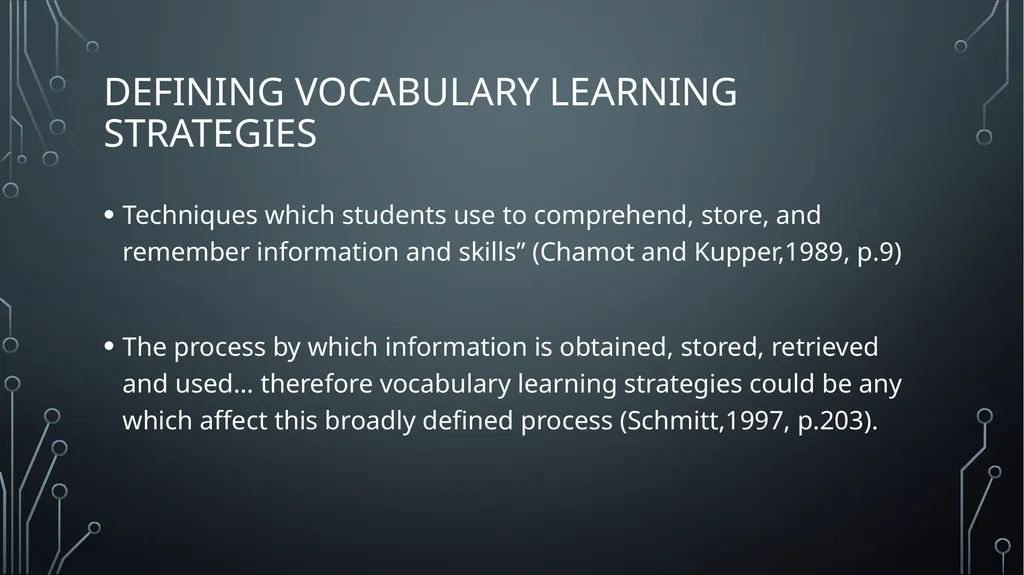
Defining vocabulary learning strategies Techniques which students use to comprehend, store, and remember information and skills” (Chamot and Kupper,1989, p.9)
The process by which information is obtained, stored, retrieved and used... therefore vocabulary learning strategies could be any which affect this broadly defined process (Schmitt,1997, p.203).<br>
04
Important Different strategies work for different people<br>
05
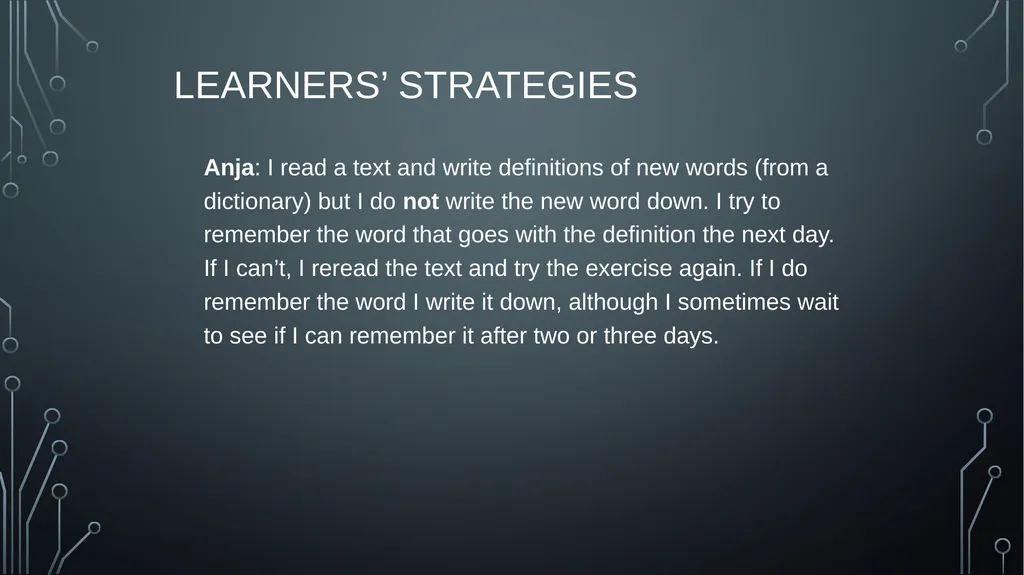
Learners’ strategies Anja: I read a text and write definitions of new words (from a dictionary) but I do not write the new word down. I try to remember the word that goes with the definition the next day. If I can’t, I reread the text and try the exercise again. If I do remember the word I write it down, although I sometimes wait to see if I can remember it after two or three days.<br>
06
Learners’ strategies David: I copy out the sentences from the text that have a new word in but in place of the new word I leave a gap. At university you have to read ______ journals (academic). Later I go back and try to fill in the gaps. Learners’ strategies<br>
07
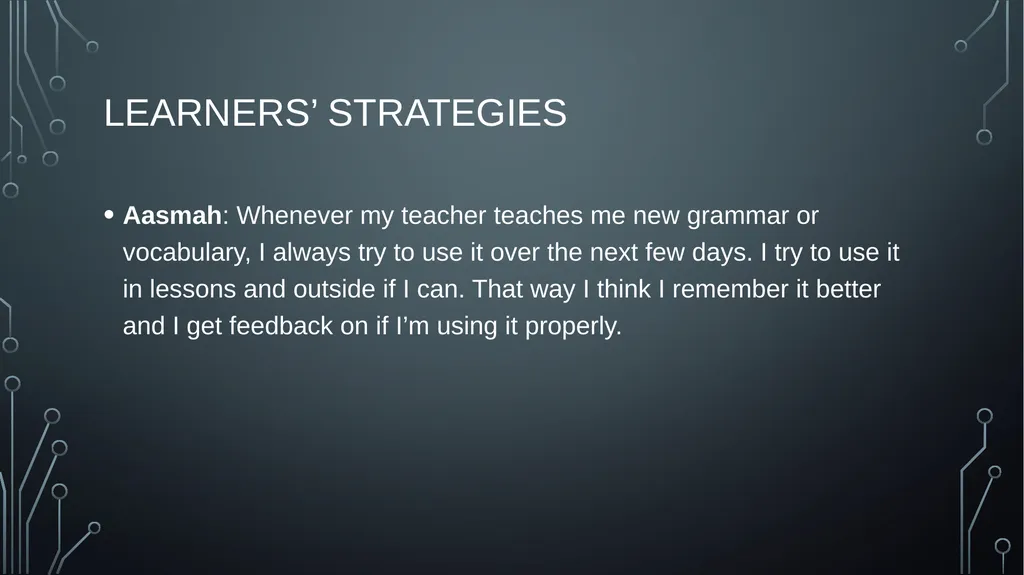
Learners’ strategies Aasmah: Whenever my teacher teaches me new grammar or vocabulary, I always try to use it over the next few days. I try to use it in lessons and outside if I can. That way I think I remember it better and I get feedback on if I’m using it properly.<br>
08
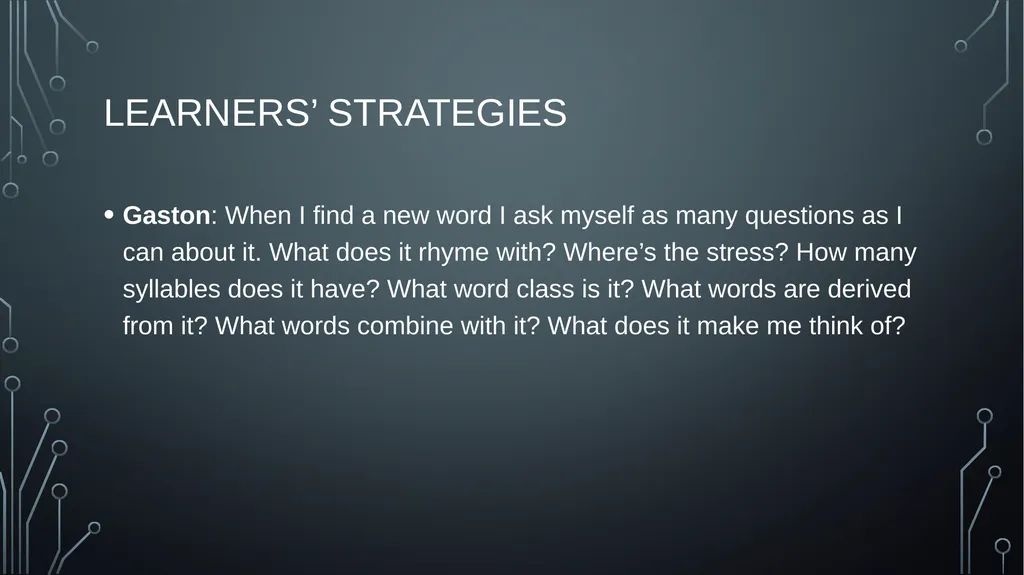
Learners’ strategies Gaston: When I find a new word I ask myself as many questions as I can about it. What does it rhyme with? Where’s the stress? How many syllables does it have? What word class is it? What words are derived from it? What words combine with it? What does it make me think of?<br>
09
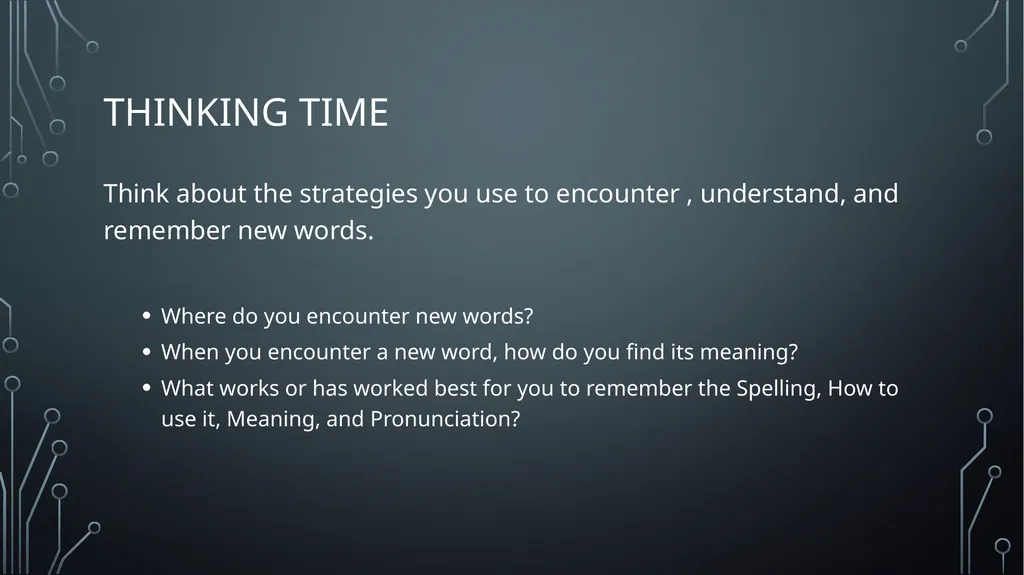
Thinking time Think about the strategies you use to encounter , understand, and remember new words.
Where do you encounter new words?
When you encounter a new word, how do you find its meaning?
What works or has worked best for you to remember the Spelling, How to use it, Meaning, and Pronunciation?<br>
10
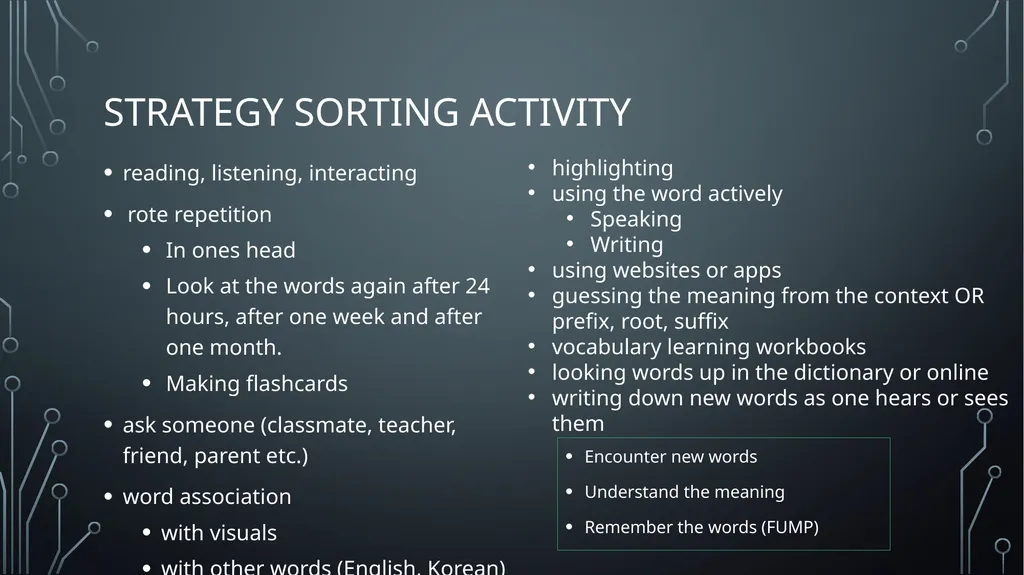
Strategy sorting activity reading, listening, interacting
rote repetition
In ones head
Look at the words again after 24 hours, after one week and after one month.
Making flashcards
ask someone (classmate, teacher, friend, parent etc.)
word association
with visuals
with other words (English, Korean) highlighting
using the word actively
Speaking
Writing
using websites or apps
guessing the meaning from the context OR prefix, root, suffix
vocabulary learning workbooks
looking words up in the dictionary or online
writing down new words as one hears or sees them Encounter new words
Understand the meaning
Remember the words (FUMP)<br>
11
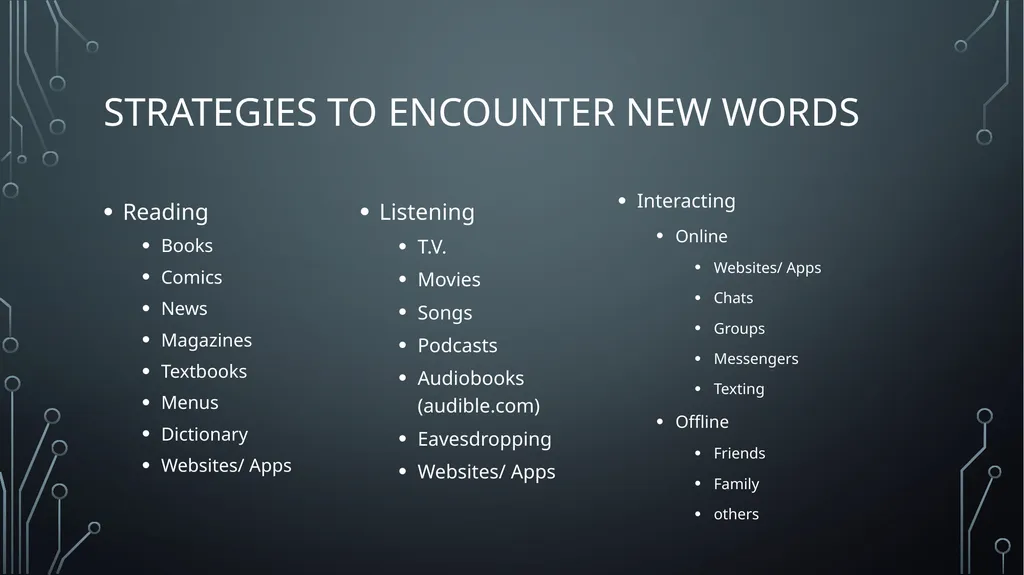
Strategies to encounter new words Reading
Books
Comics
News
Magazines
Textbooks
Menus
Dictionary
Websites/ Apps Listening
T.V.
Movies
Songs
Podcasts
Audiobooks (audible.com)
Eavesdropping
Websites/ Apps Interacting
Online
Websites/ Apps
Chats
Groups
Messengers
Texting
Offline
Friends
Family
others<br>
12
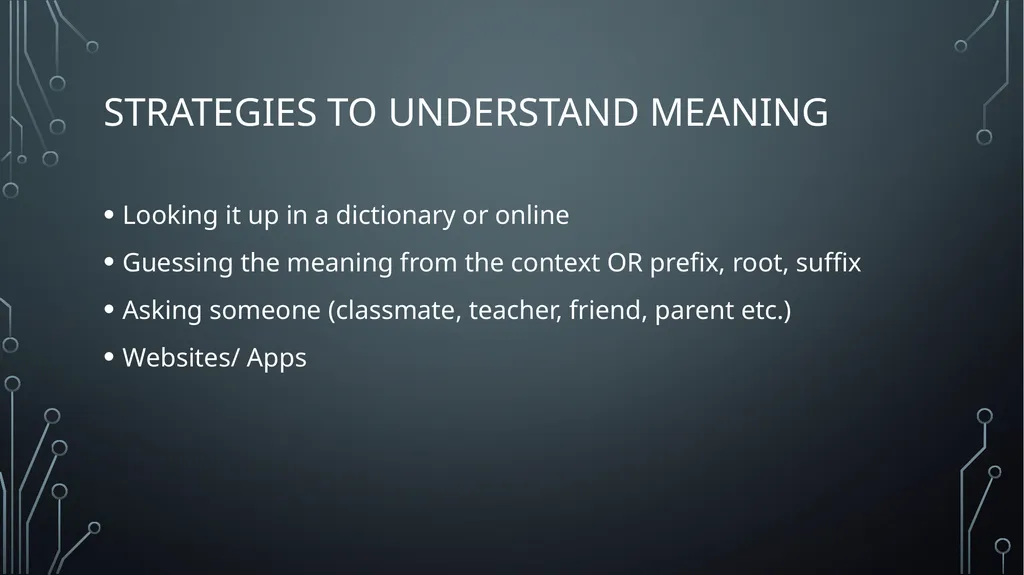
Strategies to understand meaning Looking it up in a dictionary or online
Guessing the meaning from the context OR prefix, root, suffix
Asking someone (classmate, teacher, friend, parent etc.)
Websites/ Apps<br>
13
Remember the words (FUMP) rote repetition
In ones head
Look at the words again after 24 hours, after one week and after one month.
Making flashcards
word association
with visuals
with other words (English, Korean)
using the word actively
Speaking
Writing
using websites or apps<br>
14
What about highlighting? Not purposeful unless additional steps are taken to understand the meaning and remember it.<br>
15
Useful apps and websites Word associations
Lexipedia
Word it out
Memrise
Anki
Word to Word
Magoosh
Vocabulary.com
Freerice.com<br>
17
Why are concordances useful Good for checking word usage and contexts of word usage.
Good to check what words often surround the word.
Good reference to check if students answers on a test are acceptable or not.<br>
19
Teaching vocabulary learning strategies<br>
20
Remember Different strategies work for different people.
Help learners develop what works best for them by introducing them to different strategies (directly or indirectly).
Give them a lot of exposure and practice with different strategies through different classroom activities and tasks.
Many of the strategies for finding meaning and remembering can be turned into learner centered classroom activities, or given as out of class tasks or assignments.<br>
21
21 According to Mike Graves (2006), for younger learners, strategies can be taught casually and informally in the context of reading.
In middle school it is possible to introduce strategies through more formal instruction.
In an ideal world, initial instruction would be largely concluded by high-school.
However, if older students have not had quality instruction in word-learning strategies, they are likely to profit from instruction in at least some elements. Teaching VLS<br>
22
22 Do not teach too many strategies at once. Give them enough time to practice with one or two before introducing another.
Key point: teach one or two strategies well rather than more strategies less well.
Explain but also demonstrate/ show students how to use the strategy you are presenting Teaching VLS Guidelines<br>
23
references Chamot, A.U., & Kupper. L. (1989): Learning strategies in foreign language instruction. Foreign Language Annals, 22, 13-24.
Oxford, R. (1990). Language Learning Strategies. Boston: Heinle & Heinle Publishers
Schmitt, N. (1997). Vocabulary Learning Strategies. In Schmitt, N., and McCarthy, M. Vocabulary: Description, Acquisition and Pedagogy. Cambridge: Cambridge University Press.
Watkins, P. (2014). Learning to Teach English (2nd ed.). Peaslake: Delta Publishing.<br>