Volunteer work statistics Measurement toolsmethods Vladimir Ganta Date: Thursday 04 March 2020 Advancing social justice, promoting decent work 1 What is volunteer work? 19th International Conference of Labour Statisticians (ICLS),
"Volunteer work statistics Measurement" is the property of its rightful owner. Permission is granted to
download and print the materials on this website for personal, non-commercial use only, and to display it
on your personal computer provided you do not modify the materials and that you retain all copyright
notices contained in the materials. By downloading content from our website, you accept the terms of this
agreement.
Presentation Transcript
01
Volunteer work statistics Measurement tools&methods
Vladimir Ganta Date: Thursday / 04 / March / 2020 Advancing social justice, promoting decent work 1<br>
02
What is volunteer work? 19th International Conference of Labour Statisticians (ICLS), Geneva, 2013
Production of goods or provision of services
No remuneration for work done or time worked
Still, volunteers may receive small gifts or support (in-kind or cash) to enable their participation in activities
Non-compulsory, voluntary participation
To help organizations, communities, persons outside own family or the environment
Excluded from volunteer work are
Corporate/company volunteering during paid time
Volunteering “required” by education/training programmes
Unpaid work ordered by authorities, following court decisions or legal requirements
Civic participation activities (e.g. voting, protesting, boycotting) Date: Monday / 01 / October / 2019 Advancing social justice, promoting decent work 2<br>
03
Who are the volunteers? 19th International Conference of Labour Statisticians (ICLS), Geneva, 2013
All persons who perform volunteer work for at least one hour during a period of four weeks or a month
Volunteers can provide help:
Through all sorts of registered or unregistered organizations, including communities (organization-based volunteer work)
Independently (direct volunteer work) Date: Monday / 01 / October / 2019 Advancing social justice, promoting decent work 3<br>
04
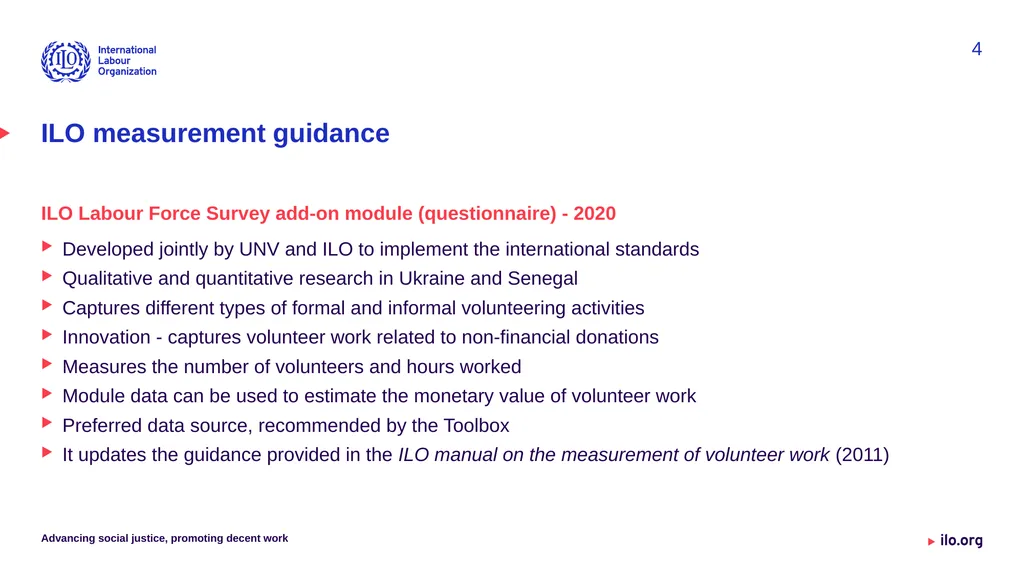
ILO measurement guidance ILO Labour Force Survey add-on module (questionnaire) - 2020
Developed jointly by UNV and ILO to implement the international standards
Qualitative and quantitative research in Ukraine and Senegal
Captures different types of formal and informal volunteering activities
Innovation - captures volunteer work related to non-financial donations
Measures the number of volunteers and hours worked
Module data can be used to estimate the monetary value of volunteer work
Preferred data source, recommended by the Toolbox
It updates the guidance provided in the ILO manual on the measurement of volunteer work (2011) Date: Monday / 01 / October / 2019 Advancing social justice, promoting decent work 4<br>
05
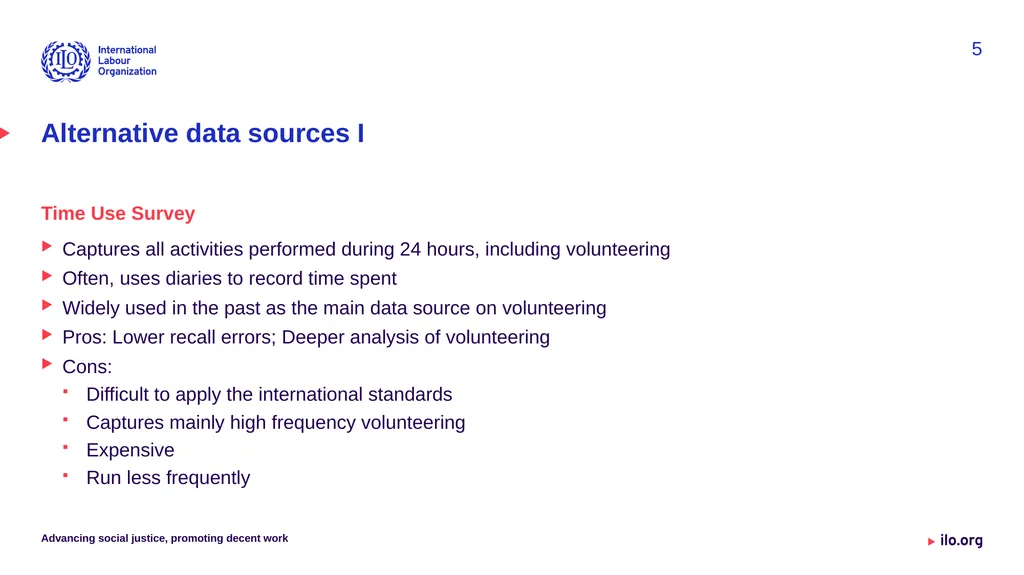
Alternative data sources I Time Use Survey
Captures all activities performed during 24 hours, including volunteering
Often, uses diaries to record time spent
Widely used in the past as the main data source on volunteering
Pros: Lower recall errors; Deeper analysis of volunteering
Cons:
Difficult to apply the international standards
Captures mainly high frequency volunteering
Expensive
Run less frequently Date: Monday / 01 / October / 2019 Advancing social justice, promoting decent work 5<br>
06
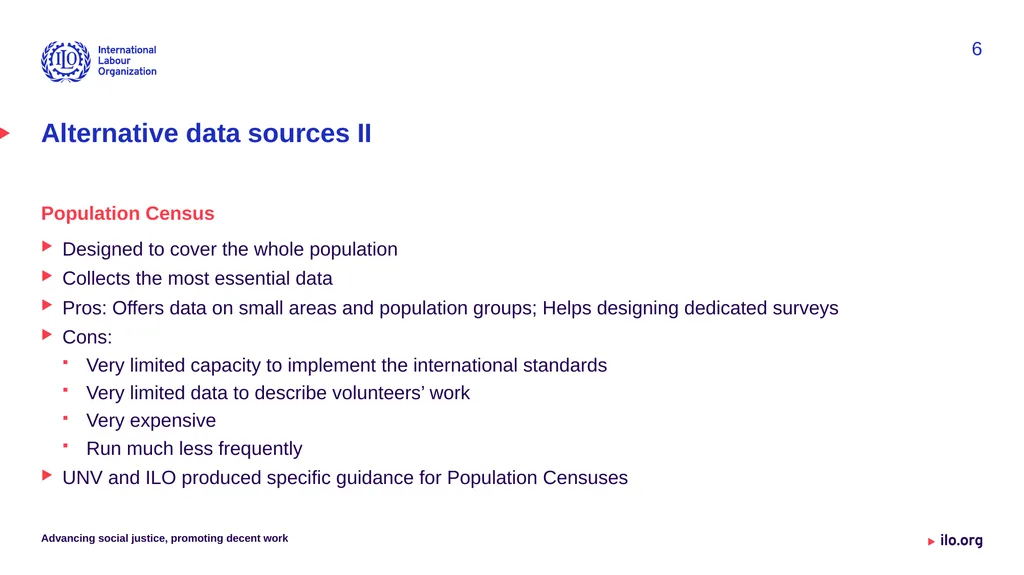
Alternative data sources II Population Census
Designed to cover the whole population
Collects the most essential data
Pros: Offers data on small areas and population groups; Helps designing dedicated surveys
Cons:
Very limited capacity to implement the international standards
Very limited data to describe volunteers’ work
Very expensive
Run much less frequently
UNV and ILO produced specific guidance for Population Censuses Date: Monday / 01 / October / 2019 Advancing social justice, promoting decent work 6<br>
07
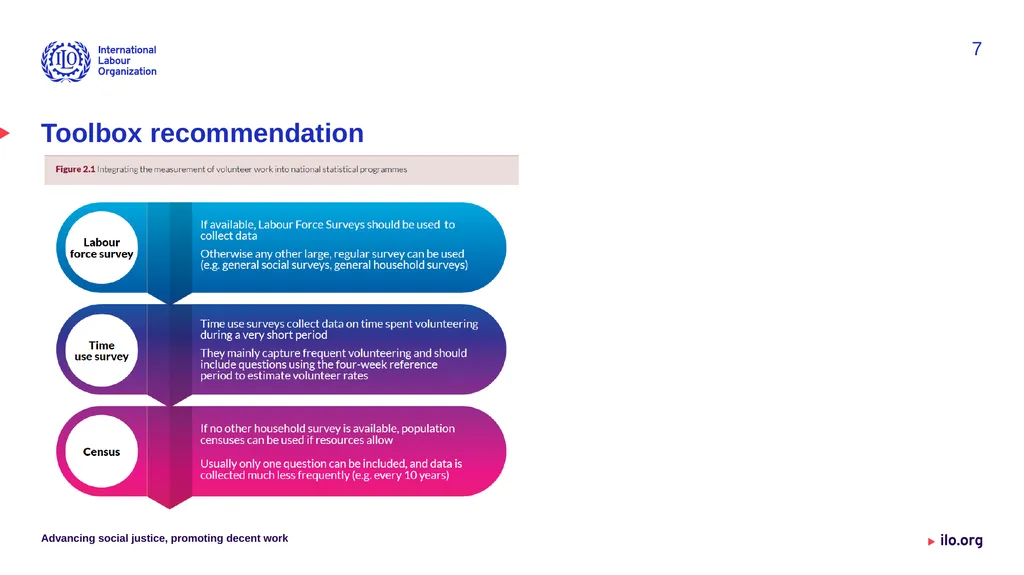
Toolbox recommendation Date: Monday / 01 / October / 2019 Advancing social justice, promoting decent work 7<br>
08
UNV global estimates 2018 State of the World's Volunteerism Report
More than 1 billion volunteers around the world dedicate their time and effort to help others.
Globally, women take on the majority of volunteer work, 57%, and an even bigger share of informal volunteering, 59%, often as an extension of unpaid care roles. Most of volunteer work (70%) is performed informally.
These estimates are influenced by available data sources
For many countries TUSs are the only data source
Participation in informal volunteering tends to be underestimated
Volunteering related to non-financial donation was not measured explicitly previously Date: Monday / 01 / October / 2019 Advancing social justice, promoting decent work 8<br>
09
Why producing volunteer work statistics? Economy
Estimate the volume and value of work people willingly donate to produce goods and provide services (usually to support those left behind)
Society
Identify ways to use volunteering as an accelerator to build more inclusive and resilient societies
Wellbeing
Develop models to use the potential of volunteering to increase the wellbeing of those who receive help and those who provide it Date: Monday / 01 / October / 2019 Advancing social justice, promoting decent work 9<br>
10
Higher volunteer rates are associated with more trust Date: Monday / 01 / October / 2019 Advancing social justice, promoting decent work 10<br>