
VvM Competition Law in an Algorithmic Age – One
KB
Published · 26 slides · 0 views

1 / 1


Description
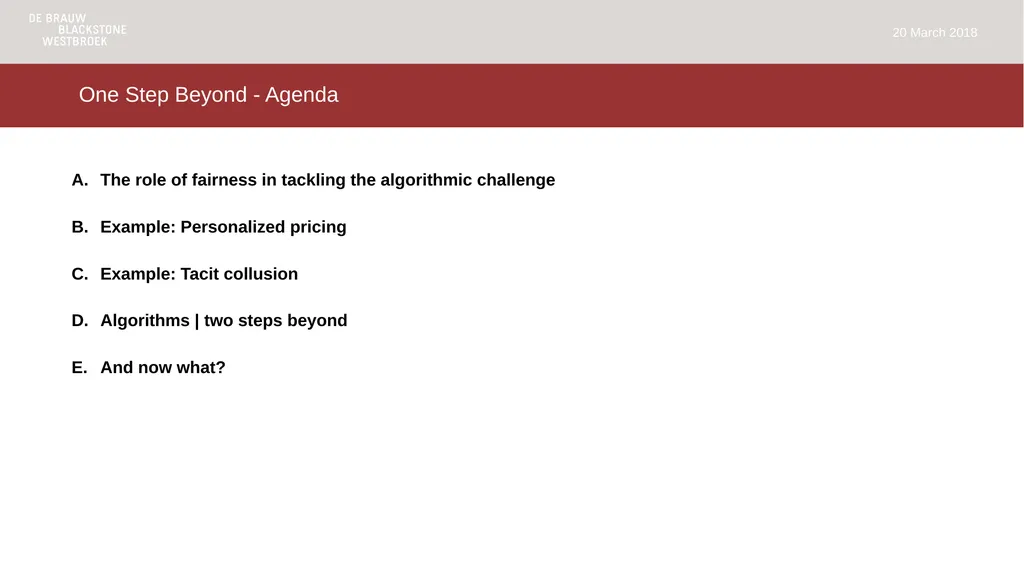
VvM Competition Law in an Algorithmic Age One Step Beyond 20 March 2018 Martijn Snoep One Step Beyond - Agenda The role of fairness in tackling the algorithmic challenge Example: Personalized pricing Example: Tacit collusion Algorithms
Related Topics
Share
Embed code
Download this presentation From Below
"VvM Competition Law in an Algorithmic Age – One" is the property of its rightful owner. Permission is granted to download and print the materials on this website for personal, non-commercial use only, and to display it on your personal computer provided you do not modify the materials and that you retain all copyright notices contained in the materials. By downloading content from our website, you accept the terms of this agreement.
Presentation Transcript
01
VvM Competition Law in an Algorithmic Age – One Step Beyond 20 March 2018 Martijn Snoep<br>
02
One Step Beyond - Agenda The role of fairness in tackling the algorithmic challenge
Example: Personalized pricing
Example: Tacit collusion
Algorithms | two steps beyond
And now what? 20 March 2018<br>
Example: Personalized pricing
Example: Tacit collusion
Algorithms | two steps beyond
And now what? 20 March 2018<br>
03
Fairness put on the political agenda 20 March 2018 Margrethe Vestager, EU Competition Commissioner 'Because when competition works, we end up with a market that treats people more fairly. One where their choices and preferences are counted.' 'So competition policy helps build a fair society (…) Because fair markets are just what competition is about…' 'They cannot be allowed to abuse their power by forcing others out of the market so that consumers have less choice.'<br>
04
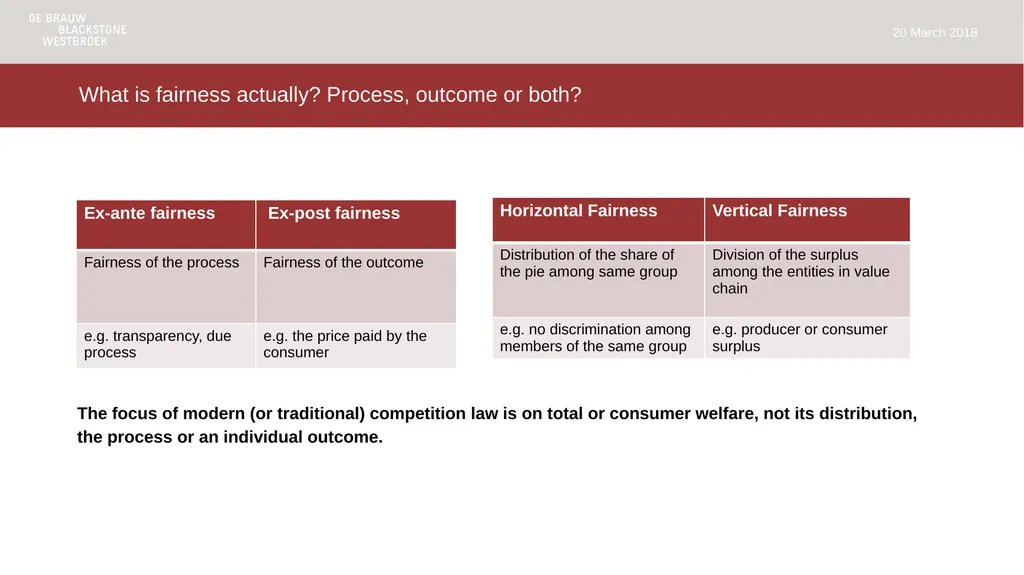
What is fairness actually? Process, outcome or both? The focus of modern (or traditional) competition law is on total or consumer welfare, not its distribution, the process or an individual outcome. 20 March 2018<br>
05
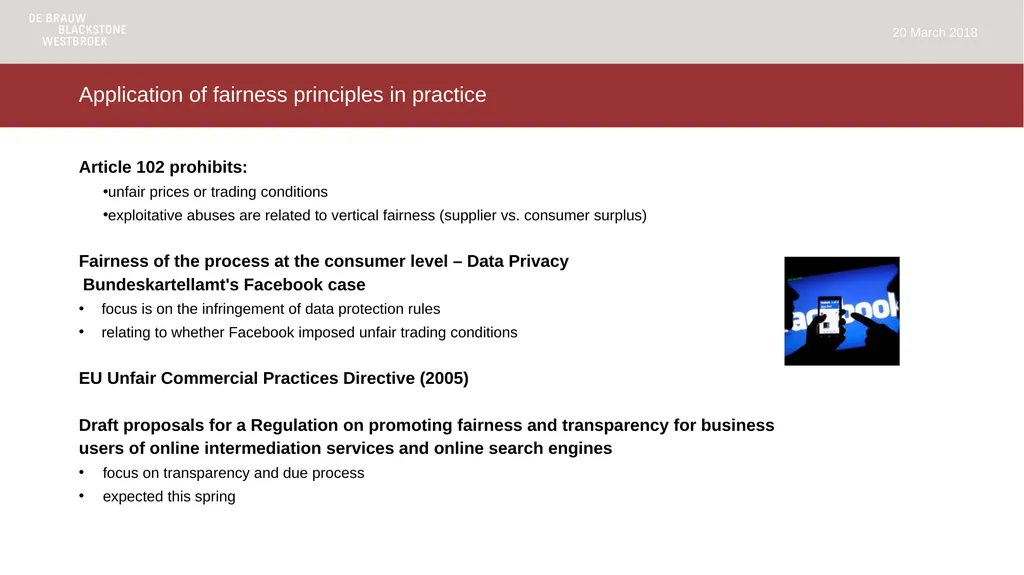
Application of fairness principles in practice Article 102 prohibits:
unfair prices or trading conditions
exploitative abuses are related to vertical fairness (supplier vs. consumer surplus)
Fairness of the process at the consumer level – Data Privacy
Bundeskartellamt's Facebook case
focus is on the infringement of data protection rules
relating to whether Facebook imposed unfair trading conditions
EU Unfair Commercial Practices Directive (2005)
Draft proposals for a Regulation on promoting fairness and transparency for business users of online intermediation services and online search engines
focus on transparency and due process
expected this spring 20 March 2018<br>
unfair prices or trading conditions
exploitative abuses are related to vertical fairness (supplier vs. consumer surplus)
Fairness of the process at the consumer level – Data Privacy
Bundeskartellamt's Facebook case
focus is on the infringement of data protection rules
relating to whether Facebook imposed unfair trading conditions
EU Unfair Commercial Practices Directive (2005)
Draft proposals for a Regulation on promoting fairness and transparency for business users of online intermediation services and online search engines
focus on transparency and due process
expected this spring 20 March 2018<br>
06
Prepare to vote Voting is anonymous Internet 1 2 TXT 1 2 This presentation has been loaded without the Sendsteps add-in.
Want to download the add-in for free? Go to https://dashboard.sendsteps.com/info.<br>
Want to download the add-in for free? Go to https://dashboard.sendsteps.com/info.<br>
07
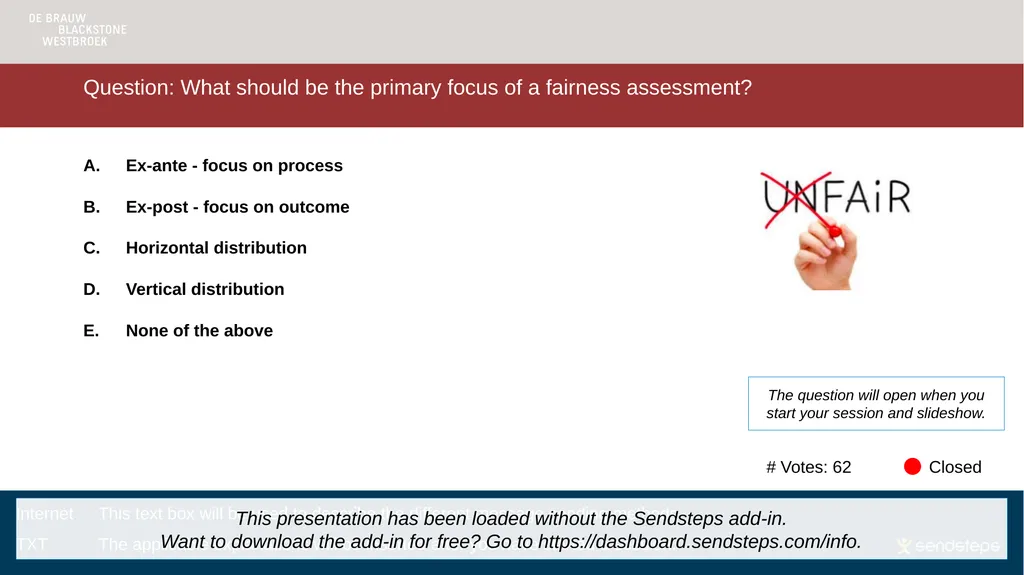
Question: What should be the primary focus of a fairness assessment? Ex-ante - focus on process
Ex-post - focus on outcome
Horizontal distribution
Vertical distribution
None of the above # Votes: 62 The question will open when you start your session and slideshow. This presentation has been loaded without the Sendsteps add-in.
Want to download the add-in for free? Go to https://dashboard.sendsteps.com/info.<br>
Ex-post - focus on outcome
Horizontal distribution
Vertical distribution
None of the above # Votes: 62 The question will open when you start your session and slideshow. This presentation has been loaded without the Sendsteps add-in.
Want to download the add-in for free? Go to https://dashboard.sendsteps.com/info.<br>
08
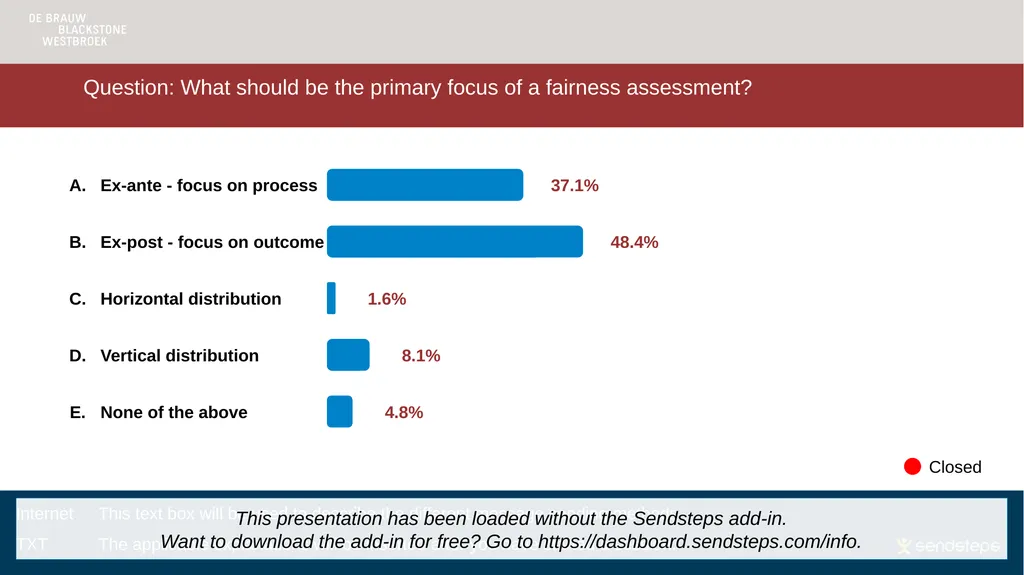
Question: What should be the primary focus of a fairness assessment? This presentation has been loaded without the Sendsteps add-in.
Want to download the add-in for free? Go to https://dashboard.sendsteps.com/info.<br>
Want to download the add-in for free? Go to https://dashboard.sendsteps.com/info.<br>
09
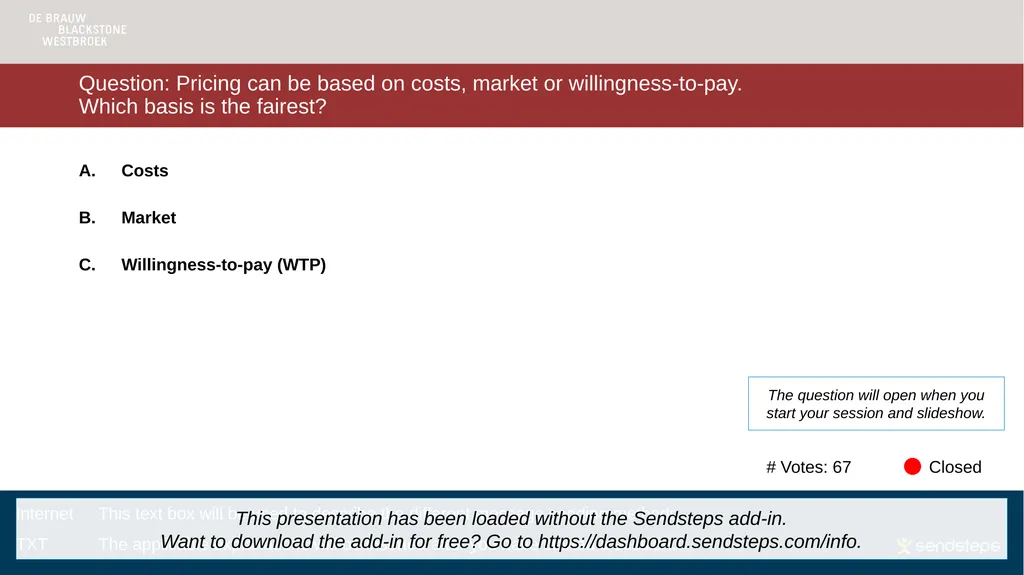
Question: Pricing can be based on costs, market or willingness-to-pay.
Which basis is the fairest? Costs
Market
Willingness-to-pay (WTP) # Votes: 67 The question will open when you start your session and slideshow. This presentation has been loaded without the Sendsteps add-in.
Want to download the add-in for free? Go to https://dashboard.sendsteps.com/info.<br>
Market
Willingness-to-pay (WTP) # Votes: 67 The question will open when you start your session and slideshow. This presentation has been loaded without the Sendsteps add-in.
Want to download the add-in for free? Go to https://dashboard.sendsteps.com/info.<br>
10
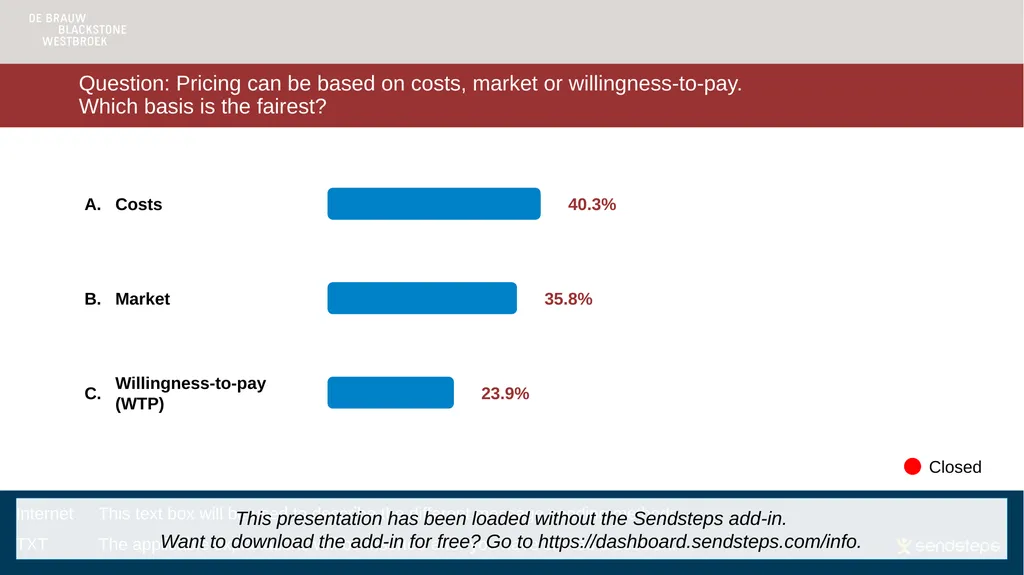
Question: Pricing can be based on costs, market or willingness-to-pay.
Which basis is the fairest? This presentation has been loaded without the Sendsteps add-in.
Want to download the add-in for free? Go to https://dashboard.sendsteps.com/info.<br>
Want to download the add-in for free? Go to https://dashboard.sendsteps.com/info.<br>
11
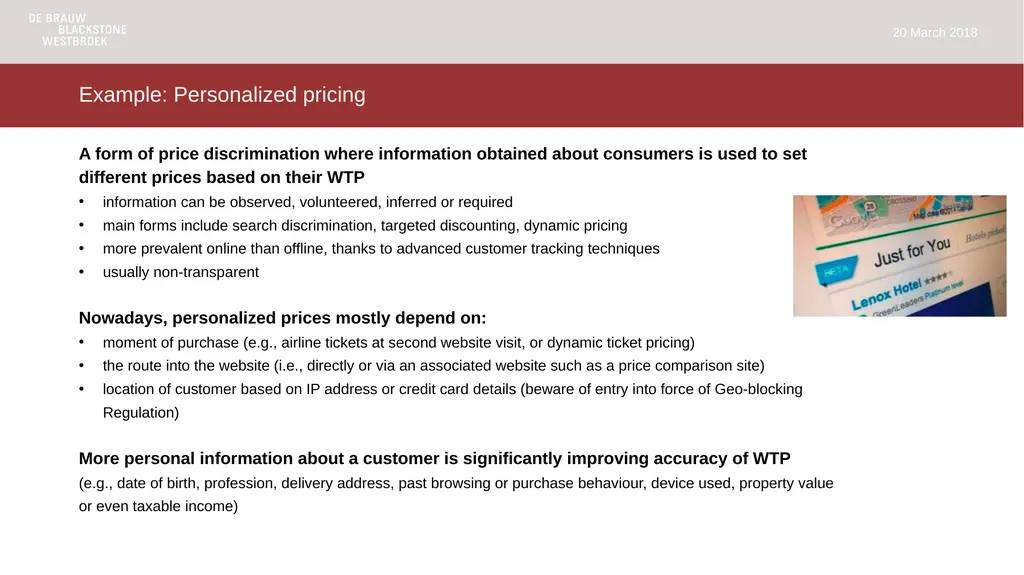
Example: Personalized pricing A form of price discrimination where information obtained about consumers is used to set different prices based on their WTP
information can be observed, volunteered, inferred or required
main forms include search discrimination, targeted discounting, dynamic pricing
more prevalent online than offline, thanks to advanced customer tracking techniques
usually non-transparent
Nowadays, personalized prices mostly depend on:
moment of purchase (e.g., airline tickets at second website visit, or dynamic ticket pricing)
the route into the website (i.e., directly or via an associated website such as a price comparison site)
location of customer based on IP address or credit card details (beware of entry into force of Geo-blocking Regulation)
More personal information about a customer is significantly improving accuracy of WTP
(e.g., date of birth, profession, delivery address, past browsing or purchase behaviour, device used, property value or even taxable income) 20 March 2018<br>
information can be observed, volunteered, inferred or required
main forms include search discrimination, targeted discounting, dynamic pricing
more prevalent online than offline, thanks to advanced customer tracking techniques
usually non-transparent
Nowadays, personalized prices mostly depend on:
moment of purchase (e.g., airline tickets at second website visit, or dynamic ticket pricing)
the route into the website (i.e., directly or via an associated website such as a price comparison site)
location of customer based on IP address or credit card details (beware of entry into force of Geo-blocking Regulation)
More personal information about a customer is significantly improving accuracy of WTP
(e.g., date of birth, profession, delivery address, past browsing or purchase behaviour, device used, property value or even taxable income) 20 March 2018<br>
12
Example: Personalized pricing You want to a have a new tie and are willing to pay up to €40.
Brick & Mortar age
Sellers do not know your WTP and cannot price discriminate If you manage to purchase one for €30, your consumer surplus is €10
Algorithmic age
Algorithms of sellers estimate your WTP is between €35-40. So, the cheapest one you will get is €35 Consumer welfare is diminished, your surplus is only €5
Is this fair? 20 March 2018<br>
Brick & Mortar age
Sellers do not know your WTP and cannot price discriminate If you manage to purchase one for €30, your consumer surplus is €10
Algorithmic age
Algorithms of sellers estimate your WTP is between €35-40. So, the cheapest one you will get is €35 Consumer welfare is diminished, your surplus is only €5
Is this fair? 20 March 2018<br>
13
Question: Is it fair if your friend who earns more than you do pays more than you
for exactly the same train ticket to Brussels? Yes
No
Not sure # Votes: 66 The question will open when you start your session and slideshow. This presentation has been loaded without the Sendsteps add-in.
Want to download the add-in for free? Go to https://dashboard.sendsteps.com/info.<br>
No
Not sure # Votes: 66 The question will open when you start your session and slideshow. This presentation has been loaded without the Sendsteps add-in.
Want to download the add-in for free? Go to https://dashboard.sendsteps.com/info.<br>
14
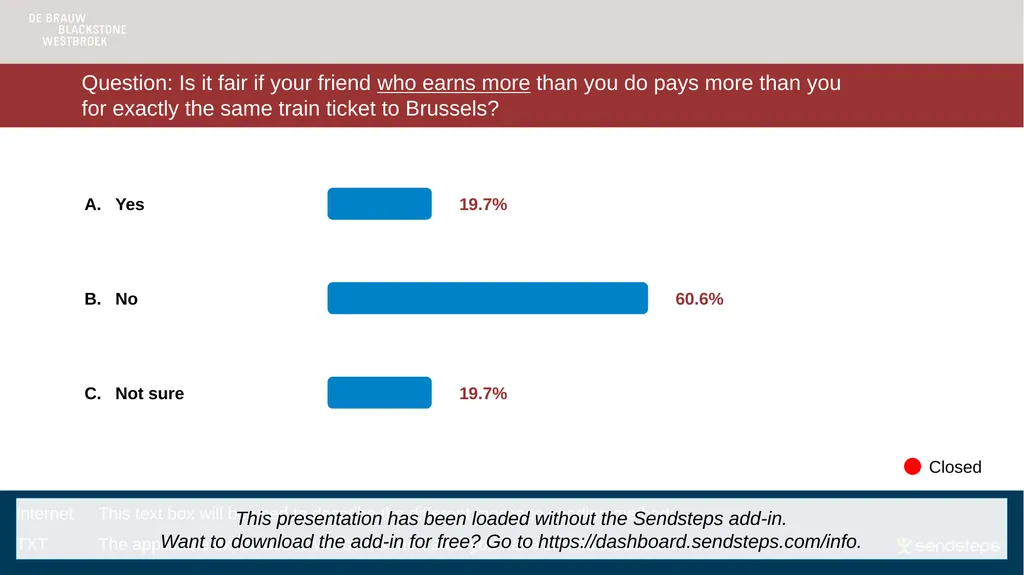
Question: Is it fair if your friend who earns more than you do pays more than you
for exactly the same train ticket to Brussels? This presentation has been loaded without the Sendsteps add-in.
Want to download the add-in for free? Go to https://dashboard.sendsteps.com/info.<br>
Want to download the add-in for free? Go to https://dashboard.sendsteps.com/info.<br>
15
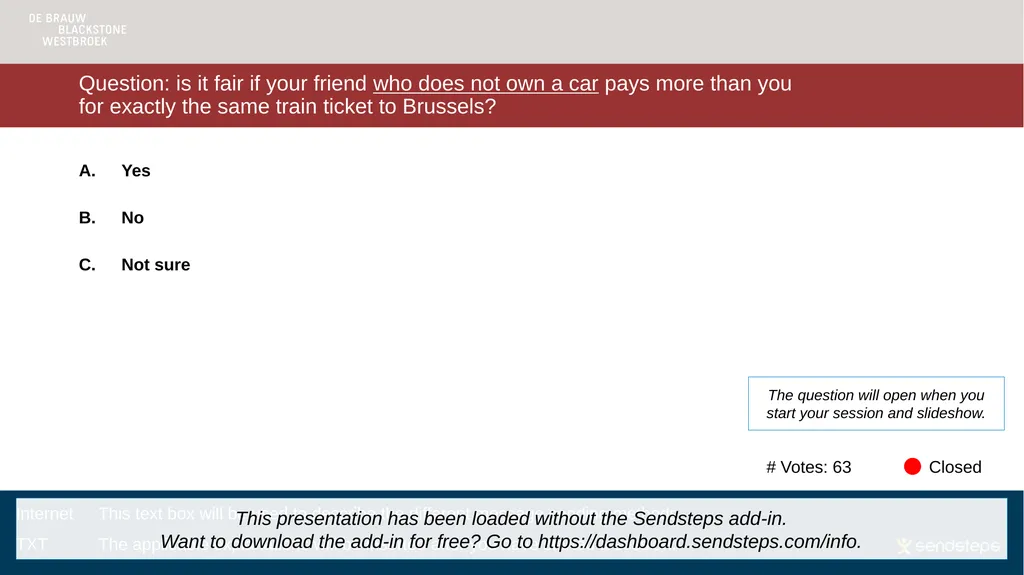
Question: is it fair if your friend who does not own a car pays more than you
for exactly the same train ticket to Brussels? Yes
No
Not sure # Votes: 63 The question will open when you start your session and slideshow. This presentation has been loaded without the Sendsteps add-in.
Want to download the add-in for free? Go to https://dashboard.sendsteps.com/info.<br>
No
Not sure # Votes: 63 The question will open when you start your session and slideshow. This presentation has been loaded without the Sendsteps add-in.
Want to download the add-in for free? Go to https://dashboard.sendsteps.com/info.<br>
16
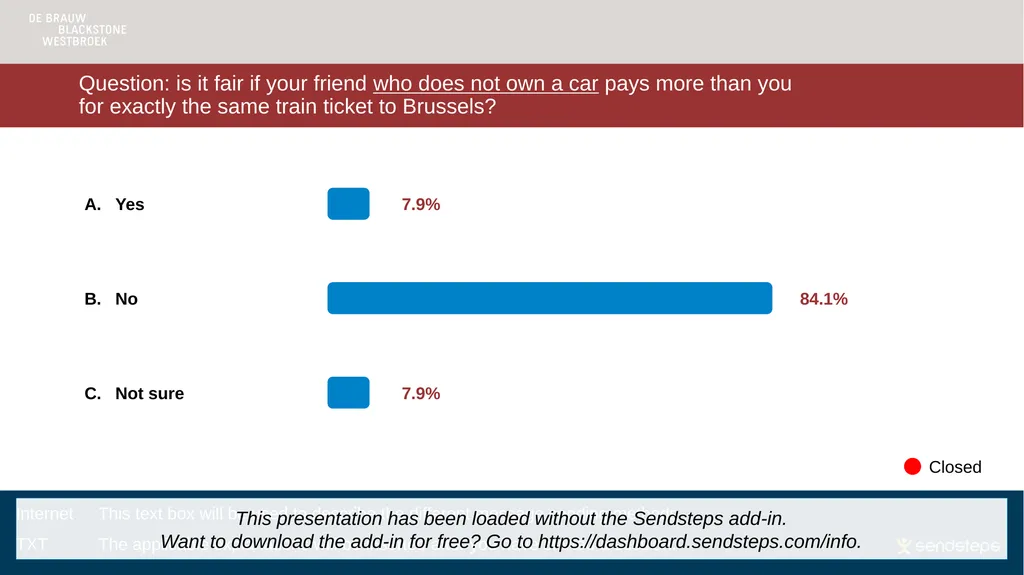
Question: is it fair if your friend who does not own a car pays more than you
for exactly the same train ticket to Brussels? This presentation has been loaded without the Sendsteps add-in.
Want to download the add-in for free? Go to https://dashboard.sendsteps.com/info.<br>
Want to download the add-in for free? Go to https://dashboard.sendsteps.com/info.<br>
17
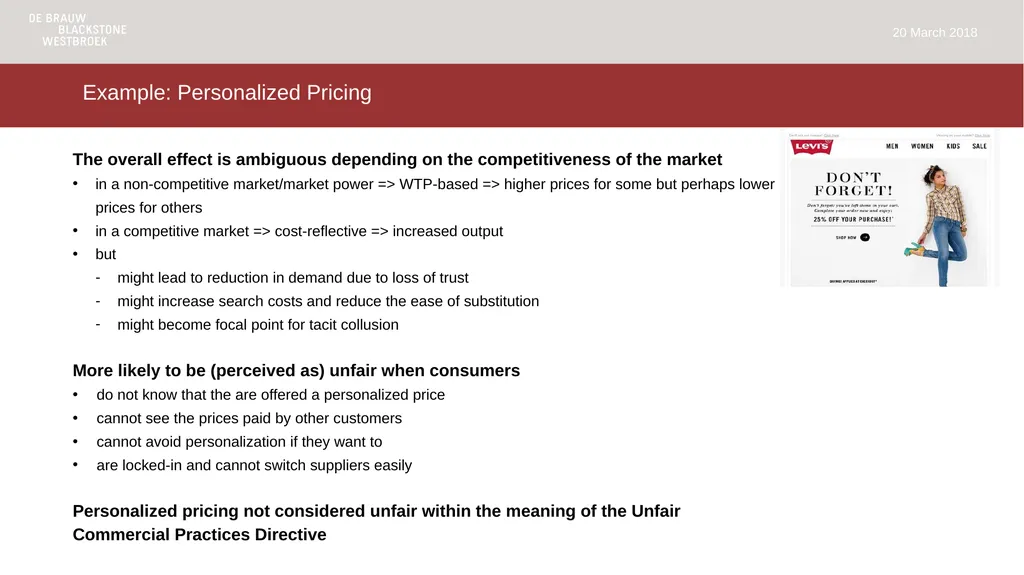
Example: Personalized Pricing The overall effect is ambiguous depending on the competitiveness of the market
in a non-competitive market/market power => WTP-based => higher prices for some but perhaps lower prices for others
in a competitive market => cost-reflective => increased output
but
might lead to reduction in demand due to loss of trust
might increase search costs and reduce the ease of substitution
might become focal point for tacit collusion
More likely to be (perceived as) unfair when consumers
do not know that the are offered a personalized price
cannot see the prices paid by other customers
cannot avoid personalization if they want to
are locked-in and cannot switch suppliers easily
Personalized pricing not considered unfair within the meaning of the Unfair Commercial Practices Directive 20 March 2018<br>
in a non-competitive market/market power => WTP-based => higher prices for some but perhaps lower prices for others
in a competitive market => cost-reflective => increased output
but
might lead to reduction in demand due to loss of trust
might increase search costs and reduce the ease of substitution
might become focal point for tacit collusion
More likely to be (perceived as) unfair when consumers
do not know that the are offered a personalized price
cannot see the prices paid by other customers
cannot avoid personalization if they want to
are locked-in and cannot switch suppliers easily
Personalized pricing not considered unfair within the meaning of the Unfair Commercial Practices Directive 20 March 2018<br>
18
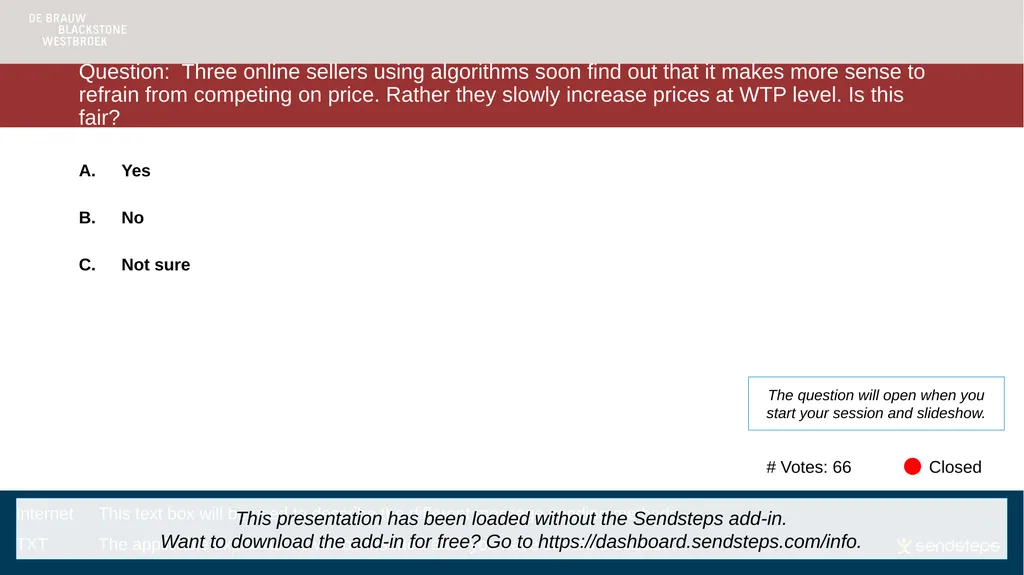
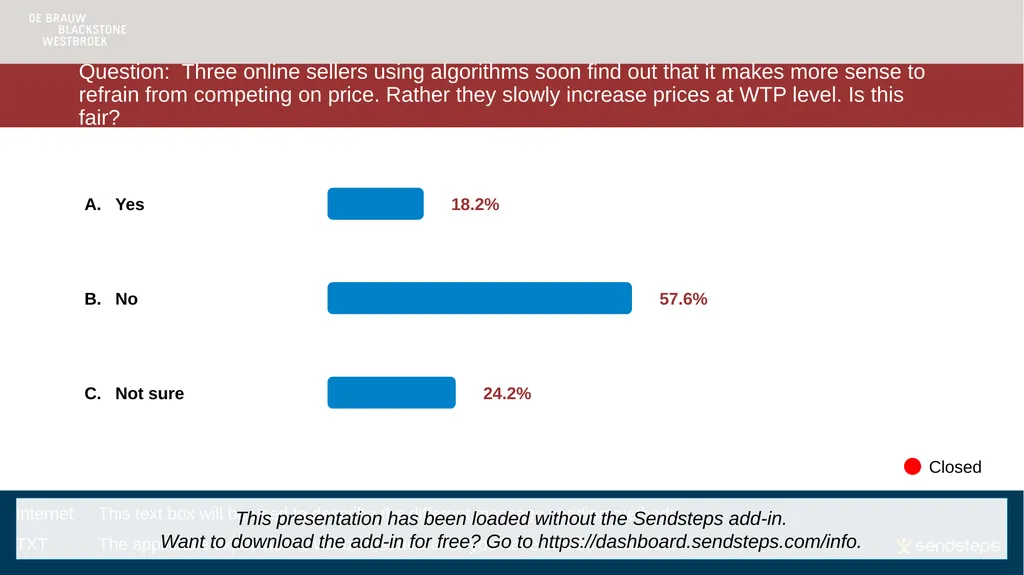
Question: Three online sellers using algorithms soon find out that it makes more sense to
refrain from competing on price. Rather they slowly increase prices at WTP level. Is this fair? Yes
No
Not sure # Votes: 66 The question will open when you start your session and slideshow. This presentation has been loaded without the Sendsteps add-in.
Want to download the add-in for free? Go to https://dashboard.sendsteps.com/info.<br>
No
Not sure # Votes: 66 The question will open when you start your session and slideshow. This presentation has been loaded without the Sendsteps add-in.
Want to download the add-in for free? Go to https://dashboard.sendsteps.com/info.<br>
19
Question: Three online sellers using algorithms soon find out that it makes more sense to
refrain from competing on price. Rather they slowly increase prices at WTP level. Is this fair? This presentation has been loaded without the Sendsteps add-in.
Want to download the add-in for free? Go to https://dashboard.sendsteps.com/info.<br>
Want to download the add-in for free? Go to https://dashboard.sendsteps.com/info.<br>
20
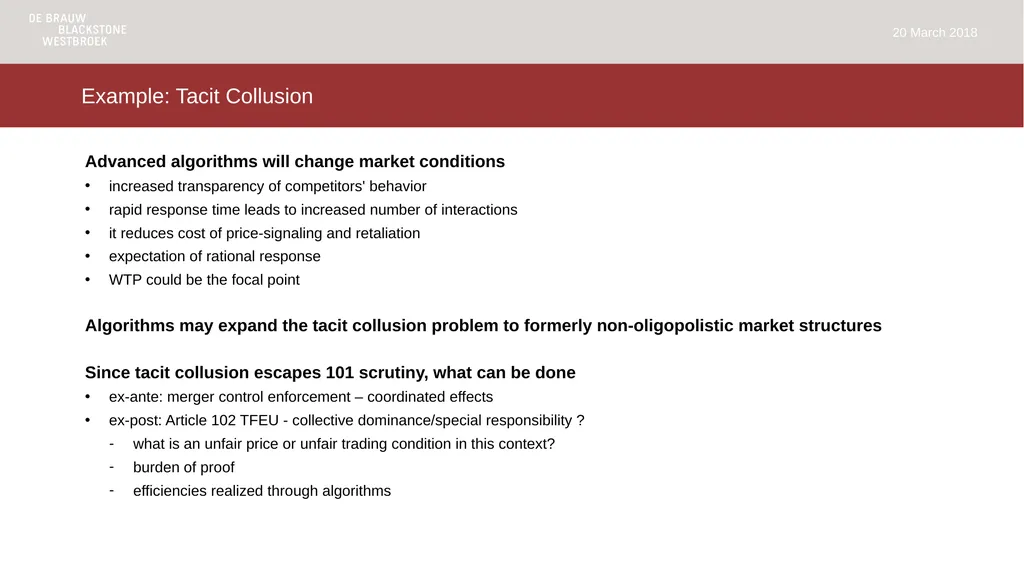
Example: Tacit Collusion Advanced algorithms will change market conditions
increased transparency of competitors' behavior
rapid response time leads to increased number of interactions
it reduces cost of price-signaling and retaliation
expectation of rational response
WTP could be the focal point
Algorithms may expand the tacit collusion problem to formerly non-oligopolistic market structures
Since tacit collusion escapes 101 scrutiny, what can be done
ex-ante: merger control enforcement – coordinated effects
ex-post: Article 102 TFEU - collective dominance/special responsibility ?
what is an unfair price or unfair trading condition in this context?
burden of proof
efficiencies realized through algorithms 20 March 2018<br>
increased transparency of competitors' behavior
rapid response time leads to increased number of interactions
it reduces cost of price-signaling and retaliation
expectation of rational response
WTP could be the focal point
Algorithms may expand the tacit collusion problem to formerly non-oligopolistic market structures
Since tacit collusion escapes 101 scrutiny, what can be done
ex-ante: merger control enforcement – coordinated effects
ex-post: Article 102 TFEU - collective dominance/special responsibility ?
what is an unfair price or unfair trading condition in this context?
burden of proof
efficiencies realized through algorithms 20 March 2018<br>
21
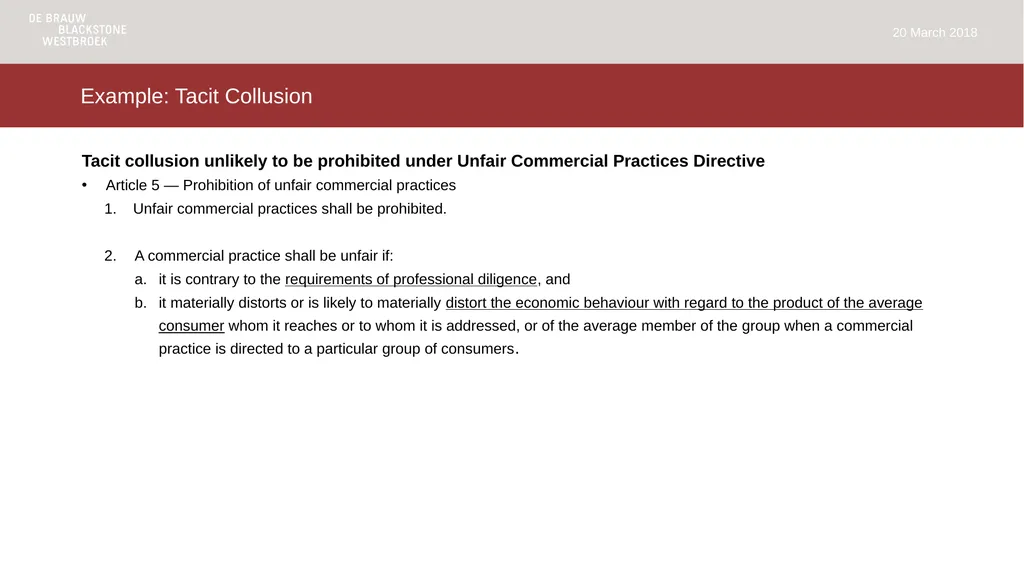
Example: Tacit Collusion Tacit collusion unlikely to be prohibited under Unfair Commercial Practices Directive
Article 5 — Prohibition of unfair commercial practices
Unfair commercial practices shall be prohibited.
2. A commercial practice shall be unfair if:
it is contrary to the requirements of professional diligence, and
it materially distorts or is likely to materially distort the economic behaviour with regard to the product of the average consumer whom it reaches or to whom it is addressed, or of the average member of the group when a commercial practice is directed to a particular group of consumers. 20 March 2018<br>
Article 5 — Prohibition of unfair commercial practices
Unfair commercial practices shall be prohibited.
2. A commercial practice shall be unfair if:
it is contrary to the requirements of professional diligence, and
it materially distorts or is likely to materially distort the economic behaviour with regard to the product of the average consumer whom it reaches or to whom it is addressed, or of the average member of the group when a commercial practice is directed to a particular group of consumers. 20 March 2018<br>
22
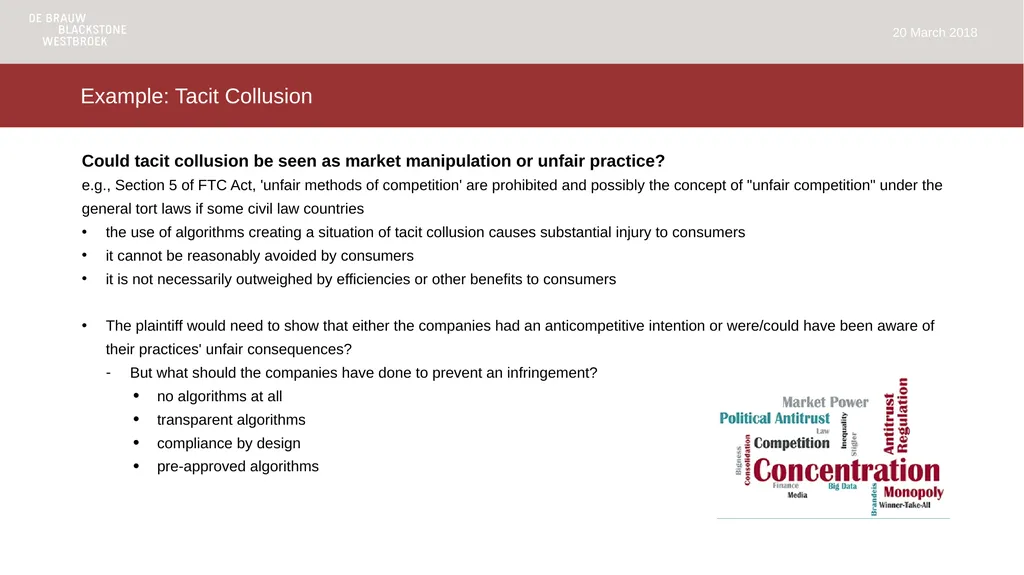
Example: Tacit Collusion Could tacit collusion be seen as market manipulation or unfair practice?
e.g., Section 5 of FTC Act, 'unfair methods of competition' are prohibited and possibly the concept of "unfair competition" under the general tort laws if some civil law countries
the use of algorithms creating a situation of tacit collusion causes substantial injury to consumers
it cannot be reasonably avoided by consumers
it is not necessarily outweighed by efficiencies or other benefits to consumers
The plaintiff would need to show that either the companies had an anticompetitive intention or were/could have been aware of their practices' unfair consequences?
But what should the companies have done to prevent an infringement?
no algorithms at all
transparent algorithms
compliance by design
pre-approved algorithms 20 March 2018<br>
e.g., Section 5 of FTC Act, 'unfair methods of competition' are prohibited and possibly the concept of "unfair competition" under the general tort laws if some civil law countries
the use of algorithms creating a situation of tacit collusion causes substantial injury to consumers
it cannot be reasonably avoided by consumers
it is not necessarily outweighed by efficiencies or other benefits to consumers
The plaintiff would need to show that either the companies had an anticompetitive intention or were/could have been aware of their practices' unfair consequences?
But what should the companies have done to prevent an infringement?
no algorithms at all
transparent algorithms
compliance by design
pre-approved algorithms 20 March 2018<br>
23
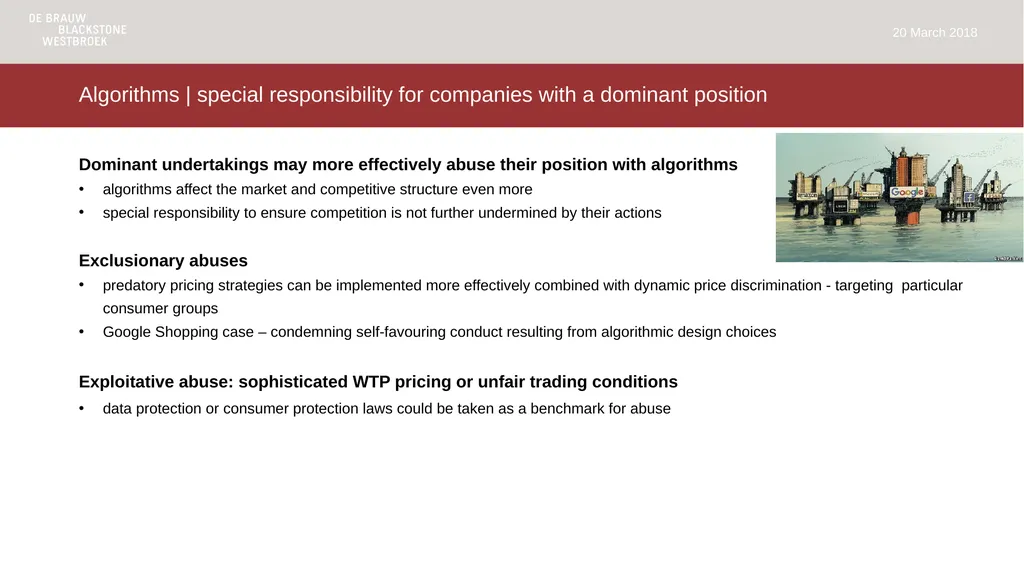
Algorithms | special responsibility for companies with a dominant position 20 March 2018 Dominant undertakings may more effectively abuse their position with algorithms
algorithms affect the market and competitive structure even more
special responsibility to ensure competition is not further undermined by their actions
Exclusionary abuses
predatory pricing strategies can be implemented more effectively combined with dynamic price discrimination - targeting particular consumer groups
Google Shopping case – condemning self-favouring conduct resulting from algorithmic design choices
Exploitative abuse: sophisticated WTP pricing or unfair trading conditions
data protection or consumer protection laws could be taken as a benchmark for abuse<br>
algorithms affect the market and competitive structure even more
special responsibility to ensure competition is not further undermined by their actions
Exclusionary abuses
predatory pricing strategies can be implemented more effectively combined with dynamic price discrimination - targeting particular consumer groups
Google Shopping case – condemning self-favouring conduct resulting from algorithmic design choices
Exploitative abuse: sophisticated WTP pricing or unfair trading conditions
data protection or consumer protection laws could be taken as a benchmark for abuse<br>
24
Algorithms | two steps beyond 'Hybrid scenario': Price discrimination & tacit collusion occur simultaneously
tacitly colluding for low value and & loyal customers while exploiting high-value customers
harms every group as sellers can profit at each level
'Truman show': Creating a façade of competition while profiting from information asymmetry and degradation of quality, like privacy protection
Algorithms modelled to achieve certain target will eventually self-learn even if their actions are limited to avoid certain anti-competitive outcomes
will identify the winning strategy of its own to max. profits
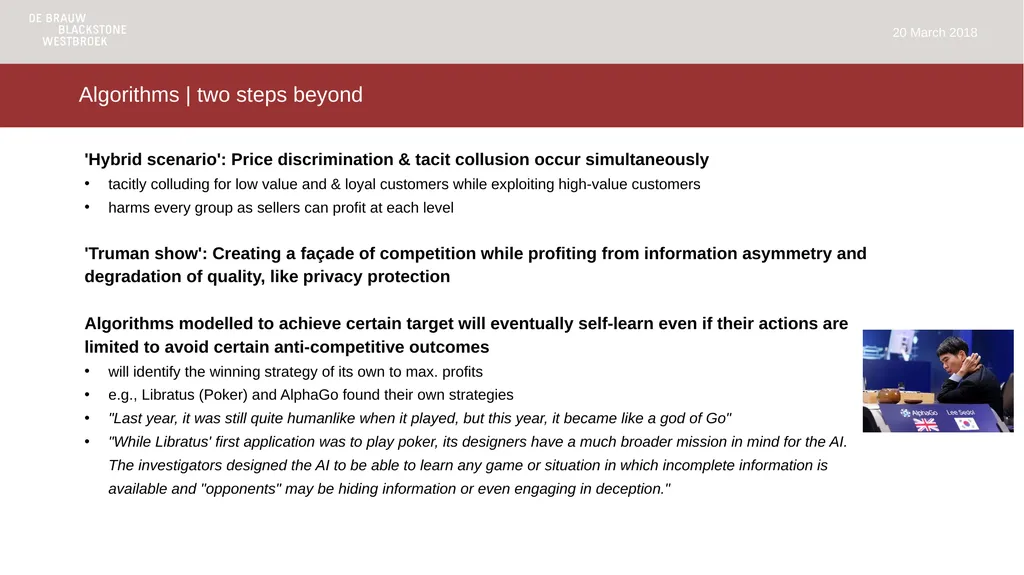
e.g., Libratus (Poker) and AlphaGo found their own strategies
"Last year, it was still quite humanlike when it played, but this year, it became like a god of Go"
"While Libratus' first application was to play poker, its designers have a much broader mission in mind for the AI. The investigators designed the AI to be able to learn any game or situation in which incomplete information is available and "opponents" may be hiding information or even engaging in deception." 20 March 2018<br>
tacitly colluding for low value and & loyal customers while exploiting high-value customers
harms every group as sellers can profit at each level
'Truman show': Creating a façade of competition while profiting from information asymmetry and degradation of quality, like privacy protection
Algorithms modelled to achieve certain target will eventually self-learn even if their actions are limited to avoid certain anti-competitive outcomes
will identify the winning strategy of its own to max. profits
e.g., Libratus (Poker) and AlphaGo found their own strategies
"Last year, it was still quite humanlike when it played, but this year, it became like a god of Go"
"While Libratus' first application was to play poker, its designers have a much broader mission in mind for the AI. The investigators designed the AI to be able to learn any game or situation in which incomplete information is available and "opponents" may be hiding information or even engaging in deception." 20 March 2018<br>
25
And now what? Joint effort by policy makers, academia and practitioners to come up with theories of harm and preventive measures
fresh look at unfair competition, collective dominance and coordinated effects concepts
more theory and guidelines on fairness
more empirical analysis of personalized pricing and tacit collusion to improve predictive models and counterfactuals
more recognition of the interplay between competition law, sector regulation and consumer law protection
Competition authorities to attract data specialists, appoint chief data scientist and establish specialist units
compare with economic revolution in competition law of the late 90's and 00's
EU Commission will establish an expert group drawing up a proposal for guidelines on ethics around technology including AI ethics
relevant topics should fairness, transparency, consumer's own responsibility, compliance-by-design standards and control over self-learning algorithms 20 March 2018<br>
fresh look at unfair competition, collective dominance and coordinated effects concepts
more theory and guidelines on fairness
more empirical analysis of personalized pricing and tacit collusion to improve predictive models and counterfactuals
more recognition of the interplay between competition law, sector regulation and consumer law protection
Competition authorities to attract data specialists, appoint chief data scientist and establish specialist units
compare with economic revolution in competition law of the late 90's and 00's
EU Commission will establish an expert group drawing up a proposal for guidelines on ethics around technology including AI ethics
relevant topics should fairness, transparency, consumer's own responsibility, compliance-by-design standards and control over self-learning algorithms 20 March 2018<br>
26
Sources OECD (2017), Algorithms and Collusion: Competition Policy in the Digital Age
Algorithmic Collusion: Problems and Counter-Measures - OECD Note by A. Ezrachi & M. E. Stucke
Oxera (2017), When algorithms set prices: winners and losers
OFT (2016) Personalised Pricing
Joint Report by Autorité de la concurrence & Bundeskartellamt (2016) Competition Law and Data
Autoritat Catalana de la Competencia (2016), La Economía de Los Datos 20 March 2018<br>
Algorithmic Collusion: Problems and Counter-Measures - OECD Note by A. Ezrachi & M. E. Stucke
Oxera (2017), When algorithms set prices: winners and losers
OFT (2016) Personalised Pricing
Joint Report by Autorité de la concurrence & Bundeskartellamt (2016) Competition Law and Data
Autoritat Catalana de la Competencia (2016), La Economía de Los Datos 20 March 2018<br>