
Warm Up There are four agents (1, 2, 3, 4)


Description: Warm Up There are four agents (1, 2, 3, 4) and four objects (A, B, C, D). Preferences are as follows: How many Pareto efficient allocations can you find? Warm Up Solution There are five: ABCD ABDC ACDB CBDA CBAD Engineering the Allocation
Related Topics
Download Presentation
"Warm Up There are four agents (1, 2, 3, 4)" is the property of its rightful owner. Permission is granted to download and print the materials on this website for personal, non-commercial use only, and to display it on your personal computer provided you do not modify the materials and that you retain all copyright notices contained in the materials. By downloading content from our website, you accept the terms of this agreement.
Presentation Transcript
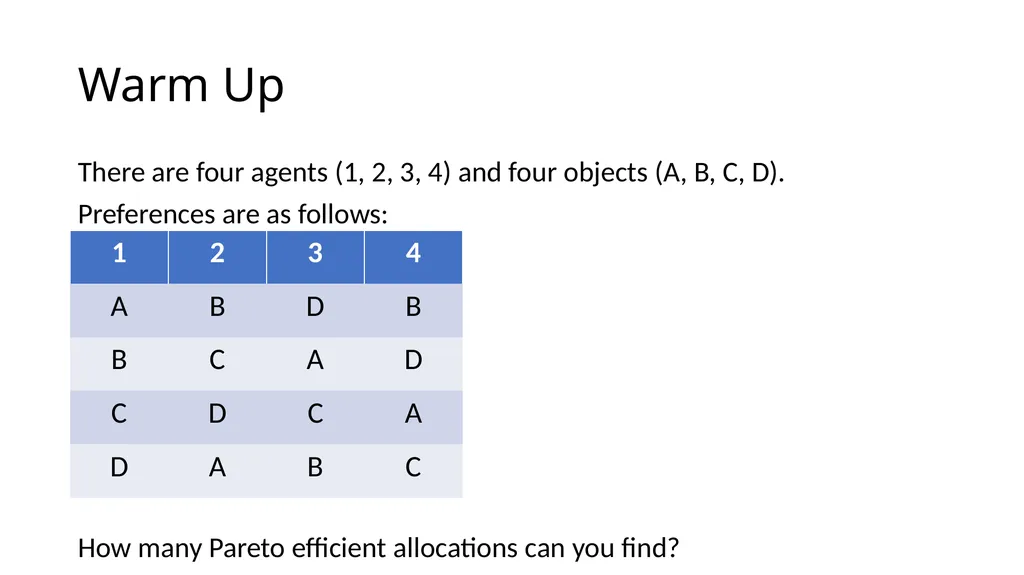
slide1. Warm Up There are four agents (1, 2, 3, 4) and four objects (A, B, C, D).
Preferences are as follows:
How many Pareto efficient allocations can you find?<br>
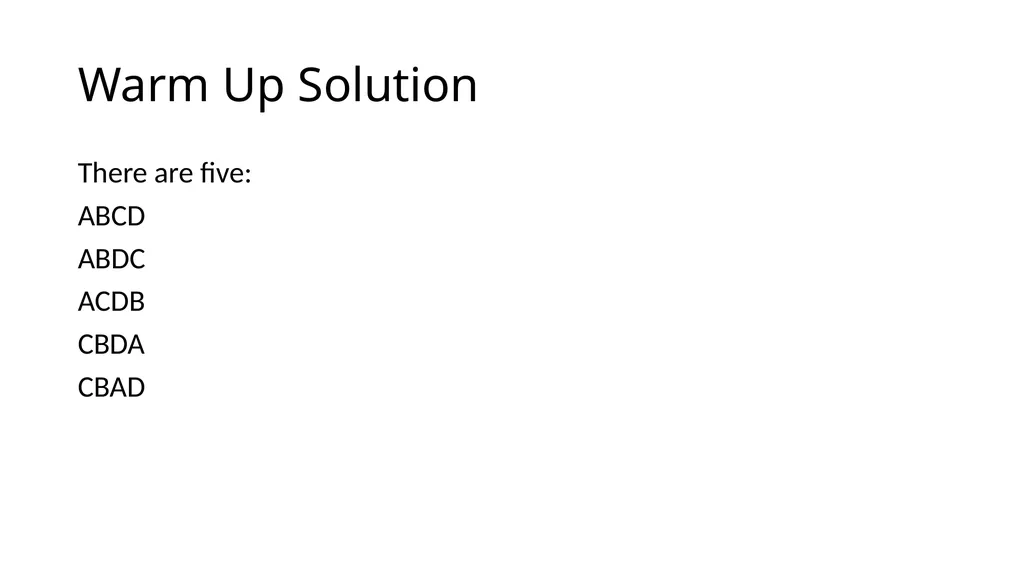
slide2. Warm Up Solution There are five:
ABCD
ABDC
ACDB
CBDA
CBAD<br>
slide3. Engineering the Allocation of Public Resources Lecture 2: Truthfulness and the Core<br>
slide4. Recall: Three Important Goals Efficiency
Truthfulness
Fairness Last Class
Today
Next Week<br>
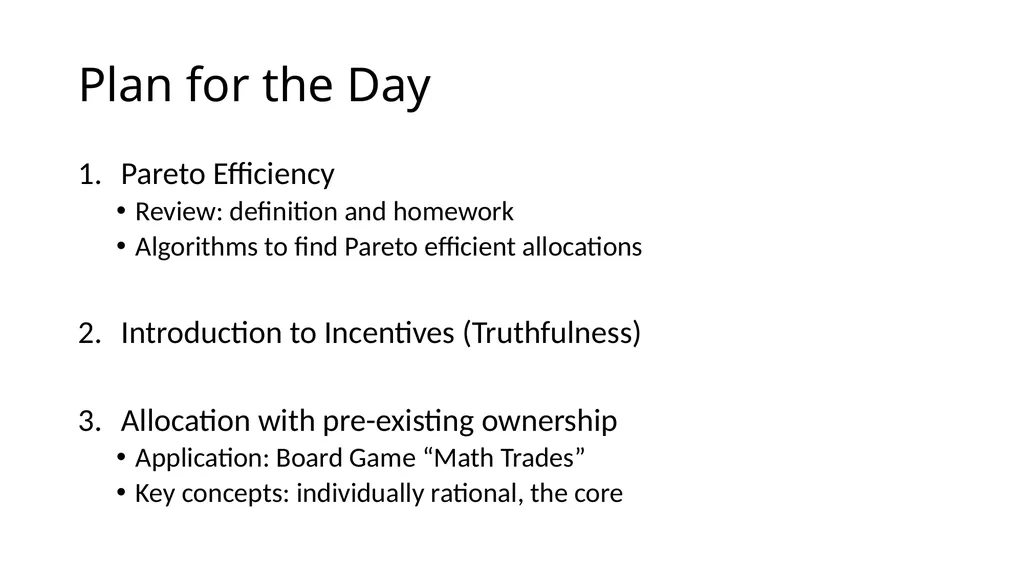
slide5. Plan for the Day Pareto Efficiency
Review: definition and homework
Algorithms to find Pareto efficient allocations
Introduction to Incentives (Truthfulness)
Allocation with pre-existing ownership
Application: Board Game “Math Trades”
Key concepts: individually rational, the core<br>
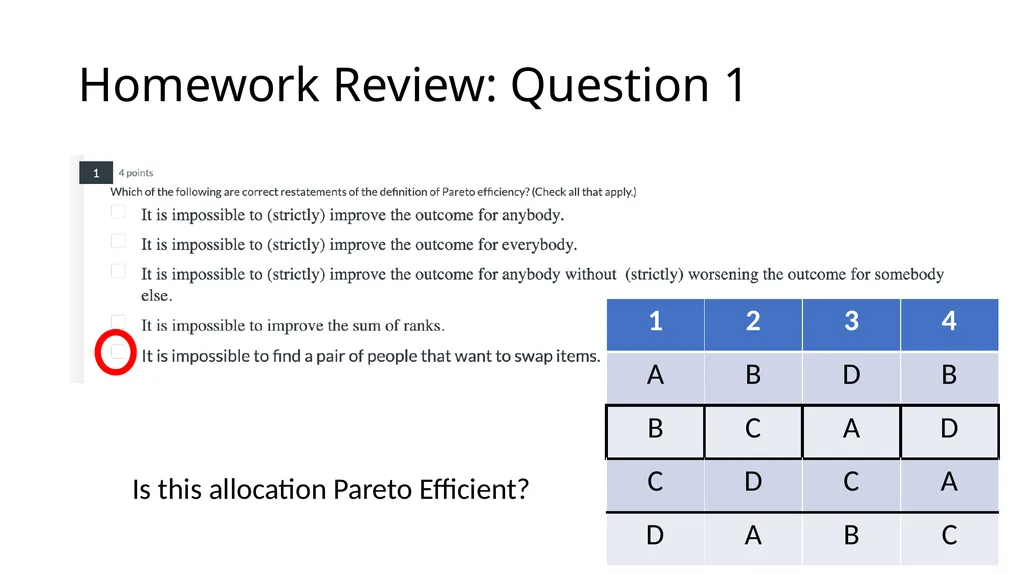
slide6. Homework Review: Question 1 Is this allocation Pareto Efficient?<br>
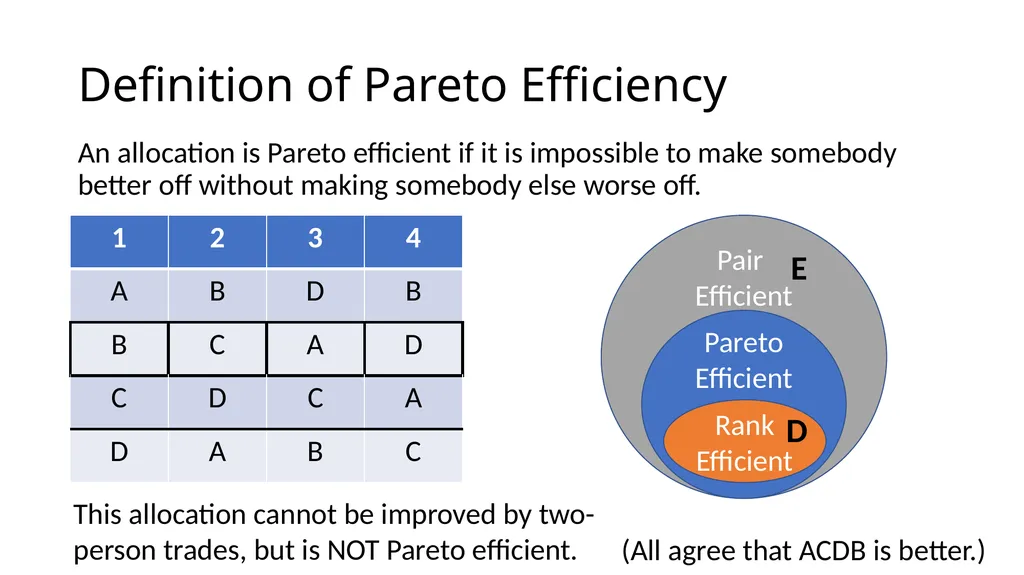
slide7. Pair
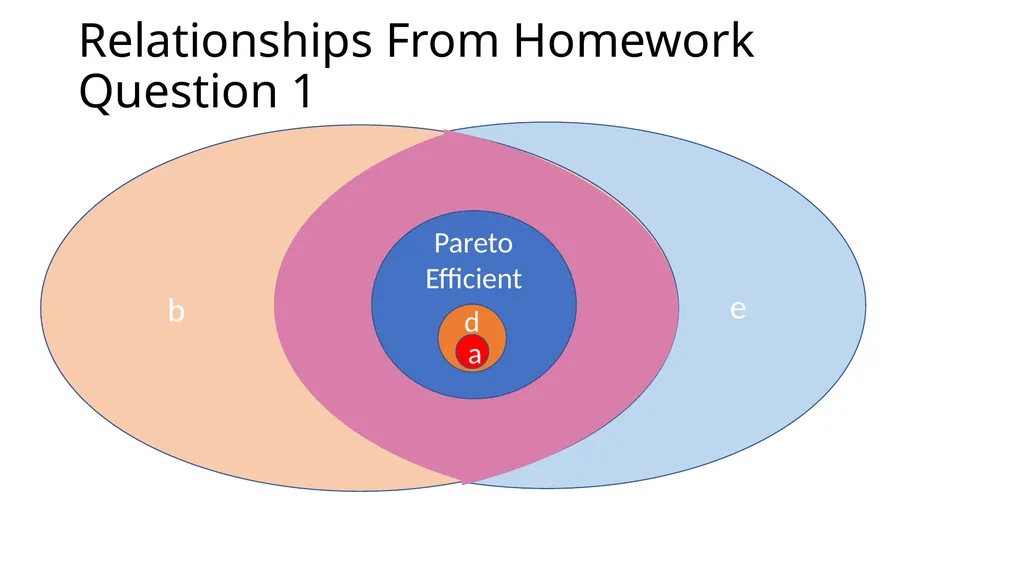
Efficient Definition of Pareto Efficiency An allocation is Pareto efficient if it is impossible to make somebody better off without making somebody else worse off. Pareto Efficient Rank Efficient This allocation cannot be improved by two-person trades, but is NOT Pareto efficient. (All agree that ACDB is better.) D E<br>
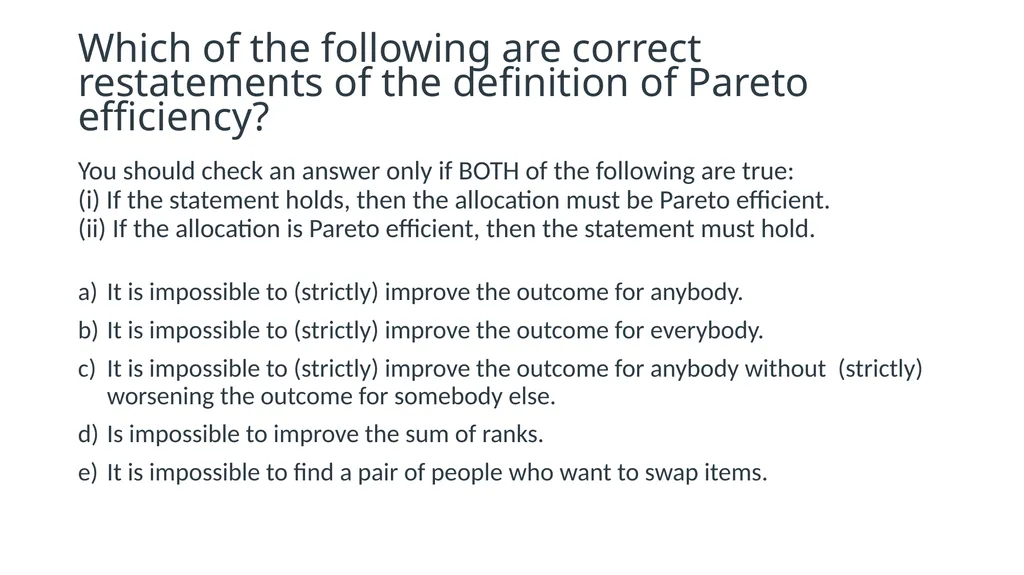
slide8. Which of the following are correct restatements of the definition of Pareto efficiency? You should check an answer only if BOTH of the following are true: (i) If the statement holds, then the allocation must be Pareto efficient. (ii) If the allocation is Pareto efficient, then the statement must hold.
It is impossible to (strictly) improve the outcome for anybody.
It is impossible to (strictly) improve the outcome for everybody.
It is impossible to (strictly) improve the outcome for anybody without (strictly) worsening the outcome for somebody else.
Is impossible to improve the sum of ranks.
It is impossible to find a pair of people who want to swap items. An allocation could be Pareto efficient, even though (a) does not hold.
Even if (b) holds, the allocation might not be Pareto efficient.
(c) is equivalent to Pareto efficiency
An allocation could be Pareto efficient, even though (d) does not hold.
Even if (e) holds, the allocation might not be Pareto efficient.<br>
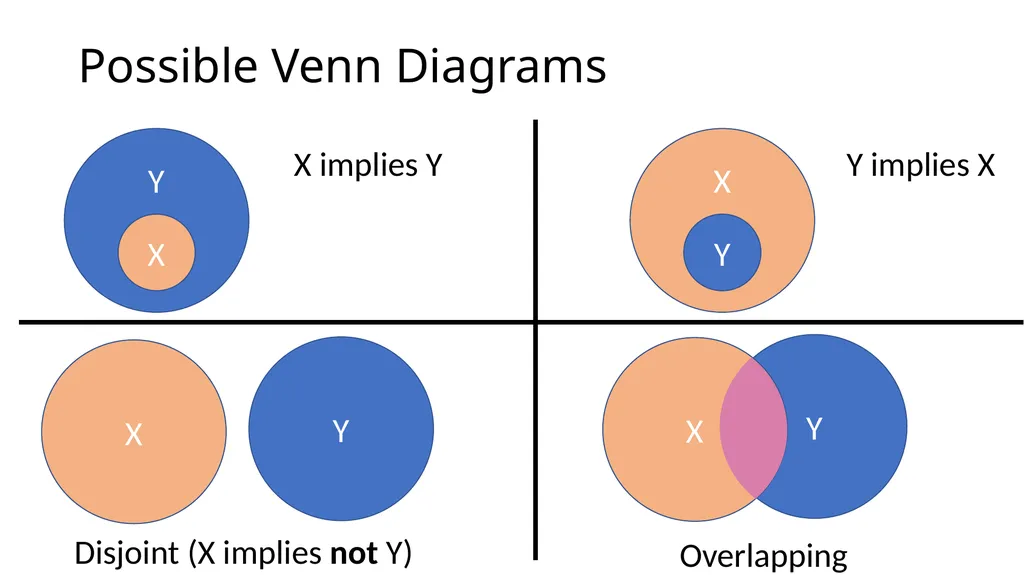
slide9. Possible Venn Diagrams Y X Y X X Y Y X X implies Y Y implies X Disjoint (X implies not Y) Overlapping<br>
slide10. Relationships From Homework Question 1 Y e b Pareto Efficient d a<br>
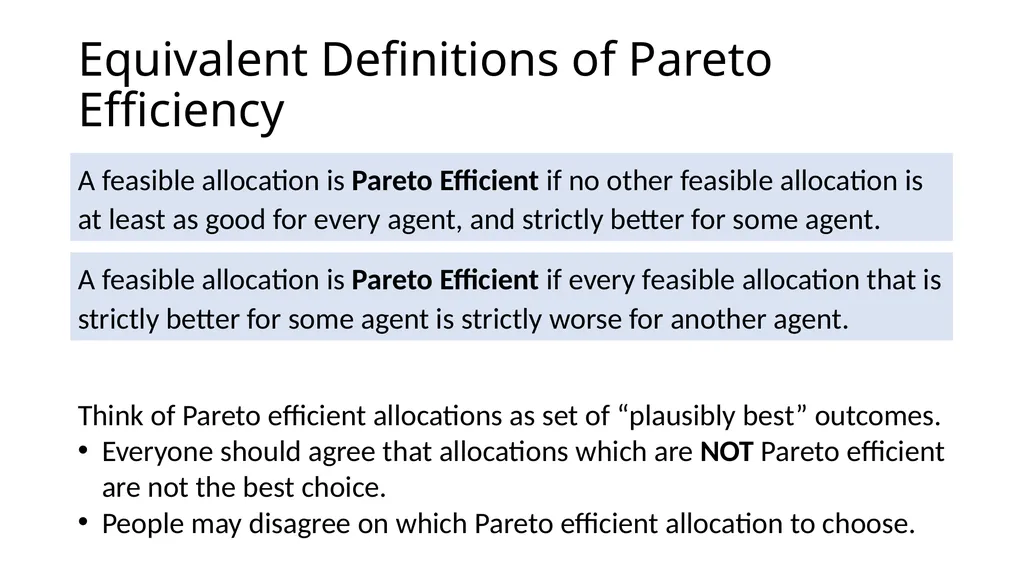
slide11. Equivalent Definitions of Pareto Efficiency A feasible allocation is Pareto Efficient if no other feasible allocation is at least as good for every agent, and strictly better for some agent. A feasible allocation is Pareto Efficient if every feasible allocation that is strictly better for some agent is strictly worse for another agent. Think of Pareto efficient allocations as set of “plausibly best” outcomes.
Everyone should agree that allocations which are NOT Pareto efficient are not the best choice.
People may disagree on which Pareto efficient allocation to choose.<br>
slide12. How to Find Pareto Efficient Allocations One way: Serial Dictatorship<br>
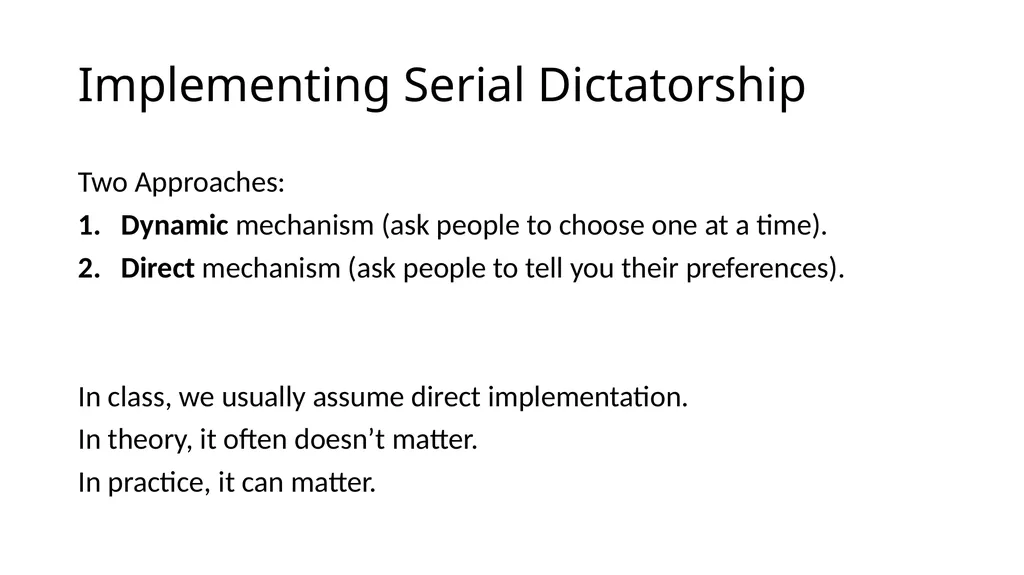
slide13. Implementing Serial Dictatorship Two Approaches:
Dynamic mechanism (ask people to choose one at a time).
Direct mechanism (ask people to tell you their preferences).
In class, we usually assume direct implementation.
In theory, it often doesn’t matter.
In practice, it can matter.<br>
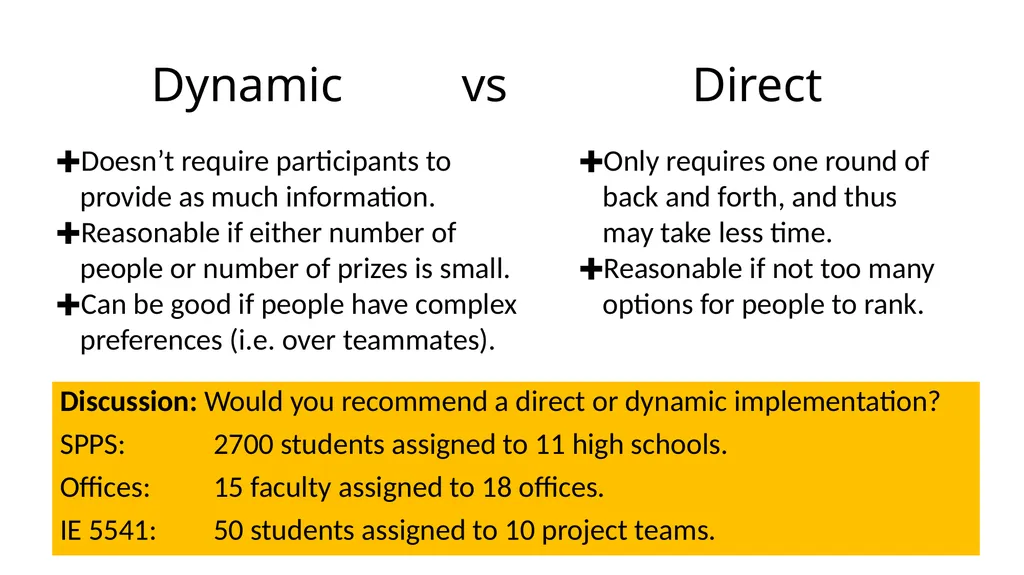
slide14. Dynamic vs Direct Doesn’t require participants to provide as much information.
Reasonable if either number of people or number of prizes is small.
Can be good if people have complex preferences (i.e. over teammates). Only requires one round of back and forth, and thus may take less time.
Reasonable if not too many options for people to rank. Discussion: Would you recommend a direct or dynamic implementation?
SPPS: 2700 students assigned to 11 high schools.
Offices: 15 faculty assigned to 18 offices.
IE 5541: 50 students assigned to 10 project teams.<br>
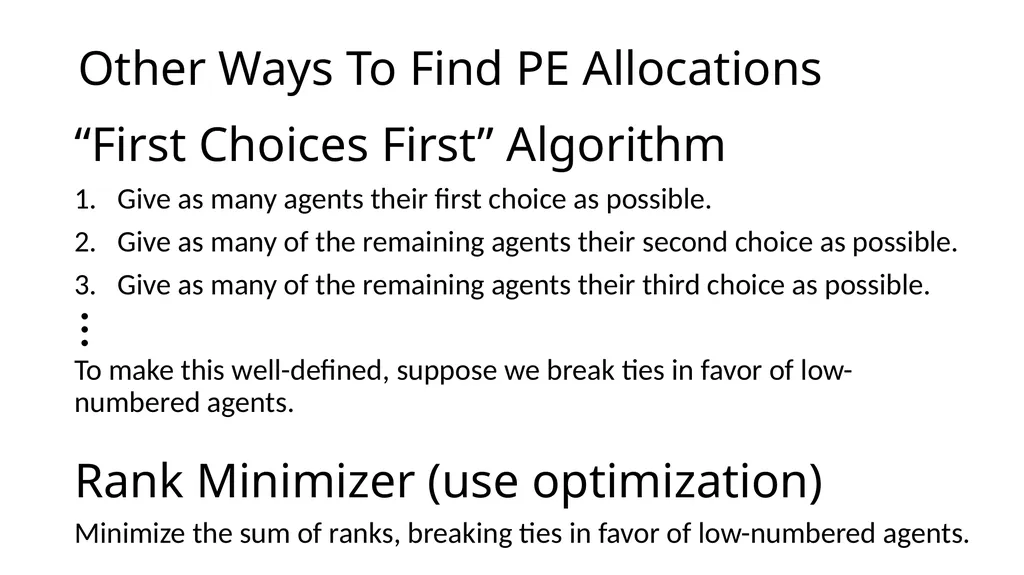
slide15. Give as many agents their first choice as possible.
Give as many of the remaining agents their second choice as possible.
Give as many of the remaining agents their third choice as possible.
To make this well-defined, suppose we break ties in favor of low-numbered agents. “First Choices First” Algorithm … Other Ways To Find PE Allocations Rank Minimizer (use optimization) Minimize the sum of ranks, breaking ties in favor of low-numbered agents.<br>
slide16. Three Ways to Find Pareto Efficient Allocation Serial dictatorship.
First choices first.
Rank minimizer.
Should we always use rank minimizer?
How do we know what preferences to use?
Should they tell the truth? Agents tell us!<br>
slide17. How Do We Know Agent Preferences? They tell us!
Should they tell the truth?<br>
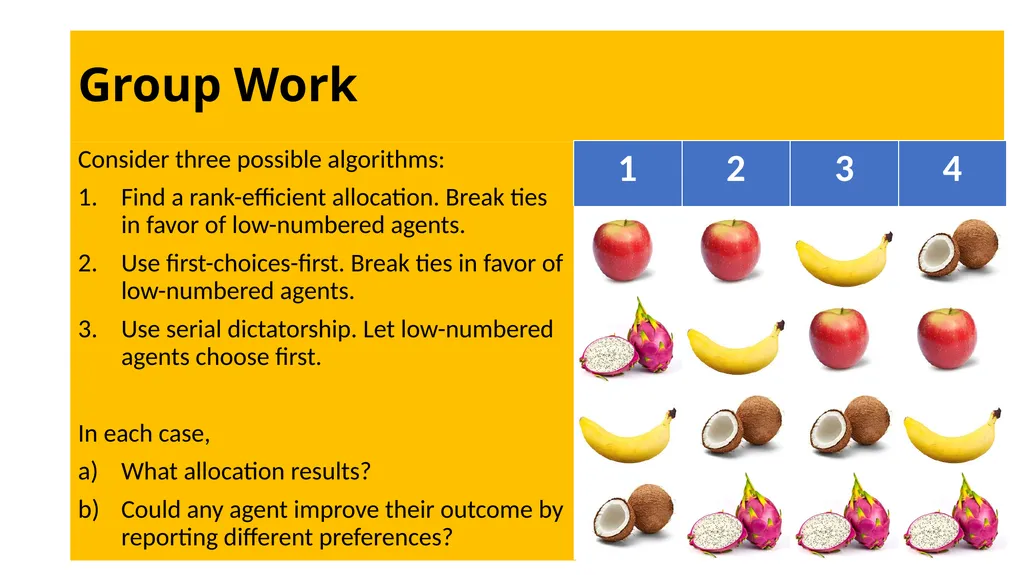
slide18. Group Work Consider three possible algorithms:
Find a rank-efficient allocation. Break ties in favor of low-numbered agents.
Use first-choices-first. Break ties in favor of low-numbered agents.
Use serial dictatorship. Let low-numbered agents choose first.
In each case,
What allocation results?
Could any agent improve their outcome by reporting different preferences?<br>
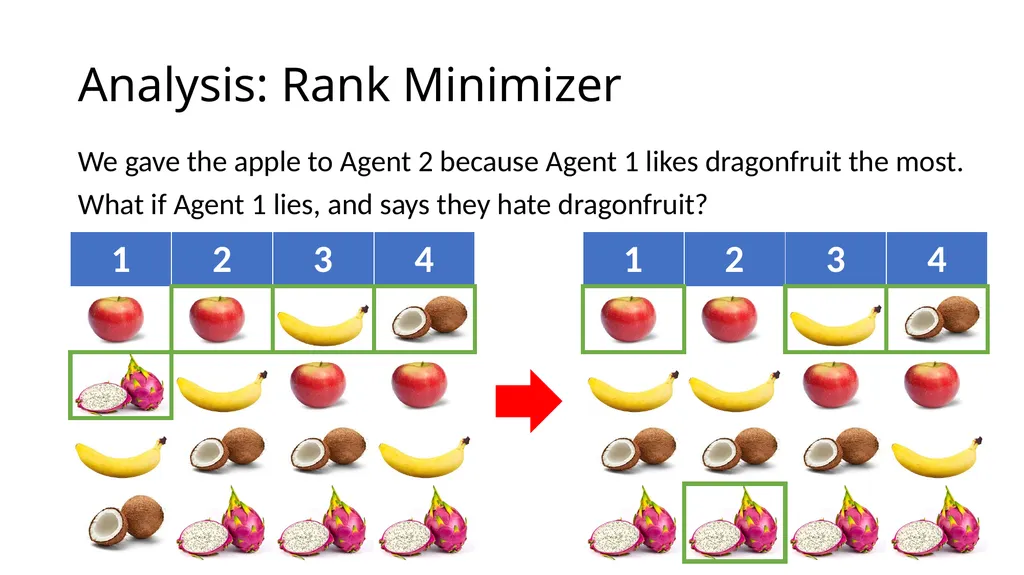
slide19. Analysis: Rank Minimizer We gave the apple to Agent 2 because Agent 1 likes dragonfruit the most.
What if Agent 1 lies, and says they hate dragonfruit?<br>
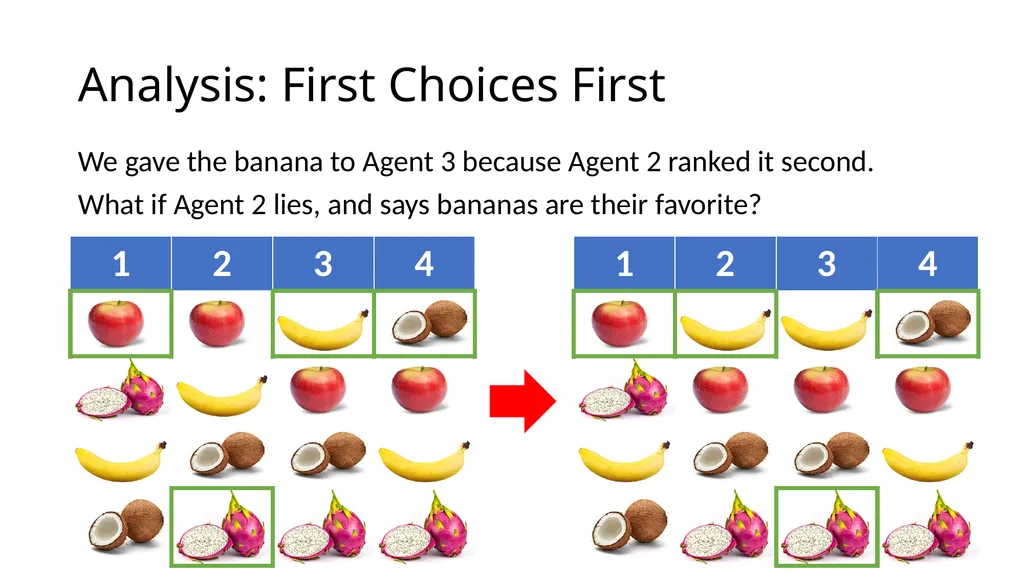
slide20. Analysis: First Choices First We gave the banana to Agent 3 because Agent 2 ranked it second.
What if Agent 2 lies, and says bananas are their favorite?<br>
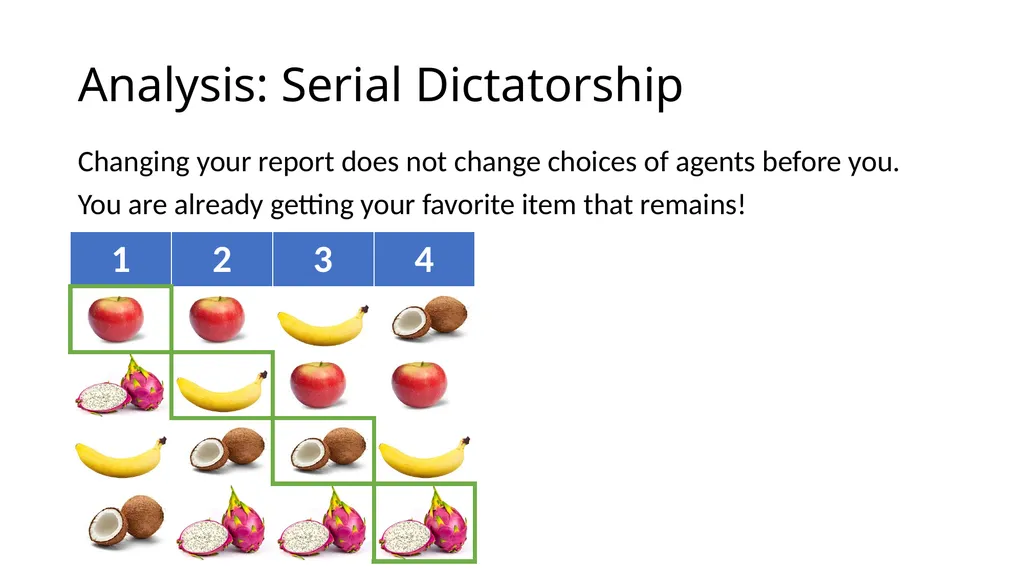
slide21. Analysis: Serial Dictatorship Changing your report does not change choices of agents before you.
You are already getting your favorite item that remains!<br>
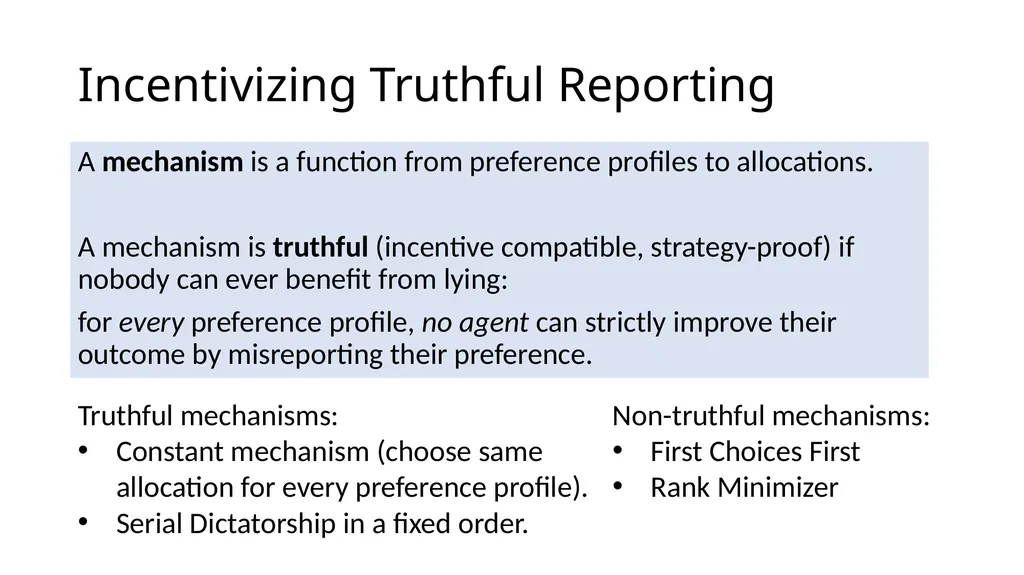
slide22. Incentivizing Truthful Reporting A mechanism is a function from preference profiles to allocations.
A mechanism is truthful (incentive compatible, strategy-proof) if nobody can ever benefit from lying:
for every preference profile, no agent can strictly improve their outcome by misreporting their preference. Truthful mechanisms:
Constant mechanism (choose same allocation for every preference profile).
Serial Dictatorship in a fixed order. Non-truthful mechanisms:
First Choices First
Rank Minimizer<br>
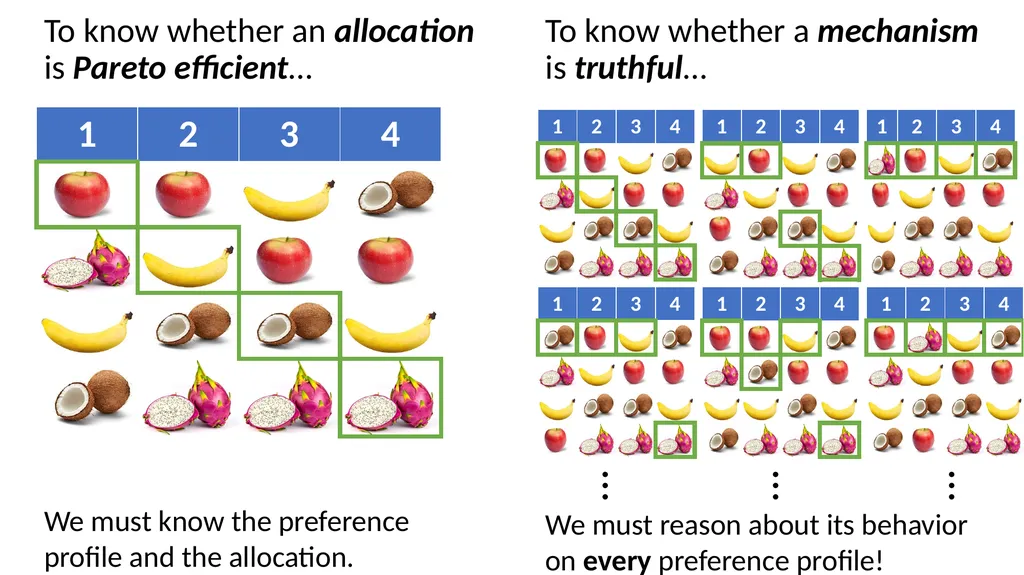
slide23. To know whether an allocation is Pareto efficient… To know whether a mechanism is truthful… … … … We must know the preference profile and the allocation. We must reason about its behavior on every preference profile!<br>
slide24. An Asymmetry Proving that a mechanism is NOT truthful is relatively easy:
Must find one preference profile where somebody can benefit from lying.
Proving that a mechanism IS truthful is harder:
Must explain why nobody can EVER benefit from lying.<br>
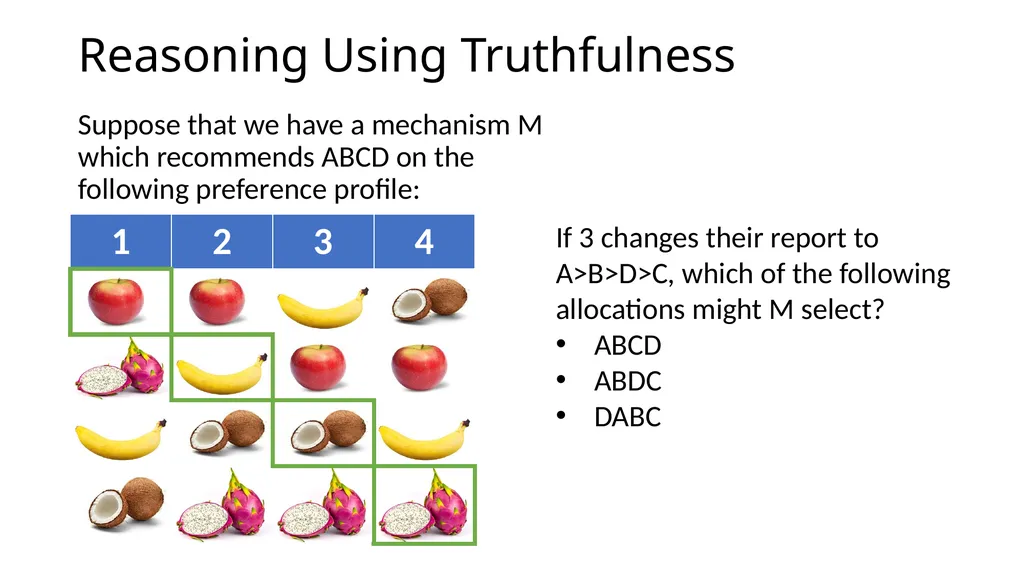
slide25. Reasoning Using Truthfulness Suppose that we have a mechanism M which recommends ABCD on the following preference profile: If 3 changes their report to A>B>D>C, which of the following allocations might M select?
ABCD
ABDC
DABC<br>
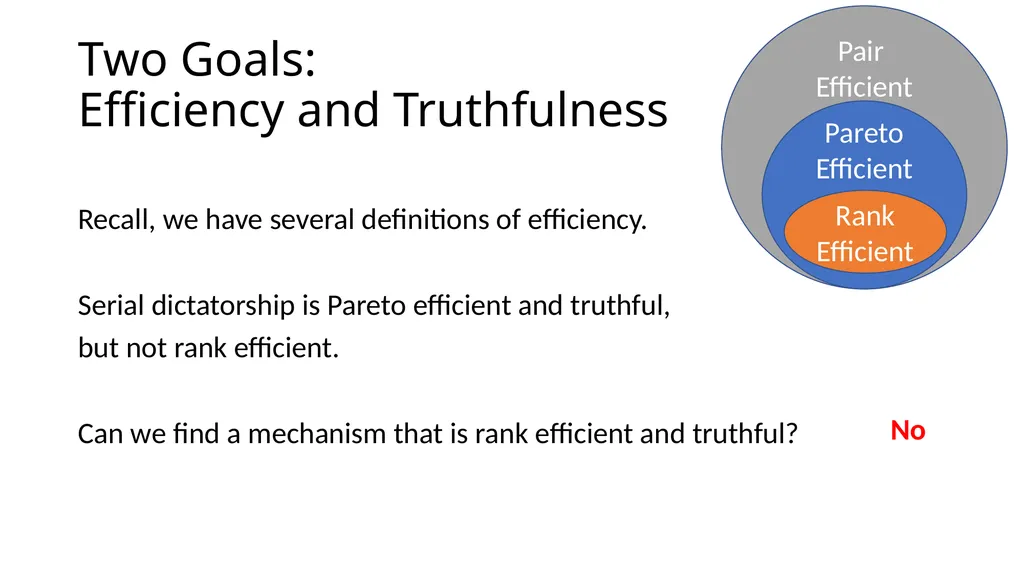
slide26. Two Goals: Efficiency and Truthfulness Recall, we have several definitions of efficiency.
Serial dictatorship is Pareto efficient and truthful,
but not rank efficient.
Can we find a mechanism that is rank efficient and truthful? Pair
Efficient Pareto Efficient Rank Efficient No<br>
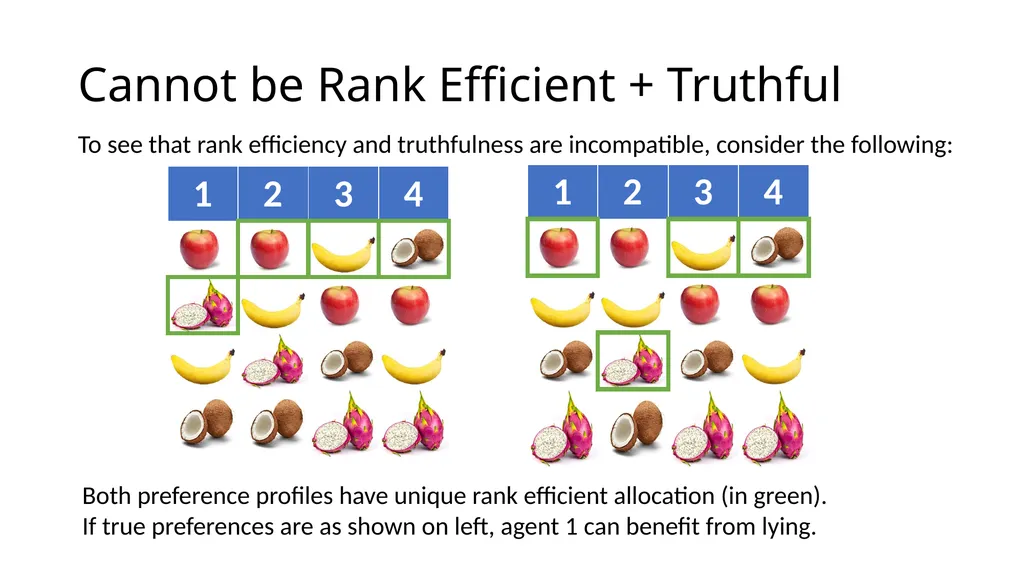
slide27. Cannot be Rank Efficient + Truthful To see that rank efficiency and truthfulness are incompatible, consider the following: Both preference profiles have unique rank efficient allocation (in green).
If true preferences are as shown on left, agent 1 can benefit from lying.<br>
slide28. Break<br>
slide29. “Math Trades” For Board Games<br>
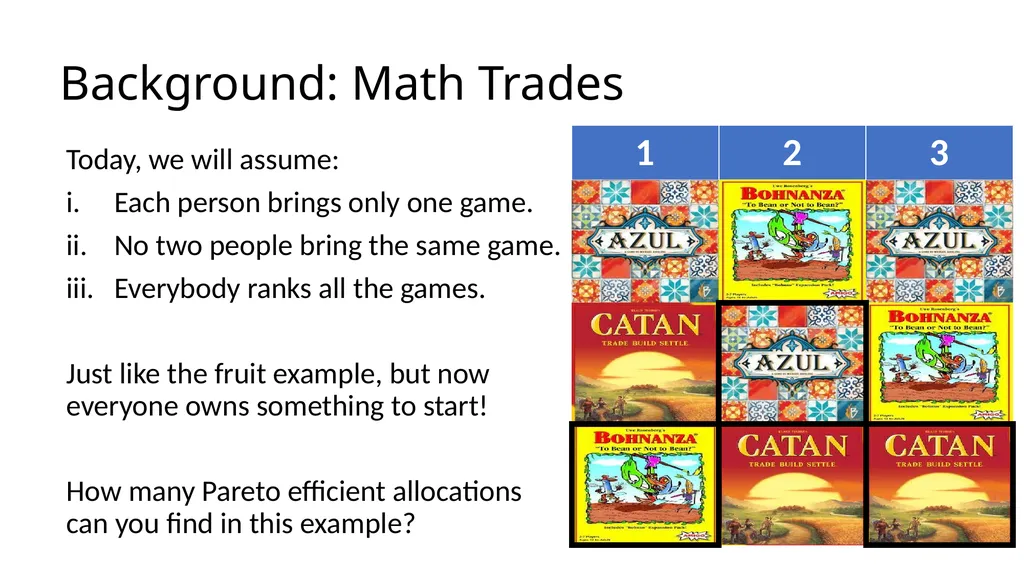
slide30. Background: Math Trades Today, we will assume:
Each person brings only one game.
No two people bring the same game.
Everybody ranks all the games.
Just like the fruit example, but now everyone owns something to start!
How many Pareto efficient allocations can you find in this example?<br>
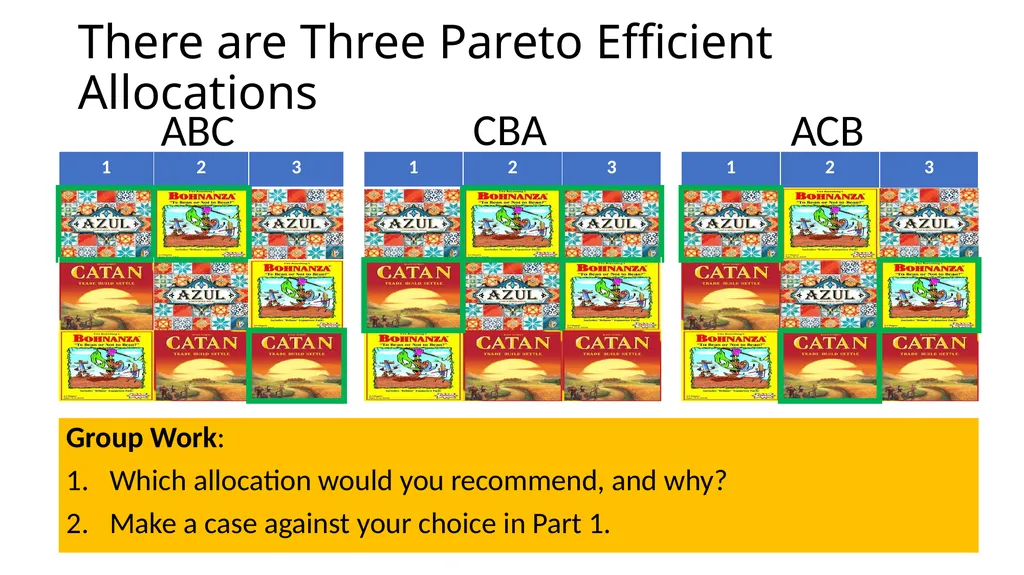
slide31. There are Three Pareto Efficient Allocations Group Work:
Which allocation would you recommend, and why?
Make a case against your choice in Part 1. ABC CBA ACB<br>
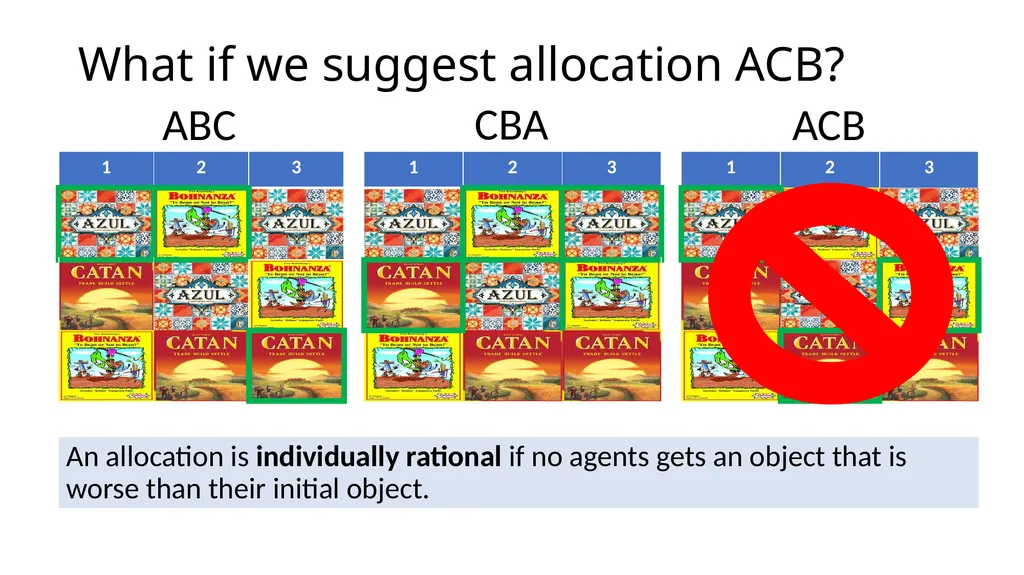
slide32. What if we suggest allocation ACB? An allocation is individually rational if no agents gets an object that is worse than their initial object. ABC CBA ACB<br>
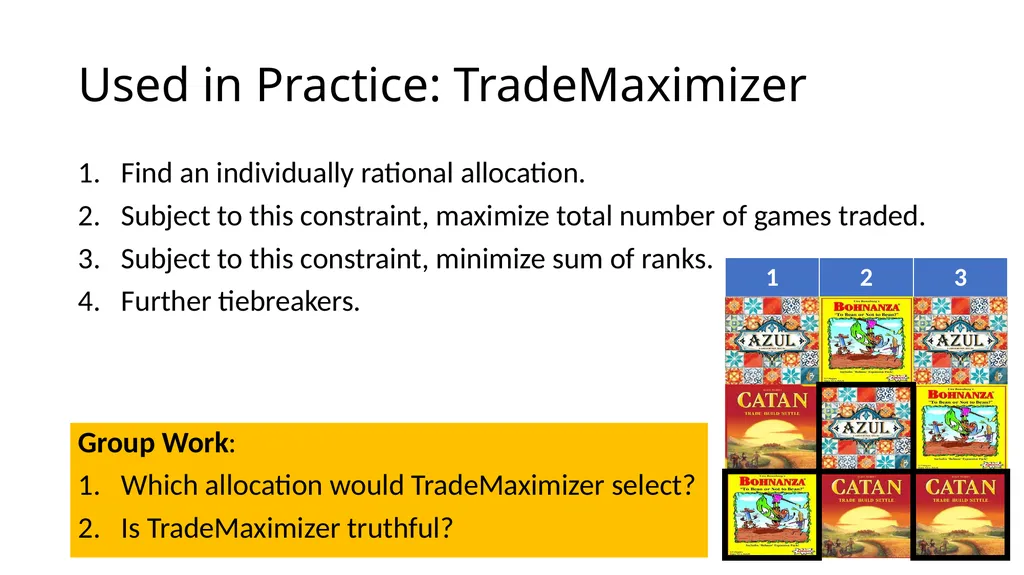
slide33. Used in Practice: TradeMaximizer Find an individually rational allocation.
Subject to this constraint, maximize total number of games traded.
Subject to this constraint, minimize sum of ranks.
Further tiebreakers. Group Work:
Which allocation would TradeMaximizer select?
Is TradeMaximizer truthful?<br>
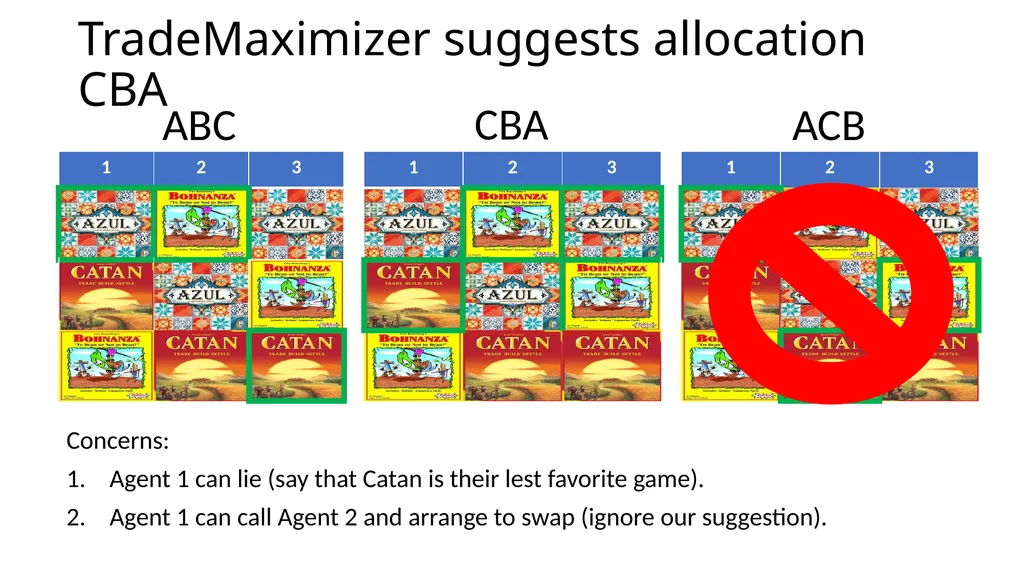
slide34. TradeMaximizer suggests allocation CBA ABC CBA ACB Concerns:
Agent 1 can lie (say that Catan is their lest favorite game).
Agent 1 can call Agent 2 and arrange to swap (ignore our suggestion).<br>
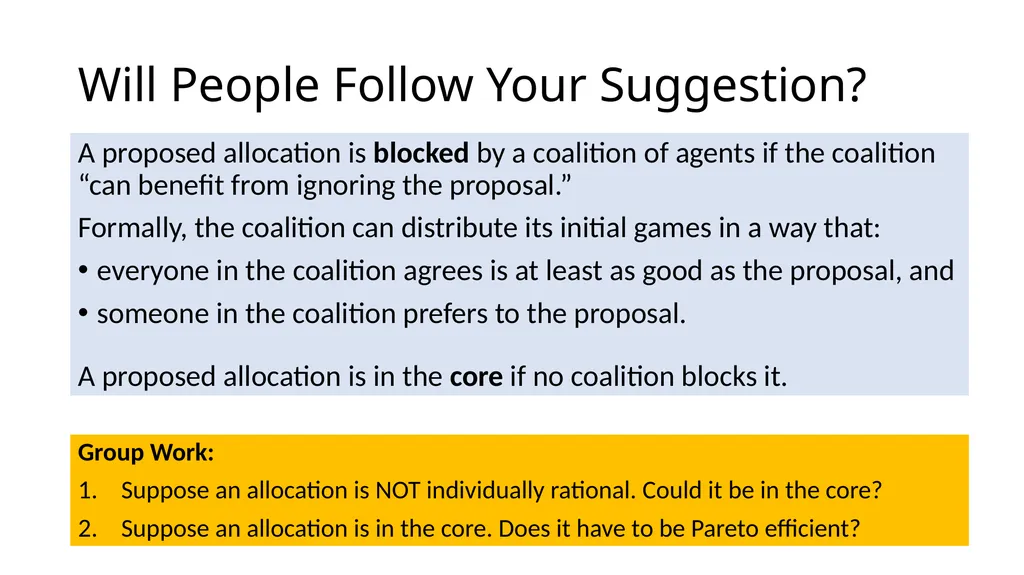
slide35. Will People Follow Your Suggestion? A proposed allocation is blocked by a coalition of agents if the coalition “can benefit from ignoring the proposal.”
Formally, the coalition can distribute its initial games in a way that:
everyone in the coalition agrees is at least as good as the proposal, and
someone in the coalition prefers to the proposal.
A proposed allocation is in the core if no coalition blocks it. Group Work:
Suppose an allocation is NOT individually rational. Could it be in the core?
Suppose an allocation is in the core. Does it have to be Pareto efficient?<br>
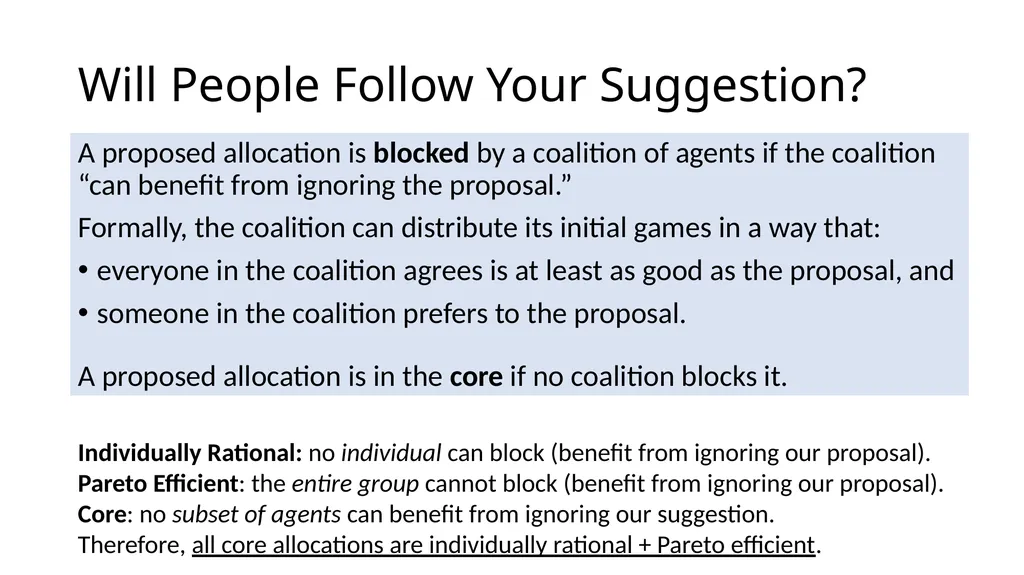
slide36. Will People Follow Your Suggestion? A proposed allocation is blocked by a coalition of agents if the coalition “can benefit from ignoring the proposal.”
Formally, the coalition can distribute its initial games in a way that:
everyone in the coalition agrees is at least as good as the proposal, and
someone in the coalition prefers to the proposal.
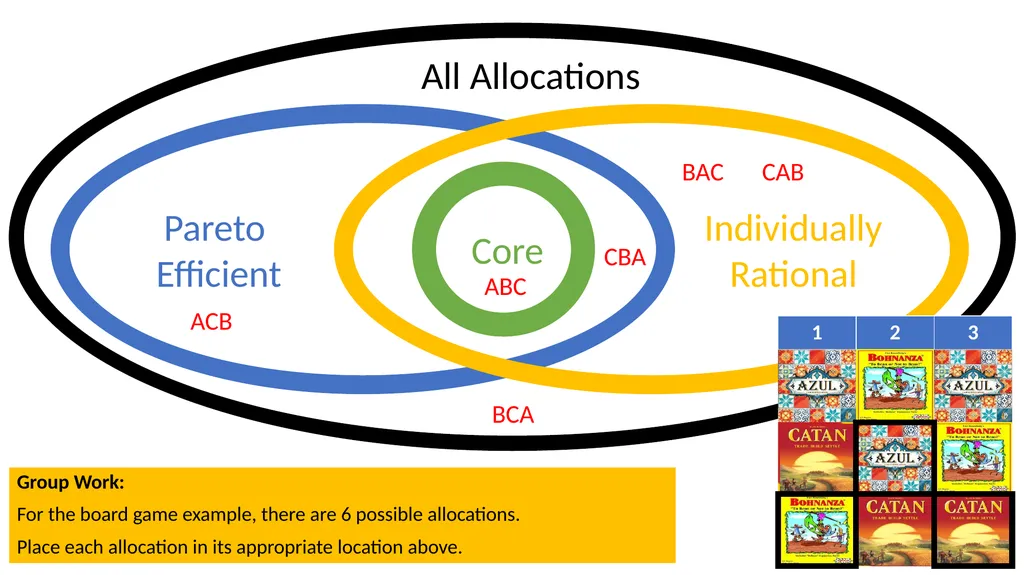
A proposed allocation is in the core if no coalition blocks it. Individually Rational: no individual can block (benefit from ignoring our proposal).
Pareto Efficient: the entire group cannot block (benefit from ignoring our proposal).
Core: no subset of agents can benefit from ignoring our suggestion.
Therefore, all core allocations are individually rational + Pareto efficient.<br>
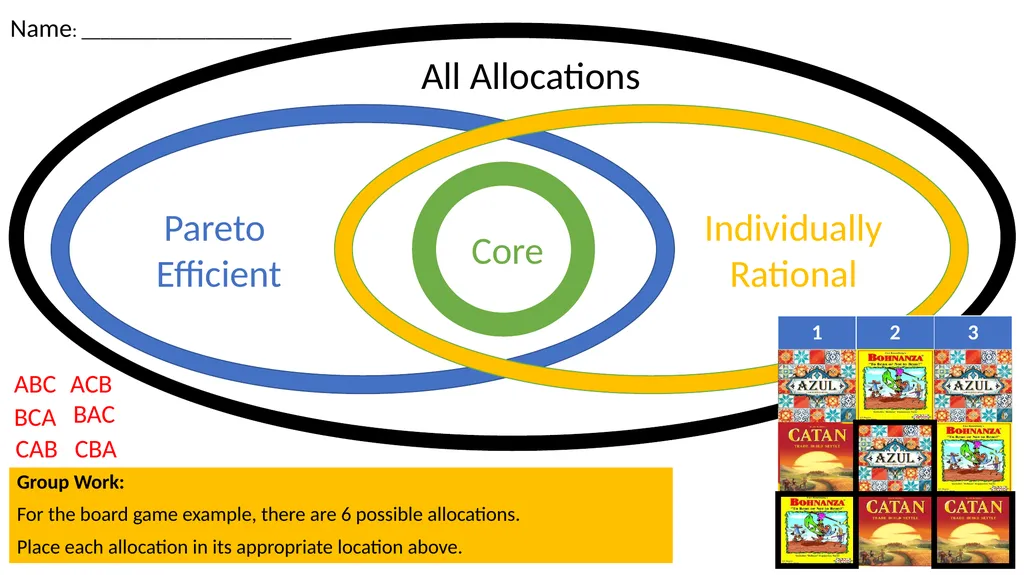
slide37. Pareto
Efficient Individually
Rational Core All Allocations ABC ACB CBA BCA BAC CAB Group Work:
For the board game example, there are 6 possible allocations.
Place each allocation in its appropriate location above. Name: ______________________<br>
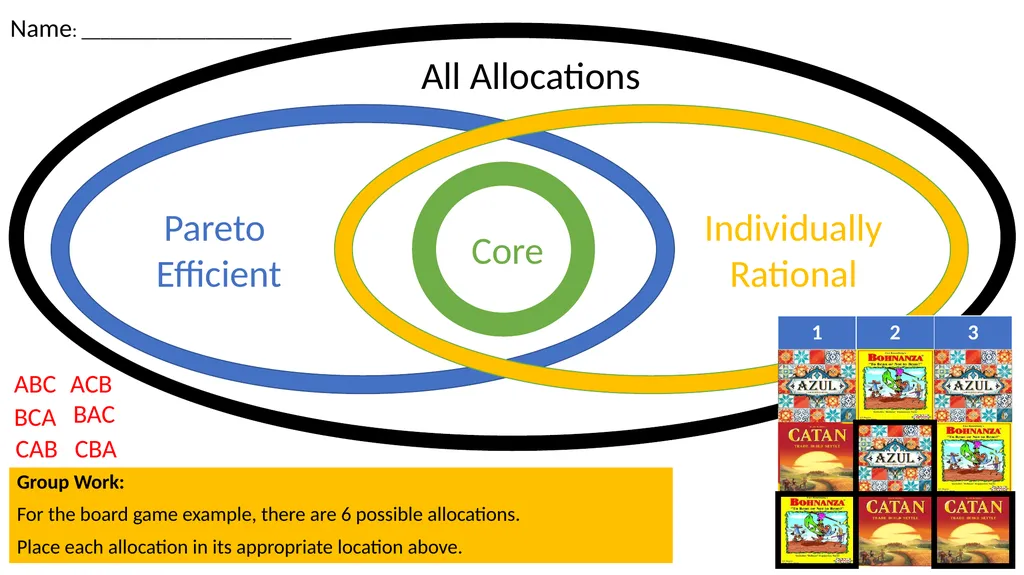
slide38. Pareto
Efficient Individually
Rational Core All Allocations ABC ACB CBA BCA BAC CAB Group Work:
For the board game example, there are 6 possible allocations.
Place each allocation in its appropriate location above. Name: ______________________<br>
slide39. Pareto
Efficient Individually
Rational Core All Allocations ABC ACB CBA BCA BAC CAB Group Work:
For the board game example, there are 6 possible allocations.
Place each allocation in its appropriate location above.<br>
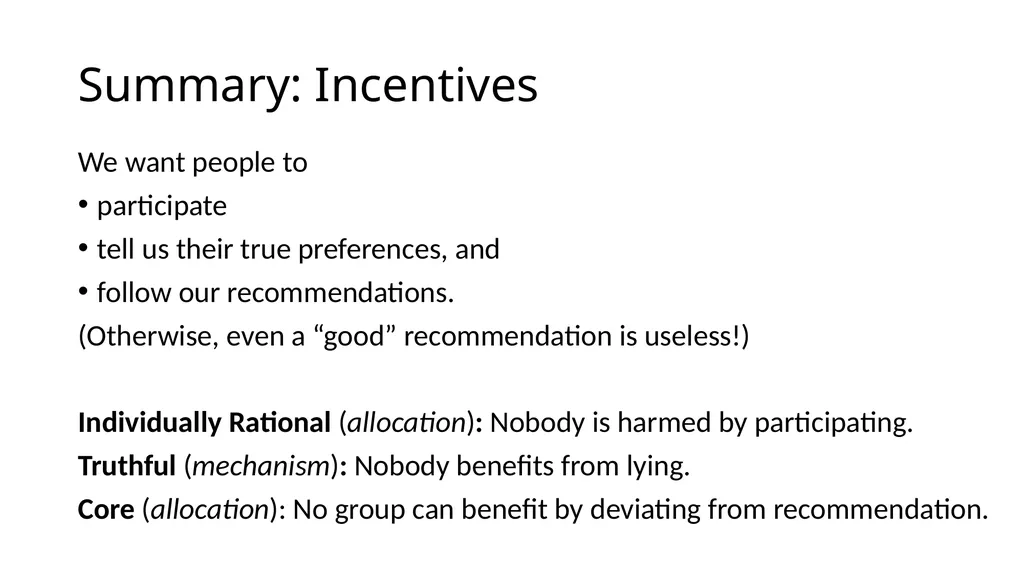
slide40. Summary: Incentives We want people to
participate
tell us their true preferences, and
follow our recommendations.
(Otherwise, even a “good” recommendation is useless!)
Individually Rational (allocation): Nobody is harmed by participating.
Truthful (mechanism): Nobody benefits from lying.
Core (allocation): No group can benefit by deviating from recommendation.<br>
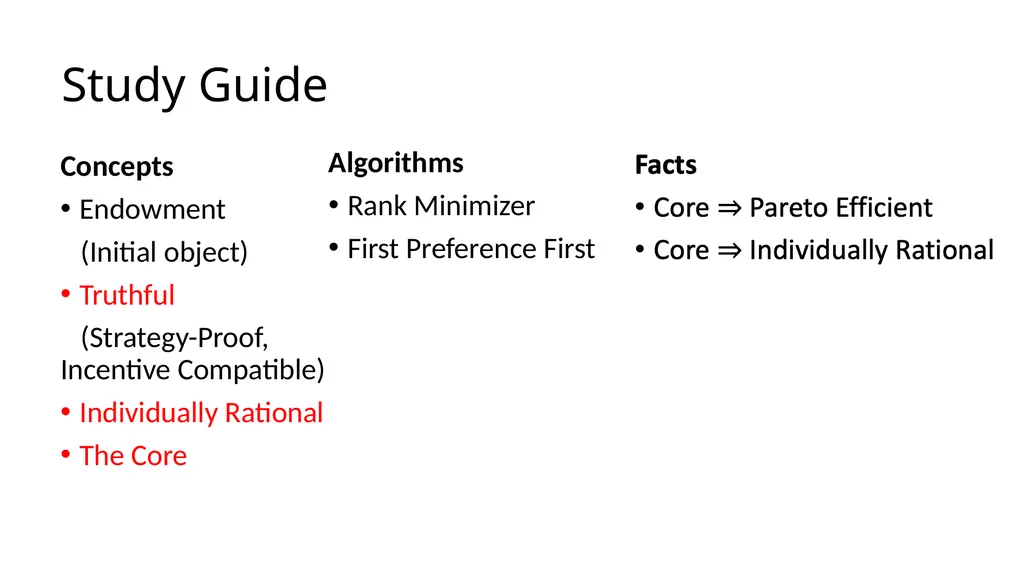
slide41. Study Guide Concepts
Endowment
(Initial object)
Truthful
(Strategy-Proof, Incentive Compatible)
Individually Rational
The Core Algorithms
Rank Minimizer
First Preference First<br>
slide42. Coming Up Topics for next class:
Is there always an allocation in the core?
Can there be more than one allocation in the core?
How can we find an allocation in the core?
Can we find this allocation in a way that is truthful?
Due Monday at 11:59 pm:
Reflection and Critical Thinking 1 (Pareto Efficiency)
Concept Check 2 (on truthfulness, individual rationality, the core) Can work with classmates + use AI (must disclose) Must do solo (no AI)<br>
slide43. What if people bring multiple games? Not sure this is worth going into. (Relevant for application, but not as relevant for future of course.)
Could also ask, what if we have fewer games than people (Less relevant for application, more relevant for future of course.)<br>
Preferences are as follows:
How many Pareto efficient allocations can you find?<br>
slide2. Warm Up Solution There are five:
ABCD
ABDC
ACDB
CBDA
CBAD<br>
slide3. Engineering the Allocation of Public Resources Lecture 2: Truthfulness and the Core<br>
slide4. Recall: Three Important Goals Efficiency
Truthfulness
Fairness Last Class
Today
Next Week<br>
slide5. Plan for the Day Pareto Efficiency
Review: definition and homework
Algorithms to find Pareto efficient allocations
Introduction to Incentives (Truthfulness)
Allocation with pre-existing ownership
Application: Board Game “Math Trades”
Key concepts: individually rational, the core<br>
slide6. Homework Review: Question 1 Is this allocation Pareto Efficient?<br>
slide7. Pair
Efficient Definition of Pareto Efficiency An allocation is Pareto efficient if it is impossible to make somebody better off without making somebody else worse off. Pareto Efficient Rank Efficient This allocation cannot be improved by two-person trades, but is NOT Pareto efficient. (All agree that ACDB is better.) D E<br>
slide8. Which of the following are correct restatements of the definition of Pareto efficiency? You should check an answer only if BOTH of the following are true: (i) If the statement holds, then the allocation must be Pareto efficient. (ii) If the allocation is Pareto efficient, then the statement must hold.
It is impossible to (strictly) improve the outcome for anybody.
It is impossible to (strictly) improve the outcome for everybody.
It is impossible to (strictly) improve the outcome for anybody without (strictly) worsening the outcome for somebody else.
Is impossible to improve the sum of ranks.
It is impossible to find a pair of people who want to swap items. An allocation could be Pareto efficient, even though (a) does not hold.
Even if (b) holds, the allocation might not be Pareto efficient.
(c) is equivalent to Pareto efficiency
An allocation could be Pareto efficient, even though (d) does not hold.
Even if (e) holds, the allocation might not be Pareto efficient.<br>
slide9. Possible Venn Diagrams Y X Y X X Y Y X X implies Y Y implies X Disjoint (X implies not Y) Overlapping<br>
slide10. Relationships From Homework Question 1 Y e b Pareto Efficient d a<br>
slide11. Equivalent Definitions of Pareto Efficiency A feasible allocation is Pareto Efficient if no other feasible allocation is at least as good for every agent, and strictly better for some agent. A feasible allocation is Pareto Efficient if every feasible allocation that is strictly better for some agent is strictly worse for another agent. Think of Pareto efficient allocations as set of “plausibly best” outcomes.
Everyone should agree that allocations which are NOT Pareto efficient are not the best choice.
People may disagree on which Pareto efficient allocation to choose.<br>
slide12. How to Find Pareto Efficient Allocations One way: Serial Dictatorship<br>
slide13. Implementing Serial Dictatorship Two Approaches:
Dynamic mechanism (ask people to choose one at a time).
Direct mechanism (ask people to tell you their preferences).
In class, we usually assume direct implementation.
In theory, it often doesn’t matter.
In practice, it can matter.<br>
slide14. Dynamic vs Direct Doesn’t require participants to provide as much information.
Reasonable if either number of people or number of prizes is small.
Can be good if people have complex preferences (i.e. over teammates). Only requires one round of back and forth, and thus may take less time.
Reasonable if not too many options for people to rank. Discussion: Would you recommend a direct or dynamic implementation?
SPPS: 2700 students assigned to 11 high schools.
Offices: 15 faculty assigned to 18 offices.
IE 5541: 50 students assigned to 10 project teams.<br>
slide15. Give as many agents their first choice as possible.
Give as many of the remaining agents their second choice as possible.
Give as many of the remaining agents their third choice as possible.
To make this well-defined, suppose we break ties in favor of low-numbered agents. “First Choices First” Algorithm … Other Ways To Find PE Allocations Rank Minimizer (use optimization) Minimize the sum of ranks, breaking ties in favor of low-numbered agents.<br>
slide16. Three Ways to Find Pareto Efficient Allocation Serial dictatorship.
First choices first.
Rank minimizer.
Should we always use rank minimizer?
How do we know what preferences to use?
Should they tell the truth? Agents tell us!<br>
slide17. How Do We Know Agent Preferences? They tell us!
Should they tell the truth?<br>
slide18. Group Work Consider three possible algorithms:
Find a rank-efficient allocation. Break ties in favor of low-numbered agents.
Use first-choices-first. Break ties in favor of low-numbered agents.
Use serial dictatorship. Let low-numbered agents choose first.
In each case,
What allocation results?
Could any agent improve their outcome by reporting different preferences?<br>
slide19. Analysis: Rank Minimizer We gave the apple to Agent 2 because Agent 1 likes dragonfruit the most.
What if Agent 1 lies, and says they hate dragonfruit?<br>
slide20. Analysis: First Choices First We gave the banana to Agent 3 because Agent 2 ranked it second.
What if Agent 2 lies, and says bananas are their favorite?<br>
slide21. Analysis: Serial Dictatorship Changing your report does not change choices of agents before you.
You are already getting your favorite item that remains!<br>
slide22. Incentivizing Truthful Reporting A mechanism is a function from preference profiles to allocations.
A mechanism is truthful (incentive compatible, strategy-proof) if nobody can ever benefit from lying:
for every preference profile, no agent can strictly improve their outcome by misreporting their preference. Truthful mechanisms:
Constant mechanism (choose same allocation for every preference profile).
Serial Dictatorship in a fixed order. Non-truthful mechanisms:
First Choices First
Rank Minimizer<br>
slide23. To know whether an allocation is Pareto efficient… To know whether a mechanism is truthful… … … … We must know the preference profile and the allocation. We must reason about its behavior on every preference profile!<br>
slide24. An Asymmetry Proving that a mechanism is NOT truthful is relatively easy:
Must find one preference profile where somebody can benefit from lying.
Proving that a mechanism IS truthful is harder:
Must explain why nobody can EVER benefit from lying.<br>
slide25. Reasoning Using Truthfulness Suppose that we have a mechanism M which recommends ABCD on the following preference profile: If 3 changes their report to A>B>D>C, which of the following allocations might M select?
ABCD
ABDC
DABC<br>
slide26. Two Goals: Efficiency and Truthfulness Recall, we have several definitions of efficiency.
Serial dictatorship is Pareto efficient and truthful,
but not rank efficient.
Can we find a mechanism that is rank efficient and truthful? Pair
Efficient Pareto Efficient Rank Efficient No<br>
slide27. Cannot be Rank Efficient + Truthful To see that rank efficiency and truthfulness are incompatible, consider the following: Both preference profiles have unique rank efficient allocation (in green).
If true preferences are as shown on left, agent 1 can benefit from lying.<br>
slide28. Break<br>
slide29. “Math Trades” For Board Games<br>
slide30. Background: Math Trades Today, we will assume:
Each person brings only one game.
No two people bring the same game.
Everybody ranks all the games.
Just like the fruit example, but now everyone owns something to start!
How many Pareto efficient allocations can you find in this example?<br>
slide31. There are Three Pareto Efficient Allocations Group Work:
Which allocation would you recommend, and why?
Make a case against your choice in Part 1. ABC CBA ACB<br>
slide32. What if we suggest allocation ACB? An allocation is individually rational if no agents gets an object that is worse than their initial object. ABC CBA ACB<br>
slide33. Used in Practice: TradeMaximizer Find an individually rational allocation.
Subject to this constraint, maximize total number of games traded.
Subject to this constraint, minimize sum of ranks.
Further tiebreakers. Group Work:
Which allocation would TradeMaximizer select?
Is TradeMaximizer truthful?<br>
slide34. TradeMaximizer suggests allocation CBA ABC CBA ACB Concerns:
Agent 1 can lie (say that Catan is their lest favorite game).
Agent 1 can call Agent 2 and arrange to swap (ignore our suggestion).<br>
slide35. Will People Follow Your Suggestion? A proposed allocation is blocked by a coalition of agents if the coalition “can benefit from ignoring the proposal.”
Formally, the coalition can distribute its initial games in a way that:
everyone in the coalition agrees is at least as good as the proposal, and
someone in the coalition prefers to the proposal.
A proposed allocation is in the core if no coalition blocks it. Group Work:
Suppose an allocation is NOT individually rational. Could it be in the core?
Suppose an allocation is in the core. Does it have to be Pareto efficient?<br>
slide36. Will People Follow Your Suggestion? A proposed allocation is blocked by a coalition of agents if the coalition “can benefit from ignoring the proposal.”
Formally, the coalition can distribute its initial games in a way that:
everyone in the coalition agrees is at least as good as the proposal, and
someone in the coalition prefers to the proposal.
A proposed allocation is in the core if no coalition blocks it. Individually Rational: no individual can block (benefit from ignoring our proposal).
Pareto Efficient: the entire group cannot block (benefit from ignoring our proposal).
Core: no subset of agents can benefit from ignoring our suggestion.
Therefore, all core allocations are individually rational + Pareto efficient.<br>
slide37. Pareto
Efficient Individually
Rational Core All Allocations ABC ACB CBA BCA BAC CAB Group Work:
For the board game example, there are 6 possible allocations.
Place each allocation in its appropriate location above. Name: ______________________<br>
slide38. Pareto
Efficient Individually
Rational Core All Allocations ABC ACB CBA BCA BAC CAB Group Work:
For the board game example, there are 6 possible allocations.
Place each allocation in its appropriate location above. Name: ______________________<br>
slide39. Pareto
Efficient Individually
Rational Core All Allocations ABC ACB CBA BCA BAC CAB Group Work:
For the board game example, there are 6 possible allocations.
Place each allocation in its appropriate location above.<br>
slide40. Summary: Incentives We want people to
participate
tell us their true preferences, and
follow our recommendations.
(Otherwise, even a “good” recommendation is useless!)
Individually Rational (allocation): Nobody is harmed by participating.
Truthful (mechanism): Nobody benefits from lying.
Core (allocation): No group can benefit by deviating from recommendation.<br>
slide41. Study Guide Concepts
Endowment
(Initial object)
Truthful
(Strategy-Proof, Incentive Compatible)
Individually Rational
The Core Algorithms
Rank Minimizer
First Preference First<br>
slide42. Coming Up Topics for next class:
Is there always an allocation in the core?
Can there be more than one allocation in the core?
How can we find an allocation in the core?
Can we find this allocation in a way that is truthful?
Due Monday at 11:59 pm:
Reflection and Critical Thinking 1 (Pareto Efficiency)
Concept Check 2 (on truthfulness, individual rationality, the core) Can work with classmates + use AI (must disclose) Must do solo (no AI)<br>
slide43. What if people bring multiple games? Not sure this is worth going into. (Relevant for application, but not as relevant for future of course.)
Could also ask, what if we have fewer games than people (Less relevant for application, more relevant for future of course.)<br>