Warp Scheduling Basics Loose Round Robin (LRR)
Description: Warp Scheduling Basics Loose Round Robin (LRR) Goes around to every warp and issue if ready (R) If warp is not ready (W), skip and issue next ready warp Issue: Warps all run at the same speed, potentially all reaching memory access phase
Related Topics
Download Presentation
"Warp Scheduling Basics Loose Round Robin (LRR)" is the property of its rightful owner. Permission is granted to download and print the materials on this website for personal, non-commercial use only, and to display it on your personal computer provided you do not modify the materials and that you retain all copyright notices contained in the materials. By downloading content from our website, you accept the terms of this agreement.
Presentation Transcript
slide1. Warp Scheduling Basics<br>
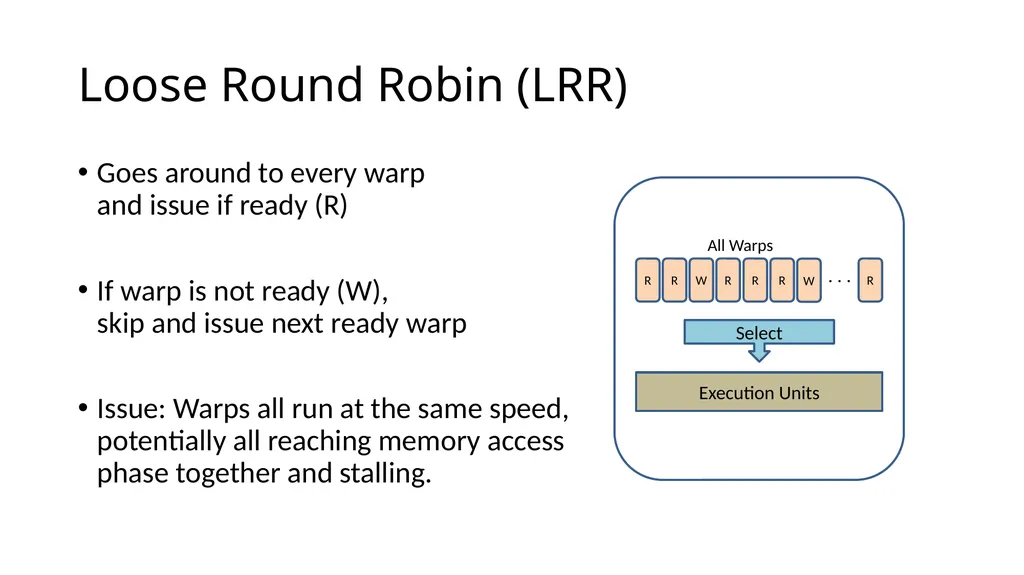
slide2. Loose Round Robin (LRR) Goes around to every warp and issue if ready (R)
If warp is not ready (W), skip and issue next ready warp
Issue: Warps all run at the same speed,potentially all reaching memory accessphase together and stalling. R R W R R R R Select All Warps Execution Units W . . .<br>
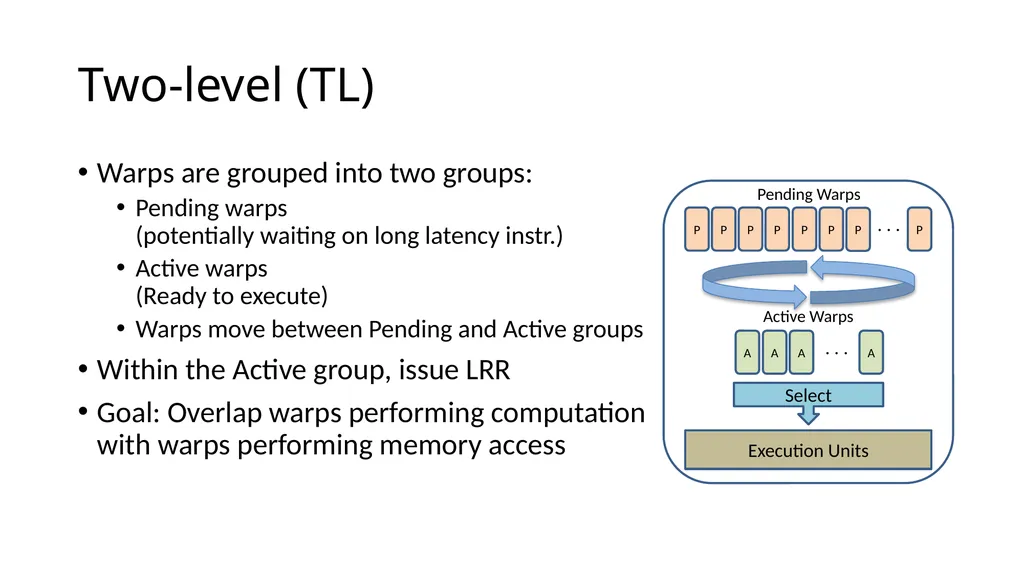
slide3. Two-level (TL) Warps are grouped into two groups:
Pending warps (potentially waiting on long latency instr.)
Active warps (Ready to execute)
Warps move between Pending and Active groups
Within the Active group, issue LRR
Goal: Overlap warps performing computationwith warps performing memory access<br>
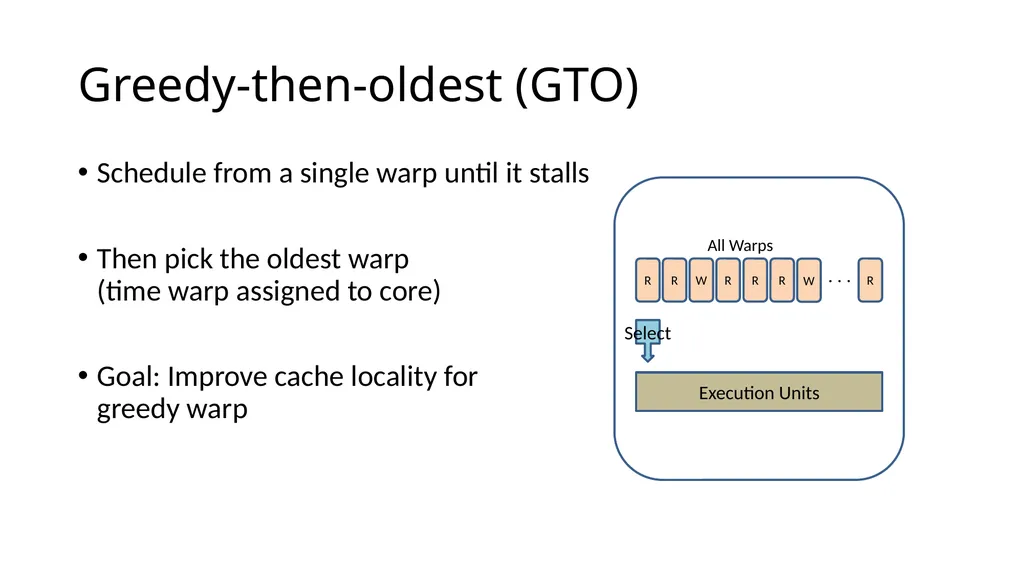
slide4. Greedy-then-oldest (GTO) Schedule from a single warp until it stalls
Then pick the oldest warp (time warp assigned to core)
Goal: Improve cache locality for greedy warp R R W R R R R Select All Warps Execution Units W . . .<br>
slide5. Cache-Conscious Wavefront Scheduling Timothy G. Rogers1
Mike O’Connor2
Tor M. Aamodt1 1The University of British Columbia
2AMD Research<br>
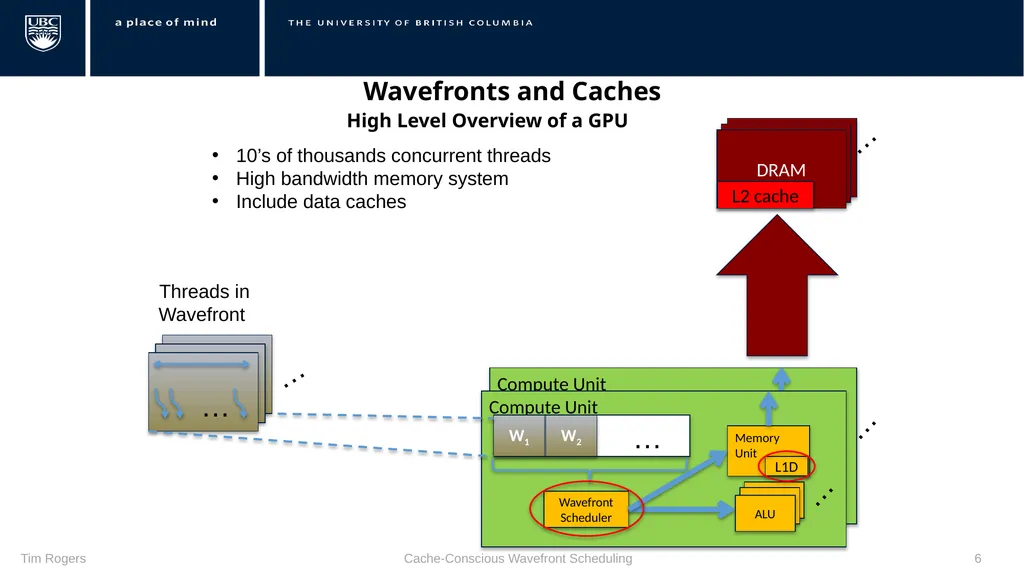
slide6. Compute Unit DRAM DRAM Wavefronts and Caches Threads in Wavefront Compute Unit W1 … … Wavefront Scheduler W2 DRAM … 10’s of thousands concurrent threads
High bandwidth memory system
Include data caches … ALU ALU ALU … … L2 cache Memory Unit L1D High Level Overview of a GPU<br>
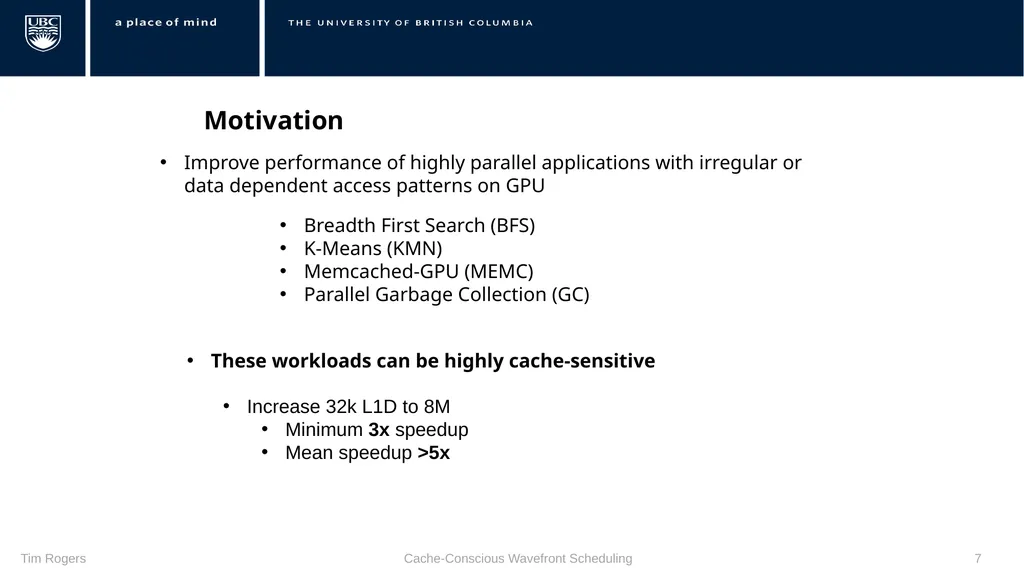
slide7. Motivation Improve performance of highly parallel applications with irregular or data dependent access patterns on GPU These workloads can be highly cache-sensitive Increase 32k L1D to 8M
Minimum 3x speedup
Mean speedup >5x Breadth First Search (BFS)
K-Means (KMN)
Memcached-GPU (MEMC)
Parallel Garbage Collection (GC)<br>
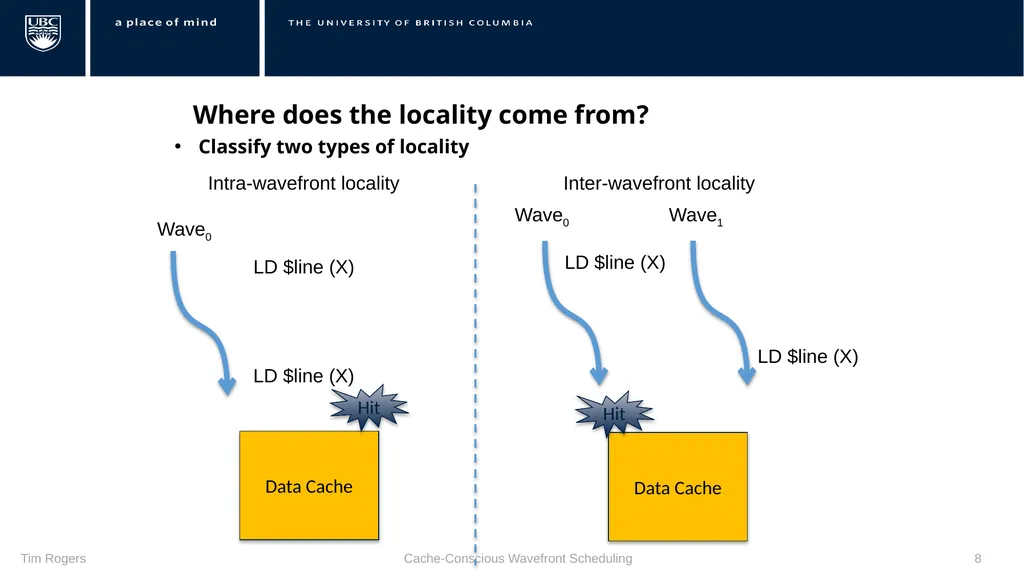
slide8. Data Cache Data Cache Where does the locality come from? Classify two types of locality Intra-wavefront locality Inter-wavefront locality LD $line (X) LD $line (X) LD $line (X) LD $line (X) Wave0 Hit Wave0 Wave1 Hit<br>
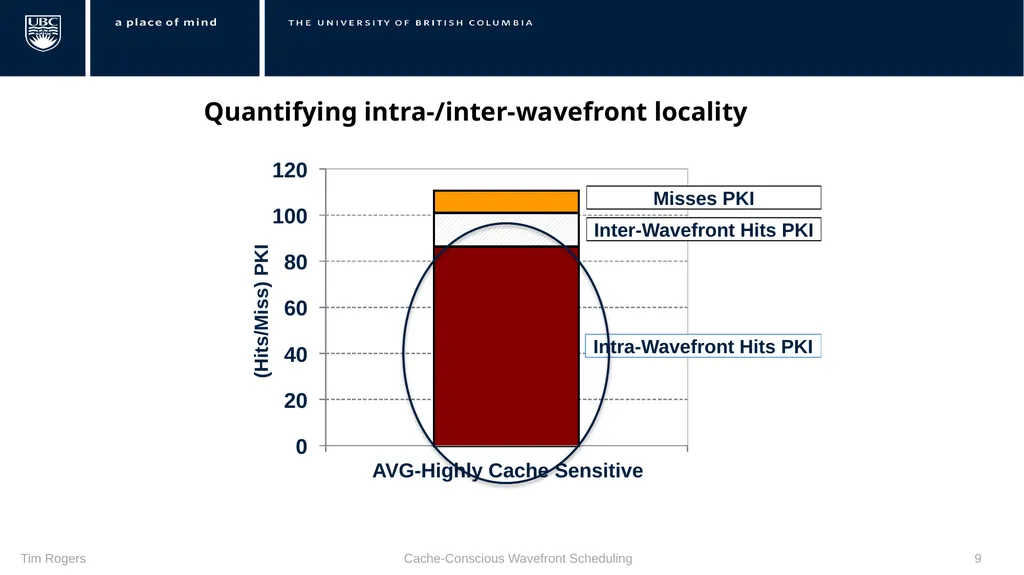
slide9. 0 20 40 60 80 100 120 AVG-Highly Cache Sensitive (Hits/Miss) PKI Misses PKI Inter-Wavefront Hits PKI Intra-Wavefront Hits PKI Quantifying intra-/inter-wavefront locality<br>
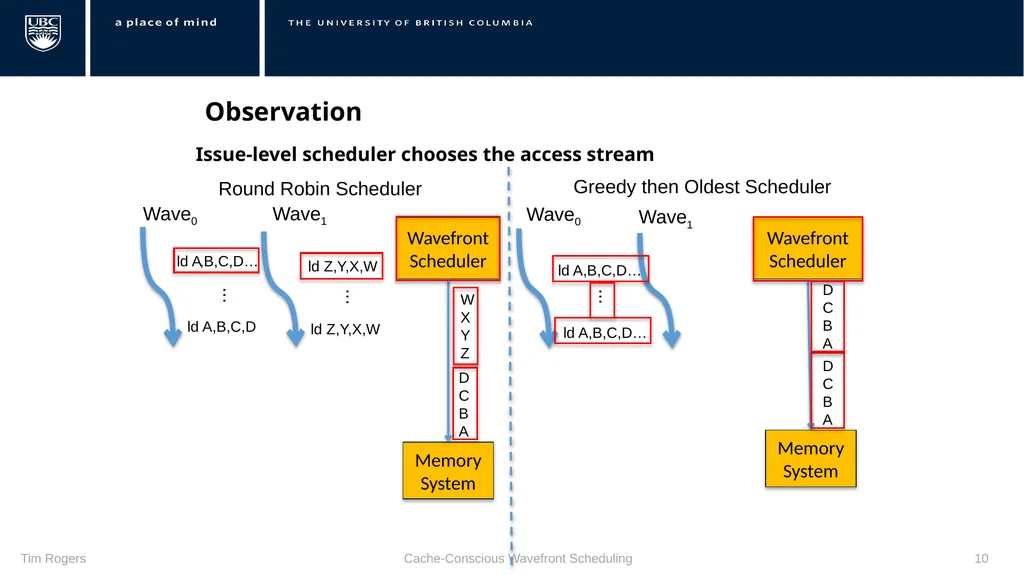
slide10. Observation Issue-level scheduler chooses the access stream Memory System Wavefront Scheduler Wavefront Scheduler Round Robin Scheduler Memory System Greedy then Oldest Scheduler ld A ,B,C,D… DC
B
A ld Z,Y,X,W ld A,B,C,D WX
Y
Z ... ... ld Z,Y,X,W DC
B
A DC
B
A ld A,B,C,D… ... Wave0 Wave1 Wave0 Wave1 ld A,B,C,D…<br>
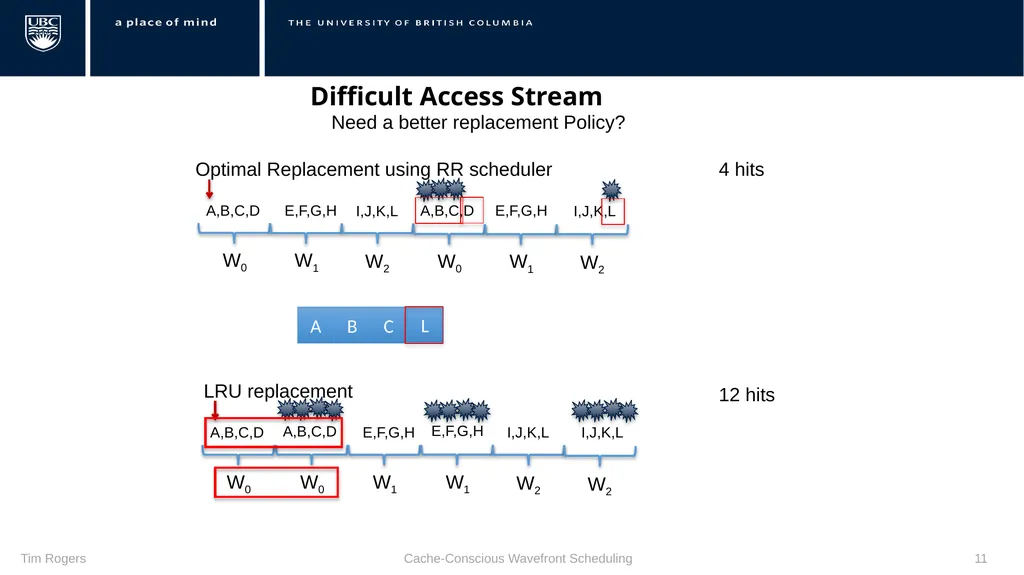
slide11. A,B,C,D E,F,G,H I,J,K,L A,B,C,D E,F,G,H I,J,K,L W0 W1 W2 W0 W1 W2 Optimal Replacement using RR scheduler LRU replacement A,B,C,D W0 A,B,C,D W0 E,F,G,H W1 E,F,G,H W1 I,J,K,L W2 I,J,K,L W2 A B C D 4 hits 12 hits E F L Difficult Access Stream Need a better replacement Policy?<br>
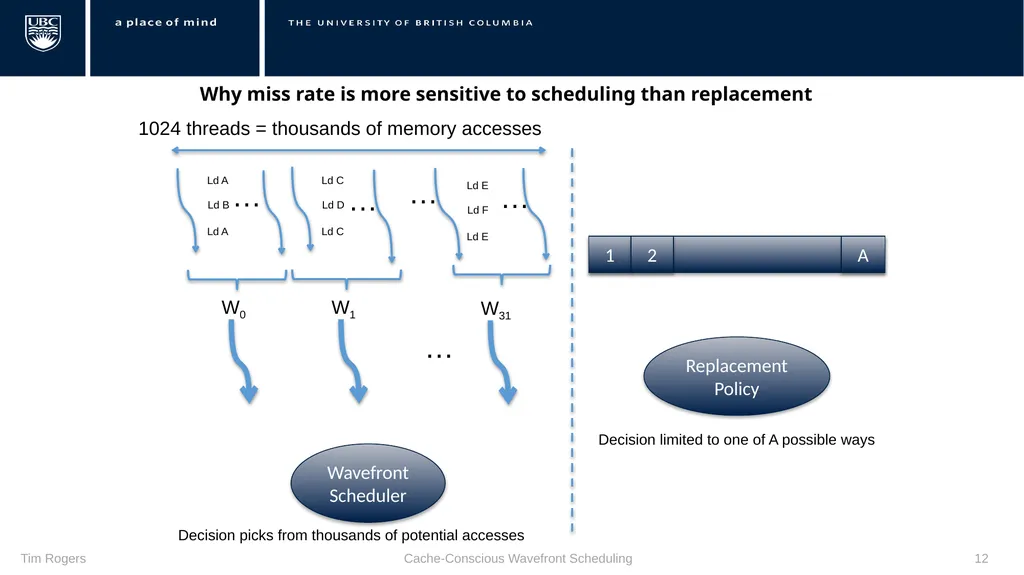
slide12. Why miss rate is more sensitive to scheduling than replacement … 1024 threads = thousands of memory accesses … … … 1 2 A Wavefront Scheduler Replacement Policy Ld A Ld A Ld B Ld C Ld C Ld D Ld E Ld E Ld F W0 W1 W31 Decision picks from thousands of potential accesses Decision limited to one of A possible ways …<br>
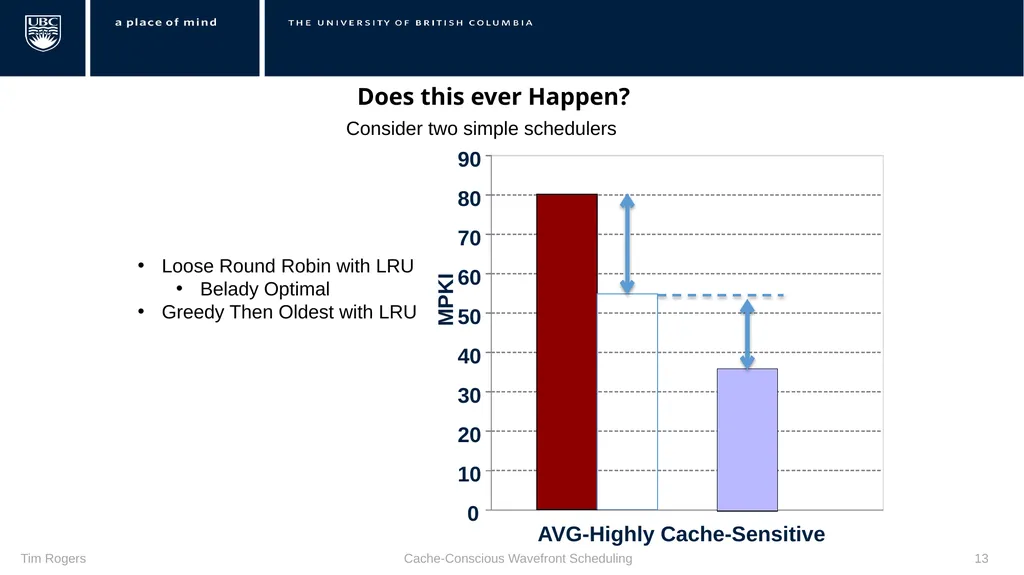
slide13. Does this ever Happen? Loose Round Robin with LRU
Belady Optimal
Greedy Then Oldest with LRU Consider two simple schedulers MPKI<br>
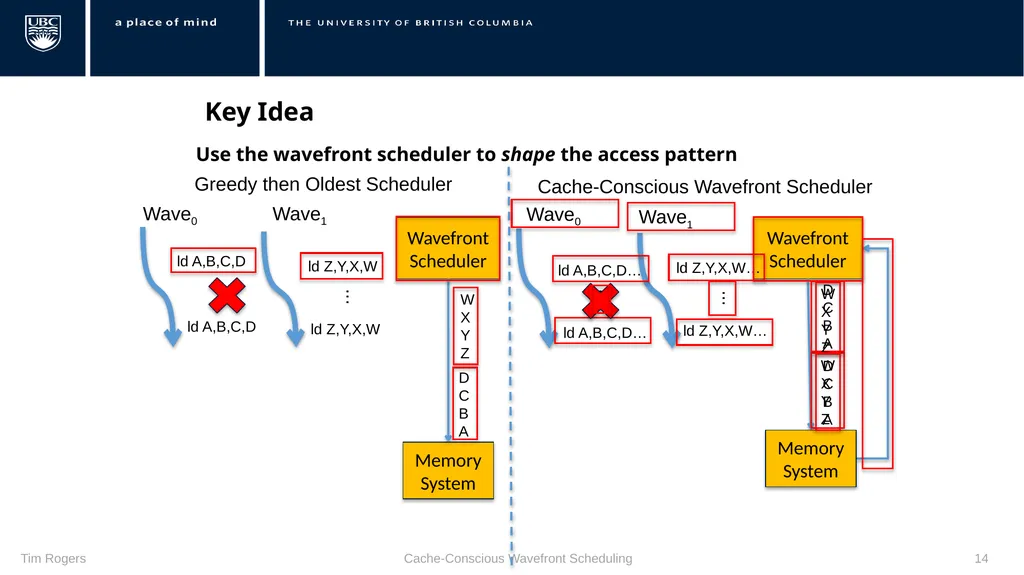
slide14. Key Idea Use the wavefront scheduler to shape the access pattern Memory System Wavefront Scheduler Wavefront Scheduler Greedy then Oldest Scheduler Memory System Cache-Conscious Wavefront Scheduler ld A,B,C,D DC
B
A ld Z,Y,X,W ld A,B,C,D WX
Y
Z ... ... ld Z,Y,X,W DC
B
A DC
B
A ld Z,Y,X,W… ld A,B,C,D… ... ... ld Z,Y,X,W… Wave0 Wave1 Wave0 Wave1 ld A,B,C,D… WX
Y
Z WX
Y
Z<br>
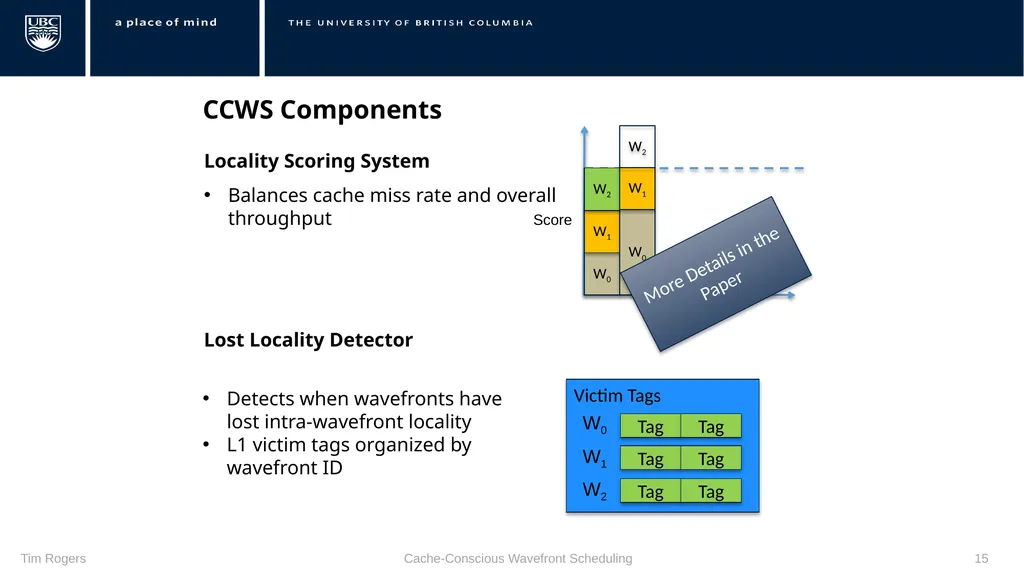
slide15. Time CCWS Components Locality Scoring System Balances cache miss rate and overall throughput Lost Locality Detector W0 W1 W2 W0 W1 W2 Victim Tags Tag Tag Tag Tag Tag Tag W0 W1 W2 Detects when wavefronts have lost intra-wavefront locality
L1 victim tags organized by wavefront ID More Details in the Paper Score<br>
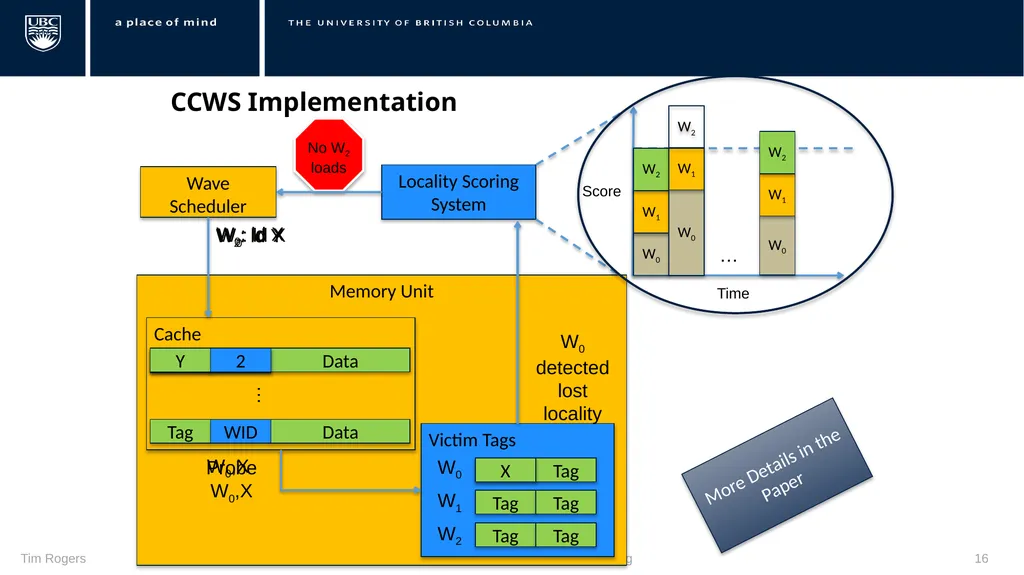
slide16. CCWS Implementation Memory Unit Cache Victim Tags Locality Scoring System Wave Scheduler W0 W1 W2 Tag WID Data Tag Tag Tag Tag Tag Tag W0 W1 W2 Time Score Tag WID Data … W0 W1 W2 No W2 loads W0 W1 W2 … W0: ld X X 0 W0,X X W0detected lost locality W2: ld Y W0: ld X ProbeW0,X Y 2 More Details in the Paper<br>
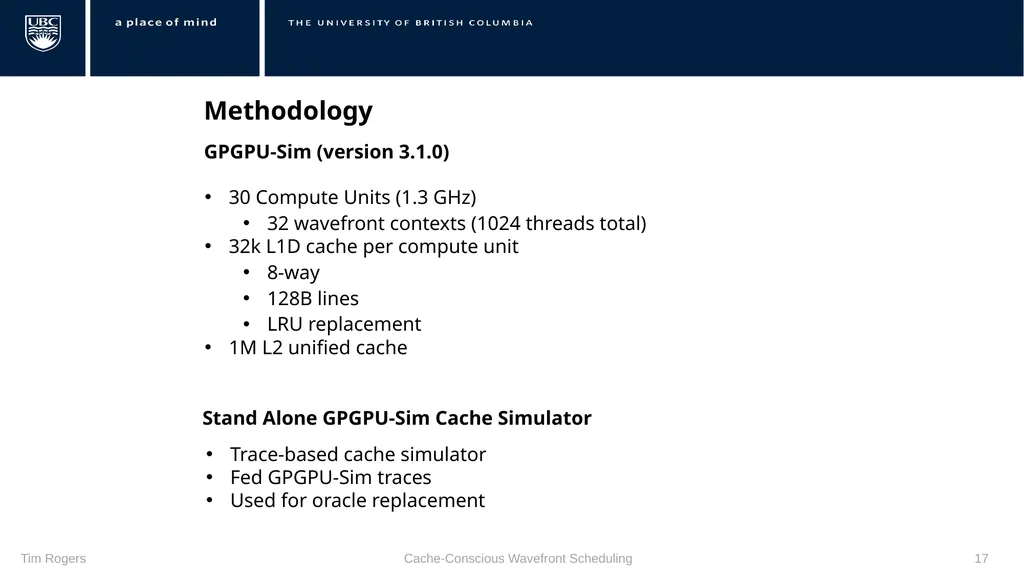
slide17. Methodology GPGPU-Sim (version 3.1.0) 30 Compute Units (1.3 GHz)
32 wavefront contexts (1024 threads total)
32k L1D cache per compute unit
8-way
128B lines
LRU replacement
1M L2 unified cache Stand Alone GPGPU-Sim Cache Simulator Trace-based cache simulator
Fed GPGPU-Sim traces
Used for oracle replacement<br>
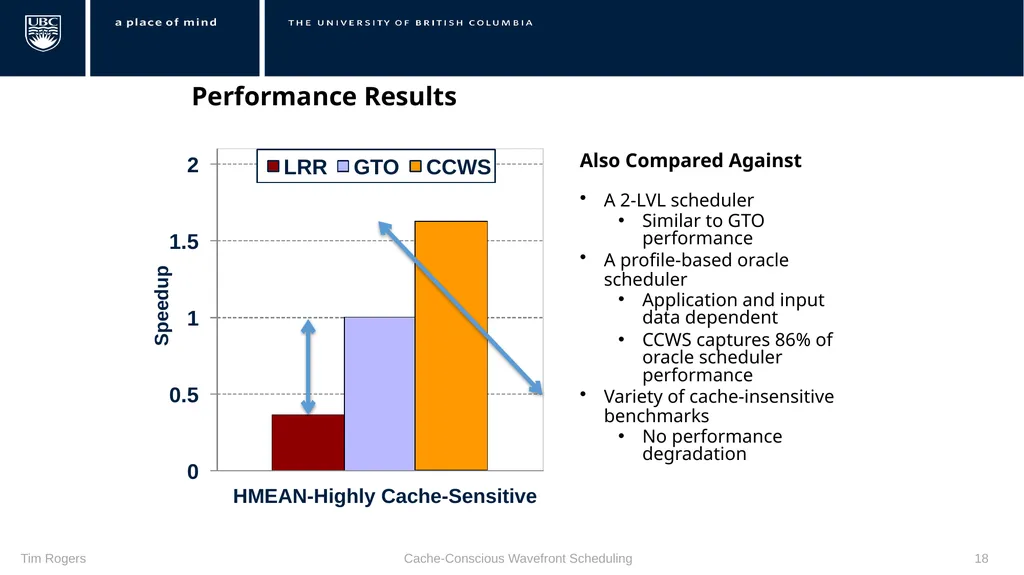
slide18. Performance Results Also Compared Against A 2-LVL scheduler
Similar to GTO performance
A profile-based oracle scheduler
Application and input data dependent
CCWS captures 86% of oracle scheduler performance
Variety of cache-insensitive benchmarks
No performance degradation 0 0.5 1 1.5 2 HMEAN-Highly Cache-Sensitive Speedup LRR GTO CCWS<br>
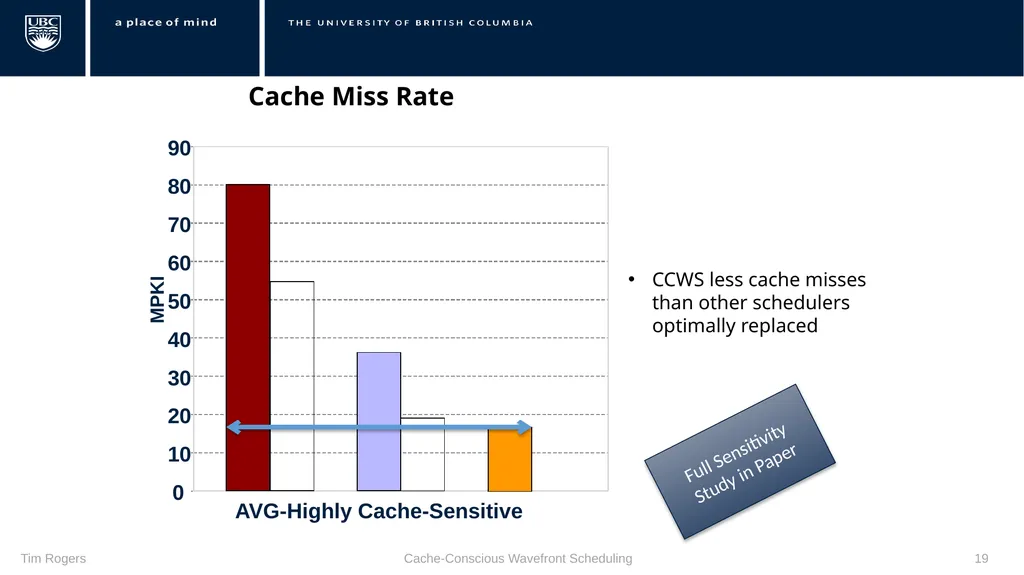
slide19. Cache Miss Rate CCWS less cache misses than other schedulers optimally replaced Full Sensitivity Study in Paper MPKI<br>
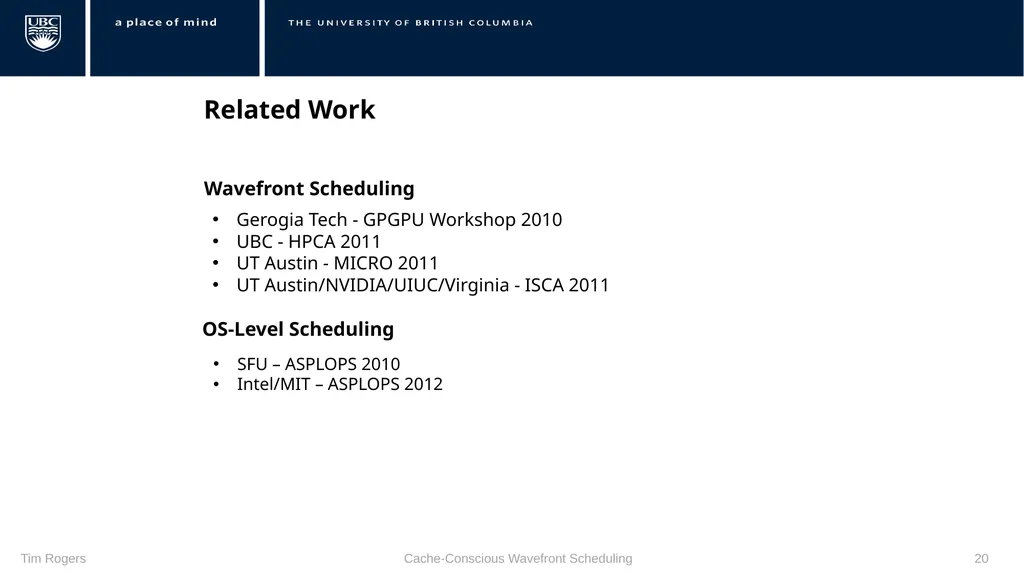
slide20. Related Work Wavefront Scheduling Gerogia Tech - GPGPU Workshop 2010
UBC - HPCA 2011
UT Austin - MICRO 2011
UT Austin/NVIDIA/UIUC/Virginia - ISCA 2011 OS-Level Scheduling SFU – ASPLOPS 2010
Intel/MIT – ASPLOPS 2012<br>
slide21. Conclusion Different approach to fine-grained cache management
Good for power and performance
High level insight not tied specifics of a GPU
Any system with many threads sharing a cache can potentially benefit Questions?<br>

slide2. Loose Round Robin (LRR) Goes around to every warp and issue if ready (R)
If warp is not ready (W), skip and issue next ready warp
Issue: Warps all run at the same speed,potentially all reaching memory accessphase together and stalling. R R W R R R R Select All Warps Execution Units W . . .<br>
slide3. Two-level (TL) Warps are grouped into two groups:
Pending warps (potentially waiting on long latency instr.)
Active warps (Ready to execute)
Warps move between Pending and Active groups
Within the Active group, issue LRR
Goal: Overlap warps performing computationwith warps performing memory access<br>
slide4. Greedy-then-oldest (GTO) Schedule from a single warp until it stalls
Then pick the oldest warp (time warp assigned to core)
Goal: Improve cache locality for greedy warp R R W R R R R Select All Warps Execution Units W . . .<br>
slide5. Cache-Conscious Wavefront Scheduling Timothy G. Rogers1
Mike O’Connor2
Tor M. Aamodt1 1The University of British Columbia
2AMD Research<br>
slide6. Compute Unit DRAM DRAM Wavefronts and Caches Threads in Wavefront Compute Unit W1 … … Wavefront Scheduler W2 DRAM … 10’s of thousands concurrent threads
High bandwidth memory system
Include data caches … ALU ALU ALU … … L2 cache Memory Unit L1D High Level Overview of a GPU<br>
slide7. Motivation Improve performance of highly parallel applications with irregular or data dependent access patterns on GPU These workloads can be highly cache-sensitive Increase 32k L1D to 8M
Minimum 3x speedup
Mean speedup >5x Breadth First Search (BFS)
K-Means (KMN)
Memcached-GPU (MEMC)
Parallel Garbage Collection (GC)<br>
slide8. Data Cache Data Cache Where does the locality come from? Classify two types of locality Intra-wavefront locality Inter-wavefront locality LD $line (X) LD $line (X) LD $line (X) LD $line (X) Wave0 Hit Wave0 Wave1 Hit<br>
slide9. 0 20 40 60 80 100 120 AVG-Highly Cache Sensitive (Hits/Miss) PKI Misses PKI Inter-Wavefront Hits PKI Intra-Wavefront Hits PKI Quantifying intra-/inter-wavefront locality<br>
slide10. Observation Issue-level scheduler chooses the access stream Memory System Wavefront Scheduler Wavefront Scheduler Round Robin Scheduler Memory System Greedy then Oldest Scheduler ld A ,B,C,D… DC
B
A ld Z,Y,X,W ld A,B,C,D WX
Y
Z ... ... ld Z,Y,X,W DC
B
A DC
B
A ld A,B,C,D… ... Wave0 Wave1 Wave0 Wave1 ld A,B,C,D…<br>
slide11. A,B,C,D E,F,G,H I,J,K,L A,B,C,D E,F,G,H I,J,K,L W0 W1 W2 W0 W1 W2 Optimal Replacement using RR scheduler LRU replacement A,B,C,D W0 A,B,C,D W0 E,F,G,H W1 E,F,G,H W1 I,J,K,L W2 I,J,K,L W2 A B C D 4 hits 12 hits E F L Difficult Access Stream Need a better replacement Policy?<br>
slide12. Why miss rate is more sensitive to scheduling than replacement … 1024 threads = thousands of memory accesses … … … 1 2 A Wavefront Scheduler Replacement Policy Ld A Ld A Ld B Ld C Ld C Ld D Ld E Ld E Ld F W0 W1 W31 Decision picks from thousands of potential accesses Decision limited to one of A possible ways …<br>
slide13. Does this ever Happen? Loose Round Robin with LRU
Belady Optimal
Greedy Then Oldest with LRU Consider two simple schedulers MPKI<br>
slide14. Key Idea Use the wavefront scheduler to shape the access pattern Memory System Wavefront Scheduler Wavefront Scheduler Greedy then Oldest Scheduler Memory System Cache-Conscious Wavefront Scheduler ld A,B,C,D DC
B
A ld Z,Y,X,W ld A,B,C,D WX
Y
Z ... ... ld Z,Y,X,W DC
B
A DC
B
A ld Z,Y,X,W… ld A,B,C,D… ... ... ld Z,Y,X,W… Wave0 Wave1 Wave0 Wave1 ld A,B,C,D… WX
Y
Z WX
Y
Z<br>
slide15. Time CCWS Components Locality Scoring System Balances cache miss rate and overall throughput Lost Locality Detector W0 W1 W2 W0 W1 W2 Victim Tags Tag Tag Tag Tag Tag Tag W0 W1 W2 Detects when wavefronts have lost intra-wavefront locality
L1 victim tags organized by wavefront ID More Details in the Paper Score<br>
slide16. CCWS Implementation Memory Unit Cache Victim Tags Locality Scoring System Wave Scheduler W0 W1 W2 Tag WID Data Tag Tag Tag Tag Tag Tag W0 W1 W2 Time Score Tag WID Data … W0 W1 W2 No W2 loads W0 W1 W2 … W0: ld X X 0 W0,X X W0detected lost locality W2: ld Y W0: ld X ProbeW0,X Y 2 More Details in the Paper<br>
slide17. Methodology GPGPU-Sim (version 3.1.0) 30 Compute Units (1.3 GHz)
32 wavefront contexts (1024 threads total)
32k L1D cache per compute unit
8-way
128B lines
LRU replacement
1M L2 unified cache Stand Alone GPGPU-Sim Cache Simulator Trace-based cache simulator
Fed GPGPU-Sim traces
Used for oracle replacement<br>
slide18. Performance Results Also Compared Against A 2-LVL scheduler
Similar to GTO performance
A profile-based oracle scheduler
Application and input data dependent
CCWS captures 86% of oracle scheduler performance
Variety of cache-insensitive benchmarks
No performance degradation 0 0.5 1 1.5 2 HMEAN-Highly Cache-Sensitive Speedup LRR GTO CCWS<br>
slide19. Cache Miss Rate CCWS less cache misses than other schedulers optimally replaced Full Sensitivity Study in Paper MPKI<br>
slide20. Related Work Wavefront Scheduling Gerogia Tech - GPGPU Workshop 2010
UBC - HPCA 2011
UT Austin - MICRO 2011
UT Austin/NVIDIA/UIUC/Virginia - ISCA 2011 OS-Level Scheduling SFU – ASPLOPS 2010
Intel/MIT – ASPLOPS 2012<br>
slide21. Conclusion Different approach to fine-grained cache management
Good for power and performance
High level insight not tied specifics of a GPU
Any system with many threads sharing a cache can potentially benefit Questions?<br>