
Warren J. DeLuca Assistant General Counsel
BR
Published · 58 slides · 0 views

1 / 1


Description
Warren J. DeLuca Assistant General Counsel Business Law IP Practice Group 1 Contracts Training November 8, 2012 The Texas AM University System Office of General Counsel The Texas AM University System Office of General Counsel Business
Related Topics
Share
Embed code
Download this presentation From Below
"Warren J. DeLuca Assistant General Counsel" is the property of its rightful owner. Permission is granted to download and print the materials on this website for personal, non-commercial use only, and to display it on your personal computer provided you do not modify the materials and that you retain all copyright notices contained in the materials. By downloading content from our website, you accept the terms of this agreement.
Presentation Transcript
01
Warren J. DeLuca
Assistant General Counsel
Business Law & IP Practice Group 1 Contracts Training
November 8, 2012 The Texas A&M University System
Office of General Counsel<br>
Assistant General Counsel
Business Law & IP Practice Group 1 Contracts Training
November 8, 2012 The Texas A&M University System
Office of General Counsel<br>
02
The Texas A&M University System
Office of General Counsel
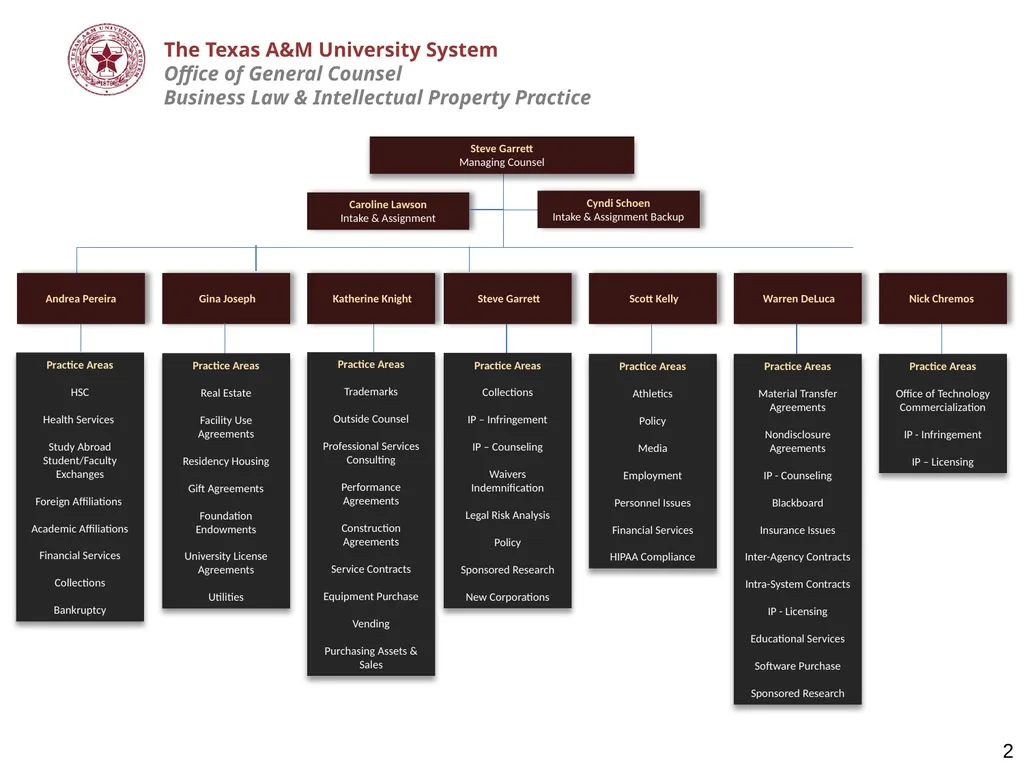
Business Law & Intellectual Property Practice Steve Garrett Managing Counsel Caroline Lawson Intake & Assignment Cyndi Schoen Intake & Assignment Backup Andrea Pereira Gina Joseph Katherine Knight Steve Garrett Scott Kelly Warren DeLuca Nick Chremos Practice Areas
HSC
Health Services
Study Abroad Student/Faculty Exchanges
Foreign Affiliations
Academic Affiliations
Financial Services
Collections
Bankruptcy Practice Areas
Real Estate
Facility Use Agreements
Residency Housing
Gift Agreements
Foundation Endowments
University License Agreements
Utilities Practice Areas
Trademarks
Outside Counsel
Professional Services Consulting
Performance Agreements
Construction Agreements
Service Contracts
Equipment Purchase
Vending
Purchasing Assets & Sales Practice Areas
Collections
IP – Infringement
IP – Counseling
Waivers Indemnification
Legal Risk Analysis
Policy
Sponsored Research
New Corporations Practice Areas
Athletics
Policy
Media
Employment
Personnel Issues
Financial Services
HIPAA Compliance Practice Areas
Material Transfer Agreements
Nondisclosure Agreements
IP - Counseling
Blackboard
Insurance Issues
Inter-Agency Contracts
Intra-System Contracts
IP - Licensing
Educational Services
Software Purchase
Sponsored Research Practice Areas
Office of Technology Commercialization
IP - Infringement
IP – Licensing 2<br>
Office of General Counsel
Business Law & Intellectual Property Practice Steve Garrett Managing Counsel Caroline Lawson Intake & Assignment Cyndi Schoen Intake & Assignment Backup Andrea Pereira Gina Joseph Katherine Knight Steve Garrett Scott Kelly Warren DeLuca Nick Chremos Practice Areas
HSC
Health Services
Study Abroad Student/Faculty Exchanges
Foreign Affiliations
Academic Affiliations
Financial Services
Collections
Bankruptcy Practice Areas
Real Estate
Facility Use Agreements
Residency Housing
Gift Agreements
Foundation Endowments
University License Agreements
Utilities Practice Areas
Trademarks
Outside Counsel
Professional Services Consulting
Performance Agreements
Construction Agreements
Service Contracts
Equipment Purchase
Vending
Purchasing Assets & Sales Practice Areas
Collections
IP – Infringement
IP – Counseling
Waivers Indemnification
Legal Risk Analysis
Policy
Sponsored Research
New Corporations Practice Areas
Athletics
Policy
Media
Employment
Personnel Issues
Financial Services
HIPAA Compliance Practice Areas
Material Transfer Agreements
Nondisclosure Agreements
IP - Counseling
Blackboard
Insurance Issues
Inter-Agency Contracts
Intra-System Contracts
IP - Licensing
Educational Services
Software Purchase
Sponsored Research Practice Areas
Office of Technology Commercialization
IP - Infringement
IP – Licensing 2<br>
03
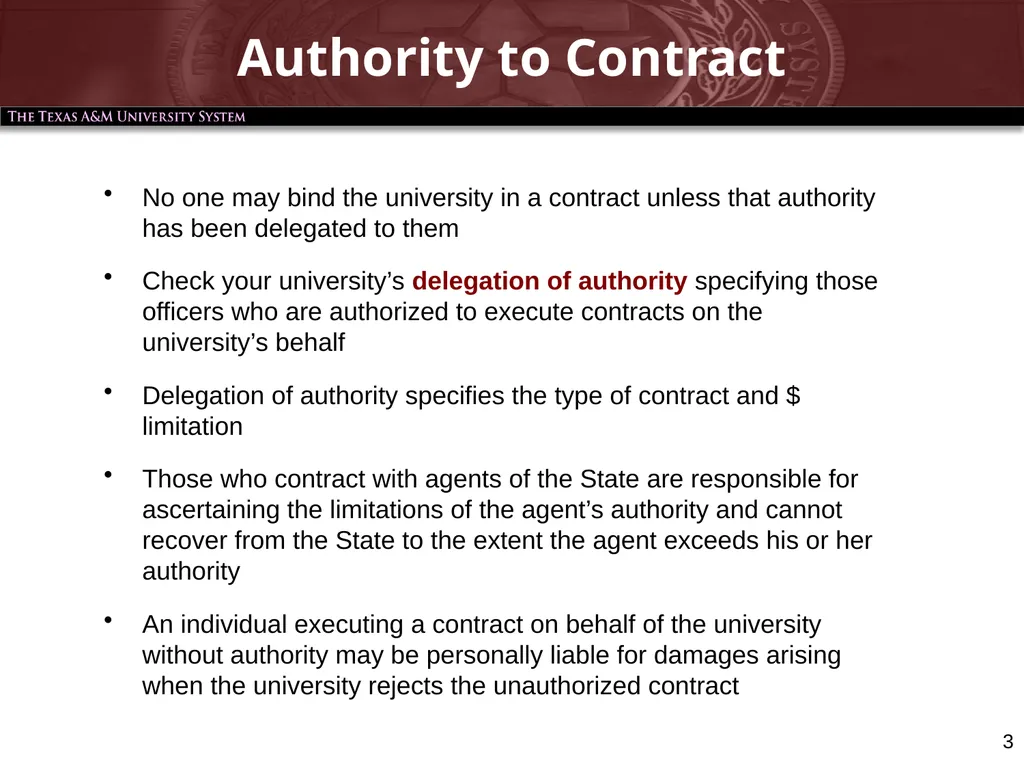
Authority to Contract 3 No one may bind the university in a contract unless that authority has been delegated to them
Check your university’s delegation of authority specifying those officers who are authorized to execute contracts on the university’s behalf
Delegation of authority specifies the type of contract and $ limitation
Those who contract with agents of the State are responsible for ascertaining the limitations of the agent’s authority and cannot recover from the State to the extent the agent exceeds his or her authority
An individual executing a contract on behalf of the university without authority may be personally liable for damages arising when the university rejects the unauthorized contract<br>
Check your university’s delegation of authority specifying those officers who are authorized to execute contracts on the university’s behalf
Delegation of authority specifies the type of contract and $ limitation
Those who contract with agents of the State are responsible for ascertaining the limitations of the agent’s authority and cannot recover from the State to the extent the agent exceeds his or her authority
An individual executing a contract on behalf of the university without authority may be personally liable for damages arising when the university rejects the unauthorized contract<br>
04
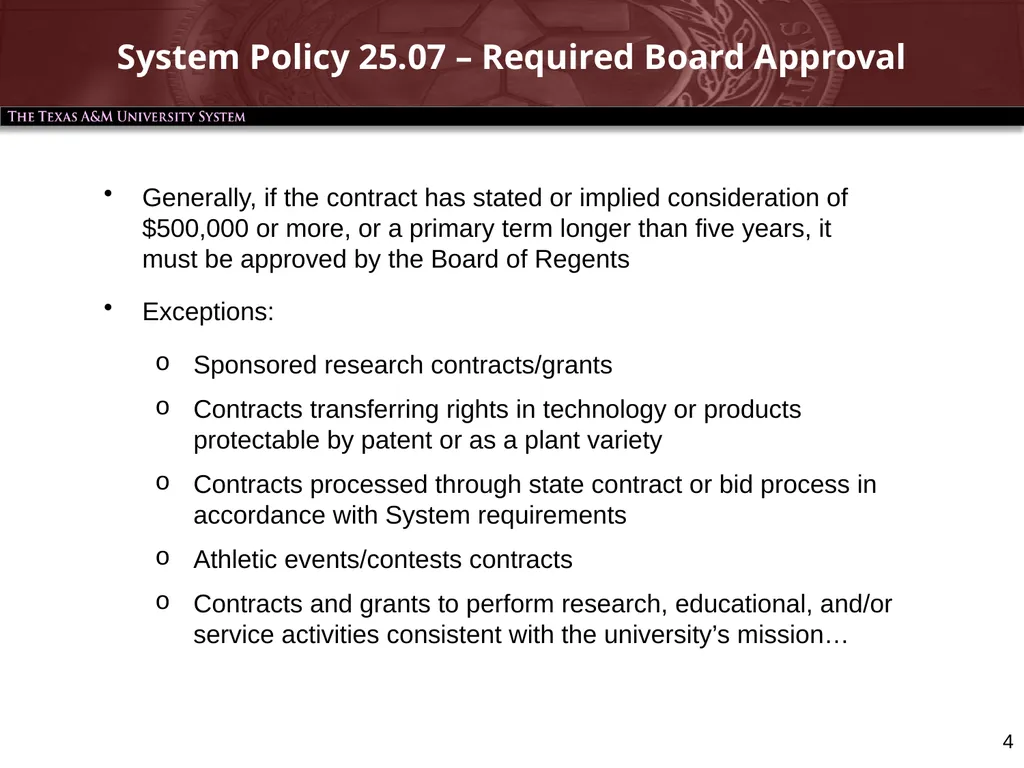
System Policy 25.07 – Required Board Approval 4 Generally, if the contract has stated or implied consideration of $500,000 or more, or a primary term longer than five years, it must be approved by the Board of Regents
Exceptions:
Sponsored research contracts/grants
Contracts transferring rights in technology or products protectable by patent or as a plant variety
Contracts processed through state contract or bid process in accordance with System requirements
Athletic events/contests contracts
Contracts and grants to perform research, educational, and/or service activities consistent with the university’s mission…<br>
Exceptions:
Sponsored research contracts/grants
Contracts transferring rights in technology or products protectable by patent or as a plant variety
Contracts processed through state contract or bid process in accordance with System requirements
Athletic events/contests contracts
Contracts and grants to perform research, educational, and/or service activities consistent with the university’s mission…<br>
05
System Policy 25.07 – Required OGC Review 5 All contracts must be submitted to OGC for review as to form and legal sufficiency, except:
Unaltered form contracts approved by OGC within the last 3 years
Contracts involving a stated or implied consideration of $50,000 or less, if reviewed by the university in accordance with guidelines recommended by OGC and approved by the chancellor<br>
Unaltered form contracts approved by OGC within the last 3 years
Contracts involving a stated or implied consideration of $50,000 or less, if reviewed by the university in accordance with guidelines recommended by OGC and approved by the chancellor<br>
06
Approved Forms OGC has approved several forms
Use standard form for first draft
May save time and effort
Start with a “clean” form every time if possible
Forms need to be re-approved every three years 6<br>
Use standard form for first draft
May save time and effort
Start with a “clean” form every time if possible
Forms need to be re-approved every three years 6<br>
07
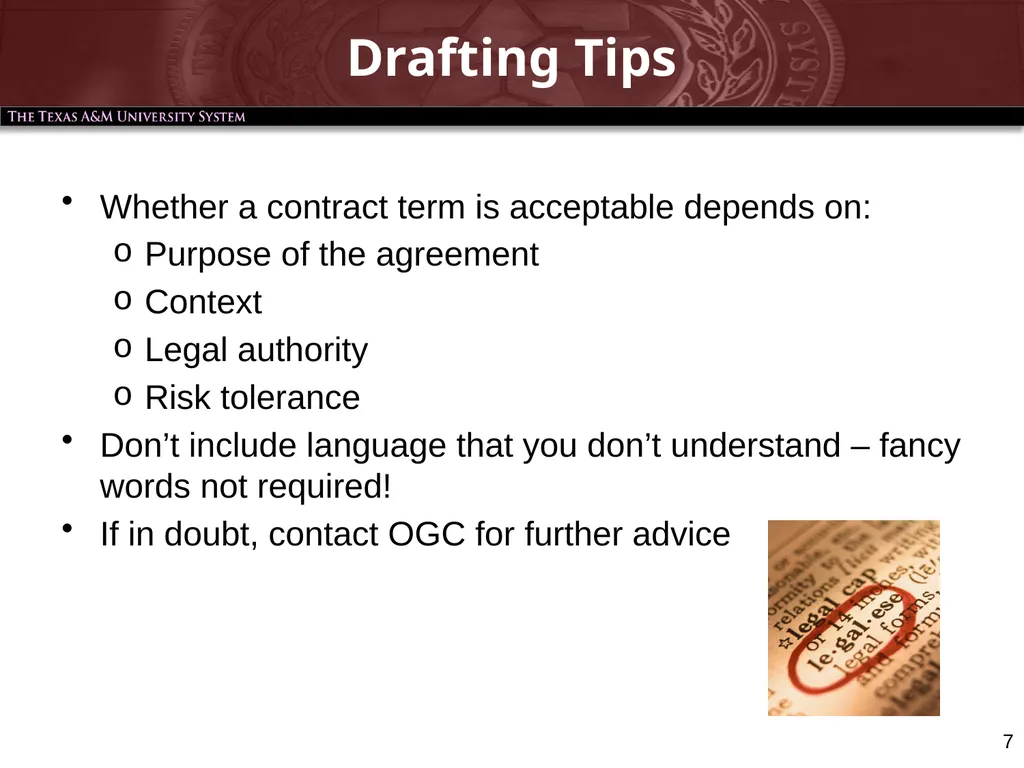
Drafting Tips Whether a contract term is acceptable depends on:
Purpose of the agreement
Context
Legal authority
Risk tolerance
Don’t include language that you don’t understand – fancy words not required!
If in doubt, contact OGC for further advice 7<br>
Purpose of the agreement
Context
Legal authority
Risk tolerance
Don’t include language that you don’t understand – fancy words not required!
If in doubt, contact OGC for further advice 7<br>
08
Drafting Tips 8 Ambiguity vs. vagueness
Ambiguous: Word, phrase, or provision can be interpreted to mean two or more different things
Vague: Lack of specificity, may be appropriate in certain circumstances – “reasonable” time, etc.<br>
Ambiguous: Word, phrase, or provision can be interpreted to mean two or more different things
Vague: Lack of specificity, may be appropriate in certain circumstances – “reasonable” time, etc.<br>
09
Contract Checklist Spelling, formatting, grammar, punctuation, and general appearance of document are professional and accurate
All exhibits, attachments, appendices, schedules, etc. attached? 9<br>
All exhibits, attachments, appendices, schedules, etc. attached? 9<br>
10
A contract by any other name
is still a contract Purchase Order
Memorandum of Understanding
Letter of Intent
Letter of Understanding
Letter Agreement
Release/Waiver 10<br>
Memorandum of Understanding
Letter of Intent
Letter of Understanding
Letter Agreement
Release/Waiver 10<br>
11
Nonbinding “Agreements” Often called “Memorandum of Understanding” or “Letter of Intent”
If you don’t intend it to be binding, say so!
Use “soft” verbs which don’t create specific obligations:
“Collaborate”
“Investigate/identify opportunities”
“Discuss” 11<br>
If you don’t intend it to be binding, say so!
Use “soft” verbs which don’t create specific obligations:
“Collaborate”
“Investigate/identify opportunities”
“Discuss” 11<br>
12
Introduction A contract should identify the parties to the contract using their correct legal name:
“This Agreement is entered into as of the [Day, Month, Year], between Texas A&M University-Corpus Christi (“TAMUCC”), a member of The Texas A&M University System, an agency of the State of Texas, and [Full Corporate Name] (“[Short Name]”), a [Type of Entity]” 12<br>
“This Agreement is entered into as of the [Day, Month, Year], between Texas A&M University-Corpus Christi (“TAMUCC”), a member of The Texas A&M University System, an agency of the State of Texas, and [Full Corporate Name] (“[Short Name]”), a [Type of Entity]” 12<br>
13
Introduction Contracting party’s full legal name?
Verify full legal name
Be consistent
Same name in the signature block
Include any relevant background information at the beginning (recitals), not in the body of the contract
Define key terms 13<br>
Verify full legal name
Be consistent
Same name in the signature block
Include any relevant background information at the beginning (recitals), not in the body of the contract
Define key terms 13<br>
14
Scope of Work 14 Description of services to be performed, items to be delivered, etc.
Clear and understandable description of the subject of the contract
If a proposal or similar document is attached as the statement of work, make sure that it is consistent with the body of the contract<br>
Clear and understandable description of the subject of the contract
If a proposal or similar document is attached as the statement of work, make sure that it is consistent with the body of the contract<br>
15
Contractor Responsibilities Clearly list the rights and duties of each party
Each party’s responsibilities identified in understandable wording
Use the active voice to the extent possible: “Contractor shall provide the services…” not “The services shall be provided…” 15<br>
Each party’s responsibilities identified in understandable wording
Use the active voice to the extent possible: “Contractor shall provide the services…” not “The services shall be provided…” 15<br>
16
Term/Termination Date contract is to begin?
This may or may not be the date the contract is signed
Date contract ends?
The date the contract will end unless terminated earlier (usually must be five years or less)
Procedure for renewal clearly identified and understood?
Beware of automatic renewal or “evergreen” clauses
Procedure for termination clearly identified and understood?
Termination for breach should be identified
Termination for convenience? 16<br>
This may or may not be the date the contract is signed
Date contract ends?
The date the contract will end unless terminated earlier (usually must be five years or less)
Procedure for renewal clearly identified and understood?
Beware of automatic renewal or “evergreen” clauses
Procedure for termination clearly identified and understood?
Termination for breach should be identified
Termination for convenience? 16<br>
17
Consideration/Price Clear description of amounts of money or other consideration for contract?
Place, time and method of payment should be clear; amounts tied to other amounts (percentages, etc.) should be stated in clear terms
All payments should be in U.S. Dollars 17<br>
Place, time and method of payment should be clear; amounts tied to other amounts (percentages, etc.) should be stated in clear terms
All payments should be in U.S. Dollars 17<br>
18
Alternative Dispute Resolution
(ADR) Chapter 2260 of the Government Code
Applies to all written contracts between a unit of state government and a contractor for goods or services or certain construction projects
Describes a procedure that a contractor must follow for breach of contract claims against the State
Gives the contractor a process for resolving a claim that may otherwise be barred by sovereign immunity 18<br>
Applies to all written contracts between a unit of state government and a contractor for goods or services or certain construction projects
Describes a procedure that a contractor must follow for breach of contract claims against the State
Gives the contractor a process for resolving a claim that may otherwise be barred by sovereign immunity 18<br>
19
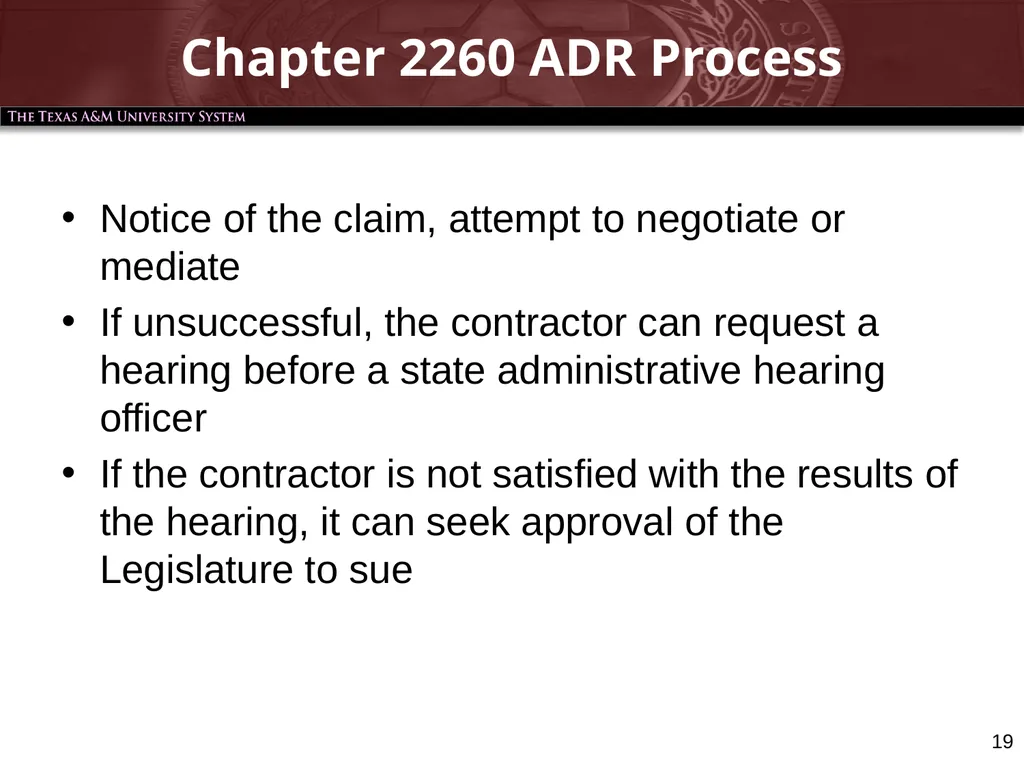
Chapter 2260 ADR Process Notice of the claim, attempt to negotiate or mediate
If unsuccessful, the contractor can request a hearing before a state administrative hearing officer
If the contractor is not satisfied with the results of the hearing, it can seek approval of the Legislature to sue 19<br>
If unsuccessful, the contractor can request a hearing before a state administrative hearing officer
If the contractor is not satisfied with the results of the hearing, it can seek approval of the Legislature to sue 19<br>
20
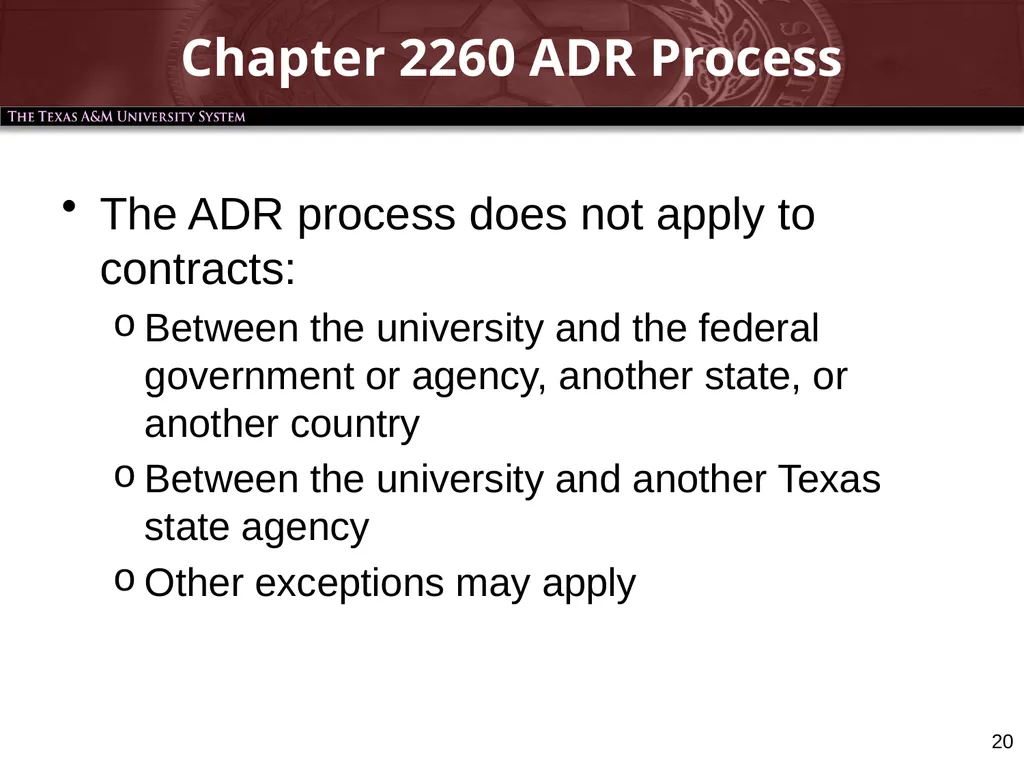
Chapter 2260 ADR Process The ADR process does not apply to contracts:
Between the university and the federal government or agency, another state, or another country
Between the university and another Texas state agency
Other exceptions may apply 20<br>
Between the university and the federal government or agency, another state, or another country
Between the university and another Texas state agency
Other exceptions may apply 20<br>
21
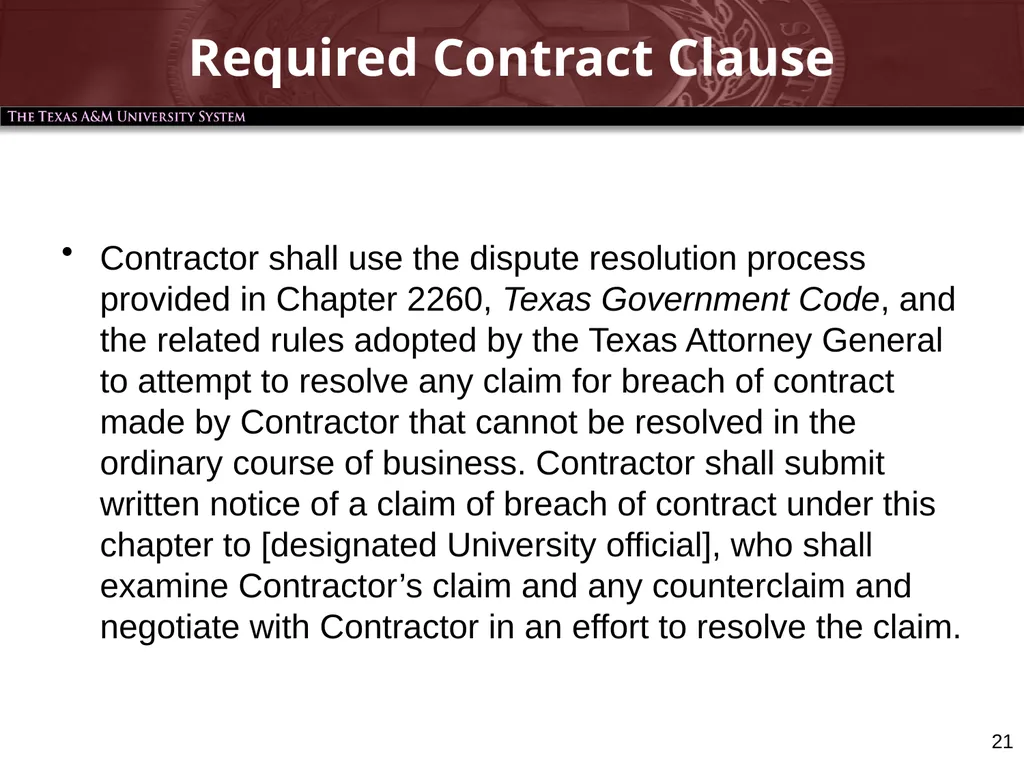
Required Contract Clause Contractor shall use the dispute resolution process provided in Chapter 2260, Texas Government Code, and the related rules adopted by the Texas Attorney General to attempt to resolve any claim for breach of contract made by Contractor that cannot be resolved in the ordinary course of business. Contractor shall submit written notice of a claim of breach of contract under this chapter to [designated University official], who shall examine Contractor’s claim and any counterclaim and negotiate with Contractor in an effort to resolve the claim. 21<br>
22
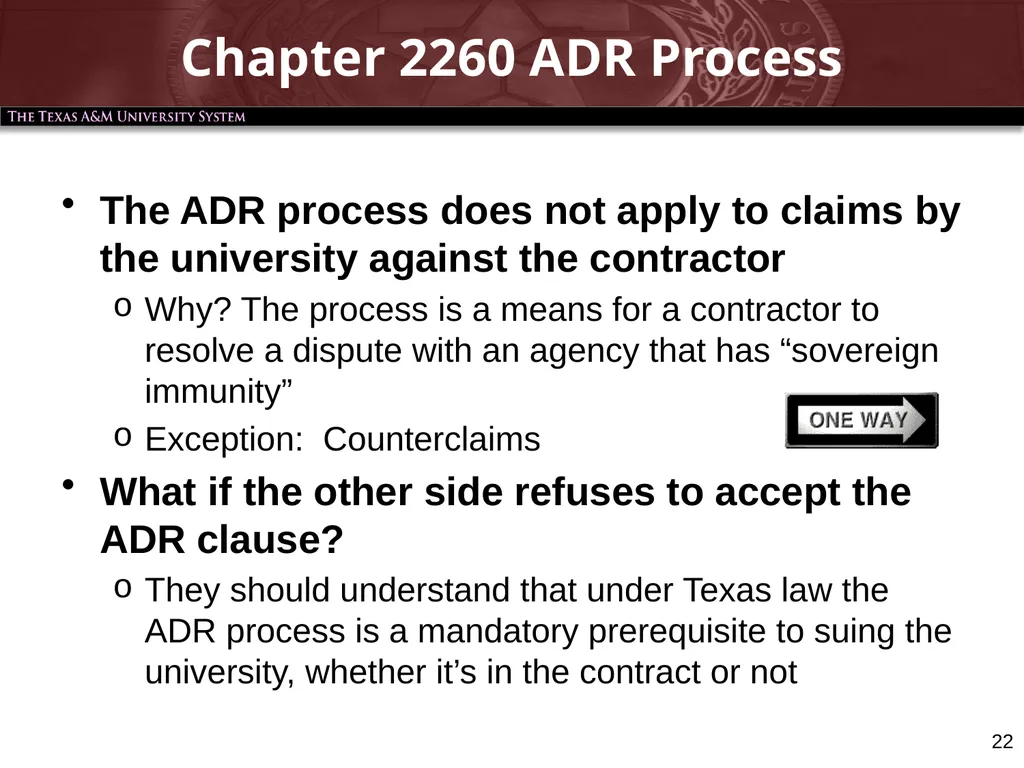
Chapter 2260 ADR Process The ADR process does not apply to claims by the university against the contractor
Why? The process is a means for a contractor to resolve a dispute with an agency that has “sovereign immunity”
Exception: Counterclaims
What if the other side refuses to accept the ADR clause?
They should understand that under Texas law the ADR process is a mandatory prerequisite to suing the university, whether it’s in the contract or not 22<br>
Why? The process is a means for a contractor to resolve a dispute with an agency that has “sovereign immunity”
Exception: Counterclaims
What if the other side refuses to accept the ADR clause?
They should understand that under Texas law the ADR process is a mandatory prerequisite to suing the university, whether it’s in the contract or not 22<br>
23
The university may agree to other non-binding ADR methods such as mediation, but not to binding arbitration
Exception: The university may agree to arbitration with foreign entities where:
The likelihood of getting the other party into a U.S. court is remote (no presence in U.S.)
The arbitration rules appear fair (such as UNCITRAL: United Nations Commission on International Trade Law) 23 Alternative Dispute Resolution<br>
Exception: The university may agree to arbitration with foreign entities where:
The likelihood of getting the other party into a U.S. court is remote (no presence in U.S.)
The arbitration rules appear fair (such as UNCITRAL: United Nations Commission on International Trade Law) 23 Alternative Dispute Resolution<br>
24
Indemnity Indemnity is an assurance by one party to compensate for the damage caused by another
The indemnifying party is responsible for paying the losses or damages incurred by the other that result from certain specified circumstances 24<br>
The indemnifying party is responsible for paying the losses or damages incurred by the other that result from certain specified circumstances 24<br>
25
Indemnity The Texas Constitution says that only the Legislature may create a “debt” on behalf of the State of Texas
An agreement by the university to indemnify is considered a debt because it creates liability or potential liability for the university
Such an agreement, unless qualified, would be invalid because it exceeds the authority granted to the university 25<br>
An agreement by the university to indemnify is considered a debt because it creates liability or potential liability for the university
Such an agreement, unless qualified, would be invalid because it exceeds the authority granted to the university 25<br>
26
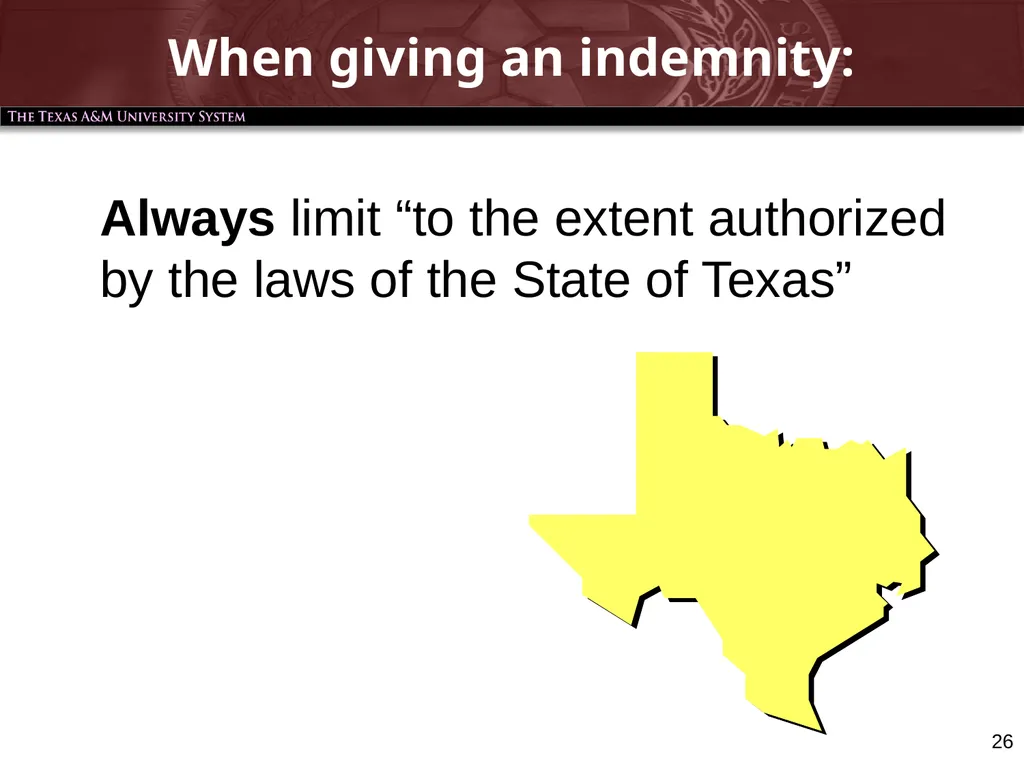
When giving an indemnity: Always limit “to the extent authorized by the laws of the State of Texas” 26<br>
27
None. Always advise the other party that this is the A&M System’s interpretation of the law. 27 To what extent is the university “authorized by the laws of the State of Texas” to indemnify? Indemnity<br>
28
When giving a qualified indemnity: Who?
Limit to losses caused only by the university and its employees, not its “agents”
What?
Limit to losses caused by (1) negligence and (2) willful misconduct
When?
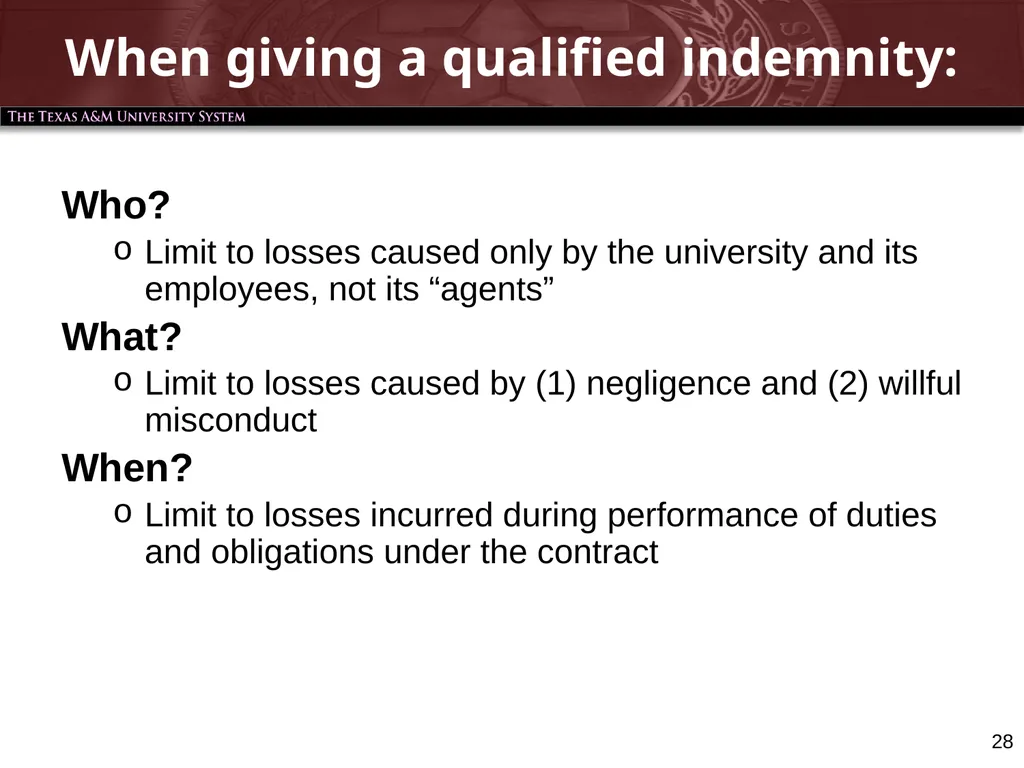
Limit to losses incurred during performance of duties and obligations under the contract 28<br>
Limit to losses caused only by the university and its employees, not its “agents”
What?
Limit to losses caused by (1) negligence and (2) willful misconduct
When?
Limit to losses incurred during performance of duties and obligations under the contract 28<br>
29
When giving a qualified indemnity: Never indemnify a party for the party’s own negligence or misconduct or the negligence or misconduct of a third party 29<br>
30
Sample indemnity a
sponsor might request University shall indemnify, defend, and hold harmless Company, its directors, officers, and employees from any third party claims related to University’s performance under this contract. 30<br>
31
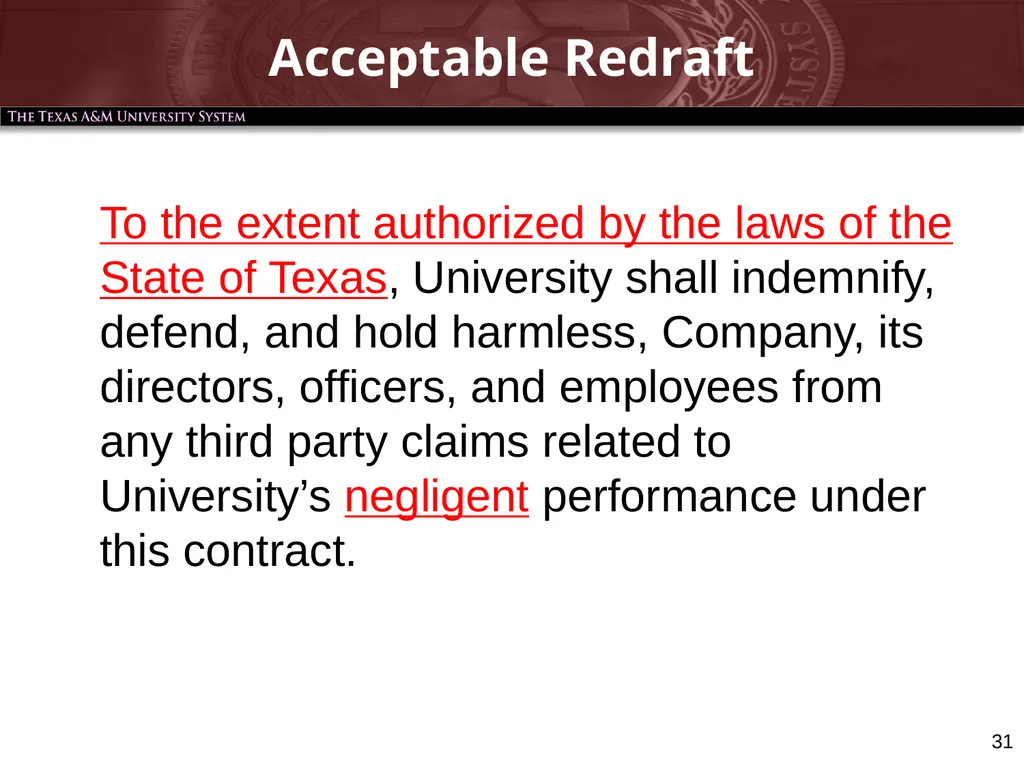
Acceptable Redraft To the extent authorized by the laws of the State of Texas, University shall indemnify, defend, and hold harmless, Company, its directors, officers, and employees from any third party claims related to University’s negligent performance under this contract. 31<br>
32
Security Interests The university may not agree to grant a security interest in property without the approval of the Texas Bond Review Board
Often in equipment lease-to-own agreements 32<br>
Often in equipment lease-to-own agreements 32<br>
33
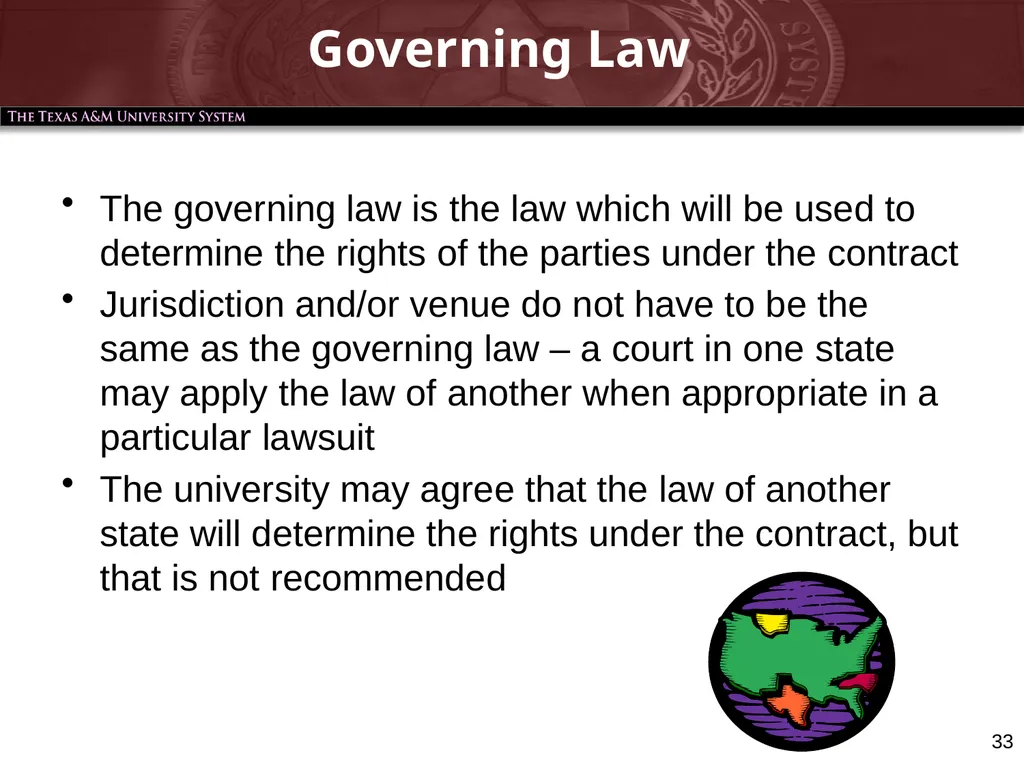
Governing Law The governing law is the law which will be used to determine the rights of the parties under the contract
Jurisdiction and/or venue do not have to be the same as the governing law – a court in one state may apply the law of another when appropriate in a particular lawsuit
The university may agree that the law of another state will determine the rights under the contract, but that is not recommended 33<br>
Jurisdiction and/or venue do not have to be the same as the governing law – a court in one state may apply the law of another when appropriate in a particular lawsuit
The university may agree that the law of another state will determine the rights under the contract, but that is not recommended 33<br>
34
Governing Law If a contract is governed by laws of a foreign country, local counsel may need to be consulted
Beware: Some foreign countries retain formalistic contract requirements
Contract must be read aloud from beginning to end by a notary
Contract must be bound by a ribbon which is affixed to both the cover page and the back page with a wax seal 34<br>
Beware: Some foreign countries retain formalistic contract requirements
Contract must be read aloud from beginning to end by a notary
Contract must be bound by a ribbon which is affixed to both the cover page and the back page with a wax seal 34<br>
35
Jurisdiction Jurisdiction is the power or authority of a court to hear a particular case and render a decision
Don’t agree to submit to the jurisdiction of any court – it could be viewed as a waiver of sovereign immunity
Can usually be worded to avoid this 35<br>
Don’t agree to submit to the jurisdiction of any court – it could be viewed as a waiver of sovereign immunity
Can usually be worded to avoid this 35<br>
36
Venue Venue is the particular place where a lawsuit may be brought and heard
Section 85.18 of the Texas Education Code:
Venue for a suit filed against the university must be in the county in which the primary office of the university’s chief executive officer is located
The university cannot agree to another venue for suits against it in Texas state court
This does not apply to suits in federal court or to suits filed by the university 36<br>
Section 85.18 of the Texas Education Code:
Venue for a suit filed against the university must be in the county in which the primary office of the university’s chief executive officer is located
The university cannot agree to another venue for suits against it in Texas state court
This does not apply to suits in federal court or to suits filed by the university 36<br>
37
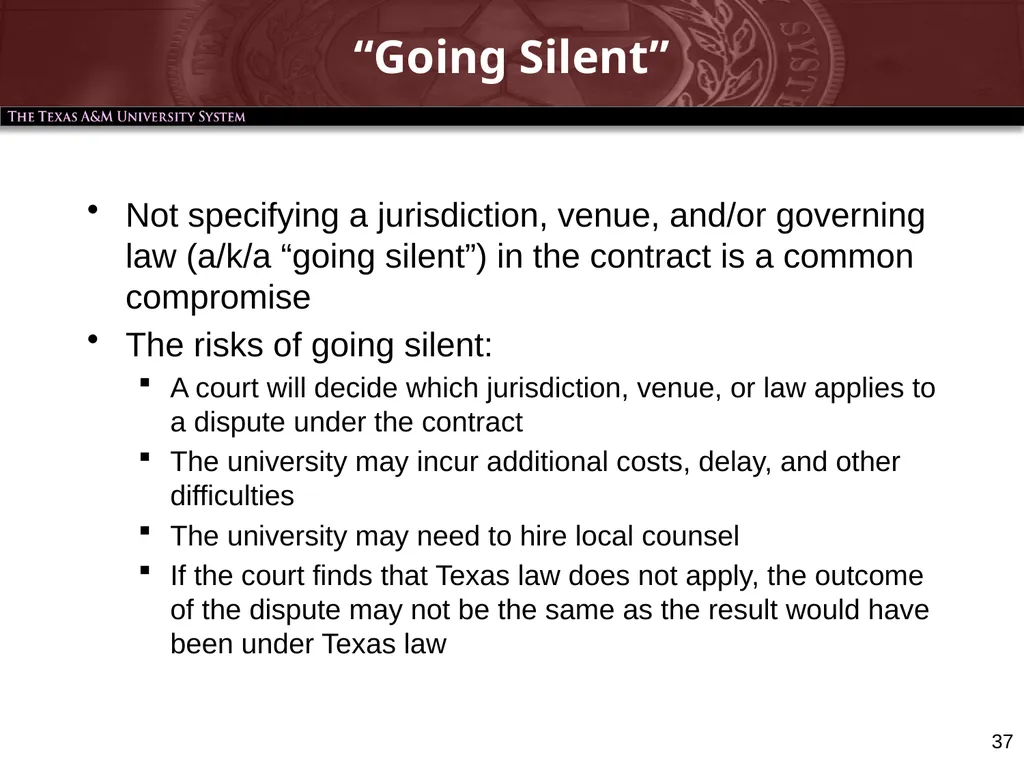
“Going Silent” Not specifying a jurisdiction, venue, and/or governing law (a/k/a “going silent”) in the contract is a common compromise
The risks of going silent:
A court will decide which jurisdiction, venue, or law applies to a dispute under the contract
The university may incur additional costs, delay, and other difficulties
The university may need to hire local counsel
If the court finds that Texas law does not apply, the outcome of the dispute may not be the same as the result would have been under Texas law 37<br>
The risks of going silent:
A court will decide which jurisdiction, venue, or law applies to a dispute under the contract
The university may incur additional costs, delay, and other difficulties
The university may need to hire local counsel
If the court finds that Texas law does not apply, the outcome of the dispute may not be the same as the result would have been under Texas law 37<br>
38
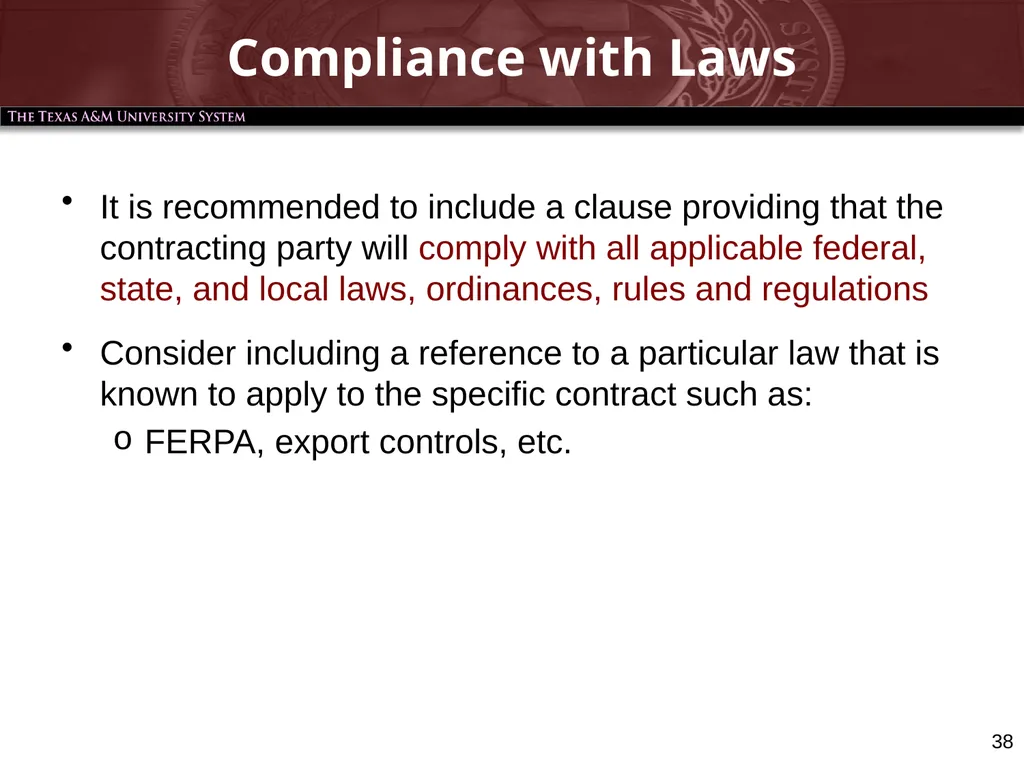
Compliance with Laws It is recommended to include a clause providing that the contracting party will comply with all applicable federal, state, and local laws, ordinances, rules and regulations
Consider including a reference to a particular law that is known to apply to the specific contract such as:
FERPA, export controls, etc. 38<br>
Consider including a reference to a particular law that is known to apply to the specific contract such as:
FERPA, export controls, etc. 38<br>
39
Relationship of the Parties State agencies may not enter into partnerships or joint ventures, because those involve sharing of losses
Avoid referring to the university as a “partner”
The following clause is recommended in most contracts:
The parties are independent contractors, and neither party is the agent of the other. This Agreement does not establish a partnership, joint venture, joint enterprise, or similar relationship. Contractor is liable for its own debts, obligations, acts, and omissions, including the payment of all required withholding, Social Security and other taxes or benefits of its employees. 39<br>
Avoid referring to the university as a “partner”
The following clause is recommended in most contracts:
The parties are independent contractors, and neither party is the agent of the other. This Agreement does not establish a partnership, joint venture, joint enterprise, or similar relationship. Contractor is liable for its own debts, obligations, acts, and omissions, including the payment of all required withholding, Social Security and other taxes or benefits of its employees. 39<br>
40
Loss of Funding The following clause is recommended for contracts in which the university is paying money, especially if they span biennia:
Performance by University under this Agreement may be dependent upon the appropriation and allotment of funds by the Texas State Legislature (“Legislature”). If the Legislature fails to appropriate or allot the necessary funds then University may issue written notice to Contractor and terminate this Agreement without further duty or obligation. Contractor acknowledges that appropriation of funds is beyond the control of University. 40<br>
Performance by University under this Agreement may be dependent upon the appropriation and allotment of funds by the Texas State Legislature (“Legislature”). If the Legislature fails to appropriate or allot the necessary funds then University may issue written notice to Contractor and terminate this Agreement without further duty or obligation. Contractor acknowledges that appropriation of funds is beyond the control of University. 40<br>
41
Audits The Texas State Auditor may audit purchases of goods or services by an institution of higher education
The following clause is recommended for contracts to purchase goods or services:
Contractor understands that acceptance of funds under this Agreement constitutes acceptance of the authority of the Texas State Auditor’s Office, or any successor agency (collectively, “Auditor”), to conduct an audit or investigation in connection with those funds under Section 51.9335(c) of the Texas Education Code. Contractor shall cooperate with the Auditor in the conduct of the audit or investigation, including without limitation providing all records requested. 41<br>
The following clause is recommended for contracts to purchase goods or services:
Contractor understands that acceptance of funds under this Agreement constitutes acceptance of the authority of the Texas State Auditor’s Office, or any successor agency (collectively, “Auditor”), to conduct an audit or investigation in connection with those funds under Section 51.9335(c) of the Texas Education Code. Contractor shall cooperate with the Auditor in the conduct of the audit or investigation, including without limitation providing all records requested. 41<br>
42
Force Majeure
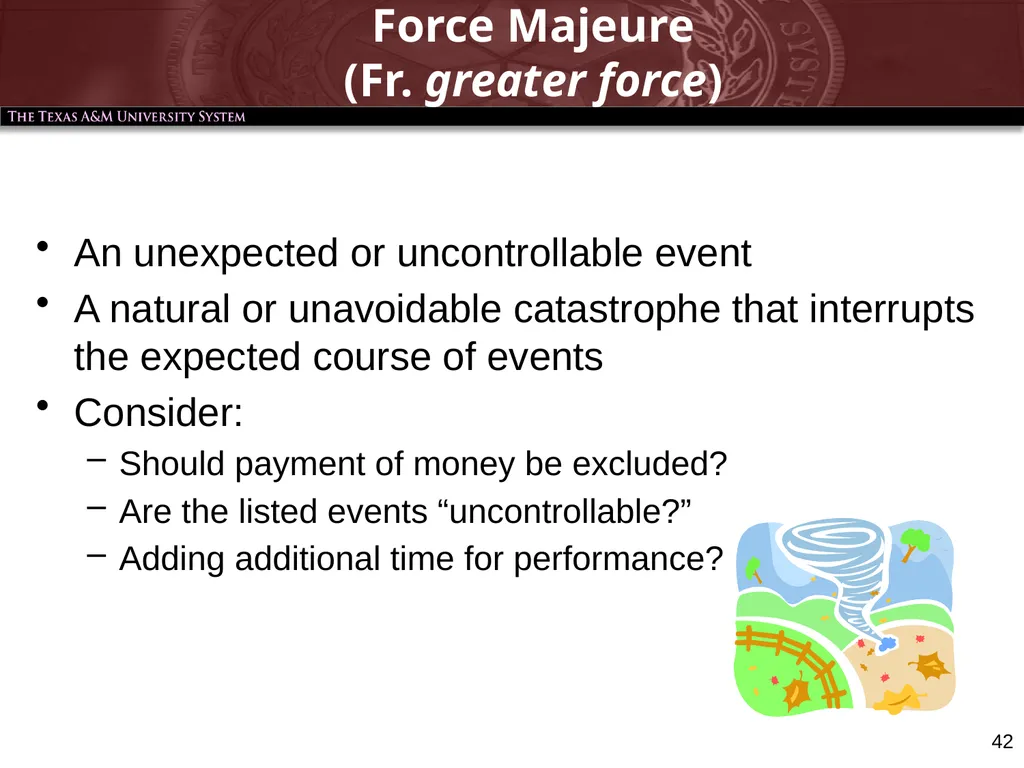
(Fr. greater force) An unexpected or uncontrollable event
A natural or unavoidable catastrophe that interrupts the expected course of events
Consider:
Should payment of money be excluded?
Are the listed events “uncontrollable?”
Adding additional time for performance? 42<br>
A natural or unavoidable catastrophe that interrupts the expected course of events
Consider:
Should payment of money be excluded?
Are the listed events “uncontrollable?”
Adding additional time for performance? 42<br>
43
Sovereign Immunity Protects the State from lawsuits without the consent of the State
“The King can do no wrong.”
Sovereign Immunity is based on two principles
The State is immune from being sued without its consent
Even if consent is granted, the State is immune from liability unless waived
Generally, the courts say that the State waives immunity from liability when it enters into a contract with another party 43<br>
“The King can do no wrong.”
Sovereign Immunity is based on two principles
The State is immune from being sued without its consent
Even if consent is granted, the State is immune from liability unless waived
Generally, the courts say that the State waives immunity from liability when it enters into a contract with another party 43<br>
44
Sovereign Immunity Still immune from suit – the Legislature must waive immunity from suit in order for a private party to sue the State for breach of contract
How can immunity from suit be waived?
Statutes that provide that an agency can sue and be sued
Specific resolution by the Legislature
If the State brings suit
Waiver by conduct 44<br>
How can immunity from suit be waived?
Statutes that provide that an agency can sue and be sued
Specific resolution by the Legislature
If the State brings suit
Waiver by conduct 44<br>
45
Sovereign Immunity Don’t assume sovereign immunity will protect the university
The Legislature could (and sometimes does) grant permission to sue
Immunity may best be used as a tool to facilitate settlements
Immunity is probably not a permanent fixture in Texas 45<br>
The Legislature could (and sometimes does) grant permission to sue
Immunity may best be used as a tool to facilitate settlements
Immunity is probably not a permanent fixture in Texas 45<br>
46
Texas Public Information Act The Texas Public Information Act (Texas Government Code Ch. 552) provides that all “public information” held by or available to a “governmental body” is open to the public
The university is a governmental body
“Public Information” is all information collected, assembled, or maintained by a governmental body, or for the governmental body if it owns or has a right of access to the information
The Act trumps any contractual confidentiality agreement 46<br>
The university is a governmental body
“Public Information” is all information collected, assembled, or maintained by a governmental body, or for the governmental body if it owns or has a right of access to the information
The Act trumps any contractual confidentiality agreement 46<br>
47
Public Information Act exceptions that may apply Commercial or financial information if disclosure would cause “substantial competitive harm” to the person from whom it was obtained
Trade secrets obtained from a person, if made confidential by law
Technological and scientific information developed in whole or in part at the university if the information has commercial potential 47<br>
Trade secrets obtained from a person, if made confidential by law
Technological and scientific information developed in whole or in part at the university if the information has commercial potential 47<br>
48
Confidentiality Clause Make the confidentiality provision subject to the Texas Public Information Act:
Company acknowledges that University must strictly comply with the Public Information Act, Chapter 552, Texas Government Code, in responding to any request for public information related to this Agreement. This obligation supersedes any conflicting provisions of this Agreement.
If someone makes a request under the Public Information Act for what may be proprietary information, the university must make a good faith effort to notify the owner of the information
The owner of the information – not the university – should be responsible for taking action to prevent the disclosure 48<br>
Company acknowledges that University must strictly comply with the Public Information Act, Chapter 552, Texas Government Code, in responding to any request for public information related to this Agreement. This obligation supersedes any conflicting provisions of this Agreement.
If someone makes a request under the Public Information Act for what may be proprietary information, the university must make a good faith effort to notify the owner of the information
The owner of the information – not the university – should be responsible for taking action to prevent the disclosure 48<br>
49
Other Confidentiality Considerations One-way or two-way – is the university just promising to protect the other’s confidential information or will the university also be sharing its own confidential information?
Should be reasonable as to:
Scope of what is confidential
Require that it be marked?
Oral or visual disclosures summarized in writing?
Standard exceptions (becomes public, etc.)
Length of obligation
2-5 years most common
Degree of care
Preferred: Same degree of care used to protect its own confidential information, but not less than a reasonable degree of care 49<br>
Should be reasonable as to:
Scope of what is confidential
Require that it be marked?
Oral or visual disclosures summarized in writing?
Standard exceptions (becomes public, etc.)
Length of obligation
2-5 years most common
Degree of care
Preferred: Same degree of care used to protect its own confidential information, but not less than a reasonable degree of care 49<br>
50
Insurance Workers’ Compensation
The A&M System is self-insured for Workers’ Compensation Insurance under Chapter 502 of the Texas Labor Code-provides reasonable and necessary medical coverage and indemnity payments to employees who sustain injuries or occupational disease while in the course and scope of employment 50<br>
The A&M System is self-insured for Workers’ Compensation Insurance under Chapter 502 of the Texas Labor Code-provides reasonable and necessary medical coverage and indemnity payments to employees who sustain injuries or occupational disease while in the course and scope of employment 50<br>
51
Insurance The A&M System maintains an automobile liability policy with a bodily injury limit of $250,000 for each person, $500,000 for each accident and a property damage limit of $100,000 for each accident
The A&M System is self-insured for most property insurance claims
Contact System Office of Risk Management and Safety with any insurance questions 51<br>
The A&M System is self-insured for most property insurance claims
Contact System Office of Risk Management and Safety with any insurance questions 51<br>
52
Insurance The following clause is recommended as a replacement for clauses requiring the university to maintain insurance:
Contractor acknowledges that because the University is an agency of the State of Texas, liability for the tortious conduct of University’s agents and employees or for injuries caused by conditions of tangible state property is provided for solely by the provisions of the Texas Tort Claims Act (Texas Civil Practice and Remedies Code, Chapters 101 and 104), and that Workers’ Compensation Insurance coverage for University employees is provided by University as mandated by the provisions of the Texas Labor Code, Chapter 502. University may, at its option, (a) obtain liability insurance protecting University and its employees and property insurance protecting University buildings and the contents, to the extent authorized by Section 51.966 of the Texas Education Code or other law, or (b) self-insure against any risk that may be incurred by University as a result of its operations under this Agreement. 52<br>
Contractor acknowledges that because the University is an agency of the State of Texas, liability for the tortious conduct of University’s agents and employees or for injuries caused by conditions of tangible state property is provided for solely by the provisions of the Texas Tort Claims Act (Texas Civil Practice and Remedies Code, Chapters 101 and 104), and that Workers’ Compensation Insurance coverage for University employees is provided by University as mandated by the provisions of the Texas Labor Code, Chapter 502. University may, at its option, (a) obtain liability insurance protecting University and its employees and property insurance protecting University buildings and the contents, to the extent authorized by Section 51.966 of the Texas Education Code or other law, or (b) self-insure against any risk that may be incurred by University as a result of its operations under this Agreement. 52<br>
53
Limitation of Liability and/or Damages Can the university agree to waive or limit the liability or potential damages of a party, including consequential or exemplary damages?
Should it? 53<br>
Should it? 53<br>
54
Liquidated Damages Clause that provides that a party will owe specific damages if it breaches the agreement
The university may agree to a liquidated damages clause as long as:
The amount stipulated in the contract is a reasonable forecast of fair compensation for the harm caused by the breach
The harm caused by the breach is incapable or very difficult of accurately estimating
Should the university agree to pay liquidated damages in most circumstances? 54<br>
The university may agree to a liquidated damages clause as long as:
The amount stipulated in the contract is a reasonable forecast of fair compensation for the harm caused by the breach
The harm caused by the breach is incapable or very difficult of accurately estimating
Should the university agree to pay liquidated damages in most circumstances? 54<br>
55
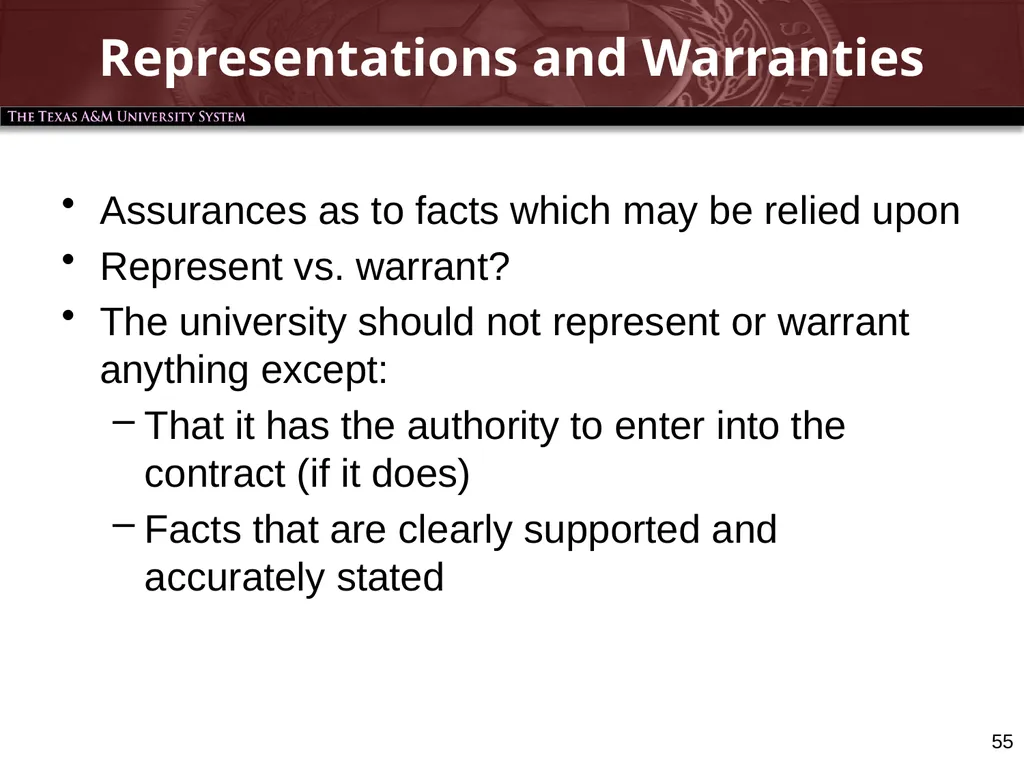
Representations and Warranties Assurances as to facts which may be relied upon
Represent vs. warrant?
The university should not represent or warrant anything except:
That it has the authority to enter into the contract (if it does)
Facts that are clearly supported and accurately stated 55<br>
Represent vs. warrant?
The university should not represent or warrant anything except:
That it has the authority to enter into the contract (if it does)
Facts that are clearly supported and accurately stated 55<br>
56
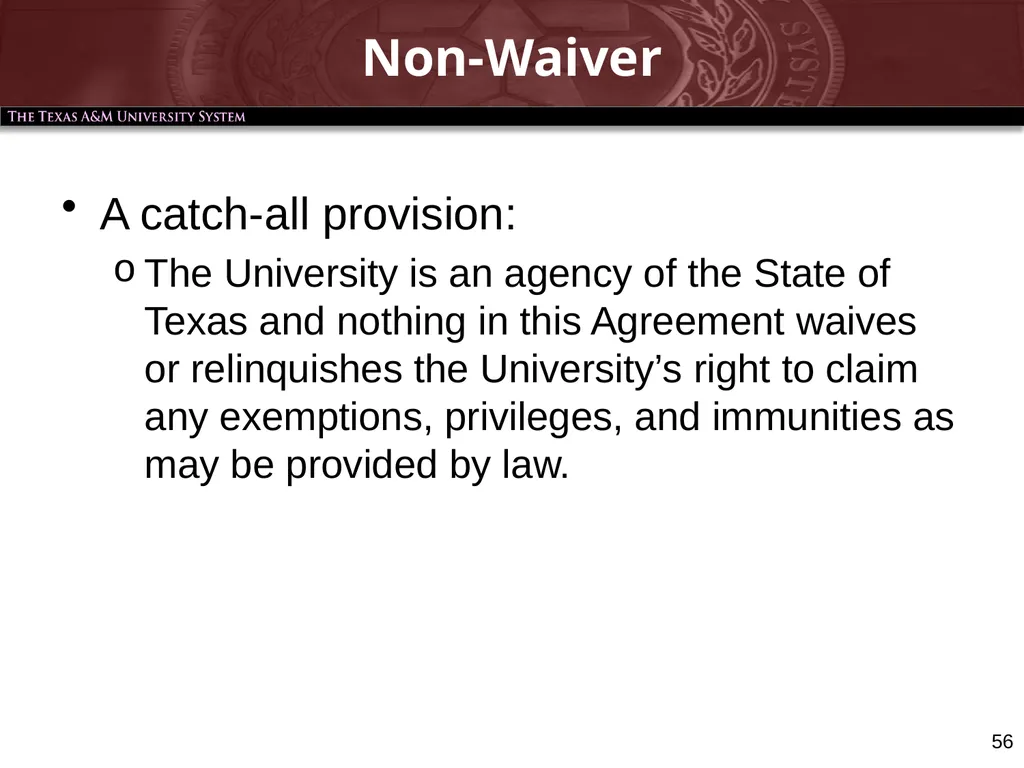
Non-Waiver A catch-all provision:
The University is an agency of the State of Texas and nothing in this Agreement waives or relinquishes the University’s right to claim any exemptions, privileges, and immunities as may be provided by law. 56<br>
The University is an agency of the State of Texas and nothing in this Agreement waives or relinquishes the University’s right to claim any exemptions, privileges, and immunities as may be provided by law. 56<br>
57
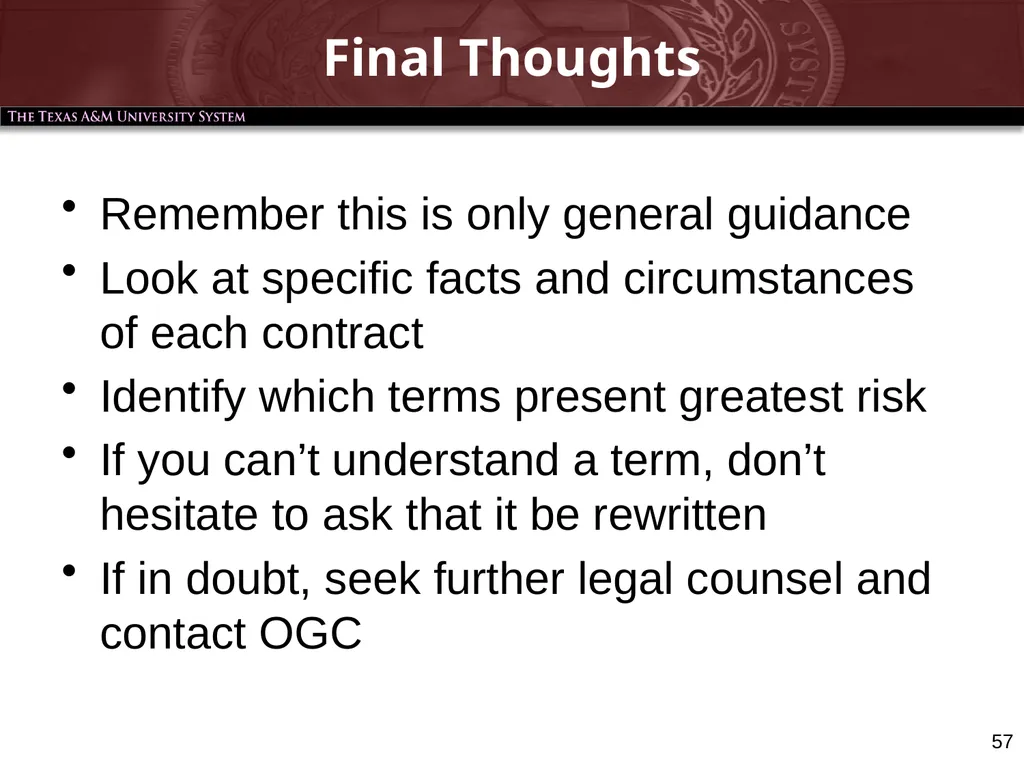
Final Thoughts Remember this is only general guidance
Look at specific facts and circumstances of each contract
Identify which terms present greatest risk
If you can’t understand a term, don’t hesitate to ask that it be rewritten
If in doubt, seek further legal counsel and contact OGC 57<br>
Look at specific facts and circumstances of each contract
Identify which terms present greatest risk
If you can’t understand a term, don’t hesitate to ask that it be rewritten
If in doubt, seek further legal counsel and contact OGC 57<br>
58
Thank you! 58<br>