
Water System Partnerships: Opportunities to Solve
DP
Published · 37 slides · 0 views

1 / 1
Description
Water System Partnerships: Opportunities to Solve Water System Challenges Office of Water, U.S. EPA 1 Purpose for Today You may have been invited to attend today because: Your water system, or water systems in your community, might benefit
Related Topics
Share
Embed code
Download this presentation From Below
"Water System Partnerships: Opportunities to Solve" is the property of its rightful owner. Permission is granted to download and print the materials on this website for personal, non-commercial use only, and to display it on your personal computer provided you do not modify the materials and that you retain all copyright notices contained in the materials. By downloading content from our website, you accept the terms of this agreement.
Presentation Transcript
01
Water System Partnerships: Opportunities to Solve Water System Challenges Office of Water, U.S. EPA 1<br>
02
Purpose for Today You may have been invited to attend today because:
Your water system, or water systems in your community, might benefit from water system partnerships
You might help interested water systems form partnerships
You might be interested in learning how partnerships could help your community at large 2<br>
Your water system, or water systems in your community, might benefit from water system partnerships
You might help interested water systems form partnerships
You might be interested in learning how partnerships could help your community at large 2<br>
03
Partnerships Checklist The Partnerships Checklist can help you determine if you or water systems in your community could benefit from a partnership
Is your water system or a water system in your community…
☐ Struggling to meet TMF capacity?
☐ Facing similar challenges as a nearby water system?
☐ Within 5-10 miles of another water system?
☐ Currently working with another water system either directly or indirectly (e.g., providing treatment chemicals, sharing an operator)?
☐ Able to share and expand upon strengths to help other water systems (e.g., strong TMF capacity)? 3<br>
Is your water system or a water system in your community…
☐ Struggling to meet TMF capacity?
☐ Facing similar challenges as a nearby water system?
☐ Within 5-10 miles of another water system?
☐ Currently working with another water system either directly or indirectly (e.g., providing treatment chemicals, sharing an operator)?
☐ Able to share and expand upon strengths to help other water systems (e.g., strong TMF capacity)? 3<br>
04
Part 1: What are water system partnerships? 4 4<br>
05
Water System Partnerships Any informal or formal relationship/agreement between water systems
They can:
Assist small and mid-size water systems in overcoming unique challenges
Build technical, managerial, and financial capacity for water systems
Provide a wide range of opportunities for water systems to work together Let’s discuss!
How are water systems in your community partnering already? 5<br>
They can:
Assist small and mid-size water systems in overcoming unique challenges
Build technical, managerial, and financial capacity for water systems
Provide a wide range of opportunities for water systems to work together Let’s discuss!
How are water systems in your community partnering already? 5<br>
06
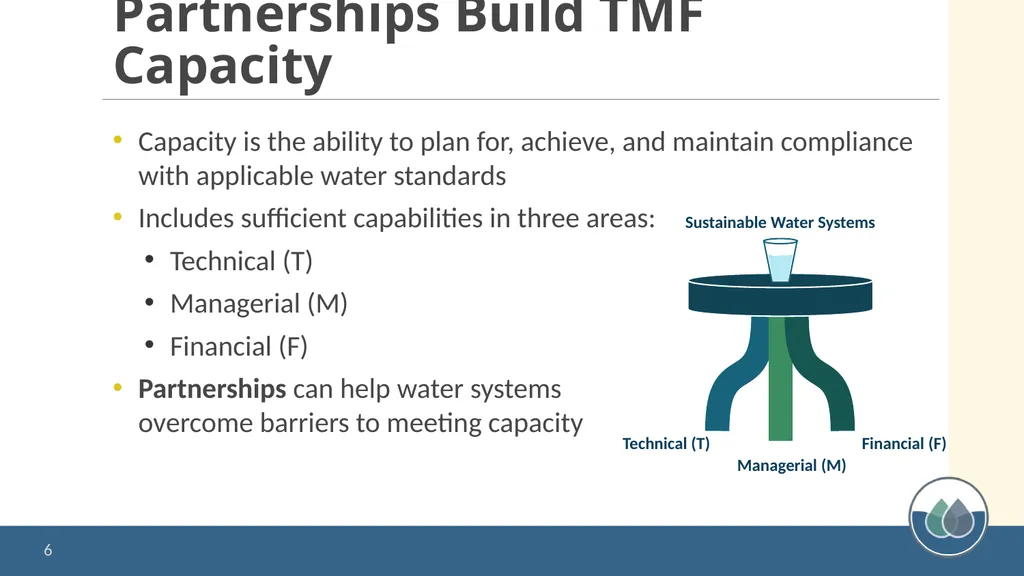
Partnerships Build TMF Capacity Capacity is the ability to plan for, achieve, and maintain compliance with applicable water standards
Includes sufficient capabilities in three areas:
Technical (T)
Managerial (M)
Financial (F)
Partnerships can help water systems overcome barriers to meeting capacity 6<br>
Includes sufficient capabilities in three areas:
Technical (T)
Managerial (M)
Financial (F)
Partnerships can help water systems overcome barriers to meeting capacity 6<br>
07
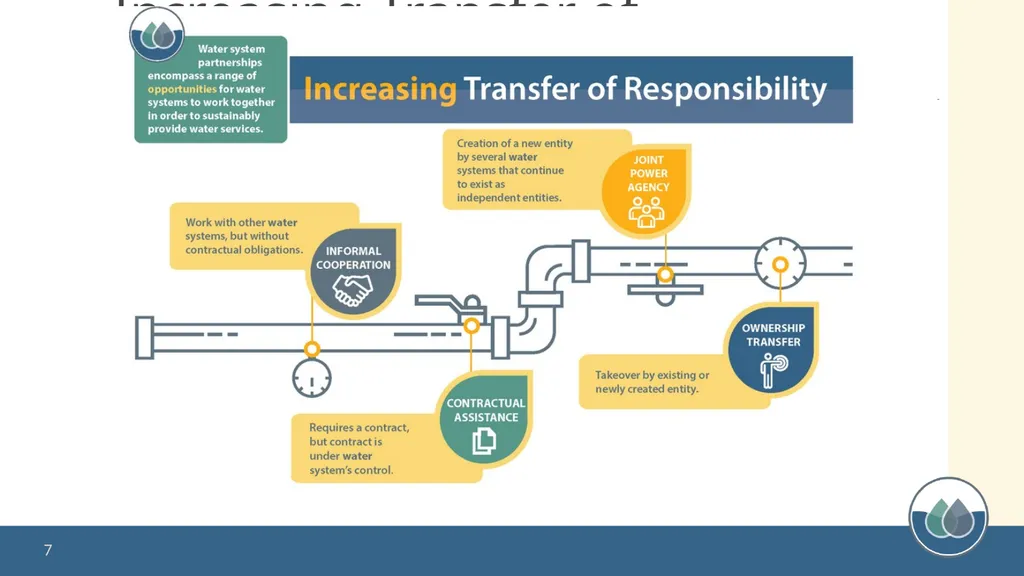
Increasing Transfer of Responsibility 7<br>
08
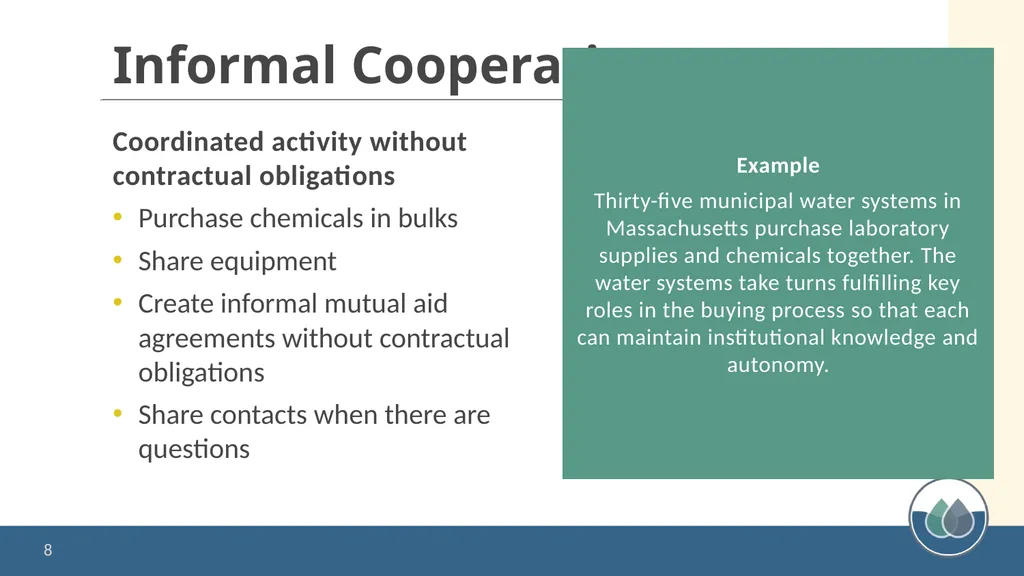
Informal Cooperation Coordinated activity without contractual obligations
Purchase chemicals in bulks
Share equipment
Create informal mutual aid agreements without contractual obligations
Share contacts when there are questions Example
Thirty-five municipal water systems in Massachusetts purchase laboratory supplies and chemicals together. The water systems take turns fulfilling key roles in the buying process so that each can maintain institutional knowledge and autonomy. 8<br>
Purchase chemicals in bulks
Share equipment
Create informal mutual aid agreements without contractual obligations
Share contacts when there are questions Example
Thirty-five municipal water systems in Massachusetts purchase laboratory supplies and chemicals together. The water systems take turns fulfilling key roles in the buying process so that each can maintain institutional knowledge and autonomy. 8<br>
09
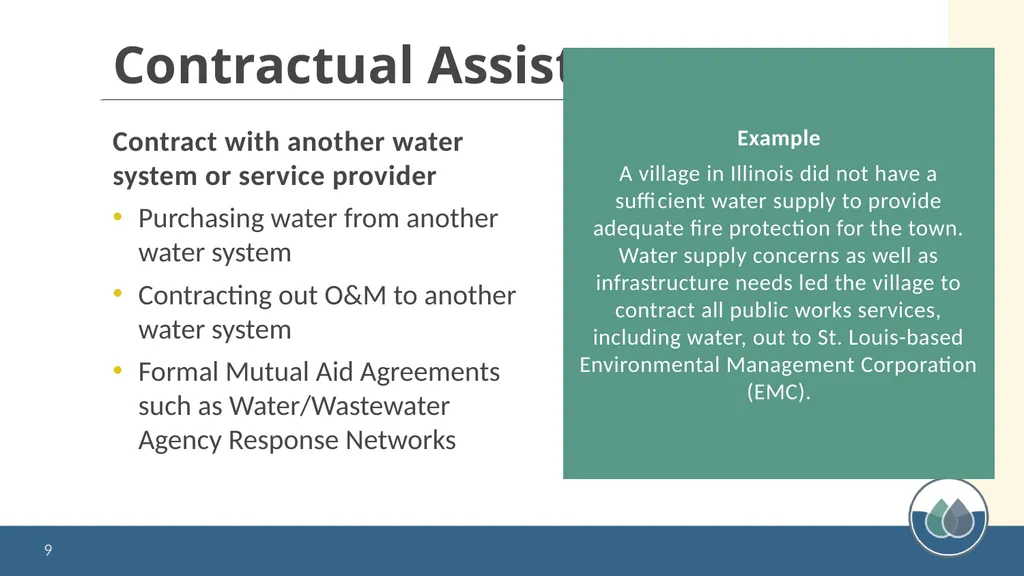
Contractual Assistance Contract with another water system or service provider
Purchasing water from another water system
Contracting out O&M to another water system
Formal Mutual Aid Agreements such as Water/Wastewater Agency Response Networks Example
A village in Illinois did not have a sufficient water supply to provide adequate fire protection for the town. Water supply concerns as well as infrastructure needs led the village to contract all public works services, including water, out to St. Louis-based Environmental Management Corporation (EMC). 9<br>
Purchasing water from another water system
Contracting out O&M to another water system
Formal Mutual Aid Agreements such as Water/Wastewater Agency Response Networks Example
A village in Illinois did not have a sufficient water supply to provide adequate fire protection for the town. Water supply concerns as well as infrastructure needs led the village to contract all public works services, including water, out to St. Louis-based Environmental Management Corporation (EMC). 9<br>
10
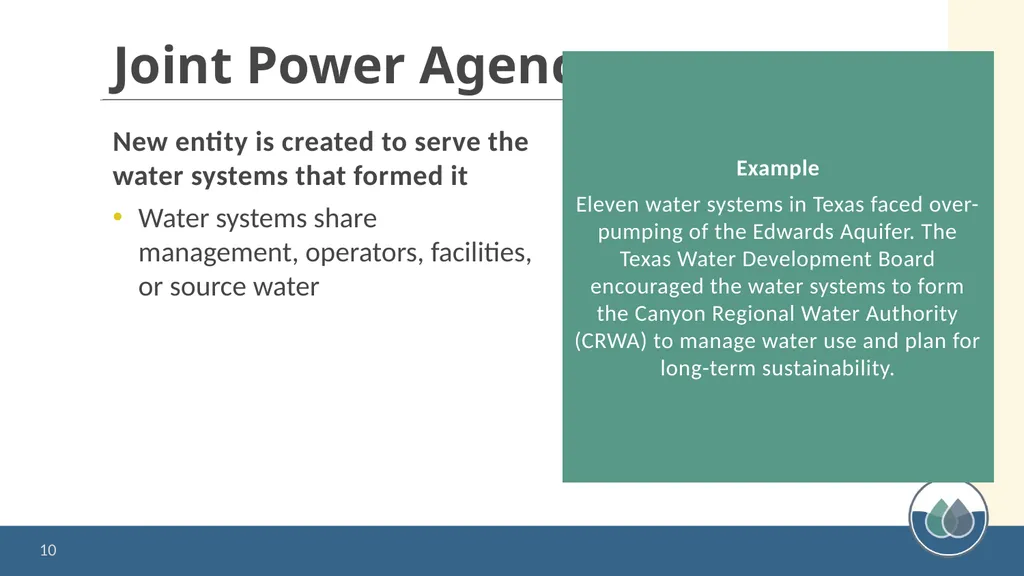
Joint Power Agency New entity is created to serve the water systems that formed it
Water systems share management, operators, facilities, or source water Example
Eleven water systems in Texas faced over-pumping of the Edwards Aquifer. The Texas Water Development Board encouraged the water systems to form the Canyon Regional Water Authority (CRWA) to manage water use and plan for long-term sustainability. 10<br>
Water systems share management, operators, facilities, or source water Example
Eleven water systems in Texas faced over-pumping of the Edwards Aquifer. The Texas Water Development Board encouraged the water systems to form the Canyon Regional Water Authority (CRWA) to manage water use and plan for long-term sustainability. 10<br>
11
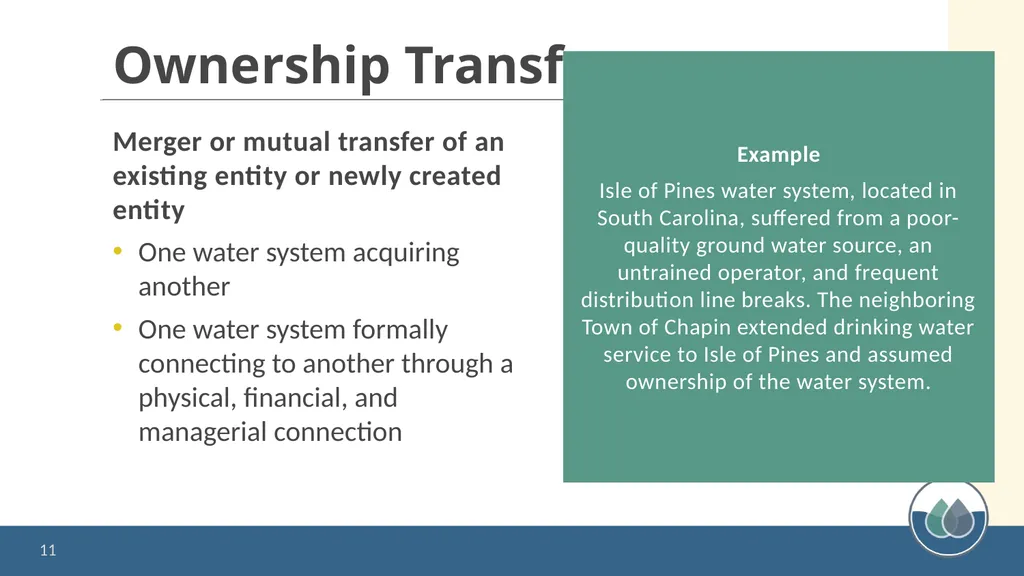
Ownership Transfer Merger or mutual transfer of an existing entity or newly created entity
One water system acquiring another
One water system formally connecting to another through a physical, financial, and managerial connection Example
Isle of Pines water system, located in South Carolina, suffered from a poor-quality ground water source, an untrained operator, and frequent distribution line breaks. The neighboring Town of Chapin extended drinking water service to Isle of Pines and assumed ownership of the water system. 11<br>
One water system acquiring another
One water system formally connecting to another through a physical, financial, and managerial connection Example
Isle of Pines water system, located in South Carolina, suffered from a poor-quality ground water source, an untrained operator, and frequent distribution line breaks. The neighboring Town of Chapin extended drinking water service to Isle of Pines and assumed ownership of the water system. 11<br>
12
Part 2: How do partnerships benefit water systems and customers? 12<br>
13
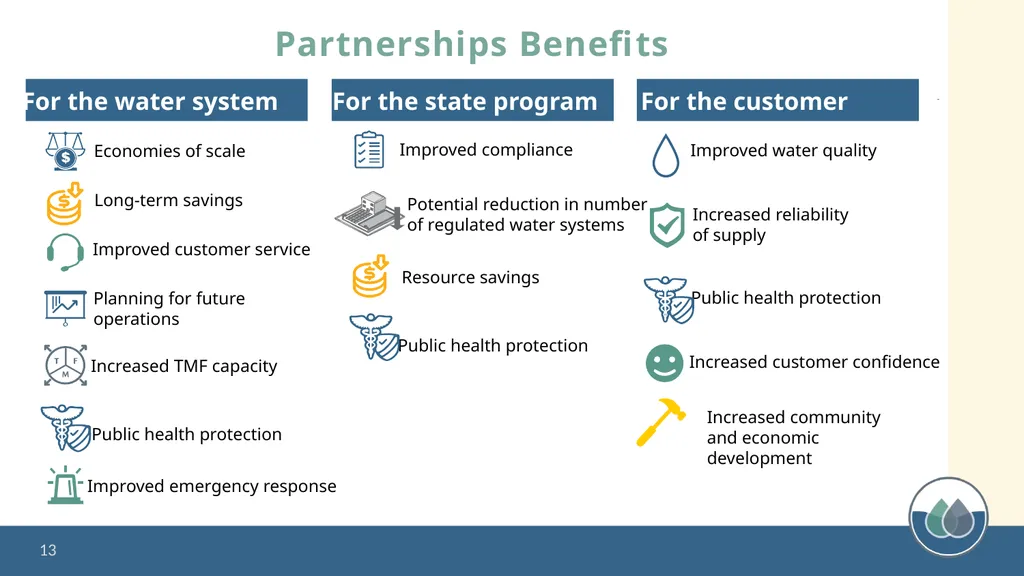
Partnerships Benefits 13<br>
14
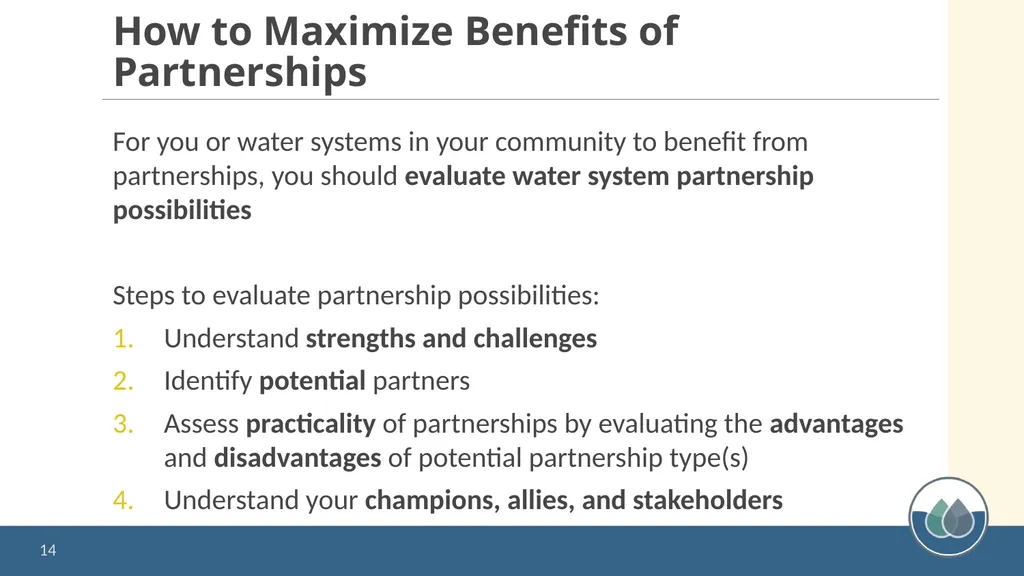
How to Maximize Benefits of Partnerships For you or water systems in your community to benefit from partnerships, you should evaluate water system partnership possibilities
Steps to evaluate partnership possibilities:
Understand strengths and challenges
Identify potential partners
Assess practicality of partnerships by evaluating the advantages and disadvantages of potential partnership type(s)
Understand your champions, allies, and stakeholders 14<br>
Steps to evaluate partnership possibilities:
Understand strengths and challenges
Identify potential partners
Assess practicality of partnerships by evaluating the advantages and disadvantages of potential partnership type(s)
Understand your champions, allies, and stakeholders 14<br>
15
1. Understand Strengths and Challenges Identify strengths of your water system
Consider if you could share or leverage those strengths by partnering to help another water system
Identify challenges or areas of capacity to improve upon
Consider if a partnership could help overcome those challenges or increase capacity 15<br>
Consider if you could share or leverage those strengths by partnering to help another water system
Identify challenges or areas of capacity to improve upon
Consider if a partnership could help overcome those challenges or increase capacity 15<br>
16
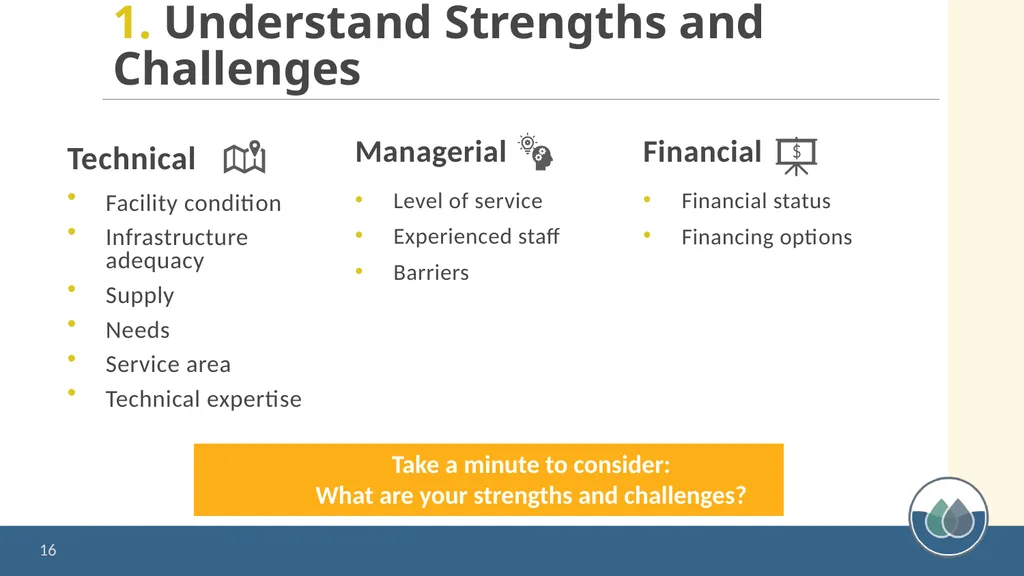
1. Understand Strengths and Challenges Technical
Facility condition
Infrastructure adequacy
Supply
Needs
Service area
Technical expertise Managerial
Level of service
Experienced staff
Barriers Financial
Financial status
Financing options 16<br>
Facility condition
Infrastructure adequacy
Supply
Needs
Service area
Technical expertise Managerial
Level of service
Experienced staff
Barriers Financial
Financial status
Financing options 16<br>
17
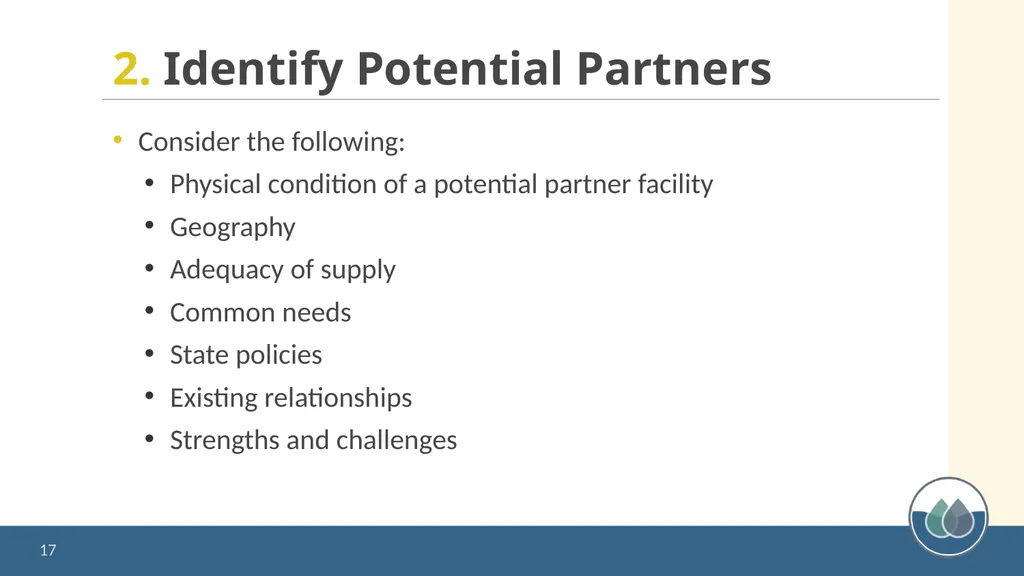
2. Identify Potential Partners Consider the following:
Physical condition of a potential partner facility
Geography
Adequacy of supply
Common needs
State policies
Existing relationships
Strengths and challenges 17<br>
Physical condition of a potential partner facility
Geography
Adequacy of supply
Common needs
State policies
Existing relationships
Strengths and challenges 17<br>
18
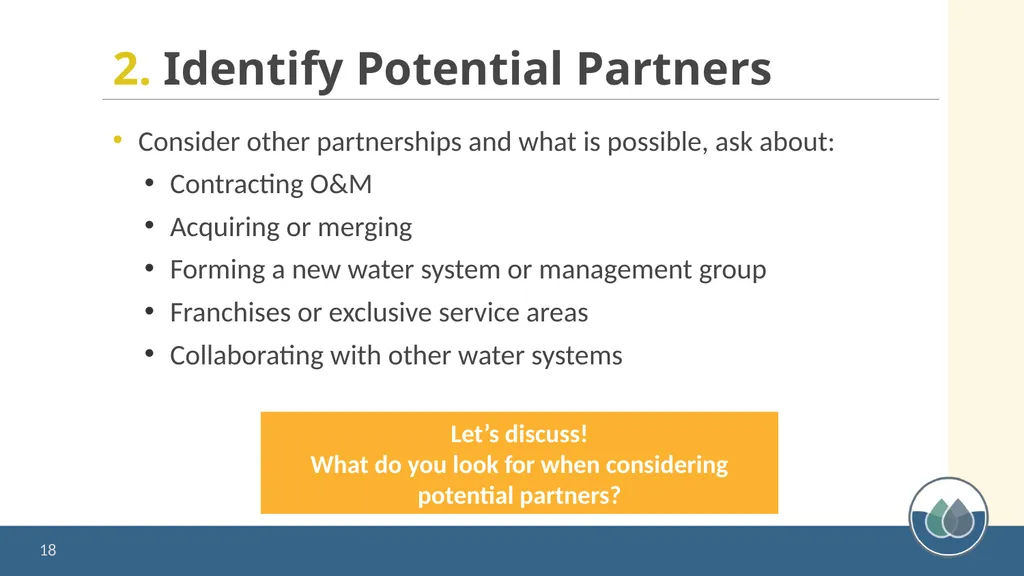
2. Identify Potential Partners Consider other partnerships and what is possible, ask about:
Contracting O&M
Acquiring or merging
Forming a new water system or management group
Franchises or exclusive service areas
Collaborating with other water systems Let’s discuss!
What do you look for when considering potential partners? 18<br>
Contracting O&M
Acquiring or merging
Forming a new water system or management group
Franchises or exclusive service areas
Collaborating with other water systems Let’s discuss!
What do you look for when considering potential partners? 18<br>
19
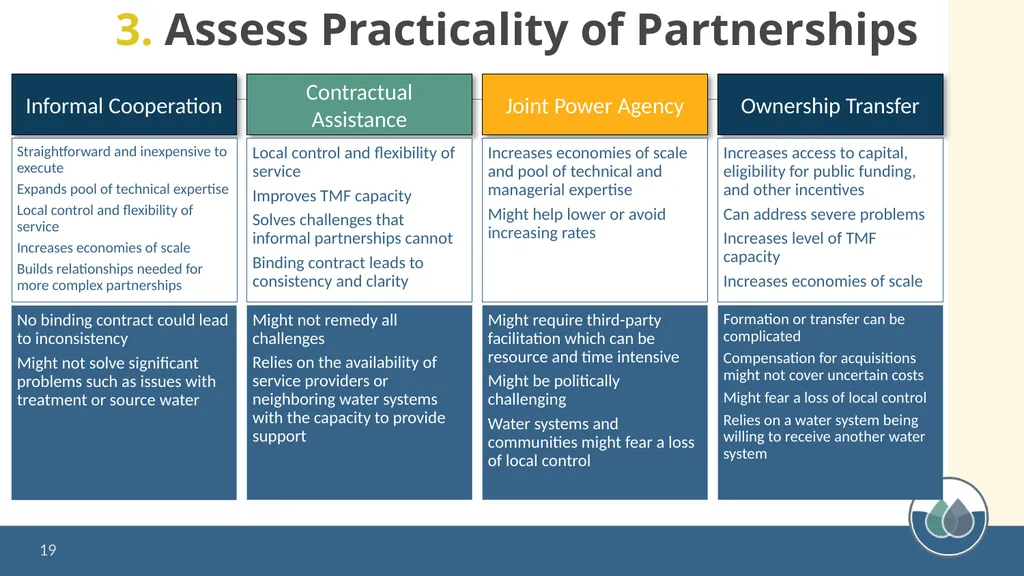
3. Assess Practicality of Partnerships Informal Cooperation Straightforward and inexpensive to execute
Expands pool of technical expertise
Local control and flexibility of service
Increases economies of scale
Builds relationships needed for more complex partnerships No binding contract could lead to inconsistency
Might not solve significant problems such as issues with treatment or source water Contractual Assistance Local control and flexibility of service
Improves TMF capacity
Solves challenges that informal partnerships cannot
Binding contract leads to consistency and clarity Might not remedy all challenges
Relies on the availability of service providers or neighboring water systems with the capacity to provide support Joint Power Agency Increases economies of scale and pool of technical and managerial expertise
Might help lower or avoid increasing rates Might require third-party facilitation which can be resource and time intensive
Might be politically challenging
Water systems and communities might fear a loss of local control Ownership Transfer Increases access to capital, eligibility for public funding, and other incentives
Can address severe problems
Increases level of TMF capacity
Increases economies of scale Formation or transfer can be complicated
Compensation for acquisitions might not cover uncertain costs
Might fear a loss of local control
Relies on a water system being willing to receive another water system 19<br>
Expands pool of technical expertise
Local control and flexibility of service
Increases economies of scale
Builds relationships needed for more complex partnerships No binding contract could lead to inconsistency
Might not solve significant problems such as issues with treatment or source water Contractual Assistance Local control and flexibility of service
Improves TMF capacity
Solves challenges that informal partnerships cannot
Binding contract leads to consistency and clarity Might not remedy all challenges
Relies on the availability of service providers or neighboring water systems with the capacity to provide support Joint Power Agency Increases economies of scale and pool of technical and managerial expertise
Might help lower or avoid increasing rates Might require third-party facilitation which can be resource and time intensive
Might be politically challenging
Water systems and communities might fear a loss of local control Ownership Transfer Increases access to capital, eligibility for public funding, and other incentives
Can address severe problems
Increases level of TMF capacity
Increases economies of scale Formation or transfer can be complicated
Compensation for acquisitions might not cover uncertain costs
Might fear a loss of local control
Relies on a water system being willing to receive another water system 19<br>
20
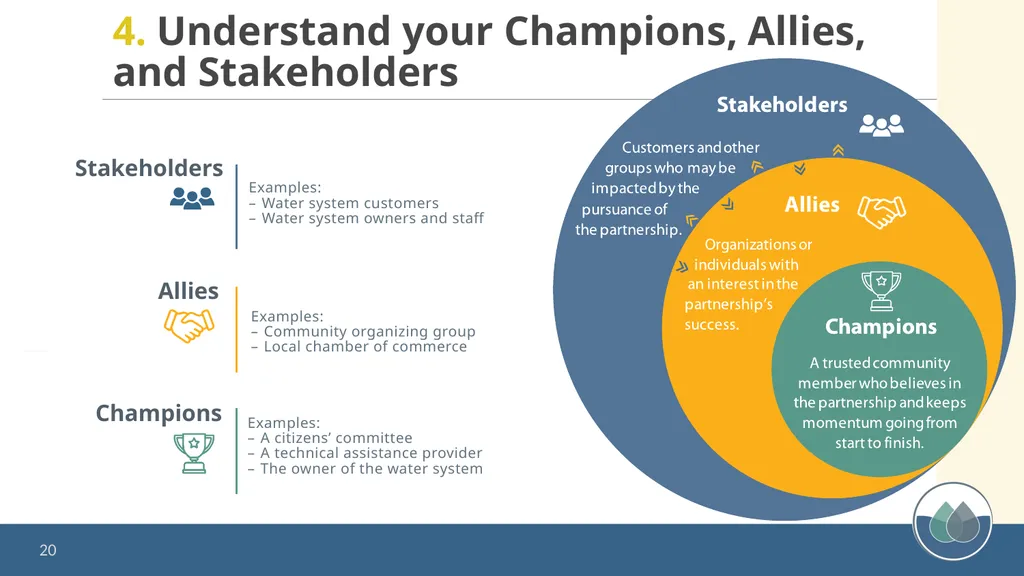
4. Understand your Champions, Allies, and Stakeholders 20<br>
21
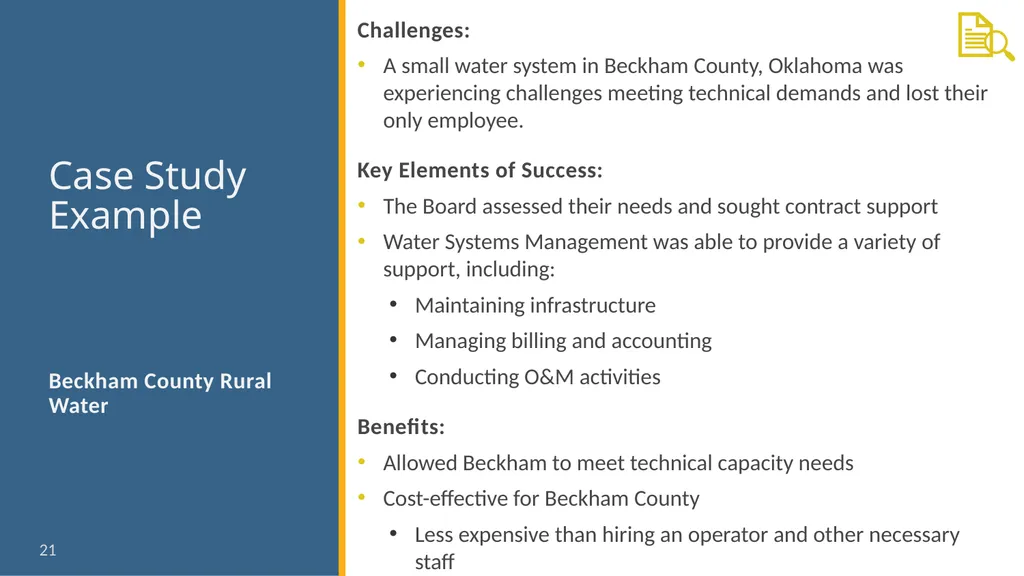
Case Study Example Beckham County Rural Water Challenges:
A small water system in Beckham County, Oklahoma was experiencing challenges meeting technical demands and lost their only employee.
Key Elements of Success:
The Board assessed their needs and sought contract support
Water Systems Management was able to provide a variety of support, including:
Maintaining infrastructure
Managing billing and accounting
Conducting O&M activities
Benefits:
Allowed Beckham to meet technical capacity needs
Cost-effective for Beckham County
Less expensive than hiring an operator and other necessary staff 21<br>
A small water system in Beckham County, Oklahoma was experiencing challenges meeting technical demands and lost their only employee.
Key Elements of Success:
The Board assessed their needs and sought contract support
Water Systems Management was able to provide a variety of support, including:
Maintaining infrastructure
Managing billing and accounting
Conducting O&M activities
Benefits:
Allowed Beckham to meet technical capacity needs
Cost-effective for Beckham County
Less expensive than hiring an operator and other necessary staff 21<br>
22
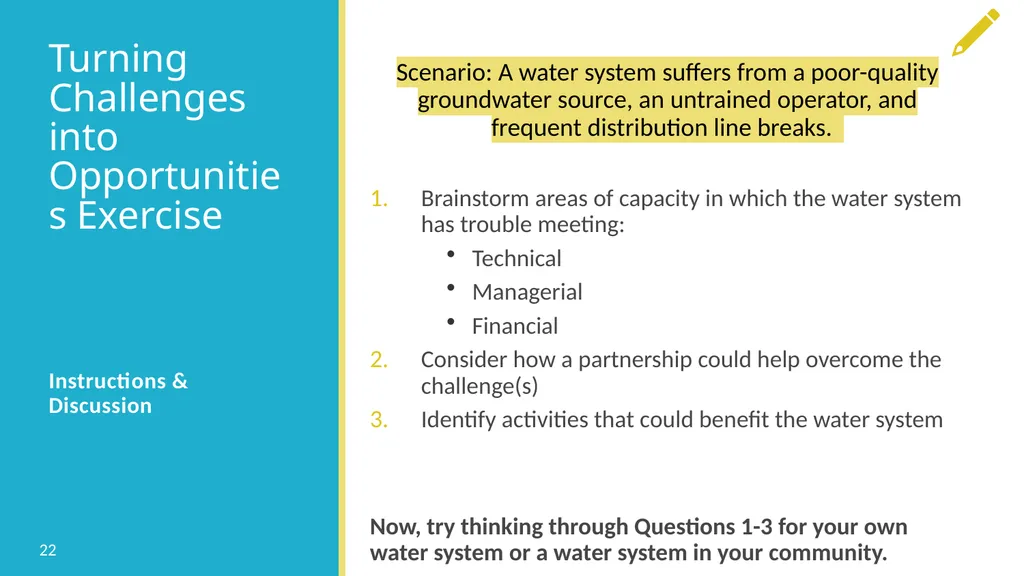
Turning Challenges into Opportunities Exercise Instructions & Discussion Scenario: A water system suffers from a poor-quality groundwater source, an untrained operator, and frequent distribution line breaks.
Brainstorm areas of capacity in which the water system has trouble meeting:
Technical
Managerial
Financial
Consider how a partnership could help overcome the challenge(s)
Identify activities that could benefit the water system
Now, try thinking through Questions 1-3 for your own water system or a water system in your community. 22<br>
Brainstorm areas of capacity in which the water system has trouble meeting:
Technical
Managerial
Financial
Consider how a partnership could help overcome the challenge(s)
Identify activities that could benefit the water system
Now, try thinking through Questions 1-3 for your own water system or a water system in your community. 22<br>
23
Part 3: What are the financial implications for a partnership? 23<br>
24
Financial Implications Partnerships need funding
Required and vital to partnership success
Used in a variety of ways
Start-up (e.g., planning and implementation)
Technical assistance
Hire a business manager
Partnerships improve financial capacity
Gain efficiencies
Reduce costs
Improve financial status over time 24<br>
Required and vital to partnership success
Used in a variety of ways
Start-up (e.g., planning and implementation)
Technical assistance
Hire a business manager
Partnerships improve financial capacity
Gain efficiencies
Reduce costs
Improve financial status over time 24<br>
25
Why Build Capacity? Capacity is critical to achieving and maintaining compliance
Your water system must have TMF capacity to receive funding from the SRF (or funding must be used to help achieve capacity)
EPA can withhold up to 20 percent of capitalization grant funds from states that do not meet regulatory requirements for capacity development
Linking these two important programs, Capacity Development and SRF, shows the importance placed on capacity SRF = State Revolving Fund 25<br>
Your water system must have TMF capacity to receive funding from the SRF (or funding must be used to help achieve capacity)
EPA can withhold up to 20 percent of capitalization grant funds from states that do not meet regulatory requirements for capacity development
Linking these two important programs, Capacity Development and SRF, shows the importance placed on capacity SRF = State Revolving Fund 25<br>
26
How to Fund Partnerships Activities Federal and State Funding
SRF (State Revolving Fund)
USDA (e.g., Rural Development Loans and Grants)
HUD (e.g., Community Development Block Grants)
Funding Resources
Water Finance Clearinghouse (web portal)
Contact SRF Program agencies
State Rural Development offices 26<br>
SRF (State Revolving Fund)
USDA (e.g., Rural Development Loans and Grants)
HUD (e.g., Community Development Block Grants)
Funding Resources
Water Finance Clearinghouse (web portal)
Contact SRF Program agencies
State Rural Development offices 26<br>
27
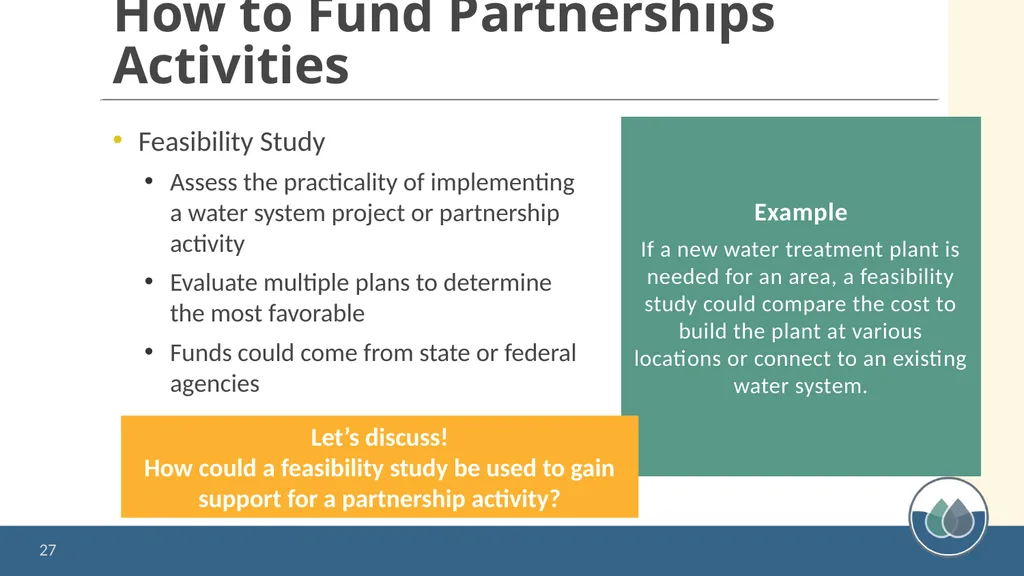
How to Fund Partnerships Activities Feasibility Study
Assess the practicality of implementing a water system project or partnership activity
Evaluate multiple plans to determine the most favorable
Funds could come from state or federal agencies Example
If a new water treatment plant is needed for an area, a feasibility study could compare the cost to build the plant at various locations or connect to an existing water system. Let’s discuss!
How could a feasibility study be used to gain support for a partnership activity? 27<br>
Assess the practicality of implementing a water system project or partnership activity
Evaluate multiple plans to determine the most favorable
Funds could come from state or federal agencies Example
If a new water treatment plant is needed for an area, a feasibility study could compare the cost to build the plant at various locations or connect to an existing water system. Let’s discuss!
How could a feasibility study be used to gain support for a partnership activity? 27<br>
28
State-Specific Funding Information [Placeholder slide] Let’s discuss!
Are there any other applicable funding sources that you can think of? 28<br>
Are there any other applicable funding sources that you can think of? 28<br>
29
Part 4: How can you create a partnership? 29<br>
30
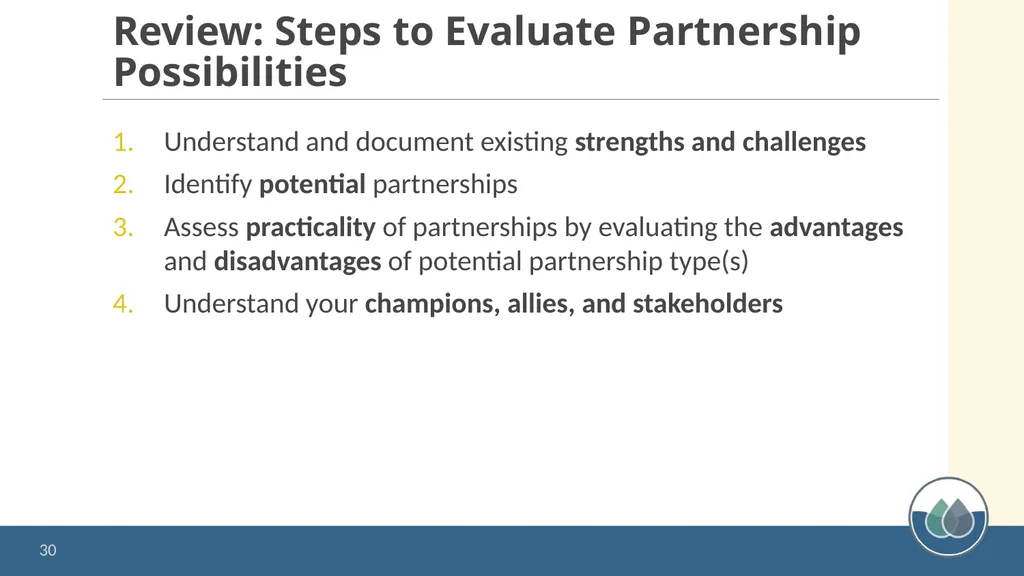
Review: Steps to Evaluate Partnership Possibilities Understand and document existing strengths and challenges
Identify potential partnerships
Assess practicality of partnerships by evaluating the advantages and disadvantages of potential partnership type(s)
Understand your champions, allies, and stakeholders 30<br>
Identify potential partnerships
Assess practicality of partnerships by evaluating the advantages and disadvantages of potential partnership type(s)
Understand your champions, allies, and stakeholders 30<br>
31
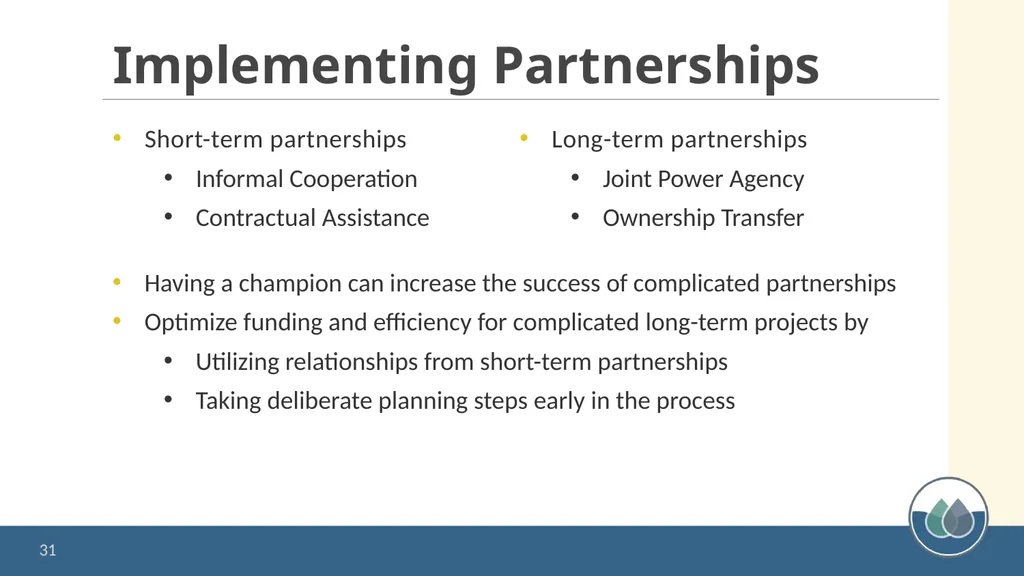
Implementing Partnerships Short-term partnerships
Informal Cooperation
Contractual Assistance
Long-term partnerships
Joint Power Agency
Ownership Transfer Having a champion can increase the success of complicated partnerships
Optimize funding and efficiency for complicated long-term projects by
Utilizing relationships from short-term partnerships
Taking deliberate planning steps early in the process 31<br>
Informal Cooperation
Contractual Assistance
Long-term partnerships
Joint Power Agency
Ownership Transfer Having a champion can increase the success of complicated partnerships
Optimize funding and efficiency for complicated long-term projects by
Utilizing relationships from short-term partnerships
Taking deliberate planning steps early in the process 31<br>
32
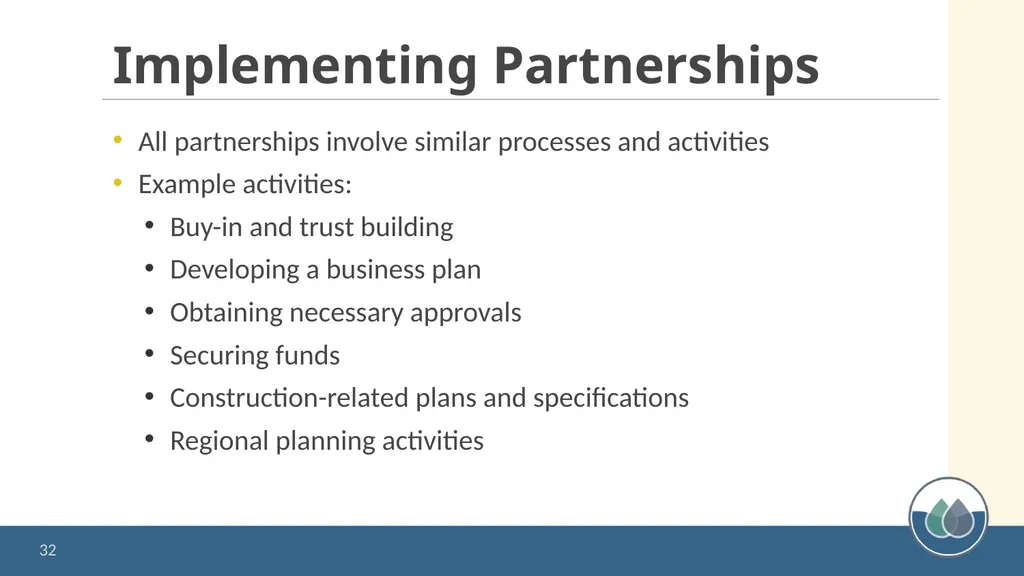
Implementing Partnerships All partnerships involve similar processes and activities
Example activities:
Buy-in and trust building
Developing a business plan
Obtaining necessary approvals
Securing funds
Construction-related plans and specifications
Regional planning activities 32<br>
Example activities:
Buy-in and trust building
Developing a business plan
Obtaining necessary approvals
Securing funds
Construction-related plans and specifications
Regional planning activities 32<br>
33
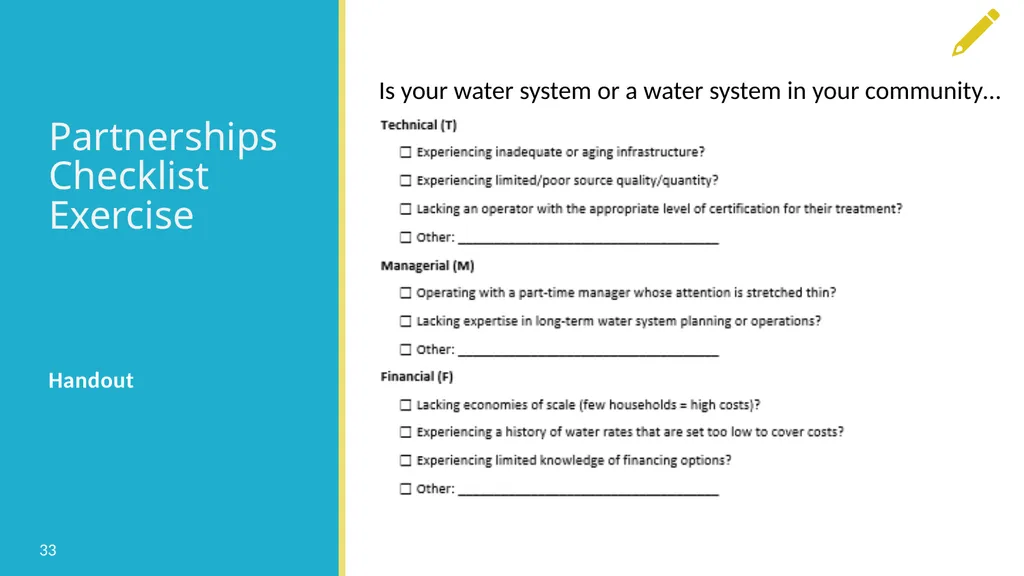
Partnerships Checklist
Exercise Handout Is your water system or a water system in your community… 33<br>
34
Next Steps Strategize outreach
Facilitate partnership building
Identify stakeholders, allies, and champions
Host a Water System Partnerships Training Workshop 34<br>
Facilitate partnership building
Identify stakeholders, allies, and champions
Host a Water System Partnerships Training Workshop 34<br>
35
Questions? 35<br>
36
Resources Resources for Beginning a Water System Partnership
https://epa.maps.arcgis.com/apps/Cascade/index.html?appid=b66053d1b56747df9a66c1a4057afc1c
Water System Partnerships - State Programs and Policies
https://www.epa.gov/sites/production/files/2017-08/documents/water_system_partnerships_guide_0.pdf
Water System Partnerships Interactive Map
https://epa.maps.arcgis.com/apps/Cascade/index.html?appid=cfccb8b4975d4d72869bd0770510c1b0
Water System Partnerships Website
https://www.epa.gov/dwcapacity/water-system-partnerships 36<br>
https://epa.maps.arcgis.com/apps/Cascade/index.html?appid=b66053d1b56747df9a66c1a4057afc1c
Water System Partnerships - State Programs and Policies
https://www.epa.gov/sites/production/files/2017-08/documents/water_system_partnerships_guide_0.pdf
Water System Partnerships Interactive Map
https://epa.maps.arcgis.com/apps/Cascade/index.html?appid=cfccb8b4975d4d72869bd0770510c1b0
Water System Partnerships Website
https://www.epa.gov/dwcapacity/water-system-partnerships 36<br>
37
Thank You! Contact Information: 37 For help with additional questions, follow up with the speakers.<br>