
Week 7 – Lesson 3 Big Question: How does William






Description: Week 7 Lesson 3 Big Question: How does William Golding hook his readers? Lesson Objective: To understand what dichotomy means and analyse its use in the opening of Lord of the Flies Low Stakes Quiz. Pause this video and click on the link
Related Topics
Download Presentation
"Week 7 – Lesson 3 Big Question: How does William" is the property of its rightful owner. Permission is granted to download and print the materials on this website for personal, non-commercial use only, and to display it on your personal computer provided you do not modify the materials and that you retain all copyright notices contained in the materials. By downloading content from our website, you accept the terms of this agreement.
Presentation Transcript
slide1. Week 7 – Lesson 3 Big Question: How does William Golding hook his readers? Lesson Objective: To understand what dichotomy means and analyse its use in the opening of Lord of the Flies<br>
slide2. Low Stakes Quiz. Pause this video and click on the link to complete your quiz.<br>
slide3. Big Question: How does William Golding hook his readers? Lesson Objective: To understand what dichotomy means and analyse its use in the opening of Lord of the Flies<br>
slide4. Narrative hooks A narrative hook (or hook) is a literary technique in the opening of a story that "hooks" the reader's attention so that he or she will keep on reading. The "opening" may consist of several paragraphs for a short story, or several pages for a novel, but ideally it is the opening sentence.<br>
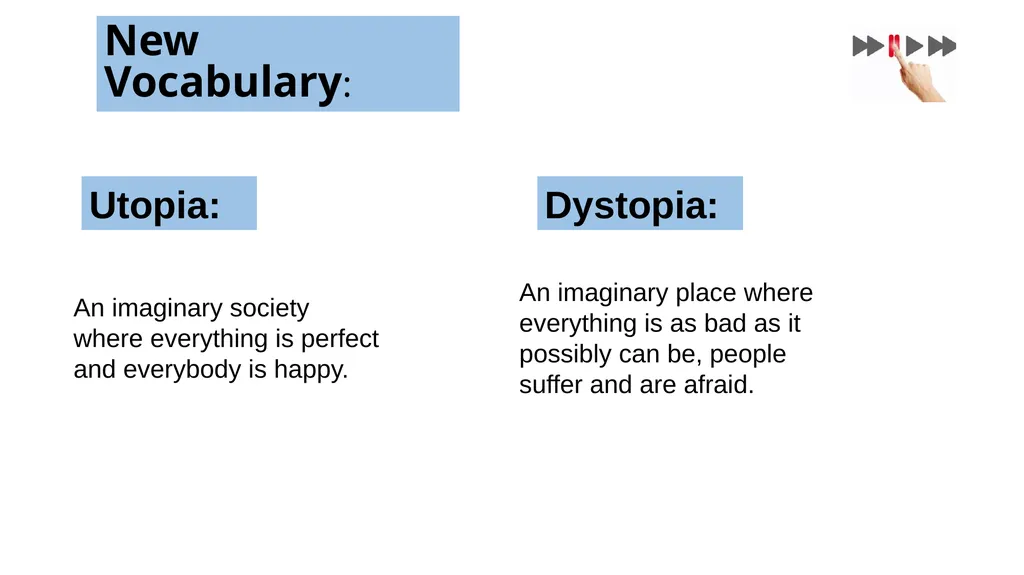
slide5. New Vocabulary: Utopia: Dystopia: An imaginary place where everything is as bad as it possibly can be, people suffer and are afraid. An imaginary society where everything is perfect and everybody is happy.<br>
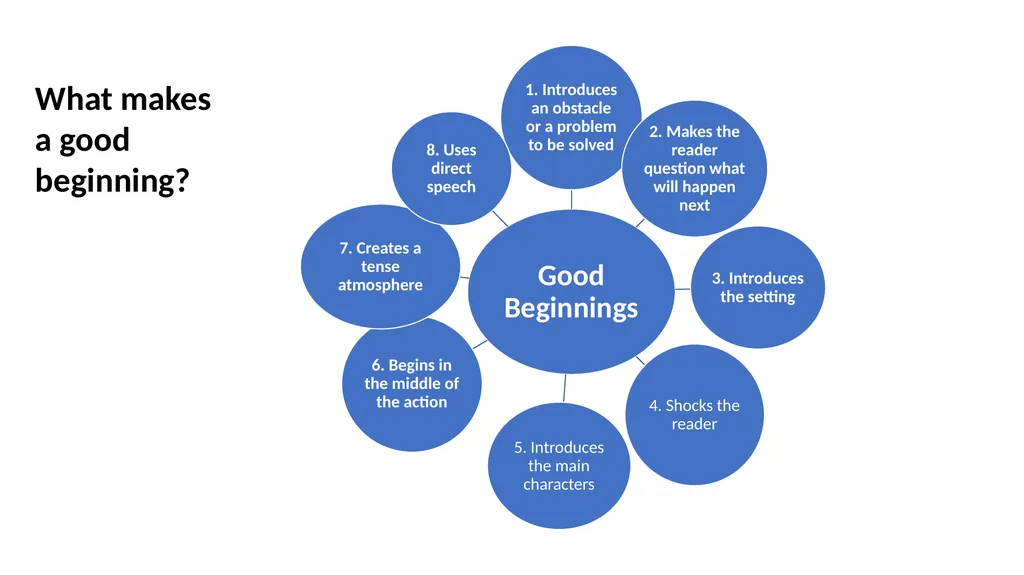
slide6. What makes a good beginning?<br>
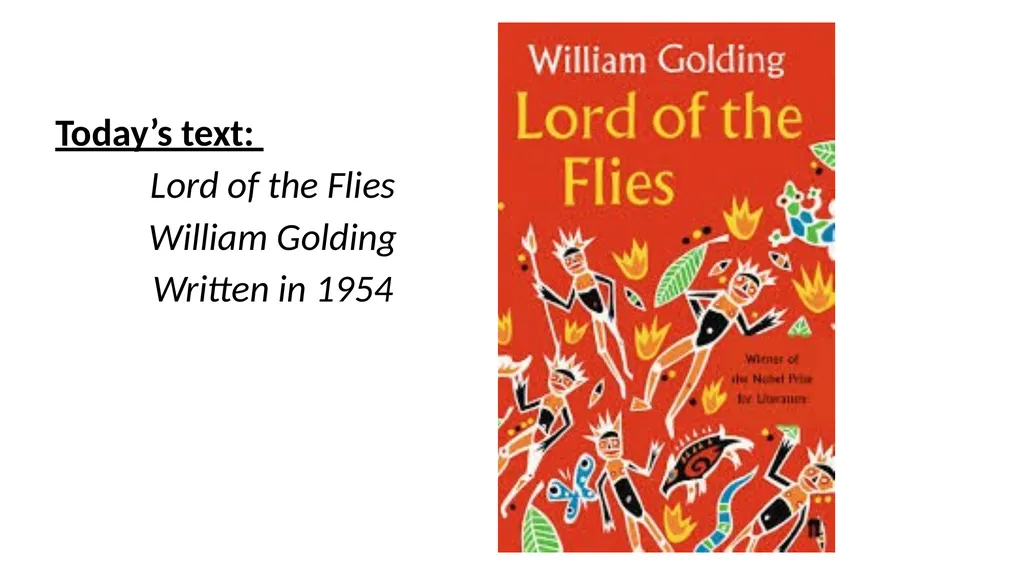
slide7. Today’s text:
Lord of the Flies
William Golding
Written in 1954<br>
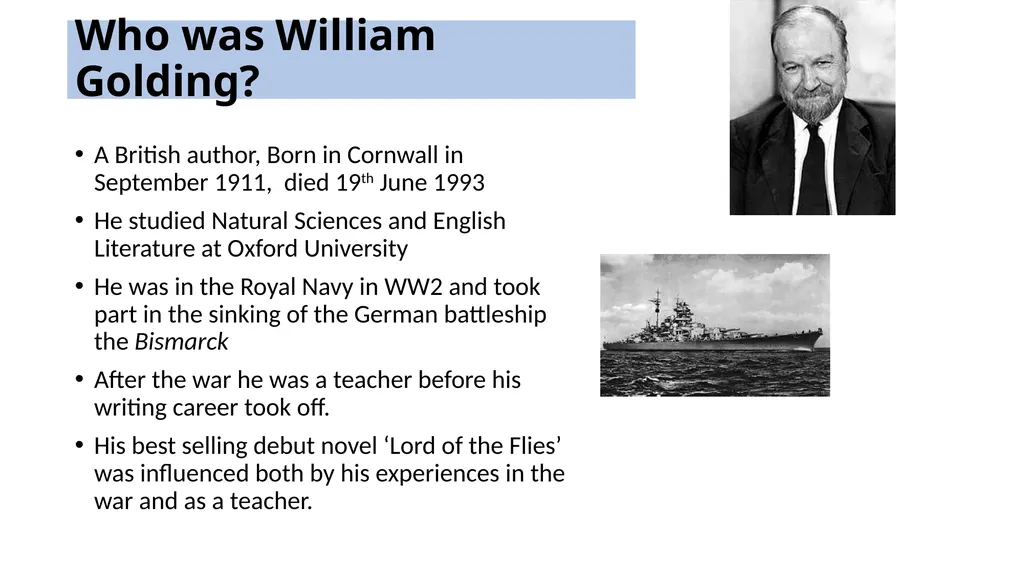
slide8. Who was William Golding? A British author, Born in Cornwall in September 1911, died 19th June 1993
He studied Natural Sciences and English Literature at Oxford University
He was in the Royal Navy in WW2 and took part in the sinking of the German battleship the Bismarck
After the war he was a teacher before his writing career took off.
His best selling debut novel ‘Lord of the Flies’ was influenced both by his experiences in the war and as a teacher.<br>
slide9. Chapter 1: The Sound of the Shell
The boy with fair hair lowered himself down the last few feet of rock and began to pick his way toward the lagoon. Though he had taken off his school sweater and trailed it now from one hand, his grey shirt stuck to him and his hair was plastered to his forehead. All round him the long scar smashed into the jungle was a bath of heat. He was clambering heavily among the creepers and broken trunks when a bird, a vision of red and yellow, flashed upwards with a witch-like cry; and this cry was echoed by another.
“Hi!” it said. “Wait a minute!”
The undergrowth at the side of the scar was shaken and a multitude of raindrops fell pattering.
“Wait a minute,” the voice said. “I got caught up.”
The fair boy stopped and jerked his stockings with an automatic gesture that made the jungle seem for a moment like the Home Counties.
The voice spoke again. “I can’t hardly move with all these creeper things.”
The owner of the voice came backing out of the undergrowth so that twigs scratched on a greasy wind-breaker. The naked crooks of his knees were plump, caught and scratched by thorns. He bent down, removed the thorns carefully, and turned around. He was shorter than the fair boy and very fat. He came forward, searching out safe lodgements for his feet, and then looked up through thick spectacles.<br>
slide10. “Where’s the man with the megaphone?”
The fair boy shook his head.
“This is an island. At least I think it’s an island. That’s a reef out in the sea. Perhaps there aren’t any grownups anywhere.”
The fat boy looked startled.
“There was that pilot. But he wasn’t in the passenger cabin, he was up in front.”
The fair boy was peering at the reef through screwed-up eyes.
“All them other kids,” the fat boy went on. “Some of them must have got out. They must have, mustn’t they?”
The fair boy began to pick his way as casually as possible toward the water. He tried to be offhand and not too obviously uninterested, but the fat boy hurried after him.
“Aren’t there any grownups at all?”
“I don’t think so.”
The fair boy said this solemnly; but then the delight of a realized ambition overcame him. In the middle of the scar he stood on his head and grinned at the reversed fat boy.
“No grownups!”
The fat boy thought for a moment.
“That pilot.”
The fair boy allowed his feet to come down and sat on the steamy earth.<br>
slide11. “He must have flown off after he dropped us. He couldn’t land here. Not in a place with wheels.”
“We was attacked!”
“He’ll be back all right.”
The fat boy shook his head.
“When we was coming down I looked through one of them windows. I saw the other part of the plane. There were flames coming out of it.”
He looked up and down the scar.
“And this is what the cabin done.”
The fair boy reached out and touched the jagged end of a trunk. For a moment he looked interested.
“What happened to it?” he asked. “Where’s it got to now?”
“That storm dragged it out to sea. It wasn’t half dangerous with all them tree trunks falling. There must have been some kids still in it.”
He hesitated for a moment, then spoke again.
“What’s your name?”
“Ralph.”
The fat boy waited to be asked his name in turn but this proffer of acquaintance was not made; the fair boy called Ralph smiled vaguely, stood up, and began to make his way once more toward the lagoon. The fat boy hung steadily at his shoulder.
“I expect there’s a lot more of us scattered about. You haven’t seen any others, have you?”
Ralph shook his head and increased his speed.<br>
slide12. Then he tripped over a branch and came down with a crash.
The fat boy stood by him, breathing hard.
“My auntie told me not to run,” he explained, “on account of my asthma.”
“Ass-mar?”
“That’s right. Can’t catch my breath. I was the only boy in our school what had asthma,” said the fat boy with a touch of pride. “And I’ve been wearing specs since I was three.”
He took off his glasses and held them out to Ralph, blinking and smiling, and then started to wipe them against his grubby wind-breaker.
An expression of pain and inward concentration altered the pale contours of his face. He smeared the sweat from his cheeks and quickly adjusted the spectacles on his nose.
“Them fruit.”
He glanced round the scar.
“Them fruit,” he said, “I expect—”
He put on his glasses, waded away from Ralph, and crouched down among the tangled foliage.
“I’ll be out again in just a minute—”<br>
slide13. Ralph disentangled himself cautiously and stole away through the branches. In a few seconds the fat boy’s grunts were behind him and he was hurrying toward the screen that still lay between him and the lagoon. He climbed over a broken trunk and was out of the jungle.
The shore was fledged with palm trees. These stood or leaned or reclined against the light and their green feathers were a hundred feet up in the air. The ground beneath them was a bank covered with coarse grass, torn everywhere by the upheavals of fallen trees, scattered with decaying coconuts and palm saplings. Behind this was the darkness of the forest proper and the open space of the scar. Ralph stood, one hand against a grey trunk, and screwed up his eyes against the shimmering water. Out there, perhaps a mile away, the white surf flinked on a coral reef, and beyond that the open sea was dark blue. Within the irregular arc of coral the lagoon was still as a mountain lake—blue of all shades and shadowy green and purple. The beach between the palm terrace and the water was a thin stick, endless apparently, for to Ralph’s left the perspectives of palm and beach and water drew to a point at infinity; and always, almost visible, was the heat.<br>
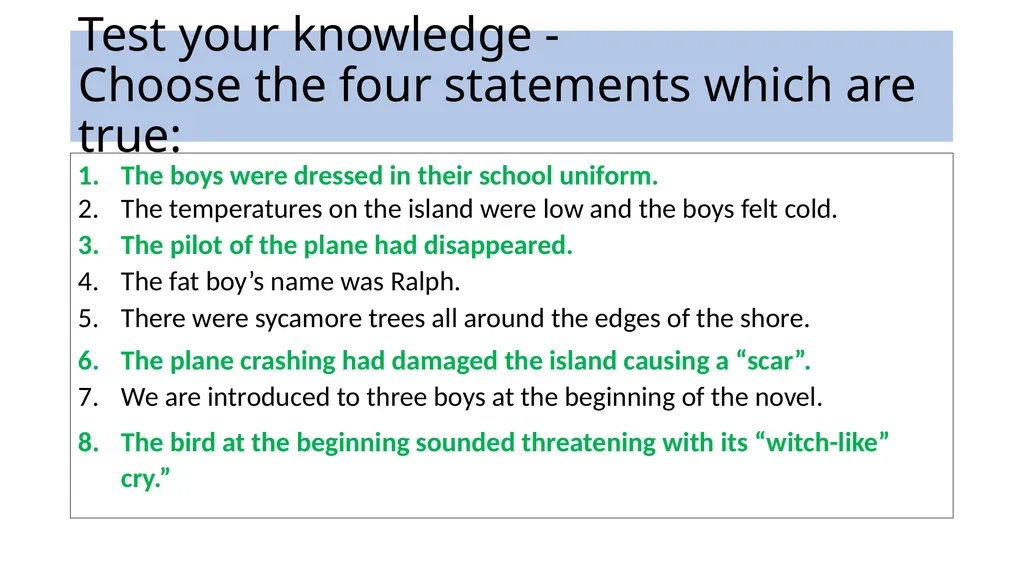
slide14. Test your knowledge - Choose the four statements which are true: The boys were dressed in their school uniform.
The temperatures on the island were low and the boys felt cold.
The pilot of the plane had disappeared.
The fat boy’s name was Ralph.
There were sycamore trees all around the edges of the shore.
The plane crashing had damaged the island causing a “scar”.
We are introduced to three boys at the beginning of the novel.
The bird at the beginning sounded threatening with its “witch-like” cry.”<br>
slide15. Test your knowledge - Choose the four statements which are true: The boys were dressed in their school uniform.
The temperatures on the island were low and the boys felt cold.
The pilot of the plane had disappeared.
The fat boy’s name was Ralph.
There were sycamore trees all around the edges of the shore.
The plane crashing had damaged the island causing a “scar”.
We are introduced to three boys at the beginning of the novel.
The bird at the beginning sounded threatening with its “witch-like” cry.”<br>
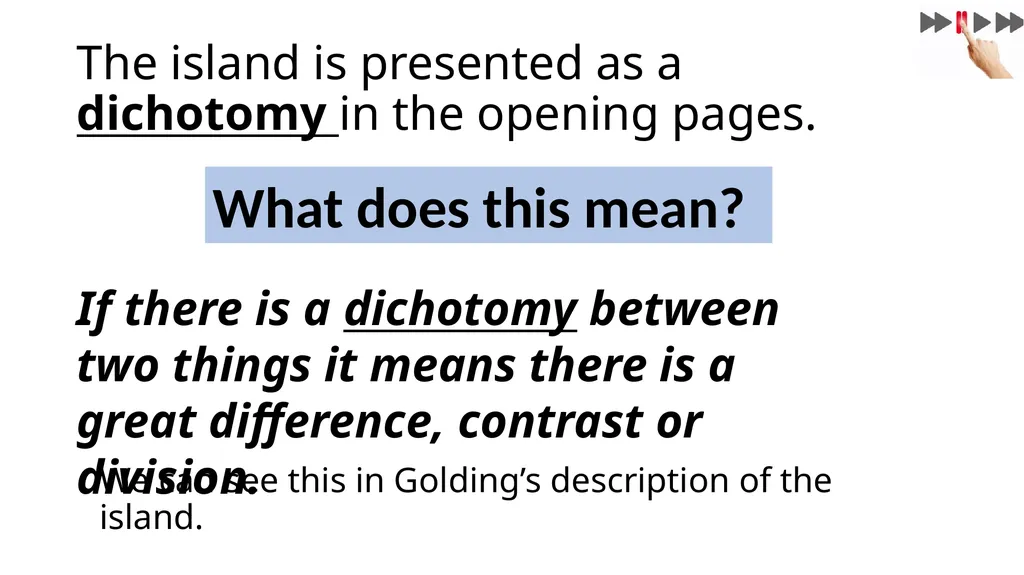
slide16. The island is presented as a dichotomy in the opening pages. What does this mean? If there is a dichotomy between two things it means there is a great difference, contrast or division. We can see this in Golding’s description of the island.<br>
slide17. The shore was fledged with palm trees. These stood or leaned or reclined against the light and their green feathers were a hundred feet up in the air. The ground beneath them was a bank covered with coarse grass, torn everywhere by the upheavals of fallen trees, scattered with decaying coconuts and palm saplings. Behind this was the darkness of the forest proper and the open space of the scar. Ralph stood, one hand against a grey trunk, and screwed up his eyes against the shimmering water. Out there, perhaps a mile away, the white surf flinked on a coral reef, and beyond that the open sea was dark blue. Within the irregular arc of coral the lagoon was still as a mountain lake—blue of all shades and shadowy green and purple. The beach between the palm terrace and the water was a thin stick, endless apparently, for to Ralph’s left the perspectives of palm and beach and water drew to a point at infinity; and always, almost visible, was the heat.<br>
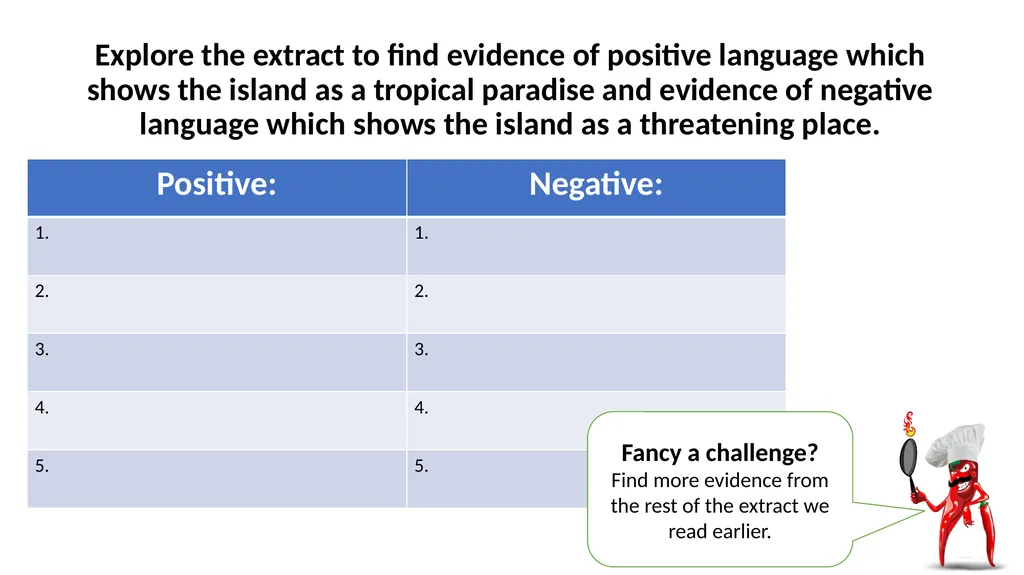
slide18. Explore the extract to find evidence of positive language which shows the island as a tropical paradise and evidence of negative language which shows the island as a threatening place. Fancy a challenge?
Find more evidence from the rest of the extract we read earlier.<br>
slide19. The shore was fledged with palm trees. These stood or leaned or reclined against the light and their green feathers were a hundred feet up in the air. The ground beneath them was a bank covered with coarse grass, torn everywhere by the upheavals of fallen trees, scattered with decaying coconuts and palm saplings. Behind this was the darkness of the forest proper and the open space of the scar. Ralph stood, one hand against a grey trunk, and screwed up his eyes against the shimmering water. Out there, perhaps a mile away, the white surf flinked on a coral reef, and beyond that the open sea was dark blue. Within the irregular arc of coral the lagoon was still as a mountain lake—blue of all shades and shadowy green and purple. The beach between the palm terrace and the water was a thin stick, endless apparently, for to Ralph’s left the perspectives of palm and beach and water drew to a point at infinity; and always, almost visible, was the heat. Need help?<br>
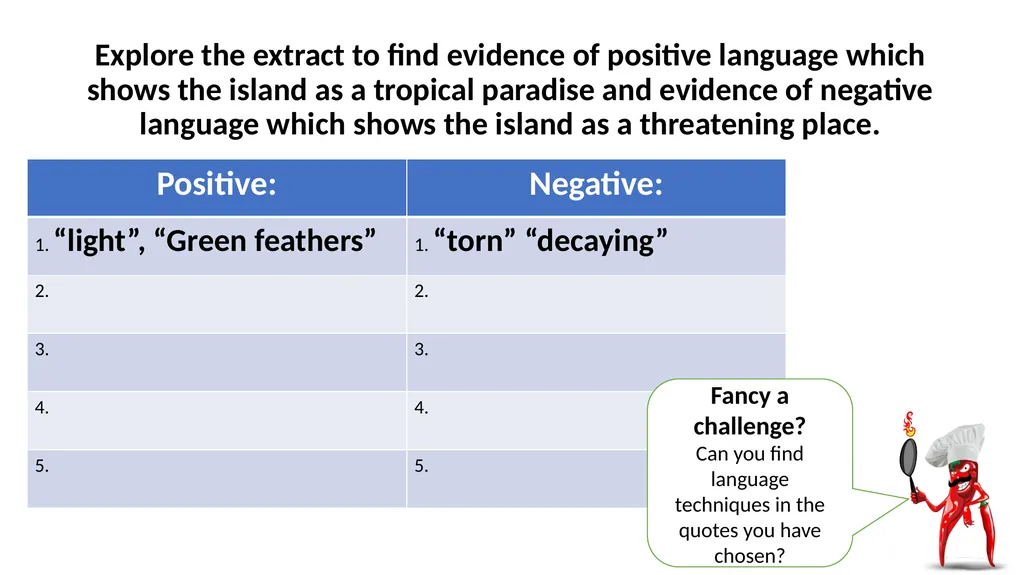
slide20. Explore the extract to find evidence of positive language which shows the island as a tropical paradise and evidence of negative language which shows the island as a threatening place. Fancy a challenge?
Can you find language techniques in the quotes you have chosen?<br>
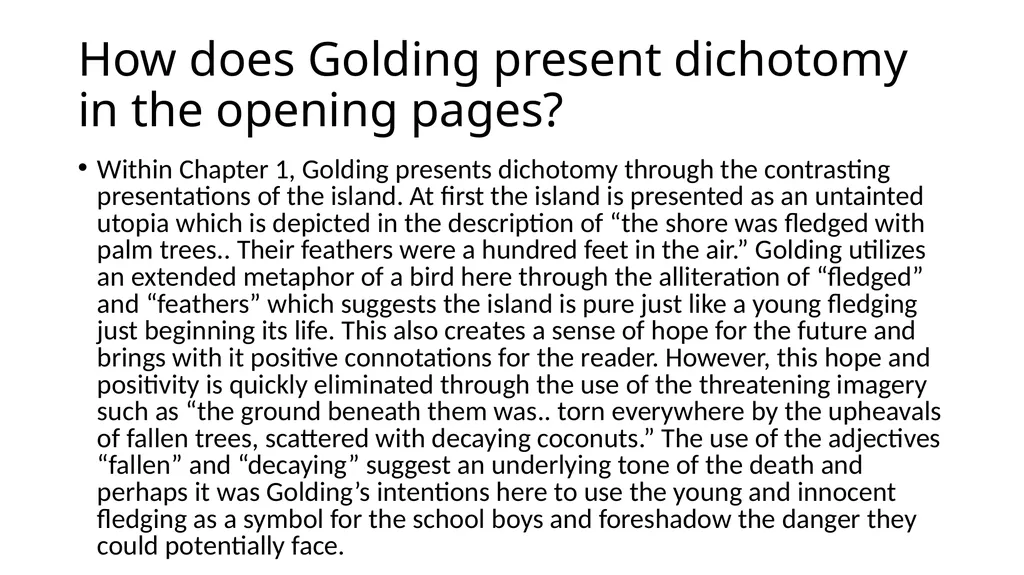
slide21. How does Golding present dichotomy in the opening pages? Within Chapter 1, Golding presents dichotomy through the contrasting presentations of the island. At first the island is presented as an untainted utopia which is depicted in the description of “the shore was fledged with palm trees.. Their feathers were a hundred feet in the air.” Golding utilizes an extended metaphor of a bird here through the alliteration of “fledged” and “feathers” which suggests the island is pure just like a young fledging just beginning its life. This also creates a sense of hope for the future and brings with it positive connotations for the reader. However, this hope and positivity is quickly eliminated through the use of the threatening imagery such as “the ground beneath them was.. torn everywhere by the upheavals of fallen trees, scattered with decaying coconuts.” The use of the adjectives “fallen” and “decaying” suggest an underlying tone of the death and perhaps it was Golding’s intentions here to use the young and innocent fledging as a symbol for the school boys and foreshadow the danger they could potentially face.<br>
slide22. What aspects did we see in the opening of Lord of the Flies?
Can you give an example?<br>
slide23. Click on the link ‘exit ticket’ to complete some questions about what you have learnt this lesson. Big Question: How does William Golding hook his readers? Lesson Objective: To understand what dichotomy means and analyse its use in the opening of Lord of the Flies<br>
slide2. Low Stakes Quiz. Pause this video and click on the link to complete your quiz.<br>
slide3. Big Question: How does William Golding hook his readers? Lesson Objective: To understand what dichotomy means and analyse its use in the opening of Lord of the Flies<br>
slide4. Narrative hooks A narrative hook (or hook) is a literary technique in the opening of a story that "hooks" the reader's attention so that he or she will keep on reading. The "opening" may consist of several paragraphs for a short story, or several pages for a novel, but ideally it is the opening sentence.<br>
slide5. New Vocabulary: Utopia: Dystopia: An imaginary place where everything is as bad as it possibly can be, people suffer and are afraid. An imaginary society where everything is perfect and everybody is happy.<br>
slide6. What makes a good beginning?<br>
slide7. Today’s text:
Lord of the Flies
William Golding
Written in 1954<br>
slide8. Who was William Golding? A British author, Born in Cornwall in September 1911, died 19th June 1993
He studied Natural Sciences and English Literature at Oxford University
He was in the Royal Navy in WW2 and took part in the sinking of the German battleship the Bismarck
After the war he was a teacher before his writing career took off.
His best selling debut novel ‘Lord of the Flies’ was influenced both by his experiences in the war and as a teacher.<br>
slide9. Chapter 1: The Sound of the Shell
The boy with fair hair lowered himself down the last few feet of rock and began to pick his way toward the lagoon. Though he had taken off his school sweater and trailed it now from one hand, his grey shirt stuck to him and his hair was plastered to his forehead. All round him the long scar smashed into the jungle was a bath of heat. He was clambering heavily among the creepers and broken trunks when a bird, a vision of red and yellow, flashed upwards with a witch-like cry; and this cry was echoed by another.
“Hi!” it said. “Wait a minute!”
The undergrowth at the side of the scar was shaken and a multitude of raindrops fell pattering.
“Wait a minute,” the voice said. “I got caught up.”
The fair boy stopped and jerked his stockings with an automatic gesture that made the jungle seem for a moment like the Home Counties.
The voice spoke again. “I can’t hardly move with all these creeper things.”
The owner of the voice came backing out of the undergrowth so that twigs scratched on a greasy wind-breaker. The naked crooks of his knees were plump, caught and scratched by thorns. He bent down, removed the thorns carefully, and turned around. He was shorter than the fair boy and very fat. He came forward, searching out safe lodgements for his feet, and then looked up through thick spectacles.<br>
slide10. “Where’s the man with the megaphone?”
The fair boy shook his head.
“This is an island. At least I think it’s an island. That’s a reef out in the sea. Perhaps there aren’t any grownups anywhere.”
The fat boy looked startled.
“There was that pilot. But he wasn’t in the passenger cabin, he was up in front.”
The fair boy was peering at the reef through screwed-up eyes.
“All them other kids,” the fat boy went on. “Some of them must have got out. They must have, mustn’t they?”
The fair boy began to pick his way as casually as possible toward the water. He tried to be offhand and not too obviously uninterested, but the fat boy hurried after him.
“Aren’t there any grownups at all?”
“I don’t think so.”
The fair boy said this solemnly; but then the delight of a realized ambition overcame him. In the middle of the scar he stood on his head and grinned at the reversed fat boy.
“No grownups!”
The fat boy thought for a moment.
“That pilot.”
The fair boy allowed his feet to come down and sat on the steamy earth.<br>
slide11. “He must have flown off after he dropped us. He couldn’t land here. Not in a place with wheels.”
“We was attacked!”
“He’ll be back all right.”
The fat boy shook his head.
“When we was coming down I looked through one of them windows. I saw the other part of the plane. There were flames coming out of it.”
He looked up and down the scar.
“And this is what the cabin done.”
The fair boy reached out and touched the jagged end of a trunk. For a moment he looked interested.
“What happened to it?” he asked. “Where’s it got to now?”
“That storm dragged it out to sea. It wasn’t half dangerous with all them tree trunks falling. There must have been some kids still in it.”
He hesitated for a moment, then spoke again.
“What’s your name?”
“Ralph.”
The fat boy waited to be asked his name in turn but this proffer of acquaintance was not made; the fair boy called Ralph smiled vaguely, stood up, and began to make his way once more toward the lagoon. The fat boy hung steadily at his shoulder.
“I expect there’s a lot more of us scattered about. You haven’t seen any others, have you?”
Ralph shook his head and increased his speed.<br>
slide12. Then he tripped over a branch and came down with a crash.
The fat boy stood by him, breathing hard.
“My auntie told me not to run,” he explained, “on account of my asthma.”
“Ass-mar?”
“That’s right. Can’t catch my breath. I was the only boy in our school what had asthma,” said the fat boy with a touch of pride. “And I’ve been wearing specs since I was three.”
He took off his glasses and held them out to Ralph, blinking and smiling, and then started to wipe them against his grubby wind-breaker.
An expression of pain and inward concentration altered the pale contours of his face. He smeared the sweat from his cheeks and quickly adjusted the spectacles on his nose.
“Them fruit.”
He glanced round the scar.
“Them fruit,” he said, “I expect—”
He put on his glasses, waded away from Ralph, and crouched down among the tangled foliage.
“I’ll be out again in just a minute—”<br>
slide13. Ralph disentangled himself cautiously and stole away through the branches. In a few seconds the fat boy’s grunts were behind him and he was hurrying toward the screen that still lay between him and the lagoon. He climbed over a broken trunk and was out of the jungle.
The shore was fledged with palm trees. These stood or leaned or reclined against the light and their green feathers were a hundred feet up in the air. The ground beneath them was a bank covered with coarse grass, torn everywhere by the upheavals of fallen trees, scattered with decaying coconuts and palm saplings. Behind this was the darkness of the forest proper and the open space of the scar. Ralph stood, one hand against a grey trunk, and screwed up his eyes against the shimmering water. Out there, perhaps a mile away, the white surf flinked on a coral reef, and beyond that the open sea was dark blue. Within the irregular arc of coral the lagoon was still as a mountain lake—blue of all shades and shadowy green and purple. The beach between the palm terrace and the water was a thin stick, endless apparently, for to Ralph’s left the perspectives of palm and beach and water drew to a point at infinity; and always, almost visible, was the heat.<br>
slide14. Test your knowledge - Choose the four statements which are true: The boys were dressed in their school uniform.
The temperatures on the island were low and the boys felt cold.
The pilot of the plane had disappeared.
The fat boy’s name was Ralph.
There were sycamore trees all around the edges of the shore.
The plane crashing had damaged the island causing a “scar”.
We are introduced to three boys at the beginning of the novel.
The bird at the beginning sounded threatening with its “witch-like” cry.”<br>
slide15. Test your knowledge - Choose the four statements which are true: The boys were dressed in their school uniform.
The temperatures on the island were low and the boys felt cold.
The pilot of the plane had disappeared.
The fat boy’s name was Ralph.
There were sycamore trees all around the edges of the shore.
The plane crashing had damaged the island causing a “scar”.
We are introduced to three boys at the beginning of the novel.
The bird at the beginning sounded threatening with its “witch-like” cry.”<br>
slide16. The island is presented as a dichotomy in the opening pages. What does this mean? If there is a dichotomy between two things it means there is a great difference, contrast or division. We can see this in Golding’s description of the island.<br>
slide17. The shore was fledged with palm trees. These stood or leaned or reclined against the light and their green feathers were a hundred feet up in the air. The ground beneath them was a bank covered with coarse grass, torn everywhere by the upheavals of fallen trees, scattered with decaying coconuts and palm saplings. Behind this was the darkness of the forest proper and the open space of the scar. Ralph stood, one hand against a grey trunk, and screwed up his eyes against the shimmering water. Out there, perhaps a mile away, the white surf flinked on a coral reef, and beyond that the open sea was dark blue. Within the irregular arc of coral the lagoon was still as a mountain lake—blue of all shades and shadowy green and purple. The beach between the palm terrace and the water was a thin stick, endless apparently, for to Ralph’s left the perspectives of palm and beach and water drew to a point at infinity; and always, almost visible, was the heat.<br>
slide18. Explore the extract to find evidence of positive language which shows the island as a tropical paradise and evidence of negative language which shows the island as a threatening place. Fancy a challenge?
Find more evidence from the rest of the extract we read earlier.<br>
slide19. The shore was fledged with palm trees. These stood or leaned or reclined against the light and their green feathers were a hundred feet up in the air. The ground beneath them was a bank covered with coarse grass, torn everywhere by the upheavals of fallen trees, scattered with decaying coconuts and palm saplings. Behind this was the darkness of the forest proper and the open space of the scar. Ralph stood, one hand against a grey trunk, and screwed up his eyes against the shimmering water. Out there, perhaps a mile away, the white surf flinked on a coral reef, and beyond that the open sea was dark blue. Within the irregular arc of coral the lagoon was still as a mountain lake—blue of all shades and shadowy green and purple. The beach between the palm terrace and the water was a thin stick, endless apparently, for to Ralph’s left the perspectives of palm and beach and water drew to a point at infinity; and always, almost visible, was the heat. Need help?<br>
slide20. Explore the extract to find evidence of positive language which shows the island as a tropical paradise and evidence of negative language which shows the island as a threatening place. Fancy a challenge?
Can you find language techniques in the quotes you have chosen?<br>
slide21. How does Golding present dichotomy in the opening pages? Within Chapter 1, Golding presents dichotomy through the contrasting presentations of the island. At first the island is presented as an untainted utopia which is depicted in the description of “the shore was fledged with palm trees.. Their feathers were a hundred feet in the air.” Golding utilizes an extended metaphor of a bird here through the alliteration of “fledged” and “feathers” which suggests the island is pure just like a young fledging just beginning its life. This also creates a sense of hope for the future and brings with it positive connotations for the reader. However, this hope and positivity is quickly eliminated through the use of the threatening imagery such as “the ground beneath them was.. torn everywhere by the upheavals of fallen trees, scattered with decaying coconuts.” The use of the adjectives “fallen” and “decaying” suggest an underlying tone of the death and perhaps it was Golding’s intentions here to use the young and innocent fledging as a symbol for the school boys and foreshadow the danger they could potentially face.<br>
slide22. What aspects did we see in the opening of Lord of the Flies?
Can you give an example?<br>
slide23. Click on the link ‘exit ticket’ to complete some questions about what you have learnt this lesson. Big Question: How does William Golding hook his readers? Lesson Objective: To understand what dichotomy means and analyse its use in the opening of Lord of the Flies<br>