
Week 8 – Lesson 3 Big Question: How does JD
DP
Published · 19 slides · 0 views
1 / 1






Description
Week 8 Lesson 3 Big Question: How does JD Salinger create a unique narrative voice in his novel? Lesson Objective: To analyse the narrative voice in The Catcher in the Rye. Low Stakes Quiz. Pause this video and click on the link to
Related Topics
Share
Embed code
Download this presentation From Below
"Week 8 – Lesson 3 Big Question: How does JD" is the property of its rightful owner. Permission is granted to download and print the materials on this website for personal, non-commercial use only, and to display it on your personal computer provided you do not modify the materials and that you retain all copyright notices contained in the materials. By downloading content from our website, you accept the terms of this agreement.
Presentation Transcript
01
Week 8 – Lesson 3 Big Question: How does JD Salinger create a unique narrative voice in his novel? Lesson Objective: To analyse the narrative voice in ‘The Catcher in the Rye’.<br>
02
Low Stakes Quiz. Pause this video and click on the link to complete your quiz.<br>
03
Big Question: How does JD Salinger create a unique narrative voice in his novel? Lesson Objective: To analyse the narrative voice in ‘The Catcher in the Rye.’<br>
04
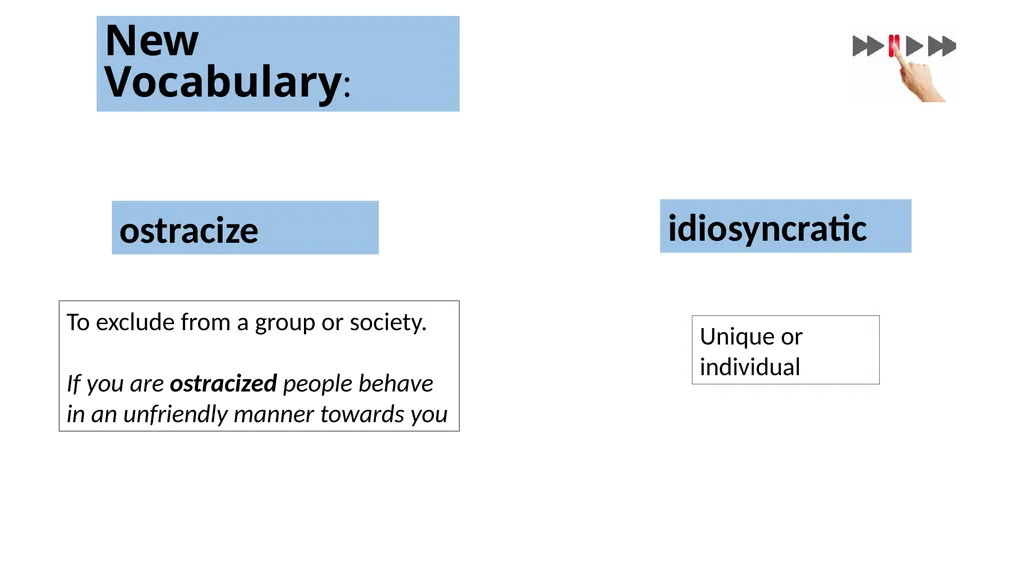
New Vocabulary: To exclude from a group or society.
If you are ostracized people behave in an unfriendly manner towards you Unique or individual ostracize idiosyncratic<br>
If you are ostracized people behave in an unfriendly manner towards you Unique or individual ostracize idiosyncratic<br>
05
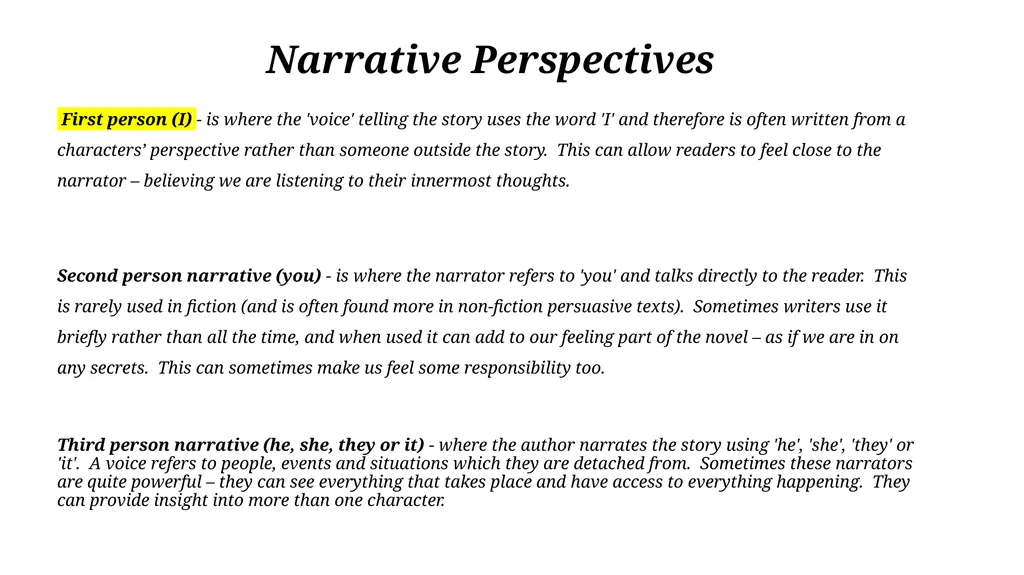
Narrative Perspectives
First person (I) - is where the 'voice' telling the story uses the word 'I' and therefore is often written from a characters’ perspective rather than someone outside the story. This can allow readers to feel close to the narrator – believing we are listening to their innermost thoughts.
Second person narrative (you) - is where the narrator refers to 'you' and talks directly to the reader. This is rarely used in fiction (and is often found more in non-fiction persuasive texts). Sometimes writers use it briefly rather than all the time, and when used it can add to our feeling part of the novel – as if we are in on any secrets. This can sometimes make us feel some responsibility too.
Third person narrative (he, she, they or it) - where the author narrates the story using 'he', 'she', 'they' or 'it'. A voice refers to people, events and situations which they are detached from. Sometimes these narrators are quite powerful – they can see everything that takes place and have access to everything happening. They can provide insight into more than one character.<br>
First person (I) - is where the 'voice' telling the story uses the word 'I' and therefore is often written from a characters’ perspective rather than someone outside the story. This can allow readers to feel close to the narrator – believing we are listening to their innermost thoughts.
Second person narrative (you) - is where the narrator refers to 'you' and talks directly to the reader. This is rarely used in fiction (and is often found more in non-fiction persuasive texts). Sometimes writers use it briefly rather than all the time, and when used it can add to our feeling part of the novel – as if we are in on any secrets. This can sometimes make us feel some responsibility too.
Third person narrative (he, she, they or it) - where the author narrates the story using 'he', 'she', 'they' or 'it'. A voice refers to people, events and situations which they are detached from. Sometimes these narrators are quite powerful – they can see everything that takes place and have access to everything happening. They can provide insight into more than one character.<br>
06
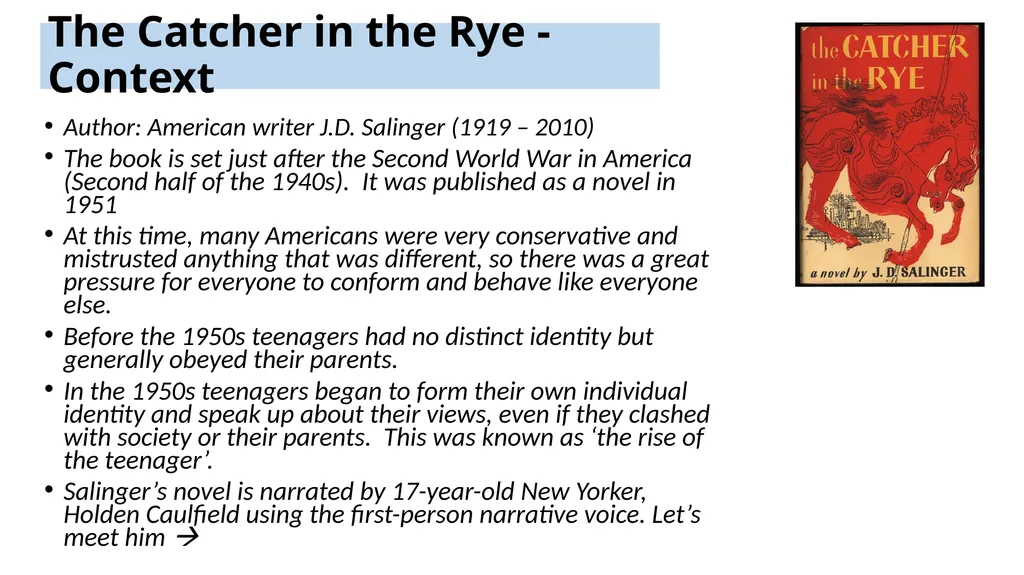
The Catcher in the Rye - Context Author: American writer J.D. Salinger (1919 – 2010)
The book is set just after the Second World War in America (Second half of the 1940s). It was published as a novel in 1951
At this time, many Americans were very conservative and mistrusted anything that was different, so there was a great pressure for everyone to conform and behave like everyone else.
Before the 1950s teenagers had no distinct identity but generally obeyed their parents.
In the 1950s teenagers began to form their own individual identity and speak up about their views, even if they clashed with society or their parents. This was known as ‘the rise of the teenager’.
Salinger’s novel is narrated by 17-year-old New Yorker, Holden Caulfield using the first-person narrative voice. Let’s meet him <br>
The book is set just after the Second World War in America (Second half of the 1940s). It was published as a novel in 1951
At this time, many Americans were very conservative and mistrusted anything that was different, so there was a great pressure for everyone to conform and behave like everyone else.
Before the 1950s teenagers had no distinct identity but generally obeyed their parents.
In the 1950s teenagers began to form their own individual identity and speak up about their views, even if they clashed with society or their parents. This was known as ‘the rise of the teenager’.
Salinger’s novel is narrated by 17-year-old New Yorker, Holden Caulfield using the first-person narrative voice. Let’s meet him <br>
07
If you really want to hear about it, the first thing you'll probably want to know is where I was born, an what my lousy childhood was like, and how my parents were occupied and all before they had me, but I don't feel like going into it, if you want to know the truth. In the first place, that stuff bores me, and in the second place, my parents would have about two haemorrhages apiece if I told anything pretty personal about them. They're quite touchy about anything like that, especially my father. They're nice and all--I'm not saying that--but they're also touchy as hell. Besides, I'm not going to tell you my whole goddam autobiography or anything. I'll just tell you about this madman stuff that happened to me around last Christmas just before I got pretty run-down and had to come out here and take it easy. I mean that's all I told D.B. about, and he's my brother and all. He's in Hollywood. That isn't too far from this crumby place, and he comes over and visits me practically every week end. He's going to drive me home when I go home next month maybe. Chapter 1<br>
08
He just got a Jaguar. One of those little English jobs that can do around two hundred miles an hour. It cost him near four thousand bucks. He's got a lot of dough, now. He didn't use to. He used to be just a regular writer, when he was home. He wrote this terrific book of short stories, The Secret Goldfish, in case you never heard of him. The best one in it was "The Secret Goldfish." It was about this little kid that wouldn't let anybody look at his goldfish because he'd bought it with his own money. It killed me. Now he's out in Hollywood, D.B. If there's one thing I hate, it's the movies. Don't even mention them to me.
Where I want to start telling is the day I left Pencey Prep. Pencey Prep is this school that's in Agerstown, Pennsylvania. You probably heard of it. You've probably seen the ads, anyway. They advertise in about a thousand magazines, always showing some hotshot guy on a horse jumping over a fence. Like as if all you ever did at Pencey was play polo all the time. I never even once saw a horse anywhere near the place. And underneath the guy on the horse's picture, it always says: "Since 1888 we have been molding boys into splendid, clear-thinking young men." Strictly for the birds. They don't do any more molding at Pencey than they do at any other school. And I didn't know anybody there that was splendid and clear-thinking and all. Maybe two guys. If that many. And they probably came to Pencey that way.<br>
Where I want to start telling is the day I left Pencey Prep. Pencey Prep is this school that's in Agerstown, Pennsylvania. You probably heard of it. You've probably seen the ads, anyway. They advertise in about a thousand magazines, always showing some hotshot guy on a horse jumping over a fence. Like as if all you ever did at Pencey was play polo all the time. I never even once saw a horse anywhere near the place. And underneath the guy on the horse's picture, it always says: "Since 1888 we have been molding boys into splendid, clear-thinking young men." Strictly for the birds. They don't do any more molding at Pencey than they do at any other school. And I didn't know anybody there that was splendid and clear-thinking and all. Maybe two guys. If that many. And they probably came to Pencey that way.<br>
09
Anyway, it was the Saturday of the football game with Saxon Hall. The game with Saxon Hall was supposed to be a very big deal around Pencey. It was the last game of the year, and you were supposed to commit suicide or something if old Pencey didn't win. I remember around three o'clock that afternoon I was standing way the hell up on top of Thomsen Hill, right next to this crazy cannon that was in the Revolutionary War and all. You could see the whole field from there, and you could see the two teams bashing each other all over the place. You couldn't see the grandstand too hot, but you could hear them all yelling, deep and terrific on the Pencey side, because practically the whole school except me was there.
There were never many girls at all at the football games. Only seniors were allowed to bring girls with them. It was a terrible school, no matter how you looked at it. I like to be somewhere at least where you can see a few girls around once in a while, even if they're only scratching their arms or blowing their noses or even just giggling or something. Old Selma Thurmer--she was the headmaster's daughter--showed up at the games quite often. She was a pretty nice girl, though. I sat next to her once in the bus from Agerstown and we sort of struck up a conversation. I liked her. She had a big nose and her nails were all bitten down and bleedy-looking, but you felt sort of sorry for her. What I liked about her, she didn't give you a lot of horse manure about what a great guy her father was. She probably knew what a phony slob he was.<br>
There were never many girls at all at the football games. Only seniors were allowed to bring girls with them. It was a terrible school, no matter how you looked at it. I like to be somewhere at least where you can see a few girls around once in a while, even if they're only scratching their arms or blowing their noses or even just giggling or something. Old Selma Thurmer--she was the headmaster's daughter--showed up at the games quite often. She was a pretty nice girl, though. I sat next to her once in the bus from Agerstown and we sort of struck up a conversation. I liked her. She had a big nose and her nails were all bitten down and bleedy-looking, but you felt sort of sorry for her. What I liked about her, she didn't give you a lot of horse manure about what a great guy her father was. She probably knew what a phony slob he was.<br>
10
The reason I was standing way up on Thomsen Hill, instead of down at the game, was because I'd just got back from New York with the fencing team. I was the goddam manager of the fencing team. Very big deal. We'd gone in to New York that morning for this fencing meet with McBurney School. Only, we didn't have the meet. I left all the foils and equipment and stuff on the goddam subway. It wasn't all my fault. I had to keep getting up to look at this map, so we'd know where to get off. So we got back to Pencey around two-thirty instead of around dinnertime. The whole team ostracized me the whole way back on the train. It was pretty funny, in a way.
The other reason I wasn't down at the game was because I was on my way to say good-by to old Spencer, my history teacher. He had the grippe, and I figured I probably wouldn't see him again till Christmas vacation started. He wrote me this note saying he wanted to see me before I went home. He knew I wasn't coming back to Pencey. I forgot to tell you about that. They kicked me out. I wasn't supposed to come back after Christmas vacation on account of I was flunking four subjects and not applying myself and all. They gave me frequent warning to start applying myself--especially around midterms, when my parents came up for a conference with old Thurmer--but I didn't do it. So I got the ax. They give guys the ax quite frequently at Pencey. It has a very good academic rating, Pencey. It really does.<br>
The other reason I wasn't down at the game was because I was on my way to say good-by to old Spencer, my history teacher. He had the grippe, and I figured I probably wouldn't see him again till Christmas vacation started. He wrote me this note saying he wanted to see me before I went home. He knew I wasn't coming back to Pencey. I forgot to tell you about that. They kicked me out. I wasn't supposed to come back after Christmas vacation on account of I was flunking four subjects and not applying myself and all. They gave me frequent warning to start applying myself--especially around midterms, when my parents came up for a conference with old Thurmer--but I didn't do it. So I got the ax. They give guys the ax quite frequently at Pencey. It has a very good academic rating, Pencey. It really does.<br>
11
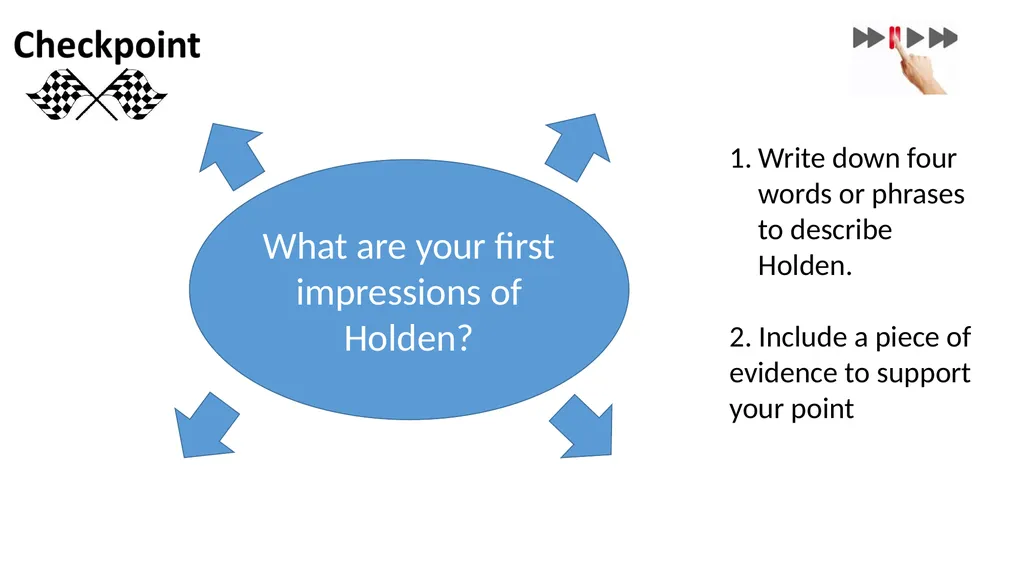
What are your first impressions of Holden? Write down four words or phrases to describe Holden.
2. Include a piece of evidence to support your point<br>
2. Include a piece of evidence to support your point<br>
12
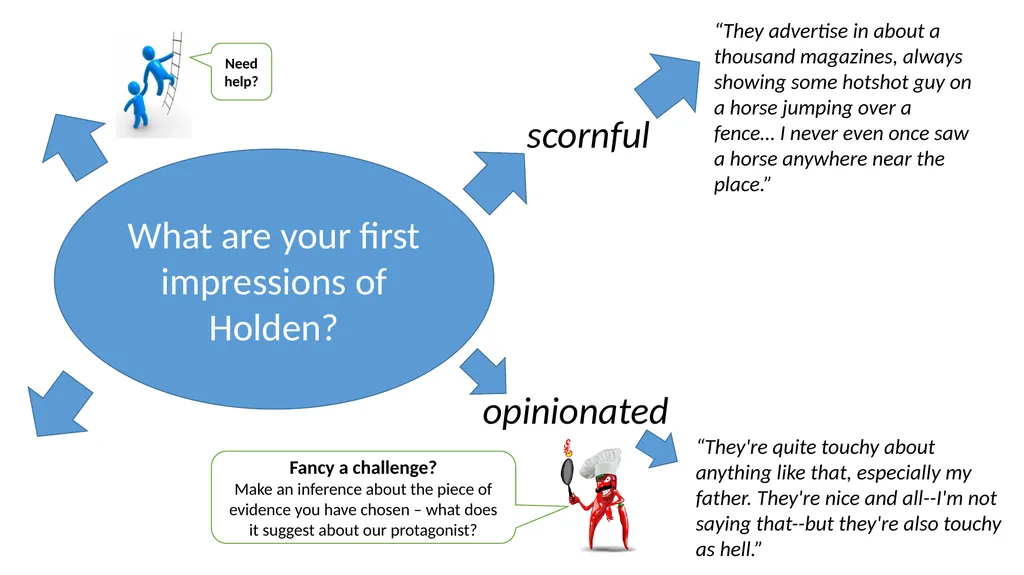
What are your first impressions of Holden? scornful “They advertise in about a thousand magazines, always showing some hotshot guy on a horse jumping over a fence… I never even once saw a horse anywhere near the place.” opinionated “They're quite touchy about anything like that, especially my father. They're nice and all--I'm not saying that--but they're also touchy as hell.” Need help? Fancy a challenge?
Make an inference about the piece of evidence you have chosen – what does it suggest about our protagonist?<br>
Make an inference about the piece of evidence you have chosen – what does it suggest about our protagonist?<br>
13
What are your first impressions of Holden? Write down four words or phrases to describe Holden.
2. Include a piece of evidence to support your point<br>
2. Include a piece of evidence to support your point<br>
14
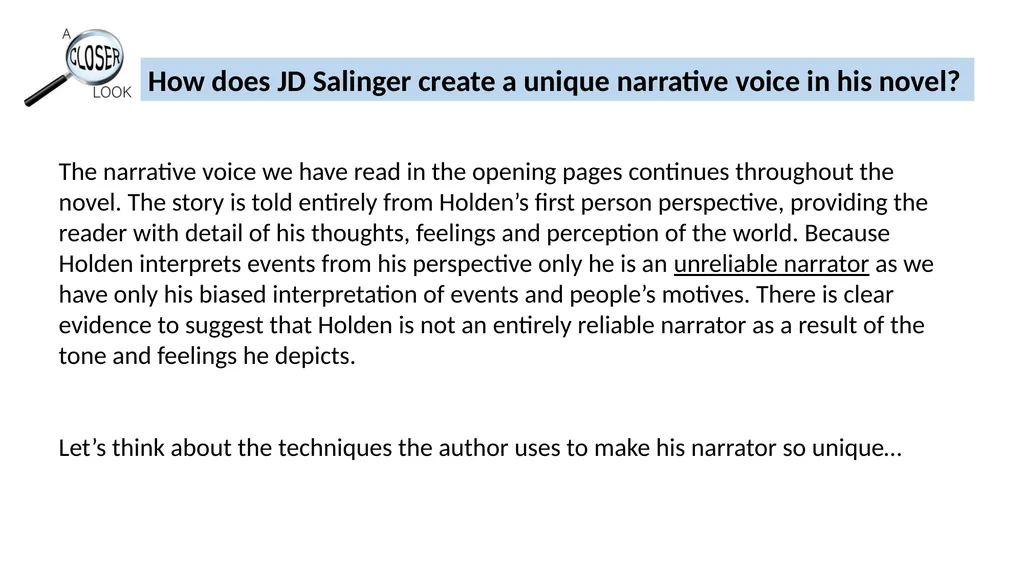
How does JD Salinger create a unique narrative voice in his novel? The narrative voice we have read in the opening pages continues throughout the novel. The story is told entirely from Holden’s first person perspective, providing the reader with detail of his thoughts, feelings and perception of the world. Because Holden interprets events from his perspective only he is an unreliable narrator as we have only his biased interpretation of events and people’s motives. There is clear evidence to suggest that Holden is not an entirely reliable narrator as a result of the tone and feelings he depicts.
Let’s think about the techniques the author uses to make his narrator so unique…<br>
Let’s think about the techniques the author uses to make his narrator so unique…<br>
15
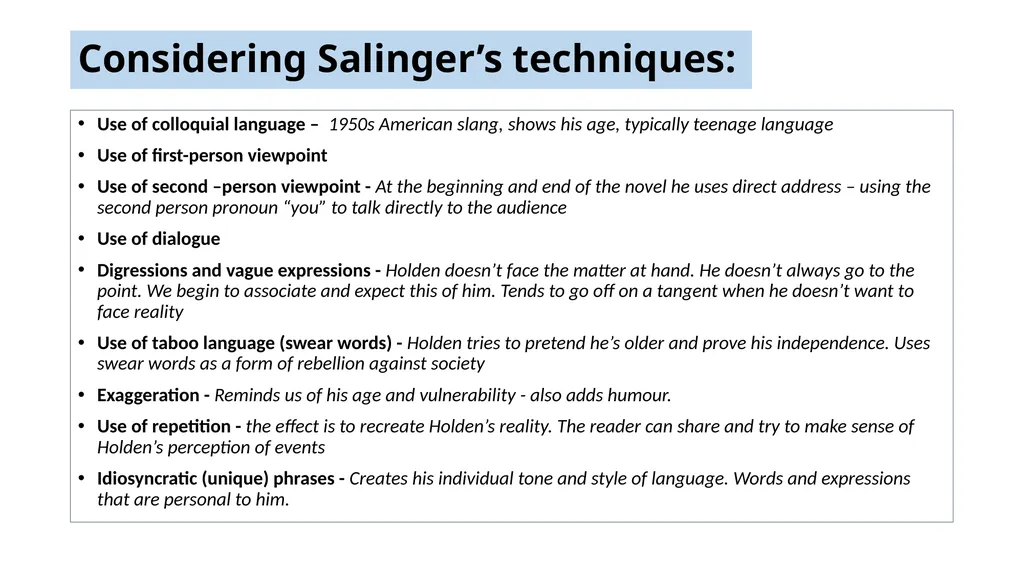
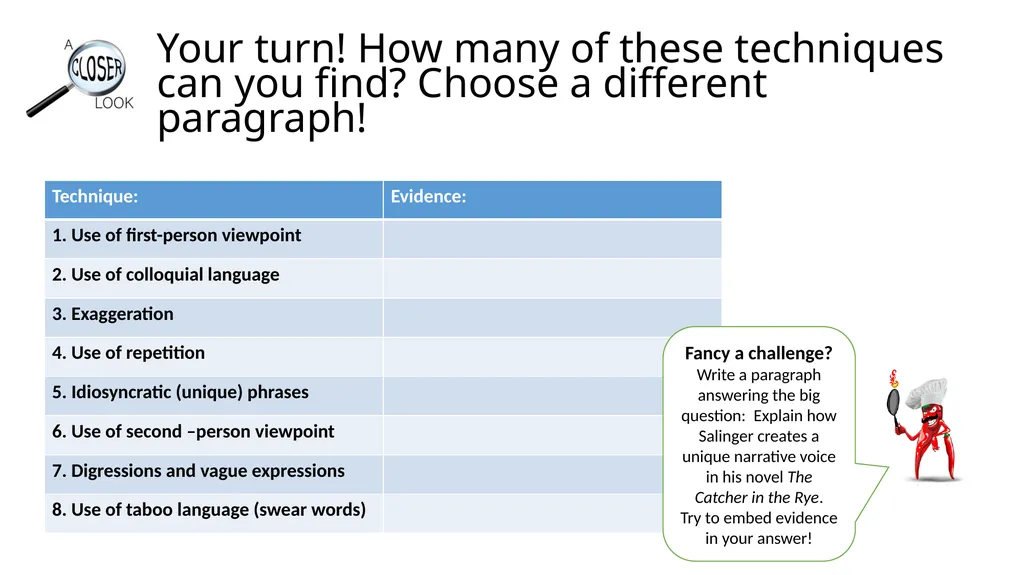
Considering Salinger’s techniques: Use of colloquial language – 1950s American slang, shows his age, typically teenage language
Use of first-person viewpoint
Use of second –person viewpoint - At the beginning and end of the novel he uses direct address – using the second person pronoun “you” to talk directly to the audience
Use of dialogue
Digressions and vague expressions - Holden doesn’t face the matter at hand. He doesn’t always go to the point. We begin to associate and expect this of him. Tends to go off on a tangent when he doesn’t want to face reality
Use of taboo language (swear words) - Holden tries to pretend he’s older and prove his independence. Uses swear words as a form of rebellion against society
Exaggeration - Reminds us of his age and vulnerability - also adds humour.
Use of repetition - the effect is to recreate Holden’s reality. The reader can share and try to make sense of Holden’s perception of events
Idiosyncratic (unique) phrases - Creates his individual tone and style of language. Words and expressions that are personal to him.<br>
Use of first-person viewpoint
Use of second –person viewpoint - At the beginning and end of the novel he uses direct address – using the second person pronoun “you” to talk directly to the audience
Use of dialogue
Digressions and vague expressions - Holden doesn’t face the matter at hand. He doesn’t always go to the point. We begin to associate and expect this of him. Tends to go off on a tangent when he doesn’t want to face reality
Use of taboo language (swear words) - Holden tries to pretend he’s older and prove his independence. Uses swear words as a form of rebellion against society
Exaggeration - Reminds us of his age and vulnerability - also adds humour.
Use of repetition - the effect is to recreate Holden’s reality. The reader can share and try to make sense of Holden’s perception of events
Idiosyncratic (unique) phrases - Creates his individual tone and style of language. Words and expressions that are personal to him.<br>
16
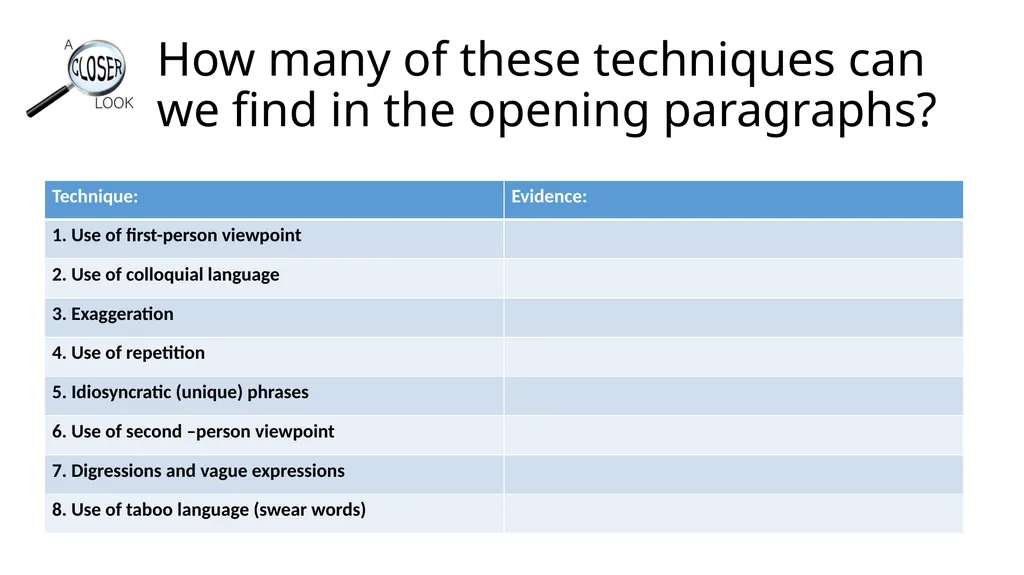
How many of these techniques can we find in the opening paragraphs?<br>
17
If you really want to hear about it, the first thing you'll probably want to know is where I was born, an what my lousy childhood was like, and how my parents were occupied and all before they had me, but I don't feel like going into it, if you want to know the truth. In the first place, that stuff bores me, and in the second place, my parents would have about two haemorrhages apiece if I told anything pretty personal about them. They're quite touchy about anything like that, especially my father. They're nice and all--I'm not saying that--but they're also touchy as hell. Besides, I'm not going to tell you my whole goddam autobiography or anything. I'll just tell you about this madman stuff that happened to me around last Christmas just before I got pretty run-down and had to come out here and take it easy. I mean that's all I told D.B. about, and he's my brother and all. He's in Hollywood. That isn't too far from this crumby place, and he comes over and visits me practically every week end. He's going to drive me home when I go home next month maybe. Need help? First-person viewpoint Colloquial Language Exaggeration Repetition Idiosyncratic Phrases Second Person Viewpoint Vague Expressions Taboo Language<br>
18
Your turn! How many of these techniques can you find? Choose a different paragraph! Fancy a challenge?
Write a paragraph answering the big question: Explain how Salinger creates a unique narrative voice in his novel The Catcher in the Rye.
Try to embed evidence in your answer!<br>
Write a paragraph answering the big question: Explain how Salinger creates a unique narrative voice in his novel The Catcher in the Rye.
Try to embed evidence in your answer!<br>
19
Click on the link ‘exit ticket’ to complete some questions about what you have learnt this lesson. Big Question: How does JD Salinger create a unique narrative voice in his novel? Lesson Objective: To analyse the narrative voice in ‘The Catcher in the Rye’.’<br>