
WELCOME IRB Basics for Students Kate Boschert
MT
Published · 27 slides · 0 views

1 / 1

Description
WELCOME IRB Basics for Students Kate Boschert April 2025 IRBadministratorwpunj.edu Topics to cover Purpose of the IRB What needs IRB Review (and What Doesnt) How to Submit your Protocol to the WP IRB Categories of IRB Review Cayuse Human
Related Topics
Download this presentation From Below
"WELCOME IRB Basics for Students Kate Boschert" is the property of its rightful owner. Permission is granted to download and print the materials on this website for personal, non-commercial use only, and to display it on your personal computer provided you do not modify the materials and that you retain all copyright notices contained in the materials. By downloading content from our website, you accept the terms of this agreement.
Share
Embed code
Presentation Transcript
01
WELCOME IRB Basics for Students
Kate Boschert April 2025
IRBadministrator@wpunj.edu<br>
Kate Boschert April 2025
IRBadministrator@wpunj.edu<br>
02
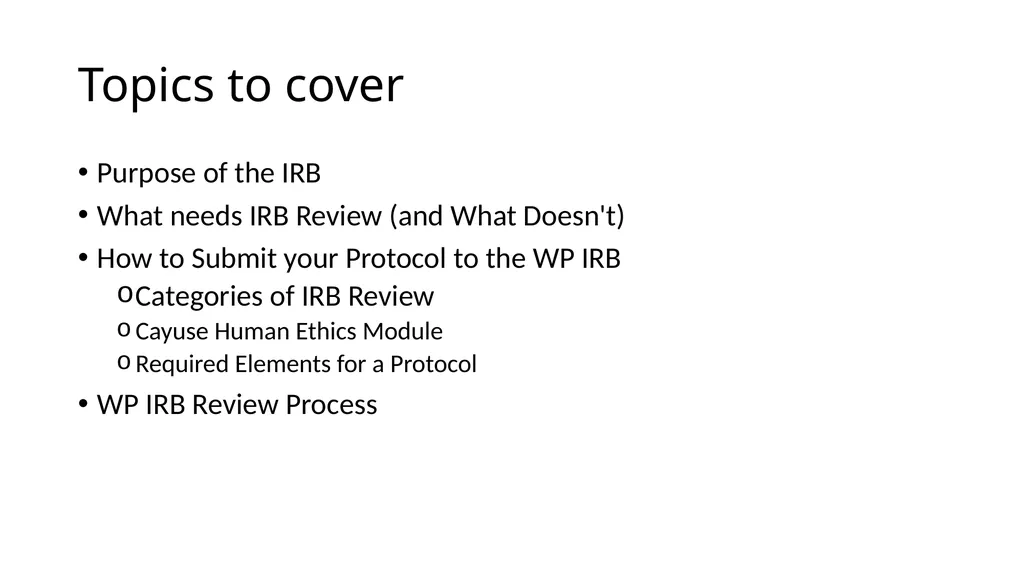
Topics to cover Purpose of the IRB
What needs IRB Review (and What Doesn't)
How to Submit your Protocol to the WP IRB
Categories of IRB Review
Cayuse Human Ethics Module
Required Elements for a Protocol
WP IRB Review Process<br>
What needs IRB Review (and What Doesn't)
How to Submit your Protocol to the WP IRB
Categories of IRB Review
Cayuse Human Ethics Module
Required Elements for a Protocol
WP IRB Review Process<br>
03
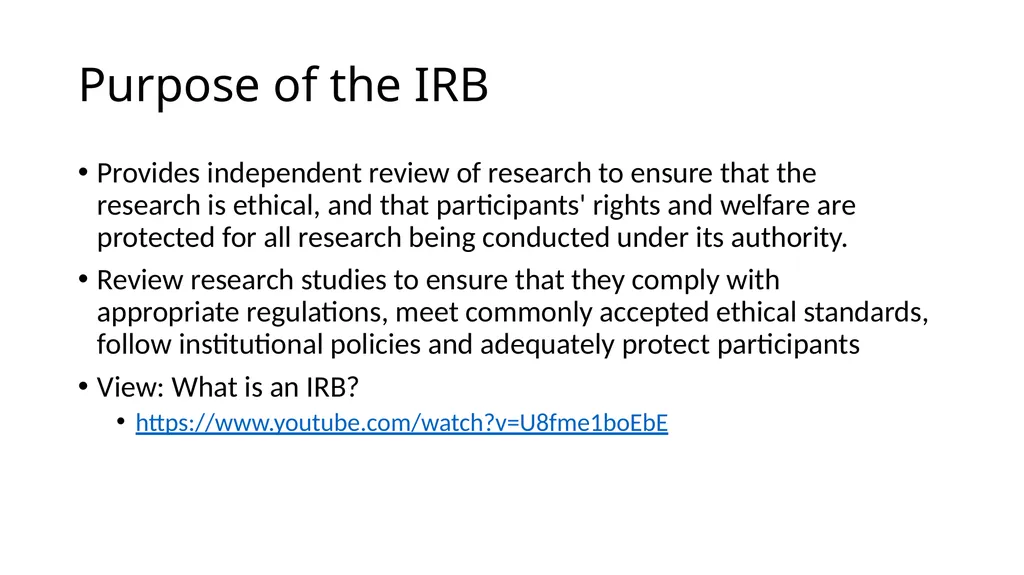
Purpose of the IRB Provides independent review of research to ensure that the research is ethical, and that participants' rights and welfare are protected for all research being conducted under its authority.
Review research studies to ensure that they comply with appropriate regulations, meet commonly accepted ethical standards, follow institutional policies and adequately protect participants
View: What is an IRB?
https://www.youtube.com/watch?v=U8fme1boEbE<br>
Review research studies to ensure that they comply with appropriate regulations, meet commonly accepted ethical standards, follow institutional policies and adequately protect participants
View: What is an IRB?
https://www.youtube.com/watch?v=U8fme1boEbE<br>
04
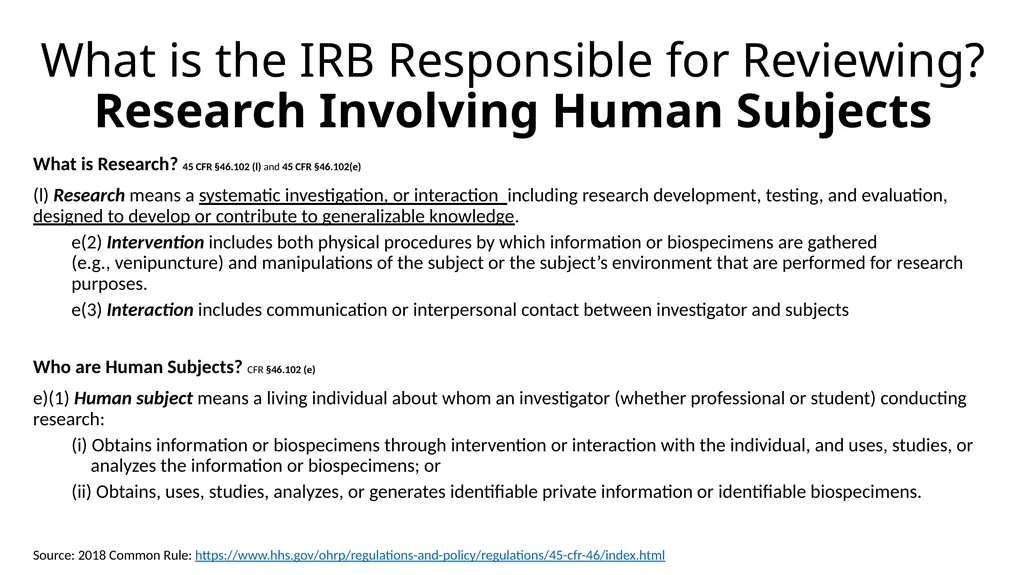
What is the IRB Responsible for Reviewing?
Research Involving Human Subjects What is Research? 45 CFR §46.102 (l) and 45 CFR §46.102(e)
(l) Research means a systematic investigation, or interaction including research development, testing, and evaluation, designed to develop or contribute to generalizable knowledge.
e(2) Intervention includes both physical procedures by which information or biospecimens are gathered (e.g., venipuncture) and manipulations of the subject or the subject’s environment that are performed for research purposes.
e(3) Interaction includes communication or interpersonal contact between investigator and subjects
Who are Human Subjects? CFR §46.102 (e)
e)(1) Human subject means a living individual about whom an investigator (whether professional or student) conducting research:
(i) Obtains information or biospecimens through intervention or interaction with the individual, and uses, studies, or analyzes the information or biospecimens; or
(ii) Obtains, uses, studies, analyzes, or generates identifiable private information or identifiable biospecimens.
Source: 2018 Common Rule: https://www.hhs.gov/ohrp/regulations-and-policy/regulations/45-cfr-46/index.html<br>
(l) Research means a systematic investigation, or interaction including research development, testing, and evaluation, designed to develop or contribute to generalizable knowledge.
e(2) Intervention includes both physical procedures by which information or biospecimens are gathered (e.g., venipuncture) and manipulations of the subject or the subject’s environment that are performed for research purposes.
e(3) Interaction includes communication or interpersonal contact between investigator and subjects
Who are Human Subjects? CFR §46.102 (e)
e)(1) Human subject means a living individual about whom an investigator (whether professional or student) conducting research:
(i) Obtains information or biospecimens through intervention or interaction with the individual, and uses, studies, or analyzes the information or biospecimens; or
(ii) Obtains, uses, studies, analyzes, or generates identifiable private information or identifiable biospecimens.
Source: 2018 Common Rule: https://www.hhs.gov/ohrp/regulations-and-policy/regulations/45-cfr-46/index.html<br>
05
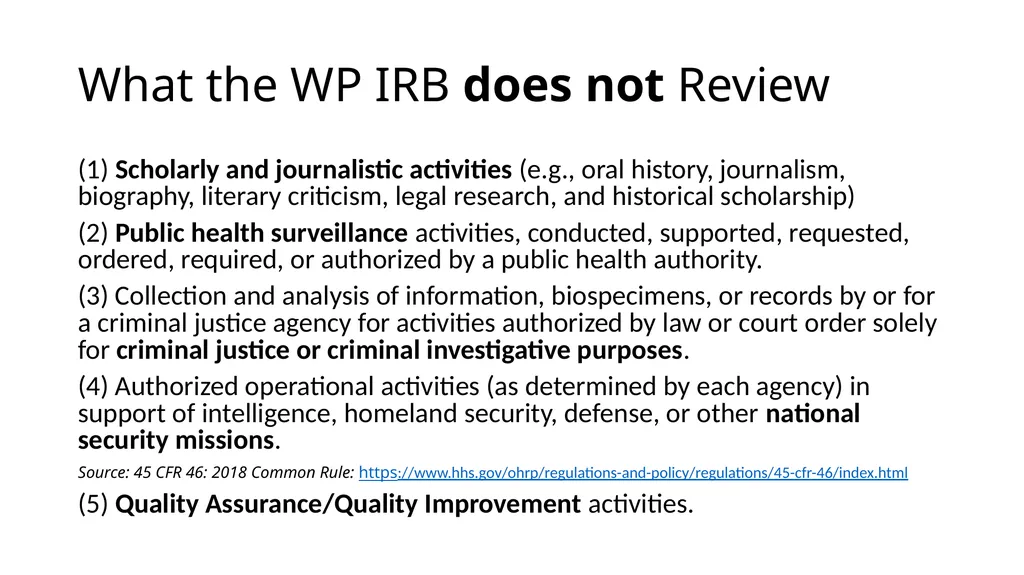
What the WP IRB does not Review (1) Scholarly and journalistic activities (e.g., oral history, journalism, biography, literary criticism, legal research, and historical scholarship)
(2) Public health surveillance activities, conducted, supported, requested, ordered, required, or authorized by a public health authority.
(3) Collection and analysis of information, biospecimens, or records by or for a criminal justice agency for activities authorized by law or court order solely for criminal justice or criminal investigative purposes.
(4) Authorized operational activities (as determined by each agency) in support of intelligence, homeland security, defense, or other national security missions.
Source: 45 CFR 46: 2018 Common Rule: https://www.hhs.gov/ohrp/regulations-and-policy/regulations/45-cfr-46/index.html
(5) Quality Assurance/Quality Improvement activities.<br>
(2) Public health surveillance activities, conducted, supported, requested, ordered, required, or authorized by a public health authority.
(3) Collection and analysis of information, biospecimens, or records by or for a criminal justice agency for activities authorized by law or court order solely for criminal justice or criminal investigative purposes.
(4) Authorized operational activities (as determined by each agency) in support of intelligence, homeland security, defense, or other national security missions.
Source: 45 CFR 46: 2018 Common Rule: https://www.hhs.gov/ohrp/regulations-and-policy/regulations/45-cfr-46/index.html
(5) Quality Assurance/Quality Improvement activities.<br>
06
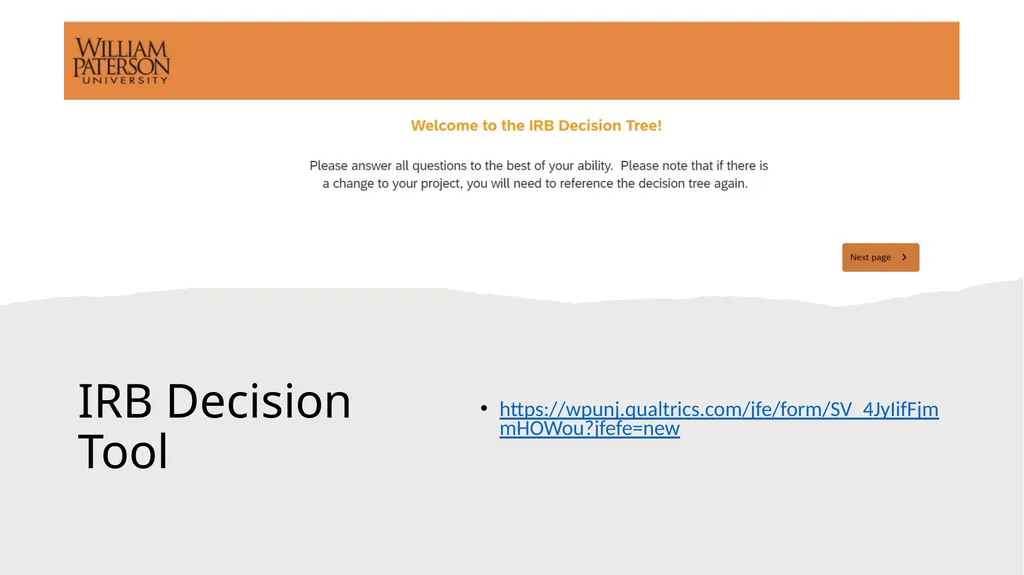
IRB Decision Tool https://wpunj.qualtrics.com/jfe/form/SV_4JyIifFjmmHOWou?jfefe=new<br>
07
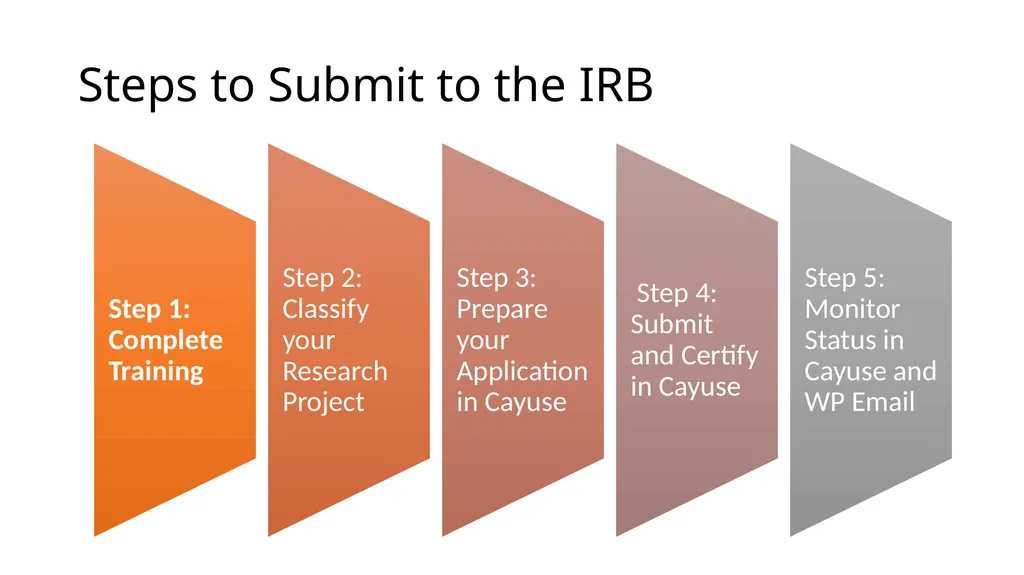
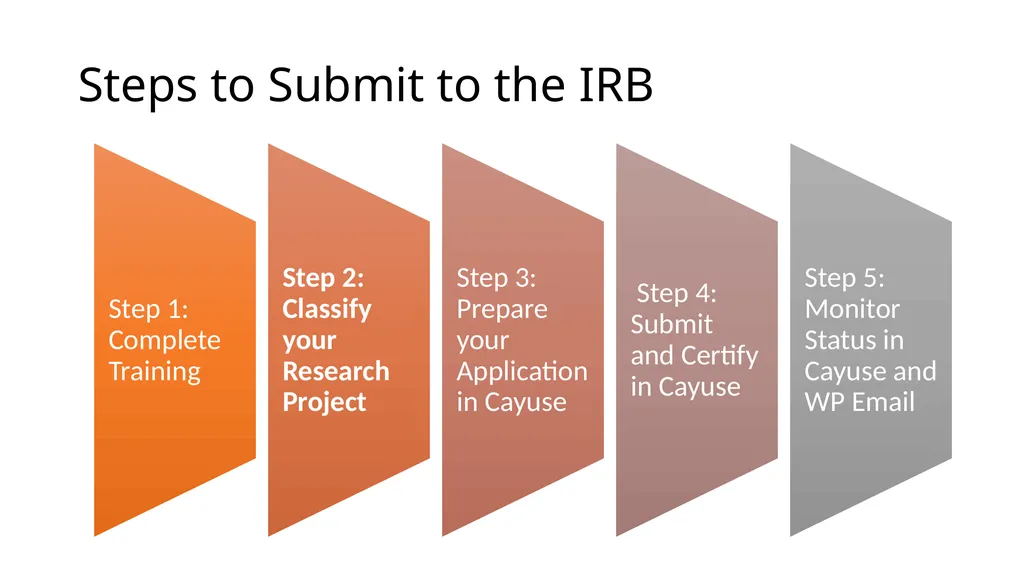
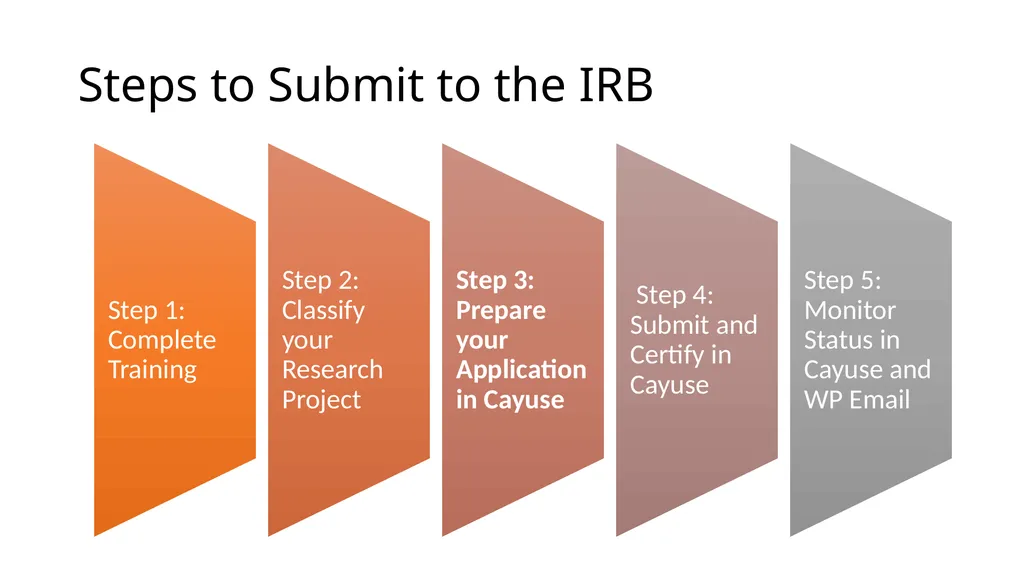
Steps to Submit to the IRB<br>
08
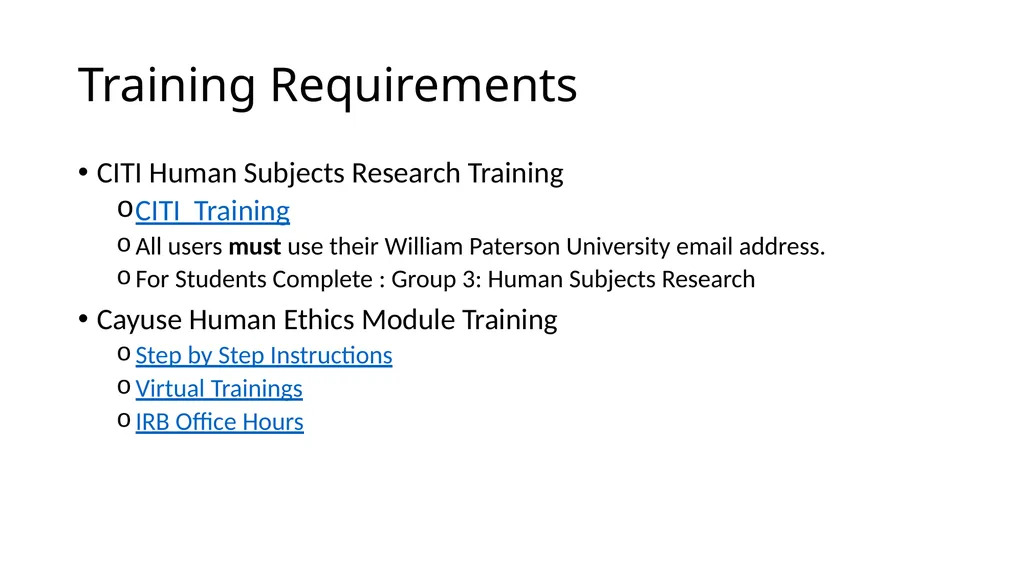
Training Requirements CITI Human Subjects Research Training
CITI Training
All users must use their William Paterson University email address.
For Students Complete : Group 3: Human Subjects Research
Cayuse Human Ethics Module Training
Step by Step Instructions
Virtual Trainings
IRB Office Hours<br>
CITI Training
All users must use their William Paterson University email address.
For Students Complete : Group 3: Human Subjects Research
Cayuse Human Ethics Module Training
Step by Step Instructions
Virtual Trainings
IRB Office Hours<br>
09
Steps to Submit to the IRB<br>
10
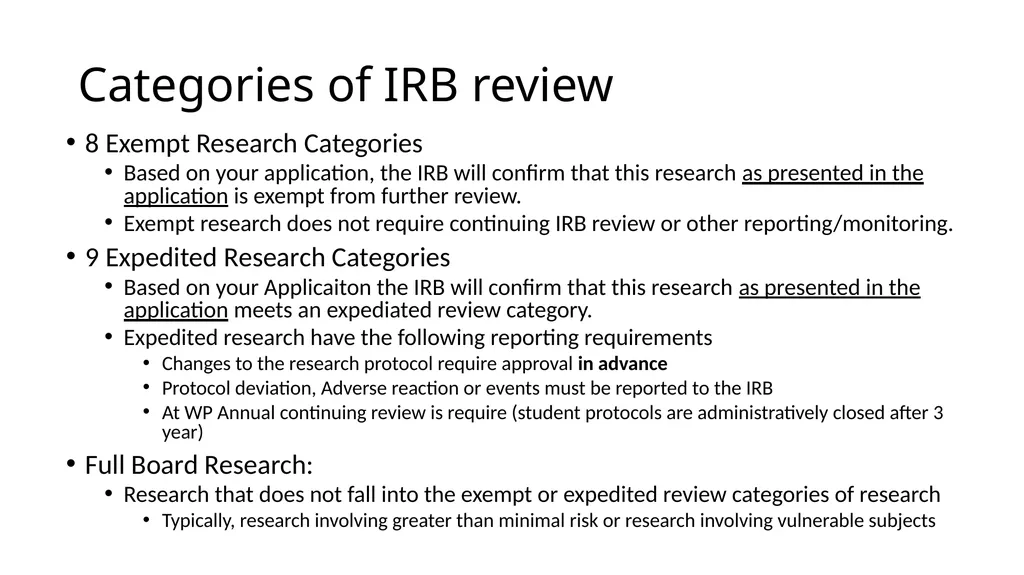
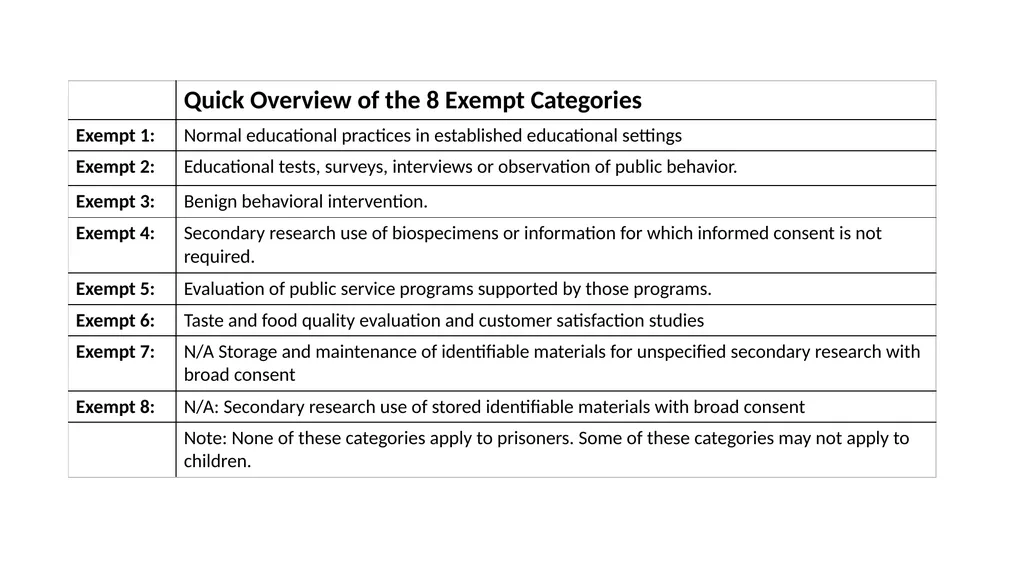
Categories of IRB review 8 Exempt Research Categories
Based on your application, the IRB will confirm that this research as presented in the application is exempt from further review.
Exempt research does not require continuing IRB review or other reporting/monitoring.
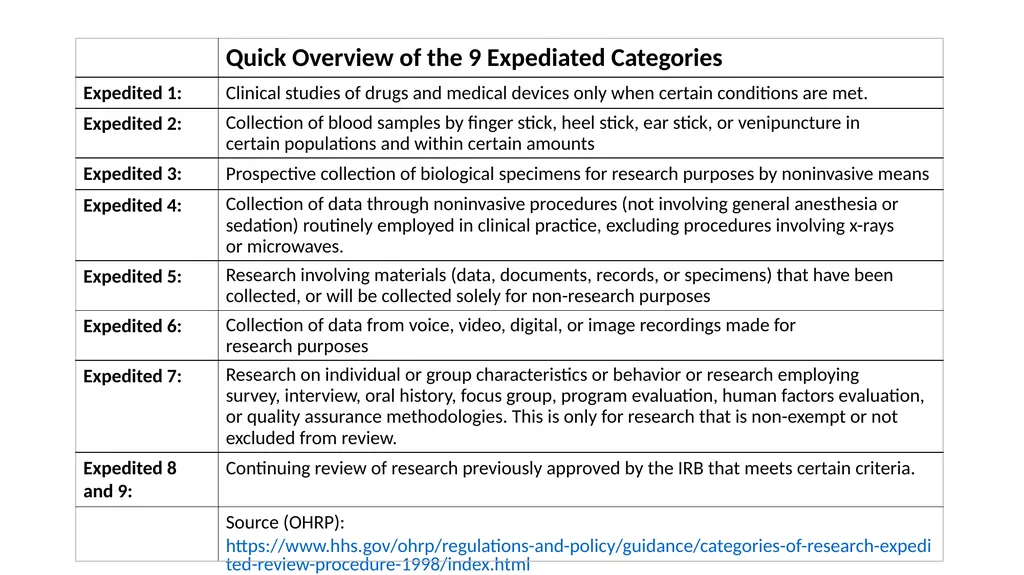
9 Expedited Research Categories
Based on your Applicaiton the IRB will confirm that this research as presented in the application meets an expediated review category.
Expedited research have the following reporting requirements
Changes to the research protocol require approval in advance
Protocol deviation, Adverse reaction or events must be reported to the IRB
At WP Annual continuing review is require (student protocols are administratively closed after 3 year)
Full Board Research:
Research that does not fall into the exempt or expedited review categories of research
Typically, research involving greater than minimal risk or research involving vulnerable subjects<br>
Based on your application, the IRB will confirm that this research as presented in the application is exempt from further review.
Exempt research does not require continuing IRB review or other reporting/monitoring.
9 Expedited Research Categories
Based on your Applicaiton the IRB will confirm that this research as presented in the application meets an expediated review category.
Expedited research have the following reporting requirements
Changes to the research protocol require approval in advance
Protocol deviation, Adverse reaction or events must be reported to the IRB
At WP Annual continuing review is require (student protocols are administratively closed after 3 year)
Full Board Research:
Research that does not fall into the exempt or expedited review categories of research
Typically, research involving greater than minimal risk or research involving vulnerable subjects<br>
11
Steps to Submit to the IRB<br>
12
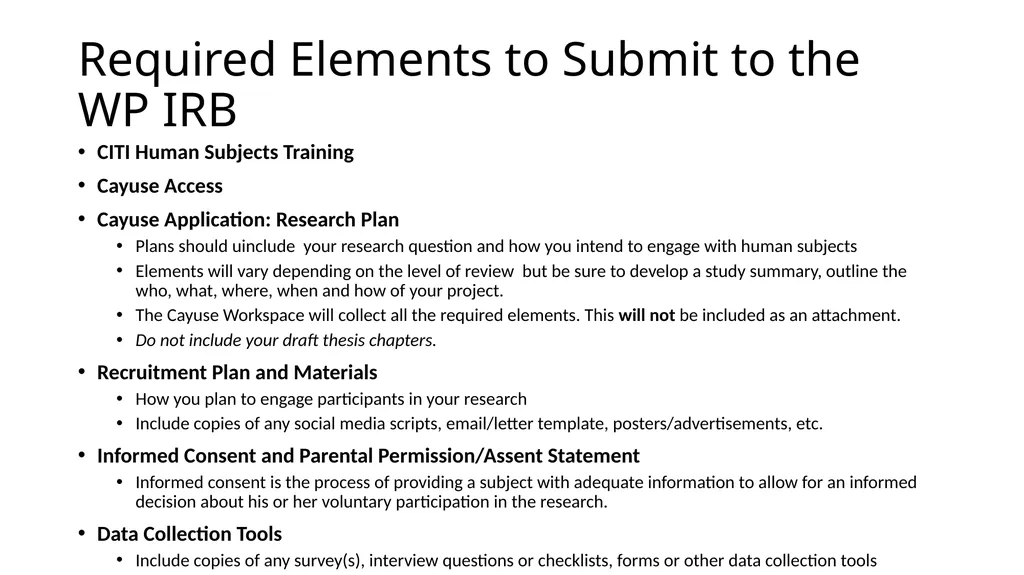
Required Elements to Submit to the WP IRB CITI Human Subjects Training
Cayuse Access
Cayuse Application: Research Plan
Plans should uinclude your research question and how you intend to engage with human subjects
Elements will vary depending on the level of review but be sure to develop a study summary, outline the who, what, where, when and how of your project.
The Cayuse Workspace will collect all the required elements. This will not be included as an attachment.
Do not include your draft thesis chapters.
Recruitment Plan and Materials
How you plan to engage participants in your research
Include copies of any social media scripts, email/letter template, posters/advertisements, etc.
Informed Consent and Parental Permission/Assent Statement
Informed consent is the process of providing a subject with adequate information to allow for an informed decision about his or her voluntary participation in the research.
Data Collection Tools
Include copies of any survey(s), interview questions or checklists, forms or other data collection tools<br>
Cayuse Access
Cayuse Application: Research Plan
Plans should uinclude your research question and how you intend to engage with human subjects
Elements will vary depending on the level of review but be sure to develop a study summary, outline the who, what, where, when and how of your project.
The Cayuse Workspace will collect all the required elements. This will not be included as an attachment.
Do not include your draft thesis chapters.
Recruitment Plan and Materials
How you plan to engage participants in your research
Include copies of any social media scripts, email/letter template, posters/advertisements, etc.
Informed Consent and Parental Permission/Assent Statement
Informed consent is the process of providing a subject with adequate information to allow for an informed decision about his or her voluntary participation in the research.
Data Collection Tools
Include copies of any survey(s), interview questions or checklists, forms or other data collection tools<br>
13
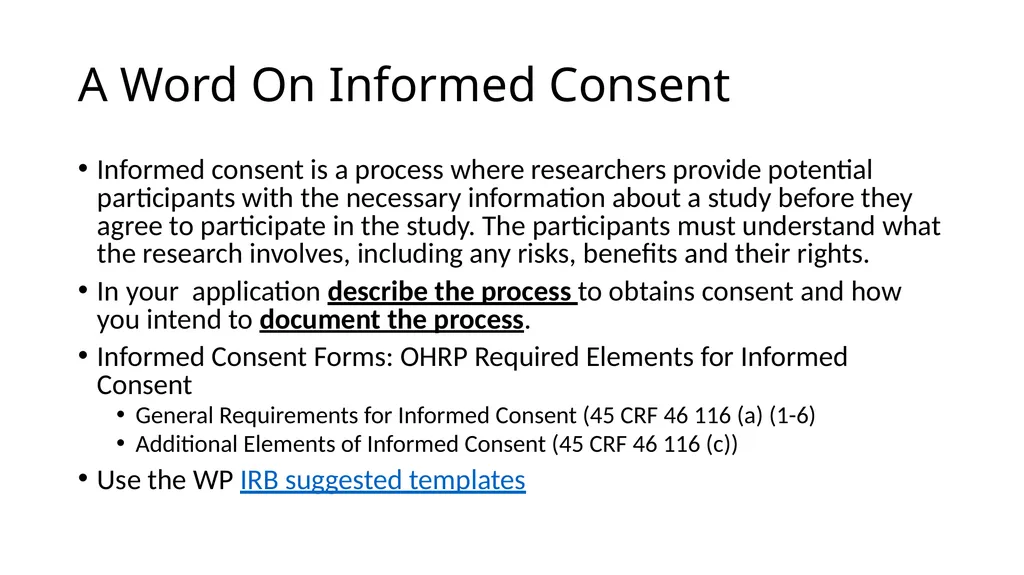
A Word On Informed Consent Informed consent is a process where researchers provide potential participants with the necessary information about a study before they agree to participate in the study. The participants must understand what the research involves, including any risks, benefits and their rights.
In your application describe the process to obtains consent and how you intend to document the process.
Informed Consent Forms: OHRP Required Elements for Informed Consent
General Requirements for Informed Consent (45 CRF 46 116 (a) (1-6)
Additional Elements of Informed Consent (45 CRF 46 116 (c))
Use the WP IRB suggested templates<br>
In your application describe the process to obtains consent and how you intend to document the process.
Informed Consent Forms: OHRP Required Elements for Informed Consent
General Requirements for Informed Consent (45 CRF 46 116 (a) (1-6)
Additional Elements of Informed Consent (45 CRF 46 116 (c))
Use the WP IRB suggested templates<br>
14
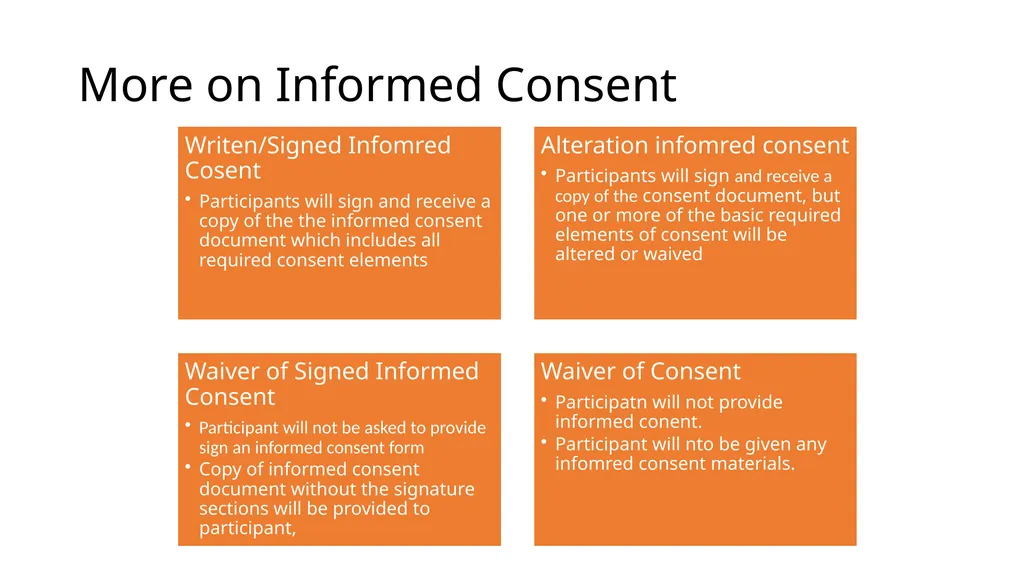
More on Informed Consent<br>
15
Research Involving Children Parental Permission
Research involving children requires both parental consent and child assent.
If the parent agrees and the child does not; the child cannot be included in research
Assent for Research involving Children
Assent is a process by which the research obtaining a child’s agreement to participate in research and research activities in an age-appropriate manner.
WP Assent Template<br>
Research involving children requires both parental consent and child assent.
If the parent agrees and the child does not; the child cannot be included in research
Assent for Research involving Children
Assent is a process by which the research obtaining a child’s agreement to participate in research and research activities in an age-appropriate manner.
WP Assent Template<br>
16
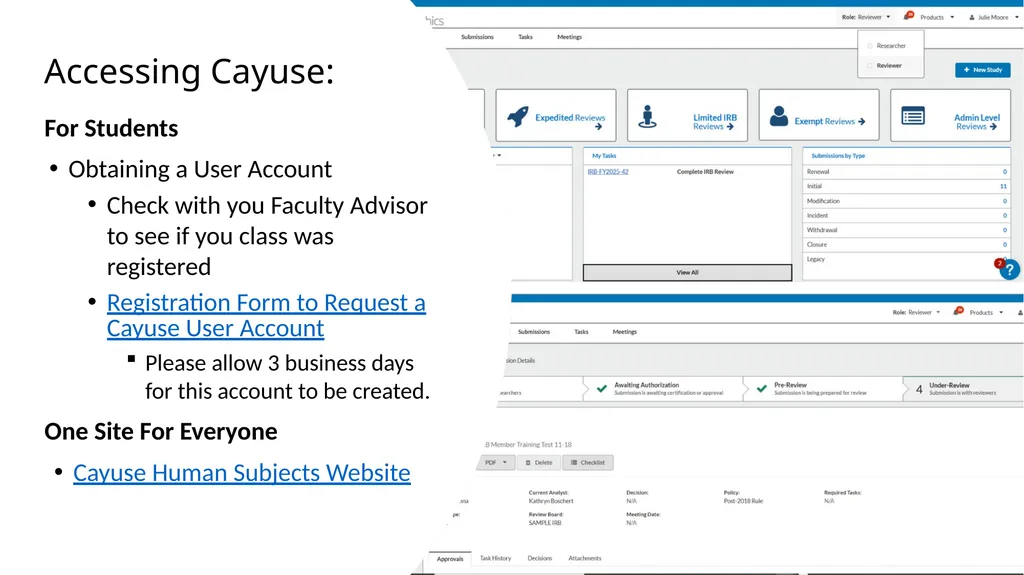
Accessing Cayuse: For Students
Obtaining a User Account
Check with you Faculty Advisor to see if you class was registered
Registration Form to Request aCayuse User Account
Please allow 3 business days for this account to be created.
One Site For Everyone
Cayuse Human Subjects Website<br>
Obtaining a User Account
Check with you Faculty Advisor to see if you class was registered
Registration Form to Request aCayuse User Account
Please allow 3 business days for this account to be created.
One Site For Everyone
Cayuse Human Subjects Website<br>
17
How to Submit through Cayuse What is CAYUSE?
An electronic grants management software platform to support sponsored programs and research management in one central system.
Electronically mangos the Human Ethics review process from inhiation to closure.
Integrated One-Stop Shop for Grants and Research Mangement. Modules include:
Human Ethics
Outside Interest
Sponsored Programs
System to System (grants.gov)<br>
An electronic grants management software platform to support sponsored programs and research management in one central system.
Electronically mangos the Human Ethics review process from inhiation to closure.
Integrated One-Stop Shop for Grants and Research Mangement. Modules include:
Human Ethics
Outside Interest
Sponsored Programs
System to System (grants.gov)<br>
18
How to Submit your Protocol to the WP IRB Brief Demo: WP Cayuse
Cayuse UAT<br>
Cayuse UAT<br>
19
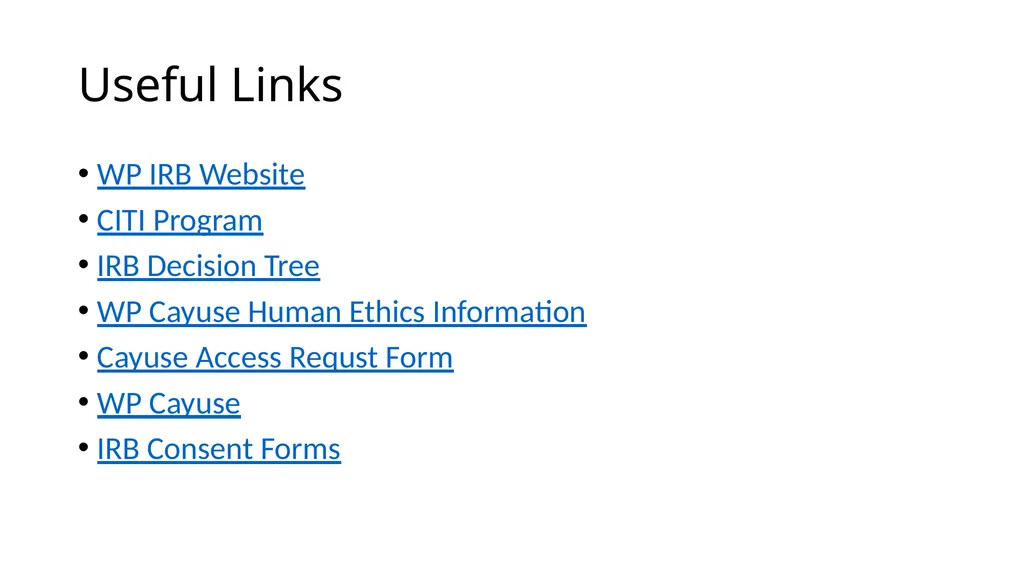
Useful Links WP IRB Website
CITI Program
IRB Decision Tree
WP Cayuse Human Ethics Information
Cayuse Access Requst Form
WP Cayuse
IRB Consent Forms<br>
CITI Program
IRB Decision Tree
WP Cayuse Human Ethics Information
Cayuse Access Requst Form
WP Cayuse
IRB Consent Forms<br>
20
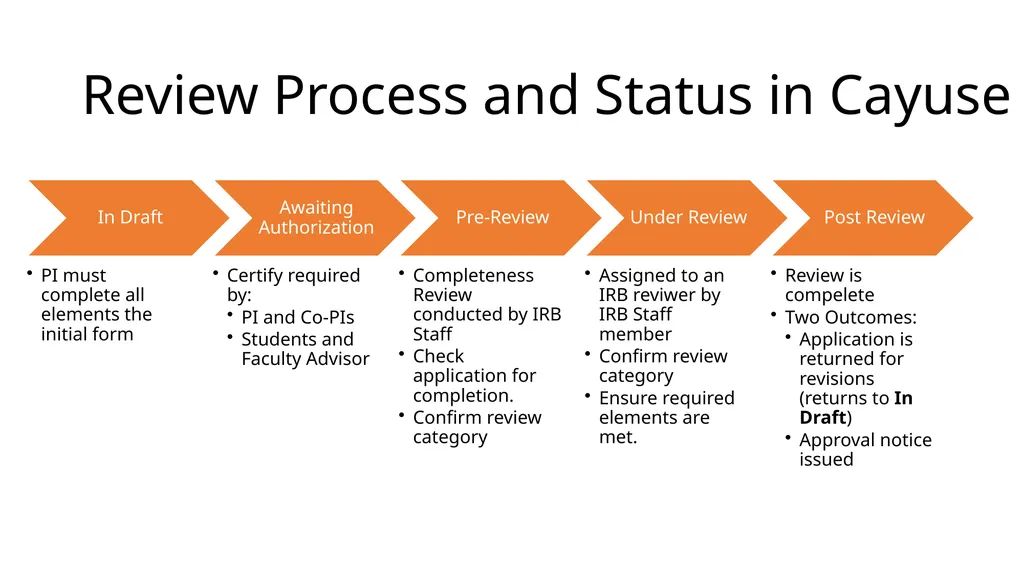
Review Process and Status in Cayuse<br>
21
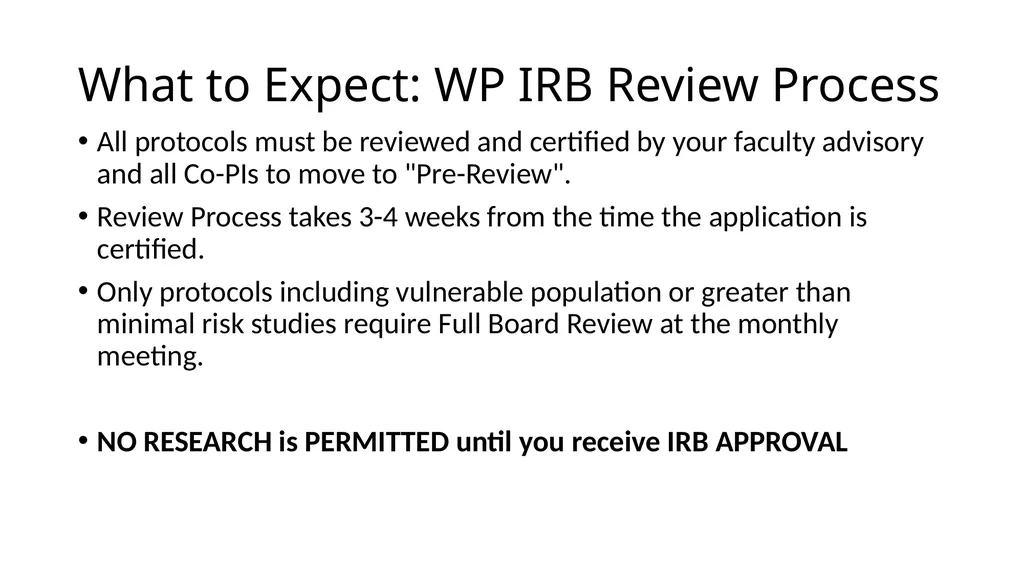
What to Expect: WP IRB Review Process All protocols must be reviewed and certified by your faculty advisory and all Co-PIs to move to "Pre-Review".
Review Process takes 3-4 weeks from the time the application is certified.
Only protocols including vulnerable population or greater than minimal risk studies require Full Board Review at the monthly meeting.
NO RESEARCH is PERMITTED until you receive IRB APPROVAL<br>
Review Process takes 3-4 weeks from the time the application is certified.
Only protocols including vulnerable population or greater than minimal risk studies require Full Board Review at the monthly meeting.
NO RESEARCH is PERMITTED until you receive IRB APPROVAL<br>
22
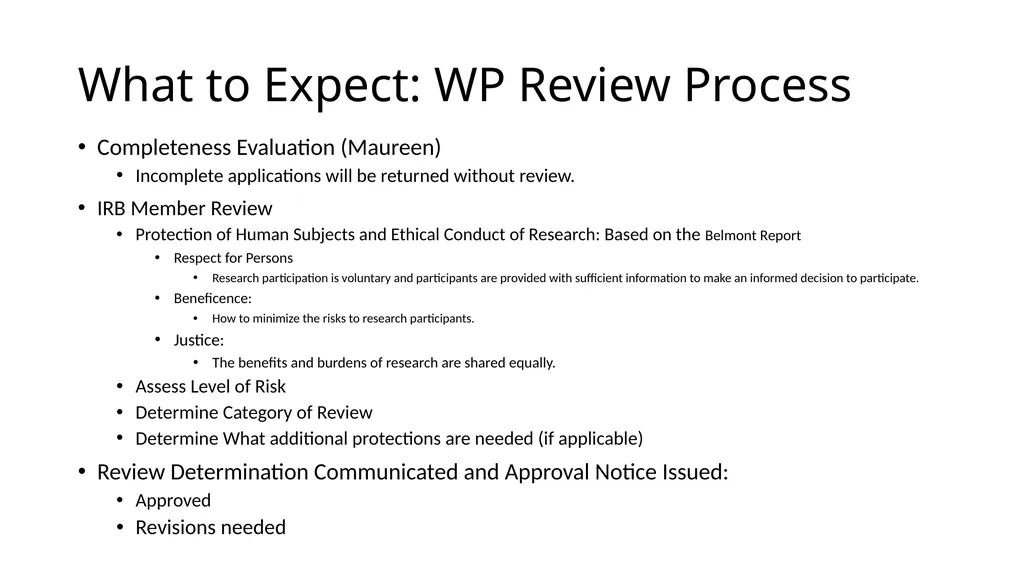
What to Expect: WP Review Process Completeness Evaluation (Maureen)
Incomplete applications will be returned without review.
IRB Member Review
Protection of Human Subjects and Ethical Conduct of Research: Based on the Belmont Report
Respect for Persons
Research participation is voluntary and participants are provided with sufficient information to make an informed decision to participate.
Beneficence:
How to minimize the risks to research participants.
Justice:
The benefits and burdens of research are shared equally.
Assess Level of Risk
Determine Category of Review
Determine What additional protections are needed (if applicable)
Review Determination Communicated and Approval Notice Issued:
Approved
Revisions needed<br>
Incomplete applications will be returned without review.
IRB Member Review
Protection of Human Subjects and Ethical Conduct of Research: Based on the Belmont Report
Respect for Persons
Research participation is voluntary and participants are provided with sufficient information to make an informed decision to participate.
Beneficence:
How to minimize the risks to research participants.
Justice:
The benefits and burdens of research are shared equally.
Assess Level of Risk
Determine Category of Review
Determine What additional protections are needed (if applicable)
Review Determination Communicated and Approval Notice Issued:
Approved
Revisions needed<br>
23
Knowledge Check What is the IRB responsible for reviewing?
What doesn't the IRB review?
What materials do you need to submit to the IRB?
How do I submit your protocol to the WP IRB?
What causes delay in IRB protocol review?
What are the three categories of IRB review?
Where can you go for help?<br>
What doesn't the IRB review?
What materials do you need to submit to the IRB?
How do I submit your protocol to the WP IRB?
What causes delay in IRB protocol review?
What are the three categories of IRB review?
Where can you go for help?<br>
24
Thank You! For More Information:
Visit: https://wpunj.edu/osp/irb/
Email:
IRBAdministrator@wpunj.edu<br>
Visit: https://wpunj.edu/osp/irb/
Email:
IRBAdministrator@wpunj.edu<br>
25
General Requirments for Informed Consent (45 CRF 46 (a) (1-6) (1) Before involving a human subject in research covered by the WP IRB, an investigator shall obtain the legally effective informed consent of the subject or the subject's legally authorized representative.
(2) An investigator shall seek informed consent only under circumstances that provide the prospective subject or the legally authorized representative sufficient opportunity to discuss and consider whether or not to participate and that minimize the possibility of coercion or undue influence.
(3) The information that is given to the subject or the legally authorized representative shall be in language understandable to the subject or the legally authorized representative.
(4) The prospective subject or the legally authorized representative must be provided with the information that a reasonable person would want to have in order to make an informed decision about whether to participate, and an opportunity to discuss that information.
(5) (i) Informed consent must begin with a concise and focused presentation of the key information that is most likely to assist a prospective subject or legally authorized representative in understanding the reasons why one might or might not want to participate in the research. This part of the informed consent must be organized and presented in a way that facilitates comprehension.
(5) (ii) Informed consent as a whole must present information in sufficient detail relating to the research and must be organized and presented in a way that does not merely provide lists of isolated facts, but rather facilitates the prospective subject's or legally authorized representative's understanding of the reasons why one might or might not want to participate.
(6) No informed consent may include any exculpatory language through which the subject or the legally authorized representative is made to waive or appear to waive any of the subject's legal rights, or releases or appears to release the investigator, the sponsor, the institution, or its agents from liability for negligence.<br>
(2) An investigator shall seek informed consent only under circumstances that provide the prospective subject or the legally authorized representative sufficient opportunity to discuss and consider whether or not to participate and that minimize the possibility of coercion or undue influence.
(3) The information that is given to the subject or the legally authorized representative shall be in language understandable to the subject or the legally authorized representative.
(4) The prospective subject or the legally authorized representative must be provided with the information that a reasonable person would want to have in order to make an informed decision about whether to participate, and an opportunity to discuss that information.
(5) (i) Informed consent must begin with a concise and focused presentation of the key information that is most likely to assist a prospective subject or legally authorized representative in understanding the reasons why one might or might not want to participate in the research. This part of the informed consent must be organized and presented in a way that facilitates comprehension.
(5) (ii) Informed consent as a whole must present information in sufficient detail relating to the research and must be organized and presented in a way that does not merely provide lists of isolated facts, but rather facilitates the prospective subject's or legally authorized representative's understanding of the reasons why one might or might not want to participate.
(6) No informed consent may include any exculpatory language through which the subject or the legally authorized representative is made to waive or appear to waive any of the subject's legal rights, or releases or appears to release the investigator, the sponsor, the institution, or its agents from liability for negligence.<br>