
Welcome to the Routine Practices Learning Module
FD
Published · 57 slides · 0 views
1 / 1


Description
Welcome to the Routine Practices Learning Module Infection Prevention Control Routine Practices WRHA Infection Prevention Control This Routine Practices PowerPoint presentation is intended to provide staff working in acute care, long
Related Topics
Share
Embed code
Download this presentation From Below
"Welcome to the Routine Practices Learning Module" is the property of its rightful owner. Permission is granted to download and print the materials on this website for personal, non-commercial use only, and to display it on your personal computer provided you do not modify the materials and that you retain all copyright notices contained in the materials. By downloading content from our website, you accept the terms of this agreement.
Presentation Transcript
01
Welcome to the Routine Practices Learning Module Infection Prevention & Control<br>
02
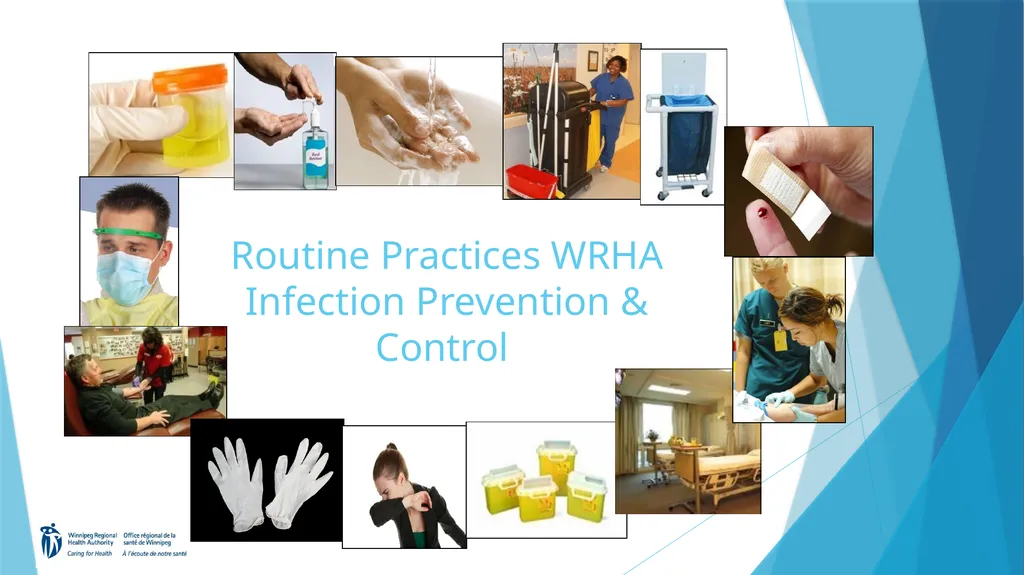
Routine Practices WRHA Infection Prevention & Control<br>
03
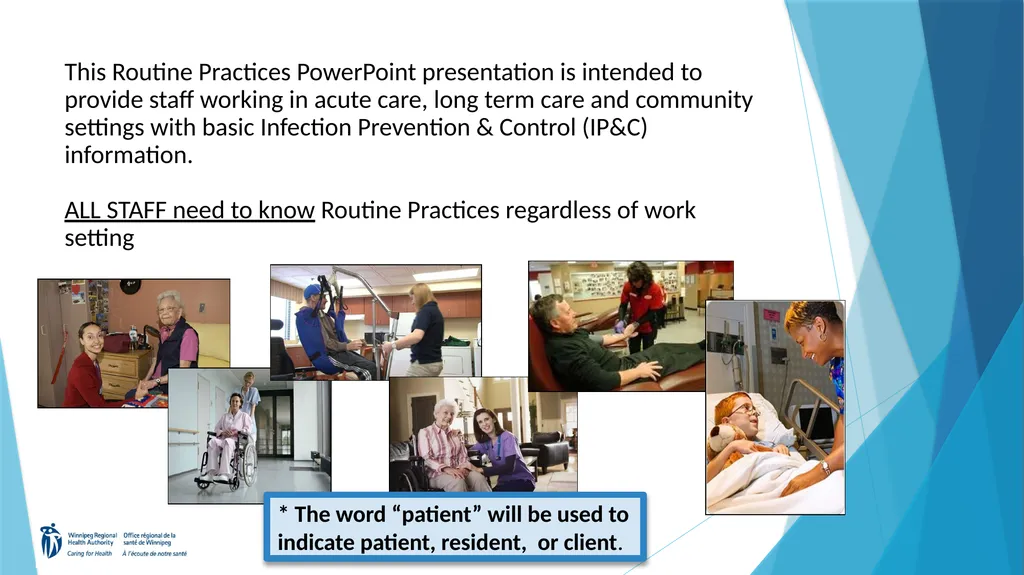
This Routine Practices PowerPoint presentation is intended to provide staff working in acute care, long term care and community settings with basic Infection Prevention & Control (IP&C) information.
ALL STAFF need to know Routine Practices regardless of work setting * The word “patient” will be used to indicate patient, resident, or client.<br>
04
Routine Practices The following Educational Modules must be completed to meet your educational requirements for these elements of Routine Practices:
Hand Hygiene
Personal Protective Equipment
Point of Care Risk Assessment (PCRA)
Management of the Health Care Environment
AND
Source Control
Whether you are a presenter or using this PowerPoint for self study the speaker notes must be reviewed
This PowerPoint should take about 20 minutes to review<br>
Hand Hygiene
Personal Protective Equipment
Point of Care Risk Assessment (PCRA)
Management of the Health Care Environment
AND
Source Control
Whether you are a presenter or using this PowerPoint for self study the speaker notes must be reviewed
This PowerPoint should take about 20 minutes to review<br>
05
Routine Practices
What are they?
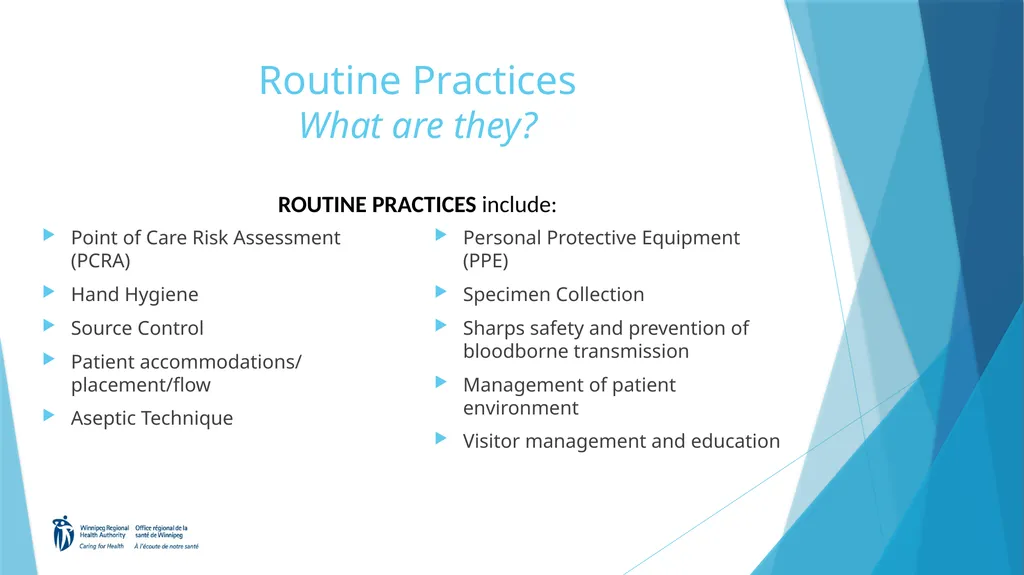
ROUTINE PRACTICES include: Point of Care Risk Assessment (PCRA)
Hand Hygiene
Source Control
Patient accommodations/ placement/flow
Aseptic Technique Personal Protective Equipment (PPE)
Specimen Collection
Sharps safety and prevention of bloodborne transmission
Management of patient environment
Visitor management and education<br>
Hand Hygiene
Source Control
Patient accommodations/ placement/flow
Aseptic Technique Personal Protective Equipment (PPE)
Specimen Collection
Sharps safety and prevention of bloodborne transmission
Management of patient environment
Visitor management and education<br>
06
Routine Practices
What Are They? Routine Practices are basic infection prevention and control measures expected for the care of all patients at all times in any healthcare setting
Consistently following Routine Practices reduces the risk of transmission of germs<br>
Consistently following Routine Practices reduces the risk of transmission of germs<br>
07
Routine Practices
Why use them? About 220,000 Canadians (or one patient in nine) admitted to hospital every year get a healthcare associated infection (HAI) as a consequence of their hospital stay
8,000 patients die annually from these infections (about the same number of annual deaths as those from breast cancer and motor vehicle accidents)<br>
8,000 patients die annually from these infections (about the same number of annual deaths as those from breast cancer and motor vehicle accidents)<br>
08
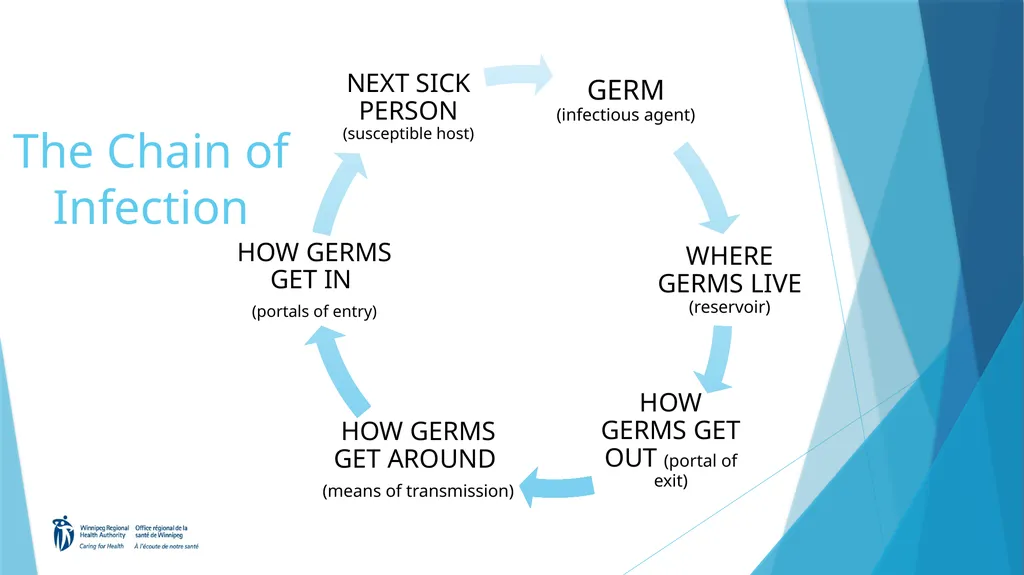
The Chain of Infection<br>
09
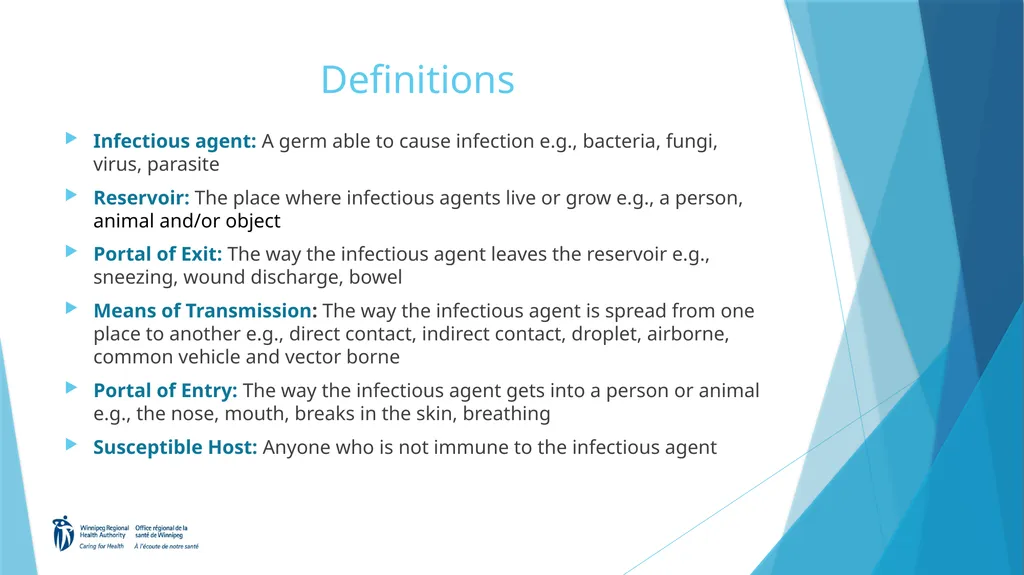
Definitions Infectious agent: A germ able to cause infection e.g., bacteria, fungi, virus, parasite
Reservoir: The place where infectious agents live or grow e.g., a person, animal and/or object
Portal of Exit: The way the infectious agent leaves the reservoir e.g., sneezing, wound discharge, bowel
Means of Transmission: The way the infectious agent is spread from one place to another e.g., direct contact, indirect contact, droplet, airborne, common vehicle and vector borne
Portal of Entry: The way the infectious agent gets into a person or animal e.g., the nose, mouth, breaks in the skin, breathing
Susceptible Host: Anyone who is not immune to the infectious agent<br>
Reservoir: The place where infectious agents live or grow e.g., a person, animal and/or object
Portal of Exit: The way the infectious agent leaves the reservoir e.g., sneezing, wound discharge, bowel
Means of Transmission: The way the infectious agent is spread from one place to another e.g., direct contact, indirect contact, droplet, airborne, common vehicle and vector borne
Portal of Entry: The way the infectious agent gets into a person or animal e.g., the nose, mouth, breaks in the skin, breathing
Susceptible Host: Anyone who is not immune to the infectious agent<br>
10
Means of Transmission
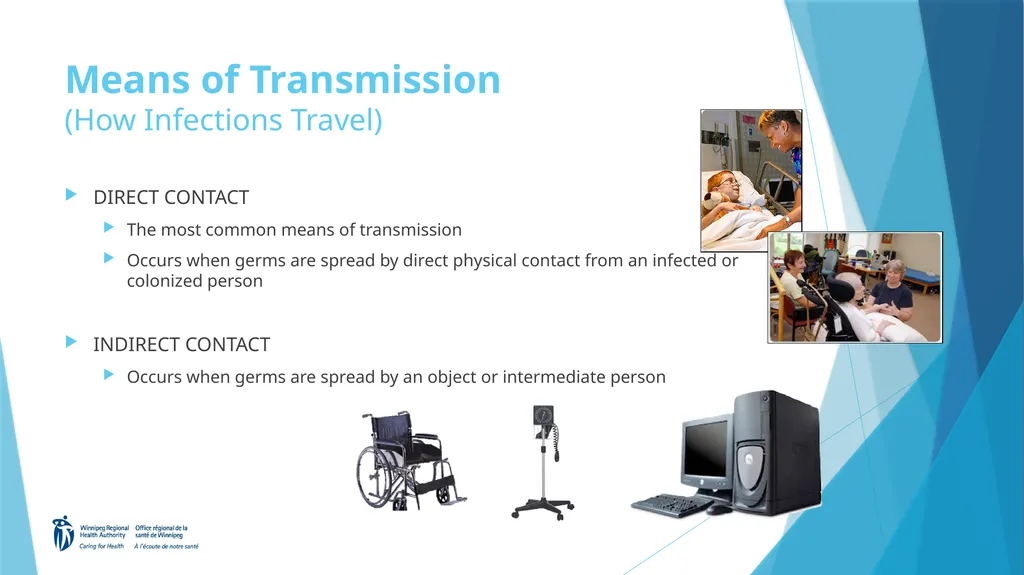
(How Infections Travel) DIRECT CONTACT
The most common means of transmission
Occurs when germs are spread by direct physical contact from an infected or colonized person
INDIRECT CONTACT
Occurs when germs are spread by an object or intermediate person<br>
The most common means of transmission
Occurs when germs are spread by direct physical contact from an infected or colonized person
INDIRECT CONTACT
Occurs when germs are spread by an object or intermediate person<br>
11
Means of Transmission
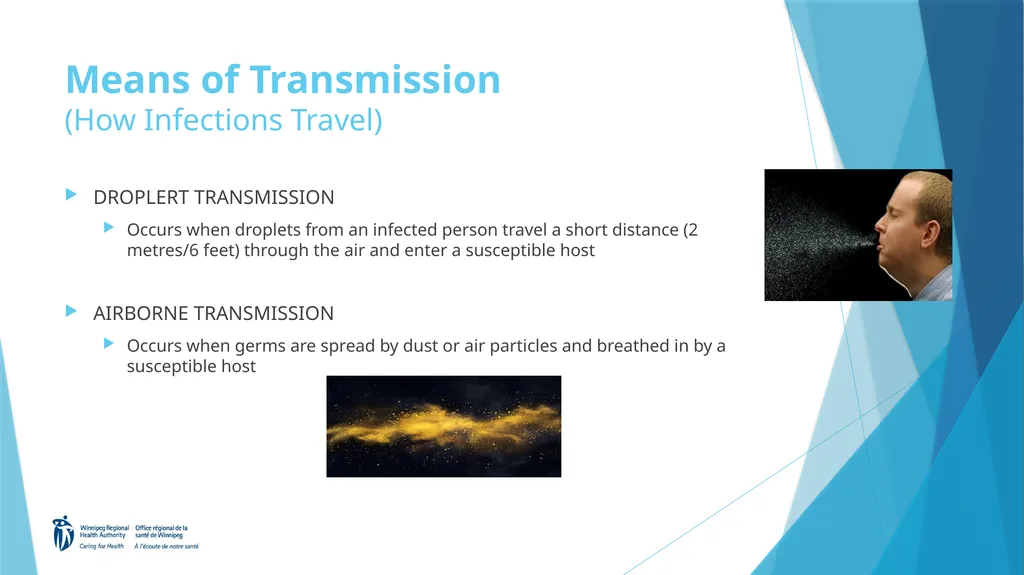
(How Infections Travel) DROPLERT TRANSMISSION
Occurs when droplets from an infected person travel a short distance (2 metres/6 feet) through the air and enter a susceptible host
AIRBORNE TRANSMISSION
Occurs when germs are spread by dust or air particles and breathed in by a susceptible host<br>
Occurs when droplets from an infected person travel a short distance (2 metres/6 feet) through the air and enter a susceptible host
AIRBORNE TRANSMISSION
Occurs when germs are spread by dust or air particles and breathed in by a susceptible host<br>
12
Means of Transmission
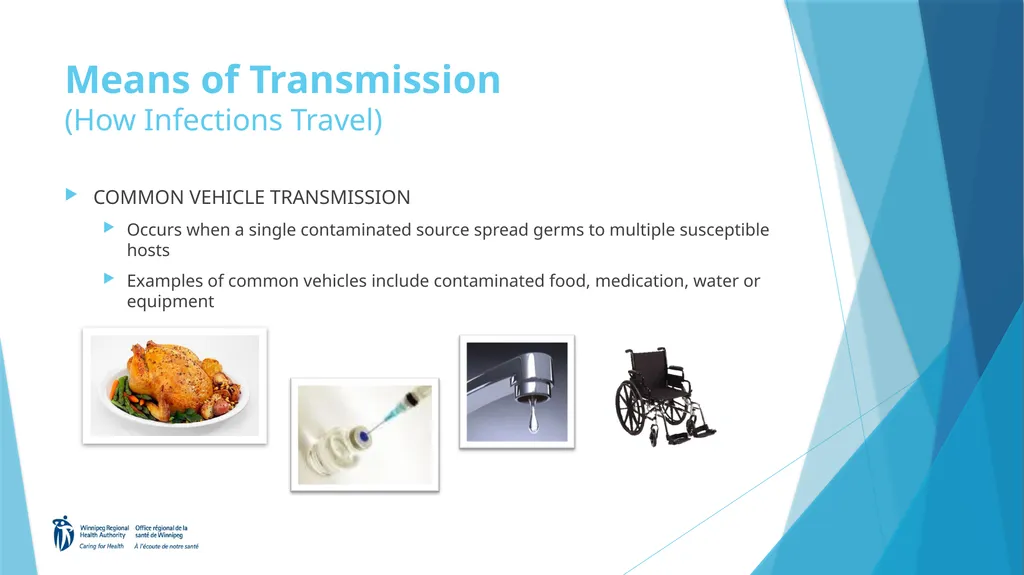
(How Infections Travel) COMMON VEHICLE TRANSMISSION
Occurs when a single contaminated source spread germs to multiple susceptible hosts
Examples of common vehicles include contaminated food, medication, water or equipment<br>
Occurs when a single contaminated source spread germs to multiple susceptible hosts
Examples of common vehicles include contaminated food, medication, water or equipment<br>
13
Means of Transmission
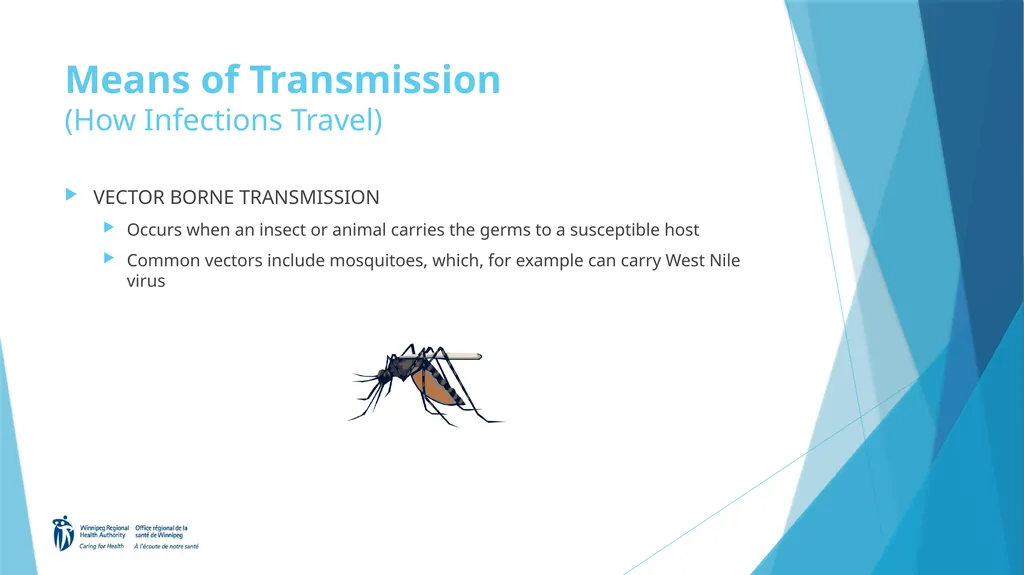
(How Infections Travel) VECTOR BORNE TRANSMISSION
Occurs when an insect or animal carries the germs to a susceptible host
Common vectors include mosquitoes, which, for example can carry West Nile virus<br>
Occurs when an insect or animal carries the germs to a susceptible host
Common vectors include mosquitoes, which, for example can carry West Nile virus<br>
14
Point of Care Risk Assessment
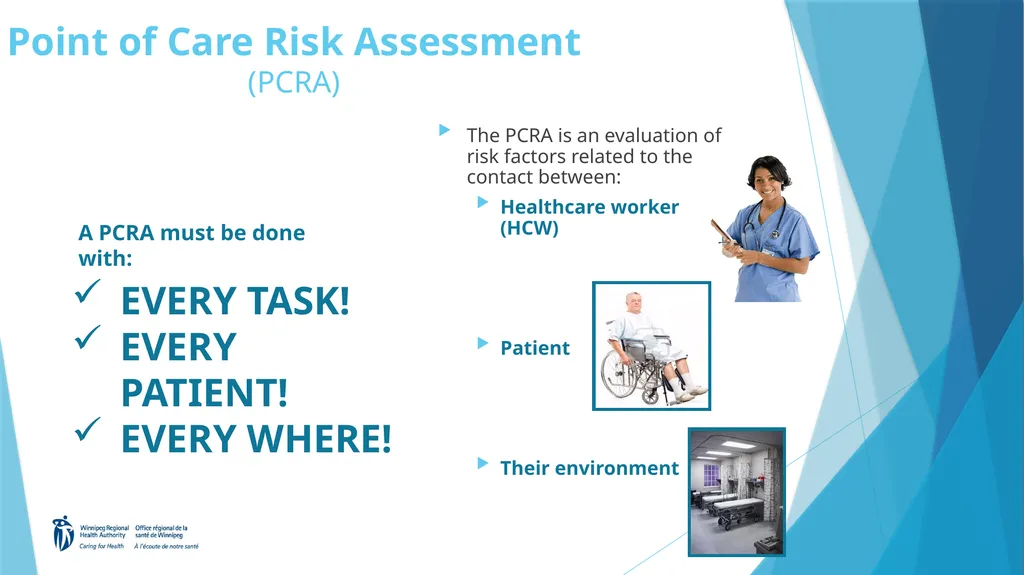
(PCRA) The PCRA is an evaluation of risk factors related to the contact between:
Healthcare worker (HCW)
Patient
Their environment EVERY TASK!
EVERY PATIENT!
EVERY WHERE! A PCRA must be done with:<br>
Healthcare worker (HCW)
Patient
Their environment EVERY TASK!
EVERY PATIENT!
EVERY WHERE! A PCRA must be done with:<br>
15
Point of Care Risk Assessment
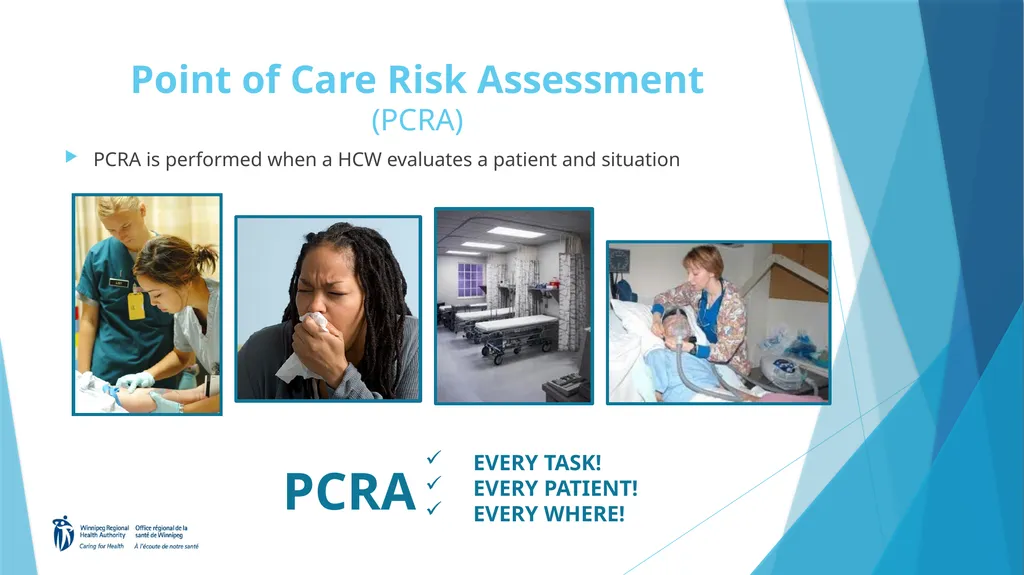
(PCRA) PCRA is performed when a HCW evaluates a patient and situation EVERY TASK!
EVERY PATIENT!
EVERY WHERE! PCRA<br>
EVERY PATIENT!
EVERY WHERE! PCRA<br>
16
Point of Care Risk Assessment
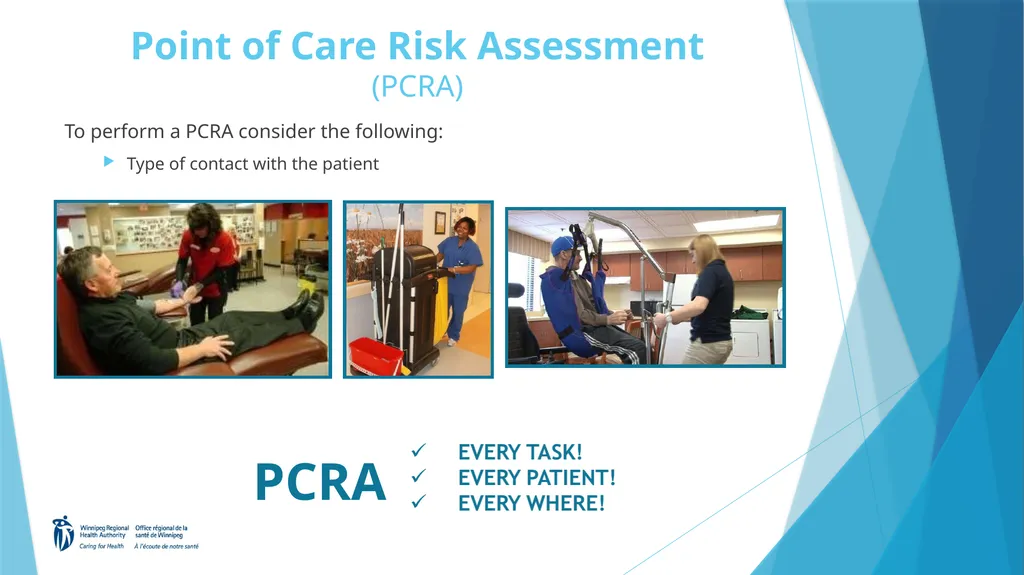
(PCRA) To perform a PCRA consider the following:
Type of contact with the patient PCRA<br>
Type of contact with the patient PCRA<br>
17
Point of Care Risk Assessment
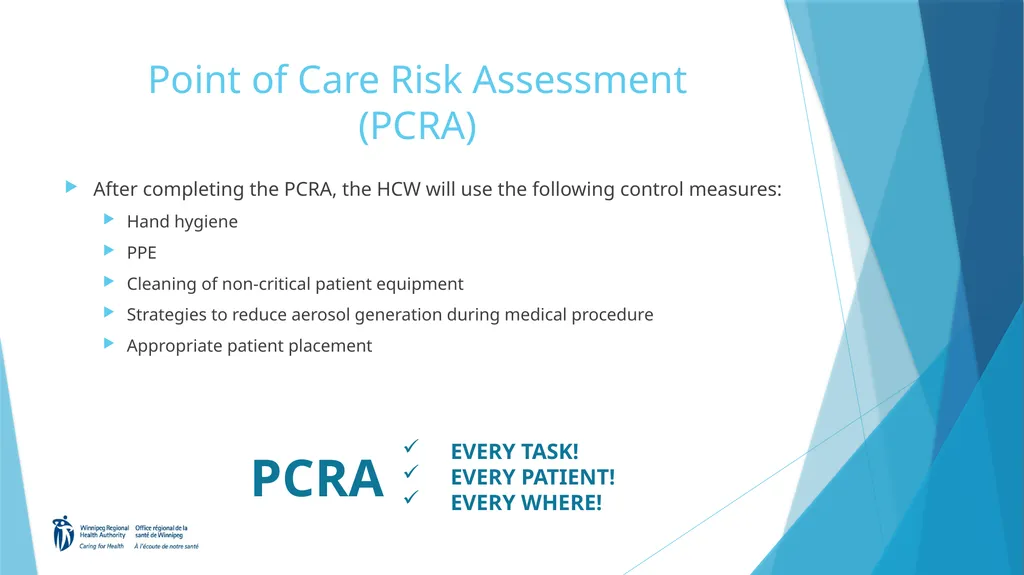
(PCRA) After completing the PCRA, the HCW will use the following control measures:
Hand hygiene
PPE
Cleaning of non-critical patient equipment
Strategies to reduce aerosol generation during medical procedure
Appropriate patient placement PCRA EVERY TASK!
EVERY PATIENT!
EVERY WHERE!<br>
Hand hygiene
PPE
Cleaning of non-critical patient equipment
Strategies to reduce aerosol generation during medical procedure
Appropriate patient placement PCRA EVERY TASK!
EVERY PATIENT!
EVERY WHERE!<br>
18
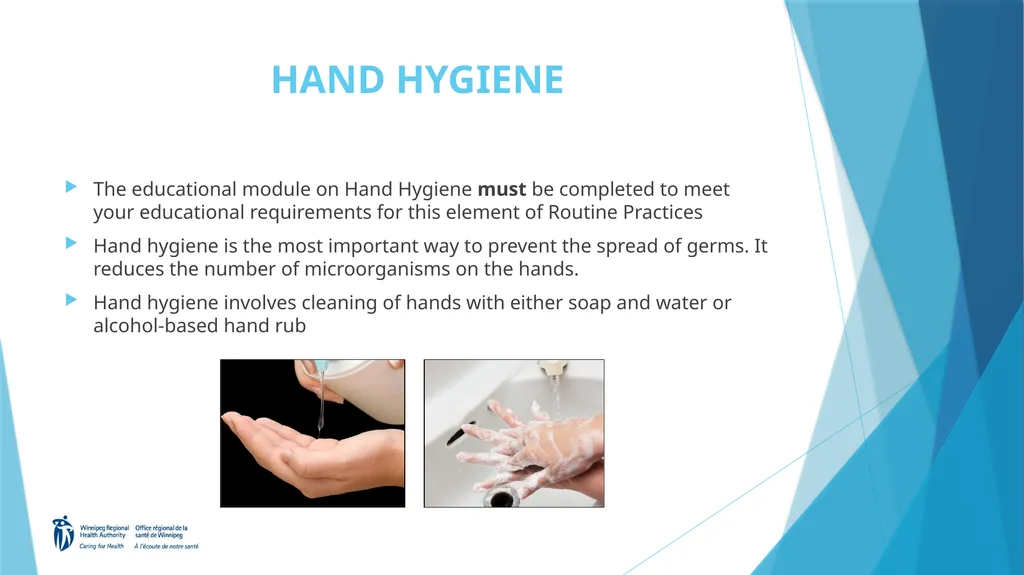
HAND HYGIENE The educational module on Hand Hygiene must be completed to meet your educational requirements for this element of Routine Practices
Hand hygiene is the most important way to prevent the spread of germs. It reduces the number of microorganisms on the hands.
Hand hygiene involves cleaning of hands with either soap and water or alcohol-based hand rub<br>
Hand hygiene is the most important way to prevent the spread of germs. It reduces the number of microorganisms on the hands.
Hand hygiene involves cleaning of hands with either soap and water or alcohol-based hand rub<br>
19
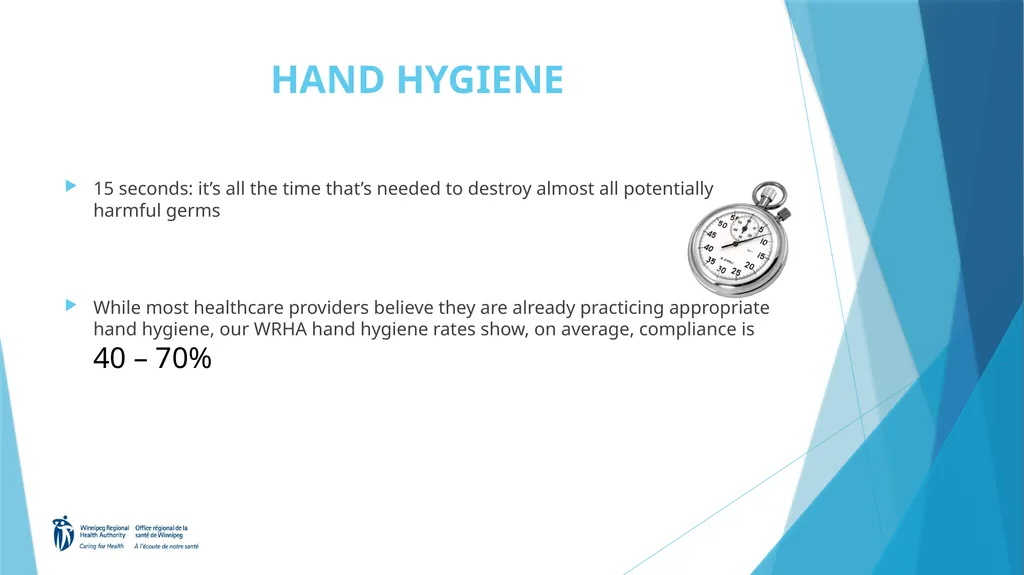
HAND HYGIENE 15 seconds: it’s all the time that’s needed to destroy almost all potentially harmful germs
While most healthcare providers believe they are already practicing appropriate hand hygiene, our WRHA hand hygiene rates show, on average, compliance is 40 – 70%<br>
While most healthcare providers believe they are already practicing appropriate hand hygiene, our WRHA hand hygiene rates show, on average, compliance is 40 – 70%<br>
20
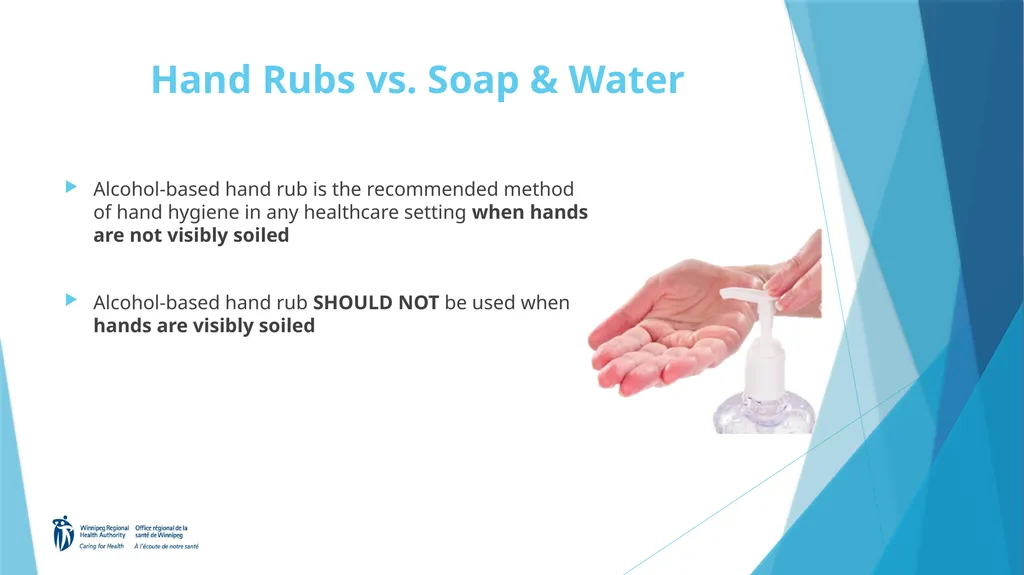
Hand Rubs vs. Soap & Water Alcohol-based hand rub is the recommended method of hand hygiene in any healthcare setting when hands are not visibly soiled
Alcohol-based hand rub SHOULD NOT be used when hands are visibly soiled<br>
Alcohol-based hand rub SHOULD NOT be used when hands are visibly soiled<br>
21
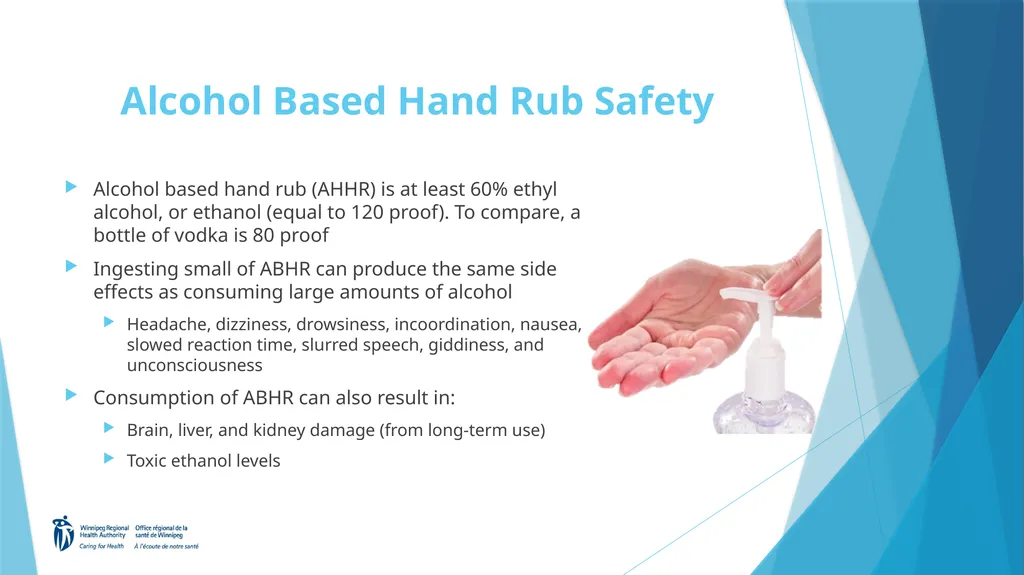
Alcohol Based Hand Rub Safety Alcohol based hand rub (AHHR) is at least 60% ethyl alcohol, or ethanol (equal to 120 proof). To compare, a bottle of vodka is 80 proof
Ingesting small of ABHR can produce the same side effects as consuming large amounts of alcohol
Headache, dizziness, drowsiness, incoordination, nausea, slowed reaction time, slurred speech, giddiness, and unconsciousness
Consumption of ABHR can also result in:
Brain, liver, and kidney damage (from long-term use)
Toxic ethanol levels<br>
Ingesting small of ABHR can produce the same side effects as consuming large amounts of alcohol
Headache, dizziness, drowsiness, incoordination, nausea, slowed reaction time, slurred speech, giddiness, and unconsciousness
Consumption of ABHR can also result in:
Brain, liver, and kidney damage (from long-term use)
Toxic ethanol levels<br>
22
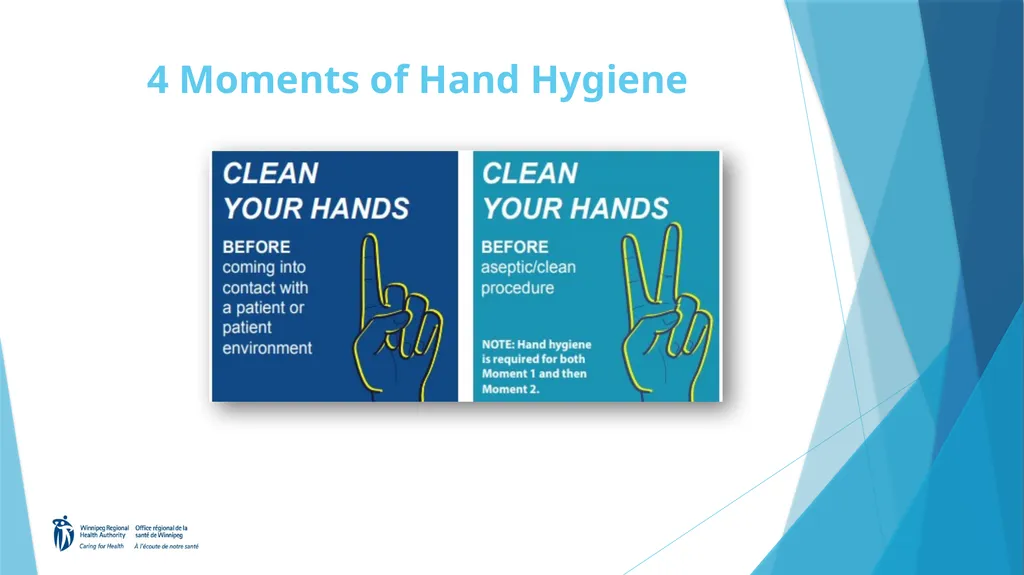
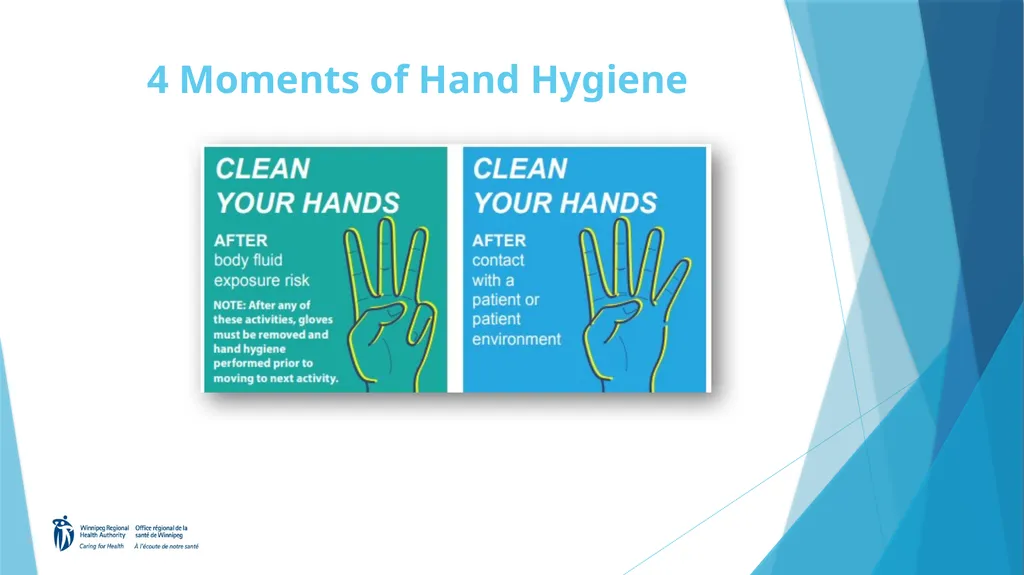
4 Moments of Hand Hygiene<br>
23
4 Moments of Hand Hygiene<br>
24
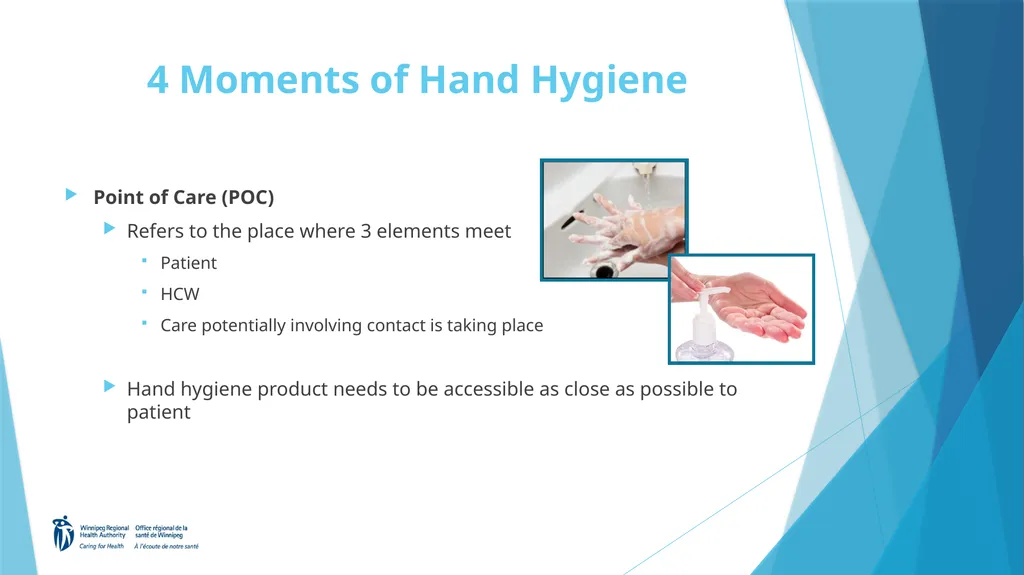
4 Moments of Hand Hygiene Point of Care (POC)
Refers to the place where 3 elements meet
Patient
HCW
Care potentially involving contact is taking place
Hand hygiene product needs to be accessible as close as possible to patient<br>
Refers to the place where 3 elements meet
Patient
HCW
Care potentially involving contact is taking place
Hand hygiene product needs to be accessible as close as possible to patient<br>
25
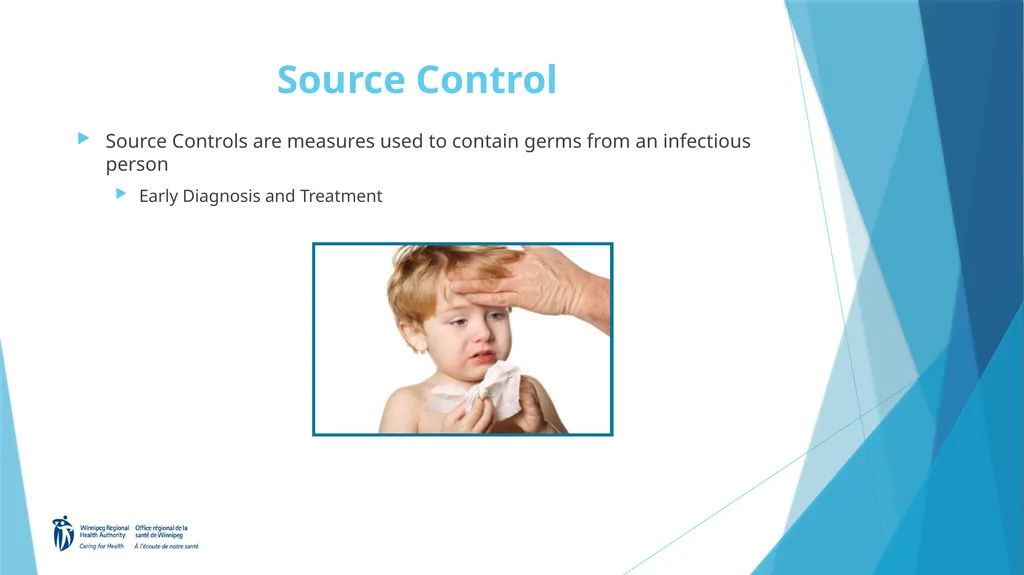
Source Control Source Controls are measures used to contain germs from an infectious person
Early Diagnosis and Treatment<br>
Early Diagnosis and Treatment<br>
26
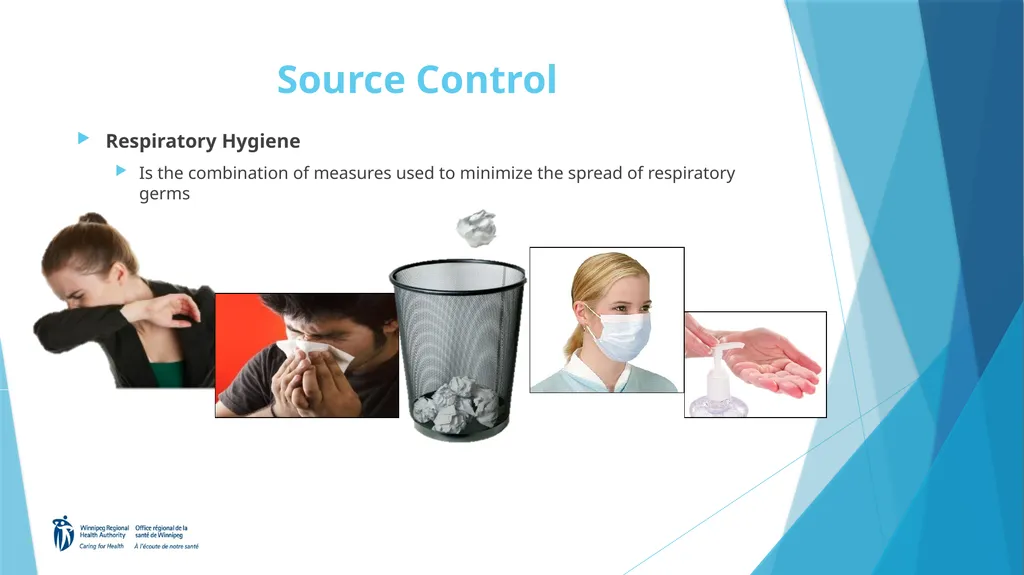
Source Control Respiratory Hygiene
Is the combination of measures used to minimize the spread of respiratory germs<br>
Is the combination of measures used to minimize the spread of respiratory germs<br>
27
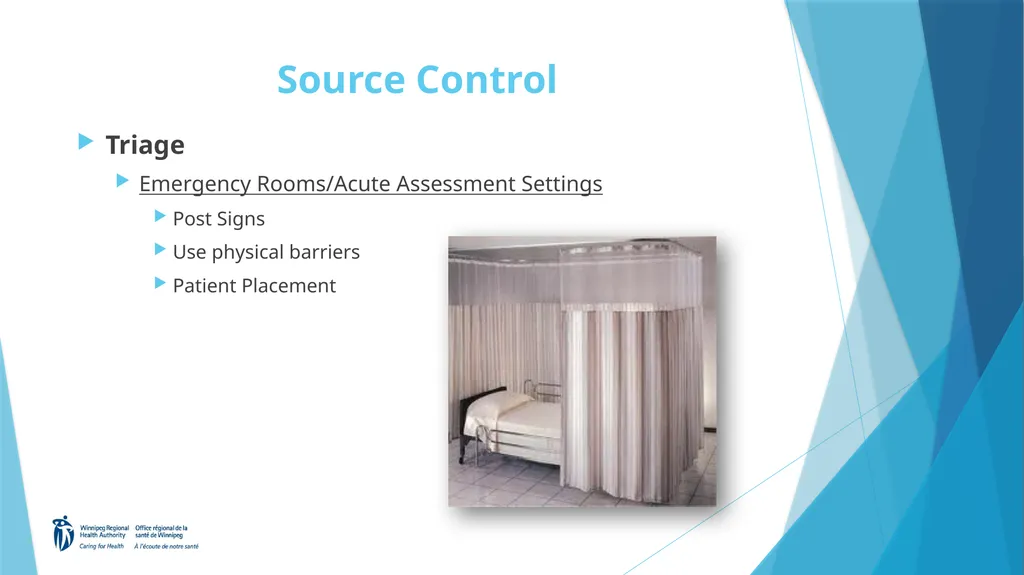
Source Control Triage
Emergency Rooms/Acute Assessment Settings
Post Signs
Use physical barriers
Patient Placement<br>
Emergency Rooms/Acute Assessment Settings
Post Signs
Use physical barriers
Patient Placement<br>
28
Source Control Triage
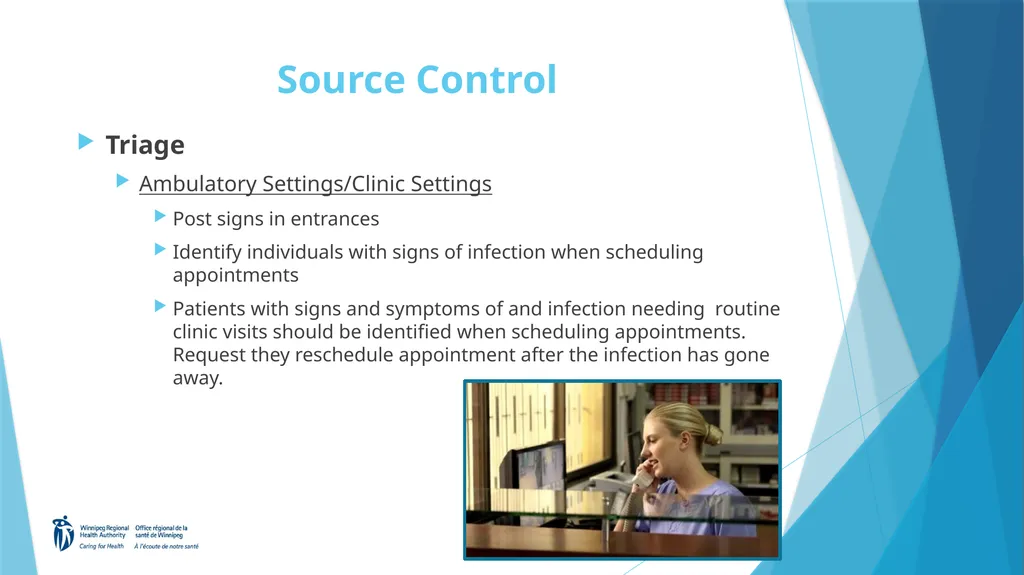
Ambulatory Settings/Clinic Settings
Post signs in entrances
Identify individuals with signs of infection when scheduling appointments
Patients with signs and symptoms of and infection needing routine clinic visits should be identified when scheduling appointments. Request they reschedule appointment after the infection has gone away.<br>
Ambulatory Settings/Clinic Settings
Post signs in entrances
Identify individuals with signs of infection when scheduling appointments
Patients with signs and symptoms of and infection needing routine clinic visits should be identified when scheduling appointments. Request they reschedule appointment after the infection has gone away.<br>
29
Source Control Spatial Separation
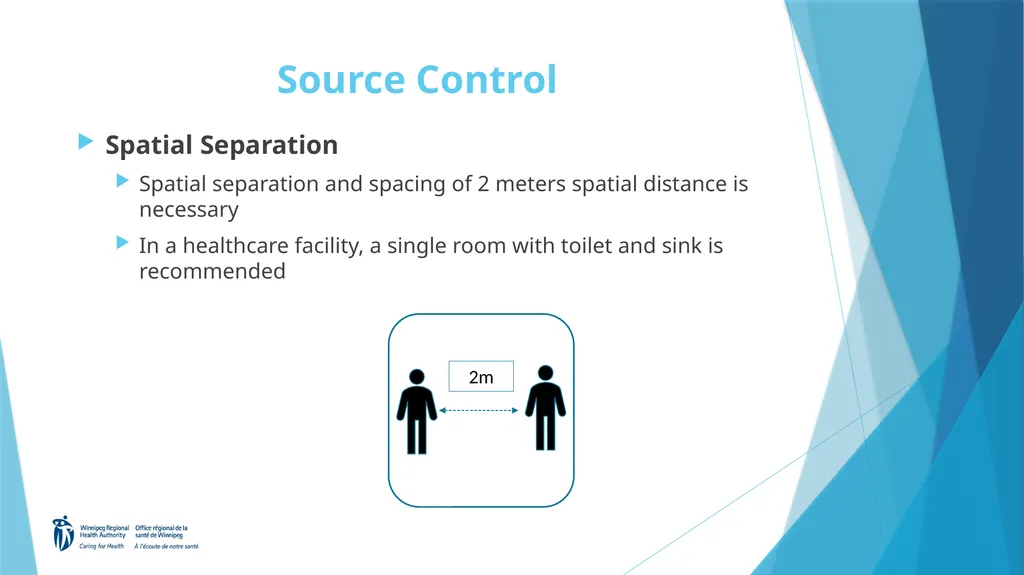
Spatial separation and spacing of 2 meters spatial distance is necessary
In a healthcare facility, a single room with toilet and sink is recommended<br>
Spatial separation and spacing of 2 meters spatial distance is necessary
In a healthcare facility, a single room with toilet and sink is recommended<br>
30
Source Control Patient Accommodation, Placement and Flow
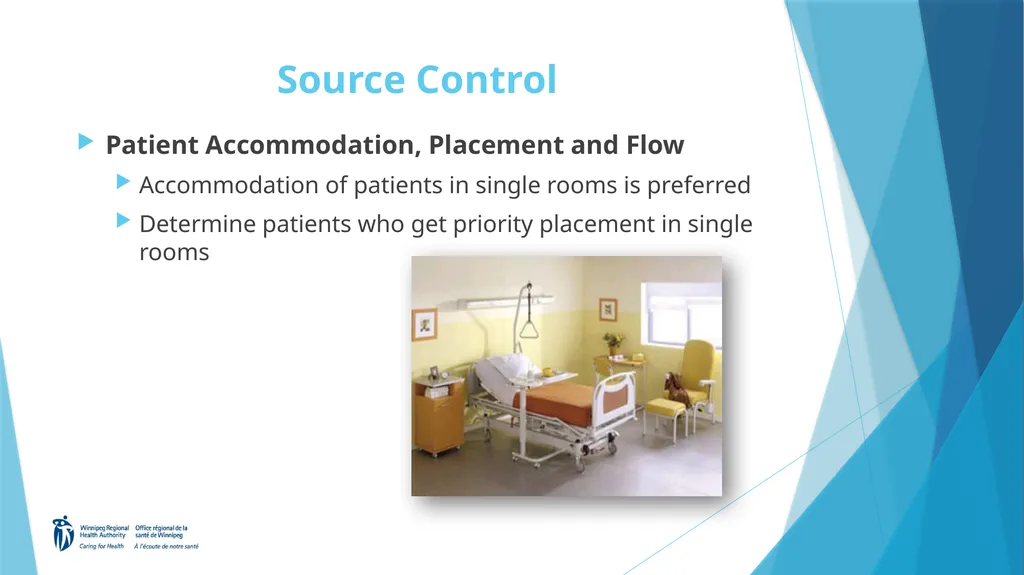
Accommodation of patients in single rooms is preferred
Determine patients who get priority placement in single rooms<br>
Accommodation of patients in single rooms is preferred
Determine patients who get priority placement in single rooms<br>
31
Source Control Patient Accommodation, Placement and Flow
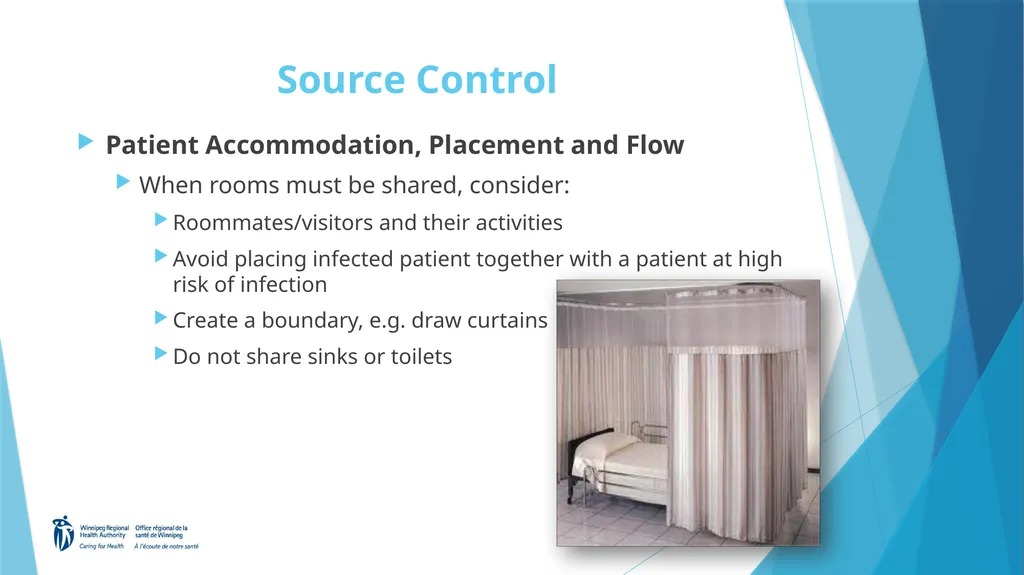
When rooms must be shared, consider:
Roommates/visitors and their activities
Avoid placing infected patient together with a patient at high risk of infection
Create a boundary, e.g. draw curtains
Do not share sinks or toilets<br>
When rooms must be shared, consider:
Roommates/visitors and their activities
Avoid placing infected patient together with a patient at high risk of infection
Create a boundary, e.g. draw curtains
Do not share sinks or toilets<br>
32
Source Control Patient Accommodation, Placement and Flow
Patient Flow:
Patient flow is transfer within and outside of facility/area and their activity
Considers the potential for exposure to and transmission of germs as a result of their activity and transport due to contact with other patients, their items and environmental surfaces<br>
Patient Flow:
Patient flow is transfer within and outside of facility/area and their activity
Considers the potential for exposure to and transmission of germs as a result of their activity and transport due to contact with other patients, their items and environmental surfaces<br>
33
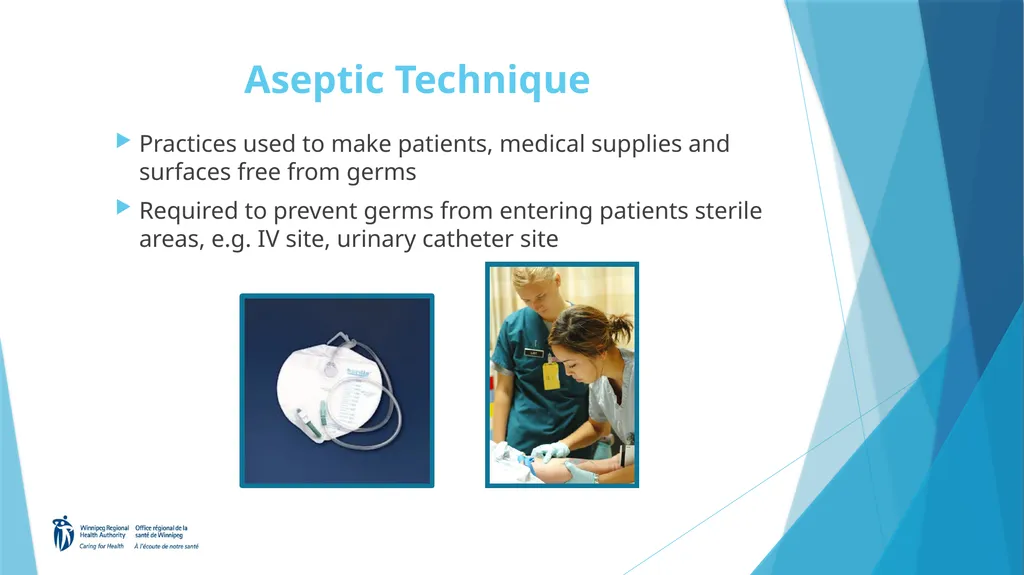
Aseptic Technique Practices used to make patients, medical supplies and surfaces free from germs
Required to prevent germs from entering patients sterile areas, e.g. IV site, urinary catheter site<br>
Required to prevent germs from entering patients sterile areas, e.g. IV site, urinary catheter site<br>
34
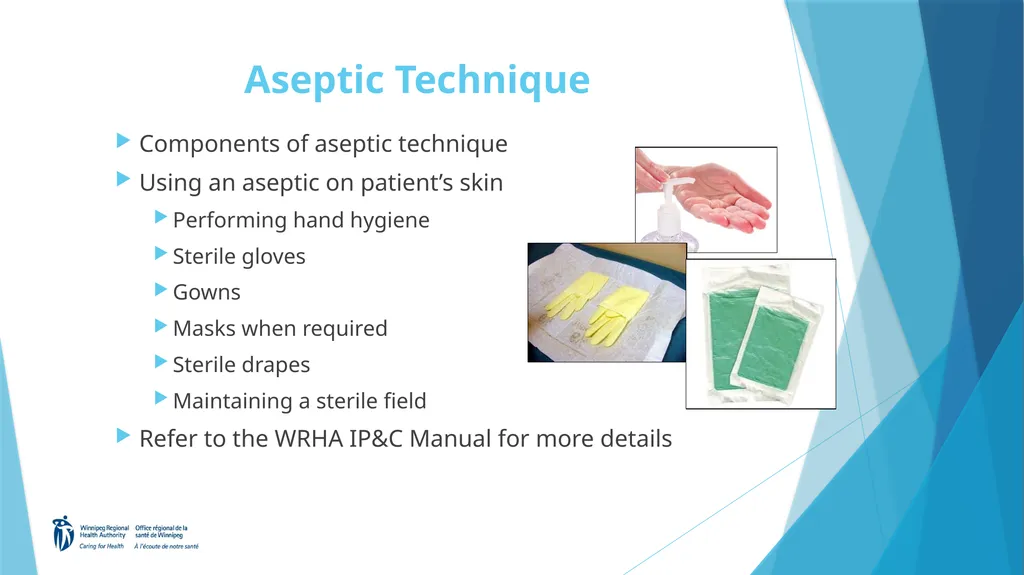
Aseptic Technique Components of aseptic technique
Using an aseptic on patient’s skin
Performing hand hygiene
Sterile gloves
Gowns
Masks when required
Sterile drapes
Maintaining a sterile field
Refer to the WRHA IP&C Manual for more details<br>
Using an aseptic on patient’s skin
Performing hand hygiene
Sterile gloves
Gowns
Masks when required
Sterile drapes
Maintaining a sterile field
Refer to the WRHA IP&C Manual for more details<br>
35
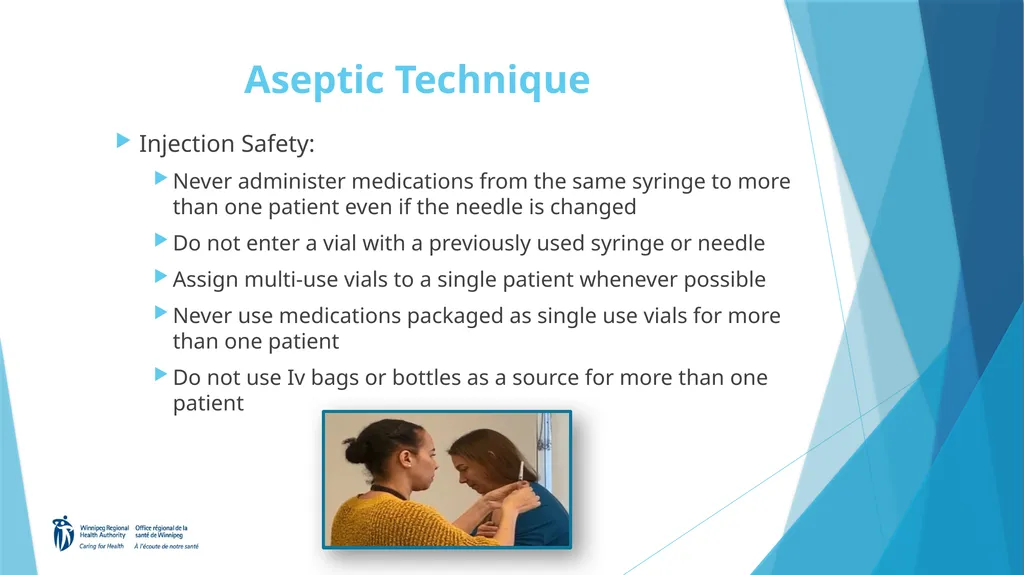
Aseptic Technique Injection Safety:
Never administer medications from the same syringe to more than one patient even if the needle is changed
Do not enter a vial with a previously used syringe or needle
Assign multi-use vials to a single patient whenever possible
Never use medications packaged as single use vials for more than one patient
Do not use Iv bags or bottles as a source for more than one patient<br>
Never administer medications from the same syringe to more than one patient even if the needle is changed
Do not enter a vial with a previously used syringe or needle
Assign multi-use vials to a single patient whenever possible
Never use medications packaged as single use vials for more than one patient
Do not use Iv bags or bottles as a source for more than one patient<br>
36
Personal Protective Equipment (PPE) The educational module on PPE must be completed to meet your educational requirements for this element of Routine Practices
PPE provides a physical barrier between the sources of infection and protects to user from exposure to germs
PPE should be used appropriately<br>
PPE provides a physical barrier between the sources of infection and protects to user from exposure to germs
PPE should be used appropriately<br>
37
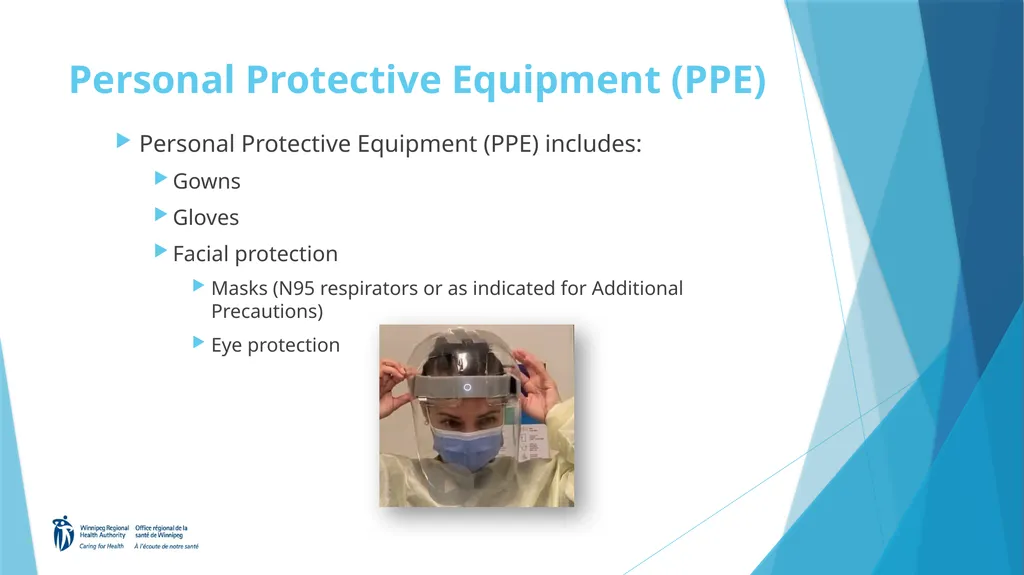
Personal Protective Equipment (PPE) Personal Protective Equipment (PPE) includes:
Gowns
Gloves
Facial protection
Masks (N95 respirators or as indicated for Additional Precautions)
Eye protection<br>
Gowns
Gloves
Facial protection
Masks (N95 respirators or as indicated for Additional Precautions)
Eye protection<br>
38
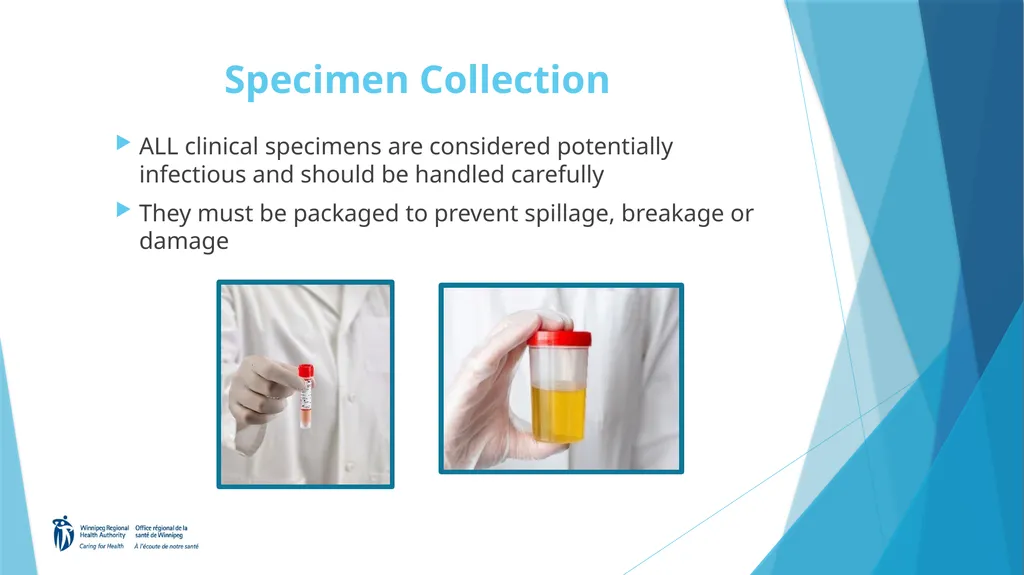
Specimen Collection ALL clinical specimens are considered potentially infectious and should be handled carefully
They must be packaged to prevent spillage, breakage or damage<br>
They must be packaged to prevent spillage, breakage or damage<br>
39
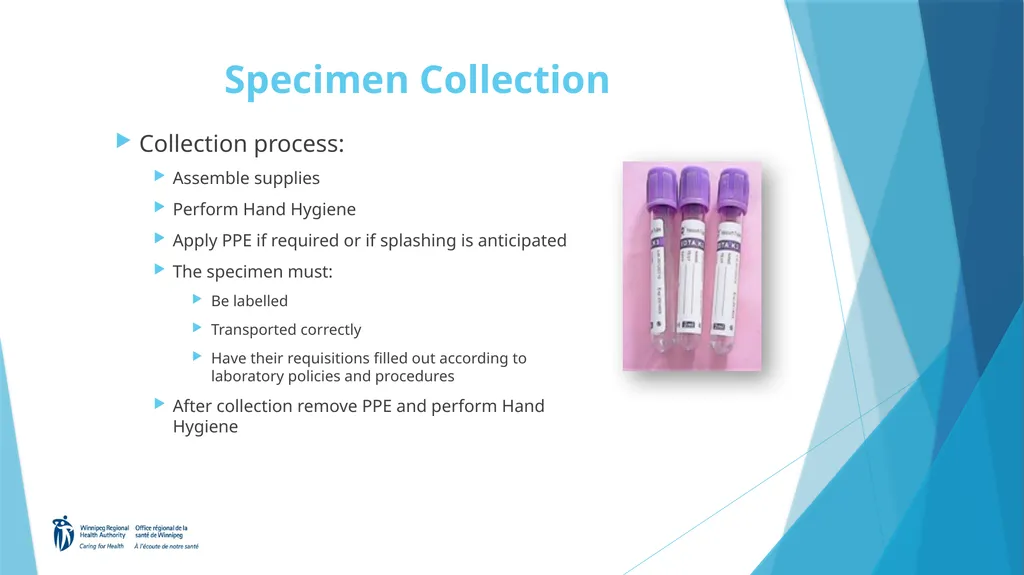
Specimen Collection Collection process:
Assemble supplies
Perform Hand Hygiene
Apply PPE if required or if splashing is anticipated
The specimen must:
Be labelled
Transported correctly
Have their requisitions filled out according to laboratory policies and procedures
After collection remove PPE and perform Hand Hygiene<br>
Assemble supplies
Perform Hand Hygiene
Apply PPE if required or if splashing is anticipated
The specimen must:
Be labelled
Transported correctly
Have their requisitions filled out according to laboratory policies and procedures
After collection remove PPE and perform Hand Hygiene<br>
40
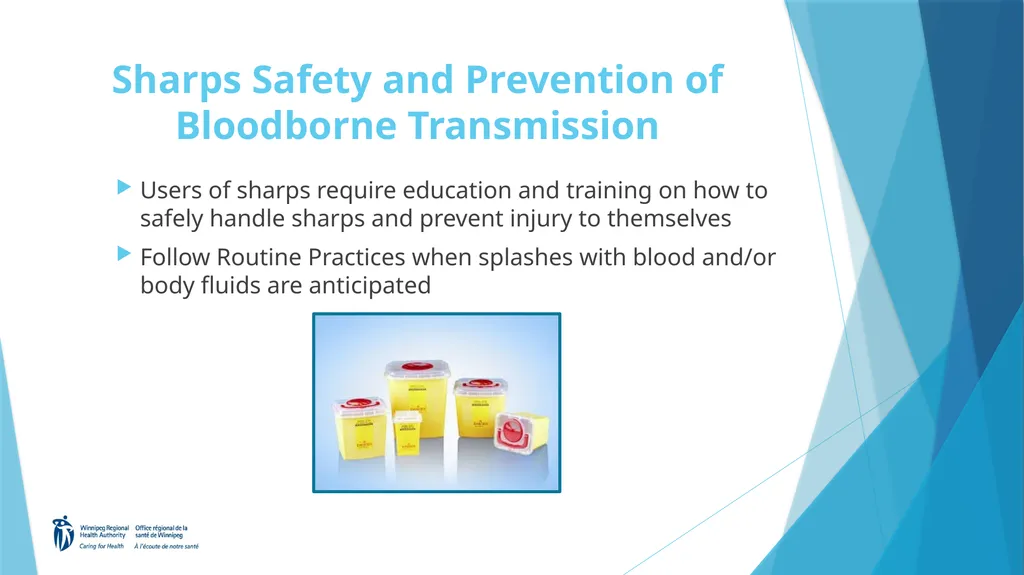
Sharps Safety and Prevention of Bloodborne Transmission Users of sharps require education and training on how to safely handle sharps and prevent injury to themselves
Follow Routine Practices when splashes with blood and/or body fluids are anticipated<br>
Follow Routine Practices when splashes with blood and/or body fluids are anticipated<br>
41
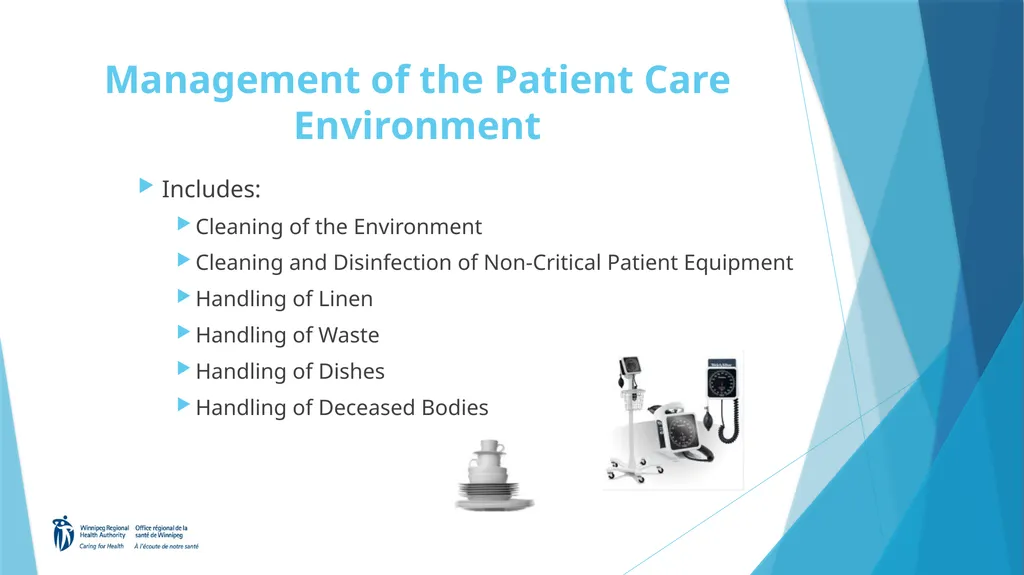
Management of the Patient Care Environment Includes:
Cleaning of the Environment
Cleaning and Disinfection of Non-Critical Patient Equipment
Handling of Linen
Handling of Waste
Handling of Dishes
Handling of Deceased Bodies<br>
Cleaning of the Environment
Cleaning and Disinfection of Non-Critical Patient Equipment
Handling of Linen
Handling of Waste
Handling of Dishes
Handling of Deceased Bodies<br>
42
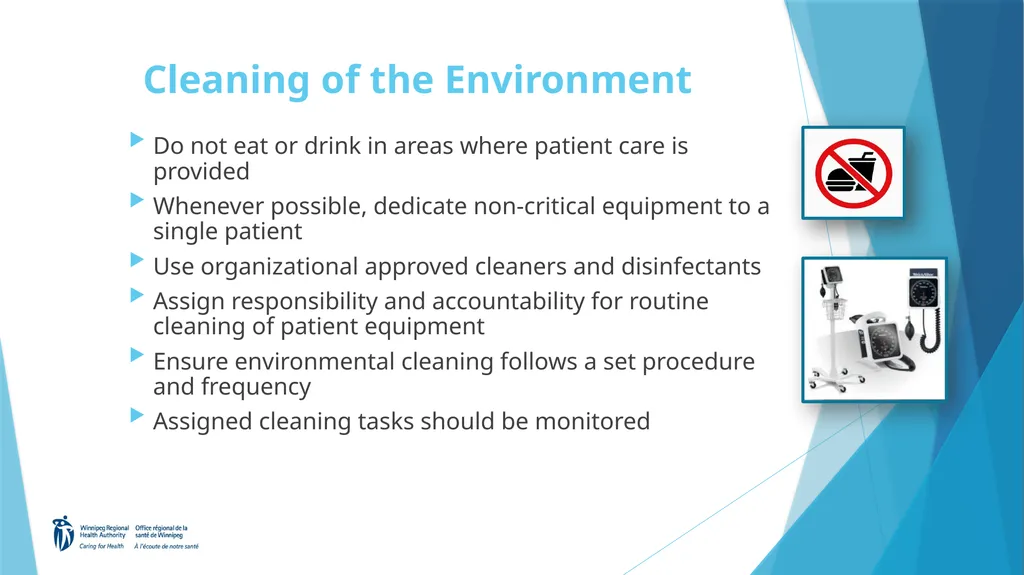
Cleaning of the Environment Do not eat or drink in areas where patient care is provided
Whenever possible, dedicate non-critical equipment to a single patient
Use organizational approved cleaners and disinfectants
Assign responsibility and accountability for routine cleaning of patient equipment
Ensure environmental cleaning follows a set procedure and frequency
Assigned cleaning tasks should be monitored<br>
Whenever possible, dedicate non-critical equipment to a single patient
Use organizational approved cleaners and disinfectants
Assign responsibility and accountability for routine cleaning of patient equipment
Ensure environmental cleaning follows a set procedure and frequency
Assigned cleaning tasks should be monitored<br>
43
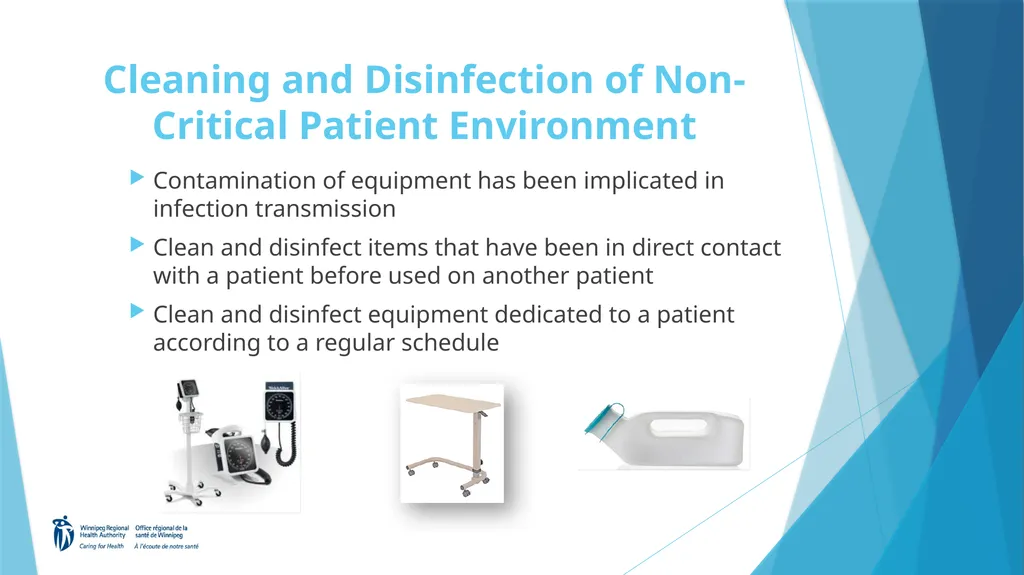
Cleaning and Disinfection of Non-Critical Patient Environment Contamination of equipment has been implicated in infection transmission
Clean and disinfect items that have been in direct contact with a patient before used on another patient
Clean and disinfect equipment dedicated to a patient according to a regular schedule<br>
Clean and disinfect items that have been in direct contact with a patient before used on another patient
Clean and disinfect equipment dedicated to a patient according to a regular schedule<br>
44
Cleaning and Disinfection of Non-Critical Patient Environment Store sterile/clean supplies in a designated and separate clean dry protected by dust
Discard personal care items (e.g. tissues, lotions) and disposable equipment left in the room following transfer, terminal cleaning, or discharge<br>
Discard personal care items (e.g. tissues, lotions) and disposable equipment left in the room following transfer, terminal cleaning, or discharge<br>
45
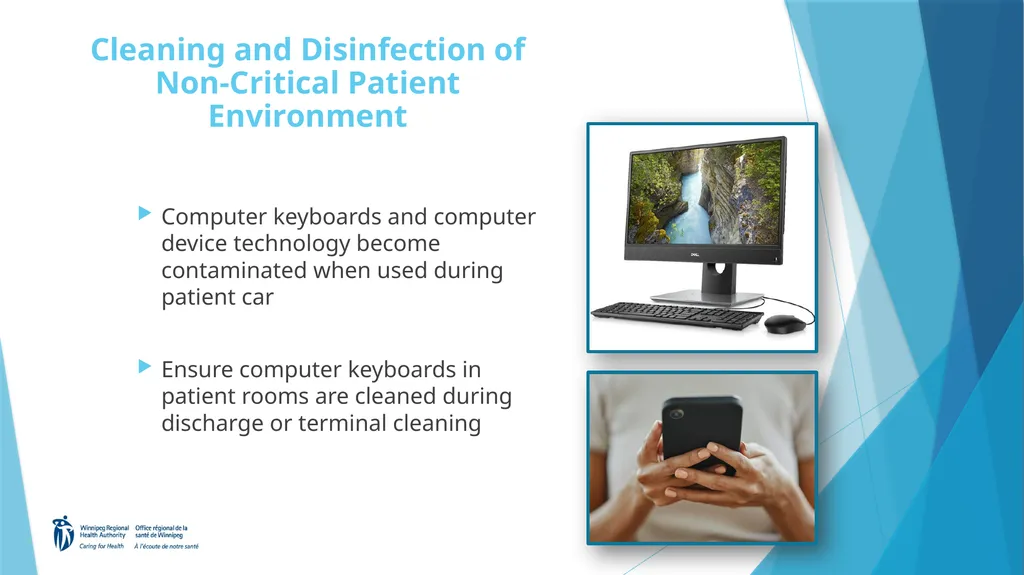
Cleaning and Disinfection of Non-Critical Patient Environment Computer keyboards and computer device technology become contaminated when used during patient car
Ensure computer keyboards in patient rooms are cleaned during discharge or terminal cleaning<br>
Ensure computer keyboards in patient rooms are cleaned during discharge or terminal cleaning<br>
46
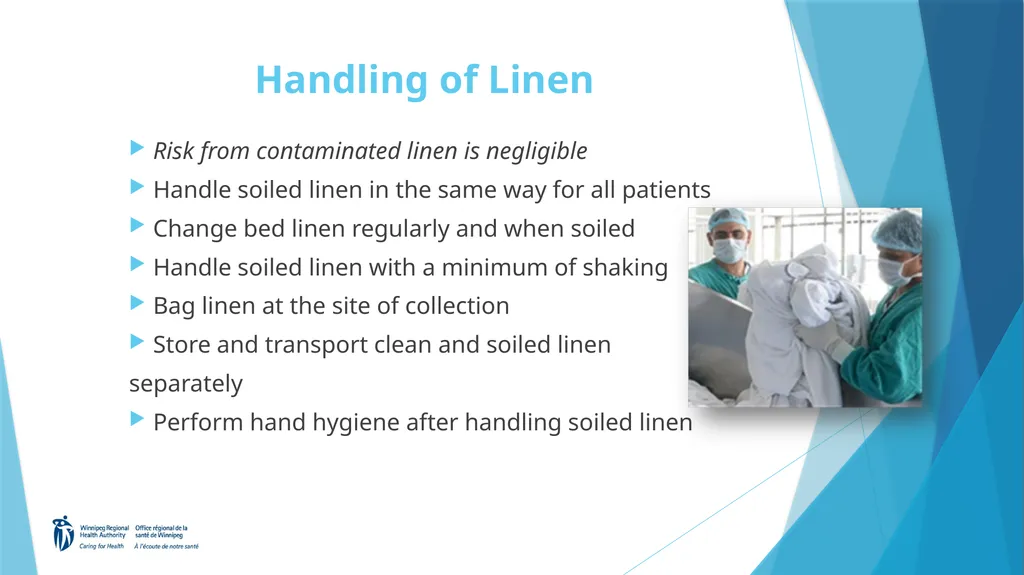
Handling of Linen Risk from contaminated linen is negligible
Handle soiled linen in the same way for all patients
Change bed linen regularly and when soiled
Handle soiled linen with a minimum of shaking
Bag linen at the site of collection
Store and transport clean and soiled linen
separately
Perform hand hygiene after handling soiled linen<br>
Handle soiled linen in the same way for all patients
Change bed linen regularly and when soiled
Handle soiled linen with a minimum of shaking
Bag linen at the site of collection
Store and transport clean and soiled linen
separately
Perform hand hygiene after handling soiled linen<br>
47
Handling of Waste Risk from most healthcare waste is negligible
Waste receptacles should be conveniently located and preferably, hands-free
Contain and dispose of biomedical waste according to WRHA policies and procedures<br>
Waste receptacles should be conveniently located and preferably, hands-free
Contain and dispose of biomedical waste according to WRHA policies and procedures<br>
48
Handling of Dishes Disposable dishes and utensils are not required other than when dishwashing equipment is nonfunctioning
No special precautions
Follow Routine Practices<br>
No special precautions
Follow Routine Practices<br>
49
Handling of Deceased Bodies There are no special requirements
Follow Routine Practices<br>
Follow Routine Practices<br>
50
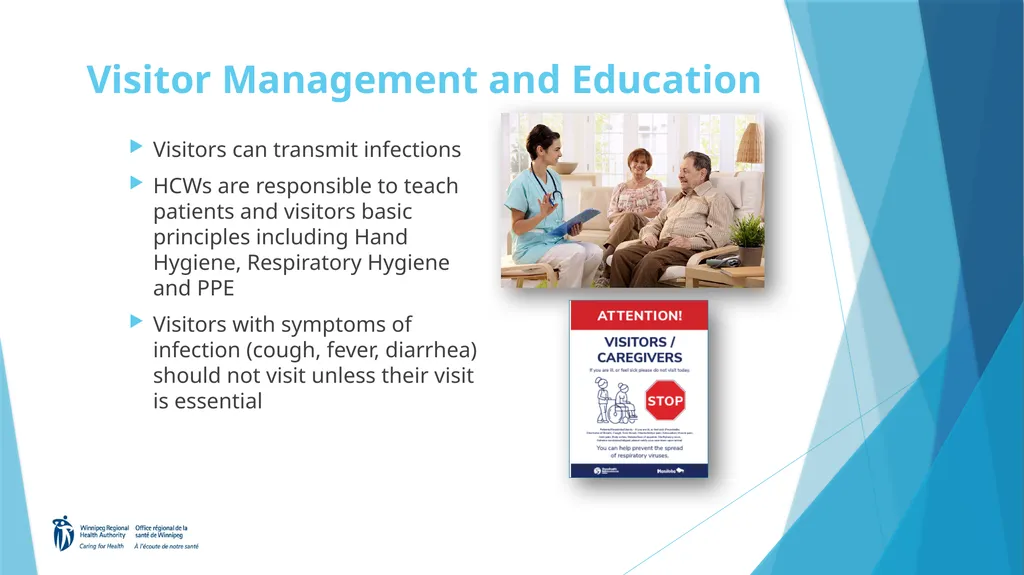
Visitor Management and Education Visitors can transmit infections
HCWs are responsible to teach patients and visitors basic principles including Hand Hygiene, Respiratory Hygiene and PPE
Visitors with symptoms of infection (cough, fever, diarrhea) should not visit unless their visit is essential<br>
HCWs are responsible to teach patients and visitors basic principles including Hand Hygiene, Respiratory Hygiene and PPE
Visitors with symptoms of infection (cough, fever, diarrhea) should not visit unless their visit is essential<br>
51
Awareness of Infection Prevention & Control (IP&C) Issues Community, Hospital or Long Term Care
Refer to WRHA IP&C Manual
Other Routine Practices learning tools and resources are available at: https://professionals.wrha.mb.ca/infection-prevention-control/routine-practices/<br>
Refer to WRHA IP&C Manual
Other Routine Practices learning tools and resources are available at: https://professionals.wrha.mb.ca/infection-prevention-control/routine-practices/<br>
52
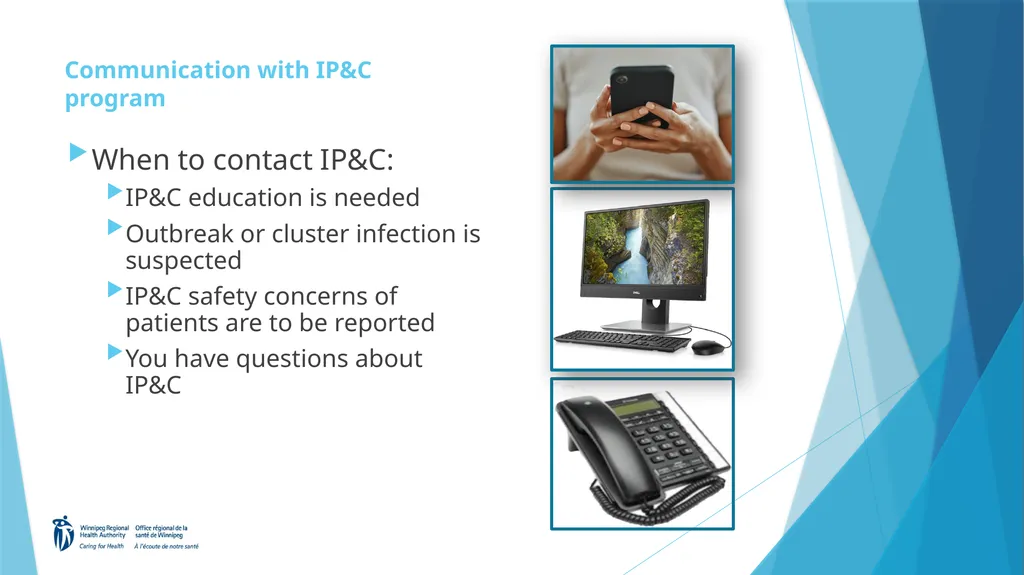
Communication with IP&C program When to contact IP&C:
IP&C education is needed
Outbreak or cluster infection is suspected
IP&C safety concerns of patients are to be reported
You have questions about IP&C<br>
IP&C education is needed
Outbreak or cluster infection is suspected
IP&C safety concerns of patients are to be reported
You have questions about IP&C<br>
53
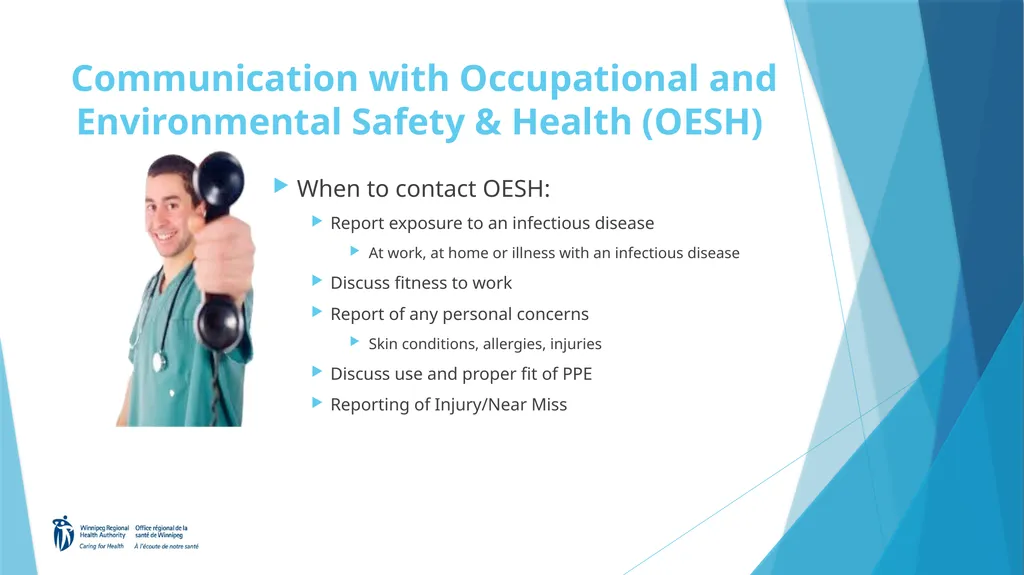
Communication with Occupational and Environmental Safety & Health (OESH) When to contact OESH:
Report exposure to an infectious disease
At work, at home or illness with an infectious disease
Discuss fitness to work
Report of any personal concerns
Skin conditions, allergies, injuries
Discuss use and proper fit of PPE
Reporting of Injury/Near Miss<br>
Report exposure to an infectious disease
At work, at home or illness with an infectious disease
Discuss fitness to work
Report of any personal concerns
Skin conditions, allergies, injuries
Discuss use and proper fit of PPE
Reporting of Injury/Near Miss<br>
54
QUESTIONS??<br>
55
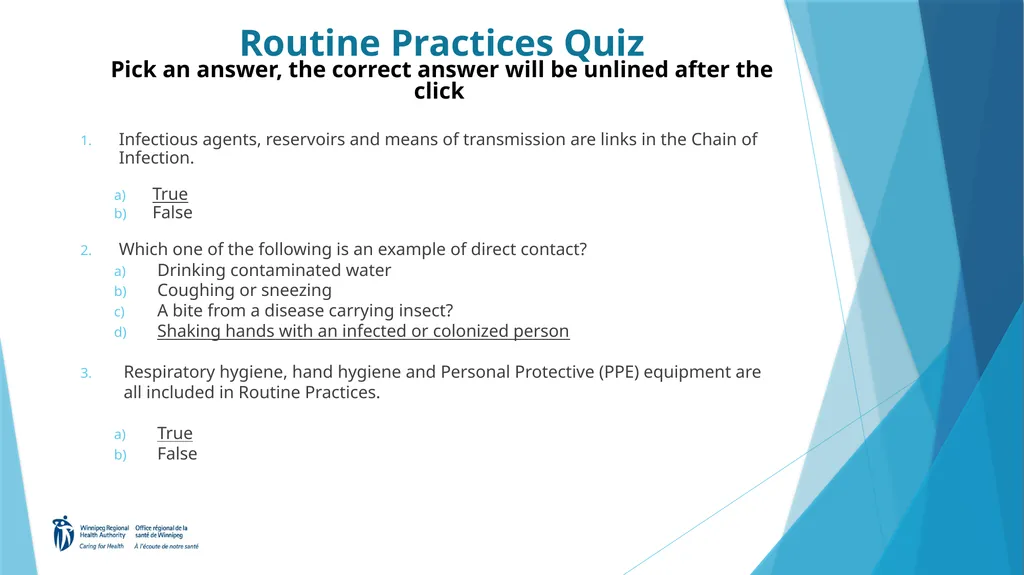
Routine Practices Quiz
Pick an answer, the correct answer will be unlined after the click Infectious agents, reservoirs and means of transmission are links in the Chain of Infection.
True
False
Which one of the following is an example of direct contact?
Drinking contaminated water
Coughing or sneezing
A bite from a disease carrying insect?
Shaking hands with an infected or colonized person
Respiratory hygiene, hand hygiene and Personal Protective (PPE) equipment are all included in Routine Practices.
True
False<br>
True
False
Which one of the following is an example of direct contact?
Drinking contaminated water
Coughing or sneezing
A bite from a disease carrying insect?
Shaking hands with an infected or colonized person
Respiratory hygiene, hand hygiene and Personal Protective (PPE) equipment are all included in Routine Practices.
True
False<br>
56
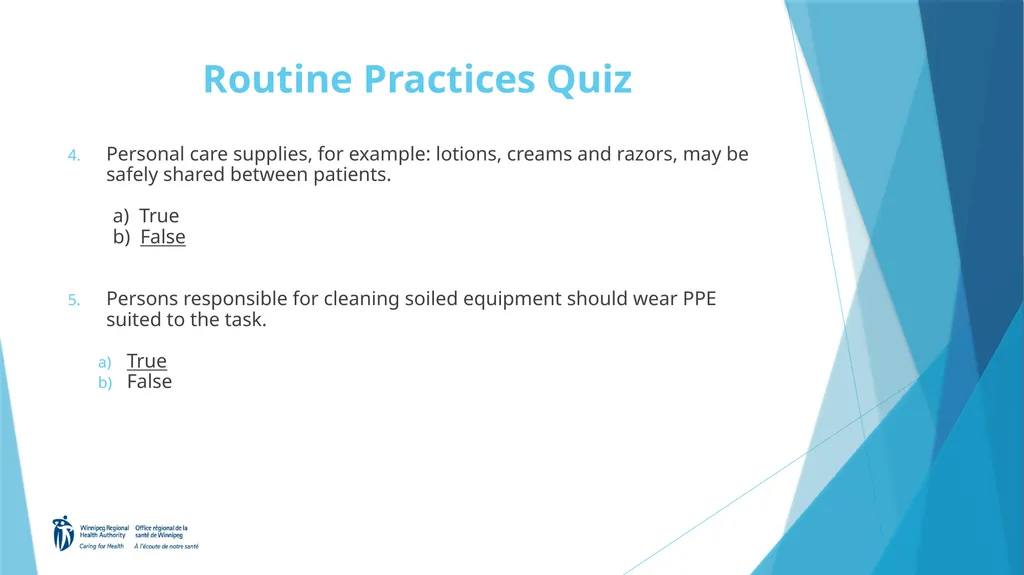
Routine Practices Quiz Personal care supplies, for example: lotions, creams and razors, may be safely shared between patients.
a) True
b) False
Persons responsible for cleaning soiled equipment should wear PPE suited to the task.
True
False<br>
a) True
b) False
Persons responsible for cleaning soiled equipment should wear PPE suited to the task.
True
False<br>
57
Resources Routine Practices document are available at: https://professionals.wrha.mb.ca/infection-prevention-control/routine-practices/
The Routine Practices document contains all the references used to create this PowerPoint<br>
The Routine Practices document contains all the references used to create this PowerPoint<br>