
Welcome Welcome! Topics that will be covered:
CP
Published · 333 slides · 0 views

1 / 1












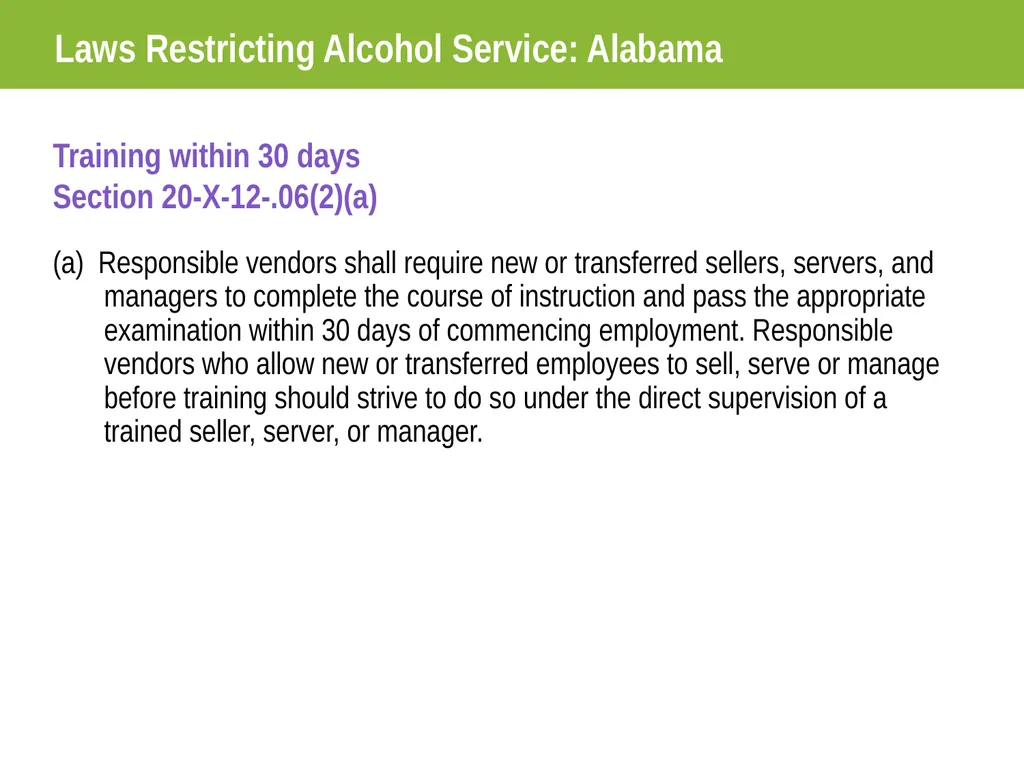

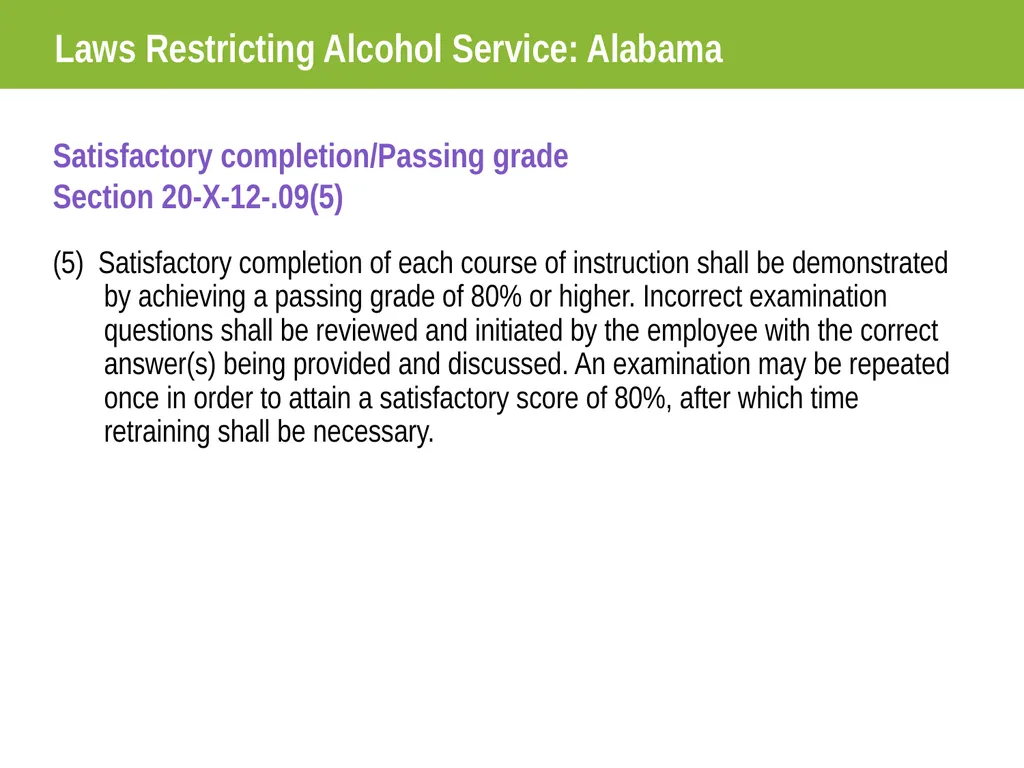



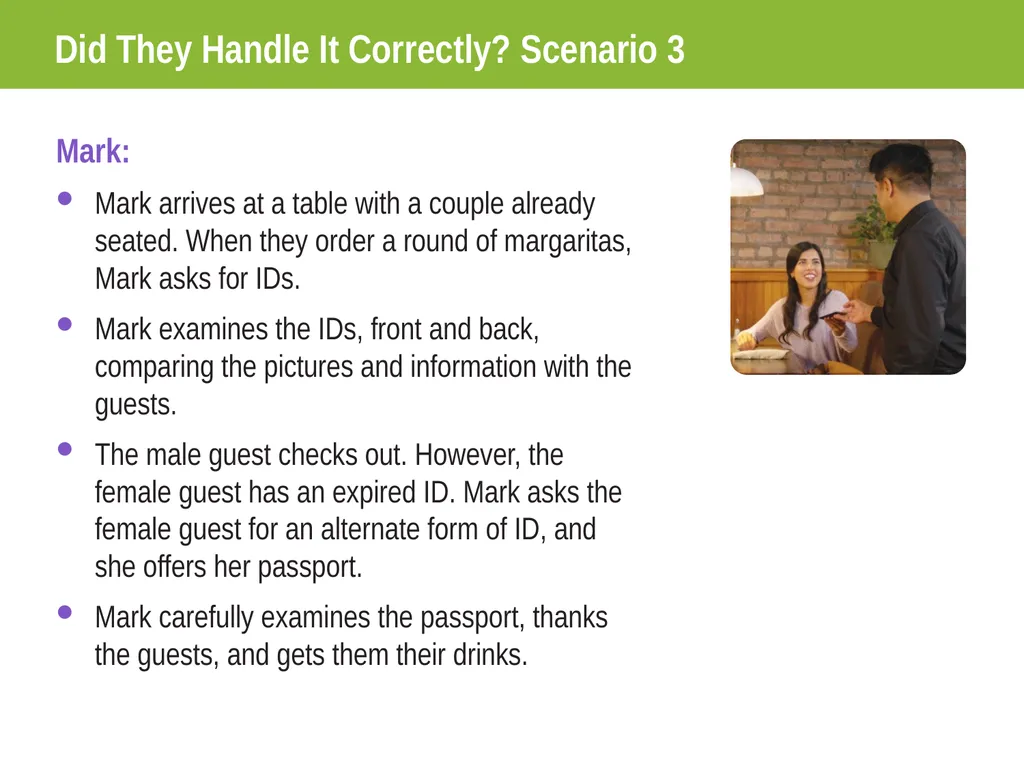
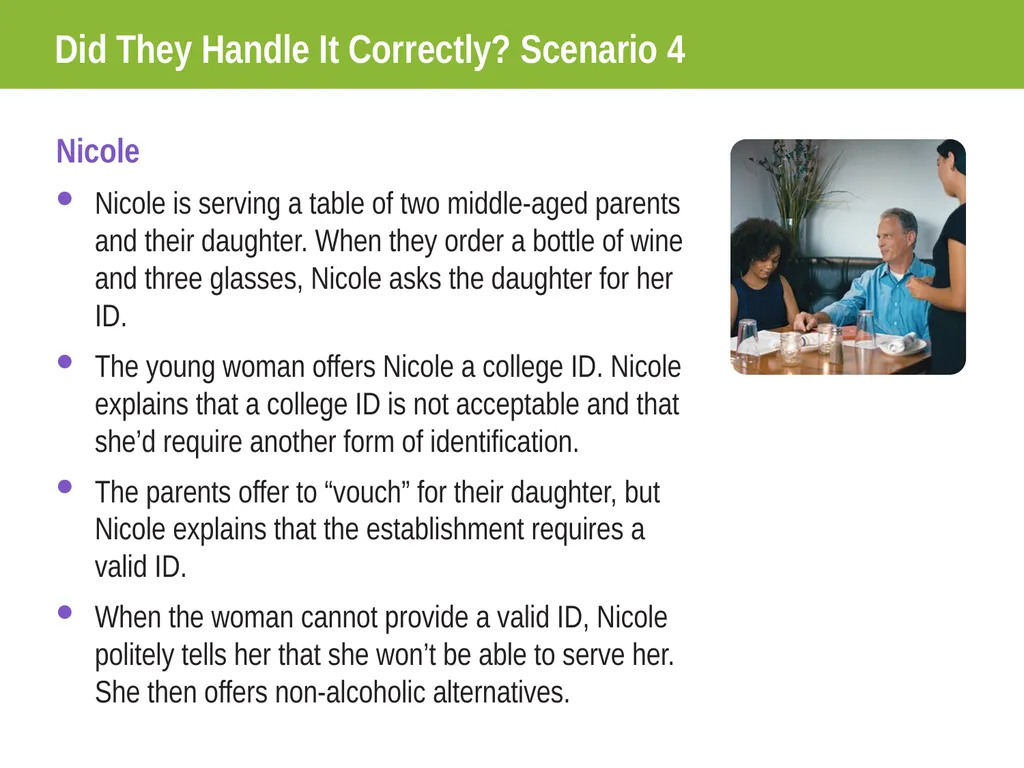








Description
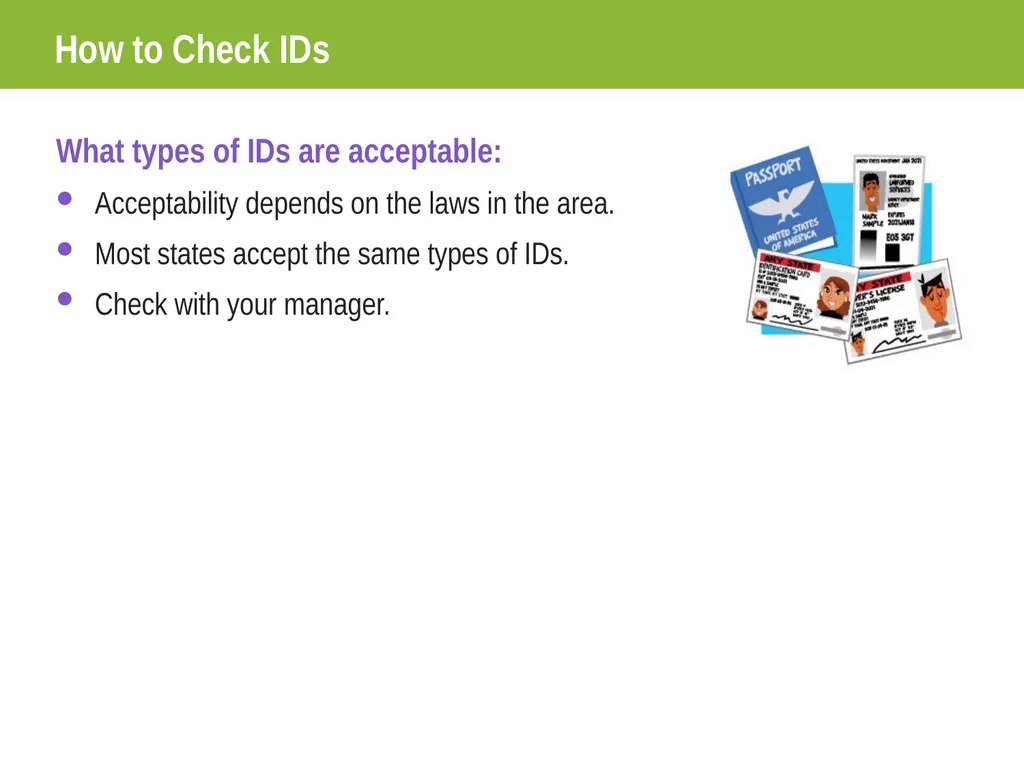
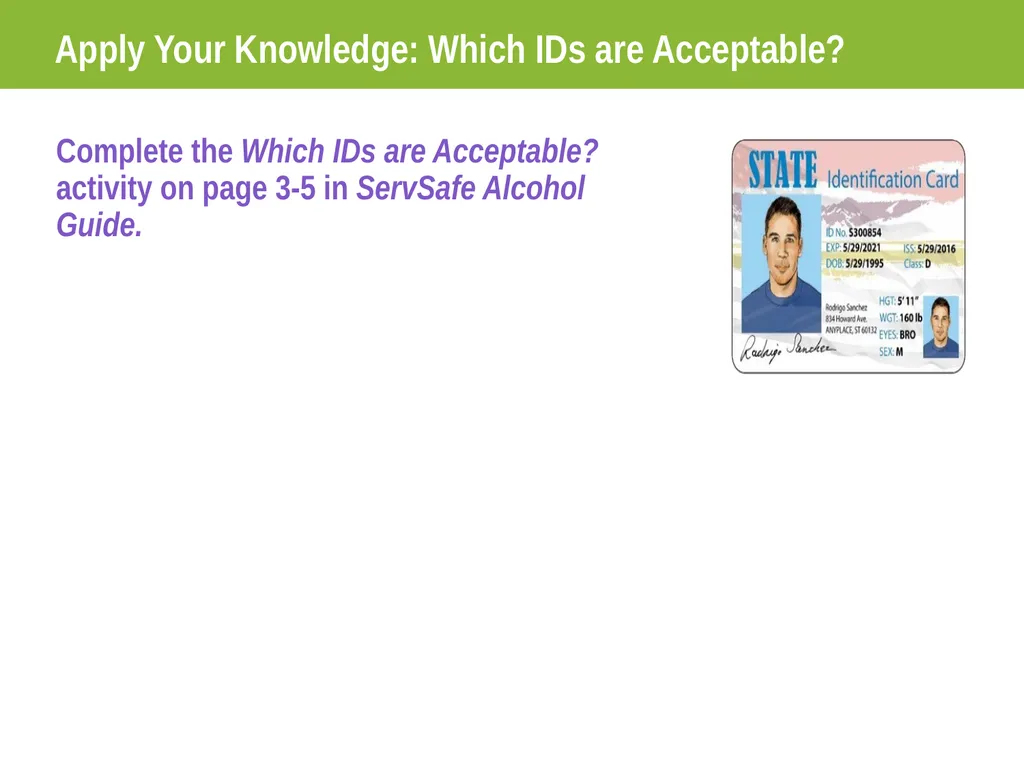
Welcome Welcome! Topics that will be covered: Alcohol Law and Your Responsibility Recognizing and Preventing Intoxication Checking Identification Handling Difficult Situations What Do You Like about Serving Alcohol? What Do You Think?
Related Topics
Share
Embed code
Download this presentation From Below
"Welcome Welcome! Topics that will be covered:" is the property of its rightful owner. Permission is granted to download and print the materials on this website for personal, non-commercial use only, and to display it on your personal computer provided you do not modify the materials and that you retain all copyright notices contained in the materials. By downloading content from our website, you accept the terms of this agreement.
Presentation Transcript
01
Welcome<br>
02
Welcome! Topics that will be covered:
Alcohol Law and Your Responsibility
Recognizing and Preventing Intoxication
Checking Identification
Handling Difficult Situations<br>
Alcohol Law and Your Responsibility
Recognizing and Preventing Intoxication
Checking Identification
Handling Difficult Situations<br>
03
What Do You Like about Serving Alcohol? What Do You Think?<br>
04
Objectives After completing this topic, you will be able to identify the following:
Costs of not serving alcohol responsibly
Three types of liability related to alcohol service
Laws for alcohol service
Alabama State Laws<br>
Costs of not serving alcohol responsibly
Three types of liability related to alcohol service
Laws for alcohol service
Alabama State Laws<br>
05
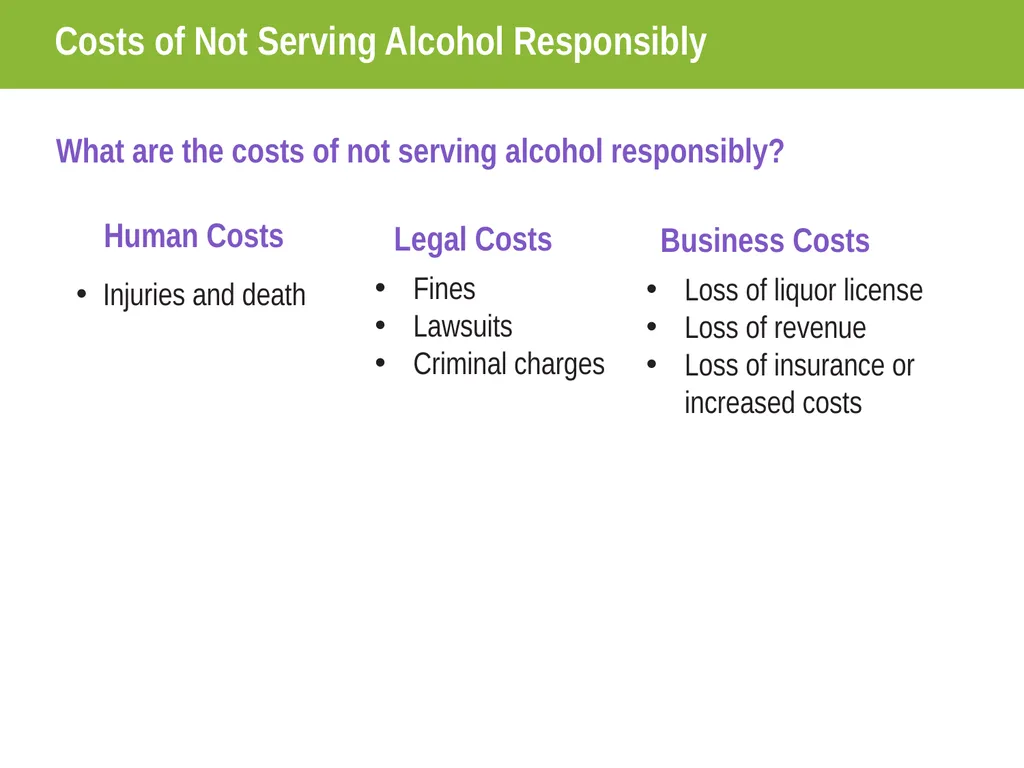
What are the costs of not serving alcohol responsibly? Human Costs Legal Costs Business Costs Injuries and death Fines
Lawsuits
Criminal charges Loss of liquor license
Loss of revenue
Loss of insurance or increased costs Costs of Not Serving Alcohol Responsibly<br>
Lawsuits
Criminal charges Loss of liquor license
Loss of revenue
Loss of insurance or increased costs Costs of Not Serving Alcohol Responsibly<br>
06
B. Being responsible for something A. Being licensed to do something What does being liable mean? Why? Liability means you are legally responsible for something. What Do You Think?<br>
07
B. Your customers’ actions A. Your actions What are you responsible for when selling or serving alcohol? Why? You are legally responsible for your actions—both the things you do and the things you don’t. What Do You Think?<br>
08
The three types of liability that apply to you when selling or serving alcohol:
Criminal liability
Civil liability, including dram shop laws
Administrative liability Types of Liability<br>
Criminal liability
Civil liability, including dram shop laws
Administrative liability Types of Liability<br>
09
Types of Liability Criminal Liability
You are responsible for making sure you don’t break alcohol laws
If you do, you can be held responsible for committing a crime
This is criminal liability
For what two actions will you be held criminally liable in most states?
Serving someone who is underage
Serving someone who is intoxicated<br>
You are responsible for making sure you don’t break alcohol laws
If you do, you can be held responsible for committing a crime
This is criminal liability
For what two actions will you be held criminally liable in most states?
Serving someone who is underage
Serving someone who is intoxicated<br>
10
Types of Liability What are the penalties related to criminal liability?
Jail time
Probation
Fines<br>
Jail time
Probation
Fines<br>
11
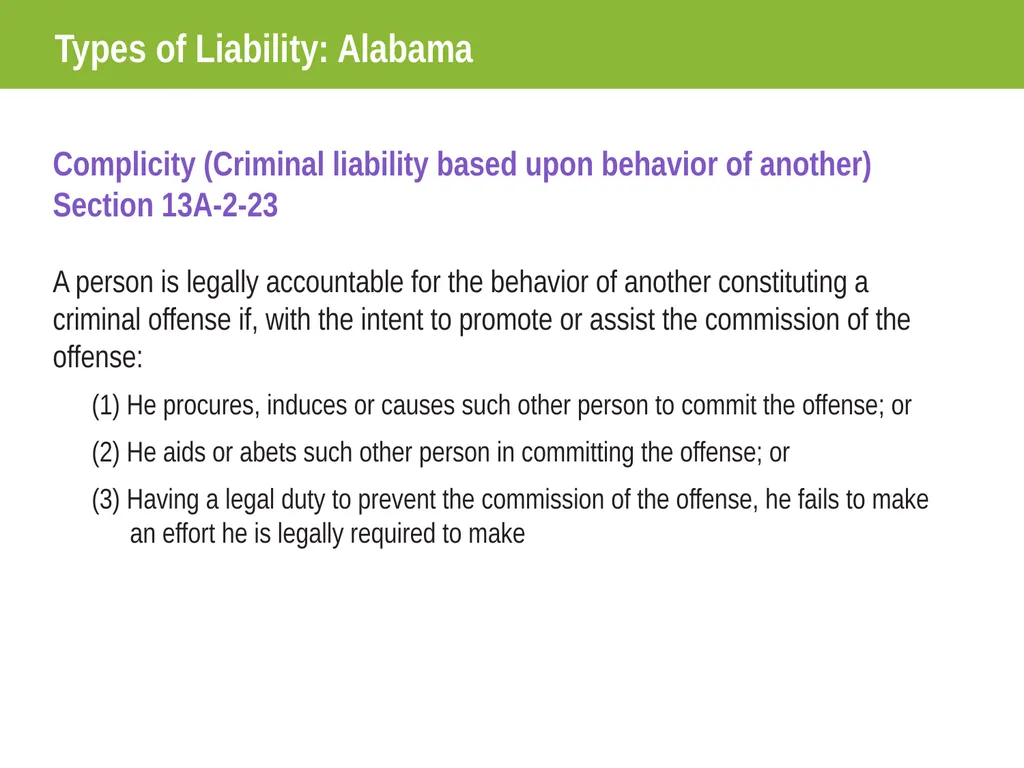
Complicity (Criminal liability based upon behavior of another)
Section 13A-2-23
A person is legally accountable for the behavior of another constituting a criminal offense if, with the intent to promote or assist the commission of the offense:
(1) He procures, induces or causes such other person to commit the offense; or
(2) He aids or abets such other person in committing the offense; or
(3) Having a legal duty to prevent the commission of the offense, he fails to make an effort he is legally required to make Types of Liability: Alabama<br>
Section 13A-2-23
A person is legally accountable for the behavior of another constituting a criminal offense if, with the intent to promote or assist the commission of the offense:
(1) He procures, induces or causes such other person to commit the offense; or
(2) He aids or abets such other person in committing the offense; or
(3) Having a legal duty to prevent the commission of the offense, he fails to make an effort he is legally required to make Types of Liability: Alabama<br>
12
Types of Liability Civil Liability
Focuses on compensating people hurt by someone who was negligent
Someone who does not serve responsibly is negligent
They can be sued and forced to pay damages if they contributed to an injury<br>
Focuses on compensating people hurt by someone who was negligent
Someone who does not serve responsibly is negligent
They can be sued and forced to pay damages if they contributed to an injury<br>
13
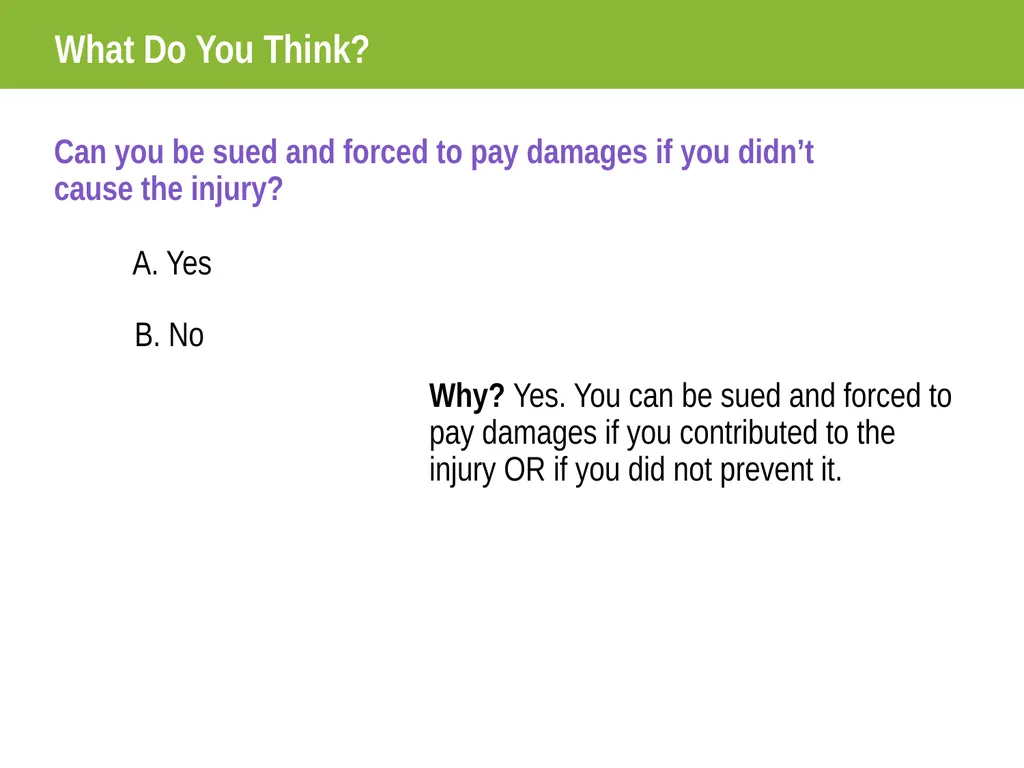
B. No A. Yes Can you be sued and forced to pay damages if you didn’t
cause the injury? Why? Yes. You can be sued and forced to pay damages if you contributed to the injury OR if you did not prevent it. What Do You Think?<br>
cause the injury? Why? Yes. You can be sued and forced to pay damages if you contributed to the injury OR if you did not prevent it. What Do You Think?<br>
14
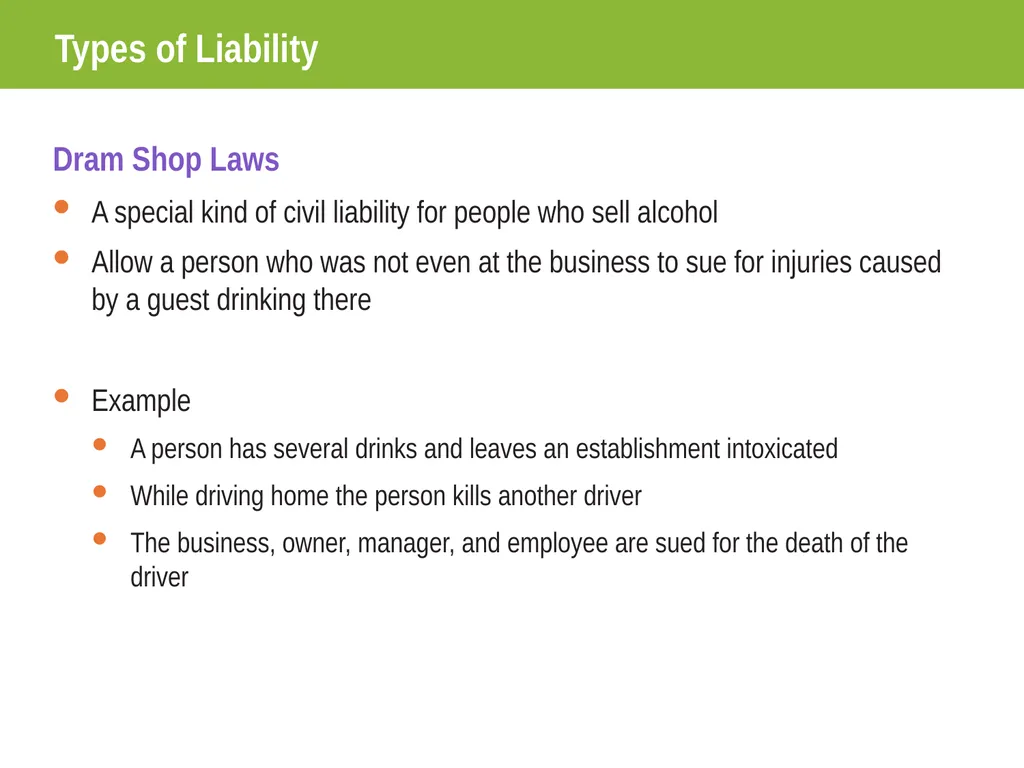
Dram Shop Laws
A special kind of civil liability for people who sell alcohol
Allow a person who was not even at the business to sue for injuries caused by a guest drinking there
Example
A person has several drinks and leaves an establishment intoxicated
While driving home the person kills another driver
The business, owner, manager, and employee are sued for the death of the driver Types of Liability<br>
A special kind of civil liability for people who sell alcohol
Allow a person who was not even at the business to sue for injuries caused by a guest drinking there
Example
A person has several drinks and leaves an establishment intoxicated
While driving home the person kills another driver
The business, owner, manager, and employee are sued for the death of the driver Types of Liability<br>
15
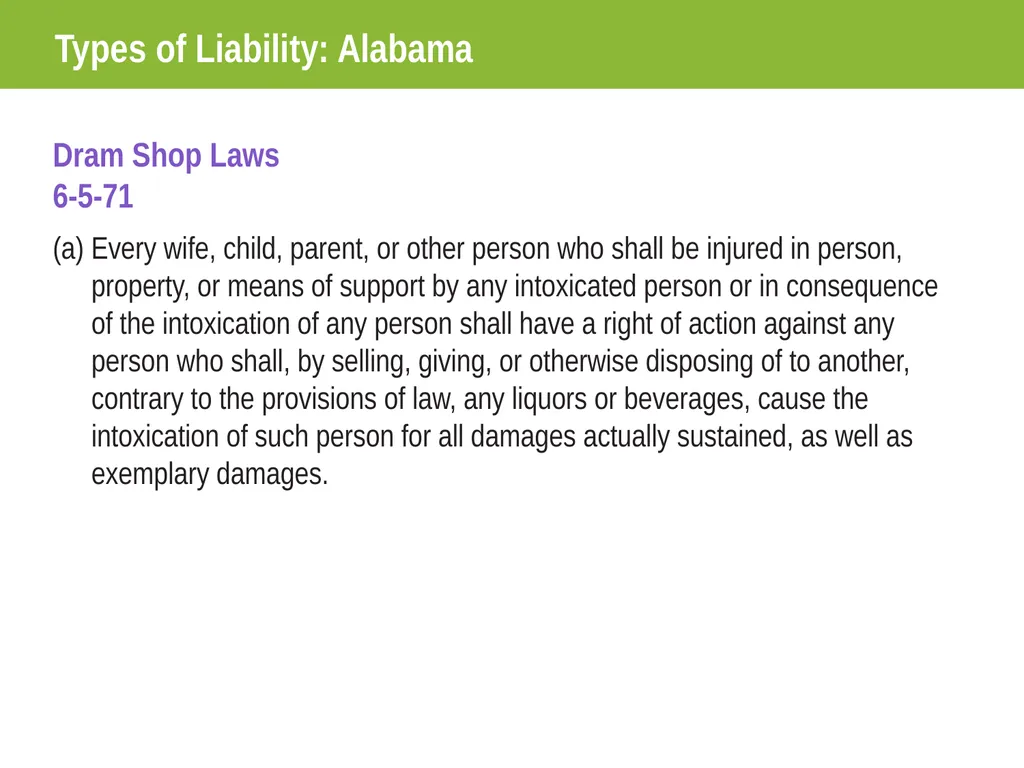
Dram Shop Laws
6-5-71
(a) Every wife, child, parent, or other person who shall be injured in person, property, or means of support by any intoxicated person or in consequence of the intoxication of any person shall have a right of action against any person who shall, by selling, giving, or otherwise disposing of to another, contrary to the provisions of law, any liquors or beverages, cause the intoxication of such person for all damages actually sustained, as well as exemplary damages. Types of Liability: Alabama<br>
6-5-71
(a) Every wife, child, parent, or other person who shall be injured in person, property, or means of support by any intoxicated person or in consequence of the intoxication of any person shall have a right of action against any person who shall, by selling, giving, or otherwise disposing of to another, contrary to the provisions of law, any liquors or beverages, cause the intoxication of such person for all damages actually sustained, as well as exemplary damages. Types of Liability: Alabama<br>
16
Dram Shop Laws cont.
6-5-71
(b) Upon the death of any party, the action or right of action will survive to or against his executor or administrator.
(c) The party injured, or his legal representative, may commence a joint or separate action against the person intoxicated or the person who furnished the liquor, and all such claims shall be by civil action in any court having jurisdiction thereof. Types of Liability: Alabama<br>
6-5-71
(b) Upon the death of any party, the action or right of action will survive to or against his executor or administrator.
(c) The party injured, or his legal representative, may commence a joint or separate action against the person intoxicated or the person who furnished the liquor, and all such claims shall be by civil action in any court having jurisdiction thereof. Types of Liability: Alabama<br>
17
Dram Shop Laws (Furnishing Liquor to Minors)
6-5-70
Either parent of a minor, guardian, or a person standing in loco parentis to the minor having neither father nor mother shall have a right of action against any person who unlawfully sells or furnishes spirituous liquors to such minor and may recover such damages as the jury may assess, provided the person selling or furnishing liquor to the minor had knowledge of or was chargeable with notice or knowledge of such minority. Only one action may be commenced for each offense under this section. Types of Liability: Alabama<br>
6-5-70
Either parent of a minor, guardian, or a person standing in loco parentis to the minor having neither father nor mother shall have a right of action against any person who unlawfully sells or furnishes spirituous liquors to such minor and may recover such damages as the jury may assess, provided the person selling or furnishing liquor to the minor had knowledge of or was chargeable with notice or knowledge of such minority. Only one action may be commenced for each offense under this section. Types of Liability: Alabama<br>
18
Types of Liability Administrative Liability
Deals with penalties for establishments and employees who do not follow alcohol laws
Penalties are given by agencies called “liquor authorities”
Each state and many municipalities have one<br>
Deals with penalties for establishments and employees who do not follow alcohol laws
Penalties are given by agencies called “liquor authorities”
Each state and many municipalities have one<br>
19
Liquor authorities
Grant liquor licenses
Help enforce state and local liquor laws
Can penalize establishments and employees who break alcohol laws Types of Liability<br>
Grant liquor licenses
Help enforce state and local liquor laws
Can penalize establishments and employees who break alcohol laws Types of Liability<br>
20
B. Fines against owners and staff A. Suspension or loss of the liquor license Which is a penalty that can be imposed by a liquor authority? Why? Both A and B. Penalties can include, but are not limited to: suspension or loss of the establishment’s liquor license; loss of a server’s right to serve; fines against owners and staff. What Do You Think?<br>
21
Types of Liability: Alabama Penalties
Licensees are responsible for administrative penalties for violations by employees
Employees are responsible for paying criminal fines<br>
Licensees are responsible for administrative penalties for violations by employees
Employees are responsible for paying criminal fines<br>
22
Apply Your Knowledge: Types of Liability Complete the Types of Liability activity on page 1-5 in the ServSafe Alcohol Guide.<br>
23
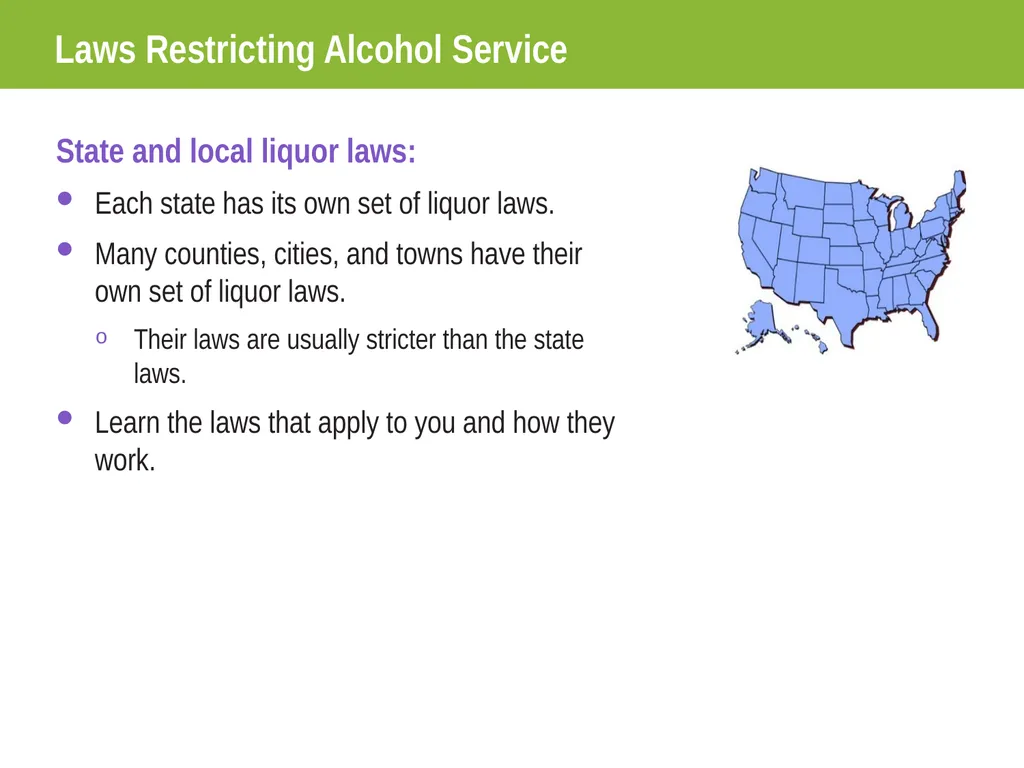
Laws Restricting Alcohol Service State and local liquor laws:
Each state has its own set of liquor laws.
Many counties, cities, and towns have their own set of liquor laws.
Their laws are usually stricter than the state laws.
Learn the laws that apply to you and how they work.<br>
Each state has its own set of liquor laws.
Many counties, cities, and towns have their own set of liquor laws.
Their laws are usually stricter than the state laws.
Learn the laws that apply to you and how they work.<br>
24
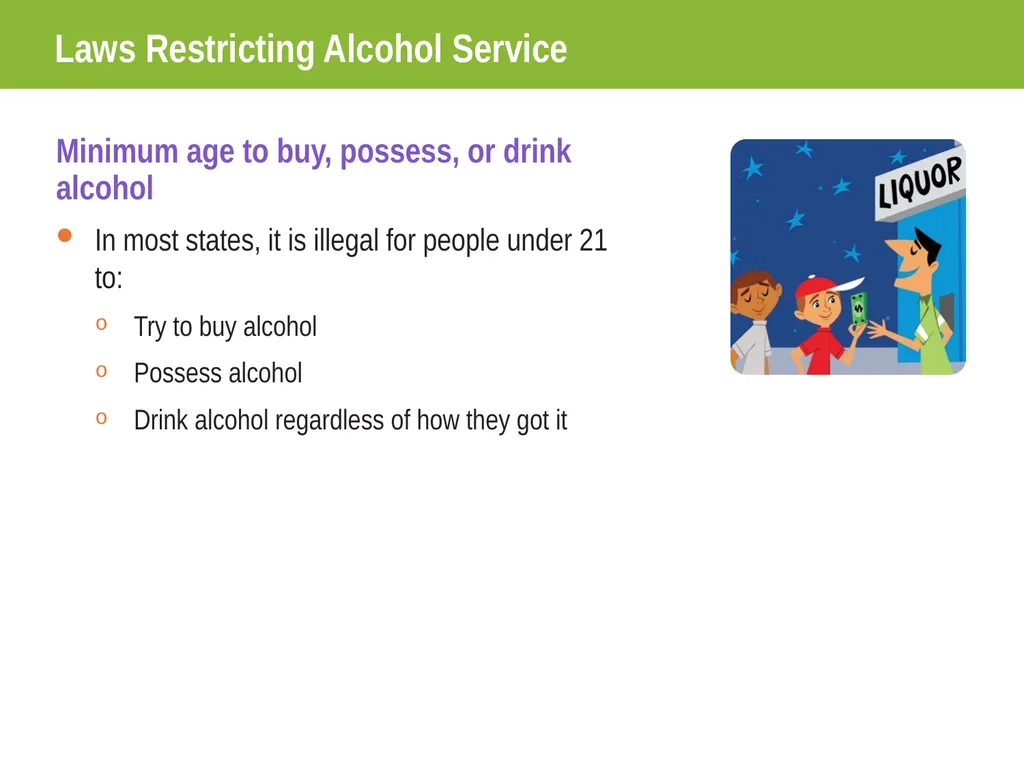
Laws Restricting Alcohol Service Minimum age to buy, possess, or drink alcohol
In most states, it is illegal for people under 21 to:
Try to buy alcohol
Possess alcohol
Drink alcohol regardless of how they got it<br>
In most states, it is illegal for people under 21 to:
Try to buy alcohol
Possess alcohol
Drink alcohol regardless of how they got it<br>
25
Minimum age for purchase of alcohol
Section 28-1-5
Notwithstanding the provisions of Section 26-1-1, it shall be unlawful for a person less than 21 years of age to purchase, consume, possess, or to transport any alcohol, liquor or malt or brewed beverages within the State of Alabama.
Whoever violates this section shall be fined not less than $25.00 nor more than $100.00, or imprisoned in the county jail for not more than 30 days or both; provided further, that juvenile offenders shall not be held in the county jail, but shall be held, either before or after sentencing, in a juvenile detention facility pursuant to the guidelines of the Department of Youth Services, which shall be separate and apart from adult offenders. Laws Restricting Alcohol Service: Alabama<br>
Section 28-1-5
Notwithstanding the provisions of Section 26-1-1, it shall be unlawful for a person less than 21 years of age to purchase, consume, possess, or to transport any alcohol, liquor or malt or brewed beverages within the State of Alabama.
Whoever violates this section shall be fined not less than $25.00 nor more than $100.00, or imprisoned in the county jail for not more than 30 days or both; provided further, that juvenile offenders shall not be held in the county jail, but shall be held, either before or after sentencing, in a juvenile detention facility pursuant to the guidelines of the Department of Youth Services, which shall be separate and apart from adult offenders. Laws Restricting Alcohol Service: Alabama<br>
26
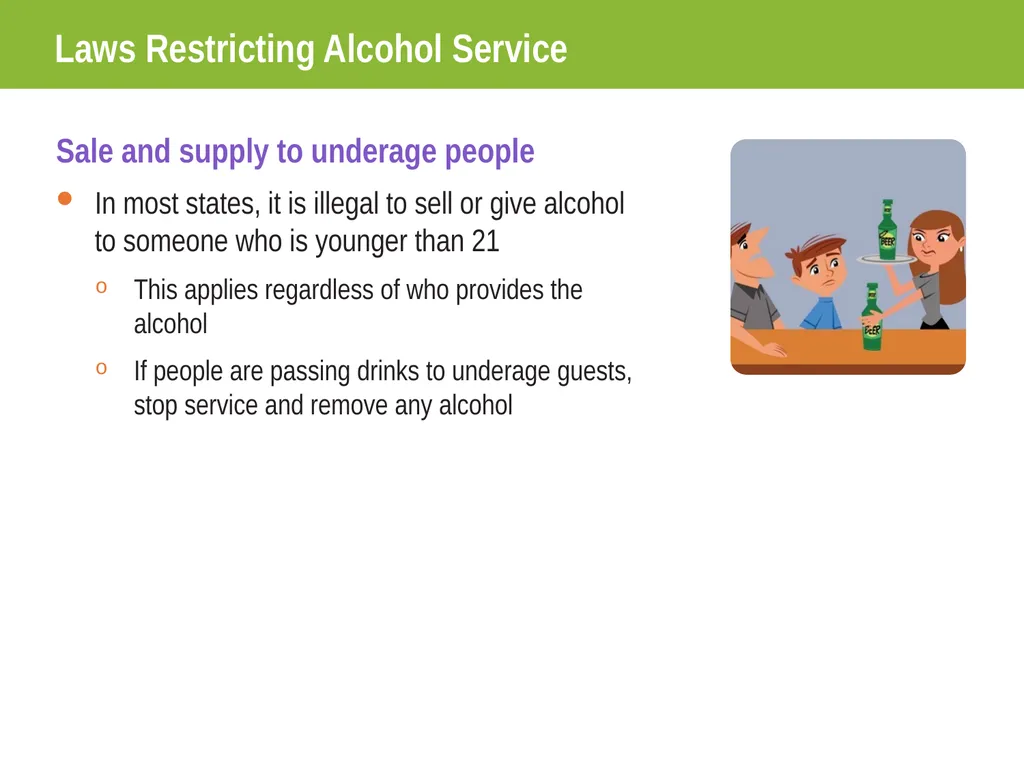
Laws Restricting Alcohol Service Sale and supply to underage people
In most states, it is illegal to sell or give alcohol to someone who is younger than 21
This applies regardless of who provides the alcohol
If people are passing drinks to underage guests, stop service and remove any alcohol<br>
In most states, it is illegal to sell or give alcohol to someone who is younger than 21
This applies regardless of who provides the alcohol
If people are passing drinks to underage guests, stop service and remove any alcohol<br>
27
Selling, delivering, or furnishing alcohol to minors Section 28-3A-25 (a)(3)
In Alabama it is illegal for any person, licensee, or the board either directly or by the servants, agents, or employees of the same, or for any servant, agent, or employee of the same, to sell, deliver, furnish, or give away alcoholic beverages to any person under the legal drinking age, as defined in Section 28-1-5, or to permit any person under the legal drinking age, as defined in Section 28-1-5, to drink, consume, or possess any alcoholic beverages on any licensee's premises. Laws Restricting Alcohol Service: Alabama<br>
In Alabama it is illegal for any person, licensee, or the board either directly or by the servants, agents, or employees of the same, or for any servant, agent, or employee of the same, to sell, deliver, furnish, or give away alcoholic beverages to any person under the legal drinking age, as defined in Section 28-1-5, or to permit any person under the legal drinking age, as defined in Section 28-1-5, to drink, consume, or possess any alcoholic beverages on any licensee's premises. Laws Restricting Alcohol Service: Alabama<br>
28
Selling, delivering, or furnishing alcohol to minors: Penalty cont. Section 28-3A-25 (b)(1)
(b)(1) Any violation of subdivision (3) section (a) shall be a misdemeanor punishable by a fine of not less than one hundred dollars ($100) nor more than one thousand dollars ($1,000), to which, at the discretion of the court or judge trying the case, may be added imprisonment in the county jail or at hard labor for the county for not more than six months for the first conviction; and, on the second conviction of a violation of the subdivisions, the offense shall, in addition to the aforementioned fine, be punishable by imprisonment or at hard labor for the county for not less than three months nor more than six months to be imposed by the court or judge trying the case; Laws Restricting Alcohol Service: Alabama<br>
(b)(1) Any violation of subdivision (3) section (a) shall be a misdemeanor punishable by a fine of not less than one hundred dollars ($100) nor more than one thousand dollars ($1,000), to which, at the discretion of the court or judge trying the case, may be added imprisonment in the county jail or at hard labor for the county for not more than six months for the first conviction; and, on the second conviction of a violation of the subdivisions, the offense shall, in addition to the aforementioned fine, be punishable by imprisonment or at hard labor for the county for not less than three months nor more than six months to be imposed by the court or judge trying the case; Laws Restricting Alcohol Service: Alabama<br>
29
Selling, delivering, or furnishing alcohol to minors: Penalty cont.
Section 28-3A-25 (b)(1)
and, on the third conviction and every subsequent conviction of a violation of the subdivisions, the offense shall, in addition to a fine within the limits above named, be punishable by imprisonment or at hard labor for the county for not less than six months nor more than 12 months.
Draft beer for off-premise consumption (Selling to a minor)
20-X-6-.18(4)(f)
(f) A filled or refilled container (of draft beer) shall not be sold or provided to any consumer who is under the age of 21. Laws Restricting Alcohol Service: Alabama<br>
Section 28-3A-25 (b)(1)
and, on the third conviction and every subsequent conviction of a violation of the subdivisions, the offense shall, in addition to a fine within the limits above named, be punishable by imprisonment or at hard labor for the county for not less than six months nor more than 12 months.
Draft beer for off-premise consumption (Selling to a minor)
20-X-6-.18(4)(f)
(f) A filled or refilled container (of draft beer) shall not be sold or provided to any consumer who is under the age of 21. Laws Restricting Alcohol Service: Alabama<br>
30
B. No A. Yes Can parents and guardians legally serve alcohol to their
underage children? What Do You Think? Why? It depends on where you are. C. It depends<br>
31
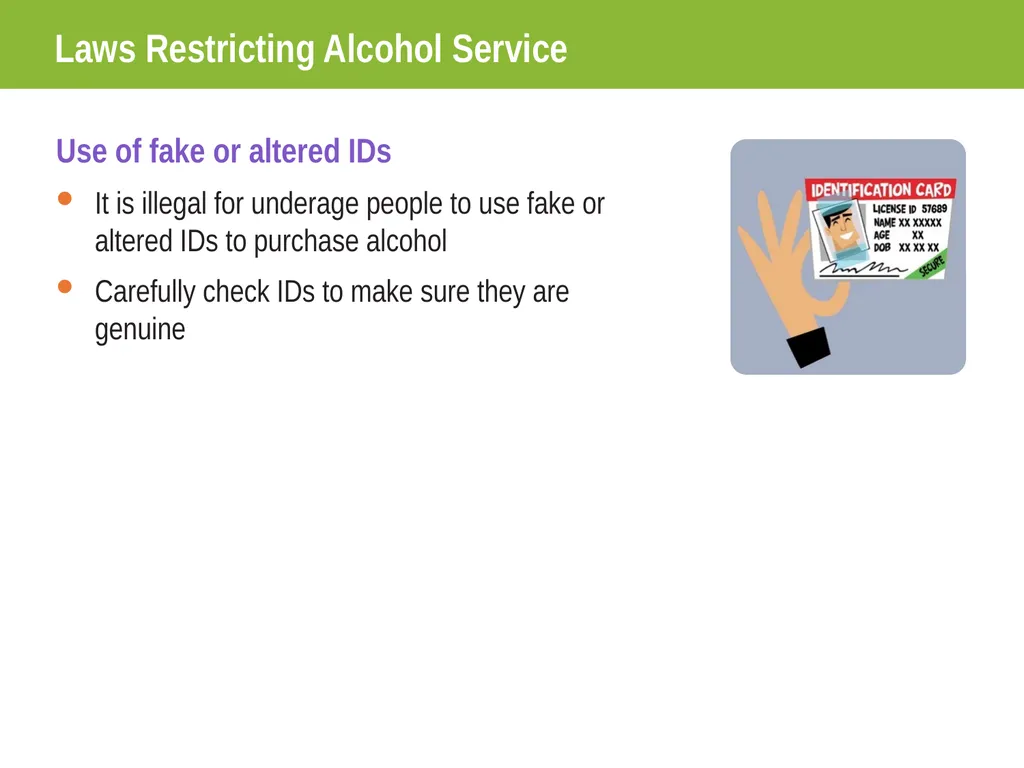
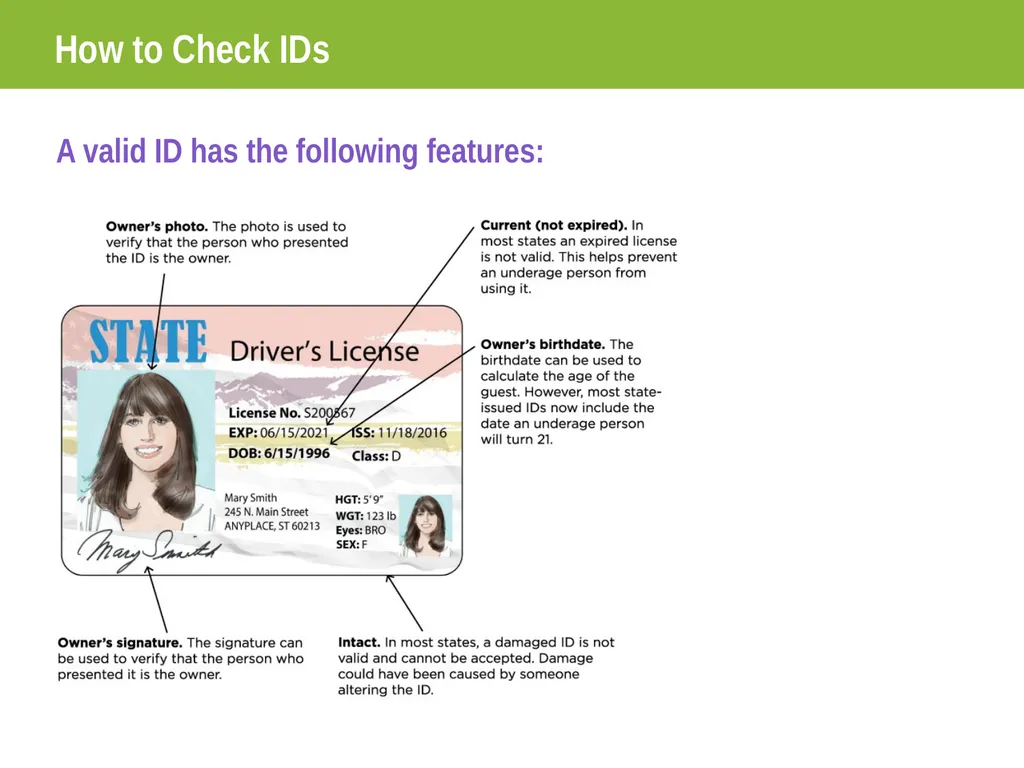
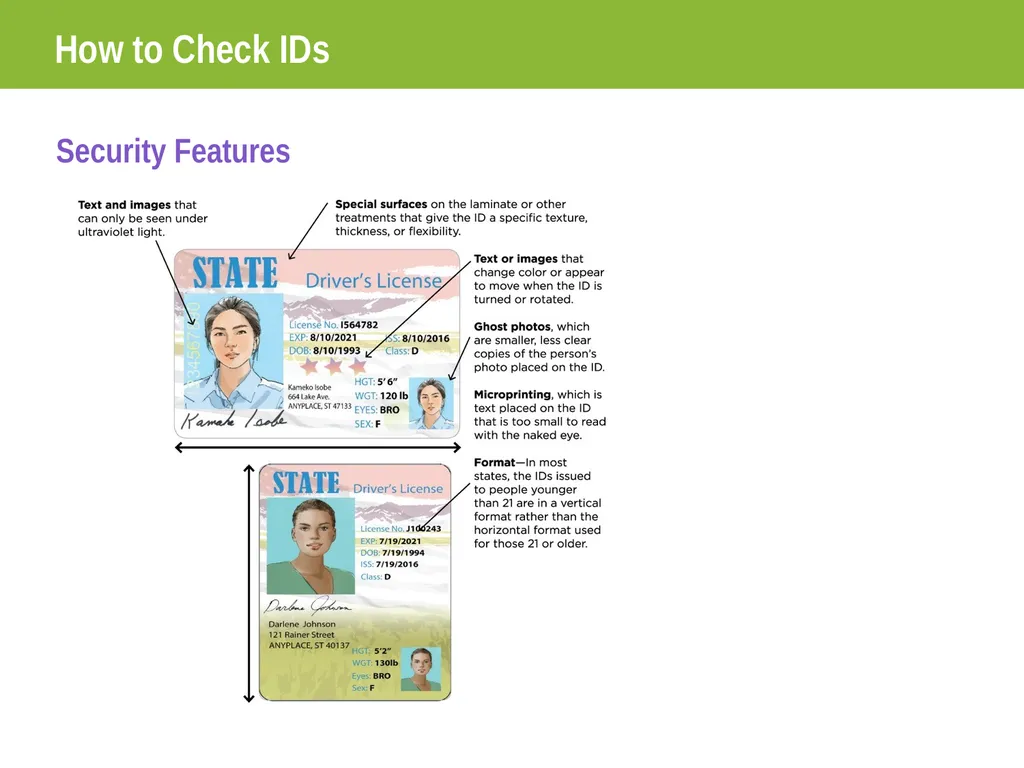
Laws Restricting Alcohol Service Use of fake or altered IDs
It is illegal for underage people to use fake or altered IDs to purchase alcohol
Carefully check IDs to make sure they are genuine<br>
It is illegal for underage people to use fake or altered IDs to purchase alcohol
Carefully check IDs to make sure they are genuine<br>
32
Minors use or attempt to use non-genuine driver license Section 28-3A-25 (a)(21)
In Alabama, it is illegal for a person under the age of 21 years to knowingly use or attempt to use a false, forged, deceptive, or otherwise non-genuine driver's license to obtain or attempt to obtain alcoholic beverages within this state.
Penalty
Section 28-3A-25 (b)(2)
(2) Any violation… shall be a misdemeanor punishable by a fine of not less than fifty dollars ($50) nor more than five hundred dollars ($500), to which, at the discretion of the court or judge trying the case, may be added imprisonment in the county jail or at hard labor for the county for not more than three months. Laws Restricting Alcohol Service: Alabama<br>
In Alabama, it is illegal for a person under the age of 21 years to knowingly use or attempt to use a false, forged, deceptive, or otherwise non-genuine driver's license to obtain or attempt to obtain alcoholic beverages within this state.
Penalty
Section 28-3A-25 (b)(2)
(2) Any violation… shall be a misdemeanor punishable by a fine of not less than fifty dollars ($50) nor more than five hundred dollars ($500), to which, at the discretion of the court or judge trying the case, may be added imprisonment in the county jail or at hard labor for the county for not more than three months. Laws Restricting Alcohol Service: Alabama<br>
33
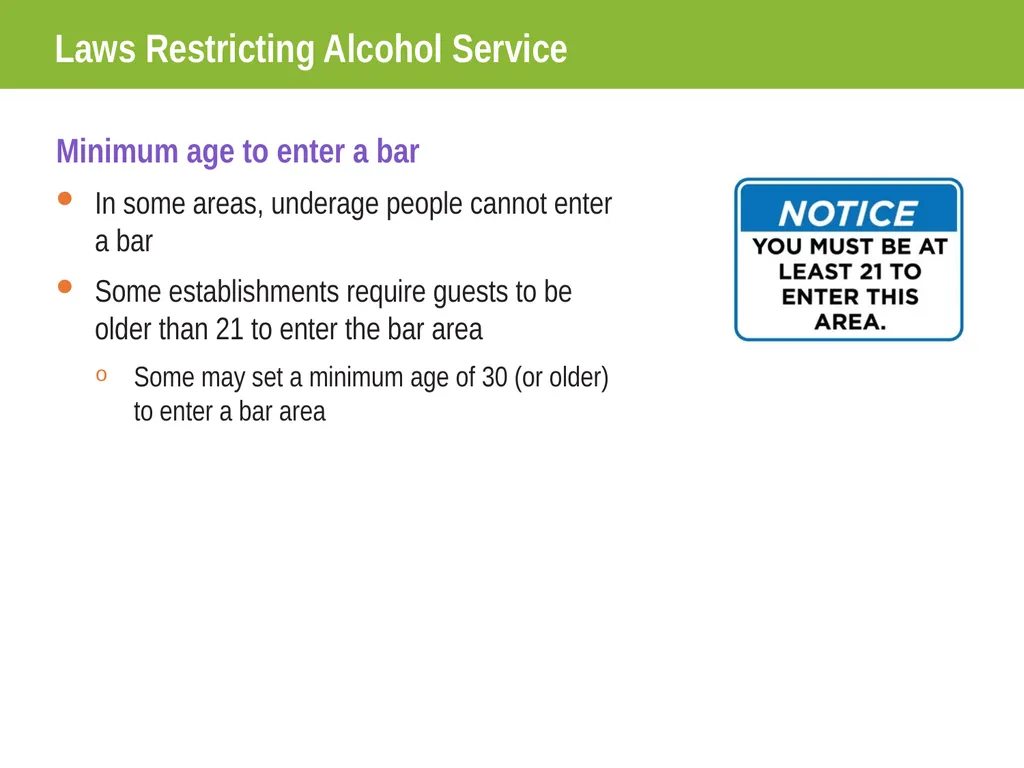
Laws Restricting Alcohol Service Minimum age to enter a bar
In some areas, underage people cannot enter a bar
Some establishments require guests to be older than 21 to enter the bar area
Some may set a minimum age of 30 (or older) to enter a bar area<br>
In some areas, underage people cannot enter a bar
Some establishments require guests to be older than 21 to enter the bar area
Some may set a minimum age of 30 (or older) to enter a bar area<br>
34
B. No A. Yes Can someone younger than 21 legally serve alcohol? What Do You Think? Why? It depends on where you are. In some states, the minimum age for servers or bartenders is 21. In many other states, servers can be younger than 21. C. It depends<br>
35
Employment of underage persons by board licensee
Section 28-1-5
Persons who are 19 years of age or older and working as a waiter, waitress, or server may serve alcoholic beverages during normal dining hours in a restaurant which holds an Alcoholic Beverage Control Board restaurant retail license.
An employer who employs a person between the ages of 19 and 21 to serve alcoholic beverages as provided in the preceding sentence shall be a licensee of the board who has been annually certified as a responsible vendor under the Alabama Responsible Vendor Act as provided in Chapter 10 (commencing with Section 28-10-1) of this title. Laws Restricting Alcohol Service: Alabama<br>
Section 28-1-5
Persons who are 19 years of age or older and working as a waiter, waitress, or server may serve alcoholic beverages during normal dining hours in a restaurant which holds an Alcoholic Beverage Control Board restaurant retail license.
An employer who employs a person between the ages of 19 and 21 to serve alcoholic beverages as provided in the preceding sentence shall be a licensee of the board who has been annually certified as a responsible vendor under the Alabama Responsible Vendor Act as provided in Chapter 10 (commencing with Section 28-10-1) of this title. Laws Restricting Alcohol Service: Alabama<br>
36
Filling and refilling (beer) requirements: Employment of minors:
Section 20-X-6-.18(3)(b)
(b) The container shall be filled or refilled only by the licensee or the licensee’s employees who are 21 years of age or older. Laws Restricting Alcohol Service: Alabama<br>
Section 20-X-6-.18(3)(b)
(b) The container shall be filled or refilled only by the licensee or the licensee’s employees who are 21 years of age or older. Laws Restricting Alcohol Service: Alabama<br>
37
Read the In The News story on page 1-7 in the ServSafe Alcohol Guide. Laws Restricting Alcohol Service<br>
38
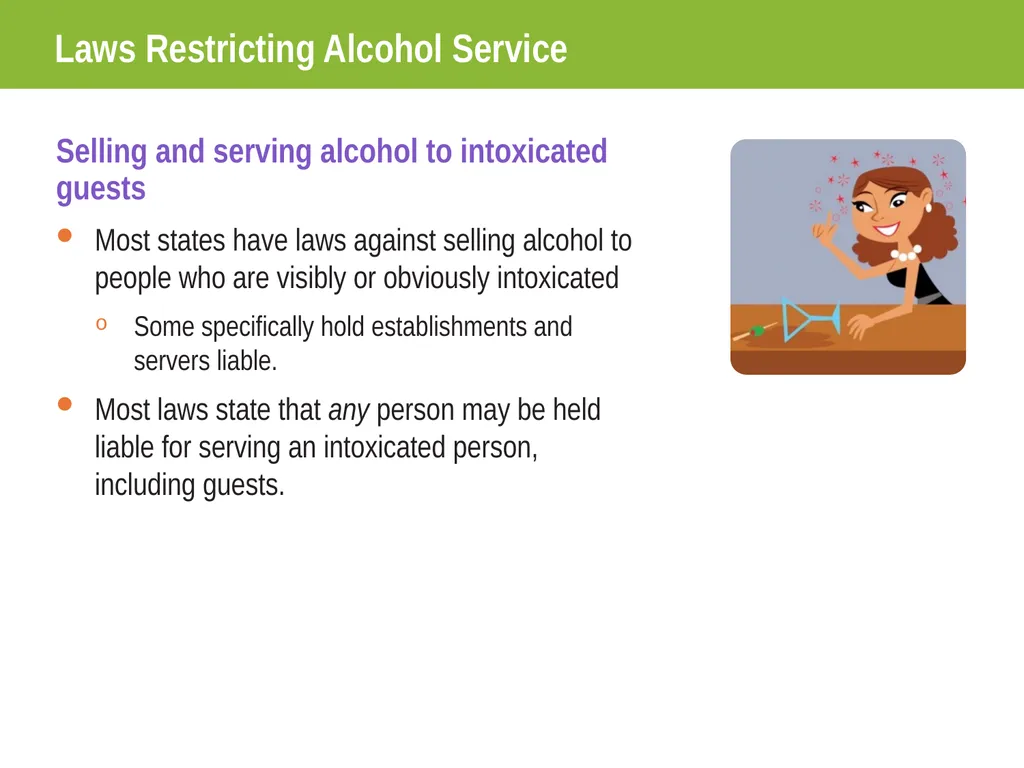
Laws Restricting Alcohol Service Selling and serving alcohol to intoxicated guests
Most states have laws against selling alcohol to people who are visibly or obviously intoxicated
Some specifically hold establishments and servers liable.
Most laws state that any person may be held liable for serving an intoxicated person, including guests.<br>
Most states have laws against selling alcohol to people who are visibly or obviously intoxicated
Some specifically hold establishments and servers liable.
Most laws state that any person may be held liable for serving an intoxicated person, including guests.<br>
39
Serve alcohol to a person appearing intoxicated
Section 20-X-6-.02(4)
No ABC Board on-premises licensee, employee or agent thereof shall serve any person alcoholic beverages if such person appears, considering the totality of the circumstances, to be intoxicated.
Draft beer for off-premise consumption
20-X-6-.18(4)(f)
(f) A filled or refilled container (of draft beer) shall not be sold or provided to any consumer who appears, considering the totality of the circumstances, to be intoxicated. Laws Restricting Alcohol Service: Alabama<br>
Section 20-X-6-.02(4)
No ABC Board on-premises licensee, employee or agent thereof shall serve any person alcoholic beverages if such person appears, considering the totality of the circumstances, to be intoxicated.
Draft beer for off-premise consumption
20-X-6-.18(4)(f)
(f) A filled or refilled container (of draft beer) shall not be sold or provided to any consumer who appears, considering the totality of the circumstances, to be intoxicated. Laws Restricting Alcohol Service: Alabama<br>
40
Serving known alcoholics
Some states hold the establishment and employees liable for serving a known alcoholic Laws Restricting Alcohol Service<br>
Some states hold the establishment and employees liable for serving a known alcoholic Laws Restricting Alcohol Service<br>
41
Public intoxication
13A-11-10(a)(b)
(a) A person commits the crime of public intoxication if he appears in a public place under the influence of alcohol, narcotics or other drug to the degree that he endangers himself or another person or property, or by boisterous and offensive conduct annoys another person in his vicinity.
(b) Public intoxication is a violation. Laws Restricting Alcohol Service: Alabama<br>
13A-11-10(a)(b)
(a) A person commits the crime of public intoxication if he appears in a public place under the influence of alcohol, narcotics or other drug to the degree that he endangers himself or another person or property, or by boisterous and offensive conduct annoys another person in his vicinity.
(b) Public intoxication is a violation. Laws Restricting Alcohol Service: Alabama<br>
42
B. No A. Yes Can you drink alcohol on the job? Why? It really depends on where you are. Drinking can impair judgment, making it harder to identify when guests have had enough. It can also result in bad decisions that will cost you and the establishment. C. It depends What Do You Think?<br>
43
Consuming during working hours
Section 20-X-6-.02(5)
(5) No ABC Board on-premises licensee, employee or agent thereof engaged in serving customers, may consume alcoholic beverages during working hours. Laws Restricting Alcohol Service: Alabama<br>
Section 20-X-6-.02(5)
(5) No ABC Board on-premises licensee, employee or agent thereof engaged in serving customers, may consume alcoholic beverages during working hours. Laws Restricting Alcohol Service: Alabama<br>
44
B. No A. Yes Can guests bring alcohol onto the premises? What Do You Think? Why? It’s illegal for guests to bring their own alcoholic beverages onto the premises unless it’s permitted by law and your company policy. C. It depends<br>
45
Allowing unauthorized alcohol (brown bagging)
Section 20-X-6-.01(12)
No ABC Board licensee shall allow on the licensed premises the consumption and/or possession of any type of alcoholic beverage which the licensee is not authorized to sell. Further, the practice of brown bagging or customers bringing on the licensed premises their own alcoholic beverages is prohibited on ABC Board licensed premises.
This brown bagging provision shall not apply to alcoholic beverages, for which the appropriate Alabama tax has been paid, which are brought on the premises of Class I Club (not operated for pecuniary gain) licensees. Laws Restricting Alcohol Service: Alabama<br>
Section 20-X-6-.01(12)
No ABC Board licensee shall allow on the licensed premises the consumption and/or possession of any type of alcoholic beverage which the licensee is not authorized to sell. Further, the practice of brown bagging or customers bringing on the licensed premises their own alcoholic beverages is prohibited on ABC Board licensed premises.
This brown bagging provision shall not apply to alcoholic beverages, for which the appropriate Alabama tax has been paid, which are brought on the premises of Class I Club (not operated for pecuniary gain) licensees. Laws Restricting Alcohol Service: Alabama<br>
46
Wine, Beer, and Spirits Laws Restricting Alcohol Service: Alabama<br>
47
Wine Laws Restricting Alcohol Service: Alabama<br>
48
Wine tasting
Section 20-X-7-.07
Table wine tastings may be permitted subject to the following terms and conditions:
(a) Table wine tastings are restricted to the following licensed premises:
1. On-premises table wine.
2. Off-premises table wine.
3. Lounge retail liquor, Class I and Class II.
4. Restaurant retail liquor.
5. Club liquor, Class I and II.
6. Wholesale table wine
7. Special events retail
8. Special retail Laws Restricting Alcohol Service: Alabama<br>
Section 20-X-7-.07
Table wine tastings may be permitted subject to the following terms and conditions:
(a) Table wine tastings are restricted to the following licensed premises:
1. On-premises table wine.
2. Off-premises table wine.
3. Lounge retail liquor, Class I and Class II.
4. Restaurant retail liquor.
5. Club liquor, Class I and II.
6. Wholesale table wine
7. Special events retail
8. Special retail Laws Restricting Alcohol Service: Alabama<br>
49
Wine tasting cont.
Section 20-X-7-.07
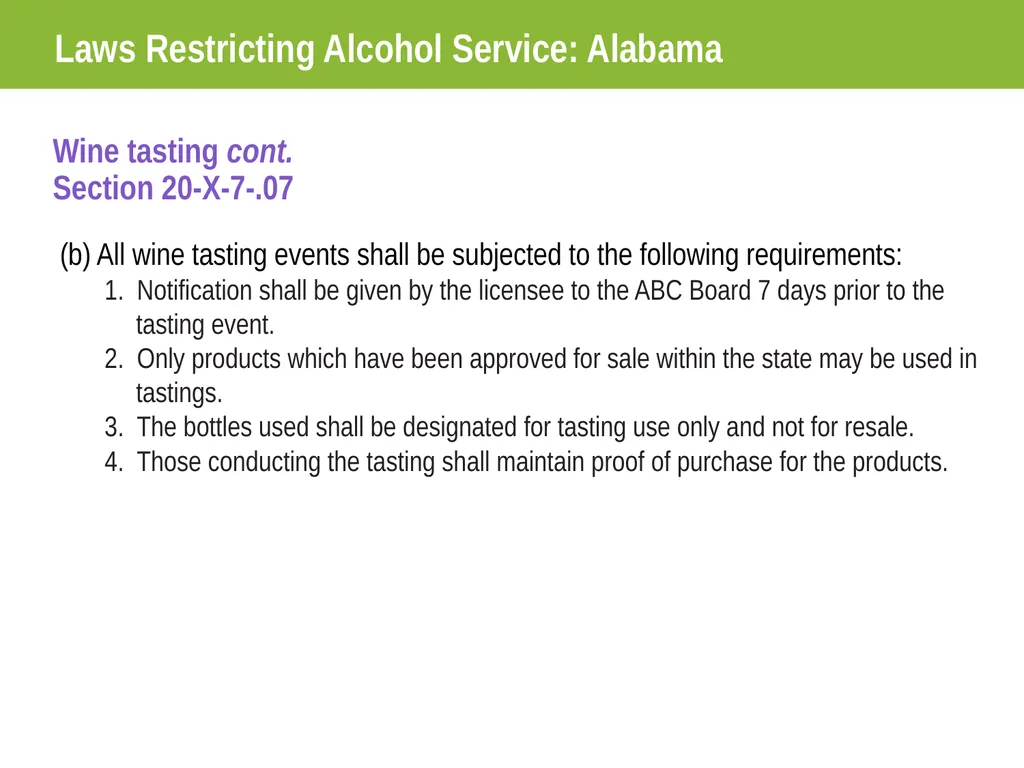
(b) All wine tasting events shall be subjected to the following requirements:
1. Notification shall be given by the licensee to the ABC Board 7 days prior to the tasting event.
2. Only products which have been approved for sale within the state may be used in tastings.
3. The bottles used shall be designated for tasting use only and not for resale.
4. Those conducting the tasting shall maintain proof of purchase for the products. Laws Restricting Alcohol Service: Alabama<br>
Section 20-X-7-.07
(b) All wine tasting events shall be subjected to the following requirements:
1. Notification shall be given by the licensee to the ABC Board 7 days prior to the tasting event.
2. Only products which have been approved for sale within the state may be used in tastings.
3. The bottles used shall be designated for tasting use only and not for resale.
4. Those conducting the tasting shall maintain proof of purchase for the products. Laws Restricting Alcohol Service: Alabama<br>
50
Wine tasting cont.
Section 20-X-7-.07
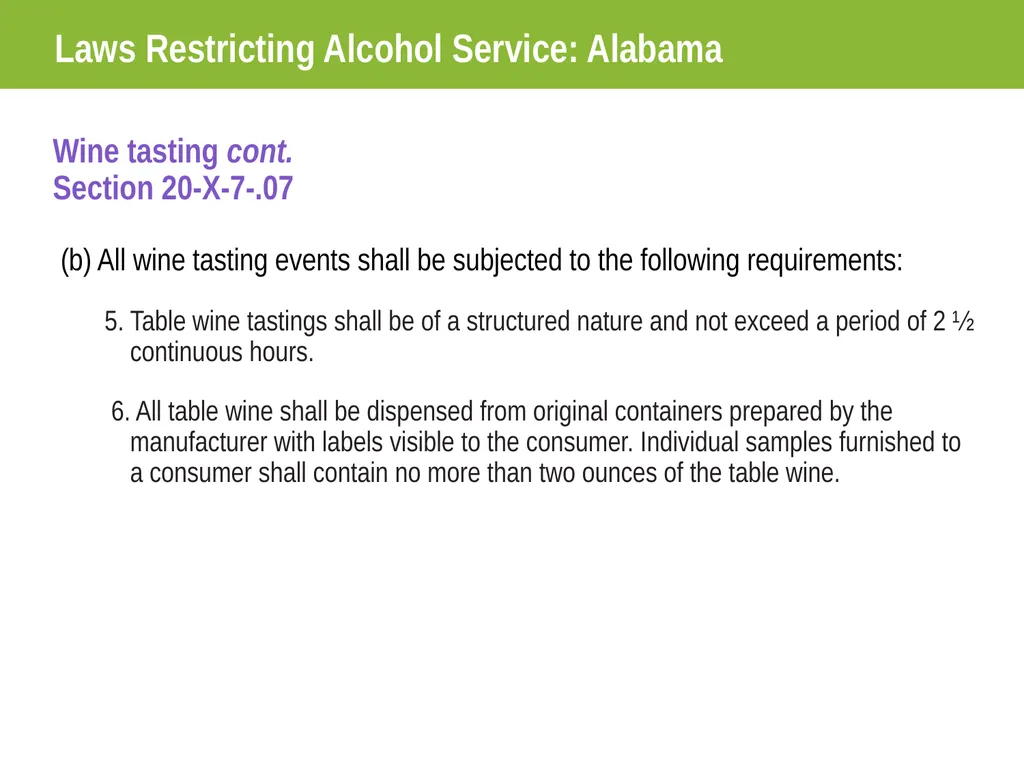
(b) All wine tasting events shall be subjected to the following requirements:
5. Table wine tastings shall be of a structured nature and not exceed a period of 2 ½ continuous hours.
6. All table wine shall be dispensed from original containers prepared by the manufacturer with labels visible to the consumer. Individual samples furnished to a consumer shall contain no more than two ounces of the table wine. Laws Restricting Alcohol Service: Alabama<br>
Section 20-X-7-.07
(b) All wine tasting events shall be subjected to the following requirements:
5. Table wine tastings shall be of a structured nature and not exceed a period of 2 ½ continuous hours.
6. All table wine shall be dispensed from original containers prepared by the manufacturer with labels visible to the consumer. Individual samples furnished to a consumer shall contain no more than two ounces of the table wine. Laws Restricting Alcohol Service: Alabama<br>
51
Wine tasting cont.
Section 20-X-7-.07
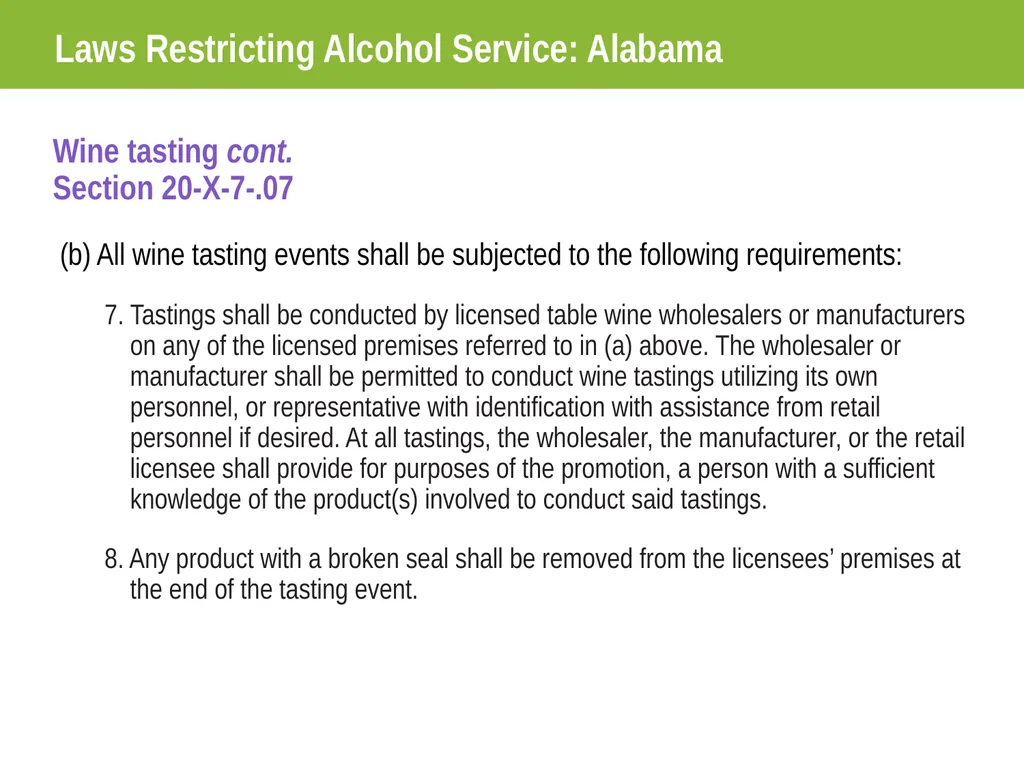
(b) All wine tasting events shall be subjected to the following requirements:
7. Tastings shall be conducted by licensed table wine wholesalers or manufacturers on any of the licensed premises referred to in (a) above. The wholesaler or manufacturer shall be permitted to conduct wine tastings utilizing its own personnel, or representative with identification with assistance from retail personnel if desired. At all tastings, the wholesaler, the manufacturer, or the retail licensee shall provide for purposes of the promotion, a person with a sufficient knowledge of the product(s) involved to conduct said tastings.
8. Any product with a broken seal shall be removed from the licensees’ premises at the end of the tasting event. Laws Restricting Alcohol Service: Alabama<br>
Section 20-X-7-.07
(b) All wine tasting events shall be subjected to the following requirements:
7. Tastings shall be conducted by licensed table wine wholesalers or manufacturers on any of the licensed premises referred to in (a) above. The wholesaler or manufacturer shall be permitted to conduct wine tastings utilizing its own personnel, or representative with identification with assistance from retail personnel if desired. At all tastings, the wholesaler, the manufacturer, or the retail licensee shall provide for purposes of the promotion, a person with a sufficient knowledge of the product(s) involved to conduct said tastings.
8. Any product with a broken seal shall be removed from the licensees’ premises at the end of the tasting event. Laws Restricting Alcohol Service: Alabama<br>
52
Wine tasting cont.
Section 20-X-7-.07
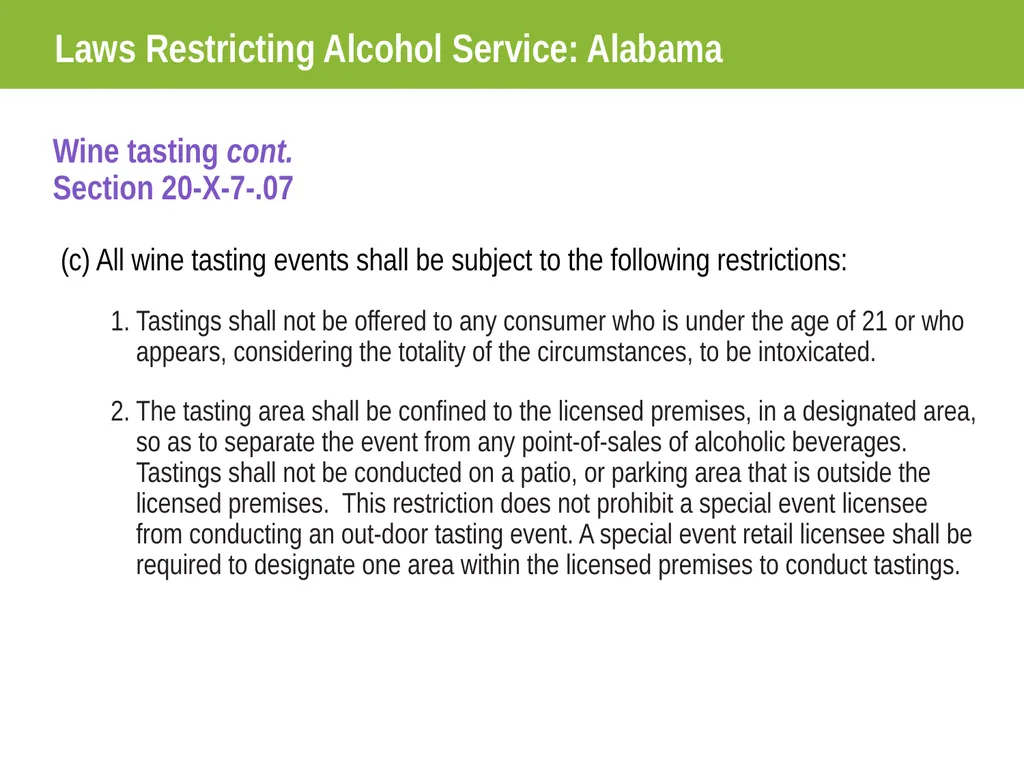
(c) All wine tasting events shall be subject to the following restrictions:
1. Tastings shall not be offered to any consumer who is under the age of 21 or who appears, considering the totality of the circumstances, to be intoxicated.
2. The tasting area shall be confined to the licensed premises, in a designated area, so as to separate the event from any point-of-sales of alcoholic beverages. Tastings shall not be conducted on a patio, or parking area that is outside the licensed premises. This restriction does not prohibit a special event licensee from conducting an out-door tasting event. A special event retail licensee shall be required to designate one area within the licensed premises to conduct tastings. Laws Restricting Alcohol Service: Alabama<br>
Section 20-X-7-.07
(c) All wine tasting events shall be subject to the following restrictions:
1. Tastings shall not be offered to any consumer who is under the age of 21 or who appears, considering the totality of the circumstances, to be intoxicated.
2. The tasting area shall be confined to the licensed premises, in a designated area, so as to separate the event from any point-of-sales of alcoholic beverages. Tastings shall not be conducted on a patio, or parking area that is outside the licensed premises. This restriction does not prohibit a special event licensee from conducting an out-door tasting event. A special event retail licensee shall be required to designate one area within the licensed premises to conduct tastings. Laws Restricting Alcohol Service: Alabama<br>
53
Wine tasting cont.
Section 20-X-7-.07
(c) All wine tasting events shall be subject to the following restrictions:
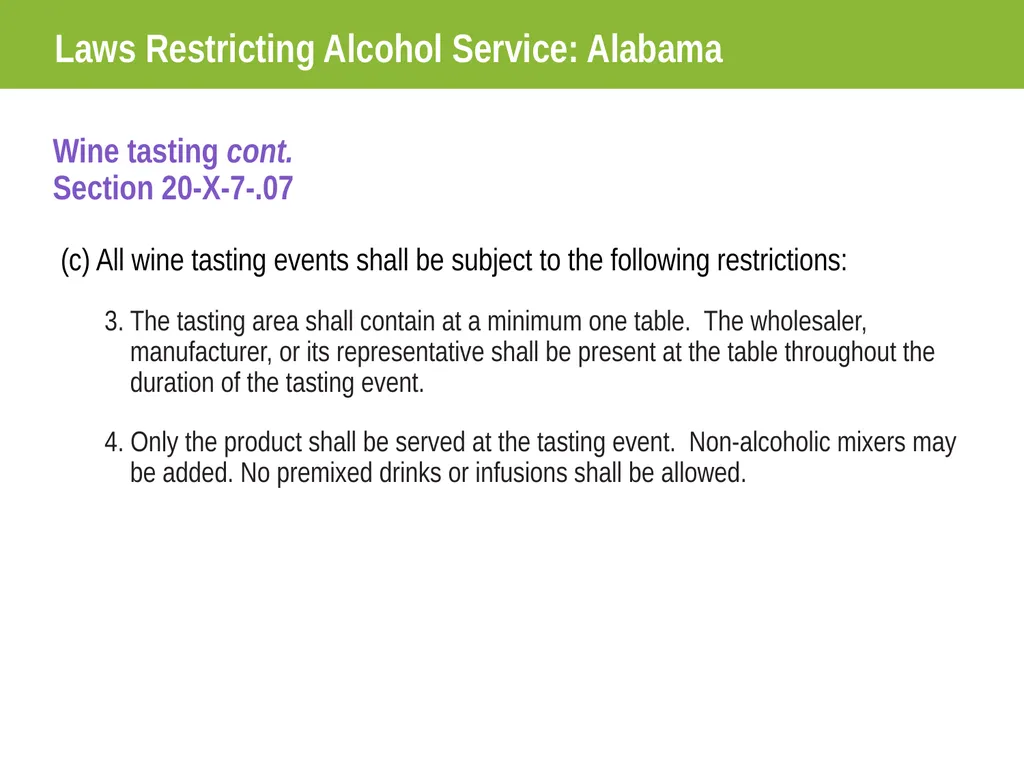
3. The tasting area shall contain at a minimum one table. The wholesaler, manufacturer, or its representative shall be present at the table throughout the duration of the tasting event.
4. Only the product shall be served at the tasting event. Non-alcoholic mixers may be added. No premixed drinks or infusions shall be allowed. Laws Restricting Alcohol Service: Alabama<br>
Section 20-X-7-.07
(c) All wine tasting events shall be subject to the following restrictions:
3. The tasting area shall contain at a minimum one table. The wholesaler, manufacturer, or its representative shall be present at the table throughout the duration of the tasting event.
4. Only the product shall be served at the tasting event. Non-alcoholic mixers may be added. No premixed drinks or infusions shall be allowed. Laws Restricting Alcohol Service: Alabama<br>
54
Wine tasting cont.
Section 20-X-7-.07
(c) All wine tasting events shall be subject to the following restrictions:
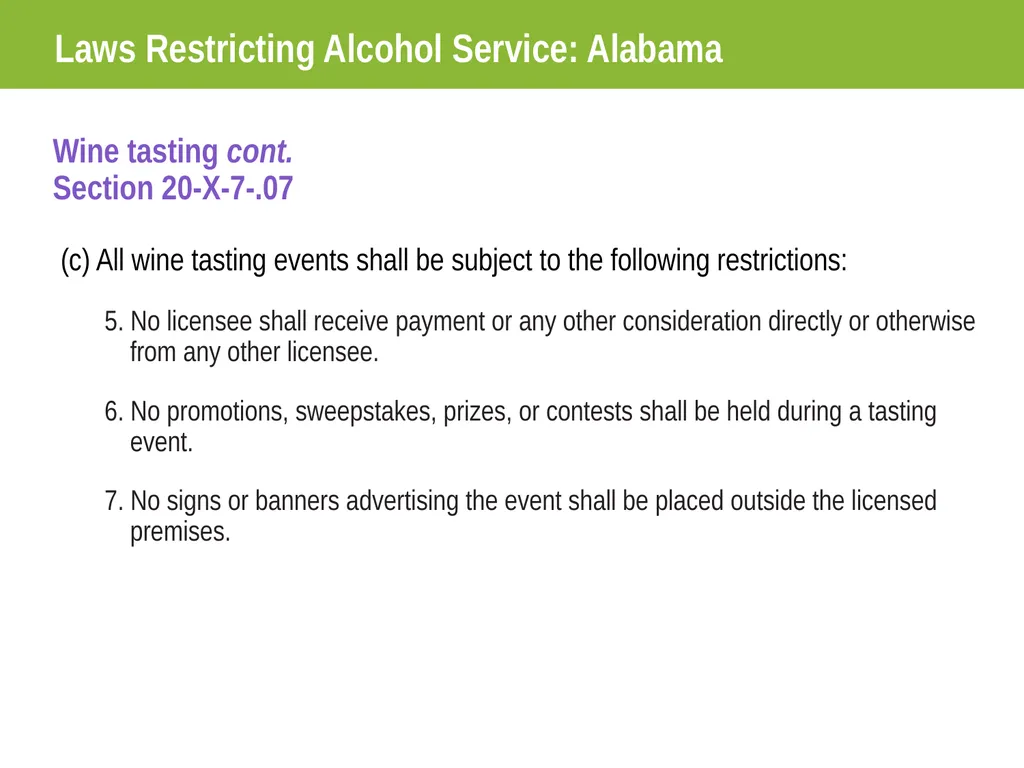
5. No licensee shall receive payment or any other consideration directly or otherwise from any other licensee.
6. No promotions, sweepstakes, prizes, or contests shall be held during a tasting event.
7. No signs or banners advertising the event shall be placed outside the licensed premises. Laws Restricting Alcohol Service: Alabama<br>
Section 20-X-7-.07
(c) All wine tasting events shall be subject to the following restrictions:
5. No licensee shall receive payment or any other consideration directly or otherwise from any other licensee.
6. No promotions, sweepstakes, prizes, or contests shall be held during a tasting event.
7. No signs or banners advertising the event shall be placed outside the licensed premises. Laws Restricting Alcohol Service: Alabama<br>
55
Wine tasting cont.
Section 20-X-7-.07
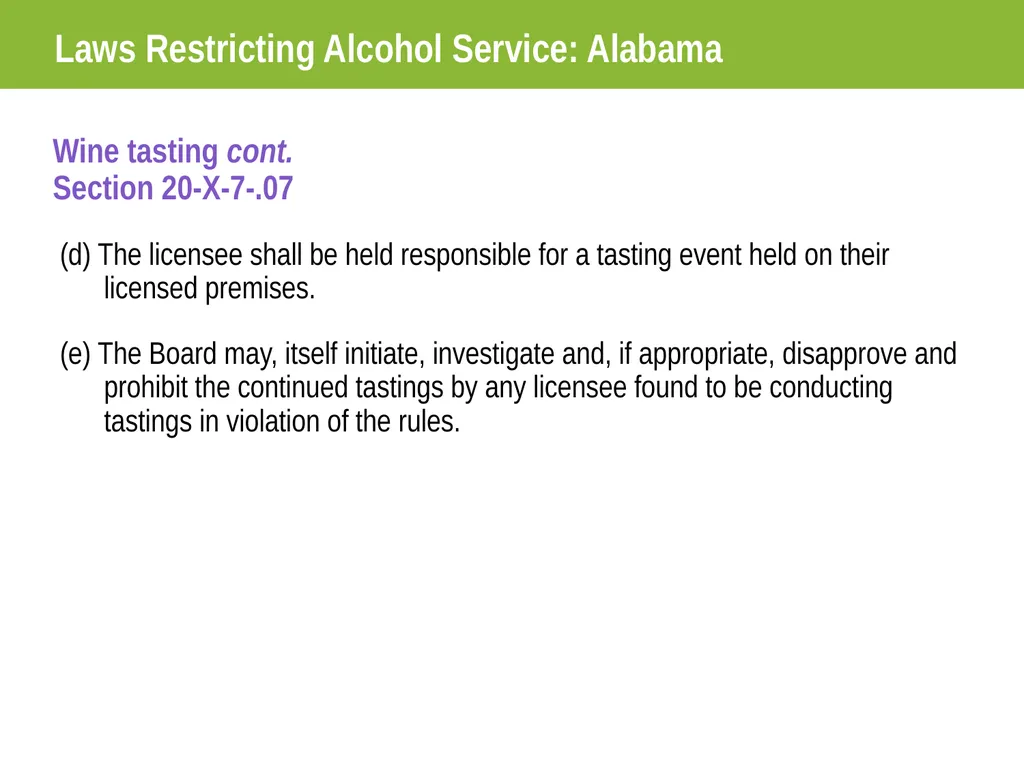
(d) The licensee shall be held responsible for a tasting event held on their licensed premises.
(e) The Board may, itself initiate, investigate and, if appropriate, disapprove and prohibit the continued tastings by any licensee found to be conducting tastings in violation of the rules. Laws Restricting Alcohol Service: Alabama<br>
Section 20-X-7-.07
(d) The licensee shall be held responsible for a tasting event held on their licensed premises.
(e) The Board may, itself initiate, investigate and, if appropriate, disapprove and prohibit the continued tastings by any licensee found to be conducting tastings in violation of the rules. Laws Restricting Alcohol Service: Alabama<br>
56
Wine tasting cont.
Section 20-X-7-.07
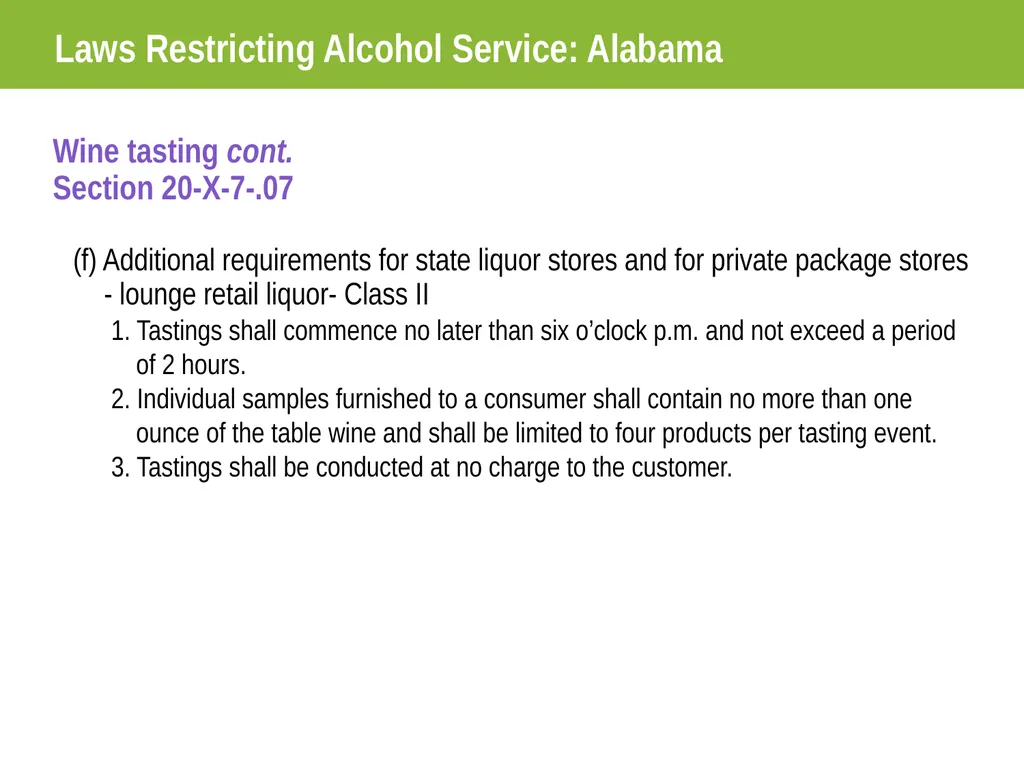
(f) Additional requirements for state liquor stores and for private package stores - lounge retail liquor- Class II
1. Tastings shall commence no later than six o’clock p.m. and not exceed a period of 2 hours.
2. Individual samples furnished to a consumer shall contain no more than one ounce of the table wine and shall be limited to four products per tasting event.
3. Tastings shall be conducted at no charge to the customer. Laws Restricting Alcohol Service: Alabama<br>
Section 20-X-7-.07
(f) Additional requirements for state liquor stores and for private package stores - lounge retail liquor- Class II
1. Tastings shall commence no later than six o’clock p.m. and not exceed a period of 2 hours.
2. Individual samples furnished to a consumer shall contain no more than one ounce of the table wine and shall be limited to four products per tasting event.
3. Tastings shall be conducted at no charge to the customer. Laws Restricting Alcohol Service: Alabama<br>
57
Resealing or recorking of wine
Section 28-3A-20.1
Notwithstanding any provision of this chapter to the contrary, a person holding a license to sell alcoholic beverages for consumption on the licensed premises may permit a customer to remove one unsealed bottle of wine for consumption off the premises if the customer has purchased and consumed a portion of the bottle of wine on the licensed premises.
The licensee or the licensee's agent shall either: (1) recork the bottle of wine with the original or similar type cork that is reinserted in the bottle and the cork can only be removed by a corkscrew or similar device; or (2) securely reseal the bottle in a bag designed so that it is visibly apparent that the resealed bottle of wine has not been tampered with and shall provide a dated receipt for the resealed bottle of wine to the customer. Laws Restricting Alcohol Service: Alabama<br>
Section 28-3A-20.1
Notwithstanding any provision of this chapter to the contrary, a person holding a license to sell alcoholic beverages for consumption on the licensed premises may permit a customer to remove one unsealed bottle of wine for consumption off the premises if the customer has purchased and consumed a portion of the bottle of wine on the licensed premises.
The licensee or the licensee's agent shall either: (1) recork the bottle of wine with the original or similar type cork that is reinserted in the bottle and the cork can only be removed by a corkscrew or similar device; or (2) securely reseal the bottle in a bag designed so that it is visibly apparent that the resealed bottle of wine has not been tampered with and shall provide a dated receipt for the resealed bottle of wine to the customer. Laws Restricting Alcohol Service: Alabama<br>
58
Resealing or recorking of wine cont.
Section 28-3A-20.1
A wine bottle recorked or resealed pursuant to the requirements of this section is otherwise subject to the requirements of Section 32-5A-330 as further provided herein. The recorked or resealed bottle of wine, if transported in a motor vehicle, shall be placed in a locked trunk; in a storage or luggage compartment; in a locked glove compartment; in a storage or cargo compartment in the bed of a pickup truck or in a locked case placed in an area not readily accessible behind the front seat of a pickup truck if the truck has no trunk or separate enclosed area other than the truck cab; or in the area behind the last upright seat of a motor vehicle which is not equipped with a trunk. Laws Restricting Alcohol Service: Alabama<br>
Section 28-3A-20.1
A wine bottle recorked or resealed pursuant to the requirements of this section is otherwise subject to the requirements of Section 32-5A-330 as further provided herein. The recorked or resealed bottle of wine, if transported in a motor vehicle, shall be placed in a locked trunk; in a storage or luggage compartment; in a locked glove compartment; in a storage or cargo compartment in the bed of a pickup truck or in a locked case placed in an area not readily accessible behind the front seat of a pickup truck if the truck has no trunk or separate enclosed area other than the truck cab; or in the area behind the last upright seat of a motor vehicle which is not equipped with a trunk. Laws Restricting Alcohol Service: Alabama<br>
59
Beer Laws Restricting Alcohol Service: Alabama<br>
60
Beer Tastings
Section 20-X-7-.10
(a) Beer tastings are restricted to the following licensed premises:
1. On-premises beer.
2. Off-premises beer.
3. Lounge retail liquor, Class I.
4. Restaurant retail liquor.
5. Club liquor, Class I and II.
6. Wholesale beer.
7. Special events retail.
8. Special retail. Laws Restricting Alcohol Service: Alabama<br>
Section 20-X-7-.10
(a) Beer tastings are restricted to the following licensed premises:
1. On-premises beer.
2. Off-premises beer.
3. Lounge retail liquor, Class I.
4. Restaurant retail liquor.
5. Club liquor, Class I and II.
6. Wholesale beer.
7. Special events retail.
8. Special retail. Laws Restricting Alcohol Service: Alabama<br>
61
Beer Tastings cont.
Section 20-X-7-.10
(b) All participants in any tastings shall be of legal drinking age.
(c) Beer tastings shall be of a structured nature and not exceed a period of 2 1/2 continuous hours.
(d) All beer shall be dispensed from original containers prepared by the manufacturer with labels visible to the consumer. Individual samples furnished to a consumer shall contain no more than two ounces of the beer. Laws Restricting Alcohol Service: Alabama<br>
Section 20-X-7-.10
(b) All participants in any tastings shall be of legal drinking age.
(c) Beer tastings shall be of a structured nature and not exceed a period of 2 1/2 continuous hours.
(d) All beer shall be dispensed from original containers prepared by the manufacturer with labels visible to the consumer. Individual samples furnished to a consumer shall contain no more than two ounces of the beer. Laws Restricting Alcohol Service: Alabama<br>
62
Beer Tastings cont.
Section 20-X-7-.10
(e) Beer tastings may be conducted by beer manufacturers or wholesalers on any of the licensed premises referred to in (1)(a) above. The manufacturer or wholesaler shall be permitted to conduct beer tastings utilizing its own personnel, with the assistance from retail personnel if desired. At all tastings, the manufacturer, wholesale or retail licensee shall provide for purposes of the promotion, a person with a sufficient knowledge of the product(s) involved to conduct said tastings. Laws Restricting Alcohol Service: Alabama<br>
Section 20-X-7-.10
(e) Beer tastings may be conducted by beer manufacturers or wholesalers on any of the licensed premises referred to in (1)(a) above. The manufacturer or wholesaler shall be permitted to conduct beer tastings utilizing its own personnel, with the assistance from retail personnel if desired. At all tastings, the manufacturer, wholesale or retail licensee shall provide for purposes of the promotion, a person with a sufficient knowledge of the product(s) involved to conduct said tastings. Laws Restricting Alcohol Service: Alabama<br>
63
Beer Tastings cont.
Section 20-X-7-.10
(f) Beer tastings shall be limited to products which have not been available, or have not been widely distributed, within the State of Alabama for a period of more than one (1) year immediately preceding the date of the beer tasting.
(g) All cost of a beer tasting, including the cost of the beer, shall be borne by the licensee on whose premises the beer tasting is held. Laws Restricting Alcohol Service: Alabama<br>
Section 20-X-7-.10
(f) Beer tastings shall be limited to products which have not been available, or have not been widely distributed, within the State of Alabama for a period of more than one (1) year immediately preceding the date of the beer tasting.
(g) All cost of a beer tasting, including the cost of the beer, shall be borne by the licensee on whose premises the beer tasting is held. Laws Restricting Alcohol Service: Alabama<br>
64
Beer container size
Section 28-3A-23(g)
(g) All beer, except draft or keg beer, sold by retailers must be sold or dispensed in bottles, cans, or other containers not to exceed 25.4 ounces. All wine sold by retailers for off-premise consumption must be sold or dispensed in bottles or other containers in accordance with the standards of fill specified in the then effective standards of fill for wine prescribed by the U.S. Treasury Department. Laws Restricting Alcohol Service: Alabama<br>
Section 28-3A-23(g)
(g) All beer, except draft or keg beer, sold by retailers must be sold or dispensed in bottles, cans, or other containers not to exceed 25.4 ounces. All wine sold by retailers for off-premise consumption must be sold or dispensed in bottles or other containers in accordance with the standards of fill specified in the then effective standards of fill for wine prescribed by the U.S. Treasury Department. Laws Restricting Alcohol Service: Alabama<br>
65
Draft beer for off-premises consumption: Filling/refilling requirements
Section 20-X-6-.18(3)(c)
(c) The container shall be filled or refilled only at the time the in-person sale is made and only with beer from the original container. Laws Restricting Alcohol Service: Alabama<br>
Section 20-X-6-.18(3)(c)
(c) The container shall be filled or refilled only at the time the in-person sale is made and only with beer from the original container. Laws Restricting Alcohol Service: Alabama<br>
66
Spirits Laws Restricting Alcohol Service: Alabama<br>
67
Spirit tastings
Section 20-X-7-11
(1) Spirits tastings may be permitted subject to the following terms and conditions:
(a) For the purpose of this regulations, the term “spirits” applies to the same alcoholic beverages as those defined under the term “liquor” in the Glossary of Terms, Regulation 20-X-2-.01, for this publication. Laws Restricting Alcohol Service: Alabama<br>
Section 20-X-7-11
(1) Spirits tastings may be permitted subject to the following terms and conditions:
(a) For the purpose of this regulations, the term “spirits” applies to the same alcoholic beverages as those defined under the term “liquor” in the Glossary of Terms, Regulation 20-X-2-.01, for this publication. Laws Restricting Alcohol Service: Alabama<br>
68
Spirit tastings cont.
Section 20-X-7-11
(b) Spirits tastings are restricted to the following licensed premises:
1. Lounge retail liquor, Class I and Class II.
2. Restaurant retailer liquor.
3. Club liquor, Class I and II.
4. Special events retail.
5. Special retails. Laws Restricting Alcohol Service: Alabama<br>
Section 20-X-7-11
(b) Spirits tastings are restricted to the following licensed premises:
1. Lounge retail liquor, Class I and Class II.
2. Restaurant retailer liquor.
3. Club liquor, Class I and II.
4. Special events retail.
5. Special retails. Laws Restricting Alcohol Service: Alabama<br>
69
Spirit tastings cont.
Section 20-X-7-11
(c) All spirit tasting events shall be subjected to the following requirements:
1. Notification shall be given by the licensee to the Board 7 days prior to the tasting event.
2. Only products which have been approved for sale within the state may be used in tastings.
3. The bottles used shall be designated for tasting use only and not for resale.
4. Those conducting the tasting shall maintain proof of purchase for the products. Laws Restricting Alcohol Service: Alabama<br>
Section 20-X-7-11
(c) All spirit tasting events shall be subjected to the following requirements:
1. Notification shall be given by the licensee to the Board 7 days prior to the tasting event.
2. Only products which have been approved for sale within the state may be used in tastings.
3. The bottles used shall be designated for tasting use only and not for resale.
4. Those conducting the tasting shall maintain proof of purchase for the products. Laws Restricting Alcohol Service: Alabama<br>
70
Spirit tastings cont.
Section 20-X-7-11
(c) All spirit tasting events shall be subjected to the following requirements:
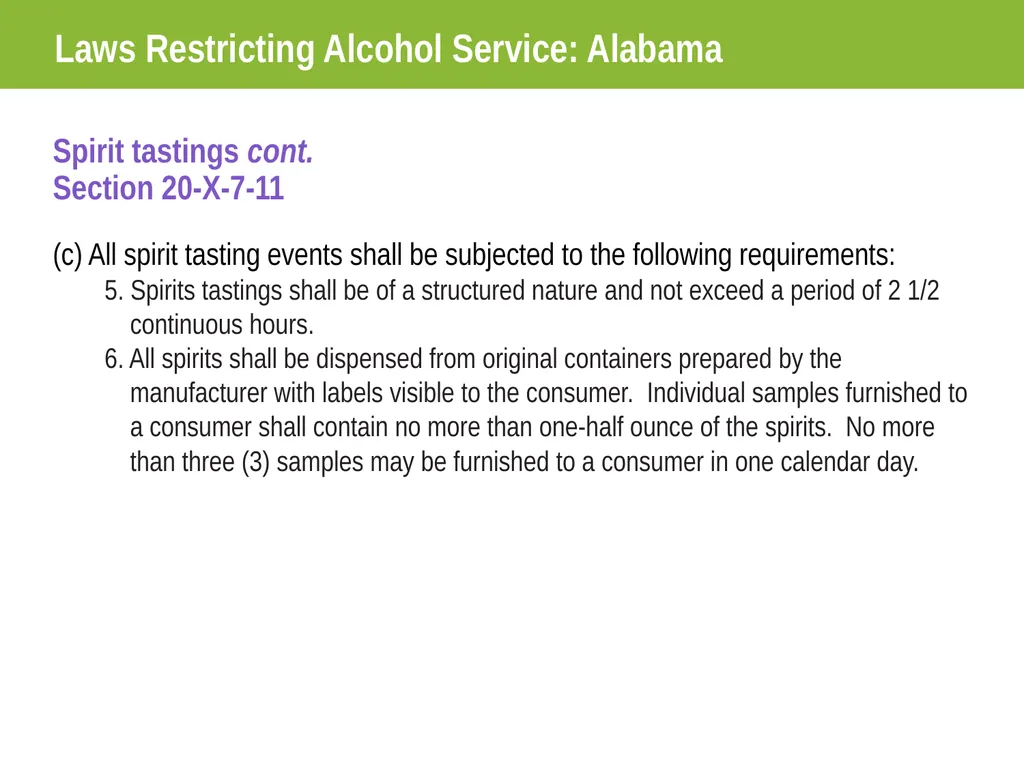
5. Spirits tastings shall be of a structured nature and not exceed a period of 2 1/2 continuous hours.
6. All spirits shall be dispensed from original containers prepared by the manufacturer with labels visible to the consumer. Individual samples furnished to a consumer shall contain no more than one-half ounce of the spirits. No more than three (3) samples may be furnished to a consumer in one calendar day. Laws Restricting Alcohol Service: Alabama<br>
Section 20-X-7-11
(c) All spirit tasting events shall be subjected to the following requirements:
5. Spirits tastings shall be of a structured nature and not exceed a period of 2 1/2 continuous hours.
6. All spirits shall be dispensed from original containers prepared by the manufacturer with labels visible to the consumer. Individual samples furnished to a consumer shall contain no more than one-half ounce of the spirits. No more than three (3) samples may be furnished to a consumer in one calendar day. Laws Restricting Alcohol Service: Alabama<br>
71
Spirit tastings cont.
Section 20-X-7-11
(c) All spirit tasting events shall be subjected to the following requirements:
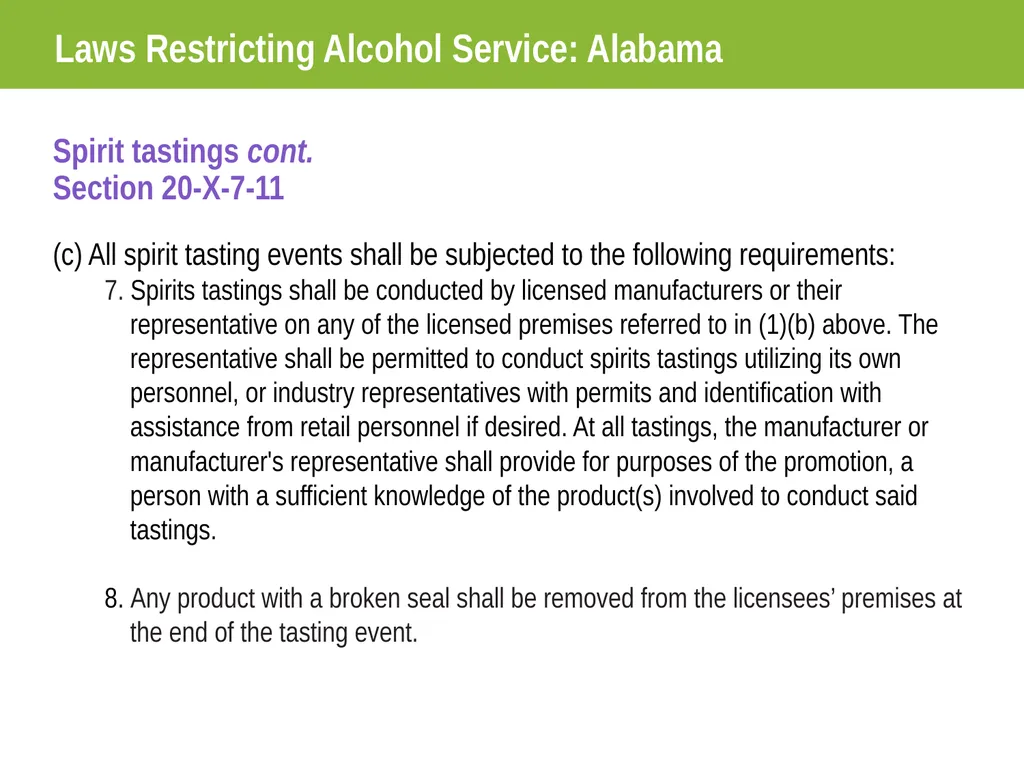
7. Spirits tastings shall be conducted by licensed manufacturers or their representative on any of the licensed premises referred to in (1)(b) above. The representative shall be permitted to conduct spirits tastings utilizing its own personnel, or industry representatives with permits and identification with assistance from retail personnel if desired. At all tastings, the manufacturer or manufacturer's representative shall provide for purposes of the promotion, a person with a sufficient knowledge of the product(s) involved to conduct said tastings.
8. Any product with a broken seal shall be removed from the licensees’ premises at the end of the tasting event. Laws Restricting Alcohol Service: Alabama<br>
Section 20-X-7-11
(c) All spirit tasting events shall be subjected to the following requirements:
7. Spirits tastings shall be conducted by licensed manufacturers or their representative on any of the licensed premises referred to in (1)(b) above. The representative shall be permitted to conduct spirits tastings utilizing its own personnel, or industry representatives with permits and identification with assistance from retail personnel if desired. At all tastings, the manufacturer or manufacturer's representative shall provide for purposes of the promotion, a person with a sufficient knowledge of the product(s) involved to conduct said tastings.
8. Any product with a broken seal shall be removed from the licensees’ premises at the end of the tasting event. Laws Restricting Alcohol Service: Alabama<br>
72
Spirit tastings cont.
Section 20-X-7-11
(d) All spirit tasting events shall be subject to the following restrictions:
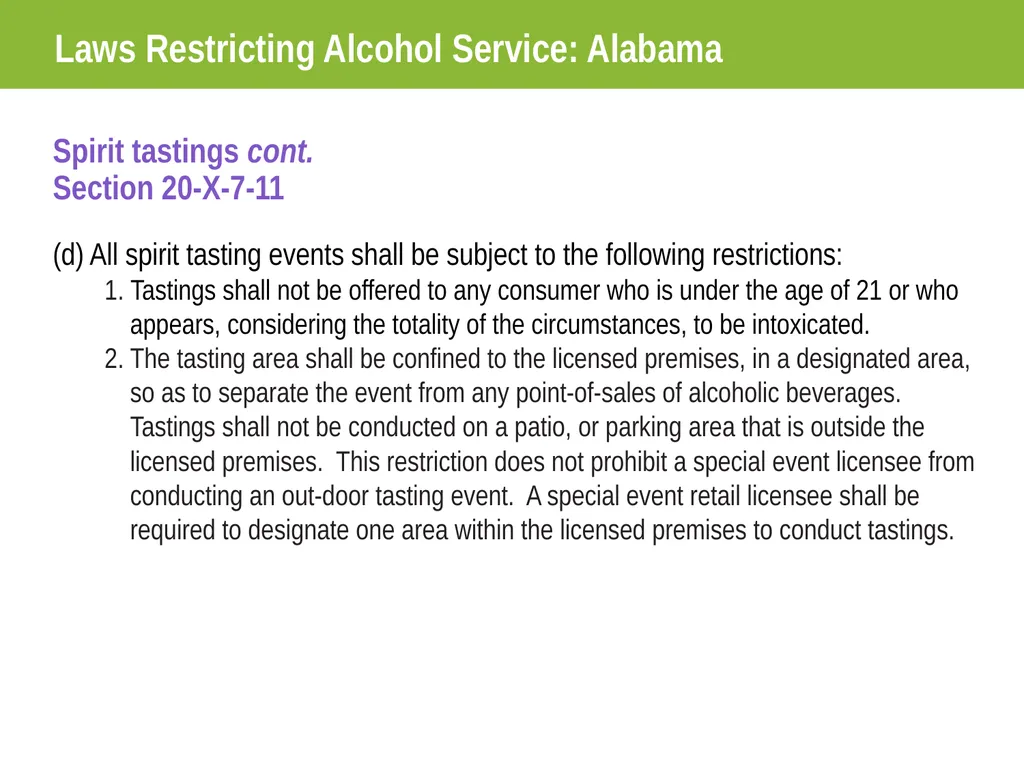
1. Tastings shall not be offered to any consumer who is under the age of 21 or who appears, considering the totality of the circumstances, to be intoxicated.
2. The tasting area shall be confined to the licensed premises, in a designated area, so as to separate the event from any point-of-sales of alcoholic beverages. Tastings shall not be conducted on a patio, or parking area that is outside the licensed premises. This restriction does not prohibit a special event licensee from conducting an out-door tasting event. A special event retail licensee shall be required to designate one area within the licensed premises to conduct tastings. Laws Restricting Alcohol Service: Alabama<br>
Section 20-X-7-11
(d) All spirit tasting events shall be subject to the following restrictions:
1. Tastings shall not be offered to any consumer who is under the age of 21 or who appears, considering the totality of the circumstances, to be intoxicated.
2. The tasting area shall be confined to the licensed premises, in a designated area, so as to separate the event from any point-of-sales of alcoholic beverages. Tastings shall not be conducted on a patio, or parking area that is outside the licensed premises. This restriction does not prohibit a special event licensee from conducting an out-door tasting event. A special event retail licensee shall be required to designate one area within the licensed premises to conduct tastings. Laws Restricting Alcohol Service: Alabama<br>
73
Spirit tastings cont.
Section 20-X-7-11
(d) All spirit tasting events shall be subject to the following restrictions:
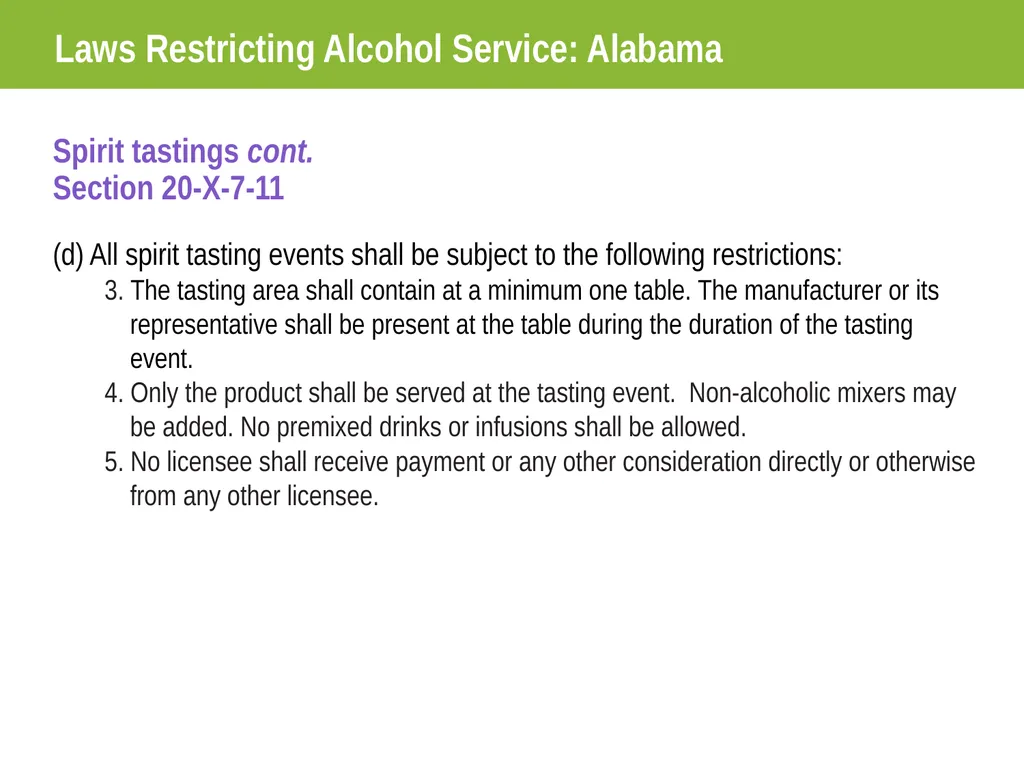
3. The tasting area shall contain at a minimum one table. The manufacturer or its representative shall be present at the table during the duration of the tasting event.
4. Only the product shall be served at the tasting event. Non-alcoholic mixers may be added. No premixed drinks or infusions shall be allowed.
5. No licensee shall receive payment or any other consideration directly or otherwise from any other licensee. Laws Restricting Alcohol Service: Alabama<br>
Section 20-X-7-11
(d) All spirit tasting events shall be subject to the following restrictions:
3. The tasting area shall contain at a minimum one table. The manufacturer or its representative shall be present at the table during the duration of the tasting event.
4. Only the product shall be served at the tasting event. Non-alcoholic mixers may be added. No premixed drinks or infusions shall be allowed.
5. No licensee shall receive payment or any other consideration directly or otherwise from any other licensee. Laws Restricting Alcohol Service: Alabama<br>
74
Spirit tastings cont.
Section 20-X-7-11
(d) All spirit tasting events shall be subject to the following restrictions:
6. No promotions, sweepstakes, prizes, or contests shall be held during a tasting event.
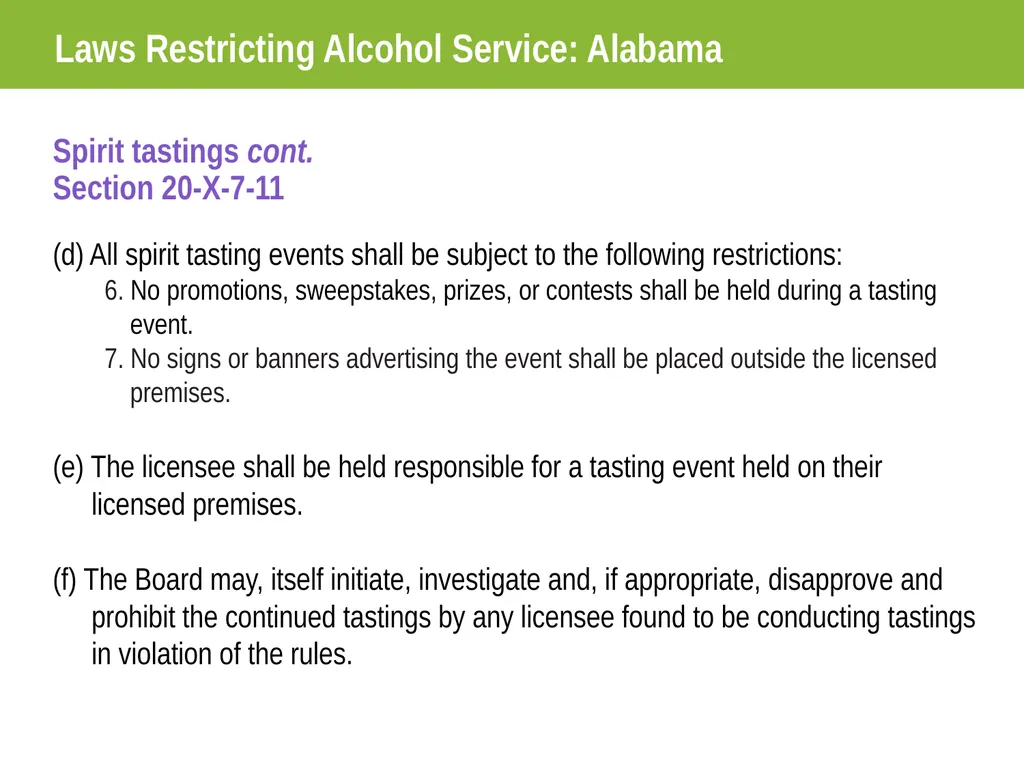
7. No signs or banners advertising the event shall be placed outside the licensed premises.
(e) The licensee shall be held responsible for a tasting event held on their licensed premises.
(f) The Board may, itself initiate, investigate and, if appropriate, disapprove and prohibit the continued tastings by any licensee found to be conducting tastings in violation of the rules. Laws Restricting Alcohol Service: Alabama<br>
Section 20-X-7-11
(d) All spirit tasting events shall be subject to the following restrictions:
6. No promotions, sweepstakes, prizes, or contests shall be held during a tasting event.
7. No signs or banners advertising the event shall be placed outside the licensed premises.
(e) The licensee shall be held responsible for a tasting event held on their licensed premises.
(f) The Board may, itself initiate, investigate and, if appropriate, disapprove and prohibit the continued tastings by any licensee found to be conducting tastings in violation of the rules. Laws Restricting Alcohol Service: Alabama<br>
75
Spirit tastings cont.
Section 20-X-7-11
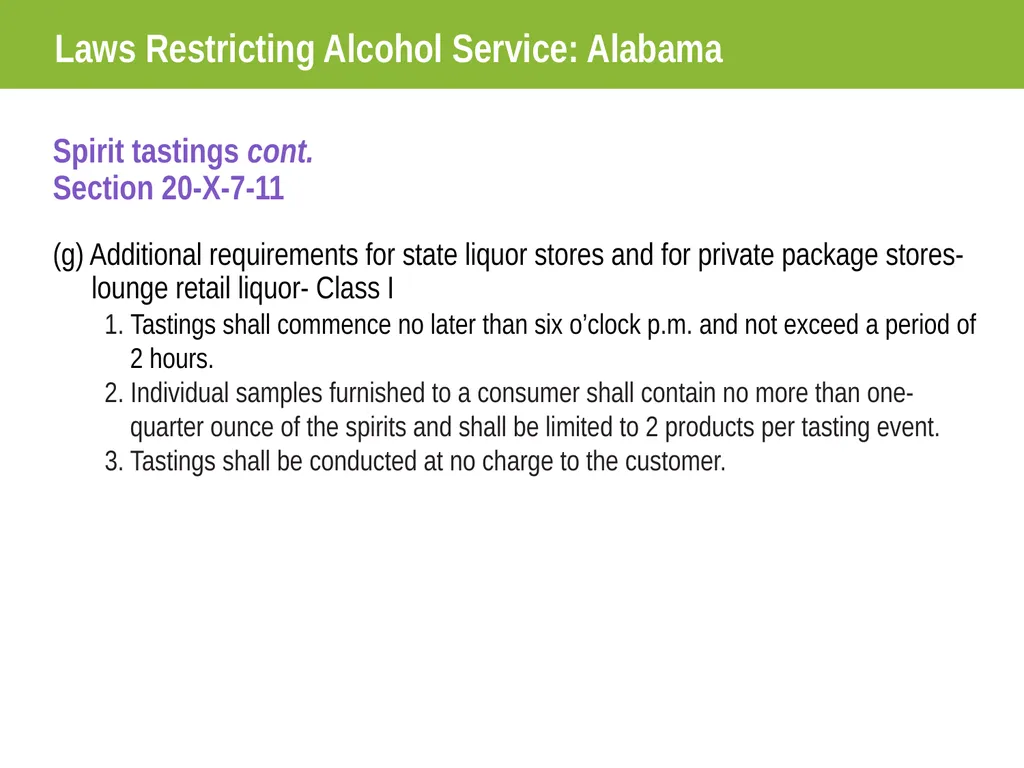
(g) Additional requirements for state liquor stores and for private package stores- lounge retail liquor- Class I
1. Tastings shall commence no later than six o’clock p.m. and not exceed a period of 2 hours.
2. Individual samples furnished to a consumer shall contain no more than one-quarter ounce of the spirits and shall be limited to 2 products per tasting event.
3. Tastings shall be conducted at no charge to the customer. Laws Restricting Alcohol Service: Alabama<br>
Section 20-X-7-11
(g) Additional requirements for state liquor stores and for private package stores- lounge retail liquor- Class I
1. Tastings shall commence no later than six o’clock p.m. and not exceed a period of 2 hours.
2. Individual samples furnished to a consumer shall contain no more than one-quarter ounce of the spirits and shall be limited to 2 products per tasting event.
3. Tastings shall be conducted at no charge to the customer. Laws Restricting Alcohol Service: Alabama<br>
76
Use and disposition of original liquor containers
Section 20-X-6-.03
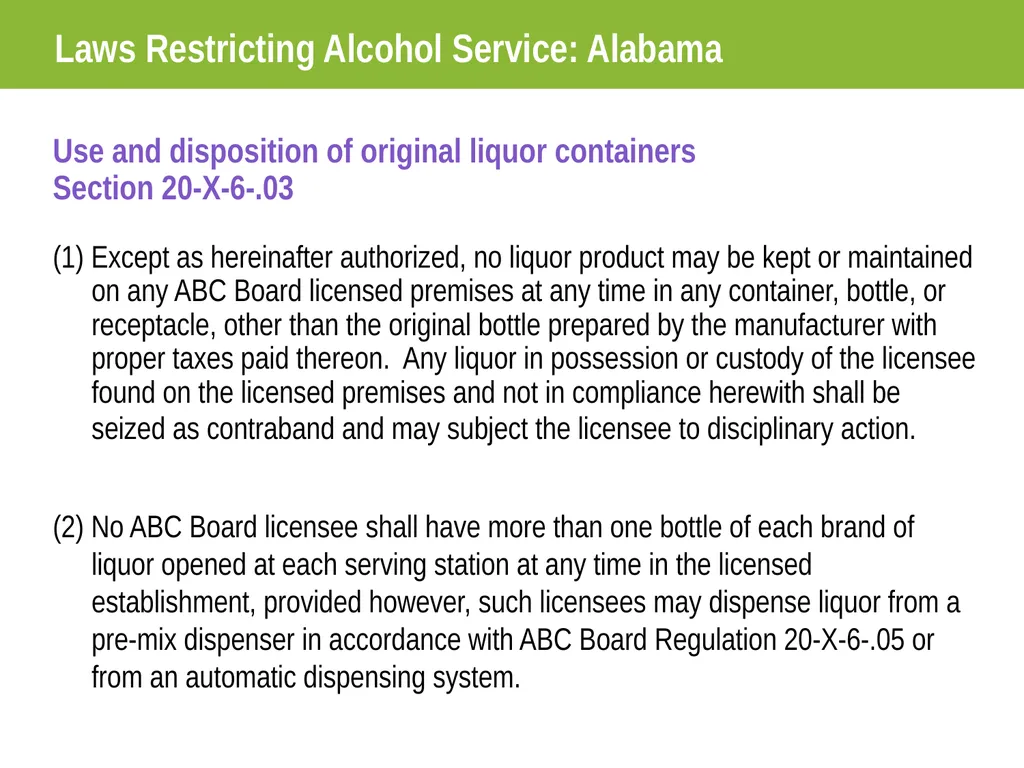
(1) Except as hereinafter authorized, no liquor product may be kept or maintained on any ABC Board licensed premises at any time in any container, bottle, or receptacle, other than the original bottle prepared by the manufacturer with proper taxes paid thereon. Any liquor in possession or custody of the licensee found on the licensed premises and not in compliance herewith shall be seized as contraband and may subject the licensee to disciplinary action.
(2) No ABC Board licensee shall have more than one bottle of each brand of liquor opened at each serving station at any time in the licensed establishment, provided however, such licensees may dispense liquor from a pre-mix dispenser in accordance with ABC Board Regulation 20-X-6-.05 or from an automatic dispensing system. Laws Restricting Alcohol Service: Alabama<br>
Section 20-X-6-.03
(1) Except as hereinafter authorized, no liquor product may be kept or maintained on any ABC Board licensed premises at any time in any container, bottle, or receptacle, other than the original bottle prepared by the manufacturer with proper taxes paid thereon. Any liquor in possession or custody of the licensee found on the licensed premises and not in compliance herewith shall be seized as contraband and may subject the licensee to disciplinary action.
(2) No ABC Board licensee shall have more than one bottle of each brand of liquor opened at each serving station at any time in the licensed establishment, provided however, such licensees may dispense liquor from a pre-mix dispenser in accordance with ABC Board Regulation 20-X-6-.05 or from an automatic dispensing system. Laws Restricting Alcohol Service: Alabama<br>
77
Use and disposition of original liquor containers cont.
Section 20-X-6-.03
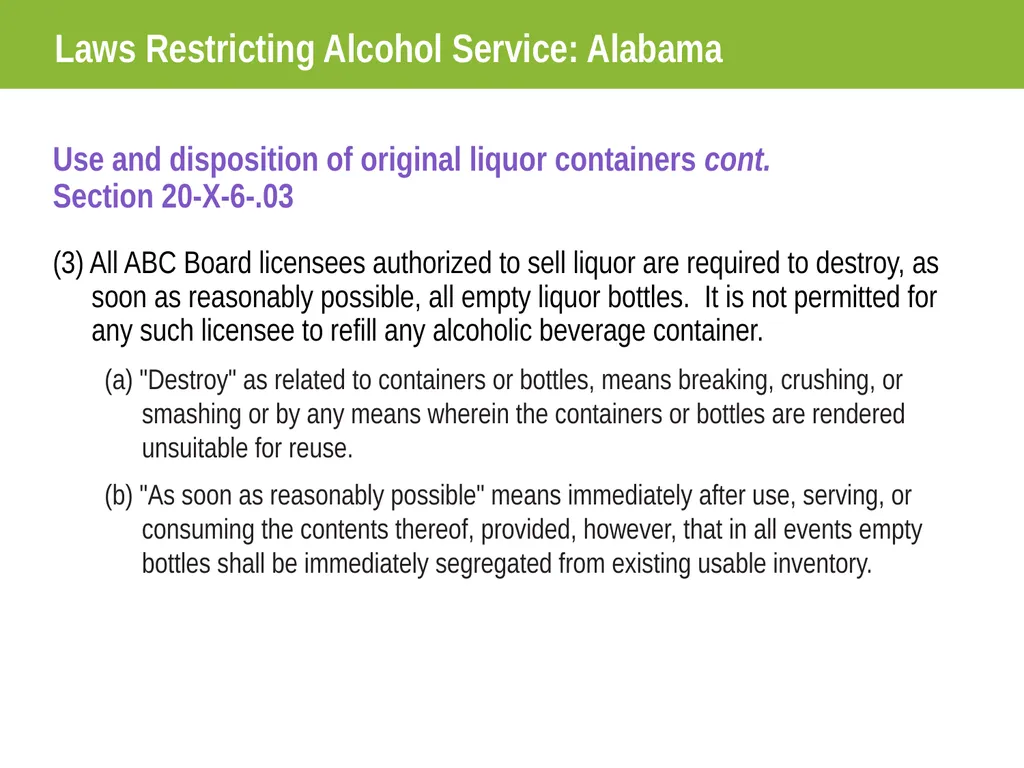
(3) All ABC Board licensees authorized to sell liquor are required to destroy, as soon as reasonably possible, all empty liquor bottles. It is not permitted for any such licensee to refill any alcoholic beverage container.
(a) "Destroy" as related to containers or bottles, means breaking, crushing, or smashing or by any means wherein the containers or bottles are rendered unsuitable for reuse.
(b) "As soon as reasonably possible" means immediately after use, serving, or consuming the contents thereof, provided, however, that in all events empty bottles shall be immediately segregated from existing usable inventory. Laws Restricting Alcohol Service: Alabama<br>
Section 20-X-6-.03
(3) All ABC Board licensees authorized to sell liquor are required to destroy, as soon as reasonably possible, all empty liquor bottles. It is not permitted for any such licensee to refill any alcoholic beverage container.
(a) "Destroy" as related to containers or bottles, means breaking, crushing, or smashing or by any means wherein the containers or bottles are rendered unsuitable for reuse.
(b) "As soon as reasonably possible" means immediately after use, serving, or consuming the contents thereof, provided, however, that in all events empty bottles shall be immediately segregated from existing usable inventory. Laws Restricting Alcohol Service: Alabama<br>
78
Fortifying, adulterating alcohol
Section 28-3A-25(a)(9)
(a) It shall be unlawful:.
(9) For any person to fortify, adulterate, contaminate, or in any manner change the character or purity of alcoholic beverages from that as originally marketed by the manufacturer, except that a retail licensee on order from a customer may mix a chaser or other ingredients necessary to prepare a cocktail or mixed drink for on-premises consumption. Laws Restricting Alcohol Service: Alabama<br>
Section 28-3A-25(a)(9)
(a) It shall be unlawful:.
(9) For any person to fortify, adulterate, contaminate, or in any manner change the character or purity of alcoholic beverages from that as originally marketed by the manufacturer, except that a retail licensee on order from a customer may mix a chaser or other ingredients necessary to prepare a cocktail or mixed drink for on-premises consumption. Laws Restricting Alcohol Service: Alabama<br>
79
Fortifying, adulterating alcohol: Penalties
Section 28-3A-25(b)(1)
(b)(1) Any violation of subdivisions (1) through (17) of subsection (a) shall be a misdemeanor punishable by a fine of not less than one hundred dollars ($100) nor more than one thousand dollars ($1,000), to which, at the discretion of the court or judge trying the case, may be added imprisonment in the county jail or at hard labor for the county for not more than six months for the first conviction; and, on the second conviction of a violation of the subdivisions, the offense shall, in addition to the aforementioned fine, be punishable by imprisonment or at hard labor for the county for not less than three months nor more than six months to be imposed by the court or judge trying the case; and, on the third conviction and every subsequent conviction of a violation of the subdivisions, the offense shall, in addition to a fine within the limits abovenamed, be punishable by imprisonment or at hard labor for the county for not less than six months nor more than 12 months. Laws Restricting Alcohol Service: Alabama<br>
Section 28-3A-25(b)(1)
(b)(1) Any violation of subdivisions (1) through (17) of subsection (a) shall be a misdemeanor punishable by a fine of not less than one hundred dollars ($100) nor more than one thousand dollars ($1,000), to which, at the discretion of the court or judge trying the case, may be added imprisonment in the county jail or at hard labor for the county for not more than six months for the first conviction; and, on the second conviction of a violation of the subdivisions, the offense shall, in addition to the aforementioned fine, be punishable by imprisonment or at hard labor for the county for not less than three months nor more than six months to be imposed by the court or judge trying the case; and, on the third conviction and every subsequent conviction of a violation of the subdivisions, the offense shall, in addition to a fine within the limits abovenamed, be punishable by imprisonment or at hard labor for the county for not less than six months nor more than 12 months. Laws Restricting Alcohol Service: Alabama<br>
80
Sales of untaxed alcohol
Section 28-3A-25(a)(16)
(a) It shall be unlawful:
(16) For any person to sell, give away, or otherwise dispose of taxable alcoholic beverages within this state on which the required taxes have not been paid as required by law. Laws Restricting Alcohol Service: Alabama<br>
Section 28-3A-25(a)(16)
(a) It shall be unlawful:
(16) For any person to sell, give away, or otherwise dispose of taxable alcoholic beverages within this state on which the required taxes have not been paid as required by law. Laws Restricting Alcohol Service: Alabama<br>
81
Sales of untaxed alcohol: Penalties
Section 28-3A-25(b)(1)
(b)(1) Any violation of subdivisions (1) through (17) of subsection (a) shall be a misdemeanor punishable by a fine of not less than one hundred dollars ($100) nor more than one thousand dollars ($1,000), to which, at the discretion of the court or judge trying the case, may be added imprisonment in the county jail or at hard labor for the county for not more than six months for the first conviction; and, on the second conviction of a violation of the subdivisions, the offense shall, in addition to the aforementioned fine, be punishable by imprisonment or at hard labor for the county for not less than three months nor more than six months to be imposed by the court or judge trying the case; and, on the third conviction and every subsequent conviction of a violation of the subdivisions, the offense shall, in addition to a fine within the limits abovenamed, be punishable by imprisonment or at hard labor for the county for not less than six months nor more than 12 months. Laws Restricting Alcohol Service: Alabama<br>
Section 28-3A-25(b)(1)
(b)(1) Any violation of subdivisions (1) through (17) of subsection (a) shall be a misdemeanor punishable by a fine of not less than one hundred dollars ($100) nor more than one thousand dollars ($1,000), to which, at the discretion of the court or judge trying the case, may be added imprisonment in the county jail or at hard labor for the county for not more than six months for the first conviction; and, on the second conviction of a violation of the subdivisions, the offense shall, in addition to the aforementioned fine, be punishable by imprisonment or at hard labor for the county for not less than three months nor more than six months to be imposed by the court or judge trying the case; and, on the third conviction and every subsequent conviction of a violation of the subdivisions, the offense shall, in addition to a fine within the limits abovenamed, be punishable by imprisonment or at hard labor for the county for not less than six months nor more than 12 months. Laws Restricting Alcohol Service: Alabama<br>
82
Display of alcoholic beverages by retail licensees
Section 20-X-6-.08
Retail licensees may display alcoholic beverages within their licensed premises, provided said beverages are displayed, stored or kept in such a manner so as not to be conspicuously visible to the public from outside the licensed premises. Laws Restricting Alcohol Service: Alabama<br>
Section 20-X-6-.08
Retail licensees may display alcoholic beverages within their licensed premises, provided said beverages are displayed, stored or kept in such a manner so as not to be conspicuously visible to the public from outside the licensed premises. Laws Restricting Alcohol Service: Alabama<br>
83
Sale of alcoholic beverages by retail licensees: Resale
Section 20-X-6-.04(5)
(5) An ABC Board retail licensee shall not sell to any person or other licensee for purposes of resale, nor shall such licensee purchase or attempt to purchase alcoholic beverages from another ABC Board retail licensee. Laws Restricting Alcohol Service: Alabama<br>
Section 20-X-6-.04(5)
(5) An ABC Board retail licensee shall not sell to any person or other licensee for purposes of resale, nor shall such licensee purchase or attempt to purchase alcoholic beverages from another ABC Board retail licensee. Laws Restricting Alcohol Service: Alabama<br>
84
Beverage locker/Storage service
Section 20-X-6-.01(11)
(11) ABC Board licensees shall not rent, furnish, or maintain beverage locker service or storage service for the keeping of alcoholic beverages by customers, patrons, or consumers. Laws Restricting Alcohol Service: Alabama<br>
Section 20-X-6-.01(11)
(11) ABC Board licensees shall not rent, furnish, or maintain beverage locker service or storage service for the keeping of alcoholic beverages by customers, patrons, or consumers. Laws Restricting Alcohol Service: Alabama<br>
85
Sales from storage cabinets and guest rooms
Section 20-X-6-.17
(1) Licensees of the ABC Board possessing the privilege of selling liquor at retail who regularly offer to the public, for compensation, transitory lodging or sleeping accommodations may provide alcoholic beverages to registered guests twenty-one years of age or older in storage cabinets individual private rooms of lodging.
(2) All storage cabinets (also commonly known as mini bars) in private rooms must be locked with a secure locking device. The key or combination needed to open the cabinets may only be given by the licensee to the registered guest responsible for the room rental. Laws Restricting Alcohol Service: Alabama<br>
Section 20-X-6-.17
(1) Licensees of the ABC Board possessing the privilege of selling liquor at retail who regularly offer to the public, for compensation, transitory lodging or sleeping accommodations may provide alcoholic beverages to registered guests twenty-one years of age or older in storage cabinets individual private rooms of lodging.
(2) All storage cabinets (also commonly known as mini bars) in private rooms must be locked with a secure locking device. The key or combination needed to open the cabinets may only be given by the licensee to the registered guest responsible for the room rental. Laws Restricting Alcohol Service: Alabama<br>
86
Sales from storage cabinets and guest rooms cont.
Section 20-X-6-.17
(3) The sale of the registered guest of alcoholic beverages from storage cabinets is deemed to occur upon the delivery of the key or combination to the locking device. In the case of refills or restocking, the sale is deemed to occur upon delivery by room service. No sale of alcoholic beverages shall be made on Sundays after 2:00 A.M., except where the sale thereof is permitted by law.
(4) All sales herein made shall be made in unopened containers. After the registered guest vacates the room, the licensee shall promptly inventory the storage cabinet and cause the cabinet to be locked and secure. All containers which have been opened must be removed from the private room. The contents of the opened containers must be poured out immediately and not reused. Laws Restricting Alcohol Service: Alabama<br>
Section 20-X-6-.17
(3) The sale of the registered guest of alcoholic beverages from storage cabinets is deemed to occur upon the delivery of the key or combination to the locking device. In the case of refills or restocking, the sale is deemed to occur upon delivery by room service. No sale of alcoholic beverages shall be made on Sundays after 2:00 A.M., except where the sale thereof is permitted by law.
(4) All sales herein made shall be made in unopened containers. After the registered guest vacates the room, the licensee shall promptly inventory the storage cabinet and cause the cabinet to be locked and secure. All containers which have been opened must be removed from the private room. The contents of the opened containers must be poured out immediately and not reused. Laws Restricting Alcohol Service: Alabama<br>
87
Sales from storage cabinets and guest rooms cont.
Section 20-X-6-.17
(5) If the licensee determines or has reason to believe that the registered guest having the key or combination to the storage cabinet has allowed or intends to allow minors to consume alcoholic beverages from the cabinet, then the licensee shall take such action as necessary to remove the alcoholic beverages from the cabinet and/or retrieve the key thereto or cancel the combination device.
(6) ABC Board agents may enter any room containing a storage cabinet, for inspection thereof, at any time that the room is not let to a registered guest. Laws Restricting Alcohol Service: Alabama<br>
Section 20-X-6-.17
(5) If the licensee determines or has reason to believe that the registered guest having the key or combination to the storage cabinet has allowed or intends to allow minors to consume alcoholic beverages from the cabinet, then the licensee shall take such action as necessary to remove the alcoholic beverages from the cabinet and/or retrieve the key thereto or cancel the combination device.
(6) ABC Board agents may enter any room containing a storage cabinet, for inspection thereof, at any time that the room is not let to a registered guest. Laws Restricting Alcohol Service: Alabama<br>
88
Service of alcoholic beverages on patios or around swimming pool areas
Section 20-X-6-.07
Any ABC Board on-premises licensee may serve alcoholic beverages as authorized by their license on patios or around swimming pool areas adjacent to or connected with the main licensed premises. Said serving area shall be located so as not to be a nuisance nor readily visible from a church or school premises. Laws Restricting Alcohol Service: Alabama<br>
Section 20-X-6-.07
Any ABC Board on-premises licensee may serve alcoholic beverages as authorized by their license on patios or around swimming pool areas adjacent to or connected with the main licensed premises. Said serving area shall be located so as not to be a nuisance nor readily visible from a church or school premises. Laws Restricting Alcohol Service: Alabama<br>
89
B. No A. Yes Can people continue drinking past the hours of service listed on an operation’s liquor license? What Do You Think? Why? This is illegal. The hours listed on the liquor license must be strictly followed. They apply to both guests and employees C. It depends<br>
90
Sunday sales
Section 28-3A-25-(a)(19)
(a) It shall be unlawful:
(19) For any person, except where authorized by a local act or general act of local application, to buy, give away, sell, or serve for consumption on or off the premises, or to drink or consume any alcoholic beverages in any cafe, lunchroom, restaurant, hotel dining room, or other public place on Sunday after the hour of two o’clock a.m. Laws Restricting Alcohol Service: Alabama<br>
Section 28-3A-25-(a)(19)
(a) It shall be unlawful:
(19) For any person, except where authorized by a local act or general act of local application, to buy, give away, sell, or serve for consumption on or off the premises, or to drink or consume any alcoholic beverages in any cafe, lunchroom, restaurant, hotel dining room, or other public place on Sunday after the hour of two o’clock a.m. Laws Restricting Alcohol Service: Alabama<br>
91
Sunday sales: Penalty for violations
Section 28-3A-25-(b)(2)
(2) Any violation of any provision of subdivisions (18), (19), (20), and (21) of subsection (a) shall be a misdemeanor punishable by a fine of not less than fifty dollars ($50) nor more than five hundred dollars ($500), to which, at the discretion of the court or judge trying the case, may be added imprisonment in the county jail or at hard labor for the county for not more than three months. Laws Restricting Alcohol Service: Alabama<br>
Section 28-3A-25-(b)(2)
(2) Any violation of any provision of subdivisions (18), (19), (20), and (21) of subsection (a) shall be a misdemeanor punishable by a fine of not less than fifty dollars ($50) nor more than five hundred dollars ($500), to which, at the discretion of the court or judge trying the case, may be added imprisonment in the county jail or at hard labor for the county for not more than three months. Laws Restricting Alcohol Service: Alabama<br>
92
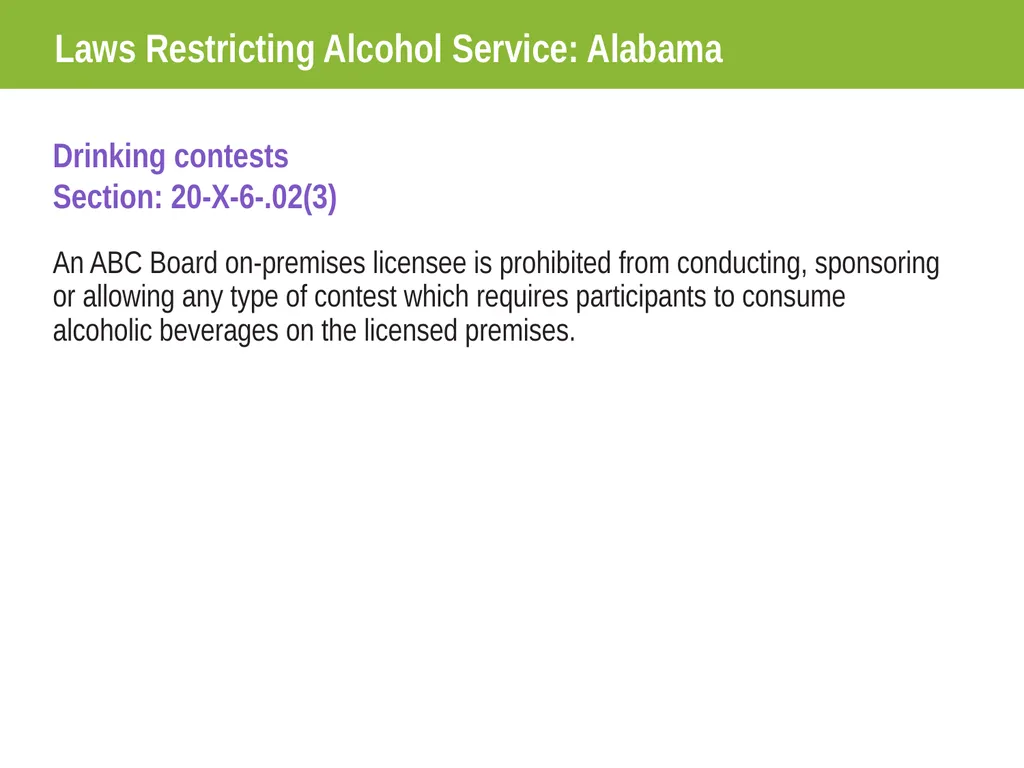
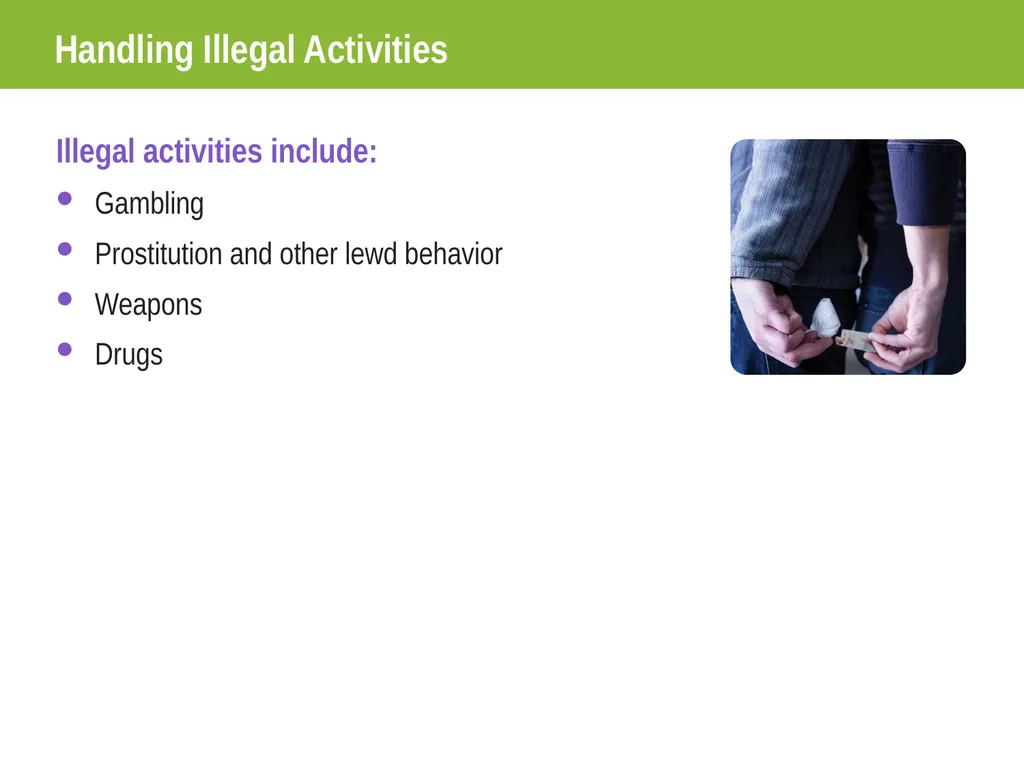
Laws Restricting Alcohol Service Some other activities that are illegal on the premises.
Gambling, prostitution, other lewd behavior
In most states you can be liable if you knowingly permit these activities
Drinking games and contests
In many states it’s illegal to let people play games that involve drinking alcohol
These encourage people to drink to intoxication
Illegal drugs
These encourage people to drink to intoxication<br>
Gambling, prostitution, other lewd behavior
In most states you can be liable if you knowingly permit these activities
Drinking games and contests
In many states it’s illegal to let people play games that involve drinking alcohol
These encourage people to drink to intoxication
Illegal drugs
These encourage people to drink to intoxication<br>
93
Allowing criminal conduct
Section: 20-X-6-.01(6)
ABC Board licensees shall be accountable to the ABC Board for criminal conduct which occurs or is suffered to occur on any part of the licensed premises. Where the ABC Board or Hearing Commission finds such criminal conduct to be allowed, caused, permitted, or suffered to occur by the licensee, employees or agents thereof, such licensee’s license shall be subject to disciplinary action. Laws Restricting Alcohol Service: Alabama<br>
Section: 20-X-6-.01(6)
ABC Board licensees shall be accountable to the ABC Board for criminal conduct which occurs or is suffered to occur on any part of the licensed premises. Where the ABC Board or Hearing Commission finds such criminal conduct to be allowed, caused, permitted, or suffered to occur by the licensee, employees or agents thereof, such licensee’s license shall be subject to disciplinary action. Laws Restricting Alcohol Service: Alabama<br>
94
Prohibition of obscene, lewd or indecent conduct on licensed premises
Section: 20-X-6-.11
(1) No ABC Board licensee shall permit bottomless dancing, topless dancing wherein the portion of the female breast beneath the top of the nipple is exposed, or such performing, or any other lewd or indecent conduct on the premises of such licensee. Laws Restricting Alcohol Service: Alabama<br>
Section: 20-X-6-.11
(1) No ABC Board licensee shall permit bottomless dancing, topless dancing wherein the portion of the female breast beneath the top of the nipple is exposed, or such performing, or any other lewd or indecent conduct on the premises of such licensee. Laws Restricting Alcohol Service: Alabama<br>
95
Prohibition of obscene, lewd or indecent conduct on licensed premises cont.
Section: 20-X-6-.11
(2) No ABC Board licensee shall permit any person to perform acts of or acts which simulate:
(a) Sexual intercourse, masturbation, sodomy, bestiality, oral copulation, flagellation or any sexual acts which are prohibited by law.
(b) The touching, caressing or fondling on the breasts, buttocks, anus or genitals.
(c) The displaying of the portion of the female breast beneath the top of the nipple, pubic hair, anus, vulva or genitals. Laws Restricting Alcohol Service: Alabama<br>
Section: 20-X-6-.11
(2) No ABC Board licensee shall permit any person to perform acts of or acts which simulate:
(a) Sexual intercourse, masturbation, sodomy, bestiality, oral copulation, flagellation or any sexual acts which are prohibited by law.
(b) The touching, caressing or fondling on the breasts, buttocks, anus or genitals.
(c) The displaying of the portion of the female breast beneath the top of the nipple, pubic hair, anus, vulva or genitals. Laws Restricting Alcohol Service: Alabama<br>
96
Prohibition of obscene, lewd or indecent conduct on licensed premises cont.
Section: 20-X-6-.11
(3) No ABC Board licensee shall permit any patron, customer or member to touch, caress or fondle the breasts, buttocks, anus, genitals or any part of the body or clothing of a performer. Performers may not touch, caress or fondle the breast, buttocks, anus, genitals or any part of the body or clothing of patrons or other performers. Laws Restricting Alcohol Service: Alabama<br>
Section: 20-X-6-.11
(3) No ABC Board licensee shall permit any patron, customer or member to touch, caress or fondle the breasts, buttocks, anus, genitals or any part of the body or clothing of a performer. Performers may not touch, caress or fondle the breast, buttocks, anus, genitals or any part of the body or clothing of patrons or other performers. Laws Restricting Alcohol Service: Alabama<br>
97
Prohibition of obscene, lewd or indecent conduct on licensed premises cont.
Section: 20-X-6-.11
(4) No ABC Board licensee shall permit the showing of films, still pictures, electronic reproduction or other visual reproductions depicting:
(a) Acts or simulated acts of sexual intercourse, masturbation, sodomy, bestiality, oral copulation, flagellation or any sexual acts which are prohibited by law.
(b) Any person being touched, caressed or fondled on the breasts, buttocks, anus or genitals. Laws Restricting Alcohol Service: Alabama<br>
Section: 20-X-6-.11
(4) No ABC Board licensee shall permit the showing of films, still pictures, electronic reproduction or other visual reproductions depicting:
(a) Acts or simulated acts of sexual intercourse, masturbation, sodomy, bestiality, oral copulation, flagellation or any sexual acts which are prohibited by law.
(b) Any person being touched, caressed or fondled on the breasts, buttocks, anus or genitals. Laws Restricting Alcohol Service: Alabama<br>
98
Prohibition of obscene, lewd or indecent conduct on licensed premises cont.
Section: 20-X-6-.11
(4) No ABC Board licensee shall permit the showing of films, still pictures, electronic reproduction or other visual reproductions depicting:
(c) Scenes wherein a person displays the vulva or the anus or the genitals.
(d) Scenes wherein artificial devices or inanimate objects are employed to depict, or drawings are employed to portray, any of the prohibited activities described above. Laws Restricting Alcohol Service: Alabama<br>
Section: 20-X-6-.11
(4) No ABC Board licensee shall permit the showing of films, still pictures, electronic reproduction or other visual reproductions depicting:
(c) Scenes wherein a person displays the vulva or the anus or the genitals.
(d) Scenes wherein artificial devices or inanimate objects are employed to depict, or drawings are employed to portray, any of the prohibited activities described above. Laws Restricting Alcohol Service: Alabama<br>
99
Drinking contests
Section: 20-X-6-.02(3)
An ABC Board on-premises licensee is prohibited from conducting, sponsoring or allowing any type of contest which requires participants to consume alcoholic beverages on the licensed premises. Laws Restricting Alcohol Service: Alabama<br>
Section: 20-X-6-.02(3)
An ABC Board on-premises licensee is prohibited from conducting, sponsoring or allowing any type of contest which requires participants to consume alcoholic beverages on the licensed premises. Laws Restricting Alcohol Service: Alabama<br>
100
Unlawful distribution of a controlled substance
Section 13A-12-211(a)(b)
(a) A person commits the crime of unlawful distribution of controlled substances if, except as otherwise authorized, he or she sells, furnishes, gives away, delivers, or distributes a controlled substance enumerated in Schedules I through V.
(b) Unlawful distribution of controlled substances is a Class B felony. Laws Restricting Alcohol Service: Alabama<br>
Section 13A-12-211(a)(b)
(a) A person commits the crime of unlawful distribution of controlled substances if, except as otherwise authorized, he or she sells, furnishes, gives away, delivers, or distributes a controlled substance enumerated in Schedules I through V.
(b) Unlawful distribution of controlled substances is a Class B felony. Laws Restricting Alcohol Service: Alabama<br>
101
Limitations on happy hour and similar price reductions
Section 20-X-6-.13
(1) It shall be unlawful for any ABC Board licensee to:
(a) Serve multiple drinks for a single price.
(b) Establish a single retail price based upon the required purchase of two or more drinks.
(c) Sell or otherwise furnish drinks before 10 a.m. or after 9 p.m. at a price which is reduced from the usual customary or established retail price charged for such drinks.
(d) Sell or provide one person or group of persons drinks at prices less than those charged the general public for that day. Laws Restricting Alcohol Service: Alabama<br>
Section 20-X-6-.13
(1) It shall be unlawful for any ABC Board licensee to:
(a) Serve multiple drinks for a single price.
(b) Establish a single retail price based upon the required purchase of two or more drinks.
(c) Sell or otherwise furnish drinks before 10 a.m. or after 9 p.m. at a price which is reduced from the usual customary or established retail price charged for such drinks.
(d) Sell or provide one person or group of persons drinks at prices less than those charged the general public for that day. Laws Restricting Alcohol Service: Alabama<br>
102
Limitations on happy hour and similar price reductions cont.
Section 20-X-6-.13
(2) Nothing herein contained shall be construed to prohibit the dispensing of drinks customarily sold in pitchers, provided such pitchers shall be available at all times the licensee is open for business. The usual, customary or established retail price thereof shall not be reduced before 10 a.m. or after 9 p.m. Laws Restricting Alcohol Service: Alabama<br>
Section 20-X-6-.13
(2) Nothing herein contained shall be construed to prohibit the dispensing of drinks customarily sold in pitchers, provided such pitchers shall be available at all times the licensee is open for business. The usual, customary or established retail price thereof shall not be reduced before 10 a.m. or after 9 p.m. Laws Restricting Alcohol Service: Alabama<br>
103
Limitations on happy hour and similar price reductions cont.
Section 20-X-6-.13
(3) The term "drink" or "drinks" is defined herein to mean any beverage containing any quantity of alcohol. "Multiple drinks" is defined to mean two or more drinks containing any quantity of alcohol or a single container which contains more than the normal quantity of alcohol for an individual drink in accordance with ABC Board Regulation 20-X-6-.04(2). The term "pitcher" is defined to mean any receptacle containing a minimum of sixty (60) fluid ounces of beverages.
(4) This regulation shall not apply to legitimate, prearranged private parties, functions, or events where guests thereof are served in a room or rooms so designated and used exclusively therefor. Laws Restricting Alcohol Service: Alabama<br>
Section 20-X-6-.13
(3) The term "drink" or "drinks" is defined herein to mean any beverage containing any quantity of alcohol. "Multiple drinks" is defined to mean two or more drinks containing any quantity of alcohol or a single container which contains more than the normal quantity of alcohol for an individual drink in accordance with ABC Board Regulation 20-X-6-.04(2). The term "pitcher" is defined to mean any receptacle containing a minimum of sixty (60) fluid ounces of beverages.
(4) This regulation shall not apply to legitimate, prearranged private parties, functions, or events where guests thereof are served in a room or rooms so designated and used exclusively therefor. Laws Restricting Alcohol Service: Alabama<br>
104
Discrimination Against Guests
States also hold the owners and operators of establishments and their employees liable if they discriminate against guests due to:
Race
Color
Gender
Sexual orientation
Age
Disability
Religion or creed Laws Restricting Alcohol Service<br>
States also hold the owners and operators of establishments and their employees liable if they discriminate against guests due to:
Race
Color
Gender
Sexual orientation
Age
Disability
Religion or creed Laws Restricting Alcohol Service<br>
105
B. No A. Yes Can you refuse alcohol service to a pregnant woman? What Do You Think? Why? Refusing to serve alcohol to a woman because she’s pregnant is gender discrimination. C. It depends<br>
106
The Premises Laws Restricting Alcohol Service: Alabama<br>
107
Mechanisms to gain access to licensed premises
Section 20-X-6-.01(13)
Any ABC Board licensee which requires its members or patrons to possess keys, card keys, code numbers, membership cards or other such mechanisms as a condition to gaining access to its licensed premises, shall provide and supply to the ABC Board upon initial issuance of the license and/or renewal, as the case may be, access to and evidence of such mechanisms so as to allow entry by ABC Board personnel upon the licensed premises at any time during normal business hours for the purpose of observing the normal operation thereof. Any changes or modifications to said premise entry mechanisms during the license year shall be brought to the attention of the ABC Board immediately. Failure to provide said above information shall, at the ABC Board’s discretion, be grounds for disciplinary action against the licensee. Laws Restricting Alcohol Service: Alabama<br>
Section 20-X-6-.01(13)
Any ABC Board licensee which requires its members or patrons to possess keys, card keys, code numbers, membership cards or other such mechanisms as a condition to gaining access to its licensed premises, shall provide and supply to the ABC Board upon initial issuance of the license and/or renewal, as the case may be, access to and evidence of such mechanisms so as to allow entry by ABC Board personnel upon the licensed premises at any time during normal business hours for the purpose of observing the normal operation thereof. Any changes or modifications to said premise entry mechanisms during the license year shall be brought to the attention of the ABC Board immediately. Failure to provide said above information shall, at the ABC Board’s discretion, be grounds for disciplinary action against the licensee. Laws Restricting Alcohol Service: Alabama<br>
108
Sale of alcoholic beverages by retail licensees: Adequate lighting
Section 20-X-6-.04(6)
(6) All ABC Board retail licensed premises shall be adequately lighted for purposes of observing the operation thereof or patrons therein. Laws Restricting Alcohol Service: Alabama<br>
Section 20-X-6-.04(6)
(6) All ABC Board retail licensed premises shall be adequately lighted for purposes of observing the operation thereof or patrons therein. Laws Restricting Alcohol Service: Alabama<br>
109
Refusing to allow inspection
Section 28-3A-25-(a)(6)
(a) It shall be unlawful:
(6) For any licensee or the servants, agents, or employees of the same to refuse the board, any of its authorized employees, or any duly commissioned law enforcement officer the right to completely inspect the entire licensed premises at any time the premises are open for business. Laws Restricting Alcohol Service: Alabama<br>
Section 28-3A-25-(a)(6)
(a) It shall be unlawful:
(6) For any licensee or the servants, agents, or employees of the same to refuse the board, any of its authorized employees, or any duly commissioned law enforcement officer the right to completely inspect the entire licensed premises at any time the premises are open for business. Laws Restricting Alcohol Service: Alabama<br>
110
Refusing to allow inspection: Penalties
Section 28-3A-25-(b)(1)
(b)(1) Any violation of subdivision 6 of subsection (a) shall be a misdemeanor punishable by a fine of not less than one hundred dollars ($100) nor more than one thousand dollars ($1,000), to which, at the discretion of the court or judge trying the case, may be added imprisonment in the county jail or at hard labor for the county for not more than six months for the first conviction; and, on the second conviction of a violation of the subdivisions, the offense shall, in addition to the aforementioned fine, be punishable by imprisonment or at hard labor for the county for not less than three months nor more than six months to be imposed by the court or judge trying the case; and, on the third conviction and every subsequent conviction of a violation of the subdivisions, the offense shall, in addition to a fine within the limits abovenamed, be punishable by imprisonment or at hard labor for the county for not less than six months nor more than 12 months. Laws Restricting Alcohol Service: Alabama<br>
Section 28-3A-25-(b)(1)
(b)(1) Any violation of subdivision 6 of subsection (a) shall be a misdemeanor punishable by a fine of not less than one hundred dollars ($100) nor more than one thousand dollars ($1,000), to which, at the discretion of the court or judge trying the case, may be added imprisonment in the county jail or at hard labor for the county for not more than six months for the first conviction; and, on the second conviction of a violation of the subdivisions, the offense shall, in addition to the aforementioned fine, be punishable by imprisonment or at hard labor for the county for not less than three months nor more than six months to be imposed by the court or judge trying the case; and, on the third conviction and every subsequent conviction of a violation of the subdivisions, the offense shall, in addition to a fine within the limits abovenamed, be punishable by imprisonment or at hard labor for the county for not less than six months nor more than 12 months. Laws Restricting Alcohol Service: Alabama<br>
111
Required Postings Laws Restricting Alcohol Service: Alabama<br>
112
Sale of alcoholic beverages by retail licensees
Section 20-X-6-.04(2)
(2) The quantity of liquor served in an individual drink shall be posted within the licensed premises in a conspicuous place on or behind the service area and on any food or beverage menu. Said notice, except in food or beverage menus, shall be no less than 12" x 20" and shall read, "All drinks contain __ ounces of liquor, unless special ordered." Letters shall be no less than two (2) inches in height. Laws Restricting Alcohol Service: Alabama<br>
Section 20-X-6-.04(2)
(2) The quantity of liquor served in an individual drink shall be posted within the licensed premises in a conspicuous place on or behind the service area and on any food or beverage menu. Said notice, except in food or beverage menus, shall be no less than 12" x 20" and shall read, "All drinks contain __ ounces of liquor, unless special ordered." Letters shall be no less than two (2) inches in height. Laws Restricting Alcohol Service: Alabama<br>
113
Person in charge
Section 20-X-6-.06
Each licensee, except a licensed individual who is on the premises, shall have a designated person who is at least 21 years of age present and in actual charge of the business being conducted under the license at any time the licensed establishment is kept open for business, whether or not the privileges of the license are being exercised. The name of the designated person of every retail licensee shall be posted in an area of the establishment, readily available to ABC Board personnel, in letters not less than one inch in size, during the time he is in charge. Laws Restricting Alcohol Service: Alabama<br>
Section 20-X-6-.06
Each licensee, except a licensed individual who is on the premises, shall have a designated person who is at least 21 years of age present and in actual charge of the business being conducted under the license at any time the licensed establishment is kept open for business, whether or not the privileges of the license are being exercised. The name of the designated person of every retail licensee shall be posted in an area of the establishment, readily available to ABC Board personnel, in letters not less than one inch in size, during the time he is in charge. Laws Restricting Alcohol Service: Alabama<br>
114
Posting of signs
Section 20-X-12-.04(1)(e)3
(3) Responsible vendors shall display signs on the licensed premises informing customers of the vendor’s policy against serving or selling alcoholic beverages to underage persons and/or intoxicated customers. These signs must measure no less than 8 inches by 13 inches with type sufficiently large to be easily read, and be placed at customer entrance(s) of the licensed premises or at cash registers and on or near the area where alcoholic beverages are displayed or dispensed. All signs shall be situated in areas easily viewed by the public. Laws Restricting Alcohol Service: Alabama<br>
Section 20-X-12-.04(1)(e)3
(3) Responsible vendors shall display signs on the licensed premises informing customers of the vendor’s policy against serving or selling alcoholic beverages to underage persons and/or intoxicated customers. These signs must measure no less than 8 inches by 13 inches with type sufficiently large to be easily read, and be placed at customer entrance(s) of the licensed premises or at cash registers and on or near the area where alcoholic beverages are displayed or dispensed. All signs shall be situated in areas easily viewed by the public. Laws Restricting Alcohol Service: Alabama<br>
115
Displaying the beverage license
Section 20-X-6-.01(10)
(10) All ABC Board licensees shall display their current ABC licenses in public view on the licensed premises. Laws Restricting Alcohol Service: Alabama<br>
Section 20-X-6-.01(10)
(10) All ABC Board licensees shall display their current ABC licenses in public view on the licensed premises. Laws Restricting Alcohol Service: Alabama<br>
116
Training Laws Restricting Alcohol Service: Alabama<br>
117
Training within 30 days
Section 20-X-12-.06(2)(a)
(a) Responsible vendors shall require new or transferred sellers, servers, and managers to complete the course of instruction and pass the appropriate examination within 30 days of commencing employment. Responsible vendors who allow new or transferred employees to sell, serve or manage before training should strive to do so under the direct supervision of a trained seller, server, or manager. Laws Restricting Alcohol Service: Alabama<br>
Section 20-X-12-.06(2)(a)
(a) Responsible vendors shall require new or transferred sellers, servers, and managers to complete the course of instruction and pass the appropriate examination within 30 days of commencing employment. Responsible vendors who allow new or transferred employees to sell, serve or manage before training should strive to do so under the direct supervision of a trained seller, server, or manager. Laws Restricting Alcohol Service: Alabama<br>
118
Semi-annuals
Section 20-X-12-.06(2)(c)
(c) Responsible vendors shall require each server, seller and manager to attend meetings semi-annually, or more frequently as deemed appropriate. A register with names and social security numbers of all employees who attend the meeting, the date of each meeting, the person conducting the meeting, and the subjects covered shall be maintained by the responsible vendor or agent thereof. Laws Restricting Alcohol Service: Alabama<br>
Section 20-X-12-.06(2)(c)
(c) Responsible vendors shall require each server, seller and manager to attend meetings semi-annually, or more frequently as deemed appropriate. A register with names and social security numbers of all employees who attend the meeting, the date of each meeting, the person conducting the meeting, and the subjects covered shall be maintained by the responsible vendor or agent thereof. Laws Restricting Alcohol Service: Alabama<br>
119
Satisfactory completion/Passing grade
Section 20-X-12-.09(5)
(5) Satisfactory completion of each course of instruction shall be demonstrated by achieving a passing grade of 80% or higher. Incorrect examination questions shall be reviewed and initiated by the employee with the correct answer(s) being provided and discussed. An examination may be repeated once in order to attain a satisfactory score of 80%, after which time retraining shall be necessary. Laws Restricting Alcohol Service: Alabama<br>
Section 20-X-12-.09(5)
(5) Satisfactory completion of each course of instruction shall be demonstrated by achieving a passing grade of 80% or higher. Incorrect examination questions shall be reviewed and initiated by the employee with the correct answer(s) being provided and discussed. An examination may be repeated once in order to attain a satisfactory score of 80%, after which time retraining shall be necessary. Laws Restricting Alcohol Service: Alabama<br>
120
Beverage License Types Laws Restricting Alcohol Service: Alabama<br>
121
Lounge Retail Liquor License Laws Restricting Alcohol Service: Alabama<br>
122
Lounge Retail Liquor License
Section 28-3A-11
Upon applicant's compliance with the provisions of this chapter and the regulations made thereunder, the board shall, where the application is accompanied by a certificate from the clerk or proper officer setting out that the applicant has presented his application to the governing authority of the municipality, if the licensed premises is to be located therein, and has obtained its consent and approval, issue a retail liquor license… Laws Restricting Alcohol Service: Alabama<br>
Section 28-3A-11
Upon applicant's compliance with the provisions of this chapter and the regulations made thereunder, the board shall, where the application is accompanied by a certificate from the clerk or proper officer setting out that the applicant has presented his application to the governing authority of the municipality, if the licensed premises is to be located therein, and has obtained its consent and approval, issue a retail liquor license… Laws Restricting Alcohol Service: Alabama<br>
123
Lounge Retail Liquor License cont.
Section 28-3A-11
…which will authorize the licensee to purchase liquor and wine from the board or as authorized by the board and to purchase table wine, and beer, including draft or keg beer in any county or municipality in which the sale thereof is permitted, from any wholesaler licensee of the board and to sell at retail liquor and wine, dispensed from containers of any size, and beer, including draft or keg beer in any county or municipality in which the sale thereof is permitted, to patrons… Laws Restricting Alcohol Service: Alabama<br>
Section 28-3A-11
…which will authorize the licensee to purchase liquor and wine from the board or as authorized by the board and to purchase table wine, and beer, including draft or keg beer in any county or municipality in which the sale thereof is permitted, from any wholesaler licensee of the board and to sell at retail liquor and wine, dispensed from containers of any size, and beer, including draft or keg beer in any county or municipality in which the sale thereof is permitted, to patrons… Laws Restricting Alcohol Service: Alabama<br>
124
Lounge Retail Liquor License cont.
Section 28-3A-11
…A lounge liquor licensee may permit dancing or provide other lawful entertainment on the licensed premises. No person under 19 years of age shall be admitted on the premises of any lounge liquor licensee as a patron or employee, and it shall be unlawful for any such licensee to admit any minor to the premises as a patron or employee. Laws Restricting Alcohol Service: Alabama<br>
Section 28-3A-11
…A lounge liquor licensee may permit dancing or provide other lawful entertainment on the licensed premises. No person under 19 years of age shall be admitted on the premises of any lounge liquor licensee as a patron or employee, and it shall be unlawful for any such licensee to admit any minor to the premises as a patron or employee. Laws Restricting Alcohol Service: Alabama<br>
125
Lounge Retail Liquor License cont.
Section 20-X-5-.04
(1) A Lounge Retail Liquor License may be issued to any person, partnership, association, or corporation duly authorized to do business in the State of Alabama once all state and local requirements are met and approval is granted. Laws Restricting Alcohol Service: Alabama<br>
Section 20-X-5-.04
(1) A Lounge Retail Liquor License may be issued to any person, partnership, association, or corporation duly authorized to do business in the State of Alabama once all state and local requirements are met and approval is granted. Laws Restricting Alcohol Service: Alabama<br>
126
Laws Restricting Alcohol Service: Alabama Lounge Retail Liquor License cont.
Section: 20-X-5-.04
(2) There shall be two classes of Lounge Retail Liquor Licenses.
(a) Class I will permit the licensee to sell alcoholic beverages for on-premises and off-premises consumption. All sales for off-premises consumption shall be in original unopened containers.
(b) Class II will permit the licensee to sell alcoholic beverages only for off-premises consumption in the original unopened containers and shall comply with the requirements of 20-X-5-.13.<br>
Section: 20-X-5-.04
(2) There shall be two classes of Lounge Retail Liquor Licenses.
(a) Class I will permit the licensee to sell alcoholic beverages for on-premises and off-premises consumption. All sales for off-premises consumption shall be in original unopened containers.
(b) Class II will permit the licensee to sell alcoholic beverages only for off-premises consumption in the original unopened containers and shall comply with the requirements of 20-X-5-.13.<br>
127
Restaurant Retail Liquor License Laws Restricting Alcohol Service: Alabama<br>
128
Restaurant Retail Liquor License
Section 28-3A-13
Upon applicant's compliance with the provisions of this chapter and the regulations made thereunder, the board shall, where the application is accompanied by a certificate from the clerk or proper officer setting out that the applicant has presented his application to the governing authority of the municipality, if the licensed premises is to be located therein, and has obtained its consent and approval issue a restaurant liquor license for a hotel, restaurant, civic center authority or dinner theater… Laws Restricting Alcohol Service: Alabama<br>
Section 28-3A-13
Upon applicant's compliance with the provisions of this chapter and the regulations made thereunder, the board shall, where the application is accompanied by a certificate from the clerk or proper officer setting out that the applicant has presented his application to the governing authority of the municipality, if the licensed premises is to be located therein, and has obtained its consent and approval issue a restaurant liquor license for a hotel, restaurant, civic center authority or dinner theater… Laws Restricting Alcohol Service: Alabama<br>
129
Restaurant Retail Liquor License cont.
Section 28-3A-13
…which will authorize the licensee to purchase liquor and wine from the board or as authorized by the board and to purchase table wine and beer, including draft or keg beer in any county or municipality in which the sale thereof is permitted, from any wholesale licensee of the board and, in that part of the hotel, restaurant, club or dinner theater set out in the license, to sell liquor and wine, dispensed from containers of any size, and beer, including draft or keg beer, in any county or municipality in which the sale thereof is permitted,… Laws Restricting Alcohol Service: Alabama<br>
Section 28-3A-13
…which will authorize the licensee to purchase liquor and wine from the board or as authorized by the board and to purchase table wine and beer, including draft or keg beer in any county or municipality in which the sale thereof is permitted, from any wholesale licensee of the board and, in that part of the hotel, restaurant, club or dinner theater set out in the license, to sell liquor and wine, dispensed from containers of any size, and beer, including draft or keg beer, in any county or municipality in which the sale thereof is permitted,… Laws Restricting Alcohol Service: Alabama<br>
130
Restaurant Retail Liquor License cont.
Section 28-3A-13
…to the patrons, guests or members for on-premises consumption in any part of the civic center or in that part of the hotel, restaurant or dinner theater habitually used for serving meals to patrons, guests or members, or other public or private rooms of the building in accordance with the provisions of this chapter and the regulations made thereunder, and where a restaurant located in a hotel, but not operated by the owner of the hotel, is licensed to sell alcoholic beverages in the restaurant, it may also sell alcoholic beverages to guests in private rooms in the hotel. Laws Restricting Alcohol Service: Alabama<br>
Section 28-3A-13
…to the patrons, guests or members for on-premises consumption in any part of the civic center or in that part of the hotel, restaurant or dinner theater habitually used for serving meals to patrons, guests or members, or other public or private rooms of the building in accordance with the provisions of this chapter and the regulations made thereunder, and where a restaurant located in a hotel, but not operated by the owner of the hotel, is licensed to sell alcoholic beverages in the restaurant, it may also sell alcoholic beverages to guests in private rooms in the hotel. Laws Restricting Alcohol Service: Alabama<br>
131
Restaurant Retail Liquor License cont.
Section 20-X-5-.05
(1) Restaurant Retail Liquor licenses shall be issued only to reputable persons for locations which are “habitually and principally” used for the purpose of preparing and serving meals for the public to consume on the licensed premises during normal and reasonable dining hours. Only those locations whose customary and primary business is preparing and serving meals to the public will be issued a Restaurant Retail Liquor license. Laws Restricting Alcohol Service: Alabama<br>
Section 20-X-5-.05
(1) Restaurant Retail Liquor licenses shall be issued only to reputable persons for locations which are “habitually and principally” used for the purpose of preparing and serving meals for the public to consume on the licensed premises during normal and reasonable dining hours. Only those locations whose customary and primary business is preparing and serving meals to the public will be issued a Restaurant Retail Liquor license. Laws Restricting Alcohol Service: Alabama<br>
132
Restaurant Retail Liquor License cont.
Section 20-X-5-.05
(2) Restaurant Retail Liquor license applicants shall comply with all pertinent and related requirements of state, county, and where applicable, municipal health departments prior to licensing and shall remain in compliance thereafter for as long as said license shall remain valid.
(3) All Restaurant Retail Liquor licensees shall have a fully equipped and operational kitchen on the licensed premises. The licensee shall maintain and operate said kitchen and shall, upon order of a customer, prepare and serve all food items shown on its menu during normal and reasonable dining hours. Exceptions shall be made where there is a known and provable shortage or temporary unavailable supply of a food item. Laws Restricting Alcohol Service: Alabama<br>
Section 20-X-5-.05
(2) Restaurant Retail Liquor license applicants shall comply with all pertinent and related requirements of state, county, and where applicable, municipal health departments prior to licensing and shall remain in compliance thereafter for as long as said license shall remain valid.
(3) All Restaurant Retail Liquor licensees shall have a fully equipped and operational kitchen on the licensed premises. The licensee shall maintain and operate said kitchen and shall, upon order of a customer, prepare and serve all food items shown on its menu during normal and reasonable dining hours. Exceptions shall be made where there is a known and provable shortage or temporary unavailable supply of a food item. Laws Restricting Alcohol Service: Alabama<br>
133
Restaurant Retail Liquor License cont.
Section 20-X-5-.05
(4) Any applicant or licensee shall, upon request, provide to the ABC Board, any records, books, ledgers, menus, receipts, or other documentation necessary to demonstrate compliance with this regulation. Laws Restricting Alcohol Service: Alabama<br>
Section 20-X-5-.05
(4) Any applicant or licensee shall, upon request, provide to the ABC Board, any records, books, ledgers, menus, receipts, or other documentation necessary to demonstrate compliance with this regulation. Laws Restricting Alcohol Service: Alabama<br>
134
Club Liquor Class 1 Laws Restricting Alcohol Service: Alabama<br>
135
Club Liquor Class 1
Section 28-3-1(7)(a)
a. Class I. A corporation or association organized or formed in good faith by authority of law and which must have at least 150 paid-up members. It must be the owner, lessee, or occupant of an establishment operated solely for the objects of a national, social, patriotic, political, or athletic nature or the like, but not for pecuniary gain,… Laws Restricting Alcohol Service: Alabama<br>
Section 28-3-1(7)(a)
a. Class I. A corporation or association organized or formed in good faith by authority of law and which must have at least 150 paid-up members. It must be the owner, lessee, or occupant of an establishment operated solely for the objects of a national, social, patriotic, political, or athletic nature or the like, but not for pecuniary gain,… Laws Restricting Alcohol Service: Alabama<br>
136
Club Liquor Class 1 cont.
Section 28-3-1(7)(a)
…and the property as well as the advantages of which, belong to all the members and which maintains an establishment provided with special space and accommodations where, in consideration of payment, food with or without lodging is habitually served. The club shall hold regular meetings, continue its business through officers regularly elected, admit members by written application, investigation, and ballot and charge and collect dues from elected members. Laws Restricting Alcohol Service: Alabama<br>
Section 28-3-1(7)(a)
…and the property as well as the advantages of which, belong to all the members and which maintains an establishment provided with special space and accommodations where, in consideration of payment, food with or without lodging is habitually served. The club shall hold regular meetings, continue its business through officers regularly elected, admit members by written application, investigation, and ballot and charge and collect dues from elected members. Laws Restricting Alcohol Service: Alabama<br>
137
Club Liquor Class 1 cont.
Section 20-X-5-.03
(1) All membership applications shall contain at least the following:
(a) Applicant's name and date of birth.
(b) Home address and telephone number.
(c) Occupation and place of employment Laws Restricting Alcohol Service: Alabama<br>
Section 20-X-5-.03
(1) All membership applications shall contain at least the following:
(a) Applicant's name and date of birth.
(b) Home address and telephone number.
(c) Occupation and place of employment Laws Restricting Alcohol Service: Alabama<br>
138
Club Liquor Class 1 cont.
Section 20-X-5-.03
(2) An applicant's true identity shall be verified by the club by use of any of the following:
(a) A valid driver's license of any state.
(b) A valid United States Uniformed Service Identification.
(c) A valid passport.
(d) A valid identification issued by any agency of a state for the purpose of identification, bearing a photograph and date of birth of the individual in question. Laws Restricting Alcohol Service: Alabama<br>
Section 20-X-5-.03
(2) An applicant's true identity shall be verified by the club by use of any of the following:
(a) A valid driver's license of any state.
(b) A valid United States Uniformed Service Identification.
(c) A valid passport.
(d) A valid identification issued by any agency of a state for the purpose of identification, bearing a photograph and date of birth of the individual in question. Laws Restricting Alcohol Service: Alabama<br>
139
Club Liquor Class 1 cont.
Section 20-X-5-.03
(3) Upon filing by an applicant of a bona fide membership application, a club may, at its discretion, issue a temporary membership card which will allow the applicant to use the facilities of the club until the application is processed. A temporary membership card shall only be valid for a maximum of thirty calendar days from date of issue. An applicant may receive only one temporary membership card per year, per club. Laws Restricting Alcohol Service: Alabama<br>
Section 20-X-5-.03
(3) Upon filing by an applicant of a bona fide membership application, a club may, at its discretion, issue a temporary membership card which will allow the applicant to use the facilities of the club until the application is processed. A temporary membership card shall only be valid for a maximum of thirty calendar days from date of issue. An applicant may receive only one temporary membership card per year, per club. Laws Restricting Alcohol Service: Alabama<br>
140
Club Liquor Class 1 cont.
Section 20-X-5-.03
(4) A complete club membership record shall be maintained, showing the date of application of all proposed members, the date of admission after election, the date initiation fees and dues are paid and the amounts paid. The record shall also reflect the name of the applicant’s sponsor and other remarks deemed desirable. This record shall be either on a standard form or, preferably, a card index or a computer disk, showing the name of the member, the address of the member and the serial number of the membership card issued. Dues shall be accumulated and posted to the proper column in the income records. A separate form or card shall be prepared for each member, and when members are removed or resign, their cards shall be removed from the active file and placed in an inactive file for a period of two years. Laws Restricting Alcohol Service: Alabama<br>
Section 20-X-5-.03
(4) A complete club membership record shall be maintained, showing the date of application of all proposed members, the date of admission after election, the date initiation fees and dues are paid and the amounts paid. The record shall also reflect the name of the applicant’s sponsor and other remarks deemed desirable. This record shall be either on a standard form or, preferably, a card index or a computer disk, showing the name of the member, the address of the member and the serial number of the membership card issued. Dues shall be accumulated and posted to the proper column in the income records. A separate form or card shall be prepared for each member, and when members are removed or resign, their cards shall be removed from the active file and placed in an inactive file for a period of two years. Laws Restricting Alcohol Service: Alabama<br>
141
Club Liquor Class 1 cont.
Section 20-X-5-.03
(5) Only a permanent club member may bring bona fide guests on the premises of the club at any time. The presence of a non-member (other than a club employee, a person making a sale or delivery to the club, or other individual similarly present solely in connection with the provision of services or materials to or for the club) on the premises of the club, who is not a bona fide guest of a permanent club member shall be a violation of this regulation.
(6) A bona fide guest is deemed to be a person who has a social, civic, business, or charitable relationship with their host, and shall not include persons whose primary purpose in attendance is for the pecuniary benefit of the club. The bona fide guest’s host member shall not be an employee of the club then on duty. Laws Restricting Alcohol Service: Alabama<br>
Section 20-X-5-.03
(5) Only a permanent club member may bring bona fide guests on the premises of the club at any time. The presence of a non-member (other than a club employee, a person making a sale or delivery to the club, or other individual similarly present solely in connection with the provision of services or materials to or for the club) on the premises of the club, who is not a bona fide guest of a permanent club member shall be a violation of this regulation.
(6) A bona fide guest is deemed to be a person who has a social, civic, business, or charitable relationship with their host, and shall not include persons whose primary purpose in attendance is for the pecuniary benefit of the club. The bona fide guest’s host member shall not be an employee of the club then on duty. Laws Restricting Alcohol Service: Alabama<br>
142
Club Liquor Class 1 cont.
Section 20-X-5-.03
(7) Upon initial application for a Class I Club Liquor Retail License and with each renewal thereafter, the applicant shall present to the ABC Board as part of the application process, good and sufficient evidence that the applicant is a bona fide non-profit organization and exists solely for the objects set forth in Section 28-3-1(7)(a)(b), Code of Ala. 1975. Laws Restricting Alcohol Service: Alabama<br>
Section 20-X-5-.03
(7) Upon initial application for a Class I Club Liquor Retail License and with each renewal thereafter, the applicant shall present to the ABC Board as part of the application process, good and sufficient evidence that the applicant is a bona fide non-profit organization and exists solely for the objects set forth in Section 28-3-1(7)(a)(b), Code of Ala. 1975. Laws Restricting Alcohol Service: Alabama<br>
143
Club Liquor Class 2 Laws Restricting Alcohol Service: Alabama<br>
144
Club Liquor Class 2
Section 28-3-1(7)(b)
b. Class II. A corporation or association organized or formed in good faith by authority of law and which must have at least 100 paid-up members. It must be the owner, lessee, or occupant of an establishment operated solely for the objects of a national, social, patriotic, political, or athletic nature or the like. The club shall hold regular meetings, continue its business through officers regularly elected, admit members by written application, investigation and ballot and charge and collect dues from elected members. Laws Restricting Alcohol Service: Alabama<br>
Section 28-3-1(7)(b)
b. Class II. A corporation or association organized or formed in good faith by authority of law and which must have at least 100 paid-up members. It must be the owner, lessee, or occupant of an establishment operated solely for the objects of a national, social, patriotic, political, or athletic nature or the like. The club shall hold regular meetings, continue its business through officers regularly elected, admit members by written application, investigation and ballot and charge and collect dues from elected members. Laws Restricting Alcohol Service: Alabama<br>
145
Club Liquor Class 2 cont.
Section 20-X-5-.03
(1) All membership applications shall contain at least the following:
(a) Applicant's name and date of birth.
(b) Home address and telephone number.
(c) Occupation and place of employment Laws Restricting Alcohol Service: Alabama<br>
Section 20-X-5-.03
(1) All membership applications shall contain at least the following:
(a) Applicant's name and date of birth.
(b) Home address and telephone number.
(c) Occupation and place of employment Laws Restricting Alcohol Service: Alabama<br>
146
Club Liquor Class 2 cont.
Section 20-X-5-.03
(2) An applicant's true identity shall be verified by the club by use of any of the following:
(a) A valid driver's license of any state.
(b) A valid United States Uniformed Service Identification.
(c) A valid passport
(d) A valid identification issued by any agency of a state for the purpose of identification, bearing a photograph and date of birth of the individual in question. Laws Restricting Alcohol Service: Alabama<br>
Section 20-X-5-.03
(2) An applicant's true identity shall be verified by the club by use of any of the following:
(a) A valid driver's license of any state.
(b) A valid United States Uniformed Service Identification.
(c) A valid passport
(d) A valid identification issued by any agency of a state for the purpose of identification, bearing a photograph and date of birth of the individual in question. Laws Restricting Alcohol Service: Alabama<br>
147
Club Liquor Class 2 cont.
Section 20-X-5-.03
(3) Upon filing by an applicant of a bona fide membership application, a club may, at its discretion, issue a temporary membership card which will allow the applicant to use the facilities of the club until the application is processed. A temporary membership card shall only be valid for a maximum of thirty calendar days from date of issue. An applicant may receive only one temporary membership card per year, per club. Laws Restricting Alcohol Service: Alabama<br>
Section 20-X-5-.03
(3) Upon filing by an applicant of a bona fide membership application, a club may, at its discretion, issue a temporary membership card which will allow the applicant to use the facilities of the club until the application is processed. A temporary membership card shall only be valid for a maximum of thirty calendar days from date of issue. An applicant may receive only one temporary membership card per year, per club. Laws Restricting Alcohol Service: Alabama<br>
148
Club Liquor Class 2 cont.
Section 20-X-5-.03
(4) A complete club membership record shall be maintained, showing the date of application of all proposed members, the date of admission after election, the date initiation fees and dues are paid and the amounts paid. The record shall also reflect the name of the applicant’s sponsor and other remarks deemed desirable. This record shall be either on a standard form or, preferably, a card index or a computer disk, showing the name of the member, the address of the member and the serial number of the membership card issued. Dues shall be accumulated and posted to the proper column in the income records. A separate form or card shall be prepared for each member, and when members are removed or resign, their cards shall be removed from the active file and placed in an inactive file for a period of two years. Laws Restricting Alcohol Service: Alabama<br>
Section 20-X-5-.03
(4) A complete club membership record shall be maintained, showing the date of application of all proposed members, the date of admission after election, the date initiation fees and dues are paid and the amounts paid. The record shall also reflect the name of the applicant’s sponsor and other remarks deemed desirable. This record shall be either on a standard form or, preferably, a card index or a computer disk, showing the name of the member, the address of the member and the serial number of the membership card issued. Dues shall be accumulated and posted to the proper column in the income records. A separate form or card shall be prepared for each member, and when members are removed or resign, their cards shall be removed from the active file and placed in an inactive file for a period of two years. Laws Restricting Alcohol Service: Alabama<br>
149
Club Liquor Class 2 cont.
Section 20-X-5-.03
(5) Only a permanent club member may bring bona fide guests on the premises of the club at any time. The presence of a non-member (other than a club employee, a person making a sale or delivery to the club, or other individual similarly present solely in connection with the provision of services or materials to or for the club) on the premises of the club, who is not a bona fide guest of a permanent club member shall be a violation of this regulation.
(6) A bona fide guest is deemed to be a person who has a social, civic, business, or charitable relationship with their host, and shall not include persons whose primary purpose in attendance is for the pecuniary benefit of the club. The bona fide guest’s host member shall not be an employee of the club then on duty. Laws Restricting Alcohol Service: Alabama<br>
Section 20-X-5-.03
(5) Only a permanent club member may bring bona fide guests on the premises of the club at any time. The presence of a non-member (other than a club employee, a person making a sale or delivery to the club, or other individual similarly present solely in connection with the provision of services or materials to or for the club) on the premises of the club, who is not a bona fide guest of a permanent club member shall be a violation of this regulation.
(6) A bona fide guest is deemed to be a person who has a social, civic, business, or charitable relationship with their host, and shall not include persons whose primary purpose in attendance is for the pecuniary benefit of the club. The bona fide guest’s host member shall not be an employee of the club then on duty. Laws Restricting Alcohol Service: Alabama<br>
150
Club Liquor Class 2 cont.
Section 20-X-5-.03
(7) Upon initial application for a Class I Club Liquor Retail License and with each renewal thereafter, the applicant shall present to the ABC Board as part of the application process, good and sufficient evidence that the applicant is a bona fide non-profit organization and exists solely for the objects set forth in Section 28-3-1(7)(a)(b), Code of Ala. 1975. Laws Restricting Alcohol Service: Alabama<br>
Section 20-X-5-.03
(7) Upon initial application for a Class I Club Liquor Retail License and with each renewal thereafter, the applicant shall present to the ABC Board as part of the application process, good and sufficient evidence that the applicant is a bona fide non-profit organization and exists solely for the objects set forth in Section 28-3-1(7)(a)(b), Code of Ala. 1975. Laws Restricting Alcohol Service: Alabama<br>
151
Retail Beer (On or Off premises) Laws Restricting Alcohol Service: Alabama<br>
152
Retail Beer (On or Off premises)
Section 28-3A-16
Upon applicant's compliance with the provisions of this chapter and the regulations made thereunder, the board shall issue to applicant a retail beer license which will authorize the licensee to purchase beer, including draft beer in counties or municipalities where the sale thereof is permitted, from a licensed wholesaler and to sell at retail for on-premises consumption in a room or rooms or place on the licensed premises at all times accessible to the use and accommodation of the general public, and in original unopened containers for off-premises consumption, where such use of the proposed location is not, at the time of the original application, prohibited by a valid zoning ordinance or other ordinance in the valid exercise of police power by the governing body of the municipality or county in which the outlet is located. Laws Restricting Alcohol Service: Alabama<br>
Section 28-3A-16
Upon applicant's compliance with the provisions of this chapter and the regulations made thereunder, the board shall issue to applicant a retail beer license which will authorize the licensee to purchase beer, including draft beer in counties or municipalities where the sale thereof is permitted, from a licensed wholesaler and to sell at retail for on-premises consumption in a room or rooms or place on the licensed premises at all times accessible to the use and accommodation of the general public, and in original unopened containers for off-premises consumption, where such use of the proposed location is not, at the time of the original application, prohibited by a valid zoning ordinance or other ordinance in the valid exercise of police power by the governing body of the municipality or county in which the outlet is located. Laws Restricting Alcohol Service: Alabama<br>
153
Retail Beer (On or Off premises) cont.
Section 20-X-6-.02(6)(7)
(6) All ABC Board licensees authorized to conduct retail sales on-premises shall designate and mark an area no smaller than 500 square feet solely for service and consumption on-premises. The on-premises consumption area shall not contain sales or display items.
(a) This area shall be open and available to customers for on-premise consumption at all times that alcoholic beverages are available for sale at that premises.
(b) An employee shall be present in and maintain control of the on-premises area at all times the business is open for operation. Laws Restricting Alcohol Service: Alabama<br>
Section 20-X-6-.02(6)(7)
(6) All ABC Board licensees authorized to conduct retail sales on-premises shall designate and mark an area no smaller than 500 square feet solely for service and consumption on-premises. The on-premises consumption area shall not contain sales or display items.
(a) This area shall be open and available to customers for on-premise consumption at all times that alcoholic beverages are available for sale at that premises.
(b) An employee shall be present in and maintain control of the on-premises area at all times the business is open for operation. Laws Restricting Alcohol Service: Alabama<br>
154
Retail Beer (On or Off premises) cont.
Section 20-X-6-.02(6)(7)
(c) No patron shall be allowed to leave the on-premises area or the licensed premises with an open container of alcoholic beverage.
(7) All ABC Board licensees authorized to conduct retail sales on-premises shall at all times provide tables and seating adequate to accommodate no less than 16 persons within the designated on-premises consumption area. Laws Restricting Alcohol Service: Alabama<br>
Section 20-X-6-.02(6)(7)
(c) No patron shall be allowed to leave the on-premises area or the licensed premises with an open container of alcoholic beverage.
(7) All ABC Board licensees authorized to conduct retail sales on-premises shall at all times provide tables and seating adequate to accommodate no less than 16 persons within the designated on-premises consumption area. Laws Restricting Alcohol Service: Alabama<br>
155
Retail Table Wine (On or Off premises) Laws Restricting Alcohol Service: Alabama<br>
156
Retail Table Wine (On or Off premises)
Section 28-3A-14
Upon applicant's compliance with the provisions of this chapter and the regulations made thereunder, the board shall issue to applicant a retail table wine license which will authorize the licensee to purchase table wine from the board or from a licensed wholesaler in counties and municipalities where authorized, and to sell at retail, in unopened original containers or dispense from containers of any size, for on-premises consumption in a room or rooms or place on the licensed premises at all times accessible to the use and accommodation of the general public, and in original unopened containers for off-premises consumption,… Laws Restricting Alcohol Service: Alabama<br>
Section 28-3A-14
Upon applicant's compliance with the provisions of this chapter and the regulations made thereunder, the board shall issue to applicant a retail table wine license which will authorize the licensee to purchase table wine from the board or from a licensed wholesaler in counties and municipalities where authorized, and to sell at retail, in unopened original containers or dispense from containers of any size, for on-premises consumption in a room or rooms or place on the licensed premises at all times accessible to the use and accommodation of the general public, and in original unopened containers for off-premises consumption,… Laws Restricting Alcohol Service: Alabama<br>
157
Retail Table Wine (On or Off premises) cont.
Section 28-3A-14
…where such use of the proposed location is not, at the time of the original application, prohibited by a valid zoning ordinance or other ordinance in the valid exercise of police power by the governing body of the municipality or county in which the outlet is located. Laws Restricting Alcohol Service: Alabama<br>
Section 28-3A-14
…where such use of the proposed location is not, at the time of the original application, prohibited by a valid zoning ordinance or other ordinance in the valid exercise of police power by the governing body of the municipality or county in which the outlet is located. Laws Restricting Alcohol Service: Alabama<br>
158
Retail Table Wine (On or Off premises) cont.
Section 20-X-6-.02(6)(7)
(6) All ABC Board licensees authorized to conduct retail sales on-premises shall designate and mark an area no smaller than 500 square feet solely for service and consumption on-premises. The on-premises consumption area shall not contain sales or display items.
(a) This area shall be open and available to customers for on-premise consumption at all times that alcoholic beverages are available for sale at that premises.
(b) An employee shall be present in and maintain control of the on-premises area at all times the business is open for operation. Laws Restricting Alcohol Service: Alabama<br>
Section 20-X-6-.02(6)(7)
(6) All ABC Board licensees authorized to conduct retail sales on-premises shall designate and mark an area no smaller than 500 square feet solely for service and consumption on-premises. The on-premises consumption area shall not contain sales or display items.
(a) This area shall be open and available to customers for on-premise consumption at all times that alcoholic beverages are available for sale at that premises.
(b) An employee shall be present in and maintain control of the on-premises area at all times the business is open for operation. Laws Restricting Alcohol Service: Alabama<br>
159
Retail Table Wine (On or Off premises) cont.
Section 20-X-6-.02(6)(7)
(c) No patron shall be allowed to leave the on-premises area or the licensed premises with an open container of alcoholic beverage.
(7) All ABC Board licensees authorized to conduct retail sales on-premises shall at all times provide tables and seating adequate to accommodate no less than 16 persons within the designated on-premises consumption area. Laws Restricting Alcohol Service: Alabama<br>
Section 20-X-6-.02(6)(7)
(c) No patron shall be allowed to leave the on-premises area or the licensed premises with an open container of alcoholic beverage.
(7) All ABC Board licensees authorized to conduct retail sales on-premises shall at all times provide tables and seating adequate to accommodate no less than 16 persons within the designated on-premises consumption area. Laws Restricting Alcohol Service: Alabama<br>
160
Special Events Retail License Laws Restricting Alcohol Service: Alabama<br>
161
Special Events Retail License
Section 28-3A-19
Upon applicant's compliance with the provisions of this chapter and the regulations made thereunder, the board shall issue a special retail license in wet counties for a state park, racing commission, fair authority, airport authority, or civic center authority, or the franchises or concessionaire of such park, commission or authority, and may, in its discretion, issue a special retail license to any other valid responsible organization of good reputation for such period of time not to exceed one year and upon such terms and conditions as the board shall prescribe,… Laws Restricting Alcohol Service: Alabama<br>
Section 28-3A-19
Upon applicant's compliance with the provisions of this chapter and the regulations made thereunder, the board shall issue a special retail license in wet counties for a state park, racing commission, fair authority, airport authority, or civic center authority, or the franchises or concessionaire of such park, commission or authority, and may, in its discretion, issue a special retail license to any other valid responsible organization of good reputation for such period of time not to exceed one year and upon such terms and conditions as the board shall prescribe,… Laws Restricting Alcohol Service: Alabama<br>
162
Special Events Retail License cont.
Section 28-3A-19
…which will authorize the licensee to purchase, where the retail sale thereof is authorized by the board, liquor and wine from the board or as authorized by the board and table wine and beer from any wholesale licensee of the board and to sell at retail and dispense such alcoholic beverages as are authorized by the board at such locations authorized by the board upon such terms and conditions as prescribed by the board. Provided, however, no sale of alcoholic beverages shall be permitted on any Sunday after the hour of 2:00 A.M. Laws Restricting Alcohol Service: Alabama<br>
Section 28-3A-19
…which will authorize the licensee to purchase, where the retail sale thereof is authorized by the board, liquor and wine from the board or as authorized by the board and table wine and beer from any wholesale licensee of the board and to sell at retail and dispense such alcoholic beverages as are authorized by the board at such locations authorized by the board upon such terms and conditions as prescribed by the board. Provided, however, no sale of alcoholic beverages shall be permitted on any Sunday after the hour of 2:00 A.M. Laws Restricting Alcohol Service: Alabama<br>
163
Special Events Retail License cont.
Section 20-X-5-.12
A Special Events Retail license may be issued only after all the requirements of Section 28-3A-20, Code of Ala. 1975, have been met and only for a special event. A Special Retail license may be issued only after all the requirements of Section 28-3A-19, Code of Ala. 1975, have been met. A Special Retail license will not be issued for an occurrence that is in essence, a special event. Laws Restricting Alcohol Service: Alabama<br>
Section 20-X-5-.12
A Special Events Retail license may be issued only after all the requirements of Section 28-3A-20, Code of Ala. 1975, have been met and only for a special event. A Special Retail license may be issued only after all the requirements of Section 28-3A-19, Code of Ala. 1975, have been met. A Special Retail license will not be issued for an occurrence that is in essence, a special event. Laws Restricting Alcohol Service: Alabama<br>
164
Apply Your Knowledge: Self-Check Complete the Self-Check on page 1-11 in ServSafe Alcohol Guide.<br>
165
Objectives After completing this topic, you will be able to identify
the following:
What alcohol is and how it moves through the body
Factors that affect BAC
How to assess guests
How to count drinks and estimate BAC
Signs of intoxication
How to prevent intoxication<br>
What alcohol is and how it moves through the body
Factors that affect BAC
How to assess guests
How to count drinks and estimate BAC
Signs of intoxication
How to prevent intoxication<br>
166
What Alcohol Is What kind of alcohol do we drink, and how is it made?
There are different kinds of alcohol. The kind we drink is called beverage alcohol or ethanol.
Some alcohol, such as beer and wine, is made by fermenting plants or grains.
Other types, such as vodka and whiskey, are made by fermenting plants and grain, then distilling the product. This removes water and makes the drink stronger.<br>
There are different kinds of alcohol. The kind we drink is called beverage alcohol or ethanol.
Some alcohol, such as beer and wine, is made by fermenting plants or grains.
Other types, such as vodka and whiskey, are made by fermenting plants and grain, then distilling the product. This removes water and makes the drink stronger.<br>
167
Complete the Which is stronger? activity on page 2-3 in the ServSafe Alcohol Guide. What Alcohol Is<br>
168
What Alcohol Is How is alcohol strength measured?
The term “proof” historically has been used to indicate the strength of liquor.
By dividing the proof by two, you can determine how much alcohol a liquor contains.
Here’s the formula: Strength of liquor = proof ÷ 2<br>
The term “proof” historically has been used to indicate the strength of liquor.
By dividing the proof by two, you can determine how much alcohol a liquor contains.
Here’s the formula: Strength of liquor = proof ÷ 2<br>
169
What Alcohol Is Calculating alcohol strength
For example, 100 proof whiskey is 50% alcohol.
100 proof ÷2 = 50% alcohol<br>
For example, 100 proof whiskey is 50% alcohol.
100 proof ÷2 = 50% alcohol<br>
170
What Alcohol Is ABV (Alcohol by Volume)
The ABV is the percentage of a drink that is alcohol.
For example, if a bottle of vodka has an ABV of 40%, that means that 40% of the liquid in the bottle is alcohol.<br>
The ABV is the percentage of a drink that is alcohol.
For example, if a bottle of vodka has an ABV of 40%, that means that 40% of the liquid in the bottle is alcohol.<br>
171
B. 6% to 9% A. 4% to 6% What’s the typical alcohol content of beer in the U.S.? What Do You Think? Why? Four to 6% is the typical ABV for beer. But craft beers can range anywhere from 2.5% to 15% ABV. C. It depends<br>
172
B. 12% to 14% A. 6% to 9% What’s the typical alcohol content of wine? What Do You Think? Why? This is true for wine in the U.S. But some types containing distilled spirits can have an ABV even higher. C. It depends<br>
173
Alcohol’s Path Through the Body How does alcohol move through the body?
Mouth: A small amount of alcohol is immediately absorbed from the mouth into the bloodstream.
Stomach: The rest of the alcohol moves into the stomach. Some is absorbed into the bloodstream through the stomach wall.
Small Intestine: From the stomach, the alcohol moves into the small intestine. Most of the alcohol is absorbed into the bloodstream from here.
Brain: Once in the bloodstream, alcohol travels quickly throughout the body. It reaches the brain in minutes.<br>
Mouth: A small amount of alcohol is immediately absorbed from the mouth into the bloodstream.
Stomach: The rest of the alcohol moves into the stomach. Some is absorbed into the bloodstream through the stomach wall.
Small Intestine: From the stomach, the alcohol moves into the small intestine. Most of the alcohol is absorbed into the bloodstream from here.
Brain: Once in the bloodstream, alcohol travels quickly throughout the body. It reaches the brain in minutes.<br>
174
Alcohol’s Path Through the Body Alcohol is a depressant
It slows or reduces brain activity
It affects areas of the brain as people drink
These brain process are especially impacted:
Major motor skills
Coordination
Memory
Judgment
This can make tasks dangerous, especially driving<br>
It slows or reduces brain activity
It affects areas of the brain as people drink
These brain process are especially impacted:
Major motor skills
Coordination
Memory
Judgment
This can make tasks dangerous, especially driving<br>
175
What is Blood Alcohol Content (BAC)?
Also called Blood Alcohol Concentration
The amount of alcohol in a person’s bloodstream
The percentage of a person’s blood that is alcohol
How much alcohol can be in the bloodstream before the brain is affected?
Only a small amount in the bloodstream will affect the brain
Just a teaspoonful of ethanol in the bloodstream of a 150 lb. man can raise BAC to .08 Alcohol’s Path Through the Body<br>
Also called Blood Alcohol Concentration
The amount of alcohol in a person’s bloodstream
The percentage of a person’s blood that is alcohol
How much alcohol can be in the bloodstream before the brain is affected?
Only a small amount in the bloodstream will affect the brain
Just a teaspoonful of ethanol in the bloodstream of a 150 lb. man can raise BAC to .08 Alcohol’s Path Through the Body<br>
176
B. .10 A. .08 In most states, what’s the legal level for intoxication when driving? What Do You Think? Why? Research has shown that a person’s motor skills can be significantly affected at .08.<br>
177
Blood Alcohol Content (BAC) and Driving: Alabama Alabama law relating to driving under the influence (alcohol, controlled substances, etc.)
Section 32-5A-191
(a) A person shall not drive or be in actual physical control of any vehicle while:
(1) There is 0.08 percent or more by weight of alcohol in his or her blood;
(2) Under the influence of alcohol;
(3) Under the influence of a controlled substance to a degree which renders him or her incapable of safely driving;
(4) Under the combined influence of alcohol and a controlled substance to a degree which renders him or her incapable of safely driving; or
5) Under the influence of any substance which impairs the mental or physical faculties of such person to a degree which renders him or her incapable of safely driving.<br>
Section 32-5A-191
(a) A person shall not drive or be in actual physical control of any vehicle while:
(1) There is 0.08 percent or more by weight of alcohol in his or her blood;
(2) Under the influence of alcohol;
(3) Under the influence of a controlled substance to a degree which renders him or her incapable of safely driving;
(4) Under the combined influence of alcohol and a controlled substance to a degree which renders him or her incapable of safely driving; or
5) Under the influence of any substance which impairs the mental or physical faculties of such person to a degree which renders him or her incapable of safely driving.<br>
178
Alabama law relating to driving under the influence cont.
(b) A person who is under the age of 21 years shall not drive or be in actual physical control of any vehicle if there is 0.02 percent or more by weight of alcohol in his or her blood. The Department of Public Safety shall suspend or revoke the driver's license of any person, including, but not limited to, a juvenile, child, or youthful offender, convicted or adjudicated of, or subjected to a finding of, delinquency based on this subsection. Notwithstanding the foregoing, upon the first violation of this subsection by a person whose blood alcohol level is between 0.02 and 0.08, the person's driver's license or driving privilege shall be suspended for a period of 30 days in lieu of any penalties provided in subsection (e) of this section, and there shall be no disclosure, other than to courts, law enforcement agencies, the person's attorney of record, and the person's employer, by any entity or person of any information, documents, or records relating to the person's arrest, conviction, or adjudication of or finding of delinquency based on this subsection. Blood Alcohol Content (BAC) and Driving: Alabama<br>
(b) A person who is under the age of 21 years shall not drive or be in actual physical control of any vehicle if there is 0.02 percent or more by weight of alcohol in his or her blood. The Department of Public Safety shall suspend or revoke the driver's license of any person, including, but not limited to, a juvenile, child, or youthful offender, convicted or adjudicated of, or subjected to a finding of, delinquency based on this subsection. Notwithstanding the foregoing, upon the first violation of this subsection by a person whose blood alcohol level is between 0.02 and 0.08, the person's driver's license or driving privilege shall be suspended for a period of 30 days in lieu of any penalties provided in subsection (e) of this section, and there shall be no disclosure, other than to courts, law enforcement agencies, the person's attorney of record, and the person's employer, by any entity or person of any information, documents, or records relating to the person's arrest, conviction, or adjudication of or finding of delinquency based on this subsection. Blood Alcohol Content (BAC) and Driving: Alabama<br>
179
Alabama law relating to driving under the influence cont.
All persons, except as otherwise provided in this subsection for a first offense, including, but not limited to, a juvenile, child, or youthful offender, convicted or adjudicated of or subjected to a finding of delinquency based on this subsection shall be fined pursuant to this section, notwithstanding any other law to the contrary, and the person shall also be required to attend and complete a DUI or substance abuse court referral program in accordance with subsection (k). Blood Alcohol Content (BAC) and Driving: Alabama<br>
All persons, except as otherwise provided in this subsection for a first offense, including, but not limited to, a juvenile, child, or youthful offender, convicted or adjudicated of or subjected to a finding of delinquency based on this subsection shall be fined pursuant to this section, notwithstanding any other law to the contrary, and the person shall also be required to attend and complete a DUI or substance abuse court referral program in accordance with subsection (k). Blood Alcohol Content (BAC) and Driving: Alabama<br>
180
Other Risk Factors for Intoxication Risks of Excessive Consumption:
BAC’s of .30 or higher can lead to coma or death
That’s why binge drinking is dangerous
Binge drinking is drinking large amounts of alcohol in a short amount of time<br>
BAC’s of .30 or higher can lead to coma or death
That’s why binge drinking is dangerous
Binge drinking is drinking large amounts of alcohol in a short amount of time<br>
181
Read the In The News story on page 2-7 in the ServSafe Alcohol Guide. Alcohol’s Path Through the Body<br>
182
Apply Your Knowledge: Fact or Myth? Complete the Fact or myth? activity on page 2-8 in ServSafe Alcohol Guide.<br>
183
B. Two drinks per hour A. One drink per hour How fast does the liver break down alcohol in the bloodstream? What Do You Think? Why? A healthy liver processes alcohol at a constant rate of about one drink per hour.<br>
184
A. BAC will remain steady at .08 B. BAC will continue to increase What will happen to a person who drinks more than 1 drink
per hour? What Do You Think? Why? It takes the liver a whole hour to remove a single drink from the body. If a person drinks any more than that, the alcohol will build up in the bloodstream and raise the BAC.<br>
185
Apply Your Knowledge: Who’s BAC Is Higher? Complete the Who’s BAC Is Higher? activity in the ServSafe Alcohol Guide on pages 2-9 and 2-10.<br>
186
Apply Your Knowledge: Which Food? Complete the Which Food Items Are Better for Slowing the Movement of Alcohol? activity in the ServSafe Alcohol Guide on page 2-13.<br>
187
Factors That Affect Blood Alcohol Content (BAC) Other risk factors should be considered red flags when observing guests:
Feeling stressed, depressed, angry, or tired.
This may cause people to be more susceptible to the effects of alcohol.
Taking medications or illegal drugs.
This can result in dangerous drug-alcohol interactions and/or intensified effects.
Certain health conditions such as cirrhosis of the liver, diabetes, and transplants.
People with these conditions are more likely to feel the effects of alcohol.<br>
Feeling stressed, depressed, angry, or tired.
This may cause people to be more susceptible to the effects of alcohol.
Taking medications or illegal drugs.
This can result in dangerous drug-alcohol interactions and/or intensified effects.
Certain health conditions such as cirrhosis of the liver, diabetes, and transplants.
People with these conditions are more likely to feel the effects of alcohol.<br>
188
Other risk factors should be considered red flags when observing guests: cont.
Intent on becoming intoxicated
A person may be at a higher risk based on why they are drinking
Certain events can trigger emotions that can cause guests to drink more:
To forget about a sad event, such as a funeral
To celebrate a special event, such as a wedding
To catch up to friends who have had more drinks
While watching a sports event Factors That Affect Blood Alcohol Content (BAC)<br>
Intent on becoming intoxicated
A person may be at a higher risk based on why they are drinking
Certain events can trigger emotions that can cause guests to drink more:
To forget about a sad event, such as a funeral
To celebrate a special event, such as a wedding
To catch up to friends who have had more drinks
While watching a sports event Factors That Affect Blood Alcohol Content (BAC)<br>
189
Other risk factors should be considered red flags when observing guests: cont.
Keep in mind that some people will be affected by a combination of risk factors
This means they are at an even higher risk for intoxication
These people will need more attention to prevent intoxication Factors That Affect Blood Alcohol Content (BAC)<br>
Keep in mind that some people will be affected by a combination of risk factors
This means they are at an even higher risk for intoxication
These people will need more attention to prevent intoxication Factors That Affect Blood Alcohol Content (BAC)<br>
190
Assessing a Guest’s Level of Intoxication A guest’s level of intoxication can be assessed two ways:
Count the number of drinks you serve.
Observe the guest’s behavior.
Using a combination of the two is the best approach for preventing over-service.<br>
Count the number of drinks you serve.
Observe the guest’s behavior.
Using a combination of the two is the best approach for preventing over-service.<br>
191
When should you start assessing your guest’s level of intoxication?
Assess people from the time they enter the establishment until they leave.
Watching guests’ behavior from the time they arrive will serve as a reference point to spot changes in behavior.
You are responsible from the moment guests arrive, during their time on the premises, and even after they leave.
If a person is showing signs of intoxication or you are concerned about a guest’s alcohol consumption, tell your manager and coworkers and stop service. Assessing a Guest’s Level of Intoxication<br>
Assess people from the time they enter the establishment until they leave.
Watching guests’ behavior from the time they arrive will serve as a reference point to spot changes in behavior.
You are responsible from the moment guests arrive, during their time on the premises, and even after they leave.
If a person is showing signs of intoxication or you are concerned about a guest’s alcohol consumption, tell your manager and coworkers and stop service. Assessing a Guest’s Level of Intoxication<br>
192
Counting Drinks All of these drinks contain the same amount of alcohol, and are considered one “standard drink.”<br>
193
B. No A. Yes Can a beverage contain more alcohol than a “standard drink”? What Do You Think? Why? The size of a beverage and its contents also affect the way it is counted. Some beverages contain more alcohol than the standard drinks.<br>
194
Counting Drinks To calculate the standard number of drinks in a beverage: Amount of liquor in the beverage ÷ Amount of liquor in 1 standard drink = Number of drinks in beverage<br>
195
Counting Drinks How many standard drinks are in a three ounce glass of 80-proof whiskey? 2 drinks<br>
196
Counting Drinks How many standard drinks are in a 16 ounce glass of 5% ABV beer? 1.33 drinks<br>
197
Mixed Drinks
Often contain multiple liquors.
This makes counting them a challenge, especially if the liquors each have different amounts of alcohol.
Always remember to round up when counting drinks. Counting Drinks<br>
Often contain multiple liquors.
This makes counting them a challenge, especially if the liquors each have different amounts of alcohol.
Always remember to round up when counting drinks. Counting Drinks<br>
198
Apply Your Knowledge: Calculating Drinks Complete the Calculating Drinks activity on page 2-18 in ServSafe Alcohol Guide.<br>
199
Estimating BAC Steps when estimating BAC:
Count the number of standard drinks the person was served.
Estimate the person’s weight.
Determine the person’s BAC using a BAC chart.<br>
Count the number of standard drinks the person was served.
Estimate the person’s weight.
Determine the person’s BAC using a BAC chart.<br>
200
Estimating BAC BAC Charts
There are different BAC charts for men and women.
The ServSafe Alcohol BAC charts are based on:
Number of drinks consumed in one hour
Assumption that a person’s liver breaks down one drink per hour
The charts highlight BACs of .08 or higher by putting them in red.<br>
There are different BAC charts for men and women.
The ServSafe Alcohol BAC charts are based on:
Number of drinks consumed in one hour
Assumption that a person’s liver breaks down one drink per hour
The charts highlight BACs of .08 or higher by putting them in red.<br>
201
Estimating BAC To use the BAC chart:
Go to the row for the number of drinks.
Follow the row across until you have reached the column with the person’s estimated weight.
Where the row and column meet, you will find the person’s estimated BAC.<br>
Go to the row for the number of drinks.
Follow the row across until you have reached the column with the person’s estimated weight.
Where the row and column meet, you will find the person’s estimated BAC.<br>
202
Estimating BAC When estimating BAC, keep in mind:
A person's actual BAC may be higher or lower than the chart.
BAC charts cannot account for other factors:
Prior drinking
Physical condition
Emotional state
Prior eating
Medication that has been taken
BAC charts should only be used as a reference.<br>
A person's actual BAC may be higher or lower than the chart.
BAC charts cannot account for other factors:
Prior drinking
Physical condition
Emotional state
Prior eating
Medication that has been taken
BAC charts should only be used as a reference.<br>
203
Apply Your Knowledge: Using a BAC chart Complete the Using a BAC Chart activity on page 2-21 in ServSafe Alcohol Guide.<br>
204
Tracking Drink Counts How do you track drink counts in your operation?
Use a physical tally sheet.
Mark drinks on a coaster or napkin.
Place a printed receipt in front of the guest, and update it each time the guest is served another drink.
Use the point-of-sale system.
Keep a drink tally on the back of the guest check.<br>
Use a physical tally sheet.
Mark drinks on a coaster or napkin.
Place a printed receipt in front of the guest, and update it each time the guest is served another drink.
Use the point-of-sale system.
Keep a drink tally on the back of the guest check.<br>
205
Tracking Drink Counts Some situations can make it difficult to track drink counts.
Bottle Service: Bottles of liquor are sold to the table and guests can mix their own drinks.
Tableside Dispensers: Beer and wine tableside dispensers allow guests to serve themselves.
Establishments with self-service options must create and follow policies to monitor guests.<br>
Bottle Service: Bottles of liquor are sold to the table and guests can mix their own drinks.
Tableside Dispensers: Beer and wine tableside dispensers allow guests to serve themselves.
Establishments with self-service options must create and follow policies to monitor guests.<br>
206
Tracking Drink Counts Over-pouring makes it difficult to track drink counts.
For example, three ½ ounce over-pours of 80-proof liquor will equal one additional standard drink.
Bartenders must know and follow recipes.
Bartenders should be tested on this knowledge.
Always use the right-size glass. This is especially true for wine, as it can be easy to over-pour.<br>
For example, three ½ ounce over-pours of 80-proof liquor will equal one additional standard drink.
Bartenders must know and follow recipes.
Bartenders should be tested on this knowledge.
Always use the right-size glass. This is especially true for wine, as it can be easy to over-pour.<br>
207
Observing Guests for Signs of Intoxication What you should look for:
Physical and behavioral changes
A change in behavior is more revealing than the actual behavior
Why the guest is there
Talk to the guest
Keep talking throughout their stay
Lets you know intent and if the guest is becoming intoxicated<br>
Physical and behavioral changes
A change in behavior is more revealing than the actual behavior
Why the guest is there
Talk to the guest
Keep talking throughout their stay
Lets you know intent and if the guest is becoming intoxicated<br>
208
Observing Guests for Signs of Intoxication Signs of intoxication:
Relaxed inhibitions
Impaired judgment
Slowed reaction time
Impaired motor coordination<br>
Relaxed inhibitions
Impaired judgment
Slowed reaction time
Impaired motor coordination<br>
209
Observing Guests for Signs of Intoxication Relaxed Inhibitions:
Inhibitions prevent people from saying or doing things that may be unacceptable
As people drink, their inhibitions become relaxed<br>
Inhibitions prevent people from saying or doing things that may be unacceptable
As people drink, their inhibitions become relaxed<br>
210
Observing Guests for Signs of Intoxication What are some signs of relaxed inhibitions?
Guests with relaxed inhibitions may show these behaviors
Be overly friendly
Be unfriendly, depressed, or quiet
Become loud
Make rude comments
Use foul language<br>
Guests with relaxed inhibitions may show these behaviors
Be overly friendly
Be unfriendly, depressed, or quiet
Become loud
Make rude comments
Use foul language<br>
211
Observing Guests for Signs of Intoxication Impaired Judgment:
As people drink, the alcohol starts to impair their judgment
They lose the ability to make sensible decisions<br>
As people drink, the alcohol starts to impair their judgment
They lose the ability to make sensible decisions<br>
212
Observing Guests for Signs of Intoxication What are some signs of impaired judgment?
Guests with impaired judgment may show these behaviors:
Complain about the strength of a drink after drinking others of the same strength
Begin drinking faster or switch to larger or stronger drinks
Make irrational or argumentative statements
Become careless with money, such as buying drinks for strangers<br>
Guests with impaired judgment may show these behaviors:
Complain about the strength of a drink after drinking others of the same strength
Begin drinking faster or switch to larger or stronger drinks
Make irrational or argumentative statements
Become careless with money, such as buying drinks for strangers<br>
213
Observing Guests for Signs of Intoxication Slowed Reaction Time:
Guests’ reaction time and responses will become slower as they drink
What are some signs of slowed reaction time?
Guests with slowed reaction time may show these behaviors:
Talk or move slowly
Be unable to concentrate, lose their train of thought, or become forgetful
Become drowsy
Become glassy eyed, lose eye contact, or become unable to focus<br>
Guests’ reaction time and responses will become slower as they drink
What are some signs of slowed reaction time?
Guests with slowed reaction time may show these behaviors:
Talk or move slowly
Be unable to concentrate, lose their train of thought, or become forgetful
Become drowsy
Become glassy eyed, lose eye contact, or become unable to focus<br>
214
Observing Guests for Signs of Intoxication Impaired Motor Coordination:
Guests’ motor skills will be affected as they drink
These people are easy to spot as they will exhibit the classic signs<br>
Guests’ motor skills will be affected as they drink
These people are easy to spot as they will exhibit the classic signs<br>
215
Observing Guests for Signs of Intoxication What are some signs of impaired motor skills?
Guests with impaired motor coordination may show these behaviors:
Stagger, stumble, fall down, bump objects, or sway when sitting or standing
Be unable to pick up objects or may drop them
Spill drinks or miss their mouths when drinking
Slur their speech<br>
Guests with impaired motor coordination may show these behaviors:
Stagger, stumble, fall down, bump objects, or sway when sitting or standing
Be unable to pick up objects or may drop them
Spill drinks or miss their mouths when drinking
Slur their speech<br>
216
Some people can handle the effects of alcohol without showing signs:
This is called tolerance
Tolerance does not affect BAC
The only way to tell if an experienced drinker is intoxicated is by counting drinks
Inexperienced drinkers:
Show signs of intoxication after drinking small amounts of alcohol
Their bodies are not used to it Observing Guests for Signs of Intoxication<br>
This is called tolerance
Tolerance does not affect BAC
The only way to tell if an experienced drinker is intoxicated is by counting drinks
Inexperienced drinkers:
Show signs of intoxication after drinking small amounts of alcohol
Their bodies are not used to it Observing Guests for Signs of Intoxication<br>
217
Is This Person Intoxicated? Scenario 1 Tiffany:
Tiffany is unhappy. She accuses the bartender of scamming her by watering down her drinks, and calls him a cheat.
She says that her first drink was fine, but the last two just tasted like water, ice, and lime.
When the bartender explains that he measures all of his drinks the same way, Tiffany cuts him off and demands “a real drink.”
She says that she’ll pay more for extra vodka if she has to.<br>
Tiffany is unhappy. She accuses the bartender of scamming her by watering down her drinks, and calls him a cheat.
She says that her first drink was fine, but the last two just tasted like water, ice, and lime.
When the bartender explains that he measures all of his drinks the same way, Tiffany cuts him off and demands “a real drink.”
She says that she’ll pay more for extra vodka if she has to.<br>
218
B. No A. Yes Is the guest intoxicated? Is This Person Intoxicated? Scenario 1 Why? She is complaining about the strength of her drinks and being argumentative—both signs of impaired judgment. She also made several rude comments, which may be a sign of relaxed inhibitions.<br>
219
Is This Person Intoxicated? Scenario 2 Steve:
Steve is having a great night, and his current tab shows that he’s had four rum and cokes.
He compliments the bartender and says “I don’t know what you’re putting in these, but they’re really hitting the spot!”
Steve chugs his current drink, and orders another. He adds “Hey, make it a double!”<br>
Steve is having a great night, and his current tab shows that he’s had four rum and cokes.
He compliments the bartender and says “I don’t know what you’re putting in these, but they’re really hitting the spot!”
Steve chugs his current drink, and orders another. He adds “Hey, make it a double!”<br>
220
B. No A. Yes Is the guest intoxicated? Is This Person Intoxicated? Scenario 2 Why? He is drinking fast, and he wants to switch to a double—a much stronger drink. These are classic signs of impaired judgment.<br>
221
Is This Person Intoxicated? Scenario 3 Jerry and Donna:
Jerry and Donna are coworkers. They are having a working dinner while reviewing papers.
As they finish up a round of sliders, they discuss whether or not to order more.
They call the server over and order more sliders. Donna orders another beer, and Jerry decides to join her in a round, adding “One more is my limit!”<br>
Jerry and Donna are coworkers. They are having a working dinner while reviewing papers.
As they finish up a round of sliders, they discuss whether or not to order more.
They call the server over and order more sliders. Donna orders another beer, and Jerry decides to join her in a round, adding “One more is my limit!”<br>
222
B. No A. Yes Are the guests intoxicated? Is This Person Intoxicated? Scenario 3 Why? There are no outward signs of intoxication because they are eating and have been at the establishment a while.<br>
223
Is This Person Intoxicated? Scenario 4 Pete:
Pete downs his first shot and asks for a second. He grabs his next drink and starts talking.
He explains that his wife of 15 years is leaving him, which he just found out about 15 minutes ago.
Pete empties his shot glass and says “I’m going to need a few more of these. Nothing this stuff can’t fix, am I right?”<br>
Pete downs his first shot and asks for a second. He grabs his next drink and starts talking.
He explains that his wife of 15 years is leaving him, which he just found out about 15 minutes ago.
Pete empties his shot glass and says “I’m going to need a few more of these. Nothing this stuff can’t fix, am I right?”<br>
224
B. No A. Yes Is the guest intoxicated? Is This Person Intoxicated? Scenario 4 Why? He is not intoxicated, at least not at this point.<br>
225
Is This Person Intoxicated? Scenario 5 Marla:
Marla sets her wine glass down on the table very slowly and carefully.
She receives a text on her phone, but has trouble picking it up and hitting the right keys. Marla also has trouble reading the text.
She gives up on the phone, then asks her server for another glass of wine. She slurs her words a bit.
When her wine arrives, Marla nearly knocks it over. She grabs the glass, drinking half of it in one gulp.<br>
Marla sets her wine glass down on the table very slowly and carefully.
She receives a text on her phone, but has trouble picking it up and hitting the right keys. Marla also has trouble reading the text.
She gives up on the phone, then asks her server for another glass of wine. She slurs her words a bit.
When her wine arrives, Marla nearly knocks it over. She grabs the glass, drinking half of it in one gulp.<br>
226
B. No A. Yes Is the guest intoxicated? Is This Person Intoxicated? Scenario 5 Why? Her reaction time was affected by alcohol and she showed signs of impaired motor coordination.<br>
227
Preventing Guests From Becoming Intoxicated How can you prevent guests from becoming intoxicated?
Offer Water: Alcohol can cause dehydration, leading to more drinking. Offering water reduces dehydration and may reduce alcohol consumption.
Offer Food: Food keeps alcohol in the stomach for a longer period of time, slowing its movement into the small intestine and bloodstream.
Offer Nonalcoholic Drinks: Offer nonalcoholic drinks as an alternative to alcohol. Allows guests to still feel part of the group.<br>
Offer Water: Alcohol can cause dehydration, leading to more drinking. Offering water reduces dehydration and may reduce alcohol consumption.
Offer Food: Food keeps alcohol in the stomach for a longer period of time, slowing its movement into the small intestine and bloodstream.
Offer Nonalcoholic Drinks: Offer nonalcoholic drinks as an alternative to alcohol. Allows guests to still feel part of the group.<br>
228
Preventing Guests From Becoming Intoxicated How can you prevent guests from becoming intoxicated? cont.
Measure Liquor: It can be measured using jiggers, mechanical pour spouts, or technology-equipped pour spouts.
Free-pour accurately:
If free-pouring is allowed, train bartenders to free-pour accurately.
Regularly test the bartenders’ accuracy.<br>
Measure Liquor: It can be measured using jiggers, mechanical pour spouts, or technology-equipped pour spouts.
Free-pour accurately:
If free-pouring is allowed, train bartenders to free-pour accurately.
Regularly test the bartenders’ accuracy.<br>
229
Preventing Guests From Becoming Intoxicated How can you prevent guests from becoming intoxicated? cont.
Set Drink Limits: Some operations limit the number of drinks that will be served to a guest.
Setting a maximum number of drinks served to a guest per hour is one example.
These limits slow drinking, which can help prevent intoxication.<br>
Set Drink Limits: Some operations limit the number of drinks that will be served to a guest.
Setting a maximum number of drinks served to a guest per hour is one example.
These limits slow drinking, which can help prevent intoxication.<br>
230
Apply Your Knowledge: Self-Check Complete the Self-Check on page 2-28 in ServSafe Alcohol Guide.<br>
231
How Do You Feel about Checking IDs? What Do You Think?<br>
232
Objectives After completing this chapter, you will be able to identify the following:
When to check IDs
Which types of ID are acceptable
What makes an ID valid
The signs of a fake or altered ID
How to determine if a person is 21 or older
How to determine if an ID belongs to the person who gave it<br>
When to check IDs
Which types of ID are acceptable
What makes an ID valid
The signs of a fake or altered ID
How to determine if a person is 21 or older
How to determine if an ID belongs to the person who gave it<br>
233
Complete the Who’s 21 or Older? activity on page 3-2 in
ServSafe Alcohol Guide. Apply Your Knowledge: Who is 21 or Older?<br>
234
Consequences for Not Checking IDs Serving alcohol to an underage guest can result in:
Severe legal penalties
Job loss
Risk to business
People in danger<br>
Severe legal penalties
Job loss
Risk to business
People in danger<br>
235
When to Check IDs Always remember the following when checking IDs:
Follow company policies and local laws:
Some states provide specific guidelines for checking IDs
For example, if someone looks older than 21 but younger than 30, you might be required to check ID
Card guests if they leave and then return<br>
Follow company policies and local laws:
Some states provide specific guidelines for checking IDs
For example, if someone looks older than 21 but younger than 30, you might be required to check ID
Card guests if they leave and then return<br>
236
B. No A. Yes You are unsure about the age of a guest who was previously carded by a coworker. Should you recheck their ID? What Do You Think? Why? It’s your responsibility to check the ID of any guest you’re unsure about–even if that guest was previously carded by a coworker. Don’t assume guests are old enough even if they have drink tickets, are wearing a wrist band, or were stamped to indicate they were carded.<br>
237
When to Check IDs Always remember the following when checking IDs:
Do not allow underage guests to be served
If you do, you could be held liable
This is true even if the guest presented what appeared to be a genuine ID
Communicate with your team
Discuss underage attempts with other staff
It’s everyone’s responsibility to ensure underage guests are not served alcohol<br>
Do not allow underage guests to be served
If you do, you could be held liable
This is true even if the guest presented what appeared to be a genuine ID
Communicate with your team
Discuss underage attempts with other staff
It’s everyone’s responsibility to ensure underage guests are not served alcohol<br>
238
How to Check IDs Before accepting an ID make sure:
The ID is acceptable
The ID is valid
The ID has not been falsified or altered
The guest is old enough to be served alcohol
The ID belongs to the guest<br>
The ID is acceptable
The ID is valid
The ID has not been falsified or altered
The guest is old enough to be served alcohol
The ID belongs to the guest<br>
239
B. No A. Yes Can you accept an ID that’s shown to you in a wallet? What Do You Think? Why? You need to hold the ID to make sure it’s genuine.<br>
240
Hold the ID and check both sides:
Never let a guest simply show you an ID or leave it in their wallet.
You need to hold an ID so you can feel it and see both sides
This helps ensure it’s real and not altered
If a guest shows you an ID in a wallet
Politely ask the guest to remove it
Apologize and cite company policy if the guest asks why How to Check IDs<br>
Never let a guest simply show you an ID or leave it in their wallet.
You need to hold an ID so you can feel it and see both sides
This helps ensure it’s real and not altered
If a guest shows you an ID in a wallet
Politely ask the guest to remove it
Apologize and cite company policy if the guest asks why How to Check IDs<br>
241
What types of IDs are acceptable:
Acceptability depends on the laws in the area.
Most states accept the same types of IDs.
Check with your manager. How to Check IDs<br>
Acceptability depends on the laws in the area.
Most states accept the same types of IDs.
Check with your manager. How to Check IDs<br>
242
Apply Your Knowledge: Which IDs are Acceptable? Complete the Which IDs are Acceptable? activity on page 3-5 in ServSafe Alcohol Guide.<br>
243
Minors
Section 20-X-.09(1)(d) It shall be unlawful:
(d) For a licensee, employee or agent thereof to accept any proof of age from a person purchasing or attempting to purchase alcoholic beverages, except for the following:
1. A valid driver's license of any state.
2. A valid United States Uniformed Service Identification.
3. A valid passport.
4. A valid identification issued by any agency of a state for the purpose of identification, bearing a photograph and date of birth of the individual in question. Types of Acceptable IDs: Alabama<br>
Section 20-X-.09(1)(d) It shall be unlawful:
(d) For a licensee, employee or agent thereof to accept any proof of age from a person purchasing or attempting to purchase alcoholic beverages, except for the following:
1. A valid driver's license of any state.
2. A valid United States Uniformed Service Identification.
3. A valid passport.
4. A valid identification issued by any agency of a state for the purpose of identification, bearing a photograph and date of birth of the individual in question. Types of Acceptable IDs: Alabama<br>
244
B. No A. Yes Is an ID valid if it is damaged? What Do You Think? Why? In most states, a damaged ID is not valid and cannot be accepted. Damage could have been caused by someone altering the ID.<br>
245
A valid ID has the following features: How to Check IDs<br>
246
To ensure an ID is real and not altered:
Use ID checking guides
Check security features
Check for signs of tampering
Use tools designed for checking IDs How to Check IDs<br>
Use ID checking guides
Check security features
Check for signs of tampering
Use tools designed for checking IDs How to Check IDs<br>
247
ID Checking Guide
Provide samples and descriptions of current driver’s licenses and state ID cards.
Include detailed descriptions of security features on IDs.
Managers should:
Have ID checking guides available for staff. Make sure they know where these guides are located.
Make sure these guides are current. ID checking guides are issued annually.
Make sure appropriate staff are trained on how to use these guides. How to Check IDs<br>
Provide samples and descriptions of current driver’s licenses and state ID cards.
Include detailed descriptions of security features on IDs.
Managers should:
Have ID checking guides available for staff. Make sure they know where these guides are located.
Make sure these guides are current. ID checking guides are issued annually.
Make sure appropriate staff are trained on how to use these guides. How to Check IDs<br>
248
Security Features How to Check IDs<br>
249
B. No A. Yes Can a person with a vertical ID be 21 or older? What Do You Think? Why? IDs do not always expire on a person’s birthday. If the guest has turned 21 and the ID is not expired, it may be OK to serve the person, assuming everything else checks out.<br>
250
B. No A. Yes Is it okay to accept an ID that is blank on the back? What Do You Think? Why? All government-issued ID cards have information on the back.<br>
251
When to Check IDs Signs of Tampering:
Surface issues: The surface is NOT how it should be for the type of ID, such as smooth, embossed, or textured.
Lamination flaws: The lamination has flaws, such as holes, cuts, tears, or bubbles.
Rough edges: The edges are rough rather than smooth.
Blurry or raised photos: The photo is blurry or has raised edges. Either can mean someone added a new photo.
Thickness: The ID is too thick or too thin. If it is too thick, it could mean someone added layers to hide something.<br>
Surface issues: The surface is NOT how it should be for the type of ID, such as smooth, embossed, or textured.
Lamination flaws: The lamination has flaws, such as holes, cuts, tears, or bubbles.
Rough edges: The edges are rough rather than smooth.
Blurry or raised photos: The photo is blurry or has raised edges. Either can mean someone added a new photo.
Thickness: The ID is too thick or too thin. If it is too thick, it could mean someone added layers to hide something.<br>
252
Tools for checking IDs:
Flashlight
ID reader
Magnifying glass
Ultraviolet light
These tools should only be used to help with the ID checking process. They should never replace a good thorough inspection. How to Check IDs<br>
Flashlight
ID reader
Magnifying glass
Ultraviolet light
These tools should only be used to help with the ID checking process. They should never replace a good thorough inspection. How to Check IDs<br>
253
Apply Your Knowledge: Which Tool Should You Use? Complete the Which Tool Should You Use? activity on page 3-10 in ServSafe Alcohol Guide.<br>
254
When using ID readers:
Compare the readout with the information on the ID.
If it doesn’t match, the ID is fake or was altered.
If the ID reader gives an error code, check the magnetic stripe or bar codes:
People can intentionally scratch them to stump the ID reader.
If there are scratches, politely ask for another valid form of ID. How to Check IDs<br>
Compare the readout with the information on the ID.
If it doesn’t match, the ID is fake or was altered.
If the ID reader gives an error code, check the magnetic stripe or bar codes:
People can intentionally scratch them to stump the ID reader.
If there are scratches, politely ask for another valid form of ID. How to Check IDs<br>
255
When dealing with a fake or altered ID, you may be required to:
Refuse entry to the establishment
Confiscate the ID, if required
Call the police, if required How to Check IDs<br>
Refuse entry to the establishment
Confiscate the ID, if required
Call the police, if required How to Check IDs<br>
256
How to calculate if someone is 21 or older:
1. Add 21 to the person’s birth year
To make this easier, add 20 to the birth year and then add 1 to the total.
The calculated year plus the person’s birthday tell you when the person turns 21.
2. Determine if the person’s birthday has passed
Compare the current date to the calculated date when the person will turn 21: the month, day, and year. If the person’s birthday has passed, the person is 21 or older. If not, the person is underage.
Example: How to Check IDs<br>
1. Add 21 to the person’s birth year
To make this easier, add 20 to the birth year and then add 1 to the total.
The calculated year plus the person’s birthday tell you when the person turns 21.
2. Determine if the person’s birthday has passed
Compare the current date to the calculated date when the person will turn 21: the month, day, and year. If the person’s birthday has passed, the person is 21 or older. If not, the person is underage.
Example: How to Check IDs<br>
257
Signs
Some establishments post signs or calendars stating that a guest must have been born on or before a certain date to be served alcohol
These can be helpful in determining if a guest is old enough to drink. How to Check IDs<br>
Some establishments post signs or calendars stating that a guest must have been born on or before a certain date to be served alcohol
These can be helpful in determining if a guest is old enough to drink. How to Check IDs<br>
258
Apply Your Knowledge: Old Enough to Drink? Complete the Old Enough to Drink? activity on page 3-13 in the ServSafe Alcohol Guide.<br>
259
To make sure an ID belongs to the person:
Compare the person to the ID photo: Look at the features that usually do not change over time:
Shape of the chin
Shape of the head
Distance between the eyes
Location and shape of the ears
Distance between the eyebrows and hairline
Visible scars How to Check IDs<br>
Compare the person to the ID photo: Look at the features that usually do not change over time:
Shape of the chin
Shape of the head
Distance between the eyes
Location and shape of the ears
Distance between the eyebrows and hairline
Visible scars How to Check IDs<br>
260
To make sure an ID belongs to the person:
Compare the person to the physical traits on the ID. Look at the following traits on the ID to see if they match the person: How to Check IDs<br>
Compare the person to the physical traits on the ID. Look at the following traits on the ID to see if they match the person: How to Check IDs<br>
261
B. Ask for another ID A. Take your best guess What should you do if you’re still not sure an ID belongs to someone? What Do You Think? Why? You are liable for serving an underage guest. Ask for another acceptable type of ID. Some establishments may accept something of value with a person’s name on it as a second form of identification. Ask your manager.<br>
262
If you are still having doubts about the person:
Ask questions that the ID owner should know:
What is your address?
What is your birthdate or age?
How tall are you?
What is your middle name?
If the person hesitates, they may not be the ID owner.
You can also ask guests to sign their name on a piece of paper and compare it to the signature on the ID. How to Check IDs<br>
Ask questions that the ID owner should know:
What is your address?
What is your birthdate or age?
How tall are you?
What is your middle name?
If the person hesitates, they may not be the ID owner.
You can also ask guests to sign their name on a piece of paper and compare it to the signature on the ID. How to Check IDs<br>
263
Did They Handle It Correctly? Scenario 1 Caleb:
Caleb is busy bartending when a young, nervous-looking female customer arrives.
Caleb wants to be helpful. He manages to ask the customer what she’d like. After hesitating, she says “How about that light beer?”
Caleb asks for ID and the woman hands him her wallet. He checks the birthdate without removing the ID. Everything looks okay, and he gets the woman her drink.<br>
Caleb is busy bartending when a young, nervous-looking female customer arrives.
Caleb wants to be helpful. He manages to ask the customer what she’d like. After hesitating, she says “How about that light beer?”
Caleb asks for ID and the woman hands him her wallet. He checks the birthdate without removing the ID. Everything looks okay, and he gets the woman her drink.<br>
264
B. No A. Yes Did the bartender handle the situation correctly? Did They Handle It Correctly? Scenario 1 Why? The bartender should have asked the person to take her ID out of the wallet and hand it to him. Then he should have spent more time checking the front and back of the ID and comparing it to the person.<br>
265
Did They Handle It Correctly? Scenario 2 Jeff:
A young-looking couple arrive at the club and offer Jeff, the doorman, their IDs. Jeff examines them front and back. He makes sure that the photos match.
Jeff asks the male guest his age and birthday, which the guest volunteers.
Jeff asks the male guest his height, and the guest replies “Five nine…I meant five-eleven.”
Finally, Jeff asks the guest to provide a sample of his signature. After comparing the sample to the ID, Jeff refuses entry to the male.<br>
A young-looking couple arrive at the club and offer Jeff, the doorman, their IDs. Jeff examines them front and back. He makes sure that the photos match.
Jeff asks the male guest his age and birthday, which the guest volunteers.
Jeff asks the male guest his height, and the guest replies “Five nine…I meant five-eleven.”
Finally, Jeff asks the guest to provide a sample of his signature. After comparing the sample to the ID, Jeff refuses entry to the male.<br>
266
B. No A. Yes Did the door person handle the situation correctly? Did They Handle It Correctly? Scenario 2 Why? The door person thoroughly checked the ID—front and back—then compared it to the person to make sure it belonged to him. When he was unsure about that, he asked questions the ID owner should know and had the person write his signature.<br>
267
Did They Handle It Correctly? Scenario 3 Mark:
Mark arrives at a table with a couple already seated. When they order a round of margaritas, Mark asks for IDs.
Mark examines the IDs, front and back, comparing the pictures and information with the guests.
The male guest checks out. However, the female guest has an expired ID. Mark asks the female guest for an alternate form of ID, and she offers her passport.
Mark carefully examines the passport, thanks the guests, and gets them their drinks.<br>
Mark arrives at a table with a couple already seated. When they order a round of margaritas, Mark asks for IDs.
Mark examines the IDs, front and back, comparing the pictures and information with the guests.
The male guest checks out. However, the female guest has an expired ID. Mark asks the female guest for an alternate form of ID, and she offers her passport.
Mark carefully examines the passport, thanks the guests, and gets them their drinks.<br>
268
B. No A. Yes Did the server handle the situation correctly? Did They Handle It Correctly? Scenario 3 Why? The server checked the IDs thoroughly, making sure they belonged to the people and were acceptable and genuine. When he saw that one person’s license had expired, which made it invalid, he correctly asked for another valid form of ID.<br>
269
Did They Handle It Correctly? Scenario 4 Nicole
Nicole is serving a table of two middle-aged parents and their daughter. When they order a bottle of wine and three glasses, Nicole asks the daughter for her ID.
The young woman offers Nicole a college ID. Nicole explains that a college ID is not acceptable and that she’d require another form of identification.
The parents offer to “vouch” for their daughter, but Nicole explains that the establishment requires a valid ID.
When the woman cannot provide a valid ID, Nicole politely tells her that she won’t be able to serve her. She then offers non-alcoholic alternatives.<br>
Nicole is serving a table of two middle-aged parents and their daughter. When they order a bottle of wine and three glasses, Nicole asks the daughter for her ID.
The young woman offers Nicole a college ID. Nicole explains that a college ID is not acceptable and that she’d require another form of identification.
The parents offer to “vouch” for their daughter, but Nicole explains that the establishment requires a valid ID.
When the woman cannot provide a valid ID, Nicole politely tells her that she won’t be able to serve her. She then offers non-alcoholic alternatives.<br>
270
B. No A. Yes Did the server handle the situation correctly? Did They Handle It Correctly? Scenario 4 Why? The server did the right thing by rejecting the college ID and asking for another acceptable form of ID.<br>
271
Did They Handle It Correctly? Scenario 5 Jasen:
Jasen is working the door at a busy nightclub. There is a line of guests waiting to get in.
As the guests arrive, Jasen quickly scans their IDs with an ID reader.
After confirming that the scanner reads 21 or over, he allows the guests inside.<br>
Jasen is working the door at a busy nightclub. There is a line of guests waiting to get in.
As the guests arrive, Jasen quickly scans their IDs with an ID reader.
After confirming that the scanner reads 21 or over, he allows the guests inside.<br>
272
B. No A. Yes Did the door person handle the situation correctly? Did They Handle It Correctly? Scenario 5 Why? While the door person did scan the licenses with an ID reader, he did not make sure that the readout matched the information on the licenses. He also failed to do a good, thorough inspection of the IDs.<br>
273
Apply Your Knowledge: Self-Check Complete the Self-Check on page 3-17 in the ServSafe Alcohol Guide.<br>
274
How Do You Feel about Stopping Service? What Do You Think?<br>
275
Objectives After completing this chapter, you will be able to identify
the following:
How to deal with intoxicated guests
Ways to communicate in difficult situations
How to handle potentially violent situations and violence
How to handle illegal activities
What to do when people present fake or altered IDs
What to do when law enforcement or liquor authorities visit your establishment<br>
How to deal with intoxicated guests
Ways to communicate in difficult situations
How to handle potentially violent situations and violence
How to handle illegal activities
What to do when people present fake or altered IDs
What to do when law enforcement or liquor authorities visit your establishment<br>
276
Fundamentals For Safety Personal safety first:
Call the police if you or others are at risk.
Never assume an unsafe situation will resolve itself. It usually won’t.
Follow the requirements for your establishment:
Always follow company policy.
Follow local law.<br>
Call the police if you or others are at risk.
Never assume an unsafe situation will resolve itself. It usually won’t.
Follow the requirements for your establishment:
Always follow company policy.
Follow local law.<br>
277
Stop alcohol service when:
The person is showing signs of intoxication
There is concern about the number of drinks the person has had Dealing with Intoxicated Guests<br>
The person is showing signs of intoxication
There is concern about the number of drinks the person has had Dealing with Intoxicated Guests<br>
278
Are you allowed to stop service in your establishment?
Some establishments allow employees to stop service after notifying management
Others require managers to stop service
Follow your company policy Dealing with Intoxicated Guests<br>
Some establishments allow employees to stop service after notifying management
Others require managers to stop service
Follow your company policy Dealing with Intoxicated Guests<br>
279
B. When the person orders the next drink A. While serving the person’s last drink When is the best time to tell a guest you’re stopping alcohol service? What Do You Think? Why? This is the best time to tell someone because stopping service can upset people. If you tell your guests as you serve their final drink, there is more time for their resentment to build while they continue to drink.<br>
280
When stopping service
If you see that a person is becoming intoxicated, you must stop service immediately.
In some areas, this might mean stopping service while the person is still finishing their drink.
Follow your company policy and state and local laws. Dealing with Intoxicated Guests<br>
If you see that a person is becoming intoxicated, you must stop service immediately.
In some areas, this might mean stopping service while the person is still finishing their drink.
Follow your company policy and state and local laws. Dealing with Intoxicated Guests<br>
281
How to Stop Service
1. Alert a Backup. Ask your manager or another coworker to back you up.
The backup person must be:
Available to help, if needed
Close enough to see and hear what’s happening
Not so close that the guest feels threatened Dealing with Intoxicated Guests<br>
1. Alert a Backup. Ask your manager or another coworker to back you up.
The backup person must be:
Available to help, if needed
Close enough to see and hear what’s happening
Not so close that the guest feels threatened Dealing with Intoxicated Guests<br>
282
How to Stop Service
2. Ask for Help if Possible. If there’s an opportunity, ask the intoxicated guest’s friends or relatives for help.
They may be able to convince the person not to order another drink.
They can also help smooth things over. Dealing with Intoxicated Guests<br>
2. Ask for Help if Possible. If there’s an opportunity, ask the intoxicated guest’s friends or relatives for help.
They may be able to convince the person not to order another drink.
They can also help smooth things over. Dealing with Intoxicated Guests<br>
283
How to Stop Service
3. Tell the Person. When telling someone that you cannot serve them anymore:
Always be professional and polite.
Be aware of your body language. Do NOT frown or stare. This can be interpreted as shaming or aggression, and it may escalate things.
Remain calm, even if the person does not.
Do NOT get personal or take anything personally. Dealing with Intoxicated Guests<br>
3. Tell the Person. When telling someone that you cannot serve them anymore:
Always be professional and polite.
Be aware of your body language. Do NOT frown or stare. This can be interpreted as shaming or aggression, and it may escalate things.
Remain calm, even if the person does not.
Do NOT get personal or take anything personally. Dealing with Intoxicated Guests<br>
284
How to Stop Service
4. Offer Food and Nonalcoholic Alternatives. They are helpful for a few reasons:
If the person is there with others, having a nonalcoholic drink or food may let the person still feel like part of the group.
Food slows the movement of alcohol into the bloodstream by keeping it in the stomach.
The longer a guest sits there not drinking alcohol, the more time the body has to process the alcohol already consumed. Dealing with Intoxicated Guests<br>
4. Offer Food and Nonalcoholic Alternatives. They are helpful for a few reasons:
If the person is there with others, having a nonalcoholic drink or food may let the person still feel like part of the group.
Food slows the movement of alcohol into the bloodstream by keeping it in the stomach.
The longer a guest sits there not drinking alcohol, the more time the body has to process the alcohol already consumed. Dealing with Intoxicated Guests<br>
285
How to Stop Service
5. Tell Your Coworkers.
Make sure all coworkers in the front of the house know.
They can keep the guest from drinking or driving while intoxicated. Dealing with Intoxicated Guests<br>
5. Tell Your Coworkers.
Make sure all coworkers in the front of the house know.
They can keep the guest from drinking or driving while intoxicated. Dealing with Intoxicated Guests<br>
286
B. “Sorry, but it’s against the law for me to serve you any more alcohol.” A. "Sorry, but you’ve had enough.” Which is the best statement when stopping service? What Do You Think? Why? The first statement is judgmental because it sounds like you personally think the guest has had too much to drink. The second is stated as a fact: the law requires you to stop serving alcohol.<br>
287
Communication Techniques for Difficult Situations
Avoid Judgmental Language
Avoid “you” statements like, “You’ve had enough.”
This can offend people and invite argument. Dealing with Intoxicated Guests<br>
Avoid Judgmental Language
Avoid “you” statements like, “You’ve had enough.”
This can offend people and invite argument. Dealing with Intoxicated Guests<br>
288
Communication Techniques for Difficult Situations
Explain with Facts
Cite the law or company policy.
Deflects blame and keeps things from becoming personal.
Examples:
“Our company policy doesn’t allow me to serve you any more alcohol.”
It’s against the law for me to serve you any more alcohol. Dealing with Intoxicated Guests<br>
Explain with Facts
Cite the law or company policy.
Deflects blame and keeps things from becoming personal.
Examples:
“Our company policy doesn’t allow me to serve you any more alcohol.”
It’s against the law for me to serve you any more alcohol. Dealing with Intoxicated Guests<br>
289
B. “Sorry, but I’m just trying to do my job.” A. “I just want to make sure you get home okay.” Which is the best statement when stopping service? What Do You Think? Why? The first statement tells the person that you care about him or her. The second does not express any concern for the person.<br>
290
Communication Techniques for Difficult Situations
Express Concern
People are more likely to respond positively when they think you are stopping service out of concern for them.
But, it needs to be genuine. Dealing with Intoxicated Guests<br>
Express Concern
People are more likely to respond positively when they think you are stopping service out of concern for them.
But, it needs to be genuine. Dealing with Intoxicated Guests<br>
291
B. “I’m sorry, but I just can’t serve you another one.” A. “I’m sorry if this is upsetting.” Which is the best statement when stopping service? What Do You Think? Why? The first statement lets the person know that you understand how they feel. The second is not bad to say, it just lacks empathy.<br>
292
Communication Techniques for Difficult Situations
Express Empathy
Empathy means putting yourself in someone else’s shoes.
This lets the person know you understand how they feel.
Everyone appreciates a little understanding. This makes the use of empathy effective. Dealing with Intoxicated Guests<br>
Express Empathy
Empathy means putting yourself in someone else’s shoes.
This lets the person know you understand how they feel.
Everyone appreciates a little understanding. This makes the use of empathy effective. Dealing with Intoxicated Guests<br>
293
B. “Sorry, but I could lose my job if I serve you one more.” A. “Okay, I’ll serve you one more. But it’s the last one.” Which is the best statement when stopping service? What Do You Think? Why? The first statement is an agreement to do something illegal. The second statement tells the person that you are being firm; you will not change your mind about stopping service.<br>
294
Communication Techniques for Difficult Situations
Be Firm: Do not back down after attempting to stop service:
It’s against the law
It will make it harder to stop service next time Dealing with Intoxicated Guests<br>
Be Firm: Do not back down after attempting to stop service:
It’s against the law
It will make it harder to stop service next time Dealing with Intoxicated Guests<br>
295
Did They Handle It Correctly? Scenario 1 Marc:
Marc is visibly intoxicated, and he’s been pestering a woman sitting near him. This causes the woman to get up and leave.
Seeing this, the bartender decides that it is time to stop service to Marc. She alerts her backup. Shoulder to shoulder they approach Marc, who is gesturing for another drink.
In a clear voice the bartender leans in and says “I’m cutting you off. You’re bothering the other guests, and you’ve had enough.”<br>
Marc is visibly intoxicated, and he’s been pestering a woman sitting near him. This causes the woman to get up and leave.
Seeing this, the bartender decides that it is time to stop service to Marc. She alerts her backup. Shoulder to shoulder they approach Marc, who is gesturing for another drink.
In a clear voice the bartender leans in and says “I’m cutting you off. You’re bothering the other guests, and you’ve had enough.”<br>
296
B. No A. Yes Was the situation handled correctly? Why: While the first bartender got a backup, the backup stood too close to the guest. This can be threatening. And while she waited until the guest ordered the next drink to stop service, the way she told him was judgmental. Moreover, neither of the bartenders offered the guest food or nonalcoholic beverages as an alternative. Did They Handle It Correctly? Scenario 1<br>
297
Did They Handle It Correctly? Scenario 2 Tiffany:
Tiffany demands another drink, and she’s not being nice about it. The bartender politely says that company policy won’t allow him to serve her more alcohol, and offers her a soda or coffee.
Tiffany lets the bartender know that she came to the bar for a drink, not a lecture, and demands another vodka tonic.
By this point, the bartender is fed up. He states that she’s had four drinks in 45 minutes, and for a woman her size, that’s over her limit. He adds “You’ve had enough.”
Tiffany is not happy, and says “What do you mean ‘my size’ and what do YOU know about my limits?”<br>
Tiffany demands another drink, and she’s not being nice about it. The bartender politely says that company policy won’t allow him to serve her more alcohol, and offers her a soda or coffee.
Tiffany lets the bartender know that she came to the bar for a drink, not a lecture, and demands another vodka tonic.
By this point, the bartender is fed up. He states that she’s had four drinks in 45 minutes, and for a woman her size, that’s over her limit. He adds “You’ve had enough.”
Tiffany is not happy, and says “What do you mean ‘my size’ and what do YOU know about my limits?”<br>
298
B. No A. Yes Was the situation handled correctly? Did They Handle It Correctly? Scenario 2 Why? The bartender was initially polite when stopping service and offered nonalcoholic beverages. But the situation went downhill quickly. He ended up losing his temper and using judgmental language.<br>
299
Did They Handle It Correctly? Scenario 3 Steve and Paula:
Steve is a regular at the bar, and he’s having a great time. But he’s visibly intoxicated, and his regular bartender Paula decides to stop service. She asks her backup to tell the staff.
When Steve orders another double bourbon, Paula explains that she can’t serve him any more. It’s against policy and she could get in trouble.
Steve says “I won’t tell if you won’t! Besides, Mary’s driving me home tonight.”
Paula explains that she really can’t, and offers him coffee or soda. She also recommends an order of his favorite chicken wings.<br>
Steve is a regular at the bar, and he’s having a great time. But he’s visibly intoxicated, and his regular bartender Paula decides to stop service. She asks her backup to tell the staff.
When Steve orders another double bourbon, Paula explains that she can’t serve him any more. It’s against policy and she could get in trouble.
Steve says “I won’t tell if you won’t! Besides, Mary’s driving me home tonight.”
Paula explains that she really can’t, and offers him coffee or soda. She also recommends an order of his favorite chicken wings.<br>
300
B. No A. Yes Was the situation handled correctly? Did They Handle It Correctly? Scenario 3 Why? First, she alerted a backup before stopping service. She also asked her coworker to let everyone know what she was doing. Then she waited until the guest ordered his next round before speaking up. When the guest kept trying to get a drink, the bartender held her ground. And she offered him food and other nonalcoholic alternatives.<br>
301
Did They Handle It Correctly? Scenario 4 Pete:
Pete has been drowning his sorrows, and he looks miserable. Paula decides it’s time to stop serving him.
After alerting her manager, Paula approaches Pete. He asks for another, but Paula gently explains that she can’t serve him. She offers him a soda.
Pete’s not interested. He says “Worst day of my life and you think I want a soda? No way, get me another drink.”
Paula is firm but gentle. She explains that she cannot serve him any more, and asks if there is anyone who can drive him home. Pete relents and gives her his brother’s phone number.<br>
Pete has been drowning his sorrows, and he looks miserable. Paula decides it’s time to stop serving him.
After alerting her manager, Paula approaches Pete. He asks for another, but Paula gently explains that she can’t serve him. She offers him a soda.
Pete’s not interested. He says “Worst day of my life and you think I want a soda? No way, get me another drink.”
Paula is firm but gentle. She explains that she cannot serve him any more, and asks if there is anyone who can drive him home. Pete relents and gives her his brother’s phone number.<br>
302
B. No A. Yes Was the situation handled correctly? Did They Handle It Correctly? Scenario 4 Why? She told another server to alert the manager for backup and to tell their coworkers about the situation. Then she defused the situation by not being judgmental and by being empathetic. She also offered food and nonalcoholic beverages. And most importantly, she called a relative to come and pick up the man.<br>
303
If drinks are being passed to a guest whose service has been stopped:
Tell your manager and coworkers.
Stop alcohol service to the group.
Quote the law.
Use good communication techniques.
Take away the alcohol.
Follow company policy and the law. Dealing with Intoxicated Guests<br>
Tell your manager and coworkers.
Stop alcohol service to the group.
Quote the law.
Use good communication techniques.
Take away the alcohol.
Follow company policy and the law. Dealing with Intoxicated Guests<br>
304
Joan:
Joan is cashing out two guests when she sees one of them pull out his car keys. Joan asks if they are driving, and they say “Yup, sure are.”
Because both of them appear to be intoxicated, Joan offers to call a ride for the couple. They say “No thanks, we’ve got this covered.”
Apologetically, Joan explains that if they drive away, she’s legally required to call the police. It’s just policy. She offers again to call a ride.
Unhappily, the guest tosses his keys to Joan, who calls for a ride. Did They Handle It Correctly? Scenario 5<br>
Joan is cashing out two guests when she sees one of them pull out his car keys. Joan asks if they are driving, and they say “Yup, sure are.”
Because both of them appear to be intoxicated, Joan offers to call a ride for the couple. They say “No thanks, we’ve got this covered.”
Apologetically, Joan explains that if they drive away, she’s legally required to call the police. It’s just policy. She offers again to call a ride.
Unhappily, the guest tosses his keys to Joan, who calls for a ride. Did They Handle It Correctly? Scenario 5<br>
305
B. No A. Yes Was the situation handled correctly? Why? The server did a good job handling the situation. When an intoxicated guest intends to drive, try to convince them not to. If the guest offers their car keys, accept them. Finally, arrange for alternate transportation. This could include asking a sober companion to drive, calling a guest’s friend or relative, calling a cab, or arranging for another mode of transportation. Did They Handle It Correctly? Scenario 5<br>
306
If intoxicated guests are attempting to leave, do the following:
Try to talk the person out of driving.
If the guest still plans to drive:
Warn the guest that you will call the police. Dealing with Intoxicated Guests<br>
Try to talk the person out of driving.
If the guest still plans to drive:
Warn the guest that you will call the police. Dealing with Intoxicated Guests<br>
307
B. Prevent the person from leaving. A. Ask the person to leave immediately. What should you do if an intoxicated person still insists on driving after you’ve tried to talk them out of it? What Do You Think? Why? If an intoxicated person plans on driving, warn the person that you will call the police. If the person still insists on driving, call the police. Give them the make and model of the vehicle, license plate number, and the person’s direction of travel. C. Call the police.<br>
308
If the guest agrees not to drive, follow these steps to help the guest get home safely:
Accept the guest’s car keys if they are offered.
Arrange for alternative transportation. This might include any of the following:
Asking a sober companion to drive.
Calling the guest’s friend or relative.
Calling a cab or arranging for another mode of transportation. Dealing with Intoxicated Guests<br>
Accept the guest’s car keys if they are offered.
Arrange for alternative transportation. This might include any of the following:
Asking a sober companion to drive.
Calling the guest’s friend or relative.
Calling a cab or arranging for another mode of transportation. Dealing with Intoxicated Guests<br>
309
B. No A. Yes Can you serve guests to the point of intoxication if they have a designated driver? What Do You Think? Why? You’re never allowed to serve someone to the point of intoxication. And you shouldn’t, because you’re still liable.<br>
310
B. Call the police A. Refuse entry What should you do if a person arrives intoxicated? What Do You Think? Why? If a guest arrives intoxicated, try to keep the person from entering the establishment. Remember, you always have the right to refuse service. Follow your company policy, and state and local law.<br>
311
If it’s not possible to keep an intoxicated person from entering:
Do NOT serve them alcohol.
Offer food and nonalcoholic beverages.
Make sure the guest gets home safely.
Make sure coworkers know about the situation. Dealing with Intoxicated Guests<br>
Do NOT serve them alcohol.
Offer food and nonalcoholic beverages.
Make sure the guest gets home safely.
Make sure coworkers know about the situation. Dealing with Intoxicated Guests<br>
312
Handling Potentially Violent Situations Watch your guests.
Look for behaviors which can quickly escalate into violence:
Being unruly or loud, or overly animated or emotional.
Making inappropriate sexual or physical contact.
Arguing or making threats.
Throwing things, such as glasses and chairs.<br>
Look for behaviors which can quickly escalate into violence:
Being unruly or loud, or overly animated or emotional.
Making inappropriate sexual or physical contact.
Arguing or making threats.
Throwing things, such as glasses and chairs.<br>
313
Handling Potentially Violent Situations Be prepared.
If it looks like the situation can become violent:
Tell your manager and coworkers right away. They should be prepared and ready to help.
Continue to watch the situation.<br>
If it looks like the situation can become violent:
Tell your manager and coworkers right away. They should be prepared and ready to help.
Continue to watch the situation.<br>
314
Handling Potentially Violent Situations Put safety first.
If anyone’s safety is at immediate risk:
Call the police. Do NOT wait for the situation to resolve itself. It usually won’t.
Try to keep bystanders out of harm’s way.<br>
If anyone’s safety is at immediate risk:
Call the police. Do NOT wait for the situation to resolve itself. It usually won’t.
Try to keep bystanders out of harm’s way.<br>
315
Handling Potentially Violent Situations Manage the situation.
When it looks like a person will become violent:
Stay calm.
Ask the person to stop the behavior.
Warn the person that you have called, or will call, the police.
Do NOT get confrontational.
NEVER touch or try to restrain someone you believe may become violent.<br>
When it looks like a person will become violent:
Stay calm.
Ask the person to stop the behavior.
Warn the person that you have called, or will call, the police.
Do NOT get confrontational.
NEVER touch or try to restrain someone you believe may become violent.<br>
316
Handling Illegal Activities Illegal activities include:
Gambling
Prostitution and other lewd behavior
Weapons
Drugs<br>
Gambling
Prostitution and other lewd behavior
Weapons
Drugs<br>
317
B. Call the police. A. Tell your manager. What should you do if illegal activities are happening on
the premises? What Do You Think? Why? First, consider your safety and the safety of your guests. Tell your manager. Call the police if required.<br>
318
Illegal Weapons Some situations require extreme caution.
Example:
Say a guest is carrying an illegal weapon.
Unfortunately, you can’t ignore this.
In some states, an establishment can lose its liquor license if an employee knowingly allows a person to have an illegal firearm on the premises.<br>
Example:
Say a guest is carrying an illegal weapon.
Unfortunately, you can’t ignore this.
In some states, an establishment can lose its liquor license if an employee knowingly allows a person to have an illegal firearm on the premises.<br>
319
B. Ask the guest for a permit. A. Ignore the situation. What should you do if you see someone carrying an illegal weapon? What Do You Think? Why? Never ignore the situation. Do not confront the guest. Tell a manager and follow company policy, and state and local law. That may include calling the police. C. Call the police.<br>
320
Requests for Illegal Activities Request from Management
If you think your manager is asking you to do something illegal:
Express your concern.
Respectfully decline.
Contact the next level of management or your human resources department.<br>
If you think your manager is asking you to do something illegal:
Express your concern.
Respectfully decline.
Contact the next level of management or your human resources department.<br>
321
Requests for Illegal Activities Request from Coworkers
If a coworker asks you to do something illegal, like serving underage guests:
Say NO!
Then, tell your manager.<br>
If a coworker asks you to do something illegal, like serving underage guests:
Say NO!
Then, tell your manager.<br>
322
Requests for Illegal Activities Request from Guests
If a guest has made an illegal request or offered a bribe to continue service:
Respectfully decline.
Tell your manager.
Communicate the situation to coworkers.
Follow state and local laws, and company policies.<br>
If a guest has made an illegal request or offered a bribe to continue service:
Respectfully decline.
Tell your manager.
Communicate the situation to coworkers.
Follow state and local laws, and company policies.<br>
323
Documenting Incidents Incident reports:
Written record of an event (e.g., stopping service)
Help owners/operators prepare for possible legal action
Help determine if alcohol service policies are effective
Not usually required by law
Seek legal advice if deciding whether or not to use them
Follow company policy for when and how to use them<br>
Written record of an event (e.g., stopping service)
Help owners/operators prepare for possible legal action
Help determine if alcohol service policies are effective
Not usually required by law
Seek legal advice if deciding whether or not to use them
Follow company policy for when and how to use them<br>
324
Handling Fake or Altered IDs When dealing with situations involving fake or altered IDs:
Be polite
Use good communication techniques
Avoid being judgmental or rude
Tell management and coworkers<br>
Be polite
Use good communication techniques
Avoid being judgmental or rude
Tell management and coworkers<br>
325
Apply Your Knowledge: From the Trenches Complete the From the Trenches activity in the ServSafe Alcohol Guide on pages 4-15 and 4-16.<br>
326
C. Ask them to come back at an appointed time. A. Ask for a search warrant. What should you do when law enforcement or the liquor authority show up? What Do You Think? Why? Politely ask for identification, tell your manager and coworkers, and follow any related company policies. B. Ask for identification.<br>
327
Laws Restricting Alcohol Service: Alabama Refusing to allow inspection
Section 28-3A-25(a)(6) (a) It shall be unlawful:
(6) For any licensee or the servants, agents, or employees of the same to refuse the board, any of its authorized employees, or any duly commissioned law enforcement officer the right to completely inspect the entire licensed premises at any time the premises are open for business.<br>
Section 28-3A-25(a)(6) (a) It shall be unlawful:
(6) For any licensee or the servants, agents, or employees of the same to refuse the board, any of its authorized employees, or any duly commissioned law enforcement officer the right to completely inspect the entire licensed premises at any time the premises are open for business.<br>
328
Apply Your Knowledge: Self-Check Complete the Self-Check on page 4-18 in the ServSafe Alcohol Guide.<br>
329
GREAT WORK! Next, let’s talk
about the exam.<br>