
Wet chartering Associate Professor Dionysios

Description: Wet chartering Associate Professor Dionysios Polemis Worldscale The Worldscale index is the scale for measuring tanker vessel rates. Tanker Freight Scales were created in WWII by the UK USA to group tanker voyages without the need to
Related Topics
Download Presentation
"Wet chartering Associate Professor Dionysios" is the property of its rightful owner. Permission is granted to download and print the materials on this website for personal, non-commercial use only, and to display it on your personal computer provided you do not modify the materials and that you retain all copyright notices contained in the materials. By downloading content from our website, you accept the terms of this agreement.
Presentation Transcript
slide1. Wet chartering Associate Professor Dionysios Polemis<br>
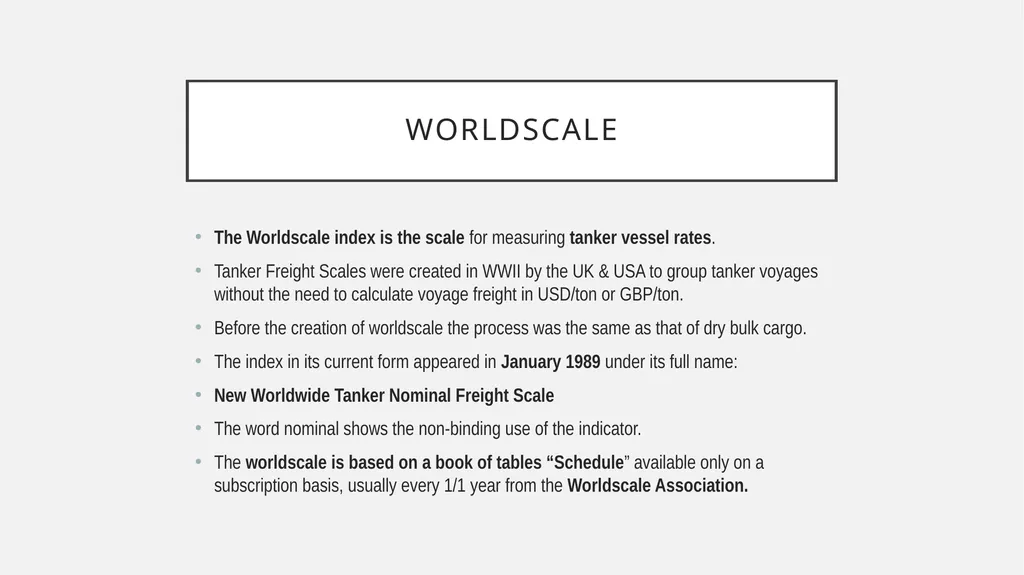
slide2. Worldscale The Worldscale index is the scale for measuring tanker vessel rates.
Tanker Freight Scales were created in WWII by the UK & USA to group tanker voyages without the need to calculate voyage freight in USD/ton or GBP/ton.
Before the creation of worldscale the process was the same as that of dry bulk cargo.
The index in its current form appeared in January 1989 under its full name:
New Worldwide Tanker Nominal Freight Scale
The word nominal shows the non-binding use of the indicator.
The worldscale is based on a book of tables “Schedule” available only on a subscription basis, usually every 1/1 year from the Worldscale Association.<br>
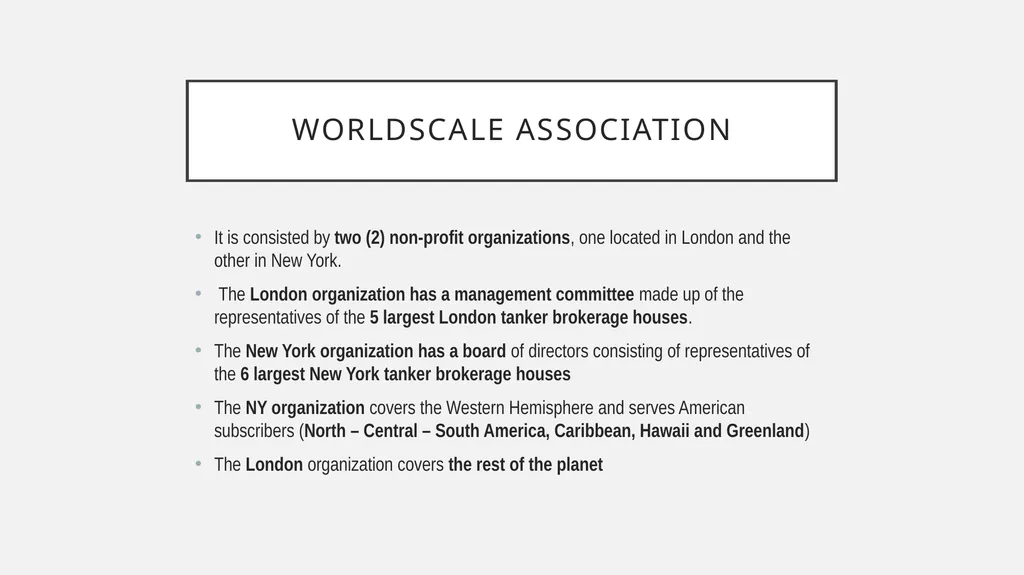
slide3. Worldscale association It is consisted by two (2) non-profit organizations, one located in London and the other in New York.
The London organization has a management committee made up of the representatives of the 5 largest London tanker brokerage houses.
The New York organization has a board of directors consisting of representatives of the 6 largest New York tanker brokerage houses
The NY organization covers the Western Hemisphere and serves American subscribers (North – Central – South America, Caribbean, Hawaii and Greenland)
The London organization covers the rest of the planet<br>
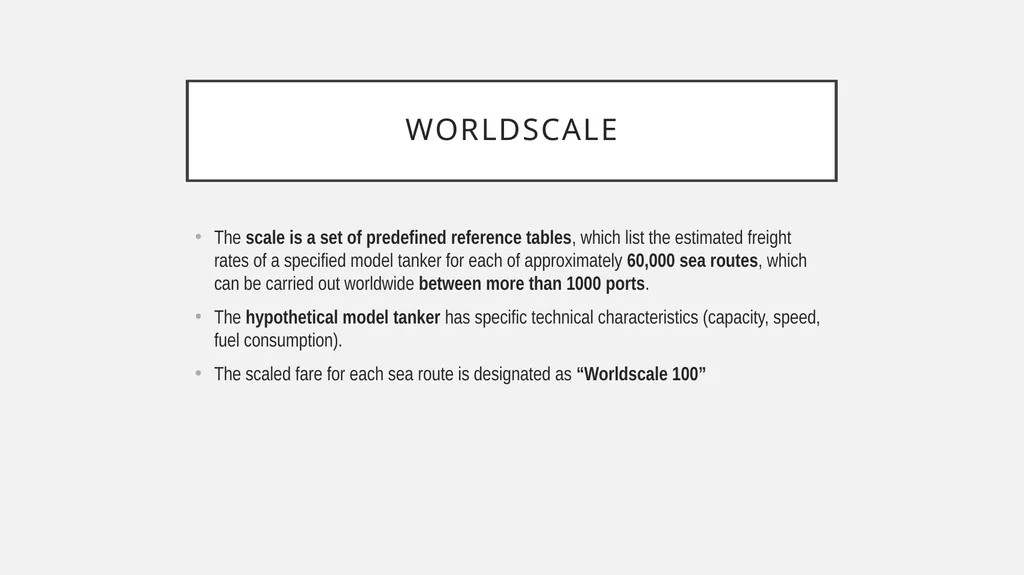
slide4. worldscale The scale is a set of predefined reference tables, which list the estimated freight rates of a specified model tanker for each of approximately 60,000 sea routes, which can be carried out worldwide between more than 1000 ports.
The hypothetical model tanker has specific technical characteristics (capacity, speed, fuel consumption).
The scaled fare for each sea route is designated as “Worldscale 100”<br>
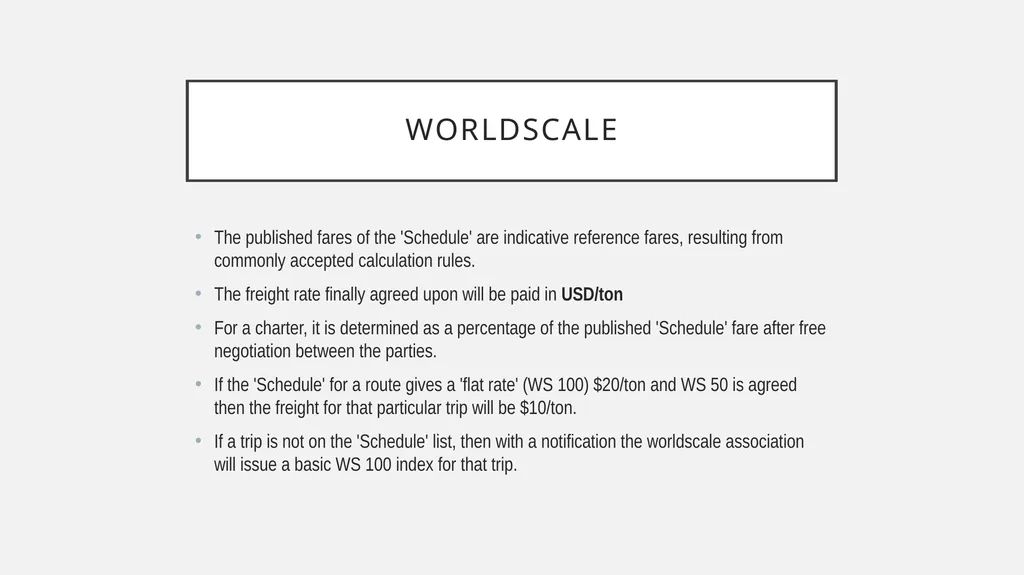
slide5. Worldscale The published fares of the 'Schedule' are indicative reference fares, resulting from commonly accepted calculation rules.
The freight rate finally agreed upon will be paid in USD/ton
For a charter, it is determined as a percentage of the published 'Schedule' fare after free negotiation between the parties.
If the 'Schedule' for a route gives a 'flat rate' (WS 100) $20/ton and WS 50 is agreed then the freight for that particular trip will be $10/ton.
If a trip is not on the 'Schedule' list, then with a notification the worldscale association will issue a basic WS 100 index for that trip.<br>
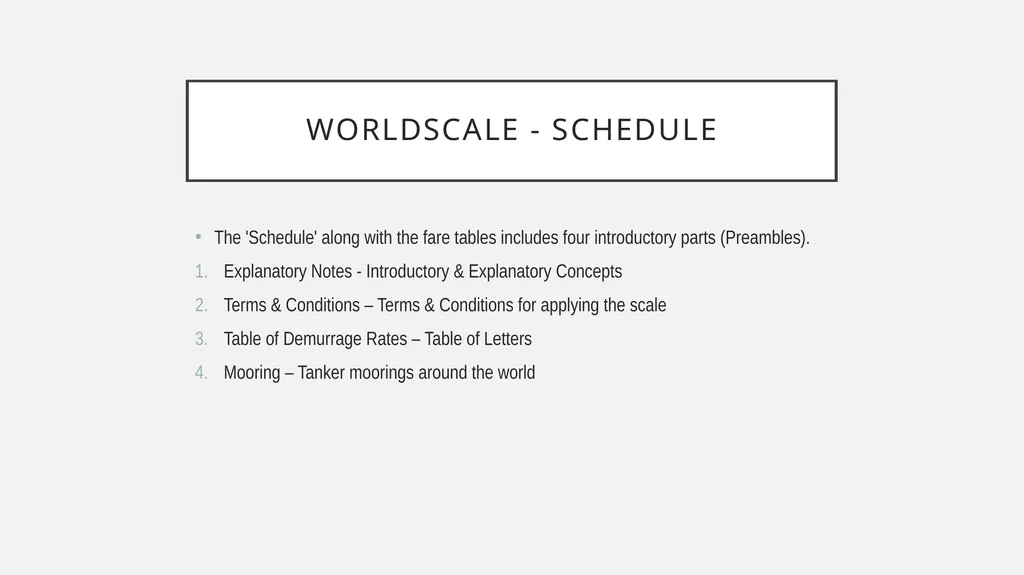
slide6. Worldscale - schedule The 'Schedule' along with the fare tables includes four introductory parts (Preambles).
Explanatory Notes - Introductory & Explanatory Concepts
Terms & Conditions – Terms & Conditions for applying the scale
Table of Demurrage Rates – Table of Letters
Mooring – Tanker moorings around the world<br>
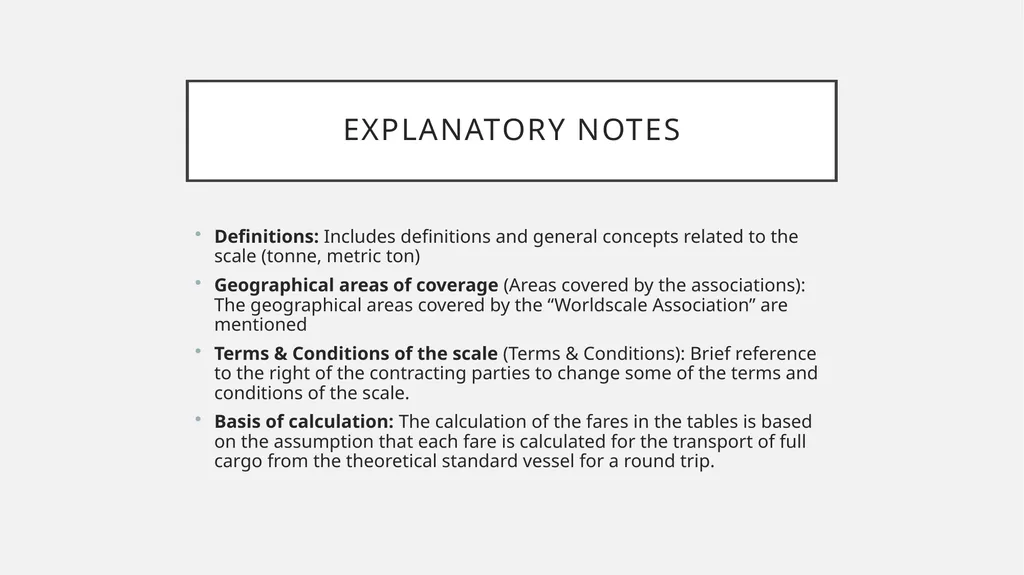
slide7. Explanatory notes Definitions: Includes definitions and general concepts related to the scale (tonne, metric ton)
Geographical areas of coverage (Areas covered by the associations): The geographical areas covered by the “Worldscale Association” are mentioned
Terms & Conditions of the scale (Terms & Conditions): Brief reference to the right of the contracting parties to change some of the terms and conditions of the scale.
Basis of calculation: The calculation of the fares in the tables is based on the assumption that each fare is calculated for the transport of full cargo from the theoretical standard vessel for a round trip.<br>
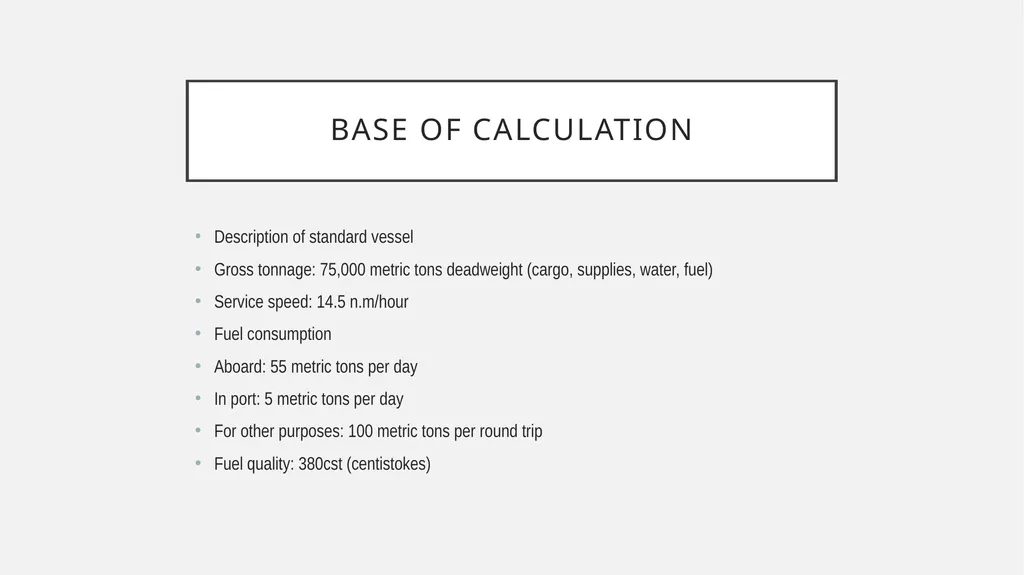
slide8. Base of calculation Description of standard vessel
Gross tonnage: 75,000 metric tons deadweight (cargo, supplies, water, fuel)
Service speed: 14.5 n.m/hour
Fuel consumption
Aboard: 55 metric tons per day
In port: 5 metric tons per day
For other purposes: 100 metric tons per round trip
Fuel quality: 380cst (centistokes)<br>
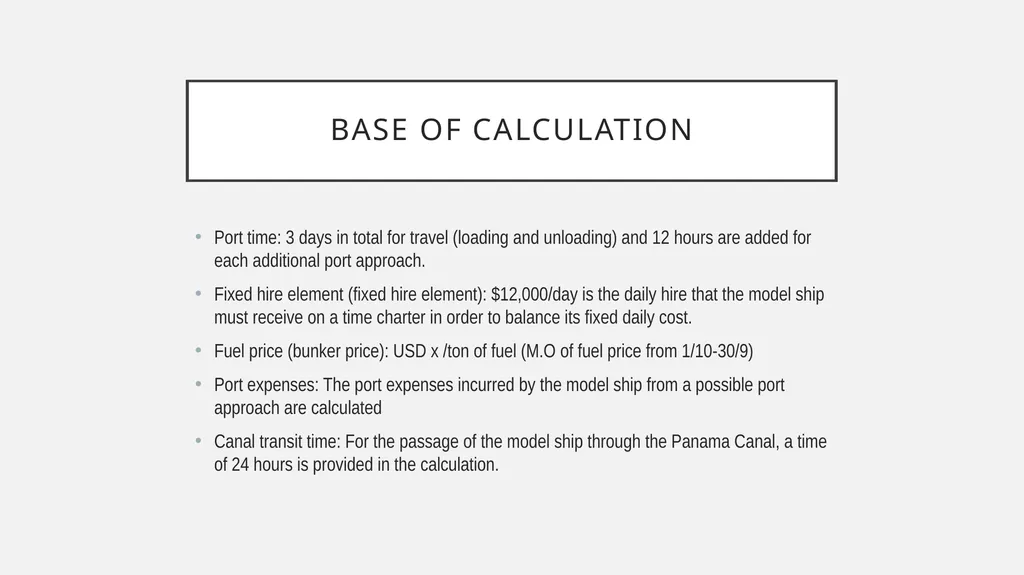
slide9. Base of calculation Port time: 3 days in total for travel (loading and unloading) and 12 hours are added for each additional port approach.
Fixed hire element (fixed hire element): $12,000/day is the daily hire that the model ship must receive on a time charter in order to balance its fixed daily cost.
Fuel price (bunker price): USD x /ton of fuel (M.O of fuel price from 1/10-30/9)
Port expenses: The port expenses incurred by the model ship from a possible port approach are calculated
Canal transit time: For the passage of the model ship through the Panama Canal, a time of 24 hours is provided in the calculation.<br>
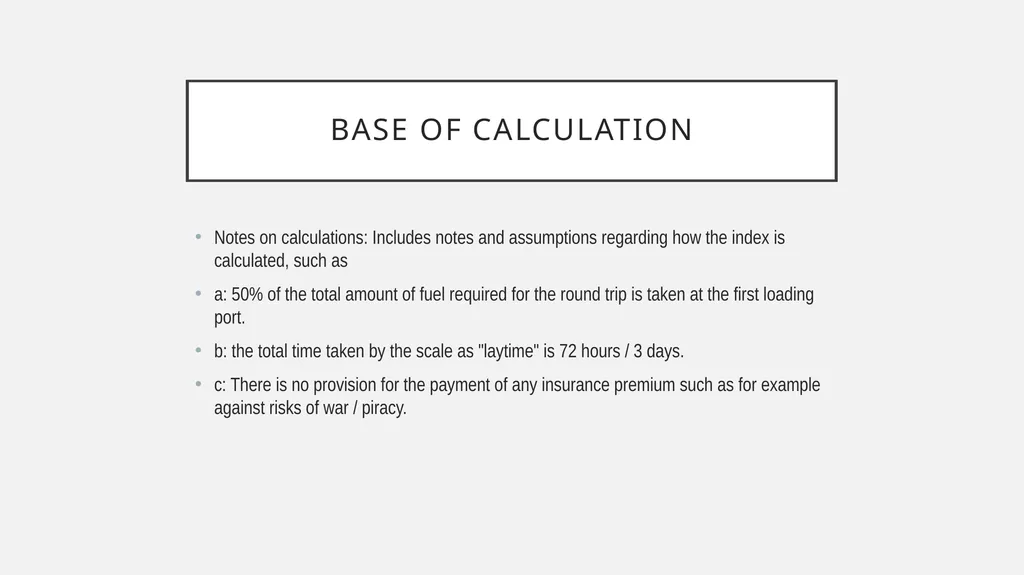
slide10. Base of calculation Notes on calculations: Includes notes and assumptions regarding how the index is calculated, such as
a: 50% of the total amount of fuel required for the round trip is taken at the first loading port.
b: the total time taken by the scale as "laytime" is 72 hours / 3 days.
c: There is no provision for the payment of any insurance premium such as for example against risks of war / piracy.<br>
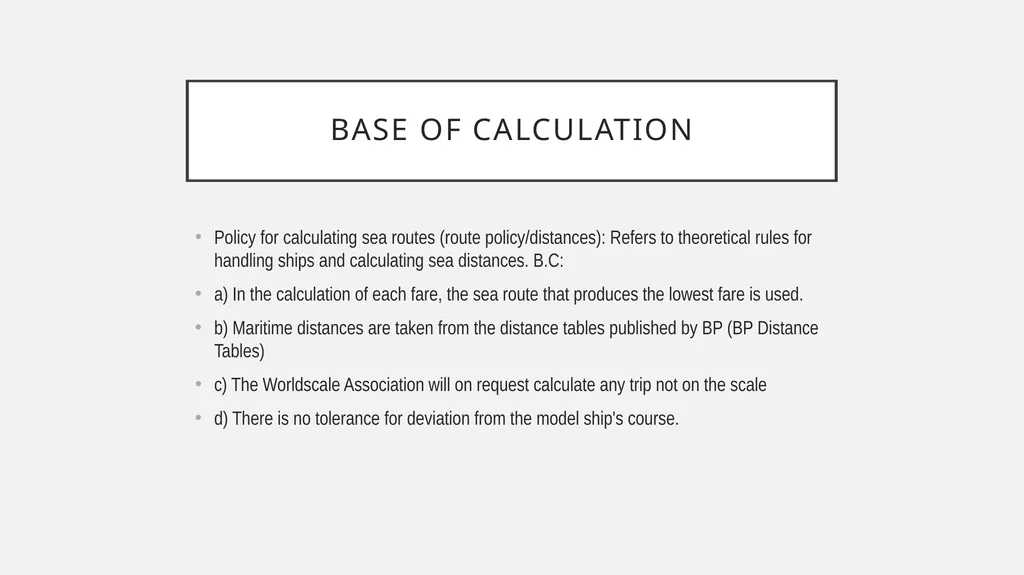
slide11. Base of calculation Policy for calculating sea routes (route policy/distances): Refers to theoretical rules for handling ships and calculating sea distances. B.C:
a) In the calculation of each fare, the sea route that produces the lowest fare is used.
b) Maritime distances are taken from the distance tables published by BP (BP Distance Tables)
c) The Worldscale Association will on request calculate any trip not on the scale
d) There is no tolerance for deviation from the model ship's course.<br>
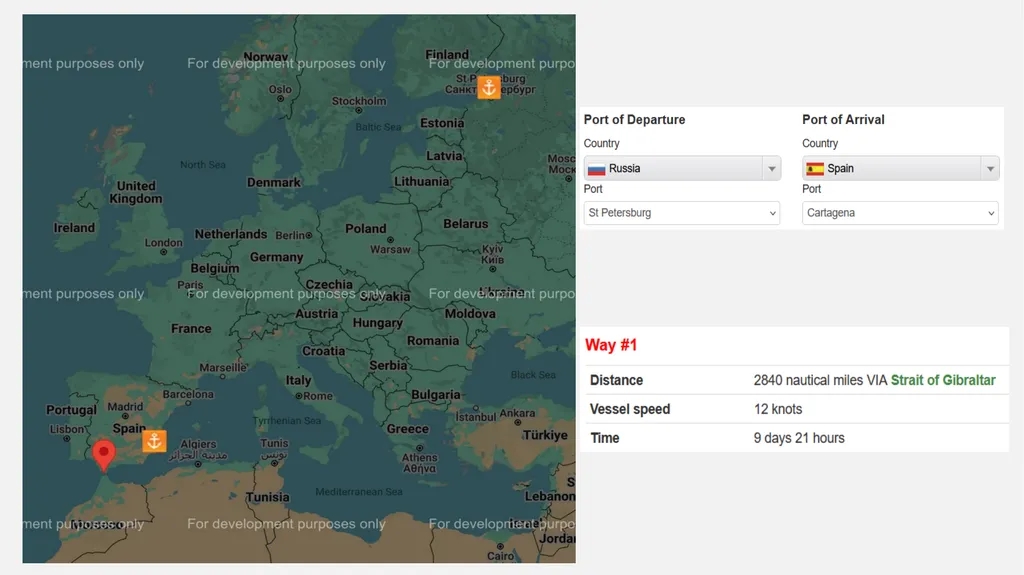
slide12. Base of calculation Policy for calculating sea routes (route policy/distances): The following abbreviations refer to sea routes, where the second part of the journey is always considered ballast.
C: Cape of Good Hope laden and ballast
CS: Cape of Good Hope (laden) and via Suez Canal (ballast)
S: Via Suez Canal (laden) & (ballast)
P: Via Panama Canal (laden) & (ballast)
CP: Cape of Good Hope laden and Panama Canal (ballast)
H: Through Cape Horn (laden) & (ballast)
CH: Cape of Good Hope (laden) and Cape Horn (ballast)<br>
slide13. Base of calculation Assessment of port costs:
Includes all port charges incurred by the shipowner on each voyage Lighterage,
pilot costs,
towing costs,
terminal charges,
ship mooring costs,
tugs and boats on hand,
port charges,
wharfage,
tonnage fees,
boat fees,
customs fees,
free society expenses,
customs overtime,
agency costs<br>
slide14. Base of calculation Table revision policy (Revision policy): The tables are revised every January 1 of each year by the Worldscale Associations London & New York.
Transshipment Areas (TSA):
Transloading areas are defined as locations located far from the coasts and outside the commercial limits of the port, they do not have port infrastructure for loading / unloading and mooring.
There the cargo is transferred from large ships to smaller ones or vice versa (Ship to Ship)
The scale refers to the calculation of fares that concern transshipment areas.<br>
slide15. Terms & conditions Effective Date of the scale (Effective Date)
Estimated shipping time (Laytime)
Port & Terminal Combinations: e.g. GREECE: Piraeus, Drapetsona Bay, Perama, Saint George Harbor
Expenses on behalf of the ship owner (Owner's Account): It is stipulated that the ship owner is responsible for the payment of all dues and other port charges imposed on the ship.
Charges to the Charterer's Account: It is stipulated that the charterer is responsible for the payment of all fees and charges imposed on the cargo.<br>
slide16. Table of demurrage rates The Schedule lists a table of letters which classifies tankers into 29 classes according to their size and calculates a daily amount of letters for each of these classes.
When estimating each letter amount in the table, the scale takes into account a provision for the cost of one day of fuel consumption in the port with engines on standby (stand by) but does not calculate any port costs during the overtime period.
If in a charter a ship is "closed" with a WS 70 fare it is usual that the same rate applies to the calculation of the demurrage payable<br>
slide17. Mooring list List 1: Includes all ports in the scale in alphabetical order, the transshipment areas, the country in which each port is located, as well as the relevant port for which the table rates are calculated.
Eg Canvey Island (London rates apply) – United Kingdom
List 2: Includes ports of call, listing the states to which they belong in alphabetical order. Also mentioned is the nearby port of the area for which the table fares are calculated.
Eg Nigeria: Bonny Anchorage (Bonny Rates Apply)
List 3: Includes all Transport Areas (TSA) by geographic region
Eg U.S Gulf: Offshore Galveston No.1, 28 27 N 94 30 W, Offshore Texas<br>
slide18. Fixed rate differencials They refer to additional special costs incurred by the shipowner on the particular voyage.
Variables are usually calculated in USD/ton of cargo or USD/Gross Tonnage
Typical examples of such costs are:
Costs of crossing channels / canals
Charges on the quantity of cargo loaded and unloaded
Oil spill insurance<br>
slide19. Variable rate differentials They are factors related to variations from the usual process of carrying out a journey, which cause variations in the calculation of the normal cost of the journey and therefore in the final fare of the tables (Flat Rate).
Cost differentiation can involve increasing or decreasing it.<br>
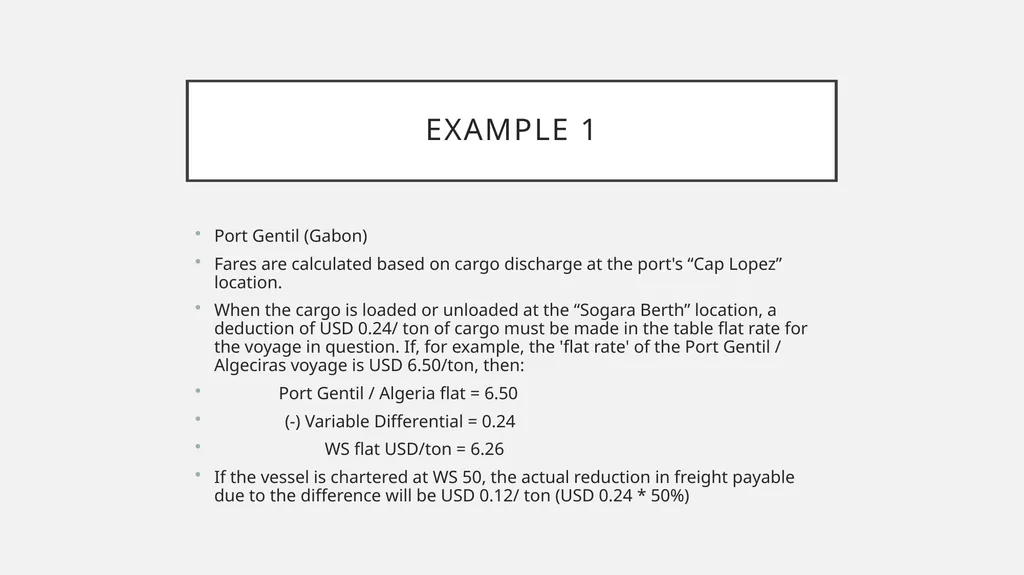
slide20. Example 1 Port Gentil (Gabon)
Fares are calculated based on cargo discharge at the port's “Cap Lopez” location.
When the cargo is loaded or unloaded at the “Sogara Berth” location, a deduction of USD 0.24/ ton of cargo must be made in the table flat rate for the voyage in question. If, for example, the 'flat rate' of the Port Gentil / Algeciras voyage is USD 6.50/ton, then:
Port Gentil / Algeria flat = 6.50
(-) Variable Differential = 0.24
WS flat USD/ton = 6.26
If the vessel is chartered at WS 50, the actual reduction in freight payable due to the difference will be USD 0.12/ ton (USD 0.24 * 50%)<br>
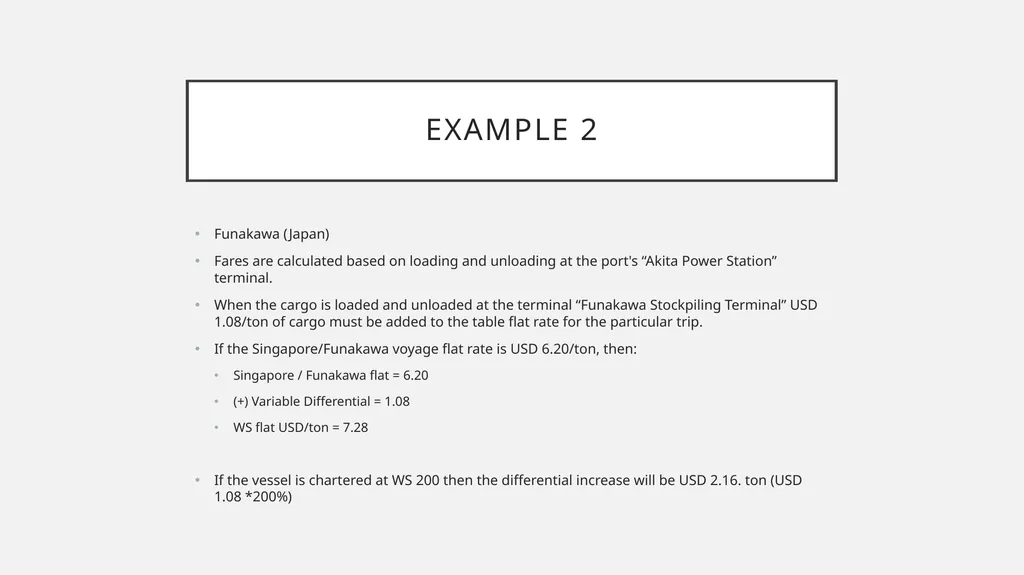
slide21. Example 2 Funakawa (Japan)
Fares are calculated based on loading and unloading at the port's “Akita Power Station” terminal.
When the cargo is loaded and unloaded at the terminal “Funakawa Stockpiling Terminal” USD 1.08/ton of cargo must be added to the table flat rate for the particular trip.
If the Singapore/Funakawa voyage flat rate is USD 6.20/ton, then:
Singapore / Funakawa flat = 6.20
(+) Variable Differential = 1.08
WS flat USD/ton = 7.28
If the vessel is chartered at WS 200 then the differential increase will be USD 2.16. ton (USD 1.08 *200%)<br>
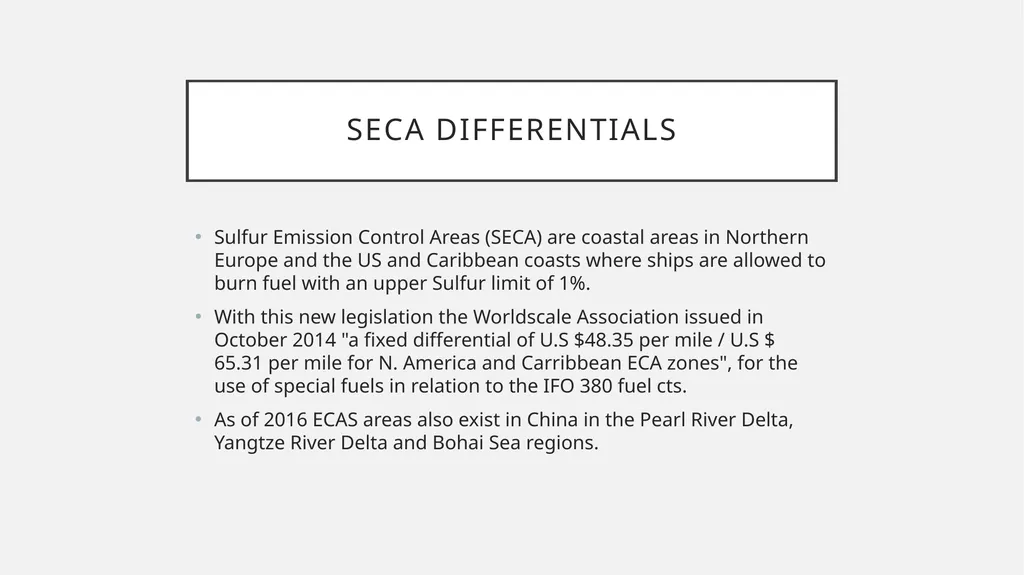
slide22. SECA Differentials Sulfur Emission Control Areas (SECA) are coastal areas in Northern Europe and the US and Caribbean coasts where ships are allowed to burn fuel with an upper Sulfur limit of 1%.
With this new legislation the Worldscale Association issued in October 2014 "a fixed differential of U.S $48.35 per mile / U.S $ 65.31 per mile for N. America and Carribbean ECA zones", for the use of special fuels in relation to the IFO 380 fuel cts.
As of 2016 ECAS areas also exist in China in the Pearl River Delta, Yangtze River Delta and Bohai Sea regions.<br>
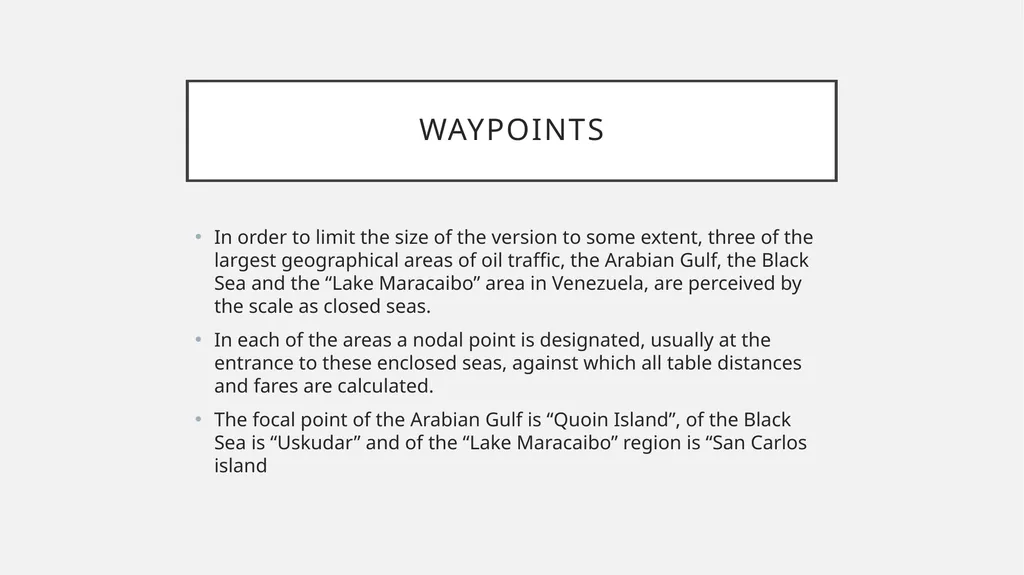
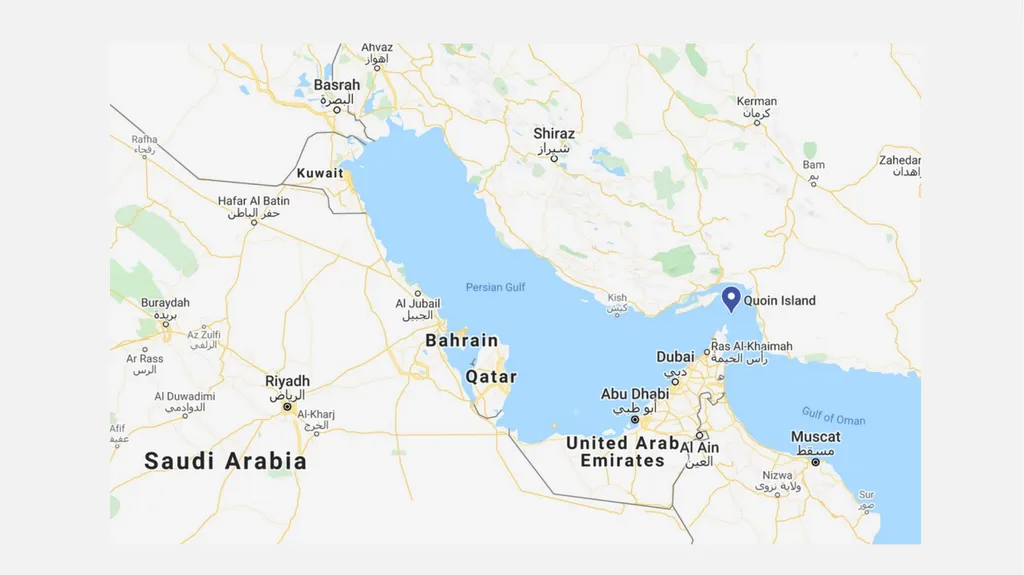
slide23. waypoints In order to limit the size of the version to some extent, three of the largest geographical areas of oil traffic, the Arabian Gulf, the Black Sea and the “Lake Maracaibo” area in Venezuela, are perceived by the scale as closed seas.
In each of the areas a nodal point is designated, usually at the entrance to these enclosed seas, against which all table distances and fares are calculated.
The focal point of the Arabian Gulf is “Quoin Island”, of the Black Sea is “Uskudar” and of the “Lake Maracaibo” region is “San Carlos island<br>
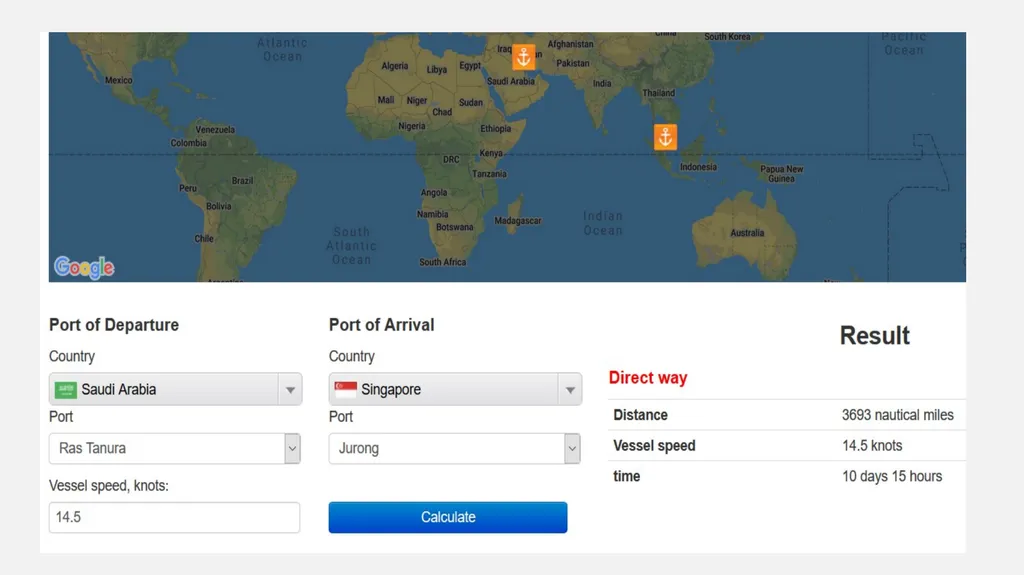
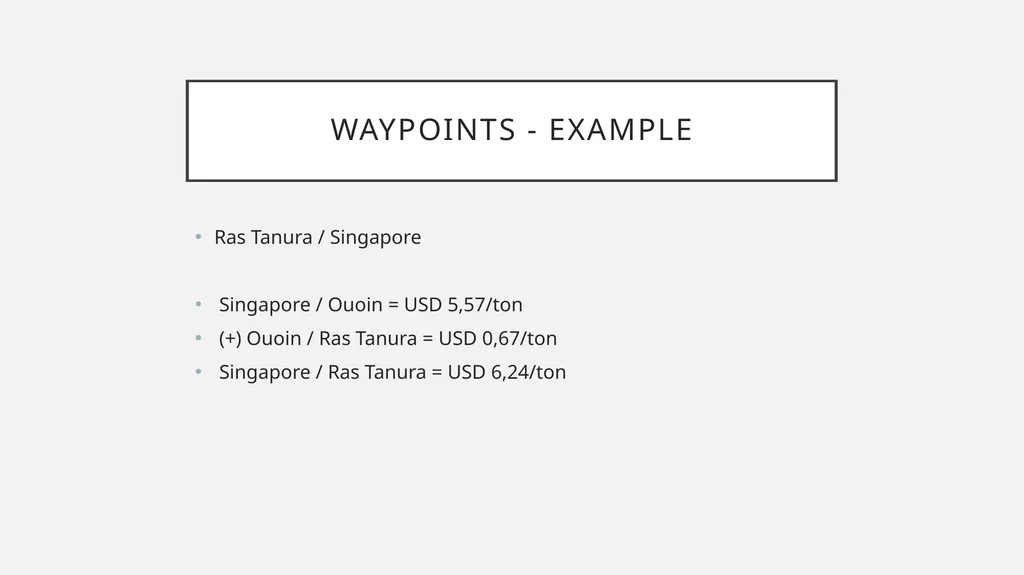
slide26. Waypoints - example Ras Tanura / Singapore
Singapore / Ouoin = USD 5,57/ton
(+) Ouoin / Ras Tanura = USD 0,67/ton
Singapore / Ras Tanura = USD 6,24/ton<br>
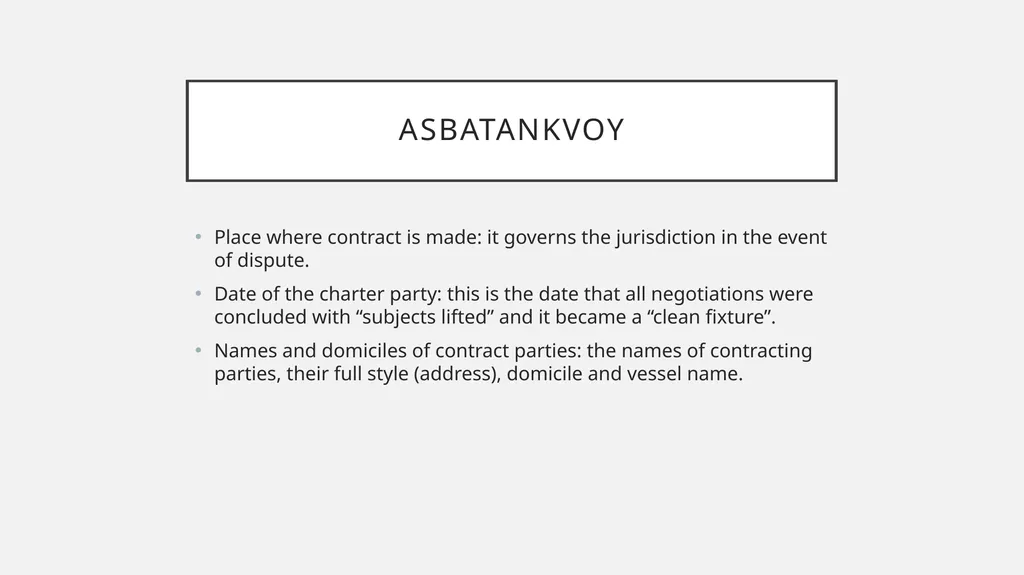
slide29. ASBATANKVOY Place where contract is made: it governs the jurisdiction in the event of dispute.
Date of the charter party: this is the date that all negotiations were concluded with “subjects lifted” and it became a “clean fixture”.
Names and domiciles of contract parties: the names of contracting parties, their full style (address), domicile and vessel name.<br>
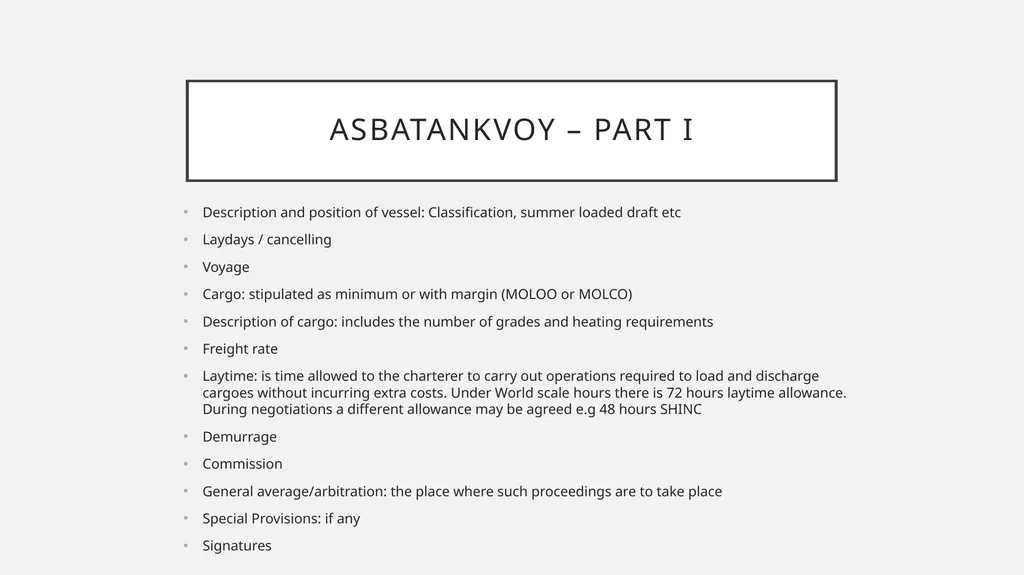
slide30. ASBATANKVOY – part i Description and position of vessel: Classification, summer loaded draft etc
Laydays / cancelling
Voyage
Cargo: stipulated as minimum or with margin (MOLOO or MOLCO)
Description of cargo: includes the number of grades and heating requirements
Freight rate
Laytime: is time allowed to the charterer to carry out operations required to load and discharge cargoes without incurring extra costs. Under World scale hours there is 72 hours laytime allowance. During negotiations a different allowance may be agreed e.g 48 hours SHINC
Demurrage
Commission
General average/arbitration: the place where such proceedings are to take place
Special Provisions: if any
Signatures<br>
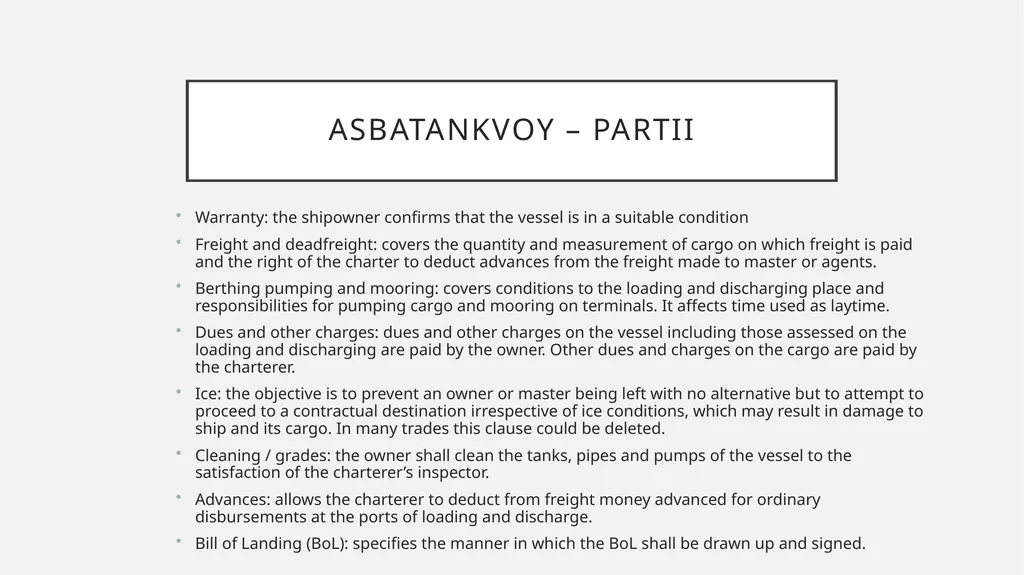
slide31. ASBATANKVOY – partII Warranty: the shipowner confirms that the vessel is in a suitable condition
Freight and deadfreight: covers the quantity and measurement of cargo on which freight is paid and the right of the charter to deduct advances from the freight made to master or agents.
Berthing pumping and mooring: covers conditions to the loading and discharging place and responsibilities for pumping cargo and mooring on terminals. It affects time used as laytime.
Dues and other charges: dues and other charges on the vessel including those assessed on the loading and discharging are paid by the owner. Other dues and charges on the cargo are paid by the charterer.
Ice: the objective is to prevent an owner or master being left with no alternative but to attempt to proceed to a contractual destination irrespective of ice conditions, which may result in damage to ship and its cargo. In many trades this clause could be deleted.
Cleaning / grades: the owner shall clean the tanks, pipes and pumps of the vessel to the satisfaction of the charterer’s inspector.
Advances: allows the charterer to deduct from freight money advanced for ordinary disbursements at the ports of loading and discharge.
Bill of Landing (BoL): specifies the manner in which the BoL shall be drawn up and signed.<br>
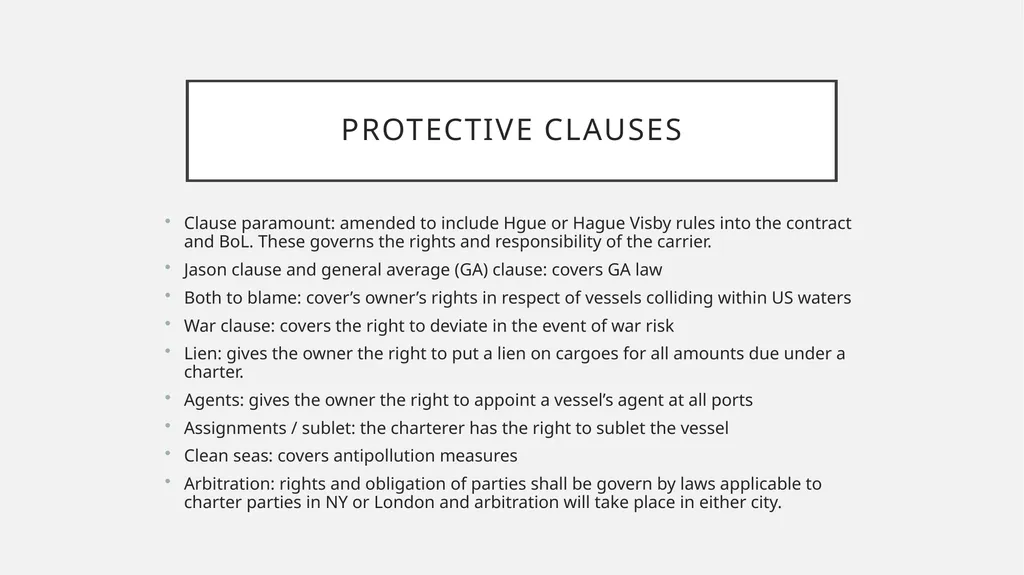
slide32. Protective clauses Clause paramount: amended to include Hgue or Hague Visby rules into the contract and BoL. These governs the rights and responsibility of the carrier.
Jason clause and general average (GA) clause: covers GA law
Both to blame: cover’s owner’s rights in respect of vessels colliding within US waters
War clause: covers the right to deviate in the event of war risk
Lien: gives the owner the right to put a lien on cargoes for all amounts due under a charter.
Agents: gives the owner the right to appoint a vessel’s agent at all ports
Assignments / sublet: the charterer has the right to sublet the vessel
Clean seas: covers antipollution measures
Arbitration: rights and obligation of parties shall be govern by laws applicable to charter parties in NY or London and arbitration will take place in either city.<br>
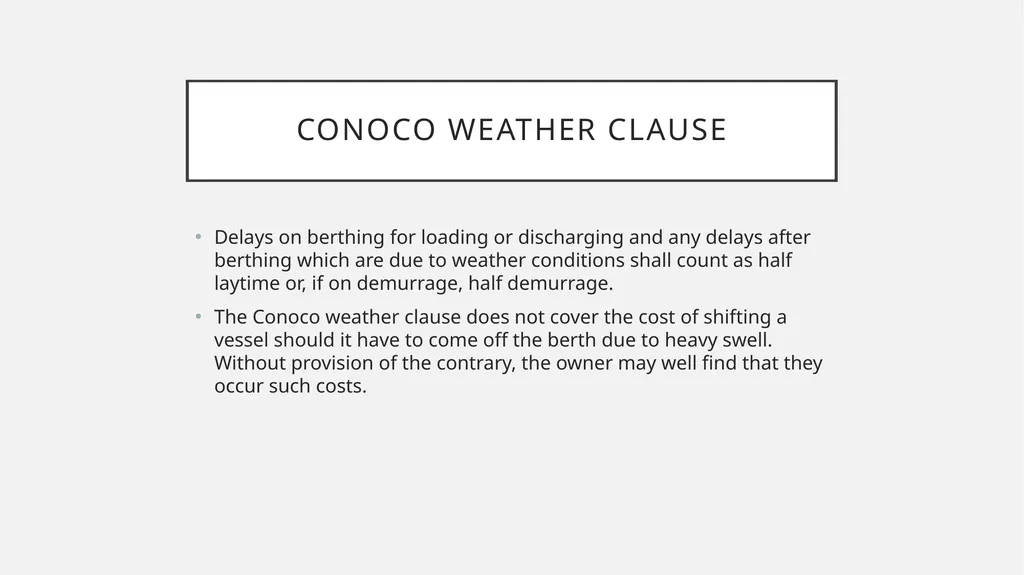
slide33. Conoco weather clause Delays on berthing for loading or discharging and any delays after berthing which are due to weather conditions shall count as half laytime or, if on demurrage, half demurrage.
The Conoco weather clause does not cover the cost of shifting a vessel should it have to come off the berth due to heavy swell. Without provision of the contrary, the owner may well find that they occur such costs.<br>
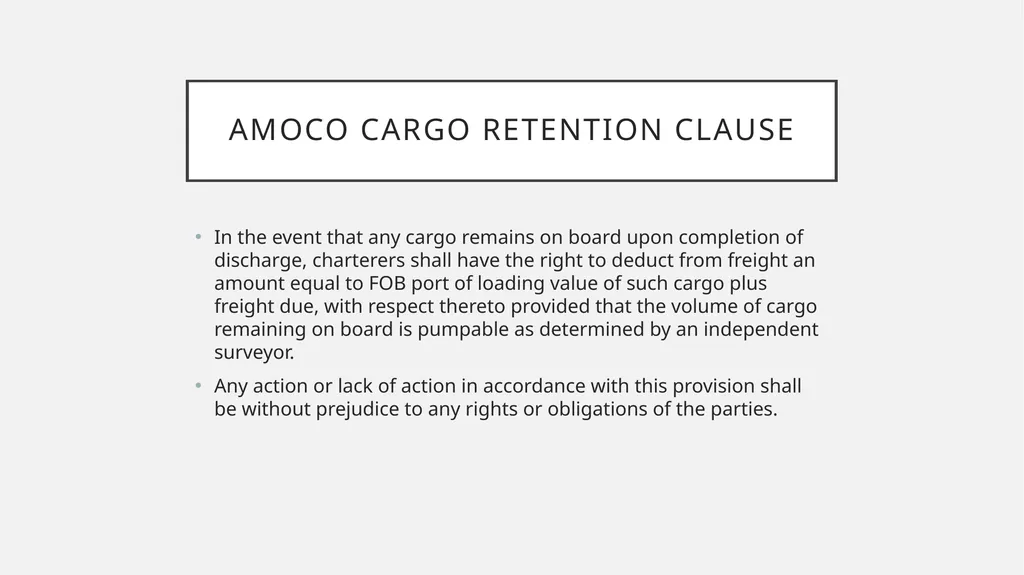
slide34. Amoco cargo retention clause In the event that any cargo remains on board upon completion of discharge, charterers shall have the right to deduct from freight an amount equal to FOB port of loading value of such cargo plus freight due, with respect thereto provided that the volume of cargo remaining on board is pumpable as determined by an independent surveyor.
Any action or lack of action in accordance with this provision shall be without prejudice to any rights or obligations of the parties.<br>
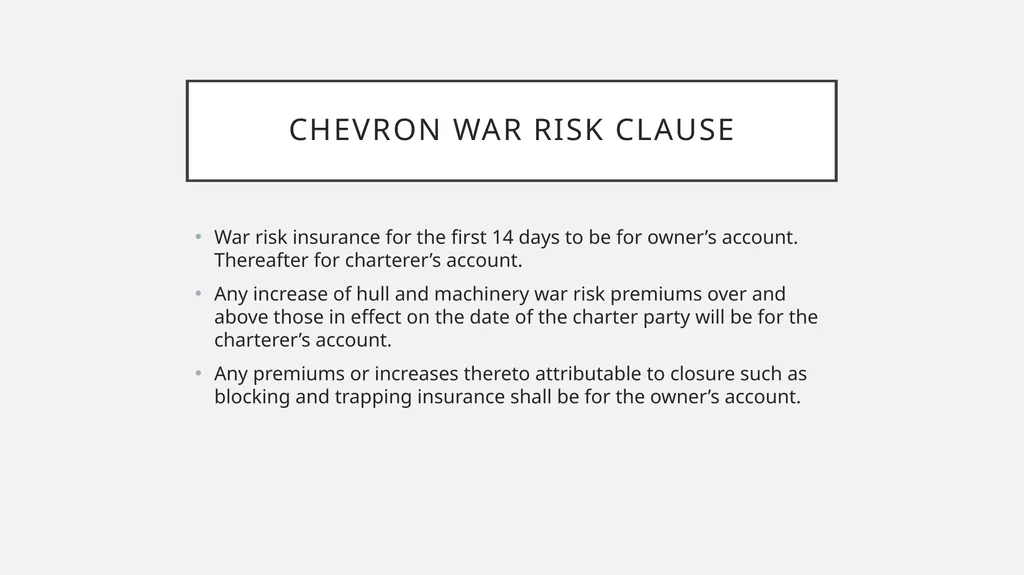
slide35. Chevron war risk clause War risk insurance for the first 14 days to be for owner’s account. Thereafter for charterer’s account.
Any increase of hull and machinery war risk premiums over and above those in effect on the date of the charter party will be for the charterer’s account.
Any premiums or increases thereto attributable to closure such as blocking and trapping insurance shall be for the owner’s account.<br>
slide36. Cleaning Without prejudice and in addition to owner’s obligations elsewhere in this charter to present vessel with clean cargo tanks, pumps, and pipes, the vessel shall arrive at the loading port with all cargo tanks, pumps and pipes cleaned to charterer’s inspector’s satisfaction.
Owners shall ensure that all traces of sediment, tank washings or chemicals, if used, are removed from tanks, pumps and pipes intended for the carriage of the designated cargo.
If the vessel is unclean at the cancelling deadline, charterers will retain its cancellation option until 24 hours after cancelling deadline or until 24 hours after the inspector first rejects the vessel, whichever is later.<br>
slide37. Lightering/ ship to ship clause If lightering transfer operation is required same always to be in accordance with OCIMF latest edition of STS transfer.
Charterers to supply all fenders/lines/hoses and any other equipment required for such an operation at charter’s time and expenses and always subject to master’s approval.
Time to count in full 6 hours after tendering NOR or when first lighter vessel is alongside, whichever earlier, until last line/fender is off and lighter vessel has sailed.
Time lost due to tide and / or weather and /or sea conditions to count in full as laytime or demurrage if on demurrage.
If the vessel is required to complete cargo operation at a berth in port charterers will not have the benefit of 6 hours not prior berthing in port.
Charterers warrant that there is no prohibition or restriction on STS operation at port/place to which the vessel is ordered to perform sts transfer and further that they have obtained any/all necessary local approvals or licenses to carry out operations at the designated port/place.<br>
slide38. Time bar Charterers shall be discharged and released from all and any liability in respect of any claims owners may have under the C/P (e.g deadfreight, demurrage, detention etc) unless a claim has been presented to charterers in writing with supporting documents within 60 days from completion of discharge of the cargo concerned under the C/P.<br>
slide39. Inert gas Owner warrants that the vessel has operable an inert gasnsystem abroad the vessel and that this system shall be operational during duration of this charter party.
Master may be required by terminal personnel, charterer or independent inspectors to breach the gas system for the purpose of gauging, sampling, temperature determination or determining the quantity of cargo remaining on board after discharge.
Master shall comply, consistent with the safe operation of the vessel and regulations of the port.
This clause does not specify whether laytime will count during such operations.<br>
slide40. Crude oil washing The charterer shall have the right to require the vessel, if it so equipped to crude oil wash the cargo tanks, and, in such case, the allowed pumping hours shall be increased by a negotiated amount of time.<br>
slide41. Worldscale Worldscale hours, terms and conditions as per date of loading to apply to this C/P<br>
slide42. Pumping clause The owner warrants that the vessel will discharge its entire cargo within 24hours or will maintain 100psi at the ship’s rail.
The main causes of delay in pumping the cargo are:
The vessel’s boilers or pumps are unable to provide the rate or maintain the pressure required in the C/P
Residues on tanks’ bottoms extend stripping time, especially if cargo has a high viscosity
The shore tanks are at a much greater elevation than the tanker
The terminal provided too few hoses or hoses that are too small or shore valves have been deliberately closed.
Shore instructions require the tanker to reduce pumping pressure. This calls for a protest from the master.<br>
slide43. speed Usually an agreed economic speed or range of speeds is included in the charter and the ship is expected to perform at that speed, weather and safe navigation permitting.<br>
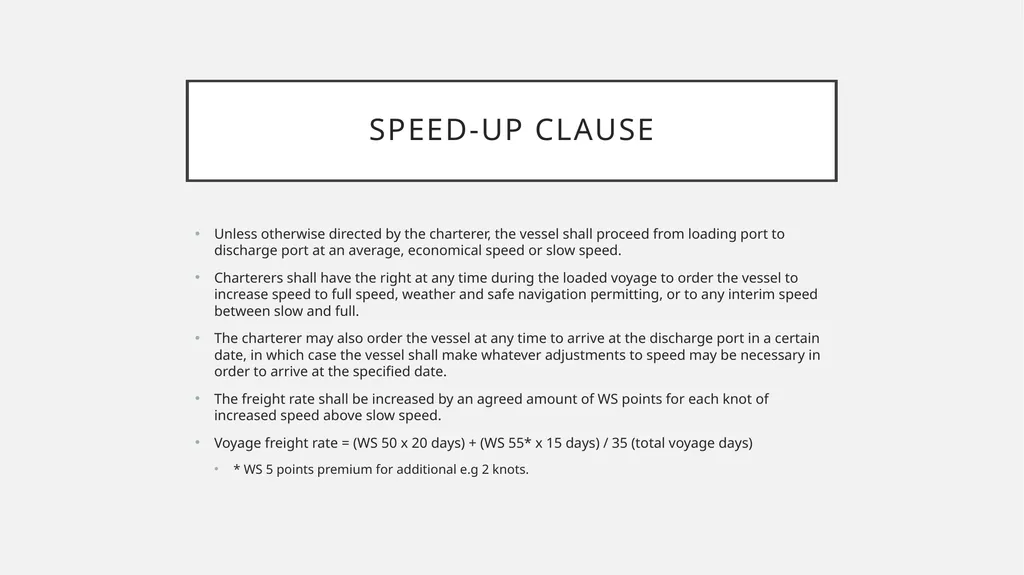
slide44. Speed-up clause Unless otherwise directed by the charterer, the vessel shall proceed from loading port to discharge port at an average, economical speed or slow speed.
Charterers shall have the right at any time during the loaded voyage to order the vessel to increase speed to full speed, weather and safe navigation permitting, or to any interim speed between slow and full.
The charterer may also order the vessel at any time to arrive at the discharge port in a certain date, in which case the vessel shall make whatever adjustments to speed may be necessary in order to arrive at the specified date.
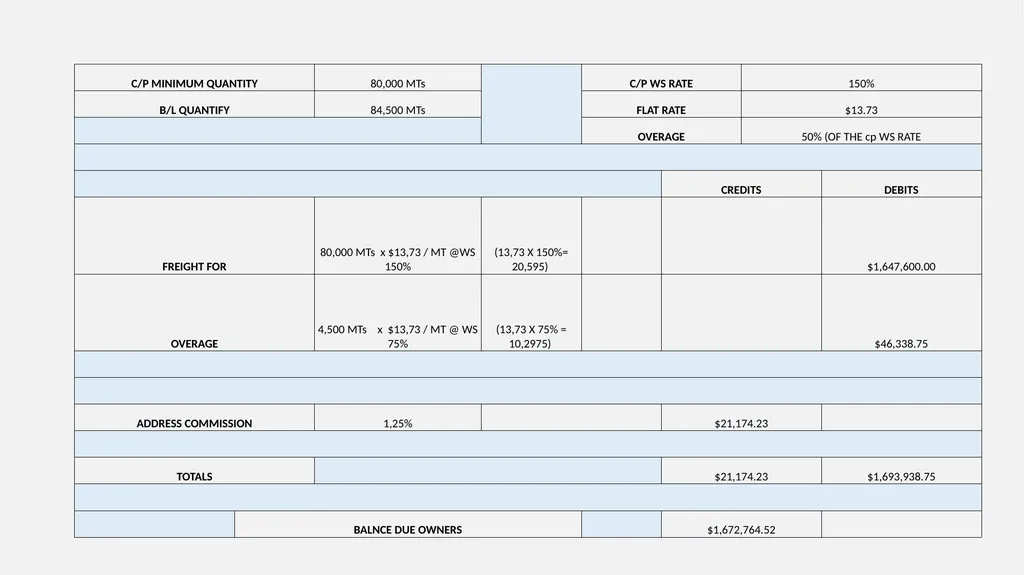
The freight rate shall be increased by an agreed amount of WS points for each knot of increased speed above slow speed.
Voyage freight rate = (WS 50 x 20 days) + (WS 55* x 15 days) / 35 (total voyage days)
* WS 5 points premium for additional e.g 2 knots.<br>
slide45. Exxonmobil drug and alcohol policy clause The owner warrants that it has a policy on drug and alcohol abuse applicable to the vessel which meets or exceeds the standards in the Oil Companies International Marine Forum Guidelines for drugs and alcohol on board vessels (ODIMF Guidelines)
Under most legal systems, no crew member is obliged to submit to a random testing of alcohol content in the system and a testing must be expressly be permitted by law, presumably by the law of the flag of the ship.<br>
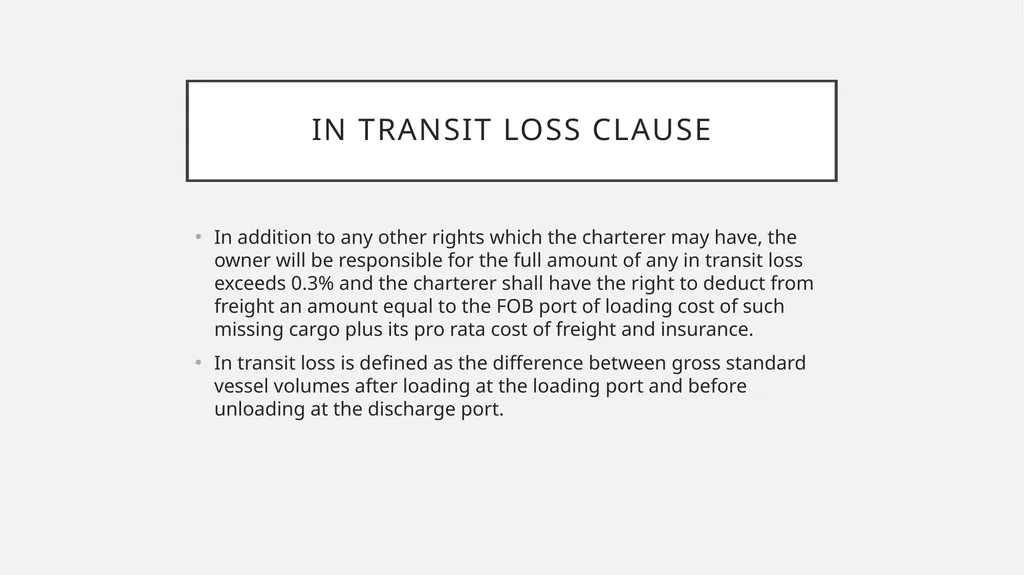
slide46. In transit loss clause In addition to any other rights which the charterer may have, the owner will be responsible for the full amount of any in transit loss exceeds 0.3% and the charterer shall have the right to deduct from freight an amount equal to the FOB port of loading cost of such missing cargo plus its pro rata cost of freight and insurance.
In transit loss is defined as the difference between gross standard vessel volumes after loading at the loading port and before unloading at the discharge port.<br>
slide47. privacy All negotiations and details of this fixture shall be kept strictly private and confidential.<br>
slide48. questionnaires Q88 have become a permanent part of negotiations in chemical cargoes and most charterers will not proceed until they have reviewed an updated Q88 from the owners covering all updated crew details, certificates and inspection dates.<br>
slide49. Letters of indemnity The are four instance when an LOI is required:
Non-production of bills of lading
Actual discharge port differ from that shown on the bill of lading
The commingling of grades of cargo
Adding dye or component to a cargo<br>
slide2. Worldscale The Worldscale index is the scale for measuring tanker vessel rates.
Tanker Freight Scales were created in WWII by the UK & USA to group tanker voyages without the need to calculate voyage freight in USD/ton or GBP/ton.
Before the creation of worldscale the process was the same as that of dry bulk cargo.
The index in its current form appeared in January 1989 under its full name:
New Worldwide Tanker Nominal Freight Scale
The word nominal shows the non-binding use of the indicator.
The worldscale is based on a book of tables “Schedule” available only on a subscription basis, usually every 1/1 year from the Worldscale Association.<br>
slide3. Worldscale association It is consisted by two (2) non-profit organizations, one located in London and the other in New York.
The London organization has a management committee made up of the representatives of the 5 largest London tanker brokerage houses.
The New York organization has a board of directors consisting of representatives of the 6 largest New York tanker brokerage houses
The NY organization covers the Western Hemisphere and serves American subscribers (North – Central – South America, Caribbean, Hawaii and Greenland)
The London organization covers the rest of the planet<br>
slide4. worldscale The scale is a set of predefined reference tables, which list the estimated freight rates of a specified model tanker for each of approximately 60,000 sea routes, which can be carried out worldwide between more than 1000 ports.
The hypothetical model tanker has specific technical characteristics (capacity, speed, fuel consumption).
The scaled fare for each sea route is designated as “Worldscale 100”<br>
slide5. Worldscale The published fares of the 'Schedule' are indicative reference fares, resulting from commonly accepted calculation rules.
The freight rate finally agreed upon will be paid in USD/ton
For a charter, it is determined as a percentage of the published 'Schedule' fare after free negotiation between the parties.
If the 'Schedule' for a route gives a 'flat rate' (WS 100) $20/ton and WS 50 is agreed then the freight for that particular trip will be $10/ton.
If a trip is not on the 'Schedule' list, then with a notification the worldscale association will issue a basic WS 100 index for that trip.<br>
slide6. Worldscale - schedule The 'Schedule' along with the fare tables includes four introductory parts (Preambles).
Explanatory Notes - Introductory & Explanatory Concepts
Terms & Conditions – Terms & Conditions for applying the scale
Table of Demurrage Rates – Table of Letters
Mooring – Tanker moorings around the world<br>
slide7. Explanatory notes Definitions: Includes definitions and general concepts related to the scale (tonne, metric ton)
Geographical areas of coverage (Areas covered by the associations): The geographical areas covered by the “Worldscale Association” are mentioned
Terms & Conditions of the scale (Terms & Conditions): Brief reference to the right of the contracting parties to change some of the terms and conditions of the scale.
Basis of calculation: The calculation of the fares in the tables is based on the assumption that each fare is calculated for the transport of full cargo from the theoretical standard vessel for a round trip.<br>
slide8. Base of calculation Description of standard vessel
Gross tonnage: 75,000 metric tons deadweight (cargo, supplies, water, fuel)
Service speed: 14.5 n.m/hour
Fuel consumption
Aboard: 55 metric tons per day
In port: 5 metric tons per day
For other purposes: 100 metric tons per round trip
Fuel quality: 380cst (centistokes)<br>
slide9. Base of calculation Port time: 3 days in total for travel (loading and unloading) and 12 hours are added for each additional port approach.
Fixed hire element (fixed hire element): $12,000/day is the daily hire that the model ship must receive on a time charter in order to balance its fixed daily cost.
Fuel price (bunker price): USD x /ton of fuel (M.O of fuel price from 1/10-30/9)
Port expenses: The port expenses incurred by the model ship from a possible port approach are calculated
Canal transit time: For the passage of the model ship through the Panama Canal, a time of 24 hours is provided in the calculation.<br>
slide10. Base of calculation Notes on calculations: Includes notes and assumptions regarding how the index is calculated, such as
a: 50% of the total amount of fuel required for the round trip is taken at the first loading port.
b: the total time taken by the scale as "laytime" is 72 hours / 3 days.
c: There is no provision for the payment of any insurance premium such as for example against risks of war / piracy.<br>
slide11. Base of calculation Policy for calculating sea routes (route policy/distances): Refers to theoretical rules for handling ships and calculating sea distances. B.C:
a) In the calculation of each fare, the sea route that produces the lowest fare is used.
b) Maritime distances are taken from the distance tables published by BP (BP Distance Tables)
c) The Worldscale Association will on request calculate any trip not on the scale
d) There is no tolerance for deviation from the model ship's course.<br>
slide12. Base of calculation Policy for calculating sea routes (route policy/distances): The following abbreviations refer to sea routes, where the second part of the journey is always considered ballast.
C: Cape of Good Hope laden and ballast
CS: Cape of Good Hope (laden) and via Suez Canal (ballast)
S: Via Suez Canal (laden) & (ballast)
P: Via Panama Canal (laden) & (ballast)
CP: Cape of Good Hope laden and Panama Canal (ballast)
H: Through Cape Horn (laden) & (ballast)
CH: Cape of Good Hope (laden) and Cape Horn (ballast)<br>
slide13. Base of calculation Assessment of port costs:
Includes all port charges incurred by the shipowner on each voyage Lighterage,
pilot costs,
towing costs,
terminal charges,
ship mooring costs,
tugs and boats on hand,
port charges,
wharfage,
tonnage fees,
boat fees,
customs fees,
free society expenses,
customs overtime,
agency costs<br>
slide14. Base of calculation Table revision policy (Revision policy): The tables are revised every January 1 of each year by the Worldscale Associations London & New York.
Transshipment Areas (TSA):
Transloading areas are defined as locations located far from the coasts and outside the commercial limits of the port, they do not have port infrastructure for loading / unloading and mooring.
There the cargo is transferred from large ships to smaller ones or vice versa (Ship to Ship)
The scale refers to the calculation of fares that concern transshipment areas.<br>
slide15. Terms & conditions Effective Date of the scale (Effective Date)
Estimated shipping time (Laytime)
Port & Terminal Combinations: e.g. GREECE: Piraeus, Drapetsona Bay, Perama, Saint George Harbor
Expenses on behalf of the ship owner (Owner's Account): It is stipulated that the ship owner is responsible for the payment of all dues and other port charges imposed on the ship.
Charges to the Charterer's Account: It is stipulated that the charterer is responsible for the payment of all fees and charges imposed on the cargo.<br>
slide16. Table of demurrage rates The Schedule lists a table of letters which classifies tankers into 29 classes according to their size and calculates a daily amount of letters for each of these classes.
When estimating each letter amount in the table, the scale takes into account a provision for the cost of one day of fuel consumption in the port with engines on standby (stand by) but does not calculate any port costs during the overtime period.
If in a charter a ship is "closed" with a WS 70 fare it is usual that the same rate applies to the calculation of the demurrage payable<br>
slide17. Mooring list List 1: Includes all ports in the scale in alphabetical order, the transshipment areas, the country in which each port is located, as well as the relevant port for which the table rates are calculated.
Eg Canvey Island (London rates apply) – United Kingdom
List 2: Includes ports of call, listing the states to which they belong in alphabetical order. Also mentioned is the nearby port of the area for which the table fares are calculated.
Eg Nigeria: Bonny Anchorage (Bonny Rates Apply)
List 3: Includes all Transport Areas (TSA) by geographic region
Eg U.S Gulf: Offshore Galveston No.1, 28 27 N 94 30 W, Offshore Texas<br>
slide18. Fixed rate differencials They refer to additional special costs incurred by the shipowner on the particular voyage.
Variables are usually calculated in USD/ton of cargo or USD/Gross Tonnage
Typical examples of such costs are:
Costs of crossing channels / canals
Charges on the quantity of cargo loaded and unloaded
Oil spill insurance<br>
slide19. Variable rate differentials They are factors related to variations from the usual process of carrying out a journey, which cause variations in the calculation of the normal cost of the journey and therefore in the final fare of the tables (Flat Rate).
Cost differentiation can involve increasing or decreasing it.<br>
slide20. Example 1 Port Gentil (Gabon)
Fares are calculated based on cargo discharge at the port's “Cap Lopez” location.
When the cargo is loaded or unloaded at the “Sogara Berth” location, a deduction of USD 0.24/ ton of cargo must be made in the table flat rate for the voyage in question. If, for example, the 'flat rate' of the Port Gentil / Algeciras voyage is USD 6.50/ton, then:
Port Gentil / Algeria flat = 6.50
(-) Variable Differential = 0.24
WS flat USD/ton = 6.26
If the vessel is chartered at WS 50, the actual reduction in freight payable due to the difference will be USD 0.12/ ton (USD 0.24 * 50%)<br>
slide21. Example 2 Funakawa (Japan)
Fares are calculated based on loading and unloading at the port's “Akita Power Station” terminal.
When the cargo is loaded and unloaded at the terminal “Funakawa Stockpiling Terminal” USD 1.08/ton of cargo must be added to the table flat rate for the particular trip.
If the Singapore/Funakawa voyage flat rate is USD 6.20/ton, then:
Singapore / Funakawa flat = 6.20
(+) Variable Differential = 1.08
WS flat USD/ton = 7.28
If the vessel is chartered at WS 200 then the differential increase will be USD 2.16. ton (USD 1.08 *200%)<br>
slide22. SECA Differentials Sulfur Emission Control Areas (SECA) are coastal areas in Northern Europe and the US and Caribbean coasts where ships are allowed to burn fuel with an upper Sulfur limit of 1%.
With this new legislation the Worldscale Association issued in October 2014 "a fixed differential of U.S $48.35 per mile / U.S $ 65.31 per mile for N. America and Carribbean ECA zones", for the use of special fuels in relation to the IFO 380 fuel cts.
As of 2016 ECAS areas also exist in China in the Pearl River Delta, Yangtze River Delta and Bohai Sea regions.<br>
slide23. waypoints In order to limit the size of the version to some extent, three of the largest geographical areas of oil traffic, the Arabian Gulf, the Black Sea and the “Lake Maracaibo” area in Venezuela, are perceived by the scale as closed seas.
In each of the areas a nodal point is designated, usually at the entrance to these enclosed seas, against which all table distances and fares are calculated.
The focal point of the Arabian Gulf is “Quoin Island”, of the Black Sea is “Uskudar” and of the “Lake Maracaibo” region is “San Carlos island<br>
slide26. Waypoints - example Ras Tanura / Singapore
Singapore / Ouoin = USD 5,57/ton
(+) Ouoin / Ras Tanura = USD 0,67/ton
Singapore / Ras Tanura = USD 6,24/ton<br>
slide29. ASBATANKVOY Place where contract is made: it governs the jurisdiction in the event of dispute.
Date of the charter party: this is the date that all negotiations were concluded with “subjects lifted” and it became a “clean fixture”.
Names and domiciles of contract parties: the names of contracting parties, their full style (address), domicile and vessel name.<br>
slide30. ASBATANKVOY – part i Description and position of vessel: Classification, summer loaded draft etc
Laydays / cancelling
Voyage
Cargo: stipulated as minimum or with margin (MOLOO or MOLCO)
Description of cargo: includes the number of grades and heating requirements
Freight rate
Laytime: is time allowed to the charterer to carry out operations required to load and discharge cargoes without incurring extra costs. Under World scale hours there is 72 hours laytime allowance. During negotiations a different allowance may be agreed e.g 48 hours SHINC
Demurrage
Commission
General average/arbitration: the place where such proceedings are to take place
Special Provisions: if any
Signatures<br>
slide31. ASBATANKVOY – partII Warranty: the shipowner confirms that the vessel is in a suitable condition
Freight and deadfreight: covers the quantity and measurement of cargo on which freight is paid and the right of the charter to deduct advances from the freight made to master or agents.
Berthing pumping and mooring: covers conditions to the loading and discharging place and responsibilities for pumping cargo and mooring on terminals. It affects time used as laytime.
Dues and other charges: dues and other charges on the vessel including those assessed on the loading and discharging are paid by the owner. Other dues and charges on the cargo are paid by the charterer.
Ice: the objective is to prevent an owner or master being left with no alternative but to attempt to proceed to a contractual destination irrespective of ice conditions, which may result in damage to ship and its cargo. In many trades this clause could be deleted.
Cleaning / grades: the owner shall clean the tanks, pipes and pumps of the vessel to the satisfaction of the charterer’s inspector.
Advances: allows the charterer to deduct from freight money advanced for ordinary disbursements at the ports of loading and discharge.
Bill of Landing (BoL): specifies the manner in which the BoL shall be drawn up and signed.<br>
slide32. Protective clauses Clause paramount: amended to include Hgue or Hague Visby rules into the contract and BoL. These governs the rights and responsibility of the carrier.
Jason clause and general average (GA) clause: covers GA law
Both to blame: cover’s owner’s rights in respect of vessels colliding within US waters
War clause: covers the right to deviate in the event of war risk
Lien: gives the owner the right to put a lien on cargoes for all amounts due under a charter.
Agents: gives the owner the right to appoint a vessel’s agent at all ports
Assignments / sublet: the charterer has the right to sublet the vessel
Clean seas: covers antipollution measures
Arbitration: rights and obligation of parties shall be govern by laws applicable to charter parties in NY or London and arbitration will take place in either city.<br>
slide33. Conoco weather clause Delays on berthing for loading or discharging and any delays after berthing which are due to weather conditions shall count as half laytime or, if on demurrage, half demurrage.
The Conoco weather clause does not cover the cost of shifting a vessel should it have to come off the berth due to heavy swell. Without provision of the contrary, the owner may well find that they occur such costs.<br>
slide34. Amoco cargo retention clause In the event that any cargo remains on board upon completion of discharge, charterers shall have the right to deduct from freight an amount equal to FOB port of loading value of such cargo plus freight due, with respect thereto provided that the volume of cargo remaining on board is pumpable as determined by an independent surveyor.
Any action or lack of action in accordance with this provision shall be without prejudice to any rights or obligations of the parties.<br>
slide35. Chevron war risk clause War risk insurance for the first 14 days to be for owner’s account. Thereafter for charterer’s account.
Any increase of hull and machinery war risk premiums over and above those in effect on the date of the charter party will be for the charterer’s account.
Any premiums or increases thereto attributable to closure such as blocking and trapping insurance shall be for the owner’s account.<br>
slide36. Cleaning Without prejudice and in addition to owner’s obligations elsewhere in this charter to present vessel with clean cargo tanks, pumps, and pipes, the vessel shall arrive at the loading port with all cargo tanks, pumps and pipes cleaned to charterer’s inspector’s satisfaction.
Owners shall ensure that all traces of sediment, tank washings or chemicals, if used, are removed from tanks, pumps and pipes intended for the carriage of the designated cargo.
If the vessel is unclean at the cancelling deadline, charterers will retain its cancellation option until 24 hours after cancelling deadline or until 24 hours after the inspector first rejects the vessel, whichever is later.<br>
slide37. Lightering/ ship to ship clause If lightering transfer operation is required same always to be in accordance with OCIMF latest edition of STS transfer.
Charterers to supply all fenders/lines/hoses and any other equipment required for such an operation at charter’s time and expenses and always subject to master’s approval.
Time to count in full 6 hours after tendering NOR or when first lighter vessel is alongside, whichever earlier, until last line/fender is off and lighter vessel has sailed.
Time lost due to tide and / or weather and /or sea conditions to count in full as laytime or demurrage if on demurrage.
If the vessel is required to complete cargo operation at a berth in port charterers will not have the benefit of 6 hours not prior berthing in port.
Charterers warrant that there is no prohibition or restriction on STS operation at port/place to which the vessel is ordered to perform sts transfer and further that they have obtained any/all necessary local approvals or licenses to carry out operations at the designated port/place.<br>
slide38. Time bar Charterers shall be discharged and released from all and any liability in respect of any claims owners may have under the C/P (e.g deadfreight, demurrage, detention etc) unless a claim has been presented to charterers in writing with supporting documents within 60 days from completion of discharge of the cargo concerned under the C/P.<br>
slide39. Inert gas Owner warrants that the vessel has operable an inert gasnsystem abroad the vessel and that this system shall be operational during duration of this charter party.
Master may be required by terminal personnel, charterer or independent inspectors to breach the gas system for the purpose of gauging, sampling, temperature determination or determining the quantity of cargo remaining on board after discharge.
Master shall comply, consistent with the safe operation of the vessel and regulations of the port.
This clause does not specify whether laytime will count during such operations.<br>
slide40. Crude oil washing The charterer shall have the right to require the vessel, if it so equipped to crude oil wash the cargo tanks, and, in such case, the allowed pumping hours shall be increased by a negotiated amount of time.<br>
slide41. Worldscale Worldscale hours, terms and conditions as per date of loading to apply to this C/P<br>
slide42. Pumping clause The owner warrants that the vessel will discharge its entire cargo within 24hours or will maintain 100psi at the ship’s rail.
The main causes of delay in pumping the cargo are:
The vessel’s boilers or pumps are unable to provide the rate or maintain the pressure required in the C/P
Residues on tanks’ bottoms extend stripping time, especially if cargo has a high viscosity
The shore tanks are at a much greater elevation than the tanker
The terminal provided too few hoses or hoses that are too small or shore valves have been deliberately closed.
Shore instructions require the tanker to reduce pumping pressure. This calls for a protest from the master.<br>
slide43. speed Usually an agreed economic speed or range of speeds is included in the charter and the ship is expected to perform at that speed, weather and safe navigation permitting.<br>
slide44. Speed-up clause Unless otherwise directed by the charterer, the vessel shall proceed from loading port to discharge port at an average, economical speed or slow speed.
Charterers shall have the right at any time during the loaded voyage to order the vessel to increase speed to full speed, weather and safe navigation permitting, or to any interim speed between slow and full.
The charterer may also order the vessel at any time to arrive at the discharge port in a certain date, in which case the vessel shall make whatever adjustments to speed may be necessary in order to arrive at the specified date.
The freight rate shall be increased by an agreed amount of WS points for each knot of increased speed above slow speed.
Voyage freight rate = (WS 50 x 20 days) + (WS 55* x 15 days) / 35 (total voyage days)
* WS 5 points premium for additional e.g 2 knots.<br>
slide45. Exxonmobil drug and alcohol policy clause The owner warrants that it has a policy on drug and alcohol abuse applicable to the vessel which meets or exceeds the standards in the Oil Companies International Marine Forum Guidelines for drugs and alcohol on board vessels (ODIMF Guidelines)
Under most legal systems, no crew member is obliged to submit to a random testing of alcohol content in the system and a testing must be expressly be permitted by law, presumably by the law of the flag of the ship.<br>
slide46. In transit loss clause In addition to any other rights which the charterer may have, the owner will be responsible for the full amount of any in transit loss exceeds 0.3% and the charterer shall have the right to deduct from freight an amount equal to the FOB port of loading cost of such missing cargo plus its pro rata cost of freight and insurance.
In transit loss is defined as the difference between gross standard vessel volumes after loading at the loading port and before unloading at the discharge port.<br>
slide47. privacy All negotiations and details of this fixture shall be kept strictly private and confidential.<br>
slide48. questionnaires Q88 have become a permanent part of negotiations in chemical cargoes and most charterers will not proceed until they have reviewed an updated Q88 from the owners covering all updated crew details, certificates and inspection dates.<br>
slide49. Letters of indemnity The are four instance when an LOI is required:
Non-production of bills of lading
Actual discharge port differ from that shown on the bill of lading
The commingling of grades of cargo
Adding dye or component to a cargo<br>