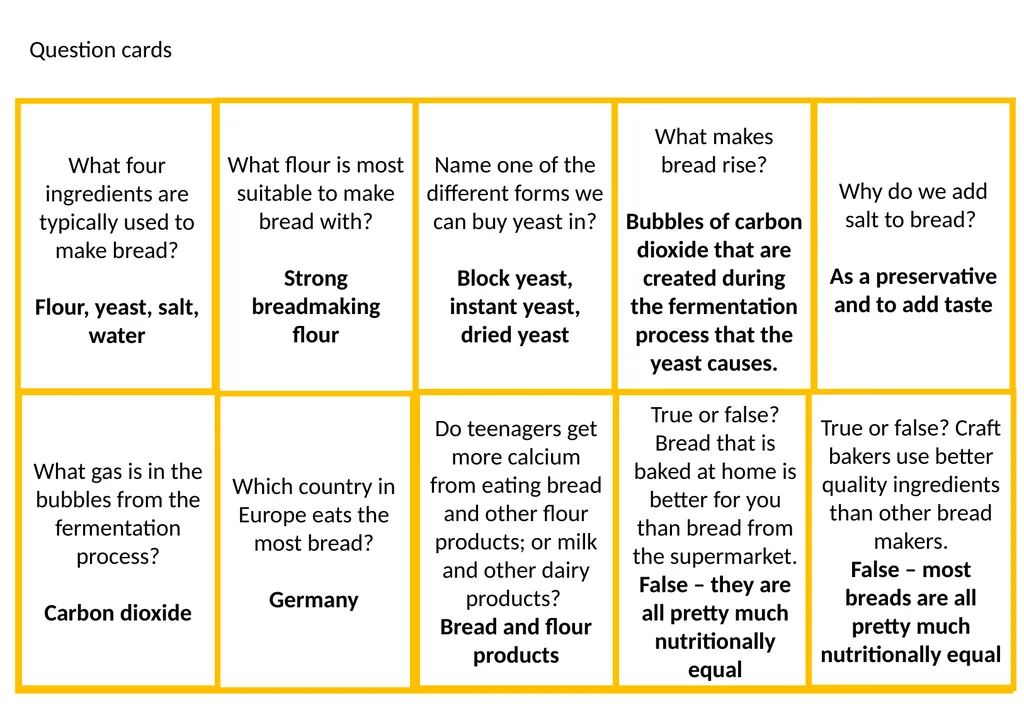
What four ingredients are typically used to make bread? Flour, yeast, salt, water What flour is most suitable to make bread with? Strong breadmaking flour Name one of the different forms we can buy yeast in? Block yeast, instant yeast,
"What four ingredients are typically used to make" is the property of its rightful owner. Permission is granted to
download and print the materials on this website for personal, non-commercial use only, and to display it
on your personal computer provided you do not modify the materials and that you retain all copyright
notices contained in the materials. By downloading content from our website, you accept the terms of this
agreement.
Presentation Transcript
01
What four ingredients are typically used to make bread?
Flour, yeast, salt, water What flour is most suitable to make bread with?
Strong breadmaking flour Name one of the different forms we can buy yeast in?
Block yeast, instant yeast, dried yeast What makes bread rise?
Bubbles of carbon dioxide that are created during the fermentation process that the yeast causes. Which country in Europe eats the most bread?
Germany What gas is in the bubbles from the fermentation process?
Carbon dioxide Do teenagers get more calcium from eating bread and other flour products; or milk and other dairy products?
Bread and flour products True or false? Bread that is baked at home is better for you than bread from the supermarket. False – they are all pretty much nutritionally equal True or false? Craft bakers use better quality ingredients than other bread makers.
False – most breads are all pretty much nutritionally equal Why do we add salt to bread?
As a preservative and to add taste Question cards<br>
02
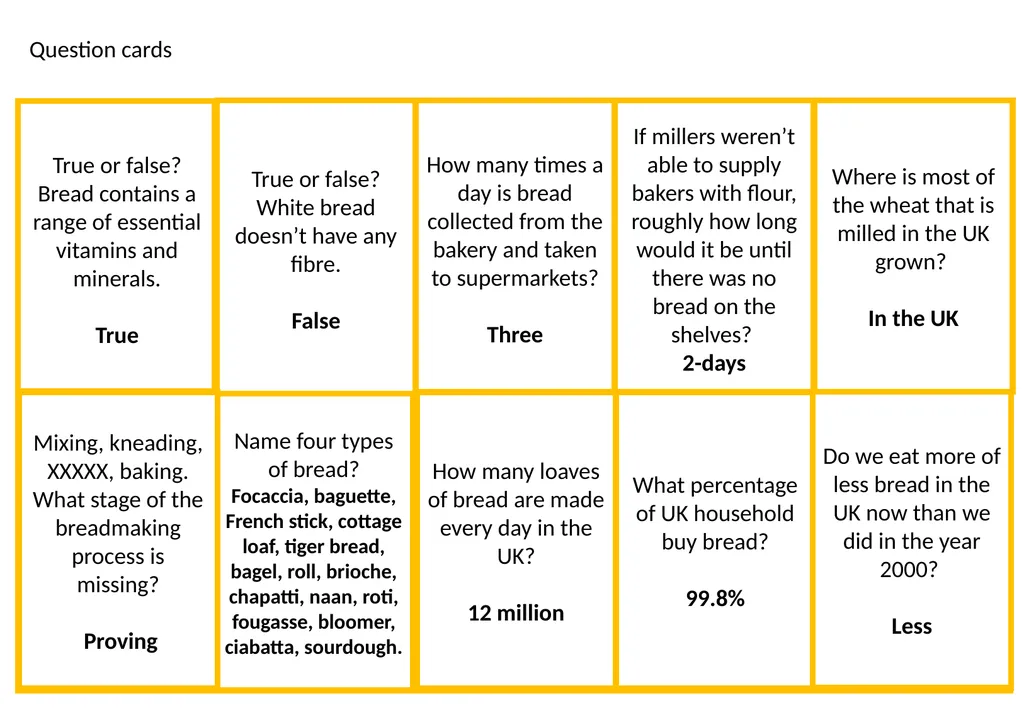
True or false? Bread contains a range of essential vitamins and minerals.
True True or false?
White bread doesn’t have any fibre.
False How many times a day is bread collected from the bakery and taken to supermarkets?
Three If millers weren’t able to supply bakers with flour, roughly how long would it be until there was no bread on the shelves?
2-days Name four types of bread?
Focaccia, baguette, French stick, cottage loaf, tiger bread, bagel, roll, brioche, chapatti, naan, roti, fougasse, bloomer, ciabatta, sourdough. Mixing, kneading, XXXXX, baking. What stage of the breadmaking process is missing?
Proving How many loaves of bread are made every day in the UK?
12 million What percentage of UK household buy bread?
99.8% Do we eat more of less bread in the UK now than we did in the year 2000?
Less Where is most of the wheat that is milled in the UK grown?
In the UK Question cards<br>
03
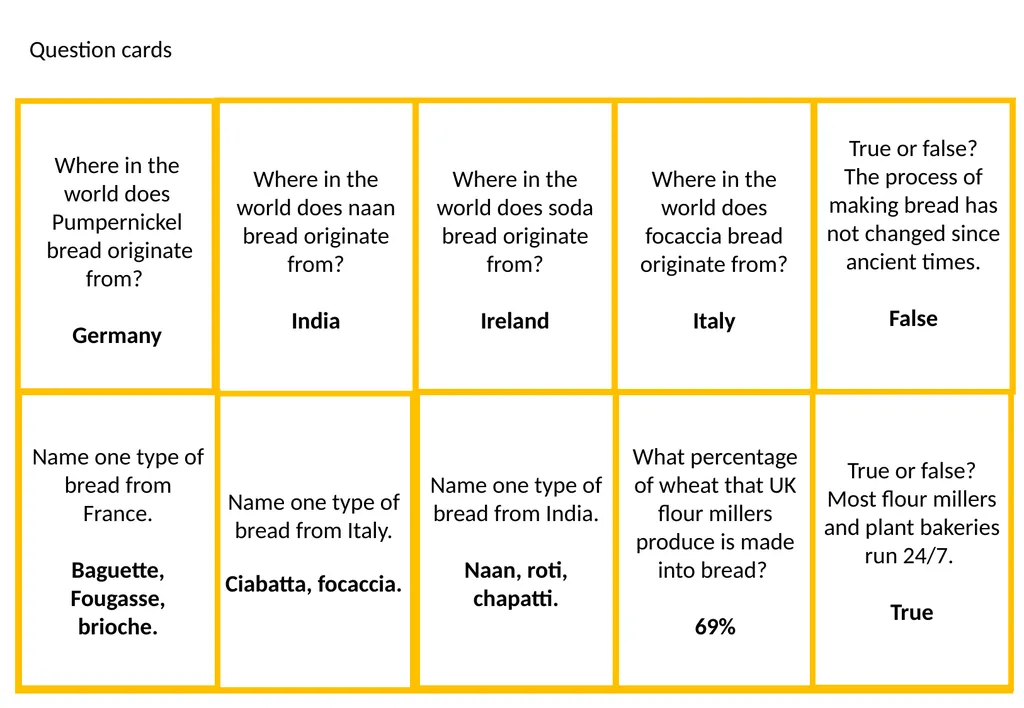
Where in the world does Pumpernickel
bread originate from?
Germany Where in the world does naan bread originate from?
India Where in the world does soda bread originate from?
Ireland Where in the world does focaccia bread originate from?
Italy Name one type of bread from Italy.
Ciabatta, focaccia. Name one type of bread from France.
Baguette, Fougasse, brioche. Name one type of bread from India.
Naan, roti, chapatti. What percentage of wheat that UK flour millers produce is made into bread?
69% True or false? Most flour millers and plant bakeries run 24/7.
True True or false?
The process of making bread has not changed since ancient times.
False Question cards<br>
04
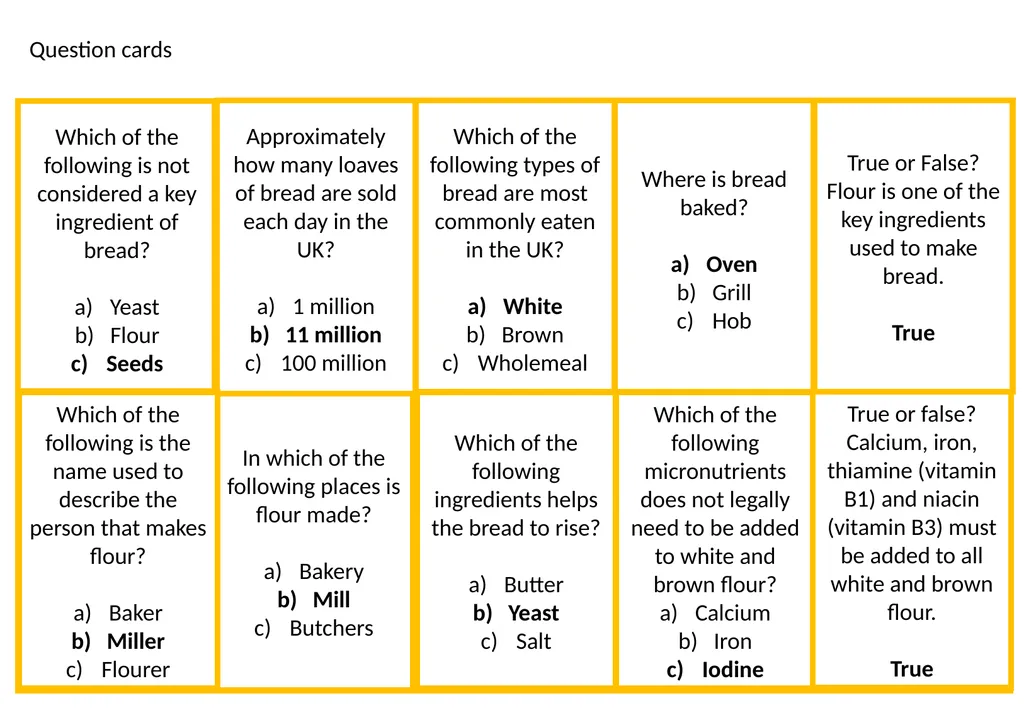
Which of the following is not considered a key ingredient of bread?
Yeast
Flour
Seeds Approximately how many loaves of bread are sold each day in the UK?
1 million
11 million
100 million Which of the following types of bread are most commonly eaten in the UK?
White
Brown
Wholemeal Where is bread baked?
Oven
Grill
Hob In which of the following places is flour made?
Bakery
Mill
Butchers Which of the following is the name used to describe the person that makes flour?
Baker
Miller
Flourer Which of the following ingredients helps the bread to rise?
Butter
Yeast
Salt Which of the following micronutrients does not legally need to be added to white and brown flour?
Calcium
Iron
Iodine True or false?
Calcium, iron, thiamine (vitamin B1) and niacin (vitamin B3) must be added to all white and brown flour.
True True or False? Flour is one of the key ingredients used to make bread.
True Question cards<br>
05
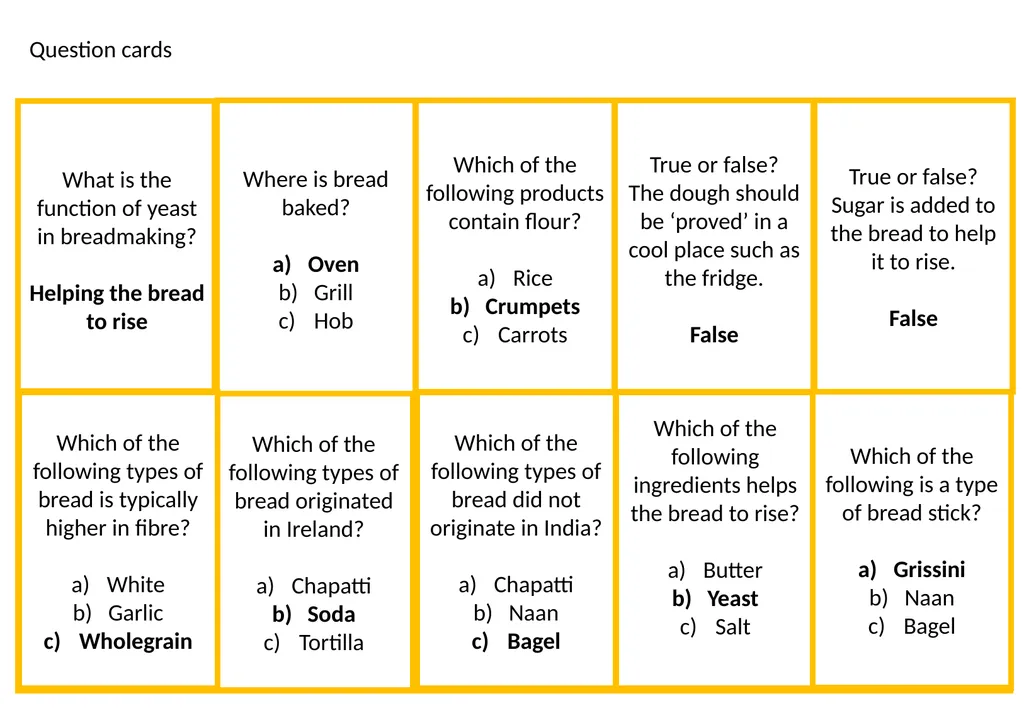
What is the function of yeast in breadmaking?
Helping the bread to rise Where is bread baked?
Oven
Grill
Hob Which of the following products contain flour?
Rice
Crumpets
Carrots True or false?
The dough should be ‘proved’ in a cool place such as the fridge.
False Which of the following types of bread originated in Ireland?
Chapatti
Soda
Tortilla Which of the following types of bread is typically higher in fibre?
White
Garlic
Wholegrain Which of the following types of bread did not originate in India?
Chapatti
Naan
Bagel Which of the following ingredients helps the bread to rise?
Butter
Yeast
Salt Which of the following is a type of bread stick?
Grissini
Naan
Bagel True or false?
Sugar is added to the bread to help it to rise.