What is Comparative Politics? Introduction Understanding or substance of comparative politics The evolution of comparative politics Comparative method As a subject of study, comparative politics focuses on understanding and explaining
"What is Comparative Politics? Introduction" is the property of its rightful owner. Permission is granted to
download and print the materials on this website for personal, non-commercial use only, and to display it
on your personal computer provided you do not modify the materials and that you retain all copyright
notices contained in the materials. By downloading content from our website, you accept the terms of this
agreement.
Presentation Transcript
01
What is Comparative Politics?<br>
02
Introduction Understanding or substance of comparative politics
The evolution of comparative politics
Comparative method
As a subject of study, comparative politics focuses on understanding and explaining political phenomena that take place within a state, society, country, or political system.<br>
03
In other words comparative politics focuses on internal political structures (like parliaments and executives), actors (voters, parties, interest groups), processes (policy-making, communication, political culture) and analysing them empirically by defining, describing, explaining and predicting their variety (similarities and differences) across political systems – be they national political systems, regional, municipal, or even supra-national political systems<br>
04
What is studying comparative politics? It is focused first of all on each country’s internal politics, or how governments are structured, i. e. what are governing institutions and how their function;
how governments interact with their population and what decisions are made;
how political leaders and population behave in politics and how decisions are made; how and who makes or influences decisions or policy orientations, leadership, and other attributes of political decisions are vital components of comparative politics.<br>
05
Famous American political scientist Robert Dahl was thinking that the essence of comparative politics is a study of power distribution in decision making situations.
On the other hand, Jean Blondel noted that a primary object of comparative politics is public policy or outcomes of political action.<br>
06
Why we need to study comparative politics? the main purposes of studying comparative politics are as follows:
– widen our understanding of politics in other countries;
– increase our appreciation of the advantages and disadvantages of our own political system and to enable us to learn from other countries;
– develop a more sophisticated understanding of politics in general e. g., the relationships between governments and people, and other concepts and processes;
– help us understand the linkages between domestic and international affairs;<br>
07
– help us see the relationship between politics and such fields as science and technology, the environment, public health, law, business, religion, ethnicity, and culture;
– enable us to become more informed citizens: form our own political opinions, participate in political life, evaluate the actions and proposals of political leaders, and make our own political decisions and electoral choices;
– sharpen our critical thinking skills by applying scientific logic and coherent argumentation to our understanding of political phenomena<br>
08
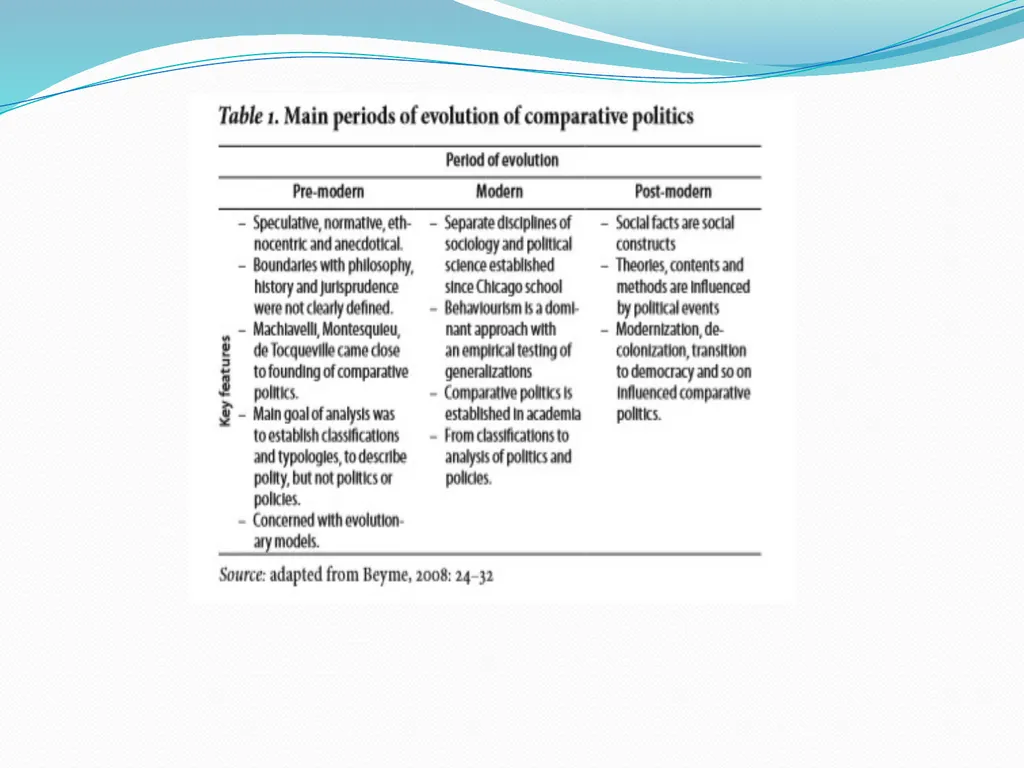
The evolution of comparative politics The roots of comparative political analysis are found in Ancient Greece as the first comparative studies begin with Aristotle (384–322 B. C. E), who studied different constitutions of Greek city-states.
Machiavelli (1469–1527) sought to compare and evaluate the merits of different forms of rule. Thomas Hobbes (1632–1704) developed the idea of a ‘social contract’ and Karl Marx (1818–1883) developed the theory of economic and political development and revolutionary change.
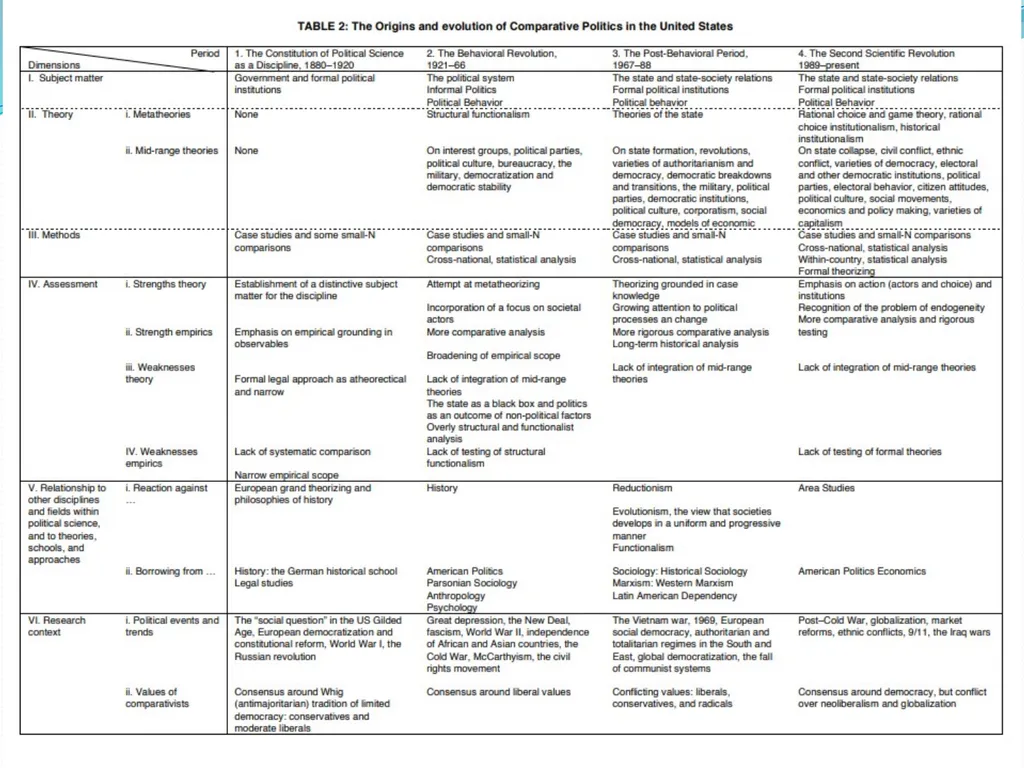
However, comparative politics was established as an academic discipline only in the very late 19th and the beginning of the 20th century. Still prior to the 1950s comparative politics was mostly normative and descriptive or dominated by the so-called traditional approach and being at the pre-modern phase of its development.<br>
09
In 1955 Roy Macridis launched a diatribe against traditional comparative politics.
He accused the discipline of being formal-legalistic because of the studying of formal institutions over non-formal political processes, descriptive rather than analytic, case study-orientated rather than genuinely comparative, and Eurocentric with its emphasis on Great Britain, France, Germany and the Soviet Union.
‘Scientific’ comparative politics begins mainly with the rise of behaviourism in social sciences.
Growth of the post behavioural movement-its importance.<br>
10
Comparative method In general the comparative method is the oldest and most popular method of acquiring knowledge.
The foundations of the comparative method were laid down in the mid-19th century by John Stuart Mill, who described a number of methods for finding causal factors.
In the case of Mill’s method of agreement one needs to look for events that occur whenever the phenomenon being studied occurs.
The single event that is found to be common to all occurrences of the phenomenon is said to be the cause.
Mill’s method of difference asks to see if changes in a phenomenon occur whenever a particular event changes.
The single event that is found to change when differences occur in the phenomenon is said to be the cause.<br>
11
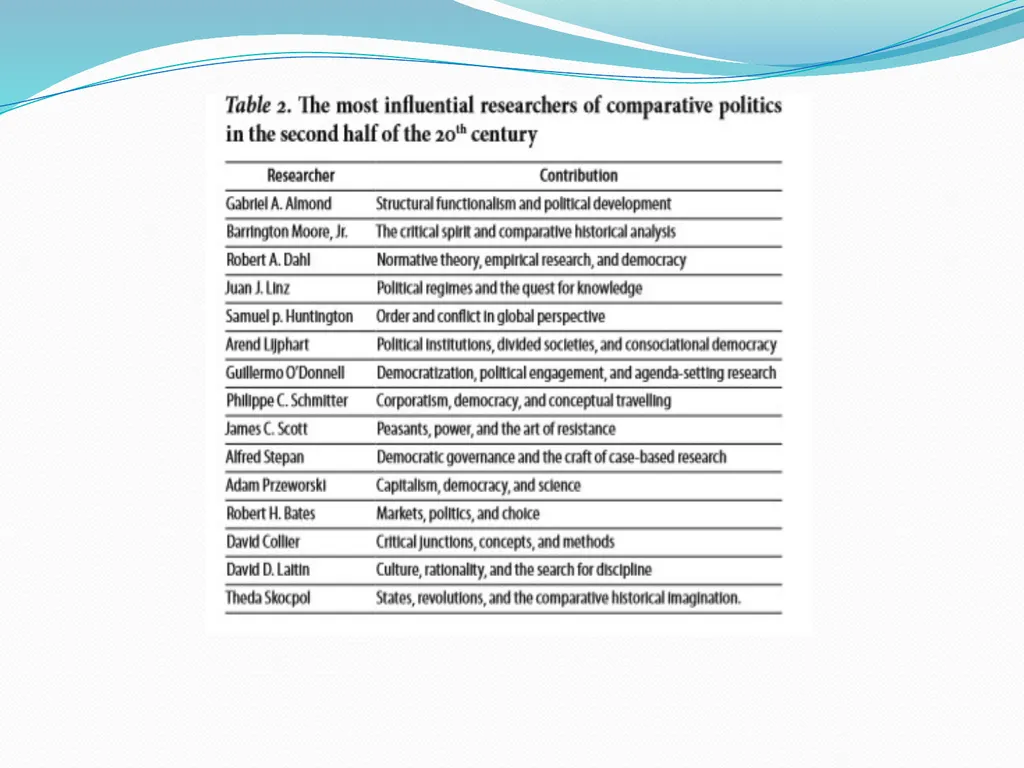
Arend Lijphart was among the first scholars who started a discussion on the comparative method within political science.
In his famous article Comparative Politics and the Comparative Method he described the comparative method ‘as one of the basic methods, the others being: the experimental, statistical, and case study methods of establishing general empirical propositions.’<br>
12
According to Charles Ragin there are three main goals of comparative research:
1) exploring diversity,
2) interpreting cultural or historical significance, and
3) advancing theory
Todd Landman noted that there are four main reasons for comparison, including contextual description, classification and ‘typologizing’, hypothesis-testing and theory-building and prediction.<br>